After this desert city faced dry taps, California rushed through emergency water funding
Ralph Vartabedian
City water operator Taylor Miller stands at well 15, the main water supply in the Mojave desert town of Needles, in June. (Brian van der Brug/Los Angeles Times)
For months, the city of Needles has endured not just scorching hot weather but the possibility that its single water well could fail, a potentially life-threatening risk for this Mojave desert community of 5,000 residents.
Yet over recent weeks, word arrived that state officials — flush with billions of dollars in surplus tax revenue — intend to hand over $2 million to pay for a new well that could be operational later this year. City officials are now breathing easier, even as they prepare for high temperatures this Labor Day weekend of 111 degrees.
Needles is one of the hottest cities in the nation and one of the poorest in California. It has faced what City Manager Rick Daniels calls a “life and death” situation after state officials notified the city that three of its four wells failed to meet state water quality standards.
The city is so short of cash that it didn’t have money for a new well and was instead relying on its single good well that barely met demand. The well failed in late August, after an electronic control panel was fried in a power outage, and the city nearly ran out of water. The city has only 24 to 36 hours of water in storage tanks. City water technicians worked around the clock and restored the pump as reserves were nearly exhausted.
After The Times wrote about the city’s risky situation in July, Sen. Diane Feinstein, along with state legislators, began to put some political heat on the California State Water Resources Control Board to speed up conditional approval for emergency funding the city had sought.
“We got our grant, it is glorious,” Daniels said.
Until Feinstein and others weighed in, the state board was asking that the city modify an environmental report for the new well before they would process the grant, Daniels said. At best the city thought the grant might not come for at least a year, playing blackjack with the residents’ safety.
“We are just a microcosm of the state,” Daniels said. “There has to be hundreds of small rural towns across the state that are in or will be in our situation. Small towns can’t afford staffs of engineers, grant writers and lawyers to deal with these regulations.”
The drought has exacerbated the water supply problems of many communities, putting the lowest-income cities at a disadvantage.
Jay Lund, co-director of the UC Davis Center for Watershed Sciences and a member of the National Academy of Engineering, said the state has about 9,000 regulated public water utilities and many of them are facing serious problems. It is a tough task to ensure there are no cities or towns that have failing water systems.
“You never will,” he said. “There are so many of them and you can afford to fix only a few of them at a time. Even if you try your best, you will miss some problem. There aren’t enough resources to fix everybody’s problem, especially when you get into a drought.”
Lund estimates that as many as 100 public water systems face the threats that Needles faces. “California is a big state and there are a lot of problems,” he said.
Needles received help in navigating the state’s thicket of regulations from a nonprofit coalition of labor unions and contractors, known as Rebuild SoCal Partnership. It attempts to help smaller cities deal with the state’s complex laws governing infrastructure issues.
“Things are falling apart in the state,” said Dave Sorem, an engineer on the group’s board and a vice president of a Baldwin Park construction firm, who went out to Needles to advise them on the problem. “A lot of agencies don’t have a clue about what is happening in small cities.”
Indeed, Daniels, the city manager, said none of the state water officials who were dealing with the city’s requests have ever been to Needles. The county seat is more than 200 miles away and the state senator lives in the Central Valley. Daniels said the situation reminds him of the Jimmy Buffet line, “Don’t try to describe the ocean if you’ve never seen it.”
Indeed, the city is hotter than many renowned municipal ovens, like Phoenix, Las Vegas and Houston. The daily high temperature in August never went below 100 degrees and topped out at 122 on Aug. 4.
The Colorado River flows through town and the city has rights to 1,272 acre feet of water each year. It has historically operated four wells, but starting last fall the water board notified the city that three of the wells were contaminated with naturally occurring minerals, manganese and iron, that exceeded state standards. Then it ordered a corrective action plan in May, which the city said it could not afford.
Manganese is regulated as a secondary contaminant, based on its aesthetics. It causes stains and a bitter taste to water. But toxicologists believe manganese causes neurological disorders, particularly in children, and say it will eventually be regulated as a health hazard.
The new well will be 150 feet to 300 feet deep, located upriver in an area where some private wells have low levels of manganese, Daniels said. It will be connected by a new 16-inch main, running 2,700 feet to the city’s water system. The city hopes to have the well online within three to four months.
When the new well is running, the city will have a 48-hour reserve capacity, still well under the seven-day reserve recommended for large municipal systems in Southern California. Ultimately, the city would like to build another water tank to supplement the three it currently uses, Daniels said.
Among the heavy water users in the city are 14 marijuana growing facilities, which also contribute a fair amount to city finances through cultivation taxes and a 10% local excise tax on production. The city puts tax receipts back into upgrading the water system, Daniels said. For example, Needles is trying to replace aged and leak-prone pipes made of cast iron, asbestos cement and copper. Last year, the system sprung 200 leaks and in one case dumped a half-million gallons of water onto I-40, forcing a partial shutdown.
Needles Mayor Jeff Williams said the few local residents who know about the situation have been understanding. “Luckily, we didn’t have to distribute bottled water,” he said.
Report: Nearly a third of Americans endured a weather disaster this summer
Erin Doherty
Nearly 1 in 3 Americans experienced a weather disaster since June, according to a Washington Post analysis of federal disaster declarations.
Why it matters: The data underscores the extent to which climate change and a warming planet are increasingly impacting Americans’ lives on a daily basis, the Post notes.
Driving the news: At least 388 people have died from hurricanes, floods, heat waves and wildfires since June in the U.S., per media reports and government records obtained by the Post.
Additionally, 64% of people live in areas that experienced a prolonged heat wave, which are not officially considered disasters but can be life-threatening.
Over the course of the summer, extreme heat waves scorched the Pacific Northwest, wildfires raged across the West and flash floods from storms killed dozens of people in the Northeast, among other weather events.
Between the lines: The Post based its analysis on FEMA-declared severe storms, fires, hurricanes, storms and floods.
The big picture: Atmospheric CO2 concentrations were higher in 2019 than at any time in at least 2 million years, and the past 50 years saw the fastest temperature increases in at least 2,000 years, according to an assessment by the Intergovernmental Panel on Climate Change (IPCC) published last month.
Weather and climate events are becoming increasingly common and severe and rising sea levels are flooding coastal areas with regularity, Axios’ Andrew Freedman reports.
The world must approximately halve emissions by the end of the decade to have a chance of avoiding the worst effects of warming, the Post writes.
What they’re saying: “What we are doing with global warming is making ourselves play a game that is rigged more and more against us because of our own actions,” Claudia Tebaldi, a researcher at the Pacific Northwest National Laboratory and a lead author of the IPCC’s climate report, told the Post.
“If we want to limit these probabilities, if we want to limit the damages, then we should start to do something for real about mitigating,” Tebaldi said. “And we need to start now.”
Madison Cawthorn: behold the rotten fruit of extreme Republican gerrymandering
David Daley
Photograph: Brandon Bell/Getty Images
The congressman from North Carolina brandished a gun as he addressed a Macon county Republican event last weekend. “We all need to be storing up some ammunition,” Madison Cawthorn warned the crowd, as he embraced the big lie about the 2020 presidential race and insisted that “we all know it was a stolen election”.
Then, chillingly, Cawthorn conjured a second civil war being fought over his fraudulent claims. “If our election systems continue to be rigged and continue to be stolen, then it’s going to lead to one place,” Cawthorn said, “and that’s bloodshed … As much as I am willing to defend our liberty at all costs, there’s nothing I would dread doing more than having to pick up arms against a fellow American.”
We awaken every day to pillars of liberal democracy torn down, wrecked norms and ruined institutions, fresh assaults on foundational freedoms from state legislatures and runaway courts, political leaders bathed in the hateful stew of rightwing media and racing to bend a knee before an authoritarian leader who himself bowed before dictators and cared so little for his voters that he offered them bleach during a pandemic.
The roots of this fearful moment run deep: a constitutional system unprepared for a political party willing to play constitutional hardball; a Democratic party that neglected local elections while Republicans invested in a decades-long effort to capture state legislatures and the courts; winner-takes-all districts that break toward extremes under severe polarization; a nation that has never been willing to embrace multiracial democracy.
But there’s a simpler reason that Cawthorn can spew such an abhorrent incitement to violence. His extremism was created intentionally by aggressive partisan gerrymandering. Cawthorn and many of the other demagogues and conspiracy theorists who have hijacked the Republican party owe their seats to the noncompetitive districts Republicans drew themselves a decade ago. Without gerrymandering, Cawthorn would just be another loudmouth Twitter troll pumped full of Newsmax nuttiness. With it, he’s issuing a call to arms as a prominent member of an elite Washington club of 435.
The road to political power for Cawthorn, who has been accused of multiple instances of inappropriate sexual behavior and even lying about the car wreck that left him paralyzed, began not long after the 2010 elections. He has denied those allegations. That year, Republicans spent more than $1m on a dark-money, negative-ad driven effort to win control of North Carolina’s house and senate just in time to dominate redistricting. When they won, a determined Republican party focused on drawing a congressional map that would turn this moderate state inside-out – producing 10 reliable Republican seats and just three Democratic districts.
The key to the entire map? Asheville, the largest city in western North Carolina, an enclave of vegan restaurants and independent bookstores surrounded by conservative mountain towns. With Asheville as its core, the 11th district had long been a swing seat, see-sawing between a Republican from 2000 through 2004 and a Democrat during 2006, 2008 and 2010 as this area, like so many others, rallied behind the Iraq war and then shifted Democratic as the war and economy soured. Republicans needed to win the 11th to assure a 10-3 map. So they drew the district line straight through Asheville, neatly attaching half of the city to a larger number of rural, conservative towns, and diluting the Democratic vote across two districts they could never hope to win.
In a district like this, the Republican primary was now the only race that mattered; the Democratic incumbent saw the writing on the wall and promptly announced his retirement. A small-town businessman who had dabbled in meteorology, a local sandwich shop and real estate read the angry base of this new district perfectly. His name was Mark Meadows, and you can watch on YouTube the moment when he first tasted power. Meadows’s closest Republican competitor dissembled when a Tea Party audience asked about pursuing an investigation into Barack Obama’s citizenship. Meadows pounced with a quick, direct answer: “Yes.” As the crowd roared, Meadows gives a tiny smirk. “You know what?” he added. “We’ll send him back home to Kenya or wherever it is.”
When Meadows led an Obamacare rebellion that forced a government shutdown in October 2013, Karl Rove called the insurgent Republican members his redistricting strategy helped create a “suicide caucus”. The New Yorker took a look at the districts they represented, and discovered a kind of America in reverse – whiter, more rural, more conservative, at a time when demographic trends were headed the other direction. These districts became 2% whiter ahead of 2012. They were 75% white, on average, compared with 63% elsewhere. The Republican party engineered themselves a fantasia: Obama defeated Mitt Romney by four percentage points nationwide. But not in “suicide caucus” nation. There, Obama went down to a stunning 23-point defeat.
That’s what Cawthorn inherited when Meadows left Congress for a seat at Trump’s side as White House chief of staff: a district Republicans cannot lose, where red meat and outrage are all that matters, demographics and representativeness be damned. Cawthorn learned his lessons well. Generate outrage, generate attention, generate big dollars fundraising off the hate.
The census numbers released last month show a nation that continues on its path to diversity. But can a multiracial nation become a multiracial democracy? Not if we continue to redistrict in this toxic fashion. The connection between gerrymandering and polarization is a complicated one; they act as accelerants on each other. Yet there’s no denying this: Cawthorn and his ilk would not be in office without it. There is a huge difference between the kind of candidate who won this very seat a decade ago, and the two extremists who have held it for the last decade. And when we lose swing seats and bridge builders to those who urge Americans to stockpile weapons and ammunition, we have lost an important part of ourselves.
As the 2021 redistricting cycle gets underway, and the maps that will define our politics for the next 10 years are crafted in state capitals nationwide, Cawthorn’s dark vision hangs in the balance. If lawmakers continue to draw tilted maps that maximize the number of seats their party wins, at the cost of representative results in otherwise competitive states, they will continue to produce districts easily captured by ultra-radical zealots like Cawthorn. They will continue to incentivize elected officials to cater only to the militant base that drives party primaries. And we could break, once and for all, under the strain of this existential test.
David Daley is the author of the national bestseller Ratf**ked: Why Your Vote Doesn’t Count and Unrigged: How Americans Are Battling Back to Save Democracy
GOP Senate campaign heats up after report tying Budd to bankruptcy that hurt farmers
Will Wright
The race for the Republican nomination for a U.S. Senate seat in North Carolina heated up in recent days after a Washington Post story detailed how farmers lost millions of dollars in the bankruptcy of a company led in part by the family of Rep. Ted Budd.
Budd, whose candidacy won former president Donald Trump’s endorsement in June, has faced sharp criticism from his competitors after the story published on Tuesday. Both former Gov. Pat McCrory and former Rep. Mark Walker, who are also vying for the nomination, jumped at the chance to accuse Budd of being a “D.C. insider” who swindled farmers.
AgriBioTech, based in Henderson, Nev., was a “full-service seed company” specializing in forage and turfgrass that also researched and developed seed varieties and processing plants, according to a company news release.
Budd was not an officer of the company, but was a shareholder. His father, Richard Budd, took over as chief executive in 1999 and served as chairman of the board, according to federal securities filings.
Budd was also one of 11 people who signed a loan to AgriBioTech to try and save the faltering company less than a year before the company declared bankruptcy, his campaign acknowledged. AgriBioTech repaid the loan with interest, but more than 1,200 farmers in 39 states went unpaid for more than $50 million of products.
Following AgriBioTech’s bankruptcy filing in 2000, a lawsuit filed in Nevada claimed that Richard Budd transferred millions of dollars out of the company to his family, including Ted Budd, before paying back farmers for their products. In a settlement reached in 2005, the Budds agreed to pay about $6 million to the farmers without admitting wrongdoing, according to a report by the Las Vegas Sun at the time.
“I wish my efforts to save ABT had been successful, but they were not,” Richard Budd said in a statement provided by his son’s campaign. “I did my best, but in this case, my best was not enough to save the company.”
In an interview this week with the Winston-Salem news channel WXII, Ted Budd said he “never had any involvement” with the company. His campaign spokesman, Jonathan Felts, said in a statement that farmers’ accusations of fraudulent transfers were “untrue allegations which is, sadly, a typical tactic in these sorts of lawsuits.”
“Ted’s got the Trump endorsement and has the momentum to win this race,” Felts said. “Some reporters suffer from Trump Derangement Syndrome and will say or do anything if they think it might hurt President Trump’s political popularity.”
McCrory, Walker’s response
All three of the leading Republican candidates have tried to paint themselves as outsiders in Washington, and both Walker and McCrory are using the Post’s story as a way to kick the legs off Budd’s efforts.
“Do we really need another Washington politician like this representing North Carolina in the United States Senate?” McCrory wrote on Twitter.
Walker wrote on Facebook that the report was “unsettling but confirms the Budd record: follow big money and you always find Ted Budd.”
“Unfortunately, this is not the end of the story, but the opening chapter of Budd putting money over principle,” Walker added. “You cannot expect to serve North Carolina in the U.S. Senate with this lack of judgment and refusal to answer questions.”
State of the campaigns
The U.S. Senate race in North Carolina will play a pivotal role in determining which party will control the chamber after the 2022 midterm elections. The primary is scheduled for March 8.
So far, Budd has cashed in on his Trump endorsement by raising $700,000 in the second quarter. He also loaned his own campaign $250,000, and came into the race with an extra $1.1 million in cash from his House races. McCrory raised $1.24 million in the second quarter, and Walker has raised more than $1.25 million since he declared his candidacy in December.
It is unclear what impact Budd’s connection to AgriBioTech will have on the race.
Jordan Shaw, a campaign advisor to McCrory, wrote on Twitter that Budd is “going to need a better answer” than denying connection to the company.
The oil industry has embarked on a lobbying blitz in an effort to derail any attempts by Congress to repeal fossil fuel subsidies as part of a much broader assault by corporate interests on the $3.5 trillion budget package that Democrats are currently drafting.
In particular, the oil industry is worried about the potential loss of one specific subsidy that they receive: the intangible drilling cost (IDC) deduction. This allows companies to deduct from their taxes the costs of drilling new wells.
The industry’s fear follows a letter sent to Democratic leadership on August 30, by Rep. Carolyn Maloney (D-NY), the Chair of the House Oversight and Reform Committee, and Rep. Ro Khanna (D-CA), who chairs the subcommittee on Environment.
The letter, signed by 50 other Democrats from the House of Representatives, specifically calls for the removal of the IDC deduction as part of the budget reconciliation process underway. The tax giveaway is worth billions of dollars each year, and makes up a large portion of the $20.5 billion that Democrats are targeting.
“Fossil fuel subsidies have been embedded in our tax code for over a hundred years, enriching oil and gas companies and their lobbying firms at the expense of our planet. It comes as no surprise to see Big Oil currently working overtime to protect these benefits,” Congressman Ro Khanna’s office told DeSmog in a statement. “What’s different now is that we have a real chance to end the worst of these subsidies in the Build Back Better Act and I’m committed to working with my colleagues in Congress to do so.”
Among those lobbying is a relatively obscure industry lobby group, the American Exploration and Production Council (AXPC), which is heavily pushing Congress to keep the IDC in place. AXPC is a collection of some of the largest fracking companies in the U.S., including ConocoPhillips, Chesapeake Energy, EOG Resources, Occidental Petroleum, Pioneer Natural Resources, EQT, and ExxonMobil subsidiary XTO Energy.
AXPC’s website is sparse, but has a heavy focus on the intangible drilling cost deduction, which appears to be one of only a few policy issues on which the industry front group is lobbying. According to The Hill, AXPC is “rounding up support from moderate Democrats from fracking-heavy states such as Texas, Pennsylvania and Ohio to ensure the deduction survives.”
AXPC warns that eliminating the IDC deduction would result in job losses, and frames its potential elimination as “increased taxes.”
AXPC also says that without the intangible drilling cost deduction, the number of wells drilled would decline by 25 percent. Whether or not those figures are accurate, it is true that federal largesse does prop up otherwise unprofitable drilling to some extent.
A recent paper published in the peer-reviewed journal Environmental Research Letters in July found that the IDC deduction can boost the returns of an oil drilling project by as much as 11 percentage points. For projects that were already profitable to begin with, the subsidy simply pads corporate profits. For projects on the margins, the subsidy results in extra drilling.
AXPC also argues that some methane regulations and fees would “empower” Russia and Iran due to higher costs on American producers. Methane is an extremely powerful greenhouse gas, and leaks from a range of oil and gas infrastructure in both the U.S. and around the world.
Ties to Republican Politics and Industry
The industry lobby group AXPC is led by Anne Bradbury, who previously worked in the House of Representatives for two former Republican Speakers of the House of Representatives – House Speaker Paul Ryan (R-WI) and House Speaker John Boehner (R-OH). Liz Bowman, AXPC’s vice president for communications, previously worked at the oil trade group American Petroleum Institute, and also in the public affairs office of the U.S. Environmental Protection Agency during the Trump administration. The handful of other staffers working at AXPC also have extensive backgrounds in both Republican politics and the oil and gas industry.
According to Greenpeace, the oil companies that make up AXPC have long enjoyed federal subsidies, receiving at least $92 billion combined since 1998, while also racking up more than $700 million in fines for environmental and other violations.
Meanwhile, those companies also doled out $188 million in executive pay in 2020, a year in which many of them tapped federal bailout money in the CARES Act, aid meant to prop up the economy during the pandemic. And even as the oil companies received huge sums for pandemic relief, they also laid off workers.
Last year, Bailout Watch, a watchdog group, singled out Diamondback Energy and EOG Resources in its “Hall of Shame” for their particularly egregious behavior of taking federal bailout money while boosting pay to executives and shareholders. Both are members of AXPC.
AXPC did not respond to a list of questions from DeSmog.
The Stakes Are ‘Turbocharged’
As climate scientists continue to warn with increasing alarm, the world needs to phase out fossil fuel production and consumption as fast as possible. The International Energy Agency also warned earlier this year that new oil and gas projects are not compatible with global climate targets.
“[T]he fact that [the IDC] subsidy still exists at all, when the U.S. and the world need to be phasing down oil and gas consumption and production, indicates that removing it would be a prudent step, both for fiscal reasons as well as for climate reasons,” Pete Erickson, climate policy director at the Stockholm Environment Institute, and a coauthor of the Environmental Research Letters study, told DeSmog.
Any subsidy for fossil fuels is counterproductive and the IDC is the single most lucrative federal subsidy that the oil industry receives, according to Erickson.
The Democrats have slim majorities in both the House and the Senate, and will need virtually all of their members to vote in lockstep to successfully repeal fossil fuel subsidies. Oil lobbying outfits like AXPC only need to peel off a handful of Democrats in order to keep the federal spigot open.
“The legislative stakes are being turbocharged by ecological breakdown,” John Noel, a senior campaigner with Greenpeace, told DeSmog. Wildfires continue to ravage California. Much of Louisiana is without power after Hurricane Ida. And New York, Philadelphia, and other parts of the northeast just suffered catastrophic flooding. All of those disasters unfolded within days of each other, and come after several months of global climate-fueled catastrophes, ranging from floods in China and Germany, to wildfires in Siberia.
Louisiana National Guard rescue people in LaPlace, Louisiana in the aftermath of Hurricane Ida. The National Guard. (CC BY 2.0).
As climate disasters like these continue to mount, it is creating “a visceral rage at the fossil fuel industry because it’s common knowledge now that they are the stakeholders that are standing in the way of rapid progress and they have delayed action in order to preserve their short-term profits,” Noel said. “They’re losing their grip on the narrative. When they do finally lose their grip totally, the backlash is going to be intense and it’s going to be swift.”
Noel pointed to the federal support for fracking, adding: “If there was ever a moment in the history of fossil fuel production to close these tax loopholes it would be right now.”
UPDATE (09/03/2021): On Friday, AXPC responded to DeSmog, stating that it does in fact support methane regulations. “AXPC is not opposed to methane regulations, we support methane regulations that balance driving down emissions with domestic production. We support methane regulations that: encourage innovation, allow for new technologies, quantify the costs/benefits of new requirements for existing facilities, avoids duplication, and properly implements the Clean Air Act,” Liz Bowman, a spokesperson for AXPC, said in a statement.
Power outage in New Orleans: Is Ida or Entergy to blame?
By Greg Palast
In the 1980’s, I lead an investigation of Entergy, which runs the Louisiana power system My conclusion? “Entergy is a racketeering enterprise parading as a power company.”
After Katrina, I investigated their failure to get the lights back on in over a year.
This past week, Entergy lost 2000 miles of high-voltage line, which doesn’t happen in Bangladesh after a typhoon.
Entergy of Little Rock Arkansas, became a protected political juggernaut, even taking over the electricity system of London, after its lawyer Hillary Clinton somehow obtained influence with the White House.
Below is an excerpt on Entergy from my book Armed Madhouse:
In 1986, I was hired by the City of New Orleans to check out suspicious doings by a corporation called “Entergy.” I flew in to meet City Councilman Brod Bagert, who is also New Orleans’s top trial lawyer and its most accomplished poet.
I called Bagert four months after the flood. Nearly half the city is still in the dark. The electric company, New Orleans Public Service, “NOPSI,” is owned by a holding company, Entergy, the company Bagert and I investigated in 1986.
Here’s what we found. In 1986, the New Orleans company was going broke because of the eye-popping cost of buying wholesale power — four times normal — from a company called Middle South Energy, charges they were passing right on to their captive customers in the city. Middle South is 100% owned and controlled by, you’ve guessed it, Entergy. But these were the days of government regulation, and government ordered an end to the shell game. Then came deregulation and the siphoning restarted with a vengeance. Busy shuffling loot from pocket to pocket, Entergy had neither the concern nor funds to harden their system against a hurricane.
But from the looks of it, and my own review of their accounts, their plan in case of the long-expected flood came down to “turn off the lights and declare their subsidiary bankrupt,” which they did three weeks after the hurricane. Negligent damage liabilities and rebuilding obligations were thrown into the Dumpster of the bankruptcy courts, and the holding company walked away.
But don’t worry, Entergy the holding company is doing quite well, posting a big 24% leap in earnings for the third quarter, a profit it attributes to “weather.” So who’s to blame for losing New Orleans?
Reports of environmental problems caused by Hurricane Ida begin to trickle in
Department of Environmental Quality to inspect industrial sites over next few weeks
Mark Schleifstein, Staff Writer August 31, 2021
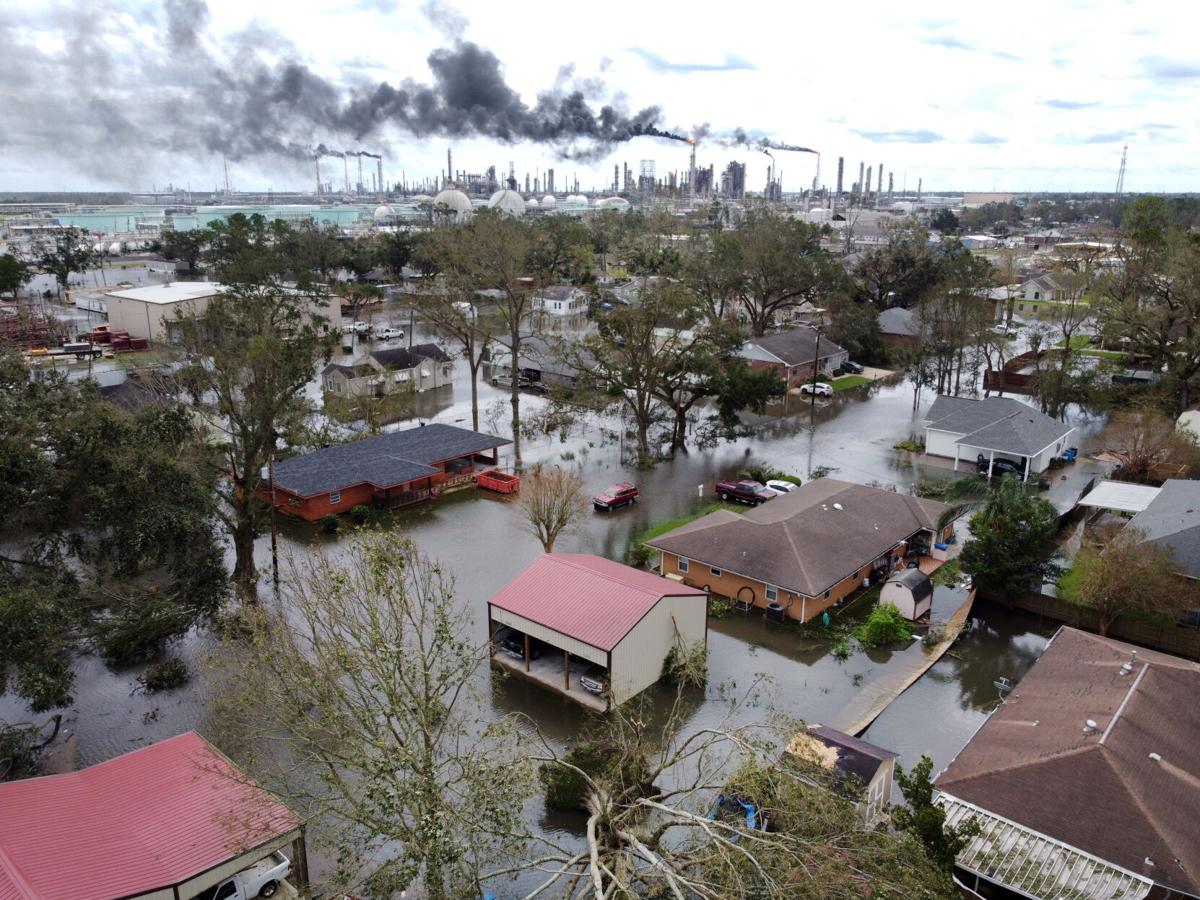
Homes near Norco are still surrounded by flood water as chemical plants and refineries continue to flare the day after Hurricane Ida hit south Louisiana on Monday, August 30, 2021. The Coast Guard and state Department of Environmental Quality received reports of chemical releases in Norco and a number of other locations when flares were extinguished by Ida’s winds on Sunday. (Photo by Chris Granger | The Times-Picayune | The New Orleans Advocate). CHRIS GRANGER
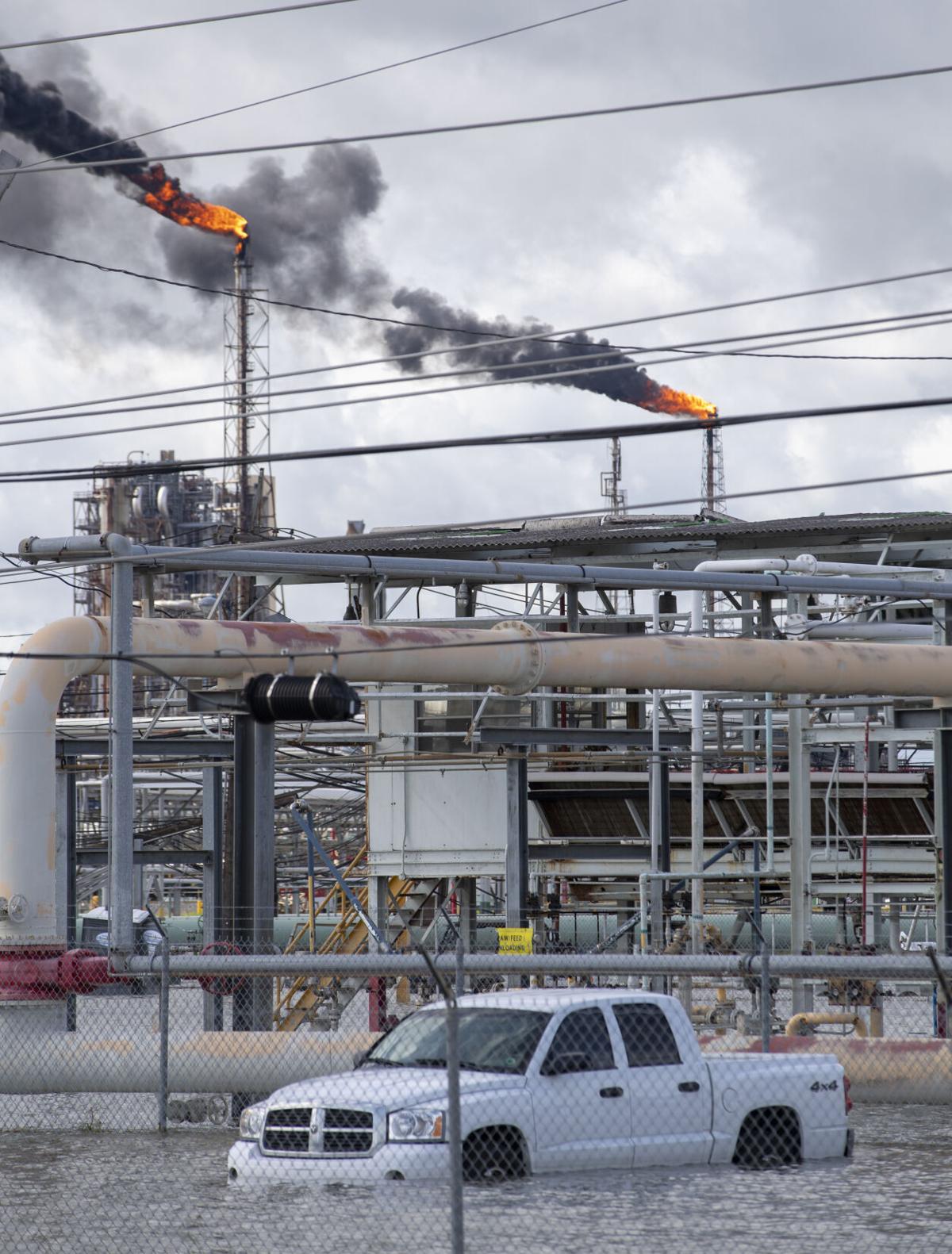
Wind damage to parts of a refinery where flaring was taking place the morning after Hurricane Ida in Norco, Louisiana on Monday, August 30, 2021. (Photo by Chris Granger | The Times-Picayune | The New Orleans Advocate). CHRIS GRANGER
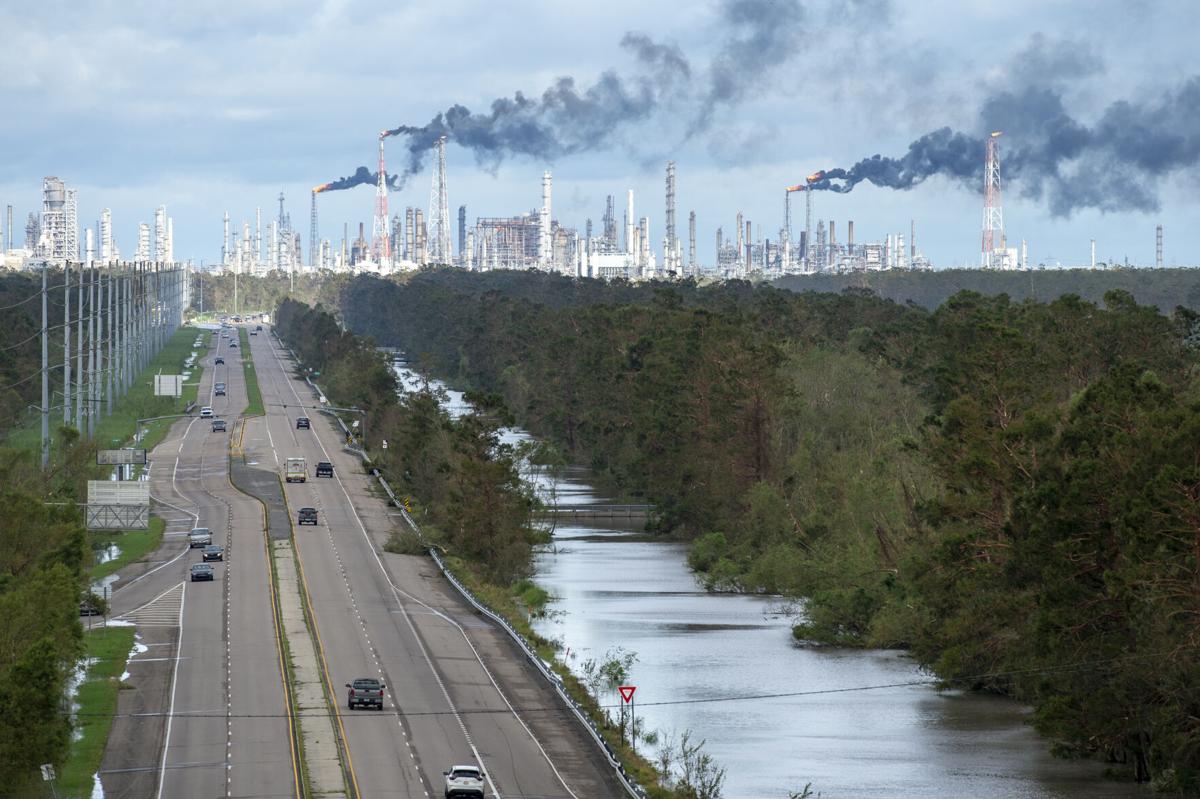
Industrial plants burn off chemicals in major flaring over Norco on Monday, Aug. 30, 2021, the day after Hurricane Ida knocked out commercial power across much of southeast Louisiana. STAFF PHOTO BY CHRIS GRANGER
Floodwater covers the ground at an industrial plant flaring off chemicals in Norco on Monday, Aug. 30, 2021, the day after Hurricane Ida knocked out commercial power across much of southeast Louisiana. STAFF PHOTO BY CHRIS GRANGER
Information about potential environmental threats caused by Hurricane Ida have been slow in coming, but initial reports to the Coast Guard’s National Response Center and the state Department of Environmental Quality confirm there were releases of crude oil, fuel oils and a variety of chemicals in numerous locations in southeastern Louisiana on the day before and the day of the storm.
The information that’s available is not complete or comprehensive, consisting of initial call-in or emailed reports by company officials or others to the two agencies. They include releases of different chemicals by refineries and chemical plants when flares were extinguished by Ida’s winds, as well as the possible release of sewage and wastewater in numerous locations in Jefferson Parish when power was lost, knocking out 95% of the parish pump stations that move waste through underground pipes.
The state environmental agency has already begun more detailed inspections of all facilities within Ida’s path to identify concerns, with that information likely to be made public over the next few weeks.
On Tuesday, the National Response Center had reports on 11 incidents that occurred in Louisiana on Saturday, the day before Ida hit, through the end of Sunday.
The state Department of Environmental Quality listed 35 incidents that had been reported to them on Sunday and Monday, some of which were also reported to the Coast Guard.
The Saturday incidents reported by the Coast Guard:
The release of an unknown amount of hydrogen at the Shell Norco facility during a unit’s shutdown in advance of Ida.
An unknown amount of ammonia was released from a process safety valve at Cornerstone Chemical in Waggaman. The valve was restored to stop the leak.
On Sunday, the Coast Guard reported several incidents involving ships:
A vessel slipped from its moorings at Golden Meadow and was adrift with a tug boat connected to it. Neither were leaking oil.
A stray vessel struck another vessel in its berth at Danos Shipyard in Morgan City, and a sheen was noticed in the water nearby.
In Port Fourchon, where Ida made landfall at 11:55 a.m., a floating dry dock at Bollinger Fourchon broke free and breached the hull of another vessel, possibly breaching a tank aboard the vessel and resulting in the discharge of some fuel oil. The breach occurred above the water line of the hit vessel.
It also reported a number of releases at refineries, petrochemical plants and pipelines:
ETC Texas Pipelines reported the release of two barrels of condensate onto the ground near the intersection of La. 151 and Virgil Road in Minden, La., the result of a corroded pipe.
Koch Nitrogen in Hahnville reported the release of 58 pounds of ammonia through a flare during a power outage caused by Ida. The release was halted, and plant officials said they were working to restore power at the plant. No information about the amount of nitrogen released was available
CF Industries in Donaldsonville reported that the pilots on the flares of two storage tanks were extinguished, while control valves were partially open, allowing the release of ammonia. “Conditions from Hurricane Ida are ongoing and a crew is unable to secure the release,” the company reported. The amount of ammonia released was unknown.
Phillips 66 Pipeline LLC reported two leaks on two separate pipelines, RV 26 and RV 32, due to conditions during Ida, resulting in the release of propylene and isobutane into the atmosphere. “It is unknown if there is waterway impact at this time,” the company reported. The releases were near Paradis and Louisiana 3127 in St. Charles Parish.
Mosaic Fertilizer reported ammonia vapor released inside its St. James facility after a flare blew out during Ida.
Shintech Louisiana, in Plaquemine, reported the release of an unknown amount of ethylene dichloride from a storage tank into the air “due to power consistency/Hurricane Ida.”
The DEQ list includes the Phillips 66 Pipeline, Mosaic and Shintech reports, and many other reports of incidents at refineries, chemical plants, pipelines, vessels and other government and business sites, including one made by the Entergy Waterford 3 nuclear power plant. The information reported by DEQ was less detailed than that made public by the Coast Guard.
Jefferson Parish Sewer Department reported wastewater and rainwater were released due to loss of power that caused 95% of the lift stations that move waste through pipes to fail. The releases were in various locations throughout the parish.
Waterford 3 in Hahnville reported an unusual event due to the loss of power running to the station from offsite. There was no release of radiation or other materials resulting from that power loss.
Chalmette Refining reported the release of sulphur dioxide from a flare due to loss of power.
The Dow-Union Carbide plant in Hahnville reported flaring of products and byproducts due to loss of power.
ExxonMobil in Baton Rouge reported releases of nitrogen oxide, nitrate, sulphur dioxide and hydrogen sulfide due to an upset caused by Ida.
Hudson Marine/Orion Reederei reported that a vessel ran aground at Magnolia Landing in St. James Parish. No release was reported.
Energy Transfer Partners/Lone Star NGL in Geismar reported a loss of power that caused its flare to produce black smoke. What was actually released was unknown
Marquette Transportation on the Mississippi River near LaPlace reported fuel coming from the cargo vessel Golden L.
Kirby Inland Marine on the river in St. Charles Parish, reported the release of pygas in a discharge from a tank of the barge M/V Kirby 28046.
Cornerstone Chemical reported the release of sulphur dioxide and sulphur trioxide. “Molten sulfur tank may have been struck by lightning or other ignition source,” the report said.
Phillips 66 Alliance Refinery in Belle Chasse reported a release of mainly stormwater after the refinery was flooded when a levee was overtopped. Officials hope to open floodgates to reduce water within the leveed area to lessen the flooding impact.
The Valero St. Charles refinery in Norco reported damage to a gasoline tank and a release of gasoline.
Entergy’s Little Gypsy Plant in Montz reported an unknown amount of asbestos blown off the ground.
ECM Maritime/Hokoku Marine reported that one of its vessels in the Mississippi River ran aground in St. Charles Parish, and there was potential for release of fuel oil.
Marathon Pipeline’s St. James Tank Farm reported crude oil discharged onto an aboveground storage tank and then onto the ground and into surface water.
Hudson Marine reported that tugs broke free from the Bonnet Carre Anchorage at Norco and struck a vessel. There is the potential for a release.
Tennessee Gas Pipeline reported that a nipple on a pipeline near Golden Meadow was damaged, releasing natural gas.
Gallagher Marine/Safety Sailing Ship Management reported that the bulk cargo ship L/T Ocean Star was aground in the Mississippi River in St. Charles Parish and there was potential for the release of oil.
The Coast Guard reported that there was an unidentified barge sunk in the Mississippi River in St. Charles Parish, posing the threat of a release of an unknown amount of oil.
Clean Gulf reported oil sheen in the Gulf of Mexico a few miles off Port Fourchon from an unknown source.
Shell Pipeline reported damage to piping at a pipeline booster facility near Golden Meadow that was leaking crude oil.
Climate Change Is Bankrupting America’s Small Towns
Christopher Flavelle
The abandoned downtown of Fair Bluff, N.C., five years since flooding from Hurricane Matthew devastated the small town, on June 18, 2021. (Mike Belleme/The New York Times)
FAIR BLUFF, N.C. — It has been almost five years since Hurricane Matthew flooded the small town of Fair Bluff, on the coastal plain of North Carolina. But somehow, the damage keeps getting worse.
The storm submerged Main Street in 4 feet of water, destroyed the town hall and the police and fire departments, and flooded almost one-quarter of Fair Bluff’s homes. After two weeks underwater, the roads buckled. The school and grocery store shut, then did not reopen. When Hurricane Florence submerged the same ground two years later, in 2018, there was little left to destroy.
What started as a physical crisis has become an existential one. The town’s only factory, which made vinyl products, closed a few months after Matthew. The population of around 1,000 fell by about half. The federal government tried to help, buying the homes of people who wanted to leave, but those buyouts meant even less property tax, tightening the fiscal noose.
Al Leonard, the town planner, who is responsible for its recovery, said his own job may have to be eliminated, and maybe the police department, too.
Climate shocks are pushing small rural communities like Fair Bluff, many of which were already struggling economically, to the brink of insolvency. Rather than bouncing back, places hit repeatedly by hurricanes, floods and wildfires are unraveling; residents and employers leave, the tax base shrinks, and it becomes even harder to fund basic services.
That downward spiral now threatens low-income communities in the path this week of Hurricane Ida and those hit by the recent flooding in Tennessee — hamlets regularly pummeled by storms that are growing more frequent and destructive because of climate change.
Their gradual collapse means more than just the loss of identity, history and community. The damage can haunt those who leave, since they often cannot sell their old homes at a price that allows them to buy something comparable in a safer place. And it threatens to disrupt neighboring towns and cities as the new arrivals push up demand for housing.
The federal government has struggled to respond, often taking years to provide disaster funds. And those programs sometimes work at cross purposes, paying some people to rebuild while paying their neighbors to leave.
What Comes After the Storm
Fair Bluff is small-town idyllic, nestled among fields of corn and tobacco near the South Carolina border, shielded from the Lumber River by a narrow bank of tupelo gum, river birch and bald cypress trees. But its main road offers a sobering glimpse of what climate change could mean for communities that cannot defend themselves.
On a recent afternoon, the sidewalks were empty and the storefronts abandoned, their interiors smashed up and littered with trash, doors ajar. The roof of one building had collapsed, a battered American flag stuck in the debris; inside other buildings were ransacked shelves, plastic containers full of Christmas decorations, an upside-down tricycle. Speakers on a Methodist church played recorded hymns for no one.
Some stores were strewn with cleaning supplies and half-full garbage bags, as if shopkeepers had first tried to fix the flood damage before giving up.
“If you look at what the folks here called downtown, really the only business that came back was the U.S. Post Office,” said Leonard, who splits his time between Fair Bluff and four other towns, none of which can afford a full-time employee on their own.
It is no coincidence that small towns in eastern North Carolina are among the first in the country to face an existential threat from climate change. Many were already struggling from the decline of the tobacco and textile industries, and the area’s flat terrain makes it especially vulnerable to flooding from powerful hurricanes that are coming more often. Between 1954 and 2016, North Carolina was hit by 19 hurricanes severe enough to produce a federal disaster declaration, about one every three years. By contrast, four hurricanes have cleared that bar since 2018.
Leonard described Fair Bluff’s hopeful plan: Buy the ruined stores downtown, tear them down, clean up the land and turn it into a park that can flood safely. Build a new downtown a few blocks east on land is less likely to flood. Rebuild, revive and regain what has been lost.
But the town cannot afford any of it.
“We were a small town before the hurricanes; we’re much smaller after the hurricanes,” Leonard said. The median household income is $20,000 a year; many residents are retired, and just one-third have jobs. “Fair Bluff’s recovery will go as far as someone else’s money will take us.”
‘Ain’t Gonna Be That Many People on This Street’
That strategy has half-worked. The town won grants to rebuild in bits and pieces, repairing some roads and the drinking water system. Last spring, the Economic Development Administration, part of the U.S. Department of Commerce, announced $4.8 million to build a small business center. A company that makes pipes has said it would open a factory in Fair Bluff.
But clearing the old downtown could cost $10 million — money Fair Bluff does not have, Leonard said. And while the EDA is funding a new commercial building, other federal agencies are paying for residents to leave — residents who might have been customers for those new shops.
After Hurricane Matthew, the Federal Emergency Management Agency is paying to buy 34 houses in the town to demolish them — a process that can take years. Only 14 have been purchased so far; the rest should be sold sometime in the next year. FEMA’s rules require that no new homes be constructed on that property, taking it off the real estate tax rolls.
Buyouts protect people by getting them out of homes likely to flood, said David Maurstad, head of insurance and mitigation at FEMA. But he acknowledged it makes it harder for towns to stay economically viable. “That’s a real challenge for communities,” he said.
State officials offered to buy another 35 houses in Fair Bluff, this time with money from the U.S. Department of Housing and Urban Development. To persuade the town, the officials brought a map with a shaded area, showing the homes they said could not reasonably be protected against future floods.
Those homeowners, the state argued, should have the chance to leave.
The shaded area covered nine blocks in the middle of town. It would have carved a hole in Fair Bluff, which is only 3 square miles, setting aside land that could never be rebuilt upon. The town refused.
More buyouts would make it even harder for the town to survive financially, Leonard said. “Those folks have decided to stay in Fair Bluff,” he said. “Who are we to say, ‘We want you to leave?’”
But in interviews, some residents said that if another storm struck, they would not come back.
A few blocks south of Main Street, Barbara Vereen lives in a modest white house. After Hurricane Matthew, Vereen, 64, moved in with relatives while her flooded house was repaired. Then came Hurricane Florence, displacing her another six months.
From a chair on her front porch, she pointed to the neighboring houses, most of them waiting to be torn down. “Ain’t gonna be that many people on this street,” she said. If another flood comes, Vereen said, she will join her neighbors and leave.
The mayor of Fair Bluff is Billy Hammond, who works as an undertaker at the local funeral home. He said he thinks the town can regain some population within the next decade — if another storm does not hit.
“If we would have another flood and lose 200 people,” he said, “we would be in dire need.”
Build Back or Pay People to Leave?
Adapting to climate change in the United States arguably comes down to a brutal decision: when to build back and when to help move people away from threats that are only getting worse.
The first option is becoming more expensive and less effective as disasters mount. The second option is usually too painful to even consider.
In 2016, the Obama administration set up a working group among agencies that handle disaster policy and recovery, including FEMA, HUD and the Army Corps of Engineers, asking them to devise a coordinated approach for what experts call managed retreat: relocating entire communities from areas that cannot be protected.
But that work stopped under former President Donald Trump and has not resumed.
Instead, agencies continue to pursue their own programs, even if they conflict with each other.
Halfway between Raleigh, North Carolina, and the Atlantic coast is Princeville, the first town in America chartered by freed slaves. Princeville was built at a spot where the Tar River veers through a 90-degree bend, creating a natural choke point when hurricanes flush the river with rain.
In 1967, the Army Corps of Engineers built a levee in Princeville; three decades later, flooding from Hurricane Floyd overwhelmed that levee, damaging or destroying the town’s 1,000 homes. In 2016, Hurricane Matthew flooded Princeville again.
As residents left and tax revenue shrank, so did the town’s role in daily life. The county took over policing as well as water and sewer services and tax collection. A contractor handles trash pickup.
Bobbie Jones, the mayor of Princeville, said he wanted to bring residents and businesses back so the town could provide those services again.
“When we are doing things for ourselves, we take more pride in it,” Jones said. “The oldest town chartered by Blacks in America — we want to make sure that everything that all other towns have, that we have the same services for ourselves.”
After Floyd, FEMA offered to buy every home; town officials refused. After Matthew, Congress tried a new approach, directing the Corps to build a $40 million system of levees and other flood protections.
But as the Corps plans the new levee, FEMA and HUD have begun providing people with money to leave. Since Matthew, FEMA is paying for the state to buy and tear down 22 homes. HUD is paying to buy another 27, and more could follow.
Laura Hogshead leads the North Carolina Office of Recovery and Resiliency, which manages disaster money the state gets from HUD. She said that buying out homes in Princeville, at the same time as another agency builds a new levee to protect those homes, may require reconsideration.
“If we are seeing significant numbers of people who want to stay in Princeville, then I want them to be protected,” Hogshead said. “If everyone’s going to move, then that’s a different conversation.”
‘If Another Flood Happens, It’s Definitely Gone’
Fifty miles south of Princeville is a warning about what happens when people leave and do not return.
All that is left of the town of Seven Springs is a few dozen buildings on the south bank of the Neuse River, land that rises gently to a highway a few hundred feet away. The effect is like a bathtub — which is what the town became when Hurricane Floyd sent the Neuse over its banks in 1999. Hurricane Matthew flooded the town again in 2016. Hurricane Florence repeated the damage in 2018.
Floyd cut the population of Seven Springs by about half; Matthew cut it again. Of the 30 or so houses left between the river and the highway, maybe a dozen are still occupied, said Stephen Potter, the mayor. The population, which peaked at 207 in 1960, had dwindled to 55 by last year.
The main street consists largely of abandoned businesses: the old Southern Bank branch, a general store, a restaurant. The town cannot condemn partially collapsed buildings because it cannot afford to tear them down and clear the debris, Potter said.
The town budget has fallen to $50,000 a year; to make ends meet, it has been dipping into reserves. Potter’s strategy is to turn one of the town’s empty lots into a campsite big enough for two recreational vehicles, which visitors to a nearby state park could use when that park’s main RV site fills up.
“Now, what happens when we have another catastrophic flood? I don’t know,” Potter said. “I really don’t want to be the mayor that presides over the death of Seven Springs.”
Still, the town keeps shrinking. Hogshead approached Seven Springs with a map showing which houses could not be protected and so were eligible for buyouts. It included almost all the land between the river and the highway. So far, 12 homeowners have signed up.
“I remember the town when it was thriving,” said Alan Cash, a 46-year-old electrician who works in Raleigh, an hour and a half away. “It’s very sad to see what it’s become.”
Cash said he had declined a buyout because it would not be enough money for a similar house elsewhere, adding that most of his neighbors who did accept them wound up in mobile home parks along the highway. “It is really a step down,” he said.
He described how the series of floods had shrunken Seven Springs: With each flood, more people leave. The tax base shrinks. Those who stay lose the will to improve their properties, knowing that they will likely flood again.
“I don’t know that it’s really going to take the next flood to kill it,” Cash said of Seven Springs. “But if another flood happens, it’s definitely gone.”
Inside a Florida Hospital Full of Dying, Unvaxxed Thirtysomethings
Francisco Alvarado
Photo Illustration by Sarah Rogers/The Daily Beast / Photos Getty
MIAMI—After ending a 12-hour shift on Sunday, an intensive-care unit nurse at Baptist Hospital was ready to put August behind her.
The nurse, who spoke on condition of anonymity because she did not have permission from the hospital to speak to reporters, said the past month was the worst of the pandemic so far—echoing the horrific hard numbers in the state.
“It’s horrible,” the nurse told The Daily Beast. “I’ve never bagged so many thirtysomething-year-olds, leaving behind young kids, pregnant wives.”
“The screams when we tell them their loved ones didn’t make it,” the nurse added. “We’re exhausted.”
Across much of America, frontline hospital workers are going through similar stress and fatigue as they grapple with a devastating coronavirus surge primarily fueled by the Delta variant and vaccine hesitancy. But in Florida, experts and medical workers say, a uniquely stubborn and denialist Gov. Ron DeSantis has helped transform hot vaxx summer into a summer from hell.
With skyrocketing numbers of cases, hospitalizations, and deaths this summer, any optimism that the Sunshine State was rounding the corner on the pandemic has been laid to waste. And September may not offer any respite.
Florida Gov. Ron DeSantis has hardened his resolve against mask and vaccine mandates even as his state’s ICUs fill up. Joe Raedle/Getty
According to a Miami Herald analysis of recent Centers for Disease Control and Prevention data, Florida added at least 894 deaths on a single day to its August tally as reported to the agency this past week. According to The New York Times’COVID-19 tracker, an average of 262 Floridians a day drew their last breaths during the seven days ending Aug. 31, representing about a sixth of the nationwide total. Over the past week, COVID-19 hospitalizations mercifully trended downward, except for Aug. 30, when there was an uptick by 10 patients, according to data from the U.S. Department of Health and Human Services.
Interviews with employees and internal emails obtained by The Daily Beast show how Baptist, like other hospitals, struggled to keep up with a torrent of new COVID-19 patients, a majority unvaccinated and under 65—and sometimes much younger. Instead of breathing a sigh of relief after a year and a half of nightmarish case loads, the hospital’s halls transformed into spectacles of pandemic skepticism and death.
Spokespersons for Baptist Health South Florida, the nonprofit company that owns Baptist Hospital, did not respond to multiple requests for comment.
In an Aug. 20 email to all employees, Baptist Hospital CEO Patricia Rosello told her workforce that the previous evening, three people in their thirties died from COVID-19.
“We realized this week that not everyone who works here realizes how different this surge has been,” Rosello wrote. “We want you to share this data and information with your friends and family as we all have to do our part in sharing the TRUTH. Many of your colleagues are having to face the multiple deaths of young people. We have pregnant patients with COVID in our ICU and that is something we did not experience before.”
Rosello warned that the start of the new school year and the Labor Day holiday would likely send more people to the emergency room seeking treatment for COVID-19. “Unfortunately, we will see our numbers rise, so we have to continue to be strong and resilient.”
Her email contained the hospital’s coronavirus update, which stated that Baptist had experienced a 700 percent increase in the number of patients not breathing and flat-lining throughout its COVID-19 units from June until Aug. 20.
“We’ve had code blues going off all the time,” the nurse working at the hospital told The Daily Beast, referring to an emergency code hospital staff respond to when a patient is in cardiac arrest or having respiratory issues. “It’s very scary.”
The same day, a separate email sent out to all Baptist hospital nurses informed them that the oxygen supply had reached critical levels.
“Everyone, please be extra aware that our oxygen supply is at critically low levels due to the high number of patients on high flow oxygen,” the email stated. “When you are rounding in your areas and in patient rooms, please ensure that the oxygen on the wall is OFF when not in use.”
The email also noted that the number of COVID-19 patients actively in the hospital had eclipsed 300—and that the number of patients requiring constant observation had risen to record levels.
ICUs around the country, like this one in California, have been filling up. But one Florida health system saw a 700 percent increase in the number of patients not breathing and flatlining throughout its COVID-19 units from June until Aug. 20. Apu Gomes/Getty
A video clip uploaded to the hospital’s Facebook account that day showed a masked ICU nurse named Alexis choking through tears as she talked about treating an unvaccinated pregnant young woman and other patients in their adult prime. “COVID this time around is no joke,” she said. “It is beyond scary to see someone my age in here with breathing tubes and lines [inserted] everywhere you can think of. The fact that some of these people cannot hold their loved one’s hand is very heartbreaking.”
Amid the COVID-19 chaos, Gov. DeSantis has hardened his resolve against mask mandates in schools and to prevent businesses—such as cruise lines—from requiring employees and customers to provide proof of vaccination. On Monday, the state Department of Health even dangled $5,000 fines against businesses that require proof of vaccination.
The DeSantis administration is also facing new criticism for how it is tabulating the pandemic death toll.
The Herald reported Tuesday that the Florida Department of Health changed its reporting format for death data to the CDC as cases mushroomed worse than ever last month. The tweak in the reporting system caused the health department’s Monday update to show just 46 new deaths per day over the previous seven days. If the state had used the previous metric, it would show the number of average daily deaths was 262.
Meanwhile, DeSantis is in full combat mode, sparring with national media outlets and President Joe Biden’s administration while playing to his Republican base.
Last week, during an appearance on Fox News, DeSantis hyped his administration’s barnstorming push to provide free Regeneron monoclonal antibody treatments to people sick with COVID-19 at pop-up medical sites around Florida. The governor also made sure to take shots at the current occupant in the White House.
“You know, he said he was going to end COVID,” DeSantis crowed. “He hasn’t done that. We are the first state to start the treatment centers for monoclonal antibodies. We’re having great success with that.”
DeSantis intimated that Biden’s administration should follow Florida’s lead in making monoclonal antibody treatments easily available across the U.S: “At the end of the day, he is trying to find a way to distract from the failures of his presidency.”
Marissa Levine, an infectious-disease professor at the University of South Florida, said DeSantis’ approach failed to meet the needs imposed by a rapidly-changing reality.
“The pandemic is an evolving situation involving a series of outbreaks in different places at different points in time,” Levine said. “You have to continue learning and adapting as you go. You can’t create a line-in-the-sand policy to respond to a constantly evolving situation.”
She added, “I don’t think that approach is the right approach in successfully dealing with a pandemic.”
Christina Pushaw, a DeSantis spokeswoman, told The Daily Beast the latest criticisms of her boss were unfair. She insisted the governor’s office, along with the Florida Department of Health, have consistently advocated for vaccines, and now monoclonal antibody treatments, as the best tools to fight COVID-19, based on science.
“Gov. DeSantis has done more than 50 events in 27 counties promoting the vaccines,” Pushaw said Tuesday. “At every Regeneron press conference, including three he did yesterday, he talks for a few minutes about the vaccines.”
Whether it’s fear of the Delta variant or DeSantis reminding people to get their shots at his Regeneron events, vaccination rates are up this past month, Pushaw said. She also said Floridians who were getting free Regeneron treatments have also led to recent decreases in COVID-19 hospitalizations.
Even with Florida reporting an average of over 200 COVID-19 deaths each day during the last week of August—the highest in the nation, according to the Washington Post—Pushsaw said the state was faring much better than the rest of the country. That is, she argued, if you take into account the overall number of deaths since the pandemic began.
She pointed to the CDC’s rankings of age adjusted deaths by state, which shows Florida ranks 17th in the nation.
“The bottom line is that Gov. DeSantis is giving Floridians the facts about vaccines and the monoclonal antibody treatments,” Pushaw said. “Gov. DeSantis is saving lives by expanding access to free monoclonal antibody treatment. He feels that all Americans who could benefit from this treatment should have access to sites like the ones in Florida.”
Even if Pushaw can point to the governor’s Regeneron tour as having had a positive impact in helping alleviate strained hospitals, the situation inside Baptist’s intensive care unit remains dire.
According to the hospital’s Aug. 27 and Aug. 30 COVID-19 census updates, the number of patients went down from 248 to 222 between those dates—but the intensive care unit was still slammed. Both updates noted that the number of patients requiring “high acuity” care had not decreased at the same rate as people who come in and are discharged.
“High acuity means patients who have been intubated or need constant high-flow oxygen,” the ICU nurse told The Daily Beast. “Those beds are still full.”
The Aug. 27 update also said that a 50-year-old and three patients in their 30s died the previous day, and that 61 percent of the patients requiring constant observation were between the ages of 18 and 65. Staff were again instructed to keep tabs on oxygen levels.
“The statewide oxygen shortage continues to present challenges to hospitals throughout Florida, and the demand for oxygen will continue to increase, so conservation is crucial,” the update read.
According to the Aug. 30 summary, last month, Baptist had 90 patients die from COVID-19, the highest number of deaths at the hospital during any given month of the pandemic.
Last Friday, a second ICU nurse told The Daily Beast, the hospital only had 32 hours of oxygen left when she arrived for her shift.
“The oxygen truck came later that night,” she said. “Last weekend, the morgue was full and we had two freezer trailers outside. One filled up by midnight the same day.”
The nurse, who also spoke on the condition of anonymity, said 90 percent of the COVID-19 patients she treated were unvaccinated, and of the ones who died, 99 percent did not get vaccines.
“It’s a nightmare I wish we could wake up from,” the second nurse said.
Losses mount as Caldor fire rages; Biden declares emergency
Hayley Smith, Anita Chabria, Ruben Vives
The Caldor fire is reflected off Caples Lake near Kirkwood ski resort Wednesday. (Wally Skalij / Los Angeles Times)
President Biden declared an emergency in California that will allow federal assistance for the Caldor fire, which has burned hundreds of structures and is moving toward Nevada.
The fire took aim at Lake Tahoe for several days amid heavy winds. But that threat became one of many as the fire moved in other directions, including north toward Wrights Lake and Desolation Wilderness and south toward Kirkwood. Officials say it remains highly dangerous, and thousands of weary firefighters are battling it on several fronts.
Crews may get a break Thursday as red flag conditions are expected to abate, according to incident meteorologist Jim Dudley. However, dry conditions and low humidity will remain persistent problems.
The fire roared to more than 200,000 acres Wednesday but stayed mostly clear of the resort town as crews scrambled to keep it east of Pioneer Trail. Firefighters also managed to protect many of the homes in Christmas Valley and Meyers, both within the Tahoe basin.
By Thursday morning, it had reached 210,259 acres and was 25% contained.
Officials confirmed some damage on the outskirts of the Sierra-at-Tahoe ski resort late Wednesday night, said Assistant Chief Jamie Moore, a Los Angeles firefighter working as part of the state’s interagency effort on the Caldor fire.
“They did lose some outbuildings, but the main lodge was not damaged,” Moore said. Active structure defense is ongoing in Twin Bridges and Strawberry.
As of Thursday morning, 622 homes and 12 commercial properties had been destroyed by the fire, officials said. More than 32,000 structures remained threatened.
Yet even as officials expressed some optimism amid improving weather conditions, a new possibility was looming as the head of the fire moved east toward the Nevada state line.
The eastern flank of the fire was a top concern, officials said.
“This is where we have a lot of focus,” Cal Fire spokesman Beale Monday said. “All of our resource focus on this side is all broken up into structure protection, and trying to skirt that fire away from the valuables at risk and the communities down here.”
Monday said crews were laying bulldozer lines on the east side of Pioneer Trail and on the west side of Truckee Drive in an effort to keep flames away from South Lake Tahoe. Crews were also removing brush and debris from the side of the highways in the event that they have to ignite a backfire, he said.
Officials were considering opportunities to build a “catcher’s mitt” beyond the immediate fire lines and into Nevada to stop the fire’s march east, he said.
At Heavenly ski resort, near the state border, containment lines made with bulldozers appeared to be keeping the fire at bay. However, on the northern side of the wildfire flames remained active near the picturesque Desolation Wilderness and Wrights Lake.
To the south, plumes of smoke rose behind Kirkwood Mountain ski resort as officials used snow spreaders to wet down the area. Fire engines were parked throughout the community, poised to defend dozens of homes as well as resort property.
As of Wednesday night, the fire was about five miles from the state line, Moore said.
“I’d be surprised if it doesn’t make it to Nevada in the next day or so,” said Craig Clements, a professor of meteorology and director of the Wildfire Interdisciplinary Research Center at San Jose State University.
Clements’ team used dynamic computer modeling to forecast the fire’s likely behavior. The model initially showed the fire reaching Nevada late Wednesday night or early Thursday, he said, but was later amended to reflect slowing spread.
“This is a difficult fire to forecast,” Clements said, noting that it is burning in complex terrain with very dry vegetation. “But our model shows it’s going to keep going east.”
Fire behavior analyst Steven Volmer said, given the hot, dry conditions in the area, the probability of an errant ember sparking a new fire remained high.
“The terrain-driven winds are going to be what’s forcing the fire spread today,” he said Thursday morning.
Biden’s declaration allows for federal agencies to provide relief measures in areas hit hard by the fires.






 Florida Gov. Ron DeSantis has hardened his resolve against mask and vaccine mandates even as his state’s ICUs fill up. Joe Raedle/Getty
 ICUs around the country, like this one in California, have been filling up. But one Florida health system saw a 700 percent increase in the number of patients not breathing and flatlining throughout its COVID-19 units from June until Aug. 20. Apu Gomes/Getty