Who to blame for Taliban takeover? Former Afghan envoy points finger at Kabul
Phil Stewart
FILE PHOTO: Afghan Ambassador to the United States Roya Rahmani speaks during an interview with Reuters in Washington.
WASHINGTON (Reuters) – Roya Rahmani, Afghanistan’s first female ambassador to the United States who left her post in July, is clearly horrified by the Taliban takeover of her country. But she is not surprised.
In an interview, Rahmani accused the former U.S.-backed government in Kabul of a failure to lead the country and of widespread corruption that ultimately paved the way for the Taliban’s victory last month.
She also warned the United States, still smarting from its defeat, that the rise of the Taliban would have far-reaching geopolitical consequences.
“I, as an Afghan, was not surprised by the fact that the Taliban took over Afghanistan the way they did and how quickly they did, partly because of the lack of leadership by the Afghan government that was in place at the time,” Rahmani said.
President Joe Biden acknowledged he and other officials were aware of the risk that the Afghan government could collapse following the U.S. military withdrawal.
But they say they were caught off-guard by the speed of the Taliban victory, a miscalculation that helped lead to a chaotic U.S. military airlift of U.S. citizens and vulnerable Afghans. Thirteen U.S. troops and scores of Afghans were killed in a suicide bombing during the operation.
Biden, in a speech last month, accused Afghan troops of lacking “the will to fight” for their country’s future.
Rahmani saw things differently.
“It was not the Afghan forces, that they were not willing to fight for their freedom and for protection of their people. It was the leadership that was corrupt. And they handed over, basically, the country to the Taliban,” she said, without providing specific allegations.
In particular, Ashraf Ghani’s decision to abandon the presidency and leave Afghanistan on Aug. 15 was “extremely disappointing and embarrassing,” she said.
Ghani said on Wednesday he left because he wanted to avoid bloodshed. He denied allegations he stole millions of dollars on his way out.
“Leaving Kabul was the most difficult decision of my life,” Ghani said.
Rahmani, who is 43, left the job as ambassador to the United States after nearly three years in the role. During her posting she wrestled with what she believed was a politically-motivated case over an embassy construction project.
She denied any wrongdoing and an anti-corruption court found flaws in the case, sending it back even before the Afghan government crumbled.
“I invite any investigative body to look at all the documents,” she said.
But Rahmani’s accusations of broad corruption and mismanagement in Kabul carry echoes of warnings by current and former U.S. officials for years. Experts say corruption was steadily eroding ordinary Afghans’ faith in the U.S.-backed government and even turning some of them to the Taliban.
Rahmani described being cut out of discussions between Washington and Kabul, including during the Trump administration. Neither capital appeared to be fully preparing for consequences of the U.S. withdrawal, she said.
She warned of geopolitical shifts that will impact the United States and its allies.
Pakistan – a prickly U.S. ally that is close to the Taliban – will have gained leverage in its dealings with the Washington, she said.
“I believe that the United States will be facing a new Pakistan,” she said, while cautioning the Taliban’s takeover will have ripple effects on India, China, Turkey and beyond.
LAUDS AFGHAN WOMEN PROTESTERS
The last time the Taliban ruled Afghanistan, girls could not attend school and women were banned from work and education. Religious police would flog anyone breaking the rules and public executions were carried out.
The Taliban have urged Afghans to be patient and vowed to be more tolerant this time.
But Rahmani says the Taliban’s decision to exclude women from all of the top government positions announced on Tuesday was proof that dark times may be ahead for women.
On Tuesday, a group of Afghan women in a Kabul street had to take cover after Taliban gunmen fired into the air to disperse hundreds of protesters.
“I salute all the brave women of Afghanistan. It is quite risky to do what they are doing,” Rahmani said. “And it’s also an indication to the rest of the world that they have everything to lose at this point.”
(Reporting by Phil Stewart; Editing by Mary Milliken and Angus MacSwan)
An expert says the Taliban have ‘almost no chance’ of getting their hands on the Afghan central bank’s nearly $10 billion in reserves that’s mostly stashed in New York
Natalie Musumeci
Taliban on patrol in Kabul, Afghanistan. Rahmat Gul/AP
The Taliban have “almost no chance” of getting the Afghan central bank’s reserves, an expert said.
“It’s all but impossible, to tell you the truth,” Cornell University professor Robert Hockett said.
The majority of Afghanistan’s reserves are reportedly held by the Federal Reserve Bank of New York.
The Taliban have “almost no chance” of getting their hands on the nearly $10 billion in reserves in Afghanistan’s central bank – and it’s likely that most of the assets will remain frozen in US bank accounts for decades to come, a legal and financial expert said.
“It’s all but impossible, to tell you the truth, both practically and legally,” Robert Hockett, a Cornell University professor of law and finance, told Insider on Wednesday of the likelihood that the Taliban obtain those reserves.
Hockett said it was essentially legally impossible because the Taliban are “not recognized as a legitimate government by the United States.”
“And the United States has the legal authority to freeze assets that were held by a government when that government is replaced by a nongovernment,” he added.
The “only way” that the Taliban could see the billions of dollars in reserves, according to Hockett, is “if it ceases to be the Taliban.”
“Because only if they were to cease being the Taliban, might they come to be viewed as a legitimate government of Afghanistan,” Hockett said.
Shortly after the Taliban seized control of Afghanistan following the stunning collapse of the Afghan government last month, the US froze most of the roughly $9.5 billion in assets in the country’s central bank.
And the majority of those reserves are reportedly held by the Federal Reserve Bank of New York, where many governments and foreign central banks hold assets.
The former acting governor of the Afghan central bank, Ajmal Ahmady, previously told The New York Times that a stash of about $7 billion of the central bank’s reserves was held by the Federal Reserve Bank of New York, while $1.3 billion was held in international accounts.
Those assets, Hockett said, could sit frozen in the US “indefinitely.”
“There’s no sort of time, date, or limit on how long that can be. It could literally be for hundreds of years, legally speaking,” Hockett said.
He added: “Afghanistan held assets in other countries, too, and they’re without a doubt all doing the same thing.”
Hockett pointed to how the US froze billions in Iranian assets after Iran’s 1979 Islamic Revolution, when Ayatollah Khomeini took control of the government. Iranian assets, in that case, were frozen for decades.
“With Iran, of course, it has gone on for decades,” Hockett said. “And with the Taliban, it could also go on for decades, if the Taliban itself goes on for decades.”
Another possibility with regard to Afghanistan’s reserves, Hockett said, is that the frozen assets are one day be used to pay damages from lawsuits filed by Afghan refugees who were airlifted out of the country by US and allied forces in the lead-up to the completion of the US military withdrawal from the region.
“I think it’s more likely than not that a bunch of those refugees will end up becoming plaintiffs in suits brought against the Taliban,” Hockett said. “I can imagine class-action suits … brought against the Taliban, or the sort of Taliban-controlled Afghanistan, in US federal courts and seeking compensation out of those assets.”
It is likely lawsuits would “succeed,” Hockett said, “given that the US hasn’t even recognized the Taliban as a government, as distinguished from a sort of terror group.”
“I don’t think there’s any chance at all that the Taliban gets this money back through any kind of legal argumentation or legal process,” Hockett said.
The cash-strapped Taliban could “finance themselves in the way that they have over the last 20 years, which is through the illicit drug trade” or rely “on some sort of financing help from rogue elements in the world that have money,” Hockett said.
Additionally, the US could use the frozen assets “as a kind of bargaining chip in negotiations with the Taliban to prevail on the Taliban to do certain things,” Hockett added.
“This is yet another case in which the importance of the US in the global financial system ends up conferring a great deal of power on the US,” Hockett said. “It’s exactly in cases like this where you see just how important or how much power that role the US in the global financial system plays.”
The US Federal Reserve and the Treasury Department did not return requests for comment for this report.
A New York Fed official told Insider in a statement: “As a matter of policy, we do not acknowledge or discuss individual account holders.”
Imagine If We Had Spent the Last 20 Years Fighting Climate Change Instead of the War on Terror
At the dawn of the new millennium, we directed our national resources in the exact wrong direction. But it’s not too late to turn things around.
Sarah Lazare September 7, 2021
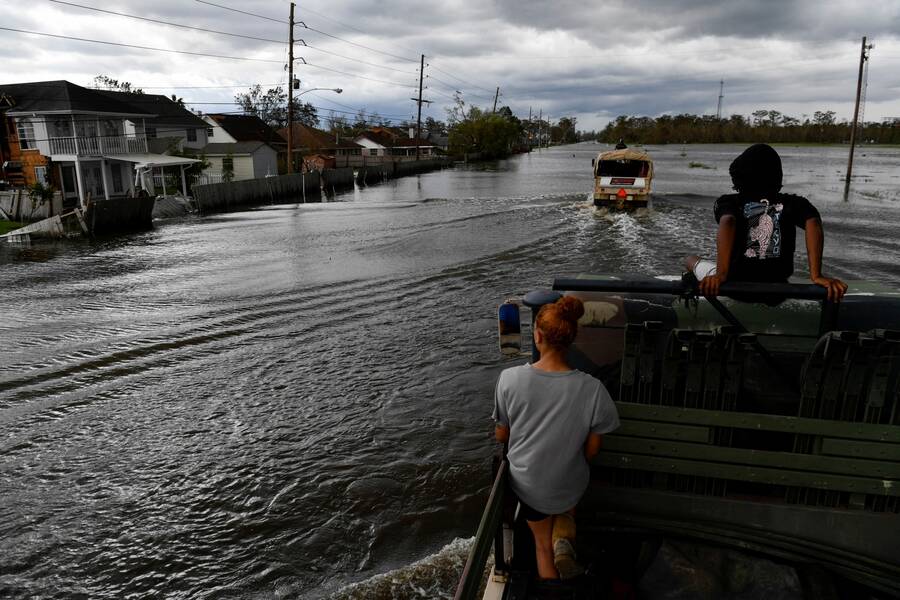
Catera Whitson (C) and Kyler Melancon (R) ride in the back of a high water truck as they volunteer to help evacuate people from homes after neighborhoods flooded in LaPlace, Louisiana on August 30, 2021. PATRICK T. FALLON/AFP VIA GETTY IMAGES.
Twenty years into a nebulous “War on Terror,” the United States is in the grips of a full-fledged climate crisis. Hurricane Ida, whose severity is a direct result of human-made climate change, flooded cities, cut off power to hundreds of thousands, killed at least 60 people, and left elderly people dying in their homes and in squalid evacuation facilities. This followed a summer of heat waves, wildfires and droughts — all forms of extreme weather that the Global South has borne the brunt of, but are now, undeniably, the new “normal” in the United States.
The U.S. government has turned the whole globe into a potential battlefield, chasing some ill-defined danger “out there,” when, in reality, the danger is right here — and is partially of the U.S. government’s own creation. Plotting out the connections between this open-ended war and the climate crisis is a grim exercise, but an important one. It’s critical to examine how the War on Terror not only took up all of the oxygen when we should have been engaged in all-out effort to curb emissions, but also made the climate crisis far worse, by foreclosing on other potential frameworks under which the United States could relate with the rest of the world. Such bitter lessons are not academic: There is still time to stave off the worst climate scenarios, a goal that, if attained, would likely save hundreds of millions of lives, and prevent entire countries from being swallowed into the sea.
One of the most obvious lessons is financial: We should have been putting every resource toward stopping climate disaster, rather than pouring public goods into the war effort. According to a recent report by the National Priorities Project, which provides research about the federal budget, the United States has spent $21 trillion over the last 20 years on “foreign and domestic militarization.” Of that amount, $16 trillion went directly to the U.S. military — including $7.2 trillion that went directly to military contracts. This figure also includes $732 billion for federal law enforcement, “because counterterrorism and border security are part of their core mission, and because the militarization of police and the proliferation of mass incarceration both owe much to the activities and influences of federal law enforcement.”
Of course, big government spending can be a very good thing if it goes toward genuine social goods. The price tag of the War on Terror is especially tragic when one considers what could have been done with this money instead, note the report’s authors, Lindsay Koshgarian, Ashik Siddique and Lorah Steichen. A sum of $1.7 trillion could eliminate all student debt, $200 billion could cover 10 years of free preschool for all three and four year olds in the country. And, crucially, $4.5 trillion could cover the full cost of decarbonizing the U.S. electric grid.
But huge military budgets are not only bad when they contrast with poor domestic spending on social goods — our bloated Pentagon should, first and foremost, be opposed because of the harm it does around the world, where it has roughly 800 military bases, and almost a quarter of a million troops permanently stationed in other countries. A new report from Brown University’s Costs of War Project estimates that between 897,000 and 929,000 people have been killed “directly in the violence of the U.S. post‑9/11 wars in Afghanistan, Pakistan, Iraq, Syria, Yemen and elsewhere.” This number could be even higher. One estimate found that the U.S. war on Iraq alone killed one million Iraqis.
Still, the financial cost of war is worth examining because it reveals something about the moral priorities of our society. Any genuine effort to curb the climate crisis will require a tremendous mobilization of resources — a public works program on a scale that, in the United States, is typically only reserved for war. Now, discussions of such expenditures can be a bit misleading, since the cost of doing nothing to curb climate change is limitless: When the entirety of our social fabric is at stake, it seems silly to debate dollars here or there. But this is exactly what proponents of climate action are forced to do in our political climate. As I reported in March 2020, presidential candidates in the 2020 Democratic primary were grilled about how they would pay for social programs, like a Green New Deal, but not about how they would pay for wars.
In June 2019, Rep. Alexandria Ocasio-Cortez (D‑N.Y.) estimated that the Green New Deal would cost $10 trillion. Her critics on the Right came up with their own number of up to $93 trillion, a figure that was then used as a talking point to bludgeon any hopes of the proposal’s passage. But let’s suppose for a moment that this number, calculated by American Action Forum, were correct, and the price of a Green New Deal came to 4.43 times the cost of 20 years of the War on Terror? So what? Shouldn’t we be willing to devote far more resources to protecting life than to taking it? What could be more valuable than safeguarding humanity against an existential threat?
The reality is that warding off the worst-case scenario of climate change, which the latest IPCC report says is still possible, will require massive amounts of spending upfront. Not only do we have to stop fossil fuel extraction and shift to decarbonized energy, but we have to do so in a way that does not leave an entire generation of workers destitute. Several proposals for how to achieve this have been floated: a just transition for workers; a revamping of public transit and public housing; public ownership of energy industries for the purpose of immediately decarbonizing them; global reparations for the harm the United States has done. Any way you look at it, meaningful climate legislation will require a huge mobilization of public resources — one that beats back the power of capital. And of course, dismantling the carbon-intensive U.S. military apparatus must be part of the equation.
In our society, it’s a given that we spend massive amounts of these public resources on military expansion year after year, with the National Defense Authorization Act regularly accounting for more than half of all discretionary federal spending (this year being no exception, despite President Biden’s promise to end “forever wars”). Over the past 20 years, the mobilization behind the War on Terror has been enabled by a massive propaganda effort. Think tanks financed by weapons contractors have filled cable and print media with “expert” commentators on the importance of open-ended war. Longstanding civilian suffering as a result post‑9/11 U.S. wars has been ignored. From abetting the Bush administration’s lies about weapons of mass destruction to the demonization of anti-war protesters as “terrorist” sympathizers, the organs of mass communication in this country have roundly fallen on the side of supporting the War on Terror, a dynamic that is in full evidence as media outlets move to discipline President Biden for actually ending the Afghanistan war.
What if a similar effort had been undertaken to educate the public about the need for dramatic climate action? Instead of falsehoods and selective moral outrage, we could have had sound, scientifically-based political education about the climate dangers that Exxon has known of for more than 40 years. We could have spent 20 years building the political will for social transformation. It may seem ridiculous to suggest that the war propaganda effort could have gone toward progressive ends: After all, the institutions responsible — corporate America, major media outlets and bipartisan lawmakers — were incentivized against such a public service, and would never have undertaken similar efforts for progressive ends.
But this gets at something crucial — if difficult to quantify — about the harm done by 20 years of the War on Terror. The push for militarization has been used to shut down exactly the left-wing political ideas that are vitally needed to curb the climate crisis. As I argued in February 2020, U.S. wars have repeatedly been used to justify a crackdown on left-wing movements. World War I saw passage of the Espionage Act, which was used to crack down on anti-war protesters and radical labor organizers. The Cold War was used as pretext for crackdowns on a whole host of domestic movements, from communist to socialist to Black Freedom, alongside U.S. support for vicious anti-communist massacres around the world. The War on Terror was no different, used to justify passage of the PATRIOT Act, which was used to police and surveil countless protesters, including environmentalists. The Global Justice Movement was sounding the alarm about the climate crisis in the late 1990s, and was not only subjected to post‑9/11 government repression, but was then forced to refocus on opposing George W. Bush’s global war effort.
The War on Terror also makes it nearly impossible to attain the kinds of global cooperation we need to address the climate crisis. It is difficult for countries to focus on making the transformations needed to curb climate change when they are focused on trying to survive U.S. bombings, invasions, meddling and sanctions. And it’s difficult to force the United States to reverse its disproportionate climate harms when perpetual war and confrontation is the primary American orientation toward much of the world, and the vast majority of U.S. global cooperation is aimed at maintaining this footing.
Such grim reflections on the climate harms wrought by 20 years of the War on Terror do not amount to a nihilistic “I told you so.” We vitally need to apply these grisly lessons now, as the nebulous “War on Terror” is still being waged, from drone wars in Somalia to the bombing campaign against ISIS in Iraq and Syria. Meanwhile, while Biden claims to be “ending an era of major military operations to remake other countries,” he is overseeing an increasingly confrontational posture toward China, an approach championed by members of Congress in both parties. As dozens of environmental and social justice organizations noted in July, it is inconceivable that the world can curb the climate crisis without the cooperation of the United States (the biggest per-capita greenhouse gas emitter) and China (the biggest overall greenhouse gas emitter). Instead of militarizing the Asia-Pacific region to hedge against China, the United States could acknowledge this stark reality and launch an unprecedented effort for climate cooperation with China.
The possibilities for an alternative global orientation are both vast and difficult to know. What we do know is that the status quo of the War on Terror is not working. In addition to the hospitals the United States has bombed, the homes it has destroyed, the factories it has obliterated, and the people it has terrorized, the American military project has deeply worsened the climate crisis. And that crisis is now, undeniably, on our shores.
Sarah Lazare, is web editor and reporter for In These Times.
“I owe the Afghan people an explanation”: Ashraf Ghani apologizes for fleeing Kabul
Zachary Basu
Former Afghan President Ashraf Ghani issued a statement Wednesday apologizing to Afghans for fleeing Kabul on the day the Taliban entered the capital city, calling it “the most difficult decision” of his life.
Why it matters: Ghani’s decision to flee Kabul and seek asylum in the United Arab Emirates on Aug. 15 precipitated the collapse of the Afghan government.
In a White House address the day after the Taliban took control of Afghanistan, President Biden criticized Ghani and the Afghan security forces for choosing not to “fight for their country.”
Ghani was also accused of stealing millions of dollars worth of public money as he fled Kabul, allegations he has vigorously denied. He said Wednesday that he and his top aides would submit to an independent investigation or audit to prove his innocence.
The big picture: Ghani’s statement — his most extensive public remarks since the fall of Kabul — comes one day after the Taliban announced the formation of an acting government that features top loyalists and several internationally sanctioned terrorists.
What they’re saying: “I owe the Afghan people an explanation for leaving Kabul abruptly on August 15th after Taliban unexpectedly entered the city. I left at the urging of the palace security who advised me that to remain risked setting off the same horrific street-to-street fighting the city had suffered during the Civil War of the 1990s,” Ghani said.
“Leaving Kabul was the most difficult decision of my life, but I believed it was the only way to keep the guns silent and save Kabul and her 6 million citizens,” he added.
“Now is not the moment for a long assessment of the events leading up to my departure — I will address them in detail in the near future. But I must now address baseless allegations that as I left Kabul I took with my millions of dollars belonging to the Afghan people. These charges are completely and categorically false.”
“Corruption is a plague that has crippled our country for decades and fighting corruption has been a central focus of my efforts as president. I inherited a monster that could not easily or quickly be defeated.”
The bottom line: “It is with deep and profound regret that my own chapter ended in similar tragedy to my predecessors — without ensuring stability and prosperity. I apologize to the Afghan people that I could not make it end differently,” Ghani concluded. “My commitment to the Afghan people has never wavered and will guide me for the rest of my life.”
Go Ahead, Worry! A Worst-Case Scenario for American Democracy
The American far right has transformed politics in unprecedented ways. Can this be reversed?
By Robert Crawford September 1, 2021
With Trump no longer president and the January 6 insurrection thwarted, the danger may appear to be behind us. “Democracy survived.”
Yet few observers and activists on the left are sanguine about what the future holds. Most alarming are the bald attempts by Republican state legislatures to suppress likely Democratic voters, along with redistricting and other moves to control or even override elections. President Biden called these machinations an “assault on democracy.” However Republican voter suppression might be the tip of a much larger iceberg. Are Americans now be living in the last years of a hard-fought democratic project?
Could the United States be on the cusp of a far-right takeover of the federal government—as early as 2024?
Like climate catastrophe, the signs of severely compromised democracy and impending political disaster are present everywhere in our political life. Shouldn’t we have seen the emergency earlier? The racial justice movement has long directed attention to how racism and racialized structures of power have undermined American democracy from the beginning. Historical amnesia engenders continuing somnolence on the perverse influence of money, radical inequality, obstructed social democracy, militarism and impunity for human rights violations abroad and at home.
The last six years have shocked many of us into a new apprehension. We need to listen to historians like Timothy Snyder and others who have researched the final years of democracy in Weimar Germany before the Nazi takeover. If the peril we face is remotely similar to 1933—a more apt comparison might be Orban’s authoritarian takeover of Hungary—all progressive movements should put this threat at the forefront of their strategic calculations. Yet, with some notable exceptions, what is lacking is a comprehensive grasp of the dangers we still face.
I offer here a tentative map of the multiple and interlocking dimensions of the threat from the contemporary far right. Most are already familiar to readers of The Nation. My intent, however, is to help us avoid reductionist explanations and strategies.
An assessment of the American far right should at minimum pay close attention to the following dimensions—which taken together compose the threat we face.
1) A popular, authoritarian leader who transformed the political landscape during his four years in office and who still retains broad public support, the loyalty of a radicalized “base” and Republican activists and leaders who either ideologically identify with Trumpism or who instrumentally choose to align themselves with it. Donald Trump popularized and legitimized a violent, authoritarian, and cruel style of politics that now reaches far beyond the question of whether he will be the Republican nominee for president in 2024.
2) An attempted coup on January 6, orchestrated by the sitting president and his Republican party and militia collaborators, aimed at overturning the election and preventing the peaceful transfer of power. Republicans have blocked or undermined official investigations which would have laid bare their party’s complicity with Trump. The “Stop the Steal” movement—backed by a network of far-right funders—and other attempts by the president and Republicans to negate the results of a free and fair election strike at the heart of the democratic system. Bitterness and resentment about the election continue to be widespread among Trump supporters. As of late May 2021, a Reuters/Ipsos poll indicates that 61 percent of Republicans still believe the election was stolen. The myth of a fraudulent election is also used to justify ongoing voter suppression maneuvers.
3) Dangerously faltering commitments to nonviolent, democratic values. Millions of Americans now think the use of force is a legitimate option. In a January 2020 YouGov poll of self-identified Republicans and Republican-leaning independents, 50.7 percent agreed that “the traditional American way of life is disappearing so fast that we may have to use force to save it.” Over 40 percent agreed that “a time will come when patriotic Americans have to take the law into their own hands.” Making clear the connection with racism, the poll also found a high correlation between “ethnic antagonism” and the acceptance of violent acts. Further, a CBS/YouGov poll reported on January 13, 2021, found that one in five Republicans—that is, millions of Americans—approved of the January 6 perpetrators. When asked what words would best describe the actions of those “who forced their way into the U.S. Capitol,” 43 percent of Republicans chose “patriotism” and 50 percent chose “defending freedom.” Those percentages remained at that level and slightly higher in a July 20 CBS/YouGov poll.
4) A proliferation of preexisting and new white-supremacist/far-right militia and other groups training for violence. They have organized armed “gun rights” and anti-lockdown demonstrations at state capitols, confrontations with antifa, the “defense” of communities against imagined invasions of antifa or Black Lives Matter activists, and openly racist rallies. In October 2020, a militia group, inspired by Trump’s tweet from the White House to “liberate Michigan,” plotted to kidnap its Democratic governor. Many of the January 6 participants were militia members, demonstrating their willingness to overthrow the government. One week later, the FBI issued a warning that “armed protests are being planned in all 50 state capitols…and at the US Capitol.” The federal and state security mobilizations that followed dampened such plans—but for how long? A barrage of death threats against election officials over the 2020 election continued into 2021. Acts of domestic terrorism by far-right/white supremacist groups and individuals have soared in recent years, climbing to new highs in 2019 and 2020. Targets have included Blacks, Jews, immigrants, LGBTQs, Asians and other people of color.
5) Far-right/white supremacist radicalization within, or infiltration of, state institutions that exercise “legitimate” (law-protected) violence—a critical element of state capture used to control populations and suppress opposition. These include police, military, ICE, and Customs and Border Patrol. In an era of Black Lives Matter protests and demands for constraining police violence, the protection of prerogatives to use violence (even for private citizens, as in the various Stand Your Ground laws) has become a key mobilizing issue on the right.
6) A thriving far-right media juggernaut dominated by Fox News on cable, along with print media, talk radio, and internet sites. Right-wing groups effectively use social media to amplify messaging and create followers. Social media is also well-suited for rapid dissemination of conspiratorial other kinds of disinformation. Encrypted messaging platforms such as Telegram operate as recruitment and organizing vehicles for underground organizations. Tucker Carlson’s recent broadcast from Hungary, after meeting with and praising Viktor Orban, the country’s authoritarian leader, is just one indication of what far-right media personalities have in mind for America.
7) A steady acceleration of right-wing political movements since the election of Barack Obama, shifting further to the right with Trump. Dating back at least to the late 1970s, “pseudo-populist” and “America First” narratives have been advanced by Republicans and right-wing media (although Bernie Sanders demonstrated that the left could also draw on populism’s long history to respond to economic precarity and dislocation, concentrated wealth and corporate control). Trump’s pseudo-populism—after all, his singular legislative achievement was a tax cut for the rich—promotes a hateful and militant politics of resentment, displacing economic anxieties onto to social, religious, and racial antagonisms. Nativism and white fears of demographic “replacement” dominate the Trumpian world-view, followed by anti-tax/anti-government, anti-abortion, anti-gay views and hysteria about the left. The success of Trumpism as far-right ideology, including a cult-like loyalty to the leader, has facilitated the tectonic shift to the right among people who identify as Republican.
8) The Republican Party’s transformation into a far-right party, currently controlled by Trumpists but extending beyond Trump to right-wing and white supremacist politicians who came out of the Tea Party and the Freedom Caucus. The party’s racist Southern strategy has gone national. In addition to its long-standing subservience to money and a corporate agenda, the GOP is backed by various right-wing interest groups and foundations, evangelical religious groups, and wealthy dark-money donors. At the state level, Republicans already control 30 state legislatures; in 22 states they control both legislature and the governorships. In several of these states, the party has already taken steps that must be described as authoritarian and repressive, enacting measures that criminalize protest; suppress the teaching of anti-racist history and diversity or the struggle for social justice; ban transgender people from public spaces; further restrict abortion rights; and oppose local and federal public health measures.
9) The Supreme Court and many appellate and local courts falling under the control of right-wing judges. The Supreme Court’s 6-3 conservative supermajority is poised to rule or has already ruled on several cases that will likely block key progressive policies such as Biden’s eviction moratorium extension, union access to workplaces, restrictions on gun rights, abortion rights, and Biden’s efforts to reverse Trump administration immigration policies. The chances for campaign finance reform remain nonexistent. Ominously, the court has further weakened the Voting Rights Act of 1965 and has demonstrated its hostility toward other federal government efforts to ensure free and fair elections.
10) Last, but not least: voter suppression, gerrymandering and related initiatives enacted by Republican state legislatures, all designed to undermine Democratic-leaning, especially Black, voting blocs and ensure favorable electoral outcomes in 2022 and 2024. In a transparent authoritarian turn, Republicans are also passing legislation aimed at giving state legislatures the power to overturn election results they don’t like. As of July 14, 18 states had enacted 30 laws restricting access to the vote. On the national level, two major voting rights bills put forward by Democrats remain stymied by a Republican filibuster in the Senate.
So many contingencies make the future impossible to predict. Yet, taken in full measure, the transformations outlined above call for a sober assessment of possibilities. Two scenarios point to the 2024 election, which is why most progressives are so focused on protecting the vote. Most likely, the Republican nominee will be Donald Trump.
In one scenario, Trump wins and with the Supreme Court and a Republican Congress behind him takes the country as far to the right as he can. The electoral system will be further reworked to ensure long-term Republican control. Steeped in a media-fed rhetoric of fear and hate, America will become a fortress state. Police, with the likely help of militia groups, will suppress resistance mounted by progressive movements.
Another scenario is a closely contested presidential election, marked by intimidation of voters and possible violence. If a Democrat narrowly wins, Republicans are likely to declare the election illegitimate and attempt another coup, this time more carefully executed. If the nation descends into violence or mass civil disobedience, the military and police would then move to restore order in support of their own version of the legitimate claimants to power, likely backed by the Supreme Court.
My purpose in highlighting these 10 dimensions is to urge that we grasp the contemporary far right as a totality. No matter how loosely integrated or internally conflicted, today’s far-right movement aims to capture power and is frighteningly close to achieving that end. The far-right/white supremacist movement must be confronted in all its interconnected dimensions. If we fail to rouse ourselves to oppose the threat, we may easily fall into a racist and brutal autocracy lasting generations. Our present may come to be understood as “The Before”—the period when history might have taken a different turn but, because of inertia and lack of political will, did not.
It’s time to summon up that political will. The choice is still ours to make.
‘America After 9/11’ Review: Frontline’s Outstanding Deconstruction of the War on Terror Is a Must-Watch
“America After 9/11” examines the nation’s policy failures over the last two decades and how the War on Terror has impacted the homefront.
Tyler Hersko September 7, 2021
“America After 9/11”
PBS
America’s War on Terror began with ill-defined intentions and led to 20 years of brutality that eroded the country’s international goodwill while fostering paranoia, mistrust of public institutions, and xenophobia at home. This is the crux of “America After 9/11,” the latest investigative journalism project from PBS’ Frontline team, and it’s a belief that the two-hour film effectively relays via its facts-first reporting and extensive sourcing.
To call the film timely is both stating the obvious and an understatement; while “America After 9/11” is one of numerous media productions being published this month to coincide with the 20th anniversary of World Trade Center attacks, the film’s release also comes just weeks after the United States’ contentious exit from Afghanistan. As its title implies (and as is to be expected from Frontline), “America After 9/11,” which is directed by longtime political documentarian Michael Kirk, centers on the United States’ political and military actions following the 2001 terrorist attack — it’s a must-watch deconstruction of the War on Terror explained in clear and illuminating terms by numerous experts involved in or affected by the last 20 years of American politics.
“America After 9/11” analyzes numerous developments and individual incidents that stemmed from the last 20 years of the country’s policy-making but most of these topics are used to answer two key questions: How did America’s War on Terror affect the international community’s perception of the country, and what were its impacts inside the United States’ borders?
On the latter question: One of the film’s earliest scenes shows prominent Democratic and Republican politicians coming together at the U.S. Capitol to sing “God Bless America” the evening after 9/11; the scene is followed by footage of the Donald Trump-inspired insurrection at the same building around 20 years later. The juxtaposition of the War on Terror and the January attack on the U.S. Capitol may sound unusual, but “America After 9/11” makes strong, repeated points about how the United States’ foreign policy decisions have had starkly negative influences on domestic politics. As Ben Rhodes, a White House staffer during Barack Obama’s presidency and one of over 30 sources interviewed in the film, argues: “The January 6 insurrection at the Capitol was the logical endpoint of the 9/11 era. When you have people who can’t trust institutions anymore, who are angry that the wars they were promised great victories in didn’t turn out well, they start to look for people to blame.”
“Who are we and what do we want to do as a nation? We answered that question too simply on 9/11: ‘We’re the good guys,’” journalist Thomas E. Ricks said in one of the film’s interviews. “And 20 years later, we found out that we are the enemy. That the biggest national security threat facing the United States is internal, and it has grown partly as a result of American leadership failures over the last 20 years since 9/11.”
The United States’ attempts to postulate itself as “the good guys” in the War on Terror is a key point in the film’s first hour, which primarily hones in on the foreign policies of George W. Bush’s administration. Ample time is dedicated to the tactical mistakes in the war, as well the United States’ many violations of human rights, particularly the abuses at the Abu Ghraib prison and the nation’s ongoing failure to close Guantanamo Bay. The film clearly lays out the government’s initial intentions behind the war — go to Afghanistan and kill Osama bin Laden — and details how the initial failure to do so, amplified by fear-mongering about threats ranging from nuclear weapons to anthrax, influenced the White House.
One of the film’s most surreal anecdotes concerns Vice President Dick Cheney: “This was Cheney’s nightmare come true. He’d been getting ready for doomsday for years and thought a lot about it,” The New Yorker journalist Jane Mayer said in the film. “And then on 9/11 , it seemed like it was almost coming true. He felt death was stalking him. He kept a gas mask and a hazmat suit in a bag in the back seat.”
“America After 9/11” later pivots to the United States public’s erosion of trust in the government and in the media as the war continued and public support waned. The film cites lie-riddled speeches from Democratic politicians such as Hillary Clinton, John Kerry, and Joe Biden: “People who knew better voted for it because they were afraid of being called weak,” Rhodes said in one of the film’s interviews. “You have Democratic, as well as Republican members of Congress, voting for a war that does anybody really believe if they were president they would have chosen to do that? That undermined, I think, confidence in the American public in their leaders. ‘Who can I trust anymore? The Democrats voted for this war too. Why should I trust them anymore than I trust the Republicans?’” The news media’s role on the erosion of public trust after 9/11 — leading newspapers effectively gave credibility to the lies of politicians via pro-war op-eds and reports, while television news channels drummed up fears of potential terrorism attacks for ratings — is also examined in the film.
These segments come into sharp focus in the second half of “America After 9/11,” which analyzes the War on Terror under the Obama and Trump administrations and aptly connects the public’s growing war fatigue and paranoia to issues that are more topical than ever, ranging from racism and conspiracy theories to hyper-partisanship and the devaluation of basic facts. The roughly 30-minute section of the film that revolves around Obama’s presidency focuses on his messages of hope and de-escalation during his 2008 campaign, and how his war policies — namely, the expansion of drone strikes, the short-lived exit from Iraq, and a failure to close Guantanamo Bay — further eroded trust in the government at home and abroad, despite the eventual killing of bin Laden. As the wars dragged on, the right-wing media helped to direct the country’s growing sentiments of nationalism and racism towards Obama and Muslims.
As the film notes, those attitudes contributed to Trump’s election. Trump’s presidency is the focus of the documentary final 20 minutes, which notes that he further escalated targeted killings and affirmed his support for Guantanamo Bay. That said, the film primarily focuses on how the consequences of the War on Terror impacted America under Trump during the George Floyd protests and the Capitol insurrection.
‘It seemed to be the wars came home. You can look at police in America and you can see all the kit that they’ve got,” Emma Sky, a former political advisor to U.S. generals, said in the film while footage of militarized police and federal agents attacking, intimidating, and detaining peaceful protestors in the summer of 2020 plays. “They’ve taken all the surplus from Iraq and Afghanistan. It’s come back and a lot of these weapons, a lot of these vehicles, are now being used by law enforcement. […]By the time you get to January 6, so much doubt has been sown in the system, so much fear, that how this opposition is described by Trump and Trump supporters, it looks terrifying.”
There is a call to action near the end of “America After 9/11”: a need for America to take a proper accounting of what it has done in the last 20 years and what the impacts of those actions. After that, the film closes with a brief look at the United States’ exit from Afghanistan under Biden and a note that a war in the country will likely persist — with deadly consequences for those who supported America over the last two decades. It’s a grim, albeit suitable sendoff; Frontline’s latest film is equal parts a fearless deconstruction on the United States’ foreign policy failures over the last two decades and an illuminating analysis on how those failures have impacted the home front.
Hurricane Ida power outages, misery persist 9 days later
Kevin McGill and Melinda Deslatte
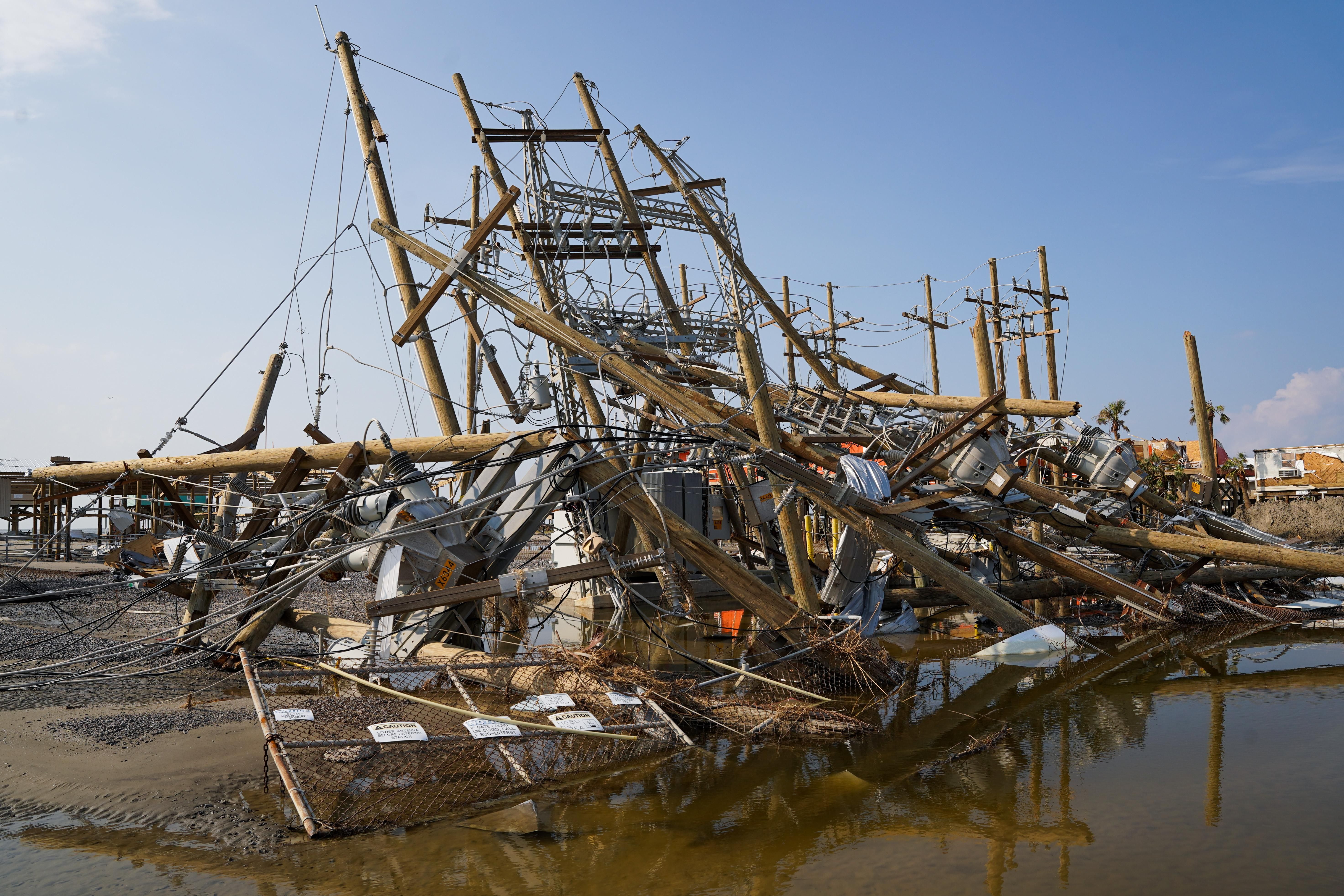
LaPlace, La. (AP) — Hundreds of thousands of homes and businesses in Louisiana, most of them outside New Orleans, still didn’t have power Tuesday and more than half the gas stations in two major cities were without fuel nine days after Hurricane Ida slammed into the state, splintering homes and toppling electric lines.
There were also continuing signs of recovery, however, as the total number of people without electricity has fallen from more than a million at its peak, while hundreds of thousands of people have had their water restored.
State health officials, meanwhile, announced that they are revoking the licenses of seven nursing homes that evacuated to a warehouse where seven residents died amid deteriorating conditions after the hurricane.
The disparity in power restoration between New Orleans, where nearly 3/4 of the city had electricity again, and other communities where almost all residents were still in the dark prompted frustration and finger-pointing.
State Rep. Tanner Magee, the House’s second-ranking Republican who lives in the devastated city of Houma in Terrebonne Parish, said he’s convinced his region is being shortchanged in favor of New Orleans.
“It’s very infuriating to me,” Magee said.
Though water was running again in his area, most hospitals in the region remained shuttered and the parish was in desperate need of temporary shelter for first responders and others vital to the rebuilding effort, he said.
Warner Thomas, president and CEO of the state’s largest hospital system Ochsner Health warned that it would be “some time” before two Ochsner hospitals — one in Terrebonne Parish and the other in Lafourche Parish — fully reopen. Emergency rooms at the two hospitals, however, were operating.
Carnival Cruise Line announced Tuesday that it will keep one of its ships, Carnival Glory, docked in New Orleans through Sept. 18 to serve as housing for first responders.
Louisiana Gov. John Bel Edwards said while there had been much progress in restoring water and power, “there’s an awful lot of work to be done.”
Without power, the Louisiana heat is the hardest thing to cope with, said Kim Bass, who lives in St. John the Baptist Parish. She and her husband are using a generator to keep food refrigerated but have no air conditioning. Water service is intermittent.
“So you may have water one minute, then you may not have water for the next two days,” Bass said.
In many neighborhoods, homes were uninhabitable. State and federal officials said about 3,200 people are in mass shelters around Louisiana while another 25,000 people whose houses have been damaged are staying in hotel rooms through the Federal Emergency Management Agency’s transitional sheltering program. FEMA already has approved more than 159,000 household applications for disaster assistance, according to Louisiana’s emergency preparedness office.
Shontrece and Michael Lathers looked on despondently as workers wrestled a billowing blue tarp into place over what was left of the roof of their home in the St. John the Baptist Parish town of LaPlace. Ida’s floodwaters had risen to about 3 feet (1 meter) inside their home and rain that had poured in through the wind-damaged roof obliterated most of the drywall ceilings.
The house will have to be gutted floor to ceiling, Michael Lathers said, adding that he had no idea how much the repairs will cost.
Fuel shortages also persisted across hard-hit areas of the state. More than 50% of gas stations in New Orleans and Baton Rouge remained without gasoline Tuesday afternoon, according to GasBuddy.com.
The power situation has improved greatly since Ida first hit. In the first hours after the storm, nearly 1.1 million customers were in the dark, but that number was down to about 430,000 on Tuesday. With the help of tens of thousands of workers from power companies in numerous states, the state’s biggest energy provider, Entergy, has been able to slowly bring electricity back, leaving only 19% of its customers in the region without power as of Tuesday.
For residents in the state’s five hardest-hit parishes in southeastern Louisiana, however, that number is little comfort. Fully 98% of those residents are still without power more than a week after Ida slammed onshore with 150 mph winds (240 kph) on Aug. 29.
Power probably won’t be widely restored to St. John the Baptist and St. James parishes until Sept. 17 and until Sept. 29 to Lafourche, St. Charles and Terrebonne parishes, Entergy said Tuesday. The parishes are home to about 325,000 people.
In contrast, nearly all power has been restored in the capital of Baton Rouge, and only 25% of homes and businesses are still suffering outages in New Orleans. Entergy said it expected to have the vast majority of New Orleans brought online by Wednesday. Once areas such as New Orleans have their power restored, Entergy is moving its crews into communities south and west of the city that saw more widespread damage, said Entergy Louisiana President and CEO Phillip May.
As Entergy worked to get the lights turned on everywhere, the Louisiana Department of Health reported that the number of people without water had fallen from a peak of 850,000 to 62,000, though about 580,000 people were being advised to boil their water for safety. And grocery stores reopened in some places.
Ida’s death toll in Louisiana rose to 15 people Tuesday after the state Department of Health reported two additional storm-related fatalities: a 68-year-old man who fell off of a roof while making repairs to damage caused by Hurricane Ida and a 71-year-old man who died of a lack of oxygen during an extended power outage. The storm’s remnants also brought historic flooding, record rains and tornados from Virginia to Massachusetts, killing at least 50 more people.
Deslatte reported from Baton Rouge, Louisiana. Associated Press writers Rebecca Santana in New Orleans; Jeff Martin in Marietta, Georgia; Sudhin Thanawala in Atlanta; and Lisa J. Adams Wagner in Evans, Georgia, contributed to this report.
The Afghanistan Meltdown Proves Vietnam Taught Us Nothing
James A. Warren
Joe Raedle/Getty Images
The American war in Afghanistan came to a long-overdue end on the evening of Aug. 30, when the last U.S. military plane, a C-17 transport, lumbered into the skies above the Hamid Karzai International Airport in Kabul. Among its passengers was the last American soldier to depart this hard, mountainous, war-ravaged country, Maj. Gen. Chris Donahue, the commander of the 82nd Airborne Division. Shortly thereafter, the Taliban’s senior spokesman, Zabihullah Mujahid, announced to the Afghan people: “This victory belongs to us all.”
The harried American withdrawal, replete with scenes of desperate Afghans clinging to the rear of a giant U.S. Air Force transport as began its takeoff, parents passing a baby to Marine guards on the tense perimeter of the airport, and horrific mayhem following two massive suicide bombings by Islamic State of Khorasan terrorists, succeeded in evacuating about 123,000 people—an astonishing feat, carried out with great skill and courage by the American military.
Nonetheless, the evacuation will be seen by historians for generations for what it was: the sobering last act in yet another lost American war.
Inevitably the exhausting saga of the final U.S military operation in Afghanistan evokes memories of another grim evacuation: Operation Frequent Wind, the dramatic, last-ditch effort to evacuate the last Americans remaining in Saigon, along with their South Vietnamese allies on April 29-30, 1975. That operation, also carried out with extraordinary cool-headedness by U.S. Marines under intense pressure, succeeded in bringing out every American, but thousands of South Vietnamese who had worked for the United States as faithful servants of the cause were left to fend for themselves. Many ended up serving multiple-year tours in communist re-education camps, or drowning in rickety boats in the South China Sea as they tried to make their escape.
The Marines who took the last chopper off the embassy roof around 7:50 a.m. on April 30, 1975, were blinded for a few minutes by tear gas they had fired to keep desperate Vietnamese from trying to jump into their overloaded aircraft. It was somehow fitting that the last Americans who left Vietnam did so when they were for all intents and purposes blind.
Any soldier or Marine can tell you that orchestrating a “retrograde movement” is among the trickiest and most delicate of military maneuvers. In Kabul, this extremely difficult operation was unnecessarily complicated and compromised by the failure of senior decision-makers in the White House and State Department to anticipate the rapid collapse of the Kabul government’s armed forces and government in the face of a determined and well-organized adversary, the Taliban. Their failure is all the more inexplicable in light of the fact that both the CIA and the State Department provided the president with sound intelligence estimates during the last weeks of the Taliban’s stunning advance.
The same thing happened in 1975, more or less, as the ambassador to South Vietnam, Graham Martin, mysteriously refused to give the order to evacuate when the writing was on the wall, and CIA operatives had already begun evacuating their Vietnamese allies surreptitiously.
The forced withdrawal from Afghanistan ranks among the most humiliating episodes in all of America’s 400-year history, for it symbolizes in dramatic fashion the end of a horrendously destructive failed crusade to export American-style democracy by arrogant policymakers transfixed by their own country’s raw military power.
It is depressing, to say the least, but we failed in Afghanistan for many of the same reasons we stumbled in Vietnam, almost 50 years ago.
At the outset of each conflict, U.S. policymakers were woefully ignorant of the political and cultural dynamics of the nation they aimed to transform. And so, to a greater degree than is usually realized, the United States went into both conflicts half-blind, convinced that the righteousness of the cause would compensate for ignorance, and ensure success.
The Johnson administration made the absurd assumption that deep in the heart of every Vietnamese there was an American yearning to be born. George W. Bush and his advisers made the same assumption about the Afghan people. Time proved the utter bankruptcy of this assumption in both cases, as well several others, including the idea that the United States possessed the wisdom and wherewithal to crush a well-organized insurgency while it simultaneously built an entirely new government apparatus.
Like Vietnam, Afghanistan was an “irregular war,” a brutal counterinsurgency struggle in which the United States failed to find a way to counter the ingenious protracted war strategy adopted by its adversary. The Taliban’s way of war, much like the Vietcong’s, pivoted largely on hanging on and outlasting the Americans and their vast array of war machines. They were willing to suffer innumerable tactical setbacks—including being driven out of Afghanistan entirely back in 2002—sure in the knowledge that eventually the United States would weary of supporting a corrupt and dysfunctional government, pack up, and go home. Like the Vietcong, the Taliban drew comfort and sustenance from its possession of a sanctuary, in this case Pakistan, and from the inability of the United States or its allies to seal off the flow of enemy fighters into Afghanistan.
Once America grew tired of the fighting, the Taliban high command reckoned, it would be a relatively simple matter to conquer the broken and illegitimate administration that the United States had tried to create and support. So it was.
The strategy worked brilliantly, just as it had in Vietnam.
In both wars, the United States had enormous military power at its disposal, but very little political power, and even less understanding of how politics actually functioned locally. But as the history of irregular war tells us again and again, in conflicts between powerful conventional armies and local insurgencies, politics, political organization, and mobilization are invariably more important factors in determining the outcome than battles.
In irregular warfare, coercive politics—assassination, terrorism, subversion, propaganda, the methodical construction of a shadow government—figure prominently, and cannot be countered by strictly military means alone. Human relationships and political mobilization are more important than military technology, and restraint in the use of armed force, rather than sheer firepower, is often critical to success. In these kinds of conflicts, said a prominent recent U.S. Army Special Forces officer, “You can’t kill your way to victory.”
When Major Harry Summers told his North Vietnamese counterpart on a small team of officers who were negotiating the terms for the American evacuation of Saigon that the communists had never defeated the Americans in a major battle, the officer, a Colonel Tu, replied, “That may be so, but it is also irrelevant.” How right he was!
The United States never lost a multi-battalion battle in Afghanistan, but in light of the failure to build a legitimate, functional government, the Americans’ tactical victories were essentially “irrelevant.”
In both of these tragic counterinsurgency conflicts, the lion’s share of the nation-building work fell by default on the U.S. military, which is neither properly trained to undertake such work, nor temperamentally suited for it. The efforts of the State Department, USAID, and other civilian agencies and NGOs were notoriously disjointed and ineffective. In both Afghanistan and Vietnam, billions were spent each year on ambitious social engineering projects, but the host governments remained dysfunctional, corrupt and utterly unresponsive to the needs of the population.
As both conflicts morphed from stalemate to quagmire to looming disaster, the American public was fed a steady, unremitting diet of upbeat assessments of progress being made on the ground, served up by presidents, their advisers, and commanding generals. These assessments, it is now all too clear, were fairy tales, born of a lethal amalgam of wishful thinking, obtuseness, and outright dissembling.
As the futility of the fighting became more and more apparent in both these conflicts, American ground forces were ultimately withdrawn, and the American people were assured by the White House that the cause was not lost, that the good fight would be carried on by our local allies.
But this, too, was dissembling.
Only the most naïve observers of the scene in Vietnam in 1973 on the eve of the withdrawal of U.S. combat forces believed the South Vietnamese Army could stand up to the combined forces of the North Vietnamese army and the Vietcong on its own. They had invariably been bested by the enemy during the war with the Americans. How could they be expected to survive against such powerful, well-motivated forces as the Vietnamese communists without them?
Even granting that, the South Vietnamese managed to hang on for more than two years after the last Americans departed Vietnam in March 1973, and they were defeated by a powerful conventional army force of more than 20 divisions, several of them amply supplied with tanks. So corrupt and hollow was the regime in Kabul that it folded just four months after President Biden announced the final American withdrawal.
This precipitous collapse of the Kabul government certainly has no upside for the long-suffering Afghan people, who seemingly cannot escape the curse of devastating civil war. Indeed, it may not be long before the country’s warlords resume the fight against the Taliban. But the failure of the government or the army to put up much a fight, I think, go a long way toward confirming the wisdom of President Biden’s decision to withdraw. The Kabul government was fatally, irrevocably shaky, and had been kept on life support by the United States troops and dollars. Yet the very presence of the world’s largest, most powerful foreign army only served to erode the government’s sliver of legitimacy in the eyes of its own people.
Where these two failed wars differ fundamentally is on the question of their impact on American society. Vietnam was at the heart of a tumultuous social revolution in America in the late 1960s and early 1970s. The war pervaded every aspect of American life, and came perilously close to tearing the social fabric of the country irrevocably. “Nothing did more than the conflict in Vietnam to alter the course of post–World War II society and politics, or unleash the emotions that polarized the nation after 1965” than Vietnam, writes Brown historian James T. Patterson. Few historians would disagree. More than any single event of this time, the war broke the trust between the government and the people. It was the first war the United States had ever lost.
Afghanistan has aroused no such passions, nor has it altered significantly the lives of many Americans outside the relatively small universe of the American military and their families. The conflict went on and on, and Americans in general seemed to care less and less about it. In truth, the major reason the war lasted so long is that the American people didn’t care enough about it to demand that it end.
The collective weight of three lost wars—Vietnam, Iraq, and Afghanistan—surely demands a searching re-examination of how the United States goes about making the decision to go to war, and how it develops strategies for achieving its objectives. It would also seem to call for a less activist foreign policy—a foreign policy of military restraint that would focus on the use of the United States’ economic and political power rather than the military to shape the world.
But don’t count on any of this happening soon. As Mary L. Dudziak, a law professor at Duke who has written extensively about war, told TheNew York Times, “In our toxic political environment, Republicans are likely to use this moment to undermine President Biden, and partisanship may foreclose the deeper re-examination of American war politics that is sorely needed now, and was also needed after the war in Vietnam.”
U.N. says basic services in Afghanistan are collapsing
Afghans line up outside a bank to take out their money after Taliban takeover in Kabul
GENEVA (Reuters) – Afghanistan is facing the collapse of basic services and food and other aid is about to run out, the U.N. Office for the Coordination of Humanitarian Affairs (OCHA) said on Tuesday.
OCHA spokesperson Jens Laerke told a U.N. briefing in Geneva that millions of Afghans were in need of food aid and health assistance, urging donors to give more ahead of an international aid conference for Afghanistan on Sept. 13.
The agency has released a flash appeal for around $600 million to meet humanitarian needs for 11 million people for the remainder of the year amid warnings of drought and starvation.
“Basic services in Afghanistan are collapsing and food and other lifesaving aid is about to run out,” he said. “We urge international donors to support this appeal fast and generously.”
More than half a million people have been displaced internally in Afghanistan this year as the Taliban has swept across the country, culminating in its seizure of the capital Kabul on Aug. 15.
The alleged corruption and abuse by Afghan leaders that the US ignored was a ‘big factor’ in the country’s fall, human rights expert says
Ryan Pickrell
A member of the Afghan army stands guard at a high point overlooking the Panjshir Valley Carolyn Cole/Los Angeles Times via Getty Images
The Afghan institutions the US and its allies propped up for years collapsed in a matter of weeks.
One key problem, experts argue, was overlooked corruption and human rights abuses at senior levels.
One expert told Insider that when it came to Afghanistan, the US and its allies were “choosing the least bad partner.”
The US and its NATO allies propped up the Afghan government and security forces for years, but the moment they withdrew, both crumbled in a matter of weeks.
The stunning collapse of these institutions, which allowed the Taliban to retake Afghanistan, have raised a host of questions about what went wrong after decades of international support.
Some experts contend that persistent and troubling allegations of corruption and abuse surrounding Afghan leaders that were largely ignored by the US and its NATO allies crippled efforts to build a government and military able to withstand the Taliban, gain strong popular support, and meet Afghanistan’s needs.
There were generals put in place through connections rather than capability, soldiers in the Afghan security forces that existed only on paper, and supply lines disrupted by officials who siphoned off essential resources. The problems in Afghanistan ran much deeper though, experts said.
Patricia Gossman, a senior Human Rights Watch researcher who has interviewed Afghans and international officials and conducted on-the-ground investigations in Afghanistan, told Insider that problems such as human rights abuses and corruption were “a big factor” in the country’s fall.
In Afghanistan, the US and its allies aligned themselves with “some very notorious figures reviled by many communities that they were in because of previous atrocities,” Gossman told Insider, explaining that they also empowered some people that later became problematic while focusing on short-sighted needs.
Ryan Crocker, a career diplomat who served the US as the ambassador to Afghanistan during the Obama administration, once recounted for the Special Inspector General for Afghanistan Reconstruction (SIGAR) a truly uncomfortable encounter with Mohammed Fahim, an Afghan defense minister who later became a vice president.
Fahim giggled as he related to Crocker a story of another senior Afghan minister who had been killed, the ambassador recalled in a conversation obtained as part of The Washington Post’s “Afghanistan Papers.” Later, Crocker revealed, it came out that Fahim might have actually had the official killed.
Crocker explained that he “certainly came out of those opening months with the feeling that even by Afghan standards” he “was in the presence of a totally evil person.”
For example, Afghan President Ashraf Ghani’s defense minister Asadullah Khalid, previously the head of the National Directorate of Security, allegedly personally engaged in or ordered torture, sexual violence, and extrajudicial killings, according to Human Rights Watch.
And Abdul Raziq, a powerful Afghan National Police chief until he was killed, was accused of running secret detention centers and carrying out or ordering torture and extrajudicial killings.
Soldiers with the U.S. Army’s 4th squadron 2nd Cavalry Regiment and the Afghan National Army (ANA) return to their vehicles following a patrol through a village on March 5, 2014 near Kandahar, Afghanistan. Scott Olson/Getty Images
‘Choosing the least bad partner’
Experts say that issues at the top exacerbated problems at other levels. “There was this sense that nobody was held accountable for anything,” Gossman said. “You have a trickle down lack of accountability.”
A US Army veteran of the Afghan war that Insider spoke to recently revealed that he encountered police leaders that expected bribes for information on the Taliban, security checkpoints that had made deals with the Taliban, and some security forces members engaged in child sex trafficking.
Some other veterans had similar experiences. Capt. Dan Quinn, a former US Special Forces soldier, was famously relieved after he beat up a US-backed militia leader sexually abusing a young boy.
“The reason we were here is because we heard the terrible things the Taliban were doing to people, how they were taking away human rights,” Quinn told The New York Times in 2015.
“But,” he added, “we were putting people into power who would do things that were worse than the Taliban did – that was something village elders voiced to me.”
A senior US official reflecting on the situation in Afghanistan in 2015 said that “our money was empowering a lot of bad people,” adding that “there was massive resentment among the Afghan people,” according to The Washington Post’s Afghanistan Papers.
Another US official said that “we were giving out contracts to pretty nasty people, empowering people we shouldn’t have empowered, in order to achieve our own goals.”
“Successive US administrations have largely perceived human rights more as an obstacle than as an essential component of addressing Afghanistan’s problems,” Gossman asserted in a recent Just Security column, adding that “this approach has been catastrophic.”
“It affected the legitimacy of the government,” Gossman, who has spent years documenting human rights abuses in Afghanistan, told Insider. “Maybe it didn’t make people want the Taliban, but they may have seen the Taliban as a better option in certain circumstances.”
Sarah Chayes, who ran non-governmental organizations in Afghanistan and served as a senior advisor to US military leaders in country, told PBS last month that “Afghan government officials would shake people down at every interaction.”
She added that “from Afghans’ perspective, it almost looked like the United States was in favor of this system because our officials were always seen partnering with these venal Afghan leaders.”
Chayes explained that when she was working with the chairman of the Joint Chiefs of Staff in 2011, interagency policy was to ignore high-level corruption and other misdeeds.
“Why would a population take risks to fight the Taliban on behalf of a government that is treating them almost as badly as the Taliban do?” she asked.
That said, not every interaction between the US and NATO and their Afghan partners was necessarily plagued by problems.
“Did we back bad horses across the country? I think probably the answer is no,” Erol Yayboke, a Center for Strategic and International Studies expert and a former international development contractor, told Insider, saying there was likely a mix of both good and bad actors.
“I think the question is less did we back a bad horse and is more were there actual alternatives? What you hear from people who spent years and years working in Afghanistan is that the option was backing people that we had concerns about over corruption, etc., or leaving,” he said.
With US leaders largely against leaving, “we had to find some local partners,” Yayboke said. “I think that a lot of folks that were out there would argue that, in many cases, it was not choosing the best partner. It was choosing the least bad partner.”
“I think that decisions that people were making, including our people in the field, American leaders, were based primarily on least bad options,” he said.