In the Louisiana Bayou, Dolphin Victims of Hurricane Ida Set the Stage for a Political Fight Over Coastal Restoration

DeSmog

In the Louisiana Bayou, Dolphin Victims of Hurricane Ida Set the Stage for a Political Fight Over Coastal Restoration

Dolphins killed during Ida’s storm surge are a reminder of how vulnerable Louisiana’s marine life is to climate change. And locals worry a controversial river diversion project to increase the state’s marshland could make things even worse.
By Rocky Kistner                              
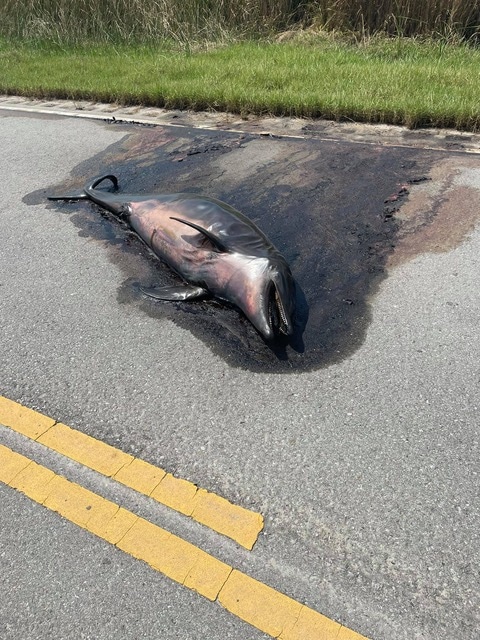
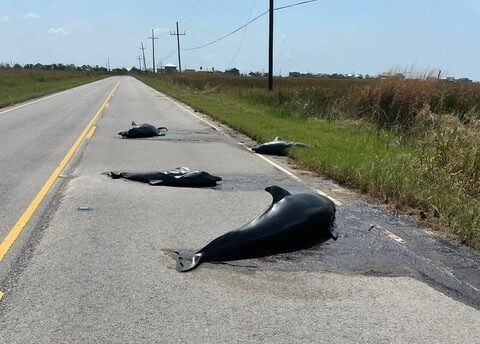
Dolphins killed by Hurricane Ida raise fear among locals for what the future holds. Credit: Capt. Kevin Coleman, Plaquemines Parish Fire Department

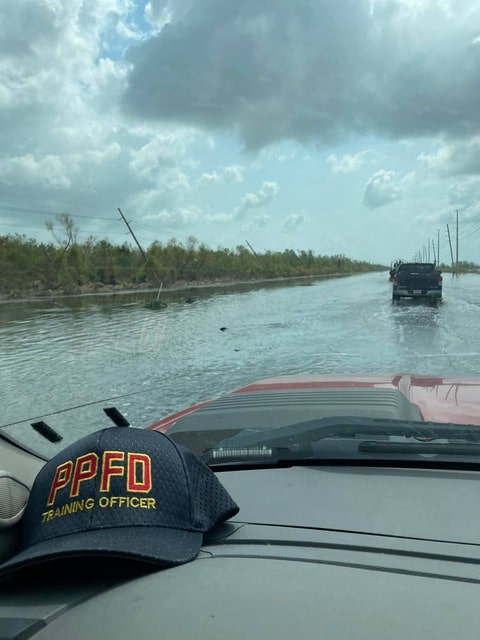
Days after Hurricane Ida roared through coastal Louisiana, sending a 12-foot storm surge rushing across the marshlands south of New Orleans, Plaquemines Parish Fire Department Capt. Kevin Coleman was driving on a coastal road trying to reach his isolated fire station near Myrtle Grove, Louisiana.

As he drove toward Barataria Bay, he saw in the distance what looked like black plastic garbage bags littering the road. But as he drove closer his curiosity turned to horror. “What the hell,” he said to himself as he slammed on the brakes. Scattered along the road were the remains of four dead bottlenose dolphins, lying on the drying asphalt with mouths agape, a decaying pile of flesh that revealed their agonizing deaths.

Coleman jumped out of his vehicle and took a few pictures to capture the morbid moment he had just witnessed. The fire department captain didn’t have much time to reflect on what he had seen, but later he couldn’t shake the thought of what might be in store for the region’s dolphins. He says he worries that the future is not a bright one for the dolphins, as well as the oysters, shrimp, and salt-water fish that make the bay one of the most productive in the nation.

That’s because, he says, about six miles from where he found the dolphins dead in the middle of the road, the state of Louisiana plans to build an unprecedented multi-billion river diversion project. The goal is to build up marshland in Barataria Bay in order to mitigate coastal erosion. The plan is currently under federal environmental review.

The project’s supporters, including major environmental nonprofits like the Environmental Defense Fund, the National Wildlife Federation, and the Audubon Society, say large river diversions are the most effective way to send land-building sediment streaming into the bayou from the Mississippi River to fight land subsidence and sea-level rise. Losing land at an alarming rate, Louisiana is one of the states most threatened by the impacts of climate change in the U.S.

The diversion project is part of a 50-year coastal restoration plan by the state, boosted by major funding from the Walton Family Foundation, which has supported a multi-million dollar PR and media campaign to promote the plan. The foundation also has funded local media coastal reporting efforts, which, along with national media stories, has largely been positive about the state’s diversion plan.

But that’s not how some locals and other marine mammal experts see it. The massive river diversions planned for Plaquemines and St. Bernard Parishes has run into a buzzsaw of opposition, as local fishing communities worry that the diversions will pour polluted Mississippi River water into the bay. The fear is that upstream chemicals, pesticides, and other toxins will change the salinity levels of the water and destroy one of the most productive fisheries in the country.

study earlier this year found that the Barataria Bay diversion project could result in local dolphin populations becoming “functionally extinct.”

But in 2018 a Congressional lobbying effort successfully managed to insert an exemption to remove protections under the Marine Mammal Protection Act in order to allow the project to move forward.

Dolphin expert Moby Solangi, president and executive director of the Institute of Marine Mammal Studies in Gulfport, Mississippi, says finding four stranded dolphins on a road is unusual, but it’s not surprising given that climate change is contributing to bigger and more destructive storms. “The climate predictions of increased hurricanes and tropical storms in the region, and the proposed diversion of polluted Mississippi River in the Louisiana estuaries, will have a devastating effect on dolphins, turtles, fish and shellfish,” Solangi said.

Solangi and other marine mammal experts say dolphins are territorial and will not move, even if their habitat is threatened, and they will suffer deadly skin lesions disease caused by the planned massive inflows of river water.

Dolphin expert Moby Solangi, at the Institute of Marine Mammal Studies. Credit: Julie Dermansky


Dolphin populations are already stressed in the area, having been severely damaged by the historic BP oil disaster in 2010, which still impacts the dolphin populations in Barataria Bay today. Officials with the National Oceanic and Atmospheric Administration report that deadly dolphin strandings in Texas, western Louisiana, and coastal Florida are on the rise this year as well. Still, they haven’t approached the dangerous 2019 levels when record flooding pumped river runoff into the Gulf and contributed to the death of more than 300 hundred dolphins. Scientists say impacts of red tide and the toxic impacts of yearly “dead zones” caused by inflows of toxins and oxygen-killing algal blooms may be contributing too.

Meanwhile, Louisiana faces challenges to find all the dolphins that may be dying in its marshes, a major task considering the state essentially abandoned its stranding effort, a program to identify and recover marine mammals in distress, in the years following the 2010 BP disaster. Experts say many dolphins likely have died unidentified.

Gabriella Harlamert, coordinator of the Audubon Nature Institute’s wildlife stranding network, says the organization is trying to build up its resources, and that it now has its first boat on order. She says they were able to help rescue seven dolphins last year after Hurricane Laura slammed into the Louisiana coast, and they participated in a recent multi-agency rescue of a young dolphin trapped in Ida’s floodwaters in Slidell, Louisiana.

But Harlamert was too late to help save the four dolphins recently found in Plaquemines. Her small team responded to the stranding report, but she says the animals were too decomposed to do a proper necropsy. “I’ve never gotten dolphins like this that were so fragmented,” she says. She blames storm surge for trapping the animals, who likely got caught in a containment area by the road as the surging water rushed back into the bay.

Dolphins killed by Hurricane Ida. Credit: Capt. Kevin Coleman, Plaquemines Parish Fire Department

Public officials, however, like Lt. Governor Billy Nungesser, former president of Plaquemines Parish during the BP oil disaster, say the dolphins killed during Hurricane Ida are symbolic of a state’s coastal restoration plan gone awry.

Nungesser, who is in charge of Louisiana’s seafood promotion board, has made opposing the massive river diversion projects central to his likely run for governor in 2023. He said earlier this year that the future of Louisiana lies in protecting its fisheries, not the oil and gas industry, which he famously said “was going down.” He argues that the state should be focusing on more immediate, short-term projects they know work, such as more dredging and berms to help land areas which act as a buffer between storm surges and the coastline, instead of working on 50-year programs when it’s challenging to predict that far into the future.

“The dolphins on that road is a wake-up call,” Nungesser told Desmog. “How do they think they can dump all this polluted river water in there and not kill everything?”

Political leaders and residents in coastal areas that will be impacted by these diversions largely agree with the Lt. Governor. They say there are other ways to try to build coastal land that won’t destroy the fisheries in the process.

Dredging, for instance, also works to build land — but requires constant maintenance. The state says diversions can build land naturally. The question for many is: at what cost? Is it worth impacting dolphin populations and jeopardizing the fisheries? The state says it will compensate local communities for their losses, but locals say that is impossible. They say it will kill their livelihoods.

“There are more than two thousand dolphins in this area,” says Coleman. “The diversions will kill them … we need to stick with dredging.”

Inside Task Force Pineapple: How we saved Americans and allies trapped in Afghanistan

Inside Task Force Pineapple: How we saved Americans and allies trapped in Afghanistan


In the week before America officially exited Afghanistan, a private effort organized from inside the United States cobbled together a first-of-its-kind virtual underground railroad that got more than 800 Americans, Afghan veterans, interpreters and VIPs out of the country.

I was honored to play a part an effort that became known as Task Force Pineapple, taken from the code word the first high-risk interpreter used to make it into the airport in Kabul on his way to freedom.

We built a citizen-liaison network to protect Americans and other dedicated allies being left behind during the chaotic and expedited withdrawal of the U.S. military, intelligence and diplomatic presence from the country.

Americans need to help protect fellow citizens, especially those abroad

Everything we accomplished arose from the ability of those involved to leverage our collective knowledge of Afghanistan and good relationships built over many years with allies and friends around the world.

Why did we do it? Because, to a man and woman involved, we believed it was the right thing to do.

For generations, it meant something to be an American. It meant caring about virtues like honor and integrity and acting with a distinctive sense of pride and a standard of respect for who we are. Other countries knew not to mess with Americans overseas because we would expend everything in our power to protect them.

Taliban Takeover: Taliban fighters tortured my journalist colleagues. They risk their lives to tell the truth.

A story I heard years ago illustrates the essence of this very American mindset: In 2003, a rifle company of a U.S. Marine Corps unit just outside Baghdad was ambushed. With a journalist for an international news agency filming things, a Navy corpsman serving alongside them as a medic turned and rushed through the fire, into the fight, and returned from the battlefield carrying an injured Marine to safety. He did this not once but three times. On his third run, carrying another injured man over his shoulder, the journalist called to him, saying in effect, Hey, mate, what’d you do that for? Didn’t you notice that wasn’t a Marine?

That newsman was right. That third wounded warrior wasn’t a U.S. Marine, he was an Iraqi soldier. As the story was told to me, the Navy corpsman’s response was simple but spoke volumes. “He was wounded,” he said. “We’re Americans. That’s what we do.”

What we accomplished through Task Force Pineapple is very much an expression of that same mindset.

Calling myself an American means something. And it carries with it a responsibility – this especially applies for those in American government – to honor our promise to take care of the people who have taken care of us.

Jason Redman in Afghanistan, 2005.


These amazing warriors and Afghan allies fought directly alongside us. They all knew they might die for the cause. Many of them did. Some had family members murdered in retribution. Today, as Afghanistan has fallen and is once again under the control of the Taliban, we are obliged to save them.

Our values as Americans help us serve abroad

We cannot do this alone. Task Force Pineapple is standing by to assist whatever efforts the U.S. government may be contemplating. We have the skills and the contacts to help honor America’s promise to bring these people back by facilitating safe passage and resettlement with plans and funding for their successful futures, reintegration and repurposing of their unique abilities the U.S. military and government organizations once relied upon.

Taliban Takeover: Afghan allies in hiding, executed in the street — Jewish people know this haunting story

This is a matter of national honor. Our credibility is at stake. Leaving our friends in a state of extreme danger, failing to honor our commitments to their well-being as they made commitments to ours, will produce long-term damage not easily repaired.

Jason Redman in Afghanistan, 2005.


The rest of the world is watching. Our allies, our competitors and especially our enemies. All are questioning our continuing commitment to those who help us in times of trouble.

I worry that U.S. intelligence gathering capabilities may be damaged for years to come. Why take the risk of helping America if America isn’t going to help you when the time comes. Our strategic influence is predicated upon the relationships we establish and maintain with people around the world who are willing to help us.

Why did I do any of the things I’ve recently done for the people trapped in Afghanistan? Because it was the right thing to do. We take care of the people who take care of us.

We’re Americans. It’s what we do. And that’s got to mean something.

Jason “Jay” Redman, who participated in Task Force Pineapple, is a retired U.S. Navy SEAL, the author of “The Trident,” and founder and CEO of SOF Spoken Speaking, Courses and Coaching.

Female Afghan Governor Opposed to the Taliban Reveals She Is Safe After Secret Escape

Female Afghan Governor Opposed to the Taliban Reveals She Is Safe After Secret Escape

This photograph taken on July 14, 2021 shows Salima Mazari (C), a female district governor in male-dominated Afghanistan, looking on from a hill while accompanied by security personnel near the frontlines against the Taliban at Charkint district in Balkh province. - Mazari, a female district governor in male-dominated Afghanistan, is on a mission -- recruiting menfolk to fight the Taliban.


One of the three female district governors in Afghanistan, Salima Mazari, is telling her story after revealing that she has escaped the Taliban.

TIME reported in a piece published Tuesday that Mazari, who had been feared captured, is not only alive but was never taken into custody by the militant group. In fact, the reporters of the TIME piece say they assisted with her escape.

“Zakarya was based in Afghanistan but able to leave for Paris during the evacuation,” Zakarya Hassani and Robyn Huang write. “He kept in touch with Mazari after the Taliban seized power and she went into hiding. Together in a joint rescue effort by Afghans, Americans and Canadians, he helped to play a part in getting her to safety.”

RELATED: Meet the Female Afghan Governor Who Led a Taliban Resistance and Is Now Feared Captured

Following the fall of Afghanistan in mid-August, as the U.S. military prepared to withdraw, stories circulated online suggesting that Mazari, who had been leading the fight against the Taliban in her area, had been captured after the group overtook her district of Charkint.

“If we don’t fight now against the extremist ideologies and the groups that force them on us, we will lose our chance to defeat them. They will succeed. They will brainwash society into accepting their agenda,” Mazari said earlier this year, adding, “I am not afraid. I believe in the rule of law in Afghanistan.”

As the the Taliban swept into Kabul in August, Mazari went quiet and fears for her spread.

According to TIME, this is what happened:

Everything changed when Mazar-i-Sharif, Afghanistan’s fourth-largest city, fell on Aug. 14. After ordering her men to stand down, Mazari told TIME, she fled to the Uzbekistan border but was turned away.

So she headed back to Mazar-i-Sharif, staying at numerous safe houses along the way.

Mazari first informed Hassani, one of the story’s reporters, that she was safe on Aug. 20. Hassani then relayed the message to Huang. Her partner, Canadian photojournalist Matt Reichel, was assisting others in escaping Afghanistan and agreed to help.

RELATED: What Happens to the Military Equipment Left Behind in Afghanistan to the Taliban?

Reichel reportedly pressed contacts within the State Department and Department of Defense for assistance in bringing Mazari to safety.

“Eventually, one of my friends at the State Department, who wishes to remain unnamed, but has been instrumental in helping countless vulnerable Afghans escape, was able to forward her information to the Joint Interagency Task Force (JIATF) and a high-level figure in the Secretary of State’s office,” Reichel told the TIME authors. “This individual replied within hours offering help.”

Later that evening, according to the magazine, Mazari and 13 of her family members made their way to the rescue point, where they were to be helicoptered over to Hamid Karzai International Airport in Kabul and evacuated the following day.

RELATED: Scenes from the Startling Fall of Afghanistan

The plan was a success: Mazari and her family were transported to Qatar on a U.S. military flight and are currently waiting for resettlement.

Though safe, Mazari told TIME that she remains concerned for her fellow Afghans. “I saw families fleeing and leaving everything behind … It was difficult to see my people in that situation. Everyone I spoke to is dealing with the weight of sadness on their shoulders.”

“I have cried a lot,” she added. “I have thought about all those youth who were sacrificed in the past 20 years for the evils of politics. I thought about the aspirations of a generation that are heading towards destruction. I feel a lump in my throat when thinking of my people and fellow soldiers’ struggles, sacrifices and deaths. Every time I think of these things, I feel like I am dying.”

The Greatest Killer in New Orleans Wasn’t the Hurricane. It Was the Heat.

The Greatest Killer in New Orleans Wasn’t the Hurricane. It Was the Heat.

National Guard members distribute ice outside a community center in New Orleans on Sept. 1, 2021. The city was without power for days after Hurricane Ida made landfall. (Johnny Milano/The New York Times)


NEW ORLEANS — In many ways, Iley Joseph’s one-bedroom apartment was an ideal place to ride out a hurricane. It was on the third floor — much too high to flood — of a building that was sturdy and new, part of a sleek, gated community for older residents like him.

But in the days after Hurricane Ida, his home began to feel like a trap. The huge power failure that cut off electricity to New Orleans rendered Joseph’s air-conditioner useless and his refrigerator nothing more than a cupboard. Even worse, the outage froze the complex’s elevators in place, sealing him inside the building because his health problems prevented him from using the stairs.

Joseph, 73, insisted in telephone conversations with his sons that he was doing just fine. But in his apartment, No. 312, it kept getting hotter. On Sept. 2, the fourth day after the storm hit — the hottest yet — a friend found him lying still on the side of his bed.

“I call his name, he doesn’t respond,” said the friend, Jared Righteous. “I realized he was gone.”

Only in recent days, as the last lights flickered back on in New Orleans, have officials here discovered the true toll of Hurricane Ida. Unlike in the Northeast, where many who perished were taken by floodwaters and tornadoes, heat has emerged as the greatest killer in New Orleans.

Of 14 deaths caused by the storm in the city, Joseph’s and nine others are believed to be tied to the heat. Experts say there are probably more. And friends of those who died have begun to ask whether the government or apartment landlords could have done more to protect older residents before they died, often alone, in stiflingly hot homes.

“Heat is a hazard that we simply haven’t given sufficient attention to,” said David Hondula, a professor at Arizona State University who studies the effects of sweltering temperatures. “All cities are in the early stages of understanding what an effective heat response looks like.”

In New Orleans, officials set up air-conditioned cooling centers across the city and distributed food, water and ice around town. But for residents like Joseph who could not leave their buildings, the aid might as well have been worlds away.

All 10 people whose deaths have been tied to the heat were in their 60s and 70s, and they died over four broiling days, the last of which was Sept. 5, a full week after the storm.

Among the first was Corinne Labat-Hingle, a 70-year-old woman who had fled to Memphis during Hurricane Katrina but returned to New Orleans and was living at an apartment complex for older people near Saint Bernard Avenue, a short walk from the city’s largest park. She was found dead on Sept. 2, when the temperature reached 93 degrees outdoors and was most likely higher inside her apartment.

Two days later, another 93-degree day, four people were found dead, including Reginald Logan, 74, whose body was discovered after a neighbor saw flies in his window. On Sept. 5, the heat index reached 101, and one of the last victims of the heat was found dead: Keith Law, a 65-year-old man who lived in the Algiers neighborhood.

Heat most likely contributes to more deaths each year than are officially recorded, Hondula said. Though the Centers for Disease Control and Prevention reports fewer than 700 heat-related deaths a year, some studies have estimated 5,000 to 12,000. Last month, The New York Times found that 600 more people died in Oregon and Washington in the last week of June, during a heat wave, than normally would have, a number three times the state officials’ estimates of heat-related deaths.

This comes as heat waves are growing more frequent, longer lasting and more dangerous. The 2018 National Climate Assessment, a major scientific report by 13 federal agencies, notes that the number of hot days is increasing, and the frequency of heat waves in the United States jumped from an average of two per year in the 1960s to six per year by the 2010s.

People who die from the heat may not recognize their symptoms as life-threatening, and heat-related deaths can also occur suddenly, with little warning. The most frequent cause is cardiovascular failure, when the heart cannot pump blood fast enough. Less frequent are deaths from heat stroke, when a person’s internal temperature rises by several degrees and the body cannot cool off, causing organs like the brain, heart or kidneys to fail.

Laura Bergerol, a 65-year-old New Orleans photographer, died on Sept. 5. She had planned to evacuate to Florida before the storm but told friends she had trouble finding a hotel room. By the time she arranged plans, it was too dangerous to leave. After the storm, an errant $400 charge on her bank account had left her without enough money to get out. She stocked up on candles and hunkered down in her second-floor apartment in an affordable complex built for artists in the Bywater neighborhood downriver from the French Quarter.

“Missed my window of opportunity,” she wrote on Twitter. “Curse you #HurricaneIda.”

Neighbors said Bergerol largely stayed in her apartment with the doors and windows closed. Still, she seemed to be surviving. On Sept. 3, she texted Josh Hailey, a neighbor, asking if she could visit his cat while he was out. “I have plenty of treats,” she wrote. The next day, she joined neighbors in the building’s courtyard for a showing of “Cinderella.”

On Sunday, Hailey let himself into her apartment when she did not answer the door. He found her lying on the floor and tried to resuscitate her, but it was too late. That evening, the neighbors played brass-band music in the courtyard and danced for Bergerol, recalling her vivid blue eyes and frequent, wide smile.

By then, city health officials had begun to realize the danger that older residents were facing. A day before Bergerol’s death, they evacuated eight apartments for older residents, including several where people had died. Now, city officials are considering mandating, during natural disasters, that subsidized apartments serving older or disabled residents have generators, conduct welfare checks or have a building manager on the property at all times, a spokesperson said.

The proposed measures are gaining momentum partly because of deaths like that of Joseph, the man stuck in apartment 312.

Joseph was well known at Village de Jardin, a relatively affordable complex in New Orleans East for people 55 and older. It is owned by the Louisiana Housing Corp., a state agency, and managed by Latter & Blum, a large real estate company that manages properties across several states. The housing agency said Latter & Blum had encouraged tenants to evacuate and then, after the storm, brought cooling buses to the property and supplies to tenants who chose to stay.

Joseph had retired years ago from a job selling car parts. He frequently chatted with neighbors, and his routine included grabbing coffee and beignets around town. He was known for his faith, his love of his family and, to some, his trademark reply, “Yes, indeed,” which led his grandchildren to call him Grandpa Yes Indeed. Many more people knew him for his humor, which is how he became friends with Righteous, 45, who was drawn to Joseph when he was cracking jokes at an event hosted by the Franklin Avenue Baptist Church.

In the days after the hurricane, neighbors looked out for Joseph, who was subsisting on peanut butter and jelly sandwiches. One friend brought him a warm plate of food. A neighbor across the hall charged Joseph’s phone using a car battery and an inverter.

But Sept. 2 was the most grueling day yet. Around 1:45 p.m., the heat index was nearing 103, and Joseph’s phone had died again. He poked his head outside his door and motioned for a woman in the hallway to come closer. The woman, Rhonda Quinn, thought he looked unwell and asked if he needed some air. He brushed her off, joking that after days in the heat, he smelled too bad to go out, she said.

What he did need, he said, was to charge his phone to make a call. Quinn found someone to help, but when she tried to return the phone sometime before 3 p.m., he did not answer her repeated knocks. She assumed he had gone out, and she left.

Shortly after, Joseph’s friend from church, Righteous, pulled into the complex’s parking lot with a bag of oatmeal cream pies and other snacks. He, too, received no answer after knocking on Joseph’s door. When he opened it, he found Joseph slumped to the side of the bed, as if he had been sitting on its edge and looking out the window.

His death has left his two sons grief-stricken and stunned, unable to understand how their father could make it through the hurricane’s wrath without a scratch only to perish in the heat that followed.

“He didn’t die from flooding, he didn’t die from a lightning bolt,” said his oldest son, Iley Joseph Jr., 45. “It’s just, he’s gone.”

© 2021 The New York Times Company

75% of the Young People Around the World are Frightened of the Future Because of Climate Change

75% of the Young People Around the World are Frightened of the Future Because of Climate Change

UK Students Strike Over Climate Change

UK Students Strike Over Climate Change. Students march on Westminster Bridge during the “Fridays for Future” climate change rally on February 14, 2020 in London, England. Credit – John Keeble—Getty Images

Growing up in the emerging reality of the climate crisis is taking its toll on young people’s mental health. According to a global survey and peer-reviewed study soon to be published in Lancet Planetary Health, a scientific journal, 75% of young people think the future is frightening and 45% say climate concern negatively impacts their day.

The study, which claims to be the largest investigation to date into youth climate anxiety, surveyed 10,000 people aged 16-25 across 10 countries. Four of the countries were in the Global South (Brazil, India, Nigeria and the Philippines) and the remaining six were in the Global North (Australia, France, Finland, Portugal, the U.K. and the U.S.)
https://datawrapper.dwcdn.net/7yTH7/9/

Levels of concern varied from country to country, tending to be higher in the Global South nations surveyed than in those in the Global North. When asked if their own family’s security would be threatened by climate change, for example, on average 65.5% of those in the South said yes, compared to 42% in the North.

The looming threats of the climate crisis—which include increased extreme weather and economic instability—are affecting how young people plan for their future, the survey suggests, with 39% of respondents saying they are hesitant to have their own children. The proportion reporting that hesitancy varied relatively little between countries, standing between 36% and 48% for all those surveyed, except Nigeria, an outlier on 22%
https://datawrapper.dwcdn.net/5xvj2/2/

Young people were also asked about how they see governments’ responses to the climate crisis. Broadly speaking, governments have failed to reassure young people through their actions, per the study, with 64% of those surveyed saying officials are lying about the impact of the measures they are taking and 58% saying governments are betraying future generations.

In almost every category, negative feelings about the government’s climate response were most prevalent in Brazil, where President Jair Bolsonaro has overseen a dismantling of environmental protections since 2019. Respondents in Finland were the least likely to have a negative perception of their government’s actions, though even there, 47% believed the government was failing young people.

UPDATE 1-Biden says in Colorado that extreme weather will cost U.S. over $100 bln this year

UPDATE 1-Biden says in Colorado that extreme weather will cost U.S. over $100 bln this year


GOLDEN, Colo., Sept 14 (Reuters) – President Joe Biden said on Tuesday that extreme weather events would cost the United States over $100 billion this year, as he visited Colorado to highlight drought conditions and raging wildfires in the U.S. West.

Colorado was his last stop on a three-state western swing in which he also visited California and Idaho to demonstrate how global warming has scorched the region’s landscape even as states in other parts of the country battle hurricanes and storms that have caused flash floods and killed dozens.

Tropical Storm Nicholas was battering the Texas and Louisiana coasts on Tuesday, flooding streets and leaving hundreds of thousands of homes and businesses without power.

Biden has also used the trip to build support for his administration’s infrastructure spending plans aimed at fighting the growing threat of climate change.

“We have to make the investments that are going to slow our contributions to climate change, today, not tomorrow,” Biden said after touring the National Renewable Energy Laboratory in Golden, Colorado.

Recent extreme weather events will “come with more ferocity,” he added.

Biden estimated the economic damage caused by such events this year would come in at more than $100 billion, a day after saying they cost the United States $99 billion last year.

“Even if it’s not in your backyard, you feel the effects,” he said.

During the tour, Biden examined a windmill blade resting on the ground outside the laboratory and also looked at a giant solar battery, saying such batteries would be important in ensuring homeowners have seven days of reserve power.

Biden hopes to tap into voter concerns about the climate to gain popular support for a $3.5 trillion spending plan that is being negotiated in the U.S. Congress.

Republicans oppose the legislation due to its price tag and because taxes would be raised on the wealthy to pay for it.

Democrats who hold narrow majorities in the House of Representatives and the Senate are hoping to pass the spending plan with only Democratic votes, a difficult balancing act in chambers rife with competing interests. (Reporting by Steve Holland in Golden, Colorado; Writing by Nandita Bose; Editing by David Gregorio and Peter Cooney)

World Faces Growing Risk of Food Shortages Due to Climate Change

World Faces Growing Risk of Food Shortages Due to Climate Change

Yields of staple crops could decline by almost a third by 2050 unless emissions are drastically reduced in the next decade, while farmers will need to grow nearly 50% more food to meet global demand, the think tank said. The Chatham House report was drawn up for heads of state before next month’s pivotal United Nations COP26 climate summit in Glasgow.

Food prices are already near a decade high, fueled by supply chain disruptions during the pandemic and extreme weather. Wheat prices surged over the summer due to crop losses in some of the biggest exporters. The Chatham House report suggests climate challenges could keep that trend intact.

“We can expect all basic food staples to significantly increase in price,” the report’s lead author Daniel Quiggin said in an interview. “We would also expect there to be shortages in some reaches of the world.”

Thе proportion of cropland affected by drought will more than triple to 32% a year, the report said. It also predicts nearly 50-50 odds of a loss of 10% or more of the corn crop across the top four producing countries during the 2040s.

Major crops from wheat to soy and rice “are likely to see big yield declines” due to drought, and shorter growing periods, Quiggin said. Severe climate impacts will be “locked in” by 2040 if countries do not reduce emissions, according to the report.

Report: Climate change could see 200 million move by 2050

Report: Climate change could see 200 million move by 2050


The second part of the Groundswell report published Monday examined how the impacts of slow-onset climate change such as water scarcity, decreasing crop productivity and rising sea levels could lead to millions of what it describes as “climate migrants” by 2050 under three different scenarios with varying degrees of climate action and development.

Under the most pessimistic scenario, with a high level of emissions and unequal development, the report forecasts up to 216 million people moving within their own countries across the six regions analyzed. Those regions are Latin America; North Africa; Sub-Saharan Africa; Eastern Europe and Central Asia; South Asia; and East Asia and the Pacific.

In the most climate-friendly scenario, with a low level of emissions and inclusive, sustainable development, the world could still see 44 million people being forced to leave their homes.

The findings “reaffirm the potency of climate to induce migration within countries,” said Viviane Wei Chen Clement, a senior climate change specialist at the World Bank and one of the report’s authors.

The report didn’t look at the short-term impacts of climate change, such as the effects of extreme weather events, and did not look at climate migration across borders.

In the worst-case scenario, Sub-Saharan Africa — the most vulnerable region due to desertification, fragile coastlines and the population’s dependence on agriculture — would see the most migrants, with up to 86 million people moving within national borders.

North Africa, however, is predicted to have the largest proportion of climate migrants, with 19 million people moving, equivalent to roughly 9% of its population, due mainly to increased water scarcity in northeastern Tunisia, northwestern Algeria, western and southern Morocco, and the central Atlas foothills, the report said.

In South Asia, Bangladesh is particularly affected by flooding and crop failures, accounting for almost half of the predicted climate migrants, with 19.9 million people, including an increasing number of women, moving by 2050 under the pessimistic scenario.

“This is our humanitarian reality right now and we are concerned this is going to be even worse, where vulnerability is more acute,” said Prof. Maarten van Aalst, director of the International Red Cross Red Crescent Climate Centre, who wasn’t involved with the report.

Many scientists say the world is no longer on track to the worst-case scenario for emissions. But even under a more moderate scenario, van Aalst said many impacts are now occurring faster than previously expected, “including the extremes we are already experiencing, as well as potential implications for migration and displacement.”

While climate change’s influence on migration is not new, it is often part of a combination of factors pushing people to move, and acts as a threat multiplier. People affected by conflicts and inequality are also more vulnerable to the impacts of climate change as they have limited means to adapt.

“Globally we know that three out of four people that move stay within countries,” said Dr. Kanta Kumari Rigaud, a lead environmental specialist at the World Bank and co-author of the report.

The report also warns that migration hot spots could appear within the next decade and intensify by 2050. Planning is needed both in the areas where people will move to, and in the areas they leave to help those who remain.

Among the actions recommended were achieving “net zero emissions by mid-century to have a chance at limiting global warming to 1.5° degrees Celsius” and investing in development that is “green, resilient, and inclusive, in line with the Paris Agreement.”

Clement and Rigaud warned that the worst-case scenario is still plausible if collective action to reduce greenhouse gas emissions and invest in development isn’t taken soon, especially in the next decade.

GOP Rep. Adam Kinzinger Takes A Favorite Conservative Insult, Fires It Right At Trump

HuffPost

GOP Rep. Adam Kinzinger Takes A Favorite Conservative Insult, Fires It Right At Trump


Rep. Adam Kinzinger (R-Ill.) used an insult frequently hurled by the right at liberals to take a swipe at Donald Trump.

Kinzinger called the former president a “snowflake” and “one of the weakest men that I’ve ever seen” in an interview Monday with CNN’s Anderson Cooper.

The comment came amid a discussion about Trump’s vitriolic response to predecessor George W. Bush’s speech on the 20th anniversary of the Sept. 11 terrorist attacks.

Bush on Saturday said there is “little cultural overlap between violent extremists abroad and violent extremists at home.” Trump hit back Monday, saying Bush “shouldn’t be lecturing anybody” because of his role in “getting us into the quicksand of the Middle East.”

Kinzinger, a frequent critic of the twice-impeached Trump, suggested the response demonstrated a lack of strength.

“I mean, If you think about it, what is strength? Strength isn’t somebody that just gets their dander up every time because they feel they have such a lack of self-esteem, they feel they have to out an attack,” said Kinzinger.

“Somebody with strength is someone who can take criticism, who can go out on a day like Sept. 11 and bring people together,” he continued. “Folks on my side like to use the term snowflake when talking about people that get offended really easy. Well, that’s Donald Trump.”

“I look at who he is as a person and the amount of offended he gets on anything and how he has to go out and punch down,” Kinzinger added. “He’ll attack a radio host, for goodness sakes, when he was president of the United States.”

See Kinzinger’s full interview on CNN here:

A Beachfront Property Taken From A Black Family A Century Ago May Soon Be Returned

NPR – Race

A Beachfront Property Taken From A Black Family A Century Ago May Soon Be Returned

Joe Hernandez                           September 10, 2021

William Redmond III, a visitor from Atlanta, takes a photo of the historic plaque marking Bruce’s Beach in April in Manhattan Beach, Calif. Mario Tama/Getty Images

In 1924, a flourishing beach resort for Black people along the Southern California coast was seized by the local city government through eminent domain.

The stated reason was to build a park, but historical records show the resort was shut down because the resort’s owners and its patrons were Black.

Now, an effort to return what is known as Bruce’s Beach to the descendants of its original owners — and make amends for a historical wrong — is poised to become reality.

The California Legislature gave its final approval Thursday night to a bill that would let Los Angeles County officials give Bruce’s Beach back to the family that owned it nearly a century ago.

An aerial view shows Bruce’s Beach (center) wedged between expensive real estate in April in Manhattan Beach. Mario Tama/Getty Images

All that’s needed is a signature from Gov. Gavin Newsom, whom lawmakers expect to give “quick approval” to the bipartisan legislation, Spectrum News 1 reported.

“I’m elated, walking on water right now,” Duane Shepard, a Bruce descendant and family historian, said Thursday, according to the Southern California News Group. “This is one of the greatest things in American history right now.”

The rise and fall of Bruce’s Beach

Married couple Willa and Charles Bruce began purchasing land along the shoreline in the city of Manhattan Beach, just outside Los Angeles, in 1912.

The pair ran a successful resort for Black families — the spot was quickly dubbed Bruce’s Beach — during a time when Jim Crow laws were common and Black people had limited access to the beach, the Southern California News Group reported.

But white landowners suggested the growing Black population would depreciate land prices. They were also angry over the success of Bruce’s Beach.

According to a report Manhattan Beach prepared in April, historical documents indicate that “white neighbors resented the resort’s growing popularity and prosperity of its African American owners.”

Ultimately, it was the Bruces’ own government that ended their run in the seaside community.

According to the text of the bill, the Manhattan Beach board of trustees voted in 1924 to condemn Bruce’s Beach and the surrounding land, taking control of it through eminent domain.

A photo of Charles and Willa Bruce is attached to a plaque marking Bruce’s Beach in April in Manhattan Beach. Mario Tama/Getty Images

The board also enacted ordinances preventing the opening of any new beach resorts, effectively blocking the Bruces from relocating their business within the city limits.

“As a result of these intentional racially discriminatory acts, the Bruces lost their land and their business, the Bruce family moved out of the City of Manhattan Beach, and the city immediately demolished the Bruce’s Beach resort,” the bill said.

Why does transferring the land require a new law?

Because the action against the Bruces involved government bureaucracy, it’s not as easy as simply turning over the property to the descendants of the family.

After a series of land transfers, the plots formerly belonging to the couple were given to Los Angeles County.

But state law requires the county to use Bruce’s Beach for public recreation and prevents it from transferring or selling the property.

The bill that has now gained final legislative approval would eliminate that restriction for Bruce’s Beach.