Chief Justice John Roberts says Supreme Court went too far in taking the ‘dramatic step’ of overturning Roe v. Wade
Brent D. Griffiths – June 24, 2022
Chief Justice John Roberts.Drew Angerer/Getty Images
Chief Justice John Roberts said the Supreme Court shouldn’t have overturned Roe v. Wade.
He argued the court’s conservative justices went too far in ending a federal right to abortion.
He added that a “narrower decision” would have been “markedly less unsettling.”
Chief Justice John Roberts made it abundantly clear that he felt the Supreme Court’s five other conservative justices went too far in their decision on Friday to overturn Roe v. Wade and end a federal right to an abortion.
“The Court’s decision to overrule Roe and Casey is a serious jolt to the legal system—regardless of how you view those cases,” Roberts wrote in his concurring opinion, released on Friday along with the majority opinion. “A narrower decision rejecting the misguided viability line would be markedly less unsettling, and nothing more is needed to decide this case.”
Roberts’ view, though, became largely moot in the face of the bloc of other Republican-appointed justices, including President Donald Trump’s three picks, Justices Neil Gorsuch, Brett Kavanaugh, and Amy Coney Barrett.
Justice Samuel Alito wrote the court’s majority opinion, which overturned nearly 50 years of precedent holding that abortion rights are part of a constitutional right to privacy. As he had in a leaked draft opinion, Alito torched the landmark 1973 decision in Roe.
“Roe was egregiously wrong from the start,” Alito wrote. “Its reasoning was exceptionally weak, and the decision has had damaging consequences. And far from bringing about a national settlement of the abortion issue, Roe and Casey have enflamed debate and deepened division.”
Roberts has long cut a reputation as a justice who would prefer that the court more directly address the questions before it as opposed to authoring sweeping opinions that go down in the history books. It has long been thought that this principle animated his decision to preserve the Patient Protection and Affordable Care Act of 2010, better known as Obamacare, in the 2012 ruling that protected President Barack Obama’s signature domestic achievement.
Roberts made clear in his concurring opinion that he would have upheld Mississippi’s near-complete ban on abortions after 15 weeks of pregnancy — the law at the center of the case decided on Friday — but he stressed that overturning Roe and the 1992 decision in Planned Parenthood v. Casey would have profound effects. Roberts called such an action a “dramatic step” that Mississippi did not want the court to take. (The state changed its view of the case after Barrett was confirmed to the court.)
“Both the Court’s opinion and the dissent display a relentless freedom from doubt on the legal issue that I cannot share,” Roberts wrote. “I am not sure, for example, that a ban on terminating a pregnancy from the moment of conception must be treated the same under the Constitution as a ban after fifteen weeks.”
Roberts’ preferred decision would still have significantly curtailed abortion rights. Upholding Mississippi’s law without overturning Roe would have limited the concept of fetal viability that the court made the center of its ruling in Casey. Roberts said he agreed that the court erred in its original decision in Roe, but he added that the justices did not need to gut the decision “all the way down to the studs.”
Supreme Court overturns Roe v. Wade, sends abortion back to the states
Jon Ward, Chief National Correspondent – June 24, 2022
Roe has fallen, and the fight over abortion in America will now rage on into a new and possibly even more polarizing and divisive chapter.
The U.S. Supreme Court ruled Friday, in Dobbs v. Jackson Women’s Health Organization, that the Constitution does not guarantee a right to abortion, in one of the most momentous and controversial decisions of the past few decades.
The court’s conservative majority overturned the 1973 decision in Roe v. Wade by a vote of 5-4. Roe had stood as one of the most debated rulings in the court’s history: revered by many women’s rights advocates and reviled by conservatives who believe abortion kills a human life.
Security fencing outside the Supreme Court on Tuesday. (Amanda Andrade-Rhoades/Bloomberg via Getty Images)
“The Constitution does not confer a right to abortion; Roe and Casey are overruled; and the authority to regulate abortion is returned to the people and their elected representatives,” read the majority opinion.
Under Roe and the court’s 1992 ruling in Planned Parenthood v. Casey, states had not been allowed to enact bans on most abortions until after a pregnancy had reached the threshold of fetal viability, when it is believed that an unborn child could survive outside the womb. That viability threshold is about 23 or 24 weeks.
The abortion issue will now be decided state by state. Abortion will not be outlawed across the country. Some states will now expand access to the procedure.
“Whatever the exact scope of the coming laws, one result of today’s decision is certain: the curtailment of women’s rights, and of their status as free and equal citizens,” read the dissenting opinion, joined by Justices Stephen Breyer, Elena Kagan and Sonia Sotomayor.
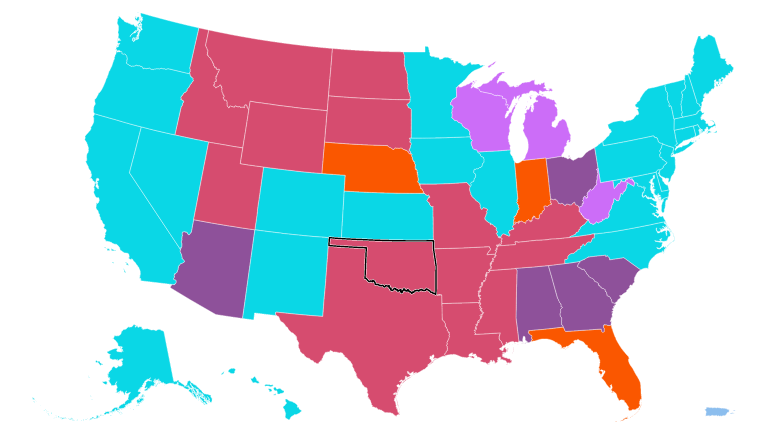
In at least 15 states abortion will be illegal. Most of these states — across the South, the Midwest and the Mountain West — have “trigger” laws in place that will now ban the procedure. The new laws will take effect within a few days in some places, and within a month in others.
The 15 states that are now expected to enact an outright ban on abortion are Alabama, Arkansas, Idaho, Kentucky, Louisiana, Mississippi, Missouri, North Dakota, Oklahoma, South Dakota, Tennessee, Texas, Utah, West Virginia and Wyoming.
Three other states — Georgia, Ohio and South Carolina — are likely to ban abortions after the sixth week of pregnancy. Two other states — Arizona and Florida — have passed 15-week bans this year.
That is a total of 20 states banning or limiting abortion within the first trimester or early in the second.
But others may join them. Iowa currently limits abortion after 22 weeks, and this month the state’s highest court said there is no right to abortion in Iowa’s Constitution. Republican lawmakers in the state are likely to try now to ban the procedure.
Abortion rights advocates and anti-abortion activists outside the U.S. Supreme Court on Tuesday. (Bill Clark/CQ-Roll Call, Inc via Getty Images)
And so there are about 20 states, and the District of Columbia, where abortion is likely to remain widely available — and fairly well along into a pregnancy.
President Biden, a supporter of abortion rights, is limited in what he can do in response to the ruling. There are marginal changes he can make to expand access through the Food and Drug Administration and through Medicaid.
Conversely, the overall impact on abortion rates may not be as dramatic as anti-abortion activists might be hoping for, which is likely to lead to the next round of political skirmishes over the issue.
“Absolute bans in red states probably won’t have the effect that the right-to-life movement expects … especially if blue states step up abortion funding, and especially given the difficulty of eliminating access to abortion medication,” wrote Mary Ziegler, a historian and attorney who has written five books about abortion law and politics, including “Dollars for Life,” which was released this month. “The question becomes what happens then.”
“Some conservative lawmakers will likely respond by trying to stop interstate travel for abortion or fighting for a nationwide ban — steps designed to eliminate abortion in progressive states,” she wrote.
Anti-abortion protesters outside the Supreme Court on June 13. (Valerie Plesch/Bloomberg via Getty Images)
Last December, when the Supreme Court heard oral arguments in the Dobbs case, Ziegler made the point even more sharply: “The right-to-life movement is aiming for the recognition of personhood and the outlawing of every abortion, nationwide. Roe is just the beginning,” she said then.
However, Justice Brett Kavanaugh signaled during those arguments that he does not believe the court can enact a nationwide ban. Kavanaugh, who was confirmed to the court in 2018, described the state of Mississippi as arguing that “because the Constitution is neutral, that this court should be scrupulously neutral on the question of abortion.”
In his concurring opinion in the court’s final decision, Kavanaugh made this point even more explicitly.
“Because the Constitution is neutral on the issue of abortion, this Court also must be scrupulously neutral. The nine unelected Members of this Court do not possess the constitutional authority to override the democratic process and to decree either a pro-life or a pro-choice abortion policy for all 330 million people in the United States,” Kavanaugh wrote.
Since Chief Justice John Roberts wrote his own concurring opinion saying he supported a 15-week ban but did not support throwing out a right to abortion entirely, the court does not currently have a majority of judges who might even be open to enacting a nationwide ban on abortion.
Then, in early May, a draft of the court’s opinion in Dobbs was leaked to a Politico reporter. Politico also reported that a majority of justices were prepared to rule that Roe and Casey were wrongly decided, and that states should decide the issue.
Justice Samuel Alito in 2019. (Alex Wong/Getty Images)
It was not known for sure, however, that the court’s ruling would emerge in the same form as the leaked draft. However, the final decision that was released was largely the same.
Roe, Alito wrote in the final opinion, was “egregiously wrong and on a collision course with the Constitution from the day it was decided.”
“The Constitution makes no reference to abortion, and no such right is implicitly protected by any constitutional provision,” he wrote.
The dissenting opinion said that under Roe and Casey, the court had “struck a balance” between Americans with “profoundly different views about the ‘moral[ity]’ of ‘terminating a pregnancy, even in its earliest stage.’”
“Today, the Court discards that balance. It says that from the very moment of fertilization, a woman has no rights to speak of,” the dissent said.
“Some States have enacted laws extending to all forms of abortion procedure, including taking medication in one’s own home. They have passed laws without any exceptions for when the woman is the victim of rape or incest. Under those laws, a woman will have to bear her rapist’s child or a young girl her father’s — no matter if doing so will destroy her life.
“… Most threatening of all, no language in today’s decision stops the Federal Government from prohibiting abortions nationwide, once again from the moment of conception and without exceptions for rape or incest,” the dissent said.
The liberal justices also expressed grave concern that other individual rights, to contraception and to “same-sex intimacy and marriage,” may be under threat from the conservative majority.
Now that the court has thrown Roe out, the American debate may become even more contentious, as the legal and political battles shift to a kaleidoscope of state legislatures and courts.
“This decision shows a branch of government that is so out of touch with the country and any sense of human dignity,” the WNBA players association said in a statement less than two hours after the Court officially ruled on Dobbs v. Jackson Women’s Health Organization.
Sue Bird tweeted that she was “gutted.” Her team, the Seattle Storm, said they were “furious and ready to fight.”
The WNBPA statement continued: “This ruling provides a treacherous pathway to abortion bans that reinforce economic, social and political inequalities and could lead to higher rates of maternal mortality while eviscerating rights to reproductive freedom for everybody.”
The NWSL players association also “strongly condemned” the decision — “a decision that effectively takes away a person’s right to make decisions about their own body, a basic human right at the core of every aspect of life,” the NWSLPA said in a statement later Friday afternoon.
Megan Rapinoe delivers emotional response, call to action
Individual soccer players also spoke out against the ruling while in camp with the U.S. women’s national team. On a previously-scheduled Zoom call with reporters Friday afternoon, midfielder Lindsey Horan said she was “still a little bit shocked,” and called it a “step backwards for our country.”
Forward Megan Rapinoe, who was not originally slated to meet with reporters, asked to speak in light of the Court’s ruling, and wiped away tears as she described a “disheartening,” “infuriating” and “scary day.”
In an unscripted opening statement that lasted more than nine minutes, she stressed that the decision will hit various groups of marginalized women most forcefully.
“We know that this will disproportionately affect poor women, Black women, Brown women, immigrants, women in abusive relationships, women who have been raped, women and girls who have been raped by family members — [or] who, you know what, maybe just didn’t make the best choice,” she said.
“And that’s no reason to be forced to have a pregnancy. It will completely exacerbate so many of the existing inequalities that we have in our country. It doesn’t keep not one single person safer. It doesn’t keep not one single child safer, certainly. And it does not keep one single — inclusive term — woman safer. We know that the lack of abortion [rights] does not stop people from having abortions, it stops people from having safe abortions.”
“I absolutely think gay rights are under attack, I absolutely think we will see legislation pop up state by state by state that will eventually come to this radical court. I have zero faith that my rights will be upheld by the court. I have faith in our country, and I have faith in people, and I have faith in the voters. And if you ever needed a f*cking motivation to vote, to get involved — quite literally, people’s lives depend on it. Actual lives. We’re talking life and death, and also your life in terms of, what does it mean to even be alive? If you can’t be your full self, what the f*ck is the point?”
She also explained why she doesn’t view the ruling as “pro-life,” pointing to other areas — such as healthcare — that will be affected by the Supreme Court’s decision.
“I just can’t understate how sad, and how cruel this is. I think the cruelty is the point. Because this is not pro-life by any means. This way of thinking, or political belief, is coupled with a complete lack of motivation around gun laws, it comes with pro-death penalty, it comes with anti-healthcare, anti-prenatal care, anti-childcare, anti-pre-K, anti-food assistance, anti-welfare, anti-education, anti-maternity leave, anti-paternity leave.
“This is not pro-life. And it’s very frustrating and disheartening, and frankly just infuriating to hear that be the reason that people are wanting to end abortion rights, and end this vital aspect of a woman’s — not only healthcare and general basic safety in this country, but her bodily autonomy, and the right to freedom, and the pursuit of happiness and liberty, is being assaulted in this instance. And it’s just incredibly disheartening.”
She concluded with a call to men who’ve “been silent” on abortion rights. “Stand up,” she said. “Say something.”
She pointed out that the decision was made by a majority-male court, and that the many systems and laws that discriminate against women in the U.S. were created by men.
“You are allowing a violent and consistent onslaught on the autonomy of women’s bodies, on women’s rights, on women’s minds, on our hearts, on our souls,” Rapinoe said when asked what her message to men, as a monolith, would be. “We live in a country that forever tries to chip away at what you have enabled, at what you have been privileged enough to feel your entire life.
“You also have the opportunity to do better every single day. You have the opportunity to show up, make your voices heard, whether that’s in the workplace, on a media zoom, in stadiums, in your family, the way that you vote. It is not a women’s issue. It is everyone’s issue.”
Other prominent athletes speak out on Supreme Court overturning Roe v. Wade
Several athletes past and present referenced the timing of the decision, one day after the 50th anniversary of Title IX, the watershed law that helped spark a decades-long women’s sports boom. “Yesterday we celebrated Title IX,” Orlando Magic guard Devin Cannady tweeted. “Today we tell these same women that they don’t have the freedom to make decisions about their own body.
“I’m sick for you, I stand with you,” Cannady wrote. “This country needs to be better, this sh*t is so backwards.”
Several teams and leagues responded with incisive statements, including the NBA and WNBA, which vowed to ensure access to reproductive health care for their employees.
“The NBA and WNBA believe that women should be able to make their own decisions concerning their health care and future, and we believe that freedom must be protected,” the joint statement reads. “We will continue to advocate for gender and health equity, including ensuring our employees have access to reproductive health care regardless of their location.”
In the NWSL, the Kansas City Current said they were “heartbroken.” The OL Reign said they “fiercely oppose the decision.” Gotham FC said it “vehemently objects to any rollback of Roe v. Wade and believes reproductive rights are human rights.”
The NWSL released its own statement, saying the ruling denies individuals “liberty and equality.”
“The Supreme Court’s ruling today denies individuals in this country the full liberty and equality that is the cornerstone of a just society. Reproductive rights are human rights. Until every individual has the same freedoms as their neighbor, our work is not done. We will continue to make our voices heard. The NWSL is more than just a soccer league; we are a collective who will stand up every day for what is right.”
While most strong statements came from women’s leagues and teams, the Seattle Sounders of MLS said they “believe in the right to autonomy over our bodies, and the right to choose.” Their goalkeeper, Stefan Frei, tweeted that “our country is actively moving in the wrong direction.”
Orlando City, in a joint statement with the NWSL’s Orlando Pride, said that this autonomy, and access to safe reproductive healthcare, were “basic, nonnegotiable human rights, and our club deeply objects to today’s Supreme Court decision.”
“Today’s reversal of Roe v. Wade is one that will not only put many at risk, disproportionately those in BIPOC and underserved communities, but is one that opens the door for future discrimination and civil rights violations of other marginalized groups,” the two Orlando clubs continued.
“Defending human rights is a battle that we will continue to fight, both for those impacted today, and for those who may be targeted in the future.”
Abortion protections have been in place since the court’s decision in 1973, and polls show roughly two-thirds of Americans think it should stay that way. Yet the explosive opinionin Dobbs v. Jackson Women’s Health Organization invalidates Roe and leaves abortion laws up to states. About half of states plan to partially or fully ban abortions, which is bound to generate storms of protest.
There will also be stark financial implications for many women who want to end a pregnancy but find they can’t. “What we’re going to see is a shock to poverty and inequality for poor women, Black women, young women in the Deep South,” economist Caitlin Myers told Yahoo Finance in a recent interview, before the June 24 decision came down. “What we will see are poor, vulnerable women, many of whom are already parenting, having children that they do not feel prepared for and suffering financial shocks as a result.”
Myers organized more than 150 economists and other researchers who filed an amicus brief in Dobbs v. Jackson, which began in Mississippi in 2018 when the state legislature banned abortions after 15 weeks of pregnancy. There were prompt legal challenges, and the Supreme Court heard the case last December. With the court overturning Roe, it won’t make abortion illegal everywhere, but will leave the decision up to states. Some states are ready to impose bans much stricter than the Mississippi law.
While there are obvious moral arguments against abortion, it may also be morally dubious to ban abortions and effectively impose financial hardship on reluctant mothers. Research shows that abortion protections afforded by Roe have helped reduce teenage motherhood by 34% and teen marriage by 20%. That has allowed more young women to complete high school, attend college and establish professional careers. People who go further in school have higher lifetime earnings, in general. By most metrics, the improved outcomes are more pronounced for Black women than for whites, which suggests Black women would suffer more from a new set of bans than white women would.
“Some of the financial instability that these women experience, it is severe, it can last for years,” Myers told Yahoo Finance. “We do see some evidence of recovery, particularly at about five years out. But then there are other components of the shock, for instance, shocks to the probability that these women complete their desired education, that they finish high school, that they finish college, that they enter a professional occupation. Those shocks appear to be much more permanent. And they can have long run effects on the probability that women live in poverty.”
That may not sound like a lot, but women who can’t afford to travel out of state are generally in tough financial circumstances already. They’re unlikely to be able to afford $10,000 or more per year for child care so they can work after the child is born. They’re at risk of falling into or remaining in the poverty trap Roe has helped some women avoid.
States that do enact abortion bans can put programs into place that would help keep new mothers afloat, such as child-care and health-care subsidies and more generous welfare programs. But they seem unlikely to, given that virtually all the states likely to enact bans have Republican governors or legislatures that tend to oppose well-funded social programs. Of the 12 states that have refused to expand Medicaid, as the Affordable Care Act allows them to do, for instance, 10 also have abortion bans on the books or in the works, including Florida and Texas, the most populous anti-abortion states. Abortion opponents who think they’ve won a historic victory should consider the women who will lose from the decision.
John Mellencamp slams politicians for not doing more to prevent gun violence: ‘They don’t give a f*** about our children’
Suzy Byrne, Editor Yahoo Entertainment – June 22, 2022
John Mellencamp is slamming lawmakers for not doing more to stop school shootings.
The “Small Town” singer criticized politicians over their response to gun violence, saying they “don’t give a f*** about our children.”
“Only, in America, can 21 people be murdered and a week later be buried and forgotten, with a flimsy little thumbnail, a vague notion of some sort of gun control law laying on the senators’ desks,” the 70-year-old musician and painter wrote on Twitter Tuesday, referring to the Uvalde, Texas, school shooting on May 24.
“What kind of people are we who claim that we care about pro-life?” he continued. Just so you know, anyone that’s reading this… politicians don’t give a f*** about you, they don’t give a f*** about me, and they don’t give a f*** about our children.”
He concluded, “So, with that cheery thought in mind, have a happy summer, because it will be just a short time before it happens again.”
Mellencamp’s comments came on Tuesday as the Senate voted to advance a new bipartisan gun control bill. It would enhance background checks and give authorities up to 10 business days to review the juvenile and mental health records of gun purchasers under 21. Funding would also go to help states implement red flag laws as well as to expand mental health resources in communities and schools and boost school safety, among other things.
The Uvalde shooter legally purchased an AR-15-style rifle on May 17 — one day after he turned 18. Three days later, he purchased a second rifle, and in between bought 375 rounds of ammunition. On May 24, he killed19 fourth graders and two teachers at Robb Elementary. The gunman also shot his grandmother in the face.
Mellencamp has long spoken out against gun violence, joining 200 other artists and music execs in 2016 in calling for gun reform in the wake of the Orlando nightclub shooting. Following the Uvalde shooting, he said on MSNBC’s The Beat last week that news outlets should start showing the carnage of school shootings to open the eyes of those resisting reform.
“I don’t know if you’re old enough, but I remember when Vietnam first started, and it was a conversation on the news,” the father of five said. “But then, when they started showing dead teenagers, people did something about it, and the country united. I think that we need to start showing the carnage of these kids who have died in vain… If we don’t show it, then they’re dying in vain, because they’re just going to pass more bulls*** laws like they’re trying to get through now. Show us. Let the country see what a machine gun can do to a kid’s head.”
One Surprising Theory Why the Philippines Has Very Few Mass Shootings—Despite Easy Access to Lots of Guns
Chad de Guzman / Manila – June 15, 2022
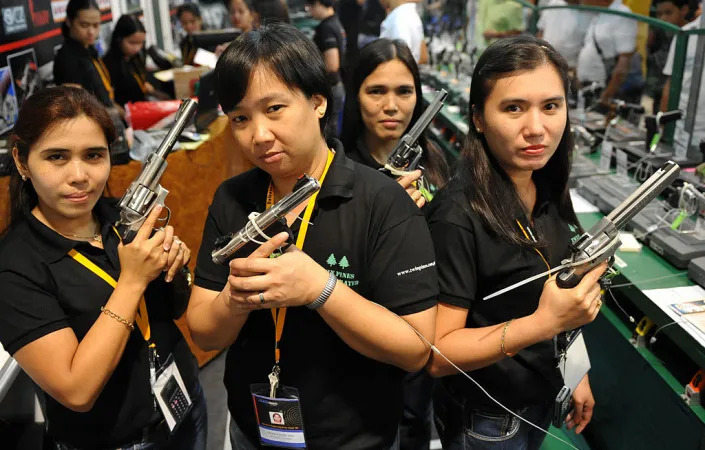
Shop assistants pose with various handgu
Shop assistants pose with various handguns at the Defense and Sporting Arms show at a shopping mall in Manila on July 16, 2009. Credit – TED ALJIBE/AFP via Getty Images
Mass shootings are a result of a confluence of factors, but at the heart of the problem are guns—of which the Philippines has plenty. Firearms are sold openly in malls, and almost anyone can carry them, even priests and accountants.
Fixers can reportedly take care of formalities standing in the way of gun ownership, such as drug and psychological tests, and there are estimated to be some four million firearms in the nation of 110 million people. Hundreds of thousands of weapons are illegally owned. Poverty, corruption, crime, and outgoing President Rodrigo Duterte’s brutal war on drugs have left deep social scars.
No consensus has been reached in the Philippines over what sets a mass shooting apart from other gun deaths, but indiscriminate slayings are uncommon. When eight people died and 11 were injured after a drunk gunman began firing wildly in the southern province of Cavite back in 2013, the tragedy was notable for its sheer rarity.
To be clear, homicides involving firearms are a fact of life in the Philippines. Hitmen can be hired for as little as $300. In fact, the Philippines is one of the deadliest places in Asia when it comes to firearm homicides. The country saw over 1,200 intentional killings using firearms in 2019. This meant guns killed one in every 100,000 people in the Southeast Asian country—one of the highest rates in Asia. (In 2020, the comparable figure for the U.S. is four.)
Elections can be particularly bloody times, with lethal attacks on poll officers and political rivals. One of the country’s worst killings, the 2009 Maguindanao massacre of 58 people, took place during a gubernatorial election. But it was a political atrocity. Shootings not related to politics or crime are uncommon—and there has been nothing as extreme as Columbine, Sandy Hook, or Uvalde.
“I think it’s just a matter of time,” says Gerry Caño, Dean of the School of Criminology and Criminal Justice at Cagayan de Oro College. “I think our authorities and the public safety practitioners are just waiting for that time to happen, considering that Philippine culture is greatly influenced by the West, particularly the United States.”
For now, though, powerful social factors continue to have a restraining effect on indiscriminate violence. Philippine academic Raymund Narag, a criminology associate professor at Southern Illinois University and a former prisoner himself, says mass shootings in his native country are in part deterred by hiyâ, a Tagalog word meaning shame or embarrassment. Avoidance of hiyâ, and sparing one’s family and community from it, is often described as a core Philippine value.
“It reflects on you, and reflects on your family,” Narag says. “When I was jailed, our entire clan felt humiliated.”
Visitors view displayed firearms during the Tactical, Survival and Arms Expo in Pasay City, the Philippines, Nov.15, 2019.Rouelle Umali/Xinhua via Getty
Gun culture in the Philippines
While the right to bear arms isn’t enshrined in the nation’s constitution, as it is in the United States, there is no denying the Philippine love of guns.
When the U.S. colonized the Philippines in the early 1900s, private citizens were allowed to own high-powered guns for “lawful purposes” and hunting. After Ferdinand Marcos declared martial law in 1972, owners were limited to one low-powered rifle and a pistol or revolver—and both had to be licensed. But in 2000, President Joseph Estrada lifted these limits and allowed citizens to possess as many guns as they wanted, of any type and caliber.
A 2013 law set down qualifications for owning guns and carrying them in public. Licensed gun owners had to be 21 years old and take a firearm safety seminar, among other requirements. Depending on their license, most owners could possess up to 15 handguns, rifles and shotguns (collectors are allowed more than 15). Licenses were issued for as long as 10 years.
Before he was president, Estrada was a gun-wielding hero in action movies—a genre beloved of Filipinos for playing up machismo and depicting shootouts as legitimate forms of defense in a crime-riddled country. The action movie craze certainly helped Filipinos embrace gun culture.
In some of the country’s poorest communities, guns became a common sight among warring gangs, who sourced low-priced firearms from illegal sellers. Shooting clubs opened for those with more money and an interest in shooting for sport. Many affluent Filipinos took up gun collecting, while the wealthiest citizens began enthusiastically arming their bodyguards.
But despite the glorification of firearms, when gun violence takes place, the victims are rarely random bystanders in movie theaters or shopping malls. Almost a quarter of the Philippine population falls below the poverty line and “the money or the reward seems to be the best motivating factor” in many homicide cases involving firearms, Caño says.
In January, a provincial hitman admitted to committing his crime in exchange for $500 to help his child, who was suffering from meningitis. In April, another gunman confessed to killing a mechanic for $400.
Displaced children playing with wooden toy guns inside a temporary shelter area in Mamasapano, Maguindanao, on August 22, 2018, in Mamasapano, Maguindanao, southern Philippines.Jes Aznar/Getty Images
How hiyâ plays a role in social control
Narag says the strong ties of Philippine kinship mean troubled individuals are more likely to be identified before they become mass shooters. He contrasts that with the situation in the U.S., where he presently lives and teaches.
“Here, if you have problems, you have to go to a health professional,” he tells TIME. “You’ll divulge everything there. You don’t talk to your neighbors—sometimes you don’t talk to your own parents—because [there isn’t] an engaged culture where one’s problem is everyone’s problem.”
Jose Antonio Clemente, a professor of social psychology at the University of the Philippines, says community is everything. “At an early age, we are trained to give importance to our families and our relationships,” he says. “Maybe at some point we’re also taught to value our community, since there are a lot of communities that are very close-knit because of the high population density.”
National police do have mass shooting protocols in place. Authorities have also suggested an increased police presence on college campuses to deter insurgent groups from recruiting students. But it seems that ingrained values in the Philippines are restraining people from using guns indiscriminately.
Whether that is enough is up for debate. For now, however, hiyâ means you cannot “just start shooting people,” Narag says. “Because if that happens, you know the community won’t support you.”
Hellfire: The Uvalde Shooter Owned a Device That Makes AR-15s Even More Deadly
Tim Dickinson – June 15, 2022
US-TEXAS-GUNS-NRA – Credit: Patrick T. Fallon/AFP/Getty Images
“Unleashing ‘Hell-Fire.’”
It pictures a gunman, wearing a skull mask with blacked out eyes, who unloads an AR-15 that is sending spent cartridges flying from its ejection port. The ad copy reads: “All you do is squeeze the trigger and shoot at rates up to 900 rpm” — or rounds per minute.
The sales pitch is for a hellfire trigger device, a gun accessory that allows a semi-automatic rifle to fire at rates similar to machine gun. Although the physics behind the device are nearly identical to that of a bump-stock — now illegal under federal law — hellfires remain cheap and easy to acquire. Including, evidently, by a teenager bent on mass murder.
The gunman in the Uvalde massacre had purchased a hellfire device, which was recovered from one of the classrooms where the massacre took place, according to investigative documents reviewed by the New York Times. Federal authorities reportedly don’t believe the device was used in the attack. But had it been deployed, the carnage at Robb Elementary School — where 19 children and two teachers were murdered — might have been, unimaginably, worse.
Even in the trigger-happy US of A, machine guns are supposed to be illegal. A central fixture of federal firearms law since the days of Al Capone’s 1930s is that fully-automatic weapons are too powerful to be in civilian hands. Yes, modern consumers can buy high-powered weapons, like AR-15-style rifles, that are nearly identical to guns used in the U.S. military, but these guns fire only one round with each trigger pull.
But in the poorly regulated market of fire-arms accessories, a small but dedicated band of companies have pushed the legal envelope. They’ve engineered and marketed devices that circumvent the limitations of semi-automatic weapons, turning rifles into bullet hoses that can fire hundreds of rounds per minute.
After a 2017 massacre in Las Vegas, the Bureau of Alcohol, Tobacco and Firearms — better known as ATF — outlawed one class of these accessories, known as bump stocks, by classifying them as machine guns. But they didn’t touch hellfire triggers.
That differential treatment has no logic, insists Josh Sugarmann, Executive Director of the Violence Policy Center. When it comes to hellfires and similar “trigger activators,” he says, “ATF has been very, very lenient in its interpretation of federal law.”
Screenshot of an ad for a Hellfire style device – Credit: Youtube
Youtube
“Bump firing without the stock”
A hellfire device and a bump-stock both rely on the same physics to mimic fully automatic fire. They absorb the energy from the recoil of a single gunshot, then rebound the weapon slightly forward, activating the trigger against a shooter’s otherwise stationary finger — again and again and again and again and again.
With a bump-stock, this rebound is generated in the butt of the rifle pressed against the shooter’s shoulder. A hellfire device attaches to the pistol grip and rebounds, instead, against the shooter’s palm.
ATF itself recognized the similarity of the devices, explicitly comparing them in 2013 correspondence with a congressman, back when both devices were deemed legal. Gun enthusiasts today praise the hellfire as offering “bump firing without the stock.” (ATF did not answer questions from Rolling Stone about why the devices are treated differently.)
From San Francisco to Waco
Hellfires are not new. In fact, the trigger devices have dark history. In a 1993 mass shooting in a San Francisco high rise, the gunman used hellfire triggers, attached to a pair of assault pistols with 50-round magazines; he killed eight, wounded six, and then took his own life. Hellfire triggers were also believed to have been in use at David Koresh’s militarized Waco, Texas, cult compound.
These days, the trigger devices are cheap, and marketed with disturbing slogans and imagery. It’s not immediately clear what device the Uvalde shooter purchased. But there are many models available online. At one retailer, just $29.95 can get you the “Classic” hellfire “made infamous by David Koresh and the Branch Davidians in Waco,” according to the sales pitch.
The “Gen II” model offers “recoil assist technology” to enable “one handed operation,” and will set you back $59.95. A new “Stealth” model, meanwhile, is for sale at just $39.95, and can be installed “invisibly within your grip on any AR15 style rifle” and be “activated or deactivated in seconds.”
Banning Bump-Stocks
It was the Trump administration, surprisingly, that banned bump-stocks — after they were used to catastrophic effect in a 2017 Las Vegas shooting. In that attack, a gunman fired bump-stock-equipped AR-15s from the 32nd floor of the Mandalay Bay hotel. The spray of more than 1,000 rounds killed 60 people and wounded more than 400 at a concert festival below.
Without the need of new legislation, the ATF issued a rule in 2019 outlawing bump stocks. The devices, the regulation states, “convert an otherwise semiautomatic firearm into a machinegun” by harnessing “the recoil energy… [to] continue firing without additional physical manipulation of the trigger by the shooter.” (The regulation has, at least so far, held up in court)
Despite operating on the same principle, hellfire triggers remain street legal — putting machine gun firepower in the hands of untrained amateurs. The rate of fire enabled by these devices is so high, in fact, that the more expensive hellfire models actually offer features to slow down the firing cycle “to save ammo!”
Hellfire triggers can be finicky to master — which may be why the young Uvalde shooter ultimately didn’t deploy his. And it’s impossible to know whether automatic fire would have led to even more devastation at Robb Elementary School. (The shooter was left unimpeded for more than an hour by dithering local police; the gunman was not pressed for time.)
Marketing Lethality
The “most important” takeaway from the hellfire purchase is what it reflects about “the mindset of the shooter,” argues Sugarmann. “He had done everything he could, in his mind, to find the most lethal combination of weaponry and accessories when he planned the attack.”
Such lethality is — not coincidentally — the top selling point of a the modern firearms industry, which pitches its customers on military-grade precision and firepower. That includes the maker the Uvalde shooter’s rifle, Daniel Defense, whose Georgia headquarters are located at “101 Warfighter Way.”
The Uvalde shooter simply found, in the hellfire, a low-cost accessory that promised to unlock his weapon’s full military pedigree, by mimicking the automatic fire reserved for soldiers.
Sugarmann insists the ATF has the authority to send a warning to the industry by targeting hellfire makers, who are small operators and operate at the margins of the industry. “They’re the bottom feeders,” he says. “If you took action against one of them, it would send a message throughout the industry that ATF has regulatory role that it can use to the to protect public safety.”
The Violence Policy Center founder insists that the agency “could move against them, the way that they moved against bump-stocks.” But at least so far, Sugarmann laments, “the agency has chosen not to.”
Indeed, the text of ATF’s own bump-stock regulation notes that public commenters argued the broad language could be read to encompass “Hellfire trigger mechanisms” and similar devices. The agency’s response? Simply that it “disagrees that other firearms or devices… will be reclassified as machineguns under this rule.”
Russia’s Oil Revenue Soars Despite Sanctions, Study Finds
Hiroko Tabuchi – June 13, 2022
Yang Mei Hu oil products tanker owned by COSCO Shipping gets moored at the crude oil terminal Kozmino on the shore of Nakhodka Bay near the port city of Nakhodka, Russia June 13, 2022. REUTERS/Tatiana Meel (Tatiana Meel / reuters)
Russia’s invasion of Ukraine triggered global condemnation and tough sanctions aimed at denting Moscow’s war chest. Yet Russia’s revenues from fossil fuels, by far its biggest export, soared to records in the first 100 days of its war on Ukraine, driven by a windfall from oil sales amid surging prices, a new analysis shows.
Russia earned what is very likely a record 93 billion euros in revenue from exports of oil, gas and coal in the first 100 days of the country’s invasion of Ukraine, according to data analyzed by the Center for Research on Energy and Clean Air, a research organization based in Helsinki. About two-thirds of those earnings, the equivalent of about $97 billion, came from oil, and most of the remainder from natural gas.
“The current rate of revenue is unprecedented, because prices are unprecedented, and export volumes are close to their highest levels on record,” said Lauri Myllyvirta, an analyst who led the center’s research.
Fossil fuel exports have been a key enabler of Russia’s military buildup. In 2021, revenue from oil and gas alone made up 45% of Russia’s federal budget, according to the International Energy Agency. The revenue from Russia’s fossil fuel exports exceeds what the country is spending on its war in Ukraine, the research center estimated, a sobering finding as momentum shifts in Russia’s favor as its forces focus on important regional targets amid a weapons shortage among Ukrainian soldiers.
Ukrainian officials again called on countries and firms to halt their trade with Russia completely.
“We’re asking the world to do everything possible in order to cut off Putin and his war machine from all possible financing, but it’s taking much too long,” Oleg Ustenko, an economic adviser to President Volodymyr Zelenskyy of Ukraine, said from Kyiv about President Vladimir Putin of Russia.
Ukraine has also been tracking Russia’s exports, and Ustenko described the research center’s numbers as seeming on the conservative side. Still, the underlying finding was the same, he said: Fossil fuels continue to fund Russia’s war.
“You can stop importing Russian caviar and Russian vodka, and that’s good, but definitely not enough. You need to stop importing Russian oil,” he said.
Though Russia’s fossil fuel exports have started to fall somewhat by volume, as more countries and companies shun trading with Moscow, surging prices have more than canceled out the effects of that decline. The research found Russia’s export prices for fossil fuels have been on average around 60% higher than last year, even accounting for the fact that Russian oil is fetching about 30% below international market prices.
Europe, particularly, has struggled to wean itself from Russian energy, even as many countries send military aid to Ukraine. The European Union made most progress on reducing its imports of natural gas from Russia, buying 23% less in the first 100 days of the invasion than the same period the previous year. Still, income at Gazprom, Russia’s state-owned gas giant, remained about twice as high as the year before, thanks to higher gas prices, the Center for Research on Energy and Clean Air found.
The EU also reduced its imports of Russian crude oil, which declined 18% in May. But that dip was made up by India and the United Arab Emirates, leading to no net change in Russia’s oil export volumes, the research showed. India has become a significant importer of Russian crude oil, buying 18% of the country’s exports over the 100-day period.
The United States has made a dent in Russia’s earnings, banning all Russian fossil fuel imports. Still, the United States is importing refined oil products from countries like the Netherlands and India that most likely contain Russian crude, a loophole for oil from Russia to make its way to the U.S.
Overall, China was the largest importer of Russian fossil fuels over the 100-day period, edging out Germany, Italy and the Netherlands. China imported the most oil; Japan was the top purchaser of Russian coal.
Stricter bans are coming. Late last month, the EU agreed to an embargo that will cover roughly three-quarters of Russian oil shipped to the region, though that will not be enforced for six months. Britain has said it will also phase out imports of Russian oil by year’s end. But Hungary, the Czech Republic and Slovakia, which receive Russian oil via pipelines, remain exempt. European and U.S.-owned ships also continue to transport Russian oil.
Europe is also speeding up its transition away from fossil fuels altogether. A new EU target aims to increase the region’s share of electricity from renewable forms of energy to 63% by 2030, up from a previous expected target of 55%.
U.S. Treasury Secretary Janet Yellen said last week that Washington was in talks with its European allies about forming a cartel that would set a cap on the price of Russian oil roughly equal to the price of production. That would trim Russia’s fossil fuel revenues while also keeping Russian oil flowing to global markets, stabilizing prices and fending off a global recession, she told the Senate Finance Committee.
Ustenko said he would welcome such a move as a temporary measure until full embargoes can be imposed. He also suggested that countries should take the difference between global prices and the capped price on Russian oil and pay it into a fund to aid Ukrainian reconstruction.
“Then we’ll be able to cut off Russians from much of their financing, and almost immediately,” he said.
Mark Meadows Burned Papers After Talk About Tossing Election Results, Ex-Aide Says
Mary Papenfuss – June 12, 2022
Former White House chief of staff Mark Meadows destroyed documents after a meeting about overturning the results of the 2020 presidential election, a former aide said Sunday on CNN.
Alyssa Farah Griffin said a source with “first-hand knowledge” provided testimony to the House panel probing the insurrection that Meadows burned papers in his office after meeting with Rep. Scott Perry (R-Penn.) about challenging the election.
“I expect to see that come out in testimony” before the House committee investigating the insurrection, she added.
Another former Meadows aide, Cassidy Hutchinson, said she watched Meadows burn the documents in her account before House select committee investigators, Politico reported last month.
The meeting with Perry occurred an unspecified number of weeks after the election while Trump and supporters were desperately casting around for ways to change the vote, according to Politico.
Hutchinson also told the panel that Meadows was warned of possible violence on Jan. 6, 2021, but it was unclear what action, if any, he took in response.
Griffin may have been referring to Cassidy as her source with first-hand knowledge of the destruction of documents by Meadows. Hutchinson is expected to testify in the ongoing televised hearings held by the House panel.
Perry was pressuring Meadows to take action regarding the election, according to his emails to Meadows released by the House committee.
“Mark, just checking in as time continues to count down. 11 days to 1/6 and 25 days to inauguration. We gotta get going!” he wrote to Meadows late last year in one of the messages.
Members of white nationalist group charged with planning riot at Idaho pride event
Joseph Ax – June 11, 2022
Group of men arrested after they were found in the rear of a U Haul van in Coeur d’Alene
(Reuters) – Police in northwest Idaho arrested more than two dozen members of a white nationalist group on Saturday and charged them with planning to stage a riot near a LGBTQ pride event, authorities said.
Lee White, police chief in the city of Coeur D’Alene, told reporters 31 members of Patriot Front face misdemeanor charges of conspiracy to riot and additional charges could come later.
A local resident spotted the men, wearing white masks and carrying shields, getting into a U-Haul truck and called police, telling the emergency dispatcher it “looked like a little army,” according to White. Police pulled the truck over about 10 minutes after the call.
Video taken at the scene of the arrest and posted online showed about 20 men kneeling next to the truck with their hands bound, wearing similar khaki pants, blue shirts, white masks and baseball caps.
Police recovered at least one smoke grenade and documents that included an “operations plan” from the truck, as well as shields and shin guards, all of which made their intentions clear, White said.
“They came to riot downtown,” he said.
The men come from at least 11 states, White said, including Texas, Colorado and Virginia.
Patriot Front formed in the aftermath of the 2017 white nationalist “Unite the Right” rally in Charlottesville, Virginia, when it broke off from another extremist organization, Vanguard America, according to the Southern Poverty Law Center, which tracks hate groups.
(Reporting by Joseph Ax; Editing by Daniel Wallis)