Listen to the audio of Bob Woodward’s interviews with Trump that made him think of the former president as an ‘unparalleled danger’ rather than simply incompetent
Hannah Getahun – October 23, 2022
Washington Post reporter Bob Woodward and former President Donald Trump.William B. Plowman/NBC NewsWire via Getty Images and Anna Moneymaker-Pool/Getty Images
Bob Woodward said he changed his mind about Trump after re-listening to his own interviews.
Woodward previously described the former president as the “wrong man” for the presidency.
But “Trump is an unparalleled danger,” Woodward wrote on Sunday in the Washington Post.
Ahead of the release of his never-before-heard audio interviews with former President Donald Trump, Watergate journalist Bob Woodward wrote that after listening to the unreleased tapes again, he concluded that Trump was an “unparalleled danger” rather than just the “wrong man” to be president.
“The Trump Tapes: Bob Woodward’s Twenty Interviews with President Trump,” set to be released Oct. 25, is an audiobook of previously unreleased conversations between the veteran journalist and the businessman-turned-politician.
In an op-ed for the Washington Post released Sunday, which includes previously unreleased snippets of “The Trump Tapes,” Woodward wrote that he had concluded his 2020 book on Trump by calling him “the wrong man for the job.”
Woodward now says his assessment of Trump did not accurately describe the former president.
“Two years later, I realize I didn’t go far enough. Trump is an unparalleled danger,” Woodward wrote.
He continued: “When you listen to him on the range of issues from foreign policy to the virus to racial injustice, it’s clear he did not know what to do. Trump was overwhelmed by the job. He was largely disconnected from the needs and leadership expectations of the public and his absolute self-focus became the presidency.”
Woodward explains in his piece for the Post that he decided to release the tapes to capture Trump’s personality in a way that the written word couldn’t. “Trump’s voice magnifies his presence,” Woodward said.
The tapes allow listeners to hear Trump repeatedly interrupting and at times mocking Woodward as they speak about the most pressing policy issues of his presidency, including his handling of the COVID-19 pandemic, which Woodward described as Trump’s “greatest failure.”
In clips of the Trump Tapes previously released by CNN, Trump can be heard talking about his admiration for strongmen leaders like Russian President Vladimir Putin and North Korean President Kim Jong Un. In another clip, Trump also bragged to Woodward that no other president was “tougher” than him when faced with impeachment.
A representative for Trump did not immediately respond to Insider’s request for comment.
US politics’ post-shame era: how Republicans became the party of hate
David Smith in Washington – October 23, 2022
Photograph: Jeff Swensen/Getty Images
Republicans were in trouble. Mitt Romney, their US presidential nominee, had been crushed by Barack Obama. The party commissioned an “autopsy” report that proposed a radical rethink. “If we want ethnic minority voters to support Republicans,” it said, “we have to engage them and show our sincerity.”
Ten years after Romney’s loss, Republicans are fighting their first election since the presidency of Donald Trump. But far from entering next month’s midterms as the party of tolerance, diversity and sincerity, critics say, they have shown itself to be unapologetically the party of hate.
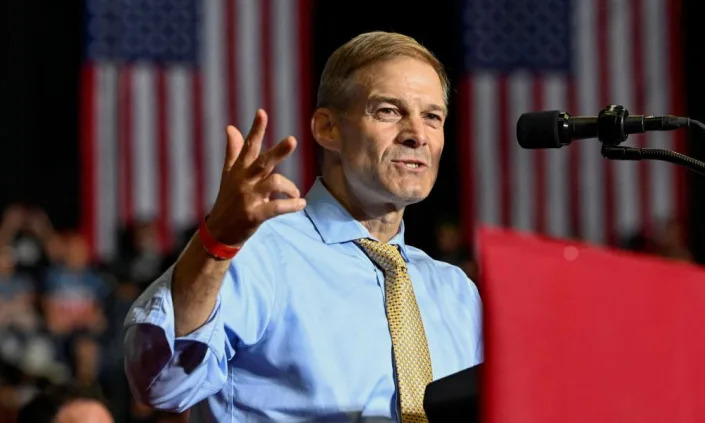
Perhaps nothing captures the charge more eloquently than a three-word post that appeared on the official Twitter account for Republicans on the House of Representatives’ judiciary committee – ranking member Jim Jordan – on 6 October. It said, simply and strangely: “Kanye. Elon. Trump.”
The first of this unholy trinity referred to Ye, the rapper formerly known as Kanye West, who has recently drawn fierce criticism for wearing a “White Lives Matter” T-shirt at Paris fashion week and for antisemitic messages on social media, including one that said he would soon go “death con 3 on JEWISH PEOPLE”.
The second was billionaire Elon Musk, who published a pro-Russian peace plan for Ukraine and denied reports that he had been speaking to Russian autocrat Vladimir Putin.
The third was former president Donald Trump, who wrote last weekend that American Jews have offered insufficient praise of his policies toward Israel, warning that they need to “get their act together” before “it is too late!” The comment played into the antisemitic prejudice that American Jews have dual loyalties to the US and Israel.
It was condemned by the White House as “insulting” and “antisemitic”. But when historian Michael Beschloss tweeted: “Do any Republican Party leaders have any comment at all on Trump’s admonition to American Jews?”, the silence was deafening.
Jim Jordan, who recently tweeted ‘Kanye. Elon. Trump’, speaks at a rally held by Trump in Youngstown, Ohio, in September. Photograph: Gaelen Morse/Reuters
Republicans have long been accused of coded bigotry and nodding and winking to their base. There was an assumption of rules of political etiquette and taboos that could not be broken. Now, it seems, politics has entered a post-shame era where anything goes.
Jared Holt, an extremism researcher at the Institute for Strategic Dialogue thinktank, said: “The type of things they would say in closed rooms full of donors they’re just saying out in the open now. It’s a cliche but I always remember what I heard growing up which is, when people tell you who they are, you should believe them.”
The examples are becoming increasingly difficult to downplay or ignore. Earlier this month Tommy Tuberville, a Republican senator for Alabama, told an election rally in Nevada that Democrats support reparations for the descendants of enslaved people because “they think the people that do the crime are owed that”. The remark was widely condemned for stereotyping African Americans as people committing crimes.
And Marjorie Taylor Greene, a congresswoman from Georgia, echoed the rightwing “great replacement” theory when she told a rally in Arizona: “Joe Biden’s 5 million illegal aliens are on the verge of replacing you, replacing your jobs and replacing your kids in school and, coming from all over the world, they’re also replacing your culture.”
Such comments have handed ammunition to Democrats as they battle to preserve wafer thin majorities in the House and Senate. Although the party is facing electoral headwinds from inflation, crime and border security, it has plenty of evidence that Trump remains dominant among Republicans – a huge motivator for Democratic turnout.
Indeed, Trump did more than anyone to turn the 2013 autopsy on its head. In his first run for president, he referred to Mexicans as criminals, drug dealers and rapists and pledged to build a border wall and impose a Muslim ban. Opponents suggest that he liberated Republicans to say the unsayable, rail against so-called political correctness and give supporters the thrill of transgression.
Antjuan Seawright, a senior adviser to the Democratic Congressional Campaign Committee, said: “He has been the creator of the permission slip and the validator of the permission slip. For many of them, he is their trampoline to jump even further with their right wing red meat racial rhetoric.”
Beyond Republicans’ headline-grabbing stars, the trend is also manifest at the grassroots. In schools, the party has launched a sweeping assault on what teachers can say or teach about race, gender identity, LGBTQ+ issues and American history. An analysis by the Washington Post newspaper found that 25 states have passed 64 laws reshaping what students can learn and do at school over the past three academic years.
There are examples of the new extremism all over the country. The New York Republican Club will on Monday host an event with Katie Hopkins, a British far-right political commentator who has compared migrants to cockroaches and was repeatedly retweeted by Trump before both were banned by the social media platform.
In Idaho, long a deeply conservative state, Dorothy Moon, the new chairwoman of the state Republican party, is accused of close associations with militia groups and white nationalists. Last month she appeared on Trump ally Steve Bannon’s War Room podcast to accuse the state’s Pride festival and parade of sexualising children.
A recent headline in the Idaho Capital Sun newspaper stated: “Hate makes a comeback in Idaho, this time with political support.”
Michelle Vincent, a senior adviser to Democratic gubernatorial candidate Stephen Heidt, noted the such currents have long been a problem in Idaho but said: “Trump made hate OK. He made bad behavior seem OK because of the extremes of what he was doing. They started emulating him. People were were abused here during Black Lives Matter protests. We have so much militia here and they are out of control.”
In many cases, the naked bigotry goes hand in hand with Trump’s “big lie” that the last election was stolen from him due to widespread voter fraud. A New York Times investigation found that about 70% of Republican midterm candidates running for Congress in next month’s midterm elections have either questioned or flat-out denied the results of the 2020 election.
They can now count on support from Tulsi Gabbard, a former Democratic congresswoman and presidential candidate who in 2017 met with Syrian dictator Bashar al-Assad and dismissed his entire opposition as “terrorists” Gabbard this week defected to the Republicans and campaigned for Kari Lake, the Republican nominee for governor of Arizona and an unabashed defender of the big lie.
Another election denier is Doug Mastriano, a political novice running for governor of Pennsylvania with the help of far-right figures. He was outside the US Capitol during the January 6 insurrection and photographed watching demonstrators attacking police before he supposedly walked away.
Mastriano has repeatedly criticised his opponent, attorney general Josh Shapiro, for attending and sending his children to what he brands a “privileged, exclusive, elite” school, suggesting that this demonstrates Shapiro’s “disdain for people like us”. It is a Jewish day school where students receive both secular and religious instruction.
After a long courtship, Trump himself has in recent months begun embracing the antisemitic conspiracy theory QAnon in earnest. In September, using his Truth Social platform, the former president reposted an image of himself wearing a Q lapel pin overlaid with the words “The Storm is Coming”. A QAnon song has been played at the end of several his campaign rallies.
Ron Klein, chair of the Jewish Democratic Council of America, said: “It’s very unfortunate that the Republican party is either silent and complicit in this antisemitic language that’s being put forward by Donald Trump and others that align with him. But it’s very indicative of a Republican party that does not want to take on rightwing extremists.”
Klein, a former congressman, added: “Some members of Republican party did use dog whistles and symbolic language to make their points about minorities, including the Jewish community, and that was very troubling. But the era of Donald Trump has just lifted the rock under which these people now feel it’s OK and even helpful for them to make these kinds of statements and use these kinds of words to gain political power and political stature, which is very troubling in our American political system.”
The 2013 autopsy now looks like a blip, an outlier, in half a century of Republican politics. Richard Nixon’s 1968 “law and order” message stoked racial fear and resentment in the south. Ronald Reagan demonised “welfare queens” in 1976 and, four years later, launched his election campaign with a speech lauding “states’ rights” near the site of the “Mississippi Burning” murders – seen by many as a nod to southern states that resented the federal government enforcing civil rights.
A political action committee linked to George HW Bush’s campaign in 1988 paid for an attack advert blaming Democratic rival Michael Dukakis for the case of Willie Horton, an African American convict who committed rape during a furlough from prison. Lee Atwater, Bush’s campaign manager, bragged that he would turn Horton into “Dukakis’s running mate”.
I don’t think Donald Trump made people more racist or antisemitic; I think he gave them permission to express it
Stuart Stevens, veteran Republican campaign strategist
The Atwater playbook is being deployed again in Senate midterm races as Republicans Ron Johnson of Wisconsin and Mehmet Oz of Pennsylvania run attack ads accusing their Democratic opponents, Mandela Barnes and John Fetterman, of being soft on crime, often with images of Black prison inmates.
Stuart Stevens, a veteran Republican campaign strategist who wrote a withering indictment of the party’s trajectory, It Was All a Lie: How the Republican Party Became Donald Trump, said: “I don’t think Donald Trump made people more racist or antisemitic; I think he gave them permission to express it.”
Stevens, a senior adviser at the Lincoln Project, an anti-Trump group, continued: “It’s a party of white grievance and anger and hate is an element of that.”
Kurt Bardella, a Democratic strategist and former Republican congressional aide, agreed: “The real consequence of Donald Trump’s presidency is it did give permission to so many people within the party who used to try to mask or hide their racism. They now feel like they can proudly wear it and they do.”
With hate crimes on the rise across America, there are fears that comments by Trump, Tuberville, Greene and others will lead to threats and violence that put lives in danger. Bardella added: “We learned after January 6 that, to the Republican party faithful, these aren’t just words, they are instructions. It’s a very dangerous development that one of the major political parties in America has made the conscious decision to wrap itself in the embrace of white nationalism.”
Kremlin Says Everyone Must Suffer So Putin Will Win
Allison Quinn – October 22, 2022
Sputnik/Gavriil Grigorov/Pool via Reuters
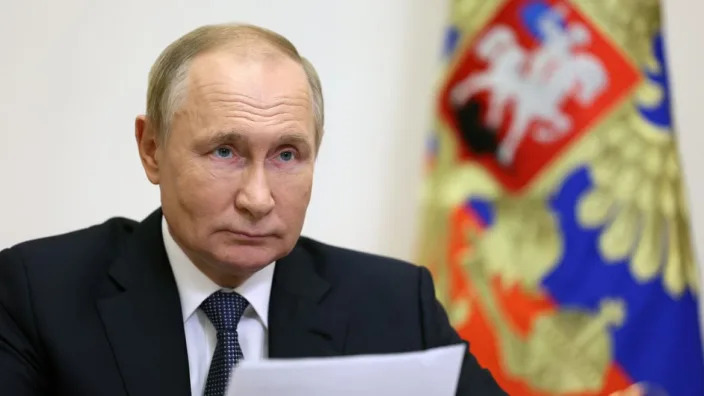
With dozens of newly drafted troops already dead and Russian troops laying the groundwork for a retreat from a key Ukrainian city, the Kremlin has now revealed it is hoping to give its war a second wind by making ordinary Russians feel it as much as possible.
Sergei Kirienko, the first deputy chief of staff of the presidential administration, said as much Saturday in a speech to a national conference of teachers, declaring that the war the Kremlin has until now doggedly insisted is only a “special military operation” must become a “people’s war.”
“Russia has always won any war, if that war became a people’s [war]. We will definitely win this war: both the ‘hot’ one, and the economic one, and the very psychological, information war that is being waged against us. But for that it is necessary that it is precisely a people’s war, so that every person feels his own involvement. So that every person has the opportunity to contribute to our common victory,” Kirienko said.
His comments raised eyebrows on social media, where many noted this appeared to be the first time the presidential administration had dropped its absurd “special operation” euphemism, and others pointed out that millions of Russians had already fled the country in protest.
Even as Kirienko made his comments, authorities in Belgorod on the border with Ukraine revealed they have erected concrete barriers to ostensibly keep the region safe from Ukrainians. And in Moscow, multiple media reports said local authorities had begun preparing bomb shelters in schools and hospitals—perhaps a theatrical move aimed at stoking fears of an attack in the capital.
Meanwhile, just one month after Vladimir Putin summoned tens of thousands of citizens to face death for him on the battlefield, at least 41 newly drafted troops have already been killed, according to a tally by Mediazona and the BBC. Among them were some who, by law, were not even eligible for the draft—including a Raiffeisenbank employee named Timur Izmailov, who was apparently tricked into visiting his local military recruitment office and then died six days after being tossed on to the frontline.
Bizarrely, Kirienko insisted that the “most important battle” for Russia right now is the “battle for the youth”—a strange priority to name given the thousands of youth already killed to prop up Putin’s delusional war against Ukraine.
An unnamed Russian soldier’s phone call to his mother offered perhaps the most succinct reply to Kirienko’s vision of a “people’s war.”
“Fucking scumbags! This fucking government pisses me off so much! They are so dumb, I am in shock,” he told her from the frontline in Ukraine, according to audio released by Ukrainian intelligence.
“This is how it will be: half the country will be jailed and half the country will go to war.”
After his mother tried to reassure him by predicting Russia will soon take land from Poland, her son shot back that it is Russia that should be worried about losing territory now.
“Yes, yes, yes, with this fucking government it’s already been made clear.”
‘We are going to be homeless’: How mobile homeowners are being forced out in metro Phoenix
Catherine Reagor, Juliette Rihl and Kunle Falayi, – October 22, 2022
Homeowners in mobile home parks across metro Phoenix are getting evicted.
Many own the mobile home but rent the small lot it sets on.
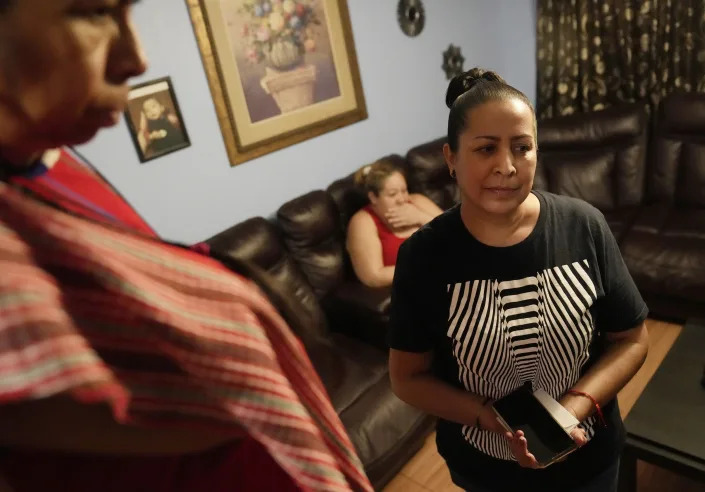
“This is more than just a notice to get out,” said Priscilla Salazar, whose family has lived 11 years in the Weldon Park mobile home community near 16th Street and Osborn Road. “We are going to be homeless.”
Like Valley apartments, some mobile home park owners are raising rents when leases expire and evicting tenants who can’t pay.
In other cases, owners are shutting the parks down so the land can be used for something else, including housing that mobile homeowners can’t afford. Some mobile home park buyers are clearing out tenants and flipping the infill sites for big profits.
Mobile homes have long been one of the most affordable housing options for metro Phoenix residents, but the growing number of parks closing or becoming pricier is putting many residents in a bind. New affordable parks aren’t being built, and many mobile homeowners can’t afford to live elsewhere or move their homes to other communities in the Valley, alarming housing advocates and prompting government officials to seek solutions.
In mid-September, tenants of Weldon Court received a notice that their park would be closing. It had been sold for $5.48 million to an investor from California just days before. Tenants were given six months to move out.
The Weldon Court mobile home park was recently sold, and mobile homeowners in the community were given six months to move out.
“This is our little mini Phoenix. This is our community,” said Salazar, whose children have grown up in the park. Many tenants are low-income families or seniors on fixed incomes.
Residents of Weldon Court and two other Valley mobile home parks that are evicting tenants or raising rents recently protested at the Arizona Capitol and Phoenix City Council chambers. The other two parks with residents fighting their landlords are Las Casitas — which is now called Beacon — at 19th Avenue and Buckeye Road, and Periwinkle, at 27th Avenue and Colter Street.
Mobile home park buying spree
Like with affordable Phoenix-area apartments, investors are snatching up mobile home parks in the Valley.
Since the beginning of 2021, at least 30 trailer, manufactured and mobile home parks have sold for almost $260 million, according to an Arizona Republic analysis of real estate records.
The Valley has been a hub for factory-built homes since after World War II. Many GIs returning home headed to the Southwest. Some hitched a travel trailer to their cars and put down roots and wheels in metro Phoenix.
Most of the metro Phoenix mobile home parks to sell during the past five years are prime infill sites.
The mobile home park buying and closure spree comes as Arizona is facing a shortage of 270,000 homes.
“It’s horrible for people who own their mobile home and have been living in a park for decades,” said Pamela Bridge, director of litigation and advocacy at Community Legal Services. “Investors are raising rents and our office is seeing so many more evictions in older parks.”
She said many longtime residents in Phoenix-area mobile home parks have paid off their homes and made improvements on them, but they can’t afford to move them and can’t find other parks where they can rent a space.
“These people have done nothing wrong,” she said. “We need to leave these mobile home park owners in stable situations.”
Jerry Suter, an 83-year-old veteran who has lived at the Periwinkle Mobile Home Park for 28 years, planned to live out the rest of his days there. He called the park’s closing “devastating” and “traumatic.” With an income of $1,290 in Social Security payments each month, he said he can’t afford to live anywhere else.
Grand Canyon University bought the park six years ago, decided to close it and plans to build student housing.
“They’re going to literally have to drag me out of there,” Suter said. “I’m not giving up my trailer.”
Phoenix has about 20,000 mobile homes, which represents about 3.1% of all of the area’s homes, according to the U.S. Census Bureau. That’s far more than the number of mobile homes that can be found in cities with similar populations, including Houston, San Diego and Philadelphia.
But the supply of mobile homes and parks is shrinking. About 5% of Phoenix homes were in mobile home parks in 2018.
The rapid disappearance of mobile home parks is due, in part, to transactions like this: In 2018, homebuilder Taylor Morrison bought the former Scottsdale Wheel Inn Ranch RV and Mobile Home Park, where residents were evicted by another owner a few years before. Similar scenarios with investors buying the parks, evicting the tenants and then selling to a developer are happening across metro Phoenix.
The Phoenix city manager’s office recently created a task force to research potential solutions to the mobile home dilemma. The task force will present its findings to the City Council next month.
District 8 Councilmember Carlos Garcia, whose district includes Las Casitas mobile home park, said he wants to find a way to keep people in their homes or, if the evictions move forward, find new places for the residents to live.
“To me, all options are on the table,” Garcia said. “Priority is to make sure these families don’t end up on the streets.”
Sylvia Herrera (left) and Raquel Hernandez meet during an emergency meeting at the Beacon mobile home park (formerly Las Casitas mobile home park) on Sept. 20, 2022, in Phoenix. The residents were asked to sign a four-month lease and are worried about being evicted by the new owner. Hernandez recently bought her mobile home in the park.
Residents of Beacon mobile home park were given a new lease in late September. Their rent will increase by 88% over the next four years, it said.
Elvia Ramirez, who lives in the park with her children, started looking for somewhere else to move. But the single mother of four, who works as a receptionist and has lived in the park since she was a teenager, hasn’t been able to find something within her budget.
“Even the mobile homes are too expensive now,” said Ramirez, 33. If she doesn’t secure a new home, she said, she and her kids will probably have to move in with family.
The median price of a U.S. mobile home is now $61,400, according to a LendingTree study. That’s up 35% since 2016.
Many mobile homes are several decades old, and some are even trailers, the oldest type of mobile house. Some of the parks in metro Phoenix sold since early last year are more than 70 years old.
Many parks won’t rent to owners of older mobile homes because their houses may not be up to code. Also, some with additions can’t be moved without damaging them.
The typical rent for a mobile home lot in the Phoenix area was about $400 to $500 a month in 2019, according to housing advocates. Now, rents are rising above $1,000 per lot in some Valley parks.
Help available to mobile homeowners
Arizona has a fund to help, but some mobile homeowners don’t hear about it, and others cannot fully benefit from it because of the age of their residences.
For some owners, the fund isn’t enough to help them move, so they take less than $2,000 in state funds to walk away from their mobile home.
Under Arizona law, mobile home park residents who are displaced because of redevelopment are eligible to receive up to $12,500 from the state’s relocation fund.
But many of the mobile homes are so old, they cannot be moved to another park, either because they would fall apart or because they don’t meet current wind-resistance codes.
Residents who have to leave their homes in place because they can’t be moved can get only $1,875 from the fund, which is managed by the Arizona Housing Department.
Many residents and housing advocates said more help is needed.
“Now I have to abandon my home and give it to the university,” Suter said. “What am I gonna buy for $1,875?”
Patricia Dominguez said her family recently spent $4,000 on a new roof for their home — more than double what they will be reimbursed if they abandon it.
“What they’re offering is nothing compared to the love, and the blood, and the sweat and tears that we’ve all put into our unit,” said Dominguez. Her mother and sister, Salazar, live in Weldon Court.
Community organizer Sylvia Herrera, who is working with residents of all three parks to get more time and money before eviction, said the state relocation fund is “deceiving” because many people can’t move their trailers and therefore can’t access the full relocation amount.
“These are not really resources if you can’t qualify,” she said.
Tara Brunetti, assistant deputy director of the Arizona Department of Housing’s Manufactured Housing Division, said park owners must notify the agency if they plan on closing a park and give tenants 180 days’ notice.
“That gives us time to reach out to the residents” and offer them help, she said. “We are definitely seeing more applications for the fund now.”
The fund has more than $7.6 million to help mobile home park residents.
Sylvia Herrera leads an emergency meeting of residents at the Beacon mobile home park (formerly Las Casitas mobile home park) on Sept. 20, 2022, in Phoenix. The residents were asked to sign a four-month lease and are worried about being evicted by the new owner.
The state program does offer more money than it did five years ago, but it took a legislative move to get the increase.
Mobile homeowners and their advocates are hoping for a different kind of fix.
Some cities, including Portland, Oregon, and Austin, Texas, have updated their zoning laws to help prevent mobile home residents from displacement.
A 2018 Austin city ordinance zoned existing mobile home parks as a “mobile home residence district.” That means if the landowner wanted to use the land for a different purpose, they would need City Council approval to change the zoning.
In 2018, when a new owner began evicting longtime residents from the Tempe Mobile Home Park near Arizona State University, the city of Tempe stepped in and helped get rent concessions from the landlord. Tempe also set up meetings for the tenants to negotiate with the new owner and get aid from the Arizona Housing Department.
That former mobile home park is now high-end apartments.
“I believe there should be laws or community work in cities and counties that come up with long-term solutions for people in the park. These people are a vital part of our community,” said Bridge, of Community Legal Services. “We want their children to remain in schools and for the parents to be able to get to their jobs nearby.”
Then, big Wall Street-backed investment firms were behind most of the sales. Now, big and small investors are driving the trend, but almost all are out-of-state buyers.
The biggest Phoenix-area mobile home park sale since the beginning of 2021 was $84.5 million for the Royal Palm park in Phoenix at 19th and Dunlap avenues. Property records show Chicago-based Continental Communities is the new manager.
Bridge said she has come across several cases of new out-of-state mobile home park owners not giving tenants or the state enough move-out notice.
Mobile home evictions are tracked differently than other rental evictions, and the data to tally the total isn’t available in Arizona.
“Because of the housing crisis, there is no affordable housing. Trailer parks are the most affordable housing right now that you can find,” Herrera said. “People are just trying to retain that, trying to hold on to living in mobile home parks.”
Coverage of housing insecurity on azcentral.com and in The Arizona Republic is supported by a grant from the Arizona Community Foundation.
DOJ Slams Trump Filing Claiming 9 Mar-A-Lago Files Are His ‘Personal’ Property
Mary Papenfuss – October 21, 2022
The Department of Justice has fired back at Donald Trump’s claim that nine White House files seized from his Mar-a-Lago compound by the FBI are his “personal” property.
The files include two documents related to U.S. immigration policy, six requests for clemency to the then-president, and a letter to him from someone in a military academy, according to the DOJ’s letter, filed Thursday in Florida to U.S. District Judge Raymond Dearie, the special master appointed to review the confiscated documents.
The Justice Department dismissed the notion that any of the materials belong to Trump. It pointed out that the pardon requests, for example, “were received by plaintiff in his capacity as the official with authority to grant reprieves and pardons, not in his personal capacity.”
The DOJ letter cited the Presidential Records Act, which states that all documentary materials created or received by a president, his staff or his office in the course of official activities are government property that should go to the National Archives when a president leaves office.
Trump also claimed that four documents should be withheld from investigators because of executive privilege. They include the two immigration policy documents, which Trump’s team said were “predecisional materials,” and two documents about meetings.
The Justice Department argued that the former president can’t claim the immigration documents are both his personal records and protected by executive privilege. The claims are contradictory and he must argue one or the other, the filing said.
Dearie made a similar point about mixed and confusing claims concerning the documents in a conference call with the parties earlier this week. He pointed out that there’s “certainly an incongruity there” when Trump’s lawyers insist that some documents are protected both by executive privilege and as Trump’s personal records.
Dearie also complained on the call that Trump’s legal team hadn’t offered much substance in either case to support its claims.
The special master was appointed last month by U.S. District Judge Aileen Cannon at Trump’s request. He is tasked with reviewing about 11,000 pages of documents to determine if any should be shielded by attorney-client or executive privilege. Dearie’s name was submitted by Trump’s legal team.
The U.S. Court of Appeals for the 11th Circuit ruled earlier this month that the Justice Department can resume reviewing the seized classified records, blocking part of a stay issued earlier by Cannon. The appeals court also prohibited Dearie from vetting the documents marked classified.
Republicans plan to torpedo key Biden policies as polls predict midterm victory
Chris Stein in Washington DC – October 21, 2022
Photograph: Evelyn Hockstein/Reuters
A standoff over the debt ceiling. Aid to Ukraine on the chopping block. And impeachment proceedings against homeland security secretary Alejandro Mayorkas – or perhaps even president Joe Biden himself.
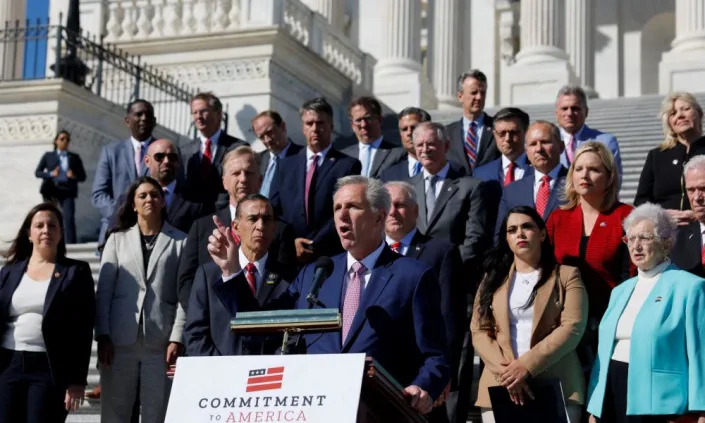
With polls indicating they have a good shot of winning a majority in the House of Representatives in the 8 November midterms, top Republican lawmakers have in recent weeks offered a preview what they might do with their resurgent power, and made clear they have their sights set on key aspects of the Biden administration’s policies at home and abroad.
Kevin McCarthy, the top Republican in the chamber, this week signaled in an interview with Punchbowl News that if Congress is going to approve an increase in the amount the federal government can borrow – as it’s expected to need to by sometime next year – Republicans are going to want an agreement to cut spending in return.
“You can’t just continue down the path to keep spending and adding to the debt,” said McCarthy, who is likely to be elevated to speaker of the house in a Republican led-chamber. “And if people want to make a debt ceiling [for a longer period of time], just like anything else, there comes a point in time where, okay, we’ll provide you more money, but you got to change your current behavior.”
Asked if he might demand that Social Security and Medicare, the two massive federal retirement and healthcare benefit programs that are nearing insolvency, be reformed as part of debt ceiling negotiations, McCarthy replied that he would not “predetermine” anything.
But the California lawmaker warned that members of his caucus were starting to question the money Washington was sending to Ukraine to help it fend off Russia’s invasion. “Ukraine is important, but at the same time it can’t be the only thing they do and it can’t be a blank check,” he told Punchbowl.
Then there’s the question of if Republicans will choose to exercise the House’s powers of impeachment – as they did against Bill Clinton in 1998, and as Democrats did to Donald Trump in 2019 and 2021.
The prime target appears to be Mayorkas, whom Republicans have pilloried amid an uptick in arrivals of migrants at the United States’ border with Mexico. Yet another target could be Biden himself – as Jim Banks, chair of the conservative Republican Study Committee, which crafts policy for the party, suggested on Thursday.
Political realities may pose an obstacle to McCarthy and his allies’ ability to see their plans through. High inflation and Biden’s low approval ratings have given them momentum to retake the House, but their chances of winning a majority in the Senate are seen as a toss-up. Even if they did win that chamber, they’re unlikely to have the two-thirds majority necessary to convict Biden, Mayorkas, or whomever else they intend to impeach – or even the numbers to overcome Democratic filibusters of any legislation they try to pass.
Matt Grossman, director of Michigan State University’s Institute for Public Policy and Social Research, questioned the GOP’s willingness to legislate. The party’s plans, as outlined in the Commitment to America McCarthy unveiled last month, appear thin in comparison to similar platforms rolled out in 1994 and 2010, when Republicans again took back Congress’ lower chamber from Democratic majorities.
“There’s a longstanding asymmetry between the parties. Republicans legitimately want government to do less,” he said.
“They’re doing pretty well electorally without necessarily needing a policy agenda, and they’re tied to, kind of, defending the Trump administration or attacking the Biden administration. There’s not much of a felt need for a lot of policy.”
There are also signs of division within the party over how the GOP should use its new majority. In his interview with Punchbowl, McCarthy said he was against “impeachment for political purposes” and focused instead on addressing crime, border security and economic issues, all familiar themes for Republicans running this year.
The split was even more pronounced when it came to Ukraine. On Wednesday, Trump’s former vice-president Mike Pence called in a speech at influential conservative group the Heritage Foundation for Republicans to continue to support the country, saying “there can be no room in the conservative movement for apologists to” Russian president Vladimir Putin.
The day after, the foundation’s president Kevin Roberts put out a statement saying: “Heritage will vigorously oppose Washington’s big spenders who attempt to pass another Ukrainian aid package lacking debate, a clear strategy, targeted funding and spending offsets.”
Democrats are assured control of Congress until the end of the year, and have taken note of the apparent erosion of will to support Kyiv. NBC News reports they may push for another big military aid infusion in a year-end spending bill, intended to keep the Ukrainians armed for months to come.
It seems clear that Republicans will eventually coalesce behind a strategy to strong-arm the Biden administration for some purpose, but Grossman predicted the likely result would be similar to the 2013 government shutdown, when then president Barack Obama and the Democrats refused the GOP’s demands to dismantle his signature health care law.
“With McCarthy it just seems like he is a go along,” he said. “He’s going to be a go-along speaker and that’s going to be the case with a pretty fractious caucus.”
Trump’s years-long crusade against Ukraine has finally come home to roost as Republicans call for abandoning Kyiv
John Haltiwanger, Sonam Sheth – October 20, 2022
House Minority Leader Kevin McCarthy of California. Kent Nishimura/Los Angeles Times via Getty Images Trump’s years-long crusade against Ukraine has finally come home to roost as Republicans call for abandoning Kyiv
US aid to Ukraine could be in jeopardy if Republicans win the House in the midterms.
Several GOP lawmakers and candidates have signaled they would support reducing or cutting off Ukraine aid.
“Ukraine unfortunately has been hijacked sometimes in domestic politics. Now and then that happens,” a Zelenskyy advisor told Insider.
In a phone call with Ukraine’s president this month, US President Joe Biden pledged continued solidarity with Ukraine as it battles Russia’s military invasion and illegal annexation of Ukrainian territory.
But that level of support could be in jeopardy if the GOP gains control of the House of Representatives in this year’s midterm elections.
The warning signs have been building for months.
In April, 10 House Republicans voted against a bill allowing the Biden administration to more easily lend military equipment to Ukraine. The following month, 57 House Republicans voted “no” on a nearly $40 billion aid package for Ukraine. Both measures ultimately passed the chamber.
“I think people are gonna be sitting in a recession and they’re not going to write a blank check to Ukraine,” House Minority Leader Kevin McCarthy, who’s favored to become House Speaker if the GOP retakes the chamber, recently told Punchbowl News. “They just won’t do it.”
Ukraine has repeatedly defied expectations since Russia launched its unprovoked invasion, delivering a blow to the Russian military’s prestige. With the help of Western aid and at a massive personal cost, Ukrainian forces prevented Russia from seizing Kyiv in the early days of the war and more recently launched a counteroffensive that’s shown major signs of success.
But a far-right faction of the GOP has increasingly pushed against continued assistance to Ukraine, saying the billions the US has provided to Kyiv is too costly and not worth the risk of sparking a wider conflict with Russia.
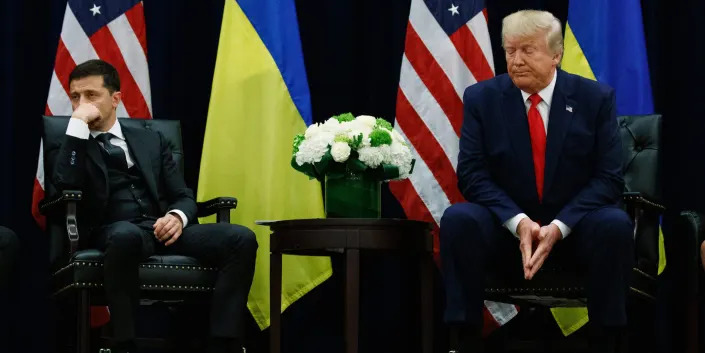
In this Sept. 25, 2019 file photo President Donald Trump meets with Ukrainian President Volodymyr Zelenskyy at the InterContinental Barclay New York hotel during the United Nations General Assembly in New York.AP Photo/Evan Vucci, File
A remarkable shift
The GOP’s gradual shift away from Ukraine and toward Russia has been years in the making, but right-wing hostility toward Ukraine hit a pivotal point during Donald Trump’s presidency.
In addition to peddling the conspiracy theory that Ukraine, not Russia, interfered in the 2016 US election, Trump was impeached in 2019 for withholding hundreds of millions in vital aid to Ukraine as it fought a war against Kremlin-backed separatists in the eastern Donbas region.
While withholding the aid, Trump and his allies pressured Zelenskyy, a political neophyte who won the 2019 election in a landslide victory, to launch an investigation targeting the Bidens ahead of the 2020 US election.
Foreign policy experts said Trump’s actions — dangling security assistance in exchange for political favors — were a threat to the US’s national security and bipartisan support for Ukraine. But the vast majority of congressional Republicans rallied to Trump’s defense, and ultimately, just one Senate Republican, Mitt Romney, voted to convict the former president over his actions.
In the years since, Trump has continued to take a controversial stance on Ukraine, praising Russian President Vladimir Putin’s justifications for invading as “genius” and “savvy.” The former president has often lauded the Russian leader, going out of his way to avoid criticizing Putin amid a historically contentious period in US-Russia relations.
Anti-Ukraine sentiment doesn’t just come from the top of the GOP. Putin has long been seen as a hero by the alt-right and white nationalists, and since Russia invaded Ukraine, many prominent right-wing politicians and media figures have moved in lockstep with the Kremlin, creating a feedback loop where each side amplifies and recycles the other’s propaganda.
On Fox News, for instance, the far-right host Tucker Carlson has repeatedly echoed a nonsense conspiracy theory, which originated in Moscow before taking root in the US, suggesting that Ukraine houses US-funded bioweapons labs.
Russian state-sponsored media outlets in turn frequently feature Carlson’s segments, and in March, Mother Jones reported that the Russian government instructed state media that it was “essential to use as much as possible fragments of broadcasts of the popular Fox News host Tucker Carlson” to spread negative information about Ukraine, the US, and NATO.
“When we see Fox News commentators, from our perspective, promote isolationist positions — that looks like support for Russia,” Mykola Kniazhytskyi, a member of Ukraine’s parliament, recently told NPR.
Some GOP opposition to continuing aid to Ukraine is tied to Trump’s “America First” policy vis-a-vis foreign affairs. Trump embraced a non-interventionist stance and was often critical of US spending abroad, particularly when it came to NATO and European security.
It’s a remarkable shift for the Republican Party, which for years touted a hawkish position on foreign policy, especially as it related to leading adversaries like Russia. But under Trump’s stewardship, the party has become increasingly isolationist, and its growing opposition to aiding Ukraine is the latest and clearest sign of that.
Biden, meanwhile, has made the case that supporting Ukraine is part of a wider fight between democracy and autocracy. But a growing number of Republicans say sending aid to Kyiv should not be prioritized in Washington amid concerns over inflation and a potential recession.
“When people are seeing a 13% increase in grocery prices; energy, utility bills doubling … if you’re a border community and you’re being overrun by migrants and fentanyl, Ukraine is the furthest thing from your mind,” GOP Rep. Kelly Armstrong told Axios.
Democrats are more optimistic about retaining the Senate, but according to forecaster FiveThirtyEight, their chances have gone down in recent weeks based on polling in four key contests in Pennsylvania, Wisconsin, Nevada, and North Carolina.
And in Ohio, GOP Senate candidate JD Vance has made it clear that he would vote against sending more aid to Ukraine, saying in September that “we’ve got to stop the money spigot to Ukraine eventually. We cannot fund a long-term military conflict that I think ultimately has diminishing returns for our own country.”
‘The cards have been dealt’
Ukrainian troops fire with surface-to-surface rockets MLRS towards Russian positions at a front line in the eastern Ukrainian region of Donbas on June 7, 2022.Aris Messinis/AFP via Getty Images
There are some in Kyiv who believe that US support to Ukraine will continue regardless of which party controls Congress.
“Ukraine unfortunately has been hijacked sometimes in domestic politics. Now and then that happens,” Tymofiy Mylovanov, an advisor to Zelenskyy who previously served as Ukraine’s economic minister, told Insider. “We try our best to stay away from this. We would like to stay away from this.”
“Despite all that rhetoric, the support has always been bipartisan,” Mylovanov said, adding that the amount of assistance Ukraine needs is a small fraction of the US GDP. “In terms of what it means in the budget — it means nothing. It’s not trillions of dollars,” he said.
The US has provided over $20 billion in security assistance to Ukraine since Russia invaded and annexed Crimea in 2014. The Biden administration has sent Ukraine $18.2 billion in military aid, including roughly $17.6 billion since Russia launched its full-scale invasion in late February.
Other Western countries have provided important assistance to Ukraine, but the US has contributed the most of any individual country so far.
Weapons the US sent, including Javelin anti-tank missiles and High-Mobility Artillery Rocket Systems (HIMARS), have turned the tables on Russia by blunting its previous advantages in armored vehicles and artillery. If US aid to Kyiv suddenly dried up, it would likely curtail Ukraine’s ability to oust sizable Russian columns from dug-in positions.
Trump, meanwhile, called for a negotiated settlement to the war during a rally earlier this month. “We must demand the immediate negotiation of a peaceful end to the war in Ukraine or we will end up in World War III,” he said at the time.
But Putin has shown little interest in negotiating, as evidenced by the drastic steps he’s taken in recent weeks. Beyond the illegal annexations, Putin announced a partial military mobilization — calling up hundreds of thousands of men — and imposed martial law in the regions Moscow claims are now part of Russia but does not fully control.
Russia has also ramped up missile and drone attacks against civilian areas while destroying key infrastructure across Ukraine.
But Mylovanov, the former economic minister who is also the president at the Kyiv School of Economics, said that while Russia wants Ukraine to surrender, the “Ukrainian people will not have it.”
“People think that what happens in Kyiv is decided either in Moscow or Washington or Brussels, or maybe Beijing. It is not, it’s decided in Ukraine,” Mylovanov said.
“The cards have been dealt,” he added, and it’s up to the US if it wants to be at the table.
Trump drops F-bombs and shares potentially sensitive information in newly released audio
Stephen Proctor – October 19, 2022
Previously unheard audio featuring former President Donald Trump aired Tuesday on Anderson Cooper 360. Famed journalist Bob Woodward recorded 20 conversations he had with the former president, with Trump’s knowledge, from 2016 through 2020. Trump, who is facing possible legal peril for taking classified documents when he left office, appears in one recording to share sensitive information with Woodward.
“I have built a weapons system that nobody’s ever had in this country before,” Trump said. “We have stuff that you haven’t even seen or heard about. We have stuff that Putin and Xi have never heard about before.”
Trump also spoke of Russia’s nuclear capabilities.
“Getting along with Russia is a good thing, not a bad thing, alright?” Trump said. “Especially because they have 1,332 nuclear f***ing warheads.”
Throughout his presidency, Trump was criticized for his apparent affinity for authoritarian leaders, which he spoke about to Woodward.
“It’s funny, the relationships I have, the tougher and meaner they are, the better I get along with them. You know? Explain that to me someday, OK,” Trump said. “But maybe it’s not a bad thing. The easy ones are the ones I maybe don’t like as much or don’t get along with as much.”
In another recording, Trump brags about how he handled being impeached, while at the same time taking shots at two of his predecessors who also faced impeachment.
“There’s nobody that’s tougher than me,” Trump said. “Nobody’s tougher than me. You asked me about impeachment. I’m under impeachment, and you said, you know, you just act like you won the f***ing race. Nixon was in a corner with his thumb in his mouth. Bill Clinton took it very, very hard. I just do things, OK?”
In 2016, Woodward asked then-candidate Trump about having his staff sign non-disclosure agreements. Woodward recorded Trump talking to his staff about who had and who had not yet signed one. Trump was confident in the effectiveness of these agreements at the time, but a multitude of former officials wrote tell-all books after leaving the administration.
Woodward plans to release the more than eight hours of recordings as an audiobook titled The Trump Tapes on Oct. 25.
Former DOJ official says Trump’s reaction to the January 6 panel is starting to look like the makings of an insanity defense
Cheryl Teh – October 17, 2022
Former President Donald Trump at a rally in Wilkes-Barre, Pennsylvania, on September 3.Mary Altaffer/AP
The former DOJ official Neal Katyal commented on Donald Trump’s 14-page response to the DOJ.
Katyal said he did not think the response would help Trump unless he was trying to plead insanity.
He said Trump’s response showed “evidence” of an insanity plea.
Neal Katyal, a former Justice Department official, says former President Donald Trump’s written response to the House Capitol-riot panel’s intention to subpoena him looks like an insanity defense.
Katyal — a law professor and an Obama-era acting solicitor general — made an appearance on NBC on Sunday, three days after the House panel investigating January 6, 2021, unanimously voted to subpoena Trump. The subpoena will compel the former president to cooperate with the committee or be held in contempt of Congress and referred to the Justice Department for prosecution — much like Trump’s allies Steve Bannon and Peter Navarro.
In response to the decision, Trump sent a document to the panel that started with the sentence, “THE PRESIDENTIAL ELECTION OF 2020 WAS RIGGED AND STOLEN!” and contained multiple baseless claims of election fraud. It also included four photos of the crowd near the Washington Monument on January 6, 2021.
“Yeah, so, this is a 14-page screed, Jonathan, that’s very hard to follow. But it does seem to dig the hole in deeper for Donald Trump,” Katyal told the MSNBC host Jonathan Capehart.
“I can’t see it in any legal way helping him unless he is trying to go for the insanity defense, of which this paper seems, you know, to be some evidence of,” Katyal added.
Katyal also said he thought it was a “pretty fanciful” idea that Trump would just give in and testify to the panel because of the congressional subpoena.
“I mean, this is a man who took the Fifth Amendment more than 400 times the last time he was questioned under oath. And I doubt he’s suddenly become eager to testify,” Katyal said.
Katyal added that he thought Attorney General Merrick Garland would indict Trump, as there’s overwhelming evidence to do so and “no contrition whatsoever” on Trump’s part.
A representative at Trump’s post-presidential press office did not immediately respond to a request for comment.
As FBI probed Jan. 6, many agents sympathized with insurrection, according to newly released email
Will Carless, USA TODAY – October 15, 2022
A “sizable percentage” of FBI employees felt sympathy towards the Jan. 6 insurrectionists, and considered the riot at the U.S. Capitol “no different than the BLM protests,” according to a warning email sent to a top FBI official by someone with apparent connections to the bureau.
In the email, which is included in a trove of documents released by the bureau this week, the sender’s name is redacted. The documents indicate the message came from an email address outside the bureau, though the subject line is “Internal concerns.”
The email was sent to Paul Abbate, now the second highest official at the FBI, who responded an hour later, thanking the sender for the message.
FBI Deputy Director Paul Abbate at a news conference in 2021.
The Jan. 13, 2021, email contained a stark warning about attitudes toward the insurrection within the bureau:
“I literally had to explain to an agent from a ‘blue state’ office the difference between opportunists burning and looting during protests that stemmed legitimate grievance to police brutality vs. an insurgent mob whose purpose was to prevent the execution of democratic processes at the behest of a sitting president,” the email states. “One is a smattering of criminals, the other is an organized group of domestic terrorists.”
And it relayed concerns from agents within the bureau:
“I’ve spoken to multiple African American agents who have turned down asks to join SWAT because they do not trust that every member of their office’s SWAT team would protect them in an armed conflict.”
Michael German, a former FBI special agent and a fellow with the Brennan Center for Justice’s Liberty and National Security Program at New York University and an outspoken critic of the bureau, said the email didn’t surprise him.
“It didn’t tell me anything I didn’t expect already, but I think it’s important to substantiate the suspicions me and many other people had,” German said. “They clearly are on notice about a much more serious problem within the FBI.”
An FBI spokesperson declined to comment on the email.
While there may be some sympathy towards the Capitol rioters within the FBI, the bureau’s investigations have nonetheless contributed to Justice Department prosecutions of almost 900 people who were there that day. Scores of defendants have received jail time for their crimes. Dozens more have agreed to cooperate with the prosecutions.
But there has been pushback. Earlier this year, FBI special agent Stephen Friend was suspended for refusing to participate in prosecutions of Jan. 6 protesters. Friend’s stance was praised by Republican lawmakers, who called him “patriotic.”
The FBI email sheds more light on a problem that has been endemic in American law enforcement for decades, said Heidi Beirich, co-founder of the Global Project Against Hate and Extremism, who has studied white supremacists since the 1980s.
“The situation has been serious enough that the FBI for almost 20 years, has been warning of insider threats from cops,” Beirich said. “And the thing is, nobody’s done anything about it.”
A 2009 warning about extremists recruiting members of the military and police officers went largely ignored by the federal government, and resulted in the ostracizing of the author of the study, a senior Department of Homeland Security official.
Ten years later, a 2019 study by the Center for Investigative Reporting found that hundreds of active duty police officers were active inside racist, Islamophobic and anti-government groups on Facebook. Another study by the Plain View Project compiled hundreds of hateful and racist posts made on Facebook by police officers. Last year, USA TODAY found more than 200 people who claimed they worked for police departments in a leaked database of members of the Oath Keepers, an armed extremist group that is now the subject of one of the biggest prosecutions emerging from Jan. 6.
And as USA TODAY reported last month, the FBI itself has also been heavily criticized for directing domestic extremism investigations overwhelmingly towards left-wing targets.
The FBI has a long and troubled history of focusing on groups on the left of the political spectrum while largely turning a blind eye to domestic extremists on the far-right, Matthew Guariglia, a policy analyst at the Electronic Frontier Foundation, told USA TODAY.
“Both historically speaking and in current events, we’ve seen the amount of surveillance that has been marshaled specifically against groups fighting for racial justice increased exponentially than from what we’ve seen being monitored on the right,” said Guariglia, who holds a doctorate in the history of police surveillance.
Beirich said given the conservative nature of law enforcement, there is bound to be some “overlap” into far-right extremism within the ranks. The biggest problem is a lack of action taken by departments to root out extremists on the payroll, she said.
“Even right now, there aren’t policies in a whole lot of departments about what to do with these guys — there’s no screening mechanisms,” Beirich said. “There’s no effort to really deal with it.”