Big Tech was moving cautiously on AI. Then came ChatGPT.
Nitasha Tiku – January 27, 2023
Big Tech was moving cautiously on AI. Then came ChatGPT.
Three months before ChatGPT debuted in November, Facebook’s parent company Meta released a similar chatbot. But unlike the phenomenon that ChatGPT instantly became, with more than a million users in its first five days, Meta’s Blenderbot was boring, said Meta’s chief artificial intelligence scientist, Yann LeCun.
“The reason it was boring was because it was made safe,” LeCun said last week at a forum hosted by AI consulting company Collective[i]. He blamed the tepid public response on Meta being “overly careful about content moderation,” like directing the chatbot to change the subject if a user asked about religion. ChatGPT, on the other hand, will converse about the concept of falsehoods in the Quran, write a prayer for a rabbi to deliver to Congress and compare God to a flyswatter.
ChatGPT is quickly going mainstream now that Microsoft – which recently invested billions of dollars in the company behind the chatbot, OpenAI – is working to incorporate it into its popular office software and selling access to the tool to other businesses. The surge of attention around ChatGPT is prompting pressure inside tech giants including Meta and Google to move faster, potentially sweeping safety concerns aside, according to interviews with six current and former Google and Meta employees, some of whom spoke on the condition of anonymity because they were not authorized to speak.
At Meta, employees have recently shared internal memos urging the company to speed up its AI approval process to take advantage of the latest technology, according to one of them. Google, which helped pioneer some of the technology underpinning ChatGPT, recently issued a “code red” around launching AI products and proposed a “green lane” to shorten the process of assessing and mitigating potential harms, according to a report in the New York Times.
ChatGPT, along with text-to-image tools such as DALL-E 2 and Stable Diffusion, is part of a new wave of software called generative AI. They create works of their own by drawing on patterns they’ve identified in vast troves of existing, human-created content. This technology was pioneered at big tech companies like Google that in recent years have grown more secretive, announcing new models or offering demos but keeping the full product under lock and key. Meanwhile, research labs like OpenAI rapidly launched their latest versions, raising questions about how corporate offerings, like Google’s language model LaMDA, stack up.
Tech giants have been skittish since public debacles like Microsoft’s Tay, which it took down in less than a day in 2016 after trolls prompted the bot to call for a race war, suggest Hitler was right and tweet “Jews did 9/11.” Meta defended Blenderbot and left it up after it made racist comments in August, but pulled down another AI tool, called Galactica, in November after just three days amid criticism over its inaccurate and sometimes biased summaries of scientific research.
“People feel like OpenAI is newer, fresher, more exciting and has fewer sins to pay for than these incumbent companies, and they can get away with this for now,” said a Google employee who works in AI, referring to the public’s willingness to accept ChatGPT with less scrutiny. Some top talent has jumped ship to nimbler start-ups, like OpenAI and Stable Diffusion.
Some AI ethicists fear that Big Tech’s rush to market could expose billions of people to potential harms – such as sharing inaccurate information, generating fake photos or giving students the ability to cheat on school tests – before trust and safety experts have been able to study the risks. Others in the field share OpenAI’s philosophy that releasing the tools to the public, often nominally in a “beta” phase after mitigating some predictable risks, is the only way to assess real world harms.
“The pace of progress in AI is incredibly fast, and we are always keeping an eye on making sure we have efficient review processes, but the priority is to make the right decisions, and release AI models and products that best serve our community,” said Joelle Pineau, managing director of Fundamental AI Research at Meta.
“We believe that AI is foundational and transformative technology that is incredibly useful for individuals, businesses and communities,” said Lily Lin, a Google spokesperson. “We need to consider the broader societal impacts these innovations can have. We continue to test our AI technology internally to make sure it’s helpful and safe.”
Microsoft’s chief of communications, Frank Shaw, said his company works with OpenAI to build in extra safety mitigations when it uses AI tools like DALLE-2 in its products. “Microsoft has been working for years to both advance the field of AI and publicly guide how these technologies are created and used on our platforms in responsible and ethical ways,” Shaw said.
OpenAI declined to comment.
The technology underlying ChatGPT isn’t necessarily better than what Google and Meta have developed, said Mark Riedl, professor of computing at Georgia Tech and an expert on machine learning. But OpenAI’s practice of releasing its language models for public use has given it a real advantage.
“For the last two years they’ve been using a crowd of humans to provide feedback to GPT,” said Riedl, such as giving a “thumbs down” for an inappropriate or unsatisfactory answer, a process called “reinforcement learning from human feedback.”
Silicon Valley’s sudden willingness to consider taking more reputational risk arrives as tech stocks are tumbling. When Google laid off 12,000 employees last week, CEO Sundar Pichai wrote that the company had undertaken a rigorous review to focus on its highest priorities, twice referencing its early investments in AI.
A decade ago, Google was the undisputed leader in the field. It acquired the cutting edge AI lab DeepMind in 2014 and open-sourced its machine learning software TensorFlow in 2015. By 2016, Pichai pledged to transform Google into an “AI first” company.
The next year, Google released transformers – a pivotal piece of software architecture that made the current wave of generative AI possible.
The company kept rolling out state-of-the-art technology that propelled the entire field forward, deploying some AI breakthroughs in understanding language to improve Google search. Inside big tech companies, the system of checks and balances for vetting the ethical implications of cutting-edge AI isn’t as established as privacy or data security. Typically teams of AI researchers and engineers publish papers on their findings, incorporate their technology into the company’s existing infrastructure or develop new products, a process that can sometimes clash with other teams working on responsible AI over pressure to see innovation reach the public sooner.
Google released its AI principles in 2018, after facing employee protest over Project Maven, a contract to provide computer vision for Pentagon drones, and consumer backlash over a demo for Duplex, an AI system that would call restaurants and make a reservation without disclosing it was a bot. In August last year, Google began giving consumers access to a limited version of LaMDA through its app AI Test Kitchen. It has not yet released it fully to the general public, in spite of Google’s plans to do so at the end of 2022, according to former Google software engineer Blake Lemoine, who told The Washington Post that he had come to believe LaMDA was sentient.
But the top AI talent behind these developments grew restless.
In the past year or so, top AI researchers from Google have left to launch start-ups around large language models, including Character.AI, Cohere, Adept, Inflection.AI and Inworld AI, in addition to search start-ups using similar models to develop a chat interface, such as Neeva, run by former Google executive Sridhar Ramaswamy.
Character.AI founder Noam Shazeer, who helped invent the transformer and other core machine learning architecture, said the flywheel effect of user data has been invaluable. The first time he applied user feedback to Character.AI, which allows anyone to generate chatbots based on short descriptions of real people or imaginary figures, engagement rose by more than 30 percent.
Bigger companies like Google and Microsoft are generally focused on using AI to improve their massive existing business models, said Nick Frosst, who worked at Google Brain for three years before co-founding Cohere, a Toronto-based start-up building large language models that can be customized to help businesses. One of his co-founders, Aidan Gomez, also helped invent transformers when he worked at Google.
“The space moves so quickly, it’s not surprising to me that the people leading are smaller companies,” said Frosst.
AI has been through several hype cycles over the past decade, but the furor over DALL-E and ChatGPT has reached new heights.
Soon after OpenAI released ChatGPT, tech influencers on Twitter began to predict that generative AI would spell the demise of Google search. ChatGPT delivered simple answers in an accessible way and didn’t ask users to rifle through blue links. Besides, after a quarter of a century, Google’s search interface had grown bloated with ads and marketers trying to game the system.
“Thanks to their monopoly position, the folks over at Mountain View have [let] their once-incredible search experience degenerate into a spam-ridden, SEO-fueled hellscape,” technologist Can Duruk wrote in his newsletter Margins, referring to Google’s hometown.
On the anonymous app Blind, tech workers posted dozens of questions about whether the Silicon Valley giant could compete.
“If Google doesn’t get their act together and start shipping, they will go down in history as the company who nurtured and trained an entire generation of machine learning researchers and engineers who went on to deploy the technology at other companies,” tweeted David Ha, a renowned research scientist who recently left Google Brain for the open source text-to-image start-up Stable Diffusion.
AI engineers still inside Google shared his frustration, employees say. For years, employees had sent memos about incorporating chat functions into search, viewing it as an obvious evolution, according to employees. But they also understood that Google had justifiable reasons not to be hasty about switching up its search product, beyond the fact that responding to a query with one answer eliminates valuable real estate for online ads. A chatbot that pointed to one answer directly from Google could increase its liability if the response was found to be harmful or plagiarized.
Chatbots like OpenAI routinely make factual errors and often switch their answers depending on how a question is asked. Moving from providing a range of answers to queries that link directly to their source material, to using a chatbot to give a single, authoritative answer, would be a big shift that makes many inside Google nervous, said one former Google AI researcher. The company doesn’t want to take on the role or responsibility of providing single answers like that, the person said. Previous updates to search, such as adding Instant Answers, were done slowly and with great caution.
Inside Google, however, some of the frustration with the AI safety process came from the sense that cutting-edge technology was never released as a product because of fears of bad publicity – if, say, an AI model showed bias.
Meta employees have also had to deal with the company’s concerns about bad PR, according to a person familiar with the company’s internal deliberations who spoke on the condition of anonymity to discuss internal conversations. Before launching new products or publishing research, Meta employees have to answer questions about the potential risks of publicizing their work, including how it could be misinterpreted, the person said. Some projects are reviewed by public relations staff, as well as internal compliance experts who ensure the company’s products comply with its 2011 Federal Trade Commission agreement on how it handles user data.
To Timnit Gebru, executive director of the nonprofit Distributed AI Research Institute, the prospect of Google sidelining its responsible AI team doesn’t necessarily signal a shift in power or safety concerns, because those warning of the potential harms were never empowered to begin with. “If we were lucky, we’d get invited to a meeting,” said Gebru, who helped lead Google’s Ethical AI team until she was fired for a paper criticizing large language models.
From Gebru’s perspective, Google was slow to release its AI tools because the company lacked a strong enough business incentive to risk a hit to its reputation.
After the release of ChatGPT, however, perhaps Google sees a change to its ability to make money from these models as a consumer product, not just to power search or online ads, Gebru said. “Now they might think it’s a threat to their core business, so maybe they should take a risk.”
Rumman Chowdhury, who led Twitter’s machine-learning ethics team until Elon Musk disbanded it in November, said she expects companies like Google to increasingly sideline internal critics and ethicists as they scramble to catch up with OpenAI.
“We thought it was going to be China pushing the U.S., but looks like it’s start-ups,” she said.
3 Chicago-area oil refineries that dump toxic chemicals into Lake Michigan and other waterways are among worst polluters in US, study shows
Michael Hawthorne, Chicago Tribune – January 27, 2023
Oil refineries are dumping massive amounts of toxic chemicals and heavy metals into the Great Lakes and the nation’s rivers with little, if any, oversight from government regulators, according to a new analysis that found some of the worst polluters are in the Chicago area.
During 2021 alone, 81 refineries in the United States that treat waste on-site released 1.6 billion pounds of chlorides, sulfates and other dissolved solids harmful to fish and other aquatic life, the nonprofit Environmental Integrity Project determined in its review of federal data.
The refineries also collectively discharged 60,000 pounds of selenium, an element that can mutate fish, and 15.7 million pounds of nitrogen, which contributes to water-fouling algae blooms and dead zones in important fisheries such as the Great Lakes, Chesapeake Bay and the Gulf of Mexico.
Most of the refineries are in low-income, predominantly Black and Latino communities that face disproportionate health risks from industrial pollution.
Some refinery pollution is legal because federal and state officials have failed to limit it, despite requirements in the 1972 Clean Water Act mandating a review of standards for various chemicals and metals at least every five years based on the latest science and improvements in water treatment technology.
“You have refineries that may look like they are complying with the law, but the standards are decades old and really don’t require very much,” said Eric Schaeffer, the group’s executive director and former chief of civil enforcement at the U.S. Environmental Protection Agency.
Three Chicago-area refineries — BP Whiting in Indiana, ExxonMobil Joliet and Citgo in Lemont — highlight the consequences of lax regulations and weak enforcement, Schaeffer said Thursday during an online news conference.
Even when limits are in place, oil companies often pay minimal fines for violating the law. Some aren’t penalized at all.
The Joliet refinery, on the Des Plaines River southwest of the city, exceeded its permitted levels of pollution 40 times between 2019 and 2021, federal records show. Neither federal nor state officials have sued ExxonMobil or fined the company for its repeated infractions.
Only three other refineries discharged more selenium than BP Whiting, located on the southwest shore of Lake Michigan about 8 miles from one of Chicago’s water intake cribs. Small doses of the element are healthy, but higher levels can cause hair and nail loss, gastrointestinal distress, dizziness and tremors.
Citgo Lemont and ExxonMobil Joliet ranked fifth and ninth for selenium pollution, respectively, the analysis showed.
A public beach near the Whiting refinery is a popular spot for surfers drawn by big waves when winter winds whip down Lake Michigan from Canada.
Mitch McNeil, chairman of the local chapter of Surfrider, a nonprofit advocacy group, said he and other surfers have suffered eye, ear and urinary tract infections and gastrointestinal illnesses after swimming in dark brown water that smells alternately like metal, sewage, petroleum and a used ashtray.
“People always ask us why we keep surfing in dirty water,” McNeil said. “Our response is we surf in it but you drink it, so you should be just as concerned as we are.”
BP routinely faces scrutiny about air pollution from the Whiting refinery. Water pollution hasn’t drawn as much attention since the Chicago Tribune reported in 2007 that Indiana regulators were planning to relax limits on the refinery’s discharges of ammonia, brain-damaging mercury and suspended solids — tiny particles of sewage sludge.
The company later backed down and vowed to abide by the terms of its existing permit.
Responding to the new analysis of federal data, BP said it will “continue to operate consistent with its permit as part of our commitment to safe, compliant and reliable operations, not just at Whiting refinery but at every facility BP operates around the world.”
Speaking on behalf of the oil industry in general, the American Petroleum Institute did not directly answer questions about the lack of standards for selenium and other pollutants.
“Our industry takes seriously its obligation to protect our nation’s waters and adheres to strict local, state and federal requirements to ensure water is properly treated and tested prior to leaving a facility,” Will Hupman, the trade group’s vice president of downstream policy said in a statement.
Schaeffer noted that federal pollution standards for refineries and several other industry sectors haven’t been updated since Ronald Reagan was president during the 1980s.
Federal judges are taking notice. Calling existing standards out of date is a “charitable understatement,” a federal appellate court concluded after the EPA in 2019 updated its 1982 limits on water pollution from coal-fired power plants.
Environmental groups asked EPA Administrator Michael Regan in 2021 why the agency had fallen so far behind in meeting its legal obligations under the Clean Water Act. The EPA acknowledged the letter but didn’t respond.
An EPA spokesman said the agency is aware of the new pollution analysis “and will review and respond accordingly.”
Most of the top polluting refineries are in California or along the Gulf of Mexico in Texas and Louisiana. Also in the top 10 is a Phillips 66 refinery on the Mississippi River in Wood River, a small, heavily industrialized Illinois city upstream from St. Louis.
The Wood River refinery released more fish-harming nickel than any of the other facilities reviewed. It also ranked among the top 10 for discharges of selenium, nitrogen and total dissolved solids.
For people who live near refineries, the new report reflects what they see, smell and breathe — and ingest when eating locally caught fish or while swimming.
Gina Ramirez grew up on Chicago’s Southeast Side and often visits Whihala Beach in Whiting, 2 miles up the lakeshore from the BP refinery. Nowadays her son joins her.
“To think that we are recreating among some of the most polluted waters is terrifying,” said Ramirez, an outreach manager at the nonprofit Natural Resources Defense Council and senior adviser to the Southeast Environmental Task Force. “U.S. EPA needs to step up.”
John Beard, a former refinery worker who leads the Port Arthur Community Action Network in Texas, said communities like his rely on the EPA to enforce air and water laws because they can’t afford to fight for a cleaner environment.
“(Oil companies) don’t build these facilities in Beverly Hills, or River Oaks (in Houston) or Madison Avenue,” Beard said. “They don’t build in communities of affluence that have the ways and means to go about seeking justice and correction.”
“Many people say we need the jobs and we need all these products (oil companies) produce,” Beard added. “That’s true. But we don’t need the pollution that comes with it, and they can do better.”
Rural resentment has become a central fact of American politics — in particular, a pillar of support for the rise of right-wing extremism. As the Republican Party has moved ever further into MAGAland, it has lost votes among educated suburban voters; but this has been offset by a drastic rightward shift in rural areas, which in some places has gone so far that the Democrats who remain face intimidation and are afraid to reveal their party affiliation.
But is this shift permanent? Can anything be done to assuage rural rage?
The answer will depend on two things: whether it’s possible to improve rural lives and restore rural communities, and whether the voters in these communities will give politicians credit for any improvements that do take place.
This week my colleague Thomas B. Edsall surveyed research on the rural Republican shift. I was struck by his summary of work by Katherine J. Cramer, who attributes rural resentment to perceptions that rural areas are ignored by policymakers, don’t get their fair share of resources and are disrespected by “city folks.”
As it happens, all three perceptions are largely wrong. I’m sure that my saying this will generate a tidal wave of hate mail, and lecturing rural Americans about policy reality isn’t going to move their votes. Nonetheless, it’s important to get our facts straight.
The truth is that ever since the New Deal rural America has received special treatment from policymakers. It’s not just farm subsidies, which ballooned under Donald Trump to the point where they accounted for around 40 percent of total farm income. Rural America also benefits from special programs that support housing, utilities and business in general.
In terms of resources, major federal programs disproportionately benefit rural areas, in part because such areas have a disproportionate number of seniors receiving Social Security and Medicare. But even means-tested programs — programs that Republicans often disparage as “welfare” — tilt rural. Notably, at this point rural Americans are more likely than urban Americans to be on Medicaid and receive food stamps.
And because rural America is poorer than urban America, it pays much less per person in federal taxes, so in practice major metropolitan areas hugely subsidize the countryside. These subsidies don’t just support incomes, they support economies: Government and the so-called health care and social assistance sector each employ more people in rural America than agriculture, and what do you think pays for those jobs?
What about rural perceptions of being disrespected? Well, many people have negative views about people with different lifestyles; that’s human nature. There is, however, an unwritten rule in American politics that it’s OK for politicians to seek rural votes by insulting big cities and their residents, but it would be unforgivable for urban politicians to return the favor. “I have to go to New York City soon,” tweeted J.D. Vance during his senatorial campaign. “I have heard it’s disgusting and violent there.” Can you imagine, say, Chuck Schumer saying something similar about rural Ohio, even as a joke?
So the ostensible justifications for rural resentment don’t withstand scrutiny — but that doesn’t mean things are fine. A changing economy has increasingly favored metropolitan areas with large college-educated work forces over small towns. The rural working-age population has been declining, leaving seniors behind. Rural men in their prime working years are much more likely than their metropolitan counterparts to not be working. Rural woes are real.
Ironically, however, the policy agenda of the party most rural voters support would make things even worse, slashing the safety-net programs these voters depend on. And Democrats shouldn’t be afraid to point this out.
But can they also have a positive agenda for rural renewal? As The Washington Post’s Greg Sargent recently pointed out, the infrastructure spending bills enacted under President Biden, while primarily intended to address climate change, will also create large numbers of blue-collar jobs in rural areas and small cities. They are, in practice, a form of the “place-based industrial policy” some economists have urged to fight America’s growing geographic disparities.
Will they work? The economic forces that have been hollowing out rural America are deep and not easily countered. But it’s certainly worth trying.
But even if these policies improve rural fortunes, will Democrats get any credit? It’s easy to be cynical. Sarah Huckabee Sanders, the new governor of Arkansas, has pledged to get the “bureaucratic tyrants” of Washington “out of your wallets”; in 2019 the federal government spent almost twice as much in Arkansas as it collected in taxes, de facto providing the average Arkansas resident with $5,500 in aid. So even if Democratic policies greatly improve rural lives, will rural voters notice?
Still, anything that helps reverse rural America’s decline would be a good thing in itself. And maybe, just maybe, reducing the heartland’s economic desperation will also help reverse its political radicalization.
How Barr’s Quest to Find Flaws in the Russia Inquiry Unraveled
The review by John Durham at one point veered into a criminal investigation related to Donald Trump himself, even as it failed to find wrongdoing in the origins of the Russia inquiry.
Charlie Savage, Adam Goldman and Katie Benner – January 26, 2023
The veteran prosecutor John H. Durham was given the job of determining whether there was any wrongdoing behind the investigation into the 2016 Trump campaign’s ties to Russia.Credit…Samuel Corum for The New York Times
WASHINGTON — It became a regular litany of grievances from President Donald J. Trump and his supporters: The investigation into his 2016 campaign’s ties to Russia was a witch hunt, they maintained, that had been opened without any solid basis, went on too long and found no proof of collusion.
Egged on by Mr. Trump, Attorney General William P. Barr set out in 2019 to dig into their shared theory that the Russia investigation likely stemmed from a conspiracy by intelligence or law enforcement agencies. To lead the inquiry, Mr. Barr turned to a hard-nosed prosecutor named John H. Durham, and later granted him special counsel status to carry on after Mr. Trump left office.
But after almost four years — far longer than the Russia investigation itself — Mr. Durham’s work is coming to an end without uncovering anything like the deep state plot alleged by Mr. Trump and suspected by Mr. Barr.
Moreover, a months long review by The New York Times found that the main thrust of the Durham inquiry was marked by some of the very same flaws — including a strained justification for opening it and its role in fueling partisan conspiracy theories that would never be charged in court — that Trump allies claim characterized the Russia investigation.
Interviews by The Times with more than a dozen current and former officials have revealed an array of previously unreported episodes that show how the Durham inquiry became roiled by internal dissent and ethical disputes as it went unsuccessfully down one path after another even as Mr. Trump and Mr. Barr promoted a misleading narrative of its progress.
Mr. Barr and Mr. Durham never disclosed that their inquiry expanded in the fall of 2019, based on a tip from Italian officials, to include a criminal investigation into suspicious financial dealings related to Mr. Trump. The specifics of the tip and how they handled the investigation remain unclear, but Mr. Durham brought no charges over it.
Mr. Durham used Russian intelligence memos — suspected by other U.S. officials of containing disinformation — to gain access to emails of an aide to George Soros, the financier and philanthropist who is a favorite target of the American right and Russian state media. Mr. Durham used grand jury powers to keep pursuing the emails even after a judge twice rejected his request for access to them. The emails yielded no evidence that Mr. Durham has cited in any case he pursued.
There were deeper internal fractures on the Durham team than previously known. The publicly unexplained resignation in 2020 of his No. 2 and longtime aide, Nora R. Dannehy, was the culmination of a series of disputes between them over prosecutorial ethics. A year later, two more prosecutors strongly objected to plans to indict a lawyer with ties to Hillary Clinton’s 2016 campaign based on evidence they warned was too flimsy, and one left the team in protest of Mr. Durham’s decision to proceed anyway. (A jury swiftly acquitted the lawyer.)
Now, as Mr. Durham works on a final report, the interviews by The Times provide new details of how he and Mr. Barr sought to recast the scrutiny of the 2016 Trump campaign’s myriad if murky links to Russia as unjustified and itself a crime.
Mr. Barr, Mr. Durham and Ms. Dannehy declined to comment. The current and former officials who discussed the investigation all spoke on the condition of anonymity because of the legal, political and intelligence sensitivities surrounding the topic.
A year into the Durham inquiry, Mr. Barr declared that the attempt “to get to the bottom of what happened” in 2016 “cannot be, and it will not be, a tit-for-tat exercise. We are not going to lower the standards just to achieve a result.”
But Robert Luskin, a criminal defense lawyer and former Justice Department prosecutor who represented two witnesses Mr. Durham interviewed, said that he had a hard time squaring Mr. Durham’s prior reputation as an independent-minded straight shooter with his end-of-career conduct as Mr. Barr’s special counsel.
“This stuff has my head spinning,” Mr. Luskin said. “When did these guys drink the Kool-Aid, and who served it to them?”
Attorney General William P. Barr took office in 2019 with suspicions about the origins of the Russia investigation. Credit…Doug Mills/The New York Times
An Odd Couple
A month after Mr. Barr was confirmed as attorney general in February 2019, the special counsel Robert S. Mueller III ended the Russia investigation and turned in his report without charging any Trump associates with engaging in a criminal conspiracy with Moscow over its covert operation to help Mr. Trump win the 2016 election.
That spring, Mr. Barr assigned Mr. Durham to scour the origins of the Russia investigation for wrongdoing, telling Fox News that he wanted to know if “officials abused their power and put their thumb on the scale” in deciding to pursue the investigation. “A lot of the answers have been inadequate, and some of the explanations I’ve gotten don’t hang together,” he added.
While attorneys general overseeing politically sensitive inquiries tend to keep their distance from the investigators, Mr. Durham visited Mr. Barr in his office for at times weekly updates and consultations about his day-to-day work. They also sometimes dined and sipped Scotch together, people familiar with their work said.
In some ways, they were an odd match. Taciturn and media-averse, the goateed Mr. Durham had spent more than three decades as a prosecutor before Mr. Trump appointed him the U.S. attorney for Connecticut. Administrations of both parties had assigned him to investigate potential official wrongdoing, like allegations of corrupt ties between mafia informants and F.B.I. agents, and the C.I.A.’s torture of terrorism detainees and destruction of evidence.
By contrast, the vocal and domineering Mr. Barr has never prosecuted a case and is known for using his law enforcement platform to opine on culture-war issues and politics. He had effectively auditioned to be Mr. Trump’s attorney general by asserting to a New York Times reporter that there was more basis to investigate Mrs. Clinton than Mr. Trump’s “so-called ‘collusion’” with Russia, and by writing a memo suggesting a way to shield Mr. Trump from scrutiny for obstruction of justice.
But the two shared a worldview: They are both Catholic conservatives and Republicans, born two months apart in 1950. As a career federal prosecutor, Mr. Durham already revered the office of the attorney general, people who know him say. And as he was drawn into Mr. Barr’s personal orbit, Mr. Durham came to embrace that particular attorney general’s intense feelings about the Russia investigation.
President Donald J. Trump openly suggested that Mr. Durham should charge his adversaries with crimes. Credit…Doug Mills/The New York Times
‘The Thinnest of Suspicions’
At the time Mr. Barr was confirmed, he told aides that he already suspected that intelligence abuses played a role in igniting the Russia investigation — and that unearthing any wrongdoing would be a priority.
In May 2019, soon after giving Mr. Durham his assignment, Mr. Barr summoned the head of the National Security Agency, Paul M. Nakasone, to his office. In front of several aides, Mr. Barr demanded that the N.S.A. cooperate with the Durham inquiry.
Referring to the C.I.A. and British spies, Mr. Barr also said he suspected that the N.S.A.’s “friends” had helped instigate the Russia investigation by targeting the Trump campaign, aides briefed on the meeting said. And repeating a sexual vulgarity, he warned that if the N.S.A. wronged him by not doing all it could to help Mr. Durham, Mr. Barr would do the same to the agency.
Mr. Barr’s insistence about what he had surmised bewildered intelligence officials. But Mr. Durham spent his first months looking for any evidence that the origin of the Russia investigation involved an intelligence operation targeting the Trump campaign.
Mr. Durham’s team spent long hours combing the C.I.A.’s files but found no way to support the allegation. Mr. Barr and Mr. Durham traveled abroad together to press British and Italian officials to reveal everything their agencies had gleaned about the Trump campaign and relayed to the United States, but both allied governments denied they had done any such thing. Top British intelligence officials expressed indignation to their U.S. counterparts about the accusation, three former U.S. officials said.
Mr. Durham and Mr. Barr had not yet given up when a new problem arose: In early December, the Justice Department’s independent inspector general, Michael E. Horowitz, completed his own report on the origins of the Russia investigation.
But the broader findings contradicted Mr. Trump’s accusations and the rationale for Mr. Durham’s inquiry. Mr. Horowitz found no evidence that F.B.I. actions were politically motivated. And he concluded that the investigation’s basis — an Australian diplomat’s tip that a Trump campaign adviser had seemed to disclose advance knowledge that Russia would release hacked Democratic emails — had been sufficient to lawfully open it.
Michael Horowitz, the Justice Department’s inspector general, found no evidence that the F.B.I.’s actions in opening the investigation into the Trump campaign’s ties to Russia were politically motivated.Credit…Anna Moneymaker/The New York Times
The week before Mr. Horowitz released the report, he and aides came to Mr. Durham’s offices — nondescript suites on two floors of a building in northeast Washington — to go over it.
Mr. Durham lobbied Mr. Horowitz to drop his finding that the diplomat’s tip had been sufficient for the F.B.I. to open its “full” counterintelligence investigation, arguing that it was enough at most for a “preliminary” inquiry, according to officials. But Mr. Horowitz did not change his mind.
That weekend, Mr. Barr and Mr. Durham decided to weigh in publicly to shape the narrative on their terms.
Minutes before the inspector general’s report went online, Mr. Barr issued a statement contradicting Mr. Horowitz’s major finding, declaring that the F.B.I. opened the investigation “on the thinnest of suspicions that, in my view, were insufficient.” He would later tell Fox News that the investigation began “without any basis,” as if the diplomat’s tip never happened.
Mr. Trump also weighed in, telling reporters that the details of the inspector general’s report were “far worse than anything I would have even imagined,” adding: “I look forward to the Durham report, which is coming out in the not-too-distant future. It’s got its own information, which is this information plus, plus, plus.”
And the Justice Department sent reporters a statement from Mr. Durham that clashed with both Justice Department principles about not discussing ongoing investigations and his personal reputation as particularly tight-lipped. He said he disagreed with Mr. Horowitz’s conclusions about the Russia investigation’s origins, citing his own access to more information and “evidence collected to date.”
But as Mr. Durham’s inquiry proceeded, he never presented any evidence contradicting Mr. Horowitz’s factual findings about the basis on which F.B.I. officials opened the investigation.
By summer 2020, it was clear that the hunt for evidence supporting Mr. Barr’s hunch about intelligence abuses had failed. But he waited until after the 2020 election to publicly concede that there had turned out to be no sign of “foreign government activity” and that the C.I.A. had “stayed in its lane” after all.
Mr. Barr later wrote that his relationship with Mr. Trump eroded because his “failure to deliver scalps in time for the election.”Credit…Anna Moneymaker for The New York Times
An Awkward Tip
On one of Mr. Barr and Mr. Durham’s trips to Europe, according to people familiar with the matter, Italian officials — while denying any role in setting off the Russia investigation — unexpectedly offered a potentially explosive tip linking Mr. Trump to certain suspected financial crimes.
Mr. Barr and Mr. Durham decided that the tip was too serious and credible to ignore. But rather than assign it to another prosecutor, Mr. Barr had Mr. Durham investigate the matter himself — giving him criminal prosecution powers for the first time — even though the possible wrongdoing by Mr. Trump did not fall squarely within Mr. Durham’s assignment to scrutinize the origins of the Russia inquiry, the people said.
Mr. Durham never filed charges, and it remains unclear what level of an investigation it was, what steps he took, what he learned and whether anyone at the White House ever found out. The extraordinary fact that Mr. Durham opened a criminal investigation that included scrutinizing Mr. Trump has remained secret.
But in October 2019, a garbled echo became public. The Times reported that Mr. Durham’s administrative review of the Russia inquiry had evolved to include a criminal investigation, while saying it was not clear what the suspected crime was. Citing their own sources, manyothernewsoutlets confirmed the development.
The news reports, however, were all framed around the erroneous assumption that the criminal investigation must mean Mr. Durham had found evidence of potential crimes by officials involved in the Russia inquiry. Mr. Barr, who weighed in publicly about the Durham inquiry at regular intervals in ways that advanced a pro-Trump narrative, chose in this instance not to clarify what was really happening.
By the spring and summer of 2020, with Mr. Trump’s re-election campaign in full swing, the Durham investigation’s “failure to deliver scalps in time for the election” began to erode Mr. Barr’s relationship with Mr. Trump, Mr. Barr wrote in his memoir.
Mr. Trump was stoking a belief among his supporters that Mr. Durham might charge former President Barack Obama and former Vice President Joseph R. Biden Jr. That proved too much for Mr. Barr, who in May 2020 clarified that “our concern of potential criminality is focused on others.”
Even so, in August, Mr. Trump lashed out in a Fox interview, asserting that Mr. Obama and Mr. Biden, along with top F.B.I. and intelligence officials, had been caught in “the single biggest political crime in the history of our country” and the only thing stopping charges would be if Mr. Barr and Mr. Durham wanted to be “politically correct.”
Against that backdrop, Mr. Barr and Mr. Durham did not shut down their inquiry when the search for intelligence abuses hit a dead end. With the inspector general’s inquiry complete, they turned to a new rationale: a hunt for a basis to accuse the Clinton campaign of conspiring to defraud the government by manufacturing the suspicions that the Trump campaign had colluded with Russia, along with scrutinizing what the F.B.I. and intelligence officials knew about the Clinton campaign’s actions.
Mr. Durham also developed an indirect method to impute political bias to law enforcement officials: comparing the Justice Department’s aggressive response to suspicions of links between Mr. Trump and Russia with its more cautious and skeptical reaction to various Clinton-related suspicions.
He examined an investigation into the Clinton Foundation’s finances in which the F.B.I.’s repeated requests for a subpoena were denied. He also scrutinized how the F.B.I. gave Mrs. Clinton a “defensive briefing” about suspicions that a foreign government might be trying to influence her campaign through donations, but did not inform Mr. Trump about suspicions that Russia might be conspiring with people associated with his campaign.
The Durham inquiry looked for evidence that Hillary Clinton’s 2016 presidential campaign had conspired to frame Donald J. Trump.Credit…Doug mills/The New York Times
Dubious Intelligence
During the Russia investigation, the F.B.I. used claims from what turned out to be a dubious source, the Steele dossier — opposition research indirectly funded by the Clinton campaign — in its botched applications to wiretap a former Trump campaign aide.
The Durham investigation did something with parallels to that incident.
In Mr. Durham’s case, the dubious sources were memos, whose credibility the intelligence community doubted, written by Russian intelligence analysts and discussing purported conversations involving American victims of Russian hacking, according to people familiar with the matter.
The memos were part of a trove provided to the C.I.A. by a Dutch spy agency, which had infiltrated the servers of its Russian counterpart. The memos were said to make demonstrably inconsistent, inaccurate or exaggerated claims, and some U.S. analysts believed Russia may have deliberately seeded them with disinformation.
Mr. Durham wanted to use the memos, which included descriptions of Americans discussing a purported plan by Mrs. Clinton to attack Mr. Trump by linking him to Russia’s hacking and releasing in 2016 of Democratic emails, to pursue the theory that the Clinton campaign conspired to frame Mr. Trump. And in doing so, Mr. Durham sought to use the memos as justification to get access to the private communications of an American citizen.
One purported hacking victim identified in the memos was Leonard Benardo, the executive vice president of the Open Society Foundations, a pro-democracy organization whose Hungarian-born founder, Mr. Soros, has been vilified by the far right.
In 2017, The Washington Post reported that the Russian memos included a claim that Mr. Benardo and a Democratic member of Congress, Representative Debbie Wasserman Schultz of Florida, had discussed how Loretta E. Lynch, the Obama-era attorney general, had supposedly promised to keep the investigation into Mrs. Clinton’s emails from going too far.
But Mr. Benardo and Ms. Wasserman Schultz said they had never even met, let alone communicated about Mrs. Clinton’s emails.
Mr. Durham set out to prove that the memos described real conversations, according to people familiar with the matter. He sent a prosecutor on his team, Andrew DeFilippis, to ask Judge Beryl A. Howell, the chief judge of the Federal District Court in Washington, for an order allowing them to seize information about Mr. Benardo’s emails.
But Judge Howell decided that the Russian memo was too weak a basis to intrude on Mr. Benardo’s privacy, they said. Mr. Durham then personally appeared before her and urged her to reconsider, but she again ruled against him.
Rather than dropping the idea, Mr. Durham sidestepped Judge Howell’s ruling by invoking grand-jury power to demand documents and testimony directly from Mr. Soros’s foundation and Mr. Benardo about his emails, the people said. (It is unclear whether Mr. Durham served them with a subpoena or instead threatened to do so if they did not cooperate.)
Rather than fighting in court, the foundation and Mr. Benardo quietly complied, according to people familiar with the matter. But for Mr. Durham, the result appears to have been another dead end.
In a statement provided to The Times by Mr. Soros’s foundation, Mr. Benardo reiterated that he never met or corresponded with Ms. Wasserman Schultz, and said that “if such documentation exists, it’s of course made up.”
Nora R. Dannehy in 2009. A longtime aide to Mr. Durham, Ms. Dannehy resigned from his team in 2020 after disputes with him over prosecutorial ethics.Credit…Mark Wilson/Getty Images
Internal Strife
As the focus of the Durham investigation shifted, cracks formed inside the team. Mr. Durham’s deputy, Ms. Dannehy, a longtime close colleague, increasingly argued with him in front of other prosecutors and F.B.I. agents about legal ethics.
Ms. Dannehy had independent standing as a respected prosecutor. In 2008, Attorney General Michael B. Mukasey assigned her to investigate whether to charge senior Bush administration officials with crimes related to a scandal over the firing of U.S. attorneys; she decided in 2010 that no charges were warranted.
Now, Ms. Dannehy complained to Mr. Durham about how Mr. Barr kept hinting darkly in public about the direction of their investigation. In April 2020, for example, he suggested to Fox News that officials could be prosecuted, saying that “the evidence shows that we are not dealing with just mistakes or sloppiness. There is something far more troubling here.”
Ms. Dannehy urged Mr. Durham to ask the attorney general to adhere to Justice Department policy and not discuss the investigation publicly. But Mr. Durham proved unwilling to challenge him.
The strains grew when Mr. Durham used grand jury powers to go after Mr. Benardo’s emails. Ms. Dannehy opposed that tactic and told colleagues that Mr. Durham had taken that step without telling her.
By summer 2020, with Election Day approaching, Mr. Barr pressed Mr. Durham to draft a potential interim report centered on the Clinton campaign and F.B.I. gullibility or willful blindness.
On Sept. 10, 2020, Ms. Dannehy discovered that other members of the team had written a draft report that Mr. Durham had not told her about, according to people briefed on their ensuing argument.
Ms. Dannehy erupted, according to people familiar with the matter. She told Mr. Durham that no report should be issued before the investigation was complete and especially not just before an election — and denounced the draft for taking disputed information at face value. She sent colleagues a memo detailing those concerns and resigned.
Cracks formed in Mr. Durham’s team as the scope of his investigation shifted. Credit…Manuel Balce Ceneta/Associated Press
Two people close to Mr. Barr said he had pressed for the draft to evaluate what a report on preliminary findings would look like and what evidence would need to be declassified. But they insisted that he intended any release to come during the summer or after the Nov. 3 election — not soon before Election Day.
In any case, in late September 2020, about two weeks after Ms. Dannehy quit, someone leaked to a Fox Business personality that Mr. Durham would not issue any interim report, disappointing Trump supporters hoping for a pre-Election Day bombshell.
Stymied by the decision not to issue an interim Durham report, John Ratcliffe, Mr. Trump’s national intelligence director, tried another way to inject some of the same information into the campaign.
Over the objections of Gina Haspel, the C.I.A. director, Mr. Ratcliffe declassified nearly 1,000 pages of intelligence material before the election for Mr. Durham to use. Notably, in that fight, Mr. Barr sided with Ms. Haspel on one matter that is said to be particularly sensitive and that remained classified, according to two people familiar with the dispute.
Mr. Ratcliffe also disclosed in a letter to a senator that “Russian intelligence analysis” claimed that on July 26, 2016, Mrs. Clinton had approved a campaign plan to stir up a scandal tying Mr. Trump to Russia.
The disclosure infuriated Dutch intelligence officials, who had provided the memos under strictest confidence.
Mr. Durham accused Michael Sussmann of lying in a meeting with an F.B.I. official. He was acquitted.Credit…Samuel Corum for The New York Times
‘Fanning the Flames’
Late in the summer of 2021, Mr. Durham prepared to indict Michael Sussmann, a cybersecurity lawyer who had represented Democrats in their dealings with the F.B.I. about Russia’s hacking of their emails. Two prosecutors on Mr. Durham’s team — Anthony Scarpelli and Neeraj N. Patel — objected, according to people familiar with the matter.
Five years earlier, Mr. Sussmann had relayed a tip to the bureau about odd internet data that a group of data scientists contended could reflect hidden communications between the Trump Organization and Alfa Bank of Russia. The F.B.I., which by then had already launched its Russia investigation, briefly looked at the allegation but dismissed it.
Mr. Durham accused Mr. Sussmann of lying to an F.B.I. official by saying he was not conveying the tip for a client; the prosecutor maintained Mr. Sussmann was there in part for the Clinton campaign.
Mr. Scarpelli and Mr. Patel argued to Mr. Durham that the evidence was too thin to charge Mr. Sussmann and that such a case would not normally be prosecuted, people familiar with the matter said. Given the intense scrutiny it would receive, they also warned that an acquittal would undermine public faith in their investigation and federal law enforcement.
When Mr. Durham did not change course, Mr. Scarpelli quit in protest, people familiar with the matter said. Mr. Patel left soon after to take a different job. Both declined to comment.
The charge against Mr. Sussmann was narrow, but the Durham team used it to make public large amounts of information insinuating what Mr. Durham never charged: that Clinton campaign associates conspired to gin up an F.B.I. investigation into Mr. Trump based on a knowingly false allegation.
Trial testimony, however, showed that while Mrs. Clinton and her campaign manager hoped Mr. Sussmann would persuade reporters to write articles about Alfa Bank, they did not want him to take the information to the F.B.I. And prosecutors presented no evidence that he or campaign officials had believed the data scientists’ complex theory was false.
After Mr. Sussmann’s acquittal, Mr. Barr, by then out of office for more than a year, suggested that using the courts to advance a politically charged narrative was a goal in itself. Mr. Durham “accomplished something far more important” than a conviction, Mr. Barr told Fox News, asserting that the case had “crystallized the central role played by the Hillary campaign in launching as a dirty trick the whole Russiagate collusion narrative and fanning the flames of it.”
And he predicted that a subsequent trial, concerning a Russia analyst who was a researcher for the Steele dossier, would also “get the story out” and “further amplify these themes and the role the F.B.I. leadership played in this, which is increasingly looking fishy and inexplicable.”
Mr. Durham’s prosecution of Igor Danchenko, a Russia analyst who was a researcher for the Steele dossier, ended in acquittal. Credit…Chip Somodevilla/Getty Images
That case involved Igor Danchenko, who had told the F.B.I. that the dossier exaggerated the credibility of gossip and speculation. Mr. Durham charged him with lying about two sources. He was acquitted, too.
The two failed cases are likely to be Mr. Durham’s last courtroom acts as a prosecutor. Bringing demonstrably weak cases stood in contrast to how he once talked about his prosecutorial philosophy.
James Farmer, a retired prosecutor who worked with Mr. Durham on several major investigations, recalled him as a neutral actor who said that if there were nothing to charge, they would not strain to prosecute. “That’s what I heard, time and again,” Mr. Farmer said.
Delivering the closing arguments in the Danchenko trial, Mr. Durham defended his investigation to the jury, denying that his appointment by Mr. Barr had been tainted by politics.
He asserted that Mr. Mueller had concluded “there’s no evidence of collusion here or conspiracy” — a formulation that echoed Mr. Trump’s distortion of the Russia investigation’s complex findings — and added: “Is it the wrong question to ask, well, then how did this get started? Respectfully, that’s not the case.”
Trump adviser Eastman faces California disciplinary charges
January 26, 2023
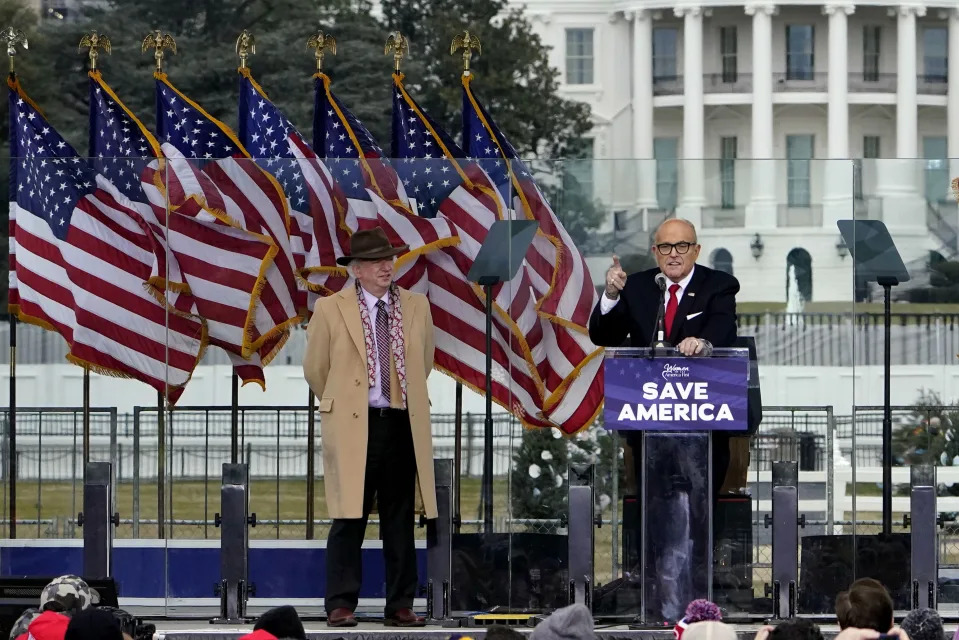
Chapman School of Law professor John Eastman testifies on Capitol Hill in Washington, March 16, 2017. Conservative attorney Eastman, a lead architect of some of former President Donald Trump’s efforts to remain in power after the 2020 election, was slapped Thursday, Jan.26, 2023, with a series of disciplinary charges in California that could lead to his disbarment. (AP Photo/Susan Walsh, File)Chapman University law professor John Eastman stands at left as former New York Mayor Rudolph Giuliani speaks in Washington at a rally in support of President Donald Trump, called the “Save America Rally” on Jan. 6, 2021. Conservative attorney Eastman, a lead architect of some of former President Donald Trump’s efforts to remain in power after the 2020 election, was slapped Thursday, Jan. 26, 2023, with a series of disciplinary charges in California that could lead to his disbarment.( AP Photo/Jacquelyn Martin, File)
LOS ANGELES (AP) — Conservative attorney John Eastman, a lead architect of some of former President Donald Trump’s efforts to remain in power after the 2020 election, was slapped Thursday with a series of disciplinary charges in California that could lead to his disbarment.
The State Bar of California’s chief trial counsel, George Cardona, said in a statement that the 11 charges stem from allegations that Eastman assisted Trump with a strategy — not supported by facts — to overturn the legitimate results of the 2020 election by obstructing the count of electoral votes of certain states.
The office intends to seek Eastman’s disbarment.
Eastman, the former dean of Chapman University law school in Southern California, was one of Trump’s lawyers during the election. He wrote a memo that argued former Vice President Mike Pence could keep Trump in power by overturning the results of the election during a joint session of Congress convened to count electoral votes. Critics have likened that to instructions for staging a coup.
The State Bar said Eastman faces charges that he violated the business and professions code by making false and misleading statements that constitute acts of “moral turpitude, dishonesty, and corruption.”
Eastman disputes “every aspect” of the charges filed by the State Bar, which are based on his role as counsel to the former president after the election, his attorney, Randall A. Miller, said in a statement.
The State Bar’s action “is part of a nationwide effort to use the bar discipline process to penalize attorneys who opposed the current administration in the last presidential election. Americans of both political parties should be troubled by this politicization of our nation’s state bars,” Miller’s statement said.
In advising Trump, “Eastman’s assessments were the product of comprehensive research of the law and historical records — including the 12th Amendment and Electoral Count Act — supported by reasonable interpretation of legal and historical precedent, scholarly analysis, and legislative history,” Miller added.
“He was a lawyer, not Rasputin,” Miller said.
The bar disclosed in March that it was investigating Eastman for possible ethics violations.
As the State Bar’s chief trial counsel, Cardona investigates and prosecutes attorney disciplinary matters before the State Bar Court, which can recommend attorneys be either suspended or, in some cases, lose their licenses to practice law. The California Supreme Court ultimately decides what to do.
Eastman has been a member of the California Bar since 1997, according to its website. He was a law clerk for U.S. Supreme Court Justice Clarence Thomas and a founding director of the Center for Constitutional Jurisprudence, a law firm affiliated with the Claremont Institute. He ran for California attorney general in 2010, finishing second in the Republican primary.
Eastman retired as dean of the Chapman University law school last year after more than 160 faculty members signed a letter calling for the university to take action against him.
In his statement, Cardona said the charges allege that Eastman “violated this duty in furtherance of an attempt to usurp the will of the American people and overturn election results for the highest office in the land — an egregious and unprecedented attack on our democracy.”
Science has finally cracked the mystery of why so many people believe in conspiracy theories
Adam Rogers – January 26, 2023
People don’t buy into conspiracy theories because of ignorance or social isolation. They do it because of a more prevalent personality quirk: overconfidence.Getty Images; iStock; Alyssa Powell/Insider
When it comes to the spread of cockamamie conspiracy theories, Twitter was a maximum viable product long before Elon Musk paid $44 billion for the keys. But as soon as he took the wheel, Musk removed many of the guardrails Twitter had put in place to keep the craziness in check. Anti-vaxxers used an athlete’s collapse during a game to revive claims that COVID-19 vaccines kill people. (Theydon’t.) Freelance journalists spun long threads purporting to show that Twitter secretly supported Democrats in 2020. (It didn’t.) Musk himself insinuated that the attack on Nancy Pelosi’s husband was carried out by a jealous boyfriend. (Nope.) Like a red thread connecting clippings on Twitter’s giant whiteboard, conspiratorial ideation spread far and wide.
By some measures more than half of Americans believe at least one tale of a secret cabal influencing events. Some are more plausible than others; a few are even true. But most — from classics like the faked moon landing to new-school stuff like 5G cell towers causing COVID — defy science and logic. And while social-media platforms like Twitter and Meta may help deranged conspiracy theories metastasize, a fundamental question remains: Why does anyone fall for stuff like that?
Social scientists are closing in on some answers. The personality traits known as the “Dark Triad” — that’s narcissism, psychopathy, and a tendency to see the world in black-or-white terms — play a part. So do political beliefs, particularly populism and a tolerance for political violence. Cognitive biases, like believing only evidence that confirms what you already think, also make people more vulnerable.
But according to new research, it isn’t ignorance that makes people most likely to buy into conspiratorial thinking, or social isolation or mental illness. It’s a far more prevalent and pesky personality quirk: overconfidence.
The more you think you’re right all the time, a new study suggests, the more likely you are to buy conspiracy theories, regardless of the evidence. That’d be bad enough if it applied only to that one know-it-all cousin you see every Thanksgiving. But given how both politics and business reward a faith in one’s own genius, the news is way worse. Some of the same people this hypothesis predicts will be most prone to conspiracy thinking also have the biggest megaphones — like an ex-president who believes he’s never wrong, and a CEO who thinks that building expensive cars makes him some sort of visionary. It’d be better, or at least more reassuring, if conspiracy theories were fueled by dumb yahoos rather than self-centered monsters. Because arrogance, as history has repeatedly demonstrated, is a lot harder to stamp out than stupidity.
Have faith in yourself (but not too much)
A decade or so ago, when Gordon Pennycook was in graduate school and wanted to study conspiracist thinking, a small but powerful group of unelected people got together to stop him. It wasn’t a conspiracy as such. It was just that back then, the people who approved studies and awarded grants didn’t think that “epistemically suspect beliefs” — things science can easily disprove, like astrology or paranormal abilities — were deserving of serious scholarship. “It was always a kind of fringe thing,” Pennycook says. He ended up looking into misinformation instead.
Still, the warning signs that conspiracy theories were a serious threat to the body politic go way back. A lot of present-day anti-semitism can be traced back to a 19th-century forgery purporting to describe a secret meeting of a Jewish cabal known as the Elders of Zion (a forgery based in part on yet another antisemitic conspiracy theory from England in the 1100s and re-upped by the industrialist Henry Ford in the 1920s). In 1962, the historian Richard Hofstadter warned against what he called the “paranoid style” of America’s radical right and its use of conspiracy fears to whip up support. Still, most scientists thought conspiracy theories weren’t worth their time, the province of weirdos connecting JFK’s death to lizard aliens.
Then the weirdos started gaining ground. Bill Clinton, they claimed, murdered Vince Foster. George W. Bush had advance knowledge of the September 11 attacks. Barack Obama wasn’t born in the United States. Belief in baseless theories could lead to actual violence — burning cellphone towers because of that COVID thing, or attacking the Capitol because Hugo Chávez rigged the US election. By the time of the January 6 insurrection, Pennycook had already switched to studying conspiracy.
It still isn’t entirely clear whether more people believe conspiracy theories today. Maybe there are just more theories to believe. But researchers pretty much agree that crackpot ideas are playing a far more significant role in politics and culture, and they have a flurry of hypotheses about what’s going on. People who believe in conspiracies tend to be more dogmatic, and unable to handle disagreement well. They also rate higher on those Dark Triad personality traits. They’re not stark raving mad, just a tick more antisocial.
But at this point, there are just way too many believers in cuckoo theories running around for the explanation to be ignorance or mental illness. “Throughout most of the 1970s, 80% — that’s eight zero — believed Kennedy was killed by a conspiracy,” says Joseph Uscinski, a political scientist at the University of Miami. “Would we say all of those people were stupid or had a serious psychological problem? Of course not.”
Which brings us to the overconfidence thing. Pennycook and his collaborators had been looking at the ways intuition could lead people astray. They hypothesized that conspiratorial thinkers overindex for their own intuitive leaps — that they are, to put it bluntly, lazy. Most don’t bother to “do their own research,” and those who do believe only things that confirm their original conclusions.
“Open-minded thinking isn’t just engaging in effortful thought,” Pennycook observes. “It’s doing so to evaluate evidence that’s directed toward what’s true or false — to actually question your intuitions.” Pennycook wanted to know why someone wouldn’t do that. Maybe it was simple overconfidence in their own judgment.
Sometimes, of course, people are justified in their confidence; after four decades in journalism, for example, I’m right to be confident in my ability to type fast. But then there’s what’s known as “dispositional” overconfidence — a person’s sense that they are just practically perfect in every way. How could Pennycook’s team tell the difference?
Their solution was pretty slick. They showed more than 1,000 people a set of six images blurred beyond recognition and then asked the subjects what the pictures were. Baseball player? Chimpanzee? Click the box. The researchers basically forced the subjects to guess. Then they asked them to self-assess how well they did on the test. People who thought they nailed it were the dispositional ones. “Sometimes you’re right to be confident,” Pennycook says. “In this case, there was no reason for people to be confident.”
Sure enough, Pennycook found that overconfidence correlated significantly with belief in conspiracy theories. “This is something that’s kind of fundamental,” he says. “If you have an actual, underlying, generalized overconfidence, that will impact the way you evaluate things in the world.”
The results aren’t peer-reviewed yet; the paper is still a preprint. But they sure feel true (confirmation bias aside). From your blowhard cousin to Marjorie Taylor Greene, it seems as if every conspiracist shares one common trait: a supreme smugness in their own infallibility. That’s how it sounds every time Donald Trump opens his mouth. And insideaccounts of Elon Musk’s management at Twitter suggest he may also be suffering from similar delusions.
“That’s often what happens with these really wealthy, powerful people who sort of fail upwards,” says Joe Vitriol, a psychologist at Lehigh University who has studied the way people overestimate their own expertise. “Musk is not operating in an environment in which he’s accountable for the mistakes he makes, or in which others criticize the things he says or does.”
An epidemic of overconfidence
Pennycook isn’t the first researcher to propose a link between self-regard and epistemically suspect beliefs. Anyone who has attended a corporate meeting has experienced the Dunning-Kruger effect — the way those who know the least tend to assume they know the most. And studies by Vitriol and others have found a correlation between conspiracy thinking and the illusion of explanatory depth — when people who possess only a superficial understanding of how something works overestimate their knowledge of the details.
But what makes Pennycook’s finding significant is the way it covers all the different flavors of conspiracists. Maybe some people think their nominal expertise in one domain extends to expertise about everything. Maybe others actually believe the conspiracy theories they spread, or simply can’t be bothered to check them out. Maybe they define “truth” legalistically, as anything people can be convinced of, instead of something objectively veridical. Regardless, they trust their intuition, even though they shouldn’t. Overconfidence could explain it all.
Pennycook’s findings also suggest an explanation for why conspiracy theories have become so widely accepted. Supremely overconfident people are often the ones who get handed piles of money and a microphone. That doesn’t just afford them the means to spread their baseless notions about Democrats running an international child sex-trafficking ring out of the basement of a pizza parlor, or Sandy Hook being a hoax. It also connects them to an audience that shares and admires their overweening arrogance. To many Americans, Pennycook suggests, the overconfidence of a Musk or a Trump isn’t a bug. It’s a feature.
To many Americans, new research suggests, the overconfidence of an Elon Musk or a Donald Trump isn’t a bug. It’s a feature.Stanton Sharpe/SOPA Images/LightRocket
It’s not necessarily unreasonable to believe in dangerous conspiracies. The US government really did withhold medical treatment from Black men in the Tuskegee trial. Richard Nixon really did cover up an attempted burglary at The Watergate Hotel. Jeffrey Epstein really did force girls to have sex with his powerful friends. Transnational oil companies really did hide how much they knew about climate change.
So distinguishing between plausible and implausible conspiracies isn’t easy. And we might be more likely to fall for the implausible ones if they’re being spouted by people we trust. “The same thing is true for you,” Pennycook tells me. “If you hear a scientist or a fellow journalist at a respected outlet, you say, ‘This is someone I can trust.’ And the reason you trust them is that they’re at a respected outlet. But the problem is, people are not that discerning. Whether the person says something they agree with becomes the reason they trust them. Then, when the person says something they’re not sure about, they tend to trust that, too.”
The next step, or course, is to figure out how to fight the spread of conspiratorial nonsense. Pennycook is trying; he spent last year working at Google to curb misinformation; his frequent collaborator David Rand has worked with Facebook. They had some meetings with TikTok, too. That pop-up asking whether you want to read the article before sharing it? That was them.
And what about the bird site? “Twitter? Well, that’s another thing altogether,” Pennycook says. He and Rand worked on the crowdsource fact-check function called Community Notes. But now? “It’s all in flux, thanks to Elon Musk.”
But Pennycook’s new study suggests that the problem of conspiracy theories runs far deeper — and may prove far more difficult to solve — than simply tweaking a social-media algorithm or two. “How are you going to fix overconfidence? The people who are overconfident don’t think there’s a problem to be fixed,” he says. “I haven’t come up with a solution for that yet.”
Fox’s ‘Straight News’ Anchor Harris Faulkner Lets Rick Scott Peddle His Medicare Lie
Justin Baragona – January 26, 2023
Fox News
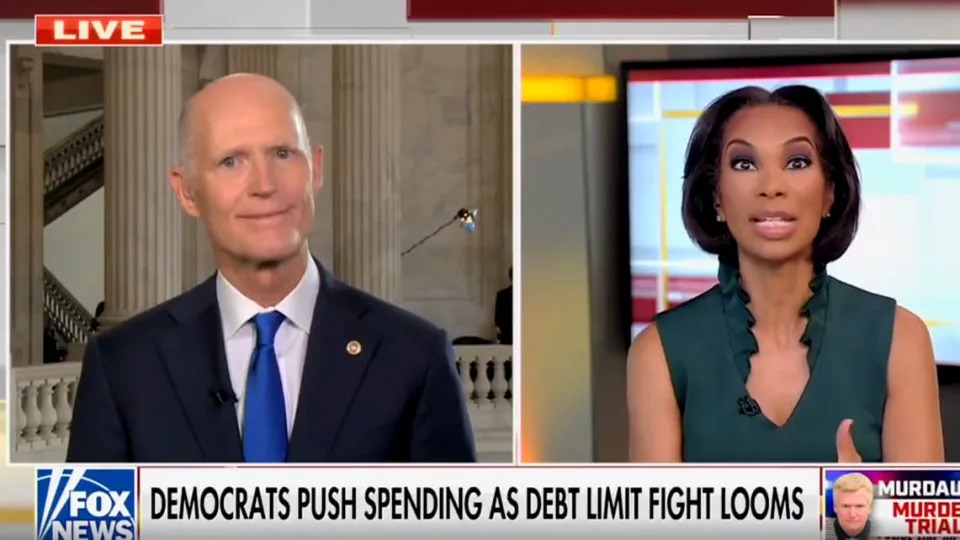
Fox News anchor Harris Faulkner on Thursday allowed Sen. Rick Scott (R-FL) to repeatedly push the lie that Democrats slashed hundreds of billions of dollars in funding for Medicare—even though that spurious claim had been debunked months ago.
In fact, not only did Faulkner—often labeled one of Fox’s “straight news” anchors—allow Scott’s falsehood to slide, she wondered how the Florida lawmaker would be able to work with Democrats since they’re “incapable of telling the truth.”
With the GOP now holding a slim majority in the House, the party has shifted much of its focus to austerity and pushing spending cuts across the board. Despite insisting during the midterms that they wouldn’t target Social Security and Medicare, House Republicans are now leveraging the fight over the debt ceiling to explicitly weigh proposals that would slash these entitlement programs.
Faulkner, who began her Thursday program by decrying the Democratic “spend, spend, spend” agenda amid rising debt, sounded the alarm over the “alarming” crisis facing entitlement programs. She aired a clip of President Joe Biden accusing Scott and Republicans of looking to reduce Social Security and Medicare.
“I don’t know one Republican, including me—we would never cut Medicare or Social Security. I’m gonna do everything I can to make sure there are no cuts in Medicare or Social Security,” the senator exclaimed. “But let’s remember, the Democrats, they all voted to cut $280 billion out of Medicare last September and Biden signed it.”
“Yes,” Faulkner empathically agreed.
“Let’s just remember—$280 billion they cut, and they want to say other people will do it,” Scott continued.
Though the Fox anchor heartily endorsed Scott’s assertion, fact-checkers knocked downthis claim last year—which centers on provisions in the Inflation Reduction Act that allows Medicare to negotiate drug prices with manufacturers.
According to government budget scorers, the Democratic-led bill that passed last year would save taxpayers anywhere between $237 billion and $288 billion due to pharmaceutical companies agreeing to lower prices on medications for Medicare patients. Still, Scott—whose GOP policy agenda last year drewwidespread criticism for proposing to cut Social Security—insisted at the time that this was a reduction in benefits.
CNN anchor Dana Bash, meanwhile, pushed back against his talking points during an interview last October, telling Scott that the legislation “allowed for negotiation for prescription drug prices, which would ultimately bring down the price and the costs for Medicare consumers.”Faulkner, however, was content to let Scott’s lie stand on Thursday.
Having already agreed with him once, the Fox anchor teed the Florida Republican up for a second round by airing comments from a Fox Business host who accused Democrats of “lying through their teeth” about the debt ceiling and Republicans’ stance on entitlements.
“I have to get your reaction to that because you have to negotiate with these people and you hear Larry Kudlow describing Democrats as they’re incapable of telling the truth about what we owe,” Faulkner declared.
After Scott grumbled that “they are not going to be honest with the American public,” the wealthiest U.S. senator expressed concern that “Wall Street has done really well” while average Americans suffer.
“That’s a flip of what the rhetoric is, isn’t it?” Faulkner reacted. “Democrats are looking across the aisle at you as Republicans and saying we are the ones who care about the middle class and seniors, but now what we’re seeing is that’s not actually true!”
Scott then repeated his false claim about Medicare cuts.
“They cut Medicare, Harris! They cut Medicare just four months ago,” They cut $280 billion out of Medicare, and they wanna say we want to cut it? No, I’m gonna fight like hell to make sure we preserve Medicare and Social Security because we can, we should, and we owe it to our seniors, but we have to do it by living within our means.”
Rather than correct the record, the Fox News anchor instead said that “everybody” has to live within a budget before moving on to Biden’s classified documents scandal.
Democrats revel in the GOP’s ‘doozy’ of an idea for a national sales tax
Ben Werschkul, Washington Correspondent – January 25, 2023
It’s a bill that is opposed by Speaker Kevin McCarthy (R-CA), unlikely to pass the GOP-controlled House of Representatives, and has approximately 0% chance of becoming law anytime soon.
But Democrats don’t want to stop talking about the Republicans’ proposal to replace income taxes with a national sales tax.
“This so-called fair tax plan is the craziest yet. It’s a real doozy,” Chuck Schumer said on Wednesday as the Senate Majority Leader took time out of his schedule to appear alongside House Democratic Leader Hakeem Jeffries (D-NY) for a press conference devoted to the subject. “Just the biggest lollapalooza I have ever seen around here.”
President Biden is also set to focus on the subject in a big way in a speech Thursday in Springfield, Virginia, with White House aides promising a contrast between the Democratic and GOP economic agendas that they hope voters will remember in coming years.
Senate Majority Leader Chuck Schumer (D-NY), left, meets with Hakeem Jeffries (D-NY), the leader the House Democratic Caucus, in Schumer’s office on Capitol Hill in December. (REUTERS/Evelyn Hockstein)
Rep. Earl L. “Buddy” Carter (R-GA) is the leading proponent of the idea and pushed back in a statement to Yahoo Finance, saying “Washington Democrats are fear-mongering about this bill because it takes power away from the federal government and puts it in the hands of the American people.”
Yet even voices sympathetic to Republicans urge the party to back away.
Grover Norquist, a tax reduction advocate, told Semafor it was “a political gift to Biden and the Democrats;” the conservative Wall Street Journal editorial page called it “masochism;” and Steve Forbes of flat tax fame called it a “belated, but huge Christmas present” for Democrats.
To top it off, Larry Kudlow, the former Director of Donald Trump’s National Economic Council, said it “really is a lousy idea” when he interviewed McCarthy on Tuesday.
The bill would eliminate all income taxes — from the payroll tax to corporate taxes to personal income taxes and more — and would also eliminate the Internal Revenue Service, just the latest salvo in the GOP’s feud with the tax-collection agency.
And while Americans may like the idea of no longer filling out tax forms each April, the bill would replace the trillions of dollars lost with a national sales tax.
The rate would begin at 23% in 2025 and could increase. An analysis of the plan from the Brookings Institution found that a rate around 30% — on top of existing state sales taxes — would be needed to cover the losses.
Rep. Buddy Carter (R-GA) during a budget hearing in 2022. (Roberto Schmidt-Pool/Getty Images)
Economists have also criticized the plan for lowering the the tax burden from high-income earners and corporations and shifting the onus to middle- and lower-class Americans who spend a much higher percentage of their monthly income on goods and services.
The Tax Policy Center found the idea would be a hike for 80% of Americans and a tax cut for the richest Americans. The top 20% would go from paying 84.2% of all federal income taxes to 65.1% under a theoretical federal retail sales tax.
But now, a full vote seems less likely in the near future. Three New York Republicans have already announced their opposition to the proposal and those “no” votes along with McCarthy would mean the bill would likely be defeated if put up for a full House vote.
Carter maintains that the bill removes complexity from the tax code, will encourage economic growth, and is better for working Americans. But the Georgia Congressman doesn’t seem to be expecting a floor vote soon.
“I’m excited for open debate on this legislation and for it to go through the committee process,” he said, adding it will be an opportunity for “a transparent discussion” about improving the tax system.
‘Go home and tell your moms’
Meanwhile, the unlikelihood of a national sales tax doesn’t seem to be dampening Democrats’ enthusiasm for discussing the issue.
During a recent speech, President Biden sarcastically proclaimed: “National sales tax, that’s a great idea…go home and tell your moms, they’re going to be really excited about that.”
On Capitol Hill, Sen. Jon Tester (D-MT) sent a letter to Senate leadership Tuesday, pledging “I will take on anyone” to stop the idea while his colleagues like Sens. Elizabeth Warren (D-MA) and Chris Murphy (D-CT) have taken to Twitter to mock the proposal.
“You wonder who is sitting in some dungeon, some laboratory, some basement cooking up these extreme ideas to try jam them down the throats of the American people,” added Leader Jeffries Wednesday.
It was former Georgia Congressman John Linder who first proposed the idea in 1999 and later co-authored a book called “The Fair Tax Book: Saying Goodbye to the Income Tax and the IRS.”
“The only tax collector that the consumer would ever see is the smiling face behind the register at the local grocery store,” Linder said in 2000 about the proposal that has been periodically revived over the last 20 year without ever gaining widespread Republican support.
Ben Werschkul is Washington correspondent for Yahoo Finance.
If you care about your country and your rights, don’t vote for any Republicans in 2022
Jill Lawrence, USA TODAY – January 24, 2023
Now that primary season is over there is a simple test for voters, especially Republicans and independents: If you care about the future of America, democracy and your own rights, don’t vote for Republicans. Any of them. Even the officeholders who have stood up to Donald Trump and the newcomers who pitch themselves as reality-based and results-oriented.
Even so, the Republican Party is on a dark path and should not hold power anywhere until it comes back into the light. That’s especially true on Capitol Hill.
Congressional math is unforgiving. If there is just one more Republican than Democrat in the House or Senate, a power-obsessed party in thrall to election deniers and conspiracists will control committees, agendas, investigations and leadership positions.
Republican voters are key to the outcome. About 8% of them voted for Democrats in 2018, TargetSmart CEO Tom Bonier, a Democratic data and polling expert, told me in an email. If that rises to 15% this year, he added, “the GOP has no chance of taking back either the Senate or the House.”
That’s not an unrealistic goal given the percentage of Republicans who voted for abortion rights last month in Kansas (roughly 30%, Bonier said Wednesday at a New Democrat Network webinar) and the chunk of GOP voters alarmed by Trump and his “Make America Great Again” loyalists. A new poll found a quarter of Republicans agree that Trump’s MAGA movement threatens democracy.
President Joe Biden accurately summarized that threat in a recent speech: “MAGA Republicans do not respect the Constitution. They do not believe in the rule of law. They do not recognize the will of the people. They refuse to accept the results of a free election. And they’re working right now, as I speak, in state after state to give power to decide elections in America to partisans and cronies, empowering election deniers to undermine democracy itself.”
As national security expert Tom Nichols wrote afterward in The Atlantic, “We should be deeply troubled that Joe Biden had to give this speech at all.” And he had to. Because even now, after the Trump mob’s insurrection attempt on Jan. 6, 2021, two impeachments, years of election lies, escalating legal problems and the FBI recovery of top secret government documents from Mar-a-Lago, Trump is not a spent force.
Former President Donald Trump and ally Doug Mastriano, the GOP nominee for Pennsylvania governor, at a rally in Wilkes-Barre, Pa., on Sept. 3, 2022.
Hours after Trump supporters stormed the Capitol on their deadly quest to block Congress from finalizing Biden’s win, 147 Republican lawmakers went ahead and objected to certified election results from Arizona, Pennsylvania or both. Over 18 months later, the party is still with Trump. Polls show roughly 70% of Republicans don’t view Biden as the legitimate winner of the 2020 election, and most Republicans want Trump as their 2024 nominee.
Believers of Trump’s Big Lie that he was the true winner have elevated so many delusional Republicans that 60% of voters will find election deniers on their 2022 ballots, according to FiveThirtyEight. Its analysis of GOP nominees for House, Senate, governor, secretary of state and attorney general found at least 200 of 552 say the 2020 election was illegitimate. If they win, they could influence and possibly even overturn elections in 40 states.
Some of these races are out of reach for Democrats. In U.S. House contests, FiveThirtyEight found that “118 election deniers and eight election doubters have at least a 95 percent chance of winning.”
At the same time, Real Clear Politics counts eight toss-up Senate races, 11 toss-ups for governor and 34 in the House. Concerned conservatives and moderates could make the difference in these contests – particularly if they vote Democratic no matter what kind of Republican is running.
This seems unfair to Republicans who have shown principled independence. By my count, 20 in the House made it to the fall ballot despite voting for an independent bipartisan commission to investigate the violent Capitol riot. Two of them, California’s Rep. David Valadao and Washington state’s Rep. Dan Newhouse, also voted to impeach Trump for inciting the rioters.
Valadao’s tight race could be one of the few that determine House control. Does he deserve to be reelected? Maybe. But could America survive a GOP-controlled House unscathed? Also maybe, and that’s not good enough.
The same argument holds for candidates like Senate nominee Joe O’Dea in Colorado, who says he’d be an “independent-minded” senator, and House nominee Allan Fung in Rhode Island, who says he’d work with Democrats to solve problems. That’s commendable, but voting for them could produce a Republican House or Senate.
I wouldn’t even bet on fact-based Republican governors. Some could face veto-proof legislatures dominated by MAGA fantasists. And some could fold. Look at New Hampshire Gov. Chris Sununu and retired Army Brig. Gen. Don Bolduc, who a month ago declared that “Trump won the election. … I’m not switchin’ horses baby. This is it.” Sununu called Bolduc a “conspiracy theorist-type” and “not a serious candidate” for the GOP Senate nomination. But right before Tuesday’s primary, Sununu said he’d endorse Bolduc if he won.
A MAGA-driven America is a grim prospect. Would future Republican candidates admit defeat if they lost, or would they make sure, through legislation and manipulation, that they’d win? Would they cement minority rule and further restrict fundamental rights like voting and abortion?
Biden has correctly distinguished between “mainstream Republicans” and Trump’s extreme “MAGA Republicans.” They are different, and mainstream GOP politicians holding the line deserve credit. Nevertheless, when it comes to who controls Congress and the levers of power in states across the country, all that counts right now is the “R” after their names.
US governor defends ban on African American history course
January 23, 2023
The Republican leader of the US state of Florida defended his ban on an African American studies course Monday, railing against its pushing of “social justice” topics such as “queer theory.”
“We want education, not indoctrination. If you fall on the side of indoctrination, we’re going to decline. If it’s education, then we will do (it),” Governor Ron DeSantis, who is considered one of the favorites for his party’s 2024 presidential nomination, told reporters.
“This course on Black history: what is one of the lessons about? Queer theory. Now who would say that an important part of Black history is queer theory? That is somebody pushing an agenda on our kids,” he added.
The class covers more than 400 years of African American history and is being rolled out as part a nationwide “advanced placement” program giving high school students the chance to take college-level subjects before graduation.
But Florida’s Department of Education has objected to the inclusion of “Black Queer Studies” and topics such as Black feminism and the alleged promotion of critical race theory, an academic discipline investigating systemic racism in American society.
Officials have also complained about its approach to the debate over reparations — the argument for compensating Black Americans for slavery — telling organizers the program violated state law and rejecting its inclusion in Florida schools.
DeSantis has seen his political stock rise following a big election win in November and he is now considered former president Donald Trump’s main rival in the race for the 2024 Republican nomination.
He has gained support on the right for his hardline stances on “culture war” issues such as public health restrictions during the pandemic and alleged “woke” indoctrination in education.
He argued Monday that the purpose of education was the “pursuit of truth,” and not to use schools as “an instrument of what they consider social justice and social change.”
“We believe in teaching kids facts and how to think, but we don’t believe they should have an agenda imposed on them,” DeSantis said. “When you try to use Black history to shoehorn in queer theory, you are clearly trying to use that for political purposes.”
The decision to block the course has been met with outrage from the American Civil Liberties Union, which said DeSantis had “no right to censor speech he disagrees with” while Vice President Kamala Harris said at the weekend anyone banning teaching US history “has no right to shape America’s future.”