12 of the most unforgettable moments from State of the Union addresses
Shelby Slauer and Rebecca Cohen – February 7, 2023
12 of the most unforgettable moments from State of the Union addressesFormer President Barack Obama during a State of the Union address.REUTERS/Mandel Ngan/Pool
The State of the Union address allows the US president to update Congress on the nation’s progress.
Former President Harry S. Truman’s speech in 1947 was the first to be broadcast on television.
Nancy Pelosi ripped up a copy of Donald Trump’s speech after he finished speaking.
Parts of Abraham Lincoln’s State of the Union speech were leaked and it prompted an investigation.
His wife was accused of leaking information, but Lincoln said she hadn’t seen the speech in advance.Hulton Archive / Stringer / Getty Images
Hours after Abraham Lincoln sent his State of the Union address to Congress, the newspaper The New York Herald published a few excerpts from the speech that had been leaked. Readers of the paper got to see parts of the speech before it was formally released.
The leak prompted the House Judiciary Committee to launch an investigation into the cause of the leaks in February 1862.
Harry S. Truman’s speech in 1947 was the first to be broadcast on television.
Former President Harry S. Truman giving the State of the Union address.AP/Byron Rollins
In 1947, Harry S. Truman’s State of the Union address was the first to be televised. At the time, television owners were only in the thousands, so most Americans missed his debut, instead listening to it on the radio.
Richard Nixon called for an end to the Watergate investigation during his State of the Union address in 1974.
President Richard Nixon delivering the State of the Union address in 1974.AP Photo
In Nixon’s 1974 address, he called for an end to the Watergate investigation, saying, “one year of Watergate is enough.”
Ronald Reagan invited Lenny Skutnik to the address in 1982, starting a new tradition for State of the Union addresses.
Lenny Skutnik being recognized during the State of the Union speech in 1982.Frank Johnston/Washington Post/Getty Images
Reagan was the first president to bring a guest to honor at the State of the Union address, which began an annual tradition of recognizing everyday American heroes.
Congressional Budget Office employee Lenny Skutnik was honored for saving the life of Priscilla Tirado after an Air Florida plane crashed into the freezing Potomac River. He sat beside the First Lady during the address.
Bill Clinton called for an end to big government during his address in 1996.
President Clinton during one of his State of the Union addresses.AP/ RON EDMONDS
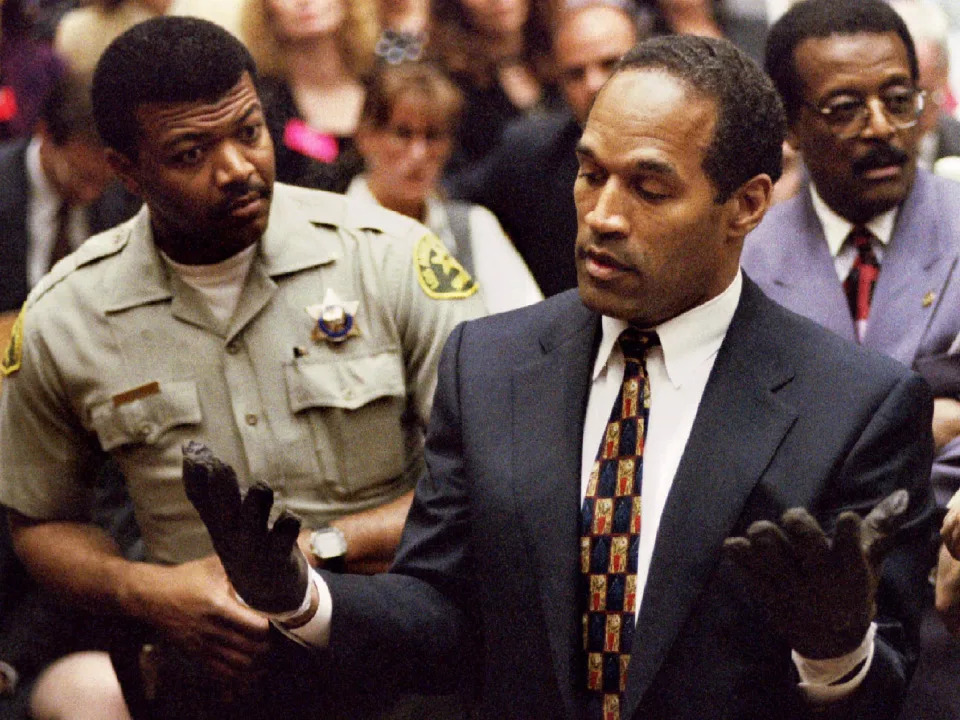
Networks cut away from Clinton’s State of the Union address in 1997 to air the OJ Simpson verdict.
Defendant OJ Simpson during his trial.Reuters
Clinton’s 1997 address was coming to an end right as the jury was about to deliver the verdict for OJ Simpson’s highly publicized criminal trial.
Networks cut straight from his address to the Simpson trial before the Republican response to Clinton’s address was aired.
George W. Bush coined “Axis of Evil” in his 2002 address, marking the beginning of the Iraq War.
George W. Bush giving a State of the Union address.Luke Frazza/Getty Images
Soon after the 9/11 attacks, Bush labeled North Korea, Iran, and Iraq as an “Axis of Evil,” arguing in favor of what would become the Iraq War.
Justice Samuel Alito shook his head in disagreement during Obama’s 2010 State of the Union address.
Supreme Court Justice Samuel Alito prior to President Barack Obama’s State of the Union address.AP Photo/Pablo Martinez
As Obama criticized the Supreme Court ruling on campaign finance, the camera cut to Justice Samuel Alito, who quietly mouthed “not true,” according to Politico’s reports.
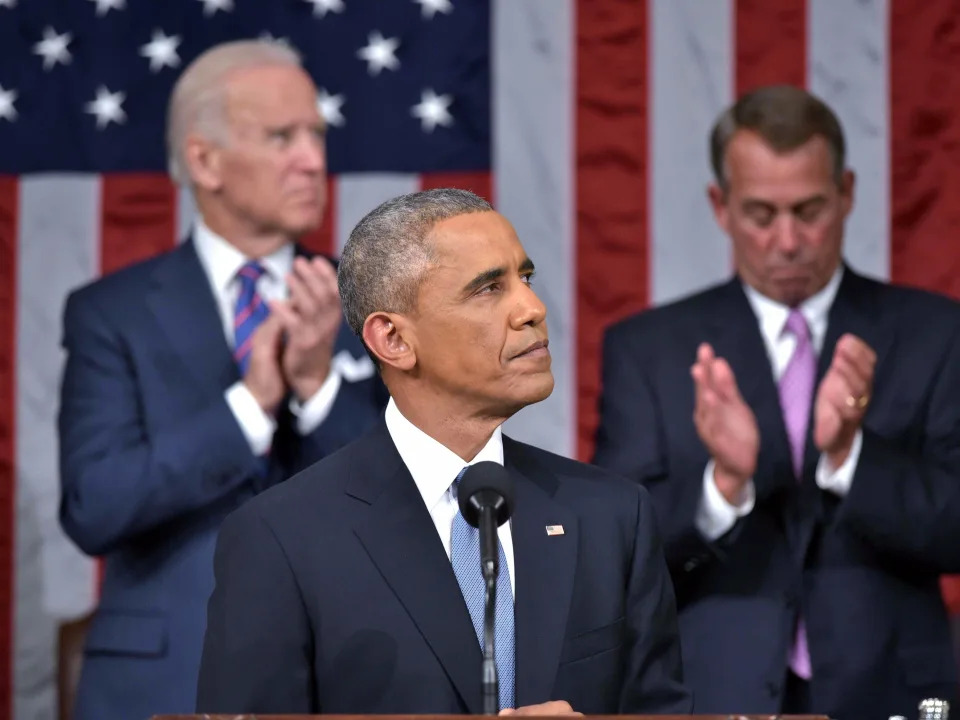
Joe Biden pointed during Obama’s State of the Union address.
Biden’s facial expressions went viral.Fox News
During Obama’s State of the Union address in 2014, many couldn’t help but be distracted by former Vice President Joe Biden’s sudden pointing and laughing behind the president.
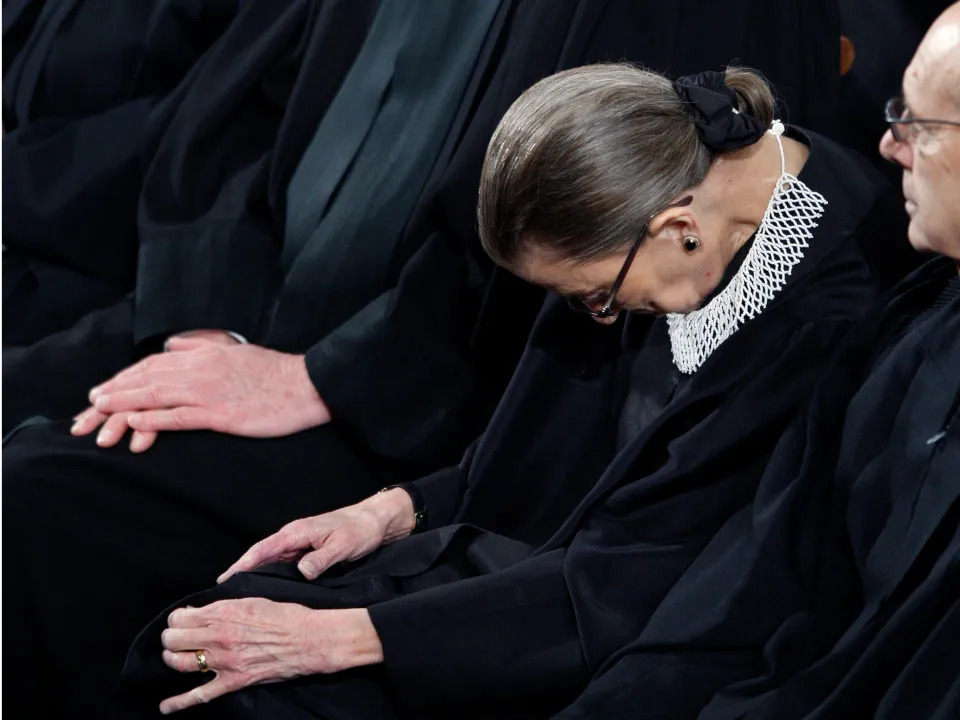
Supreme Court Justice Ruth Bader Ginsburg fell asleep during Obama’s 2015 State of the Union address.
Supreme Court Justice Ruth Bader Ginsburg during Obama’s State of the Union address.Pablo Martinez Monsivais/AP
Justice Ginsburg was caught on camera during Obama’s 2015 address with her head fully bowed, taking a nap.
Later, as per Reuters reports, she explained why her head was down: “The audience, for the most part, is awake, but they’re bobbing up and down all the time. And we sit there as stone-faced, sober judges. But we’re not. At least I wasn’t 100% sober when we went to the State of the Union.”
Donald Trump shrugged off a handshake from Speaker of the House Nancy Pelosi ahead of the 2020 State of the Union.
Nancy Pelosi extending a hand to Donald Trump ahead of the State of the Union address on February 4, 2020.OLIVIER DOULIERY/AFP via Getty Images
When Trump entered the chambers to give his 2020 State of the Union speech, Speaker of the House Nancy Pelosi offered a handshake in an attempt at being cordial with the president.
He seemed to ignore her handshake and walked right past her. Pelosi shrugged it off and was seen shaking her head and looking down throughout the duration of his address.
Pelosi ripped up a copy of Trump’s 2020 State of the Union speech after he finished speaking.
Nancy Pelosi ripping up pages of the prepared speech at President Donald Trump’s State of the Union on February 4, 2020.Mark Wilson/Getty Images
After he finished speaking during his 2020 State of the Union, Pelosi was seen ripping up a copy of Trump’s speech right behind him.
When asked why she did that, she said, “Because it was the courteous thing to do. It was the courteous thing to do considering the alternative.” It is not clear what she meant by “the alternative.”
Huge chunk of plants, animals in U.S. at risk of extinction -report
Brad Brooks – February 6, 2023
A Venus flytrap is seen at the meat-eating plant exhibition “Dejate Atrapar” (Let Yourself Get Caught), in BogotaEndangered Key Deer are pictured in a puddle following Hurricane Irma in Big Pine Key, FloridaEndangered Arizona hedgehog cactus is seen in the Oak Flat recreation area outside Superior, ArizonaA full moon rises over a cactus in PhoenixThe endangered dusky gopher frog, a darkly colored, moderately sized frog with warts covering its back and dusky spots on its belly, is shown in this handout photo
(Reuters) -A leading conservation research group found that 40% of animals and 34% of plants in the United States are at risk of extinction, while 41% of ecosystems are facing collapse.
Everything from crayfish and cacti to freshwater mussels and iconic American species such as the Venus flytrap are in danger of disappearing, a report released on Monday found.
NatureServe, which analyzes data from its network of over 1,000 scientists across the United States and Canada, said the report was its most comprehensive yet, synthesizing five decades’ worth of its own information on the health of animals, plants and ecosystems.
Importantly, the report pinpoints the areas in the United States where land is unprotected and where animals and plants are facing the most threats.
Sean O’Brien, president of NatureServe, said the conclusions of the report were “terrifying” and he hoped it would help lawmakers understand the urgency of passing protections, such as the Recovering America’s Wildlife Act that stalled out in Congress last year.
“If we want to maintain the panoply of biodiversity that we currently enjoy, we need to target the places where the biodiversity is most threatened,” O’Brien said. “This report allows us to do that.”
U.S. Representative Don Beyer, a Democrat who has proposed legislation to create a wildlife corridor system to rebuild threatened populations of fish, wildlife and plants, said NatureServe’s work would be critical to helping agencies identify what areas to prioritize and where to establish migration routes.
“The data reported by NatureServe is grim, a harrowing sign of the very real problems our wildlife and ecosystems are facing,” Beyer told Reuters. “I am thankful for their efforts, which will give a boost to efforts to protect biodiversity.”
HUMAN ENCROACHMENT
Among the species at risk of disappearing are icons like the carnivorous Venus flytrap, which is only found in the wild in a few counties of North and South Carolina.
Nearly half of all cacti species are at risk of extinction, while 200 species of trees, including a maple-leaf oak found in Arkansas, are also at risk of disappearing. Among ecosystems, America’s expansive temperate and boreal grasslands are among the most imperiled, with over half of 78 grassland types at risk of a range-wide collapse.
The threats against plants, animals and ecosystems are varied, the report found, but include “habitat degradation and land conversion, invasive species, damming and polluting of rivers, and climate change.”
California, Texas and the southeastern United States are where the highest percentages of plants, animals and ecosystems are at risk, the report found.
Those areas are both the richest in terms of biodiversity in the country, but also where population growth has boomed in recent decades, and where human encroachment on nature has been harshest, said Wesley Knapp, the chief botanist at NatureServe.
Knapp highlighted the threats facing plants, which typically get less conservation funding than animals. There are nearly 1,250 plants in NatureServe’s “critically imperiled” category, the final stage before extinction, meaning that conservationists have to decide where to spend scant funds even among the most vulnerable species to prevent extinctions.
“Which means a lot of plants are not going to get conservation attention. We’re almost in triage mode trying to keep our natural systems in place,” Knapp said.
‘NATURE SAVINGS ACCOUNT’
Vivian Negron-Ortiz, the president of the Botanical Society of America and a botanist with the U.S. Fish and Wildlife Service, who was not involved in the NatureServe report, said there is still a lot scientists do not know and have not yet discovered about biodiversity in the United States, and that NatureServe’s data helped illuminate that darkness.
More than anything, she sees the new data as a call to action.
“This report shows the need for the public to help prevent the disappearance of many of our plant species,” she said. “The public can help by finding and engaging with local organizations that are actively working to protect wild places and conserve rare species.”
John Kanter, the senior wildlife biologist with the National Wildlife Federation, said the data in the report, which he was not involved with, was essential to guiding state and regional officials in creating impactful State Wildlife Action Plans (SWAPs), which they must do every 10 years to receive federal funding to protect vulnerable species.
Currently $50 million in federal funding is divided up among all states to carry out their SWAPs. The Recovering America’s Wildlife Act, whose congressional sponsors say will be reintroduced soon, would have increased that to $1.4 billion, which would have a huge impact on the state’s abilities to protect animals and ecosystems, Kanter said, and the NatureServe report can act as roadmap for officials to best spend their money.
“Our biodiversity and its conservation is like a ‘nature savings account’ and if we don’t have this kind of accounting of what’s out there and how’s it doing, and what are the threats, there’s no way to prioritize action,” Kanter said. “This new report is critical for that.”
Read more:
GRAPHIC-The collapse of insects
Penguins offer varied clues to Antarctic climate change
ANALYSIS-U.N. nature deal can help wildlife as long as countries deliver
(Reporting by Brad Brooks in Lubbock, Texas; Additional reporting by Julio-Cesar Chavez in Washington; Editing by Lisa Shumaker)
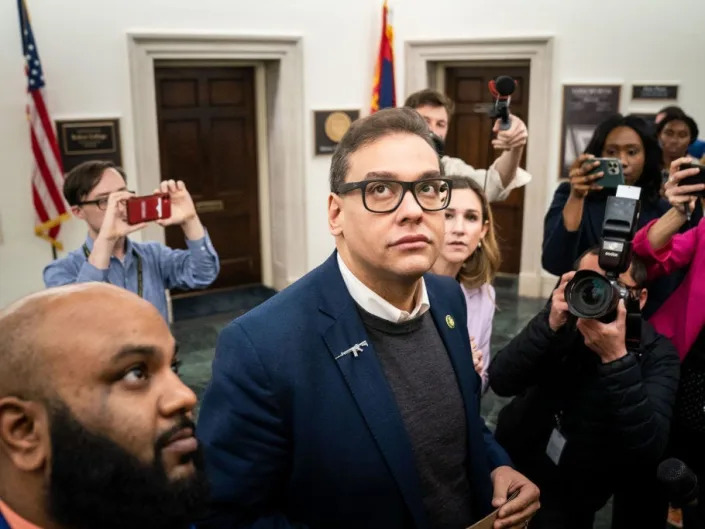
Mired in scandal, Santos has said he will step down from serving on committees in the House of Representatives while he faces multiple investigations.
While everyone tells lies occasionally, some people appear to do so much more than others. So, why and how do people become compulsive liars? This is what the experts say.
What is a compulsive liar?
Christian Hart, a professor of psychology at Texas Woman’s University who specializes in pathological lying, told Insider that the terms “habitual liar,” “compulsive liar,” and “pathological liar” essentially mean the same thing — people who lie a lot.
Hart said that compulsive liars typically engage in excessive lying that causes some problems in the normal functioning of their lives, whether with work, romantic relationships, or with friends and family.
They typically have some kind of internal conflict over the lies, he said, as they want to stop but find themselves compulsively engaging in the behavior over and over again.
While Hart said he can’t formally diagnose the lawmaker without knowing details about whether he experiences functional problems or distress, he notes that Santos does appear to engage in pathological lying.
“In the sense that most people use the term ‘pathological lying,’ I’d say yes, it seems like he’s got this long track history preceding his entering into politics where he’s cultivated this reputation of being an extremely dishonest person,” Hart said.
So why do people lie? Hart explains that people don’t lie unless there is some incentive to do so — though this incentive might not always be obvious to an outsider.
Many of Santos’ lies appear to serve a clear purpose. He embellished his résumé while on the campaign trail, likely in an attempt to impress voters. He fabricated connections to the 9/11 attacks, possibly in order to burnish his reputation as a true New Yorker or to garner sympathy.
But along with lying about details about important elements of his life and history, Santos has also appeared to tell outlandish lies about seemingly insignificant things.
“When people have historically defined pathological lying, many of them have said these people lie with no apparent reason. But I argue that it does serve a purpose, it’s just a purpose that we are unfamiliar with,” Hart said.
Santos, Hart said, “lied about being a star athlete on a volleyball team at a kind of a lower-tier college — that wouldn’t carry any cache for most people. But just because we can’t see the purpose of the lie doesn’t mean the purpose doesn’t exist for him. Perhaps, he’s always had a sense of inferiority about not being an athletic person, and so to be seen that way means a lot to him where it would mean nothing to other people.”
A representative for Santos did not reply to Insider’s request for comment.
Reporters surround embattled Rep. George Santos as he heads to the House Chamber for a vote, at the US Capitol on Tuesday, January 31, 2023 in Washington, DC.Kent Nishimura / Los Angeles Times via Getty Images
Hart has written a book about the science of pathological lying along with his colleague Drew Curtis, who is a psychology professor at Angelo State University.
Curtis told Insider that, like many psychological tendencies, pathological lying is often due to a combination of factors involving environment and genetics, both nature and nurture, and typically begins in later childhood and adolescence.
Do compulsive liars know they’re lying?
Many psychologists say compulsive lying is often a feature of a personality disorder, such as antisocial-personality disorder or narcissistic-personality disorder.
Compulsive lying is not, in itself, classified as a disorder in the DSM, the handbook healthcare professionals use as the guide to classifying mental-health disorders.
Curtis explained that it is important to distinguish people who are just pathological liars, and those that engage in pathological lying as part of a personality disorder — a key difference being that pathological liars do typically exhibit some remorse about lying.
While again Hart said he can’t formally diagnose him, he said Santos does appear to exhibit some traits of antisocial-personality disorder — where people manipulate and exploit others for personal benefit, with little guilt or remorse.
“Looking at the types of things that historically Santos has been accused of lying about and given his reaction when he’s confronted about those instances of dishonesty, he certainly seems that he could have many of the traits of antisocial-personality disorder,” Hart said.
Along with being accused of lying about things to boost his reputation, a military veteran has also accused Santos of pocketing $3,000 from a GoFundMe page for a dying dog, which the FBI is now probing.
Peers and the public have also raised questions about the congressman’s personal and campaign finances, which he is facing federal and local investigations over.
Typically, compulsive liars believe they won’t be caught and that any negative consequences from their lies are tolerable, according to Hart.
However, Santos’ lies are often well-documented, as he puts them in writing on social media or his websites, or verbalizes them in on-camera interviews.
Hart noted that it is “unusual” that Santos does not appear to be concerned about others discovering his lies and, in fact, “appears to just double down in many cases when he’s accused of lying.”
“That is unusual for him and unusual for many of the cases that we’ve explored of pathological liars,” Hart said. “It looks to me like he’s the type of person who doesn’t seem to worry too much about the reputation he’s cultivating around his honesty or dishonesty.”
Rep. George Santos.Patrick Semansky/AP Photo
When people lie constantly and repeatedly, it can be easy to question whether they are even aware that they are lying any more and whether they have simply become detached from reality.
In a recently leaked audio recording from January 30, obtained by Talking Points Memo, Santos admits to his track record of lying and appears to express frustration with himself.
“I’ve made bad judgment calls, and I’m reaping the consequences of those bad judgment calls,” Santos said in the recording.
“I’ve obviously fucked up and lied to him, like I lied to everyone else,” Santos later said, apparently referring to his chief of staff Charley Lovett. “And he still forgave me and gave me a second shot, unlike some other people.”
Curtis noted that the fact that Santos has admitted to lying about some aspects of his past suggests a conscious deception.
“I think in the case of Santos, he’s come out, at least from my understanding, he’s come out and apologized and said, you know, this wasn’t necessarily true. So then if someone’s claiming that what they said wasn’t true, then I think it’s easier to say that was a deception, not a delusion,” Curtis said.
Professions like politics are more closely linked to lying
Curtis and Hart note in their research that certain professions, like sales and politics, are more closely linked with lying.
Hart explained that these professions do not necessarily attract dishonest people, but might push people toward dishonesty. For example, a salesperson may be dishonest if they must sell an inferior product. Similarly, politicians might not be able to be honest all of the time and so might find themselves exaggerating, concealing, or outright lying about things.
He noted that politicians who are willing to tell lies are actually more likely to get reelected than politicians who are unwilling to be dishonest.
How do you deal with compulsive liars?
Rep. George Santos.
Rep. George Santos.Mary Altaffer
Curtis and Hart note that pathological lying can be difficult to treat as it is not a formally recognized diagnosis.
As it currently stands, psychologists typically treat pathological liars with cognitive-behavioral therapy, a common type of talk therapy.
Outside of a professional setting, it can be hard to know how to respond to a compulsive liar. Hart suggested that the best way to respond to pathological liars is to call them out on their lies.
“Most people don’t like being called out on their lying and feel extremely uncomfortable, and they want to prevent any further reputational damage,” he said.
Curtis suggested ignoring the deception and intentionally giving attention to honest behavior instead.
“One of the real challenges of how to respond to pathological lying is that we give attention to their lies, which then can become reinforcing. So one of the suggestions we have is called ‘differential reinforcement of other behavior,’ where you ignore the deception. Then you have to intentionally give attention to honest behavior,” Curtis said.
“So, even when honesty may be mundane, not very exciting, we need to give that attention to the person who lies a lot.”
Jan. 6 panel witness Cassidy Hutchinson said Trump assaulted Secret Service agent
Antonio Fins, Palm Beach Post – February 4, 2023
A witness has testified that a furious President Donald Trump assaulted the head of his Secret Service detail in the presidential vehicle after being told he could not go to the U.S. Capitol amid a mushrooming riot on Jan. 6, 2021.
Cassidy Hutchinson, an aide to then-White House Chief of Staff Mark Meadows, related the account on Tuesday during her appearance before the U.S. House committee investigating the attack on the Capitol.
She said a top White House official, Tony Ornato, who served as White House deputy chief of staff, told her that story in the presence of the Secret Service agent, Robert Engel, with whom Trump had the altercation.
After Engel told Trump he could not go the Capitol due to security concerns, the then-president in a fit of anger was said to have reached for the steering wheel. When told to let it go, Trump then lunged at Engel, Hutchinson said Ornato told her.
Neither Ornato nor Engel ever told her the story was wrong, Hutchinson said during questioning.
That conversation, Hutchinson testified, took place moments after the president, his Secret Service detail and a group of aides, including Hutchinson, returned to the White House after Trump’s Jan. 6 rally speech.
Hutchinson also testified that Trump was irate before his speech because metal detectors were keeping armed rallygoers from entering the area closest to where he and others were speaking. Police reports, presented during the hearing, stated some attendees were carrying weapons, including AR-15s and “Glock-style pistols.”
But Hutchinson said Trump dismissed the obvious threat saying they were “not there to hurt me” and demanded that the metal detectors be taken away.
President Donald Trump passes supporters while traveling in his motorcade in West Palm Beach, Fla., on Wednesday, January 27, 2021 on his way to Mar-a-Lago in Palm Beach.
Hutchinson also said she received a call from GOP Minority Leader Kevin McCarthy who was angry that Trump had stated during his speech that he would march with rallygoers to the Capitol.
Another White House aide, lawyer Pat Cipollone, also warned that Trump’s plans to go to the Capitol would raise serious legal exposure and liability. And upon hearing of “hang Mike Pence chants” among Capitol rioters, Trump said: “Mike deserves it.”
Hutchinson also testified that she had helped a White House valet wipe ketchup stains after Trump threw a dish at a wall in anger. That followed Trump’s hearing that Attorney General William Barr had told the Associated Press on Dec. 1, 2020, that there was no evidence of massive electoral fraud.
Hutchinson offered the in-person testimony before the Select Committee investigating the Jan. 6, 2021, violence on Capitol Hill as well as allegations that Trump abused his powers to remain in office despite losing the November 2020 election.
In a statement on Truth Social, Trump said he “hardly” knew Hutchinson, but then described her as “a total phony and ‘leaker.’ ” He also said he personally “turned her request down” when Hutchinson asked to join his team in Florida. “She is bad news,” he wrote.
He then posted 11 more missives on the platform denying he was dismissive of the threat against Pence and saying her “made up” statements were evidence of “a social climber.”
And Trump also denied he “complained” about the crowd for his Jan. 6 rally speech, or that he wanted to “make room for people with guns to watch my speech.”
An image of a photo shown during the sixth hearing of the U.S. House committee investigating the Jan. 6 attack on the Capitol.
Antonio Fins is a politics and business editor at the Palm Beach Daily News, part of the USA TODAY Florida Network.
Donald Trump and golf: Fancy resorts, A-List partners, cheating at highest level
Tom D’Angelo, Palm Beach Post – February 3, 2023
Donald Trump has a long (creative) history with golf. He owns fancy resorts and lavish courses around the world. He has played with the biggest names. And he’s received endorsements from some of the most well-known golfers in the world. Even besides himself.
But above all, the former president’s dubious claims on the course have become legendary, and were the subject of a 2019 book by sportswriter Rick Reilly: Commander in Cheat.
“Trump doesn’t just cheat at golf,” Riley wrote. “He throws it, boots it, and moves it. He lies about his lies. He fudges and foozles and fluffs. At Winged Foot, where Trump is a member, the caddies got so used to seeing him kick his ball back onto the fairway they came up with a nickname for him: ‘Pele.’”
President Donald Trump tweeted this photo after golfing with local golf legends Jack Nicklaus and Tiger Woods on Saturday, Feb. 2, 2019
Just ask members of Trump International West Palm Beach who arrived for the final round of their Senior Club Championship on Jan. 22 only to find Trump’s name at the top of the leaderboard … when he didn’t play the first round.
But he did play a round earlier that week, claimed he had a good day and decided to use that score for the first round of the Senior Club Championship. He then called it a “great honor” to have won the tournament on social media, adding, “he was hitting the ball long and straight.”
Those who know him certainly were not surprised.
Here is some of the history Trump, who lives in Palm Beach, has with golf:
Courses around the world
Trumpgolf.com lists 18 courses under the heading ‘Our Properties’, including 12 in the United States. Of those, three are in Florida: Jupiter, West Palm Beach, Doral.
Those courses have hosted many PGA and LPGA events, but Trump’s relationship with the PGA Tour soured in 2016 when the tour moved the World Golf Championship out of Trump National Doral and to Mexico City after losing its sponsor, Cadillac.
This angered Trump for so many reasons. His attitude toward Mexico was made clear as he prepared to run for president when he said of the country: “They are not our friend, believe me. They’re bringing drugs. They’re bringing crime. They’re rapists. And some, I assume, are good people.”
That continued when learning the tour was dropping Doral for Mexico City. “They’re moving it to Mexico City which, by the way, I hope they have kidnapping insurance.”
That relationship fractured even more when the PGA of America took a major away from one of Trump’s courses four days after Trump supporters rioted at the United States Capitol. The organization moved the 2022 PGA Championship from Trump’s course in Bedminster, N.J., to Southern Hills in Tulsa, Okla.
All of this led to Trump’s support for LIV Golf, the startup league headed by Palm Beach Gardens’ Greg Norman and financed by the Saudis. LIV has become a rival of the PGA Tour and three LIV events this year will be held at Trump properties.
The old switcheroo
Ted Virtue, founder and CEO of MidOcean Partners, a New York-based alternative asset management firm, won the club championship at West Palm Beach when Trump was president. At the time, Trump was in Singapore and missed the event.
Here is the story Reilly told and also was reported in Golf.com.
Trump sees Virtue on the back nine of the course one day and tells him he didn’t really win the club championship, “because I was out of town.” So he tells Virtue they will start there and play to see who the real champion is. Virtue has no choice.
“Apparently, they get to a hole with a big pond in front of the green,” Reilly said. “Both Ted and his son hit the ball on the green, but Trump hits his in the water. By the time they get to the hole, though, Trump is lining up the son’s ball. Only now it’s his ball and the caddie has switched it.
“The son is like, ‘That’s my ball!’ But Trump’s caddie goes, ‘No, this is the president’s ball; your ball went in the water.’ … Trump makes that putt, and wins one up.”
Where’d that ball come from?
Trump was playing in a charity event at a prestigious South Florida course when he was part of a foursome that included an NFL quarterback and professional golfer, according to a participant who was at the event.
On a par-3 that was playing more than 200 yards, no one hit the green, including Trump, whose tee shot clearly was short.
Two of the golfers flew the green, the balls landing in a gully. As they walked back up the hill to check out the pin placement, they noticed a ball sitting feet from the hole.
Trump tells them it was his ball and they must have not seen his tee shot land on the green.
Trump and Dallas Mavericks owner Mark Cuban had a legendary feud in 2013, with Trump attacking Cuban’s team and, of course, his golf.
By the end of a two day meltdown, and after Trump said he won yet another club championship at West Palm Beach, Trump pulled out the big guns:
“I’ve won 18 Club Championships including this weekend. @mcuban swings like a little girl with no power or talent. Mark’s a loser.”
Trump now has claimed to have won more than 20 club championships. Reilly once said the best player at that level he knows had won eight.
Reilly said in the Vox interview Trump told him whenever he opens a new golf course he plays the first club championship by himself and declares that the champion and puts his name on the wall.
“But it’s usually just him and Melania in the cart and nobody else,” Reilly said. “He just makes it up.”
Tiger tale
Soon after he became president Trump set up a foursome with Brad Faxon, Tiger Woods and Dustin Johnson. Trump and Faxon were partners.
Trump was allowed to hit from closer tees and was allowed to subtract a stroke on the eight hardest holes. On one hole, Trump hits his tee shot into the water and tells Faxon to throw him a ball. “They weren’t looking,” he said. His second tee shot goes into the water. So he drops where he should have after his first water ball, hits what was his fifth shot. After making what actually was a seven, the players were asked their scores.
When Trump was told Tiger made a three, he says he made “four for a three (with the stroke).”
‘Tough luck’
Trump invited football announcers/analysts Mike Tirico, Jon Gruden and Ron Jaworski to one of his courses. He chose Gruden as his partner.
Tirico hit a 3-wood about 230 yards onto the green on one hole. When he arrived the ball was in a bunker about 50 feet from the pin.
“Tough break,” Trump said.
Tirico later was told by Trump’s caddie that his shot was about 10 feet from the hole and Trump threw it into the bunker.
“He can really strike the ball,” Els said. “He makes good contact. He’s got a good swing. Like any amateur, you got to do the short game practice. I keep talking to him about his chipping. He’s a pretty good putter. Back in his day, he had to be a 4- or 5-handicap. Today, he’s probably a 10, 12.”
If you praise Trump’s game, it’s definitely not fake news.
Trump has played with the best of the best. Jack Nicklaus, Els, Woods, Johnson, Rory McIlroy, Bryson DeChambeau, Brooks Koepka among them.
“President Trump plays pretty well, not bad at all,” Nicklaus said in 2020.
Koepka played nine holes with Trump last year in the Pro-Am at Doral before the LIV event. When asked about Trump’s game he gave a lukewarm endorsement.
“I think he’s actually a pretty good putter,” Koepka said. “He had a lot of good putts today that just didn’t go in.”
Trump stopped several times to chat between holes during the Pro-Am at Doral. “Where are the golf writers?” he said at one point. “What do you think? Trump is pretty good, isn’t he?”
Later, when he was asked what he thought about his game, Trump said: “I hit it straight, I hit good drives, I hit good irons.”
Tom D’Angelo is the senior sports columnist for The Palm Beach Post.
Russia’s Shadow Army Accused in Mysterious Teen Abductions
Philip Obaji Jr. – February 2, 2023
Photo Illustration by Erin O’Flynn/The Daily Beast/Getty Images
KENZOU, Cameroon—It was the middle of the night when armed men from the local wing of Russia’s Wagner Group, commonly referred to as “Black Russians,” allegedly arrived at Ali’s home.
“They looked straight into my eyes and said, ‘If you don’t come back to us, you and your family will be killed,’” Ali, who had spent close to a year working closely with the Wagner Group, told The Daily Beast. “They left without saying anything else.”
Ali’s wife, his three adolescent daughters and three adult brothers were allegedly at their three-bedroom home in the outskirts of Berbérati—a city in the southwest of the Central African Republic (CAR)—when the men arrived armed with machine guns. “As they stepped out of the house, one of them looked at me and said ‘Tell your husband to do what is right or else all of you will suffer,’” Fatou*, Ali’s wife, told The Daily Beast.
Minutes later, the armed men allegedly stormed the nearby home of Hassan* and issued him a similar warning, but with a more severe punishment for allegedly masterminding the exit of several Black Russians from the Wagner Group.
“They said if I don’t return to the [Black Russians] group they’ll seize me and my family and torture us for days before they eventually kill us,” Hassan, a former Black Russian who was living in a two-bedroom home with his mother and two teenage sons when the armed men arrived, told The Daily Beast. “They believe I have been the one encouraging other members to leave the group because I was among the first to quit.”
The Wagner Group, which showed up in the war-torn Central African Republic around 2018, has relied heavily on local recruits since last year, after hundreds of its Russian mercenaries were pulled from Central Africa and sent to Ukraine to fight Vladimir Putin’s war. But poor welfare for Black Russians—and fear that they could be deployed to fight overseas without compensation or insurance—has forced many to abandon the group.
The threats to their families weren’t enough to force Ali and Hassan back to the group. Both men subsequently stayed away from their homes to avoid being captured and killed—the kind of punishment the Wagner Group is known to hand out to fighters who disobey orders or desert the organization.
“We didn’t take their threat of harming our families seriously because that is not how they [Wagner mercenaries and local recruits] are known to act,” said Ali, who—along with Hassan—had to squat in a faraway unfinished building, where construction work had long been abandoned, to hide from their former colleagues. “Throughout the time we worked with them, no one targeted anyone’s family. When you commit an offense, you face the consequences on your own.”
Ali and Hassan would later realize that they misjudged the group they had been part of—and that their refusal to rejoin the Black Russians could prove costly.
According to Hassan’s family, the same men who visited the previous week returned to his home and seized his two sons, who are 15 and 13 years old, vowing not to release them until their father returns to the Wagner unit to face discipline. Hassan and his mother, who was the only one at home with the boys when they were taken away, fled to Cameroon the following day as they feared their lives were in danger.
“They dragged my grandsons from the house and threw them into a [pickup] truck and then drove them away,” Hassan’s mother Bintou* told The Daily Beast in the Cameroonian border town of Kenzou, where she and her son live in a single-room mud house. “We don’t even know whether he is dead or alive.”
On the same day Hassan’s sons were seized, Ali’s three younger brothers, who are 27, 24, and 23 years old, left home in the morning to attend a music festival at a playground just outside Berbérati. But they never returned home and no one has seen them since then, according to family members who believe the Wagner Group is responsible for their disappearances.
“It must be the same people who came to our home to threaten us that kidnapped them,” said Ali, who also fled Berbérati to Kenzou along with his wife and daughters. “They want me to meet face to face with them, that’s why they are holding my brothers.”
Three years ago, Ali and Hassan joined the Union for Peace (UPC), a Central African rebel group fighting for control of the Ouaka central province, located at the border between the mainly Muslim north and the predominantly Christian south. Their involvement with the UPC, whose leader Ali Darassa was sanctioned over a year ago by the U.S. Department of the Treasury’s Office of Foreign Assets Control (OFAC) “for serious human rights abuses”, lasted only a few months. It was cut short by an enticing offer from Wagner Group, run by Putin’s close friend and ally Yevgeny Prigozhin.
Ali and Hassan were among hundreds of UPC rebels who surrendered to the CAR military in December 2021 after both men said they were promised a chance to work with the Wagner Group and earn a monthly pay of about $1,000.
But when Wagner stopped paying some Black Russians after a few months, and many local recruits mysteriously disappeared towards the end of 2022, both Ali and Hassan decided to leave the group and move away from their base in the capital Bangui to Berbérati.
“The main reason some of us left the [Black Russians] group is because we feared they could send us to war in Ukraine without giving us the chance to inform our families,” said Ali, who has been in touch with some of his colleagues deployed to Ukraine in the early months of Russia’s invasion and allegedly abandoned thereafter. “If we die on the battlefield, no one would know anything about it.”
Ali and Hassan believe the Wagner Group’s decision to not reveal the whereabouts of Black Russians deployed to Ukraine’s Donbas region is based on financial reasoning.
“They don’t want to pay the death benefit they promised they will pay to families of fighters who died while in active service,” said Hassan. “If families don’t know their sons are fighting in Ukraine, they won’t also know when they are killed in combat and can’t demand death benefit as a result.”
For years, and especially since a brutal civil war broke out in CAR in 2013, the Cameroonian border town of Kenzou has welcomed thousands of refugees fleeing the conflict in their country. Now, the commercial town has a new type of guests: ex-Wagner recruits running away from imminent attacks from their former employers.
“We know for sure that there are former CAR rebels now living in this town with us,” Vincent Olembe, a local chief in Kenzou, told The Daily Beast. “Luckily, they’ve assured us that they aren’t here for trouble but were forced from their country because their lives were in danger.”
The CAR government and Prigozhin did not respond to a series of requests for comment on the allegations made by Ali and Hassan. The Daily Beast sent emails to the spokesperson of the CAR government and to Concord Management, a company majority-owned by Prigozhin, but did not receive a reply.
In Kenzou, Ali and Hassan are confident that their family members wouldn’t be hurt by the Wagner Group or those working closely with them. They believe the Russians will use them as leverage.
“If they [the seized family members] were women, I would have been worried,” said Hassan, who—like Ali—turns 40 this year. “But from the way I know them to operate, anyone who is arrested or captured is offered a chance to join the Black Russians and be forgiven or punished if he refuses.”
One day, said Hassan, “I’ll reunite with my boys.”
*The names of these sources have been changed for fear of retribution.
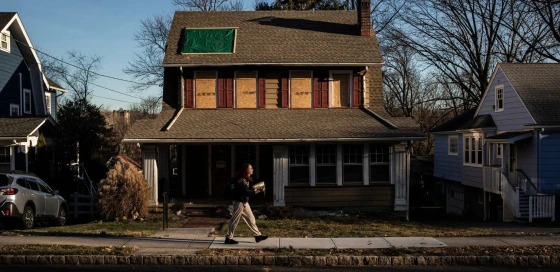
MAPLEWOOD, N.J. — It was dark by the time Eve Morawski managed to break into her home of 60 years.
The locks had been changed by sheriff’s deputies enforcing an eviction order. Movers hired by investors who took possession of the house after she fell behind on taxes had been inside most of the day, packing up photos and knickknacks her family had spent a lifetime accumulating.
She was infuriated to find the house in disarray.
Sometime before dawn, a police report shows, she located a book of matches and a knife.
“Jersey Girl Justice will hopefully prevail in the end,” Morawski wrote to friends on Facebook just before fire trucks began roaring down the pretty block in Maplewood, New Jersey.
“Aloha.”
To neighbors, the Dec. 7 fire that burst from second-floor windows and licked at the eaves of Morawski’s former home was a spectacularly sad end to an epic real estate battle that had played out publicly on social media and in state and federal courts. To her only sister, it was a tragic, avoidable coda to a 20-year family feud.
“There’s a lingering sense of: Is there something more as a community we could have done to help?” said John Guterman, a friend of Morawski who lives down the street and shared her love of animals, smoked barbecue and the New York Mets.
Well known and well liked, Morawski was a fixture in Maplewood, a commuter town 20 miles from Manhattan. Classmates recalled her as the smart kid in advanced placement classes who went on to earn an MBA from the University of Pennsylvania.
Returning home as an adult, she volunteered at area animal shelters and on the board of a preserved 18th-century house dedicated to sharing Maplewood’s history.
A longtime member of the local Interfaith Holocaust Remembrance Committee, she accepted a prestigious award in May for her dedication to keeping the lessons of the Holocaust alive. It was a passion fueled largely by devotion to her Polish immigrant parents, Roman Catholics who she has said were imprisoned by the Nazi and Soviet regimes during World War II. They went on to build a life in suburban New Jersey — a triumph that, to her, was embodied in the four-bedroom house they purchased at 60 Maplewood Avenue.
Privately, she was consumed by a cascade of debt and drawn-out legal battles that had pushed her to the emotional and financial brink.
Two acrimonious divorces. A three-year probate fight with her sister over their parents’ estate. A federal discrimination complaint against a former employer. Dueling lawsuits from a romance that ended badly. And, finally, bankruptcy.
Unable to afford a lawyer, she often represented herself. By her own telling, she was always the victim.
A cancer diagnosis in 2021 complicated everything.
By the time she lost the house, Morawski, 60, had accumulated more than $100,000 in unpaid taxes and fees, a burden that was further exacerbated by a state law heavily weighted toward real estate speculators. New Jersey is one of just a dozen states that permit investors to make huge profits on the debt of struggling homeowners, ultimately allowing them to foreclose on the property and keep all the profit.
“This has been an egregious travesty of justice,” she wrote in a letter to local officials shortly before the fire. “I need immediate help to stop the steal of my home.”
‘The house and legacy I need to save!’
Morawski’s childhood home on Maplewood Avenue sits three blocks from a commuter rail station and the quaint storefronts at the center of town, a pedestrian-friendly hub that residents call “the village.” Always considered a desirable community, Maplewood drew a flood of new buyers during the pandemic, and recent sales of renovated houses on the street have ranged from $755,000 to $1.6 million.
Long before the fire, the house was notable for its peeling buckskin-beige paint and tattered roof, outward signs of the difficulty Morawski had keeping up with repairs and household bills. But she was determined to hold on.
“The house and legacy I need to save!” she wrote on a GoFundMe page a friend created in 2019.
Details of Morawski’s fight to save the house are based on more than two dozen interviews with neighbors, friends, community leaders and lawyers, as well as tax documents, federal, state and county court records and her own social media posts.
After divorcing her first husband, who was in the Navy and stationed in Hawaii, she returned to Maplewood in 2000 to care for her ailing parents. She worked briefly for a management consulting firm and sometimes gave historical walking tours, but had trouble finding full-time work. An assortment of part-time jobs as a swim instructor ended with the onset of the pandemic.
But she had struggled to make ends meet since at least 2010. Desperate for money, she sold her burial plot, patched her leaky roof with tarps and, unable to buy a new water heater, took to showering at a YMCA.
“I have never said I do not owe back taxes + obscene interest,” she wrote to township leaders, “but the global pandemic impacted the intended course of action.”
She had been advised to sell the house rather than lose the accrued equity in a property that real estate sites valued at roughly $700,000 before the fire, friends, relatives and town officials said. The conversations never went far.
“She just wanted to stay in the home she grew up in,” said Andy Golebiowski, host of the Polish American Radio Program, who met Morawski on Facebook. “Those were her roots.”
Morawski spoke proudly of those roots when she accepted the Holocaust education award.
Her father, Michael (Szeliga) Morawski, earned Poland’s highest military honor, the Virtuti Militari. He had been imprisoned, she said, in concentration camps after trying to drive the Germans from the capital during the Warsaw Uprising of 1944, a rebellion that lasted 63 days and led to the deaths of more than 180,000 residents.
Wanda Morawski, a nurse born in what was then the Polish city of Borszczow (it is now part of Ukraine), ran field hospitals for the Allied forces during the war after being freed from a prison in Russia, according to her 2002 obituary.
After marrying in England and moving to Brooklyn, the couple spent 10 years “saving every penny” to buy “their American dream,” Morawski wrote.
Over the next four decades, their house in Maplewood was often filled with recent immigrants of various faiths. Her mother “would order, then pick up, kosher in Brooklyn,” Morawski said at the Holocaust remembrance event. “Everyone would speak Polish and feel comfortable for a few hours as they navigated a challenging new world.”
Morawski’s parents died within five months of each other, leaving a contested estate that led to a bitter fight between the two sisters for control of the house. In the end, Morawski was instructed to pay her sister $130,000 and was awarded the house. Her sister won title to another residential property that was in their parents’ name but was told by the court that she had “no right to enter the premises” at 60 Maplewood Avenue.
Morawski’s sister said she drove by the home each day for 15 years.
Mental health concerns
Morawski was often spotted on the block walking her dog, Hana, or tending to repairs of her 1992 Dodge Dakota. She was quick with a compliment and eagerly asked about neighbors’ children.
“Always seemed to be in the same mood — pleasant,” said Kevin Photiades, who lives down the street.
“She’s a wonderful, generous, amazing person,” said Kim Brown, a friend who remained close with Morawski after they worked together in the early 1990s at a consulting firm in Linden, New Jersey.
“I couldn’t imagine, emotionally, what she was going through.”
Morawski wrote about her financial trouble on social media as foreclosure loomed in 2019 and later discussed her battle with blood cancer.
Neighbors said that they had donated to the GoFundMe campaign or lent her money directly. Friends wrote to the township’s congresswoman to ask for help and dropped off soup and meals. A member of her historical book club regularly drove her to chemotherapy.
But as the date of her eviction neared in December, close friends grew increasingly worried about her mental health. She appeared to have no future plans other than lashing out publicly against the injustice she believed had caused her to lose the house.
A federal judge assigned to Morawski’s bankruptcy case, who had attended high school with her, was “heartless and biased,” she complained to the chief judge of U.S. Bankruptcy Court. “A smart, smug jock, the epitome of a privileged white male.”
A state judge who signed the eviction order was “ridiculously obsequious to the opposing attorney, who was mocking and mean to me.”
She publicly suggested that she was considering suicide. “I expect this is the last letter I will ever write,” she said in a letter to the bankruptcy judge three days before the fire. “Too bad, because I had a LOT left to offer.”
That same day, she dropped Hana at Brown’s house. The next night, she left several cherished family mementos on the back porch of her sister’s house and emailed a niece to let her know they were there.
A friend called the police and asked officers to conduct a wellness check. They arrived at the house around dinnertime, and Morawski was taken by ambulance to a nearby hospital, where she spent 25 hours under psychiatric evaluation, according to her lawyer and a message she posted on Facebook.
She was cleared to leave hours after the eviction order became final and the locks to the house were changed.
Tax liens as investments
Many of Morawski’s problems stemmed from the difficulty she had paying taxes on the house at 60 Maplewood, a home her parents purchased in 1962 and had long ago paid off.
New Jersey requires communities to auction off unpaid tax and sewer debts annually. The buyers — lien holders — can charge 18% interest on debt over $1,500 and are entitled to pay any future overdue taxes on the property, expanding their investment and its steep rate of return. Bidding is often aggressive, particularly for desirable properties in affluent or gentrifying towns.
After two years, if the debt is unpaid, investors can foreclose on the property.
Unlike most other states, New Jersey permits the lien holder to keep all resale profit. Former owners get back none of their accrued equity, no matter the size of the original debt.
“When people hear about it, they think, ‘This can’t be the whole story,’” said Christina Martin, a lawyer with the Pacific Legal Foundation, a libertarian-leaning nonprofit that tracks lien sale foreclosures nationwide. “But it is the whole story. Government thinks it can take a windfall at the expense of society’s most vulnerable people and either keep it for the public purse or give it away to private investors for their enrichment.
“Either way, it’s gross,” Martin said.
Lawyers for the foundation are preparing to argue that the practice — they call it “home equity theft” — violates the Constitution in a Minnesota case that the U.S. Supreme Court agreed in January to hear.
Between 2014 and 2021, in 31 of New Jersey’s largest communities, the owners of 661 residential properties lost homes after a foreclosure that resulted from tax or sewer debt, according to an analysis by the legal foundation. The owners forfeited roughly $115 million in equity, the group found.
The lien that led to the loss of Morawski’s house dated to 2016, when Effect Lake LLC, a Virginia-based company run by Peter Chinloy, a former Temple University professor, and his son, was the winning bidder at an October tax-certificate auction.
Three-quarters of Morawski’s unpaid taxes from 2015, $12,809, plus penalties, were put up for sale.
Competition was brisk. To win the right to buy the lien, Effect Lake not only agreed to charge zero-percent interest on the initial debt, but it paid Maplewood a $92,800 premium to do so — a routine practice used to outbid competitors.
Within weeks Effect Lake had also written checks for the $17,360.04 in taxes Morawski failed to pay in 2016, debt that would grow by the maximum 18% interest rate. The Chinloys’ company also paid all the taxes and sewer fees for the next three years.
Morawski would later say that Effect Lake deliberately mailed crucial legal notices too late for her to respond. “Real estate investors,” she wrote, “have aggressively and ruthlessly pursued foreclosure of my property so they can flip it.”
Her sister said she offered to pay the roughly $110,000 debt in exchange for the deed to the house — a deal Morawski found unfair and refused to accept.
In 2019, Effect Lake began foreclosure proceedings.
And on Jan. 30, 2020, after an investment of roughly $175,000, it held the deed to a home worth at least three times that much. Soon after, Morawski filed for bankruptcy, arguing that the property transfer had been fraudulent, a claim the judge rejected.
While fighting to save the house in bankruptcy court, she was also undergoing chemotherapy treatments that she said sapped her energy and left her unable to focus — conditions she believed should have led the court to slow the process down.
Chinloy, who earned a doctorate in economics from Harvard and was the director of real estate programs at Temple’s business school until 2020, has written extensively about investor real estate strategies and home foreclosures. He declined to comment for this article.
‘Over her dead body’
The day of the fire Morawski lit five matches at strategic points on the first, second and third floors of the house, according to a police report.
Then she walked to the basement, “laid down on a couch and proceeded to stab herself with a knife four times in the chest,” a detective wrote.
Neighbors watched as she was taken out on a stretcher and rushed to a hospital.
Three days later, charged with aggravated arson and burglary, she was transferred to a jail in Newark. A not-guilty plea was entered on her behalf for crimes that carried a maximum penalty of more than 10 years in prison.
Her lawyer, Lisa Lopata, a public defender, stressed that Morawski was “at a very low point,” and that she “deeply regrets what happened, especially the idea that anyone could have been put at risk.”
A prosecutor, Adam Wells, argued against her release from jail, in part because of her apparent determination to risk it all to make a defiant final point.
“She made a statement and apologized for her own cliché,” Wells told a judge on Jan. 13, “that over her dead body would anyone take the house.”
Ten hours later, after more than a month in custody, Morawski walked out of jail alone wearing borrowed, oversize clothes. She waited in the dark at a nearby New Jersey Transit bus stop and transferred at Newark Penn Station, en route to a friend’s apartment in South Orange, New Jersey, where she remains in home detention.
“These property tax lien holders have gotten away with everything,” Morawski said in an interview.
“If I start crying, I’m just afraid that I won’t stop.”
Weeks after the blaze, much of the first floor of the house appeared intact, largely untouched by flames. But out front, a haunting reminder of the saga’s explosive end remained etched into a sidewalk poured months ago.
“EVE M LIVED HERE 1962-2022,” Morawski had carved into the wet concrete. “LIVE. ALOHA.”
Republican-sponsored bill would fine teachers $5,000 for telling the truth
EJ Montini, Arizona Republic – February 2, 2023
Yes, there’s a bill in the Arizona House that, if made into law, would allow confused, disgruntled, ignorant or just plain unhinged individuals to file a complaint that could lead to a teacher or professor receiving a $5,000 fine for the offense of telling the truth.
About race.
Republican-sponsored House Bill 2458 is one of many misguided pieces of legislation being pushed in state legislatures around the country to prevent “critical race theory” from being taught in schools.
In essence, it’s a way of trying to whitewash history, as if our children would be better served by ignorance than knowledge. Beyond that, the only education level at which the theory has been discussed is college or above, so banning it for lower levels is a solution for a problem that does not exist.
Republican lawmakers are playacting
Not that any of this matters. HB 2458 will not become law. The sponsor knows it. The Republicans attempting to push it through the House know it. The opposition knows it. Those members of the legislative staff who do all the work know it.
Because right now, your tax dollars and mine are funding a very elaborate, very calculated, very expensive game of political make-believe being played by grown-ups in elected office who are trying to convince us their charade is real. But it is not.
It’s playacting. A fairy tale. A sham.
It is happening in Washington, D.C., in the Republican-controlled House of Representatives, and it is happening here in the Republican-controlled Arizona Legislature.
It’s a performance that accomplishes nothing
The people behind HB 2458 know that if it makes it through the House and the Senate, both narrowly controlled by Republicans, it would not be signed by Gov. Katie Hobbs.
If they were interested in finding common ground about the issue and fashioning some form of legislation that would pass they would have contacted the governor’s office and tried to negotiate a compromise.
But bills like this are meant to promote fantasy, not serve reality.
They’re meant show constituents how vehement and committed the people they elected can be when they get into office. Even though it accomplishes … nothing.
And lawmakers here are simply mimicking their brothers and sisters in D.C.
Arizona House mimics the theater in D.C.
A while back, for example, Arizona Republican Rep. Andy Biggs tweeted, “Last night, my Republican colleagues and I defeated the Democrats’ 87,000-person IRS army. We are working quickly to reverse the Democrats’ negligent policies. This is already a very good start to the 118th Congress!”First, there is no “87,000-person IRS army.” Second, the Republicans who control the House defeated nothing.
Before becoming law, any legislation passed by the House must get through the Senate, and then be signed by the president.
Republican members of the House from all over the country are boasting to constituents about bills that will never become law. And that they know will never become law because they never bothered to find common ground about the issue and fashion some form of legislation that would pass.
Even if House members squeezed their impeachment through, Biggs knows the Constitution requires a two-thirds vote of the Senate to convict. And he knows that would never happen.
What’s going on within our divided government these days, here and in Washington, is not governing. It’s burlesque. It’s opera. It’s vaudeville.
It’s musical theater, melodrama, comedy, tragedy and farce, all rolled into one.
It’s proof of a political adage that’s been around for decades: Politics is show business for ugly people.
While Ron DeSantis Is Fighting Culture Wars, Millions Of Floridians Are Losing Their Health Care
Jonathan Cohn – January 31, 2023
Florida Gov. Ron DeSantis keeps making news with his self-described campaign to fight “woke” ideology. The latest headlines came about two weeks ago, when the Republican announced that he was prohibiting public high schools from offering a new Advanced Placement course in African American history. The course, his administration explained, “lacks significant educational value.”
The announcement thrilled his supporters on the political right while infuriating his critics on the left. It’s safe to assume these were precisely the reactions that DeSantis wanted because they elevate his national profile and improve his chances of winning the 2024 Republican presidential nomination, which, as you may have heard, he is likely to seek.
But DeSantis has some other governing responsibilities, too. One of them is looking out for the health and economic well-being of Florida residents, including those who can’t pay for medical care on their own because they don’t have insurance.
Floridians without insurance suffer because when they can’t pay for their medical care, they end up in debt or go without needed treatment or both. The state suffers, too, because it ends up with a sicker, less productive workforce as well as a higher charity care load for its hospitals, clinics and other pieces of the medical safety net.
DeSantis could do something about this. He has refused. In fact, as of this moment, his administration is embarking on a plan that some analysts worry could make the problem worse.
This story probably deserves some national attention as well.
DeSantis Has A Clear Record On Health Care
The simple, straightforward reason so many Floridians have no health insurance is that its elected officials won’t sign on to the Affordable Care Act’s Medicaid expansion, which offers states extra federal matching funds if they make the program available to everybody with incomes below or just above the poverty line.
Most states have now done just that. It’s the single biggest reason that the uninsured rate nationwide is at a record low. But eleven states have held out, leaving in place the much more limited eligibility standards they had established before the Affordable Care Act took effect.
Florida is one of them. Childless adults in the Sunshine State can’t get Medicaid unless they fall into a special eligibility category, like having a disability. And even adults with kids have a hard time getting onto the program because the standard income guidelines are so low ― about 30% of the poverty line, which last year worked out to less than $7,000 for a family of three. That’s not enough to cover rent, food and other essentials, let alone buy a health insurance policy.
The non-expansion states all have Republican governors or legislatures or both, and are nearly all in the Deep South. They represent the last line of resistance against Obamacare, which Republicans have spent more than a decade fighting and, famously, came very close to repealing in 2017.
Gov. Ron DeSantis, shown at a recent appearance in Daytona Beach, doesn’t have much to say about Medicaid expansion — or why he’s opposed it.
Gov. Ron DeSantis, shown at a recent appearance in Daytona Beach, doesn’t have much to say about Medicaid expansion — or why he’s opposed it.
DeSantis was no mere bystander to that effort. As a Republican serving in the U.S. House, he was part of a far-right caucus that voted against the first ACA repeal bill that leadership brought to the floor because, DeSantis and his allies said, it didn’t undo enough of the law’s protections for people with pre-existing conditions.
GOP leaders eventually put forward a more aggressive repeal. DeSantis and his colleagues voted yes on that one, but it failed in the Senate.
With repeal now off the political agenda, the main question about the Affordable Care Act is whether states like Florida will follow the lead of all the others and finally open up its Medicaid program to everybody living at or just above the poverty line.
If it did, several hundred thousand currently uninsured residents would become eligible for the program, according to independent estimates.
End of a Pandemic Relief Effort And Its Impact
Florida’s refusal to expand Medicaid is not a new story. But it is newly relevant because of an expiring federal pandemic measure and its likely effect on access to health care for low-income residents.
When COVID-19 hit, the federal government offered states extra money to fund Medicaid as long as states agreed not to disenroll anybody who joined or was already on the program ― on the theory that in the midst of a public health emergency, the overwhelming priority was maximizing the number of people with insurance.
That arrangement is about to end. States will have a year to go through their Medicaid enrollment files, removing anybody who cannot reestablish their eligibility. And in every state, significant numbers of people are likely to lose coverage ― in some cases simply because they aren’t aware their coverage is in jeopardy or because they can’t make their way through a complex, confusing process their state has put in place.
Officials in some states are going out of their way to minimize coverage losses. Oregon, for example, will be letting all children younger than 6 stay on Medicaid automatically. Illinois is making it easier for adults to stay on the program while taking more time to go through the process of reestablishing eligibility.
Florida just announced its plan and, according to Joan Alker, executive director of Georgetown University’s Center for Children and Families, the state seems intent on pushing ahead quickly even though its own projections suggest 1.75 million Floridians could lose insurance as a result.
“They’re very anxious to get almost 2 million people off of Medicaid, which is scary,” Alker told HuffPost. She added that she is especially worried about children, who represent a disproportionate number of Florida’s Medicaid population because the income guidelines for young people are looser than they are for adults.
Alker was careful to say that it was impossible to be sure how Florida will ultimately handle the process of reviewing Medicaid enrollment. She also said she was pleased that state officials made statements acknowledging the special predicament of children.
A spokesperson for the Florida Policy Institute, a nonprofit organization that has been tracking the state’s plans, offered a similarly mixed assessment ― crediting state officials with an “intentional” plan that stressed communicating with parents clearly about their options while stating that it’s “too soon to tell whether the efforts outlined in the plans will be enough to make sure that Medicaid-eligible Floridians keep their coverage.”
But however Florida officials decide to handle this process, and however it works out, one thing is clear: If Florida were part of the Medicaid expansion, the number of people losing health coverage would be a lot lower.
The Uninsured In Florida Have A Difficult Time
Frederick Anderson, a family medicine physician, knows better than most what a difference health insurance can make for people in Florida. He oversees medical operations at a Miami-area clinic focusing on underserved populations, where large numbers of people have no insurance. He thinks a lot about one woman in particular.
She’s the primary caregiver for a son with autism, Anderson told HuffPost, and she has no insurance because her below-poverty income is too high for the state’s Medicaid threshold. She’s been suffering from serious, debilitating headaches, but she can’t pay for the MRI she needs or find a neurologist with an open appointment.
It’s a problem he sees all the time, Anderson explained, because there just aren’t enough safety net providers to meet the demand. Patients end up waiting for the care they need or skipping it altogether. “We do the best we can,” Anderson said, “but many of our patients will need to see orthopedists, or neurologists or you name it, and these individuals have no easy access to those services. Or they would benefit from certain medications that I would like to prescribe for them, but … it’s just unaffordable.”
Anderson lives and works in Miami-Dade County, where the uninsured rate is among the highest in Florida. But rural areas of Florida face their own, special challenges.
The economics of health care make it more difficult for rural hospitals to survive without help from Medicaid, which is why in states like Florida that haven’t expanded eligibility, rural hospitals are struggling and in some cases closing, depriving communities of more than just acute care.
“We think of hospitals as places to go when you have something major that is wrong,” Scott Darius, executive director of the advocacy group Florida Voices for Health Care, told HuffPost. “But in those rural areas, we’ve learned, hospitals are the primary care location for large portions of the population.”
DeSantis Hasn’t Had Much To Say On Medicaid
These accounts are consistent stories reporters covering health care hear all the time. They also echo some of the anecdotes that an organization called the Florida Health Justice Project has collected on its website as part of an ongoing campaign, in conjunction with other advocacy groups, to bring expansion to Florida.
“Florida ranks [near the bottom] for the rate of uninsured residents,” Alison Yager, executive director at the Health Justice project, told HuffPost. “Expanding Medicaid, as all but 11 of our sister states have done, would surely boost our shameful showing.”
But the cause has been a tough sell in Tallahassee, where Republicans have had nearly uninterrupted control of the Florida’s lawmaking process since 1999. Two previous efforts to get expansion through the state legislature failed. DeSantis’ spokesperson confirmed in 2021 that he remained opposed to it.
That was two years ago, and since then he’s managed to avoid saying much about the issue, including to HuffPost, despite several inquiries to his office over the past three weeks. Medicaid expansion got only sporadic attention in the 2022 gubernatorial campaign, although Democrats tried initially to make it an issue, and it didn’t draw so much as a mention in the lone debate DeSantis had with Democratic nominee Charlie Crist.
A year before that, DeSantis signed a much narrower measure: a 2021 bipartisan bill increasing Medicaid’s postpartum coverage from 60 days to a year. It was a priority for the outgoing GOP House speaker, and it’s always possible political circumstances will align and lead to more legislation like that in the future.
But DeSantis’ hostility to government health care programs runs deep.
Protesters rally near the U.S. Capitol after House Republicans voted to repeal the Affordable Care Act in 2017. DeSantis was one of those House Republicans.
Protesters rally near the U.S. Capitol after House Republicans voted to repeal the Affordable Care Act in 2017. DeSantis was one of those House Republicans.
Long before he was attacking “critical race theory” lessons and supposed sexual brainwashing in the schools, he was railing against Obama-era programs generally (as New York magazine’s Jonathan Chait has explained) and the Affordable Care Act specifically (as The New York Times’ Jamelle Bouie has written) as fundamentally incompatible with American principles of freedom and private property.
DeSantis may also have more practical objections to expanding Medicaid. Maybe he thinks it’s too big a drain on state finances or too wasteful a program, as many conservatives and libertarians argue. Maybe he thinks Medicaid does more harm than good for beneficiaries or that people on the program could find insurance on their own if only they were more industrious and got paying jobs.
Those latter claims don’t hold up well under scrutiny. The majority of Floridians missing out on Medicaid expansion are in families with at least one worker, according to the Center on Budget and Policy Priorities. And when the uninsured get Medicaid, their access to care and financial security improves, according to a large and still-growing pile of research.
Their health outcomes also seem to improve, though the evidence on how the Medicaid expansion has affected mortality specifically remains the subject of somedebate.
The Politics of Medicaid May Be Different Nationally
Advocates today have their eyes on trying to expand Medicaid through a ballot initiative, which is the way it’s happened in Idaho, Missouri and several other states where Republican lawmakers had blocked it.
But Florida Republicans are already working to make that process more difficult because it’s a way for voters to circumvent GOP opposition to popular causes. And it’s not like waging a ballot campaign is easy now. Organizers recently told the Tampa Bay Times that 2026 is the earliest they could realistically get a Medicaid measure on the ballot.
As for DeSantis, his record on health care could become a key point of contrast in a hypothetical 2024 White House campaign. President Joe Biden, after all, is the guy who called Obamacare a “big fucking deal” and just signed into law reforms that make the program’s financial assistance more generous. Any conceivable replacement on the Democratic ticket would have a similar record of votes in Congress or state actions to support coverage expansions.
There’s no way to be sure how an issue will play out in the next election ― or whether it will even matter at all. But it’s not hard to imagine the contrast on health care working to the Democrats’ advantage. The Affordable Care Act is relatively popular these days, and Medicaid expansion tends to poll well even among Republican voters.
That may help explain why DeSantis and his spokespeople have so little to say on the subject. But that silence doesn’t change the real-world impact of his posture ― or what it reveals about his priorities.
DeSantis Takes On the Education Establishment, and Builds His Brand
Stephanie Saul, Patricia Mazzei and Trip Gabriel – February 1, 2023
Patricia Okker, facing camera, president of New College of Florida in Sarasota, is embraced by a supporter on Tuesday, Jan. 31, 2023. (Todd Anderson/The New York Times)
Gov. Ron DeSantis of Florida, as he positions himself for a run for president next year, has become an increasingly vocal culture warrior, vowing to take on liberal orthodoxy and its champions, whether they are at Disney, on Martha’s Vineyard or in the state’s public libraries.
But his crusade has perhaps played out most dramatically in classrooms and on university campuses. He has banned instruction about gender identity and sexual orientation in kindergarten through third grade; limited what schools and employers can teach about racism and other aspects of history; and rejected math textbooks en masse for what the state called “indoctrination.” Most recently, he banned the College Board’s Advanced Placement courses in African American studies for high school students.
On Tuesday, DeSantis, a Republican, took his most aggressive swing yet at the education establishment, announcing a proposed overhaul of the state’s higher education system that would eliminate what he called “ideological conformity.” If enacted, courses in Western civilization would be mandated; diversity and equity programs would be eliminated; and the protections of tenure would be reduced.
His plan for the state’s education system is in lockstep with other recent moves — banning abortions after 15 weeks of pregnancy, shipping a planeload of Venezuelan migrants to Martha’s Vineyard in Massachusetts and stripping Disney, a once politically untouchable corporate giant in Florida, of favors it has enjoyed for half a century.
His pugilistic approach was rewarded by voters, who reelected him by a 19 percentage-point margin in November.
Appearing on Tuesday at the State College of Florida, Manatee-Sarasota, one of the state’s 28 publicly funded state and community colleges, DeSantis vowed to turn the page on agendas that he said were “hostile to academic freedom” in Florida’s higher education system. The programs “impose ideological conformity to try to provoke political activism,” DeSantis said. “That’s not what we believe is appropriate for the state of Florida.”
He had already moved to overhaul the leadership of the New College of Florida, a small liberal arts school in Sarasota that has struggled with enrollment but calls itself a place for “freethinkers.” It is regarded as among the most progressive of Florida’s 12 public universities.
DeSantis pointed to low enrollment and test scores at New College as part of the justification for seeking change there.
“If it was a private school, making those choices, that’s fine, I mean, what are you going to do,” he said. “But this is paid for by your tax dollars.”
The college’s board of trustees, with six new conservative members appointed by DeSantis, voted in a raucous meeting Tuesday afternoon to replace the president and agreed to appoint Richard Corcoran, a former state education commissioner, as the interim president beginning in March.
Corcoran will replace Patricia Okker, a longtime English professor and college administrator who was appointed in 2021.
While expressing her love for the college and its students, Okker called the move a hostile takeover. “I do not believe that students are being indoctrinated here at New College,” she said. “They are taught. They read Marx and they argue with Marx. They take world religions. They do not become Buddhists in February and turn into Christians in March.”
DeSantis also announced Tuesday that he had asked the Legislature to immediately free up $15 million to recruit new faculty and provide scholarships for New College.
In all, he requested from the Legislature $100 million a year for state universities.
“We’re putting our money where our mouth is,” he said.
New College is small, with nearly 700 students, but the shake-up reverberated throughout Florida, as did DeSantis’ proposed overhaul.
Andrew Gothard, president of the state’s faculty union, said the governor’s statements on the state’s system of higher education were perhaps his most aggressive yet.
“There’s this idea that Ron DeSantis thinks he and the Legislature have the right to tell Florida students what classes they can take and what degree programs,” said Gothard, who is on leave from his faculty job at Florida Atlantic University. “He says out of one side of his mouth that he believes in freedom and then he passes and proposes legislation and policies that are the exact opposite.”
At the board meeting, students, parents and professors defended the school and criticized the board members for acting unilaterally without their input.
Betsy Braden, who identified herself as the parent of a transgender student, said her daughter had thrived at the school.
“It seems many of the students that come here have determined that they don’t necessarily fit into other schools,” Braden said. “They embrace their differences and exhibit incredible bravery in staking a path forward. They thrive, they blossom, they go out into the world for the betterment of society. This is well documented. Why would you take this away from us?”
Corcoran, a DeSantis ally, had been mentioned as a possible president of Florida State University, but his candidacy was dropped following questions about whether he had a conflict of interest or the appropriate academic background.
A letter from Carlos Trujillo, the president of Continental Strategy, a consulting firm where Corcoran is a partner, said the firm hoped that his title at New College would become permanent.
Not since George W. Bush ran in 2000 to be “the education president” has a Republican seeking the Oval Office made school reform a central agenda item. That may have been because, for years, Democrats had a double-digit advantage in polling on education.
But since the pandemic started in 2020, when many Democratic-led states kept schools closed longer than Republican states did, often under pressure from teachers unions, some polling has suggested that education now plays better for Republicans. And Glenn Youngkin’s 2021 victory in the Virginia governor’s race, after a campaign focused on “parents’ rights” in public schools, was seen as a signal of the political potency of education with voters.
DeSantis’ attack on diversity, equity and inclusion programs coincides with the recent criticisms of such programs by conservative organizations and think tanks.
Examples of such initiatives include campus sessions on “microaggressions” — subtle slights usually based on race or gender — as well as requirements that candidates for faculty jobs submit statements describing their commitment to diversity.
“That’s basically like making people take a political oath,” DeSantis said Tuesday. He also attacked the programs for placing a “drain on resources and contributing to higher costs.”
Supporters of diversity, equity and inclusion programs and diverse curricula say they help students understand the broader world as well as their own biases and beliefs, improving their ability to engage in personal relationships as well as in the workplace.
DeSantis’ embrace of civics education, as well as the establishment of special civics programs at several of the state’s 12 public universities, dovetails with the growth of similar programs around the country, some partially funded by conservative donors.
The programs emphasize the study of Western civilization and economics, as well as the thinking of Western philosophers, frequently focusing on the Greeks and Romans. Critics of the programs say they sometimes gloss over the pitfalls of Western thinking and ignore the philosophies of non-Western civilizations.
“The core curriculum must be grounded in actual history, the actual philosophy that has shaped Western civilization,” DeSantis said. “We don’t want students to go through, at taxpayer expense, and graduate with a degree in zombie studies.”
The shake-up of New College, which also included the election of a new board chair, may be ongoing and dramatic, given the six new board members appointed by DeSantis.
They include Christopher Rufo, a senior fellow at Manhattan Institute who is known for his vigorous attacks on “critical race theory,” an academic concept that historical patterns of racism are ingrained in law and other modern institutions.
At the time of his appointment, Rufo, who lives and works in Washington state, tweeted that he was “recapturing” higher education.
Another new board member is Eddie Speir, who runs a Christian private school in Florida. He had recommended in a Substack posting before the meeting that the contracts of all the school’s faculty and staff be canceled.
The other new appointees include Matthew Spalding, dean of the Washington, D.C., campus of Hillsdale College, a private college in Michigan known for its conservative and Christian orientations. An aide to the governor has said that Hillsdale, which says it offers a classical education, is widely regarded as the governor’s model for remaking New College.
In addition to the governor’s six new appointees, the university system’s board of governors recently named a seventh member, Ryan T. Anderson, the head of a conservative think tank, the Ethics and Public Policy Center, which applies the Judeo-Christian tradition to contemporary questions of law, culture and politics. His selection was viewed as giving DeSantis a majority vote on the 13-member board.