Who is Jack Teixeira, the Massachusetts Air National Guard member arrested in Pentagon leak case?
The 21-year-old intelligence specialist was taken into custody by the FBI at his home in Dighton, Mass., on Thursday.
Dylan Stableford, Senior Writer – April 13, 2023
Jack Teixeira (via Facebook)
Jack Teixeira, a 21-year-old member of the U.S. National Guard, was arrested Thursday in connection with the alleged disclosure of highly classified military documents on the war in Ukraine.
Teixeira, an airman first class with the Massachusetts Air Force National Guard’s 102nd Intelligence Wing, based on Cape Cod, was taken into custody by federal agents at his home in Dighton, Mass., about 45 miles south of Boston and 15 miles east of Providence, R.I.
Attorney General Merrick Garland announced Teixeira’s arrest in a brief statement at the Justice Department. Garland said that Teixeira surrendered “without incident” and would be charged with the unauthorized removal of classified national defense information. The investigation is ongoing, Garland added.
Texeira is scheduled to make his first court appearance in Boston on Friday, according to Yahoo News partner USA Today.
Local police block the road as the FBI conducts a search of Teixeira’s home in Dighton, Mass., on Thursday. (Matt Stone/MediaNews Group/Boston Herald via Getty Images)
Footage from a local television news helicopter showed heavily armed tactical agents taking Teixeira, who was wearing a T-shirt and shorts, into custody along a wooded driveway.
The Pentagon and FBI had been scrambling to identify the source of the leak since Friday, when a trove of U.S. Defense Department slides, many marked “Secret” or “Top Secret,” were posted to a private chat group on the Discord platform.
As Yahoo News reported earlier this week, the documents included “intelligence culled from a host of spy agencies — the CIA, the National Security Agency, the Defense Intelligence Agency, the National Reconnaissance Office and more — with a limitless purview reaching all regions of the globe.”
Speaking to reporters in Dublin earlier Thursday, President Biden said that the United States was closing in on identifying a suspect.
“There’s a full-blown investigation going on, as you know, with the intelligence community and the Justice Department,” Biden said. “And they’re getting close.”
Pentagon spokesman U.S. Air Force Brig. Gen. Patrick Ryder takes questions about the leak investigation. (Alex Brandon/AP)
According to the New York Times, which first identified Teixeira as a suspect, he oversaw the private online group on the Discord site called Thug Shaker Central, where “about 20 to 30 people, mostly young men and teenagers, came together over a shared love of guns, racist online memes and video games.”
The newspaper also spoke with Teixeira’s mother, who said he had recently been working overnight shifts at the base on Cape Cod, and he had recently changed his phone number.
The Military Times reported that Teixeira joined the Air National Guard in September 2019 and that he works as a cyber transport systems journeyman.
Why Republicans Are Overreaching So Hard in So Many States
Philip Elliott – April 11, 2023
US-NEWS-KY-ABORTION-BILLS-LX
Kentucky state Rep. Randy Bridges, a Republican, gives a thumbs down as protesters chant “Bans off our bodies” at the Kentucky state Capitol on April 13, 2022 Credit – Ryan C. Hermens—Lexington Herald-Leader/Tribune News Service via Getty Images
In state capitals across the country, Republicans seem to be overplaying their hand. The most obvious example is abortion, which poll after poll shows most Americans support in many, if not most, circumstances. In Iowa, a state policy to cover the costs of abortion and morning-after pills for rape victims is on hold as the Republican Attorney General reviews it. In Idaho, where abortion is already illegal in all cases, it is now a crime punishable by up to five years in prison for adults who help pregnant minors to cross state lines to obtain the procedure. In South Carolina, a bill categorizing abortion the same as homicide—punishable by the death penalty—has seemed to lose steam, but nonetheless remains in play.
And those are just some of the dozens and dozens of efforts undertaken with Republican guidance to further erode abortion rights in a post-Roe world. Look around at other culture-war-flavored topics running on parallel tracks inside the GOP, and it’s clear that their leaders are chasing broadly unpopular goals: banning books and targeting drag queens; making some of the most dangerous firearms even more accessible; blocking health care for transgender individuals; fighting corporations over “wokeness”; and engaging in the most brazen political retaliation.
All of these are polling clunkers—with the important exception of gender-affirming care for trans minors—and stand to leave the 44% of Americans who identify with neither party wondering just what is animating Republican lawmakers this session, be it in statehouses or here in Washington. Here’s the most basic answer: it’s what they need to do to survive.
Now, hear me out. A lot of my liberal friends predictably will retort that this is all part of some scary, hate-filled agenda meant to oppress non-white, female, and marginalized communities. My conservative pals will say these are simply efforts to roll back government’s reach. Both can be true, but if you get down to the realpolitik of the situation, this polarized agenda is merely the logical conclusion of what happens when the party in power looks around and sees there’s no one there to stop them from drawing legislative districts however they please. The extreme gerrymandering that results means red states get redder legislatures—and, to be fair, blue states turn deeper blue; there are just fewer of them—and the resulting policies move to the extremes with few consequences.
Few consequences, that is, until someone falls out of line. It’s really, really rare to lose re-nomination as an incumbent; just 14 of the 435 House seats saw that happen last year, and roughly half were victims of ex-President Donald Trump’s petty endorsement of a challenger. Moving to last year’s November ballot, a study of most of the races on most ballots found 94% of all incumbents won another term, with congressional incumbents posting a staggering 98% win rate and state-level incumbents notching a 96% record in the general election.
This job-for-life patina is not by accident. Incumbents know it’s statistically improbable that any newcomer can credibly boot them from power. Incumbency has huge advantages, including taxpayer-funded (official) travel, the power of the bully pulpit, and donors looking to stay in good graces. But you look at the few case studies about incumbents who didn’t win re-nomination, and there are warning signs. The folks who lose spectacularly often run afoul of orthodoxy inside the party’s most fervent crowds. Rep. Liz Cheney—who dared call Jan. 6, 2021, for what it was—is a prime example. (To be fair, Rep. Caroline Maloney, who had the misfortune of being matched with another longtime institution of New York Democratic politics, is not.)
Then there are the very carefully drawn and high-cost maps themselves. Chris Cillizza smartly noted in his newsletter last week that the Cook Political Report analysis of the current map shows a scant 82 House seats in play, and only 45 would be considered truly competitive. When Cook did this analysis back in 1999, the number of potentially competitive districts totalled 164—double what it is today. Which means this: the head-to-head, D-vs.-R voting isn’t the real race. The true competition is the one that transforms a candidate into a nominee in increasingly homogeneous communities where voters are picking real estate based not only on crime and tax rates, but also their prospective neighbors’ ideologies. Being seen as an oddball for a district—AKA collaborating across the aisle on legislation—is a death sentence in a lot of districts, which explains the steady polarization in Congress itself. The name of the game for incumbents is survival, and veering to an extreme can be a gilded path for another term, while trying for comity can mean a skid toward K Street.
So as you look at the seemingly out-of-touch agenda snaking its way through state legislatures and the Republican-led parts of Washington and think the plans are incompatible with the electorate, that’s only partially true. Broadly, yes, Americans are aghast at parts of this all-culture-wars-all-the-time agenda. Some 76% of Americans tell pollsters that they’re fine with schools teaching ideas that might make students uncomfortable. And a clear majority of all Americans—64%—think abortion should be legal in most or all cases. The same number of Americans say there should be laws protecting transgender individuals from discrimination.
Dig into the numbers a little, though, and it’s quickly apparent that the lawmakers chasing these divisive notions are not completely irrational, especially when you consider their district borders are drawn to foment hardcore policies. The dirty secret among political professionals is that all voters are not created equal. Take the question of whether schools can teach ideas that make students uncomfortable. Among voters who backed Biden in 2020, just 7% of Americans said they were fine with such a block; look at Trump 2020 voters, and that number gets to 36%, meaning a full third of the GOP universe for 2024 is OK with at least some measure of book bans, and that group is probably more likely to vote in the next primary. On abortion, among Republicans, polls find 58% support for the overturning of Roe, including 35% who said they strongly support it. And while 64% of all Americans favor non-discrimination policies toward trans individuals, 58% of them also say trans student athletes should play on the team that matches their gender at birth, regardless of how they identify. Among Republicans, that number spikes to 85%, an astronomical figure that almost demands action.
Put simply: the culture wars might be less about the fight and more about how the battlefields were drawn well before any of the officeholders even showed up.
That’s a small consolation for liberals in competitive states watching as increasingly conservative lawmakers rush ahead on an agenda mismatched to what constituents actually want. Democrats may be able to claw back some of that imbalance if they ever convince their base of the reality that securing the right handful of state legislature seats would have far more power in shaping national politics than throwing millions at longshot, feel-good candidates who become darlings on social media but are chasing votes that aren’t there. Nonetheless, most of these maps are locked in place until at least 2031. Republicans know it, too, which explains why so many of them are leaning into broadly unpopular—but parochially homerun—policies.
Trump’s tale of crying Manhattan court employees was ‘absolute BS,’ law enforcement source says
Michael Isikoff, Chief Investigative Correspondent – April 12, 2023
Former President Donald Trump arrives at court on April 4. (Mary Altaffer/AP)
Former President Trump’s claim to a Fox News anchor that New York court employees were “crying” and apologizing for his arraignment on felony charges is “absolute BS” and doesn’t remotely resemble what took place, a law enforcement source familiar with the details of what transpired that day told Yahoo News.
“Zero,” said the source when asked how much truth there was to Trump’s colorful account. “There were zero people crying. There were zero people saying ‘I’m sorry.’”
“When I went to the courthouse, which is also a prison in a sense, they signed me in, and I’ll tell you, people were crying,” Trump told Carlson. “People that work there, professionally work there, that have no problems putting in murderers, and they see everybody. It’s a tough, tough place, and they were crying. They were actually crying. They said, ‘I’m sorry.’ They said, ‘2024, sir. 2024.’ And tears were pouring down their eyes.”
In fact, the source said, aside from his lawyers and Secret Service agents, Trump interacted only with a handful of district attorney employees at the courthouse and had extremely limited exposure with others during his arraignment last Tuesday in lower Manhattan.
Trump in court with his lawyers on April 4. (Steven Hirsch/Pool via AP)
Upon his arrival, Trump was informed of the charges against him and was booked on 34 felony counts for falsification of business records to conceal hush money payments to a porn star in the waning days of the 2016 presidential election. The former president, looking glum, said little during the booking, as did Manhattan District Attorney Alvin Bragg’s deputies, who were with him throughout the process, the source said.
The only hiccup came when his fingers were too dry for his fingerprinting, at which point district attorney employees provided lotion for his fingers, the source added.
Carlson’s friendly interview with Trump was especially ironic given its timing. It comes on the eve of a trial slated to begin next Monday in Delaware, in which Carlson, along with his fellow host Sean Hannity and multiple Fox executives, are slated to be witnesses in a $1.6 billion defamation lawsuit brought by Dominion Voting Systems against Fox News for airing debunked claims of 2020 election fraud by Trump and his surrogates.
The suit has already brought to light multiple internal emails and texts by Carlson, in which he expressed his private contempt for Trump and derided the claims of fraud and vote flipping being brought by his lawyers — views he never shared with his audience.
“I hate him passionately,” Carlson said about Trump in a text to one colleague on Jan. 4, 2021, adding in another text, “We are very, very close to being able to ignore Trump most nights.”
A protester at a rally outside Fox News headquarters in New York City in June 2022. (Michael M. Santiago/Getty Images)
In other exchanges, Carlson privately called the claims of Trump lawyer Sidney Powell about vote flipping by Dominion “insane” and “absurd.”
Yet during Tuesday night’s interview, Carlson never challenged or pushed back against any of Trump’s assertions, including an unusual exchange about the Biden administration’s alleged failure to rescue German shepherds from Afghanistan.
“They left everything,” Trump said of Biden’s pullout from Afghanistan. “They left in the dark of night. They left the lights on. They left the dogs, by the way.”
“They left the dogs?” Carlson asked.
“They left the dogs,” Trump responded. “You know, the dog lovers, and you know there are a lot of them. I love dogs. You love dogs. One of the first questions I got was, ‘What did they do with the dogs?’ Mostly German shepherds. They left them. The way they got out was so horrible. … We would have gotten out with strength and dignity.”
In her memoir, “Raising Trump,” the former president’s ex-wife Ivana wrote that Trump “was not a dog fan” and often expressed hostility to her poodle, Chappy.
‘Such An Idiot’: Nicolle Wallace Bursts Out Laughing Over Trump Comment On Fox News
Josephine Harvey – April 12, 2023
MSNBC’s Nicolle Wallace laughed in disbelief after showing viewers an excerpt from Donald Trump’s recent interview with Fox News host Tucker Carlson in which the former president lauded authoritarian leaders as “top of the line.”
“You can tell a lot about a person by the company they keep, or in the case of the twice-impeached, disgraced, now-indicted ex-president, the people they praise loudly on Fox News,” Wallace said Wednesday.
She showed viewers a clip from Trump’s Fox News interview, which aired Tuesday. “They’re all top of the line,” Trump said of Chinese President Xi Jinping, North Korean dictator Kim Jong Un and Russian President Vladimir Putin. “Our guy’s not top of the line ― never was,” he added, referring to President Joe Biden.
Trump also called Xi a “brilliant man” and praised Kim and Putin as “very smart.”
Hooting with laughter, Wallace said: “I don’t even know where to start. No one called you top of the line. Ever!”
"When Donald Trump says… Joe Biden doesn't know what he is doing, and the president of China really does, that has significant reverberations….and whether it's ignorance or intent, it leaves a very dangerous message on the world stage." @DavidJollyFL w/ @NicolleDWallacepic.twitter.com/F0CUS8IC1S
The MSNBC host noted that she typically avoids amplifying Trump or Fox News, but said that this rhetoric provided important context on the recent Republican-led efforts to strip back abortion rights, implement voter suppression laws and silence dissent in the Tennessee state legislature.
“It’s important to understand they’re not bodily functions. They’re not burping out random policies. They’re following their leader, who’s following the world’s most heinous authoritarians,” Wallace said. “And we showed you that to show you just how dangerous his rhetoric is.”
“He’s such an idiot, on top of all else,” she later added. “And he sounds like such a bleepin’ idiot.”
The Trump Team’s Startling Questions for E. Jean Carroll Jurors
Jose Pagliery – April 12, 2023
Photo Illustration by Luis G. Rendon/The Daily Beast/Getty
Are you on Truth Social? What cable news network do you watch? Have you ever used the hashtag #BelieveAllWomen when discussing sexual assault?
With just weeks to go before E. Jean Carroll’s rape trial against Donald Trump in New York, lawyers on both sides are figuring out what questions to ask prospective jurors. And while some questions are the run-of-the-mill kind used to screen biased jurors, a fair share highlight the bizarre nature of the case involving the country’s most divisive politician.
The federal trial is set to begin April 25 in Lower Manhattan, where the magazine columnist seeks to prove that the former president raped her in a changing room inside the luxury department store Bergdorf Goodman in the 1990s. Due to Trump’s delay games and refusal to test his DNA against the black coat dress she wore that day—which has been tested at a crime lab—jurors will mostly have to decide on competing recollections of what happened that day.
As such, the stakes are high for weeding out MAGA types and Trump haters. And the questions they plan to ask at jury selection indicate as much, half a dozen legal scholars told The Daily Beast.
One of Trump’s proposed questions stands out: “Do you think that the #metoo movement has gone too far?”
“He’s trying to poison the well a little bit and plant seeds in the jurors’ minds. He’s warming them up before he even talks to them,” noted Aviva Orenstein, a law school professor at Indiana University Bloomington.
However, Orenstein noted that unlike New York state courts, judges in federal court normally screen jurors with lawyers’ suggested questions—and no self-respecting judge would ask a leading question like that.
“I’d ask, ‘What is your opinion of #metoo?’” she said.
Both sides’ proposed lists include several questions on a person’s feelings about alleged sexual assault, and scoring open-minded jurors who haven’t already labeled Trump a scumbag will be difficult. At trial, Carroll’s lawyers are hoping to convince jurors that Trump’s abundant history of misogynist comments paint the picture of a serial sexual predator protected by his entitlement and wealth.
In that sense, U.S. District Judge Lewis Kaplan has already tilted the trial in Carroll’s favor by allowing jurors—if they somehow haven’t already—to watch the leaked 2005 Access Hollywood tape where Trump infamously said, “When you’re a star, they let you do it… you can do anything… grab ’em by the pussy.”
Trump’s lawyers also want to engage in what several legal scholars noted was a blatant litmus test for people’s politics: dredging up the debacle that was the Senate’s contentious confirmation of Trump’s Supreme Court pick in 2018, Brett Kavanaugh. After he underwent a surface-level FBI background check, it was journalists who documented Kavanaugh’s long history of alleged sexual misconduct—including one episode in high school, where a prep school student recalled him drunkenly pinning her down in a bed while covering up her mouth so she couldn’t scream.
At Carroll’s trial later this month, Trump’s lawyers want to ask: “Are you familiar with the allegations made against Supreme Court Justice Brett Kavanaugh before he was confirmed to the Court?”
Attorneys trying to assess people’s biases regularly draw from examples in movies and widely followed news stories—but this one carries a particular undertone that smacks of a MAGA loyalty test, noted Andrea D. Lyon, a longtime public defender who’s tried 138 cases in court.
“These are the kinds of questions you can’t get to ask. Judges won’t let you, because you’re bringing in a case that has nothing to do with a trial… there’s a huge backstory. And my guess is, it’s to identify people who just hate Trump, and also take a look and see if ‘grab ‘em by the pussy’ people stick together,” said Lyon, a law professor at Indiana’s Valparaiso University.
There is something that attorneys for both Trump and Carroll are itching to know: where these New Yorkers hang out online. Carroll’s team is keen to identify anyone who joined Trump when he got booted off Twitter and launched his own social media network—a relatively small batch that was estimated at 513,000 active daily users last year.
“Is there anyone who uses or has used the social media platform Truth Social?” Carroll’s lawyers have proposed asking.
“Most of them probably don’t know what Truth Social is. Obviously, if they use it, it tells you a lot about who they are. It’s Trump’s platform,” noted Bennett L. Gershman, a law professor at Pace University in New York City.
Meanwhile, Trump’s team wants prospective jurors to list every social platform they’re on. But they stopped short of asking for potential candidates’ usernames, which could be seen as an offensive intrusion of privacy.
Carroll’s lawyers seem intent on using the jury selection process to point out how Trump is also under criminal investigation, with proposed questions probing people’s familiarity with the Manhattan District Attorney’s criminal case against him for faking business records to hide his hush money payment to porn star Stormy Daniels and the Justice Department’s investigation into his hoarding of classified documents at his Florida oceanside estate of Mar-a-Lago.
Just this week, Trump lawyer Joe Tacopina cited that first case and the widespread press coverage of Trump’s criminal arraignment in Manhattan criminal court as a reason to delay the trial—something that Carroll’s lawyer, Roberta Kaplan, starkly resisted in a letter to the judge on Wednesday.
Carroll’s lawyers are trying to screen the crazies who still parrot Trump’s unfounded claims that he lost the 2020 election to President Joe Biden unfairly.
“Is there anyone who believes the results of the 2020 Presidential Election are illegitimate?” her lawyers hope to ask.
Gershman doubts that the federal judge will allow it, though.
“This one is unique to our time. We haven’t had a presidential election where there are elements about whether the results are legitimate or not. But this is a question that the judge might not allow, because it’s getting into politics… and partisan politics has nothing to do with this trial,” he said.
But he stressed that it’s a question worth asking—along with a person’s views about alleged sexual assault.
“I’d like to know how they feel about those kinds of issues that are prevalent today to get a sense of whether I’m dealing with someone who’s intelligent and somewhat progressive or in the Dark Ages,” Gershman said.
‘Get here now!’; 911 calls from panicked employees inside Louisville bank released – Oh my God, there’s an active shooter there.
Jorge L. Ortiz, John Bacon and Andrew Wolfson – April 12, 2023
LOUISVILLE, Ky. – A frantic call from an Old National Bank employee and a much calmer one from a co-worker hiding in a closet provided Louisville police the first indications of the carnage caused by a gunman’s attack, according to audio of 911 calls released Wednesday.
The shooter’s mother tried to prevent the mayhem, reaching out to police and saying her son “currently has a gun and is heading toward” the bank, but it was too late.
Together, the 911 calls and the body camera video released Tuesday fill out details of the chaotic scene surrounding Monday’s assault and the police officers’ heroic response.
Five people were killed and eight injured by a bank worker identified as Connor Sturgeon, who police said was armed with an AR-15 rifle. Authorities said officers arrived at the scene three minutes after being dispatched, likely saving lives.
“Oh my God, there’s an active shooter there,” says a panicked woman identified as the first 911 caller. “I just watched it on a Teams meeting. … We were having a board meeting with our commercial (lending) team.”
An initial picture of the harrowing Monday morning scene develops as the operator asks the woman for the bank’s address, where specifically the shooting was taking place and what the assailant looked like.
As more calls start to come in, the operator excuses himself and tells her, “We have them (police officers) going that way. … We do have everybody responding. We’re getting them out there.’’
One of the callers says she’s calling from inside a closet in the building as numerous gunshots are heard in the background. She gives a description of the shooting and says she knows the perpetrator: “He works with us.”
Another call came from a woman who says her son was heading toward the bank with a gun, saying his roommate had called expressing concern. She identifies herself as Sturgeon’s mother.
“He apparently left a note,’’ she says. “I don’t know what to do, I need your help. He’s never hurt anyone. He’s a really good kid. Please don’t punish him.’’
The woman says her son is an employee at the bank, is not violent and has never owned a gun. She asks if she should go to the bank and the responder advises her against it, saying officers were already at the scene and it was not a safe location.
Louisville police release body camera footage from mass shooting at bank
Latest developments:
►Funeral services will be held Friday for Elliott, a senior vice president at the bank whom Kentucky Gov. Andy Beshear described as a good friend who helped him launch his law career.
►The killer left a note behind and told at least one person he was suicidal, U.S. Rep. Morgan McGarvey said.
A mother’s anguished 911 call
The gunman’s mother appears torn in a 911 call, wanting to protect her son but also warn police about what he might do. She tells the operator her son doesn’t own a gun but may be headed toward the bank with one.
Sturgeon’s mother says she’s shaking and doesn’t know where her son could have gotten a weapon.
“We don’t even own guns,” she says, providing a description of her son – white, 6-foot-4 inches tall.
She asks whether she should go to the bank and the operator warns her against it, saying police officers have responded.
“You’ve had calls from other people?” she asks, sounding incredulous and heartbroken. “So they’re already there?”
Yes, the operator says. “It is an unsafe situation.”
– Donovan Slack
Shooter’s parents can’t explain how ‘Mr. Floyd Central’ became a mass killer
The parents of the 25-year-old bank employee who killed five people in a hail of bullets say they can’t explain how the son voted “Mr. Floyd Central High” seven years ago turned into a brutal killer.
The family of Connor Sturgeon said late Tuesday that he had “mental health challenges” but that there were never any warning signs he was capable of what police described as the targeted shooting of Old National Bank colleagues gathered for a meeting Monday morning.
“No words can express our sorrow, anguish, and horror at the unthinkable harm our son Connor inflicted on innocent people, their families, and the entire Louisville community,” the family said in a statement.
As Louisville police seek a motive, Interim Chief Jacquelyn Gwinn-Villaroel denied reports that Sturgeon was about to get fired from his job at the bank. She told CNN on Wednesday that “there was no discussion about him being terminated.”
Body camera video from the first two police officers who responded shows them taking fire in what Deputy Police Chief Paul Humphrey described as an “ambush.”
Governor, mayor among hundreds paying tribute to victims at vigil
Hundreds of people gathered Wednesday afternoon at Louisville’s Muhammad Ali Center – about a mile from the site of the shooting – for a vigil to honor the five persons killed.
They have been identified as Joshua Barrick, 40, Thomas Elliott, 63, Juliana Farmer, 45, James Tutt, 64, and Deana Eckert, 57. They were all bank employees.
Among those who spoke at the memorial were Kentucky Gov. Andy Beshear and Louisville Mayor Craig Greenberg. Beshear was close friends with Elliott, whom the governor credited with helping launch his law career.
Beshear urged those in attendance to remember to express their love for those they care about.
“We can live for the fallen, and we can live better for them. We can be better,” Beshear said. “We can be better family members. Better dads. Better moms. We can be better community members, and we can be better people. Let’s commit that to them.”
Officer Nickolas Wilt fights for his life
Officer Nickolas Wilt remained in the hospital in critical condition after being shot in the head as he ran toward the gunfire. The released version of Wilt’s footage cuts off before he is shot.
A bullet grazed fellow officer Cory Galloway, Wilt’s field trainer, on his left side. Galloway found cover behind a large planter and eventually fired the round that took down the assailant.
Wilt, 26, graduated from the Louisville Metro Police Academy 10 days before the shooting. Gwinn-Villaroel said she had sworn him in as his family watched, and Wilt’s twin brother is going through the academy now, friends of the family said. Wilt was working just his fourth shift as a police officer.
The two officers’ quick response Monday saved lives, Gwinn-Villaroel said: They “did not hesitate” when the call came in at 8:38 a.m.
“I’m just truly proud of the heroic actions of those two officers and everybody else that responded,” Gwinn-Villaroel said. “They went toward danger in order to save and preserve life, and that’s what you saw yesterday. They stopped the threat so other lives could be saved.
“They showed no hesitation, and they did what they were taught to do.”
– Lucas Aulbach and Madeline Mitchell, Louisville Courier Journal
Galloway: ‘I think I’ve got him down’
Galloway’s video shows him and Wilt as they reach the top of the stairs outside the bank. Wilt is not shown being hit, but Galloway rolls down the stairs and positions himself behind the planter and on the sidewalk. He takes cover there for just over three minutes before other officers arrive.
At that point, Galloway is shown firing several shots. The gunshots are audible, but the footage does not offer a clear view of the fatal shot. Humphrey said Galloway did not have a “close-range shot” and the stairs obscured his camera angle.
“I think I’ve got him down,” Galloway says. He then walks up the stairs and over shattered glass. An image blurred by police shows the shooter down in the lobby, near a second set of glass doors.
“There’s only a few people in this country that can do what they did. Not everybody can do that,” Humphrey said. “They deserve to be honored for what they did because it is not something that comes easily, it is not something that comes naturally. … That’s superhuman.”
– Madeline Mitchell and Lucas Aulbach, Louisville Courier Journal
Impromptu memorial to victims emerges outside bank
The steps outside of Old National Bank have been transformed into a somber memorial crowded with flowers. White crosses with blue hearts bear the names of the victims. Kett Ketterer, who works nearby at KD & Company wholesale flower company, unloaded more than a dozen potted Easter lilies.
“I think everybody’s just in shock, and you have to have some way to express yourself in your grief,” he said. “And I’m trying to understand. It just doesn’t make sense.”
Andrew Thuita came to the memorial because his girlfriend works nearby downtown. She was safe, but he has been too close to tragedy before. In 2018, he had gone shopping at the Jeffersontown Kroger on the same day two people were shot and killed.
“Another statistic in America,” Thuita said. “There is something wrong.”
– Maggie Menderski, Louisville Courier Journal
Timeline for a tragedy
Sturgeon made a number of posts on his now deleted Instagram account shortly before the rampage began. Among them: “They won’t listen to words or protests. Let’s see if they hear this.” Sturgeon, armed with an AR-15 rifle, then livestreamed his assault.
Humphrey said the first 911 call came in at 8:38 a.m., and officers were sent to the scene. Wilt and Galloway arrived at the entrance to the bank three minutes later and were met with gunfire that forced them to back up their vehicle. One minute later they got out of the car, and two minutes after that Wilt was shot and officers returned fire.
At 8:45 a.m., after a burst of gunfire, officers entered the bank and confirmed the suspect was down. Sturgeon died at the scene.
Family statement mourns loss of son, his victims
The shooter’s family reached out to the Louisville community in their statement Tuesday night.
“We mourn their loss and that of our son, Connor. We pray for everyone traumatized by his senseless acts of violence and are deeply grateful for the bravery and heroism of the Louisville Metropolitan Police Department,” the statement read.
“While Connor, like many of his contemporaries, had mental health challenges which we, as a family, were actively addressing, there were never any warning signs or indications he was capable of this shocking act. While we have many unanswered questions, we will continue to cooperate fully with law enforcement officials and do all we can to aid everyone in understanding why and how this happened.”
A star athlete with negative self-image
Sturgeon grew up in southern Indiana and graduated from Floyd Central High School, about 12 miles northwest of Louisville. He earned his bachelor’s and master’s degrees at the University of Alabama, an school spokesperson confirmed.
At Floyd Central, he played basketball for his father, Todd Sturgeon, who was the head coach. The younger Sturgeon was named “Mr. Floyd Central” in 2016 as a senior.
A former friend and teammate at Floyd Central told The Daily Beast this week that Sturgeon was “smart, popular and a star athlete.”
But in a 2018 college essay at the University of Alabama, Sturgeon wrote, “My self-esteem has long been a problem for me,” and as a “late bloomer in middle and high school, I struggled to a certain extent to fit in, and this has given me a somewhat negative self-image that persists today.” The essay was posted to a website called “CourseHero,” CNN and The Daily Beast reported, but it has since been taken down.
Pressured by Their Base on Abortion, Republicans Strain to Find a Way Forward
Jonathan Weisman – April 11, 2023
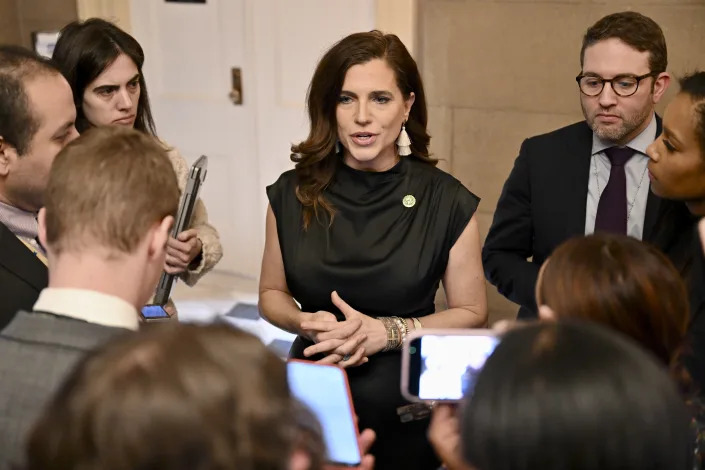
Rep. Nancy Mace (R-S.C.) speaks to reporters at the U.S. Capitol in Washington, on Feb. 2, 2023 (Kenny Holston/The New York Times)
Republican leaders have followed an emboldened base of conservative activists into what increasingly looks like a political cul-de-sac on the issue of abortion — a tightly confined absolutist position that has limited their options before the 2024 election season, even as some in the party push for moderation.
Last year’s Supreme Court decision overturning a woman’s constitutionally protected right to an abortion was supposed to send the issue of abortion access to the states, where local politicians were supposed to have the best sense of the electorate’s views. But the decision on Friday by a conservative judge in Texas, invalidating the Food and Drug Administration’s 23-year-old approval of the abortion pill mifepristone, showed the push for nationwide restrictions on abortion has continued since the high court’s nullification of Roe v. Wade.
Days earlier, abortion was the central theme in a liberal judge’s landslide victory for a contested and pivotal seat on the state Supreme Court in Wisconsin. Some Republicans are warning that the uncompromising position of their party’s activist base could be leading them over an electoral cliff next year.
“If we can show that we care just a little bit, that we have some compassion, we can show the country our policies are reasonable, but because we keep going down these rabbit holes of extremism, we’re just going to keep losing,” said Rep. Nancy Mace, R-S.C., who has repeatedly called for more flexibility on first-term abortions and exceptions for rape, incest and the life and health of the mother. “I’m beside myself that I’m the only person who takes this stance.”
She is far from the only one.
The chair of the Republican National Committee, Ronna McDaniel, has been showing polling to members of her party demonstrating that Americans largely accept abortion up to 15 weeks into a pregnancy and support the same exemptions that Mace wants. Dan O’Donnell, a conservative radio host in Wisconsin, wrote after the lopsided conservative defeat in the state Supreme Court contest that abortion was driving young voters to the polls in staggering numbers and that survival of the party dictated compromise.
“As difficult as this may be to come to grips with, Republicans are on the wrong side politically of an issue that they are clearly on the right side of morally,” he wrote.
The problem goes beyond abortion. With each mass shooting, the GOP’s staunch stand against gun control faces renewed scrutiny. Republicans courted a backlash last week when they expelled two young Democratic lawmakers out of the Tennessee state legislature for leading youthful protests after a school shooting in Nashville that left six dead. Then on Monday came another mass shooting, in Louisville, Kentucky.
“My kids had friends on Friday night running for their lives,” said Mace, referring to a shooting on South Carolina’s Isle of Palms, which elicited no response from most of her party. “Republicans aren’t showing compassion in the wake of these mass shootings.”
The party’s stand against legislation to combat climate change has helped turn young voters into the most liberal bloc of the American electorate. And Republican efforts to roll back LGBTQ rights and target transgender teenagers, while popular with conservatives, may be seen by the broader electorate as, at best, a distraction from more pressing issues.
Rep. Mark Pocan, an openly gay Democrat from Wisconsin, said Monday that in the short term, the Republican attacks on transgender Americans were having a real-world effect, with a rise in violence and bigotry. But he said it is also contributing to the marginalization of the party, even in his swing state.
He pointed to the “WOW counties” that surround Milwaukee — Waukesha, Ozaukee and Washington — where then-Republican Gov. Scott Walker won 73% in 2014, and where the Republican, Dan Kelly, won 58.7% in the state Supreme Court race last week.
“We keep seeing our numbers increase in those counties because those Republicans largely are economic Republicans, not social Republicans,” Pocan said, adding that GOP candidates “definitely are chasing their people away.”
Mace does appear to be correct that her desire for compromise is not widely shared in a party in which analysts continue to look past social issues to explain their electoral defeats.
Kelly was a poor candidate who lost by an almost identical margin in another state Supreme Court race in 2020, noted David Winston, a longtime pollster and strategist for House Republican leaders. And, Winston added, Republicans may have lost female voters by 8 percentage points in the 2022 midterm elections, but they lost them by 19 points in 2018.
If inflation and economic concerns remain elevated, he added, the 2024 elections will be about the economy, not abortion or guns.
Republicans greeted the abortion-drug ruling on Friday, by Judge Matthew J. Kacsmaryk of the U.S. District Court for the Northern District of Texas, with near total silence. The judge gave the Biden administration seven days to appeal, and on Monday, senior executives of more than 250 pharmaceutical and biotech companies pleaded with the courts to nullify the ruling with a scorching condemnation of Kacsmaryk’s reasoning.
Most anti-abortion advocates are not backing down. Katie Glenn Daniel, the state policy director for Susan B. Anthony Pro-Life America, one of the most powerful anti-abortion groups, said Wisconsin’s results were more about anti-abortion forces being badly outspent than about ideology. In her state, Florida, she noted, Democrats scorched Republicans with advertising in 2022 saying they planned to ban abortion without exceptions. Republicans, from Gov. Ron DeSantis on down, easily prevailed that November.
Republicans need to keep pressing with abortion restrictions that will affect Democratic states as well as Republican ones, she said.
“A national minimum standard is incredibly important. Without it there will continue to be late-term abortions, and governors like Gavin Newsom are very motivated to force his views on the rest of the country,” she said of California’s Democratic governor.
Last week, the Florida state Senate approved legislation pushing the state’s ban on abortion from the current 15 weeks into pregnancy to six weeks. If the state’s House of Representatives approves it, DeSantis has said he will sign it. If DeSantis runs for president as expected, his signature would thrust abortion squarely into the 2024 race for the White House.
Last year, John P. Feehery, a veteran Republican leadership aide in the House, urged his party to find a defensible position on abortion that included flexibility on abortion pills, allowed early pregnancies to be terminated and detailed a coherent position on exceptions for rape, incest and health concerns. He said Monday that he was repeatedly told abortion would be a state-level issue and federal candidates should just stay quiet.
“They didn’t want to do the hard work on abortion,” he said, blaming “a lack of leadership” in the party that still has the Republican position muddled.
Guns are another issue where silence is not working. The shooting in Louisville, which left six dead, including the gunman, and eight wounded, kept the issue of guns in the spotlight after last week’s heated showdown in Tennessee — and before a three-day gathering of the National Rifle Association on Friday in Indianapolis. The Kentucky attack was the 15th mass shooting this year in which four or more victims were killed, the largest total in a year’s first 100 days since 2009, according to a USA Today/Associated Press/Northeastern University database.
“You can’t stop paying attention after one horrible event happens. You have to watch what happens afterward,” said Rep. Maxwell Frost, 26, a Florida Democrat who last year became the first member of Generation Z to be elected to the House.
Voices for compromise are beginning to bubble up, in some cases from surprising sources. Carol Tobias, president of the National Right to Life Committee, one of the country’s largest anti-abortion groups, said Monday that even she was “somewhat concerned” that the Republican Party might be getting ahead of the voters on abortion. Her organization has drafted model legislation to ban abortion at the state level in every case but when the life of the mother is in grave danger. But, Tobias said, that legislation comes with language to extend those exceptions to the “hard cases,” pregnancies that result from rape or incest, or that might harm a mother’s health.
“We’ve always known the American public does not support abortion for all nine months of a pregnancy,” she said. “They want some limits. We are trying to find those limits.”
She added, “If we can only at this time save 95% of the babies, I am happy to support that legislation.”
In Wisconsin, a big win for liberals and a warning for the GOP
Mike Bebernes – Senior Editor – April 9, 2023
How Wisconsin’s new liberal supreme court could rule on abortion rights, redistricting
What’s happening
On Tuesday night, while most of the political world was still focusing on the indictment of former President Donald Trump, a liberal candidate secured a major win that arguably suggests more about how future national elections may go than anything that happened in that New York City courtroom earlier in the day.
In Wisconsin, a liberal judge, Janet Protasiewicz, decisively defeated her conservative opponent, Daniel Kelly, and secured a seat on the state’s Supreme Court in a race widely considered to be the most important election of 2023. Protasiewicz’s victory will give liberals a majority on the Wisconsin court for the first time in 15 years. This potentially offers them the opportunity to strike down a 19th-century law banning nearly all abortions and to redraw congressional maps that have allowed Republicans to dominate the Wisconsin Legislature, despite the near 50-50 split of voters in the state.
Although the contest was nonpartisan on paper, it had all of the markings of a traditional campaign. Democrats and Republicans rallied intensely behind their preferred candidates, spending a combined $42 million on the race — nearly three times the previous record for any state Supreme Court election. Protasiewicz campaigned heavily on abortion and democracy reform, while Kelly attempted to portray her as “soft on crime.”
In another high-profile race Tuesday night in Chicago, the progressive candidate, Brandon Johnson, beat the conservative Democrat Paul Vallas in the race to become mayor of the nation’s third-largest city. These two victories come five months after Democrats overcame predictions of a “red wave” in last year’s midterm elections by winning key Senate, House and governors’ races across the country.
Why there’s debate
The Wisconsin Supreme Court will probably have a significant impact on politics in the state, but many political observers say it also serves as a strong bellwether of the political dynamics in the country ahead of next year’s critical presidential election cycle.
Commentators on both sides of the political spectrum say the result should be a flashing red warning light for Republicans about the dangers they face in 2024. They argue that Protasiewicz’s win shows that the dynamics that fueled the GOP’s lackluster showing in the midterms — most notably opposition to Trump and backlash to the Supreme Court’s ruling overturning abortion protections established in Roe v. Wade — are still swaying swing voters. Many also make the case that Republicans have little hope of pivoting away from such unpopular positions because of the intensely pro-Trump and anti-abortion views of the party’s core voters.
There are also practical implications of the new liberal majority on Wisconsin’s top court that could benefit Democrats. If the court throws out the state’s gerrymandered district map, which is strongly biased in the Republicans’ favor, that could help Democrats gain a handful of seats in the House of Representatives and tip the balance in the state Legislature in their favor. Some legal experts add that having Protasiewicz on the bench, rather than an ally of Trump, like Kelly, dramatically reduces the chances that a GOP-backed legal effort to challenge the state’s results in the next presidential election would be successful.
Other observers are wary of making too many predictions based on a single, off-year election, with more than 18 months to go before the presidential election. They argue that the types of voters who turn out for a state Supreme Court race don’t necessarily reflect the voters who will turn out next November, especially if Trump himself is on the ballot. It’s also possible, some add, that abortion may not be as potent an issue for Democrats in the future, because the question may largely have been settled in most states by the time voters head to the polls.
What’s next
Protasiewicz is scheduled to be sworn in in August, and the court is expected to quickly take up challenges to both the state’s centuries-old abortion ban and its gerrymandered district map. There has been some speculation that Republicans in the Wisconsin State Senate may attempt to impeach Protasiewicz to prevent her from tipping power in the court, but the party’s leaders have insisted that is not going to happen.
Perspectives
Republicans’ refusal to abandon unpopular positions means the losses will keep coming
“Republicans were, after all, warned. Again and again. On Trump and abortion, but also on guns, moral Grundyism, and their addiction to the crazy. Yet despite all the red blinking lights — and they are flashing everywhere — the GOP simply smacks its lips and says, ‘This is fine.’ More, please.” — Charlie Sykes, Bulwark
The GOP has time to stem its losses on abortion if it’s willing to moderate on the issue
“The Wisconsin results show abortion is still politically potent. … Republicans had better get their abortion position straight, and more in line with where voters are or they will face another disappointment in 2024. A total ban is a loser in swing states. Republicans who insist on that position could soon find that electoral defeats will lead to even more liberal state abortion laws than under Roe.” — Editorial, Wall Street Journal
An obscure, off-year court race can’t tell us much about how national elections will go
“The supreme-court election is a big win for the Left, but it would be foolish to suggest it means Wisconsin won’t be a competitive state in 2024. Turnout in 2023 was significantly higher than in a typical supreme-court election but significantly lower than in the November 2022 midterm elections or the 2020 presidential election.” — John McCormack, National Review
Democratic strength in Midwest swing states narrows the GOP’s path to the White House
“These gains in turn will further energize progressives and elect more Democrats in a virtuous circle. It is hard to imagine any Republican presidential candidate carrying Wisconsin in 2024, and that pattern is likely to hold in other key Midwestern states.” — Robert Kuttner, American Prospect
Unique circumstances made abortion more central in Wisconsin than it will be in most other contests
“The answer seems to be that abortion is a winning issue for Democrats, but only in some circumstances. When a campaign revolves around the subject — as the Wisconsin Supreme Court race did this week and voter referendums in Kansas, Kentucky and Michigan did last year — abortion can win big even in purple or red states. … But there is not yet evidence that abortion can determine the outcome of most political campaigns.” — David Leonhardt, New York Times
The GOP’s MAGA base is driving the party straight toward disaster in 2024
“The GOP nominee will have most likely endorsed a national abortion ban (or at least draconian abortion restrictions in their own state) to make the party’s primary voters happy. … If messaging about defending abortion rights and democracy commanded a sizable majority in this highly polarized, blue collar-heavy swing state, it may well continue constituting Kryptonite to MAGA — all the way through 2024.” — Greg Sargent, Washington Post
The messages that have helped the GOP win in the past may not work today
“Away from the Trump circus, it certainly feels like a shift is happening. The go-to Republican scare tactics – Socialism is coming! Crime is rampant! The family is under attack! – aren’t working. And when the face of your party becomes the first former president ever indicted, the old ‘party of law and order’ line falls a bit flat.” — Rex Huppke, USA Today
The result should inspire Democrats to proudly stand up for progressive policies
“For Democrats, there is a lesson here. When they run on protecting abortion rights, they tend to win. When they shy away from messages that are central to their party’s identity — for instance, by tacking to the center with tough-on-crime policies — their record is much more mixed. … In much of the country, voters don’t want Republican-lite candidates. They want Democrats who act like Democrats.” — Alex Shephard, New Republic
Abortion fights may be largely settled by the time the presidential election comes around
“Abortion might be legal in Wisconsin by the 2024 election. I think that’s actually quite likely. So, you know, abortion as a motivating issue might not be there for some voters.” — Amelia Thomson-DeVeaux, FiveThirtyEight
A liberal majority on Wisconsin’s court will counter the GOP’s efforts to subvert democracy
“A redrawn map could put two or three GOP-held seats in Congress in play for Democrats. … The actual winner of the 2024 Wisconsin presidential election will all but certainly receive the state’s electoral votes.” — Christina Cauterucci, Slate
Is there a topic you’d like to see covered in “The 360”? Send your suggestions to the360@yahoonews.com.
Trump and His Lawyers: A Restless Search for Another Roy Cohn
Maggie Haberman and Jonathan Swan – April 9, 2023
Todd Blanche, a newly hired criminal defense lawyer for former President Donald Trump, leaves the courthouse after Trump’s indictment, in New York, April 4, 2023. (Ahmed Gaber/The New York Times)
Seated far to the left of the defendant, former President Donald Trump, in a Manhattan, New York, criminal courtroom Tuesday was a lawyer who has never tried a case in court, whose phone was seized by federal agents executing a warrant last year, and who once hosted syndicated news segments bombastically defending the Trump White House.
Seated to Trump’s far right was Todd Blanche, a newly hired criminal defense lawyer who also represents the lawyer at the far left end of the table, Boris Epshteyn. In between them was Joe Tacopina, a combative presence on cable television who recently represented Trump’s future daughter-in-law, Kimberly Guilfoyle, before the House committee investigating the Jan. 6 attack on the Capitol.
The tableau, rounded out by another lawyer, Susan Necheles, from Trump’s arraignment on 34 felony charges of falsifying business records, revealed more about the client than about the case at hand. It was emblematic of his relentless search for the perfect lawyer — and of his frequent replacement of his lawyers when they fail to live up to his ideal for how the perfect lawyer should operate.
Trump has long been obsessed with lawyers: obsessed with finding what he thinks are good lawyers and obsessed with ensuring that his lawyers defend him zealously in the court of public opinion.
His lawyers’ own foibles are seldom disqualifying, so long as they defend him in the manner he desires.
That often means measuring up to the example of Roy Cohn, Trump’s first fixer-lawyer, who represented him in the 1970s and early 1980s. Cohn, whose background included being indicted himself and who was eventually disbarred, earned a reputation for practicing with threats, scorched-earth attacks and media manipulation.
Trump’s continual efforts to identify and recruit the newest Roy Cohn have always been unusual and impulsive, according to interviews with a half-dozen people who have represented Trump or been involved in his legal travails over the past seven years.
He has occasionally hired lawyers after only the briefest phone call, knowing little to nothing about their background but having been impressed by a quick introduction or by seeing them praise him on Fox News.
It took only an introduction over the phone by Epshteyn on a conference call for Trump to hire Evan Corcoran, a former federal prosecutor, to handle discussions with the government over its efforts to recover classified materials in Trump’s possession. (Corcoran has since become the focus of government efforts to pierce attorney-client privilege and learn about his discussions with Trump in connection with a grand-jury subpoena for classified material at Mar-a-Lago as the government amasses evidence of obstruction of justice. Prosecutors believe Trump may have misled Corcoran during those discussions.)
Trump hired Jim Trusty, a former federal prosecutor, to work on the classified documents case after seeing him discuss one of Trump’s legal entanglements as a commentator on television.
“That’s one of the first questions: ‘Can you go on TV?’ He picks his lawyers literally off of TV,” said one lawyer who used to represent Trump, who insisted on anonymity to avoid publicly breaking confidence with a former client. “It’s more important that you go on TV for him and how you look on TV than what you actually say in the courtroom.”
The same lawyer cited Trump’s lawsuits against journalist Bob Woodward and the Pulitzer Prize Board as actions that any experienced lawyer would have known would get him or her “laughed out of court.”
“He wants people who will go out and say things that lawyers can’t say, things you just can’t say in a courtroom,” the former Trump lawyer said. “Lawyers who push back don’t make it.”
The Woodward and Pulitzer lawsuits were advocated nonetheless by Epshteyn, according to two of the former president’s advisers, because Epshteyn is “the good news guy” who relays to Trump only what he thinks will please him. (Others say Epshteyn has delivered bad news as well, when it’s been necessary.)
Epshteyn declined to comment.
“President Trump has assembled a legal team that is battle-tested and proven on all levels,” said Steven Cheung, a spokesperson for Trump. “With the law, facts and truth on President Trump’s side across the board, the witch hunts and hoaxes being thrown against him and his supporters have no chance. President Trump will not be deterred and will always keep fighting for America and Americans.”
Trump employs some veteran lawyers with extensive experience, who are candid with him even though they know he may disregard their advice or, worse, attack them for giving it, according to some who have worked in Trump’s orbit. And he hasn’t pushed them all to go on television. But longtime Trump observers see a correlation between others on his current team and the self-described “elite strike force” that championed Trump’s false claims of a stolen election after his defeat by Joe Biden.
Epshteyn was part of the group that pushed to keep Trump in power and has since stayed involved as a communications and in-house counsel. Still, several of Trump’s advisers were surprised to see Epshteyn seated at the defense table when photos were published from inside the Manhattan courtroom Tuesday: While Blanche, Tacopina and Necheles were all named in the court transcript as attorneys of record in the criminal case, Epshteyn was not.
Until he announced his presidential campaign in November, Trump had paid at least $10 million to his lawyers over the prior two years using money donated to his political action committee. The fact that he was not personally on the hook for the money seemed to make Trump even more impulsive in his hiring of lawyers, according to a person familiar with his legal decisions.
Trump is not an easy client: He often tells lawyers that he is smarter than them and more experienced in legal combat. He is given to instructing them not only what to say on television but also what to say in court.
In an interview in 2021, Trump named Cohn and Jay Goldberg, who represented him in his divorce from his first wife, Ivana, as the two best lawyers he had ever had.
“I’m not finding people like this; Jay Goldberg, you know, he was a great Harvard student, but he was great on his feet,” Trump said, before making clear how much he saw the job of his lawyers as representing him in the public eye: “I know they’ve got to exist, they’re around, but you don’t see it. A lot of people choke. They choke, you know, when the press, when you call, when the press calls. In all fairness, the press calls, and they can’t handle it.”
While Trump has privately praised Tacopina for his appearances on television, some of the former president’s advisers have been unhappy with them; Tacopina was recently joined in talking about the Manhattan criminal case by Trusty, though Trusty represents Trump in the classified documents case.
Another lawyer who has worked with Trump — his former attorney general, William Barr — shook his head at the sight of the defense table Tuesday.
Barr, who sat for an interview with the House select committee investigating Trump’s efforts to stay in office, explained that lawyers working for Trump tend to come to one conclusion.
“Lawyers inevitably are sorry for taking on assignments with him,” Barr said on Fox News. “They spend a lot of time before grand juries or depositions themselves.”
Mobile home park residents form co-ops to save their homes
Claire Rush – April 8, 2023
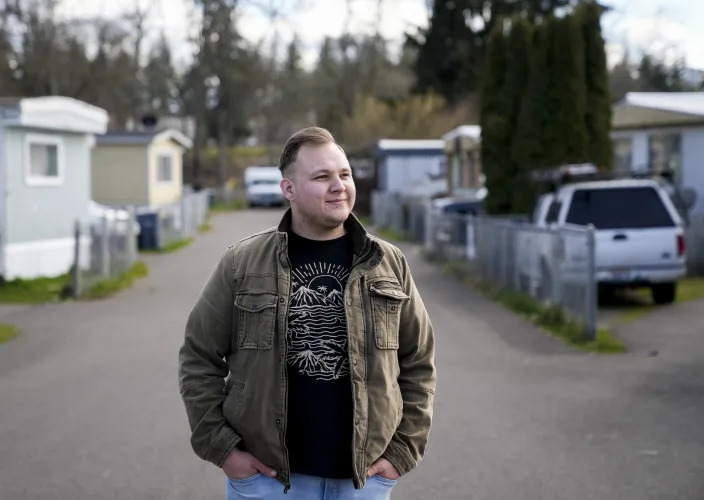
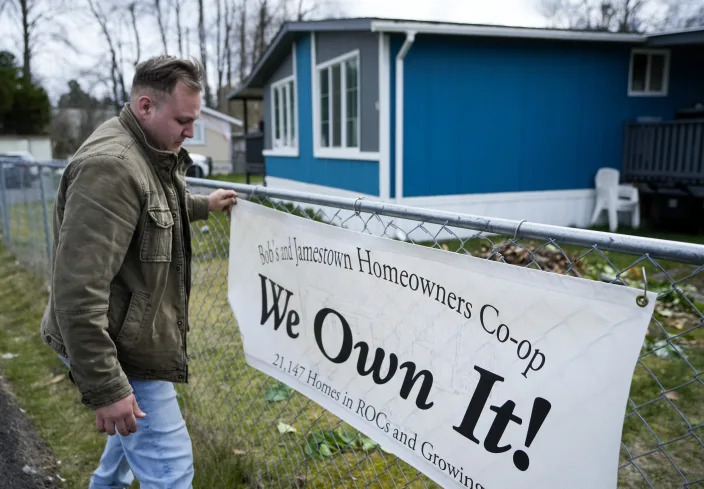
Resident and board member of the mobile home park Bob’s and Jamestown Homeowners Cooperative, Gadiel Galvez, 22, poses for a portrait in his neighborhood on Saturday, March 25, 2023, in Lakewood, Wash. When residents learned the park’s owner was looking to sell, they formed a cooperative and bought it themselves amid worries it would be redeveloped. Since becoming owners in September 2022, residents have worked together to manage and maintain the park. (AP Photo/Lindsey Wasson)Resident and board member of the mobile home park Bob’s and Jamestown Homeowners Cooperative, Gadiel Galvez, 22, takes a walk in his neighborhood on Saturday, March 25, 2023, in Lakewood, Wash. When residents learned the park’s owner was looking to sell, they formed a cooperative and bought it themselves amid worries it would be redeveloped. Since becoming owners in September 2022, residents have worked together to manage and maintain the park. (AP Photo/Lindsey Wasson)Gadiel Galvez, 22, adjusts a sign stating that his resident cooperative owns their mobile home park, Bob’s and Jamestown Homeowners Cooperative, in Lakewood, Wash., on Saturday, March 25, 2023. When residents learned the park’s owner was looking to sell, they formed a cooperative and bought it themselves amid worries it would be redeveloped. Since becoming owners in September 2022, residents have worked together to manage and maintain the park. (AP Photo/Lindsey Wasson)
PORTLAND, Ore. (AP) — When Gadiel Galvez learned that the owner of his mobile home park south of Seattle was looking to sell, he and other residents worried their largely Latino community would be bulldozed to make way for another Amazon warehouse.
So, they decided to form a cooperative and buy their park in Lakewood, Washington. With help from a nonprofit that advises communities like theirs and helps them secure loans, they bought it for $5.25 million. Since becoming owners in September, everyone’s worked to make improvements.
“Everybody thought, ‘You know what? … I’m going to make this place the best that I can,’” said Galvez, 22, who is a co-op board member. “Some people painted their homes, some people remodeled their interiors and exteriors, and some are working on their roofs.”
With rents rising at mobile home parks nationwide, advocates tout the cooperative model as a way to preserve one of the last affordable housing options for people with low- or fixed-incomes and to give them a greater voice in managing their parks.
So far these resident-owned communities are proving to be a reliable option. None of the more than 300 in the network of nonprofit ROC USA have defaulted or closed. One decided to sell back to the county housing authority it originally purchased from.
“They have a 100% track record of success, which tells you that it’s working for the residents,” said George McCarthy, president and CEO of the Lincoln Institute of Land Policy, a Cambridge, Massachusetts, think tank. “Resident ownership is an absolute bulwark against the intrusion of institutional capital in the market.”
Nearly a third of mobile home parks in the U.S. have been bought by such investors since 2015, lured by reliable cash flow and high returns from raising rents at nearly double the general rental market rate, McCarthy said.
“They’re trading on the desperation of people living in the parks,” he said. “There’s no place that they can take their homes if they can’t afford to keep paying the increasing rents.”
Park residents often own their home but rarely the land beneath it. So if a landlord raises rent, residents can be evicted or forced to sell their home. If a park is sold to be redeveloped, mobile homes that can’t be moved are demolished.
“Homelessness is really what residents are facing” if investors aggressively raise rents, said Victoria O’Banion, ROC Northwest’s marketing and acquisitions specialist.
At Rimrock Court in the central Oregon town of Madras, rent increased from $350 to $495 over five years. When the owner notified residents he planned to sell, they feared further increases — or worse, that it would be torn down to make way for apartments. So they decided to buy it.
“We were really worried about being forced out of our homes,” said Shawn King, who lives there with her husband on a fixed income and had experienced homelessness before.
To pay off the purchase loan, residents now pay $520 a month — a stretch, but one that comes with reassurance, King said.
“Just to have that peace of mind, to know that our rent is going to be locked in for awhile and not keep going up, and also knowing that our rent monies … are going back into the property, that is the cool part,” she said.
The required rent increase to go co-op was even steeper in Evergreen Village Cooperative in Mount Bethel, Pennsylvania, — from $460 a month to $750 to pay off the $12 million loan.
Still, more than two-thirds of residents voted in favor, figuring their rent would stabilize in the long run.
“We are not for profit. All the money that we get has to go back into the village and pay the mortgages off,” said Stephen Laclair, board president.
Evergreen Village has earmarked funds for improvement projects for the next decade, and this year plans to enhance the sewer plant and fix electrical issues, he said.
Co-ops can also provide social support to residents. At Liberty Landing Cooperative in Missouri, residents started a food pantry to help neighbors in need.
“If there’s a hardship, we’re willing to work with somebody. … It’s emotional when you find out that somebody’s lost their job, their child support … and they don’t know what to do,” said Kristi Peterman, the board vice president. “Our president likes to say: ‘If it doesn’t work for the poorest of us then it’s not going to work for anybody.'”
Despite the talk of better management and stronger community, most parks aren’t co-ops.
The country’s roughly 43,000 mobile home communities are home to 22 million people, according to the Manufactured Housing Institute, a national trade organization. But only about 1,000 are resident-owned, according to Carolyn Carter, deputy director at the National Consumer Law Center.
Some resistance comes from residents, many of whom are seniors and people with disabilities who may not want the responsibility of managing their park. Others argue rent control or stricter zoning regulations protecting mobile home parks from redevelopment are more effective.
“Zoning is critical. … That is what we ought to be fighting for everywhere,” said Jan Leonard, who lives in a park in Walla Walla, Washington, and worked with other residents to successfully push the city council to amend zoning codes to add mobile home parks as a land-use type.
Other residents considering buying their parks are running up against the same forces that make them popular with investors — a red-hot market and competition from private equity firms and other prospective buyers.
Sarah Marchant, vice president of Community Loan Fund, ROC USA’s New Hampshire affiliate, recalled Tara Estates, a 380-home park in Rochester. The steep $45 million asking price discouraged residents from organizing.
Another challenge is that few states provide funding for residents looking to buy their parks. The lack of grants can make it difficult for residents to finance large loans.
New Hampshire, Vermont, Rhode Island, Massachusetts, Colorado and Oregon are among states with laws that have been effective in helping residents buy their parks, the National Consumer Law Center said.
A new bill in Oregon would allocate $35 million in grants to help residents purchase their parks. Washington passed a bill last month requiring that landlords offer tenants a chance to compete to purchase their park. It also requires two years’ notice if a park will be closed, although that can be reduced if landlords financially compensate residents.
Mobile homes are “an important and affordable housing option for a lot of folks, especially older people aging in place, and we need to make sure it’s preserved,” said state Sen. Noel Frame, the Washington bill’s prime sponsor.
Some real estate groups and park owners argue the bill places an undue burden on landlords.
“If you want tenants to organize and make offers to purchase their communities … they should not wait until there’s a clock ticking,” said Robert Cochran, property manager of Contempo Mobile Home Park in Spokane.