Legal expert: SCOTUS “invented a new rule” that could even give Trump immunity for “unofficial acts”
Marina Villeneuve – July8, 2024
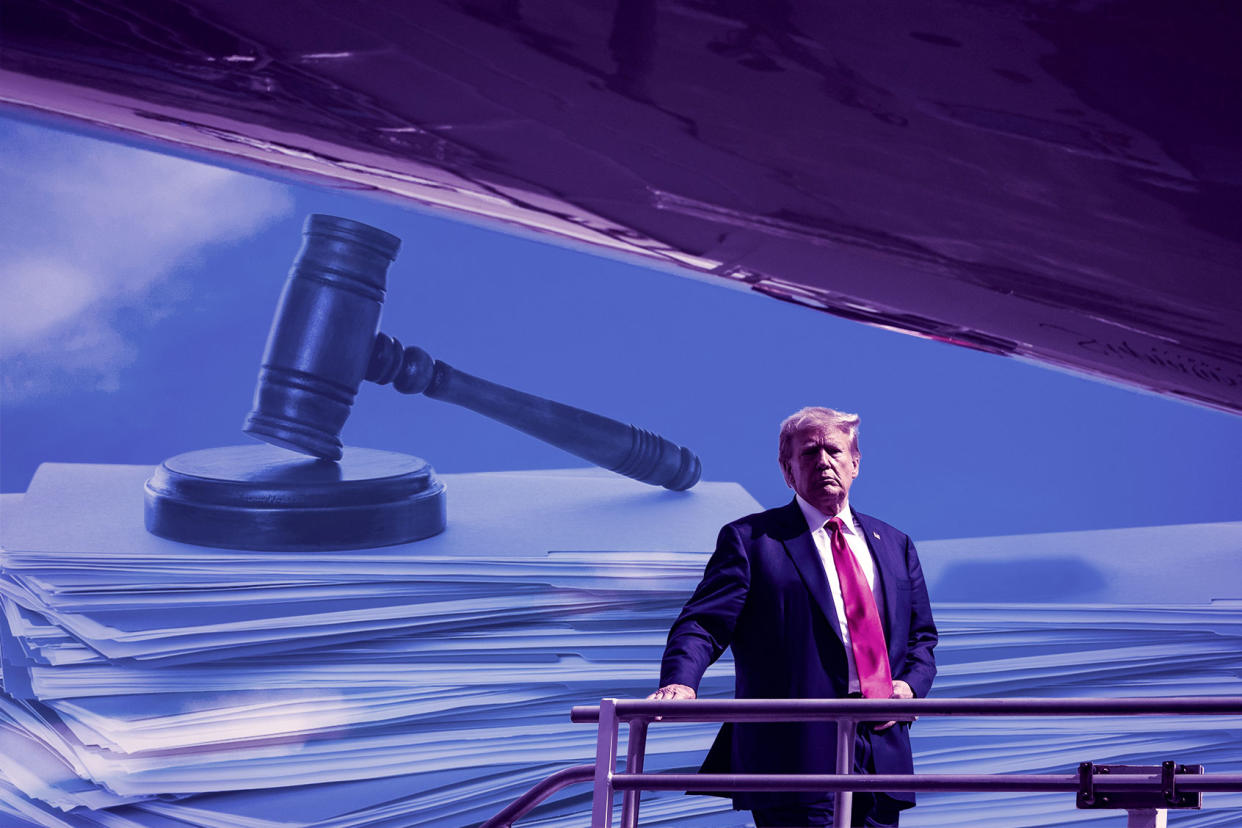
Donald Trump Photo illustration by Salon/Getty Images
Donald Trump’s classified documents case in Florida could hinge on how courts define what constitutes an official presidential act under a landmark Supreme Court ruling outlining presidential immunity, according to a legal expert.
The Supreme Court last week ruled 6-3 that presidents have “absolute immunity from criminal prosecution” for acts that fall within the “exercise of his core constitutional powers he took when in office.” Presidents, according to the ruling, have “at least presumptive” immunity from other official acts, and no immunity for unofficial acts.
Trump pleaded not guilty last year to 40 criminal counts stemming from the discovery of classified documents at Mar-a-Lago after he left office.
His lawyers argue that the Supreme Court’s ruling “guts” special counsel Jack Smith’s own theory of presidential immunity. Trump’s team wants to prevent prosecutors from using evidence that concerns Trump’s “official acts” in any trial.
“The million-dollar question now is how the president’s conduct is categorized,” University of Miami School of Law professor Caroline Mala Corbin told Salon.
“If what he did is considered official conduct, then he has either absolute immunity or at least a presumption of immunity,” she said. “And a presumption that will be very difficult to rebut.”
U.S. District Judge Aileen Cannon — who is presiding over the documents case — is now set to weigh whether Trump had immunity for any alleged acts.
She paused upcoming court deadlines for prosecutors and Trump’s team, and gave special counsel Jack Smith until July 18 to respond to Trump’s motion claiming presidential immunity. A reply from Trump’s team is due July 21.
The grand jury’s indictment includes 32 counts of unauthorized possession and retention of national defense documents, along with counts that allege Trump conspired to conceal documents from FBI investigators.
On Friday, Trump’s lawyers asked Cannon to decide whether the alleged conduct in the documents case is official or unofficial.
In Trump’s motion, his lawyers Todd Blanche and Christopher Kise pointed out that Chief Justice John Roberts — who authored the majority immunity ruling — said that “questions about whether the President may be held liable for particular actions, consistent with the separation of powers, must be addressed at the outset of a proceeding.”
Trump’s lawyers said the indictment concerns “important Presidential powers” including meeting with foreign relations leaders, overseeing international diplomacy and intelligence gathering and responsibility for Executive Branch actions.
Earlier this year, Trump’s lawyers argued that 32 criminal counts are based on official acts — including Trump deciding to “retain” the documents by having them “removed from the White House” while he was still president.
“The timeframe alleged for each of Counts 1 – 32 begins on January 20, 2021,” reads his lawyer’s motion. “President Trump was the Commander in Chief until noon that day.”
Corbin said whether Trump will have absolute immunity for official acts depends on whether Cannon determines he was acting pursuant to a power he shares with Congress.
She pointed to the ruling, which said: “Not all of the President’s official acts fall within his ‘conclusive and preclusive’ authority. The reasons that justify the President’s absolute immunity from criminal prosecution for acts within the scope of his exclusive constitutional authority do not extend to conduct in areas where his authority is shared with Congress.”
Corbin said the Supreme Court’s ruling lacked detailed parameters of what constitutes an official — and core — presidential act.
“I think they defined official conduct expansively, but not definitively,” she said. “So I think there are a lot of questions that remain.”
Pace Law School professor Bennett Gershman said the documents Trump removed belonged to the National Archive.
Trump’s possession and use of those documents as president did fall within the “outer perimeter” of his official duties, according to Gershman.
“But will a court find that his retention of the documents after he left office reasonably could be considered an official act of his presidency? Or would a court more likely conclude that his retention of these documents after he left office was a purely private and personal action on his part having nothing to do with his presidency or with any official acts of his presidency?” Gershman told Salon.
Gershman said it’s “much more reasonable” for a court to conclude that Trump’s retention of the documents falls into the unofficial bucket.
“The Supreme Court’s emphasis on affording a president extremely broad immunity is to allow the president to do his job energetically and fearlessly without tempering his decision-making over fears of prosecution,” Gershman said. “Trump, when he decided to take the documents, had no concern over how the retention and possession would affect his presidency. “
Gershman added: “The way Trump mishandled the documents — storing them in his bathroom, showing them to guests at his house, losing some of them — suggests he didn’t think these documents were official or that he was possessing in an official capacity.”
Former federal prosecutor Andrew Weissmann said the Supreme Court’s ruling won’t “jeopardize the case altogether” — but could limit evidence used by prosecutors.
“The hurrendous [sic] SCOTUS immunity decision’s effect on the Trump MAL case: it may restrict certain evidence, but not jeopardize the case altogether as it is about conduct after Trump was president (unlawful retention of docs and obstruction),” Weissmann wrote on X. “But certain allegations in the indictment may be struck.”
Weissmann pointed to half a dozen paragraphs in the Florida indictment that outlines the alleged conduct, including Trump gathering official documents and other materials in cardboard boxes in the White House.
The indictment also mentions Trump receiving intelligence briefings from high-level government officials and regularly receiving classified intelligence information in the “President’s Daily Brief.”
Trump issued a statement in 2018 stating he has a “unique, Constitutional responsibility to protect the Nation’s classified information, including by controlling access to it.”
And as he prepared to leave the White House in January 2021, the indictment says he and White House staff packed boxes containing “hundreds of classified documents” that were brought to Mar-a-Lago.
Weissmann pointed out that the Supreme Court’s ruling itself opened the door to impact proceedings involving unofficial acts.
“Because the SCOTUS decision says (ie invented a new rule) that even in such an ‘unofficial case’ the government cannot use evidence of ‘official’ conduct to prove the case (and some such arguable conduct is cited in the indictment),” he wrote.
The Supreme Court majority ruling said that allowing evidence of official conduct in cases about unofficial conduct could jeopardize presidential immunity.
“If official conduct for which the President is immune may be scrutinized to help secure his conviction, even on charges that purport to be based only on his unofficial conduct, the ‘intended effect’ of immunity would be defeated,” the ruling says. “The President’s immune conduct would be subject to examination by a jury on the basis of generally applicable criminal laws. Use of evidence about such conduct, even when an indictment alleges only unofficial conduct, would thereby heighten the prospect that the President’s official decisionmaking will be distorted.”
Trump’s lawyers pointed to that finding in their motion, and argued that the indictment does not only include official conduct.
The Supreme Court’s opinion adds: “Allowing prosecutors to ask or suggest that the jury probe official acts for which the President is immune would thus raise a unique risk that the jurors’ deliberations will be prejudiced by their views of the President’s policies and performance while in office.”
Justice Amy Coney Barrett disagreed and concurred in part with Justice Sonia Sotomayor’s dissent, arguing that excluding “any mention” of an official act associated with a bribe ‘would hamstring the prosecution.'”
Barrett said a prosecutor could point to public record to show the president performed the official act and admit evidence of what the president “allegedly demanded, received, accepted, or agreed to receive or accept.”
But Barrett said admitting testimony or private records would invite the jury to “second-guess” the president’s motivations for official acts — which she argues would “‘seriously cripple'” a president’s exercise of official duties.
In her dissent, Sotomayor said federal criminal prosecutions require “‘robust procedural safeguards.'”
“If the Government manages to overcome even that significant hurdle, then the former President can appeal his conviction, and the appellate review of his claims will be ‘particularly meticulous,’” she wrote.
She added: “I am deeply troubled by the idea, inherent in the majority’s opinion, that our Nation loses something valuable when the President is forced to operate within the confines of federal criminal law.”
Justice Ketanji Brown Jackson, meanwhile, called the “official-versus-unofficial act distinction… both arbitrary and irrational.”
Jackson said “the Court has neglected to lay out a standard that reliably distinguishes between a President’s official and unofficial conduct.”
Jackson said she questioned whether a president could be held accountable for committing crimes while undertaking official duties.
“[C]ourts must now ensure that a former President is not held accountable for any criminal conduct he engages in while he is on duty, unless his conduct consists primarily (and perhaps solely) of unofficial acts,” Jackson said.
Corbin called the Supreme Court’s ruling troubling.
“It’s assumed that everyone is subject to the law in the United States, including the president, and it’s a little worrisome that the President might be absolutely immune from criminal law just because he was executing a power given by the Constitution,” Corbin said. “The court’s justification for absolute immunity seemed pretty flimsy, and granting absolute immunity to a president especially when we know certain presidents will happily abuse their power is very worrisome.”
And she called the level of immunity granted unnecessary to protect a president’s ability to do the job.
“Given that future presidents may not be trustworthy, it’s a real worry,” Corbin said. “I mean, we’ve already seen what certain presidents will do without knowing they had absolute immunity. I can’t imagine what we might see from a president who has absolute immunity.”
In a concurrence, Supreme Court Justice Clarence Thomas raised another issue altogether — concerning the constitutionality of the special counsel.
Trump has raised such legal arguments for months and argued that Special Counsel Smith’s appointment and budget violates the Constitution.
Thomas said he wasn’t sure about whether the Attorney General could appoint a private citizen as special counsel, saying: “A private citizen cannot criminally prosecute anyone, let alone a former President.”
“Whether the Special Counsel’s office was ‘established by Law’ is not a trifling technicality,” Thomas said. “If Congress has not reached a consensus that a particular office should exist, the Executive lacks the power to unilaterally create and then fill that office. Given that the Special Counsel purports to wield the Executive Branch’s power to prosecute, the consequences are weighty.”
Trump’s lawyers cited Thomas’ dissent in their motion asking Cannon to resolve constitutional questions about presidential immunity and the special counsel’s authority.
Meanwhile, prosecutors have argued that long-held court precedents have upheld the authorities of special counsels.
Smith has pointed out that when Trump’s former Attorney General William Barr served under former President George H.W. Bush, Barr appointed former circuit and district judges.
And legal experts including D.C.-based national security attorney Bradley Moss say that for decades, criminal defendants indicted by special counsel have unsuccessfully challenged their lawfulness.
The Supreme Court’s ruling could also potentially forestall sentencing for Trump’s criminal charges in New York.
Manhattan prosecutors alleged that Trump disguised $130,000 in hush money as a legal expense as part of a scheme to keep information about alleged extramarital sex from voters and unlawfully influence the 2016 presidential election.
But in the wake of the Supreme Court’s immunity ruling, Judge Juan Merchan postponed Trump’s sentencing for at least two months — if, the judge said, “such is still necessary.”
Trump’s lawyers argue that because Trump’s crimes occurred before he assumed the presidency, some of the evidence used should have been redacted.
Prosecutors alleged Trump made or caused the falsification of business records, including invoices and checks to longtime fixer Michael Cohen — some of which have Trump’s signature on them.
Prosecutors also alleged that 2017 Trump Organization general ledger entries falsely described 2017 payments to Cohen as a “legal expense.”
Trump also faces charges for trying to overturn the 2020 election.
A D.C. federal grand jury indicted Trump on four charges in August 2023 accusing the former president of conspiring to thwart his 2020 electoral defeat and the peaceful transfer of power to President Joe Biden.
Last December, U.S. District Judge Tanya Chutkan rejected Trump’s motion to dismiss the charges on grounds of absolute presidential immunity, which he argues completely shields him from prosecution for any actions taken while in office.
In late February, the Supreme Court decided to take up Trump’s immunity appeal.
The justices sent the case back to Chutkan to figure out which acts are official and unofficial.
The Supreme Court’s ruling said deciding whether Trump’s alleged fake electors scheme “requires a close analysis of the indictment’s extensive and interrelated allegations.”
The ruling stressed that the federal government’s role in appointing electors is “limited” and that the president lacks “authority to control the state officials who do.” The opinion also says the framers excluded electors “suspected of too great devotion to the president in office.”
Still, the opinion said: “Unlike Trump’s alleged interactions with the Justice Department, this alleged conduct cannot be neatly categorized as falling within a particular Presidential function.”
The lower court will also weigh Trumps’ tweets urging his supporters to travel to D.C. on Jan. 6, as well as his speech to the crowd gathered at the Capitol.
The court’s opinion said the president has “extraordinary power” to speak with citizens.
But, the opinion added: “There may, however, be contexts in which the President, notwithstanding the prominence of his position, speaks in an unofficial capacity—perhaps as a candidate for office or party leader.”
The Most Interesting Justice on the Supreme Court Is Also the Loneliest
By Stephen I. Vladeck – July 8, 2024
Credit…Stefani Reynolds for The New York Times
When this Supreme Court term began last October, one of the more intriguing predictions from commentators was that Justice Amy Coney Barrett — entering her third full term on the court — would come out of her shell and emerge as the court’s new swing justice, casting the decisive vote in the most divisive cases.
The commentators got half of that right: There’s little doubt, in looking at the oral arguments the court has conducted and the decisions it has handed down over the past nine months, that Justice Barrett has found her voice — and has easily become the most interesting justice. Her questions at argument are penetrating; the analysis in her written opinions spares no one in its detail.
The second part of that prediction didn’t come true, though. Justice Barrett did side with some or all of the three Democratic appointees in several of the term’s most important cases — but her fellow conservatives seldom joined her. Indeed, while Justice Barrett was establishing her principled independence in the middle of the court, the other five Republican appointees moved only further to the right.
When the majority in the Colorado ballot disqualification case went further than necessary, and the Democratic appointees called them out for doing so, there was Justice Barrett — writing separately to chastise all of her colleagues for failing to send a unified message to the country. When Justice Clarence Thomas took too wooden an approach to assessing historical practice and tradition in a trademark case, there was Justice Barrett — pushing back in an important concurrence that was joined by Justice Elena Kagan and in part by Justices Sonia Sotomayor and Ketanji Brown Jackson.
When the Fifth Circuit allowed anti-vaccine activists and red states to bring an unprecedented lawsuit against the Biden administration built on the dubious claim that the government had coerced social-media networks into removing vaccine-related disinformation and misinformation, there was Justice Barrett — writing the majority opinion holding that the plaintiffs hadn’t come close to establishing that they had been harmed by the alleged government action and that the Fifth Circuit clearly erred in concluding to the contrary. And when the court sidestepped a highly charged dispute over emergency abortions in Idaho, it was Justice Barrett who wrote for the court’s “middle” in explaining why.
Even on Monday, when Justice Barrett otherwise joined the five other Republican appointees in holding that presidents enjoy at least some immunity from criminal prosecution, she went out of her way to push back against the majority’s most controversial holding — that protected conduct can’t even be used as evidence in criminal prosecutions against former chief executives.
Her partial concurrence offered a not-so-subtle road map to Judge Tanya Chutkan, presiding over the Jan. 6 prosecution, for how she might apply the majority’s new framework. Just as in her dissenting opinion in the Fischer v. United States case — in which the other Republican appointees, joined by Justice Jackson, voted to narrow a criminal obstruction statute used to prosecute Jan. 6 rioters — Justice Barrett was cleareyed about the threat to democracy Jan. 6 posed and the importance of holding to account those who were responsible for it.
This pattern has repeated in the more opaque context of emergency applications. In March, when the court briefly allowed Texas’ new state-level deportation regime to go into effect, it was a not-so-subtle nudge from Justice Barrett, in a concurring opinion, that prompted the Fifth Circuit to quickly put it back on hold (where it remains).
And in January, it was Justice Barrett who provided the fifth vote (joined by the three Democratic appointees and Chief Justice John Roberts) to allow the Biden administration to remove razor wire that Gov. Greg Abbott of Texas had placed along the U.S.-Mexico border — defusing what had been a brewing conflict between state and federal authorities in and around the town of Eagle Pass.
The justice reflected in all of these cases is someone who comes across in her writings as principled, nuanced and fair-minded — regardless of the bottom line that her votes end up supporting. Many of us may not agree with the principles reflected in her writings (like her majority opinion in a case holding that U.S. citizens don’t have a liberty interest in the immigration status of their noncitizen spouses). What cannot be doubted is that they are principles, and that, to an extent greater than many of her colleagues, Justice Barrett does her best to hew to them.
The problem that the court’s rulings at the end of the term drove home is that, as willing as Justice Barrett is to follow her principles even when they lead her away from Republican political preferences, the same can’t always be said of the other two justices in the court’s middle — Chief Justice Roberts and Justice Brett Kavanaugh. The chief justice wrote the majority opinion in Loper Bright Enterprises v. Raimondo, in which the court overruled its 40-year-old decision in Chevron — and the principle of deference to administrative agencies for which it stood. The chief justice wrote the majority opinion in Fischer, which narrowed the criminal obstruction statute so prevalent in Jan. 6 cases in blatant defiance of the principles of textualism to which the conservative justices are supposedly committed. And the chief justice wrote the court’s sweeping majority opinion in the Trump immunity case.
And it is the split between the five other Republican appointees and Justice Barrett in that last case that is most revealing. Whereas the majority mostly left application of its new and not exactly clear approach to presidential immunity to be hashed out by the lower courts, Justice Barrett “would have answered it now.” Whereas the majority went out of its way to punt on whether the charges against Mr. Trump can go forward, Justice Barrett was emphatic that, for at least some of the charges, she saw “no plausible argument for barring prosecution of that alleged conduct.”
And whereas the majority went out of its way to hold that immunized presidential conduct couldn’t even be used as evidence to try charges for which even the majority agrees there is no immunity, Justice Barrett criticized the majority and endorsed Justice Sotomayor’s dissent, noting that “the Constitution does not require blinding juries to the circumstances surrounding conduct for which presidents can be held liable.”
As with her dissent in the Jan. 6 obstruction ruling, Justice Barrett seems willing to accept that the court lives in the real world — and that the rules it hands down should be designed to actually work on the ground and to persuade those reading them that the court understands the limits on its proper role in our constitutional system.
In the end, this contrast is perhaps one of the defining — and most chilling — takeaways from the Supreme Court’s term: Justice Barrett came out of her shell. And the other Republican appointees retreated into theirs.
Stephen I. Vladeck is a professor of law at Georgetown, writes the One First weekly Supreme Court newsletter and is the author of “The Shadow Docket: How the Supreme Court Uses Stealth Rulings to Amass Power and Undermine the Republic.”
What is Project 2025? The conservative road map is raising a lot of eyebrows, on both sides of the aisle.
Katie Balevic – July 6, 2024
Project 2025 is a road map for the next Republican president.
The Heritage Foundation, a prominent conservative think tank, authored the plan.
It calls for eliminating the Education Department, among some other surprising things.
Well before the disastrous presidential debate during which President Joe Biden may have handed the keys to the White House back to former President Donald Trump, conservative thinkers were assembling a game plan.
In January 2023, The Heritage Foundation began promoting Project 2025, a 922-page “playbook” assembled with input from dozens of other conservative organizations to guide the next Republican administration.
“The time is short, and conservatives need a plan,” reads the website for the right-wing presidential transition plan. “The project will create a playbook of actions to be taken in the first 180 days of the new Administration to bring quick relief to Americans suffering from the Left’s devastating policies.”
Some of Project 2025’s priorities include:
Slashing employment in the federal government and muzzling “woke propaganda at every level of government”
Eliminating the Department of Education and its “woke-dominated system of public schools”
Prohibiting the FBI from fighting misinformation and disinformation
Ending the “war on fossil fuels” and allowing further development on Native American lands
Ending active FBI investigations that are “contrary to the national interest”
The plan is so extreme that even Trump has distanced himself from it, writing on Truth Social this week that he knows “nothing about Project 2025.”
“I have no idea who is behind it. I disagree with some of the things they’re saying and some of the things they’re saying are absolutely ridiculous and abysmal. Anything they do, I wish them luck, but I have nothing to do with them,” Trump wrote.
A spokesperson from Project 2025 told Business Insider that the playbook “does not speak for any candidate or campaign.”
“We are a coalition of more than 110 conservative groups advocating policy and personnel recommendations for the next conservative president. But it is ultimately up to that president, who we believe will be President Trump, to decide which recommendations to implement,” the spokesperson said.
Heritage faces blowback after ‘bloodless’ revolution comment
Emily Brooks – July 6,2024
The Heritage Foundation and its president, Kevin Roberts, are facing blowback in the wake of his comment about an ongoing second American revolution that will “remain bloodless if the left allows it to be.”
President Biden’s campaign jumped on the comment, with a spokesperson saying it shows that former President Trump’s allies are “dreaming of a violent revolution to destroy the very idea of America.” Commentators ranging from former GOP Rep. Adam Kinzinger (Ill.) to MSNBC hosts and guests reacted with alarm.
And in the wake of the comment, though without mentioning it, Trump distanced himself from Project 2025 — an initiative led by the conservative think tank that aims to provide a conservative policy blueprint for the next Republican administration and that has also ignited political firestorms.
Heritage and Roberts, though, are standing by the comment, dismissing the criticism as being in bad faith.
“Americans in 2024 are in the process of carrying out the Second American Revolution to take power back from the elites and despotic bureaucrats. These patriots are committed to peaceful revolution at the ballot box,” Robers said Wednesday in a post on the social platform X, continuing to describe the threat he sees and warning that “the Left may not allow a peaceful transfer of power.”
Heritage itself repeated the “bloodless” comment in a separate post on X alongside a compilation video of Democrats, commentators and public figures making controversial comments about unrest and protests.
“The Second American Revolution will remain bloodless if the Left allows it to be,” the Heritage post said. “Unfortunately, they have a well established record of instigating the opposite.”
Roberts made his original comment Tuesday on Steve Bannon’s “War Room” podcast — hosted that day by former Rep. Dave Brat (R-Va.), since Bannon reported to prison for his contempt of Congress sentence the day before — when discussing the Supreme Court’s ruling that presidents have presumptive immunity for official actions. The decision handed a win to Trump as he fights indictments over his attempts to overturn the 2020 election results.
“The left has taken over our institutions. The reason that they are apoplectic right now, the reason so many anchors on MSNBC, for example, are losing their minds daily, is because our side is winning,” Roberts said. “And so I come full circle on this response, and just want to encourage you with some substance. That we are in the process of the second American revolution, which will remain bloodless if the left allows it to be.”
For the Biden campaign, the comments were an opportunity to advance one of its core messages: that Trump is a threat to democracy.
“248 years ago tomorrow America declared independence from a tyrannical king, and now Donald Trump and his allies want to make him one at our expense,” Biden campaign spokesperson James Singer said in a statement. “On January 6, they proudly stormed our Capitol to overturn an election Donald Trump lost fair and square – something not even the Confederacy was able to accomplish – now they are dreaming of a violent revolution to destroy the very idea of America.”
Kinzinger, the former Republican congressman who is critical of Trump and has endorsed Biden, wondered about the implications of if the left did not “allow” a “bloodless” revolution.
“And if they dont? What if Americans decide they prefer to hash out differences as the constitution calls for, vis a vis politics, then what? Spell it out. If you can win politically then what?” Kinzinger said in a post on X.
And MSNBC host Joe Scarborough responded directly to Roberts’s quip about anchors on the network.
“First of all, Kev, I’m not losing my mind,” Scarborough began, later saying, “You’re the one talking about revolution. Why are you so angry, Kevin? Why are you losing your mind? America’s great. We’re strong militarily, we’re strong economically, we’re strong culturally … This whole idea that we need a new revolution — I mean, I know it is great fundraising, but it’s just B.S.”
The outrage about the comment builds on heightened attention on the leading conservative think tank and its advocacy group as it leads dozens of conservative organizations in Project 2025, which aims to compile policy proposals for the next right-wing administration.
Democrats and Biden’s campaign have repeatedly pointed to Project 2025 when warning about policies a Trump administration would enact if he wins in November, noting that former Trump administration officials have ties to it.
But in a signal that the project could have too many political liabilities for Trump’s electoral prospects, the former president said in a post on his Truth Social website Friday that he “know[s] nothing about Project 2025″ and has “no idea who is behind it.”
“I disagree with some of the things they’re saying and some of the things they’re saying are absolutely ridiculous and abysmal. Anything they do, I wish them luck, but I have nothing to do with them,” Trump said.
Neither Trump nor his campaign said the “bloodless” comment from Roberts impacted his statement, but Trump’s move to distance himself from the Heritage-led project further highlights the ideological controversies that the conservative think tank has embraced under Roberts’s leadership.
A spokesperson for Project 2025 posted on X that the coalition “does not speak for any candidate or campaign.”
A conservative leading the pro-Trump Project 2025 suggests there will be a new American Revolution
Ali Swenson – July 3, 2024
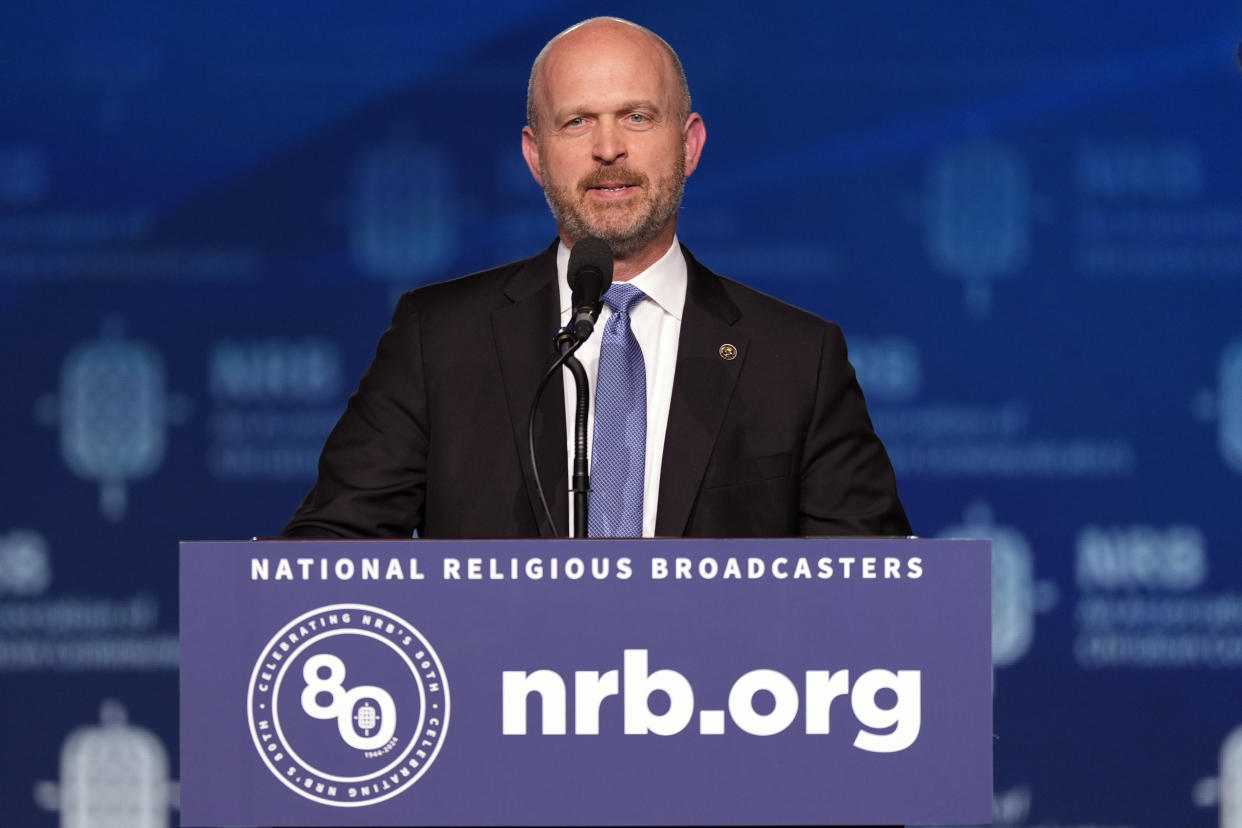
FILE – Kevin Roberts, president of The Heritage Foundation, speaks at the National Religious Broadcasters convention at the Gaylord Opryland Resort and Convention Center Feb. 22, 2024, in Nashville, Tenn. Roberts, the leader of a conservative think tank planning for a massive overhaul of the federal government says we are in the midst of “a second American Revolution” that will be bloodless “if the left allows it to be.” (AP Photo/George Walker IV, File)More
NEW YORK (AP) — The leader of a conservative think tank orchestrating plans for a massive overhaul of the federal government in the event of a Republican presidential win said that the country is in the midst of a “second American Revolution” that will be bloodless “if the left allows it to be.”
Heritage Foundation President Kevin Roberts made the comments Tuesday on Steve Bannon’s “War Room” podcast, adding that Republicans are “in the process of taking this country back.”
Democrats are “apoplectic right now” because the right is winning, Roberts told former U.S. Rep. Dave Brat, one of the podcast’s guest hosts as Bannon is serving a four-month prison term. “And so I come full circle on this response and just want to encourage you with some substance that we are in the process of the second American Revolution, which will remain bloodless if the left allows it to be.”
Roberts’ remarks shed light on how a group that promises to have significant influence over a possible second term for former President Donald Trump is thinking about this moment in American politics. The Heritage Foundation is spearheading Project 2025, a sweeping road map for a new GOP administration that includes plans for dismantling aspects of the federal government and ousting thousands of civil servants in favor of Trump loyalists who will carry out a hard-right agenda without complaint.
His call for revolution and vague reference to violence also unnerved some Democrats who interpreted it as threatening.
“This is chilling,” former Democratic presidential candidate Marianne Williamson wrote on the social platform X. “Their idea of a second American Revolution is to undo the first one.”
James Singer, a spokesperson for President Joe Biden’s reelection campaign, pointed to this week’s Fourth of July holiday in an emailed statement.
“248 years ago tomorrow America declared independence from a tyrannical king, and now Donald Trump and his allies want to make him one at our expense,” Singer said, adding that Trump and his allies are ”dreaming of a violent revolution to destroy the very idea of America.”
Roberts, whose name Bannon recently floated to The New York Times as a potential chief of staff option for Trump, also said on the podcast that Republicans should be encouraged by the Supreme Court’s recent immunity ruling.
He said Monday’s decision — which gives presidents broad immunity from prosecution — is “vital” to ensure a president won’t have to “second guess, triple guess every decision they’re making in their official capacity.”
In an emailed statement on Wednesday, Roberts reiterated his comments from the podcast, saying Americans “are in the process of carrying out the Second American Revolution to take power back from the elites and despotic bureaucrats.”
“These patriots are committed to peaceful revolution at the ballot box,” he said. “Unfortunately, it’s the Left that has a long history of violence, so it’s up to them to allow a peaceful transfer of power.”
Roberts pointed to the protests after the killing of George Floyd by police in 2020, some of which erupted into crime, vandalism and violence. Democrats, in turn, have accused their Republican counterparts of violence, using the Jan. 6, 2021, Capitol riot in which Trump supporters tried to forcibly overturn his loss to President Joe Biden.
Heidi Beirich, co-founder of the Global Project Against Hate and Extremism, said Roberts’ comments about a “second American Revolution” are “a bit terrifying but also elucidating.” The 1,000-page Project 2025 playbook calls for far-reaching changes in government, including rolling back protections for the LGBTQ community and infusing Christianity more deeply into society.
“Roberts, the Heritage Foundation, and its allies in Project 2025 want to reorder American society and fundamentally change it,” Beirich said. “He’s said the quiet part out loud.”
Trump seeks to disavow ‘Project 2025’ despite ties to conservative group
Nathan Layne – July 5,2024
Former U.S. President and Republican presidential candidate Donald Trump holds a campaign event in ChesapeakeHouse Freedom Caucus and others hold a press conference regarding federal government spending, in Washington
(Reuters) – Former President Donald Trump tried to distance himself on Friday from a conservative group’s sweeping plans for the next Republican presidency, days after its leader claimed a second American Revolution was underway that would “remain bloodless if the left allows it to be.”
The Republican presidential candidate renounced any connection with Project 2025, a plan Democrats have been attacking to highlight what they say is Trump’s extreme policy agenda for a second term should he beat President Joe Biden in the Nov. 5 election.
Many people involved in the project lead by the Heritage Foundation, America’s top conservative think tank, worked in the Trump White House and would likely help fill out his administration if he wins in November.
But Trump said on his Truth Social platform he had nothing to do with the plan.
“I know nothing about Project 2025. I have no idea who is behind it,” he wrote.
“I disagree with some of the things they’re saying,” he continued, adding some of their assertions were “absolutely ridiculous and abysmal.”
Trump’s post came three days after Heritage Foundation president Kevin Roberts’ comments on Steve Bannon’s “War Room” podcast about a second American Revolution. Democrats and others criticized what they viewed as a veiled threat of violence.
In a statement provided by a Project 2025 spokesperson on Friday, Roberts repeated his claim that Americans were carrying out a revolution “to take power back from the elites and despotic bureaucrats” and said it was the political left that had a history of political violence.
The spokesperson said that while Project 2025 provided recommendations for the next Republican president, it would be up to Trump, should he win, to decide whether to implement them.
Trump’s move to create distance with Project 2025 could in part reflect an effort to moderate his message in the final months of the race, especially with Biden’s campaign faltering after the Democratic candidate’s June 27 debate, said James Wallner, a political science professor at Clemson University.
“Trump is basically now seeking to appeal to a broader audience,” Wallner said.
The Biden campaign has stepped up its efforts to tie Trump’s campaign to Project 2025.
“Project 2025 is the extreme policy and personnel playbook for Trump’s second term that should scare the hell out of the American people,” campaign spokesperson Ammar Moussa said in a statement.
The 900-page blueprint calls for drastic reform of the federal government, including a gutting of some federal agencies and a vast expansion of presidential power. Trump’s statements and policy positions suggest he is aligned with some but not all of the project’s agenda.
The plans have been drawn up by the Heritage Foundation in coordination with a collection of other like-minded groups.
A number of people who worked on Project 2025 have close ties to the former president. Russ Vought, who was Trump’s director of the Office of Management and Budget and is heading up a key committee at the Republican National Convention, authored one of the project’s chapters.
Stephen Miller, a former senior adviser to Trump who is widely expected to be tapped for a top job in a second Trump administration, heads up a legal group on Project 2025’s advisory board.
(Reporting by Nathan Layne; Editing by Colleen Jenkins and Chris Reese)
Why Republicans Are Talking About Biden’s ‘Dictatorship’
Jamelle Bouie – June 25, 2024
Credit…Will Matsuda for The New York Times
The United States under President Biden is a “dictatorship,” according to Doug Burgum, governor of North Dakota.
“Under Joe Biden,“ Burgum told Fox News, “we’re actually living under a dictatorship today where he’s, you know, bypassing Congress on immigration policy; he’s bypassing Congress on protecting our border; he’s bypassing Congress on student loan forgiveness; he’s defying the Supreme Court.”
Asked on Sunday to defend his claim, Burgum, who is apparently on the short list of potential running mates for Donald Trump, stood his ground, telling CNN that Biden is “bypassing the other two branches of government to push an ideological view of — whether it’s on economics or whether it’s on climate extremism — he’s doing that without using the other branches.”
It is an odd sort of dictatorship in which the head of state is bound by the rule of law as well as by the authority of other constitutional actors, one in which the dictator’s critics can organize to defeat him in an election without intimidation, penalty or threat of legal sanction — and in which he will leave office if he loses. If nothing else, it is hard to imagine a world in which Biden is both a dictator and someone who would allow Burgum, a regime opponent, to speak freely on national television as he works to defeat Biden at the ballot box.
In fairness to the North Dakota governor, he was trying to make a point about a perceived double standard, in which Trump and not Biden is blasted as an authoritarian for his use of executive orders. But even this is misleading, because the issue with Trump is not the use of executive orders per se. Instead, it is his demonstrated contempt for democratic accountability — he does not accept the right of an electorate to remove him from office — his desire to use the instruments of state to inflict punishment and suffering on his political enemies and his efforts to transform the office of the presidency and the broader executive branch into instruments of his personalist rule.
(That said, there is a conversation for another day about the overreliance on executive orders by presidents of both parties as a symptom of congressional weakness and a product of long-running structural transformations in the nature of the presidency, tied specifically to the growth and pre-eminence of the national security state.)
Governor Burgum is obviously wrong about the idea that Biden is a dictator. But he is not the only Trump ally to speak in such dire terms about the United States. As Politico’s Ian Ward noted, Senator J.D. Vance of Ohio — another Republican hoping to stand with Trump as his second — believes that “the United States is on the verge of going up in smoke” and that “electing Trump represents the only hope that Americans have for getting off the path to literal civilization collapse.”
And Russ Vought, former budget chief in the Trump administration and one of the architects of the former president’s second-term agenda, believes that Americans are living in a “post-constitutional” moment that justifies the radical use of executive power to quash protesters with the military, the gutting of the federal civil service in favor of a spoils system for Trump loyalists and the seizing of the power of the purse from Congress. He urges his comrades in arms to “cast ourselves as dissidents of the current regime and to put on our shoulders the full weight of envisioning, articulating, and defending what a Radical Constitutionalism requires in the late hour that our country finds itself in, and then to do it.”
Just as Americans are not living under a Biden dictatorship — in which the watchful eye of Dark Brandon prowls the nation in search of malarkey — the United States is also not on the verge of collapse. Our economy is the envy of the world, we remain the pre-eminent military power, and for all of its serious problems of representation and inclusion, our political system is still capable of handling at least a few of the major issues that face the nation. It does not downplay the challenges we confront to say that we have the capacity and the resources to meet them head on. That, if anything, makes it all the more frustrating that we have not yet secured decent housing, health care, child care and education for everyone in this country. None of these things are beyond our material ability to accomplish — far from it.
Of course, even mentioning the reality of conditions in the United States is a bit beside the point, because the breathless catastrophizing by Trump and his allies is not an expression of ignorance as much as it is a statement of intent. Rhetorically, the MAGA political project of personalist rule in support of social hierarchy, unrestrained capital and the destruction of public goods depends on the conceit that the nation exists in a state of exception that demands extraordinary — and extreme — measures to resolve.
The cultivation of this notion of a state of exception, of a sense of emergency, is the overriding aim of MAGA political messaging. The targets change — in 2020 it was leftists and protesters, this year it is migrants and refugees again, as it was in 2016 — but the goal is always the same: to designate an enemy, to label that enemy an urgent threat to society and to try to win power on a promise to destroy that enemy by any means necessary.
Embedded in this maneuver is a radical claim of sovereignty. The so-called enemy is whoever Trump says it is, and once designated, the entire political system must bend to his will on the notion that he, alone, can fix it.
Sovereign power of the sort that Trump and his allies gesture toward does not exist in the American system as traditionally understood, and there is no provision in our Constitution by which the executive can set aside the rule of law to deal with threats and emergencies. But the point of this rhetoric of exception is to set the conditions for doing just that — for creating an actual state of exception in American politics.
Put another way, if we are on the verge of civilizational collapse, if we are in a post-constitutional moment, if we are already in a dictatorship, then anything is permitted in defense of the old order. And if democracy should stand in the way of recovery and restoration, then democracy should, perhaps, be set aside.
During the Civil War, President Abraham Lincoln did not present himself as a bulwark of liberty who could resolve the crisis alone. He tried, as much as possible, to embody and act on his deep belief in the rule of law. For example, after taking unilateral steps to confront the rebellion and defend the Union at the outset of the conflict, he went to Congress to ask for its blessing and support. In his message, issued on July 4, 1861, Lincoln did not make demands or assert extraordinary powers.
Instead, the political scientist Nomi Claire Lazar wrote, Lincoln invited “Congress to share the burden of both reflection and action, to consider and judge the reasons he has given.” What guided his deliberations, she continued, is “precisely a commitment to the rule of law as a collective and collaborative project. What is the best we can do, given the constraints and imperatives, he asks, and how can we do our best together?”
If there is anything to know about either Trump or his closest allies, it is that they do not share this commitment to collaboration or deliberation or public reason. They know only force and dominance. And they want everything to be a crisis, not for an opportunity to affirm democracy, but for a chance to undermine it.
Jamelle Bouie became a New York Times Opinion columnist in 2019. Before that he was the chief political correspondent for Slate magazine. He is based in Charlottesville, Va., and Washington.
By Ben Rhodes – July – August, Published on June 18, 2024
Álvaro Bernis
“America is back.” In the early days of his presidency, Joe Biden repeated those words as a starting point for his foreign policy. The phrase offered a bumper-sticker slogan to pivot away from Donald Trump’s chaotic leadership. It also suggested that the United States could reclaim its self-conception as a virtuous hegemon, that it could make the rules-based international order great again. Yet even though a return to competent normalcy was in order, the Biden administration’s mindset of restoration has occasionally struggled against the currents of our disordered times. An updated conception of U.S. leadership—one tailored to a world that has moved on from American primacy and the eccentricities of American politics—is necessary to minimize enormous risks and pursue new opportunities.
To be sure, Biden’s initial pledge was a balm to many after Trump’s presidency ended in the dual catastrophes of COVID-19 and the January 6 insurrection. Yet two challenges largely beyond the Biden administration’s control shadowed the message of superpower restoration. First was the specter of Trump’s return. Allies watched nervously as the former president maintained his grip on the Republican Party and Washington remained mired in dysfunction. Autocratic adversaries, most notably Russian President Vladimir Putin, bet on Washington’s lack of staying power. New multilateral agreements akin to the Iran nuclear deal, the Paris agreement on climate change, or the Trans-Pacific Partnership were impossible, given the vertiginous swings in U.S. foreign policy.
Second, the old rules-based international order doesn’t really exist anymore. Sure, the laws, structures, and summits remain in place. But core institutions such as the UN Security Council and the World Trade Organization are tied in knots by disagreements among their members. Russia is committed to disrupting U.S.-fortified norms. China is committed to building its own alternative order. On trade and industrial policy, even Washington is moving away from core tenets of post–Cold War globalization. Regional powers such as Brazil, India, Turkey, and the Gulf states pick and choose which partner to plug into depending on the issue. Even the high-water mark for multilateral action in the Biden years—support for Ukraine in its fight against Russia—remains a largely Western initiative. As the old order unravels, these overlapping blocs are competing over what will replace it.
A Biden victory in this fall’s election would offer reassurance that the particular risk of another Trump presidency has passed, but that will not vanquish the forces of disorder. To date, Washington has failed to do the necessary audit of the ways its post–Cold War foreign policy discredited U.S. leadership. The “war on terror” emboldened autocrats, misallocated resources, fueled a global migration crisis, and contributed to an arc of instability from South Asia through North Africa. The free-market prescriptions of the so-called Washington consensus ended in a financial crisis that opened the door to populists railing against out-of-touch elites. The overuse of sanctions led to increased workarounds and global fatigue with Washington’s weaponization of the dollar’s dominance. Over the last two decades, American lectures on democracy have increasingly been tuned out.
Indeed, after Hamas’s October 7 attack on Israel and the Israeli military campaign in Gaza, American rhetoric about the rules-based international order has been seen around the world on a split screen of hypocrisy, as Washington has supplied the Israeli government with weapons used to bombard Palestinian civilians with impunity. The war has created a policy challenge for an administration that criticizes Russia for the same indiscriminate tactics that Israel has used in Gaza, a political challenge for a Democratic Party with core constituencies who don’t understand why the president has supported a far-right government that ignores the United States’ advice, and a moral crisis for a country whose foreign policy purports to be driven by universal values. Put simply: Gaza should shock Washington out of the muscle memory that guides too many of its actions.
If Biden does win a second term, he should use it to build on those of his policies that have accounted for shifting global realities, while pivoting away from the political considerations, maximalism, and Western-centric view that have caused his administration to make some of the same mistakes as its predecessors. The stakes are high. Whoever is president in the coming years will have to avoid global war, respond to the escalating climate crisis, and grapple with the rise of new technologies such as artificial intelligence. Meeting the moment requires abandoning a mindset of American primacy and recognizing that the world will be a turbulent place for years to come. Above all, it requires building a bridge to the future—not the past.
THE TRUMP THREAT
One of Biden’s mantras is “Don’t compare me to the Almighty; compare me to the alternative.” As the presidential campaign heats up, it is worth heeding this advice. But to properly outline the dangers of a second Trump term, it is necessary to take Trump’s arguments seriously, despite the unserious form they often take. Much of what Trump says resonates broadly. Americans are tired of wars; indeed, his takeover of the Republican Party would have been impossible without the Iraq war, which discredited the GOP establishment. Americans also no longer trust their elites. Although Trump’s rhetoric about a “deep state” moves quickly into baseless conspiracy theory, it strikes a chord with voters who wonder why so many of the politicians who promised victories in Afghanistan and Iraq were never held to account. And although Trump’s willingness to cut off assistance to Ukraine is abhorrent to many, there is a potent populism to it. How long will the United States spend tens of billions of dollars helping a country whose stated aim—the recapture of all Ukrainian territory—seems unachievable?
Trump has also harnessed a populist backlash to globalization from both the right and the left. Particularly since the 2008 financial crisis, large swaths of the public in democracies have simmered with discontent over widening inequality, deindustrialization, and a perceived loss of control and lack of meaning. It is no wonder that the exemplars of post–Cold War globalization—free trade agreements, the U.S.-Chinese relationship, and the instruments of international economic cooperation itself—have become ripe targets for Trump. When Trump’s more punitive approaches to rivals, such as his trade war with China, didn’t precipitate all the calamities that some had predicted, his taboo-breaking approach appeared to be validated. The United States, it turned out, did have leverage.
But offering a potent critique of problems should not be confused with having the right solutions to them. To begin with, Trump’s own presidency seeded much of the chaos that Biden has faced. Time and again, Trump pursued politically motivated shortcuts that made things worse. To end the war in Afghanistan, he cut a deal with the Taliban over the heads of the Afghan people, setting a timeline for withdrawal that was shorter than the one Biden eventually adopted. Trump pulled out of the Iran nuclear deal despite Iranian compliance, unshackling the country’s nuclear program, escalating a proxy war across the Middle East, and sowing doubt across the world about whether the United States keeps its word. By moving the U.S. embassy in Israel from Tel Aviv to Jerusalem, recognizing the annexation of the Golan Heights, and pursuing the Abraham Accords, he cut the Palestinians out of Arab-Israeli normalization and emboldened Israel’s far right, lighting a fuse that detonated in the current war.
Although Trump’s tougher line with China demonstrated the United States’ leverage, it was episodic and uncoordinated with allies. As a result, Beijing was able to cast itself as a more predictable partner to much of the world, while the supply chain disruptions caused by trade disputes and decoupling created new inefficiencies—and drove up costs—in the global economy. Trump’s lurch from confronting to embracing Kim Jong Un enabled the North Korean leader to advance his nuclear and missile programs under reduced pressure. Closer to home, Trump’s recognition of an alternative Venezuelan government under the opposition leader Juan Guaidó managed to strengthen the incumbent Nicolás Maduro’s hold on power. The “maximum pressure” policy toward Venezuela and Cuba, which sought to promote regime change through crippling sanctions and diplomatic isolation, fueled humanitarian crises that have sent hundreds of thousands of people to the United States’ southern border.
Biden in Washington, D.C., May 2024Evelyn Hockstein / Reuters
A second Trump term would start amid a more volatile global environment than his first, and there would be fewer guardrails constraining a president who would be in command of his party, surrounded by loyalists, and freed from ever having to face voters again. Although there are many risks, three stand out. First, Trump’s blend of strongman nationalism and isolationism could create a permission structure for aggression. A withdrawal of U.S. support for Ukraine—and, perhaps, for NATO itself—would embolden Putin to push deeper into the country. Were Washington to abandon its European allies and promote right-wing nationalism, it could exacerbate political fissures within Europe, emboldening Russian-aligned nationalists in such places as Hungary and Serbia who have echoed Putin in seeking to reunite ethnic populations in neighboring states.
Despite U.S.-Chinese tensions, East Asia has avoided the outright conflict of Europe and the Middle East. But consider the opportunity that a Trump victory would present to North Korea. Fortified by increased Russian technological assistance, Kim could ratchet up military provocations on the Korean Peninsula, believing that he has a friend in the White House. Meanwhile, according to U.S. assessments, China’s military will be ready for an invasion of Taiwan by 2027. If Chinese leader Xi Jinping truly wishes to forcibly bring Taiwan under Beijing’s sovereignty, the twilight of a Trump presidency—by which point the United States would likely be alienated from its traditional allies—could present an opening.
Second, if given the chance, Trump has made it clear that he would almost certainly roll back American democracy, a move that would reverberate globally. If his first election represented a one-off disruption to the democratic world, his second would more definitively validate an international trend toward ethnonationalism and authoritarian populism. Momentum could swing further in the direction of far-right parties in Europe, performative populists in the Americas, and nepotistic and transactional corruption in Asia and Africa. Consider for a moment the aging roster of strongmen who will likely still be leading other powers—not just Xi and Putin but also Narendra Modi in India, Benjamin Netanyahu in Israel, Ali Khamenei in Iran, and Recep Tayyip Erdogan in Turkey. To say the least, this cast of characters is unlikely to promote respect for democratic norms within borders or conciliation beyond them.
This leads to the third danger. In the coming years, leaders will increasingly be confronted with global problems that can be managed or solved only through cooperation. As the climate crisis worsens, a Trump presidency would make a coordinated international response much harder and validate the backlash against environmental policies that has been building within advanced economies. At the same time, artificial intelligence is poised to take off, creating both valuable opportunities and enormous risks. At a moment when the United States should be turning to diplomacy to avoid wars, establish new norms, and promote greater international cooperation, the country would be led by an “America first” strongman.
A TIME TO HEAL
In any administration, national security policy is a peculiar mix of long-standing commitments, old political interests, new presidential initiatives, and improvised responses to sudden crises. Navigating the rough currents of the world, the Biden administration has often seemed to embody the contradictions of this dynamic, with one foot in the past, yearning nostalgically for American primacy, and one foot in the future, adjusting to the emerging world as it is.
Through its affirmative agenda, the administration has reacted well to changing realities. Biden linked domestic and foreign policy through his legislative agenda. The CHIPS Act made substantial investments in science and innovation, including the domestic manufacturing of semiconductors. The act worked in parallel with ramped-up export and investment controls on China’s high-tech sector, which have buttressed the United States’ lead in the development of new technologies such as AI and quantum computing. Although this story is more complicated to tell than one about a tariff-based trade war, Biden’s policy is in fact more coherent: revitalize U.S. innovation and advanced manufacturing, disentangle critical supply chains from China, and maintain a lead for U.S. companies in developing new and potentially transformative technologies.
Gaza should shock Washington out of the muscle memory that guides too many of its actions.
Biden’s most significant piece of legislation, the Inflation Reduction Act, made enormous investments in clean energy technology. These investments will allow the United States to raise its ambition in meeting climate goals by pushing domestic industry and global markets to shift away from fossil fuels faster. Although this breakthrough enhanced U.S. credibility on climate change, it also created new challenges, as even allies have complained that Washington resorted to subsidies instead of pursuing coordinated cross-border approaches to reduce emissions. In this respect, however, the Biden administration was dealing with the world as it is. Congress cannot pass complex reforms such as putting a price on carbon; what it can do is pass large spending bills that invest in the United States.
Despite tensions over U.S. industrial policy, the Biden administration has effectively reinvested in alliances that frayed under Trump. That effort has tacitly acknowledged that the world now features competing blocs, which makes it harder for the United States to pursue major initiatives by working through large international institutions or with other members of the great-power club. Instead, Washington has prioritized groupings of like-minded countries that are, to use a catch phrase, “fit for purpose.” Collaboration with the United Kingdom and Australia on nuclear submarine technology. New infrastructure and AI initiatives through the G-7. Structured efforts to create more consultation among U.S. allies in the Indo-Pacific. This approach involves a dizzying number of parts; one can lose track of the number of regional consultative groups that now exist. But in the context of an unraveled international order, it makes sense to thread together cooperation where possible, while trying to turn new habits of cooperation into enduring arrangements.
Most notably, Biden’s reinvestment in European alliances paid off when Washington was able to swiftly mobilize support for Ukraine in 2022. This task was made easier by the administration’s innovative release of intelligence on Russia’s intentions to invade, an overdue reform of the way that Washington manages information. Although the war has reached a tenuous stalemate, the effort to fortify transatlantic institutions continues to advance. NATO has grown in size, relevance, and resourcing. European Union institutions have taken a more proactive role in foreign policy, most notably in coordinating support for Ukraine and accelerating its candidacy for EU membership. For all the understandable consternation about Washington’s struggle to pass a recent aid bill for Ukraine, Europe’s focus on its own institutions and capabilities was long overdue.
SLOW TO CHANGE
Yet there are three important ways in which the Biden administration has yet to recalibrate its approach to the world of post-American primacy. The first has to do with American politics. On several issues that engender controversy in Congress, the administration has constrained or distorted its options by preemptively deferring to outdated hard-liners. Even as Trump has demonstrated how the left-right axis has been scrambled on foreign policy, Biden at times feels trapped in the national security politics of the immediate post-9/11 era. Yet what once allowed a politician to appear tough to appease hawks in Washington was rarely good policy; now, it is no longer necessarily good politics.
In Latin America, the Biden administration was slow to pivot away from Trump’s “maximum pressure” campaigns on Venezuela and Cuba. Biden maintained, for example, the avalanche of sanctions that Trump imposed on Cuba, including the cynical return of that country to the State Department’s list of state sponsors of terrorism just before leaving office, in January 2021. The result has been an acute humanitarian crisis in which U.S. sanctions exacerbated shortages of basic staples such as food and fuel, contributing to widespread suffering and migration. In the Middle East, the administration failed to move swiftly to reenter the politically contested Iran nuclear deal, opting instead to pursue what Biden called a “longer and stronger” agreement, even though Trump was the one who violated the deal’s terms. Instead,the administration embraced Trump’s Abraham Accords as central to its Middle East policy while reverting to confrontation with Iran. This effectively embraced Netanyahu’s preferred course: a shift away from pursuing a two-state solution to the Israeli-Palestinian conflict and toward an open-ended proxy war with Tehran.
Anyone who has worked at the nexus of U.S. politics and national security knows that avoiding friction with anti-Cuban and pro-Israeli hard-liners in Congress can feel like the path of least resistance. But that logic has turned into a trap. After October 7, Biden decided to pursue a strategy of fully embracing Netanyahu—insisting (for a time) that any criticism would be issued in private and that U.S. military assistance would not be conditioned on the actions of the Israeli government. This engendered immediate goodwill in Israel, but it preemptively eliminated U.S. leverage. It also overlooked the far-right nature of Netanyahu’s governing coalition, which offered warning signs about the indiscriminate way in which it planned to prosecute its military campaign, as Israeli officials cut off food and water flowing into Gaza within days of Hamas’s attack. In the months that followed, the administration has been trying to catch up to a deteriorating situation, evolving from a strategy of embracing Netanyahu, to one of issuing rhetorical demands that were largely ignored, to one of partial restrictions on offensive military assistance. Ironically, by being mindful of the political risks of breaking with Netanyahu, Biden invited greater political risks from within the Democratic coalition and around the world.
The temptation to succumb to Washington’s outdated instincts has contributed to a second liability: the pursuit of maximalist objectives. The administration has shown some prudence in this area. Even as competition ramped up with China, Biden has worked over the last year to rebuild lines of communication with Beijing and has largely avoided provocative pronouncements on Taiwan. And even as he committed the United States to helping Ukraine defend itself, Biden set the objective of avoiding a direct war between the United States and Russia (although his rhetoric did drift into endorsing regime change in Moscow). The bigger challenge has at times come from outside the administration, as some supporters of Ukraine indulged in a premature triumphalism that raised impossible expectations for last year’s Ukrainian counteroffensive. Paradoxically, this impulse ended up hurting Ukraine: when the campaign inevitably came up short, it made the broader U.S. policy toward Ukraine look like a failure. Sustaining support for Ukraine will require greater transparency about what is achievable in the near term and an openness to negotiations in the medium term.
Biden and U.S. officials meeting with a Chinese delegation in Woodside, California, November 2023 Kevin Lamarque / Reuters
Gaza also showcases the danger of maximalist aims. Israel’s stated objective of destroying Hamas has never been achievable. Since Hamas would never announce its own surrender, pursuing this goal would require a perpetual Israeli occupation of Gaza or the mass displacement of its people. That outcome may be what some Israeli officials really want, as evidenced by right-wing ministers’ own statements. It is certainly what many people around the world, horrified by the campaign in Gaza, believe the Israeli government really wants. These critics wonder why Washington would support such a campaign, even as its own rhetoric opposes it. Instead of seeking to moderate Israel’s unsustainable course, Washington needs to use its leverage to press for negotiated agreements, Palestinian state building, and a conception of Israeli security that is not beholden to expansionism or permanent occupation.
Indeed, too many prescriptions sound good in Washington but fail to account for simple realities. Even with the United States’ military advantage, China will develop advanced technologies and maintain its claim over Taiwan. Even with sustained U.S. support, Ukraine will have to live next to a large, nationalist, nuclear-armed Russia. Even with its military dominance, Israel cannot eliminate the Palestinian demand for self-determination. If Washington allows foreign policy to be driven by zero-sum maximalist demands, it risks a choice between open-ended conflict and embarrassment.
This leads to the third way in which Washington must change its approach. Too often, the United States has appeared unable or unwilling to see itself through the eyes of most of the world’s population, particularly people in the global South who feel that the international order is not designed for their benefit. The Biden administration has made laudable efforts to change this perception—for instance, delivering COVID-19 vaccines across the developing world, mediating conflicts from Ethiopia to Sudan, and sending food aid to places hit hard by shortages exacerbated by the war in Ukraine. Yet the overuse of sanctions, along with the prioritization of Ukraine and other U.S. geopolitical interests, misreads the room. To build better ties with developing countries, Washington needs to consistently prioritize the issues they care about: investment, technology, and clean energy.
Once again, Gaza interacts with this challenge. To be blunt: for much of the world, it appears that Washington doesn’t value the lives of Palestinian children as much as it values the lives of Israelis or Ukrainians. Unconditional military aid to Israel, questioning the Palestinian death toll, vetoing cease-fire resolutions at the UN Security Council, and criticizing investigations into alleged Israeli war crimes may all feel like autopilot in Washington—but that’s precisely the problem. Much of the world now hears U.S. rhetoric about human rights and the rule of law as cynical rather than aspirational, particularly when it fails to wrestle with double standards. Total consistency is unattainable in foreign policy. But by listening and responding to more diverse voices from around the world, Washington could begin to build a reservoir of goodwill.
A FAREWELL TO PRIMACY
In its more affirmative agenda, the Biden administration is repositioning the United States for a changing world by focusing on the resilience of its own democracy and economy while rebooting alliances in Europe and Asia. To extend that regeneration into something more global and lasting, it should abandon the pursuit of primacy while embracing an agenda that can resonate with more of the world’s governments and people.
As was the case in the Cold War, the most important foreign policy achievement will simply be avoiding World War III. Washington must recognize that all three fault lines of global conflict today—Russia-Ukraine, Iran-Israel, and China-Taiwan—run across territories just beyond the reach of U.S. treaty obligations. In other words, these are not areas where the American people have been prepared to go to war directly. With little public support and no legal obligation to do that, Washington should not count on bluffing or military buildups alone to resolve these issues; instead, it will have to focus relentlessly on diplomacy, buttressed by reassurance to frontline partners that there are alternative pathways to achieving security.
Avoiding friction with anti-Cuban and pro-Israeli hard-liners in Congress can feel like the path of least resistance.
In Ukraine, the United States and Europe should focus on protecting and investing in the territory controlled by the Ukrainian government—drawing Ukraine into European institutions, sustaining its economy, and fortifying it for lengthy negotiations with Moscow so that time works in Kyiv’s favor. In the Middle East, Washington should join with Arab and European partners to work directly with Palestinians on the development of new leadership and toward the recognition of a Palestinian state, while supporting Israel’s security. Regional de-escalation with Iran should, as it did during the Obama administration, begin with negotiated restrictions on its nuclear program. In Taiwan, the United States should try to preserve the status quo by investing in Taiwanese military capabilities while avoiding saber rattling, by structuring engagement with Beijing to avoid miscalculation, and by mobilizing international support for a negotiated, peaceful resolution to Taiwan’s status.
Hawks will inevitably attack diplomacy on each of these issues with tired charges of appeasement, but consider the alternative of seeking the total defeat of Russia, regime change in Iran, and Taiwanese independence. Can Washington, or the world, risk a drift into global conflagration? Moreover, the reality is that sanctions and military aid alone will not stop war from spreading or somehow cause the governments of Russia, Iran, and China to collapse. Better outcomes, including within those countries, will be more attainable if Washington takes a longer view. Ultimately, the health of the United States’ own political model and society is a more powerful force for change than purely punitive measures. Indeed, one lesson that is lost on today’s hawks is that the civil rights movement did far more to win the Cold War than the war in Vietnam did.
None of this will be easy, and success is not preordained, since unreliable adversaries also have agency. But given the stakes, it is worth exploring how a world of competing superpower blocs could be knitted into coexistence and negotiation on issues that cannot be dealt with in isolation. For instance, AI presents one area in which nascent dialogue between Washington and Beijing should evolve into the pursuit of shared international norms. Laudable U.S. efforts to pursue collaborative research on AI safety with like-minded countries will inevitably have to expand to further include China in higher-level and more consequential talks. These efforts should seek agreement on the mitigation of extreme harms, from the use of AI in developing nuclear and biological weapons to the arrival of artificial general intelligence, an advanced form of AI that risks surpassing human capacities and controls. At the same time,as AI moves out into the world, the United States can use its leadership to work with countries that are eager to harness the technology for positive ends, particularly in the developing world. The United States could offer incentives for countries to cooperate with Washington on both AI safety and affirmative uses of new technologies.
Biden and Saudi Crown Prince Mohammed bin Salman in Jeddah, Saudi Arabia, July 2022 Mandel Ngan / Reuters
A similar dynamic is required on clean energy. If there is a second Biden administration, most of its efforts to combat climate change will likely shift from domestic action to international cooperation, particularly if there is divided government in Washington. As the United States works to secure supply chains for critical minerals used for clean energy, it will need to avoid constantly working at cross-purposes with Beijing. At the same time, it has an opportunity—through “de-risking” supply chains, forging public-private partnerships, and starting multilateral initiatives—to invest more in parts of Africa, Latin America, and Southeast Asia that have not always been an attractive destination for American capital. In a sense, the Inflation Reduction Act has to be globalized.
Finally, the United States should focus its support for democracy on the health of existing open societies and offering lifelines to besieged civil society groups around the world. As someone who has made the case for putting support for democracy at the center of U.S. foreign policy, I must acknowledge that the calcification of the democratic recession in much of the world requires Washington to recalibrate. Instead of framing the battle between democracy and autocracy as a confrontation with a handful of geopolitical adversaries, policymakers in democracies must recognize that it is first and foremost a clash of values that must be won within their own societies. From that self-corrective vantage point, the United States should methodically invest in the building blocks of democratic ecosystems: anticorruption and accountability initiatives, independent journalism, civil society, digital literacy campaigns, and counter-disinformation efforts. The willingness to share sensitive information, on display in the run-up to war in Ukraine, should be applied to other cases where human rights can be defended through transparency. Outside government, democratic movements and political parties across the world should become more invested in one another’s success, mirroring what the far right has done over the last decade by sharing best practices, holding regular meetings, and forming transnational coalitions.
Ultimately, the most important thing that America can do in the world is detoxify its own democracy, which is the main reason a Trump victory would be so dangerous. In the United States, as elsewhere, people are craving a renewed sense of belonging, meaning, and solidarity. These are not concepts that usually find their way into foreign policy discussions, but if officials do not take that longing seriously, they risk fueling the brand of nationalism that leads to autocracy and conflict. The simple and repeated affirmation that all human life matters equally, and that people everywhere are entitled to live with dignity, should be America’s basic proposition to the world—a story it must commit to in word and deed.
BEN RHODES is a co-host of the podcast Pod Save the World and the author of After the Fall: Being American in the World We’ve Made. From 2009 to 2017, he served as U.S. Deputy National Security Adviser for Strategic Communications and Speechwriting in the Obama administration.
After Escaping China by Sea, a Dissident Faces His Next Act
Kwon Pyong recounted for the firsttime the series of gambles that got him out of China by jet ski, and almost a year later, out of South Korea.
John Yoon, Reporting from Incheon, South Korea – June 23, 2024
Kwon Pyong gazes out at the mud flat in Incheon, South Korea, where he arrived last year.Credit…Woohae Cho for The New York Times
The dissident’s lone regret after his 200-mile escape across the Yellow Sea was not taking night vision goggles.
Nearing the end of his jet ski journey out of China last summer, Kwon Pyong peered through the darkness off the South Korean coast. As he approached the shore, sea gulls appeared to bob as if floating. He steered forward, then ran aground: The birds were sitting on mud.
“I had everything — sunscreen, backup batteries, a knife to cut buoy lines,” he recalled in an interview. He was prepared to signal his location with a laser pen if he became stranded and to burn his notes with a lighter if he were captured. He also had a visa to enter South Korea, and had intended to arrive at a port of entry, he said, not strand himself on a mud flat.
It wasn’t enough.
Mr. Kwon, 36 and an ethnic Korean, had mocked China’s powerful leader and criticized how the ruling Communist Party was persecuting hundreds of pro-democracy activists at home and abroad. In response, he said, he faced an exit ban and years of detention, prison and surveillance.
But fleeing to South Korea did not offer the relief he expected. He was still hounded by the Chinese state, he said, and spent time in detention. Even after he was released, he was in legal limbo: neither wanted nor allowed to leave.
Map shows the distance over the ocean traveled by a Chinese dissident on a jet ski, from the Chinese Shandong Peninnsula to the town of Incheon in South Korea.
It would take 10 more months for Mr. Kwon to be permitted to leave South Korea. Days before he flew out on Sunday, he returned to the mud flat where he haplessly came ashore off Incheon last summer and recounted for the first time publicly the details of his meticulously planned journey.
Court documents from his criminal case in South Korea, past interviews with his friends and family and a statement from the Incheon Coast Guard last year corroborated many of the details in his account.
On a Yamaha WaveRunner purchased with the equivalent of $25,000 in cash, withdrawn from several banks to avoid tipping off the police, Mr. Kwon set off on the morning of Aug. 16 from the foggy coast of the Shandong Peninsula.
A photo released by South Korea’s Coast Guard showing Mr. Kwon’s WaveRunner in Incheon in August 2023.Credit…Korea Coast Guard, via Agence France-Presse — Getty Images
He said he wore a black life jacket and motorcycle helmet for the journey, where he crashed into 10-foot waves and dodged floating rice wine bottles. As his skin burned from the summer sun, he fell into the sea twice, losing his sunglasses.
A Landmark Political Trial: As part of China’s crackdown on dissent, 14 democracy activists in Hong Kong were convicted on national security charges. They now face prison time along with dozens of others.
He refueled using the five barrels of gas that he had tied to the WaveRunner. For himself, he had five bottles of water and five ham and tuna sandwiches. He navigated using a marine compass and a smartphone he had acquired from someone else.
His first glimpse of land came as the setting sun gave the islands off South Korea a warm glow. What was supposed to take eight hours turned to 14. By the time Mr. Kwon arrived in Incheon, the pink sky he had stopped to admire had faded to black.
He did not see any boats or ships on guard, he said, even as he entered a heavily militarized area that the navy monitors for activity, including defectors from North Korea.
Mr. Kwon — who speaks Chinese, English and some Korean — called the local police for help. For an hour, he waited while trying to fend off mosquitoes by walking around his watercraft in beige Crocs.
That night, he said, the Incheon Coast Guard and the South Korean Marine Corps rescued him, detained him and began investigating him along with the South Korean National Intelligence Service.
A view of the Yellow Sea from Shandong Province in China, from where Mr. Kwon began his journey.Credit…Costfoto/NurPhoto, via Getty Images
South Korea rarely accepts refugees, and the authorities served him a deportation order. But over the next months, he was also banned from leaving the country as he fought a criminal charge of unlawful entry, which can be punished with up to five years in prison.
He said that he wondered how things might have unfolded had his arrival gone as planned.
South Korean prosecutors did not lift the exit ban they imposed on Mr. Kwon until his criminal case was finished this month. He said he planned to apply for asylum in the United States or Canada. His flight on Sunday was bound for Newark.
“I want to live my own life,” he said. “I want to live in peace for a while.”
Mr. Kwon, whose Chinese name is Quan Ping, is from a city in the northeastern Chinese province of Jilin, near the border with North Korea. He has visited South Korea, his grandfather’s birthplace, regularly since childhood. He spent his college years in the United States, where he went by Johnny, participated in Iowa State University’s Army R.O.T.C. program and took flying lessons, he said.
He studied aerospace engineering at the university for a few years and returned in 2012 to China, where he ran an online clothing brand and traded cryptocurrencies. He continued traveling widely, touring Lebanon and Syria as an aspiring photojournalist, he said.
He first drew the ire of the Chinese authorities when he began criticizing the Communist Party online. In 2016, he posted on social media about antigovernment protests he had attended in Hong Kong, a Chinese territory. He wore a T-shirt calling China’s leader, Xi Jinping, “Xitler.”
A compass that Mr. Kwon carried on his 200-mile trip.Credit…Woohae Cho for The New York Times
Chinese authorities arrested Mr. Kwon that year and sentenced him in 2017 to 18 months in prison for “inciting subversion of state power,” a charge frequently leveled against dissidents and human rights lawyers.
After his release in 2018, the police tapped his communications, tracked his movements and periodically interrogated him, he said. State agents, he added, were alarmed by his contact with the leaders of the 1989 Tiananmen Square uprising, including Wang Dan, once one of China’s most wanted men.
“I couldn’t live a normal life,” he said.
China’s Ministry of Public Security did not respond to a request for comment.
Mr. Kwon grew desperate to leave as the police investigated his family and friends. He said his plans to leave China by sea were inspired in part by the 1994 movie “The Shawshank Redemption” and by Lindsay Warner, an explorer who circumnavigated Australia on a Jet Ski. He decided South Korea was his only viable option.
He left behind his e-commerce and crypto operations, as well as his friends, family members and a girlfriend.
After the rescue from the mud flat, Mr. Kwon said, investigators seemed baffled by his story and interrogated him, threatened to torture him and denied his request for a lawyer. The Incheon Coast Guard, which led the investigation, said in a statement that “there were no human rights violations” during the investigation.
Mr. Kwon at Incheon Airport, South Korea, on Sunday. He said he planned to apply for asylum in the United States or Canada.Credit…Woohae Cho for The New York Times
In court, Mr. Kwon argued that he was a political refugee and had intended to arrive legally at the Incheon Port, less than a mile from the mud flat, with a tourist visa. A judge found him guilty of unlawful entry in November, handing down a suspended one-year prison sentence with a two-year probationary period.
The verdict released Mr. Kwon from custody but not from legal limbo. Immigration officials imposed an exit ban as prosecutors appealed the judge’s decision.
While living in his parents’ house in Ansan, south of Seoul, Mr. Kwon went to the gym, read books about crypto trading and volunteered at an English language school for adults. He said he also befriended a group of Nigerian refugees by joining their soccer club.
But he didn’t let his guard down. He stuck to the routines he had developed in China: constantly checking for security cameras, and using encrypted texting apps and signal-blocking Faraday bags.
Lee Dae-seon, a South Korean activist who has helped Mr. Kwon, said that he has warned Mr. Kwon of the dangers of China’s overseas police effort, known as Operation Fox Hunt, in which Chinese dissidents living abroad have been forcibly repatriated.
South Korea’s National Intelligence Service confirmed with Mr. Lee that he and Mr. Kwon were targets of the operation, Mr. Lee said. The N.I.S. did not respond to a request for comment.
“It is not safe for him to continue living in South Korea,” Mr. Lee said.
Mr. Kwon, near where he arrived in South Korea, showing the South Korean tourist visa he had obtained. The legal port of entry he was aiming for is seen at the top right.Credit…Woohae Cho for The New York Times
In May, an appeals court dismissed prosecutors’ appeal, as well as Mr. Kwon’s lawyers’ efforts to have his sentence reduced. Mr. Kwon decided not to pursue the case further so that he could leave the country quickly, and prosecutors lifted the travel ban, said Sejin Kim, his lawyer.
At the mud flat, Mr. Kwon said he was looking forward to leaving and starting a new business venture. He said some of his friends and relatives live in the United States and Canada. He is traveling to the United States on a visa for visitors.
“I want to start my second life,” he said.
An immigration law specialist said that while a case for seeking asylum in the United States appeared to be strong, a decision could take years. Mr. Kwon would also have to demonstrate a “well-founded fear” of additional persecution should he be deported to China, said the specialist, Yael Schacher, of Refugees International, a nonprofit in Washington, D.C.
At Incheon Airport on Sunday, he said goodbye to his parents and friends in South Korea, where he would be barred from returning for five years because of his criminal record.
He disappeared into the security line, a ticket for seat 17A in hand, and with his Chinese passport and his South Korean deportation order in the black tactical backpack he had brought on his escape from China. He confirmed that he had boarded his plane by telephone.
“I’m happy, sad,” he said minutes before his flight was set to take off. “And angry,” he added, “that it took me so long to leave South Korea.”
At shortly before 10 p.m., the flight status display showed that his plane had departed.
John Liu contributed reporting. Desperate Escapes:
I Know What America’s Leading C.E.O.s Really Think of Donald Trump
By Jeffrey A. Sonnenfeld – June 23, 2024
Dr. Sonnenfeld is the president of the Yale Chief Executive Leadership Institute.
CreditCredit…Stephan Dybus
Recent headlines suggest that our nation’s business leaders are embracing the presidential candidate Donald Trump. His campaign would have you believe that our nation’s top chief executives are returning to support Mr. Trump for president, touting declarations of support from some prominent financiers like Steve Schwarzman and David Sacks.
That is far from the truth. They didn’t flock to him before, and they certainly aren’t flocking to him now. Mr. Trump continues to suffer from the lowest level of corporate support in the history of the Republican Party.
I know this because I work with roughly 1,000 chief executives a year, running a school for them, which I started 35 years ago, and I speak with business leaders almost every day. Our surveys show that 60 to 70 percent of them are registered Republicans.
The reality is that the top corporate leaders working today, like many Americans, aren’t entirely comfortable with either Mr. Trump or President Biden. But they largely like — or at least can tolerate — one of them. They truly fear the other.
If you want the most telling data point on corporate America’s lack of enthusiasm for Mr. Trump, look where they are investing their money. Not a single Fortune 100 chief executive has donated to the candidate so far this year, which indicates a major break from overwhelming business and executive support for Republican presidential candidates dating back over a century, to the days of Taft and stretching through Coolidge and the Bushes, all of whom had dozens of major company heads donating to their campaigns.
Mr. Trump secured the White House partly by tapping into the anticorporate, populist messaging of Bernie Sanders, who was then a candidate, a move that Mr. Trump discussed with me when I met him in 2015. The strategy might have won voters but did little to enhance Mr. Trump’s image with the business community. And while a number of chief executives tried to work with Mr. Trump as they would with any incumbent president and many celebrated his move to cut the corporate tax rate, wariness persisted.
Several chief executives resented Mr. Trump’s personal attacks on businesses through divide-and-conquer tactics, meddling and pitting competitors against each other publicly. Scores of them rushed to distance themselves from Mr. Trump’s more provocative stances, resigning en masse from his business advisory councils in 2017 after he equated antiracism activists with white supremacists. Dozens of them openly called for Mr. Trump’s impeachment in 2021 after the Jan. 6 insurrection.
Big business’s relationship and likelihood of future support for Mr. Biden is complicated. The president has also adopted populist stances toward business, though he has chafed at pressure from progressives to be even more combative. Nevertheless, chief executives commonly rail at what they view as excessively restrictive antitrust enforcement and misguided attacks on corporate greed.
And their legitimate misgivings about Mr. Biden are overwhelmed by worries about Mr. Trump, version 2024. Mr. Trump’s primary conduits to the business community in his first term — more-reasonable voices like those of Jared Kushner, Dina Powell and Steven Mnuchin — are gone, replaced by MAGA extremists and junior varsity opportunists.
The MAGA die-hard voices that have Mr. Trump’s ear often have more in common with the far left than with the traditional Republican Party. Mr. Trump and his team are doubling down on some of his most anti-business instincts, including proposing draconian 10 percent tariffs on all imports; unorthodox monetary and fiscal policies, including stripping the Federal Reserve Board of its independence; possibly putting in place yield curve control to force interest rates lower; and devaluing the dollar — all of which would drive inflation much higher. These Trump positions have more in common with Karl Marx than Adam Smith.
With two or three prominent exceptions, most business voices now hanging around the hoop would normally be in the minor leagues of Republican business supporters. The party must long for the days of President Dwight Eisenhower, when there were so many business leaders in support and fully 60 percent of his cabinet were chief executives.
As such, it was hardly surprising that just as when Mr. Trump faced a chilly reaction from hundreds of top executives when he spoke at my Yale Chief Executive summit in 2005, he appeared to face a similarly frigid reception when he spoke to the Business Roundtable this month, with no noticeable applause at any point during his “remarkably meandering” remarks, according to CNBC’s Andrew Ross Sorkin, and with Mr. Trump assuming a subdued, if not hostile, posture. Chief executives are not protectionist, isolationist or xenophobic, and they believe in investing where there is the rule of law, not the law of rulers.
That there are more Fortune 100 chief executives based in the smallest state in the nation, Rhode Island — and there’s exactly one Fortune 100 chief executive who is based there — than currently support Mr. Trump tells you how truly isolated the Republican presidential candidate is from the halls of big business.
Jeffrey A. Sonnenfeld is a professor in the practice of leadership at the Yale School of Management and the president of the Yale Chief Executive Leadership Institute.