Trump says Caracas is ‘safer’ than most U.S. cities. Here’s what the numbers show
Antonio Maria Delgado – August 24, 2024
Former President Donald Trump has said on different occasions that Caracas, the Venezuelan capital with a reputation for a sky-high crime rate, has now become a “safe” city because most of its criminals have entered illegally into the United States.
On Thursday night he repeated the claim in an interview with Newsmax. “We’ll go to Caracas, because it will be safer than any place in our country,” he said.
On Aug. 5, he told livestreamer Adin Ross that “If you look at Caracas, it was known for being a very dangerous city and now it’s very safe,” he said. “In fact, the next interview we do, we’ll do it in Caracas, Venezuela, because it’s safer than many of our cities.”
The Nicolas Maduro regime has not broken out numbers for crime in Venezuelan cities for years. But there are organizations that keep track of the figures — and they show the Venezuelan capital is still significantly less safe than most American cities.
Those numbers show that while crime has come down in recent years, a visit to the Venezuelan capital still is not recommended for the fainthearted. According to the Venezuelan Observatory of Violence, a Caracas-based non-profit group widely regarded as the authority on the nation’s homicide rate, Caracas had a rate of 50.8 homicides per 100,000 people.
That’s more than six times the U.S. national average of 7.8 registered in 2020, according to the National Center for Health Statistics, a unit of the U.S Centers for Disease Control and Prevention. The national homicide average for Venezuela in 2023 was 26.8, almost four times higher than the rate in the U.S.
According to the group, the Caracas homicide rate rate for 2023 came down a bit from previous years. Part of the reason is that 7.7 million Venezuelans have fled the country in the past few years, and among them are a comparatively small numbers of criminals, according to experts on Venezuelan crime. In 2020, for example, Caracas closed the year with a homicide rate rate of 56.2 per 100,000 people.
Caracas’ 2023 homicide rate is surpassed by only two large U.S. cities: New Orleans, at 58.4, and St. Louis, at 57.2, according to 2022 numbers from the CDC.
Most large American cities have numbers between the mid single digits and the low double digits. In 2022, for example, the city of Miami’s homicide rate was 8.6, while Jacksonville stood at 15.3, according to the CDC numbers.
Despite their high rates, New Orleans and St. Louis could be considered relatively peaceful in comparison with Venezuela’s most violent cities, all located in the mining region of the southern state of Bolivar. These are El Callao, with 424 violent death victims for 100,000 people, Sifontes, with 151, and Roscio, with 134, according to the violence observatory.
Concerns about the lack of security in Venezuela led the U.S. State Department to maintain a level 4 “Do Not Travel” advisory on Venezuela, originally issued on January 2023, warning Americans that they would be at risk in the South American country given its high crime, civil unrest and the risk of becoming victims to kidnappings or ill treatment from local police.
“Violent crimes, such as homicide, armed robbery, kidnapping, and carjacking, are common in Venezuela. Political rallies and demonstrations occur, often with little notice. Anti-Maduro demonstrations have elicited a strong police and security force response, including the use of tear gas, pepper spray, and rubber bullets against participants, and occasionally devolve into looting and vandalism,” the State Department warned in its advisory.
How U.S. cities rate
Here are the homicide rates per 100,000 inhabitants in the 10 largest U.S. cities in 2022, according to the CDC:
Crime has declined since Donald Trump was president. He insists on lying about that.
Chris Brennan, USA TODAY – August 22, 2024
Former President Donald Trump, in his weeklong attempt to counterprogram the Democratic National Convention, visited Michigan on Tuesday to accuse Vice President Kamala Harris of being soft on crime.
Here’s why: Trump has a sliver of statistics to offer and a national sentiment that tends to see crime as a much larger issue than it really is. So first, let’s get a few simple truths out here in the conversation:
Crime rates have been steadily falling in America since the early 1990s but did see a significant increase, especially in murder, in 2020 during Trump’s last year as president as the COVID-19 pandemic spread across the country. The decline in crime rates resumed after he left office.
That’s great for America, but not so great for Trump’s nonstop melodramatic claims that the country is some dystopian hellscape and only by returning him to power can we live in peace and prosperity again.
That’s bunk. Here’s why.
Trump and his campaign pick pieces out of a larger crime puzzle
Republican presidential nominee Donald Trump arrives to deliver remarks on crime and safety at the Livingston County Sheriff’s Office in Howell, Mich., on Aug. 20, 2024.
Trump on Tuesday claimed that Harris, as vice president, “presided over a 43% increase in violent crime.”
His campaign later told me that he referred to a Bureau of Justice Statistics report that showed a 42% increase in nonfatal violent crime in 2022. That September report, which is now nearly a year old, also noted that the particular rate of crime had just reached “a 30-year low” during President Joe Biden’s first year in office.
No surprise that Trump left that part out of his speech.
Trump really grabbed hold of the second method this week. Why? Because the first method, conducted by the FBI, debunks his lies about America being caught in some terrible, prolonged crime wave.
Of course, Trump then attacks the FBI for reporting factually about crime
If you’re Trump and a federal agency’s data disproves your claim, what do you do? You attack the agency, of course.
Trump has repeatedly derided the FBI data as “fake numbers” because of a change the agency made in 2021 in how those reports are compiled. That change was long in the planning but happened in the middle of a pandemic, and some law enforcement agencies didn’t immediately switch to the new way of reporting to the FBI.
Ames Grawert, senior counsel at the Brennan Center For Justice, told me the FBI faced “a data hiccup in 2021” and addressed the problem by collecting information through its previous system and the new system for 2022 and 2023.
Grawert noted that the murder rate is a reliable data point in this discussion because, unlike other crimes, “murder is pretty much always reported.” And “murder is one of the offenses that’s falling fastest nationwide,” he said.
“We have very, very good reason to believe that violent crime is falling in 2023 and 2024 very fast, offsetting much, if not all, of the increase in violence we saw in 2020,” Grawert told me. “And nothing President Trump said (in Michigan Tuesday) really undermines that.”
Truth is crime reporting happens at a slower pace than political rhetoric
Trump won’t let facts get in the way of a horrible story. He suggested on Tuesday that the average American out shopping for a loaf of bread faces a threat of being robbed or shot or raped.
Do you have a loaf of bread in your house right now? If so, did you face an arduous and dangerous journey to obtain it?
Trump is leaning hard on a standard American perception that has been true since long before he entered politics. We tend to believe that the national crime rate is worse than the data shows, even when we don’t see crime as a major threat closer to home.
John Gramlich, an associate director at Pew Research Center, told me that long-standing sentiment was typically stronger in Republicans but has recently become more bipartisan, even as the data shows crime rates are falling.
“Republicans are almost always more likely than Democrats to be concerned about crime or to prioritize the crime issue,” Gramlich said. “But what’s interesting is that people in both parties have become more concerned about it since the beginning of the Biden administration.”
One factor might be helping to prompt that: Crime data takes time to compile. Politics is happening around us every day. Gramlich said a temporary “vacuum” of data can allow “misperceptions to fill the void.”
“An election is a very fluid discussion about what’s happening right now,” he told me, and the lag for the data to catch up “can sometimes be filled with misinformation or fear or any number of other things.”
Are you safe buying groceries?
That’s why Trump was in Michigan this week claiming that Harris “will deliver crime, chaos, destruction and death” if she is elected president.
He held what looked like a healthy lead in the race until last month, when Biden dropped his bid for a second term and endorsed Harris.
Trump was president when the crime rates spiked in 2020. That doesn’t mean he’s to blame for that. He certainly wouldn’t accept responsibility for it (or anything else).
Now he’s trying to hang one sliver of statistics on Harris as she pulls ahead of him in the presidential race. Think about that and then ask yourself this: Do you feel safe shopping for a loaf of bread right now in your community? If you do, consider the possibility that people all across America probably feel that way, too.
$15 million Ohio State study takes aim at molecule at the heart of Long COVID
Samantha Hendrickson, Columbus Dispatch – August 14, 2024
COVID-19 is here to stay, and for some, that means symptoms last months, even years after developing the little-understood Long COVID — but a team at the Ohio State University has received millions to find out more.
The National Institutes of Health (NIH) awarded $15 million over the next five years to fund the university’s efforts, including developing new ways to treat COVID-19 and to further understanding of why Long COVID happens and how to fend it off.
The Centers for Disease Control and Prevention estimates that millions of adults and children have suffered — and continue to — suffer from Long COVID.
Dr. Amal Amer, center with glasses, stands with fellow Ohio State University researchers, who have been granted $15 million over five years to study Long COVID. The research is personal for Amer, who suffered from Long COVID herself.
The disease can be present for as short as three months, but can also last years after someone is first infected. It’s defined as a chronic condition that occurs after a COVID-19 infection with a wide range of debilitating symptoms such as severe fatigue, brain fog, heart and lung problems, bodily pain or exacerbating already existing health issues, all of which can impact someone’s daily life.
“It’s just unacceptable, you can’t just let that happen,” said Dr. Amal Amer, a professor of microbial infection and immunity at OSU and a principal investigator in the project, “We have to understand it, and if somebody, not just us, anybody, happens to have a clue or the beginning of the story, we have to follow it.”
Tiny creatures lead to big discoveries
This massive undertaking started with simple mice and a single molecule.
An OSU study published in 2022 found that mice infected with COVID-19 reacted differently to the disease depending on if they had a certain enzyme-producing molecule known as caspase 11.
Research showed that blocking this molecule in the infected mice resulted in lower inflammation, tissue injury and fewer blood clots in the animals’ lungs.
Humans have their own version of this molecule, or caspase 4, Amer said, and researchers discovered high levels of the enzyme in patients hospitalized for COVID-19 in intensive care units — a direct link to severe disease.
“It starts getting high because it has useful functions, but any molecule, when it gets too high, then these useful functions start becoming harmful,” Amer said.
The new work funded by the NIH will go beyond the study of the lungs and into how this molecule may impact the brain and the rest of the body, interfering with immune responses and possibly resulting in more blood clots in pathways leading to the brain and other vital organs – an entertained explanation for why Long COVID impacts people differently from case to case.
Currently, there are over 200 serious symptoms associated with Long COVID, according to the CDC.
Understanding how Long COVID comes to be is the first step in creating a treatment, Amer said. “Once you know the mechanism, then you can design what to target, where to target it and how to target it in order to reduce the damage being done.”
No one left behind
For Dr. Amer, finding that mechanism is an incredible research opportunity, but it’s also personal.
She herself contracted Long COVID during the pandemic. For three months, the leader in cutting edge research in her field suffered from terrible brain fog and other neurological symptoms after her second, thought seemingly mild, COVID-19 infection.
Amer has traveled all over the world, and confessed she’s gotten sick in many countries, including contracting the often deadly malaria. But nothing compared to Long COVID.
Amer would receive emails from her students, and read one sentence, but not remember what it said after reading it. She started having trouble typing on a keyboard. She couldn’t recall things people had just said to her moments before.
“I started thinking, ‘what’s gonna happen to my life?’ My job is a brain job. I lose my job, then what’s gonna happen to me?” Amer recalled. Now, she’ll head the brain-focused part of the project.
This continued for three months, before she gradually started to recover. Around six months, Amer said she began to feel normal again. Though she can’t be certain that she’s back to where she was before Long COVID, she acknowledges some people aren’t as lucky as she is.
“I have to find out, and I have to understand it, and I’m not going to let anybody be left behind,” she said.
The Trump Campaign Just Tweeted Something Really Racist
Nathalie Baptiste – August 13, 2024
On Tuesday, an official social media account of Donald Trump’s 2024 campaign posted a racist meme implying that if Vice President Kamala Harris wins the presidency in November, nice suburban neighborhoods will be overrun with hordes of Black people and immigrants.
“Import the third world. Become the third world,” read the post on X, the former Twitter.
Side-by-side images ― captioned “Your Neighborhood Under Trump” and “Your Neighborhood Under Kamala,” respectively ― show a tranquil residential street and a 2023 Getty photo of recent migrants to the U.S. sitting outside New York’s Roosevelt Hotel in hopes of securing temporary housing. (The Roosevelt now serves as an intake center for homeless migrants, and has been described as a “new Ellis Island.”) Most of the migrants in the photo are people of color.
In a conversation with X owner Elon Musk on the platform Monday night, Trump repeatedly vilified immigrants, bringing up cases of alleged murders by undocumented migrants. “These are rough people,” Trump told Musk. “These are criminals that make our criminals look like nice people. And it’s horrible what they’re doing.”
Trump has, once again, made building a wall on the U.S.-Mexico border a campaign priority, and has promised that his administration will deport every undocumented immigrant living in the U.S. At the Republican National Convention in July, attendees cheered and waved signs reading “Mass Deportations Now!”
In the three weeks since President Joe Biden announced he wouldn’t seek a second term, reports have suggested that Trump is flailing for ways to counter the swell of enthusiasm for Harris, now the Democratic nominee.
Racism is a go-to approach for Trump, as evidenced by his quest over a decade ago to “prove” that then-President Barack Obama was not born in the U.S. Some of his advisers have told the media in recent weeks of their plans to rerun the “Willie Horton” playbook, referring to an infamous ad from 1988 that supporters of Republican George H.W. Bush produced for his presidential campaign against Democrat Michael Dukakis. (Trump’s current pollster and adviser Tony Fabrizio had a hand in that advertisement.)
According to The New York Times, GOP donors and Trump’s own advisers have been pleading with him to attack Harris’ policies and stay on message, instead of questioning whether she is actually Black, as he has repeatedly done in the past two weeks. The fear among conservatives is that blatant racism will drive voters away in November.
But it seems that even when attacking Harris’ immigration policies, the Trump campaign just can’t help itself.
This is now California’s worst summer COVID wave in years. Here’s why
Rong-Gong Lin II – August 12, 2024
Individuals, some wearing face masks, walk in Laguna Beach on July 28. (Zoe Cranfill / Los Angeles Times)
California’s strongest summer COVID wave in years is still surging, and an unusual midsummer mutation may be partly to blame.
There are a number of possible culprits behind the worst summer infection spike since 2022, experts say. A series of punishing heat waves and smoke from devastating wildfires have kept many Californians indoors, where the disease can more easily spread. Most adults are also well removed from their last brush with the coronavirus, or their last vaccine dose — meaning they’re more vulnerable to infection.
But changes in the virus have also widened the scope of the surge.
Of particular concern is the rise of a hyperinfectious subvariant known as KP.3.1.1, which is so contagious that even people who have eluded infection throughout the pandemic are getting sick.
“COVID is extraordinarily common now,” said Dr. Elizabeth Hudson, regional chief of infectious diseases for Kaiser Permanente Southern California’s 16-hospital healthcare system.
COVID hospitalizations are ticking up, but remain lower than the peaks for the last two summers, probably thanks to some residual immunity and the widespread availability of anti-COVID drugs such as Paxlovid.
The World Health Organization has warned of COVID infections rising around the world, and expressed concern that more severe variants could emerge.
“In recent months, regardless of the season, many countries have experienced surges of COVID-19, including at the Olympics,” said Dr. Maria Van Kerkhove, the WHO’s technical lead on COVID.
Among those caught up was 27-year-old American sprinter Noah Lyles, who after winning the gold in the men’s 100-meter finals, came up short Thursday during the 200-meter finals, taking the bronze. Lyles collapsed after the race, fighting shortness of breath and chest pain, and was later taken away in a wheelchair.
“It definitely affected my performance,” he said of the illness, estimating that he felt “like 90% to 95%” of full strength.
The rate at which reported coronavirus tests are coming back positive has been rising for weeks — to above 10% globally and more than 20% in Europe. In California, the coronavirus positive test rate was 14.3% for the week that ended Aug. 5 — blowing past the peaks from last summer and winter — and up from 10% a month ago.
There were already indications in May that the typical U.S. midyear wave was off to an early start as a pair of new coronavirus subvariants — KP.2 and KP.1.1, collectively nicknamed FLiRT — started to make a splash, displacing the winter’s dominant strain, JN.1.
But by July, a descendant strain, KP.3.1.1, had clearly taken off.
“KP.3.1.1 is extremely transmissible and a little bit more immune evasive. It kind of came out of the blue during the summer,” said Dr. Peter Chin-Hong, an infectious-diseases specialist at UC San Francisco.
Cases are up at Kaiser Permanente Southern California, and “looking through the CDC data … KP.3.1.1 is really what is driving this particular surge,” Hudson said. “We are certainly much higher than we were last summer.”
Anecdotally, some infected people report being “pretty darn miserable, actually — really severe fatigue in the first two days,” Hudson said.
People may want to think their symptoms are just allergies, she said, but “it’s probably COVID. So we’re just really encouraging folks to continue to test.”
An initial negative test doesn’t necessarily mean you’re out of the woods, though. Officials recommend testing repeatedly over as many as five days after the onset of symptoms to be sure.
California has now reported four straight weeks with “very high” coronavirus levels in its wastewater, according to data released by the U.S. Centers for Disease Control and Prevention on Friday. That followed five weeks of “high” viral levels.
Last summer, California recorded only eight weeks with “high” coronavirus levels in wastewater, and never hit “very high” levels. In the summer of 2022, California spent 16 weeks with “high” or “very high” levels of coronavirus in wastewater.
“Fewer people got immunized this year compared to last year at this time,” Chin-Hong said. “That means, particularly amongst people who are older, they’re just not equipped to deal with this virus.”
There are 44 states with “high” or “very high” coronavirus levels in their wastewater, according to the CDC. Five states, and the District of Columbia, have “moderate” levels, and there were no data for North Dakota.
The CDC said coronavirus infections are “growing” or “likely growing” in 32 states, including California; are “stable or uncertain” in seven states, as well as the District of Columbia; are “likely declining” in Connecticut; and “declining” in Hawaii and Nevada. There were no estimates in eight states.
In Los Angeles County, coronavirus levels in wastewater jumped to 54% of last winter’s peak over the 10-day period ending July 27, the most recent available. A week earlier, coronavirus levels in wastewater were at 44% of last winter’s peak.
For the week ending Aug. 4, L.A. County reported an average of 479 coronavirus cases a day, double the number from five weeks earlier. Cases are an undercount, only reflecting tests done at medical facilities — not self-tests conducted at home.
In Santa Clara County, the most populous in the San Francisco Bay Area, coronavirus levels were high in all sewersheds, including San Jose and Palo Alto.
Hospitalizations and emergency room visits related to the coronavirus are also rising. Over the week ending Aug. 3, there were an average of 403 coronavirus-positive people in hospitals in L.A. County per day. That’s double the number from five weeks earlier, but still about 70% of last summer’s peak and one-third the height seen in summer 2022.
For the week ending Aug. 4, 4% of emergency room encounters in L.A. County were classified as related to the coronavirus — more than double the figure from seven weeks earlier. The peak from last summer was 5.1%.
“We’ve had a few people who have become very ill from COVID. Those are people who tend to be pretty severely immunocompromised,” Hudson said.
UC San Francisco has also seen a rise in the number of coronavirus-infected hospitalized patients. As of Friday, there were 28, up from fewer than 20 a week earlier, Chin-Hong said.
In the Bay Area, three counties have urged more people to consider masking in indoor public settings because of the COVID surge. Contra Costa County’s public health department “recommends masking in crowded indoor settings, particularly for those at high risk of serious illness if infected,” the agency said Tuesday, following similar pleas from San Francisco and Marin County health officials.
Compared with advice such as washing hands and staying away from sick people, suggesting wearing a mask can provoke strong opposition from some.
“The moment people see this, like in their mind, it sets off this chain reaction of, like, all the negative things of the pandemic, having to have society shut down and social isolation,” said Dr. Abraar Karan, an infectious-disease doctor and researcher at Stanford University.
But masks do help reduce the risk of infection, and people don’t have to wear them all the time to benefit. Karan says he socializes and eats at indoor restaurants. But he’ll decide to mask in other situations, like “when I’m traveling,” and, obviously, at work.
Doctors say that wearing a mask is one of many tools people can use to reduce their risk, and can be especially helpful when in crowded indoor settings.
Karan said he’s seen more coronavirus-positive patients while working shifts in urgent care, and he suggested that more healthcare providers take the time to order tests. He said he worries that when people come in with relatively mild symptoms, they may be sent home without testing.
But that could miss potential COVID diagnosis, which could allow a patient to get a prescription for an antiviral drug like Paxlovid.
Without testing, “you run the risk of taking shortcuts and not prescribing people meds that they actually should technically be getting,” Karan said.
How Hungary’s Orbán uses control of the media to escape scrutiny and keep the public in the dark
Justin Spike – July 31, 2024
FILE – Hungarian Prime Minister Viktor Orban delivers a speech at Tusvanyos Summer University, in Baile Tusnad, Harghita county, Romania, on July 27, 2024. In Hungary, Orbán has extended his party’s control over the media, directly affecting informed democratic participation. (AP Photo/Alexandru Dobre, File)Members of the media work during the government’s press conference on Thursday, Jan 18, 2024. In Hungary, Prime Minister Viktor Orbán has extended his party’s control over the media, directly affecting informed democratic participation. (AP Photo/Denes Erdos)A headphone of a cameraman is seen in the press room during the government’s press conference on Thursday, Jan 18, 2024. Polarization has created “an almost Orwellian environment” in Hungarian media, where the government weaponizes control of a majority of outlets to limit Hungarians’ access to information. (AP Photo/Denes Erdos)
BUDAPEST, Hungary (AP) — In the months leading up to elections for the European Parliament, Hungarians were warned that casting a ballot against Prime Minister Viktor Orbán would be a vote for all-out war.
The right-wing Fidesz party cast the June 9 election as an existential struggle, one that could preserve peace in Europe if Orbán won — or fuel widespread instability if he didn’t. To sell that bold claim, Orbán used a sprawling pro-government media empire that’s dominated the country’s political discourse for more than a decade.
The tactic worked, as it has since Orbán returned to power in 2010, and his party came first in the elections — though not by the margins it was used to. An upstart party, led by a former Fidesz insider, attracted disaffected voters and took 29% of the vote to Fidesz’s 44%.
“Everything has fallen apart in Hungary. The state essentially does not function, there’s only propaganda and lies,” said Péter Magyar, the leader of that new party who has emerged in recent months as perhaps the most formidable challenge yet to Orbán’s rule.
This story, supported by the Pulitzer Center for Crisis Reporting, is part of an ongoing Associated Press series covering threats to democracy in Europe.
Magyar’s Respect and Freedom, or TISZA, party campaigned on promises to root out deep-seated corruption in the government. He has also been outspoken about what he sees as the damage Orbán’s “propaganda factory” has done to Hungary’s democracy.
“It might be very difficult to imagine from America or Western Europe what the propaganda and the state machinery is like here,” Magyar said in an interview before elections with The Associated Press. “This parallel reality is like the Truman Show. People believe that it’s reality.”
Since 2010, Orbán’s government has promoted hostility to migrants and LGBTQ+ rights, distrust of the European Union, and a belief that Hungarian-American financier George Soros — who is Jewish and one of Orbán’s enduring foes — is engaged in secret plots to destabilize Hungary, a classic antisemitic trope.
Such messaging has delivered Orbán’s party four consecutive two-thirds majorities in parliament and, most recently, the most Hungarian delegates in the EU legislature.
But according to Péter Krekó, an analyst and head of the Political Capital think tank in Budapest, Orbán has created “an almost Orwellian environment” where the government weaponizes control of a majority of news outlets to limit Hungarians’ decisions.
“Hungary has become a quite successful informational autocracy, or spin dictatorship,” Krekó said.
The restriction of Hungary’s free press directly affects informed democratic participation. Opposition politicians have long complained that they only get five minutes of air time every four years on public television, the legal minimum, to present their platforms before elections.
In contrast, public television and radio channels consistently echo talking points communicated both by Fidesz and a network of think tanks and pollsters that receive funding from the government and the party. Their analysts routinely appear in affiliated media to bolster government narratives, while independent commentators rarely, if ever, appear.
During the campaign in May, Hungary’s electoral commission issued a warning to the public broadcaster for repeatedly airing Fidesz campaign videos during news segments, a violation of impartiality rules. The broadcaster carried on regardless.
Magyar, who won a seat in the European Parliament, credits his new party’s success partly to its ability to sidestep Orbán’s dominance by meeting directly with voters and developing a large following on social media.
But in Hungary, even those with a strong online presence struggle to compete with Fidesz’s control of traditional outlets.
According to press watchdog Reporters Without Borders, Orbán has used media buyouts by government-connected “oligarchs” to build “a true media empire subject to his party’s orders.” The group estimates that such buyouts have given Orbán’s party control of some 80% of Hungary’s media market resources. In 2021, it put Orbán on its list of media “predators,” the first EU leader to earn the distinction.
The title didn’t come out of nowhere: in 2016, Hungary’s oldest daily newspaper was suddenly shuttered after being bought by a businessman with links to Orbán. In 2018, nearly 500 pro-government outlets were simultaneously donated by their owners to a foundation headed by Orbán loyalists, creating a sprawling right-wing media conglomerate. And in 2020, nearly the entire staff of Hungary’s largest online news portal, Index, resigned en masse after its lead editor was fired under political pressure.
A network of independent journalists and online outlets that continue to function in Hungary struggles to remain competitive, said Gábor Polyák, head of the Media and Communication Department at Eötvös Loránd University in Budapest.
The government is the largest advertiser in Hungary, he said. A study by watchdog Mérték Media Monitor showed up to 90% of state advertising revenue is awarded to pro-Fidesz media outlets, keeping them afloat.
The government’s efforts to control media have moved beyond television, radio and newspapers, shifting into social media posts that are boosted by paid advertisements.
Hungary spent the most in the entire 27-member EU — nearly $4.8 million — on political ads on platforms owned by Facebook’s parent company, Meta, in a 30-day period in May and June, outspending Germany, which has more than eight times the population, according to a recent report based on publicly available data compiled by Political Capital, Mérték Media Monitor and fact-checking site Lakmusz.
The vast majority of that spending came from Fidesz or its proxies, the report found.
One major spender is Megafon, a self-declared training center for aspiring conservative influencers. In the same 30-day period, the group spent $800,000 on boosting its pro-government content on Meta platforms, more than what was spent in total by 16 EU countries in the same period.
With government narratives so pervasive across mediums, a level of political polarization has emerged that can reach deep into the private lives of Hungarians. In recent years, the views of Andrea Simon, a 55-year-old entrepreneur from a suburb of Budapest, and her husband Attila Kohári began to drift apart — fed, according to Simon, by Kohári’s steady diet of pro-government media.
“He listened to these radio stations where they pushed those simple talking points, it completely changed his personality,” Simon said. “I felt sometimes he’d been kidnapped, and his brain was replaced with a Fidesz brain.”
In December, after 33 years of marriage, they agreed to divorce.
“I said to him several times, ‘You have to choose: me or Fidesz,’” she said. “He said Fidesz.”
Still, like many Hungarians who hold fast to traditional values in a changing world, Kohári remains a faithful supporter of Orbán and his policies, despite the personal cost.
His love of his country and belief that Orbán has led Hungary in the right direction have him “clearly convinced that my position is the right one,” he said. “But it ruined my marriage.”
The media divide also has consequences for Hungary’s finances, says independent lawmaker Ákos Hadházy, who has uncovered dozens of suspected cases of graft involving EU funds.
Such abuses, he said, go largely unaddressed because the majority of voters are unaware of them.
“Following the Russian model, (the government) controls state media by hand and spends about 50 billion forints ($135 million) a year on advertisements … that sustain their own TV networks and websites,” he said. “The people that consume those media simply don’t hear about these things.”
On a recent day in Mezőcsát, a small village on the Hungarian Great Plain, Hadházy inspected the site of an industrial park that was built with 290 million forints ($795,000) in EU funds. The problem, he said, is that since the site was completed in 2017, it has never been active, and the money used to build it has disappeared.
Hadházy said that Hungarians “who consciously seek out the real news hear about these cases and don’t understand how it’s possible that there are no consequences when I present such things almost daily.”
He continued: “But it’s not important for the government that nobody hears about them, it’s important that more people hear their lies, and that’s the way it is now. Far more people hear their messages than the facts.”
This story has been corrected to show that the building of the industrial park in the village of Mezőcsát involved EU funds in the amount of 290 million forints, not 290 million euros.
This story, supported by the Pulitzer Center for Crisis Reporting, is part of an ongoing Associated Press series covering threats to democracy in Europe.
Vice President Kamala Harris boards Air Force Two in Westfield, Mass., on July 27. (Stephanie Scarbrough/AP)
Ever since Vice President Kamala Harris took the baton last Sunday from her boss, President Biden, and instantly became the Democratic Party’s new de facto presidential nominee, she has enjoyed one of the most significant “honeymoons” in recent U.S. campaign history.
As a result, the latest polls show Harris closing the gap with Donald Trump in key swing states; pulling even nationally; and surpassing him in terms of favorability and enthusiasm.
Yet all honeymoons come to an end. If Harris hopes to win in November, she will have to differentiate herself from Biden — and convince a decisive number of voters to reject four more years of Trump.
In an attempt to do just that, Harris and her allies have been testing out five main lines of attack: that Trump is “weird”; that he is old; that he is scared to debate; that he is a felon; and that his “Project 2025” agenda is extreme.
Harris has been so committed to these themes that even when Trump questioned her race Wednesday — falsely claiming that she suddenly “made a turn” and “became a Black person” after “only promoting [her] Indian heritage” — she refused to get sucked into a culture war.
“The American people deserve better,” is all Harris said in response.
More on the strategic contrasts Harris is trying to draw:
Trump is ‘weird’
When Biden was running, he constantly called Trump a “threat to democracy.”
Harris hasn’t left that line of attack entirely behind. “Do we want to live in a country of freedom, compassion and rule of law, or a country of chaos, fear and hate?” the vice president asked at a recent rally.
But for the most part, Harris and her allies have pivoted to a different anti-Trump message — one that comes across as a lot less alarmist and a lot more … dismissive.
“Some of what [Trump] and his running mate [JD Vance] are saying, it is just plain weird,” Harris said Saturday at her first fundraiser. “I mean that’s the box you put that in, right?”
The new term caught on after Democratic Gov. Tim Walz of Minnesota — who has been using it for months — called Trump, Vance and their policies “weird” a few times last week.
“Listen to the guy,” Walz told CNN, referring to Trump. “He’s talking about Hannibal Lecter, and shocking sharks, and just whatever crazy thing pops into his mind. And I thought we just give him way too much credit.”
So far, the “weird” attack has frustrated Republicans, “leading them to further amplify it through off-balance responses,” David Karpf, a strategic communication professor at George Washington University, told the Associated Press.
It “makes voters feel like Trump is out of touch,” added Brian Ott, a professor of communications at Missouri State University, in an interview with Newsweek. And “it’s hard to claim that it is in any way out of bounds politically, which makes any response to it seem like an overreaction and, well, weird.”
Trump is old
The first time the Harris campaign officially referred to Trump as “weird” was in a press release put out just days after the vice president announced her candidacy. But there was another, more familiar adjective alongside it.
“Trump is old and quite weird,” the statement said. “After watching Fox News this morning, we have only one question, is Donald Trump OK?”
As everyone knows, Biden is the oldest president in U.S. history; at 81, he was also on track to become the oldest presidential nominee in U.S. history until he ended his campaign last Sunday.
Now Trump, 78, has taken his place.
And so Harris, 59, has turned the tables and started describing the former president as someone who is “focused on the past” — while she, in contrast, is “focused on the future.”
For its part, the Harris campaign has been less euphemistic about the nearly two-decade age gap between the two candidates.
“Tonight, Donald Trump couldn’t pronounce words … went on and on and on, and generally sounded like someone you wouldn’t want to sit near at a restaurant, let alone be president of the United States,” Harris spokesperson James Singer said after a recent Trump speech. “America can do better than [Trump’s] bitter, bizarre and backward-looking delusions.”
Trump is scared to debate
On Sept. 10, Trump and Biden were scheduled to debate for the second time this year. But after the president withdrew from the race — and Harris emerged as the new, de facto Democratic nominee — Trump started to backtrack.
“I haven’t agreed to anything,” Trump said on a press call last week. “I agreed to a debate with Joe Biden.” Around the same time, the former president suggested that ABC News should no longer host, calling the outlet “fake news.”
Harris immediately snapped back. “What happened to ‘any time, any place’?” she said in a post on X.
In response, Harris has seized on Trump’s waffling as evidence that “the momentum in this race is shifting” and that “Trump is feeling it,” as she put it Tuesday during a rally in Atlanta — effectively weaponizing the whole situation to question Trump’s confidence.
“Well, Donald,” Harris said in Atlanta, addressing Trump directly. “I do hope you’ll reconsider. Meet me on the debate stage … because as the saying goes, if you’ve got something to say, say it to my face.”
“As many of you know, before I was elected as vice president, before I was elected as United States senator, I was the elected attorney general, as I’ve mentioned, of California,” Harris said. “And before that, I was a courtroom prosecutor.”
The reason is obvious. Democrats believe Project 2025 policies — deporting millions of immigrants, eliminating the Department of Education, installing loyalists throughout the federal bureaucracy, reversing federal approval of the abortion pill mifepristone — will be unpopular with the public.
“I know nothing about Project 2025,” the former president claimed. “I disagree with some of the things they’re saying and some of the things they’re saying are absolutely ridiculous and abysmal.”
But Harris — who has called Project 2025 a “plan to return America to a dark past” — is not moving on.
“This is his agenda, written by his allies, for Donald Trump to inflict on our country,” Harris spokesperson Julie Chavez Rodriguez said Tuesday. “Hiding the 920-page blueprint from the American people doesn’t make it less real — in fact, it should make voters more concerned about what else Trump and his allies are hiding.”
As Republicans Attack Harris on Immigration, Here’s What Her Record Shows
Zolan Kanno-Youngs and Jazmine Ulloa – July 31, 2024
Robert Rivas, speaker of the California Assembly, in Hollister, Calif., on July 25, 2024, who is backing Vice President Kamala HarrisÕs presidential campaign even though in 2021 he helped draft a statement that opposed her comments on immigration.(Nic Coury/The New York Times)
WASHINGTON — As they seek effective attack lines against Vice President Kamala Harris, Republicans are focusing on her role in the Biden administration’s border and immigration policies, seeking to blame her for the surge of migrants into the United States over the past several years.
A review of her involvement in the issue shows a more nuanced record.
President Joe Biden did not assign her the job title of “border czar” or the responsibility of overseeing the enforcement policies at the U.S.-Mexico border, as the Trump campaign suggested Tuesday in its first ad against her. But she did have a prominent role in trying to ensure that a record surge of global migration did not become worse.
After the number of migrants crossing the southern border hit record levels at times during the administration’s first three years, crossings have now dropped to their lowest levels since Biden and Harris took office.
Her early efforts at handling her role and the administration’s policies were widely panned, even by some Democrats, as clumsy and counterproductive, especially in displaying defensiveness over why she had not visited the border. Some of her allies felt she had been handed a no-win portfolio.
Early in the administration, Harris was given a role that came to be defined as a combination of chief fundraiser and conduit between business leaders and the economies of Guatemala, Honduras and El Salvador. Her attempt to convince companies across the world to invest in Central America and create jobs for would-be migrants had some success, according to immigration experts and current and former government officials.
But those successes only underlined the scale of the gulf in economic opportunity between the United States and Central America, and how policies to narrow that gulf could take years or even generations to show results.
Rather than develop ways to turn away or detain migrants at the U.S.-Mexico border, Harris’ work included encouraging a Japan-based auto parts plant, Yazaki, to build a $10 million plant in a western Guatemalan region that sees high rates of migration and pushing a Swiss-based coffee company to increase procurement by more than $100 million in a region rich with coffee beans.
She convened leaders from dozens of companies, helping to raise more than $5 billion in private and public funds.
“Not a huge amount, but it ain’t chicken feed and that links to jobs,” said Mark Schneider, who worked with Latin American and Caribbean nations as a senior official at the U.S. Agency for International Development during the Clinton administration.
Jonathan Fantini-Porter, the chief executive of the Partnership for Central America, the public-private partnership Harris helped lead, said the money had led to 30,000 jobs, with another 60,000 on the way as factories are constructed.
She also pushed Central American governments to work with the United States to create a program where refugees could apply for protection within the region.
Still, some of Harris’ critics said her focus on the “Northern Triangle” countries of Guatemala, Honduras and El Salvador was a mistake.
Most migrants crossing the U.S.-Mexico border during the Obama and Trump administrations did come from those countries. But as migration from that region stabilized during the Biden administration, it exploded from countries such as Haiti, Venezuela and Cuba.
The Northern Triangle countries accounted for roughly 500,700 of the 2.5 million crossings at the southwest border in the fiscal year of 2023, a 36% drop from the 2021 fiscal year, according to the Wilson Center.
“They didn’t care to do a good diagnosis of the issue, and they have just focused on a very small part of the topic,” said Guadalupe Correa-Cabrera, a political science professor at George Mason University who has studied Latin American relations and their impact on migration. Correa-Cabrera said Harris had “failed completely” in her mission by following an outdated approach to tackling the root causes of migration.
Biden had a similar portfolio to Harris’ when he was vice president. He was in charge of addressing the economic problems in Central America by rallying hundreds of millions of dollars of aid for a region where the United States has a complicated legacy.
After helping fuel violent civil wars in the 1980s, the United States retreated before seeing peace reforms through, a move that partly set the stage for the corrupt politicians and criminal groups who would exploit the countries’ lack of economic opportunities, overwhelm regional police forces and eventually spur hundreds of thousands of migrants — many of them unaccompanied minors — to make the dangerous trek north.
But U.S. foreign aid initiatives have not always worked to deter migration. Over the years, some investments have been mismanaged and prioritized training programs over actual jobs that would keep would-be migrants in their home countries. Former President Donald Trump froze the foreign aid programs in 2019.
When Biden gave Harris the assignment to look into the root causes of migration, some of her allies worried she was being set up to fail. During her first trip to Guatemala City in 2021, she faced outrage from progressives and immigration advocates when she delivered a blunt message to migrants: “Do not come.”
Republicans criticized her when she brushed aside questions about why she had not yet visited the border.
“I’ve never been to Europe,” Harris said during an NBC News interview with Lester Holt. “I don’t understand the point you’re making.”
Her staffers aggressively sought to distance the vice president from the rising number of crossings at the border — a top concern for voters of both parties.
Rep. Henry Cuellar, D-Texas, who worked with Biden when he had the assignment as vice president, said her task was inherently connected to the record numbers of crossings at the border, even though he agreed she was not a “border czar” in charge of enforcement.
“I think she was supposed to be looking at the diplomatic root issues,” said Cuellar, who signed a resolution proposed by House Republicans criticizing Harris’ work on migration. “But again, you can’t talk about what happens in Central America without coming to the border itself. The focus is the border.”
“I think she did try to distance herself from that,” Cuellar added.
Ricardo Zúñiga, who served as State Department’s special envoy for Honduras, Guatemala and El Salvador, said Harris was essential in bringing together Latin American and American business leaders to drive investment in Central America.
Less than a week into her role, Zúñiga recalled, Harris sat with members of the national security team and economists from the Treasury Department. After a round of introductions, she quickly got into probing the personalities of the Latin American leaders with whom she would be interacting.
Zúñiga said he later watched her put the information she had collected into practice. In Mexico City, she connected with Mexican President Andrés Manuel López Obrador by expressing interest in the artwork at his presidential palace.
In Guatemala, she took a much more direct approach to President Alejandro Giammattei. She warned him last year about attempts to disrupt the handover of power of the newly elected president, Bernardo Arévalo, while also pushing him to help form programs that migrants could use to apply for refuge in the United States closer to their home countries.
“She was curious and asked many questions,” Zúñiga said. “She very quickly realized that we weren’t going to solve 500 years of problematic history in a single term.”
On Tuesday, Harris tried to hit back against Trump’s attacks. During a campaign rally in Georgia, she highlighted his effort to tank legislation that had bipartisan support that would have curbed illegal immigration. “Donald Trump,” she said, “has been talking a big game about securing our border. But he does not walk the walk.”
Wisconsin Republicans ask voters to take away governor’s power to spend federal money
Scott Bauer – July28, 2024
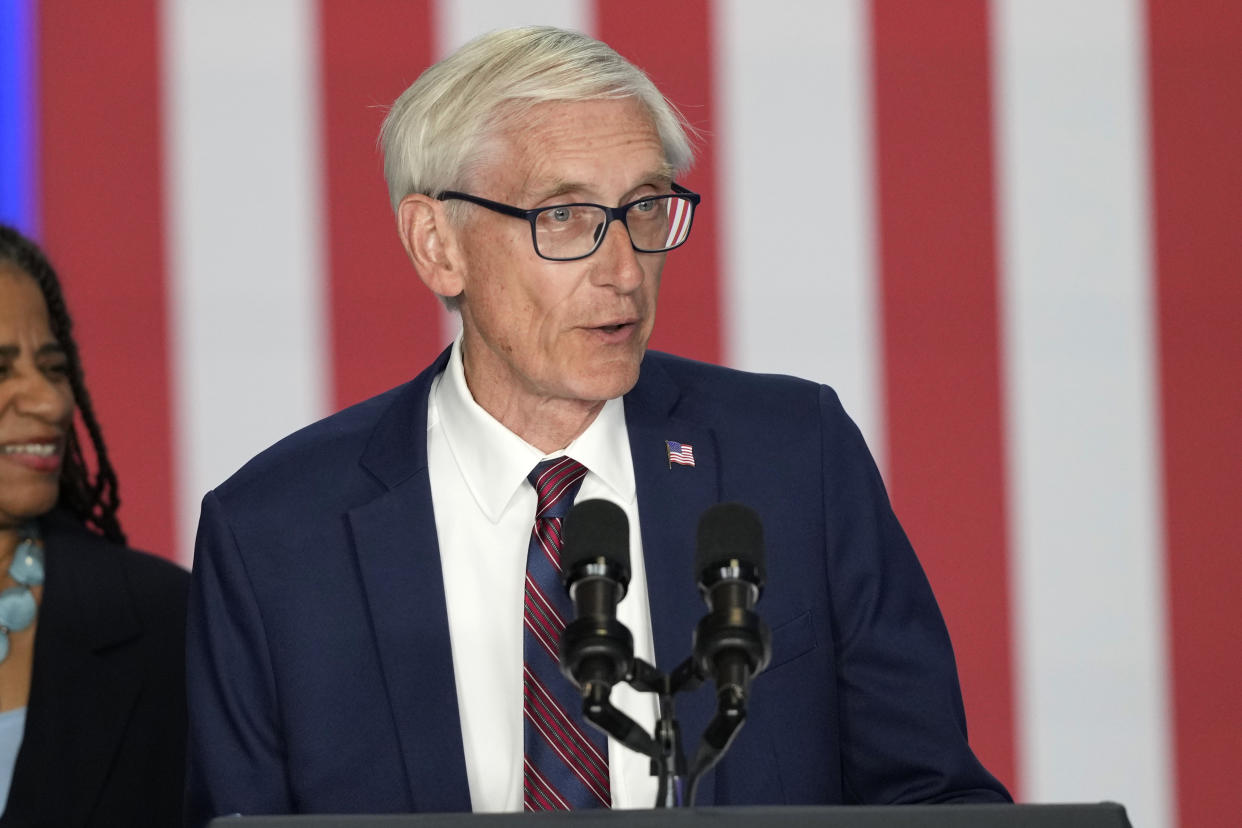
Wisconsin Gov. Tony Evers speaks before President Joe Biden at a campaign rally at Sherman Middle School in Madison, Wis., Friday, July 5, 2024. (AP Photo/Morry Gash)
Wisconsin Republicans are asking voters to take away the governor’s power to unilaterally spend federal money, a reaction to the billions of dollars that flowed into the state during the COVID-19 pandemic.
Democratic Gov. Tony Evers was free to spend most of that money as he pleased, directing most of it toward small businesses and economic development, angering Republicans who argued the Legislature should have oversight.
That’s what would happen under a pair of related constitutional amendments up for voter approval in the Aug. 13 primary election. The changes would apply to Evers and all future governors and cover any federal money to the state that comes without specific spending requirements, often in response to disasters or other emergencies.
Democrats and other opponents are mobilizing against the amendments, calling them a legislative power grab that would hamstring governors’ ability to quickly respond to a future natural disaster, economic crisis or health emergency.
If the amendments pass, Wisconsin’s government “will become even more dysfunctional,” said Julie Keown-Bomar, executive director of Wisconsin Farmers Union.
“Wisconsinites are so weary of riding the partisan crazy train, but it is crucial that we show up at the polls and vote ‘no’ on these changes as they will only make us go further off the rails,” she said in a statement.
But Republicans and other backers say it’s a necessary check on the governor’s current power, which they say is too broad.
The changes increase “accountability, efficiency, and transparency,” Republican state Sen. Howard Marklein, a co-sponsor of the initiative, said at a legislative hearing.
The two questions, which were proposed as a single amendment and then separated on the ballot, passed the GOP-controlled Legislature twice as required by law. Voter approval is needed before they would be added to the state constitution. The governor has no veto power over constitutional amendments.
Early, in-person absentee voting for the Aug. 13 election begins Tuesday across the state and goes through Aug. 11. Locations and times for early voting vary.
Wisconsin Republicans have increasingly turned to voters to approve constitutional amendments as a way to get around Evers’ vetoes. Midway through his second term, Evers has vetoed more bills than any governor in Wisconsin history.
In April, voters approved amendments to bar the use of private money to run elections and reaffirm that only election officials can work the polls. In November, an amendment on the ballot seeks to clarify that only U.S. citizens can vote in local elections.
Republicans put this question on the August primary ballot, the first time a constitutional amendment has been placed in that election where turnout is much lower than in November.
The effort to curb the governor’s spending power also comes amid ongoing fights between Republicans and Evers over the extent of legislative authority. Evers in July won a case in the Wisconsin Supreme Court that challenged the power the GOP-controlled Legislature’s budget committee had over conservation program spending.
Wisconsin governors were given the power to decide how to spend federal money by the Legislature in 1931, during the Great Depression, according to a report from the Legislative Reference Bureau.
“Times have changed and the influx of federal dollars calls for a different approach,” Republican Rep. Robert Wittke, who sponsored the amendment, said at a public hearing.
It was a power that was questioned during the Great Recession in 2008, another time when the state received a large influx of federal aid.
But calls for change intensified during the COVID-19 pandemic when the federal government handed Wisconsin $5.7 billion in aid between March 2020 and June 2022 in federal coronavirus relief. Only $1.1 billion came with restrictions on how it could be spent.
Most of the money was used for small business and local government recovery grants, buying emergency health supplies and paying health care providers to offset the costs of the pandemic.
Republicans pushed for more oversight, but Evers vetoed a GOP bill in 2021 that would have required the governor to submit a plan to the Legislature’s budget committee for approval.
Republican increased the pressure for change following the release of a nonpartisan audit in 2022 that found Evers wasn’t transparent about how he decided where to direct the money.
One amendment specifies the Legislature can’t delegate its power to decide how money is spent. The second prohibits the governor from spending federal money without legislative approval.
If approved, the Legislature could pass rules governing how federal money would be handled. That would give them the ability to change the rules based on who is serving as governor or the purpose of the federal money.
For example, the Legislature could allow governors to spend disaster relief money with no approval, but require that other money go before lawmakers first.
Opposing the measures are voting rights groups, the Wisconsin Democratic Party and a host of other liberal organizations, including those who fought to overturn Republican-drawn legislative maps, the League of Women Voters of Wisconsin and Wisconsin Faith Voices for Justice.
Wisconsin Manufacturers and Commerce, the state’s largest business lobbying group, and the Badger Institute, a conservative think tank, were the only groups that registered in support in the Legislature.
Trump Tries to Flip the Script on Democracy After Biden’s Withdrawal
Nick Corasaniti and Jim Rutenberg – July 23, 2024
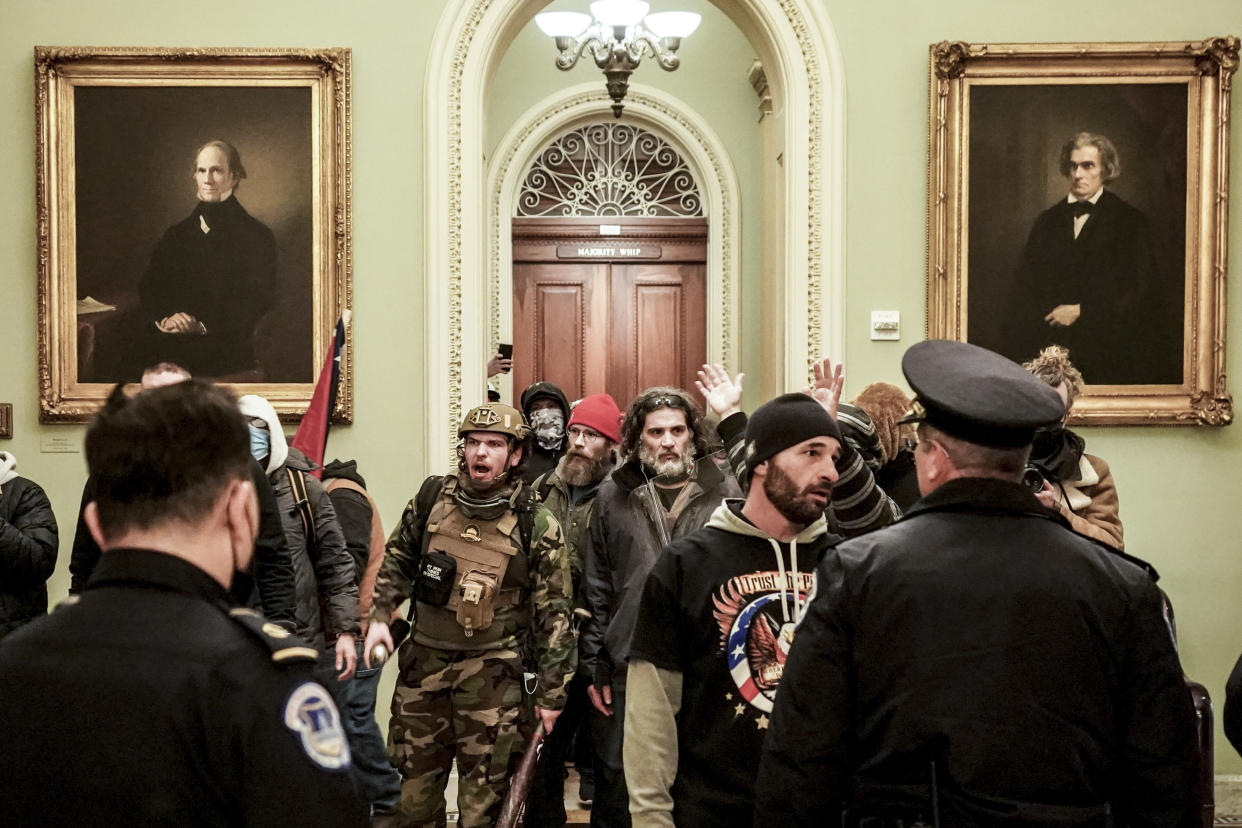
Supporters of former President Donald Trump outside the Senate chamber during the Jan. 6 riot at the Capitol in Washington, Jan. 6, 2021. (Erin Schaff/The New York Times)
Ever since rioters stormed the Capitol on Jan. 6, 2021, the Democratic Party has sought to claim the mantle of democracy, painting Donald Trump and his allies as extremists willing to deny the will of voters to cling to power.
Now, after President Joe Biden dropped his reelection bid and Democrats swiftly aligned behind Vice President Kamala Harris as a replacement, Republicans are trying to flip the argument.
In a series of statements and social media posts, Republicans have argued that Democrats, by pressuring Biden to quit, have “disenfranchised” the 14 million people who voted for him in the party primaries.
The accusation isn’t based on any party rule or supposed legal violation. Instead, it is the Republicans’ latest attempt to muddy the waters on an issue that helped Democrats win key races two years ago. Since Trump’s attempt to overturn his defeat in 2020, which led to the Jan. 6 riot and criminal charges against the former president, Democrats have cast Republicans as a threat to democratic norms.
They have used images from the Jan. 6 riot in attack ads and mobilized Democratic voters against Republican-backed legislation restricting voting. The issue was especially potent for Democratic governors and secretaries of state in critical swing states, who won every election for statewide office except for governor in Nevada and Georgia in 2022.
On Monday, Trump tried a new tactic to neutralize that threat, zeroing in on the “stolen” nomination claim. “They stole the race from Biden after he won it in the primaries — A First!” Trump posted on his social media site. “These people are the real THREAT TO DEMOCRACY!”
The two most senior Republican congressional leaders — House Speaker Mike Johnson of Louisiana and Sen. Mitch McConnell of Kentucky — echoed the claim.
“Having invalidated the votes of more than 14 million Americans who selected Joe Biden to be the Democrat nominee for president, the self-proclaimed ‘party of democracy,’ has proven exactly the opposite,” Johnson said. McConnell, the Republican minority leader in the Senate, said Democrats were “trying to upend the expressed will” of primary voters.
There is nothing in Biden’s withdrawal or his endorsement of Harris that appears to violate any party or election rules. Under party rules, when a candidate withdraws after the primary elections but before officially securing the nomination, delegates are free to vote for another candidate of their choosing. Republican Party rules outline a similar process.
Democrats and voting rights experts dismissed the criticism as a specious, and argued that Republicans lacked credibility on the subject.
On Monday, Alex Floyd, a spokesperson for the Democratic National Committee, said it was Trump who was trafficking in “anti-democratic rhetoric as part of his campaign,” adding that the former president “himself inspired a violent insurrection on Jan. 6, 2021.”
He said that Democrats were “committed to an open process” to select Biden’s successor on the ticket. That process includes a vote by the party’s nearly 4,000 delegates. Other Democrats noted that the 14 million people who voted for Biden certainly did so knowing he was on a ticket with Harris, the current front-runner.
Civil rights groups and democracy activists did not appear to share the Trump campaign’s concerns about Democratic disenfranchisement. Polling from this summer showed a majority of Democrats wanted Biden to step aside.
“I don’t think this is anti-democratic in the slightest,” said David Becker, director for the Center for Election Innovation and Research, a nonpartisan nonprofit organization. Becker noted that Trump sought to throw out millions of votes in the states where he contested his defeat, as part of his attempt to hold on to power after losing the 2020 election.
It’s unclear whether Republicans’ attacks about the “stolen” Democratic primary will land with swing voters. But Trump has been trying to reframe the political debate over democracy for years, with some signs of success. He has cast the Jan. 6 rioters as patriots and accused Democratic prosecutors of using indictments to interfere with the election.
A recent Washington Post poll found that voters in six battleground states were more likely to trust Trump than Biden to handle threats to democracy. The survey found 61% of voters in those states listed “threats to democracy” as extremely important to their vote. The only issue rating higher was the economy.
“I am the only one saving democracy for the people in our country,” Trump said as he accepted his party’s nomination last week.
Trump and his allies also sought to use the attempt on Trump’s life at his July 13 rally in Pennsylvania to portray him as a “defender” of democracy.
They have painted the shooting as an anti-democratic attempt to remove Trump from the race. (Virtually nothing is known about the motives of his shooter, Thomas Matthew Crooks.)
In making the argument that Biden’s exit from the race disenfranchised millions of primary voters, Trump and his party picked up a theme the president’s campaign had also emphasized. When Biden was resisting calls to drop out, he and his surrogates often pointed to those votes to defend his decision to stay in the race.
“We had a Democratic nominating process where the voters spoke clearly,” Biden had told MSNBC hosts Joe Scarborough and Mika Brzezinski. “I won 14 million of those votes.”
The Republican attempts to seize on that argument as their own, democracy activists say, is part of a broader, yearslong effort to erode trust in the electoral process.
“I see this all as just a continued effort to try to cast doubt on our elections, to try to undermine pro-democracy candidates,” said Joanna Lydgate, CEO of the States United Democracy Center.