California storms erase extreme drought from nearly all of state
In a single week, the portions of the state classified as experiencing extreme drought in California fell from 27.1% to 0.32%.
David Knowles, Senior Editor – January 12, 2023
Flooding from the Sacramento and American rivers, near downtown Sacramento, Calif., Jan. 11. (Fred Greaves/Reuters)
BERKELEY, Calif. — There is a silver lining to the relentless California storms that have so far killed at least 18 people and racked up an estimated $1 billion in damages: In a single week, extreme drought conditions that had gripped almost one-third of the state have been downgraded nearly everywhere.
The U.S. Drought Monitor released an updated map Thursday that accounts for the series of atmospheric river storms that have doused the state in recent weeks with more than 24 trillion gallons of water. It shows that “extreme drought,” the second-highest classification used by the agency has been all but erased from the interior sections of the state.
A U.S. Drought Monitor map of conditions in California. (U.S. Drought Monitor)
In a single week, the portions of the state classified as experiencing extreme drought in California fell from 27.1% to 0.32%, according to the U.S. Drought Monitor. Still, 46% of the state remains classified in “severe drought,” though that figure fell from 71% a week ago.
Drought conditions in California from the week of Jan. 3. (U.S. Drought Monitor)
Extreme drought conditions are still widespread in Nevada and Utah, and the California storms have not affected the Colorado River Basin, including the badly depleted reservoirs Lake Mead and Lake Powell, where the federal government has been forced to implement water restrictions.
In order to completely eliminate drought conditions across the American West several consecutive seasons of precipitation at 120% to 200% of normal would need to occur, ABC News reported. A 2022 study published in the journal Nature found that the past 22 years have been the driest period in the Southwest in the last 1,200 years.
As temperatures continue to rise thanks to humankind’s burning of fossil fuels, one effect, called the Clausius-Clapeyron relationship, is that there is 7% more moisture in the atmosphere per every degree Celsius of warming. That means extreme downpours like those in California in recent days can become more likely when conditions are right. By the same token, however, that relationship can also spur what UCLA climate scientist Daniel Swain has called “flash droughts,” in which extremely dry conditions can arise quickly, even in a year of above-average precipitation.
“The Clausius-Clapeyron relationship also increases what is known as the vapor pressure deficit,” Swain told Yahoo News in November, which means that “the atmosphere’s potential to act as a giant sponge and extract more water out of the landscape has increased, even if the relative humidity has stayed the same. This Clausius-Clapeyron relationship is actually what drives the atmosphere’s capacity to dry out the landscape faster.”
For now, however, the precipitation picture is much brighter than it was even a week ago. Water levels in depleted state reservoirs have been rising, and California’s snow pack as of Wednesday measured 226% of normal. While the risks of flash flooding remain high, more rain and snow is in the forecast for the coming week.
Developers are trying to build hundreds of thousands of homes in Arizona. New report warns there isn’t enough water.
Brandon Loomis, USA TODAY NETWORK – January 12, 2023
PHOENIX — Amid a megadrought depleting groundwater across the West, a newly released report from Arizona signals difficulty ahead for developers wishing to build hundreds of thousands of homes in the desert west of Phoenix.
Arizona Gov. Katie Hobbs released the modeling report Monday, and it shows that plans to add homes for more than 800,000 people west of the White Tank Mountains will require other water sources if they are to go forward. The report also signals the start of Hobbs’ effort to shore up groundwater management statewide.
“We must talk about the challenge of our time: Arizona’s decades-long drought, over-usage of the Colorado River, and the combined ramifications on our water supply, our forests, and our communities,” Hobbs said.
The West’s megadrought which worsened in 2021 made it the driest in at least 1,200 years, according to a study from the journal Nature Climate Change.
As a result of the expanding drought, western states are struggling with a water shortage due to lakes and rivers drying up in addition to communities pumping more groundwater and depleting aquifers at an alarming rate.
The groundwater crisis has impacted agriculture and rural communities as many are losing access to groundwater. Now, new homes will need new water sources, according to Arizona’s modeling report.
The Arizona Department of Water Resources had developed the model showing inadequate water for much of the development envisioned as far-west suburbs, but had not released it during then-Gov. Doug Ducey’s term.
In the case of development on the western edges of the urban area, the information Hobbs’ team released makes clear that developers who own desert expanses largely in Buckeye’s, the westernmost suburb in Phoenix, planning area will need more water to make their visions come true.
The report, called the Lower Hassayampa Sub-basin Groundwater Model, finds that projected growth would more than double groundwater use and put it out of balance by 15%. The state’s groundwater law requires developers in the Phoenix area to get state certificates of assured water supplies extending out 100 years before they can build.
Arizona Water Resources Director Tom Buschatzke on Monday said he would not issue new certificates for the area unless developers find secure water sources in addition to the local groundwater.
Some of the Buckeye subdivisions in the area already have certifications for homes that Buschatzke estimated to number in the thousands, and that will combine to add 50,000 acre-feet of demand in a basin that already uses 123,000 acre-feet. The aquifer apparently can bear that amount, but not the 100,000 acre-foot demand that department analysts have attributed to hundreds of thousands more homes envisioned for the zone.
The Howard Hughes Corp. is a major player in the area, with 100,000 homes planned on 37,000 acres.
The question of where developers might get the water to support such vast housing tracts has previously presented a mystery, with some developers merely saying they were confident in their prospects. The report the state released this week provides an initial answer: They won’t be finding that water solely in the aquifer below the land. Instead, they will have to find new ways of importing and possibly recycling water if they want to build out the property.
“Some of the big plans that are out there for master-planned communities will need to find other water supplies or other solutions,” Buschatzke said.
For now, the groundwater deficiency could stall much building on the Valley’s far west side. But it also could foreshadow a push for big new infrastructure projects, such as an ocean desalination plant and pipeline proposal that a state water finance board has agreed to evaluate. That proposal, led by an Israeli company that has built or operated desalination plants around the world, would pipe water north from Mexico and through Buckeye on its way to the Central Arizona Project canal.
Other options include moving water from other areas, such as the Harquahala Valley to the west, or recycling wastewater, Buschatzke said. Those options could take years, though.
Buckeye officials sent a statement to The Arizona Republic, part of the USA TODAY Network, saying they need time to study the report but will work to ensure sustainable growth: “Buckeye is committed to responsible and sustainable growth and working to ensure we have adequate water for new businesses and residents, while protecting our existing customers.”
Researcher says finding water won’t be cheap or easy
Arizona State University water researcher Kathleen Ferris had called for the groundwater report’s release, and on Tuesday said she was delighted that Hobbs made it public.
Ferris, with the school’s Kyl Center for Water Policy, is a past director of the Department of Water Resources and helped craft the 1980 groundwater law that requires a 100-year supply for new development.
“It’s a hugely important step,” Ferris said. “As the governor said, It’s about transparency and knowledge. We should not be allowing this growth to occur when the water isn’t there.”
Ferris said she counts herself among skeptics who don’t believe a desalination plant will come online quickly. The Colorado River’s drought-reduced storage means it can’t provide excess water to soon fill the gap in groundwater supplies, either. It doesn’t mean Buckeye can’t grow, she said, but finding the water to do so won’t be cheap or easy.
She cautioned that other cities with stronger water portfolios are also on the lookout to snap up new water to secure their own futures.
Beyond Buckeye, Ferris said, Hobbs is right to push for better groundwater management statewide. The 1980 law applied mostly to urban areas, leaving vast areas of rural Arizona unregulated.
The whole state doesn’t necessarily need the same 100-year-supply rule, Ferris said, but groundwater users everywhere should be responsible for tracking and reporting what they use.
Any effort to address rural groundwater with statewide regulations is bound to face resistance in the Arizona Legislature, where lawmakers for several years have declined to extend state regulations.
Whatever happens, Ferris said, the state is due for an honest conversation about where and by how much it can grow. She hopes the governor’s announcement is the start of such a reckoning. “We just can’t have subdivisions approved (solely) on groundwater,” she said.
Gov. Katie Hobbs issued a ‘wake-up call’ on groundwater. Is anyone listening?
Joanna Allhands, Arizona Republic – January 11, 2023
Gov. Katie Hobbs give her State of the State address to the Arizona House of Representatives during the opening session of the 56th Legislature on Jan. 9, 2023, in Phoenix.
Gov. Katie Hobbs called it a “wake-up call” on water.
Whether it is remains to be seen.
The newly elected governor spent a good chunk of her first State of the State address talking about the “challenge of our time: Arizona’s decades-long drought, over usage of the Colorado River, and the combined ramifications on our water supply, our forests and our communities.”
She released a long-awaited model that shows parts of the far West Valley don’t have enough groundwater to sustain all users for the long term (more on that in a second).
And she called for swift action – particularly to address rural groundwater problems that have been festering for decades.
It’s the right tone, but will lawmakers agree?
Hobbs struck the tone that many in the water community have long sought from elected leaders – one that noted we’re not playing around, that there are consequential decisions we must make (and soon) to protect our dwindling water supplies.
There have been rumors aplenty about what may or may not be addressed this session, and right now, there are few answers, particularly on how far lawmakers might be willing to go on water regulation, something they have resisted for years.
Former Rep. Regina Cobb got nowhere on an effort to give rural communities more tools to manage groundwater use and more flexibility to choose which measures best fit their circumstances.
Retooled legislation is expected again this session, with more detail on how these new authorities would work with existing regulations.
And Hobbs is clearly pressing to have this discussion.
Hobbs’ council must have clear goals, deadlines
She told lawmakers she would convene a council to study ways to modernize and expand the Groundwater Management Act of 1980, which created Irrigation Non-expansion Areas and Active Management Areas, as well as an Assured Water Supply program that requires new subdivisions to prove they have a 100-year water supply before lots can be platted.
Hobbs also promised to include money in her proposed budget, due to be released later this week, to support rural communities that want to form Active Management Areas, the state’s most stringent form of groundwater regulation.
Granted, her predecessor created a council to study urban and rural groundwater management, but without strong direction and deadlines, it was generally where ideas went to die.
Hobbs cannot make the same mistake.
What if fast-growing areas can’t grow?
Because, as she correctly noted, real issues are beginning to manifest – even in metro Phoenix, where groundwater management is most robust.
Don’t overlook the significance of the report Hobbs released, one that she and others have claimed was withheld by former Gov. Doug Ducey.
The report found that the Lower Hassayampa groundwater subbasin – which contains Buckeye, one of the fastest-growing cities in the nation – is 4.4 million acre-feet shy of the groundwater it needs to service users for the long haul.
That’s roughly half of what a similar model found in the Pinal Active Management Area south of metro Phoenix. But presuming the state Department of Water Resources treats the Hassayampa subbasin’s imbalance the same way – meaning, it no longer allows developers to grow solely on groundwater – that could have major implications for Buckeye and the massive housing projects that have been proposed nearby.
New subdivisions would all but be shut down in that subbasin, under the state’s Assured Water Supply program, unless developers can secure and count renewable supplies toward their certificates, which are required to plat lots.
Arizona needed a call to arms. Now what?
Whether it’s real or not, there is a lot of fear that lawmakers will try to loosen the rules this session to maintain the status quo on growth in the outskirts, which has heavily relied on groundwater. Hobbs could certainly veto any such effort.
But if we agree to abide by the rules – and we should, because loosening them now would be disastrous for our negotiating position on even more painful Colorado River cuts – we’re going to have to rethink a lot of assumptions about how we continue to grow.
This is not going to be easy work.
Especially if Hobbs’ speech was not the wake-up call she hoped it would be. Or if Rep. Gail Griffin, the chair of the House natural resources committee, continues to be the brick wall upon which all new water regulation explodes.
The governor will need allies willing to go around that wall, if it remains.
But give Hobbs credit for issuing a call to arms. The days of allowing 80% of the state to pump indiscriminately, without ground rules to protect everyone, are over.
And even in areas with regulation, we need to up our game.
Arizona says developers lack groundwater for big growth dreams in the desert west of Phoenix
Brandon Loomis, Arizona Republic – January 11, 2023
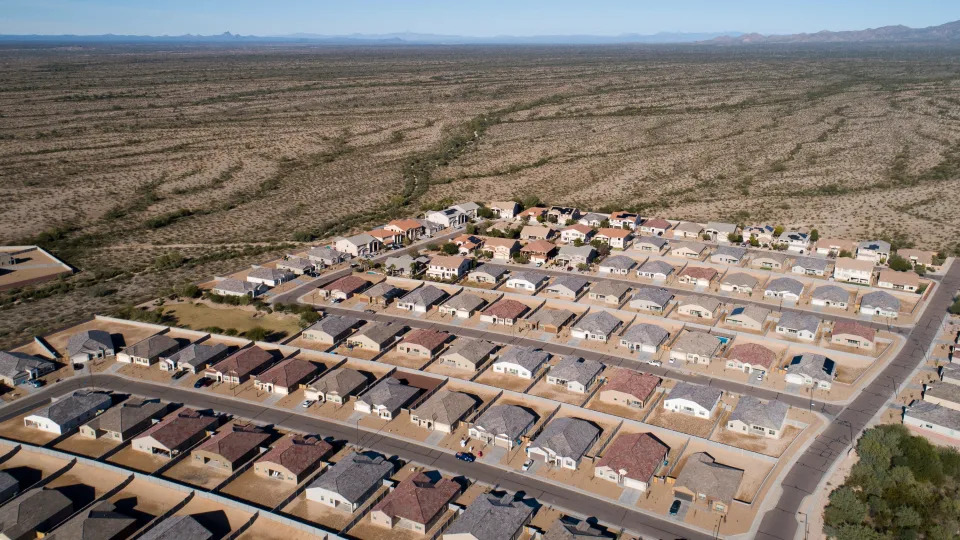
The Tartesso community development borders the desert in Buckeye. It’s one of the last noticeable developments on the way out of the Phoenix area.
A newly released state report on groundwater supplies under the desert west of Phoenix signals difficulty ahead for developers wishing to build hundreds of thousands of homes there.
It also signals the start of an effort by Arizona’s new governor to shore up groundwater management statewide.
Gov. Katie Hobbs released the modeling report Monday afternoon, and it shows that plans to add homes for more than 800,000 people west of the White Tank Mountains will require other water sources if they are to go forward.
The Arizona Department of Water Resources had developed the model showing inadequate water for much of the development envisioned as far-west suburbs, but had not released it during then-Gov. Doug Ducey’s term. Hobbs mentioned it during her State of the State address, along with other initiatives, including a new council dedicated to updating the state’s 1980 groundwater protection act for a new era of scarcity.
Hobbs also announced a new Governor’s Office of Resiliency, coordinating agencies, tribal governments and experts in finding land, water and energy solutions for the state.
“We must talk about the challenge of our time: Arizona’s decades-long drought, over-usage of the Colorado River, and the combined ramifications on our water supply, our forests, and our communities,” the governor said.
In the case of development on the western edges of the urban area, the information her team released makes clear that developers who own desert expanses largely in Buckeye’s planning area north of Interstate 10 and west and north of the White Tank Mountains will need more water to make their visions come true.
The report, called the Lower Hassayampa Sub-basin Groundwater Model, finds that projected growth would more than double groundwater use and put it out of balance by 15%. The state’s groundwater law requires developers in the Phoenix area to get state certificates of assured water supplies extending out 100 years before they can build.
Arizona Water Resources Director Tom Buschatzke on Monday said he would not issue new certificates for the area unless developers find secure water sources in addition to the local groundwater.
Some of the Buckeye subdivisions in the area already have certifications for homes that Buschatzke estimated number in the thousands, and that will combine to add 50,000 acre-feet of demand in a basin that already uses 123,000 acre-feet. The aquifer apparently can bear that amount, but not the 100,000 acre-foot demand that department analysts have attributed to hundreds of thousands more homes envisioned for the zone.
The Howard Hughes Corp. is a major player in the area, with 100,000 homes planned on 37,000 acres in the Teravalis development, formerly called Douglas Ranch.
The question of where developers might get the water to support such vast housing tracts has previously presented a mystery, with some developers merely saying they were confident in their prospects. The report the state released this week provides an initial answer: They won’t be finding that water solely in the aquifer below the land. Instead, they will have to find new ways of importing and possibly recycling water if they want to build out the property.
“Some of the big plans that are out there for master-planned communities will need to find other water supplies or other solutions,” Buschatzke said.
Contacted on Tuesday, Howard Hughes Corp. did not respond to an interview request, but did provide a statement from Phoenix Region President Heath Melton: “We support the Governor’s initiative to proactively manage Arizona’s future water supply and will continue to be a collaborative partner with our elected officials, civic agencies, and community stakeholders to drive forward the most modern water management and conservation techniques and help ensure a prosperous and sustainable future for the West Valley, Arizona, and the greater Southwest.”
For now, the groundwater deficiency could stall much building on the Valley’s far west side. But it also could foreshadow a push for big new infrastructure projects, such as an ocean desalination plant and pipeline proposal that a state water finance board has agreed to evaluate. That proposal, led by an Israeli company that has built or operated desalination plants around the world, would pipe water north from Mexico and through Buckeye on its way to the Central Arizona Project canal.
Other options include moving water from other areas, such as the Harquahala Valley to the west, or recycling wastewater, Buschatzke said. Those options could take years, though.
Buckeye officials sent a statement to The Arizona Republic saying they need time to study the report but will work to ensure sustainable growth: “Buckeye is committed to responsible and sustainable growth and working to ensure we have adequate water for new businesses and residents, while protecting our existing customers.”
Arizona State University water researcher Kathleen Ferris had called for the groundwater report’s release, and on Tuesday said she was delighted that Hobbs made it public. Ferris, with the school’s Kyl Center for Water Policy, is a past director of the Department of Water Resources and helped craft the 1980 groundwater law that requires a 100-year supply for new development.
“It’s a hugely important step,” Ferris said. “As the governor said, It’s about transparency and knowledge. We should not be allowing this growth to occur when the water isn’t there.”
Ferris said she counts herself among skeptics who don’t believe a desalination plant will come online quickly. The Colorado River’s drought-reduced storage means it can’t provide excess water to soon fill the gap in groundwater supplies, either. It doesn’t mean Buckeye can’t grow, she said, but finding the water to do so won’t be cheap or easy.
She cautioned, too, that other cities with stronger water portfolios are also on the lookout to snap up new water to secure their own futures.
Beyond Buckeye, Ferris said, Hobbs is right to push for better groundwater management statewide. The 1980 law applied mostly to urban areas, leaving vast areas of rural Arizona unregulated. The whole state doesn’t necessarily need the same 100-year-supply rule, Ferris said, but groundwater users everywhere should be responsible for tracking and reporting what they use. That would help the state know when it must act to conserve stressed aquifers, as it did this winter by halting expansion of irrigated farming around Kingman.
Any effort to address rural groundwater with statewide regulations is bound to face resistance in the Arizona Legislature, where lawmakers for several years have declined to extend state regulations to areas including Kingman. Voters in Cochise County approved a limited management area in November for one groundwater basin.
Whatever happens, Ferris said, the state is due for an honest conversation about where and by how much it can grow. She hopes the governor’s announcement is the start of such a reckoning. “We just can’t have subdivisions approved (solely) on groundwater,” she said.
One advocate for updating and strengthening groundwater protections around the state says she is encouraged that Hobbs has started her administration with moves to do just that.
“We are really encouraged and grateful that water is a top priority,” said Haley Paul, an Audubon Society regional policy director who co-chairs the Water for Arizona coalition.
The Hassayampa groundwater report demonstrates that Arizona needs to do something different now that it can’t rely on excess Colorado River water to backfill pumped groundwater, Paul said. Following a similar finding that has led groundwater depletion to limit Pinal County growth, she said, the report is “a reality check” on unlimited growth in the desert.
Brandon Loomis covers environmental and climate issues for The Arizona Republic and azcentral.com.
Environmental coverage on azcentral.com and in The Arizona Republic is supported by a grant from the Nina Mason Pulliam Charitable Trust.
I’m homeless in California. And I have an easy, cost-free solution to homelessness | Opinion
Lydia Blumberg – January 8, 2023
Renée C. Byer/rbyer@sacbee.com
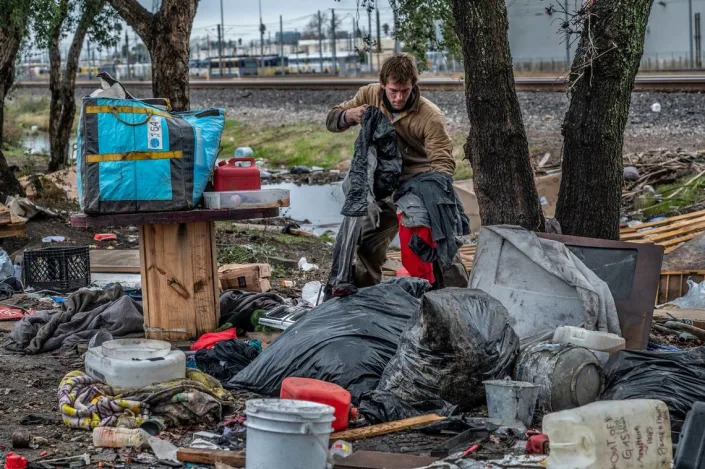
I and my fellow residents of Wood Street Commons, an unhoused community in Oakland, believe politicians pushing sweeps of homeless encampments are only making things worse.
One thing that would dramatically improve the lives of unhoused people in California could be done today, wouldn’t cost taxpayers any money and would require no effort by politicians or city workers. It’s as simple as a governor or mayor uttering three words: Stop sweeps now.
Each time a homeless camp is dismantled, people’s lives are destroyed. All the effort we put into creating a home — we do not actually consider ourselves homeless because our camp is our home — is wiped away. Our worldly possessions, including identification, medical records, family heirlooms, clothing, electronics, furniture, instruments, bedding, tents, tools and other items that we use to earn income, are literally thrown into garbage trucks. Our handmade shelters are smashed by giant machines as we watch.
Opinion
How is this acceptable? How can the people who order and carry out sweeps live with themselves?
Each time a homeless camp is dismantled, its residents face more obstacles to overcoming what put them on the street in the first place. We create camps as a way to create stability, cultivate community, and accrue needed resources to pull ourselves up by our own bootstraps. Destroying camps pushes us down and forces us to start over, with nowhere to go and often with nothing but the clothes on our backs.
Any politician who pledges to end homelessness in one breath and then pledges to rid the streets of encampments in the next — looking at you, Gov. Gavin Newsom — is completely out of his mind.
The billions spent “helping” the homeless are profoundly undermined by the daily aggression of sweeps, which many unhoused people experience several times a year. Take it from us, the real experts on this issue: Sweeps make homelessness more entrenched.
Sweeps are also an enormous waste of taxpayer money. A 2021 sweep in Los Angeles’ Echo Park, where which roughly 200 people were removed in a violent show of police force, cost an estimated $2 million. That’s nearly $10,000 per person! These are people whose lives were destroyed at an expense that could have housed them for months.
Yet city leaders declared the Echo Park sweep a rousing success, claiming nearly everyone from the camp was placed in temporary housing. But UCLA studies conducted a year later found that only a dozen or so of them remained in temporary housing. Of the rest, four were placed in permanent housing; seven died; and most returned to the streets.
Large cities routinely sweep one or more camps per day, meaning this cruelty is repeated thousands of times each year across the state and country. Sweeps don’t get rid of camps; they just move them around, causing chaos and wasting millions in the process.
A growing body of research illustrates why we should not only keep camps intact; we should actually encourage and celebrate them. That may sound crazy to many readers, but it couldn’t be more logical.
In a review of research on the topic, the U.S. Department of Housing and Urban Development noted that emergency shelters are unavailable, inaccessible or inhospitable to many unhoused people.
“Encampments may be the best alternative among a limited set of options,” the HUD report said.
It’s important to consider why people choose camps over other alternatives. Most temporary shelter facilities, and many of the permanent housing options designed to house the unhoused, come with a long list of rules that make them a little too much like prison. Among the most common rules are those limiting guests, spouses, pets, cooking, decorations and more possessions than can fit in a suitcase.
Tiny homes and sheds — the latest trends — are often placed like barracks on asphalt lots, surrounded by barbed wire and staffed by rude security guards. Would you give up your freedom to move to one of these places?
Humans need more than food, water and shelter. Autonomy and a sense of belonging are equally important to survival — and are actually the keys to recovery for people who have had a hard time in life. The impersonal facilities that we’re asked to move into are not designed with this in mind.
But autonomy and belonging are the essence of what camps are about. We camp together because it is essential to our physical and mental survival.
Our community on Wood Street in Oakland has recently been subjected to devastating sweeps. Caltrans has cleared an enormous section of the camp.
But the part that remains is stronger than ever. We cook for each other, distribute clothing and bedding, build our own tiny homes, play music, help each other heal, and host cultural events that have been attended by hundreds of housed residents. We see ourselves as part of a movement redefining the identity of American cities for the better: an identity based on an ethos of interdependence rather than the cult of independence that defines the world of the housed.
The last bit of land that we occupy on Wood Street is slated for clearance on Monday. We’ve been trying to work with Oakland officials to find a place where we can set up a new community and begin to rebuild yet again, but they refuse to cooperate. The city loves to tell us where we can’t be but has yet to tell us where we can be.
We do not accept this, which is why we’re taking matters into our own hands. We recently rode our bikes to the Capitol in Sacramento to speak with lawmakers there, and we will continue to press the case at City Hall. We will not be denied the essential human right to exist and exert our free will.
This piece was authored by Lydia Blumberg and other residents of Wood Street Commons, a settlement of unconventionally housed residents in West Oakland founded on the idea of “homeless helping the homeless.”
Joe Biden Wants to Change Social Security: Will the New Congress Help With Reform Efforts?
By Sean Williams – January 7, 2023
KEY POINTS
Social Security is facing a $20.4 trillion funding shortfall through 2096 that, if left unattended, could lead to sweeping benefit cuts.
Prior to his election as president, Joe Biden unveiled a four-point plan to reform Social Security.
Despite a new Congress taking shape just days ago, altering Social Security is highly unlikely.
Social Security is in trouble, and President Biden believes he has the ideal plan to fix it.
In November, nearly 66 million Americans, many of whom are aged 62 and over, received a Social Security benefit. For the 48.5 million who are retired workers, these payouts are widely viewed as a necessity to cover their expenses.
But despite providing a financial foundation for our nation’s retirees, America’s top retirement program finds itself in deep trouble. President Joe Biden believes he has the solution that can resolve what ails Social Security, but he’s going to need the help of newly elected lawmakers to fix it.
PRESIDENT BIDEN DELIVERING REMARKS. IMAGE SOURCE: OFFICIAL WHITE HOUSE PHOTO BY ADAM SCHULTZ.
Retired workers could be less than 12 years away from having their benefits cut
For each of the past 83 years, the Social Security Board of Trustees has released a report that’s examined the financial status of the program over the short term (the next 10 years) and long term (75 years following the release of a report). The Trustees Report effectively acts as Social Security’s balance sheet and allows anyone to see how revenue is collected and where those dollars end up.
In addition to backward-looking financial data, the Trustees Report factors in changing macroeconomic and demographic factors to determine the financial health of Social Security.
The 2022 Trustees Report showed that Social Security had dug its largest hole yet: an estimated $20.4 trillion funding shortfall through 2096. For what it’s worth, every Trustees Report since 1985 has projected a long-term funding shortfall.
Social Security’s increasingly dire financial footing is primarily a result of demographic shifts. Examples include historically low U.S. birth rates, a near-halving in net immigration into the country over two decades, and growing income inequality, among other factors. With these changes weighing on the worker-to-beneficiary ratio, it would appear the program’s financial foundation will only worsen.
Based on last year’s projections, the asset reserves for the Old-Age and Survivors Insurance Trust Fund (OASI) are expected to run out in 2034. The OASI is the Trust responsible for paying benefits to 48.5 million retired workers each month, as well as nearly 5.9 million survivors of deceased workers. If this excess cash were to be exhausted within the next 12 years, the Trustees believe an across-the-board benefit cut of 23% would be necessary to sustain payouts through 2096. For context, a 23% benefit cut would reduce the average Social Security check by roughly $420 per month (In January 2023 dollars), or $5,000 per year.
Joe Biden has proposed sweeping reforms for Social Security
In 2020, prior to his election as president, then-candidate Joe Biden released a plan he believed would strengthen Social Security for decades to come. Although there are four Social Security changes Biden is seeking, two stand out as key to shoring up the program.
This biggest Social Security change proposed by Biden would tackle income inequality head-on and generate a lot of extra revenue.
In 2023, Social Security’s 12.4% payroll tax is applicable to earned income between $0.01 and $160,200. “Earned income” means wages and salary but not any sort of investment income. Approximately 94% of all working Americans earns less than the maximum taxable earnings cap (the $160,200 figure). For the other 6% of workers, earned income above this $160,200 level is exempt from the payroll tax.
Joe Biden’s proposal would create a doughnut hole between the maximum taxable earnings cap and $400,000 where earned income would remain exempt, as well as reinstate the payroll tax on earned income above $400,000. Since the maximum taxable earnings cap tends to rise over time with inflation, this doughnut hole would eventually close decades down the line. This immediate increase in payroll tax revenue should push back the asset reserve depletion date of the OASI.
Since 1975, the Consumer Price Index for Urban Wage Earners and Clerical Workers (CPI-W) has been used to determine Social Security’s annual cost-of-living adjustment (COLA). Unfortunately, as its name implies, this is a price-measuring index focused on the spending habits of “urban wage earners and clerical workers.” In other words, people who generally aren’t receiving a Social Security benefit.
Biden would like to see the Consumer Price Index for the Elderly (CPI-E) used to calculate COLA instead of the CPI-W. The CPI-E specifically tracks the spending habits of older Americans, which would likely provide a larger annual cost-of-living adjustment.
Is a new Congress the recipe Biden needs to reform Social Security?
The challenge for Joe Biden — and frankly, every other president for more than three decades — is that he needs the support of lawmakers in Congress to amend the Social Security Act. Just a few days ago, the 118th Congress officially took shape.
The big question is: Will this new Congress work with the president to effect Social Security reform? If I were to give the Magic 8 Ball a shake, the “All signs point to no” answer would almost assuredly pop up.
Whereas the previous Congress featured a razor-thin majority in the U.S. Senate for Democrats, as well as a modest majority in the House of Representatives, the new Congress features a shift to a slight majority in the House for Republicans.
Democrats and Republicans both agree that Social Security needs attention. However, they’ve approached their respective fixes from completely different viewpoints. Whereas Biden’s proposal seeks to raise additional revenue from high-earners and boost benefits for low-earning workers, the Republican solution aims to increase the full retirement age and shift the inflationary measure to the Chained CPI. Without getting too far into the weeds, the GOP plan focuses on reducing long-term outlays to save Social Security money. In short, both parties have solutions that work, albeit on very different timelines and with ideologically opposite approaches.
The other challenge for Biden is getting the necessary votes in the Senate to amend Social Security. In the upper house of Congress, 60 votes are needed to amend America’s top retirement program. Since neither party has controlled at least 60 votes in the Senate since 1979, it means all legislation proposing to alter Social Security would require bipartisan support. Garnering that support has proved virtually impossible for every president since Ronald Reagan.
Though a new Congress has taken shape, Biden’s Social Security changes are extremely unlikely to find legislative support.
Germ Experts Share How Often You Should Really Be Washing Your Sheets
Emily Laurence – January 6, 2023
It’s probably more often than you think.
A recent survey conducted in the UK found that almost half of single men wash their sheets once every four months. How do your bed linen habits compare? Maybe you aren’t quite as neglectful as these bachelors and are in the habit of washing your sheets once a month. Or maybe you don’t have a set schedule; you can just tell when it’s time.
According to germ experts (yep, they exist), it’s important to wash your sheets regularly. Otherwise, you’ll be sleeping in a bed of bacteria—literally. But how often should you really change your sheets? Keep reading to find out.
While there aren’t any scientific studies on people’s bed linens at home, Dr. Charles Gerba, PhD., a professor of virology in the Department of Environmental Science at The University of Arizona, says that there have been studies of sheets in hospitals. Dr. Gerba says that these studies have found that bacteria from the human skin is transferred to bedding and about one-third of this bacteria is fecal bacteria (E.coli). “Fungi also appears to be common,” he adds.
“Sheets are a great place for bacteria to reside and grow. All they need are water and food, which our bodies provide,” says Jason Tetro, a scientist and author of The Germ Files. If you go too long without washing your sheets, Tetro says that the bacteria will continue to grow, which could then potentially lead to skin irritation and possibly infection.
Tetro says that in a laboratory, bacteria can multiply as quickly as every 20 minutes. In the real world, he says it takes several hours. With this in mind, Tetro recommends washing your sheets every two weeks. If you tend to sweat in bed or eat in bed, both experts recommend washing them even more often. “What matters more is the amount of bacteria transferred—the inoculum if you wish,” Tetro says. “If you are not sweating much, the inoculum won’t be too significant from night to night and two weeks should be sufficient. If you tend to sweat a significant amount, then the nightly inoculum goes up and you may want to clean them every week.”
Interestingly, Tetro says that polyester has been found to hold more bacteria than cotton. “It also took in more of the body’s natural secretions meaning the bacteria would be able to grow to higher numbers,” he adds. So if your sheets are made of polyester, you may want to wash your sheets more often.
You may want to wash your pillowcases even more often than you wash your sheets. Dr. Gerba says that’s where most bacteria and fungi are found.
As for comforters, duvets and throw blankets, Tetro says that anything that comes in direct contact with the skin regularly should be washed as frequently as your sheets. But if your throw blankets or comforter is coming into contact with the sheets instead of your skin, he says they can be washed less frequently, roughly once a month.
Even with all this in mind, if you’re still debating whether or not you should throw your bed linens in the wash, Tetro says to give them a sniff. “One can never discount the smell test,” he says. “Bacteria tend to stink once they get to high enough numbers. If your sheets—and clothes for that matter—tend to have an odor, then there’s a good likelihood that there’s a high bacterial count and a wash may be needed.”
Put this advice into practice and you’ll be able to sleep easy. (And maybe pass the info along to the single men in your life too.)
A young father died after toxic mold grew in the walls of his family home. Here’s how to spot signs of mold, and how to stay safe.
Andrea Michelson and Leah Rosenbaum – January 5, 2023
A young father died after toxic mold grew in the walls of his family home. Here’s how to spot signs of mold, and how to stay safe. Christian Childers, 26, is survived by his fiancee and young sons. He tried to clean up the mold before he fell ill.Courtesy of Lorie Peterson
26-year-old Christian Childers died Monday after long-term exposure to toxic mold.
Mold grew in his family’s home after flooding from Hurricane Ian last September.
Childers’ asthma made him particularly susceptible to health risks from mold.
Instead of spending time with his family at home, 26-year-old Christian Childers spent Christmas Eve in the hospital in a medically induced coma after a severe asthma attack led to cardiac arrest. The potential cause of this asthma attack: toxic mold that had been growing in his apartment for months.
Christian Childers and his fiancée Kendra Elliot first noticed the mold growing after Hurricane Ian flooded their home in September, Elliot told NBC affiliate WBBH-TV.
Despite attempts to get in contact with FEMA and the Red Cross, the family was forced to live with the mold for months, according to a GoFundMe set up by a family friend. The couple moved their family of five into the living room to avoid the toxic growth, but the mold continued to affect Childers, who had asthma and had to go to the hospital multiple times.
On December 24, Childers suffered an asthma flare-up and was struggling to breathe, Elliot told WBBH-TV. They went to his parents house, where he still wasn’t able to catch his breath, and then to the emergency room.
“They were on their way to the emergency room, and they didn’t make it,” Elliot told the local news station. “They had to pull into a fire station, and he went into cardiac arrest. He died, and they had to work on him for an hour to get his heartbeat back before they got him on the way to the hospital.”
Childers was initially put into a medically induced coma in the hospital to give his body a chance to recover from a hypoxic brain issue caused by a lack of oxygen, but on January 2 he died.
Additionally, during Childers’ hospital stay the family’s landlord sent them an eviction notice, which has been reviewed by Insider. Lorie Peterson, a friend of the family, said Elliot and her mother and two sons are still searching for a new place to live.
Mold is particularly dangerous for people with lung diseases like asthma
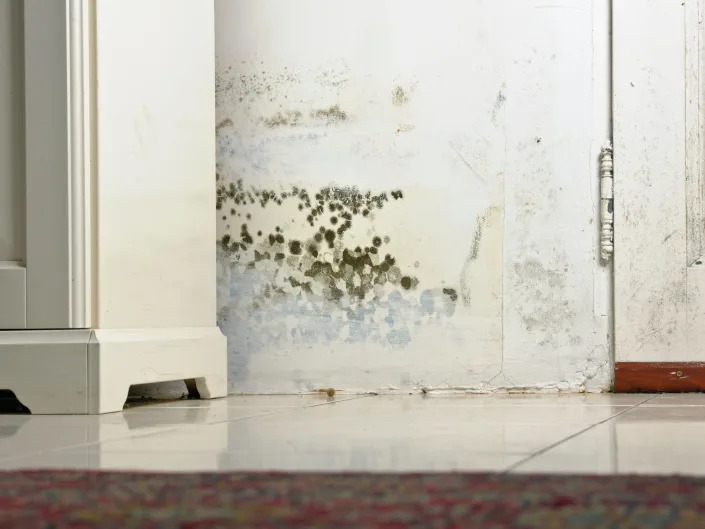
Mold stains on a damp wall.Ekspansio/Getty Images
Mold growth in the home is usually related to excess moisture in the environment — for instance, a Category 4 storm can cause plenty of water-related damage. Some molds can release toxins into the air, which can irritate the lungs, but not all molds found in the home are toxic.
While most people won’t suffer health effects from living in a home with small amounts of mold, it can be dangerous for people with lung diseases or people who are immunocompromised.
People with asthma, chronic obstructive pulmonary disease (COPD), or compromised immune systems should not stay in a moldy home, even while it is being cleaned, according to the Centers for Disease Control and Prevention (CDC). Severe reactions to mold can include fevers and shortness of breath.
The best way to stop mold exposure is prevent it from growing in the first place.
The CDC recommends that people control humidity levels in their homes through ventilating bathrooms, laundry and cooking areas; promptly fix leaks; and thoroughly clean and dry after flooding. Using an air conditioner or dehumidifier during humid and warm months can be helpful, as well as avoiding carpeting rooms that may gather moisture, like bathrooms.
If, however, you can already see or smell mold in your home, it’s best to get professional help. Mold growth can be removed with commercial cleaning products, soap and water, or a solution of water and bleach (no more than 1 cup of bleach per gallon of water). While it’s possible to clean up mold on your own, anyone with extensive mold growth or preexisting health conditions that would make them sensitive to mold should vacate the home and let a professional handle the cleanup.
“It is virtually certain that human activities have increased atmospheric levels of carbon dioxide and other greenhouse gases,” a national panel of experts concluded in a draft of the 5th National Climate Assessment released in November. They see high confidence in forecasts for longer droughts, higher temperatures and increased flooding.
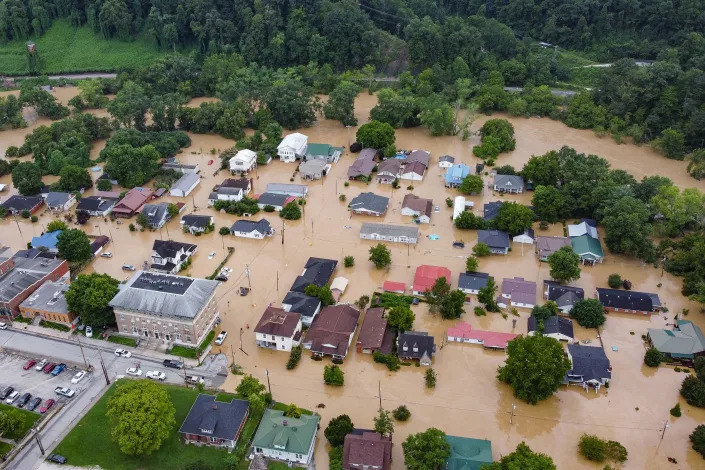
JULY 28, 2022: Aerial view of homes submerged under flood waters from the North Fork of the Kentucky River in Jackson, Kentucky. Flash flooding caused by torrential rains has killed at least eight people in eastern Kentucky and left some residents stranded on rooftops and in trees, the governor of the south-central US state said.
Warming sea surface temperatures around the globe provide more fuel for tropical storms and exacerbate the melting of glaciers and ice sheets.
Why is climate change important?
“Every part of the U.S. is feeling the effects of climate change in some way,” said Allison Crimmins, director of that 5th National Climate Assessment. Representing the latest in climate research by a broad array of scientists, the final version of the assessment is expected in late 2023.
Disaster costs are rising, and scientists warn the window to further curtail fossil fuel emissions and put a lid on rising temperatures is closing rapidly.
Many scientists and officials worldwide agree: Yes. By the end of this century, projections show global average surface temperatures compared to pre-industrial times could increase by as much as 5.4 degrees.
Merriam-Webster defines “crisis” as a time of intense difficulty, trouble, or danger. A mix of warmer temperatures, extreme rainfall and rising sea levels often make naturally occurring disasters worse, while droughts become more intense and heat waves occur more often.
“The climate crisis is not a future threat, but something we must address today,” Richard Spinrad, administrator of National Oceanic and Atmospheric Administration, said in August 2022.
The term “climate crisis” has been used to describe these worsening impacts since at least 1986. Since the United Nations’ Intergovernmental Panel on Climate Change was organized in 1988, its reports steadily have grown more dire.
The Fourth National Climate Assessment, released during the Trump administration, warned natural, built and social systems were “increasingly vulnerable to cascading impacts that are often difficult to predict, threatening essential services.”
“Every increased amount of warming will increase the risk of severe impacts, and so the more (rapidly) we can take strong action to reduce greenhouse gas emissions, the less severe the impacts will be,” Cornell University professor Rachel Bezner Kerr said after the release of one recent IPCC report.
Warmer climates put animals on the move and increases the risk they’ll spread pathogens to other animals and to humans. A group of University of Hawaii researchers looked at how 376 human diseases and allergens such as malaria and asthma are affected by climate-related weather hazards and found nearly 60% have been aggravated by hazards, such as heat and floods.
The Summer 2024 Olympics are scheduled to kick off in July in France, where the country’s meteorological officials expect 2022 to be its hottest year since records began in 1900. Meanwhile, the International Olympic Committee has delayed choosing the location for the 2030 winter games, in part over climate concerns.
Even fly fisherman see changes all around them. “Everyone knows if this keeps up, the places we can fish for trout are going to be limited,” said Tom Rosenbauer of Vermont, whose job title at sporting goods retailer Orvis is chief enthusiast.
How does climate change affect animals?
Warmer temperatures are forcing some animal species to move beyond their typical home ranges, increasing the risk that infectious viruses they carry could be transmitted to other species they haven’t encountered before. That poses a threat to human and animal health around the world.
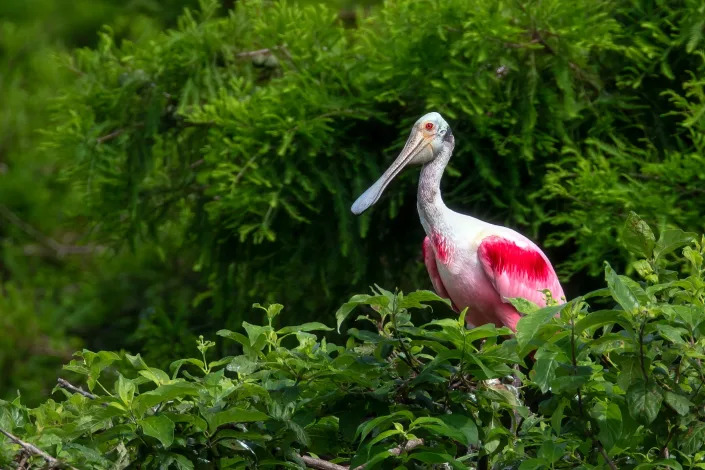
A roseate spoonbill stands bright against the green of a southeast Arkansas swamp. Jami Linder, an Arkansas photographer, documented the first spoonbill nest in the state in 2020.
In the U.S., roseate spoonbills, a brilliant pink wading bird, are moving north as temperatures warm and they’re pushed out of native coastal habitats by rising sea levels.
Thousands Will Live Here One Day (as Long as They Can Find Water)
Keith Schneider – December 27, 2022
A golf cart on a path at Verrado, an 8,800-acre planned community, in Buckeye, Ariz., Dec. 19, 2022. (Adriana Zehbrauskas/The New York Times)
BUCKEYE, Ariz. — Surrounded by miles of creosote and ocotillo in the Sonoran Desert, state officials and business leaders gathered in October against the backdrop of the ragged peaks of the White Tank Mountains to applaud a plan to turn 37,000 acres of arid land west of Phoenix into the largest planned community ever proposed in Arizona.
The development, Teravalis, is expected to have 100,000 homes and 55 million square feet of commercial space. But to make it happen, the project’s developer, the Howard Hughes Corp., will need to gain access to enough water for its projected 300,000 residents and 450,000 workers.
Teravalis is seen by local and state leaders as a crowning achievement in a booming real estate market, but it also represents the intensifying challenge in Arizona and other fast-growing Southwestern states: to build huge mixed-use projects in an era of water scarcity.
“You can’t grow and grow on these far-flung lands and put industries anywhere you want,” said Kathleen Ferris, former director of the Arizona Department of Water Resources and a senior research fellow at the Kyl Center for Water Policy at Arizona State University. “You have to be smarter about where and how we grow.”
Persistent dry conditions are driving up the cost of water and prompting more resistance to new development. But the scarcity of water is also pushing developers to innovate with design and install expensive infrastructure to save fresh water and recycle more wastewater.
A deep drought has settled on the Southwest since 2000, exacerbated by climate change. Water flow has dropped precipitously in the Colorado River and other surface water supplies that serve Arizona and its neighboring states. That is putting more pressure to supply homes and businesses from finite water reserves held in aquifers.
The consequences are being felt across the West. A proposal for a new water pipeline to supply St. George, Utah, has become the focus of public opposition. Communities in Colorado and Utah have declared moratoriums on new developments. And water supply is one reason that rural residents are fighting a proposal to increase the density of homes in Washoe County, Nevada.
In Arizona, groundwater levels are falling so fast that thousands of residential wells all over the state are going dry. In 2021, the Arizona Department of Water Resources halted new-home construction in Pinal County, south of Phoenix, because groundwater pumping exceeded the supply.
In New Mexico, two proposals for big planned communities outside Albuquerque have languished because of concerns over water. At one project, Campbell Farming Corp. proposed building 4,000 homes, a commercial and retail center and two golf courses on 8,000 acres in the mountains east of the city more than two decades ago, according to planning documents, but it faced objections to groundwater use, which would total about 400 million to 500 million gallons annually. The Office of the State Engineer found that Campbell Ranch would not meet a New Mexico requirement for developers to demonstrate that their projects have a 70-year supply of water.
“It’s fundamental; you’re not doing that development without water,” said Kathy Freas, a co-founder of East Mountain Protection Action Coalition, a citizens’ group that opposed the plan.
Similar concerns are buffeting Santolina, a 13,700-acre planned development proposed in 2014 and still not under construction. Located between Albuquerque and the Rio Grande, Santolina is the focus of active public opposition because it would need 7.3 billion gallons of water a year to serve its projected 90,000 residents.
County officials may require Santolina’s developer, Western Albuquerque Land Holdings, to install expensive wastewater treatment and recycling infrastructure to reduce water use and waste. The company has submitted a plan that would convert hundreds of acres from housing to solar energy development, a change that would significantly reduce water consumption but could potentially require it to restart the planning process.
“In the West, water has always been an issue, right? People are just much more alert now,” said Enrico Gradi, deputy county manager for Bernalillo County, who is overseeing the review of the Santolina project.
Water scarcity is also changing the design of the Southwest’s planned communities, which no longer feature big lakes, irrigated lawns, golf courses or open drainage canals.
One example is Sterling Ranch near Littleton, Colorado, a development with roads and parks that are designed to collect and store stormwater for reuse. The 3,400-acre project will have a $350 million closed-loop water supply system that collects, treats and recycles wastewater for more than 12,500 residences, as well as commercial and retail spaces. The developers are also studying how to most efficiently collect and use rainwater from rooftops.
“Until there’s scarcity, most developers aren’t incentivized to conserve water,” said Brock Smethills, president of the site’s developer. “For us, the incentives were aligned on Day 1 to use less water and conserve as much as possible.”
Another example is Verrado, an 8,800-acre planned community in Buckeye, Arizona, that houses 16,000 residents. Along with 30,000 trees for shade and to slow evaporation, Verrado features a water recycling system that collects all of the wastewater from homes and businesses and directs it to a treatment plant capable of recycling 1.5 million gallons a day that is stored and used to irrigate two golf courses.
“Every responsible developer in Arizona knows water is a constraint,” said Dan T. Kelly, chief operating officer and general manager for DMB Associates, the company behind Verrado. “It’s the first question you deal with.”
The intensifying attention to water supply is especially relevant to the Teravalis project. Hughes Corp. paid $600 million to purchase the property from its previous owners, who had proposed to use 3,000 acres for a planned community that would rely on the Hassayampa Basin, an aquifer beneath the project, to supply water. In 2006, the Arizona Department of Water Resources issued two certificates to supply and build 7,000 homes.
Those certificates are still valid, but Hughes Corp. does not have access to supply water to the remaining 34,000 acres — more than 90% of its property. The Department of Water Resources has put the Hassayampa Basin off limits to new development while it studies how much water the underground reserve actually holds.
Water supply options for Teravalis include tapping another aquifer and delivering water by pipeline. It could also lease water from one of Arizona’s Native American tribes that have extensive water rights.
Developers also could buy rights to Colorado River water. Queen Creek, a Phoenix suburb, secured state permission and is preparing to spend $27 million to draw from the river nearly 750 million gallons for its 66,000 residents.
The adage in the West that “water runs uphill to money” applies. This year, Arizona lawmakers approved a $1 billion, three-year appropriation, essentially a down payment to secure stable water supplies.
“We’re at the very start of a new era of innovation and investment,” said Greg Vogel, founder and CEO of Land Advisors Organization, a national brokerage and development consultancy in Scottsdale, Arizona. “Teravalis will be in the making for 50 years, maybe 70 years, until build-out. They’ll have enough water.”
By no means, though, is that a consensus view.
The city of Buckeye, where Teravalis is, uses nearly 3.5 billion gallons annually for its 115,000 residents. Water consumption by Teravalis’ 300,000 residents could amount to three times as much.
In 1980, Arizona enacted a groundwater conservation law that requires developers in the Phoenix metropolitan region to assure buyers that their homes and businesses have a 100-year water supply. The law also requires developers to replenish aquifers with the same amount of water that they withdraw.
Bruce Babbitt, a former governor of Arizona who signed the 1980 groundwater law while in office, said that Teravalis would not meet either requirement. “My conclusion, based on a lot of analysis, is the project is not viable on the scale they are talking about,” he said.