Larry Hogan blasts Project 2025 as a ‘dangerous path’ for GOP
Lauren Irwin – July 20, 2024
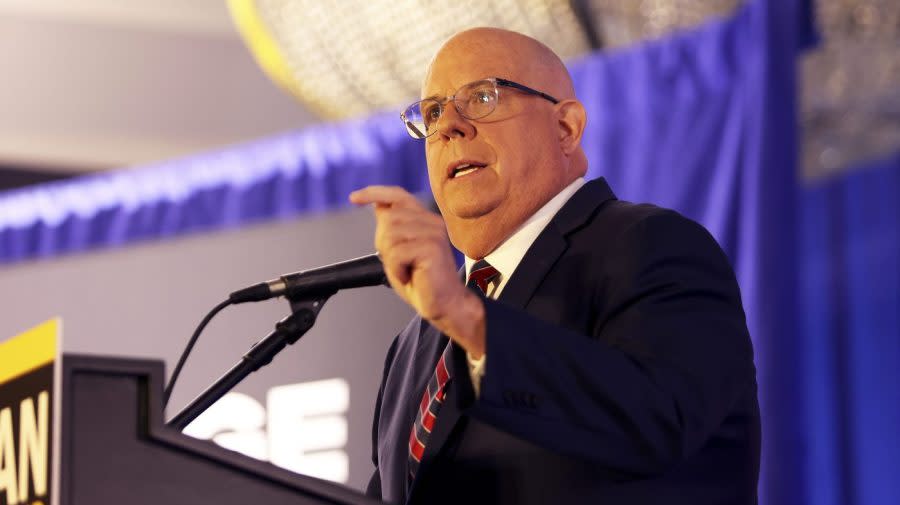
Former Maryland Gov. Larry Hogan (R) criticized Project 2025 in a recent op-ed, calling the policy priorities outlined in the conservative agenda “absurd and dangerous.”
Hogan, in the piece published Friday by The Washington Post, argued that “traditional American Values” are under threat on both sides of the aisle.
“On the left, the refusal by some to clearly stand up to radicals such as antisemitic and pro-Hamas protesters, advocates of defunding the police, and the open-borders movement has done substantial damage,” Hogan wrote. “However, on the right, there is no clearer example of the threat to American values than Project 2025.”
The 900-age policy agenda, led by the conservative Heritage Foundation, is gaining traction as the unofficial presidential transition project. It is divided into sections based on five main topics — “Taking the Reins of Government,” “The Common Defense,” “The General Welfare,” “The Economy” and “Independent Regulatory Agencies.”
Project 2025 has gained support from more than 100 other right-wing organizations and conservatives who critics argue could staff a second Trump administration if he’s reelected in November.
Hogan said to call the ideas in the plan radical would be “a disservice,” even as Republicans downplay the influence of the plan.
“In truth, Project 2025 takes many of the principles that have made this nation great and shreds them,” he wrote in the opinion piece.
Hogan, who is running for the vacant Senate seat left by retiring Sen. Ben Cardin (D-Md.), noted that one of the primary goals in the plan targets federal workers, and could affect more than 150,000 Maryland residents.
“The goal is to remove nonpartisan civil servants, most of whom patriotically do their jobs without fanfare or political agendas, and replace them with loyalists to the president,” Hogan said. “Republicans who believe this power grab will benefit them in the short term will ultimately regret empowering a Democratic president with this level of control.”
The former governor, whose father was an FBI agent, also highlighted an aspect of the plan that he said would weaken the Department of Justice’s independence from the president. Impartial justice should not be abandoned by choice and design, Hogan argued.
Of the “absurd and dangerous” policies in the plan, Hogan highlighted that the Education Department and the Federal Reserve could potentially be disbanded, as well as mass deportations.
“This radical approach is out of touch with the American people,” Hogan said. “Most Americans — regardless of party affiliation — have more in common than many realize.”
“They want common-sense solutions to address the cost of living, make our communities safer, and secure the border while fixing the broken immigration system,” he continued. “Instead of addressing these problems, Project 2025 opts for total war against the other side, making it impossible to find common ground.”
Scientists sound the alarm after new research points to growing invisible threat putting coastal cities at risk: ‘We need very dramatic action’
Susan Elizabeth Turek – July 19, 2024
A new study that accounts for seawater intrusion between ice sheets estimates that other projections about future sea level rise could be too modest.
What’s happening?
As detailed by the Guardian, researchers used computer models to analyze how ocean water intruding into ice sheet cavities impacted melting rates. They believe this could create a “tipping point” where the sheets lose ice much faster than expected.
“[Seawater intrusion] could basically be the missing piece,” study leader Dr. Alexander Bradley told the news outlet. “… And there’s a lot of evidence that when you do include it, the amount of sea level rise the models predict could be much, much higher.”
The Guardian also highlighted a previous study that suggested seawater intrusion could cause some Antarctic ice sheets to lose ice around two times more quickly. The latest findings were published in the journal Nature Geoscience.
Why is this concerning?
As it stands, models by the National Oceanic and Atmospheric Administration project large swaths of the West and East Coasts will eventually succumb to the oceans, but the latest analysis suggests the tipping point could be closer than initially believed.
Almost 40% of the global population lives less than 65 miles from a coast, according to the UN Environment Programme. If sea levels continue to rise, those communities could be at a further increased risk of property and livelihood loss, as well as displacement.
Human activities have directly impacted our seas, with the burning of dirty fuels like gas, oil, and coal overwhelmingly driving the overheating of our planet.
According to NOAA, the 10 hottest years on record have all occurred in the past decade, with 2023 being the warmest ever recorded. These warmer temperatures are causing ice sheets to melt and ocean water to expand, thus contributing to rising sea levels.
The higher water levels also increase the risk of costly damage and deadly flooding during extreme weather events. Strong hurricanes, for example, have become more frequent as a result of our changing climate, with rapid intensification a growing phenomenon.
What can be done about rising sea levels?
Floating homes and land reclamation projects are among the initiatives providing hope that we can adapt to rising sea levels. However, Dr. Bradley also called for bold action to help preserve our coastal communities.
“With every tenth of a degree of ocean warming, we get closer and closer to passing this tipping point…” Dr. Bradley told the Guardian. “So we need very dramatic action to restrict the amount of warming that takes place and prevent this tipping point from being passed.”
The global community still has a ways to go to reduce its reliance on dirty fuels and meet its agreed-upon pollution-reduction goals, but there have been promising developments. For example, in 2023, clean energy accounted for a record 30% of electricity worldwide, with wind and solar installations leading the way, according to a report by Ember.
While the appointment of 2024 United Nations Climate Change Conference president Mukhtar Babayev has been criticized because of his past ties to an oil company, there is also optimism that November’s COP29 event will lead to continued cooperation to protect our planet.
Supporting eco-friendly policymakers at home can support efforts at a systemic level. There are also simple ways to reduce the pollution you generate, like by unplugging energy vampires. Doing this can even save you around $165 on your electric bills every year.
Teamsters exec announces challenge to O’Brien after RNC speech
Lauren Irwin – July 19, 2024
International Brotherhood of Teamsters Vice President at large John Palmer announced he is mounting a challenge to current President Sean O’Brien after he gave a speech at the Republican National Convention.
In a letter, Palmer said he was officially announcing his candidacy for Teamsters national office in the 2026 election and invited all Teamsters to join him in forming an opposition slate to “send Sean O’Brien back to the truck.”
“This administration rode into power on a wave of excitement generated by our members’ desires and frustration. We were promised a more engaged leadership and a more militant union. What we have received so far is a PR blast furnace of misinformation and betrayal,” Palmer wrote in the letter, first reported by In These Times’ Kim Kelly.
Palmer also appeared to post the letter to a Teamsters Facebook group.
Of the many speeches given at the RNC this week, one of the first ones was delivered by O’Brien.
Palmer laid out several reasons why O’Brien has shown he is not fit for his leadership position, including fear of retaliation among members and failing to support members in contracts.
“This has all culminated in his presence at the anti-union, anti-worker Republican national convention, kissing the ring of a man that scabbed a picket line, failing to pay workers, discriminating against people of color as a landlord, falsely accusing five black men in New York of murder, orchestrating an insurrection against the United States, dodging the draft, and appointing Union busters from the Jones Day law firm to create the most anti-union Labor Board in history,” Palmer wrote.
Palmer argued that its “naïve to believe” that people who attended the RNC will support unions in “any way, shape, form, or manner.”
“We have successfully estranged ourselves from the rest of the labor movement through the actions of one man. Should we really go out and seek more enemies right now?” his letter said.
It’s easy to understand why “Hillbilly Elegy,” the 2016 memoir by JD Vance, piqued the interest of the American people. It recycles a narrative America has relied on for a century to sleep soundly despite the everyday horrors of our society: Rich people do well because they are morally better than the poor.
Add some powerful tropes — a firebrand “pistol packing lunatic” mamaw who protects at all costs, a rags-to-riches story in which Vance, a Marine, escapes the “worst of my cultural inheritance” (p. 253) of unsophisticated, drug-addicted, murderous hillbillies — and you’ve got a bestseller.
You’ve also got a dangerous lie, one relying on ugly stereotypes that harm real Appalachians in order to advance a political career. Former President Donald Trump announced Monday that Vance, the junior senator from Ohio, is his pick for his running mate.
Unlike me, Vance is not Appalachian. He was born and raised in Middletown, Ohio, well outside any maps of the distinct geographical and cultural region. Trump picking this Rust Belt charlatan as his running mate Monday sparked a resounding and unifying rant among conservative and liberal hillbillies alike in my social media feed: We do not acknowledge him.
Why would we? Vance introduces his reader to Appalachia by immediately profiling the worst behaviors of each of his uncles, including a scene of grotesque violence. He calls us a “pessimistic bunch” living in a “hub of misery” (p. 4), and over and over again he uses a wide brush to paint Appalachians as lazy, ignorant and unwilling to try at life.
Though there are dozens of offensive stories to choose from in “Hillbilly Elegy,” perhaps the most ridiculous one occurs when, during boot camp, Vance says he meets an eastern Kentuckian who, never having heard the term, asks “What’s a Catholic?” because, as Vance presents it, “down in that part of Kentucky [where he says that man is from], everybody’s a snake handler.” (p. 160). It’s an addictively stereotypical image: the ignorant, isolated, snake-handling hillbilly. But it’s not reality. There are a half dozen churches in that Kentuckian’s county seat, mostly Baptist and Methodist. Just 20 miles away, in Hazard, there’s a Catholic Church. Another 20 miles away, where Vance’s family lives, there’s a Catholic Church with more than 4,000 Facebook followers.
Vance’s memoir of Appalachia, full of gun-toting, drug-addicted “lunatics” aimlessly awaiting death, is at best a cherry-picking of the worst moments of his life. At worst, it’s a concoction of real memories and some of television’s worst stereotypes of what Appalachia is.
Anthony Harkins and Meredith McCarroll’s “Appalachian Reckoning,” a response to Vance’s bestseller, anthologizes more than 400 pages of responses from real Appalachians describing their lives in all the nuance they deserve.
But nuanced stories aren’t useful in politics.
Appalachia is simply a rhetorical device for Vance that he used to launch a political career. If your political goal is to blame the poor for their own problems, then using the regional ethnicity of your grandparents to present yourself as “authentic” can compel readers to believe your narrative or to feel good about having already believed it. After all, the narrative of the lazy hillbilly has existed for as long as rich folks outside of Appalachia needed an explanation for mountain poverty that doesn’t include blaming themselves.
Did the poverty come from the rest of the country ignoring a region they thought had no resources?
Did the poverty come from coal barons stealing resources once they were discovered.
Did the poverty come from outside coal companies not paying coal miners actual money for decades?
Why blame complex issues that implicate rich white folks when “lazy” is only two syllables?
Vance builds on this narrative, ignoring nuance and context, presenting supposed anecdote after supposed anecdote of cultural depravity and portraying himself as a hillbilly who survived and knows the answer to what ails Appalachia is political conservatism.
For Vance, issues of poverty, drug abuse and neglected children are “issues of family, faith, and culture.” (p. 238) He goes so far as to claim that these “problems were not created by governments or corporations or anyone else.” (p. 255)
He puts the blame entirely on poor Americans, on mothers on food stamps and on fathers who are out of work, extending the roots of that blame directly to Appalachians and some inherent moral flaw. In convincing readers outside of Appalachia that they need the solution he is selling, he paints the Appalachian as the moral problem in America:
The dog whistle is pretty clear: The immoral hill folks are already in your area. Trust me, I escaped them. I know the answer to save you from them.
“If there is any temptation to judge these problems as the narrow concerns of backwoods hollers, a glimpse at my own life reveals that Jackson [Kentucky]’s plight has gone mainstream. Thanks to the massive migration from the poorer regions of Appalachia to places like Ohio, Michigan, Indiana, Pennsylvania, and Illinois, hillbilly values spread widely along with hillbilly people.” (p. 20)
The “hillbilly” twist is a particularly clever political move because it allows poor white folks living in swing states (like those listed above) to draw a quick line of demarcation around themselves — hardworking but poor Americans — and the supposed immoral, lazy welfare queens and absent, violent hillbilly fathers spreading into their cities and towns.
Vance paints himself as having narrowly escaped “the deep anger and resentment” (p. 2) of those who raised him and laments the supposed white working class feeling that “our choices don’t matter.” (p. 176)
Wednesday morning, my sister, who has known overwhelming pain and difficulty, signed up for nursing classes at a community college. Last week, my nephew, a young man with everything stacked against him, asked me to meet him to talk about vocational school.
I see people making choices.
I see no anger.
Vance confuses frustration in a difficult system with anger and resentment.
Vance confuses frustration in a difficult system with anger and resentment; he misrepresents Appalachians acknowledging that the choices they have are few and far between and require great levels of personal sacrifice as their belief that the choices they make don’t matter.He sees the drowning person and decides they lack determination in swimming. He ignores those creating the flood.
Vance does identify one hillbilly trait that I will, at this moment, agree with: We can be distrustful of outsiders. I might add that I am most distrustful of outsiders pretending to be insiders and of outsiders with a political agenda.
The Strongest Case for Biden Is His Resilience in the Face of the Onslaught
By Charles M. Blow – July 11, 2024
Credit…Jamie Kelter Davis for The New York Times
Joe Biden is still standing, refusing to bow out — he reiterated that once again in a lengthy and mostly successful news conference on Thursday night. Some may view it as selfish and irresponsible. Some may even see it as dangerous. But I see it as remarkable.
Despite sending a clear message — in his recent flurry of interviews and rallies, in his stalwart address this week to members of the NATO alliance and in his letter on Monday to congressional Democrats, in which he assured them that “I wouldn’t be running again if I did not absolutely believe I was the best person to beat Donald Trump in 2024” — there’s still a slow drumbeat from luminaries, donors and elected officials trying to write Biden’s political obituary.
The talent agency mogul Ari Emanuel (a brother of Rahm Emanuel, Biden’s ambassador to Japan), recently said Biden “is not the candidate anymore.” In a post on X, the best-selling author Stephen King said that it’s time for Biden “to announce he will not run for re-election.” Abigail Disney, an heiress to the Walt Disney fortune, said, “I intend to stop any contributions to the party unless and until they replace Biden at the top of the ticket.”
They seem to believe that they can kill his candidacy, by a thousand cuts or by starving it to death.
But none of this sits well with me.
First, because Biden is, in fact, his party’s presumptive nominee. He won the primaries. He has the delegates. He got there via an open, organized and democratic process.
Forcing him out, against his will, seems to me an invalidation of that process. And the apparent justification for this, that polls, which are highly fluctuant, now indicate that some voters want him replaced, is insufficient; responses to polls are not votes.
Yes, two weeks ago, Biden had a bad debate, and may well be diminished. Yes, there’s a chance he could lose this election. That chance exists for any candidate. But allowing elites to muscle him out of the race would be playing a dangerous game that is not without its own very real risk. It won’t guarantee victory and may produce chaos. The logic that says you have to dump Biden in order to defeat Trump is at best a gamble, the product of panicked people in well-furnished parlors.
Furthermore, no one has really made the case that whatever decline Biden may be experiencing has significantly impacted his policy decision-making or eroded America’s standing in the world. The arguments center on the visual evidence of somewhat worrisome comportment but mostly speculation about cognition.
That is just not enough.
I am not a Biden acolyte. I’ve never met the man. And I’m not arguing against the sense among those who have seen him up close and express worry. I’m not pro-Biden as much as I am pro-stay the course.
Like Biden’s Democratic doubters, I want above all to prevent Trump from being re-elected and to ensure the preservation of democracy. It’s just that I believe allowing Biden to remain at the top of the Democratic ticket is the best way to achieve that.
And since that’s the goal, perhaps the best argument in Biden’s favor is that his mettle has been revealed by the onslaught of criticism he has endured since the debate, much of it from other liberals.
Biden’s support hasn’t cratered, as one might have expected. Which suggests that the idea that Biden can’t win — or that another Democrat would have an easier run — is speculative at best.
Indeed, when I saw one headline that read, “Poll finds Biden damaged by debate; with Harris and Clinton best positioned to win,” I thought: Hillary Clinton? Now we’re truly in fantasy baseball territory.
And in the national poll on which that article was premised, Biden trailed Trump by just one percentage point while Vice President Kamala Harris led Trump by just one percentage point; in both cases, well within the margin of error.
A new Washington Post-ABC News-Ipsos poll found that Biden and Trump are tied nationally.
As for hypothetical candidates like Harris — who I do believe would acquit herself well at the top of the ticket — that same poll shows her performing slightly better against Trump than Biden does. But that is in the abstract, before the chaos of a candidate change, and before she received the full-frontal assault that being the actual nominee would surely bring. And in an era of opposition to “wokeness” and the values of diversity, equity and inclusion, that frontal assault, directed at the first Black, Asian American and female vice president, would be savage.
The potential drag on down-ballot races is a legitimate concern for some Democrats, but it appears to be the panic of some down-ballot candidates that has exacerbated the problem, as more than a dozen House Democrats and one Senate Democrat have called for Biden to leave the race.
There’s no guarantee that swapping out candidates would leave Democrats in a better position, but I believe the case is building that the continued dithering among Democrats about Biden’s candidacy is doing further damage to their chances.
Biden’s candidacy may not survive. But forcing him out of it may hurt Democrats more than it helps them, even with voters who say they want a different choice.
Charles M. Blow is an Opinion columnist for The New York Times, writing about national politics, public opinion and social justice, with a focus on racial equality and L.G.B.T.Q. rights.
While Democrats tear themselves apart over President Biden’s disastrous debate performance and his refusal to consider stepping aside, the Republican National Committee, without much fanfare, has released its 2024 platform.
Compared with previous platforms, it dials back references to abortion — downplaying what is, for Republicans, a losing issue. That choice goes along with Donald Trump’s recent attempt to distance himself from the extremist Project 2025 — even though that blueprint was concocted by some of his close political allies. Here, Trump is clearly employing sleight of hand in an effort not to be seen as autocratically inclined. But at this point, if you believe that, I have a degree from Trump University I’d like to sell you.
In any case, there’s nothing moderate about a platform whose first plank reads, “SEAL THE BORDER, AND STOP THE MIGRANT INVASION” and whose second item calls for “THE LARGEST DEPORTATION OPERATION IN AMERICAN HISTORY.” (Yes, the list is in all caps, just in case you need help imagining Trump shouting it to you from a Mar-a-Lago ballroom.)
I’ll have a lot more to say about Republican policy ideas in the weeks ahead. For today, however, I want to focus not on what the platform proposes but what it says about the G.O.P. image of America today — a dystopian vision that bears hardly any resemblance to the vibrant country I know, a nation that has coped remarkably well with the aftermath of the Covid-19 pandemic. Republicans may try to brand themselves as patriots, but they truly appear to despise the nation they live in.
Start with item No. 10, which begins with the promise to “STOP THE MIGRANT CRIME EPIDEMIC” — presumably one of the justifications for mass deportations. Any attempt to carry out such deportations would be a humanitarian, social and economic nightmare. But leaving that aside, the whole premise is false. There is no epidemic of migrant crime in America.
Yes, some Americans have been the victims of terrible crimes, and some of the perpetrators have been migrants. But violent crime in America, homicides in particular, which surged during the last year of the Trump administration — a year of low immigration — has plunged over the past two years.
And Americans have been signaling by their behavior, literally voting with their feet, that our big cities feel fairly safe. Downtown foot traffic on nights and weekends — that is, traffic that mainly reflects people going out for shopping and entertainment rather than for work — is close to or above prepandemic levels in many major cities.
Far from facing a crime “epidemic,” America has been highly successful in recovering from the Trump crime wave.
The G.O.P. platform also pledges to “MAKE AMERICA THE DOMINANT ENERGY PRODUCER IN THE WORLD.” The subtext here is the pervasive belief on the right that woke environmentalists have undermined the U.S. energy sector.
Given how often one hears this asserted, it’s a bit shocking to look at the data and learn that America produced more energy in 2023 than ever before. In fact, we’ve become a major energy exporter, for example selling Europe vast quantities of liquefied natural gas that helped it reduce dependence on Russian supplies after Vladimir Putin invaded Ukraine.
The area in which we’re really lagging China is renewable energy, which the Biden-Harris administration is promoting — and Republicans hate.
Further, the platform promises to “END INFLATION, AND MAKE AMERICA AFFORDABLE AGAIN.” In reality, inflation is already way down — from 9 percent at its peak to just 3 percent as measured by the Consumer Price Index, and is probably down to 2.4 percent according to an alternative price index preferred by the Federal Reserve. Gasoline and groceries are just as affordable, as measured by their prices compared with the average hourly earnings of nonmanagerial workers, as they were in 2019.
So what are Republicans talking about? Are they promising to roll back the price increases that took place almost everywhere as the world economy recovered from the pandemic? We haven’t seen deflation on that scale since the Great Depression — not exactly an experience we want to repeat.
Why does the Republican vision of America, as revealed in the party’s platform, bear so little resemblance to reality? A large part of it, I believe, is that the party instinctively favors harsh, punitive policies — which obliges it to believe that failure to pursue such policies must lead to disaster, even when it doesn’t. Democrats haven’t been deporting millions or toying with the idea of shooting protesters, therefore, the logic seems to go, we must be experiencing a crime epidemic. Democrats care about the environment, therefore they must be hampering energy production. Democrats want to expand health care coverage and alleviate poverty, therefore they must be feeding runaway inflation.
For a little while, reality seemed to cooperate with some of these grim visions, mainly because of spillovers from the pandemic and its aftermath. We did have a spike in homicides, although it mostly happened on Trump’s watch. We did have a burst of inflation, but it’s behind us.
Bottom line, there’s no reason at all to believe that Republicans have moderated their extremist agenda. Energy independence — which we have already achieved! — won’t be on the ballot this year. Health care, abortion and, probably, birth control will.
Paul Krugman has been an Opinion columnist since 2000 and is also a distinguished professor at the City University of New York Graduate Center. He won the 2008 Nobel Memorial Prize in Economic Sciences for his work on international trade and economic geography.
Rising Frustration in Houston After Millions Lost Power in Storm
With outages expected to last days, a top state official promised to look into whether the utility company could have done more to prepare for Hurricane Beryl.
By J. David Goodman and Ivan Penn July 10, 2024
Reporting from Houston and Los Angeles.
Fallen power lines littered the roads in Galveston after Hurricane Beryl hit the Texas coast on Monday.Credit…Meridith Kohut for The New York Times
The sun felt hotter than usual in Houston this week, as millions of sweltering residents emerged from the rapid thrashing of Hurricane Beryl to face a prolonged power outage — the largest ever seen by the city’s utility, according to the state’s lieutenant governor.
The outages from the storm affected as many as 2.7 million customers across the state, mostly in and around Houston. Despite a promise by the utility, CenterPoint Energy, to restore power to one million customers by the end of the day on Wednesday, large swaths of the nation’s fourth-biggest city remained without power.
The scale of the outages raised questions about whether enough had been done to prepare the city, just 50 miles from the Gulf Coast, for the kinds of storms that climate scientists predict will arrive with greater frequency.
“For a Category 1 hurricane to result in over a million customer outages in its immediate aftermath demonstrates that there is plenty of need for the resiliency hardening investments,” said Wei Du, an energy expert with PA Consulting and a former senior analyst and engineer for Con Edison.
Beryl was not a particularly strong storm when it made landfall early Monday. But the hurricane struck at the heart of Houston with a ferocity that toppled trees into power lines and that knocked over 10 transmission towers, officials said.
By late Tuesday, some 1.5 million of CenterPoint’s customers still had no power — and little sense of when it would return. Neighbors reported flickerings of light to each other on group chats, hoping for signs of progress. Many shared a map of open Whataburger locations, suggesting that the fast-food chain was a better way to find out about available electricity service, compared with the spotty information released by the utility.
As the temperatures rose, so did many residents’ anger.
“The response has been too slow,” said Patricia Alexander, 79, who sat in a cooling center in northwest Houston to get a break from the heat inside the senior center where she lives. “The mayor said he was looking out for senior centers and that CenterPoint’s teams were prioritizing senior facilities, but I don’t believe it, because we don’t have air-conditioning.”
About 2.2 million customers — 80 percent of the utility’s customers in the Houston area — lost power in the storm, a CenterPoint Energy spokesman said.Credit…Meridith Kohut for The New York Times
The sheer number of damaged lines accounted for the extent of the outages, which surpassed those during Hurricane Ike in 2008. After that storm, the utility described making efforts to better manage the vegetation around power lines.
Company officials said they had been surprised by the behavior of the storm, which initially was expected to strike further south but instead hit near Matagorda, Texas, after strengthening somewhat and then spiraling north toward Houston.
“No one should have been surprised,” said Dan Patrick, the state’s lieutenant governor, who has been acting in place of Gov. Greg Abbott while he travels abroad.
Mr. Patrick said in a news conference that he wanted the utility to focus on restoring power, but that afterward the company would need to explain its preparations for the storm.
“If they made mistakes beforehand, then that will be addressed,” Mr. Patrick said. “The real question is: Were they as prepared as they should be? And that’s up to them to answer, and they will answer not only to the public but to the P.U.C.,” he added, referring to the state’s Public Utility Commission.
Texas officials have spent much of the past few years worrying about the vulnerability of the state’s power grid to extreme cold after a failure during a winter storm in 2021.
But amid increasingly frequent extreme heat, the grid has also been tested in the summer, not just during storms but also on hot, cloudless days when energy demand is high.
“It’s not just during a storm: Texas in general tends to have more outages on a blue sky day than other states,” said Doug Lewin, an energy consultant and the author of the Texas Energy and Power newsletter. “We rank very poorly compared to other states. We’ve got a long way to go.”
In CenterPoint’s last three annual reports to federal regulators, including the most recent one in February, the utility said it had risks related to aging facilities. “Aging infrastructure may complicate our utility operations’ ability to address climate change concerns and efforts to enhance resiliency and reliability,” the company told the Securities and Exchange Commission.
A spokeswoman for CenterPoint said that the company had monitored Beryl’s development and had prepared, but “a lot of the issues were just purely because the hurricane hit more intensely than we expected.”
In particular, the company said, many of the outages occurred after trees fell on power lines.
“While we tracked the projected path, intensity and timing for Hurricane Beryl closely for many days, this storm proved the unpredictability of hurricanes as it delivered a powerful blow across our service territory and impacted a lot of lives,” Lynnae Wilson, senior vice president for CenterPoint, said in a statement.
About 2.2 million customers — 80 percent of the utility’s customers in the Houston area — lost power in the storm, a company spokesman said.
Utility experts said that power companies have little excuse for not being ready for events that develop over the course of days, in particular when the primary job is to deliver safe, reliable service.
“Most of all, it really is the preparation issue,” said Robert McCullough, of McCullough Research, a consulting firm based in Portland, Ore. “Mild storm. Why weren’t we better prepared?”
The outages from Beryl came less than two months after powerful thunderstorms knocked out power across Houston in May.Credit…Daniel Becerril/Reuters
In April, CenterPoint filed a resiliency plan with the state, proposing to spend billions to “modernize and harden our existing infrastructure” to increase reliability. A significant focus, according to the plan, is to modernize the company’s transmission and distribution systems.
After a series of powerful hurricanes struck Florida two decades ago, that state took steps to improve its electrical infrastructure.
The process, which included burying a targeted number of power lines, appeared to bear fruit, according to a 2024 report by the Lawrence Berkeley National Laboratory. The power grid grew more resilient to storms, the report found.
But simply burying power lines underground is not always the best solution, experts say, particularly in areas that are prone to flooding, like many parts of Houston.
“In areas where you worry more about water, you can end up making the system more vulnerable and more expensive when you underground,” said Ted Kury, director of energy studies for the Public Utility Research Center at the University of Florida. “Storm hardening is often a choice between what type of damage you’re more concerned about,” he added.
If it’s water, you go aboveground and accept the wind damage, he said, and “if it’s wind, you might want to underground” but would then have to worry about the water.
The $2.19 billion investment plan proposed by CenterPoint includes upgrading or replacing existing poles and structures to meet current wind loading standards, and improving the distribution system to prevent automatic shut-offs. The plan also proposes a pilot program to assess whether “utility-scale” microgrids can speed up the restoration of power during a fire or weather emergency.
The plan, which still needs state approval, calls for making these investments over a three-year period from 2025 to 2027.
A committee of the Texas Legislature was set to meet on Monday in Austin to discuss the utility resiliency issue — but the meeting was canceled because of the storm.
Delay is becoming more costly. Greenhouse gas emissions are increasing the capacity of the atmosphere to hold moisture, leading to more rain, more flooding and more potential for trees to fall, said Karthik Balaguru, a researcher at the Pacific Northwest National Laboratory. “I think Houston is an area that we should expect more outages,” he said.
The outages from Beryl came less than two months after powerful thunderstorms knocked out power across Houston in May. Hundreds of thousands of residents lost power in that storm, and many of the same people found themselves again dumping spoiled food and looking for cool air this week.
“This is a double whammy,” said Cleveland James, 70, of West Houston, describing the almost back-to-back storms as he sat in the local cooling center. “I lost power for five days. So that doesn’t give me much encouragement that it will come back soon. I think it’ll take a week.”
Ms. Alexander, nearby, said she worried that Beryl would not be the last time she found herself without power this summer.
“This is going to happen again,” she said of the storm, only the second to get a name this hurricane season. “I mean, we’re only in the B’s.”
Ivan Penn is a reporter based in Los Angeles and covers the energy industry. His work has included reporting on clean energy, failures in the electric grid and the economics of utility services. More about Ivan Penn
Extreme heat waves broiling the US in 2024 aren’t normal: How climate change is heating up weather around the world
Mathew Barlow and Jeffrey Basara, UMass Lowell – July 9, 2024
Visitors walk past a sign reading ‘Stop: Extreme Heat Danger’ in Death Valley National Park during a heat wave on July 7, 2024. Etienne Laurent/AFP via Getty Images
Less than a month into summer 2024, the vast majority of the U.S. population has already experienced an extreme heat wave. Millions of people were under heat warnings across the western U.S. in early July or sweating through humid heat in the East.
Extreme heat like this has been hitting countries across the planet in 2024.
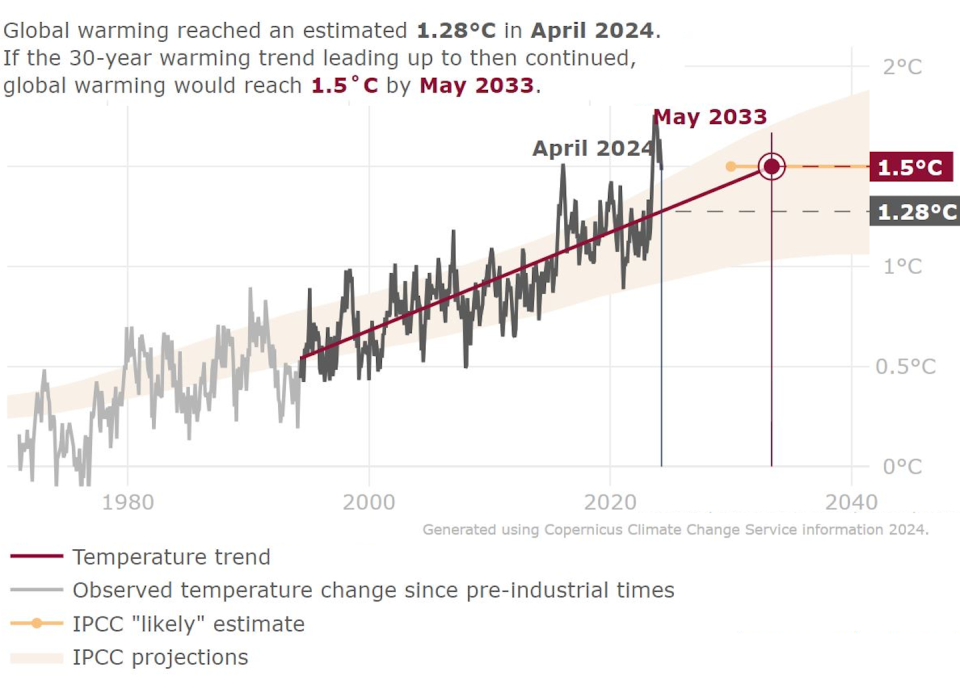
Globally, each of the past 13 months has been the hottest on record for that month, including the hottest June, according to the European Union’s Copernicus climate service. The service reported on July 8, 2024, that the average temperature for the previous 12 months had also been at least 1.5 C (2.7 F) warmer than the 1850-1900 pre-industrial average.
The 1.5 C warming threshold can be confusing, so let’s take a closer look at what that means. In the Paris climate agreement, countries worldwide agreed to work to keep global warming under 1.5 C, however that refers to the temperature change averaged over a 30-year period. A 30-year average is used to limit the influence of natural year-to-year fluctuations.
So far, the Earth has only crossed that threshold for a single year. However, it is still extremely concerning, and the world appears to be on track to cross the 30-year average threshold of 1.5 C within 10 years.
We study weather patternsinvolving heat. The early season heat, part of a warming trend fueled by humans, is putting lives at risk around the world.
Heat is becoming a global problem
Record heat has hit several countries across the Americas, Africa, Europe and Asia in 2024. In Mexico and Central America, weeks of persistent heat starting in spring 2024 combined with prolonged drought led to severe water shortages and dozens of deaths.
Muslim pilgrims spent hours in extreme temperatures and humidity during the Hajj in June 2024 in Saudi Arabia. Over 1,000 people died in the heat. AP Photo/Rafiq Maqbool
Hospitals in Karachi, Pakistan, were overwhelmed amid weeks of high heat, frequent power outages, and water shortages in some areas. Neighboring India faced temperatures around 120 F (48.9 C) for several days in April and May that affected millions of people, many of them without air conditioning.
In Greece, where temperatures were over 100 F (37.8 C) for days in June, several tourists died or were feared dead after going hiking in dangerous heat and humidity.
Although heat waves are a natural part of the climate, the severity and extent of the heat waves so far in 2024 are not “just summer.”
A scientific assessment of the fierce heat wave in the eastern U.S. in June 2024 estimates that heat so severe and long-lasting was two to four times more likely to occur today because of human-caused climate change than it would have been without it. This conclusion is consistent with the rapid increase over the past several decades in the number of U.S. heat waves and their occurrence outside the peak of summer.
These record heat waves are happening in a climate that’s globally more than 2.2 F (1.2 C) warmer – when looking at the 30-year average – than it was before the industrial revolution, when humans began releasing large amounts of greenhouse gas emissions that warm the climate.
Global surface temperatures have risen faster per decade in the past 30 years than over the past 120. NOAA NCEI
While a temperature difference of a degree or two when you walk into a different room might not even be noticeable, even fractions of a degree make a large difference in the global climate.
At the peak of the last ice age, some 20,000 years ago, when the Northeast U.S. was under thousands of feet of ice, the globally averaged temperature was only about 11 F (6 C) cooler than now. So, it is not surprising that 2.2 F (1.2 C) of warming so far is already rapidly changing the climate.
If you thought this was hot
While this summer is likely be one of the hottest on record, it is important to realize that it may also be one of the coldest summers of the future.
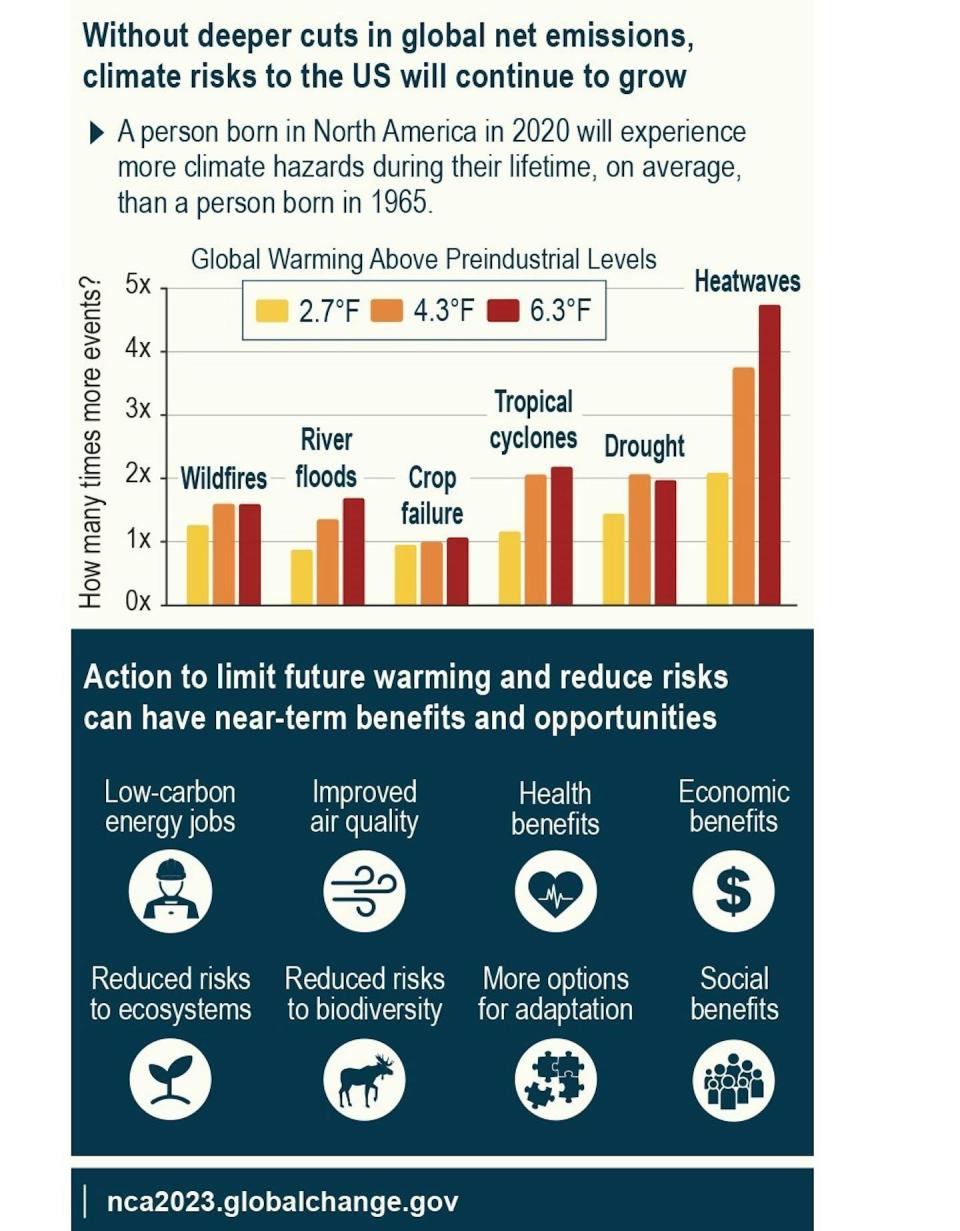
Actions to reduce warming can limit a wide range of hazards and create numerous near-term benefits and opportunities. National Climate Assessment 2023
There is much that humanity can do to limit future warming if countries, companies and people everywhere act with urgency. Rapidly reducing fossil fuel emissions can help avoid a warmer future with even worse heat waves and droughts, while also providing other benefits, including improving public health, creating jobs and reducing risks to ecosystems.
Mathew Barlow has received funding from the NOAA Modeling, Analysis, Predictions and Projections Program to study heatwaves.
Jeffrey Basara has received funding from the United States Department of Agriculture and the National Science Foundation to study flash drought and extreme temperatures.
Las Vegas hits record of fifth consecutive day of 115 degrees or greater as heat wave scorches US
Ken Ritter and TY ONeil – July 10, 2024
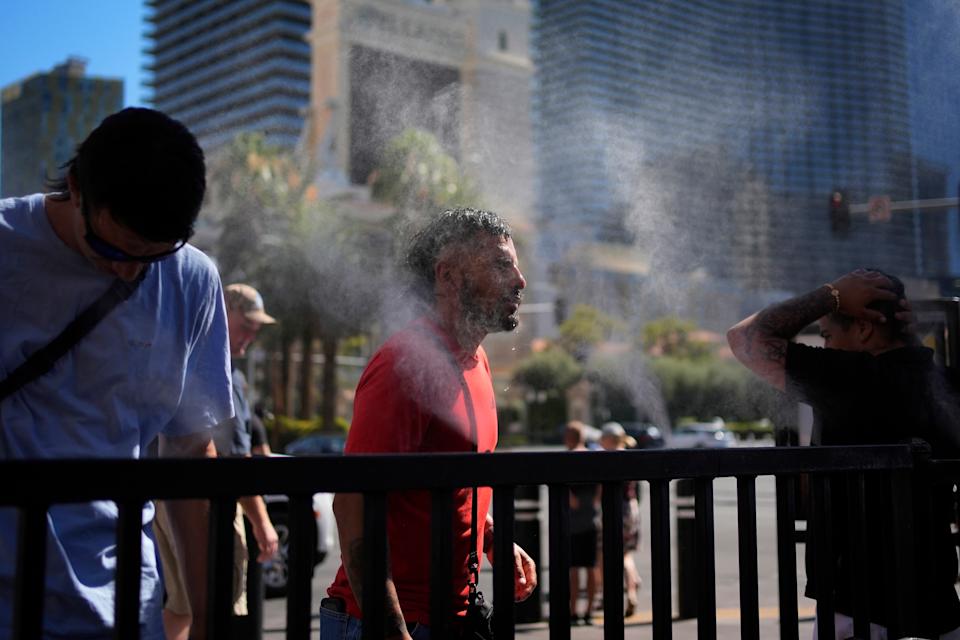
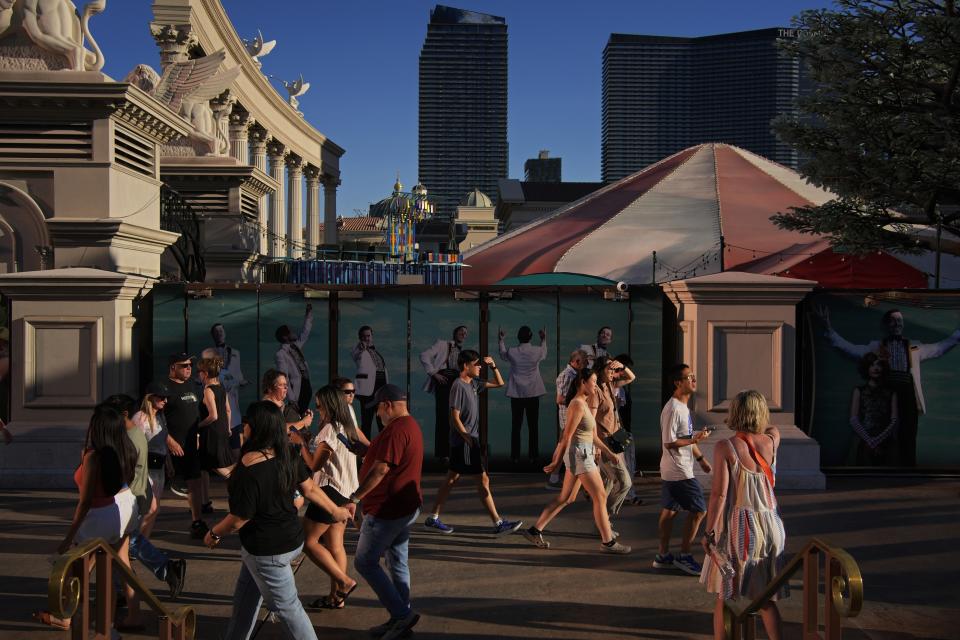
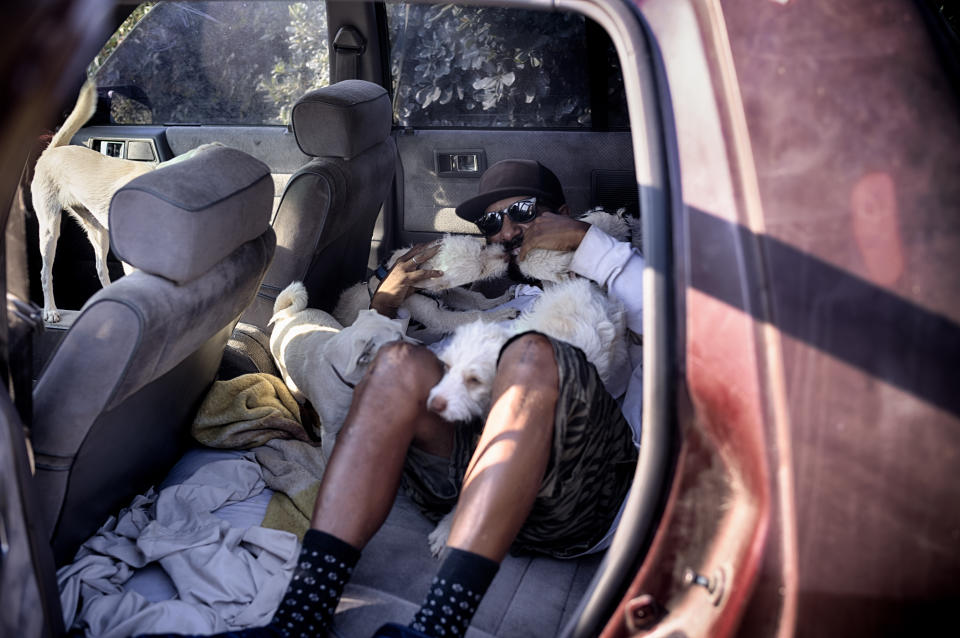
People cool off in misters along the Las Vegas Strip, Sunday, July 7, 2024, in Las Vegas. Used to shrugging off the heat, Las Vegas residents are now eyeing the thermometer as the desert city is on track Wednesday to set a record for the most consecutive days over 115 degrees (46.1 C) amid a lingering hot spell that’s expected to continue scorching much of the U.S. into the weekend. (AP Photo/John Locher, File)People shield their eyes from the sun along the Las Vegas Strip, Sunday, July 7, 2024, in Las Vegas. Used to shrugging off the heat, Las Vegas residents are now eyeing the thermometer as the desert city is on track Wednesday to set a record for the most consecutive days over 115 degrees (46.1 C) amid a lingering hot spell that’s expected to continue scorching much of the U.S. into the weekend. (AP Photo/John Locher, File)David Clarke who is suffering homelessness and living in his car with his 6 dogs, takes to the shade at the Sepulveda Basin dog park in Los Angeles on Tuesday, July 9, 2024. Dozens of locations in the West and Pacific Northwest tied or broke previous heat records over the weekend and are expected to keep doing so into the week. (AP Photo/Richard Vogel)Tourists take photographs with the thermometer at the Furnace Creek Visitor Center during a dangerous heat wave, Tuesday, July 9, 2024, in Death Valley, Calif. The thermostat is imprecise, registering the temperature anywhere from 1 to 5 degrees Fahrenheit higher than more precise instruments and providing a more impressive reading for pictures. (AP Photo/Ty ONeil)Matt Fiedler takes a photo of daughter Sally Fiedler, left, and wife Cecilia Fiedler by the thermometer at the Furnace Creek Visitor Center, Tuesday, July 9, 2024, in Death Valley, Calif. European tourists and adventurers from around the U.S. are still being drawn to Death Valley National Park, even though the desolate region known as one of the Earth’s hottest places is being punished by a dangerous heat wave. (AP Photo/Ty ONeil)Louis Lacey, director of homeless response teams at Help of Southern Nevada, speaks to a homeless woman to offer water in Las Vegas, on Tuesday, July 9, 2024. Help of Southern Nevada travels the streets with flyers about heat, water and vehicles to transport people to cooling centers. (Bizuayehu Tesfaye/Las Vegas Review-Journal via AP)
LAS VEGAS (AP) — Las Vegas baked Wednesday in its record fifth consecutive day of temperatures sizzling at 115 degrees Fahrenheit (46.1 Celsius) or greater amid a lengthening hot spell that is expected to broil much of the U.S. into the weekend.
The temperature climbed to 115 shortly after 1 p.m. at Harry Reid International Airport, breaking the old mark of four consecutive days set in July 2005. And the record could be extended, or even doubled, by the weekend.
Even by desert standards, the prolonged baking that Nevada’s largest city is experiencing is nearly unprecedented, with forecasters calling it “the most extreme heat wave” since the National Weather Service began keeping records in Las Vegas in 1937.
Already the city has broken 16 heat records since June 1, well before the official start of summer, “and we’re not even halfway through July yet,” meteorologist Morgan Stessman said Wednesday. That includes an all-time high of 120 F (48.8 C) set on Sunday, which beat the previous 117 F (47.2 C) record.
Alyse Sobosan said this July has felt the hottest in the 15 years she has lived in Las Vegas. She said she doesn’t step outside during the day if she can help it.
“It’s oppressively hot,” she said. “It’s like you can’t really live your life.”
It’s also dangerously hot, health officials have emphasized. There have been at least nine heat-related deaths this year in Clark County, which encompasses Las Vegas, according to the county coroner’s office. Officials say the toll is likely higher.
“Even people of average age who are seemingly healthy can suffer heat illness when it’s so hot it’s hard for your body to cool down,” said Alexis Brignola, an epidemiologist at the Southern Nevada Health District.
For homeless residents and others without access to safe environments, officials have set up emergency cooling centers at community centers across southern Nevada.
The Las Vegas area has been under an excessive heat warning on three separate occasions this summer, totaling about 12 days of dangerous heat with little relief even after the sun goes down, Stessman said.
Keith Bailey and Lee Doss met early Wednesday morning at a Las Vegas park to beat the heat and exercise their dogs, Breakie, Ollie and Stanley.
“If I don’t get out by 8:30 in the morning, then it’s not going to happen that day,” Bailey said, wearing a sunhat while the dogs played in the grass.
More than 142 million people around the U.S. were under heat alerts Wednesday, especially in Western states, where dozens of locations tied or broke heat records over the weekend and are expected to keep doing so all week.
Oregon has seen record daily high temperatures, with Portland reaching 103 F (39.4 C) and Salem and Eugene hitting 105 F (40.5 C) on Tuesday. The number of potentially heat-related deaths in Oregon has risen to 10, according to the state medical examiner’s office. The latest two deaths involved a 54-year-old man in Jackson County and a 27-year-old man in Klamath County.
On the other side of the nation, the National Weather Service warned of major-to-extreme heat risk over portions of the East Coast.
An excessive heat warning remained in place Wednesday for the Philadelphia area, northern Delaware and nearly all of New Jersey. Temperatures were around 90 F (32.2 C) for most of the region, and forecasters warned the heat index could soar as high as 108 F (42.2 C). The warning was due to expire at 8 p.m. Wednesday, though forecasters said there may be a need to extend it.
The heat was blamed for a motorcyclist’s death over the weekend in Death Valley National Park. At Death Valley on Tuesday, tourists queued for photos in front of a giant thermometer that was reading 120 F (48.9 C).
Simon Pell and Lisa Gregory from London left their air-conditioned RV to experience a midday blast of heat that would be unthinkable back home.
“I wanted to experience what it would feel like,” Pell said. “It’s an incredible experience.”
At the Grand Canyon, the National Park Service was investigating the third hiker death in recent weeks. Temperatures on parts of some trails can reach 120 F (49 C) in the shade.
An excessive heat warning continued Wednesday in many parts of southern and central Arizona. Forecasters said the high in Phoenix was expected to reach 114 F (45.5 C) after it hit 116 F (46.6 C) Tuesday, tying the previous record for the date set in 1958.
Authorities were investigating the death of a 2-year-old who was left alone in a hot vehicle Tuesday afternoon in Marana, near Tucson, police said. At Lake Havasu, a 4-month-old died from heat-related complications Friday, the Mohave County Sheriff’s Department said.
The U.S. heat wave came as the global temperature in June was a record warm for the 13th straight month and marked the 12th straight month that the world was 1.5 degrees Celsius (2.7 degrees Fahrenheit) warmer than pre-industrial times, the European climate service Copernicus said. Most of this heat, trapped by human-caused climate change, is from long-term warming from greenhouse gases emitted by the burning of coal, oil and natural gas, scientists say.
Firefighters in Henderson, Nevada, last week became the first in the region to deploy what city spokesperson Madeleine Skains called “ polar pods, ” devices filled with water and ice to cool a person exhibiting symptoms of heat stroke or a related medical emergency.
Extreme heat in the West has also dried out vegetation that fuels wildfires.
A blaze burning in northern Oregon, about 111 miles (178 kilometers) east of Portland, blew up to 11 square miles (28 square kilometers) by Wednesday afternoon due to hot temperatures, gusty wind and low humidity, according to the Oregon State Fire Marshal. The Larch Creek Fire closed Highway 197 and forced evacuations for remote homes.
In California, firefighters were battling least 19 wildfires Wednesday, including a 45-square-mile (117-square-kilometer) blaze that prompted evacuation orders for about 200 homes in the mountains of Santa Barbara County.
Associated Press journalists Rio Yamat in Las Vegas; Anita Snow in Phoenix; Scott Sonner and Gabe Stern in Reno, Nevada; Christopher Weber and John Antczak in Los Angeles; Martha Bellisle in Seattle and Bruce Shipkowski in Toms River, New Jersey; contributed to this report.
US heat wave turns deadly as high temperatures continue to scorch the West
Robert Shackelford, Sydney Bishop, Rachel Ramirez, Angela Dewan, Raja Razek and Jamiel Lynch – July 8, 2024
(CNN) — More than 50 million people across the US are under heat alerts amid a brutal heat wave that has shattered records and caused multiple deaths across the West.
California and Nevada are expected to see more daily record high temperatures in the week ahead. By Thursday, the heat in the Pacific Northwest will shift to the Intermountain West and northern High Plains, the National Weather Service’s Weather Prediction Center cautions.
In Oregon, four people died of suspected heat-related illnesses over the weekend, according to a Monday news release from Multnomah County. Three of the four were residents of Multnomah County, while the other individual was transported from outside the county and later died at a Portland hospital.
These deaths happened after the county declared a state of emergency Friday due to “dangerously hot temperatures,” but the news release noted “further tests and investigation will determine whether the deaths are officially hot-weather-related. In some cases, the deaths may be found to have had other causes.”
Dozens of locations in the West and Pacific Northwest tied or broke previous heat records in recent days, and more than 165 daily high temperature records could be tied or broken this week.
A motorcyclist died Saturday in California’s Death Valley from heat exposure, the Death Valley National Park said in a news release. The high temperature that day was 128 degrees Fahrenheit, according to preliminary data.
Six motorcyclists were near Badwater Basin when they became sick due to the heat, the release said. In addition to the cyclist who died, one was transported to a hospital in Las Vegas and the other four were treated on scene.
Rescue efforts were hampered due to the extreme heat at the park, as emergency medical flight helicopters cannot fly safely when it is over 120 degrees, the release noted.
“Heat illness and injury are cumulative and can build over the course of a day or days,” the release said. “Besides not being able to cool down while riding due to high ambient air temperatures, experiencing Death Valley by motorcycle when it is this hot is further challenged by the necessary heavy safety gear worn to reduce injuries during an accident.”
Heat is the deadliest weather threat in the United States, killing more than twice as many people each year on average than hurricanes and tornadoes combined.
Record-high heat during a holiday weekend
Death Valley was among a slew of places where daily temperature records were broken this Fourth of July weekend.
On Saturday, Death Valley reached 128 degrees, breaking the daily record of 127 set on July 6, 2007. An excessive heat warning is in effect until late Wednesday evening for the area where temperatures are expected to be between 122 to 129 degrees.
Areas across the West are bracing for multiple days of triple-digit temperatures this week. – Etienne Laurent/AFP/Getty Images
Many areas in Northern California surpassed 110 degrees Sunday, while Phoenix, Arizona, set a new daily record for the warmest low temperature: it never got below 92 degrees.
Las Vegas also made history, reaching a record high of 120 degrees on Sunday.
Indiana resident Mark Kavacinski told CNN affiliate KVVU his family almost canceled their vacation to Las Vegas because of the intense heat.
“We knew it was going to be hot. It’s July, right? Did we know it was going to be this hot? No,” Kavacinski said. “But we decided that heat’s heat. We can handle it.”
Las Vegas hit an all-time high temperature record on Sunday, with 120 degrees. – John Locher/AP
Las Vegas temperatures have exceeded 110 degrees each day since Wednesday and are forecast to do so every day until at least next Sunday, which would mark a stretch of prolonged extreme heat longer than any ever experienced in the city, with 11 days or more above 110 degrees.
Sunday’s heat was enough to melt crayons, the weather service office in Las Vegas demonstrated on X.
Further north, Oregon’s weekend scorcher broke many records. On Sunday, Salem hit 103 degrees, just over the city’s 100-degree record from 1945, according to the National Weather Service office in Portland. Eugene also experienced temperatures of 103, breaking the 1945 record of 98 degrees.
But some Oregonians told CNN affiliate KATU Sunday they would not miss the Portland Timbers soccer game, regardless of the heat.
“Yeah, I know it’s hot! It’s 100, it’s crazy. but the game here is greater,” Tim Hueng of Tigard, Oregon told KATU as he waited in line to enter Providence Park.
Officials are urging people to take precautions in the face of dangerously high temperatures. – Zoe Meyers/Reuters
Even mountain destinations couldn’t beat the heat.