A Key Russian Figure with Connections to Trump and the NRA Faces Sanctions
Alexander Torshin is also reportedly under investigation by the FBI.
By Tim Dickinson April 6, 2018
Alexander Torshin Mario Ruiz/Epa/REX/Shutterstock, Mark Peterson/Redux
Alexander Torshin, the Russian government official Rolling Stone reports is central to a nearly decade-long influence campaign over the NRA, has been hit with sanctions by the United States Treasury Department. Torshin is a lifetime, voting member of the NRA, and the FBI is reportedly investigating whether he illegally funneled money through the organization with the intention to help the 2016 Trump campaign.
Femme fatales, lavish Moscow parties and dark money – how Russia worked the National Rifle Association.
Torshin is among nearly three dozen Russian oligarchs, companies and government officials who were added to the sanctions list Friday by the Office of Foreign Assets Control. Torshin is now on the list by authority of an executive order signed in 2014 relating to Russia’s annexation of Crimea and interference in Ukraine. According to the text of the executive order, these sanctions freeze any American-based or -linked assets Torshin may have and bans his travel to the United States. According to Treasury, “U.S. persons are generally prohibited from dealings” with the newly sanctioned individuals.
Steve Mnuchin, the Treasury secretary, underscored the need for the expanded sanctions in a statement: “The Russian government engages in a range of malign activity around the globe, including continuing to occupy Crimea and instigate violence in eastern Ukraine… attempting to subvert Western democracies, and malicious cyber activities,” Mnuchin said. “Russian oligarchs and elites who profit from this corrupt system will no longer be insulated from the consequences of their government’s destabilizing activities.”
As Rolling Stone‘s investigation reveals, Torshin has been an NRA member since at least 2010, cultivating deep ties to its leadership, including at the NRA’s annual conventions and through NRA delegation visits to Moscow, most recently in December 2015. Through his NRA connections, Torshin sought to broker a meeting between candidate Trump and Vladimir Putin in 2016, later meeting with Donald Trump, Jr. at May 2016 NRA convention.
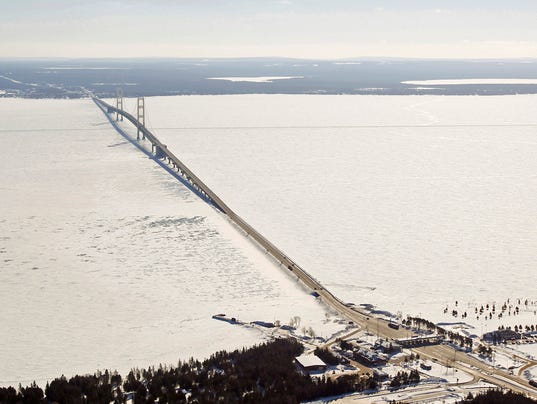
On the Straits of Mackinac: Waterfront view, apprehensions of disaster
Patty Peek April 6, 2018
(Photo: Keith King, Associated Press)
I am an incredibly blessed woman. I live on the shores of an area known as the Center of the Freshwater World: the Straits of Mackinac, where Lakes Huron intersects with Lake Michigan.
Each day, I look out over the clear blue water and thank my creator. No two days are ever alike on the Straits: The wind changes, the sky changes, the water changes.
One day the surf can be so ferocious that even the biggest freighters are forced to take shelter. On other days, it’s a tranquil mirror reflecting the clouds overhead.
I love these waters. They are vital to shipping, fishing, tourism — and to life itself. I have worked in Sub-Saharan Africa for the last 12 years. I have witnessed the challenges of a lack of access to clean water. I have seen the horrors of extended drought. I have watched women try to gather cups of water from puddles in the road after a rain. I have treated hundreds of children for water born diseases and health problems related to a lack of clean drinking water. When I look out at the Straits, I wonder why I am so lucky to have such a life-giving resource in my front yard.
I also wonder why we are not better stewards of this resource. Why aren’t we doing everything we can do to protect a resource that, honestly, is the most precious thing on Earth?
Waking to the peril
Over the past few years, I have became much more aware of the risk of the oil and gas pipelines running alongside and under our waters.
I have spoken out about the risks of Line 5, the two 20-inch-diameter oil pipelines owned by the Canadian company Enbridge, I have spoken about the difficulty of cleaning up an oil spill on days when the Straits are ice-covered, and not even the Coast Guard will venture out.
I never knew we had other dangers under our waters.
This past Sunday night, the electric transmission cable running under the Straits began to leak dielectric fluid, an an oily substance that may contain a known carcinogen.
The Coast Guard was alerted on Monday. In the meantime, a minimum of 400 gallons, of this substance (and likely much more than that) leaked into the beautiful fresh water of the Straits.
As I write this, on Wednesday, the cable is shut down. But there is no assurance that the leak is totally stopped; there are 4,000-plus gallons of that liquid sitting in those underwater cables, and the site of the leak is not known.
Patty Peek is a registered nurse. She lives in St. Ignace. (Photo: Patty Peek)
Fragility, and peril
Right now, I am staring out my window, looking at the area where I would hope to see massive clean-up efforts. I would love to see a flotilla of ships, skimmers cleaning the waters of the substances, and volunteers combing the beach for birds and other animals that may have been affected.
But no — these are the Straits. We have sustained winds of 20 m.p.h, today, and gusts of 30 to 35 m.p.h. Our north shoreline (near the power transmission station) is still ice-covered, and we continue to experience a spring storm that brought 10 inches of snow last night and this morning.
No ships can venture out. No skimmers are employed. I’m sickened to know that beneath that ice and water, there is a potentially lethal, toxic substance that is floating in the water, meandering in the unpredictable currents of the lake. Is it gathering in a pool in front of my house? Is it swirling under the bridge? Is it floating past Mackinac Island or Sturgeon Bay?
What will this mean for the whitefish, lake trout, lake perch, walleye? What will it mean for the waterfowl? What will it mean for the cities and towns that rely on water from the Great Lakes for their drinking water?
So while the news is slowly filtering out from various media sources about what is being done, I see nothing out my window except a disaster in the making.
Is this what we have to look forward to with Pipeline 5 crossing the straights of Mackinac? JH
EcoWatch
Cracked Undersea Pipeline Caused Deadly Oil Spill in Indonesia
Lorraine Chow April 5, 2018Greenpeace Indonesia / Instagram
A burst undersea pipeline owned by Indonesian state-owned oil and natural gas corporation Pertamina caused a deadly oil spill on Saturday that left Balikpapan Bay in Borneo “like a gas station.”
The company initially said the disaster had nothing to do with its nearby refinery or undersea pipelines that run across the bay, noting that its own tests on oil spill samples found marine fuel oil used for ships, not crude oil.
But on Wednesday, Pertamina admitted that its crude oil pipeline was indeed the cause. A company manager noted the distribution line was closed immediately after divers detected the leakage on Tuesday. A test on a tenth oil spill sample also confirmed that it was crude. The firm is now calculating the amount of oil leaked into the bay.
The government, however, insists the incident is not Pertamina’s fault. An energy ministry official cast blame on a foreign coal vessel that dropped anchor in the bay and dragged the pipeline 120 meters from its initial location, causing it to crack.
“The pipe was allegedly dragged by an anchor dropped by a vessel, though no vessel was permitted to drop anchor or even pass through the bay,” Djoko Siswanto, the Energy and Mineral Resources Ministry’s oil and gas director general, said, according to The Jakarta Post.
Deadly oil spill leaves Indonesian Bay like “A gas station.” Hundreds of locals have reported health issues including difficulty breathing, nausea and vomiting from the smell of fuel and black smoke.
The minister did not identify which ship but police investigating the spill have questioned the crew of the Panama-flagged MV Ever Judger.
“So, this was actually the fault of the vessel. […] As there were casualties in the incident, the owner of the vessel could be charged for the crime. But it all still depends on the results of the ongoing investigation,” Djoko said.
Greenpeace Indonesia said Pertamina is responsible for the disaster. On social media, the group condemned the state-run company for the tragedy and charged it with restoring the Balikpapan Bay ecosystem.
“This is why the world has got to start switching to renewable energy and leaving behind the limited fossil energy and destroying our planetary environment and our future,” Greenpeace Indonesia said (via Google Translate).
Indonesia declared a state of emergency on Monday after the spill ignited and killed at least five people in the port city of Balikpapan over the weekend. Hundreds of locals reported health issues including difficulty breathing, nausea and vomiting from the smell of fuel and black smoke that emanated from the blaze.
The environment ministry said the oil slick has spread across 13,000 hectares (50 square miles) of Balikpapan’s waters and polluted 60 kilometers (37 miles) of coastal ecosystems, including mangrove wetlands and marine mammal habitats.
Zulficar Mochtar from the marine and fishery ministry said the spill threatens the ecosystem, economy and livelihoods of local fishermen.
“We cannot solve this problem alone, we need to find collective solution. The efforts would be beyond beach cleaning,” Mochtar said on Thursday.
Humans Eat More Than 100 Plastic Fibers With Each Meal
The proliferation of microplastics in the ocean has led to concerns that they might work their way up the food chain to us.
Olivia Rosane April 5, 2018
assets.rbl.ms
But when researchers at Heriot-Watt University set out to investigate that concern, they found that plastics in our own homes pose a much greater threat to humans.
The results of the study, published March 29 in Environmental Pollution, found that humans likely consume about 114 plastic microfibers each meal simply from household dust that settles on their plates.
Researchers gathered mussels from around the coast of Scotland in order to assess how many microplastics humans might ingest by eating the mussels.
As a control, they also set Petri dishes filled with sticky dust traps next to dinner plates at three separate homes.
Fourteen pieces of plastic settled on the dishes after 20 minutes, about the length of a meal. Given the difference in size, scientists calculated 114 such pieces would settle on a plate during the same time.
That adds up to 13,731 to 68,415 pieces per year.
In comparison, researchers calculated that eating mussels would only lead humans to ingest 100 microplastics yearly. Each mussel they studied contained about two plastic particles.
“These results may be surprising to some people who may expect the plastic fibres in seafood to be higher than those in household dust,” senior study author Dr. Ted Henry said in a Heriot-Watt University press release.
The study’s authors did not think that the plastics came from the home-cooked meals used in the study or the kitchens where they were prepared.
“We do not know where these fibres come from, but it is likely to be inside the home and the wider environment,” Henry said in the release.
Friends of the Earth member Julian Kirby provided the university with insight into how plastic particles end up in dust.
“Plastic microfibers found in the dust in our homes and the air we breathe can come from car tyres, carpets and soft furnishings, as well as clothes such as fleece jackets. These are regularly shedding tiny bits of plastic into the environment as they are worn away,” he said in the Heriot-Watt release.
According to a study published in Lancet Planetary Health in October, 2017, the proliferation of microplastics in the environment is a concern in part because the impact on human health is still not well-known.
However, even if marine microplastics are not the main source for human consumption, they are still a major problem for marine life. The study also marked the first time microplastics were found in the protected mussel species Modiolus modiolus.
Fox News (Yes, Fox News) Just Exposed Scott Pruitt as the Ultimate Swamp Creature
Even the president’s favorite network wasn’t buying his bullshit.
By Jack Holmes April 5, 2018
Screenshot
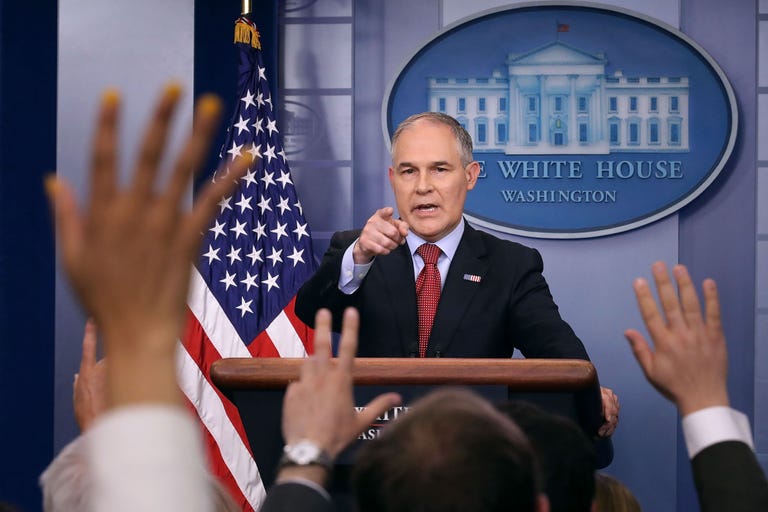
Scott Pruitt has raced to frontrunner status in our favorite new reality show, America’s Next Top Swampmonster.
Like others in President Trump’s supposedly swamp-draining cabinet, the EPA administrator was known as a big fan of flying first-class at incredible taxpayer expense. In one instance, he flew top-shelf from Washington, D.C. to New York—a four-hour drive—for a mere $1,600. But this week, we learned Pruitt had designs on being captain of this cabinet’s Blue Angels, as EPA explored leasing a private jet for Pruitt on a monthly basis. It would have cost a mere $100,000 in taxpayer cash each month, according to The Washington Post, and so was abandoned.
That little bit of public service was obscured, however, by two more episodes in Pruitt’s No Good, Very Bad Week and a Half. The Atlanticreported Pruitt went to the White House seeking raises for two longtime aides he brought with him from the Oklahoma attorney general’s office. When the request was denied, Pruitt allegedly used an obscure provision in the Safe Drinking Water Act to grant the raises anyway—to the tune of over 20-grand and 50-grand respectively. Pruitt now denies any knowledge of the raises, and had them peeled back this week after they went public.
Getty Images
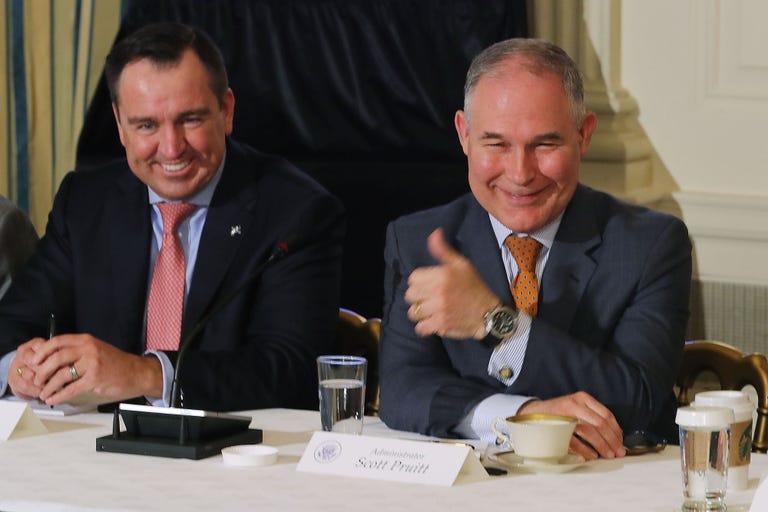
And finally, there’s the condo. ABC News broke the news that Pruitt got a sweetheart deal from the wife of a Washington lobbyist to rent a posh apartment, situated on prime D.C. real estate just steps from the Capitol, for just $50 a night. This is far below market rate. And Pruitt paid only when he stayed there. Considering the lobbyist in question represents ExxonMobil, among a host of other firms, this is a bit of obvious swampitude—to the point that even Fox News can’t abide it.
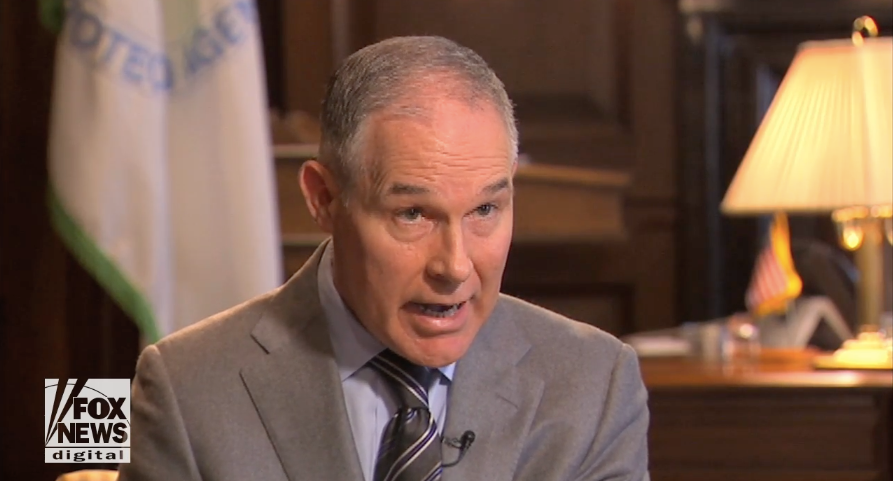
Pruitt sought comfort inside the president’s favorite television network Wednesday evening, but to his credit, correspondent Ed Henry pulled no punches and left Pruitt squirming and stammering in his chair:
Pruitt has done more interviews with Fox than all other networks combined, mostly because they’ll swallow his sell lines about the virtues of rolling back every environmental regulation, ever. This week, that included trashing a rule aimed at curbing vehicle emissions, perhaps to protect Americans’ freedom to inhale more smog. But Henry put Pruitt on the back foot throughout, starting with an exchange over the raises:
HENRY: You don’t know? You run the agency. You don’t know who did this?
PRUITT: I found out about this yesterday, and I corrected the action.
Pruitt throwing his staff under the bus is no surprise—he is, after all, a Trumpist. (Ben Carson threw his own wife under the bus.) But it doesn’t pass the laugh test that two of his closest aides got raises that proved extraordinary in more ways than one and Pruitt didn’t know a thing about it.
But then came the condo:
HENRY: President Trump said he would drain the swamp. Is draining the swamp renting an apartment from the wife of a Washington lobbyist?
PRUITT: I don’t think that that’s remotely fair to ask that question.
That just about says it all. Pruitt not only believes the rules don’t apply to him—he gets legitimately indignant when asked to be accountable to the public.
That didn’t shake Henry, though, and neither did Pruitt’s line about how the lease had been approved by EPA ethics officials. Henry reminded him that Pruitt only sought that approval when the cozy arrangement went public in the last week—months and months after it all went down. Pruitt did not care whether it abided by ethics rules until he was forced to. And then Henry got the administrator to admit he only paid for the apartment on nights he was staying there, the benefits of which the Fox host was forced to spell out to Pruitt:
HENRY: Your house in Oklahoma, you pay a mortgage on that. And when you don’t sleep there, you still pay the mortgage, right?
PRUITT: Not when I’m not using it. I mean, yes. This is a tremendous difference. I wasn’t using the facility, uh, Ed, when I wasn’t there.
Notice Pruitt’s cagey default reaction is just to make something up. No, I don’t pay my mortgage when I’m not there—wait, yes I do! He then explained that he wasn’t using the apartment when he wasn’t there, which is true and also has no bearing on the ethics.
The fact is Pruitt got a sweetheart deal on Washington real estate from the wife of a lobbyist, and at least one of that lobbyist’s clients got approval for a project from the EPA. This is a conflict of interest, an ethics disaster, and perfectly on-brand for the Trump administration.
Getty Images
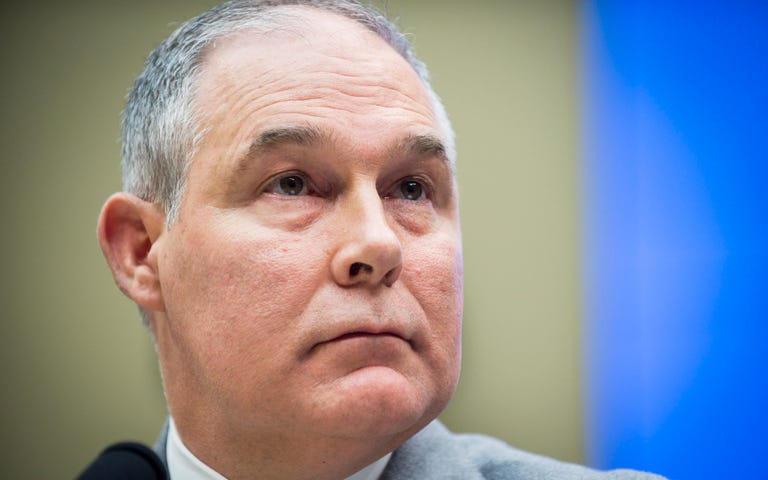
Pruitt has always transparently operated on behalf of special interests. The New York Timesgot hold of his schedule book and found it filled with fancy dinners and expensive lunches with representatives from—and lobbyists for—the industries the EPA is tasked with regulating. Pruitt had a top-secret secure phone booth installed in his offices at the agency so that his communications couldn’t be monitored. It was supposed to cost $25,000 in taxpayer cash, but ended up at over $43,000. That was spent presumably so that Pruitt can more effectively Protect the Environment, and definitely not so he can coordinate with those same lobbyists and industry types.
Of all the swamp monsters summoned forth by the Trump Era, Pruitt may well be the most diabolical. He was party to a baker’s dozen of lawsuits against the EPA at the time he was nominated to lead it. As Oklahoma’s attorney general, he received a letter from a prominent energy company complaining about EPA regulations, then stamped his letterhead on it and sent it on to the EPA as official correspondence from this office.
Since becoming the head of the EPA, he has rolled back every regulation in sight, including the Clean Power Plan, which is the United States’ main initiative to comply with the Paris Climate Accords.
Getty Images
That ought to be the most damning dimension of his legacy, along with whatever harm he brings to the quality of air and water in the United States. One wonders how many more Flints there will be by the time Pruitt leaves office. Instead, his obvious swampitude will probably hold the public’s attention.
Pruitt believes he should be free to act however he pleases as a public official, feeding special interests and living in style on the taxpayer dime. That much is clear from the interview. Even worse: He is insulted when you dare ask him why. It’s not just the environment—the very principle of holding public servants accountable is under threat right now. Props to Ed Henry for keeping the tradition alive.
Scott Pruitt Says His Lobbyist Landlord’s Clients Didn’t Have Business Before the EPA. They Did.
The EPA chief’s defense of his sweetheart rental is lacking some basic facts.
Sam Stein, Lachlan Markay April 5, 2018
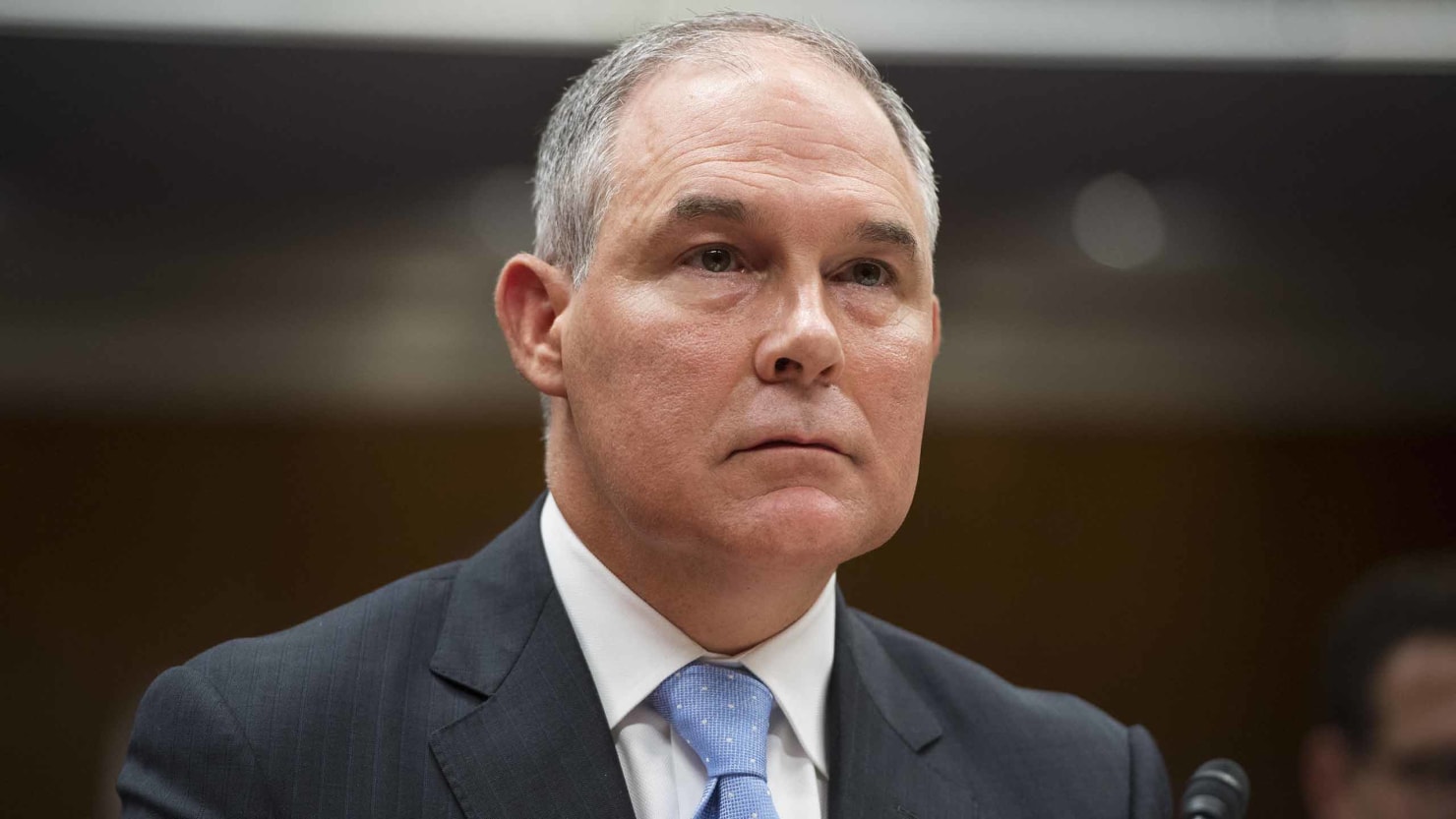
As he doggedly tries to save his job amid a mounting ethics scandal, Environmental Protection Agency chief Scott Pruitt has insisted that there was no formal or informal conflict of interest when he rented a room from high-profile Washington D.C lobbyist, J. Steven Hart.
“Mr. Hart,” Pruitt claimed in an recent interview with Fox News on Wednesday, “has no clients who have business before this agency.”
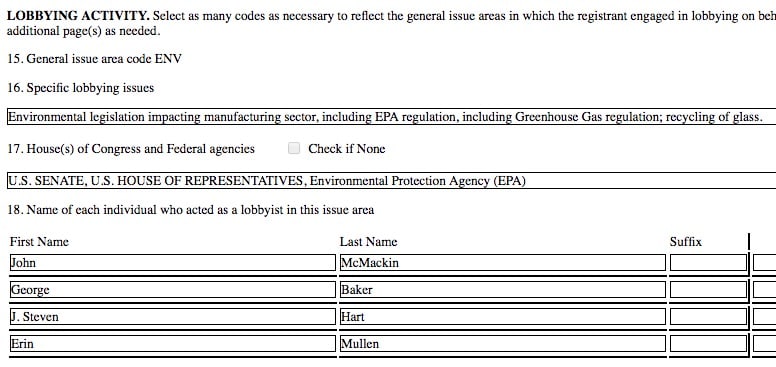
A review of lobbying disclosure forms and publicly-listed EPA records, however, suggests that Pruitt is either lying or is woefully unfamiliar with the operations of his own agency.
Far from being removed from any EPA-related interests, Hart was personally representing a natural gas company, an airline giant, and a major manufacturer that had business before the agency at the time he was also renting out a room to Pruitt. One of his clients is currently battling the EPA in court over an order to pay more than $100 million in environmental cleanup costs.
The New York Times previously reported that Hart’s firm, Williams & Jensen, represented a company that got a pipeline expansion project approved by the EPA. But that only scratches the surface of Hart’s deep involvement in the energy industry—and advocacy on behalf of clients with business before the agency that his one-time tenant leads.
Hart himself was part of a team of four Williams & Jensen lobbyists that has reported lobbying Pruitt’s EPA. They did so on behalf of Owens-Illinois, a glass bottle manufacturer that paid $39 million in 2012 to settle EPA allegations of widespread Clean Air Act violations by a subsidiary. In June 2017, while Pruitt lived at Hart’s DC condo, another of the company’s subsidiaries settled additional EPA allegations that it violated the same law.
“We know that Steven Hart’s firm had clients before the EPA,” said Craig Holman, Government Affairs Lobbyist for the good-government group Public Citizen. “So his insistence that there is no conflict of interest is just off the wall.”
Even clients of Hart’s who didn’t enlist him to lobby the EPA directly had at least tangential business before the agency.
Among them is industrial equipment manufacturer Stanley Black & Decker, which is currently in litigation with the EPA over its own environmental liabilities. In 2014, the EPA ordered the company to pay $104 million in cleanup costs at a super-fund site in Rhode Island. Black & Decker disputed the ruling, but estimated in its most recent annual shareholder report, it expects that it may eventually have to pay between $68 million and $140 million in remediation costs at the site. The case is currently working its way through federal court, an EPA official confirmed to The Daily Beast. And Pruitt himself has directly weighed in on the matter, elevating the super-fund site as a target for immediate and intense attention.
Hart’s other clients include Cheniere Energy, which as Fox’s Ed Henry noted operates liquified natural gas terminals on the Gulf Coast and is reportedly one of the best positioned companies for Pruitt’s American gas export campaign. “Steve has never represented them,” Pruitt insisted to Henry.
In a separate interview with The Daily Signal, the news arm of the conservative Heritage Foundation, Pruitt claimed that “[Hart’s] firm represents these [energy industry] clients, not him. There has been no connection whatsoever in that regard.”
In fact, Hart represents numerous firms in the energy space, in addition to Cheniere. Black & Decker subsidiary Stanley Oil and Gas “provides world-class pipeline services and equipment in more than 100 countries, offshore and onshore,” according to its website. Another Hart client, Smithfield Foods, manufactures energy through the use of animal waste collected at its hog production facilities. Hart’s lobbying on behalf of the company routinely includes advocacy on energy policy issues.
Other Hart clients have had business before the EPA on either ceremonial or non-energy related matters. Hart represents the Coca-Cola Company, which has landfill and bottling operations that have fallen under the EPA’s purview. Hart represents United Airlines, which is involved in an aircraft drinking rule program for which the EPA—while Pruitt was staying at Hart’s condo—issued self-inspection requirements. And until December 31 of last year, Hart represented the American Automotive Policy Council, a trade group formed by Chrysler, Ford Motor Company and General Motors; automakers that have numerous policy interests the overlap with the chief environmental protection agency in America.
A request for comment to Hart was not returned seeking clarity as to what, if anything, he did to advance his clients interests before the EPA. In some cases, however, it is clear that his clients fared poorly. This past week, for example, Pruitt announced that he would be rolling back Obama-era car emissions standards, a policy that both Ford and GM have been vocal about not supporting, as one plugged-in Hill source explained.
An Illinois town passed an assault weapons ban – now the NRA is backing an effort to overturn it
By Brianna Provenzano April 5, 2018
After officials in the Chicago suburb of Deerfield, Illinois, unanimously voted to ban the sale, manufacture and possession of assault weapons on Monday, prominent gun rights group Guns Save Life vowed to take legal action against the ordinance — and the National Rifle Association said that it will help.
In a statement on Wednesday, the Institute for Legislative Action — the lobbying arm of the NRA — said that the organization “is pleased to assist [Gun] Save Life” in its legal efforts to challenge the village of Deerfield’s confiscation ordinance.
“Every law-abiding villager of Deerfield has the right to protect themselves, their homes and their loved ones with the firearm that best suits their needs,” Chris W. Cox, executive director of NRA-ILA, said in the statement. “The National Rifle Association is pleased to assist [Guns] Save Life in defense of this freedom.”
With the passage of the Deerfield ban, residents will have until June 13 to remove existing assault weapons and large capacity magazines from within the village limits, with a failure to do so potentially resulting in fines of up to $1,000 a day, Matthew Rose, the village attorney, told the Chicago Tribune.
Deerfield officials released a statement Tuesday explaining that the town had based its law on an ordinance passed by Highland Park, Illinois, in 2013. That ordinance faced legal challenges but was deemed lawful by a federal appeals court, according to the Tribune.The Supreme Court declined to consider the case.
John Boch, the president of Guns Save Life, said in the NRA’s statement that the ordinance “clearly violates our member’s constitutional rights.”
“With the help of the NRA I believe we can secure a victory for law-abiding gun owners in and around Deerfield,” he said.
In an email to Mic, Boch declined to comment further on the lawsuit, but did elaborate on the decision in a piece published on TheTruthAboutGuns.com on Thursday.
“The AR-15 stands as America’s favorite rifle for a number of very good reasons.” Boch wrote. “Yes, guns protect families. Guns protect children. Banning one of the most effective guns widely in use by America’s nearly 100 million gun owners will only serve to protect criminals, lunatics and terrorists.”
Deerfield Mayor Harriet Rosenthal asked the village attorney and town staff to draft an ordinance following the Feb. 14 shooting at a Parkland, Florida, high school that left 17 students and faculty members dead, according to the town’s statement.
In the wake of that tragedy, the surviving students of Marjory Stoneman Douglas High School have become some of the most prominent faces of the national movement for gun reform — and it was their composure and poise, Rosenthal said, that inspired Deerfield to take action.
“Enough is enough,” Rosenthal told the Chicago Tribune. “Those students are so articulate just like our students. There is no place here for assault weapons.”
Silent spring revisited: New worries and the human future
By Kurt Cobb, orig. pub. by Resource Insights April 1, 2018
Photo: “Two lovely animals” (2017). Photo by Bgada9. Via Wikimedia Commons.
A precipitous decline in bird populations in France suggests that the silent spring foretold by Rachel Carson more than 50 years ago in her book of that name may yet arrive. The proximate cause of the 33 percent decline in avian populations noted by French researchers over the last 15 years is lack of food.
In practical terms, the birds are not being poisoned as they were in Rachel Carson’s day. Rather, their main sources of food, insects, are dropping like, well, flies. The ultimate cause is overuse of pesticides related mostly to agriculture, pesticides which are working all too well in keeping insect populations in check.
Described as “an ecological catastrophe,” the decline in bird populations has reached 66 and 70 percent for some species; and the decline is not just in agricultural areas, but also in forested areas outside of agricultural zones.
The findings are not that surprising given previous reports of declines in insect populations of up to 76 percent over that last 27 years in Germany.
While we humans may lament the loss of such beautiful creatures and the degradation of the natural environment, there is an even darker destination which few contemplate. Humans are not just hermetically sealed beings. Instead, we now understand ourselves as agglomerations of cells and other organisms cooperating to keep us alive and healthy. Humans are said to have a microbiome. While the extent of that microbiome is unclear—estimates range from a ratio of 1 microbe for every human cell to 10 microbes per cell—what is clear is that we are completely dependent on thousands of microscopic species.
Of course, we aren’t spraying ourselves with pesticides—at least not intentionally. But our dependence on the natural world extends beyond our skin. Of course, we depend on it for food, water, sunlight, and air. What may be hidden from us—because we are only just now beginning to understand the complexity of our connections to the natural world—are myriad dependencies about which we know nothing and which, if severed, could lead to fatal results.
A year ago I asked which species can we humans survive without. We continue to engage in an uncontrolled experiment to find out. The French avian population survey suggests we are surprisingly far along in that project without even realizing the danger not just to wildlife, but to our very survival.
Kurt Cobb is a freelance writer and communications consultant who writes frequently about energy and environment. His work has appeared in The Christian Science Monitor, Common Dreams, Le Monde Diplomatique, Oilprice.com, OilVoice, TalkMarkets, Investing.com, Business Insider and many other places. He is
Can Scott Pruitt Poison the Environment Enough to Save His Job?
Bess Levin, Vanity Fair April 5, 2018
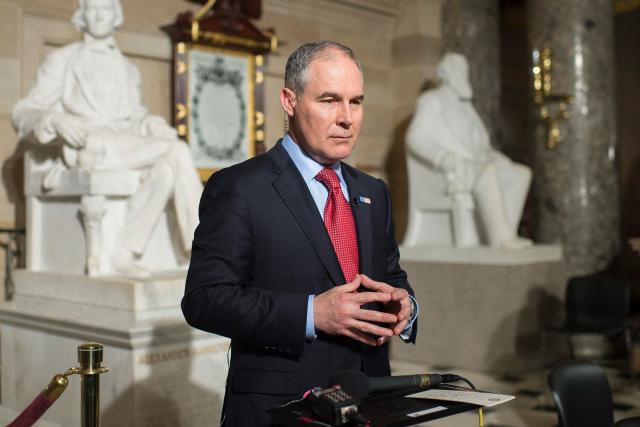
The future of Trump’s favorite polluter looks hazy.
The past couple months have been less than ideal for pollution enthusiast Scott Pruitt. At first, headlines about his expensive (taxpayer-funded) travel habit were mostly indistinguishable from similar scandals plaguing other Trump administration Cabinet members. More recently, however, negative stories about the anti-E.P.A. administrator have been tumbling out of his agency on a near daily basis. In the past week alone, we learned that Pruitt was living in a top lobbyist’s D.C. townhouse for just 50 bucks a night—when similar accommodations would have set him back several multiples of that rate—and just happened to approve a deal for one of his landlord’s water-polluting clients to expand a pipeline project after it had the distinction of receiving the second-biggest fine in the history of the Clean Water Act. On Monday, word leaked to The Washington Post that Pruitt’s staff had considered leasing a $100,000-a-month private jet to accommodate his luxe “travel needs”; on Tuesday, sources whispered to The Atlantic that Pruitt had bypassed the White House to give substantial pay raises to two of his closest aides.
Up until recently, it appeared that Pruitt’s job, if not safe, was at least as secure as anyone else’s in an administration in which casual corruption is a venial sin and job security hinges on the whim of a mostly unhinged president. By Wednesday, however, the White House’s stance on the Pruitt Situation seemed to have shifted markedly. For the first time, spokeswoman Sarah Huckabee Sanders said publicly that “The president’s not” O.K. with the E.P.A. chief‘s actions. She also declined to confirm reports that Trump rang up Pruitt in recent days to offer support. “We’re reviewing the situation. When we have had the chance to have a deeper dive on it we’ll let you know the outcomes of that,” Sanders added. “But we’re currently reviewing that here at the White House.” To those familiar with the roundabout way that Donald Trump slowly exfoliates aides who become irritants, the chilly response looked like a kiss of death.
Perhaps recognizing the gravity of his situation, Pruitt attempted to control the damage Wednesday, with mixed results. “I’m dumbfounded that that’s controversial,” he told the Washington Examiner, referring to his lobbyist-sponsored living situation. Asked by Fox News if the arrangement contradicted Trump’s pledge to “drain the swamp,” Pruitt acted shocked: “I don’t think that that’s even remotely fair to ask that question.” In other interviews, he suggested that the leaks are part of a liberal plot against him, with his enemies willing to “resort to anything” to stop him from deconstructing Obama’s environmental regulatory regime. Speaking to The Washington Times, Pruitt said he was under attack by a “bastion of liberalism,” which apparently forced him to sign a rental agreement that virtually anyone could’ve told him was ethically problematic at best. In Axios, an unnamed Pruitt defender appeared to channel his view of the world, telling the outlet that “this is really about ideology, driven by folks on the left who don’t like” his agenda, and that the bad press is allegedly coming from a recently dismissed political appointee. (That person, when contacted by Politico, denied the accusations and suggested that the E.P.A. is trying to deflect attention by attacking people who have questioned Pruitt’s decisions.)
Over at the White House, Chief of Staff John Kelly is said to be extremely miffed he wasn’t warned in advance that Trump’s E.P.A. head was a ticking time bomb, telling Pruitt in a phone call that “the flow of negative and damning stories needed to stop.” “[It] was not a friendly buck-up call at all,” is how one administration official described the chat to the Daily Beast. Yet for all the major lapses in judgment—practically a job requirement for Trump staffers, given their track record—Pruitt still has one thing going for him: he’s been the most “effective” member of Trump’s Cabinet, which in this case means he’s proven especially adept at gutting the agency he was tasked with running 14 months back. Trump may not appreciate the negative attention Pruitt is getting—and he certainly hates the positive attention, such as a New York Times headline last month, “Scott Pruitt, Trump’s Rule-Cutting E.P.A. Chief, Plots His Political Future”—but he loves what Pruitt has done for his industry pals. “As long as [Trump] feels Pruitt is effective and on his side, he’s probably fine,” one source close to the administration told the Daily Beast.
Pruitt, for his part, made sure to lay things on particularly thick while announcing the rollback of Obama’s car emissions rules this week. “This president has shown tremendous courage to say to the American people that America is going to be put first,” he said at the gathering. With the rollbacks, Pruitt added, “the president is again saying America is going to be put first.” Time will tell whether Pruitt is still around by the time those rules go into effect.
Top EPA staff who criticized Scott Pruitt were either demoted or reassigned
A glimpse into how Pruitt dealt with his critics.
By Kyla Mandel April 5, 2018
The scandals surrounding EPA administrator Scott Pruitt continue to grow. Credit: Ricky Carioti / The Washington Post via Getty Images
Five top Environmental Protection Agency (EPA) employees were either placed on leave or reassigned after raising concerns about Administrator Scott Pruitt’s spending and management habits.
The news, revealed by the New York Times on Thursday afternoon, shows high-ranking EPA officials repeatedly raised concerns about Pruitt’s exorbitant spending on first-class travel and office furniture, as well as certain demands made for increased security coverage, including expanding his protective detail to 20 people.
The revelations add to a growing picture that numerous officials within the agency were aware of, and voiced their objection to, Pruitt’s ethically questionable habits. And yet, nothing appears to have been done to change course. Instead, critics were demoted.
Kevin Chmielewski, a Trump administration political appointee, was placed on administrative leave without pay after bringing his concerns about Pruitt’s conduct directly to the White House personnel office. Chmielewski reportedly objected to the idea of buying a $100,000-a-month charter aircraft membership for the administrator, as well as spending $70,000 to replace two desks in his office.
Eric Weese questioned some of Pruitt’s security requests, including the use of lights and sirens when he was running late — on one occasion, so he could get to dinner at the popular D.C. restaurant Le Diplomate, according to the Times report. Weese was moved off Pruitt’s security detail.
An EPA spokesperson denied that the reassignments were connected to the staff members’ push-back on Pruitt’s extravagant spending and unreasonable requests.
Pruitt’s repeated denials regarding the numerous allegations of ethical misconduct he is currently facing stand on increasingly thin ground as more information emerges.
Earlier this week, news came out that Pruitt went around the White House to approve significant pay increases for two of his closest aides. When asked by Fox News why he went around President Trump to give the pay raises, Pruitt denied he approved the salary increases. “I did not,” he said. “My staff did. And I found out about that yesterday and I changed it.”
During the Fox News interview, Pruitt was also questioned about whether it might be an issue that he had rented a Capitol Hill condo — for below market value — linked to an energy lobbyist. Pruitt dodged, saying “Mr. Hart has no clients who have business before this agency.”
In reality, Steven Hart is a high-profile lobbyist for Williams & Jensen whose clients include Canadian pipeline company Enbridge. As it happens, during the same period of time that Pruitt was renting the condo, the EPA signed off on a pipeline approval for Enbridge.
And according to The Daily Beast, Hart was part of a team of four lobbyists at Williams & Jensen that reported lobbying the EPA on behalf of a glass bottle manufacturer, Owens-Illinois, which had paid almost $40 million in 2012 to settle allegations it faced from the EPA about Clean Air Act violations by one of its subsidiary.
Despite the ever-unfolding series of controversies surrounding Pruitt, Trump continues to voice support for him.
“I think Scott has done a fantastic job. I think he’s a fantastic person. You know, I just left coal and energy country,” Trump told reporters Thursday. “They love Scott Pruitt. They feel very strongly about Scott Pruitt. And they love Scott Pruitt. Thank you very much everybody.”

 Alexander Torshin Mario Ruiz/Epa/REX/Shutterstock, Mark Peterson/Redux
 Femme fatales, lavish Moscow parties and dark money – how Russia worked the National Rifle Association.
 (Photo: Keith King, Associated Press)
 Patty Peek is a registered nurse. She lives in St. Ignace. (Photo: Patty Peek)
 Greenpeace Indonesia / Instagram
 Screenshot
 Getty Images
 Getty Images
 Getty Images
 As he doggedly tries to save his job amid a mounting ethics scandal, Environmental Protection Agency chief Scott Pruitt has insisted that there was no formal or informal conflict of interest when he rented a room from high-profile Washington D.C lobbyist, J. Steven Hart.
 Steven Hart Lobbying Form

 The future of Trump’s favorite polluter looks hazy.
 The scandals surrounding EPA administrator Scott Pruitt continue to grow. Credit: Ricky Carioti / The Washington Post via Getty Images
