Finnish Prime Minister Marin calls for a 4-day-week and 6-hour-day for her country

Scoop.me – Europe

Finnish Prime Minister Marin calls for a 4-day-week and 6-hour-day for her country

Finland’s new head of state caused enthusiasm in the country: Sanna Marin (34) is the youngest female head of government worldwide. She leads a centre-left coalition in which all 5 government parties have women at the top. Her aim: To introduce the 4-day-week and the 6-hour-working day in Finland.

Sanna Marin is the new Prime Minister of Finland. The 34-year-old social democrat was celebrated internationally because of strong women-led government: It is a coalition of five parties – and in all of them, women are the leaders.

For Sanna Marin, the fact that she is young and female doesn’t play a big role:

“I have never thought about my age or gender. I think more about the motivations that brought me into politics.”

Marin wants “much shorter working hours”

More important for Marin is the question, how long the Finns should have to work. She demands much shorter working hours on the occasion of the 120th anniversary of the Social Democratic Party (SDP) in Turku. In her position as Minister of Transport and Communications, she said:

A four-day work week, a six-hour workday. Why couldn’t it be the next step? Is eight hours really the ultimate truth? I believe people deserve to spend more time with their families, loved ones, hobbies and other aspects of life, such as culture. This could be the next step for us in working life.

In Finland, 8-hour-days for five days a week are common in peoples’ work life. The left-wing alliance, with which Marin has formed a coalition recently, demanded a test run for the 6-hour-day.

Göteborg proves it: 6-hour-days keep you happy and healthy

The 6-hour-day already works in Finland’s neighbour country Sweden: In 2015, Gothenburg, Sweden’s second largest city, reduced working time to six hours a day in the old peoples’ homes and the municipal hospital – while still full paying their employees. The results two years later: The employees were happier, healthier and more productive. With the reduction in working hours, services were expanded and patients were more satisfied.

And the costs were stable: More employees were hired, which resulted in more tax revenue. In Addition to that, fewer sick days, fewer invalidity pensions and fewer people unemployed saved money.

Swedish Tech Industry as Pioneer

In the Swedish tech industry, the 6-hour-day has been default for many years. First and foremost, the automobile manufacturer Toyota proved how it works. As early as 2003, the Gothenburg plant switched to shorter working days with full pay.

Not only were Toyota’s employees more satisfied and motivated, they could also increase their productivity – and in the end: Toyota’s profits. The reasons for this are simple: First, unnecessarily long meetings were discarded or made more efficient. And second, there are much fewer idle times in the working day that are filled with social media or Internet surfing.

People go to work and do it more focused and concentrated. Then they go home and have enough time to spend the afternoon with their families, friends and hobbies.

The social democratic magazine Kontrast.at covers current political events, both in Austria and in the rest of the world. We view society, state and economy from a progressive, emancipatory point of view. Kontrast casts the gaze of social justice on the world.

Surprise Medical Billing Drives Up Health Care Spending by $40 Billion a Year

The Fiscal Times – Health Care

Surprise Medical Billing Drives Up Spending by $40 Billion a Year: Report

By Michael Rainey       December 17, 2019

Getty Images/Joe Raedle

It looks like Congress won’t be doing anything about surprise medical bills this year, but a new study in Health Affairs shows why the issue will likely remain font and center next year.

Analyzing reams of insurance data, researchers found that many out-of-network bills come from a small percentage of medical specialists who typically work in emergency rooms at for-profit hospitals and who therefore cannot be avoided by patients. While out-of-network charges are produced by only a small percentage of hospitals and practitioners, the bills that do emerge are sometimes much higher than average and push up spending by private insurers by billions of dollars – costs that are eventually reflected in everyone’s premiums.

“When physicians whom patients cannot avoid can work out of network from in-network hospitals, it exposes patients to significant financial risk and raises physicians’ in-network payments,” the study says. “Anesthesiologists, pathologists, radiologists, and assistant surgeons are out of network in approximately 10 percent of cases [in the study]. We estimated that these specialists’ ability to bill out of network raises total health care spending for people with employer-sponsored insurance by approximately 3.4 percent ($40 billion).”

Dan O’Neill, a health policy fellow at the Robert Wood Johnson Foundation, did some quick back-of-the-envelope math to calculate the average cost for policyholders, based on the study in Health Affairs: “To boil this down to a headline: The business practice of surprise billing costs a typical American family on a private health plan about $1,000 per year (+/-).”

Trump’s proposed Social Security disability cuts could end benefits for thousands.

USA Today – Politics

Trump’s proposed Social Security disability cuts could end benefits for thousands. What to know

This is why Social Security is running out of money
USA TODAY


NASHVILLE, Tenn. – The Trump Administration is proposing new rules for the nation’s safety net program for people with disabilities that could end benefits for tens of thousands of people.

The rules would require more frequent paperwork checks of people getting Social Security disability payments in a process known as a “continuing disability review.”

The proposed new rules have alarmed some advocates for people with disabilities, who call it a “backdoor way” to cut people from a program already under scrutiny for taking years to review disability claims and wrongly denying benefits.

Social Security Administration officials say the plan would “enhance program integrity and ensure that only those who continue to qualify for benefits will receive them.”

Whose Social Security disability benefits would be impacted?

More than 16 million adults and children currently receive disability benefits, but the Social Security Administration isn’t saying how many people the new rules would affect.

The agency has said it expects to conduct 4.4 million more continuing disability reviews over ten years if the rules take effect. The reviews would add $1.6 billion in administrative costs, but save $2.8 billion in benefits when people are cut from the program.

Using those figures, national advocates for people with disabilities estimate tens of thousands of people stand to lose disability benefits each year.

Alan Chrisman holds medical bills and records near the McDonald's where he worked at as a maintenance employee before being diagnosed with stage 4 colorectal cancer. This photo has been altered to blur the address on the envelope.

What is Social Security disability?

The Social Security Administration is best known for retirement benefits, but it also oversees two programs for people living with disabilities:

Supplemental Security Income, or SSI, is for low-income individuals without a work history. The maximum payment for an individual is $783 a month beginning in January.

Social Security Disability Insurance is for workers who become disabled. Payment amounts depend on past earning. In 2019, the average payment was $1,234 per month.

To qualify for either, individuals must show they have a long-term medical, psychological or intellectual impairment that prevent them for working.

Children who are blind or have severe functional limitations expected to last at least a year or result in death also qualify.

Tennesseean investigation: How some Tennessee doctors earn big money denying disability claims

The fine print on disability reviews

Once on disability, adults and children are subject to “continuing disability reviews” by Social Security staff.

The reviews require recipients to submit medical, income and asset records as well as documentation of living arrangements. Social Security staff then decide whether someone still qualifies for benefits.

How frequently anyone is required to go through a review depends on which of three categories Social Security has placed them in. Individuals whose conditions are expected to improve — babies born prematurely, for example — are in a category called “medical improvement expected” and reviewed every six to 18 months.

Victory for disability advocates: Supreme Court won’t hear Domino’s Pizza accessibility case

People with debilitating or terminal conditions are in a “medical improvement not expected” category, reviewed every five to seven years.

Those in the “medical improvement possible” category are reviewed every three years.

Social Security officials are proposing a fourth category, “medical improvement likely,” to be reviewed every two years.

Children would also be automatically reassessed at age 6 and 12. The Social Security Administration would also change some of the criteria for deciding in which category to place individuals.

You can read the rules here.

How applying for disabilities works in Tennessee

Disability docs: Doctors speed through disability claims, make millions: 6 takeaways from our investigation

Why the Social Security plan is controversial

The reviews require recipients to submit large volumes of paperwork, a complicated and burdensome process for people living with a disability.

People go through a similar process when they first apply, which can take two or more years to complete.

Advocates are concerned people would lose benefits because they are unable to navigate the process, even though they did not experience any medical improvement.

A Tennessean investigation earlier this year found that some doctors hired to review disability claims raced through the paperwork at an implausible pace while billing six figures annually.  Experts say it’s impossible to review disability claims so quickly without wrongfully rejecting claims. The report prompted an investigation by the Government Accountability Office, which is ongoing.

Advocates have also questioned the Social Security Administration’s projected savings.

The new reviews will save about $1.50 for every dollar spent, according to agency estimates.

Those projected savings, however, are significantly lower than what the Social Security Administration says it saves on current disability reviews: about $19 for every dollar spent.

What happens next?

A public comment period is open until Jan. 31 before the rules can be approved.

Congressional Democrats, in a letter to the Social Security Administration on Dec. 19, requested the comment period be extended to March 16.

Comments may be submitted online here or mailed to the Office of Regulations and Reports Clearance, Social Security Administration, 3100 West High Rise Building, 6401 Security Blvd., Baltimore, Maryland 21235-6401.

Follow Anita Wadhwani on Twitter:

This article originally appeared on Nashville Tennessean: Social Security disability benefits program may change: Things to know

For Mouth & Foot Painting Artists, anything really is possible

CBS Sunday Morning

For Mouth & Foot Painting Artists, anything really is possible

CBS NEWS                        December 15, 2019

At the Zenger Group printing plant in Buffalo, New York, Christmas came early … really early. It was August when holiday cards were rolling off the presses –a summer-time snowdrift of paper, each card as individual as a snowflake.

You might think in these digital days of ours that sending greeting cards like these is a bit old-fashioned. But for the very special artists who paint them, it’s anything but just a quaint tradition.

“I would love just for people to just enjoy the piece for what it is, and not necessarily be taken back by the way that I’m doing it,” said artist Alana Tillman.

She was born with a condition that left her arms locked in place, but she’s been drawing with her mouth since he was a kid.

alana-tillman-mouth-and-foot-painting-artist-with-lee-cowan-620.jpg
Artist Alana Tillman, a member of Mouth & Foot Painting Artists.  CBS NEWS


“No one taught you how to do it? You just figured it out?” asked correspondent Lee Cowan.

“No, I just kind of figured it out,” Tillman said. “I’ve always had to prove myself to people that I am capable. Doubters in my life just made me want to achieve even more.”

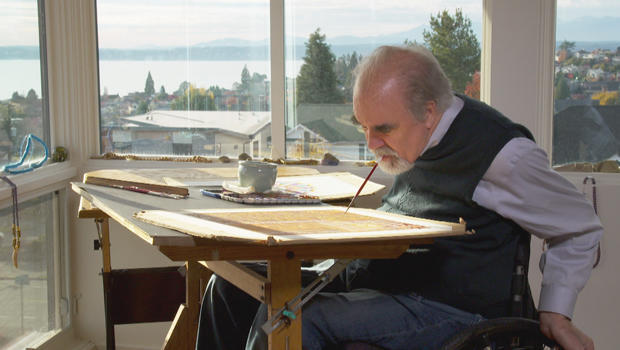
Then there’s artist Brom Wikstrom: “When I got out of the hospital it was just something to maintain my sanity, you know, to give me something to do,” he said.

“More therapy than anything?” asked Cowan.

“Yeah, to help me feel better about myself.”

brom-wikstrom-mouth-and-foot-painting-artist-620.jpg
Artist Brom Wikstrom at work.  CBS NEWS


Wikstrom was paralyzed at age 21, when he dove head-first into the Mississippi River in 1975.  He’s been painting with his mouth almost every day since“I would just paint from morning until night,” he said.

“So, it sounds like it’s almost a need for you to paint,” Cowan said.

“At this point, I can’t imagine what else I’d be doing.”

It’s remarkable to watch either of them paint – the detail, the finesse, the control.

brom-wikstrom-mouth-and-foot-painting-artwork-620.jpg
An example of Brom Wikstrom’s artwork.  CBS NEWS


And no, they don’t just paint holiday cards; they each have huge portfolios. But it’s the Christmas cards that have helped pave the way for their careers, and which have helped make possible an association called the Mouth and Foot Painting Artists. Its name takes a bit of getting used to, but not its goal: the money from its Christmas cards goes to financing disabled artists. It’s not about charity; it’s about empowerment.

It is, said Jim March, the director of North American Operations, “very much not a non-profit. They’re very proud of not being a non-profit situation. It’s a business to make money to give them a living.”

The MFPA, as it’s called, was started in 1957 by Arnulf Erich Stegmann, a German painter who had lost the use of his hands due to polio. Despite his challenges, he became an accomplished artist and publisher, who sought out other painters like him to help further their skills and build their careers.

holiday-cards-from-mouth-and-foot-painting-artists-montage-620.jpg
Examples of holiday cards from the Mouth & Foot Painting Artists.  MFPA


Today, there are about 800 artists who are members of the association, and every one of them gets a monthly stipend based on their skill level. They enter as student members, like Alana Tillman, who lives on her own in Santa Rosa, California.  She gets enough to pay for art courses as well as supplies, and it certainly helps pay the rent.

“Before they came along, I was just living off of my Social Security. I didn’t really feel like I was a contributing member to society,” she said.

“So, has it given you a sense of independence?” asked Cowan.

“Way more independence.”

She’s adapted to just about everything, including driving to work. She now owns her own business, called ArtXcursion, where she offers painting lessons (people don’t have to paint with their feet or mouth), with a side of wine and appetizers.

“Talking about my adversities, I think is what kind of helps them realize that they can actually do it, too,” Tillman said.

Brom Wikstrom has been with the MFPA so long, he gets a full salary, the equivalent of what any other commercial artist near his home in Seattle might be paid.  “I thought that I was going to be on public assistance, or you know, how was I going to make it?” he said.

Now he’s on the payroll forever, regardless of whether he stops painting or not.  “It is a lifetime position now, so if physically I was incapable of working, they would be there for me,” he said.

That’s a relief not only for him, but for his wife of 30 years, Anne. The association, she said, has not only provided Brom with a living wage, but something much harder to quantify: Confidence.

Wikstrom works part-time at the Burke Museum at the University of Washington, and he volunteers at schools, showing children that, yes, anything really is possible.

As successful as both Wikstrom and Tillman have become, their daily struggles remain. But what they hope can be changed is perception.

They want to be seen simply as artists, not “disabled artists,” who at this time of year are truly making our season bright.

“I think people do us kind of a double kindness because they’re buying our cards, but they also get to send those cards out to their loved ones,” Wikstrom said. “And it seems like such a small thing  but it means a lot.”


For more info: 

FDA Approved Treatment for Essential Tremors.

Learn About The Revolutionary Treatment For Essential Tremor.
FDA- approved incisionless treatment.

Now Covered by Medicare & Blue Cross Blue Shield plans.

See if You May be a Candidate for Treatment.

FDA Approved Treatment For Essential Tremor

Learn About The Revolutionary Treatment For Essential Tremor. FDA- approved incisionless treatment.Now Covered by Medicare & Blue Cross Blue Shield plans.See if You May be a Candidate for Treatment.

Posted by INSIGHTEC on Wednesday, September 18, 2019

Northwest Family Farm Bankruptcies Increase

OPB TV – BBC Newshour

Northwest Family Farm Bankruptcies Increase

The number of family farms seeking bankruptcy protection grew 24% over the last year, according to an Ameican Farm Bureau Federation analysis of recent court data.

The analysis found family farm bankruptcies are rising fastest in the Northwest.

“We’ve seen low crop prices, low livestock prices for a number of years now,” said chief economist John Newton. “On the back, now, of that we have the trade war where agriculture’s been unfairly retaliated against.”

Newton monitors Chapter 12 bankruptcy filings as one measure of health for the farm economy. Chapter 12 is a kind of bankruptcy protection meant to help family farmers reorganize and keep farming.

Courtesy of the American Farm Bureau Federation

Nationwide, 580 family farms filed for bankruptcy in the 12-month period ending in September 2019. Newton considers that a sign of poor health.

“While it’s nowhere near the historical highs we saw in the ‘80s, it’s an alarming trend that continues to get worse,” he said.

Newton said farmers are also assuming record debt and taking longer to pay it back.

“I’m getting calls from farmers across the country that may not be at Chapter 12 bankruptcy point, but they’re very close to it,” he said.

Thirty-three farms in the Northwest filed for Chapter 12 protection over the time period measured. Most of them were in Idaho and Montana, but the figure includes Oregon apple farmers struck by tariffs in their major export markets.

Richard and Sydney Blaine, for example, filed for Chapter 12 protection just days after President Donald Trump signed a law this summer making it easier to access. The Family Farmer Relief Act increased the amount of debt a farmer can have —$10 million — and still qualify for Chapter 12 protection.

The 33 Northwest bankruptcies represent a 74% increase over the previous year, according to the American Farm Bureau’s analysis. The size of the increase appears large in part because the Northwest previously had fewer bankruptcy filings than some other regions, such as the Midwest.

Still, economist John Newton said each Chapter 12 bankruptcy matters.

“These are family farms,” he said. “And these are family farms that are having to restructure their debt due to tough financial conditions in agriculture.”

Because of the new bankruptcy rules, more farms could seek protection in the months ahead.