What the GOP Response to the Paul Pelosi Attack Reveals About Our Miserable Political Discourse
Brian Bennett – October 31, 2022
Speaker Pelosi’s husband assaulted with hammer inside home
Police take measurements around Speaker of the House Nancy Pelosi’s home after her husband Paul Pelosi was assaulted with a hammer inside their San Francisco home on October 28, 2022. Credit – Tayfun Coskun—Anadolu Agency via Getty Images
As House Speaker Nancy Pelosi’s 82-year-old husband Paul lay in a San Francisco hospital with a skull fracture from a late-night home intruder over the weekend, Donald Trump Jr. thought it would be a good time for jokes.
The son of a former President on Sunday retweeted a photo of a “Paul Pelosi Halloween costume” showing underwear and a hammer, a reference to a debunked conspiracy theory about the attack. On Monday, he posted to Instagram a lewd cartoon image promoting the same conspiracy theory. “Dear fact checkers this has nothing at all to do with anything going on in the news,” he wrote.
The mean-spirited digs after an act of political violence highlighted the devolved state of American political discourse just over a week before a crucial midterm election in which control of Congress hangs in the balance.
“Some fringe figures think it somehow enhances their reputation to articulate disgusting and revolting messages in the wake of a tragedy,” says Whit Ayres, a prominent Republican strategist and pollster. “Our political discourse continues to spiral down below what acceptable political discourse has been in the past. We will see if there is any bottom. There doesn’t appear to be.”
David DePape, the 42-year-old man accused of breaking into the Pelosi home with zip ties and attacking Paul Pelosi with a hammer, was federally charged on Monday with assault and attempted kidnapping. DePape allegedly broke into the Pelosi home prepared to “detain and injure” Nancy Pelosi, and break “her kneecaps” if she “lied,” to him, according to a sworn affidavit submitted by an FBI special agent.
Some senior Republicans who had locked horns with Pelosi over the years in tough legislative negotiations were quick to express their condolences in the wake of the attack. Senate Minority Leader Mitch McConnell wrote he was “horrified and disgusted” by the assault. Former Vice President Mike Pence wrote, “This is an outrage and our hearts are with the entire Pelosi family.” House Minority Leader Kevin McCarthy said to Fox on Sunday that he had texted with the speaker. “Let me be perfectly clear, violence or threat of violence has no place in our society. What happened to Paul Pelosi is wrong,” McCarthy said.
The comments echoed those made by many prominent Democrats in 2017, when House Minority Whip Steve Scalise, Republican from Louisiana, was shot at a practice for the annual Congressional Baseball Game by a 66-year-old man who had volunteered on the Bernie Sanders presidential campaign and had a history of sending letters in support of liberal policies to news organizations. Nancy Pelosi described it at the time as a “despicable and cowardly attack.”
But in recent days, many prominent right-wing voices have trumpeted fake stories about the politically motivated attack on Paul Pelosi, and tried to link it to broader concerns about violent crime.
That includes the de facto leader of the Republican Party. When asked about Paul Pelosi in an interview over the weekend, Donald Trump conflated the politically motivated attack with crime in American cities run by Democrats, an issue Republicans have been pushing hard in campaigns around the country. “With Paul Pelosi, that’s a terrible thing, with all of them it’s a terrible thing,” said Trump in an interview broadcast Oct. 30 with Americano Media, a conservative Spanish language news outlet. “Look at what’s happened to San Francisco generally. Look at what’s happening in Chicago.”
Senator Ted Cruz, Republican of Texas, Congressman Clay Higgins, Republican of Louisiana, and right-wing commentator Dinesh D’Souza all mocked the attack over the weekend in social media posts, in some cases suggesting without evidence that it was part of an elaborate cover up.
Virginia governor Glenn Youngkin, who has tried to bring together Forever Trumpers and Never Trumpers within his state’s GOP, had an opportunity to take the temperature down on Friday, hours after the attack. Instead, he decided to use the violent assault as a political dig at Pelosi, and a way to tout the GOP’s effort to take the speaker’s gavel. “Speaker Pelosi’s husband, they had a break in last night in their house and he was assaulted, there’s no room for violence anywhere, but we’re going to send her back to be with him in California,” said Youngkin on Oct. 28, campaigning for GOP congressional candidate Yesli Vega. “That’s what we’re gonna go do.”
Republicans have for years made Pelosi out to be a villain. In 2009, the Republican National Committee ran an ad showing Pelosi’s face at the end of a gun barrel. On Oct. 26, days before the attack, Rep. Tom Emmer, the chair of the National Republican Congressional Committee, posted a video of himself shooting a rifle with the messages “exercising my Second Amendment rights” and “13 days to make history. Let’s #FirePelosi.”
Such rhetoric doesn’t happen in a vacuum and comes as the country is facing a period of heightened political threats. Local officials and senior politicians in every state have reported receiving death threats, as misinformation and conspiracy theories spread faster online. The deadly assault on the Capitol on Jan. 6, 2021, saw organized, armed groups battering police officers. Michigan Governor Gretchen Whitmer was the target of a kidnapping plot disrupted in October 2020.
President Biden, speaking at a Democratic Party reception in Philadelphia on Oct. 28, said that the spread of lies about the election and COVID-19 has eroded the country’s politics and heightened the dangers that public officials now face. “What makes us think that one party can talk about ‘stolen elections,’ ‘Covid being a hoax,’ ‘this is all a bunch of lies,’ and it not affect people who may not be so well balanced?” Biden said. “What makes us think that it’s not going to corrode the political climate?”
Who we elect on Nov. 8 to send to Washington as the state’s first new U.S. senator in more than a decade will likely matter for generations to come.
Despite the muck that has been lobbed this election season, it is crystal clear to our board who between Congressman Tim Ryan and author and investor J.D. Vance is best suited to replace Republican U.S. Sen. Rob Portman.
With the U.S. Senate split 50-50 and few seats in play, Ohioans — many still feeling the impacts of the global COVID-19 pandemic — will help decide the Senate’s balance of power.
One thing is for sure, pocketbook issues will and should influence those decisions.
Culture wars may dominate most of the news out of the Ohio Statehouse, but Ohioans are far more concerned about putting food on the table and dealing with high prices than what bathroom a transgender child is allowed to use or whether or not a sixth grader can read Toni Morrison’s “The Bluest Eyes.”
Nearly a third of likely Ohio voters are primarily concerned about inflation and its effect on the economy than any other issue, according to a September USA TODAY Network Ohio/Suffolk University Political Research Center poll.
Columbus is seen as the state’s economic bright spot, but things do not shine even here for everyone.
More than 53% of likely voters who took part in that September poll said economic conditions here are “fair,” but 23% of voters called conditions “poor.”
Nearly 45% of those voters said their standard of living is worse now than four years ago. This comes as little surprise.
The things he has said about the economy are vague and out of a playbook that focuses on energy independence, bashing the Biden administration on spending and inflation and commending the Trump administration’s trade policy.
He’s been light on details and comprehension of what Ohioans need and want.
“I think this is largely a self-inflicted wound. Global commodity prices are always going to shift here and there in ways that you can’t control. But if you look at things like the Keystone pipeline, shutting down that on day one, if you look at the really low number of oil and gas permits the Biden administration has granted, I think that we’ve really shot ourselves in the foot when it comes to energy prices.”
Ryan has focused his economic message on finding bipartisan solutions, taking on China and stopping “stupid” political fights to end “decades of disinvestment, unfair trade and outsourcing, and policies that have boosted the wealthiest and the biggest corporations at the expense of working people.”
Ryan was asked how he would help Ohioans facing financial hardships during a joint meeting with members of our board and others in the USA TODAY Ohio Network.
Vance was invited but declined to participate in the meeting which included questions submitted by readers from around the state.
Ryan told our board that “political people” get themselves in trouble when they think that things are OK because fundamentals of the economy like wages and unemployment seem good.
Tax cuts are needed for individuals and small businesses because those fundamentals are not being felt by Americans, he said.
“We’ve been to all 88 counties. We are going everywhere. It can be a home health care worker, it can be a construction worker— the gas prices are crushing people (as well as) food and general supply chain stuff,” he said. “You have got to put money in people’s pockets right now.”
“Inflation is a global problem. It is a little bit better here than it is in other places, but that does not eliminate the fact that people are being hurt. (There should be) a straight tax cut. Do what we did with child tax credit, advance it. The earned income tax credit, advance it. And then a general tax cut.”
What about the culture wars and social issues?
J.D. Vance shakes hands with former President Donald Trump during a rally at the Delaware County Fairgrounds on April 23, 2022.
News out of Ohio’s Statehouse and words out of J.D. Vance’s mouth leave many with the impression that Ohio is more extreme on social issues than multiple polls indicate.
Ohio needs representation in Washington that appreciates and recognizes the richness and potential of all people — not just those of one particular party or the other.
The 38-year-old “Hillbilly Elegy” author once trashed Trump, but has bent over backwards to win favor with the Trump family. How deep is Vance’s devotion?
Vance, who has taken up for a host of extremists and been flippant about the Russia invasion of Ukraine, does not deserve to replace Portman, a fellow Republican, in the U.S. Senate.
He is no Howard Metzenbaum, George Voinovich, John Glenn, Sherrod Brown, Mike Dewine or Rob Portman.
As senators they worked across party lines in the name of Ohioans. They did not fling insults to win political points, peddle in the “great replacement theory” conspiracy that there is an immigrant invasion or imply a woman should stay with her abusive husband for the good of the kids.
Columbus and the rest of Ohio need a statesman who will stand up for the people of the state.
The 49-year-old, 10-term congressman ran against Democratic leader Nancy Pelosi in 2017 for House minority leader. He has publicly criticized her for a list of issues that include so-called ‘congressional day trading,’ House members using their positions to get rich in the stock market.
“I love the president,” Ryan said at the time. “He’s done a lot for manufacturing. He’s helped us in Youngstown, and he understands the value of manufacturing. But on this particular issue, he is not fully seeing what we should be doing with the American economy.”
What’s important to Ohio?
Ryan supports issues many Ohioans say are important to them: including expanding the economy and supporting seniors, abortion access, affordable health care including mental health, affordable housing, upholding democracy, ending racial disparities and increasing equality for those in the LGBTQ community.
During that recent meeting with the editorial boards, he expressed understanding that Ohio’s future growth cannot be placed squarely on the shoulders of Columbus, which is experiencing the challenges that come with rapid growth including an affordable housing shortage.
Representing forgotten Ohioans
When asked about the $20 billion Intelsemiconductor plant planned for Licking County, Ryan said he’d work with CEOs to make sure the prosperity spreads.
“We need you to locate these suppliers around the state. We have so many forgotten communities that have great people, great culture. Iconic cities,” he said.
He said he’d work with the governor and JobsOhio to help identify and secure the resources and infrastructure cities like Marietta and Portsmouth need to land big employers.
Ryan says he has met with people all over the state, including those in Republican leaning so-called red counties.
“We have to represent these people too … Go get their vote. Go tell them what you’re going to do for them. Go tell them you care about them. We’ve done that. That’s the kind of leader Ohio wants.”
A lot is at stake this election as Republicans and Democrats battle for control of the U.S. House and the Senate.
The person Ohio sends to Washington to replace Portman will help decide what we will become.
That person should be capable and willing to represent all of us.
That person should put the good of Ohioans above political aspirations and loyalty to party.
Endorsement editorials are our board’s fact-based assessment of issues of importance to the communities we serve. These are not the opinions of our reporting staff members, who strive for neutrality in their reporting.
Just 2 Minutes of Exercise Daily Can Decrease Your Risk of Heart Disease and Cancer, New Study Says
Madeline Buiano – October 31, 2022
Young athletic woman jogging on the road in foggy forest.
skynesher / Getty Images
If you want to start exercising but can’t find time in your busy schedule, you’re in luck. A two-part study conducted by scientists in Sydney, Australia found that just two minutes of exercise daily was associated with a lower risk of death.
To obtain their findings, the researchers included adults ages 40 to 69 years from the UK Biobank. Each participant wore an activity tracker on their wrist for seven days straight to measure motion and bursts of activity at different intensities throughout the day.
The first study enrolled 71,893 adults with an average age of 62.5 who had no history of cardiovascular disease or cancer. The scientists measured the total amount of weekly vigorous activity and the frequency of exercise lasting two minutes or less. All of the participants were followed for an average of 6.9 years. During that time, researchers observed the connection between the volume and frequency of vigorous activity with death and incidence of cardiovascular disease and cancer.
According to the study results, the risk of death or incidents of cardiovascular disease and cancer reduced as vigorous physical activity increased. In fact, up to two minutes of intense exercise four times a day was associated with a 27 percent lower risk of death. The researchers note the more exercise the better, though; they found that about 53 minutes of activity a week was associated with a 36 percent lower risk of death from any cause.
In the second study, researchers analyzed 88,412 adults with an average age of 62 who were free of cardiovascular disease. The scientists estimated the volume and intensity of physical activity then observed the participants’ connection with cardiovascular disease. They followed the second group for an average of 6.8 years.
Here, the researchers found that both higher amounts of exercise and greater intensity were associated with lower rates of cardiovascular disease. When the intensity increased, the risk of heart disease decreased. For example, the rate of disease was 14 percent lower when moderate-to-vigorous activity made up 20 percent, compared to 10 percent of activity.
“Our results suggest that increasing the total volume of physical activity is not the only way to reduce the likelihood of developing cardiovascular disease,” says Paddy C. Dempsey, study author and medical research scientist at the University of Leicester and University of Cambridge, in a press release. “Raising the intensity was also particularly important, while increasing both was optimal. This indicates that boosting the intensity of activities you already do is good for heart health. For example, picking up the pace on your daily walk to the bus stop or completing household chores more quickly.”
How Xi sacrificed China’s future in pursuit of total power
Szu Ping Chan – October 30, 2022
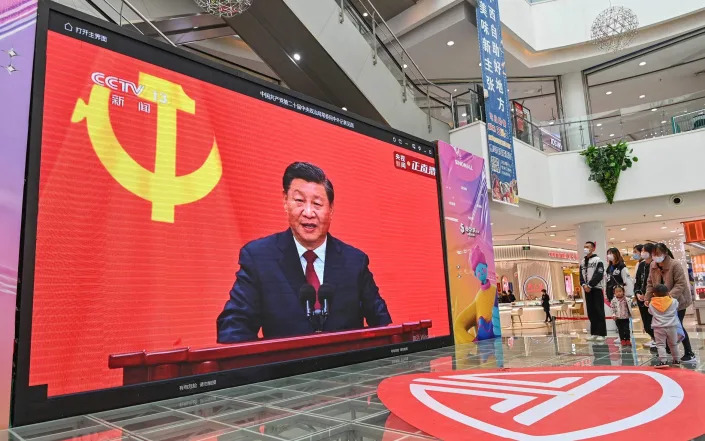
People watch a live broadcast of China’s President Xi Jinping – STR/AFP
They called it the Shanghai diet. Every morning during the two-month lockdown in China’s most populous city, Maggie found herself in a bidding war for spinach and pak choi.
At 8am, supermarkets would update apps with what was available on their virtual shelves that day. A rush to snap everything up would ensue.
“It was like a competition,” the marketing executive says from her Shanghai apartment. “Most of the food would be gone within seconds.”
While she was rarely left empty-handed, rationing meant most of her meals during the 70-day enforced confinement were either missing meat, vegetables or sometimes both. Maggie and her husband often did without. But they wanted to ensure their three-year-old son had enough to eat during the spring lockdown. “I actually lost a few kilograms,” she says jokingly.
The lockdown created an atmosphere of fear. “Everyone felt scared. Not of the virus. But about being sent to these makeshift Covid hospitals,” says Maggie, who didn’t want her surname to be used.
“You didn’t know where you’d be taken to, or how long you’d be there. Some people had their flats broken into in the middle of the night and were taken away. Or their homes were ‘sanitised’ when they were in quarantine and a lot of their belongings were ruined. I didn’t believe this would happen in Shanghai.”
But she believes she’s lucky. A white-collar job meant she could work from home. Others haven’t been so fortunate.
The world’s strictest lockdown has destroyed both lives and livelihoods – and there is no guarantee it won’t come back. But its architect has just become China’s most powerful ruler since chairman Mao.
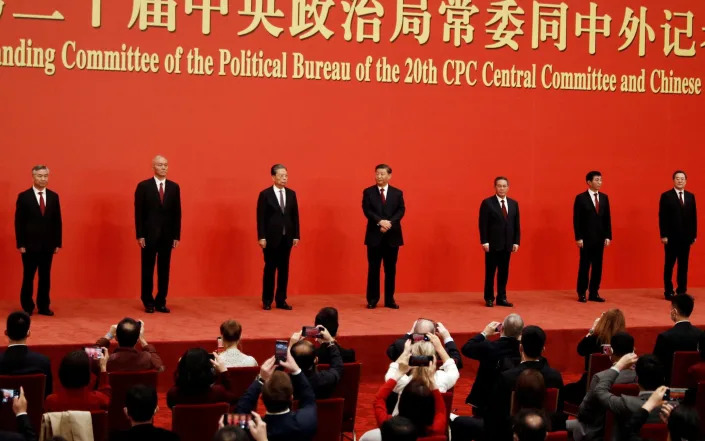
New Politburo Standing Committee members Xi Jinping, Li Qiang, Zhao Leji, Wang Huning, Cai Qi, Ding Xuexiang and Li Xi meet the media following the 20th National Congress of the Communist Party of China – TINGSHU WANG /REUTERS
Total control
Handed an unprecedented third term in office earlier this month, his political position unassailable and his every utterance carefully studied by adoring supporters, Xi Jinping is in total control of his country.
His power, and the sense that he is determined to enforce China’s cultural and military dominance even at the expense of prosperity, has sent a chill through domestic investors and the world order alike.
Proof of Xi’s apparent lack of interest in the economic consequences of his actions can be seen in the Communist leader’s choice for his second in command.
Striding out behind President Xi Jinping at the country’s recently ended Communist Party Congress last weekend, Li Qiang has become a symbol of China’s future.
Li Keqiang, the market-orientated premier, has been sidelined. As have central bank governor Yi Gang and China’s top trade negotiator Liu He. Technocrats are out. Loyalists are in.
“China has paid a high price economically in order to maintain low Covid infection,” says Vera Yuen, a lecturer in economics at the Hong Kong University Business School.
“That zero-Covid policy is likely to continue. That will affect China’s connectivity with the rest of the world.”
The emphasis at the congress on security, science and technology over economic growth and reforms also frightened investors. Not only was Xi unrepentant about lockdowns, but his tighter grip on power has paved the way for him to rule for life.
Ken Rogoff, former chief economist at the International Monetary Fund (IMF), says this will put China on a path of slower growth and greater isolation.
“If you take the post-financial crisis period running to 2020, the IMF says China contributed more than a quarter of global growth,” he says.
“That’s phenomenal. But when China slows down, it’s going to have huge ripple effects. In Europe for example, which is very dependent on selling industrial and luxury goods to China.”
Economic struggles
The IMF warned this month that repeated lockdowns meant the Chinese economy would grow by just 3.2pc this year because of strict Covid controls. An ongoing property crisis has also triggered a wave of debt defaults.
Rogoff, now a Harvard economics professor, said that the economy will struggle to hit 3pc growth for many years. If he is right, the economy will struggle to overtake the US in nominal terms in the next few decades – a task that will become increasingly difficult as its population gets older.
Economic growth isn’t everything. But pulling back from the rest of the world is also likely to accelerate China’s slowdown.
Rogoff says Xi’s “Made in China 2025” initiative, which is designed to reduce Beijing’s dependence on foreign technology, will also struggle.
“China’s talking about catching up in technology. President Xi talked about that a lot. But it’s hard to see how that’s going to work when you’re cracking down on entrepreneurs. State-owned enterprises are not going to be making technological breakthroughs.”
They’re the basic building blocks inside all modern technology. Smartphones, laptops, televisions. Aircraft, cars, cruise missiles. All are powered by tiny chips that make it all possible: semiconductors.
There’s only one dominant manufacturer. And it’s based in Taiwan.
The island, which drives just 1pc of global economic output, punches well above its weight because it’s cornered a large share of the market. Just under 40pc of the world’s processor chip manufacturing capacity is Taiwanese, while its high-end dominance is even greater. Ninety-two per cent of the most advanced semiconductors are made by Taiwan Semiconductor Manufacturing Company (TSMC).
While TSMC’s boss recently warned that advances in the technology are slowing down, nowhere else has been able to catch up yet. China has tried. But after a decade, it’s largely failed. Its global share of the market for semiconductors remains stuck below 20pc, according to Capital Economics.
“It hasn’t increased at all, despite all the money Beijing has spent trying to lure Taiwanese engineers to come over to China to help them,” says Gareth Leather, senior Asia economist at the consultancy.
“I think it just proves how difficult it is for others to replicate what Taiwan has done since it gained this comparative advantage,” he adds.
A decade behind Taiwan
It will take a long time to change this reliance. Precision engineering means building a semiconductor factory takes between two and three years, suggesting the rest of the world is at least another decade behind Taiwan.
Rogoff says it will take this long for the US to catch up, and even longer for China.
“It is remarkable what the Chinese have done,” he says.
“There are certain areas in technology where they are pretty easily on par with the United States. But in terms of private sector commercial activity, they’re behind and cutting themselves off. It’s not a recipe for growth. It’s very worrisome.”
The US is also doing its best to slow China down. It introduced strict export controls on semiconductors made with US technology in October, and also limited exports of manufacturing tools and advanced technology.
Chips for use in artificial intelligence and supercomputers can now only be sold to Beijing with a hard-to-obtain licence. Washington also introduced tough vetting standards for US citizens who want to work with Chinese chip producers. The aim is to stop China looking under the bonnet and stealing America’s intellectual property.
These developments mean the world will rely on Taiwanese semiconductors for longer, which also raises the stakes if geopolitical tensions boil over.
China’s Communist Party knows this. Beijing enshrined opposition to Taiwanese independence in its constitution last weekend, in another thinly veiled threat towards an island that has been governed independently since 1949.
Analysts fear a Chinese attack on Taiwan risks drawing the US into a war.
“If there was a war between Taiwan and China, you could potentially see a complete decoupling of trade between China and the US,” says Leather.
This would put $600 billion (£518 billion) of annual trade between the countries at risk. China is still by far America’s largest goods trading partner, with $559.2 billion sent to US shores in 2020, with machinery, toys, furniture and clothes the biggest imports.
Catastrophic consequences
And this has severe consequences for the rest of the world. “If you think about all the goods that we import from China, suddenly cutting them off would have quite catastrophic consequences for the global economy,” Leather says.
He believes a full-blown war is unlikely. “It is possible to imagine another scenario, for example, where China might, for example, want to have a blockade around Taiwan,” he says.
You’d assume that in this scenario, basic trade between the US and China would continue. But a semiconductor shortage would become apparent quite quickly.
Capital Economics says shortages will push up prices of everything from cars to computers around the world, as they did during the pandemic. It estimates that a 50pc rise in semiconductor prices would add around 2.5 percentage points to global inflation at a time when prices are already in danger of spinning out of control.
Countries such as the Czech Republic, Hungary and Germany, which are key carmaking hubs, will suffer most from shortages, alongside Taiwan and South Korea.
Leather adds: “Without ready access to the fastest chips, innovation in areas such as artificial intelligence will slow.”
China may have sent missiles over Taiwan in August to send a message, but Leather believes it will maintain a cautious approach because the leadership has seen how a war can leave a country ostracised.
“Given how badly the war in Ukraine has gone for Russia, I think it will make the Chinese think very, very carefully about what they’re going to do with Taiwan,” he says.
“All the sanctions that the US has introduced has made China realise how difficult it could be.”
Creeping control
shanghai zero covid policy – ALEX PLAVEVSKI/EPA-EFE/Shutterstock
If there’s any doubt over Beijing’s desire to control citizens’ lives, look no further than the city’s Weather Modification Office. Officials here literally try to make it rain. And they’ve succeeded. There were clear skies during the July 1 Communist Party centenary celebrations thanks to a “cloud-seeding operation” that sprayed chemicals in the sky to bring downpours forward.
This idea of creeping control has also spread to Beijing’s grip on Hong Kong.
A security law introduced two years ago changed the lives of many Hong Kongers, and left a profound impact on the rule of law in the former British colony.
Thousands of international businesses have left or are considering leaving the city, while more than 100,000 Hong Kongers have been granted visas to the UK through a new scheme introduced last year.
Beijing has noticed the brain drain. Hong Kong’s new chief executive John Lee has been given access to a $3.8 billion fund to lure big business and top talent back to the city, but many have grown weary of repeated lockdowns and the uncertain political climate.
His plans largely failed to reassure investors. The Hang Seng share index is down almost 40pc this year alone. The Shanghai Composite index is down 20pc.
“Talent is leaving Hong Kong, mainly due to the stringent Covid-19 policy,” says Vera Yuen.
“This means its economic growth is more dependent on the Chinese economy than ever. More diversification and internationalisation will be needed for the city to continue to shine.”
Those left are also feeling the impact of slower global growth.
“Business hasn’t been that great,” says Herbert Lun, managing director of Wing Sang Electrical, which makes hair dryers and curling irons that are mostly sent to the US. Lun is based in the city and he also employs 500 people at a factory in Shenzhen.
“Traditionally, manufacturing in China would peak at around June, July, August for the Christmas season. And the rush would run through to September,” he says.
“This year, we haven’t actually seen a peak. Since about May a lot of our suppliers and competitors have seen a lot of cutbacks and slowdowns. Everybody’s buying just enough to cling on.”
Lun has been forced to cut his prices to remain competitive, even as the cost of production has gone up sharply.
He says more Chinese businesses are looking to branch out overseas, where pay is lower and workers more abundant. He even considered it himself.
“It used to be all ‘made in China’,” he says. “Now it’s made everywhere. And so we have to make decisions that are best for our companies. And we have been focusing more on automation to essentially that labour shortage out of our equation.”
Rising rates
Rising global interest rates also make it harder to do business. Hong Kong’s monetary policy runs in lockstep with the US Federal Reserve because of a peg that keeps its currency in a tight range of 7.75-7.85 per US dollar.
“I think that’s going to depress a lot of investment going forward. If we look at past experience, where we had drastic rate increases, that always led to some sort of financial crisis in the rest of the world,” says Rogoff.
“Everyone is being a little bit more careful about taking on debt going forward and doing a little bit less investment. All of this is going to have a chilling effect on the economy. And I think that’s where the biggest uncertainty is going to be. How long is this rate hike cycle going to last? And how high will interest rates go?”
Rogoff believes the policy pivot will also transform the economy. “We’ve hit peak China,” he says.
“Historically China’s priority has always been giving people growth. And if you give people growth, they accept intrusion into other parts of their lives. But now growth is going to play second fiddle.”
Rogoff has led warnings about the dangers of a widespread collapse in Chinese property prices. While much attention has been focused on the country’s biggest cities, he says the smaller so-called “tier 3” cities, which account for more than three quarters of China’s housing stock and 60pc of economic output, have suffered from the biggest rates of overbuilding.
Any house price crash will most certainly begin here.
Against a gloomy global backdrop, all this suggests China may no longer be the powerhouse it was.
For decades, it served as the engine behind 90pc of economic growth in East Asia and the Pacific. But analysts at the World Bank now believe the economy will expand by just 2.8pc this year. Growth in the rest of the region is expected to average 5.3pc.
This puts China’s growth rate behind its neighbours for the first time since 1990.
While India continues to expand at a rapid pace, overtaking the UK as the world’s fifth largest economy this year, its trade links are far less established than its eastern neighbour. This leaves no obvious contender to pick up China’s mantle.
Either way, China’s fortunes will continue to be intertwined with the rest of the world.
Unsustainable situations
Economists at Axa believe a “crash-landing” scenario, where the world is plunged into a deep recession like the global financial crisis, will push China’s exports down by 20pc and result in a 3.5pc hit to the economy.
Unlike 2008, Beijing won’t be there to spend the world out of trouble.
But economists like Rogoff have warned about China’s troubles and its Great Wall of debt before. They were wrong then.
More than two decades after it joined the World Trade Organisation, China remains the world’s factory and a leader in payments technology. Rogoff concedes this, but adds that while a downturn may not be imminent, it is inevitable.
“There’s a famous saying from my thesis adviser, Rudi Dornbusch, that unsustainable situations go on for longer than you think,” he says.
“And when they collapse, that happens faster and harder than you think. It’s very hard to call the timing of these things. And China has seen remarkable growth. Their infrastructure is better than in almost any advanced economy. But you can’t keep the economy growing by just building more and more of it.”
Vaccines and lockdowns remain a crucial factor going forward. “Outbreaks have continued to flare up and mobility control has persisted,” says Wei Yao, an economist at Societe Generale.
“We think China needs much more preparation for a smooth exit, especially a much higher vaccination rate among the vulnerable. Currently, the three-dose vaccination rate for people aged over 60 remains insufficient and has been stagnant since summer.”
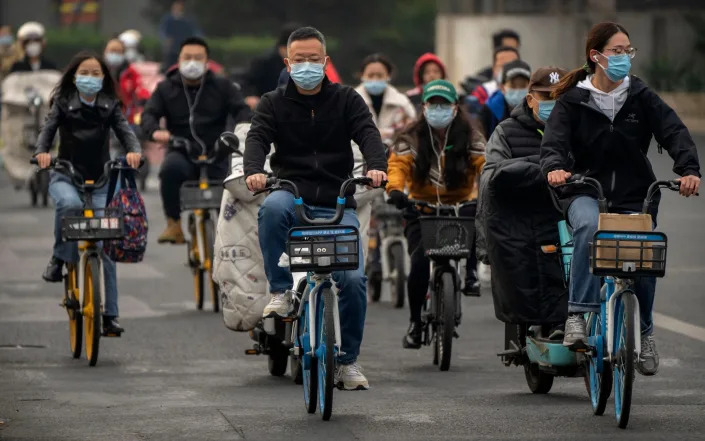
Commuters wearing face masks ride bicycles along a street in the central business district in Beijing – Mark Schiefelbein/AP
The shops and schools are back open in Shanghai, but many believe the city is far from open for business.
More than half of the Chinese companies surveyed by the US Chamber of Commerce in Shanghai believe the country’s economic management is in decline. Its poll last week showed a fifth are cutting back on investment as a direct result of its zero-Covid policy.
For Maggie, who was confined to her apartment yet again last week as part of the city’s aggressive contact tracing policy, nothing will ever be the same again.
“It has changed my life completely,” she says. “I can’t plan any more. I live with uncertainty every day. I worry my son will be taken away on his own to a quarantine hospital.”
She reflects on the future: “In our society, being obedient is very important. For your career, or to get ahead. It’s not about doing the right thing for other people, it’s about following the rules.
“But many people in Shanghai have completely lost their trust and faith in the authorities now. I always believed that Shanghai, my city, would get better. I thought we had better transparency, more justice and less corruption. I’ve lost this belief now.”
Will DeSantis run for president? The candidate I saw during the Florida debate is worrisome.
Carli Pierson, USA TODAY – October 30, 2022
If there were a recipe to make another Florida Gov. Ron DeSantis it might go something like this: Grab some playground bully off the shelf with a heaping teaspoon of science denial, a swig of race-baiting and a lump of LGBTQ bigotry for good measure.
If it sounds nasty, that’s because it is (recipe and politics).
As a former Floridian who visits as often as possible, and because I have close family that still lives there, I care deeply about what goes on in the Sunshine State and worry about where DeSantis is heading politically.
Not everyone agrees with me. During the first and only gubernatorial debate with former Republican Gov. and now Democratic Congressman Charlie Crist on Monday night in Fort Pierce, DeSantis got a concerning amount of applause for his hateful, misleading and divisive comments. Before the debate, DeSantis was also leading in the polls and has proved to be popular in Florida.
After the debate, he went back to being favored to be a GOP candidate running against former President Donald Trump (should he run) in the 2024 presidential election. It’s with that in mind that I’m writing about the debate. What kind of candidate would DeSantis be for the 2024 campaign? And, God forbid, what kind of president?
The debate was a good window into that.
Crist and DeSantis at gubernatorial debate
What DeSantis said during the debate
I didn’t ever imagine myself saying this because I am an atheist, but as I watched Monday night’s debate, I found myself praying Crist becomes governor again. No matter how much I dislike millionaires getting into politics, DeSantis’ far right ideology makes me nervous. But how will more centric and independent voters feel about his rhetoric?
DeSantis made some really troubling comments during the debate. He also has a record of troubling, bigoted leadership that has no place in 2022 America, or 2024:
►When asked by local news anchor Liz Quirantes about his “Stop WOKE” Act and his Florida Parental Rights in Education Act – which critics have called the “Don’t Say Gay” law because it bans classroom instruction on sexual orientation and gender identity for students in kindergarten through third grade – DeSantis went on a tangent dog-whistling about keeping Florida free. He also stooped to his habitual race baiting saying, “I don’t want to teach kids to hate our country,” and claimed that it was false that the United States was built on “stolen lands.”
DeSantis isn’t mature enough to be governor or president
DeSantis, like others in his party, seems to be unable to realize that he is (and would be if elected) the governor of all Floridians, not just the ones who agree with him. But his radical positions send progressives, moderate Democrats and even independents running in the opposite direction.
That won’t stop if he decides to run for president.
DeSantis’ inability to answer Crist’s question about whether he would serve the full term, if elected, made it painfully clear that he doesn’t care about being governor – he wants to be president. Rather than answering the question honestly, he mumbled something and then reverted to his inner playground bully by calling Crist a “worn-out old donkey.” A “yo mamma” joke would probably have had the same effect: Rally the base; make everyone else cringe.
DeSantis doesn’t really want to be governor for much longer and he doesn’t want to listen to American voters – he wants to be president so he can push his radical agenda from the White House.
Carli Pierson, a New York licensed attorney, is an opinion writer and a member of the USA TODAY Editorial Board.
EPA closed a refinery that rained oil. Now it’s a ‘ticking time bomb.’
Maxine Joselow, The Washington Post – October 28, 2022
WASHINGTON – An oil refinery in the U.S. Virgin Islands that the Environmental Protection Agency shut down in spring 2021 now poses the risk of a fire, explosion or other “catastrophic” releases of “extremely hazardous substances,” the agency found in a report released this week.
The idled plant on St. Croix, formerly known as the Limetree Bay refinery, experienced a series of accidents over the course of last year that spewed noxious fumes and showered oil droplets onto nearby homes, sending some residents to emergency rooms. Now deteriorating conditions at the massive facility, which was sold in a bankruptcy auction in December, pose a major test of the Biden administration’s commitment to environmental justice.
In September, the EPA conducted an inspection of the refinery and observed “significant corrosion” of equipment including valves, pipes and pressure relief devices, the agency said in a letter sent to the owners’ lawyers Oct. 13 and made public this week.
“These conditions demonstrate a risk of imminent release of extremely hazardous substances,” the EPA said in an inspection report. “Because of this degree of corrosion, the vessels, piping, and/or valves may fail, resulting in a catastrophic release.”
Local residents question why federal officials have not done more to protect the health of this Caribbean island’s largely Black and Brown population.
“This report is equally alarming and affirming to those of us in the civic sector who have been sounding the bullhorn about the dangers posed by this refinery for years,” Deanna James, president of the St. Croix Foundation, said in an email. “Since 2019, St. Croix Foundation and our nonprofit partners have been on a lonely advocacy journey trying to compel policymakers to consider alternatives to this ‘ticking time bomb’ on our shores – to no avail.”
Elías Rodríguez, a spokesman for EPA Region 2 – which oversees New Jersey, New York, Puerto Rico, the U.S. Virgin Islands and eight Native American tribes – said the agency is “continuing its vigilant oversight” of the refinery.
“EPA takes very seriously our duty to ensure that the facility complies with federal environmental rules designed to protect people,” Rodríguez said in an email. “EPA will use its authorities to protect the protect the health and safety of the facility workers and those who live in nearby communities.”
The refinery, which received approval to operate during the Trump administration, has come under closer scrutiny since Biden took office. The EPA shut down the facility in May 2021 after residents across the island reported feeling nauseous and ill from the release of gaseous fumes.
In particular, EPA inspectors voiced concern about equipment containing ammonia and liquefied petroleum gas. Exposure to high levels of ammonia can cause a burning sensation in the eyes, nose and throat and can result in lung damage or death, according to the Centers for Disease Control and Prevention.
After the facility’s previous owners filed for bankruptcy in July 2021, a bankruptcy judge approved the plant’s sale for $62 million in December to West Indies Petroleum and Port Hamilton Refining and Transportation.
Reached by phone on Thursday, Fermin Rodriguez, vice president and refinery manager for Port Hamilton Refining, said the company is “working with EPA and we’re providing all of the information that they requested. And we’re going to have independent inspectors here this week to validate what they indicate in the report.”
In a news release issued Wednesday, the company sought to reassure local residents and indicated that it plans to restart the refinery when it is safe to do so.
“[D]espite recent reports of concerns about the safety of the facility, the company continues maintaining the facility it purchased in January of this year in preparation for a safe start-up,” the company said. “. . . As we have stated before, the safety of our refinery employees and the safety of the community is our number one priority.”
In June, West Indies Petroleum denied its ownership interest in the facility, despite having won the bankruptcy auction. Representatives for the firm could not be reached for comment.
Judith Enck, who was tapped by President Barack Obama to lead EPA Region 2, expressed alarm that the agency waited nearly three weeks after the inspection to send the letter to the plant’s attorneys.
“This is not a situation where you politely exchange letters between lawyers,” said Enck, who now heads the Beyond Plastics advocacy organization. “This is a serious situation that needs the attention of the highest levels of EPA.”
Enck called on EPA Administrator Michael Regan to “cancel his weekend plans” and immediately board a flight to St. Croix, where she said the agency must inform residents of the imminent threats to their health. A recent survey found that roughly 20,000 people live downwind of the refinery, while in an earlier 2019 analysis, the EPA noted that 75 percent of residents of adjoining neighborhoods are people of color and 27 percent live below the poverty line.
Rodríguez, the EPA spokesman, said the agency took three weeks to send the letter because “time was required, especially with a facility of this size and complexity of the issues involved.”
Jennifer Valiulis, executive director of the St. Croix Environmental Association, lives about two miles from the plant and questioned whether the federal government would act with more urgency if the situation were unfolding in the contiguous United States.
“Not only are the surrounding communities primarily Black and Brown, but also as a territory, we have a different status in that we don’t vote for the president,” Valiulis said. “We don’t have a voting member of Congress. And so we have less ability to advocate for ourselves.”
How Walking Can Help You Lose Weight, Decrease Stress, and Lower Blood Pressure
Madeleine Haase, Kaitlyn Pirie, Meghan Rabbitt – October 27, 2022
How Walking Can Help You Lose Weight, Decrease Stress, and Lower Blood Pressure
“Hearst Magazines and Yahoo may earn commission or revenue on some items through the links below.”
One of the most powerful ways to maintain a healthy weight, keep your joints strong, and live longer is also one of the simplest, no matter your age. The health benefits of walking are endless, and experts agree by adding walking to your daily routine, you can greatly improve your physical and mental health.
“Walking has always been my main source of cardio, and except for when I was pregnant, I’ve been the same weight my entire life!” says fitness expert Denise Austin.
Walking is simple enough that all fitness levels can get those daily steps in. “It has tremendous benefits, from supporting a healthy immune system to boosting your metabolism to strengthening your joints, muscles, and bones—not to mention it’s amazing for stress relief and enjoying a little ‘me time,’” says Austin.
Ahead, discover the vast benefits of walking, and what you can expect when you start strolling for just a half-hour most days of the week.
1. Improve your mood.
A glass of wine or a square (or three) of dark chocolate can blunt the edge of a rough day—but going for a walk is a zero-calorie strategy that offers the same perk, says Dr. Jampolis. In fact, research shows that just 10 minutes of walking can lift your spirits. Other recent research found walking during the COVID-19 pandemic could significantly improve mood. Plus, The effect may be amplified even more if you take a stroll through some greenery.
“Research shows that regular walking actually modifies your nervous system so much that you’ll experience a decrease in anger and hostility,” Dr. Jampolis says, especially when you’re going for a stroll through some greenery or soaking in a bit of sunlight. This can be particularly helpful during the colder months, when seasonal depression spikes.
Finally, when you make your walks social—you stride with, say, your partner, a neighbor, or a good friend—that interaction helps you feel connected, Dr. Jampolis says adds, which can make you feel happier.
2. Burn calories and maintain a healthy weight
“As you continue to walk, you may notice your pants begin to fit more loosely around your midsection, even if the number on the scale isn’t moving much,” says Dr. Jampolis. That’s because regular walking can help reduce fat and, as a result, improve your body’s response to insulin, according to research.
Itching to up your calorie burn? When walking outside, plan a route that includes hills, alternate between speed walking and a slower pace, and challenge yourself to walk the same routes on different days to see if you can beat your previous times, says Austin. For an extra boost of motivation, she also recommends aiming to hit 10,000 steps a day.
“Daily walking increases metabolism by burning extra calories and by preventing muscle loss, which is particularly important as we get older,” says Ariel Iasevoli, a personal trainer in New York City.
The best part? You don’t have to tire yourself out on a treadmill at the gym to see these benefits. “One of my clients reduced her body fat by 2% in just one month by walking home from work each day, which was just under a mile,” she says.
Intervals are key here, says Michele Stanten, a walking coach and author of Prevention’s Walk Your Way to Better Health. Increasing your speed for small bouts of time during, say, a 30-minute walk allows you to burn more calories than if you strolled at a moderate pace for half an hour. This approach also benefits your cardiorespiratory system. To try adding intervals, warm up for three minutes. Then spend 25 minutes alternating between one minute of walking almost as fast as you can go and one minute of brisk walking (aiming for a six on an intensity scale of one to 10). Cool down for two minutes.
3. Reduce your risk of chronic diseases
“The physical benefits of walking are well documented,” says Scott Danberg, a paralympic athlete in Florida.
The American Diabetes Association recommends walking to lower blood sugar levels and lower your overall risk for type 2 diabetes. Some research even shows that for every 1,000 daily steps you take, you could lower your systolic blood pressure by .45 points. That means if you clock in 10,000 daily steps, your systolic blood pressure is likely to be 2.25 points lower than someone else who walks only 5,000 daily steps.
One of the most cited studies on walking and health, published in The New England Journal of Medicine, found that those who walked enough to meet physical activity guidelines had a 30% lower risk of cardiovascular events (like a heart attack or stroke) compared with those who did not walk regularly.
For disease prevention, longer walks are key. Stanten recommends doing one hour-long walk at least once or twice a week.
4. Live longer
That’s right, walking can seriously help you add years to your life, and it doesn’t take much to see results. In fact, one study found that people who did just 10 to 59 minutes of moderate exercise (like brisk walking) per week had an 18% lower risk of death during the study period compared to those who were inactive. Meanwhile, people who completed the recommended 150 minutes of weekly exercise in at least 10-minute spurts had a 31% lower risk of death. Other research shows the faster you walk, the more your risk drops. The longer life benefit is believed to come from the cardiorespiratory workout that walking provides.
5. Boost your brainpower
The research here is quickly growing. In one study, brain scans of people who walked briskly for one hour three times a week showed the decision-making areas of their brains worked more efficiently than people who attended education seminars instead. Other research shows physical exercise, like walking, can improve brain function in older women. Experts think these benefits could be due in part to increased blood flow to the brain that occurs with exercise. So when you get your feet moving, your brain starts working better too!
6. Alleviate joint pain
Contrary to what you might think, pounding pavement can help improve your range of motion and mobility because walking increases blood flow to tense areas and helps strengthen the muscles surrounding your joints.
In fact, research shows that walking for at least 10 minutes a day—or about an hour every week—can stave off disability and arthritis pain in older adults. A 2019 study in the American Journal of Preventive Medicine followed 1,564 adults older than 49 with lower-body joint pain. Participants who walked for an hour each week were more likely to remain disability-free four years later. An additional report found that walking was a safe, inexpensive, and convenient physical activity for those with arthritis of all fitness levels.
7. Delay the onset of varicose veins
As you age, your risk of varicose veins increases. However, walking is a proven way to prevent them from developing, says Luis Navarro, M.D., founder and director of The Vein Treatment Center in New York City.
“The venous system includes a circulatory section known as ‘the second heart,’ which is formed by muscles, veins, and valves located in our calf and foot,” he explains. “This system works to push blood back up to the heart and lungs—and walking strengthens this secondary circulatory system by strengthening and preserving leg muscle, which boosts healthy blood flow.”
If you already suffer from varicose veins, daily walking can help ease related swelling and restlessness in your legs, says Dr. Navarro. “Also, if you are genetically predisposed to have varicose and/or spider veins, walking daily can help delay the onset.”
LeoPatrizi – Getty Images
8. Stimulate your digestive system
If you currently count on your daily dose of coffee for keeping your digestive system going strong, get ready to start thanking your morning walk instead. That’s because a regular walking routine can greatly improve your bowel movements, says Tara Alaichamy, D.P.T., the manager of rehabilitation services at Cancer Treatment Centers of America. “One of the very first things an abdominal surgery patient is required to do is to walk because it utilizes core and abdominal muscles, encouraging movement in our GI system,” she says. In other words, when you start moving, your bowels start moving too.
9. Enhance creativity
Whether you’re feeling stuck at work or you’ve been searching for a solution to a tricky problem, research shows it’s a good idea to get moving: According to a 2014 study in the Journal of Experimental Psychology, Learning, Memory, and Cognition, going for a walk can spark creativity. “Researchers administered creative-thinking tests to subjects while seated and while walking and found that the walkers thought more creatively than the sitters,” says Dr. Jampolis.
10. Improve your sleep
If you work out regularly, you’ll sleep better at night. That’s because physical activity naturally boosts the effects of melatonin, the sleep hormone. A 2019 study from Sleep found that postmenopausal women who do light to moderate-intensity physical activity snooze better at night than those who are sedentary. Another recent study found healthy adults who walked daily had a significant positive impact on sleep quality and length of sleep. Walking also helps reduce pain and stress, which can cause sleep disturbances.
11. Kickstart your immune system.
In this era of pandemics and super-viruses, we’re all looking for ways to improve our immunity, and walking is a great place to start. Research shows that moderate-intensity exercise—and walking in particular—ramps up our immune system. It increases the number of immune cells that attack pathogens in our body, which lowers your risk of becoming seriously ill from infectious diseases. Not only that, if you do get sick, research has found that people who walk more spend less time in the hospital. One study even found those who walked regularly could reduce their risk of dying from pneumonia compared to those who don’t exercise regularly.
12. Make other goals seem more attainable.
When you become a regular walker, you will have established a regular routine—and when you have a routine, you are more likely to continue with the activity and take on new healthy behaviors. “Our bodies are not meant to be sedentary all day. Any type of movement is better than no movement, and being able to find a type of movement best suited for your age and fitness level is super important so you feel empowered and motivated to stick with it,” says Marisa Golan, a certified personal trainer, Base Ops Fitness Coach at Fort Athletic Club, and owner of e(M)powered personal training.
“Walking for older individuals is a great gateway exercise to get your muscles moving and your heart elevated. You can also speed it up to more of a speed walk to increase your heart rate.”
Plus, walking can help you believe in yourself and your health goals. Recent research found that of nearly 5,000 adults interviewed, those who walked regularly had higher health perceptions and were more likely to have better mental health.
Blood pressure medicine recall: Some pills pose potential cancer risk, FDA announces
Natalie Neysa Alund – October 27, 2022
A pharmaceutical company is recalling a blood pressure medication due to a potential cancer risk, the FDA announced this week.
Aurobindo Pharma USA is recalling two lots of quinapril and hydrochlorothiazide tablets due to levels of nitrosamine. The tablets are commonly prescribed for the treatment of hypertension to lower blood pressure.
Low levels of nitrosamine, or N-nitroso-quinapril, is regularly found in water and food including cured and grilled meats, dairy products and vegetables. Exposure to high levels, the FDA reports, has been linked with an elevated risk of cancer.
The U.S. Department of Agriculture’s Food Safety and Inspection Service announced the company’s voluntary recall Wednesday.
According to the FDA advisory, the medication are “pink colored, scored, round shaped, biconvex, film-coated tablets, debossed with ‘D’ on the scored side and ‘19’ on the other side.”
So far, the FDA reported no adverse events have been linked to this issue.
“Patients should contact their doctor or health care provider about whether to continue taking their medication, or whether to consider an alternative treatment prior to returning their medication,” according to an advisory on the FDA’s website.
Related video: How to stay on top of food recalls and prevent foodborne illnesses
How to stay on top of food recalls and prevent foodborne illnesses
About 128,000 are hospitalized and 3,000 people die each year from preventable foodborne illnesses.
Consumers with questions about the recall can call 1-866-850-2876 or email pvg@aurobindousa.com.
Natalie Neysa Alund covers trending news for USA TODAY.
Oil giants sell thousands of California wells, raising worries about future liability
Mark Olalde, Co-published with ProPublica – October 27, 2022
Aera Energy wells in Ventura. The joint venture between Shell and Exxon has announced plans to sell thousands of California gas and oil wells to the German assett management group IKAV. (Myung J. Chun / Los Angeles Times)
The price of oil produced in California this year reached its highest level in a decade. President Biden is releasing millions of barrels of oil from the Strategic Petroleum Reserve to keep prices in check. And fossil fuel companies’ earnings are so high that Gov. Gavin Newsom has called for a windfall tax on their profits.
It might seem like a lucrative time to drill for oil in the Golden State. Yet, some of the world’s largest oil companies, several of which have done business in the state for more than a century, are selling assets and beginning to pull out of California.
Even with strong cash flow in the short term, producers have more to gain from offloading wells and the associated liability — chiefly expensive environmental cleanup — than from pumping more oil and gas, experts say.
“This is the kind of deal you see when an industry is in its twilight,” said Andrew Logan, senior director for oil and gas at Ceres, a nonprofit focused on sustainability in companies and markets.
Some industry experts, lawmakers and environmentalists are concerned about the recent deals, noting that the sales shift environmental liability from corporate powerhouses to less-capitalized firms, increasing the risk that aging wells will be left orphaned, unplugged and leaking oil, brine and climate-warming methane. They see a threat that the state’s oil industry could repeat a pattern seen in other extractive industries like coal mining and lead to taxpayers bearing cleanup costs.
California Assemblymember Steve Bennett, a Democrat who has long worked on oil policy, has seen oil companies in his Ventura district walk away from environmental liability. “It gets passed on to a smaller company and to a smaller company until someone declares bankruptcy and the public is stuck with the cleanup bill,” he said.
IKAV enters the fray
Supermajors Shell and ExxonMobil recently agreed to sell more than 23,000 wells in California, which they owned through a joint venture called Aera Energy, to German asset management group IKAV for an estimated $4 billion. Aera accounts for about a quarter of California’s oil and gas production, largely from pumping in Kern and Ventura counties.
Shell and ExxonMobil say the deal will strengthen their businesses.
But Greg Rogers, an attorney and accountant who researches the oil and gas industry, said the deal allows the sellers to shed decommissioning costs. “You got bad assets with big liabilities, and you can get rid of both at the same time. That’s a win for Exxon and Shell,” he said.
IKAV will inherit a portfolio littered with wells past their prime. Nearly 9,000 Aera wells were idle as of early October, meaning about 38% of the company’s unplugged inventory isn’t producing oil or gas, according to state data.
In an email, Aera spokesperson Kimberly Ellis-Thompson said the company is capable of managing its large portfolio of idle wells. “Since 2019, when new idle well management program regulations were published, we have met or exceeded the requirements for retiring idle wells,” she said. The company has decommissioned and plugged nearly 1,000 wells on average every year since then, she said.
IKAV, Aera’s soon-to-be new owner, manages about $2.5 billion in energy-focused assets. News releases on the Aera sale quoted Constantin von Wasserschleben, IKAV’s chairman, as saying, “We advocate a co-existence between renewable and conventional energy for decades to come.”
As the world increasingly shifts to cheaper renewable energy to address climate change, IKAV has been snapping up oil and gas wells from supermajors exiting the market. The firm, which once focused exclusively on renewable energy, began expanding into oil and gas in 2020 when it purchased BP’s gas assets in the San Juan Basin, spanning New Mexico and Colorado. The deal was part of BP’s push to divest $10 billion in assets, including aging American gas fields.
BP declined to comment.
If it’s not profitable to return wells to production, they need to be plugged. But if a company doesn’t plug its wells before walking away, wells are orphaned and the cleanup costs ultimately fall to taxpayers and current operators through fees.
For example, the Greka group of companies left more than 750 wells for California to plug when its wealthy owner began pushing his businesses into bankruptcy in 2016 and retired to his Santa Maria winery. And a subsidiary of one of the country’s largest mining companies, Freeport-McMoRan, left dozens of likely orphaned wells, state records show, even though the company brought in nearly $23 billion in revenue last year.
Greka’s CEO didn’t respond to a request for comment, and a Freeport spokesperson said the company is working with the state to verify details about its orphaned wells.
To minimize the government’s exposure if wells are orphaned, producers must put up a bond, typically held as cash or a surety policy. The bonds act like a security deposit: The company gets its bond back if it cleans up its mess, but the government keeps the money if the company orphans its wells.
Newsom has called for an end to all oil extraction in the state by 2045, but his administration has yet to use another tool to hold producers responsible for cleanup.
California has the authority to ask for an additional $30 million in financial security from a single operator but only requires Aera to hold a $3-million bond. As a result, Aera’s bonds cover less than half a percent of the $1.1 billion that ProPublica estimates it would cost the state to plug the wells based on the average cost to California for past well plugging. (That estimate does not include the additional cost of full surface remediation.)
California Oil and Gas supervisor Uduak-Joe Ntuk said in a statement that his agency reviews bonds for all oil companies in the state but did not say whether the amount of Aera’s financial security would be increased through the sale.
Aera, Shell and ExxonMobil did not respond to a question about the gap between their bonds and the estimated cost to plug their wells. IKAV did not respond to requests for comment. In an email, ExxonMobil spokesperson Meghan Macdonald said that “when we make divestments, we always try to work with partners like Aera and IKAV who are also committed to a lower-emissions future.”
Costs vary widely, but states have paid $100,000 or more to plug wells — and the same to clean up surface pollution — meaning there’s a significant gap between what’s needed and what California has available in bonds.
“If they don’t have the financial resources when it comes time to plug those wells, there’s a possibility that the public will be left holding the bag and paying those costs even though it’s the company that made the profit from selling the oil,” said Hollin Kretzmann, an attorney with the Center for Biological Diversity.
Who will be liable?
More than 240,000 wells have pierced the state since the late 1800s, when Southern California’s first producing well spouted oil near where Dodger Stadium now stands. Of those, more than 5,300 are “orphan, deserted, and potentially deserted wells,” according to data the California Geologic Energy Management Division published in September.
Many on that list belong to individuals who died long ago or companies that dissolved in the shuffling of corporate paperwork. However, some responsible parties are still around but are no longer legally liable after offloading their wells through sales and bankruptcies.
So who will be responsible for cleanup?
California is unique because state law allows regulators to call on former operators such as Shell and ExxonMobil to help pay for plugging onshore oil wells if they are later orphaned, even by a different owner. But companies have escaped responsibility under this stronger legal standard by exploiting loopholes such as a porous bankruptcy code.
Some experts question whether Shell and ExxonMobil would be required to pay if the wells they are selling to IKAV are ultimately orphaned, saying their ownership of the wells through a separate company, Aera, might shield them from liability.
“Exxon and Shell do not directly operate those wells. There’s corporate structuring going on in between,” Rogers said. And IKAV now adds another layer of corporate paperwork, holding the wells it acquired in New Mexico, Colorado and California through companies that were registered in Delaware shortly before the sales.
Alongside Aera, two other companies — California Resources Corp. and Chevron — account for the vast majority of California’s oil and gas production, and they too are shrinking their positions in the state. California Resources, which has been in and out of Chapter 11 bankruptcy in recent years, sold most of its Ventura Basin operations in November 2021. Chevron recently sold its California headquarters and plans to consolidate some of its unused Bakersfield office space as it shifts employees to Texas. Reuters reported in early October that Berry Corp., another large oil company that for many years has operated in California and Utah, was considering selling.
Berry did not respond to a request for comment.
Shell acknowledged its California wells were overvalued, suggesting the wells are even nearer to the end of their economic life than previously predicted. The company is wiping as much as $400 million off its books through the sale via an impairment charge.
Shell has been shedding assets in part to hand off associated greenhouse gas emissions. A 2021 Dutch court ruling ordered it to significantly reduce emissions, although the company has appealed the ruling. Zoe Yujnovich, the company’s upstream director, said in a news release about the sale of Aera that Shell will instead be “focusing on positions with high growth potential.”
For its part, ExxonMobil plans to focus on oil and natural gas that costs less to extract, Liam Mallon, president of ExxonMobil Upstream Co., said in a news release announcing the sale to IKAV.
Large public companies are handing off oil and gas assets around the country. Between 2017 and 2021, more than a quarter of oil and gas mergers and acquisitions took public companies private, with private equity often involved, according to a study conducted by the Environmental Defense Fund. The report voiced concern that private companies are less transparent and have less incentive to protect the environment.
California is just the beginning
With more than 2 million unplugged oil wells believed to be scattered across the U.S., California is the tip of the iceberg.
A massive boom in American oil and gas production over the past 15 years spurred by technological advances in hydraulic fracturing and horizontal drilling unlocked previously inaccessible geologic formations. But the shale revolution and current market highs buoyed by Russia’s invasion of Ukraine won’t last forever.
Longtime petroleum reservoir engineer Dwayne Purvis laid out the reality at a recent conference. This shale revolution revitalized only some oil fields, and more than 90% of the country’s unplugged wells are either idle or minimally producing and unlikely to make a major comeback, according to his research.
“The bulk of the wells are producing from plays where there is no hope of another deus ex machina,” Purvis said, referencing nearly depleted oil fields.
The oil industry also faces an impending decline in demand from the shift to renewable energy and the trend toward banning the sale of new internal-combustion engine cars, as well as plans to phase out drilling in metro areas.
“The overall industry is being assaulted right now through policy changes at the state and federal level. That’s the story writ large,” Rogers said. “The industry is dying.”
Olalde reports for ProPublica.ProPublica is a nonprofit newsroom that investigates abuses of power.
And possibly Kamala Harris, and Merrick Garland, and Alejandro Mayorkas, and Antony Blinken
By Barton Gellman – October 26, 2022
Photo-collage images: Graeme Jennings / Getty; Dustin Franz / Bloomberg / Getty; Brendan Smialowski / AFP / Getty; Anna Moneymaker / Getty; Nicholas Kamm / AFP / Getty
Sometime next year, after an interval of performative investigations, Republicans in the House are going to impeach Joe Biden. This may not be their present plan, but they will work themselves up to it by degrees. The pressure from the MAGA base will build. A triggering event will burst all restraints. Eventually, Republicans will leave themselves little choice.
This prediction rests, of course, on the assumption that Republicans will win control of the House next month, which appears likely: Democrats would need to win an improbable number of toss-up races to keep their majority. And an impeachment resolution requires just a simple majority to pass the House.
Nothing in the public record offers the slightest reason to believe that the Senate, even if it is under Republican control, would convict and remove Biden from office. Still, House Republicans will come to see plenty of advantages in impeaching Biden—and, possibly, several other top administration officials.
Already, there is enormous demand for impeachment. A University of Massachusetts Amherst poll in May found that 68 percent of Republican voters think the House should impeach Biden. A majority expect that it will impeach him. Thwarting those expectations would be dangerous for any House Republican.
The poll numbers for impeachment correspond closely to the belief among Republicans that Biden is an illegitimate president. This is no coincidence: Impeachment is the corollary of election denial—the invincible certainty that Biden cheated in 2020 and Donald Trump won. If you truly believe that and haven’t joined a militia, impeachment is the least of the remedies you will accept.
Election denial is the core position of the GOP today. Two-thirds of the Republican caucus in the House voted to overturn the presidential election in 2020—including Kevin McCarthy, who is likely to become the next speaker. A new cohort of incoming members, Republican nominees in safe red districts, has campaigned as election deniers. After a number of forced retirements and establishment defeats in primaries this year, very few party members will publicly concede that Biden won a free and fair election.
“The impeachment buzz will be at the backdrop of every conversation about a Republican agenda,” Kevin Madden, a former top GOP spokesperson and strategist, told me. MAGA true believers think establishment Republicans “for too long allowed Democrats to play hardball, and now’s the time to really sort of fight fire with fire.” Trump’s supporters, he said, want “retribution.”
McCarthy has so far equivocated on the question of impeachment. His allies tell me he will instead try to channel this energy into congressional investigations of the president, his family, and his administration. The prospective chairs of the relevant committees, Oversight and Judiciary, have already laid the groundwork for these probes in planning meetings and public pronouncements. But taking the next step toward impeachment is risky, and could backfire with voters. McCarthy wants to oversee subpoenas and Benghazi-style hearings to weaken the president ahead of the 2024 election, not issue a call for Biden’s removal. (McCarthy and his staff did not respond to a request for comment.)
But there is little reason to think that McCarthy can resist the GOP’s impulse to impeach once it gathers strength. He is a notably weak leader of a conference that proved unmanageable for his predecessors Paul Ryan and John Boehner. If he does in fact reach the speakership, his elevation will be a testament to his strategy of avoiding conflict with those forces.
Donald Trump remains the strongest influence on McCarthy’s caucus. Anytime he cares to intervene, he will be the dominant figure in setting Republican priorities in the House. “Trump has the ability to get a message out, to motivate the grassroots base of the Republican Party,” a close McCarthy ally told me. “And then that then turns around and motivates all these members.”
And what will Trump want? Doug Heye, another McCarthy ally and former member of the House leadership staff, says the answer is obvious.
“Donald Trump’s going to want to impeach everybody,” he said.
We tend to think of presidential impeachment proceedings as rare. The Constitution defined the power to impeach in 1787. Nearly a century passed before Congress picked up that weapon, impeaching and (barely) acquitting Andrew Johnson in 1868. Another hundred years passed before Richard Nixon resigned ahead of certain impeachment in 1974. Then came Bill Clinton, impeached in 1998 and acquitted the following year, and Donald Trump, impeached twice—in 2019 and 2021—and acquitted twice.
Five times, then, even if you count Nixon, in 235 years. But there is a lesser known and more extensive history. Twelve presidents—including all but one since Jimmy Carter—have been subject to impeachment resolutions. Amazingly, given the animus he attracted, the exception was Barack Obama.
“In the 21st century,” the presidential historian Barbara A. Perry told me, impeachment “is now routine.”
But while most attempts at impeachment have been symbolic gestures that had no chance to win a majority in the House, the coming Biden impeachment will not be that kind. Its prospects of passing and going to the Senate for trial will be substantial.
On January 21, 2021, Joe Biden’s first full day in office, Marjorie Taylor Greene filed the first article of impeachment against him. At the time, House Resolution 57 was no more than a sneer at a president whom Greene called illegitimate. With the House under Democratic control, Greene had to know she would get no floor vote or committee referral. The House leadership did not even acknowledge the submission.
But the threat that Greene posed to Biden was not empty. In the long term, it will prove to be very real.
Greene—for all her history of anti-Semitic, racist, and ludicrously conspiratorial remarks—holds a position of growing influence in her party. Unlike Nancy Pelosi, the current speaker, McCarthy cannot ignore Greene’s next impeachment resolutions, which she has promised in the new year.
“Marjorie Taylor Greene is going to have, if not more of, as much a say in the message and political focus of a Republican House conference than Kevin McCarthy will,” Madden said. “That’s just a very real pressure Kevin McCarthy is going to face.”
Greene’s day-one impeachment maneuver set the tone for the Republican conference. In August of 2021 she offered three more resolutions, gathering eight co-sponsors, including fellow bomb-throwers and election deniers Matt Gaetz and Paul Gosar. Soon other members of the Freedom Caucus caught on.
Another resolution was introduced the following month. Yet another less than two weeks after that. Three days later, Lauren Boebert introduced a pair of resolutions against Biden and Kamala Harris. (In a nice piece of recursive logic, one of the charges against Harris was failing to invoke the Twenty-Fifth Amendment to remove Biden.) The barrage continued with another impeachment resolution in April, and still another—from Greene again—last month.
None of these resolutions will be the one that gets Biden impeached. They all expire shortly after the new year, when the 117th Congress draws to a close. When the next Congress gavels in, Republicans will likely control the committees, the floor, and the rules. At some point in 2023, momentum for impeachment will build.
What charge could republicans use on Biden?
Advocates will have to come up with something that a majority of the House will endorse, and that will take time.
I talked with a lot of Republicans for this story, and the subject they mentioned most often was the president’s son Hunter Biden. “Hunter” is an all-purpose emblem of scandal in the GOP, and to some extent that is justified. He has admitted to abusing drugs; he was thinly qualified for his position on the board of Burisma, a Ukrainian natural-gas company, which he held while his father was vice president; and he is reportedly under federal investigation for alleged tax crimes and for lying about his drug use on an application to buy a gun. (He has said that professional advisers helped him with his tax affairs and is confident they were handled legally.)
The problem for those who want to impeach is how to connect the president to his son’s alleged misadventures. Republicans who mentioned “the Hunter issue”—even those who predicted that it would be the central predicate for impeachment—grew vague when I asked them how it demonstrated wrongdoing by the president. One said it showed “a pay-to-play scheme,” but did not specify who paid whom for what corrupt purpose.
The only formal accusation against Biden in connection with his son came in Greene’s first impeachment resolution. The evidence she cited was scant. The best Greene had was a 2011 email in which a business associate told Hunter Biden: “We need to get these guys to an event or something where they get to just formally meet your Dad.” Greene concludes from this that Biden “allowed his son to trade appointments with his father … in exchange for financial compensation,” but no evidence suggests that Hunter agreed to arrange such a meeting, much less that it happened.
A former House leadership aide close to McCarthy said an impeachment charge against the president based on his son’s conduct would be politically effective only “if it was discovered that Joe Biden had been very significantly involved in making money for Hunter … and he had done something clearly illegal.”
Another oft-mentioned reason for impeachment is Biden’s immigration policies and border enforcement. One impeachment resolution offered last year alleged that Biden “has allowed illegal aliens to enter the United States in violation of immigration law, admitted aliens who have tested positive for COVID-19 into the United States, countered the will of Congress by not completing the southern border wall, [and] deprived border agents of the sufficient manpower and resources needed to secure the border.” This is a policy dispute, but Congress gets to define high crimes and misdemeanors any way it likes.
The botched U.S. withdrawal from Afghanistan last year offers another potential basis for impeachment. A resolution backed by eight Republicans said Biden “failed to secure the extraction of thousands of American civilians and Afghan allies before and during the withdrawal.” The resolution also said, accurately, that Biden “armed our enemies by leaving numerous weapons, ammunition, and other military equipment which could be used against American citizens, allies, and other civilians in Afghanistan.”
Republicans have also offered the federal government’s temporary ban on evictions as grounds for impeachment. According to three members of the Freedom Caucus, Biden showed “disrespect for Congress” and disregard for a (nonbinding) concurring Supreme Court opinion that cast doubt on the CDC’s authority to halt evictions.
Last month, in her latest impeachment charge, Greene accused Biden of “endangering, compromising, and undermining the energy security of the United States by selling oil from the United States’ Strategic Petroleum Reserve to foreign nations.”
None of these rises to impeachable conduct by historical standards. But the GOP will find some new cause for outrage. Some leading Republicans say the details won’t even matter.
Senator Ted Cruz, speaking on his podcast in December, opined that Biden’s impeachment, “whether it’s justified or not,” will come in revenge for Trump’s. “The Democrats weaponized impeachment. They used it for partisan purposes to go after Trump because they disagreed with him. And one of the real disadvantages of doing that … is the more you weaponize it and turn it into a partisan cudgel, you know, what’s good for the goose is good for the gander.”
As George Conway, an establishment Republican turned Trump critic, put it, “This is a party that basically lives off of false equivalences now.”
For months, house republicans and conservative think tanks have been meeting to game out an aggressive agenda of hearings and investigations for the coming term. Much of the action will center on the Oversight and Judiciary Committees, expected to be chaired by James Comer and Jim Jordan, respectively. The overarching purpose will be to inflict political damage on the president in the run-up to the 2024 election. But Biden will not be the only target of these investigations.
Mike Howell, who leads the Heritage Foundation’s Oversight Project and took part in a May planning retreat with senior congressional staffers, told me that oversight will quickly lead to impeachment debates—beginning with the Homeland Security secretary, Alejandro Mayorkas. “Impeachment comes up in virtually every conversation you have about what to do when the next conference gavels in,” he said. “And I’m talking about the impeachment of Mayorkas.”
Last year, an impeachment resolution against Mayorkas won 31 co-sponsors, including Scott Perry, the chair of the Freedom Caucus. This year, Heritage published what amounts to a draft impeachment resolution against him. And Republicans have already introduced articles of impeachment against Kamala Harris, Attorney General Merrick Garland, and Secretary of State Antony Blinken.
All of this momentum, Howell said, could naturally lead to the president. “I think the arguments are there” to impeach Biden, he told me. “You have your pick of multiple different types of impeachable conduct across the board.”
For die-hard Trump allies, impeaching Biden is good politics no matter what. But for McCarthy and the rest of the prospective House leadership, there are pitfalls. “There are lots of reasons not to go on an impeachment bonanza,” says Brendan Buck, who was a top aide to both Boehner and Ryan, “not the least of which is that it could politically be viewed as overreach and make House Republicans look crazy and make Joe Biden, by contrast, look better.”
But McCarthy’s equivocation on impeachment carries the seeds of its own collapse. He wants to mollify angry voters and zealous members of his conference by orchestrating aggressive investigations of Biden, but hopes to stop short of calling for the president’s removal. That strategy has two likely outcomes, either of which spells trouble for McCarthy. If the investigations don’t damage Biden, the party’s base will insist on stronger medicine. If they do, the base will demand that McCarthy finish the job.
The tipping point may be Jim Jordan. He is a co-founder and leading member of the Freedom Caucus, and no stranger to extreme rhetoric about Biden. But his looming chairmanship of the Judiciary Committee will nudge him toward institutional prerogatives and the orderly execution of McCarthy’s plans. So far he has been carefully ambiguous about impeachment, saying, “That’s definitely a discussion we have to have,” but raising the bar for proceeding: “The conference has to decide. You have to have complete buy-in from the entire conference and the leadership of our conference.”
So Jordan is with McCarthy’s program for now, but he has long made sure to position himself on the front lines against Democrats. He will not allow himself to be outdone by zealots like Greene and Gaetz once momentum for impeachment builds. He will want to be sure that his committee is the primary venue for confronting Biden. When he embraces impeachment, the die will be cast.
More than anything, my confidence that impeachment is coming relies in the end on a firm belief that Trump will demand it. His own impeachments humiliated him, and losing to Biden was an injury from which his ego has yet to recover. He is obsessed with revenge. His lifelong survival technique is to turn every accusation back on his opponents. And when he is on the defensive, as he is now on multiple legal fronts, he is especially prone to deflect attacks elsewhere.
In the new year, there will come an event that triggers all those instincts. Given his reaction to the Mar-a-Lago search warrant, and his barely veiled warnings about violence if he is indicted, that event might well be the revelation of criminal charges against him. Trump’s explosive reaction, amplified by his followers and enablers, will change every Republican’s calculus on impeachment.
Gradually, and then suddenly, impeachment will become as much a litmus test for Republican House members as the Big Lie. McCarthy—“my Kevin,” as Trump styles him—will not hold back that tide. In the end, he will not even try.