DeSantis Says No Thanks to $377 Million in Federal Energy Funds
Ari Natter – July 11, 2023
DeSantis says no to federal energy funds
(Bloomberg) — Florida Republican Governor and 2024 presidential contender Ron DeSantis quietly rejected hundreds of millions of dollars in federal energy funding, as the Biden administration touts the benefits of its marquee climate law on the campaign trail in battleground states.
The funding, totaling about $377 million, included hundreds of millions of dollars for energy-efficiency rebates and electrification as part of the Inflation Reduction Act, as well as money from the bipartisan infrastructure legislation that became law in 2021.
The Florida Department of Agriculture and Consumer Services’s Office of Energy notified the Energy Department last month it was “respectfully” withdrawing applications for the funds after DeSantis issued a line-item veto for a $5 million federal grant for the state to set up programs to distribute the rebates.
The move comes as US President Joe Biden and others have taken to the road to show how funding from the Inflation Reduction Act and other administration policies are helping Republican states, even as every single Republican voted against approving his signature climate law – which included some $374 billion in funding for clean-energy programs and tax credits.
It also comes amid Republican backlash against “woke” energy-efficiency standards, including from DeSantis himself who has proposed spending millions of dollars to enact tax credits for gas stoves.
A Florida government official, speaking on background, said the $5 million in funding was earmarked to hire people to administer the money for the energy efficiency home-rebate program, including a website and other necessary planning to distribute the funds. The official, who wasn’t authorized to speak on the record about the matter, characterized the decision as surprising.
DeSantis also rejected a $24 million federal grant from the bipartisan Infrastructure Investment and Jobs Act that would have been used to upgrade rural waste-water systems. These grant funds were among some $511 million in line-item vetoes made by DeSantis before signing the state’s $116.5 million budget into law last month.
Following the governor’s move, applications for grant funding totaling some $377 million were withdrawn, according to the Florida Department of Agriculture and Consumer Services. That included nearly $174 million set aside for rebates for energy-efficiency improvements and another $173 million for a rebate program for the purchase of energy-efficient home appliances. Another $7 million was poised for a training program for electrification contractors.
“These programs directly benefit home owners and renters and these rebates mean that people in Florida would get lower utility bills and healthier and more comfortable homes as well as lower greenhouse gas emissions,” said Lowell Ungar, director of federal policy for the American Council for an Energy-Efficient Economy. “The federal money will help pay for that so it will be a real loss if they don’t implement these programs.”
A DeSantis spokesman declined to comment.
An administration official said Florida still has the option of applying for the funding at a later time.
DeSantis’ rejection of the funds was first reported by The Capitolist, a blog with ties to NextEra Energy Inc.’s Florida Power & Light Co., a state utility.
A total of 21.6 million households now spend more than 30% of pre-tax income on rent. Some households are even paying even up to 50% of earnings on apartments, per Harvard’s research. Housing experts often suggest tenants spend less than 30% of their income on rent.
“Housing costs remain well above pre-pandemic levels thanks to the substantial increases over the last few years,” Daniel McCue, senior research associate at the Joint Center, said in the 2023 report.
Why? In large part due to the growth of so-called “luxury” buildings that have replaced less expensive options. In the last two decades, the share of construction for high-priced apartments — known as Class A — grew faster than more affordable ones. In fact, over half (51%) of 2022 rental construction projects were luxury apartments, according to Moody’s Analytics data. Also, only 34% of the market consisted of high-cost rental unitsback in 2000; that number was 51% in Q1 2023, per Moody’s.
“The challenge is that the new supply… tends to be at the very top of the price spectrum,” said Carl Whitaker, director of research and analysis at RealPage.
Apartments are seen undergoing construction on February 28, 2023 in Austin, Texas. (Photo by Brandon Bell/Getty Images)
“If rent grows faster than your income every year, and your health care expenses grow faster than your income every year…that squeeze just makes it very difficult in normal life,” Katherine McKay, associate director at the Aspen Institute Financial Security Program, told Yahoo Finance.
Lack of choices
Historically low rental vacancies in recent years also reflect the lack of affordable options for households. Although the vacancy rate climbed to 6.4% at the beginning of 2023 — a welcome increase from the four-decade low of 5.2% in late 2021 — it is still far from a healthy rate of around 7% to 8%.
“What is often looked for is a level of vacancy that supports a renter’s ability to move and to have at least some pricing power,” Lu Chen, Moody’s Analytics senior economist, wrote in an email. “In theory, this would allow rent increases to remain marginally above the general rate of price increases in the economy.”
But “we expect the national average vacancy to linger around 5% until 2025,” Chen said. That number could be more bleak for lower-income households — the rate for lower-cost housing remains at a depressed level of 4.7%.
Buddy, can you spare a studio? A ‘no vacancy’ sign for rentals is displayed outside an apartment building on September 22, 2022, in Los Angeles, California. (Photo by Allison Dinner/Getty Images)
“What [also] has happened in many places is that renters who might buy homes can’t buy homes, so they stay in their class A buildings, and then renters who want to live in Class A buildings can’t find spots, so they move a tier down,” McKay said. “It trickles down every income group having a greater competition for fewer new units that meet their needs.”
Apartments equipped with the latest and best amenities like heated pools and gyms are known as Class A buildings. Class A buildings then retire to become class B in 10-15 years, which then devolve into class C in another 5-10 years. Rents drop as buildings downgrade from A to B to C. But in the last decade, not enough buildings were built, which means not enough apartments progressed to the lower tiers.
Live it up: Apartments equipped with the latest and best amenities that get premium rents are known as Class A buildings. (Getty Images)
But that might not change anytime soon because, many times, fancy apartments are the only profitable option for developers. The majority of construction costs go into purchasing land, building materials, and building permits. Adding nice finishes doesn’t drive costs at a high level but could demand more rent revenue.
“The thorny part is that for the middle-income renters,” McKay said. “The best option for them is class B where it is not super expensive but also not where then the quality might be a problem, the sweet spot. But there just isn’t enough, because we didn’t build enough for such a long time.”
The future? Not too cheery.
“Number of households continued to grow at around 1% annually,” Moody’s Chen said. “The rapid household formation requires inventory growth to keep up the pace. Further, while the population is aging, there is a large swath of Gen Z (the oldest are 24) and 25- to 40-year-old millennials that are ready to enter the rental market.”
Rebecca Chen is a reporter for Yahoo Finance and previously worked as an investment tax certified public accountant (CPA).
WANTAGH, NEW YORK – JULY 07: A new shark-monitoring drone monitors the waters for sharks as people swim at Jones Beach State Park on July 07, 2023 in Wantagh, New York. Governor Kathy Hochul announced that local beach communities on Long Island and New York City will receive shark-monitoring drones as the state addresses beachgoer safety in response to shark sightings over the 4th of July holiday and reports of people being bitten by sharks at some of New York’s most popular beaches. (Photo by Michael M. Santiago/Getty Images) (Michael M. Santiago via Getty Images)More
Try not to think about the ocean. Because if you’re the type of person prone to listless anxiety, a simple question – What’s a submersible? Where do orcas live? – might take you to a deep, dark place. A place like the Hadal Zone, named for the Greek god of hell, where there is absolutely no light and the only creatures that can survive the crushing pressure are characterized by their transparent, gooey skin. Or maybe a place in the Gulf of Mexico called the “Hot Tub of Despair,” an underwater lake full of methane that kills any organism that enters it. Or perhaps a remote part of the Pacific Ocean that has earned the nickname “White Shark Cafe.”
We are having a “Jaws” Girl Summer. It’s giving Moby-Dick Energy. We’re in our Ancient Mariner Era. Is the ocean more terrifying than usual this year, or are we suddenly just more aware of how terrifying the ocean can be?
Here’s an illustrative roundup of recent horrors. Orcas have trained one another to attack boats off the coast of Spain and Portugal. Over the July Fourth holiday, four people were bitten by sharks on New York beaches, and approximately 200 people needed to be rescued from rip currents in Virginia and North Carolina. A man on a fishing trip to a Freeport, Tex., beach last month arrived to discover that tens of thousands of dead fish had washed ashore. Homes in the Outer Banks are toppling into the waves.
Don’t forget the beach where severed human feet wash ashore on a regular basis in a northwest Washington county that recently announced that it is crowdfunding an investigation to identify a recent set of remains. Or the awful video of the teen who jumped off the party boat in the Bahamas in May, only to be swallowed up by the inky black water, and never seen again. Or the fact that Japan is planning to release more than 1 million cubic meters of treated radioactive water – approximately 500 Olympic-size swimming pools, an amount that is considered “safe” – from the 2011 Fukushima nuclear disaster into the Pacific this summer.
Then there was the OceanGate catastrophe, which made millions of people ponder the specifics of an excruciating death: Trapped at the bottom of the ocean in a claustrophobic metal coffin-like tube, in a dark blacker than any night, with 96 hours of oxygen left to contemplate the unlikelihood of rescue and your imminent suffocation. What actually happened was no less horrific, but somehow seemed kinder: being crushed to death in milliseconds by as much as 6,000 pounds of pressure per square inch.
In the ocean, that’s a good way to go.
That’s what Alexandria Neonakis realized during the days she spent transfixed by the submersible crisis.
“At every step, every fact that you learned about it” – The video game controllers! The strange knocking noises! The fact that it was bolted shut from the outside! – “was so much worse, and it kept getting worse,” says the 38-year-old artist. “Social media just enabled that to go even crazier, because it takes your imagination and it amplifies it, because everybody’s thinking insane things,” such as: Did one of the rich men on the submersible kill another one of the rich men to conserve oxygen?
The speculation became “a feeding frenzy,” she says. Which is yet another terrifying thing you find in the ocean.
Space is also a terrifying void, but “that’s pretty far. I don’t have to worry about that,” Neonakis says. She does not have a quarter of a million dollars to spend on space tourism, so she won’t end up on a rocket anytime soon. And, yes, that’s the same price the now-defunct OceanGate charged people for a trip down to the wreckage of the Titanic, but unlike space, you can get swept away by the ocean for free. “It’s like, right there,” Neonakis says. Near Los Angeles. Where she lives.
The term for fear of the ocean is thalassophobia. Myths about deep-sea monsters can be found in ancient cultures from all across the globe. “The lack of adoration, desire for interaction, or simply fear itself, towards the deep sea is not irrational but rather primal,” wrote a team of marine researchers in a 2021 paper examining why the public seems to not care about deep-sea exploration as much as space exploration. We associate “up” with heaven, and “down” with hell.
And the fear of the unknown, combined with the vastness of a seemingly infinite horizon and improbability of rescue, makes great horror fodder, which is why the ocean has been the setting for so many scary movies. Most are fiction, such as “The Meg” and “The Shallows,” but some, such as 2003’s “Open Water,” about a couple mistakenly left to die during a scuba expedition, are based on true stories. As “Jaws” taught us, you don’t have to be out in the deep ocean to encounter its frights: Just last week, a dorsal fin popped up at Navarre Beach near Pensacola, Fla., prompting a chaotic scramble amid screams of, “Get out of the water!” Jellyfish wrap their tentacles around an ankle. Stingrays slink around the shallows. Something you can’t see just brushed past your thigh.
Mark Fryers, a British researcher who studies media representations of marine culture, says he wouldn’t be surprised if we eventually get a movie based on the ill-fated submersible.
“The sea is something of a castigating mirror: It reflects back our bad deeds,” Fryers says. “We know we’re creating, as a species, more damage in the ocean. It comes back to haunt us. It all washes back to us. There’s a pervasive sense of death and decline and self-examination.”
The problem, too, is that we focus on the unlikely catastrophes and ignore the more commonplace ones: A coast guard that allows a boat full of migrants to capsize. An ocean that is rapidly warming. Microplastics. Instead, we think about the sharp fangs of the anglerfish, or the tentacles of a colossal squid, or the spindly six-foot-long (!) legs of the Japanese spider crab. Those glow-in-the-dark fish with a bajillion fangs. Something called a goblin shark. Even the most delicious creatures in the ocean can be kind of gross, when you think about it: As a popular meme reminds us, shrimps is bugs.
Even if those creatures don’t give you anxiety, there is one that might: the great white shark.
We may have been hearing more about sharks lately – Cape Cod has become “one of the largest white shark hotspots in the world,” according to Scientific American – but it’s been a pretty typical year so far, says Gavin Naylor, director of the Florida Program for Shark Research at the University of Florida.
“We’ve had a similar number of bites thus far this year as we did at this stage last year,” Naylor tells us via email. “Every year people seem to think ‘This year is different.’ I guess they must forget how they felt this time last year.”
It’s related to a phenomenon researchers call “sea blindness,” which sounds like something that afflicted pirates and castaways, but is actually contemporary: It refers to how oceanic issues “tend to disappear from our consciousness, our daily life,” Fryers says, until an event or flash point brings them abruptly back. Like the submersible.
“Every horrifying story about the ocean is so f—ing horrifying. It’s not like it’s a little horrifying. It’s like, ‘Wow, that’s the worst thing I’ve ever heard,'” Neonakis says. Better to just brave the myriad horrors on dry land.
‘It’s brutal’: As premiums continue to soar, another home insurer is leaving Florida
Alex Harris, Lawrence Mower – July 11, 2023
Pedro Portal/pportal@miamiherald.com
Another insurer is leaving Florida, where homeowners are paying more than ever for insurance, despite the state’s attempt to shore up the wobbling market.
Tuesday, Farmers Insurance informed the state it was dropping home, auto and umbrella policies across Florida, potentially affecting tens of thousands of people. It’s the fourth company to leave the Florida market in the last year — most citing rising risks from hurricanes. Farmers, a large company with a national presence, also has reduced new business in California, citing extreme weather and wild fire threats.
“This business decision was necessary to effectively manage risk exposure,” the company wrote in a statement.
Farmers said the decision to withdraw affects about 30% of its overall policies around the state, but not ones issued through its subsidiary companies. Those — including auto insurer Bristol West and home insurer Foremost — are unaffected.
The company declined to speak on the record about how many people would lose coverage. Figures from Florida’s Office of Insurance Regulation show that Farmers has about 93,000 current home and auto policies, but an industry source suggests that number is currently closer to 100,000.
The day before Farmers made the decision public, Florida’s Chief Financial Officer Jimmy Patronis tweeted that his office has “zero communication” with the company and vowed to “explore every avenue possible for holding them accountable” for leaving Florida.
Florida’s Office of Insurance Regulation said in a statement that the office was reviewing Farmers’ notice, which was sent to the office on Monday and marked a “trade secret,” limiting what regulators could say about it.
Under state law, insurers are required to give 120 days’ notice to customers before their policies are dropped. Customers who receive a notice are encouraged to contact their agent immediately to find alternative coverage, the office said in a statement.
Later Tuesday, the office also formally chastised Farmers for not giving the office a heads-up before deciding to pull out of the state. In a letter, Florida Insurance Commissioner Michael Yaworksy also noted that Farmers made the decision to leave Florida “independently” of the state’s insurance reforms.
“We are disappointed by the hastiness in this decision and troubled by how this decision may have cascading impacts to policyholders,” Yaworsky wrote. “Farmers has noted this decision only impacts about 26.6% percent of their Florida policyholders, but any impact which impacts policyholders should not be taken lightly.”
Leaving despite reforms
Tuesday’s announcement follows a mid-June decision from Farmers to stop writing new policies in Florida due to the skyrocketing costs of hurricane recovery and rebuilding.
“With catastrophe costs at historically high levels and reconstruction costs continuing to climb, we implemented a pause on writing new homeowners policies to more effectively manage our risk exposure,” Farmers said in a statement.
Notably, Farmers did not mention lawsuits, which has been the main culprit Florida insurers point to when asked why costs are rising so fast. However, financial autopsies of failed insurers in Florida regularly point to excessive payouts, high salaries and fees to affiliated companies as the main problem that leads to bankruptcy.
The decision by Farmers follows years of turmoil in the state’s property insurance market, triggered by a series of hurricanes starting in 2017. Floridians pay the highest property insurance premiums in the nation, and 13 companies have gone insolvent in recent years. Many others have stopped writing new policies or pulled out of Florida.
Gov. Ron DeSantis and state lawmakers have responded by making it harder to sue insurance companies and assigning $3 billion to help them withstand storm seasons. A report by the state’s Office of Insurance Regulation released last week indicated that the industry broke even during the first quarter of 2023, after years of heavy losses.
But the legislation has failed to reduce premiums for homeowners. Premiums continue to go up, according to the office’s report. Between November and March, rates increased 5% in Miami-Dade County, to an average of $5,665.
But the rate increases were higher in Hillsborough and Pinellas counties, rising 9.5% and 9.25%, respectively. Homeowners in Hillsborough County are paying an average of $2,752 and $3,210 in Pinellas County.
Friedlander said the average premium in Florida is 42% higher than last year’s and miles ahead of the average premium nationwide — $1,700.
“It’s brutal, said Vince Perri, head of Key Biscayne-based public adjuster firm Elite Resolutions. “The premiums are through the roof. It’s always been high here but it’s worse now.”
Perri, who’s been in the business for more than a decade, said he sees the back-to-back storms in recent years as a major factor in rising prices. Hurricane Ian last year was Florida’s most expensive storm, causing more than $109 billion in damages across the state.
If Florida can scrape by a few more years without a hurricane landfall, Perri said, he believes insurance costs will start to go down again.
“It’s going to take a couple of years for the market to level out again,” he said. “I think insurance premiums are going to be high for awhile.”
Relentless rain causes floods in Northeast, prompts rescues and swamps Vermont’s capital
Lisa Rathke and John Minchillo – July 10, 2023
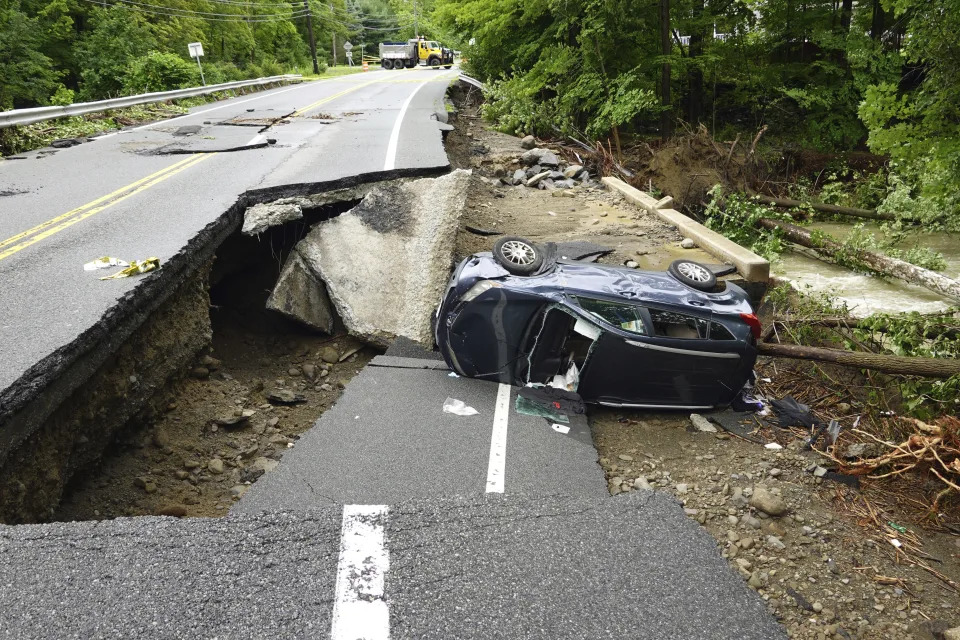
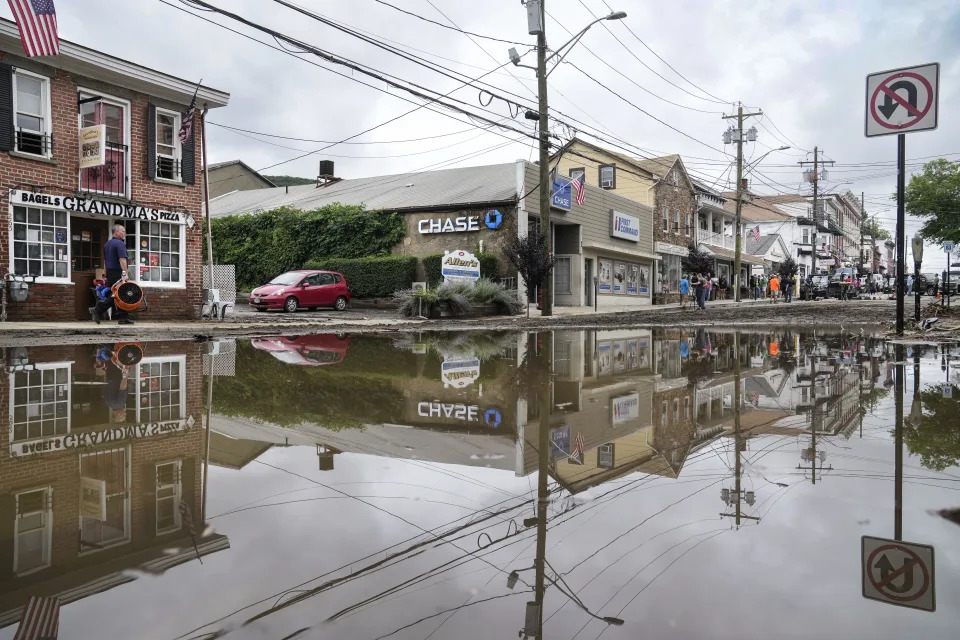
A damaged car lays on a collapsed roadway along Route 32 in the Hudson Valley near Cornwall, N.Y., Monday, July 10, 2023. Heavy rain has washed out roads and forced evacuations in the Northeast as more downpours were forecast throughout the day. (AP Photo/Paul Kazdan)Residents, journalists, and emergency service workers walk around a flooded Main Street, Monday, July 10, 2023, in Highland Falls, N.Y. Heavy rain has washed out roads and forced evacuations in the Northeast as more downpours were forecast throughout the day. One person in New York’s Hudson Valley has drowned as she was trying to leave her home. (AP Photo/John Minchillo)Mud, rocks and debris from Sunday’s flash flood cover a road on the campus of the United States Military Academy at West Point, Monday, July 10, 2023 in West Point, N.Y. Heavy rain has washed out roads and forced evacuations in the Northeast as more downpours were forecast throughout the day, Monday. (Courtesy of the USMA via AP)Erosion damage is seen after heavy rains washed down Bear Mountain near the Popolopen Bridge along U.S. Route 9W in Highland Falls, N.Y., rendering the bridge unsafe and impassable for vehicles, on Monday, July 10, 2023. (AP Photo/Ted Shaffrey)
ANDOVER, Vt. (AP) — Rescue teams raced into Vermont on Monday after heavy rain drenched parts of the Northeast, washing out roads, forcing evacuations and halting some airline travel. One person was killed in New York’s Hudson Valley as she tried to escape her flooded home.
Mike Cannon of Vermont Urban Search and Rescue said crews from North Carolina, Michigan and Connecticut were among those helping to get to towns that have been unreachable since torrents of rain belted the state. The towns of Londonderry and Weston were inaccessible, Cannon said, and rescuers were heading there to do welfare checks. Water levels at several dams were being closely monitored.
The U.S Army Corps of Engineers said late Monday they expected two dams to release water overnight, causing “severe flooding” downstream likely to affect multiple towns.
Flooding hit Vermont’s state capital, with Montpelier Town Manager Bill Fraser estimating Monday night that knee-high waters had reached much of downtown and were expected to rise a couple more feet during the night. Montpelier had largely been spared during Tropical Storm Irene, which struck the region in 2011.
“For us, this is far worse than Irene. We got water but it went up and down. There were some basements flooded but it didn’t last long,” Fraser said, comparing this flooding to the Montpelier Ice Jams in 1992. “We are completely inundated. The water is way, way higher than it ever got during Irene.”
During Irene, Vermont got 11 inches (28 centimeters) of rain in 24 hours. Irene killed six in the state, washed homes off their foundations and damaged or destroyed more than 200 bridges and 500 miles (805 kilometers) of highway.
There have been no reports of injuries or deaths related to the latest flooding in Vermont, according to state emergency officials. Roads were closed across the state, including many along the spine of the Green Mountains.
Some people canoed their way to the Cavendish Baptist Church in Vermont, which had turned into a shelter. About 30 people waited it out, some of them making cookies for firefighters who were working to evacuate and rescue others.
“People are doing OK. It’s just stressful,” shelter volunteer Amanda Gross said.
Vermont Rep. Kelly Pajala said she and about half dozen others had to evacuate early Monday from a four-unit apartment building on the West River in Londonderry.
“The river was at our doorstep,” said Pajala. “We threw some dry clothes and our cats into the car and drove to higher ground.”
The slow-moving storm reached New England in the morning after hitting parts of New York and Connecticut on Sunday. Additional downpours in the region raised the potential for flash flooding; rainfall in certain parts of Vermont had exceeded 7 inches ( 18 centimeters), the National Weather Service in Burlington said.
One of the worst-hit places was New York’s Hudson Valley, where a woman identified by police as Pamela Nugent, 43, died as she tried to escape her flooded home in the hamlet of Fort Montgomery.
The force of the flash flooding dislodged boulders, which rammed into the woman’s house and damaged part of its wall, Orange County Executive Steven Neuhaus told The Associated Press. Two other people escaped.
“She was trying to get through (the flooding) with her dog,” Neuhaus said, “and she was overwhelmed by tidal wave-type waves.”
Officials say the storm has already wrought tens of millions of dollars in damage. In New York, Gov. Kathy Hochul said at a news conference Monday the storm sent “cars swirling in our streets” and dumped a “historic” amount of rain.
“Nine inches of rain in this community,” Hochul said during a briefing on a muddy street in Highland Falls. “They’re calling this a ‘1,000 year event.’”
As of Monday evening, several washed-out streets in Highland Falls remained impassable, leaving some residents stuck in their homes but otherwise OK, Police Chief Frank Basile said in a telephone interview.
Massachusetts Gov. Maura Healey said there were reports of flooding in central and western Massachusetts and that state emergency management officials were in touch with local authorities.
The U.S. Military Academy at West Point was pounded with more than 8 inches (20.32 centimeters) of rain that sent debris sliding onto some roads and washed others out. Superintendent Lt. Gen. Steven W. Gilland said recently arrived new cadets and others at the historic academy on the Hudson River were safe, but that assessing the damage will take time.
Atmospheric scientists say destructive flooding events across the globe have this in common: Storms are forming in a warmer atmosphere, making extreme rainfall a reality right now. The additional warming that scientists predict is coming will only make it worse.
The storm also interrupted air and rail travel. There were hundreds of flight cancellations at Kennedy, LaGuardia and Newark airports and more than 200 canceled at Boston’s Logan Airport in the last 24 hours, according to the Flightaware website. Amtrak temporarily suspended service between Albany and New York.
Swift water rescue teams in Vermont have done more than 50 rescues, mainly in the southern and central areas of the state, Vermont Emergency Management said Monday night.
Among the buildings flooded Monday was the Weston Playhouse in Weston, Vermont, which had been performing “Buddy — The Buddy Holly Story” to sold-out audiences.
The Weston Theater Company’s executive artistic director Susanna Gellert said the call was made at around 4 a.m. to evacuate 11 people associated with the production to higher ground and another 15 in nearby Ludlow. The three-floor playhouse, which had been damaged during Irene, was also flooded, with the dressing room and props room under water.
“As a theater, we were just starting to get back from the COVID shutdown,” Gellert said. “To have this happen right now is painfully heartbreaking.”
Cara Philbin, 37, of Ludlow, Vermont, was awakened by a neighbor early Monday and told to clear out of her second-floor apartment because the parking lot was already flooded.
“He told me me, ‘You need to get out of here … your car is going to float away, and I suggest you do not stay,’” said Philbin. The neighbor took her car keys and moved her car to a higher spot, while she called her parents and then drove to their home to ride out the storm, she said.
Ross Andrews and his wife were driving back home to Calais, Vermont, on Monday when he saw trucks parked at a 230-year-old dam with crews trying to keep it from failing. There were trees down everywhere.
“The interstate was closed right at our exit. Our road was closed right at our driveway. We managed to thread our way back just in the nick of time,” he said.
Minchillo reported from Highland Falls, New York. Kathy McCormack in Concord, New Hampshire; Michael Hill in Albany, New York; and Mark Pratt and Steve LeBlanc in Boston contributed.
The latest jobs data suggest that workers may be losing some of the leverage they gained during the pandemic.
By Lora Kelley – July 10, 2023
Frederic J. Brown / AFP via Getty
The latest jobs data give a mixed picture of the economy—and raise questions about how America’s workers will fare.
Losing Ground?
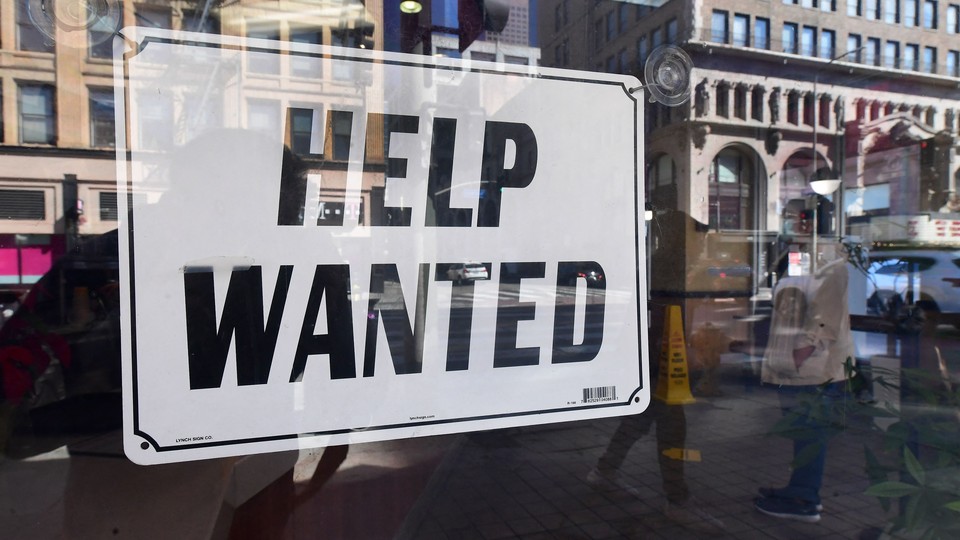
In the spring of 2021, I traveled to Pennsylvania to attend a graduation. Driving around the area, I was struck by all the signs in diner and fast-food storefronts seeking workers. As I recall, the signs had a desperate tone, advertising bonuses and high wages to anyone willing to work. I was witnessing in real time a fascinating economic moment: Low-wage workers were in high demand, and that meant they were gaining leverage.
The signs I saw in Pennsylvania were emblematic of what was happening across the economy. Restaurants are a “microcosm” of the Great Resignation, the pattern that took off in 2021 in which workers quit their jobs to seek higher wages and better benefits‚ Nick Bunker, an economist at Indeed’s Hiring Lab, told me. That spring, as freshly vaccinated Americans went out to spend their stimulus checks, they frequented restaurants. Demand for services soared, and so in turn did the demand for service workers. Businesses had to compete for staff. And when workers saw that they could find better wages and conditions elsewhere, many quit their jobs in favor of new ones.
The latest jobs data suggest that workers might be losing some of this power. The economy added about 209,000 jobs in June, according to data from the Bureau of Labor Statistics released last week. It was the 30th consecutive month of job gains, but gains were at their lowest rate since the streak began. “The picture that emerged was a mixed one,” Julia Pollak, the chief economist at ZipRecruiter, told me. “Workers are still in the driver’s seat in many industries, other than tech, but they are losing leverage.” However, she added, the job market is “still more favorable to workers than before the pandemic.”
What’s happening in hospitality, a sector that includes restaurants and bars, tells us a lot about the job market more broadly. That was true in 2021, Bunker told me, and it’s still true now. Looking at the behavior of the hospitality sector in last week’s report, Bunker noted, we can see that “the labor market is moderating but still strong.”
As the job market softens somewhat, workers may be losing some of the leverage they gained when the market was tighter. As Ben Casselman reported in The New York Times last week, “The rate at which workers voluntarily quit their jobs has fallen sharply in recent months—though it edged up in May—and is only modestly above where it was before the pandemic disrupted the U.S. labor market.” When workers quit jobs, it reflects their confidence that they can find another, better job. Casselman reported that hourly earnings for hotel and restaurant workers rose 28 percent from the end of 2020 to the end of 2022, which was faster than the rates of both inflation and overall wage growth. But now, after surging in late 2021 and early 2022, growth for low-wage workers has slowed, and fewer workers in the hospitality industry are separating from their jobs now compared with the same period last year.
This slowing wage growth could be seen as a sign that workers are losing ground. But another possible reason that wage growth has slowed, Bunker explained, is that many workers’ base pay has gone up compared with a couple of years ago. Employers are “giving raises off a wage rate that has risen a lot since the spring of 2021,” Bunker said.
The Fed will be happy to see the job market cooling off, Bunker told me, so we might see fewer interest-rate hikes in the months to come: “Reduced competition for workers is going to reduce wage growth, which is—in the Fed’s view—going to put less pressure on employers to raise prices, so that should bring inflation down.” But after pausing their hikes last month, following 10 consecutive rate hikes, the Fed is still widely expected to raise rates at its meeting at the end of this month.
The monthly job-openings report tells us more about the recent past than it does about our current reality. The patterns we saw in last week’s numbers contain new information about a moment that’s already slightly dated. And they raise fresh questions about whether the Great Resignation is over. Bunker, for his part, riffed on Mark Twain, saying that in his opinion, “rumors of the Great Resignation’s demise are greatly exaggerated.” But, he added, in a few months, we may be able to say more definitively whether the heyday of the Great Resignation really is behind us.
Nearly half of U.S. adults over 30 show signs of gum disease, which can cause tooth loss. (Hoi Chan/The New York Times)
If your spit is sometimes tinged pink at least a couple of times a week after you brush or floss, it’s possible you have early-stage gum disease. This condition can also have other surprising symptoms — or none.
“It’s a very, very quiet disease,” said DRodrigo Neiva, chair of periodontics at Penn Dental Medicine.
According to the U.S. Centers for Disease Control and Prevention, nearly half of American adults older than age show signs of gum disease, and 9% have severe gum disease, known as periodontal disease.
When left untreated, gum disease can become more difficult to remedy. “Patients may eventually end up losing their teeth,” Neiva said. And some research has connected periodontal disease with other health conditions, such as dementia, diabetes and heart disease.
Early gum disease is called gingivitis, and it is characterized by inflammation of the gums, also known as gingiva.
“It is caused by bacteria on teeth — plaque — that release products that irritate the gums,” said Deborah Foyle, interim department head of periodontics at Texas A&M University School of Dentistry.
Good oral hygiene is key to preventing gum disease, because it removes plaque from the teeth before bacteria can harm the gums. Often, people develop gingivitis because they aren’t brushing and flossing adequately. Sometimes, only parts of the gums become affected — especially the gums around the backs of the teeth where people often don’t brush as well, Neiva said.
Dentists can diagnose gingivitis by using a special instrument that measures the distance between gums and teeth, said Y. Natalie Jeong, professor and chair of the department of periodontology at Tufts University School of Dental Medicine. Larger spaces are indicative of the condition.
When gingivitis is left untreated, the bacteria can invade and destroy the tissues under the gums, causing advanced gum disease. “The bone supporting the teeth starts to break down, leaving the roots of the teeth exposed and sensitive in some cases,” Foyle said. “Spaces develop between the teeth, and the teeth start to get loose.”
People who smoke, have diabetes or grind their teeth have an increased chance of developing gum disease, Jeong said. Some medications, such as steroids, and certain epilepsy and cancer drugs, can also increase the risk. Genetics can also make people more or less susceptible, she noted.
People who rarely get cavities may be more likely than other people to get gum disease, too, Neiva said. That’s because the bacteria that cause gum disease outcompete and suppress the bacteria that cause cavities.
“It’s very common to see patients with very, very advanced periodontal disease not having a single cavity,” he said.
Gingivitis often goes unnoticed because it doesn’t cause pain. But people with gingivitis may notice that their gums bleed when they brush or floss, Neiva said. The part of the gums adjacent to their teeth may also look red rather than pink.
Smokers with gingivitis may not experience any bleeding or other symptoms, Jeong said. “People tend to think, ‘OK, my gums never bleed, I should be just fine,’” she said — but that’s a misconception.
Regular brushing and flossing can help prevent gum disease, but once gingivitis has set in, good oral hygiene at home may not be enough. That’s because the bacteria may have started to accumulate below the gum level, Neiva said. In these cases, a professional cleaning and, sometimes, antibiotics, can treat — and cure — gingivitis.
Once gingivitis has progressed into more advanced periodontal disease, people’s gums may start to recede, causing their teeth to look longer, Jeong said. They may also experience increased sensitivity around the gums. Their teeth may not fit together the same way when they bite because they have shifted, and they might have chronic bad breath. Eventually, their teeth may start to loosen and even fall out.
Advanced periodontal disease can be incurable. Dentists and periodontists can, however, recommend treatments that slow down or prevent further gum and bone loss. They may also deep-clean the roots of affected teeth and recommend gum surgery.
Keeping your gums healthy is ultimately simple: Brush twice a day, floss once a day and see your dentist for cleanings at least every six months, Neiva said.
“The sooner we detect it,” he said, “the more we can do.”
Florida is America’s inflation hotspot, thanks to a persistent problem with sky-high housing costs.
The Miami-Fort Lauderdale-West Palm Beach area has the highest inflation rate of metro areas with more than 2.5 million residents, with a 9% inflation rate for the 12 months ended in April.
That’s more than double the national average of 4%, according to data from the Consumer Price Index. The Tampa-St. Petersburg-Clearwater metro had the third-highest inflation rate in the country, at 7.3% for the year ended in May.
Other metro areas, however, have seen some welcome progress. Minneapolis had an inflation rate of 1.8% in May from a year earlier, the lowest of the 23 metro areas for which the Labor Department publishes inflation data. Urban Hawaii had the second lowest inflation rate at 2% — mirroring the Federal Reserve’s target for its preferred inflation gauge, the Personal Consumption Expenditures index.
Here are some notable inflation trends for the biggest metros in the US and the dynamics behind those shifts.
A vexing inflation problem in the Sunshine State
In Florida, the state’s growing population has been pushing up inflation — particularly via housing costs. It’s a trend that accelerated during the pandemic, when remote work gave some Americans the freedom to relocate, economists say.
“A lot of people are still coming to Florida because the economy is really strong, and many like the fact that we don’t have an income tax like in New York, for example,” said Amanda Phalin, an economist at the University of Florida. “And in places like Miami, we’re seeing a lot of real estate demand from non-Floridians or non-American investors — generally wealthy folks who want to have a nice home here.”
Florida’s population grew the most of any state from July 2021 to July 2022 because of domestic migration, according to the Census Bureau’s latest estimates. During that same period, Florida also had the fastest population growth by percentage, the first time it has notched that top spot since 1957.
Housing costs account for almost a third of the Labor Department’s Consumer Price Index, and population gains heavily influence that component. An influx of residents boosts demand in a local economy across the board — for transportation, services and housing. That has pushed up inflation rates.
Rising interest rates, limited housing stock in cities such as Miami, and more expensive property insurance have also pushed up housing costs, Phalin said.
“Both the rental and purchasing markets are seeing upward pressures on prices from all these factors,” Phalin said. She added that there’s a shortage of available rental units because “a lot of homes are converting themselves into Airbnbs and some homeowner associations prohibit people from renting out their homes.”
That has all resulted in a growing affordability issue for residents who have lived in cities such as Miami and Tampa Bay for decades or their entire lives.
Progress on inflation
Housing costs also loom large in the metro area with the lowest inflation rate: Minneapolis and St. Paul.
“Shelter costs grew faster in Minneapolis and peaked a little bit earlier,” said Tyler Schipper, associate professor of economics at the University of St. Thomas in Minneapolis. “They peaked about six months before they did on average of the rest of the country.”
Also likely playing a role is how the Bureau of Labor Statistics tabulates shelter costs within the CPI and the timing of when readings are collected for various regions.
Shelter carries a lot of weight in the CPI calculations. However, it comes at a significant lag because of how infrequently the data is collected (every six months versus monthly or two months for other CPI prices) and because of how infrequently rents change (many leases are for 12 months, and rents typically are raised when a tenant leaves).
“I think that’s leading to this divergence where inflation peaked at about the same time for [the Twin Cities and the nation], but it just has dropped off faster here than in the rest of the country,” he said.
Helping that along has been a surge of multifamily construction, putting more apartments on the market and bringing down rents in the process.
Last year, multifamily permits made up nearly half of the total housing permits issued in the Federal Reserve Bank of Minneapolis’ district, which spans the Upper Midwest into the Mountain West. The activity — which was the highest share on record for that district, the regional Fed noted — is particularly evident in southeastern Minnesota, where large apartment projects are flourishing throughout the Twin Cities.
Even though the Twin Cities’ inflation rate is currently the lowest among major cities, it might not feel that way to residents, Schipper said.
“Because the CPI is so weighted toward housing, our overall numbers still looked really good, but those food prices went higher and stayed higher relative to other metro areas,” he said. “You’re going to have a hard time convincing people that inflation is getting better if their grocery store prices are still going up.”
Minneapolis resident Latoya Rogers isn’t feeling much price relief when she’s out getting groceries or buying other home goods. Aside from grabbing an item or two if she’s near a Target or a Cub grocery store, most of her shopping is done at Costco or Sam’s Club, she said.
“I budget a lot because things are so expensive these days,” she said during a quick run to Target in south Minneapolis. “Buying in bulk will last you longer.”
Still high, but doing better
At one point, the Atlanta-Sandy Springs-Roswell metro was America’s inflation hotspot.
Inflation soared in Atlanta for the reason it did in other cities in the South: The population grew, driven by Americans fleeing expensive coastal cities.
However, inflation in this metro area has come down steadily in the past year as supply and demand in the region’s housing market has come into better balance as migration into the city has slowed.
Atlanta notched an inflation rate of 5.8% in the 12 months ended in April — about half of the 11.7% peak it saw in August 2022.
“If you look at the data, housing inventory in Atlanta has increased quite a bit from a year ago, so there’s a lot more supply in the market, while the number of sales has been declining,” said Kaiji Chen, an economics professor at Emory University in Atlanta.
A drop in transportation costs also helped slow Atlanta’s inflation rate, he said.
Father claims he ‘ended’ his young son’s health problems by making one small change in his home: ‘[It] offers zero benefit’
Brett Aresco – July 9, 2023
The national debate over gas stoves in homes has reached a fever pitch, with advocates praising their cooking precision and critics condemning their adverse health effects. With more Americans than ever debating the costs and benefits, many have started sharing their own stories about abandoning gas stoves on social media.
Writer Jamelle Bouie is one person who’s gone through that questioning — and come out the other side praising the benefits of induction stoves over gas-powered ones. Bouie, a dad, says the decision to switch had a major effect on his son’s health.
Bouie posted a TikTok explaining his reasoning, in which he says that “there is a lot of evidence going back many decades that gas stoves produce levels of indoor pollution that would be considered highly dangerous if experienced outside.”
“I’m not here to tell you that you can’t have a gas stove,” Bouie adds, noting that he and his family purchased an induction range in 2022 and have already seen the benefits.
“My son had pre-asthma,” Bouie goes on, “and removing the gas stove from our house pretty much ended any respiratory problems he had.”
Research now shows that gas stoves are a major contributor to childhood asthma cases because they release dangerous chemicals like nitrogen dioxide and formaldehyde. According to the California Air Resources Board, “Natural gas and propane stoves can release carbon monoxide, formaldehyde, and other harmful pollutants into the air, which can be toxic to people and pets.”
Induction stoves are an excellent alternative that can eliminate many of the problems with gas stoves. They’re also lightning-fast, easy to clean, and usually cheaper than their gas counterparts. Bouie says his induction range “cooks as good as gas,” and he found a lot of support for his switch from fellow TikTokers who commented on the video.
“We switched to an induction stove a few months ago,” one user writes. “I like it better than gas, heats up cast iron fast and boils water very fast.”
“Induction is better by every metric,” writes another. “Gas offers zero benefit.”
Other commenters lamented that they lived in rented homes and didn’t have the power to replace their gas stoves. “I would get rid of the stove,” one writes, “but I’m in an apartment.”
“Renters need recourse,” another commenter writes. “Not like we can legally replace them ourselves.”
Join our free newsletter for easy tips to save more, waste less, and help yourself while helping the planet.
Degenerative disc disease treatment aims to minimize symptoms and prevent further disc degeneration. Damage to the disc cannot be reversed. The right treatment option may depend on the extent of deterioration.
Degenerative disc disease is caused by the wear of the shock-absorbing discs (intervertebral discs) between the spinal vertebrae. It can occur in any area of the spine. The symptoms of degenerative disc disease include back pain (especially when sitting), numbness and tingling in the hands or feet, and weakness in the legs.
This article will cover the different treatment options for degenerative disc disease, including conservative treatment and surgery.
Medication
Medication can minimize pain and inflammation in people with degenerative disc disease. It will not stop the progression of the condition, but decrease its symptoms.
Nonsteroidal Anti-Inflammatory Drugs (NSAIDs)
NSAIDs are medications that decrease inflammation and pain. They can relieve the associated back pain and decrease inflammation in the joints in those with degenerative disc disease.
Aspirin and Advil or Motrin (ibuprofen) are common over-the-counter (OTC) NSAIDs. Prescription NSAIDs include Nalfon (fenoprofen), ketoprofen, and sulindac.
Potential side effects of NSAIDs include ringing in the ears, dizziness, gas, bloating, constipation, and nervousness. People who are on blood thinners, have poor kidney function, or are pregnant should talk to their healthcare provider before taking an NSAID.
Nonnarcotic Pain Relievers
Tylenol (acetaminophen) is a common OTC pain reliever. Prescription nonnarcotic pain relievers may also be recommended by a healthcare provider.
Narcotic Medications
Narcotic pain medications may be prescribed by a healthcare provider when pain is moderate to severe.
Narcotics like codeine and morphine work in the central nervous system (CNS) to numb pain. While narcotics are an effective pain medication, they do carry many side effects. These include:
Constipation is a very common narcotic side effect. Talk to a healthcare provider about starting a stool softener or increasing dietary fiber.
Muscle Relaxants
If someone is having muscle spasms in their back then a muscle relaxant may be a good choice to help relieve pain and spasms. Common muscle relaxants include Soma (carisoprodol) and Flexeril (cyclobenzaprine).
Muscle relaxants should not be used long-term, but rather for just three to four days. There are serious side effects like depression and drowsiness.
Antidepressants
Antidepressants may be used to treat pain and poor sleep in people with degenerative disc disease. The chemical reactions in neurons that cause depression seem to be the same nerve pathways as pain.
Using an antidepressant may not be right for everyone, but can be helpful to regain a normal sleep routine due to back pain.
Physical Therapy
People with degenerative disc disease may benefit from physical therapy. The overall goal of physical therapy will be to decrease pain and improve muscle strength and flexibility. This will help the body support the spine and reduce pain and stiffness.
There are many different treatments used under the physical therapy umbrella. They may include:
Transcutaneous electrical nerve stimulation (TENS): The electrical stimulation from a TENS unit interferes with or blocks pain signals and can work for back pain.
Strength training: Strengthening the core can stabilize the spine and reduce back pain.
Improving flexibility: This can improve spine mobility and range of motion. Stretching also decreases back spasms.
Posture training: Poor posture contributes to back pain. A physical therapist can teach someone how to sit, stand, and move correctly.
Exercise
Regular exercise is an important component in maintaining spine health. Exercise strengthens back and abdominal muscles, which support the spine. A person with degenerative disc disease should talk to a healthcare provider before beginning an exercise routine. Ask if any motions (such as twisting) should be avoided.
Many types of exercise can be used, like weight training, aerobic exercise, and aquatic therapy, as follows:
Weight training combines weights with exercise and helps to prevent bone loss and strengthen muscles.
Aerobic exercise like walking, cycling, or running increases the heart rate and blood pressure while also releasing endorphins (the body’s natural pain relievers).
Aquatic therapy, or exercise in a pool, is an effective and low-impact aerobic exercise that is beneficial to people with degenerative disc disease. The water decreases pressure on the spine allowing the person to get the benefits of a workout without all the physical stress.
Chiropractic Care
Chiropractic care uses adjustments to the spine to correct improper alignments, reduce pain, and improve the body’s ability to heal itself. There is limited research on the effectiveness and safety of chiropractic care for people with degenerative disc disease, so it should be discussed with a healthcare provider before use.
Acupuncture
Acupuncture is a traditional Chinese medicine practice in which thin needles are inserted into the skin in different areas of the body. An acupuncturist will place the needles along meridians (traditional energy pathways). Acupuncture may improve healing by increasing blood flow or relieve pain by releasing endorphins.
Cold therapy works by applying an ice pack or cold towel to the painful area for 20 minutes at a time. The cold will interrupt the pain signal, thereby reducing pain. It will also cause the surrounding blood vessels to tighten, which will reduce swelling.
Heat can be used with a warm towel or heating pad. The heat will soothe sore muscles and dilate the surrounding blood vessels, which improves blood flow to the area.
Spine Injections
A steroid spine injection can reduce back pain and inflammation caused by degenerative disc disease. The injections use a combination of steroid medication and numbing medicine. Pain relief usually starts soon after the injection and lasts a few weeks to months.
Healthcare providers may limit the number of steroid injections a person can receive in a year. Too many can cause an infection or skin discoloration. Steroid injections are typically used when other conservative treatments are not successful.
Bracing
Another nonsurgical option for degenerative disc disease is a back brace. A back brace is a medical device that is wrapped around the lower back and secured with Velcro. The brace does not completely immobilize the back but does reduce the ability to move. It can stabilize the spine and reduce tension in people with degenerative disc disease.
Surgery
When degenerative disc disease does not respond to conservative treatment, surgery may be necessary. Below are the different surgical options that can be used.
Disc Replacement
Disc replacement is used in place of a spinal fusion in people under 65 years of age who have a herniated disc in the neck. An artificial disc is placed where the damaged disc is removed. One of the greatest benefits is that it allows flexibility and stability in the spine.
People who have a disc replacement can usually go home after one night in the hospital and can walk within 24 hours. They may need to wear a brace for support during the first few weeks after surgery.
Discectomy
A discectomy is a common surgery used in the treatment of degenerative disc disease. During the procedure, the injured part of the disc is removed. This alleviates pressure on the surrounding nerves by making room in the spinal canal.
Spinal Fusion
A spinal fusion is when a surgeon permanently joins the vertebrae to eliminate movement and stabilize parts of the spine. Spinal fusion may be necessary when there is a severely degenerated disc. It is sometimes done in conjunction with a discectomy and is more often done on the neck than the lower back.
A spinal fusion requires an overnight stay at the hospital. The patient may need to wear a brace after surgery and will need to minimize activity until their surgeon clears them.
How to Prevent Degenerative Disc Disease From Getting Worse
While preventing degenerative disc disease may not be possible, there are several ways to decrease the rate of degeneration. Here are a few steps that can be taken:
Stop smoking. Research shows that smoking increases the rate at which the intervertebral disc degenerates.
Exercise. Regular exercise will strengthen the back and core muscles that support the spine.
Maintain a healthy weight. People with elevated body mass index (BMI) have a higher likelihood of developing degenerative disc disease.
Summary
Degenerative disc disease is a progressive condition that results when the cushions in between the vertebrae wear down. There is no cure for the condition and treatment is aimed at reducing symptoms and preventing further degeneration. Current treatments include exercise, physical therapy, and in severe cases surgery. Talk to a healthcare provider to determine the best treatment route.