On a dead-end street in north Denver, migrants are surviving winter with the help of an army of volunteers

Colorado Sun – News, Immigration

On a dead-end street in north Denver, migrants are surviving winter with the help of an army of volunteers

As the city reinstates time limits on hotel stays, volunteers are making plans to help hundreds more migrants in camps

Jennifer Brown – January 22, 2024

Dusk falls over a migrant encampment of about 10 as Juan Carlos Pioltelli, of Peru, walks into the community warming tent in subzero temperatures in Denver on Jan. 15, 2024. An American flag hangs upside down after migrants, in a hurry and out of excitement for being in the U.S., accidentally put it up upside down. (Eli Imadali, Special to The Colorado Sun)

Footprints in the snow lead from the sidewalk to a path through the weeds, opening to a field that is almost invisible from the road. 

North of Interstate 70, in a part of Denver filled mostly with warehouses and gas stations, the tents are flapping relentlessly in the wind. About 10 migrants from South America hunkered down here during four days of subzero temperatures, and the volunteers who brought them heaters and propane, hot meals and fresh water, are prepared to help hundreds more as Denver pushes migrants out of their city-provided hotel rooms in the coming weeks. 

The dozen or so brightly colored tents were mostly concealed from view by the field’s dirt mounds, despite that they were just across the South Platte River from the National Western Stock Show, one of Denver’s biggest events of the year. As the city stayed home during last week’s deep freeze, the Venezuelans and other South Americans in the encampment zipped into sleeping bags and gathered in a “warming tent” to play dominoes and eat a pot of homemade noodle soup. 

The camp lasted about two weeks, until Friday, when crews from Denver Parks & Recreation arrived and helped the migrants bag up their belongings and dismantle the tents.

They moved a couple of blocks away, out of the field and at the dead end of a street to nowhere.

The men in the encampment, near Washington Street and East 50th Avenue, are among the few migrants who are still living outside after the city’s massive effort to get migrants indoors before the January freeze and snowfall. Because of the cold, Denver paused time limits on stays in the seven hotels it has rented out for migrants, but that pause is ending Feb. 5 after the number of people staying in hotels has surpassed 4,300. 

Hundreds of people — including families with children — will have to leave their hotel rooms in the coming weeks. 

Jose Giovanis, left, leaves his tent as he and other South American migrants get ready to take showers in Denver on Jan. 15. Giovanis and about nine other migrants lived in the encampment with heated tents and other provisions through January’s deep freeze. (Eli Imadali, Special to The Colorado Sun)

They were offered mats in city shelters, hotel rooms and even to go home with some of the volunteers who stop by to make sure they survived another frigid night. But they chose to stay outside for various reasons — because sleeping mat to mat makes them anxious, because they didn’t want to leave their belongings or lose their campsite, because they would rather try to make it on their own, no matter how cold. 

“The snow makes you shiver so much you can’t talk or anything,” said Kevin Bolaño, who is from Colombia. “Sometimes we go out to shake the tents around and remove the snow.” 

Bolaño, 33, arrived in Denver just over a month ago, one of 37,600 migrants, mostly Venezuelans, who have come through the city in the past year. He spent his allotted 14 days in a hotel room, then camped outside the Quality Inn in northwestern Denver until earlier this month, when city crews bused more than 200 people in that sprawling camp to shelters and scooped left-behind tents, mattresses and furniture into garbage bins.  

Bolaño, a chef who specializes in Chinese dishes, wants to work in a restaurant or for a construction company, but he has struggled so far because he does not have a work permit. “If we were working for a company, we would not be here in the cold,” he said.

He left his home in Colombia, where he lived with his parents and children, because of terrorism and poverty, he said. “The government wanted all of a person’s salary. The food went up, the services and the houses went up and nothing was enough,” Bolaño said in Spanish. “It makes a person want to leave their own country in order to be able to help the family they left behind.” 

Jose Giovanis, nicknamed Valencia after the Venezuelan city he’s from, sits on his phone as he shows his heated tent in a migrant encampment where he and about nine other migrants are living, despite the frigid weather, in Denver Jan. 15. (Eli Imadali, Special to The Colorado Sun)

On a blustery day last week, Bolaño smoked a cigarette in his tent with Elis Aponte, 47, who left Venezuela to escape discrimination he felt as part of the LGBTQ community. “Here, people don’t bully me,” said Aponte, who arrived in Denver four months ago and is now living in a house with a friend after weeks in a hotel and then an encampment along the sidewalk. 

In Venezuela, Aponte studied radiology and forensic anthropology, and worked in a morgue. But like many migrants, he has struggled to find work here without the required legal documents. Still, Aponte said he is glad he made the journey to the United States. 

“There is a lot of good stuff here,” he said in Spanish. “The only bad thing was that we arrived in a season when the snow was coming. I wear one, two, three sweaters and a jacket here, and even with all that, it’s cold. But I like Denver.”

They likely would not attempt surviving a Colorado winter outside, though, if it weren’t for the local army of volunteers who drive them to get showers and bring the propane needed to keep the heaters running in every sleeping tent and community warming tent. 

Food and other cooking and eating supplies are stored in their designated tent at a Denver migrant encampment of 10 people. (Eli Imadali, Special to The Colorado Sun)
Denver locals mobilize to help via social media

The calls to help Hugo, the lone man left in an encampment under a north Denver bridge near West 48th Avenue and Fox Street, went out daily. 

“We need someone to bring Hugo a hot meal for dinner tonight after he gets home from work,” volunteer Chelsey Baker-Hauck posted on a migrant support Facebook page. “He may also need drinking water and some additional propane for tonight. He has a thermos you can also fill with hot water so he can make coffee/cocoa.”

Not long after her post, another Denver resident who is part of the “mutual aid” network responded that he would bring Hugo dinner and fresh water as soon as he finished work.

The Facebook page has 1,200 members and counting, hundreds of whom are actively helping, Baker-Hauck said. She and others started the page as an encampment began to spread under a bridge in their north Denver neighborhood. For weeks, they were delivering hot food and blankets, helping migrants find apartments and taking them into their homes. 

“If they choose to stay outside,” she said, “we try to help them stay alive.”

Mutual aid volunteer Chelsey Baker-Hauck, right, and David Amdahl, a volunteer with the Denver Friends Church, organize, salvage and save items left behind at a migrant encampment on Jan. 16 near 48th Avenue and Fox Street in Denver, ahead of a city cleanup. (Eli Imadali, Special to The Colorado Sun)

It was devastating, Baker-Hauck said, when the city posted notice that crews would clean up the camp last Thursday. Ahead of the cold snap, the city offered bus rides to shelters and hotels. But Hugo, who has no vehicle and found steady work in construction within walking distance of the bridge, refused to go. 

For a week, volunteers packed up tents, gathered and washed coats and clothing, and saved paperwork left behind as the migrants — all but Hugo — rushed to take buses to shelters. The volunteers want to return it to the people who left the camp or save it for other migrants who end up on the street when their hotel stays expire, Baker-Hauck said. Either way, they didn’t want the city to stuff it all in the trash. 

“When the city does it, everything goes in the garbage,” she said. “It’s a lot of waste.” 

The tents and winter gear will likely go to other encampments, including the one near the Denver Coliseum, Baker-Hauck said. 

The group operates under the “mutual aid” concept, meaning no one is in charge and everyone pitches in when they can. Baker-Hauck posts the needs of the day, and people respond. When the deep freeze began, a volunteer called the mayor’s office and said she had 15 people who were freezing at a camp near Tower Road and East 56th Avenue. The mayor’s staff made room inside a city building near Civic Center park that was opened as a migrant shelter a couple of weeks ago. 

Then Baker-Hauck asked the volunteer group if anyone could pick up the migrants and drive them to shelter. Nine drivers went out in the subzero temperatures. 

“They responded within minutes,” she said. “It was amazing.” 

As for Hugo, he finally agreed to stay with Baker-Hauck as the city crews were coming to clean up what was left of the camp. His first night in her home, Hugo took a hot shower, called his family in Ecuador and asked if she had any books in Spanish that would teach him about Colorado history.

He insisted on walking to work, an hour each way. 

Families will get 42 days in hotel rooms

The camp near the Stock Show has its own set of volunteers, including Amy Beck, a Denver resident who for years has been helping the city’s homeless population through her group, Together Denver. She focused her efforts on migrants in the past few months because they were so unprepared for the cold weather and it was so upsetting to her to see children in tents.

Beck chose the vacant field in the weeds, then helped coordinate efforts to gather tents and propane deliveries. She spent the past weekend helping set up the new camp in a culdesac that backs up to the field after city officials cleared the first one. Each sleeping tent has a Little Buddy propane heater, and the community tent — with a table in the center for meals and games — has a 20-pound propane tank that keeps it surprisingly warm. 

“It’s so warm, you have to take your coat off,” she said.

Still, Beck and fellow volunteers say they have done everything they can to persuade people to move indoors. At the encampment, she pulled out her phone to show the men photos of unhoused friends she brought to the hospital for amputations last spring because of frostbite. One man lost both of his feet; another lost all of his toes. 

The volunteers offer bus tickets to warmer cities, rooms in their homes, calls to Denver Human Services to find housing. 

“As a last resort, we set them up in a tent,” Beck said. 

Amy Beck, part of Together Denver and a volunteer working to help newly arrived migrants, stands for a portrait at a migrant encampment of 10 people in Denver on Jan. 15. Upset after seeing children in tents, Beck coordinated donations and volunteers to help migrants survive January’s deep freeze. (Eli Imadali, Special to The Colorado Sun)

She helped set up the encampment as the city dismantled the one outside the Quality Inn, which had stretched multiple blocks in the Highland neighborhood, across Interstate 25 from downtown. That camp, Beck said, was “complete mayhem,” with tents lining the sidewalk and blocking traffic, and dozens of nonprofits and volunteers coming by daily with breakfast burritos, medicines and boxes of snow boots. 

“Having children in tents, that crosses the line for me,” she said. “I can’t bring myself to go through a city sweep with children present. Children are not criminals, but that’s the law of Denver.” 

Beck liked the new encampment because it was so out of the way. Volunteers have collected 200 tents, which they expect to fill in the coming weeks as people time out of hotels. They said they will squeeze more into the encampment near the Stock Show and look for other spots as needed. Individuals get 14 days, while families get 42 days. 

They are going to exit everyone who queued up during the severe weather. That is going to be disastrous.

— Amy Beck, volunteer

“They are going to exit everyone who queued up during the severe weather,” Beck said. “That is going to be disastrous. That said, we are prepared. It’s not going to be super comfortable but we will be able to make a very good attempt to keep everyone safe.” 

She wants the city, since the Stock Show ended Sunday, to turn the Denver Coliseum into a shelter as it did during the height of the COVID pandemic. “We’re hoping the city is going to make some humane decisions,” Beck said. 

The city has no plans for that, as of now.

“All options are on the table, but there’s nothing happening with that space at the moment,” said Jon Ewing, spokesman for the Denver Department of Human Services.

Denver Parks & Recreation said they provided 48 hours notice that they would clear the camp in the field Friday. “Park rules do not allow individuals to set up tents or structures of any kind so as to ensure that public parks remain open for all,” spokesperson Yolanda Quesada said via email.

In November and December, Denver was receiving multiple busloads and 100-200 migrants per day, mostly from Texas. The buses keep coming, though the pace is now from 20-100 people per day. 

“I’m getting the sense that this is not going to be resolved any time soon,” Beck said. 

The outhouse sits under a tree as the sun sets and temperatures remain below zero at a migrant encampment of 10 people in Denver. (Eli Imadali, Special to The Colorado Sun)
Migrants in apartments facing steep rent after initial aid runs out

Volunteers are also helping hundreds of migrants who have moved into apartments in the Denver area, many of them with help from the city and nonprofits to pay their deposit and first month’s rent.

Shari Spooner, who runs a marketing agency in Denver and has family in Venezuela, started volunteering with an organization called Para Ti Mujer when migrants began arriving in Colorado. “It pulls at my heartstrings, obviously,” she said. 

Spooner delivers donated clothes and gift cards to Venezuelans around the metro area, and helps navigate bureaucracy to help people get information about unpaid wages and health care. She recently directed a pregnant woman to Denver Health, after explaining to her that she could receive care without insurance or citizenship. 

The woman lives with her husband and children in an apartment that costs $2,400 per month, though the first two months have been covered by the city and a foundation. Spooner worries about how they will make rent when the third month is due, especially after the woman’s husband was cheated out of his wages for construction work. 

“The vast majority of the people I’ve met and helped are looking for jobs,” Spooner said. “They are looking to be part of Colorado and build their life here in a positive way. They just need that first step. I think it’s important for people to know that.”

Snow rests atop a tent at a migrant encampment of about 10 people as temperatures dip to minus 6 degrees in Denver on Jan. 15. (Eli Imadali, Special to The Colorado Sun)

Some of the men in the encampment near the Stock Show are hoping to share apartments once they earn enough money. For now, they say they are content staying put. 

Daniel Escalona, 21, said he does not want to sleep in a shelter where there are wall-to-wall mats on the floor and regular outbursts among people crowded into the room. And the heaters at the encampment are keeping him warm enough. 

“We don’t want to sleep here,” said Escalona, who traveled from Venezuela on his own. “With a job, I can rent an apartment. But if I don’t get a job, I cannot.”

Jennifer Brown writes about mental health, the child welfare system, the disability community and homelessness for The Colorado Sun. As a former Montana 4-H kid, she also loves writing about agriculture and ranching. Brown previously worked at the Hungry Horse News in Montana, the Tyler Morning Telegraph in Texas, The Associated Press in Oklahoma City, and The Denver Post before helping found The Sun in 2018.

Read More:
Decades of inaction left a water system in southwestern Colorado in shambles. Will the state step in to help?

January 24, 2024

Colorado has the nation’s third-longest waitlist for people charged with crimes and ordered into psychiatric treatment

January 24, 2024

Trump Chooses Absolutely Baffling New Topic For Latest Rambling Aside

HuffPost

Trump Chooses Absolutely Baffling New Topic For Latest Rambling Aside

Ed Mazza – January 22, 2024

Embedded video

Donald Trump’s speech on Sunday took an unexpected turn when he went on a tangent about the names of U.S. military installations.

“We won world wars out of forts,” he said at an event in Rochester, New Hampshire. “Fort Benning, Fort This, Fort That, many forts. They changed the name, we won wars out of these forts, they changed the name, they changed the name of the forts. A lot of people aren’t too happy about that.”

Trump then essentially repeated what he’d just said.

“They changed the name of a lot of our forts. We won two world wars out of a lot of these forts and they changed the name,” he said. “It’s unbelievable.”

Nine U.S. military installations named for Confederate generals have been renamed to honor people who didn’t fight against the United States.

The Fort Benning that Trump mentioned was named for Henry L. Benning, who NPR noted was not just a Confederate general but a “virulent white supremacist.”

The Georgia installation was renamed Fort Moore last year in honor of Lt. Gen. Hal Moore and his wife, Julia Compton Moore, whom Military.com called “one of the Army’s most influential couples.”

Trump’s critics on X, the former Twitter, noted the strange digression:

Paul Waldman: Understand that Trump is mad because military facilities named for treasonous white supremacist slavery advocates who waged war against the United States were renamed to honor actual American heroes. That’s what he and his audience are pissed about.

Sophie Persists: We can’t forget the brave soldiers stationed at Fort This.

Chris Taylor: I was stationed at Fort This in 2009. They wanted to transfer me to Fort That. Lol a commander in chief that can’t even remember the names of the bases, yet he’s so upset the names were changed.

Bryan: I know by now I shouldn’t be surprised at his ignorance. Yet here we are…

Rick Wilson: Grandpa Ranty’s Ahistorical Ignorance Tour, 2024 edition.

Ron Filipkowski: Attached to this post is an excerpt from the speech Henry Benning made at the Virginia convention with his reasons for secession. Trump is bemoaning not having a base named after him. https://t.co/c6HaYsrGa9

Wu Tank is for the Children: Stay in school kids…there is so much insanity in this clip

Pro Lib: “Where were you stationed?” “Fort This, you?” “Fort That!” “Oh weird!”

Sue Z: Good God. And you MAGA people still love him. He’s an incoherent buffoon.

Keith Edwards: Trump is experiencing huge mental decline. The media has to start taking this seriously.

Trump pushes back on claims of mental missteps

The Hill

Trump pushes back on claims of mental missteps

Filip Timotija – January 20, 2024

Former President Trump, the current GOP frontrunner, pushed back on claims of mental missteps during his Saturday rally in New Hampshire, after his main rival in the state, former U.N. Ambassador Nikki Haley, raised concerns about his mental fitness.

Trump deflected the criticism that arose after he appeared to mix up Haley and former House Speaker Nancy Pelosi (D-Calif.) on Friday while talking about Jan. 6, 2021, stating his reliance on sarcasm during speeches and emphasizing that he aced a cognitive test that he claimed he took “a few months ago.”

“A lot of times I’ll say that President Obama is doing a lousy job, meaning that Obama is running the show,” Trump said during his rally. “They’ll say, Donald Trump doesn’t know who our president is. No, no. A few months ago I took a cognitive test my doctor gave me, I said give me a cognitive test just we can, you know, and I aced it. I also took one when I was in the White House.”

The 45th president has often raised concerns over President Biden’s age, claiming he is “cognitively impaired” and “in no condition to lead” the country.

During his rally on Friday, Trump appeared to have mixed up Haley and Pelosi while talking about the insurrection on the Capitol, to which the former U.N. Ambassador responded by saying that she was concerned to have somebody whose “mental fitness” is questioned while serving in the Oval Office.

“The concern I have is, I’m not saying anything derogatory, but when you’re dealing with the pressures of a presidency, we can’t have someone else that we question whether they’re mentally fit to do this,” Haley said.

During the Saturday rally, Trump continued the defense of his mental acuity, stating that he will let people know when he “goes bad.”

“I’ll let you know when I go bad,” Trump said. “I really [don’t] think I will be able to tell you because someday we go bad.”

He also refuted Haley’s claims, saying he does not mind being his age, possibly referencing when the former South Carolina governor called for “mandatory competency” tests for politicians over 75.

“They always say, like Haley, she talks about, ‘yeah, we don’t need 80-year-old,” Trump said. “Well, I don’t mind being 80, but I am 77, that’s a big difference.”

Rep. Elise Stefanik (R-N.Y.), who has endorsed the former president and is rumored to be in circulation for a potential vice president pick, pushed back on Haley’s claims, stating that “the reality is Nikki Haley is relying on Democrats, just like Nancy Pelosi, to try to have a desperate showing.”

In November, Forbes noted that Trump mixed up Biden and Obama at least seven times in recent months.

The US is struggling to handle an immigration surge – here’s how Europe is dealing with its own influx

The Conversation

The US is struggling to handle an immigration surge – here’s how Europe is dealing with its own influx

Tara Sonenshine, Tufts University – January 19, 2024

Workers from the Spanish nonprofit Open Waters rescue 178 migrants from different countries, off the coast of Italy in September 2023. <a href=
Workers from the Spanish nonprofit Open Waters rescue 178 migrants from different countries, off the coast of Italy in September 2023. Jose Colon/Anadolu Agency via Getty Images

As record-high numbers of undocumented migrants cross the United States-Mexico border illegally, one key question is how the U.S. got into this situation, and what lessons can be learned from how other countries respond to border security and immigration problems.

Having worked both inside the U.S. government and in the private sector, I have observed the growing importance of welcoming foreign citizens to one’s country for improving economic growth, scientific advancement, labor supply and cultural awareness.

But migrants entering and staying in the U.S. without visas or proper documentation can create problems – for the migrants themselves, and for overtaxed governments that lack the ability to quickly process asylum cases in immigration courts, for example, or to provide temporary shelter and other basic services for large numbers of arriving migrants. These strains are happening now in many places in the U.S.

Immigrants arrive at Ellis Island in 1923, one year before Congress reformed immigration laws in the U.S., making it harder to enter the country. <a href=
Immigrants arrive at Ellis Island in 1923, one year before Congress reformed immigration laws in the U.S., making it harder to enter the country. Underwood & Underwood/Underwood Archives/Getty Images
U.S. immigration trends

In 1924, after decades of the U.S. welcoming foreign-born citizens to its shores, Congress passed the Immigration Act, restricting the numbers and types of people who could legally enter and stay in the U.S.

That legislation ushered in even more xenophobia and division in the U.S. over the ethnic origins of immigrants – cutting off large-scale immigration, especially from Europe and Asia, until jobs needed to be filled – and there weren’t enough people in the U.S. to fill them.

In the 1960s, immigration laws were reformed again, ushering in waves of immigration from Asia because the U.S. needed people to work at unfilled jobs.

Today, once again, some U.S. politicians are pushing for new ways to restrict immigration. Much of their work focuses on making it harder for migrants to get asylum – meaning legal permission to remain in the U.S. if they have a legitimate fear of persecution in their home countries.

Overall, U.S. border officials encountered more than 1.1 million people illegally crossing the U.S. border from April 2022 through March 2023 – a sharp rise from previous years, when the number of people illegally crossing each year hovered at less than 300,000.

U.S. authorities are now stepping up deportations, quickly sending more undocumented people back to their home countries.

A shifting response to immigration

Globally, international migration to rich countries reached an all-time high in 2022.

So, how do other countries, including Canada and Germany, respond to migrants crossing their borders without a visa or proper documentation?

One answer has been to reform their immigration systems to make deportation easier.

Germany, for example, has been wrestling with increases in undocumented immigration.

Germany Chancellor Olaf Scholz announced at the end of 2023 that he supports large-scale deportations for migrants who are rejected for asylum.

Germany deported close to 8,000 people, many of them fleeing the war in Ukraine, in the first part of 2023. In total, an estimated 92,119 immigrants entered Germany illegally from January through September 2023.

New German government reforms will increase that figure and no longer require officials to announce deportations in advance.

Italy, which is also battling a huge influx of undocumented migrants from North Africa, recently doubled the amount of time that it can detain undocumented migrants, rising from three months to at least six months. This decision is seen as an effort to deter more migrants from illegally entering Italy.

In November 2023, Italy signed an agreement to build two new immigration detention centers across the Adriatic Sea in Albania.

This allows Italy to skirt a European Union policy that requires its member countries to consider and process all asylum applicants’ requests within a year of their arrival. Since Albania is not part of the European Union, it could quickly deport the migrants that Italy sends there.

In December 2023, the European Union’s 27 countries also voted on a major overhaul of asylum laws. These changes will make it easier for countries to deport migrants who fail to get asylum. They also direct the European Union to give money to countries that allow more asylum seekers to stay in those countries.

Other approaches

Right now, Italy and Greece bear much of the brunt of migration in the EU.

More than 31,000 undocumented migrants, mainly from Syria, crossed into Greece in 2023, up from 18,000 undocumented people who entered the country in 2022.

The parliament in Greece is considering new laws that would enable the country to issue tens of thousands of undocumented migrants residence and work permits to address labor shortages.

Greece is also pushing the European Union to slap economic sanctions on countries, like Pakistan, that refuse to take back the undocumented migrants that Greece deports to their home countries.

Closer to home, Canada is also experiencing a surge of undocumented migration into Quebec and other places, prompting some Canadians to feel growing anxiety, in part because of perceptions that the sudden population growth is also raising the country’s already-high housing costs. Canada deported 7,232 undocumented people in the first six months of 2023 – a rise compared to the 7,635 deportations Canada carried out in the entire year of 2021.

Canada also announced in December 2023 that it is planning to allow people who entered the country with valid, short-term visas, and who continue living in Canada after these visas expire, to apply for permanent residency. This would mainly affect foreign students and temporary workers.

A Canadian officer speaks to migrants as they arrive in Quebec in March 2023. <a href=
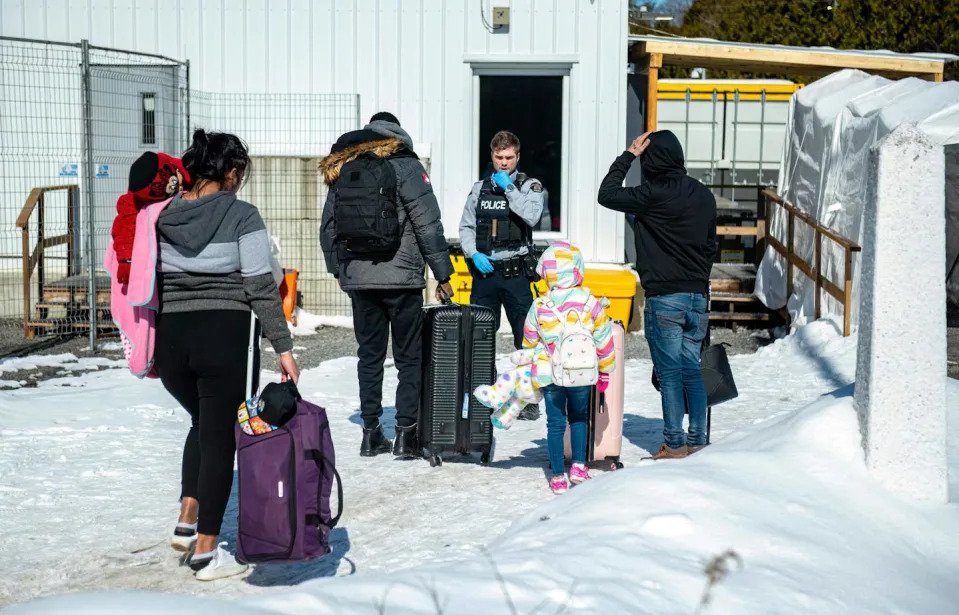
A Canadian officer speaks to migrants as they arrive in Quebec in March 2023. Sebastien St-Jean/AFP via Getty Images

An uncertain way ahead

Back in the U.S., the fight over immigration continues, with Republicans eager to crack down and Democrats who generally want to avoid harsh new standards that could lead to more deportations and mass roundups of undocumented immigrants.

Traditionally, Democrats have been supportive of immigration and the rights of undocumented immigrants in the U.S.

But the wave of migrants who arrive in cities like New York and Chicago without any money, jobs or places to live is severely straining city governments’ capacity and budgets. Local leaders like New York Mayor Eric Adams are pleading with the federal government to help with a crisis that, as Adams said in September 2023, has no clear end in sight.

This article is republished from The Conversation, a nonprofit, independent news organization bringing you facts and analysis to help you make sense of our complex world.

It was written by: Tara SonenshineTufts University.

Read more:

Tara Sonenshine does not work for, consult, own shares in or receive funding from any company or organization that would benefit from this article, and has disclosed no relevant affiliations beyond their academic appointment.

Trump Brags He ‘Aced’ Cognitive Test, Correctly Identified a Whale

Rolling Stone

Trump Brags He ‘Aced’ Cognitive Test, Correctly Identified a Whale

Charisma Madarang – January 17, 2024

Donald Trump, who has a penchant for crowing about hoarding classified documents and the crowd size on Jan. 6, 2021, boasted about acing a basic cognitive test in his continued efforts to prove his self-proclaimed title of an “extremely stable genius.”

During a campaign stop in New Hampshire Wednesday night, the former president touted his ability to correctly identify animals of different shapes. “I took it, and I aced it,” he told the crowd of supporters. “I think it was 35… 30 questions. And let me tell you, you know, they always show you the first one: a giraffe, a tiger or a whale. ‘Which one is the whale?’”

Trump then proceeded to weaponize his very average performance against President Joe Biden, saying he was sure Biden wouldn’t get far on the test — a tactic Trump has leaned into since bragging about the results of his annual physical while still in office. Spawning countless memes, the former president touted back in 2020 how well he had done on a 10-minute assessment designed to detect mild cognitive impairment (such as early-onset dementia) during an interview with Fox News.

“The first questions are very easy, the last questions are much more difficult. Like a memory question,” Trump preened in the interview. “It’s like, you’ll go, ‘Person. Woman. Man. Camera. TV.’ So they’d say, ‘Could you repeat that.’ So I said, ‘Yeah. So it’s person. Woman. Man. Camera. TV.’”

As Trump supporters stood in the cold waiting for the ex-president to take the stage on Wednesday, the scene echoed his visit to the state just a day before in southern New Hampshire where fans waited in the snow for the presumptive Republican nominee. When speaking Tuesday at the Atkinson Resort & Country Club, Trump lamented that he had to leave the White House after losing the 2020 election and said it “was ridiculous that we had to leave, but we had to leave, we have to follow the laws of our land.”

He quickly doubled down on his 2020 election lies: “They don’t investigate the people that cheated in the election. They investigate the people that understand they cheated and go after them. But they don’t investigate the people who cheated like hell. We have to have fair and free elections.”

Trump, who has achieved the feat of being the only (four-time) indicted former or current president, was charged for his efforts to overturn the 2020 election, which his own officials at the time claimed was the most secure in U.S. history. As the former president prepared for legal proceedings in ongoing cases against him, Trump swooped a historic win in Iowa on Monday with 51 percent of the caucus vote, defeating former U.N. Ambassador Nikki Haley and Florida Gov. Ron DeSantis by dozens of percentage points.

More from Rolling Stone

These voters will pick the next president. They’re frightened about American democracy.

Politico

These voters will pick the next president. They’re frightened about American democracy.

Zach Montellaro – January 17, 2024

WASHINGTON, DC – JANUARY 12: Members of the U.S. National Guard arrive at the U.S. Capitol on January 12, 2021 in Washington, DC. The Pentagon is deploying as many as 15,000 National Guard troops to protect President-elect Joe Biden’s inauguration on January 20, amid fears of new violence. (Photo by Tasos Katopodis/Getty Images) 

NAZARETH, Pennsylvania — Earlier this month, 15 voters in this closely contested area of Pennsylvania convened to discuss the state of American democracy.

To say they were discouraged as the 2024 election gets underway would be an understatement.

Three years after the attack on the U.S. Capitol, half of the voters in the focus group immediately started nodding when asked about the possibility of violence around the election.

Sitting around folding tables in an arts center just off of the small town’s Rockwell-esque Main Street, the voters painted a bleak picture over the next hour: A largely negative view on everything from trusting that their votes and their neighbors’ votes will be fairly counted, the speed it takes to get results and that those results will be accepted by the losers.

“I almost feel numb to it,” Jackie, a younger voter in the focus group, said of the violence on Jan. 6. “We’re going to have another election, could that happen again? I probably won’t even react the same, because I’m like ‘this is what happens.’ … Something’s probably going to happen.”

The focus group was brought together by Keep Our Republic, a nonprofit and nonpartisan organization that seeks to educate the public about strengthening the democratic system. It was convened in Northampton County, Pennsylvania, a swing county in one of the most important swing states in the nation.

The participants’ pessimism encapsulates one of the most pressing challenges in American politics right now — the loss of public trust in democracy itself and the electoral infrastructure that supports it. It is a problem that stretches far beyond just Nazareth; a Gallup poll released the day after the focus group found that a record low 28 percent of American adults are satisfied with the way democracy is working in this country.

Their distrust comes at a moment of intense polarization in America — and after former President Donald Trump has spread constant lies about the security of American elections in the three years since the Capitol riot.

“Everybody agreed on one thing: That there’s a very good chance there’s gonna be violence in the next election,” said former Rep. Charlie Dent (R-Pa.), who sits on the state advisory board of Keep Our Republic. “There’s a heightened sense of, or concern about, civil disorder in the next election.”

The voters in the focus group are, in a literal sense, the mythological “Main Street” swing voters that politicians talk about in their stump speeches. Christopher Borick, a pollster and professor at nearby Muhlenberg College, selected them from his neighbors who lived on or near the town’s Main Street.

The group was overwhelmingly white, like both the town of Nazareth and Northampton County more broadly, but was otherwise emblematic of the voters who will decide 2024. They were all registered voters — and those who said how they voted in 2020 during the focus group seemed evenly divided between Trump and President Joe Biden.

Borick asked them to participate because he never saw a political sign pop up on their front lawns. POLITICO observed the focus group under the condition that voters would be identified by their first names only.

The focus group came just a day before Biden gave a speech near Valley Forge, about an hour’s drive away, on the state of the country’s democracy. There, the president cast the 2024 election as a referendum that will decide “whether democracy is still America’s sacred cause.”

But the focus group made clear that much of the distrust in the democratic system is rooted in the broader political polarization of the moment.

Borick often tried to steer the conversation away from the politics of the 2024 election to the mechanics of it, but participants consistently returned to their displeasure in another Biden-Trump rematch.

Almost to a person there was a wariness — and in some cases an outright distrust— of the democratic process in the county. Two voters, distinctly in the minority, repeated conspiracy theories popularized by Trump about mail ballots being used to steal the election from him. And roughly a third of participants said they believed unregistered people were casting ballots.

But more broadly, the participants were confused by the process, with complaints especially about the time it takes to know the winner. Pennsylvania did not allow for election officials to pre-process mail ballots in 2020 — a significant cause of the state’s elongated vote count — and is now an outlier state that hasn’t updated its laws to allow for it in 2024.

“America’s Got Talent can tally 50 million votes in 15 minutes,” Mike, a middle-aged engineer, joked during the focus group. “How can we not elect officials effectively, and not feel confident? Across the board, I don’t feel a lot of confidence here that all of our votes are getting counted properly.”

Northampton voters’ suspicions are fueled by a string of recent election administration failures. In recent municipal elections, election machines have faltered twice: In 2019, initial vote totals showed a candidate who would go on to narrowly win their contest only initially get less than 200 votes across some 55,000 ballots. And just last year, the printout of a person’s ballot would in some cases display the wrong selection on judicial retention elections.

In both cases, election officials stressed that the final outcomes were correct. A paper trail backup was used to count the votes in 2019, and election officials said last year’s erroneous printouts were due to human error when programming the machines and that they were able to correctly tally the final count as voters intended.

“If they tell me they’re working, I am hoping they’re working,” Jimmy, another participant in the group, said of the voting machines. “I try to be optimistic.”

But election officials and groups like Keep Our Republic face a tough climb ahead, even in counties that did not have demonstrable problems like Northampton did.

Keep Our Republic’s theory is that the group can reverse — or at least slow — the declining trust in the democratic process by working with local leaders in key battleground states like Pennsylvania, Michigan and Wisconsin.

The group has hosted legal education classes for attorneys in Pennsylvania about the state’s election laws, and meetings with local election officials and their community in Wisconsin. The goal of the group, in the words of the group’s executive director Ari Mittleman, is to educate the local “chattering class” — local attorneys, community leaders and regular voters.

“If you look at the climate, I think we should assume that it’s going to be incredibly, incredibly tumultuous,” Mittleman said in an interview over a plate of pierogi and beer at a local brewery. “All we can do is put up speed bumps. And our hypothesis is … who is turned to in these communities in purple America, in these three states? It’s not the president. It’s not the politicians.”

The hope, he said, is that instead of turning to national pundits or politicians, voters turn inward to their community with questions. The theory is that another parent on a child’s Little League team or a church elder would be a more effective messenger about the democratic process than a prominent politician or expert parachuting into the community. And when there are questions over things like election litigation, or problems that do occur, community leaders would be inherently more trustworthy.

“I’ll be the first to say, it’s a total hypothesis that might be proven wrong. People might tune into national news, talking heads and experts who’ve never been to Northampton County or Kent County, Michigan, or whatever,” Mittleman said. “But I have a feeling they’re going to go and say to people in their community, ‘What’s this all about?’”

George Washington’s Farewell Address provides stark warning for Americans Today

Portsmouth Hereld – Opinion

Opinion: George Washington’s Farewell Address provides stark warning for Americans Today

Jeff Frenkiewich – January 17, 2024

On September 19, 1796, George Washington published his Farewell Address. In it, America’s “founding father” announced his retirement and explained his reasons for not seeking a third term as president. Nervous about the upcoming election that threatened to tear apart the country he loved, Washington also offered his fellow citizens, “some sentiments which are the result of much reflection.” With New Hampshire’s first-in-the-nation primary less than a week away, and a divisive general election later this year, we would be wise to consider George Washington’s advice, as it is just as relevant today as it was 228 years ago.

Washington’s America, much like today, was a nation divided by regional differences and sectional interests. Our first president could have predicted a time when politicians openly call for a “national divorce” based on regional differences, and state legislatures would feel empowered to debate the idea of secession.

Rebutting those who look to divide America, Washington argues that a unified country brings us, “greater strength, greater resource, proportionably greater security from external danger, a less frequent interruption of their peace by foreign nations; and, what is of inestimable value!” He states, “your Union ought to be considered as a main prop of your liberty, and that the love of the one ought to endear to you the preservation of the other.”

Washington acknowledges that regional differences exist between the North and South, East and West, but he is urging us to consider that the whole is greater than the sum of our parts; a break up of our union will only damage the liberty and prosperity that we have worked so hard to secure.

Washington is not shy in identifying the cause of animosity between regions of the United States – political parties. Washington states, “One of the expedients of party to acquire influence within particular districts is to misrepresent the opinions and aims of other districts.” Foreshadowing a media saturated with disinformation, Washington says, “You cannot shield yourselves too much against the jealousies and heart burnings which spring from these misrepresentations. They tend to render alien to each other those who ought to be bound together by fraternal affection.” Again, our unity provides us strength, and only those who wish to weaken the United States look to exploit the perceived differences amongst our people.

For Washington, the end result of political parties stoking regional divisions is despotism – a dictatorship. He states, “The disorders and miseries which result gradually incline the minds of men to seek security and repose in the absolute power of an individual; and sooner or later the chief of some prevailing faction, more able or more fortunate than his competitors, turns this disposition to the purposes of his own elevation on the ruins of public liberty… It agitates the community with ill founded jealousies and false alarms, kindles the animosity of one part against another, foments occasionally riot and insurrection.” In this election cycle, we have one candidate who actively created jealousies and false alarms when he tried to overturn the last presidential election with lies. He kindled animosity urging his followers to march on the Capitol as lawmakers were certifying that election, and he fomented an insurrection, watching idle as his followers attempted to overthrow our democracy. That same candidate, when asked if he would be a dictator if elected president, replied, “No, no, no, other than day one.” Most recently, this candidate endorsed the claim that a president, “could sell pardons, could sell military secrets, could order SEAL Team 6 to assassinate a political rival.” We must take these threats to our democracy seriously.

In his Farewell Address, a letter that runs just over 6,000 words, George Washington uses the pronouns “you” or “your” 75 times (he used “yourselves” twice). Washington is speaking directly to us, the American people, making clear that despite the cult of personality that surrounded him, he was only one of many responsible for the nation’s welfare; it is “We the People” who are the stewards of our republic.

Washington knew that we would be challenged in preserving our Union; he knew that sectional divisions would promote a spirit of party and that these factions would produce a want-to-be despot surrounded by his own cult of personality. We the people are the only guards against such a dictatorship; we must heed Washington’s warning and do everything we can to preserve our union. We must protect our democracy from those who wish to put their own self-interests above the interests of our Union. Please vote in this upcoming election.

Jeff Frenkiewich teaches social studies at Milford Middle School and he is an adjunct professor of education at the University of New Hampshire. (The views expressed here represent those of the author, not Milford School District or UNH.)

Trump posts all-caps rant telling people they ‘JUST HAVE TO LIVE WITH’ presidents who ‘CROSS THE LINE’

Business Insider

Trump posts all-caps rant telling people they ‘JUST HAVE TO LIVE WITH’ presidents who ‘CROSS THE LINE’

Grace Eliza Goodwin – January 18, 2024

  • Donald Trump said people “JUST HAVE TO LIVE WITH” presidents who “CROSS THE LINE.”
  • He posted the lengthy all-caps rant on Truth Social early Thursday morning.
  • A DC appeals court is weighing whether Trump should have criminal immunity.

Donald Trump is once again claiming that presidents should have total immunity from any crimes they commit while in office — this time, with an all-caps rant posted to Truth Social.

And he says that people need to just accept it.

“A PRESIDENT OF THE UNITED STATES MUST HAVE FULL IMMUNITY, WITHOUT WHICH IT WOULD BE IMPOSSIBLE FOR HIM/HER TO PROPERLY FUNCTION,” Trump wrote on his social-media platform in the early hours of Thursday morning. “ANY MISTAKE, EVEN IF WELL INTENDED, WOULD BE MET WITH ALMOST CERTAIN INDICTMENT BY THE OPPOSING PARTY AT TERM END.

“EVEN EVENTS THAT ‘CROSS THE LINE’ MUST FALL UNDER TOTAL IMMUNITY, OR IT WILL BE YEARS OF TRAUMA TRYING TO DETERMINE GOOD FROM BAD,” he continued.

Trump compared his situation — he’s facing more than 90 felony charges across four criminal cases — to the debate around police misconduct, saying guarding against the “OCCASIONAL ‘ROGUE COP’ OR ‘BAD APPLE'” isn’t worth it.

“SOMETIMES YOU JUST HAVE TO LIVE WITH ‘GREAT BUT SLIGHTLY IMPERFECT,'” he added.

DC appeals court is weighing whether he has immunity from criminal prosecution for his actions while in office.

Trump’s lawyers argue that unless Congress had already impeached and convicted him of a crime, then he is immune.

Trump’s lawyers previously argued the opposite in his 2021 impeachment case, saying that a former president should answer to the courts, not to Congress.

Trump’s current lawyers went so far as to argue that a president couldn’t be charged, even if he ordered the assassinations of his rivals.

Trump, awaiting ruling, says presidents must have ‘complete and total’ immunity

NBC News

Trump, awaiting ruling, says presidents must have ‘complete and total’ immunity

Rebecca Shabad and Lawrence O’Donnell – January 18, 2024

Matt Rourke

As former President Donald Trump awaits a ruling from a federal appeals court on his broad claim of presidential immunity, he said early Thursday that a U.S. president “must have complete and total presidential immunity.”

“A president of the United States must have full immunity, without which it would be impossible for him/her to properly function,” Trump said in a lengthy post on Truth Social in all caps. “Any mistake, even if well intended, would be met with almost certain indictment by the opposing party at term end. Even events that ‘cross the line’ must fall under total immunity, or it will be years of trauma trying to determine good from bad.”

“Sometimes you just have to live with ‘great but slightly imperfect,'” Trump added. “All presidents must have complete & total presidential immunity, or the authority & decisiveness of a president of the United States will be stripped & gone forever. Hopefully this will be an easy decision. God bless the Supreme Court!”

A three-judge panel of the U.S. Court of Appeals for the District of Columbia Circuit is expected to soon issue a ruling in the case brought by Trump in his effort to dismiss the federal election interference case against him. He has claimed that he should be immune from prosecution because his efforts to overturn the 2020 election fell within his official duties as president.

The judges heard oral arguments regarding the immunity question earlier this month and they appeared to be skeptical of the former president’s position.

The court could issue a ruling that decisively resolves the immunity question, thereby allowing the election interference trial, scheduled to begin March 4, to move forward.

The judges could also issue a narrower ruling that could leave some issues unresolved. The court could also simply rule that Trump had no right to bring an appeal at this stage of the litigation.

It’s likely, however, that the case will wind up before the Supreme Court, which sidestepped the immunity question in December.

The former president has argued that his effort to overturn the 2020 presidential election results and his involvement with the Jan. 6, 2021, insurrection were part of his presidential responsibilities. He has said that he was investigating election fraud as president at the time even though there was no evidence of widespread fraud.

Trump’s Truth Social post came after he sat in a New York courtroom Wednesday in a trial to determine damages in E. Jean Carroll’s defamation case against him.

MSNBC’s decision not to air Trump’s Iowa victory speech live ignites right-wing firestorm

TheAdvocate

MSNBC’s decision not to air Trump’s Iowa victory speech live ignites right-wing firestorm

Christopher Wiggins – January 17, 2024

Crybaby Donald J Trump Sane Person Rachel Maddow

Conservatives are seething online after discovering that MSNBC chose to protect its viewers from former President Donald Trump’s penchant for lying in front of cameras when the network did not broadcast his victory speech after Trump won the Iowa caucuses on Monday. Rachel Maddow announced the decision during MSNBC’s special broadcast covering the vote results.

Maddow explained the rationale behind this editorial choice.

“We will let you know if there’s any news made in that speech if there’s anything noteworthy, something substantive and important,” Maddow said. “There is a reason that we and other news organizations have generally stopped giving an unfiltered live platform to remarks by former President Trump. It is not out of spite. It is not a decision that we relish. It is a decision that we regularly revisit, and honestly, earnestly, it is not an easy decision. But there is a cost to us as a news organization of knowingly broadcasting untrue things that is a fundamental truth of our business and who we are.”

MSNBC ‘s decision was met with sharp criticism from right-wing influencers and commentators. One conservative influencer expressed their displeasure on X, formerly Twitter, remarking, “WOW—Rachel Maddow admits on air that they’ve decided to censor the leading Republican candidate’s victory speech and will decide what they want the public to know later. This why no one trusts the media—their tactics are exactly like 1984.”

Mercedes Schlapp, a well-known figure in conservative circles, joined in the criticism. She accused Maddow of engaging in “Marxist propaganda” by choosing not to broadcast Trump’s speech live, accusing the anchor of censoring a political candidate.

The situation highlights the ongoing challenges media outlets face in maintaining journalistic standards while addressing the diverse expectations of a politically polarized audience at a time when one candidate has proven himself to be a serial liar.

According to the Washington Post, Trump told more than 30,000 lies while in office. He has told countless more since he left office in 2021.

In contrast to MSNBC’s decision, CNN did carry Trump’s speech live for a time but chose to cut the speech short and return to analysis.

Trump solidified his position as the GOP frontrunner for the 2024 Republican presidential nomination, with his rivals coming in far behind. The caucuses, which saw the lowest turnout in a quarter-century, delivered Trump a roughly 30-point win, surpassing the previous record for a contested Iowa Republican caucus, the Associated Press reports.

Florida Gov. Ron DeSantis finished a distant second ahead of former U.N. Ambassador Nikki Haley. While Trump’s victory strengthens his grip on the GOP nomination, DeSantis and Haley face an uphill battle to become his strongest challengers.

During the evening’s coverage, CNN anchor Jake Tapper highlighted a striking entrance poll in Iowa, which found that a majority of Republicans did not believe that President Biden had been legitimately elected, Forbes reports. Tapper noted that while this belief was false, it demonstrated the extent to which Trump had reshaped the Republican Party and convinced Republicans of his ideology, “even when empirically false.”

The Iowa results set the stage for the upcoming New Hampshire primary, where a shrinking field will compete to gain momentum in the race for the Republican nomination.