Trump Team Clashed With Official at Arlington National Cemetery
Chris Cameron – August 28, 2024
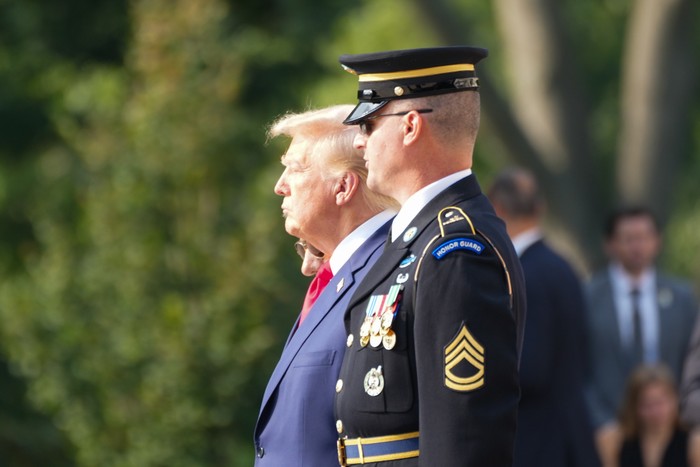
Former President Donald Trump, the Republican nominee for president, is joined by U.S. Marine Cpl. Kelsee Lainhart for a wreath-laying ceremony on Monday, Aug. 26, 2024, at Arlington National Cemetery in Virginia. (Doug Mills/The New York Times)More
ARLINGTON, Va. — Members of Donald Trump’s campaign team and an official at Arlington National Cemetery confronted each other during the former president’s visit to the cemetery Monday, the military cemetery said in a statement Tuesday.
The altercation was prompted, according to Trump campaign officials, by the presence of a photographer in a section of the cemetery where U.S. troops who were killed in recent wars are buried. The cemetery released a statement saying that federal law prohibits political campaigning or “election-related” activities within Army cemeteries, including by photographers.
An official with the cemetery tried to “physically block” members of Trump’s team, Steven Cheung, a Trump campaign spokesperson, said in a statement. Cheung added that the cemetery official was “clearly suffering from a mental health episode” and that the campaign was prepared to release footage of the confrontation to support its account of the clash. The campaign did not provide that footage after several requests.
Chris LaCivita, a top Trump campaign adviser, added in a separate statement that the cemetery official was “a disgrace and does not deserve to represent the hallowed grounds of Arlington National Cemetery.”
Cemetery officials did not provide their own account of the encounter, saying instead that “there was an incident, and a report was filed.” In an additional statement Wednesday, a spokesperson for the cemetery said that “to protect the identity of the individual involved, no further information about the incident is being released at this time.”
The cemetery added that it had “reinforced and widely shared” to the Trump campaign the federal laws prohibiting campaign activities by photographers “or any other persons attending for purposes, or in direct support of a partisan political candidate’s campaign.”
News of the altercation was first reported by NPR.
VoteVets, the liberal veterans group, called on Trump to fire the members of his team involved in the confrontation.
Trump had visited the cemetery for a wreath-laying ceremony honoring 13 U.S. troops who were killed in a suicide bombing at Abbey Gate at the airport in Kabul, Afghanistan, during the United States’ withdrawal from that country three years ago. Trump has blamed President Joe Biden and Vice President Kamala Harris for the bombing and America’s chaotic withdrawal, and repeated his attacks on the subject in campaign events after his visit to the cemetery.
Trump had laid three wreaths at the Tomb of the Unknowns in Arlington National Cemetery on Monday morning, the third anniversary of the Abbey Gate bombing. Two of the wreaths were for Marines killed: Staff Sgt. Darin Taylor Hoover and Sgt. Nicole Gee. A third was dedicated to all 13 troops killed.
Trump was accompanied for the laying of the wreaths by family members of the slain troops, as well as Sgt. Tyler Vargas-Andrews and Cpl. Kelsee Lainhart, two Marines who were injured in the Abbey Gate attack. Vargas-Andrews lost his right arm and left leg in the attack, and Lainhart was paralyzed in the attack and now uses a wheelchair.
Trump then accompanied the families and Marine veterans to Section 60 of the cemetery, reserved for those recently killed in America’s wars abroad, including at Abbey Gate.
That part of Trump’s visit was private and closed to the press. Cheung, the Trump campaign spokesperson, pointed to a screenshot of an email that he argued gave the campaign photo access to Section 60. That excerpt, however, says that “former President Trump may have an official photographer and/or videographer outside of the main media pool,” but it does not suggest Trump’s photographer was given special access.
The campaign also shared text messages from family members of the veterans consenting to having Trump’s campaign media attend the event at Section 60. The campaign did not provide evidence that the cemetery gave it permission to have a photographer at Section 60 — which the cemetery said in its statement would be a violation of federal law.
Trump staff had physical altercation with Arlington cemetery official, NPR reports
Reuters – August 28,2024
Republican presidential nominee and former U.S. President Trump holds rally in Glendale, ArizonaFlags-in ceremony at Arlington National Cemetery in Virginia
(This Aug. 27 story has been refiled to fix a typo in paragraph 3)
(Reuters) – Two members of Republican presidential candidate Donald Trump’s campaign staff had a “verbal and physical altercation” with an Arlington National Cemetery official during a visit by Trump this week, NPR reported on Tuesday.
Trump on Monday participated in a wreath-laying ceremony at Arlington National Cemetery honoring the 13 servicemembers killed during the U.S. withdrawal from Afghanistan in 2021.
Later in Detroit, Trump blamed Vice President Kamala Harris, his Democratic rival for the White House, and President Joe Biden for what he termed a “catastrophic” withdrawal.
Citing an unnamed source, NPR reported that when a cemetery official tried to prevent Trump campaign staffers from filming and photographing in an area where servicemembers are buried, the Trump staff “verbally abused and pushed the official aside.”
Trump campaign spokesperson Steven Cheung disputed the report. “There was no physical altercation as described and we are prepared to release footage if such defamatory claims are made,” Cheung said.
“The fact is that a private photographer was permitted on the premises and for whatever reason an unnamed individual, clearly suffering from a mental health episode, decided to physically block members of President Trump’s team during a very solemn ceremony.”
Arlington National Cemetery confirmed in a statement that an incident had occurred and that a report was filed.
“Federal law prohibits political campaign or election-related activities within Army National Military Cemeteries, to include photographers, content creators or any other persons attending for purposes, or in direct support of a partisan political candidate’s campaign,” the cemetery said.
It did not respond to requests for a copy of the report or an explanation of why the Trump campaign was allowed to visit the cemetery as part of his campaign.
(Reporting by Alexandra Ulmer; Editing by Michael Perry)
How the Federal Cases Against Trump Came Sputtering Back to Life
Alan Feuer – August 28, 2024
Republican presidential nominee former President Donald Trump gestures at a campaign rally at the Desert Diamond Arena, Friday, Aug. 23, 2024, in Glendale, Ariz. (AP Photo/Evan Vucci)
The two federal criminal cases against former President Donald Trump sputtered back to life this week after periods of delay and major legal setbacks.
With 10 weeks left until Election Day, prosecutors in the office of special counsel Jack Smith filed an appeal Monday of Judge Aileen Cannon’s ruling last month dismissing the indictment that accused Trump of mishandling classified documents after leaving office and obstructing the government’s repeated efforts to retrieve them.
Then on Tuesday, Smith took action in a second case, in which Trump stands accused of plotting to overturn the 2020 election. Prosecutors filed a pared-down version of their original indictment that sought to maintain the bulk of the election charges against Trump while also bringing them into line with the Supreme Court’s recent ruling granting broad immunity to former presidents for official acts they took in office.
Neither of the cases the special counsel is overseeing will go to trial before Election Day, and if Trump regains the White House in November, he will have the power to fire Smith and have both of the proceedings put to rest altogether. Still, Smith appears intent on aggressively pursuing the cases even as the campaign enters its homestretch, and has signaled that he will keep pushing them forward even up to Inauguration Day if Trump wins the election.
Here is how the two prosecutions have gotten to this point of remaining alive but still being mired in legal and political uncertainty.
Election Interference Case
Until a few weeks ago, Trump’s election case had been on hold for nearly eight months, with all proceedings frozen, as a series of federal courts — including the Supreme Court — considered his claims to be immune from prosecution on any charges arising from his official acts as president.
After the Supreme Court ruled in favor of Trump in July, granting him — and all other future former presidents — broad protections against criminal prosecution, the case was sent back to the trial judge, Tanya Chutkan.
As part of their decision, the justices gave Chutkan a daunting and complicated task: She was ordered to sort through Trump’s indictment line by line and make decisions on which of its many allegations would have to be thrown out under the immunity decision and which could survive and go to trial.
Wasting no time, Chutkan set a schedule to decide next steps and eventually settled on a deadline of Friday for Trump’s lawyers and Smith’s prosecutors to send her proposals for how to proceed.
Smith got ahead of that schedule by filing his revised indictment Tuesday afternoon in U.S. District Court in Washington.
The new indictment kept the basic structure of the old one, retaining all four of the original charges against Trump. Prosecutors are still accusing him of overlapping plots to defraud the United States, to obstruct the certification of the election at the Capitol on Jan. 6, 2021, and to deprive millions of Americans of their rights to have their votes counted.
Perhaps the most significant change in the new indictment was that Smith removed all of the allegations that touched on Trump’s attempts to strong-arm the Justice Department into supporting his false claims that the election had been rigged against him.
In its ruling on immunity, the Supreme Court had struck those charges from the case, finding that Trump could not face prosecution for any of his interactions with Justice Department officials. The court decided that a president’s dealings with the department were part of the core official duties of his office and were thus immune from prosecution.
Smith’s deputies also made many other subtle changes, reframing the charges in a way that couched them as acts Trump had taken in his private role as a candidate for office, not in his official capacity as president.
The tone of the new indictment was apparent in its first paragraph, which described Trump as “a candidate for president of the United States in 2020.” The original charging document had referred to him as “the 45th President of the United States and a candidate for reelection in 2020.”
Chutkan, who was appointed to the bench by President Barack Obama, still has the authority to determine how much of the new indictment can survive under the immunity ruling. In that sense, Smith was setting out his opening position in the coming courtroom battle.
Whatever Chutkan decides, Trump’s lawyers — or Smith, for that matter — will be able to appeal any decisions she makes to higher courts, including the Supreme Court. She is likely to offer her vision of how things will unfold at a hearing scheduled to take place in Washington on Sept. 5.
Classified Documents Case
In a stunning decision last month, Cannon threw out the classified documents case in its entirety, ruling that Smith had been illegally appointed to his post as special counsel.
The ruling shocked many legal experts for the way that it upended a quarter-century of Justice Department practice and flew in the face of previous court decisions about the appointments of special prosecutors reaching back to the Watergate era.
Issued on the first day of the Republican National Convention, the decision also gave Trump a major legal victory at an auspicious political moment.
Cannon based her dismissal of the case on the appointments clause of the Constitution. The clause requires presidents to nominate and the Senate to confirm all principal officers of the government, but allows “inferior officers” to be put in place by leaders of federal departments, including the attorney general, under the guidance of specific laws.
In her ruling, Cannon found that there were no specific laws that authorized Attorney General Merrick Garland to name Smith to the post of special counsel in November 2022. She also found that Smith’s appointment was illegal because he had not been named by the president and confirmed by the Senate.
But in their challenge to the 11th U.S. Circuit Court of Appeals, Smith’s deputies pointed to four current statutes that they believe give the attorney general the authority to name special counsels.
They also argued that independent prosecutors have long been used to conduct sensitive political investigations, reminding the appeals court that the practice reached back to the days when Jefferson Davis, the Confederate leader, was charged with seditious conspiracy after the Civil War.
The same appeals court that will now consider whether to uphold or overrule Cannon reversed her in a related proceeding last year.
In that instance, Cannon had intervened in a civil case tied to the documents investigation. She barred the Justice Department from using any documents that FBI agents had seized in the search of Mar-a-Lago, Trump’s Florida club and residence, until an independent arbiter had sorted through them for any that were privileged.
The decision was quickly reversed in a stinging ruling by the appeals court, which said she never had legal authority to get involved in the first place.
There will not be any quick resolution of the current appeal. Smith’s appellate brief Monday was merely the start of a legal battle that may ultimately end up in front of the Supreme Court and is likely to drag on until well after the election in November.
Trump’s lawyers are scheduled to file their own brief to a three-judge panel of the 11th Circuit in late September, after which the court is likely to schedule a hearing for oral arguments.
On Monday, Donald Trump visited the Arlington National Cemetery to honor the memory of 13 fallen service members. What happened next was a reminder of how little the former president understands about service, sacrifice, and heroism.
On Monday, Donald Trump visited the sacred ground of Arlington National Cemetery, where many of America’s war dead are buried, and posed for photos. In the strangest of these pictures, the former president is smiling and giving a thumbs-up by the grave of a Marine. It’s an image of a man who has no idea how to behave around fallen heroes.
Trump was at Arlington ostensibly to honor the memory of the 13 service members who were killed in a suicide bombing during the chaotic final days of the U.S. withdrawal from Afghanistan. The event was supposed to be respectful and private; according to a press-pool note, the families of the troops had asked that there be no media coverage in the area where the service members were buried. But Trump seemed to have other ideas.
According to a report by NPR, Trump’s campaign staff got into a verbal and physical altercation with a cemetery official who tried to stop campaign staffers from filming and taking photographs in the area of the cemetery reserved for recently fallen soldiers.
The cemetery confirmed that an incident took place on Monday but did not provide any details, instead noting in a statement that federal law prohibits “political campaign or election-related activities within Army National Military Cemeteries.” The Trump-campaign spokesperson Steven Cheung said in a statement that “there was no physical altercation as described,”and added in a post on X that Trump had been allowed a private photographer on the premises. But in his statement, Cheung also accused the cemetery official who’d tried to block Trump’s staff of “clearly suffering from a mental health episode.”
It’s hard to see Trump’s Monday visit as anything but a campaign stop intended to court the military vote. Speaking to a group of National Guard members in Detroit later that day, he blamed President Joe Biden and Vice President Kamala Harris for the failures of the Afghanistan withdrawal.
By now, Trump’s use of the military as a prop for his own ends should surprise no one. Despite his vigorous avoidance of military service, Trump has a long history of denigrating the service of others, even as he poses as a defender of the nation’s military.
As a candidate for the Republican nomination in 2015, he mocked Senator John McCain’s status as a prisoner of war. “He’s not a war hero,” Trump said at the time. “I like people who weren’t captured.”Later, as president, he told his then–chief of staff John Kelly that he didn’t want “any wounded guys” in his planned Independence Day parade: “This doesn’t look good for me.”
Recently, he suggested that the civilian Medal of Freedom is “actually much better” than the military’s Medal of Honor, “because everyone gets the Congressional Medal of Honor, that’s soldiers, they’re either in very bad shape because they’ve been hit so many times by bullets, or they’re dead.”
But Trump is especially out of place around the nation’s fallen troops. As reported by The Atlantic’s editor in chief, Jeffrey Goldberg, Trump went to Arlington Cemetery with Kelly on Memorial Day 2017 and visited the gravesite of Kelly’s son Robert, who had been killed in Afghanistan. Standing next to the former Marine general, Trump said: “I don’t get it. What was in it for them?”
In 2018, Trump canceled a visit to the Aisne-Marne American Cemetery, near Paris; as Jeffrey reported, Trump told staff members that the cemetery was “filled with losers.” Trump also “referred to the more than 1,800 Marines who’d lost their lives at Belleau Wood as ‘suckers’ for getting killed,” according to Jeffrey’s reporting.
Jeffrey’s story is very much a sore spot for a candidate who wants to wrap himself in the flag. Trump has denied the reporting, but it was confirmed to CNN by Kelly: “What can I add that has not already been said? … A person that thinks those who defend their country in uniform, or are shot down or seriously wounded in combat, or spend years being tortured as POWs, are all ‘suckers’ because ‘there is nothing in it for them.’ A person that did not want to be seen in the presence of military amputees because ‘it doesn’t look good for me.’”Kelly went on to corroborate other details in Jeffrey’s article. “God help us,” he concluded.
Monday’s wreath-laying at Arlington was, in part, Trump’s attempt to clean up the mess he has created, and to establish some credibility as a champion of men- and women-at-arms. But in the end, it merely served to remind Americans how little he understands about service, sacrifice, and heroism.
More than 200 Bush, McCain, Romney alums endorse Harris for president, criticize Trump
Joey Garrison, USA TODAY – August 27, 2024
WASHINGTON — More than 200 Republicans who previously worked for either former President George W. Bush, the late Sen. John McCain, R-Ariz., or Sen. Mitt Romney, R-Utah, endorsed Vice President Kamala Harris for president in an open letter Monday obtained exclusively by USA TODAY.
The letter from alums of the three Republican presidential nominees prior to former President Donald Trump comes on the heels of a Democratic National Convention last week in Chicago that showcased Republican detractors of the GOP nominee. At least five former aides to former President George H.W. Bush also signed the letter, which has 238 signatures in all.
A similar group of about 150 anti-Trump former staffers of Bush, McCain and Romney pledged support for President Joe Biden in the 2020 election.
“We reunite today, joined by new George H.W. Bush alumni, to reinforce our 2020 statements and, for the first time, jointly declare that we’re voting for Vice President Kamala Harris and Gov. Tim Walz this November,” the letter reads. “Of course, we have plenty of honest, ideological disagreements with Vice President Harris and Gov. Walz. That’s to be expected. The alternative, however, is simply untenable.”
Democratic presidential nominee Kamala Harris delivers her acceptance speech during the final day of the Democratic National Convention in Chicago on Aug. 22, 2024.
Among those who signed the letter in support of Harris and her running-mate, Minnesota Gov. Tim Walz, include: former McCain chiefs of staff Mark Salter and Chris Koch; Joe Donoghue, former legislative director for McCain; Jennifer Lux, press secretary for McCain’s 2008 campaign, and Jean Becker, longtime chief of staff for George H.W. Bush.
Also backing Harris are David Nierenberg, Romney’s 2012 campaign finance chair; David Garman, under secretary of Energy for George W. Bush; and Olivia Troye, a former advisor to both George W. Bush and Vice President Mike Pence. Troye spoke from the stage of the DNC convention last week.
President George W. Bush speaks during an interview on Wednesday, August 31, 2011 at his office in Dallas about his recollections of Sept. 11, 2001.
“At home, another four years of Donald Trump’s chaotic leadership, this time focused on advancing the dangerous goals of Project 2025, will hurt real, everyday people and weaken our sacred institutions,” the letter says, referring to the Heritage Foundation’s policy blueprint that the Trump campaign has sought to distance itself from.
“Abroad, democratic movements will be irreparably jeopardized as Trump and his acolyte JD Vance kowtow to dictators like Vladimir Putin while turning their backs on our allies. We can’t let that happen.”
The animosity between the camps of McCain, Romney, and Bush and Trump is well-documented.
Others who signed the letters include: Reed Galen, McCain’s deputy campaign manager and co-founder of the Lincoln Project; Jim Swift, a former Republican operative who is now senior editor of The Bulwark, an anti-Trump news and opinion site; and former McCain campaign strategist Mike Murphy.
Citing 2020 exit polling and other voter data, the group claims it was “moderate Republicans and conservative independents in key swing states” who were pivotal in Biden’s victory that ultimately delivered the presidency Biden − Americans who “put country far before party,” they write in the letter.
The group called on more moderate Republicans and independents to “take a brave stand once more” and support Harris over Trump in the fall.
September 13, 2023: Sen. Mitt Romney (R-UT) announces his intention to not run for reelection. Romney, who is 76, announced in a release, “the next generation of leaders must take America to the next stage of global leadership.”.
The Harris campaign has worked to highlight its backing from Republicans who oppose Trump, launching a “Republicans for Harris” group this month and featuring Republican speakers at last week’s convention.
Republicans who addressed the convention included former Rep. Adam Kinzinger, R-Ill., who served on the House panel that investigated Trump’s efforts to overturn the 2020 election; former Trump press secretary Stephanie Grisham; former Georgia Lt. Gov. Geoff Duncan, Mesa, Ariz. Mayor John Giles; and Troye, who worked as a homeland security and counterterrorism adviser to Pence. Pence has said he won’t endorse Trump for president.
Over the weekend, a dozen prominent Republican attorneys who worked for former President Ronald Reagan, George H.W. Bush and George W. Bush endorsed Harris for president. The group included conservative former federal appellate Judge Michael Luttig, who plans to vote for a Democratic president for the first time.
Former Illinois Republican U.S. Rep. Adam Kinzinger speaks during the final day of the Democratic National Convention at the United Center.
“They’ve now resorted to attacking the family dog,” she said. “I really wish I was joking. I am not joking.”
Right-wingers found a 2022 photo Walz posted on social media saying he went to a dog park with his pup Scout. Since the dog in the picture is not Scout, some conservatives treated it as a gotcha moment.
“As crazy as it sounds, bad-faith right-wingers on social media said it was all evidence that Tim Walz was lying about something,” Psaki said.
But a video Walz posted at the same time shows him with Scout at the dog park, playing with other dogs, including the one in the picture conservatives seized on.
“Mystery solved,” Psaki said. “Of course, this is a particularly ironic attack coming from the party whose own rising star ― you know who I’m about to talk about here, Kristi Noem ― boasted about hating her own family dog so much she took it to a gravel pit and shot it.”
Noem, the governor of South Dakota, was on the short list to be Donald Trump’s vice presidential pick until she released a book bragging about killing her pooch.
“Better luck next time, guys,” Psaki said, then offered some unsolicited advice going back to the days of President Franklin D. Roosevelt, whose own dog came under attack from political rivals.
“If you resort to attacking a candidate’s dog, you’re probably losing,” Psaki said. “And you deserve all the ridicule coming your way.”
The Cochise County Sheriff’s Office confirmed that the portion where Trump spoke was built under the Obama administration, the Post added.
The newspaper said a nearby extension was started under the Trump administration ― at a cost of $35 million a mile ― but didn’t get very far, with much of the construction material left in piles at the site.
Trump in 2016 repeatedly vowed to build a “big beautiful wall” across the nearly 2,000-mile U.S.-Mexico border if elected.
He has claimed that he completed the task.
“I did finish the wall,” he said on CNN earlier this year. “I built a wall.”
A 2022 report found the wall built under Trump was breached thousand of times using “inexpensive power tools.” Others reported the wall could be breached with a primitive ladder made from about $5 in material.
Trump border event at wall that Obama built highlighted an unfulfilled promise
Isaac Arnsdorf, Marianne LeVine and Erin Patrick O’Connor,
The Washington Post – August 26, 2024
MONTEZUMA PASS, Ariz. – A brown ribbon carved a straight gash across a vast, flat desert basin, the only mark of human civilization visible on this wilderness. The partition charged up a steep hill in Montezuma Canyon, then suddenly stopped. Extra pieces lay in piles nearby, rusting monuments to an unfinished campaign promise.
Republican presidential nominee Donald Trump came here on Thursday to heap praise on the structure standing to his right – “the Rolls-Royce of walls,” he called it – and lament the unused segments lying to his left. Joining him there, Border Patrol union leader Paul A. Perez called the standing fence “Trump wall” and the idle parts “Kamala wall,” after his Democratic opponent, Vice President Kamala Harris.
Those labels were inaccurate. This section of 20-foot steel slats was actually built during the administration of President Barack Obama. Trump added the unfinished extension up the hillside, an engineering challenge that cost at least $35 million a mile. The unused panels of 30-foot beams were procured during the Trump administration and never erected.
“Where you were, that was kind of a joke today,” John Ladd, a Trump supporter whose ranch extends along the border, said while driving the dirt road along the barrier, the gapped panels making a flipbook out of the shrubby trees and grass on the other side. “Had to be in front of Trump’s wall, but you went to Montezuma, and that’s Obama’s wall.”
The Cochise County Sheriff’s Office confirmed that the barrier next to Thursday’s campaign stop was built during the Obama administration. The Trump campaign and Perez did not respond to questions about the discrepancy.
“If Kamala truly wanted to close the border and continue building President Trump’s wall, she could go to the White House and do it today,” Trump campaign spokeswoman Karoline Leavitt said in a statement. “Only President Trump will get it done.”
This spot along the U.S.-Mexico border, quickly accessible from nearby Sierra Vista, has often served as the backdrop for Republican photo ops. The scenery here did not attest to the fearsome migrant caravans or invasions of military-age foreign men that Trump often describes. There was no evidence here of Trump’s depiction of vicious criminals and terrorists, cannibals and infectious hordes, or people sent directly from prisons and mental institutions pouring over the border. There was no sign of foot traffic over such hostile shadeless wilderness, other than a small patrol of Mexican authorities on the other side.
Nor did this site show the very real conditions that exist in other parts of the border: Towns teeming with displaced people, cars backed up at legal crossings and swept for smuggling, bodies recovered from the Rio Grande.
Former President Donald Trump speaks during a campaign event in front of the US-Mexico border, Thursday, Aug 22, 2024, in Sierra Vista, Arizona. (AP Photo/Rick Scuteri)
For Trump, a campaign stop here on Thursday had larger meaning. It was an attempt to recapture the storyline of this presidential race from Vice President Kamala Harris, who wrapped up an ebullient Democratic National Convention in Chicago on Thursday evening. For Trump, visiting the border was also something of a spiritual homecoming to the place that has animated his candidacy and movement since 2015.
But the reality on the ground was not as straightforward as the “Build the Wall” chant that electrified his campaign eight years ago suggested. His vow to finish the wall, now formalized in the Republican Party platform, highlights the uncomfortable fact that he did not finish it in his first term, and Mexico did not pay for it, as he once promised it would.
“I’d hear people say, ‘Oh, he didn’t build the wall’ – we built the wall,” Trump said defensively on Thursday in front of the unfinished barrier. “We built much more than I was anticipated to build.”
The day before, at a rally in North Carolina, Trump responded to a supporter who shouted “Build the Wall” by saying, “Well, the wall was largely built. We were adding space onto the wall.”
As president, Trump spent more than $11 billion to finish more than 450 miles of wall along the almost 2,000-mile southern border, one of the most expensive federal infrastructure projects in history. During the primary, some GOP rivals experimented with attacking Trump for failing to finish the wall, but Republican voters largely shrugged or scoffed.
He references the wall in a smaller percentage of his social media posts and speeches than he did eight years ago, according to a Washington Post analysis. Instead, he has emphasized plans for large-scale, militarized roundups and deportations of undocumented immigrants throughout the United States. To justify such drastic measures, he has frequently used dehumanizing language to vilify undocumented immigrants as violent and dangerous. The overwhelming majority of people in removal proceedings do not have criminal charges, according to an analysis of Department of Homeland Security records by the Republican-led House Judiciary Committee.
Even as Trump has made immigration central to his bid to take back the White House, border apprehensions have declined dramatically this summer amid the Biden administration’s new asylum restrictions and stepped-up enforcement in Mexico. In July, illegal border crossings, which rose to record levels during the Biden administration, declined to the lowest levels in almost four years, after the Biden administration enacted sweeping measures to limit asylum access.
A short walk from the spot where Trump spoke on Thursday, the barrier crosses a dry stream bed, and the uniform bollards give way to storm gates. The gates were wide open, to accommodate the sudden floods of the summer monsoon season, spanned only by a few strands of barbed wire. The base of some of the nearby slats show the scars of erosion that have sometimes left the fence dangling above the ground.
Smugglers have breached the barrier thousands of times, including while Trump was in office. The wall has been tunneled under and climbed over. It has been walked around and sawed through. It has not stopped migration any more that it has stopped drug and human smuggling, most of which happens at ports of entry.
The wall’s defenders argue that, as part of broader border enforcement, it helps slow down crossings and free up Border Patrol resources. The border wall “completely changed the operational environment and allowed Border Patrol to secure those areas with significantly fewer agents,” said Rodney Scott, who was chief of the U.S. Border Patrol under Trump and under Biden until August 2021.
But some policy experts say the barrier simply shifts where and how migrants cross the border. And many experts argue that U.S. immigration policy and conditions in migrants’ home countries are what drive migration, regardless of the obstacles placed in their path to reaching the United States.
“It’s really hard to measure the effectiveness of the wall because it’s one piece of a larger puzzle in U.S. policy on immigration, and even though it is a physical barrier, there are so many other reasons why migrants end up where they end up trying to cross into U.S. territory,” said Colleen Putzel-Kavanaugh, an associate policy analyst at the Migration Policy Institute, a nonpartisan think tank.
In his first term, Trump used executive power to bypass congressional opposition to the wall. In late 2018, his fight with Congress over funding led to the longest government shutdown in American history. When Congress refused to budge, Trump declared a national emergency in order to divert money from the military budget.
Former administration officials and the Trump campaign said he would be determined to use every available power to complete the wall in a second term.
“There’s no doubt in my mind … he will, I hope on day one, declare a national emergency,” said Mark Morgan, acting commissioner of U.S. Customs and Border Protection under Trump. “On day one, that will give him the ability then to tap into those [Department of Defense] funds … while at the same time working with Congress … You’re going to see the same approach that he used during the first administration.”
The former president “will utilize any and all appropriate authorities necessary to continue construction of the border wall and protect America’s homeland,” Leavitt said in an emailed statement.
If Trump were to declare a national emergency again in a second term, outside groups would likely sue to stop him. But the legal process could take a long time, said Elizabeth Goitein, senior director of the Liberty & National Security Program at the Brennan Center for Justice.
Trump might be able to complete large sections of wall in the meantime, she said.
“The appeals would run the entire course of the Trump presidency and even though there might be, and I think there are, meritorious legal challenges … it’s still quite possible that the Trump administration could continue to rely on that power while this process played out, if the lower courts stayed their rulings,” Goitein said.
A changed political environment might also make it easier for Trump to complete the wall. The Republican Party has become more Trump-aligned, and should Trump become president and Republicans control the House and the Senate with significant margins, border wall funding is likely to increase in the annual appropriations process.
The border wall has also become more popular with the public than it was during the Trump administration. A Monmouth University poll found that 53 percent of Americans favored the border wall in February 2024, the highest share since Monmouth began asking the question in September 2015, when support for the wall was at 48 percent. Support for the wall hit a low in September 2017, with 35 percent of Americans in favor.
Mexico has opposed the construction of the border wall and has pursued more aggressive enforcement along the border, helping the Biden administration reach its lowest level of illegal border crossings in almost four years.
But as long as construction takes place on the U.S. side of the border, Mexico can’t do much to stop it, said Theresa Cardinal Brown, senior adviser for immigration and border policy at the Bipartisan Policy Center.
Even if he gets the funding, Trump might face obstacles obtaining the land he needs for construction. Much of the land along the border in Texas is privately owned, and some landowners are reluctant to sell.
Trump might also face environmental opposition to renewed wall construction. The incomplete border wall has already affected the migration patterns of many northern American wildlife species, said Myles Traphagen, borderlands program coordinator at the Wildlands Network, a nonprofit conservation organization focused on sustaining biodiversity. The current barrier will also require constant, expensive maintenance, Traphagen noted.
“There’s going to be this big albatross hanging around America’s neck to continually maintain this beast,” he said.
For many Americans, though, the border wall has become a symbol. Traphagen added: “The border wall reinforces that, okay, this guy is doing something.”
Nick Miroff, Clara Ence Morse, Emily Guskin, Scott Clement and Maria Sacchetti contributed to this report.
Opinion: The ideas in Project 2025? Reagan tried them, and the nation suffered
Joel Edward Goza – August 25, 2024
President Reagan, shown in 1981, based many of his policies on ideas from the Heritage Foundation publication “The Mandate for Leadership.” Project 2025 makes up a majority of the latest edition of this title and recommends many of the same extreme policies. (Ron Edmonds / Associated Press)More
Project 2025, the Heritage Foundation’s conservative playbook that would overhaul much of the federal government under a second Trump administration, has sparked fear and concern from voters despite the former president’s attempt to distance his campaign from the plan. But while Project 2025 might seem radical, most of it is not new. Instead, the now-famous document seeks to reanimate many of the worst racial, economic and political instincts of the Reagan Revolution.
Project 2025 begins with its authors (one of whom stepped down last month) boasting of the Heritage Foundation’s 1981 publication “The Mandate for Leadership,” which helped shape the Reagan administration’s policy framework. It hit its mark: Reagan wrote 60% of its recommendations into public policy in his first year in office, according to the Heritage Foundation. Yet the 900-plus-page Project 2025, itself a major component of a new edition of “The Mandate for Leadership,” does not contain any analysis of the economic and social price Americans paid for the revolution the Heritage Foundation and Reagan inspired.
If today’s economic inequality, racial unrest and environmental degradation represent some of our greatest political challenges, we would do well to remember that Reagan and the Heritage Foundation were the preeminent engineers of these catastrophes. Perhaps no day in Reagan’s presidency better embodied his policy transformations or the political ambitions of the Heritage Foundation than Aug. 13, 1981, when Reagan signed his first budget.
This budget dramatically transformed governmental priorities and hollowed out the nation’s 50-year pursuit of government for the common good that began during the New Deal. Once passed, it stripped 400,000 poor working families of their welfare benefits, while removing significant provisions from another 300,000. Radical cuts in education affected 26 million students. The number of poor Americans increased by 2.2 million, and the percentage of Black Americans living in poverty rose to a staggering 34.2%.
Of course, this was just the beginning of Reagan’s war on the poor, the environment and education. Following a Heritage Foundation plan, the Environmental Protection Agency’s operating budget would fall by 27%, and its science budget decreased by more than 50%. Funding for programs by the Department of Housing and Urban Development that provided housing assistance would be cut by 70%, according to Matthew Desmond’s “Poverty, By America.” Homelessness skyrocketed. And, as Project 2025 proposes, Reagan attempted to eliminate the Department of Education but settled for gutting its funding in a manner that set public education, in the words of author Jonathan Kozol, “back almost 100 years.” As funding for these issues nosedived under Reagan, financial support for the “war on drugs” skyrocketed and the prison population nearly doubled.
All the while, protections provided to the wealthy ballooned. Tax rates on personal income, corporate revenue and capital gains plummeted. For example, the highest income tax rate when Reagan took office was 70%. He would eventually lower it to 33%.
To ensure that wealth would be a long-lived family entitlement, Reagan instituted a 300% increase in inheritance tax protections through estate tax exemptions in his first budget. In 1980, the exemption stood at $161,000. By the time Reagan left office in 1989 it was $600,000. Today it is $13,610,000. This means that today nearly all wealthy children enjoy tax-free access to generational wealth.
And beginning during Reagan’s presidency, the number of millionaires and billionaires multiplied, increasing 225% and 400%, respectively, while the poverty of Americans across racial lines intensified. Even white males were more likely to be poor following Reagan’s presidency. Today poverty is the fourth-leading cause of death in the U.S., even though this is the wealthiest nation in the world.
If we feel like we live in a country that isn’t working for anyone who isn’t wealthy, these are some of the core reasons why. Looking back at the Reagan era and the Heritage Foundation’s original “Mandate for Leadership,” we must remember that our domestic wounds are largely self-inflicted, results of buying into racial, economic and environmental lies that continue to be sold. It is precisely the types of policies that devastated the nation during the Reagan administration that Project 2025 now seeks to resuscitate. Perhaps the only truly new thing Project 2025 suggests is using more authoritarian means to enact its agenda.
History has hinges, moments that change the trajectory of nations. The greatest progress in our country has almost always emerged during turbulent times. It is up to the United States’ most committed believers to close the door on terror and trauma and open one that leads to new democratic possibilities.
Our current moment represents more than an election. It is a turning point that has the potential to transform the United States for generations to come. We don’t need the version of the past that Project 2025 is trying to sell us. It didn’t work for most Americans then, and it won’t work for most of us now. But perhaps Project 2025 is the push the Democratic Party needed. While the Republican Party veers further into authoritarianism, Democrats must be equally determined to develop a truly equitable democracy and bind the wounds of a deeply divided nation.
Joel Edward Goza, a professor of ethics at Simmons College of Kentucky, is the author of the forthcoming book “Rebirth of a Nation: Reparations and Remaking America.”
Republicans Are Right: One Party Is ‘Anti-Family and Anti-Kid’
By Nicholas Kristof, Opinion Columnist – August 24, 2024
Credit…Jamie Lee Taete for The New York Times
In attacking Democrats and Kamala Harris, Republicans have been making a legitimate point: One of our major political parties has worked to undermine America’s families.
The problem? While neither party has done enough to support families and children, the one that is failing most egregiously is — not surprisingly — the one led by the thrice-married tycoon who tangled with a porn star, boasted about grabbing women by the genitals and was found by a jury to have committed sexual assault.
You’d think that would make it awkward for the Republican Party to preach family values. But with the same chutzpah with which Donald Trump reportedly marched into a dressing room where teenage girls were half-naked, the G.O.P. claims that it’s the Democrats who betray family values.
“The rejection of the American family is perhaps the most pernicious and most evil thing that the left has done in this country,” JD Vance said in 2021. Pressed on those remarks last month, he went further in a conversation with Megyn Kelly, saying that Democrats “have become anti-family and anti-kid.”
This is gibberish. Children are more likely to be poor, to die young and to drop out of high school in red states than in blue states. The states with the highest divorce rates are mostly Republican, and with some exceptions like Utah, it’s in red states that babies are more likely to be born to unmarried mothers (partly because of lack of access to reliable contraception).
One of President Biden’s greatest achievements was to cut the child poverty rate by almost half, largely with the refundable child tax credit. Then Republicans killed the program, sending child poverty soaring again.
It’s because of the G.O.P. that the United States is one of only a few countries in the world without guaranteed paid maternity leave. Republicans fought universal health care and resisted the expansion of Medicaid; that’s one reason a child in the United States is three times as likely to die by the age of 5 as a child in, say, Slovenia or Estonia.
Think of it this way: We’d be saving the life of one American child between the ages of 1 and 5 every three hours if we had the same child mortality level as Norway or Finland.
Project 2025, a blueprint for a Trump administration that Trump is frantically trying to disavow, would make things worse. It would end Head Start, a lifeline for low-income children, and would dismantle the Department of Education.
“My Administration will be great for women and their reproductive rights,” Trump posted on Friday. But even putting aside abortion rights, Republican extremism has led to obstacles to in vitro fertilization, especially after an Alabama court ruled that a frozen embryo must be considered a child. The Southern Baptist Convention, a bastion of support for Trump, this summer criticized I.V.F.
Vance has supported a watered-down bill that he says protects I.V.F., but Republican senators blocked stronger legislation to defend I.V.F. fertility treatments and expand access. They are leaving hanging so many of the one in seven women who have trouble conceiving or sustaining a pregnancy.
Can anything be more anti-family?
Look, I’ve repeatedly argued that growing up in a two-parent household is the one privilege that liberals ignore, that the left wrongly demonized Daniel Patrick Moynihan for his emphasis on family structure and that Democrats can do more to remove marriage penalties and bolster opportunities for children.
I’m troubled by the collapse of marriage in America’s working class — more than 70 percent of Americans without a high school diploma are unmarried. If we care about child poverty, we must face the reality that households headed by single moms are five times as likely to live in poverty as those with married couples. So concerns about family and children are legitimate, and Democrats should do better.
But for Republicans to blame Democrats is ludicrous, for the G.O.P. has seemingly gone out of its way to undermine families and children.
Union membership among men raises their marriage rates, for example, apparently because they then earn more money and become more stable and appealing as partners. But Republicans have worked for decades to undermine unions.
Republicans like the House speaker, Mike Johnson, object to no-fault divorce laws, which make it straightforward for couples to obtain divorces. They claim this is a pro-family stance. (Trump, understandably, appears more sympathetic to divorce.) But the evidence is overwhelming that before easy access to divorce, large numbers of women were trapped in violent marriages that terrorized them and their children.
One careful study by the economists Betsey Stevenson and Justin Wolfers found that the introduction of no-fault divorce in America was associated with about a 20 percent reduction in female suicides, at least a 25 percent reduction in wife-beating and an apparent decline in husbands murdering wives.
Is it really pro-family to increase the number of moms who are beaten and murdered?
I’m glad Republicans are squawking about the challenges facing families and children. But if Trump, Vance and other Republicans want to blame those most responsible for the plight of families and children in America today, they should look in the mirror and hang their heads in shame.





:quality(70)/cloudfront-us-east-1.images.arcpublishing.com/adn/YXWWBAAPHVWEFYMK7JJF6XFTYY.jpg)

