
Donald Trump Is Done With Checks and Balances

By Jamelle Bouie, Opinion Columnist – November 1, 2024

A dense crowd in a sea of red hats at Donald Trump’s rally at Madison Square Garden; a supporter stands up wearing a jersey that reads “America 1.”
Credit…Damon Winter/The New York Times

What does it mean to say that “democracy is on the ballot” on Election Day?

In her speech on Tuesday in Washington, D.C., delivered from the same place near the White House where Donald Trump incited a crowd to attack the Capitol on Jan. 6, 2021, Vice President Kamala Harris said it was a question of whether Americans “have a country rooted in freedom for every American” or whether they have one “ruled by chaos and division.”

It was a question, she said later in her remarks, of whether the United States would “submit to the will of another petty tyrant” and become a “vessel for the schemes of wannabe dictators.”

The vice president was not wrong. Election Day will be a referendum on whether we want an autocrat in office — a plebiscite, of sorts, on the very idea of government of the people, by the people and for the people. But Harris’s answer is incomplete. Also at stake on Tuesday, when it comes to the question of American democracy, is the future of the Constitution.

Will it continue into the 21st century as Frederick Douglass’s “glorious liberty document,” or will it legitimize an American-style authoritarianism as a new “covenant with death,” to use the words of Douglass’s erstwhile abolitionist ally, William Lloyd Garrison.

It is important to remember that the Constitution was neither written nor ratified with democracy in mind. Just the opposite: It was written to restrain — and contain — the democratic impulses of Americans shaped in the hothouse of revolutionary fervor.

“Most of the men who assembled at the Constitutional Convention in Philadelphia in 1787 were also convinced that the national government under the Articles of Confederation was too weak to counter the rising tide of democracy in the states,” the historian Terry Bouton writes in “Taming Democracy: ‘The People,’ the Founders, and the Troubled Ending of the American Revolution.”

The framers’ Constitution would tamp down on and bind the democratic energies of those Americans who thought their revolution stood for something more egalitarian — more revolutionary — than what its leaders and leading figures imagined. It would channel democratic energy through divided institutions backstopped by counter-majoritarian rules and requirements, each designed to make it as difficult as possible to turn popular energy into governing majorities.

In short, the founders built a limited, exclusionary government centered on elite management of the people’s affairs. But by the start of the 19th century, it was clear that the people would not allow the Constitution to contain their democratic impulses and aspirations. The American Republic would not be as limited or as exclusive as the framers had envisioned.

Broad literacy and the wide availability of newspapers, pamphlets and books brought a vibrant culture of political debate and contestation. The emergence of organized political factions and, later, formal political parties brought large numbers of Americans into the political process, transforming the very nature of the union.

As Americans democratized their culture, their Constitution followed. They reshaped their constitutional order around political parties and embraced mass political participation as an integral part of the system.

You can see the vibrancy of this early form of American democracy, as exclusive as it still was, in the multitude of movements and minor parties that emerged throughout the antebellum period. There were Know-Nothings and Anti-Masons and Free Soilers, Liberty Party partisans and groups like the Wide Awakes.

“In America,” Alexis de Tocqueville observed during his tour of Jacksonian America, “democracy is given over to its own inclinations. Its pace is natural and all its movements are free.”

Out of the contradictions of America’s nascent democracy came a catastrophic civil war. And out of the practical and ideological demands of that war came the most expansive and, to that date, most inclusive vision yet for American democracy, encoded in a set of amendments that reconstituted the union as a nation. The 13th Amendment abolished chattel slavery. The 14th Amendment enshrined birthright citizenship and guaranteed the “privileges and immunities” of that citizenship. And the 15th Amendment outlawed racial discrimination in voting, giving Congress all the authority it needed to enforce that prohibition.

It should be said here that it wasn’t simply the act of amendment that changed and further democratized the Constitution. A political document as much as a legal one, its character and meaning are realized as much through practice and the everyday challenge of making it work as they are in law and legislation. Which is to say that if the Constitution that emerged out of the Civil War was more democratic than the one that helped produce that war, a good part of that was because Americans themselves, like the freed people of the South, fought to realize their democratic aspirations.

They were joined, in subsequent decades, by Americans of many other backgrounds. Over the next century and through great effort, American democracy would grow in fits and starts to include women and a broad variety of immigrant groups. And while Black Americans would suffer under the long night of Jim Crow, they would continue their struggle for equality, inclusion and recognition.

We were not given a democratic Constitution; we made one. We unraveled the elitist and hierarchical Constitution of the founders to build something that works for us — that conforms to our expectations.

But nothing is permanent. What’s made can be unmade. And at the foundation of Donald Trump’s campaign is a promise to unmake our democratic Constitution.

Consider his priorities. He wants to use the law enforcement arm of the federal government to harass his opponents and exact “retribution” on his political enemies.

“I will appoint a real special prosecutor to go after the most corrupt president in the history of the United States of America, Joe Biden, and the entire Biden crime family,” Trump said last year. In September he threatened “Lawyers, Political Operatives, Donors, Illegal Voters, & Corrupt Election Officials” with “long-term prison sentences” if they are found guilty of voter fraud, which Trump seems to equate with any form of political opposition.

Trump also wants to deport tens of millions of people from the United States, which will inevitably include American citizens, whether they’re the children of undocumented immigrants or students demonstrating in support of Palestinians. “Immediately after taking the oath of office, I will launch the largest mass deportation program in American history,” Trump said at an event in Texas last week.

To accomplish this, the former president intends to use the 1798 Alien Enemies Act, which allows the president to detain and deport noncitizens from countries at war with the United States. The idea, if it needs to be spelled out, is to classify undocumented immigration as an act of war and use the law to remove foreign nationals from the United States without due process. To obtain the personnel necessary to carry out deportations on such a large, national scale, Trump would deputize local and state law enforcement as well as deploy the National Guard.

It is not just that Trump would attempt these power grabs — which would, on their own, introduce a level and degree of state repression heretofore unseen in American history — but that he would have the support of a legal and political movement eager to constitutionalize his actions as a legitimate exercise of presidential power. Trump would act in an authoritarian manner, and his allies would then write that authoritarianism into the Constitution.

That, in fact, is what the Supreme Court did in Trump v. Hawaii, when it turned a blind eye to the clear evidence of racial and religious bigotry driving the former president’s “travel ban” (neé Muslim ban) and freed the administration to impose its restrictions under a theory of broad (or perhaps a better word would be “credulous”) deference to the executive branch.

The court took a similar approach this year in Trump v. United States, when it gave the president a broad grant of criminal immunity from prosecution for “official acts.” Rather than reckon with the overwhelming evidence that Trump abused the office of the presidency in an illegal effort to overturn the results of an election he lost, what is in effect the Republican majority on the court turned the plain meaning of the Constitution on its head, freeing future presidents — including, perhaps, a future President Trump — to abuse their power under cover of law.

More so than most of his predecessors, Trump strained against the limits of the presidency. He never understood that the office was bound by higher law — that his power wasn’t absolute. He never understood that he was an officer of the Constitution and a servant of the people; he never understood that he was a subject and not the sovereign.

It was because of this fundamental misunderstanding — itself tied to his bottomless solipsism — that Trump tried to twist and turn the presidency into an extension of his ego. To the extent he failed to accomplish this, it was only because he was stymied by those around him — officials who chose to honor their commitment to the Constitution over the interests of one man. Those same officials now warn that if he is given another term in office, he will rule as a tyrant.

America got lucky. It won’t get lucky again. Free of the guardrails that kept him in place the first time, affirmed by the Supreme Court and backed by allies and apparatchiks in the conservative movement, Trump will merge the office of the presidency with himself. He will shake it from its moorings in the Constitution and rebuild it as an instrument of his will, wielded for his friends and against his enemies. In doing so, he will erode the democratic assumptions that undergird our current constitutional order. And he will have the total loyalty of a Republican Party that itself is twisting and abusing the counter-majoritarian features of the American system to undermine and unravel democracy in the states it controls.

“Democracy is never a gift bestowed by benevolent, farseeing rulers who seek to reinforce their own legitimacy,” the historian Sean Wilentz writes in “The Rise of American Democracy: Jefferson to Lincoln”:

It must always be fought for, by political coalitions that cut across distinctions of wealth, power and interest. It succeeds and survives only when it is rooted in the lives and expectations of its citizens and is continually reinvigorated in each generation. Democratic successes are never irreversible.

Most Americans have lived only in a world where democracy was secure, where democracy was assumed. On Tuesday we’ll decide if we want to stay in that world or leave it behind.
The Sun endorses Kamala Harris and Tim Walz to lead the nation

The Las Vegas Sun

The Sun endorses Kamala Harris and Tim Walz to lead the nation

The Las Vegas Sun – October 20, 2024

Harris-Walz Rally at Thomas & Mack

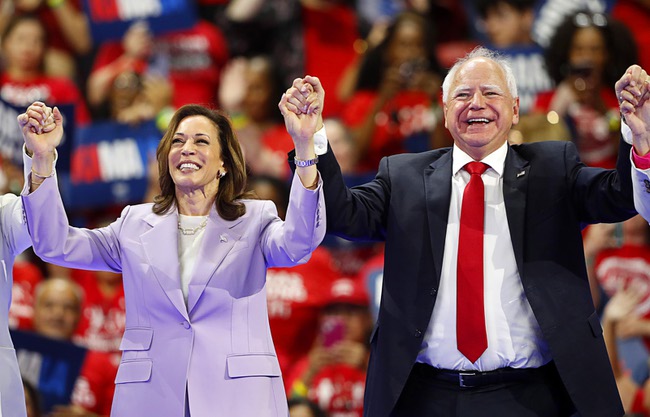
Democratic presidential nominee Vice President Kamala Harris and running mate Minnesota Gov. Tim Walz join hands during a rally at the Thomas & Mack Center Saturday, Aug. 10, 2024.

The upcoming presidential election presents a pivotal moment for the United States, offering a choice between preserving democracy or sliding into autocracy.

The Republican Party has nominated a womanizing narcissist and aspiring dictator as its candidate. He and his supporters believe in trampling on the rights of women, providing greater protections to guns than schoolchildren, silencing the history and existence of people of color and LGBTQ+ people, forcing working class families and seniors to choose between food and medicine and ceaselessly attacking the immigrants who dream of a better life.

The Democratic Party, on the other hand, has nominated a leader who will fight to preserve the rights and institutions that have made the United States the envy of the world while championing the promise of the American dream. She believes in fighting for the rights of women to choose what happens to their body, protecting children from criminals armed with weapons of war, preserving Social Security and health care programs that Americans have paid into their entire lives, giving a helping hand to those in need and creating pathways to citizenship for immigrants who contribute to our economy and our communities.

Kamala Harris represents a bridge between the measured approach of Joe Biden and the hunger for change that drove millions to support Donald Trump. While we understand the belief held by many Americans that they are being left behind, Trump is not the answer. His disregard for democratic institutions, tarnishing of the judiciary and inability to conceive of a government that serves anyone or anything beyond his personal interests are the hallmarks of an aspiring dictator. Harris, on the other hand, offers the stability and confidence of a veteran public servant and the bold vision, energy and adaptability that is needed in a rapidly evolving world.

As vice president, Harris has proven herself a capable ambassador who will strengthen America’s alliances and project a position of strength to our adversaries. For a nation still recovering from the damage to its international standing under Trump, Harris represents a return to stronger ties to our allies, determined resistance to our enemies, principled diplomacy and a strong defense of democratic values. She will not coddle our enemies and betray our friends as Trump did.

Harris’ work in the U.S. Senate reinforced her credentials as a champion for middle-class and working families. She supported legislation that aimed to lower health care costs, protect Social Security and Medicare, and expand affordable housing — issues that resonate with older Americans who have spent their lives contributing to society and now seek dignity in their twilight years. Harris’ push for measures to combat climate change, from reducing greenhouse gas emissions to investing in clean energy, aims to address not only immediate health concerns but also an understanding of the long-term effects that current policies will have on future generations.

A former prosecutor and California attorney general, Harris has demonstrated a commitment to public safety while championing reforms that aimed to make the justice system more equitable. Her tenure focused not only on holding wrongdoers accountable but also on creating pathways to rehabilitation — policies that resonate with voters who believe in the Constitution’s promise of safety, security and accountability that are balanced against liberty, fairness and a commitment to second chances for those who earn them.

Yet, it is not just her experience that makes Harris the right choice — it is also her vision. As the child of immigrants and the first woman of color to serve as vice president, she has already made history and inspired a new generation to believe in the promise of American democracy. Those experiences have inspired her vision of a government more representative of the people it serves — no matter their social, cultural, geographic or economic background.

At the Democratic National Convention, she spoke of rebuilding the middle class and creating an “opportunity economy where everyone has the chance to compete and a chance to succeed.” Tellingly, she accepted the nomination for the presidency on behalf of “every American, regardless of party, race, gender or the language your grandmother speaks,” “everyone who has ever set out on their own unlikely journey,” and “people who work hard, chase their dreams and look out for one another.”

This language reflects Harris’ understanding that every American has a story to tell and that many of those stories share the common threads of overcoming hardship through hard work and the strength and support of family and community. She is genuinely interested in those stories, interested in who we are as Americans, what we want our future and our children’s future to look like and what she can do to help realize those dreams.

For American women, the ability to pursue a vision of their own choosing is growing increasingly difficult as dozens of states with GOP-controlled legislatures impose oppressive restrictions on women’s rights to control their own bodies and receive lifesaving medical care.

Beyond reproductive rights, women also continue to bear the brunt of lawmakers’ failure to support paid family leave, affordable child care, an extension of the child tax credit or even the Equal Pay Act. While in the Senate, Harris sponsored or cosponsored legislation championing each of these issues.

Older voters too have a particular stake in a Harris presidency. With Social Security and Medicare facing long-term funding challenges, the nation needs a leader who will protect and strengthen these programs. Harris has pledged to do so while opposing efforts to privatize or cut benefits. Furthermore, her emphasis on affordable prescription drug pricing is an issue of immediate relevance to all of us, but especially seniors who often struggle with high health care costs.

Her vice-presidential running mate, Minnesota Gov. Tim Walz, shares Harris’ vision for leadership and governance that serves all Americans. It’s what inspired him to become a high school teacher, a football coach, an adviser to the school’s gay-straight alliance and a mentor to generations of young people trying to navigate decisions about the next steps in their soon-to-be adult lives. Walz also carried that vision into the governor’s office, where he cut taxes for the middle class, expanded access to prekindergarten and ensured that no child would go hungry at school, all while balancing the state budget.

Just as Harris stands in sharp contrast to Trump, Walz stands in sharp contrast to Trump’s running mate, Ohio Sen. JD Vance. From what we can tell, Vance’s only notable accomplishments since graduating from Yale Law School in 2013 have been helping billionaire venture capitalists make more money; founding a charity that didn’t help anyone except for Vance, who used it as a front for his political ambitions; and serving as an advisory board member for an organization that helped create the Project 2025 plan to destroy democracy and eliminate numerous civil rights.

Some readers might ask why we don’t note Vance’s time in the U.S. Senate among his accomplishments, but the reality is that he has accomplished nothing as a senator. Not even one of the 57 legislative bills Vance authored passed the Senate. Of course, Vance’s failure to do his job while collecting a taxpayer-funded salary is also likely related to his spending the past two years licking the boots of Trump and spreading bizarre and hateful theories about women in American life and inventing disgusting stories about Haitian immigrants. Vance’s bigotry does not appear to have a bottom, nor does his craven opportunism have limits.

The fact that Trump chose Vance as his running mate while Harris chose Walz underscores the differences in their judgment. While Harris seeks a commitment to public service and common good, Trump seeks nothing more than a “yes man” who can fulfill his pathetic need to be surrounded by people who stroke his ego and are willing to hate anyone Trump wants him to hate. Worse, Vance has made it clear that if faced with the same choice that Mike Pence faced when Congress was certifying the Electoral College vote, Vance would soil the Constitution for Trump.

It’s telling that Trump and Vance speak of America in the darkest terms and invent one imaginary crisis after another. They describe a chaotic, violent and evil America that is nothing like the lived experience of our citizens. They are lying. And like a long list of political villains before them, they trade in fear for power’s sake.

Harris and Walz on the other hand, don’t shirk from the challenge to improve policies and programs that need to be improved. But when they look at America and they describe their vision, it is filled with hope, inclusion and mending the wounds that have been inflicted by political vandals like Trump. The contrast could not be more stark: Harris and Walz love this country, its people and its freedom, Trump and Vance only want to own it. Harris looks at Americans and sees promise and opportunity that should be nurtured. This is what this nation needs in a leader.

One can’t ignore the striking differences in economic policies either. Trump’s crazed plan to institute massive tariffs to support his equally crazed plan for multitrillion-dollar tax cuts will doom America to a deep recession and burden future generations with trillions of dollars in additional deficit spending. His tariffs will cause massive inflation as the costs of the tariffs are passed on to American consumers and American companies. They will also result in retaliation from other nations targeting U.S. business and industry, crippling our economy.

We need to be clear-eyed on this: Trump’s tariff plans are not workable and not serious. They will deliver gigantic wealth to the richest Americans today, while saddling future generations with the bill for Trump’s debt. It’s a grift on a multitrillion dollar scale. Trump has bankrupted nearly all of his businesses; his current proposals will bankrupt this country for a generation or more. Virtually every responsible economist who has analyzed Trump’s plans warns of disaster if he’s allowed to get ahold of our economy again.

Harris, meanwhile, wants to ensure the middle class can thrive with detailed proposals to improve home affordability, small business creation and guarantees not to raise taxes on the middle class. While we believe her plans need further refinement in a variety of areas because the deficits are larger than we would like (but a fraction of the deficit spending Trump, the king of bankruptcies, has in mind) we have absolute faith in the idea that Harris will pull together a coalition of the brightest minds to bring about the strong economy that America deserves. When Harris speaks of an “opportunity economy,” she is serious.

In choosing Harris, Americans have an opportunity to elect a candidate who embodies both steadiness and a commitment to optimistic change. Her career is defined by a dedication to justice and equity, and her vision for the country prioritizes the needs of everyday Americans over the interests of the elite. She has shown she can rise to the moment and unite the country across generational and racial divides. Her leadership promises a government that works for all, restoring trust in public institutions while forging a path to a fairer, more sustainable future.

We can, in other words, choose to vote to make life better by putting people in office who believe in America and its people. Or we can vote to put people in office who want to divide further into camps, who have enemies lists, promise to put troops in the street and retaliate for dissent and repression.

That’s not a hard choice.

The country stands at a crossroads. A vote for Harris is a vote for renewal, stability and a government that genuinely serves the people. It is time for a leader who represents progress without abandoning the values that have long defined America. Kamala Harris is ready to take the helm and steer the nation forward. Americans deserve it. America demands it.

Harris’ unifying DC speech made Trump look every bit as small and divisive as he is

USA Today – Opinion

Harris’ unifying DC speech made Trump look every bit as small and divisive as he is

Rex Huppke, USA TODAY – October 30, 2024

Harris brings in thousands to DC's Ellipse, site of Trump's 2021 'Stop the Steal' rally

Let’s see if we can detect the subtle difference in our two presidential candidate’s closing messages.

Vice President Kamala Harris, before tens of thousands at the Ellipse near the White House, said Tuesday night: “The United States of America is the greatest idea humanity ever devised. A nation big enough to encompass all our dreams, strong enough to withstand any fracture or fissure between us. And fearless enough to imagine a future of possibilities.”

Convicted felon Donald Trump, before a crowd of maybe 8,500 in Pennsylvania, said Tuesday night: “It’s like we’re a giant garbage can.”

Hmm. Hard to tease out the nuanced distinction between Harris’ graceful rhetoric about the greatness of our country and Trump’s “We suck.” But the difference is there, I promise.

Kamala Harris offers unity and inspiration as Donald Trump divides and demeans
Democratic Presidential nominee Kamala Harris campaigns at the Ellipse near the White House on Oct. 29, 2024, to give her closing arguments before Election Day.

The former president was coming off a weekend rally at Madison Square Garden in New York City that featured vile racism, profanity and enough hate speech to, I would hope, anger God. The “giant garbage can” line has become a part of his schtick, as he paints America as a crime-ridden nation overrun by immigrant gang members, rapists and murderers.

It’s all hogwash, of course, but it’s all he’s got. That and the lies he emits like a flatulent prune-farm dog.

Opinion: Trump’s racist Madison Square Garden rally was everything America shouldn’t be

Harris spoke from the same place where Trump, on Jan. 6, 2021, fomented an attack on the U.S. Capitol. The location was wholly intentional, as was her infinitely more mature and unifying message.

“America, for too long we have been consumed with too much division, chaos, and mutual distrust,” she said. “And it can be easy then to forget a simple truth: It doesn’t have to be this way. … It is time to stop pointing fingers. We have to stop pointing fingers and start locking arms. It is time to turn the page on the drama and the conflict, the fear and division.”

Vice President Kamala Harris and second gentleman Doug Emhoff wave to supporters after her presidential campaign speech at the Ellipse near the White House on Oct. 29, 2024.

Chaos and mutual distrust? Conflict, fear and division?

What could she be talking about?

Trump says fellow Americans represent ‘a great evilness’

Earlier in the day, Trump said of Democrats: “This is a sick group of people, I’m telling you. There’s a great evilness. You know, we want to come together as a country, but there’s a lot of evil there.”

At his night rally in Allentown, he continued going after Democrats: “Who the hell can win an election with open borders, transgender everybody, men playing in women’s sports? … Allow millions of people through an open border totally unvetted, totally unchecked, they come from parts unknown, they come from countries you’ve never even heard of, and then you find out that they came from jails and mental institutions, no, no, they cheat like hell and it’s a damn disgrace.”

Former President Donald Trump campaigns for reelection on Oct. 29, 2024, in Allentown, Pa.

Oh, I see, that’s the fear and chaos and divsion Harris referenced.

After hearing Trump’s rambling, I wish she had said, “We have to stop pointing fingers, and also stop using run-on sentences filled with weird fabricated nonsense.”

‘As Americans, we rise and fall together’

As recently as Sunday, Trump labeled those who oppose him “the enemy from within.”

Harris, by contrast, said this from the Ellipse: “The fact that someone disagrees with us does not make them the enemy within. They are family, neighbors, classmates, co-workers. They are fellow Americans, and as Americans, we rise and fall together.”

Opinion: If you think Democrats fear Trump, you should hear Republicans who worked for him

She also said: “Unlike Donald Trump, I don’t believe people who disagree with me are the enemy. He wants to put them in jail. I’ll give them a seat at the table.”

Harris’ humility vs. Trump’s hubris

Harris showed humility – something Trump is allergic to – during her speech: “Look, I’ll be honest with you, I’m not perfect. I make mistakes.”

Trump, earlier in the day Tuesday, described people who may or not exist allegedly telling him how wonderful he is: “They said he’s the greatest president we’ve ever had. And then one of them said, ‘Sir, you’re the greatest president of my lifetime.’ … I said, ‘Does that include Abe Lincoln?’ Yes, sir. ‘Does that include George Washington?’ Yes, sir. I said, ‘That’s good.’ ”

The differences are stark as day and night

Harris said: “Donald Trump has spent a decade trying to keep people divided and afraid of each other. That is who he is.”

Fact check: True.

She continued, “But America, I am here to say: That’s not who we are.”

That part will be determined next week. It’s grace vs. the garbage can.

God willing, grace prevails.

Trump Camp Attempts Damage Control After Johnson Caught Being Too Explicit About Gutting ACA

TPM

Trump Camp Attempts Damage Control After Johnson Caught Being Too Explicit About Gutting ACA

Emine Yücel – October 30, 2024

The Trump campaign continued its dance of bamboozlement on where the Republican Party actually stands when it comes to gutting the Affordable Care Act (ACA) on Tuesday night, after House Speaker Mike Johnson (R-LA) acknowledged that Republicans will tackle “massive reform” of Obamacare should Donald Trump win the presidency and the GOP keep the House.

In a statement issued just after NBC News first reported on Johnson’s remarks, the campaign claimed that Trump does not support repealing the Affordable Care Act, attempting to put some distance between Trump’s vague “concepts of a plan” to supposedly improve the ACA and Johnson’s all out “no Obamacare” admission.

“This is not President Trump’s policy position,” campaign spokeswoman Karoline Leavitt said in a statement Tuesday night. “As President Trump has said, he will make our healthcare system better by increasing transparency, promoting choice and competition, and expanding access to new affordable healthcare and insurance options.”

Republicans’ longstanding interest in repealing the ACA is a political liability for Trump this cycle and, similar to his abortion policy positions, he’s avoided publicly endorsing anything specific about what he wants Congress to do should he win back the White House and control of the upper and lower chambers. During his first term, Trump and the all-Republican Congress attempted unsuccessfully to repeal the law.

The campaign’s clean up statement distancing Trump from Johnson comes just a day after the House Speaker indicated that Republicans are planning to either get rid of the popular ACA or substantially gut it during a campaign event in Bethlehem, Pennsylvania the Republican speaker attended for House candidate Ryan Mackenzie (R).

“Health care reform’s going to be a big part of the agenda. When I say we’re going to have a very aggressive first 100 days agenda, we got a lot of things still on the table,” Johnson said on Monday, according to a video obtained by NBC News.

“No Obamacare?” an event attendee asked Johnson.

“No Obamacare,” Johnson responded, reportedly rolling his eyes. “The ACA is so deeply ingrained, we need massive reform to make this work, and we got a lot of ideas on how to do that.”

“We want to take a blowtorch to the regulatory state. These agencies have been weaponized against the people. It’s crushing the free market; it’s like a boot on the neck of job creators and entrepreneurs and risk takers. And so health care is one of the sectors, and we need this across the board,” Johnson continued. “And Trump’s going to go big. I mean, he’s only going to have one more term. Can’t run for re-election. And so he’s going to be thinking about legacy, and we’re going to fix these things.”

The 14-year-old ACA, which provides health coverage to tens of millions of Americans, has been a frequent target of Republicans.

Over the years, congressional Republicans have tried and failed to overturn Obamacare on many occasions.

During his 2016 presidential campaign Trump himself vowed to repeal Obamacare. During his presidency he tried several times to do just that, with the Senate in the summer of 2017 coming just one vote shy of overturning the ACA. Backlash to Republicans’ failed attempts to repeal the law helped Democrats take back the House in 2018. Since then, Republicans have tried to soften their stance on the issue to a position of reform over repeal.

“I don’t want to terminate Obamacare, I want to REPLACE IT with MUCH BETTER HEALTHCARE. Obamacare Sucks!!!” Trump said in a Truth Social post in November 2023.

Trump’s been vague about his position ever since. In September, during the only presidential debate between Vice President Kamala Harris and Trump, the former president said Republicans will replace Obamacare under a second Trump presidency.

“Obamacare was lousy health care. Always was. It’s not very good today,” Trump said during the debate. “And what I said, that if we come up with something, and we are working on things, we’re going to do it and we’re going to replace it.”

When pressed about the specifics of his replacement plan, the former president did not offer anything beyond the now-infamous allusion to having “concepts of a plan.”

Meanwhile, drawing a stark contrast, Harris and Democrats have been campaigning on protecting and expanding Obamacare, highlighting Trump and the GOP’s past efforts to revoke the health coverage program every chance they get.

Mike Johnson vows major changes to Affordable Care Act if Trump wins election

The Washington Post

Mike Johnson vows major changes to Affordable Care Act if Trump wins election

Dan Diamond – October 30, 2024

A cardboard cutout of former President and Republican presidential nominee Donald Trump wearing a Trump Force Captain hat is seen behind Speaker of the House Mike Johnson (R-LA) as he speaks to supporters, at a Trump Force 47 campaign office in Bethlehem, Pennsylvania on October 28, 2024. (Photo by SAMUEL CORUM / AFP) (Photo by SAMUEL CORUM/AFP via Getty Images)More

House Speaker Mike Johnson pledged “massive reform” of the Affordable Care Act if Donald Trump is elected president, reopening a politically sensitive policy issue for Republicans a week before Election Day.

Johnson (R-Louisiana), who appeared at a campaign event Monday for a Republican House candidate in Pennsylvania, told attendees that GOP leaders are again weighing how to overhaul the 14-year-old law, which provides health coverage to tens of millions of Americans and has been a frequent target of Republican repeal efforts.

“Health-care reform’s going to be a big part of the agenda,” Johnson said, wearing a personalized jacket emblazoned with the Trump-Vance campaign logo. He added that a caucus of Republican physicians has shared proposals with him and that GOP leaders hope “to take a blowtorch to the regulatory state” and “fix things.”

“No Obamacare?” an attendee asked the speaker, invoking the term popularized by Republicans to describe the health law.

“No Obamacare,” Johnson responded. “The ACA is so deeply ingrained, we need massive reform to make this work, and we got a lot of ideas on how to do that.”

Johnson’s comments were first reported by NBC News, which published video of his remarks.

The Affordable Care Act, which Democrats enacted in 2010, has become one of the party’s more popular achievements after initially being perceived as a political liability. Sixty-two percent of adults had favorable views of the law in April, up from 38 percent a decade earlier, according to polling by KFF, a nonprofit health policy research, polling and news organization.

The law also has transformed the nation’s health-care landscape. The White House last month touted data showing that nearly 50 million Americans have obtained health coverage through the Affordable Care Act’s health insurance exchanges since they were established more than a decade ago, helping to lower the national uninsured rate to record lows in recent years.

Vice President Kamala Harris, the Democratic presidential nominee, has promised to expand enrollment through the law if elected president.

Republicans, meanwhile, mounted dozens of efforts in Congress to overturn the law, and Trump won the presidency in 2016 by pledging to “repeal Obamacare.” But several Trump-led repeal efforts fell short – with the Senate in July 2017 coming one vote away from overturning the Affordable Care Act – and the law’s near death catalyzed new support for it.

The backlash to Republicans’ repeal efforts also helped Democrats win back control of the House in 2018, prompting GOP leaders in recent years to avoid talking about doing away with the law. Trump’s running mate, Sen. JD Vance (R-Ohio), last month even praised Trump as a good steward of the Affordable Care Act.

But Democrats remain eager to highlight Republicans’ past pledges to “repeal Obamacare,” with the Harris campaign and its allies on Tuesday night portraying Johnson’s comments as a vow to do away with the Affordable Care Act.

“Speaker Mike Johnson is making it clear – if Donald Trump wins, he and his Project 2025 allies in Congress will make sure there is ‘no Obamacare,’” Sarafina Chitika, a campaign spokeswoman, said in a statement. “That means higher health-care costs for millions of families and ripping away protections from Americans with preexisting conditions like diabetes, asthma, or cancer.”

Johnson “finally told the truth about Donald Trump and his MAGA Republican allies’ agenda for health care in their first 100 days. They want to repeal the ACA,” Leslie Dach, the chairman of Protect Our Care, a Democratic-aligned health-care advocacy group, wrote in a statement.

Johnson’s office disputed Democrats’ interpretation, with a spokesman accusing Harris of “lying about Speaker Johnson” by claiming that he had pledged to repeal the law.

“The audio, transcript, and even the NBC News article her campaign cites make clear that the Speaker made no such comments,” spokesman Taylor Haulsee wrote in a statement.

Haulsee declined to comment on what health-care changes Johnson would pursue next year or whether the House speaker would rule out an attempt to repeal the Affordable Care Act.

The Trump campaign said that he did not support repealing the Affordable Care Act.

“This is not President Trump’s policy position,” campaign spokeswoman Karoline Leavitt said in a statement Tuesday night. “As President Trump has said, he will make our healthcare system better by increasing transparency, promoting choice and competition, and expanding access to new affordable healthcare and insurance options.”

Trump has worked to downplay his past criticism of the Affordable Care Act ahead of the election, saying in a September debate that he would keep the “lousy” law in place, while acknowledging he still hopes to replace it with something “much better.” Vance recently floated a plan to roll back the law’s approach to how chronically ill people shop for health plans.

More voters side with Democrats on questions related to health-care costs and coverage, according to recent surveys. A KFF poll released in September found that 48 percent of voters trust Harris to do a better job than Trump on handling health-care costs, compared with 39 percent who favor Trump. The nine-point edge is one of Harris’s strongest advantages against Trump, who retains double-digit polling leads on the economy and immigration.

Former President Trump called fascist; what does term mean?

Ventura County Star

Former President Trump called fascist; what does term mean?

Wes Woods II, Ventura County Star – October 29, 2024

Former White House Chief of Staff John Kelly called his former boss and 2024 presidential candidate Donald Trump a fascist, a term that’s getting a closer look.

Kelly is a former Marine Corps general who served as Trump’s secretary for the Department of Homeland Security. He later became Trump’s longest-serving chief of staff.

When did the controversy start?

In an interview with the New York Times on Tuesday, Kelly defined the term.

“Well, looking at the definition of fascism: It’s a far-right authoritarian, ultranationalist political ideology and movement characterized by a dictatorial leader, centralized autocracy, militarism, forcible suppression of opposition, belief in a natural social hierarchy,” he said.

Kelly said the definition described Trump.

“So certainly, in my experience, those are the kinds of things that he thinks would work better in terms of running America,” he said.

Kelly added: “Certainly the former president is in the far-right area, he’s certainly an authoritarian, admires people who are dictators — he has said that. So he certainly falls into the general definition of fascist, for sure.”

President Donald Trump and White House chief of staff John Kelly in 2017.
Did Trump respond?

Former President Trump criticized Kelly on his social media site Truth Social on Wednesday afternoon.

“Thank you for your support against a total degenerate named John Kelly, who made up a story out of pure Trump Derangement Syndrome Hatred!” Trump wrote. “John Kelly is a LOWLIFE, and a bad General, whose advice in the White House I no longer sought, and told him to MOVE ON!”

Did Harris respond?

Trump’s opponent in the presidential race, Vice President Kamala Harris, said she believes Kelly’s statement that the former president is a fascist.

“Yes, I do,” she said at a CNN Town Hall event with Anderson Cooper. “And I also believe that the people who know him best on this subject should be trusted.”

What is fascism?

According to the Merriam-Webster dictonary, fascism is “a populist political philosophy, movement, or regime that exalts nation and often race above the individual, that is associated with a centralized autocratic government headed by a dictatorial leader, and that is characterized by severe economic and social regimentation and by forcible suppression of opposition.”

According to the Cambridge dictionary, the word means “a political system based on a very powerful leader, state control, and being extremely proud of country and race, and in which political opposition is not allowed.”

According to dictionary.com, it means “a governmental system led by a dictator having complete power, forcibly suppressing opposition and criticism, regimenting all industry, commerce, etc., and emphasizing an aggressive nationalism and often racism.”

Jimmy Kimmel Makes Plea to Republicans Ahead of Election: “This Is About Sanity and Security and Democracy”

The Hollywood Reporter

Jimmy Kimmel Makes Plea to Republicans Ahead of Election: “This Is About Sanity and Security and Democracy”

Carly Thomas – October 29, 2024

Jimmy Kimmel kicked off his latest episode of Jimmy Kimmel Live! with a message directly for moderate Republicans.

Ahead of the show, the host posted on social media, asking for people to “ask a Republican you love” to watch Wednesday night, as he has a “special monologue” for them.

More from The Hollywood Reporter

“I assume you’re watching this because you care about the person who asked you to watch it, or maybe you’re just open-minded and not afraid to hear somebody who might not agree with you speak,” Kimmel said to kick off the show. “Either way, thank you for giving me 15 minutes of your life to talk about Donald Trump. Maybe you love him, and you’ll vote for him no matter what he says or what he does. Maybe you hate the other side so much you’ll look past anything he says or does. Or maybe there’s a little voice in the back of your head saying, ‘I might not want this guy driving the bus.’”

The host continued, “But what I’m asking you to hear isn’t what I have to say, that doesn’t matter. I want you to hear what he’s saying. Most Americans — and you are probably one of them — don’t have time to watch his rallies and his speeches and all the interviews. because you have other things to do. But I don’t have other things to do. This is all I have to do. And because I don’t have other things to do, I’ve seen all or at least part of every interview, every speech, every all-caps social media post from this man for the past nine years.”

Over the nearly 20-minute monologue on Wednesday’s episode, Kimmel made a point to only “focus on words that came out of his [Trump’s] mouth.” He played dozens of clips of the former president making comments about a range of topics, including his health care plan he’s been teasing since 2016, childcare, windmills as well as things that are “not real.”

“Aren’t you supposed to be running for President? Aren’t you supposed to be worried about important topics? Kimmel asked at one point. “And here’s the thing, it’s kind of funny, these silly, random rants of his, and it would be fine if he was hosting a podcast or selling knives at the farmers market. But he’s supposed to be leading us. People are listening to him and the country is getting crazier because he makes it OK to be nuts.”

Later, the host emphasized how presidents typically don’t sell products. However, there’s one “who sells a lot of them.” Kimmel proceeded to show a video montage of all of Trump’s ads for products he sells, including Trump coins, coffee table book, trading cards and a “God Bless the USA” bible, among others.

After also noting that several Republicans and former Trump administration members have confessed they’re not endorsing Trump this election, Kimmel began to wrap up his monologue with a message.

“Either he doesn’t care about the truth or he has a hard time understanding what the truth is. Both very bad options!” he said. “So now we have an election on Tuesday, and Trump has made it very clear that if he wins, it was an honest election. And if he loses, it was a rigged election.”

Kimmel continued, “He has no plan to lower grocery prices or to make us safer or to protect the border. The only plans he has is to file lawsuits, legal challenges, settle scores and punish his enemies. … He wants to turn it into ‘Of me, by me, for me.’”

“Listen, politics in a lot of ways is like sports. You probably just root for the team your dad roots for. Maybe you’ve been a Republican your whole life. That’s your team and it feels wrong not to vote for them. But this time around, you wouldn’t be alone. You have a lot of company,” he added. “Most elections are about policy. This one is not. This is about sanity and security and democracy.”

Listen to Kimmel’s full monologue

Best of The Hollywood Reporter

Column: Listen to Trump’s former aides: He’d be far more dangerous in a second term

Los Angeles Times

Column: Listen to Trump’s former aides: He’d be far more dangerous in a second term

Doyle McManus – October 28, 2024

Republican presidential nominee former President Donald Trump gestures at a campaign rally at Mullett Arena, Thursday, Oct. 24, 2024, in Tempe, Ariz. (AP Photo/Alex Brandon)
Donald Trump “never accepted the fact that he wasn’t the most powerful man in the world — and by power, I mean an ability to do anything he wanted, any time he wanted,” his former chief of staff said. (Alex Brandon / Associated Press)

Yahoo is using AI to generate takeaways from this article. This means the info may not always match what’s in the article. Reporting mistakes helps us improve the experience.Generate Key Takeaways

Donald Trump’s former White House chief of staff, retired Marine Gen. John F. Kelly, broke a long silence and denounced his former boss as a man who fits “the general definition of fascist.”

The conservative, normally taciturn Kelly was moved to speak out after Trump condemned former House Speaker Nancy Pelosi, Rep. Adam B. Schiff and other Democrats as “the enemy from within” and said he would deploy troops onto the nation’s streets to suppress opposition.

“Using the military on, to go after, American citizens is … a very, very bad thing,” Kelly told the New York Times. “Even to say it for political purposes to get elected, I think it’s a very, very bad thing.”

Kelly wasn’t the only former Trump aide to warn that the GOP candidate shouldn’t be trusted with the nuclear codes. Dozens of people who worked in senior positions in the Trump administration have chimed in. Gen. Mark A. Milley, a former chairman of the Joint Chiefs of Staff, called him “fascist to the core … the most dangerous person to the country.” Former national security advisor John Bolton said he was “unfit to be president.”

Trump “never accepted the fact that he wasn’t the most powerful man in the world — and by power, I mean an ability to do anything he wanted, any time he wanted,” Kelly said.

Did those warnings from authoritative sources — eminent figures Trump once appointed to high-ranking jobs — have any effect on his voters as election day approaches?

Read more: Column: The presidential race won’t be over on election night. Here’s what can go wrong after that

Not as far as anyone can tell.

Readers of this column won’t be surprised to learn that I agree wholeheartedly with Kelly, Milley, Bolton and their colleagues: Trump is a danger to our democracy.

He neither understands nor respects the Constitution. He yearns openly to rule the way China’s Xi Jinping and Russia’s Vladimir Putin do, as an autocrat answerable to no one. “He controls 1.4 billion people with an iron fist,” he said admiringly of Xi.

Trump revels in divisiveness and cruelty. And his economic “program,” which boils down to massive tariffs on imports plus unlimited drilling for oil and gas, would be disastrous.

Why do millions of voters — many of them, as Trump might put it, very fine people — blow past the warnings of figures like Kelly, Milley and Bolton?

Over the last year, I’ve listened to dozens of Trump voters describe their reasons for sticking with him.

Read more: Column: Trumponomics? He would impose the equivalent of a huge tax hike

Some, his hardcore base, agree with everything the former president says right down to the coarsest insults.

Others admit to qualms about Trump’s style but say they support him because they hope he can bring back the low-inflation prosperity of his first two years in office.

But a third group, which includes many independents as well as moderate Republicans, is the most perplexing. Not only do they dislike Trump’s style, they worry about some of his positions: his desire to unravel Obamacare, his threats to deploy the military against domestic opponents, his indiscriminate tariffs, his plan to fire thousands of civil servants and replace them with MAGA loyalists.

But many say they don’t think Trump would — or could — actually make those things happen.

In a focus group last week organized for NBC News by the public opinion consulting firm Engagious, for example, an Atlanta home inspector named Kevin said he worried that Trump’s tariffs would make consumer prices go up.

“It’s a bad idea,” he said. “But I don’t think it’s going to really go anywhere. I think it’ll cost too much money. It’ll be too difficult politically.” He’ll probably vote for Trump anyway, he said.

Read more: Kamala Harris’ politics of joy give way to a closing pitch focused on fear

Pollsters have called this Trump’s “believability gap.” Voters hear what he says, but they discount it — they think that “he’s just talking” or that surely somebody will stop his more outlandish ideas.

But there are two problems with those Trump voters’ self-comforting rationalizations.

The first is that Trump already has a track record of trying to do most of those things. He tried to repeal Obamacare, but a handful of moderate Republican senators got in his way. He issued an executive order that would have enabled him to replace civil servants with political appointees, but time ran out on his term before he could use it.

And when demonstrators assembled across the street from the White House, he urged military officials to deploy troops and shoot protesters in the legs — but Gen. Milley and Defense Secretary Mark Esper stopped him.

“When he starts talking about using the military against people … I think we should take that very seriously,” Olivia Troye, who served as an aide to Trump’s vice president, Mike Pence, told my colleague Noah Bierman recently. “He actually talked about shooting Americans. I was there … I witnessed that.”

The second problem with the “believability gap” is that if Trump gets back to the White House, he will be more likely to get his way.

He has frequently complained that he made a mistake in his first term by appointing aides like Kelly, Milley and Bolton, who believed it was their duty to restrain the president’s ill-considered impulses. If he gets a second term, he’ll surround himself with more people who will do his bidding without raising pesky questions.

Read more: Column: Trump wants to turn the federal bureaucracy into an ‘army of suck-ups.’ Here’s how that would be a disaster

He’ll run into less opposition from other institutions too.

Republicans in Congress, who occasionally restrained Trump when he was president, have purged most of the moderates from their ranks. Sen. Mitt Romney of Utah is retiring. Sen. Mitch McConnell of Kentucky, an occasional Trump critic, will no longer be his party’s leader in the Senate.

Federal courts may be more hospitable, too, thanks to judges Trump appointed his first time around.

So moderate Republicans and independents who are tempted to vote for Trump because they hope he will lower taxes or improve the economy should think long and hard about the risks of that bargain.

Read more: Column: With Harris and Trump, voters face a stark choice on foreign policy — and it’s not about Gaza

When Trump says he’ll order prosecutors to go after Joe Biden and “the Pelosis,” he means it. When Trump says he’ll punish businesses like Amazon if he doesn’t like their owners’ views, he means it. When Trump says he believes the Constitution gives him “the right to do whatever I want as president,” he means it.

And this time, he would know better how to turn his wishes into reality. A second Trump term wouldn’t be a benign rerun of the first version. As his former aides are trying their best to warn us, it would be far worse.

Trump’s Puerto Rico fallout is ‘spreading like wildfire’ in Pennsylvania

Politico

Trump’s Puerto Rico fallout is ‘spreading like wildfire’ in Pennsylvania

Meredith Lee Hill – October 28, 2024

US comedian Tony Hinchcliffe speaks during a campaign rally for former US president and Republican presidential candidate Donald Trump at Madison Square Garden in New York on October 27, 2024. (Photo by ANGELA WEISS / AFP) (Photo by ANGELA WEISS/AFP via Getty Images)More

Donald Trump has a serious Puerto Rico problem — in Pennsylvania.

Many Puerto Rican voters in the state are furious about racist and demeaning comments delivered at a Trump rally. Some say their dismay is giving Kamala Harris a new opening to win over the state’s Latino voters, particularly nearly half a million Pennsylvanians of Puerto Rican descent.

Evidence of the backlash was immediate on Monday: A nonpartisan Puerto Rican group drafted a letter urging its members to oppose Trump on election day. Other Puerto Rican voters were lighting up WhatsApp chats with reactions to the vulgar display and raising it in morning conversations at their bodegas. Some are planning to protest Trump’s rally Tuesday in Allentown, a majority-Latino city with one of the largest Puerto Rican populations in the state.

And the arena Trump is speaking at is located in the middle of the city’s Puerto Rican neighborhood.

“It’s spreading like wildfire through the community,” said Norberto Dominguez, a precinct captain with the local Democratic party in Allentown, who noted his own family is half Republican and half Democratic voters.U.S. & World NewsLatest national and global stories

“It’s not the smartest thing to do, to insult people — a large group of voters here in a swing state — and then go to their home asking for votes,” Dominguez said.

The timing couldn’t be worse for Trump. Almost a week before Election Day, he’s pushing to cut into Harris’ margins among Latinos, especially young men who are worried about the economy. But the comments from pro-Trump comedian Tony Hinchcliffe Sunday night, referring to Puerto Rico as a “floating island of garbage,” has reverberated throughout Pennsylvania and elsewhere, prompting even the former president’s Republican allies to defend the island and denounce the comments. And with the race essentially a toss up, every vote counts — especially in Pennsylvania.

“This was just like a gift from the gods,” said Victor Martinez, an Allentown resident who owns the Spanish language radio station La Mega, noting some Puerto Rican voters in the area have been on the fence about voting at all.

“If we weren’t engaged before, we’re all paying attention now,” Martinez said. He added the morning radio show he hosts was chock-full of callers Monday sounding off on the Trump rally comments, including a Puerto Rican Trump supporter who is now telling people not to vote for the former president.

In response to questions on the comments, and whether Trump was planning to publicly denounce them, Trump campaign press secretary Karoline Leavitt said in a statement, “Due to President Trump’s plans to cut taxes, end inflation, and stop the surge of illegal immigrants at the southern border, he has more support from the Hispanic American community than any Republican in recent history.”

Local Democrats like Dominguez argue the fallout at the very least reminds Puerto Rican voters of Trump’s previous comments about the island, calling it “dirty” and tossing paper towels to survivors during a 2017 visit after Hurricane Maria devastated the island and killed more than 2,000 people.

And in a sign of how worried local residents are, a school district in Allentown announced Monday morning that it had canceled classes for Tuesday, when Trump visits.

The Trump campaign has tried to distance itself from the comedian’s comments about Puerto Ricans and Latinos. Danielle Alvarez, senior adviser to the Trump campaign, said Sunday evening that the “joke does not reflect the views of President Trump or the campaign.” Another Trump adviser said the speakers’ remarks were not vetted prior to the rally. Key Republican lawmakers in Florida, New York and other states with large Puerto Rican populations quickly denounced the comments, saying it didn’t reflect GOP values.

But other Trump allies, and his running mate JD Vance, have downplayed the rhetoric as just jokes. During a rally in Wisconsin Monday, Vance said that he had not heard the joke and that “maybe it’s a stupid racist joke” or “maybe it’s not” but Harris saying people should get offended by a comedian’s jokes is “not the message of a winning campaign.”

“Our country was built by frontiersmen who conquered the wilderness,” Vance said. “We’re not going to restore the greatness of American civilization if we get offended at every little thing. Let’s have a sense of humor and let’s have a little fun.”

At a rally on Monday night in Racine, Wisconsin, Vance said that he was not worried “that a joke that a comedian who has no affiliation with Donald Trump’s campaign told,” would cost the campaign votes among minority groups in swing states. “I just don’t buy that. I don’t think that’s how most Americans think, whatever the color of their skin,” he said.

Donald Trump Jr. and other MAGA Republicans have shared social media posts with a similar message.

But at least one local Republican is denouncing the remarks.

“The comments made by this so-called ‘comedian’ at Madison Square Garden weren’t funny, they were offensive and wrong,” state Rep. Ryan Mackenzie told POLITICO. The Republican is locked in a close race against Democratic Rep. Susan Wild, who represents Allentown and a key part of the swingy Lehigh Valley. Mackenzie said he was still looking forward to Trump’s visit.

And, some Pennsylvania GOP strategists, even as they tried to downplay the electoral fallout, acknowledged it was an unforced error at the very least.

Jimmy Zumba, a Latino GOP strategist based in the Lehigh Valley, called them “stupid comments,” that were clearly not based on the immigration and crime themes that Republicans have tried to hammer this cycle.

“Obviously I would love to be talking about that, to be on the offense on that, but right now we’re on the defense trying to defend comments that are not from the campaign or President Trump,” Zumba said, adding he didn’t believe the matter is “going to shift completely a Latino vote.”

But many local Puerto Rican community members are unwilling to let go of the comments.

Roberto L. Lugo, President of the Pennsylvania Chapter of the National Puerto Rican Agenda, said the nonpartisan group will be releasing a letter, shared exclusively with POLITICO, condemning the comments and urging Pennsylvania Puerto Ricans not to vote for Trump. Lugo, who was born in Puerto Rico and now lives in Philadelphia, said Pennsylvania Puerto Ricans are “really disturbed” over the comments.

“I’m not a Republican, I’m not a Democrat, I’m independent,” Lugo said. “But at this point, it’s not about political, partisan issues. It is about the respect and honor our Puerto Ricans and Latinos deserved as citizens and legal residents of this country, that’s the issue.”

“We held Trump and his campaign responsible for this disgraceful act,” he added.

State Rep. Danilo Burgos, co-chair of the “Latinos con Harris” group in Pennsylvania, said residents have spread the comments on social media and within Philadelphia’s Puerto Rican community.

“I saw two ladies in particular saying they were considering voting for Trump, but they’re not now,” he said, “because of the comments.

He also said that Puerto Rican megastar Bad Bunny’s endorsement of Harris could be a game changer in Pennsylvania, arguing that a third-party candidate in Puerto Rico’s governor’s election surged from a double-digit deficit because the superstar got involved. Bad Bunny has not endorsed a candidate in that race, but has paid for billboards opposing Jenniffer Gonzalez-Colon’s New Progressive Party.

“She was running away with the election,” he said. “Now that election is a statistical tie.”

Notably, Donald Trump Jr., Trump’s son, made a stop in Allentown on Monday, ahead of a planned event in Coplay, Pennsylvania, a Lehigh Valley borough outside Allentown.

Pennsylvania Gov. Josh Shapiro on Monday also noted Trump made the choice not to distance himself from the comments.

“If Donald Trump really wanted to disassociate himself with that, the first thing he would have said when he came onto the stage at Madison Square Garden was, ‘hey, listen, I heard that person’s attempt at humor. It was not funny. I stand with the Puerto Rican community,’” Shapiro told a local talk news radio station in northeast Pennsylvania. “He didn’t do that.”

Republicans have been eager to peel away Puerto Rican and Latino voters from Democrats in Pennsylvania and other swing states. Trump actually made gains among voters in North Philadelphia’s Puerto Rican-dominated neighborhoods in 2020. Harris sought to shore up her support in the neighborhood during a Sunday visit to Freddy and Tony’s, a local Puerto Rican restaurant, where she was speaking about her plans for the island around the same time that Trump’s rally featured the disparaging comments.

Kenny Perez, an employee at Freddy and Tony’s, said in an interview at the restaurant on Monday that he’s often turned off by politics and normally doesn’t vote. But he condemned the Trump rally comments and said while he’s still deciding, this year, he thinks he’ll vote for Harris and “definitely not for Trump.”

“I think he gave Kamala a boost,” Perez added.

Other Puerto Ricans want an apology from Trump himself.

“They should think before they put a person in front of millions of people to talk like that and joke like that,” said Ivonne Concepion, who also lives in North Philadelphia. “He’s gotta say ‘perdon,’ not just sorry, but from here,” she said pointing to her chest.

Francis Chung contributed to this report.

Fact check: Debunking 16 false claims Trump made at Madison Square Garden

CNN

Fact check: Debunking 16 false claims Trump made at Madison Square Garden

Daniel Dale, CNN – October 28, 2024

Former President Donald Trump repeated a series of false claims, many of which have long been debunked, about immigration and other subjects in his speech at a Sunday evening rally at Madison Square Garden in New York City.

Here is a fact check of 16 false claims he made in the speech.

FEMA and North Carolina: Trump falsely claimed of the Federal Emergency Management Agency’s response to Hurricane Helene: “They haven’t even responded in North Carolina. They haven’t even responded. There’s nobody, they don’t see any FEMA.” This is not even close to true; FEMA immediately responded to the disaster in North Carolina and said Friday that it had more than 1,700 staff deployed in the state. FEMA said on October 16 that it had approved more than $100 million in individual aid to North Carolina residents.

At a briefing in early October, North Carolina Gov. Roy Cooper, a Democrat, said, “We’re grateful for the quick actions and close communications that we have had with the president and with the FEMA team.” State emergency management director Will Ray said at the briefing: “We’re grateful for the support not just from the 22 states that have sent teams to support us but also from our FEMA team and other members of the federal family.”

FEMA and migrants: Trump falsely claimed that FEMA didn’t respond in North Carolina because “they spent their money on bringing in illegal migrants, so they didn’t have money for Georgia and North Carolina and Alabama and Tennessee and Florida and South Carolina.” He repeated, “They didn’t have any money for them. They spent all of their money on bringing in illegal immigrants.”

FEMA did not spend its disaster relief money on undocumented people.
Congress appropriated the agency more than $35 billion in disaster relief funds for fiscal 2024, according to official FEMA statistics, and also gave FEMA a much smaller pool of money, $650 million in fiscal 2024, for a program aimed at helping communities shelter migrants. Contrary to Trump’s claims, these are two separate pots of funds.

Trump’s favorite immigration chart: Trump repeated his long-debunked false claim that his favorite chart about migration numbers at the southern border — which he had fortunately turned his head to look at when a gunman tried to kill him at a campaign rally in July — has an arrow at the bottom pointing to “the day I left office,” when, he said, the US had “the lowest illegal immigration that we’ve ever had in recorded history.”

The chart doesn’t show that. In fact, the arrow actually points to April 2020, when Trump still had more than eight months left in his term and when global migration had slowed to a trickle because of the Covid-19 pandemic. After hitting a roughly three-year low (not an all-time low) in April 2020, migration numbers at the southern border increased each month through the end of Trump’s term.

Harris’ border role: Trump repeated these false claims about Vice President Kamala Harris: “She was the border czar. She was in charge of the border.” Harris was never “border czar,” a label the White House has always emphasized is inaccurate, and she was never in charge of border security, a responsibility of Secretary of Homeland Security Alejandro Mayorkas. In reality, President Joe Biden gave Harris a more limited immigration-related assignment in 2021, asking her to lead diplomacy with El Salvador, Guatemala and Honduras in an attempt to address the conditions that prompted their citizens to try to migrate to the United States.

Migrants, cities and towns: Trump repeated his vow that, if elected, he would liberate every “city and town that has been invaded and conquered” by migrants. This is nonsense; no US town has been conquered by migrants.

Migrants in Springfield, Ohio: Trump falsely claimed: “You take a look at Springfield, Ohio, think of this – where, think of this, where 30,000 illegal migrants were put into a town of 50,000 people.”

This is false in more than one way. While we don’t know the immigration status of each and every Haitian immigrant in Springfield, the community is, on the whole, in the country lawfully. The Springfield city website says, “YES, Haitian immigrants are here legally, under the Immigration Parole Program. Once here, immigrants are then eligible to apply for Temporary Protected Status (TPS).” Republican Ohio Gov. Mike DeWine wrote in a New York Times op-ed about Springfield in September that the Haitian immigrants “are there legally” and that, as a Trump-Vance supporter, he is “saddened” by the candidates’ disparagement of “the legal migrants living in Springfield.”

Second, nobody “put” the immigrants into Springfield; the city’s Haitian residents were not sent there by a government resettlement program. Rather, they independently decided to move to the city because of employment opportunities, affordable housing and the presence of a Haitian community, among other factors.

And while there is no official tally of the number of immigrants in Springfield, Trump’s “30,000” figure exceeds local estimates. The website for the city of Springfield says there are an estimated 12,000 to 15,000 immigrants in the county that includes Springfield, where the total population is about 138,000. Chris Cook, the county’s health commissioner, said in July that his team estimated the best number was 10,000 to 12,000 Haitian residents in the county.

“Missing” migrant children: Trump repeated his regular false claim that, because of Harris, “325,000 children are missing, dead, sex slaves or slaves. They came through the open border and they’re gone. Their parents will most likely never see them again, almost any of them.”

Trump was wildly distorting federal statistics.

He appeared to be referring to an August report from the Homeland Security Department’s Office of Inspector General, which said ICE reported more than 32,000 unaccompanied migrant children failed to appear as scheduled for immigration court hearings after being released or transferred out of custody between fiscal years 2019 and 2023 – a period that, notably, includes two years and four months under the Trump administration. The report also said that 291,000 unaccompanied migrant children during this period were not given notices to appear in court.

The report said that ICE has “no assurances” these children “are safe from trafficking, exploitation, or forced labor.” But it did not definitively assert that any of them were being exploited – let alone that almost all of them have vanished for good.

Aaron Reichlin-Melnick, senior fellow at the American Immigration Council, told CNN in a message this summer: “Long story short, no, there are not 320,000 kids missing. 32,000 kids missed court. That doesn’t mean they’re missing, it means they missed court (either because their sponsor didn’t bring them or they are teenagers who didn’t want to show up). The remaining 291,000 cases mentioned by the OIG are cases where ICE hasn’t filed the paperwork to start their immigration court cases.”

Trump’s rally crowd in Butler, Pennsylvania: Trump repeated his wild exaggeration that there were “101,000 people” at the campaign rally he held earlier this month at the same Pennsylvania site where a gunman tried to kill him in July. CNN affiliate KDKA in Pittsburgh reported that the Secret Service put the crowd at 24,000 people, while the Trump-supporting sheriff of Blair County, Pennsylvania, James Ott, said in his speech at the rally itself (more than three hours before Trump took the stage) that he was looking out at “21,000-plus people.”

Trump and the Nord Stream 2 pipeline: Trump repeated his false claim that he “ended” the Nord Stream 2 gas pipeline from Russia to Germany, adding, “It was dead.” Trump did not kill the pipeline. He signed sanctions related to the project into law about three years into his presidency, when the pipeline was already about 90% complete, and the state-owned Russian company behind the project announced in December 2020 that construction was resuming.

Trump and the defeat of ISIS: Trump repeated his false claim that “it took us like four weeks” to defeat the ISIS terror group even though generals had told him it would take five years. The ISIS “caliphate” was declared fully liberated more than two years into Trump’s presidency.

Trump and inflation: Trump falsely claimed that, when he was president, “we had no inflation.” Cumulative inflation during Trump’s presidency was about 8%.

Harris and inflation: Trump falsely claimed that Harris’ votes to break legislative ties in the US Senate “caused the worst inflation in the history of our country.” Aside from the claim about Harris’ role, it’s not true the US has had its worst inflation ever during the Biden administration; Trump could fairly say that the US inflation rate hit a 40-year high in June 2022, when it was 9.1%, but that was not close to the all-time record of 23.7%, set in 1920. (And the rate has since plummeted. The most recent available inflation rate at the time Trump spoke here was 2.4% in September.)

Harris and law enforcement: Trump touted his endorsements from police officers and law enforcement organizations, then falsely said of Harris: “I don’t think they have one cop. They’re looking for just one cop.” In early September, 101 current and former law enforcement officials, including active sheriffs, police chiefs and other senior officers, released a letter endorsing Harris. A Michigan sheriff gave a televised speech endorsing Harris at the Democratic National Convention in August, as did a former Capitol Police officer who was injured when Trump supporters stormed the Capitol on January 6, 2021.

Trump’s border wall: The former president repeated his false claim that he “built 571 miles of wall” on the southern border. That’s a significant exaggeration; official government data shows 458 miles were built under Trump — including both wall built where no barriers had existed before and wall built to replace previous barriers.

Trump and the military: The former president repeated his false claim that “I rebuilt our military, in total — rebuilt all of our military.”

Trump has previously made clear that he is claiming to have replaced all of the military’s equipment. “This claim is not even close to being true. The military has tens of thousands of pieces of equipment, and the vast majority of it predates the Trump administration,” Todd Harrison, an expert on the defense budget and a senior fellow at the American Enterprise Institute, a conservative think tank, told CNN in November 2023, after Trump made a version of the claim.

Harrison said in an email at the time: “Moreover, the process of acquiring new equipment for the military is slow and takes many years. It’s not remotely possible to replace even half of the military’s inventory of equipment in one presidential term. I just ran the numbers for military aircraft, and about 88% of the aircraft in the U.S. military inventory today (including Air Force, Army, Navy, and Marine Corps aircraft) were built before Trump took office. In terms of fighters in particular, we still have F-16s and F- 15s in the Air Force that are over 40 years old.”

The 2020 election: Trump repeated his false claim that his opponents “used Covid to cheat” in the 2020 election. There is no basis for the claim that the Democrats cheated; many states, including states with Republican election chiefs and Republican governors, modified their election procedures because of the Covid-19 pandemic.

This story has been updated with additional information.