It’s a trap! Small towns across US use traffic tickets to collect big money from drivers.
Matthew Prensky and Rob Johnson – December 26, 2023
Towns across America are once again relying on an old scheme to generate revenue: Turn their police forces into collection agencies to squeeze money out of the citizens they are sworn to protect.
From Texas to Ohio, municipalities are using law enforcement to counteract declining tax bases through the aggressive enforcement of fineable offenses such as speeding. A 2019 report estimated that nearly 600 jurisdictions nationwide generate at least 10% of their general fund revenue through fines and forfeitures.
Yet, the current initiatives erode community trust, harm public safety and violate Americans’ constitutional rights. And the scale, of both the number of tickets written and the amount of money collected, is astounding.
In Peninsula, Ohio, police used handheld speed cameras to issue 8,900 speeding tickets in only five months this year, generating at least $1.3 million in fines. That’s more than 16 tickets per resident in the community of 536 people.
The village, with an annual budget of about $1 million, collected $400,000 in fines. The private company that supplies the cameras, Targeting and Solutions Ltd., received more than $250,000 in fines issued to motorists.
Worse, Peninsula requires individuals to pay a $100 fee to contest a citation in municipal court. Those who can’t afford the fee are stripped of their constitutional right to due process. Even those who can afford the fee risk nearly doubling the cost of their ticket if the fine is upheld. Even if you believe you’re innocent, the rational thing to do is just to pay.
Other municipalities have enacted their own policing-for-profit programs. In Brookside, Alabama, the town of about 1,200 residents saw its revenue increase more than 640% in only two years, according to AL.com, after police began an aggressive traffic stop and ticket-writing campaign. Fines and forfeitures made up almost half of the town’s budget.
In Texas, Coffee City, with a population of about 250 people, hired 50 full-time and reserve police officers, who wrote more than 5,000 citations last year. The town collected more than $1 million in fines.
Moreover, these programs often violate other constitutional rights like protections against unreasonable searches and seizures, or the prohibition against the issuance of excessive fines.
Beyond these constitutional problems, a 2019 study performed by the Institute for Justice showed that a heavy reliance on fines or fees can reduce a community’s trust and cooperation with its police department. An unrelated 2018 study found cities that rely on fines solve violent and property crimes at significantly lower rates.
Nothing about these schemes has anything to do with helping the public. If it did, municipalities wouldn’t need to engineer bogus reasons to pull someone over or impose fees designed to dissuade individuals from appealing their tickets.
If Peninsula’s program was meant to promote public safety, as officials claim, the village would’ve done more to warn the 12,000 visitors who pass through town while visiting Cuyahoga Valley National Park. Instead, Peninsula warned its residents that the tickets would be coming, but provided no such alert to visitors.
Government shouldn’t treat citizens like a piggy bank
No government should be allowed to treat citizens like ATMs. The Constitution is meant to safeguard the American people from government abuses like this.
The Institute for Justice has sued dozens of local governments for infringing on citizens’ rights by collecting unreasonable fees through procedures that violate individuals’ rights to due process. In Peninsula, the institute warned village officials that they needed to bring their speed enforcement program into compliance with the Constitution or face a lawsuit.
These revenue-generating initiatives are a nuisance to communities across America. They abuse people’s civil liberties, destroy community trust and harm public safety. Luckily, the liberties enshrined in the Constitution can help Americans stand up to towns like Peninsula and force them to stop treating citizens like walking piggy banks.
Matthew Prensky is a writer and Rob Johnson is a senior attorney at the Institute for Justice.
Trump isn’t the real threat to democracy. Christian nationalism is
Herb Paine – December 26, 2023
Less than a year away from what is surely the most fateful presidential election in American history, warnings about the threats to democracy associated with right-wing extremism and Trumpist authoritarianism dominate media’s attention.
NACL’s mission is to “formulate model statutes, ordinances and resolutions based upon a biblical worldview for introduction in cities, states and the Federal government.”
NACL now has a legislative presence in more than 30 states, including Arizona, participating in the drafting of model legislation “to reestablish and protect conservative values in America.”
NACL’s initiatives to Christianize the nation and merge church and state (essentially dismissing the Constitution’s Establishment Clause) are inspired by Christian dominionism.
Its principles are “a world-changing strategy” to “bring Godly change” to America by transforming seven spheres of societal influence: religion, family education, government, media, arts and entertainment, and business.
As this year closes, the evidence grows that state legislatures and local school boards are the fronts on which the movement’s anti-constitutional and anti-democratic policies are being pursued.
How legislation played out in Arizona
In Arizona, the NACL’s objectives are reflected in a pattern of state policy initiatives that extend as far back as 2018 when Senate Bill 1289, modeled after the National Motto Display Act, established “Ditat Deus” (“God enriches”) as Arizona’s state motto.
That may sound benign, but, as a result, whenever ADOT sells an In God We Trust license plate, $17 goes to the Scottsdale-based Alliance Defending Freedom, an anti-choice, anti-LGBTQ+ organization that files lawsuits to enshrine Christianity in government and jurisprudence.
It would a) “give religious organizations blanket immunity from all civil and criminal liability, as long as they claim to be exercising their faith while engaging in the unlawful conduct” and b) forbid the government from imposing fees, penalties, injunctions or damages against these entities.
This year, Rep. David Livingston, who serves as chairman of Arizona NACL, along with 34 other lawmakers, sponsored SB 1600, which would criminalize an abortion clinic, hospital or medical practitioner who fails to “take all medically appropriate and reasonable actions to preserve the life and health of the infant who is born alive,” regardless the newborn’s likelihood of survival.
They pushed book, transgender sports bans
In 2022, lawmakers passed SB 1164, last year’s variation of NACL’s model Heartbeat Bill, that bans abortions after 15 weeks of pregnancy. It makes exceptions for medical emergencies but not for rape or incest.
The constitutionality of that bill is now before the state Supreme Court. However the court decides, the movement’s efforts to intrude upon a woman’s health and family planning choices will continue.
This year’s NACL legislative agenda corresponds to Civics Alliance’s “American Birthright Movement,” which prioritizes a curriculum that exalts America’s past as a Christian nation, its exceptionalism and its achievements, without reference to the nation’s history of repression and exploitation.
ban transgender girls and women from participating in girls’/women’s sports teams;
ban books in schools that discuss sexuality or race;
require schools to disclose information that could “out” LGBTQ+ students to their parents.
They have also introduced or passed legislation to undermine ethical investing strategies by corporations that address racial and gender equality and reproductive rights.
What’s next on Christian nationalist agenda
All these initiatives are a precursor of what is yet to come.
Pending actions include:
an amendment to the U.S. Constitution to recognize America’s Christian heritage;
the reinstatement of prayer in public schools;
the enshrinement of a “Christian nationalist interpretation” of American history in school curricula;
immigration restrictions; and
stronger governmental actions to restrict “immoral behavior.”
This Christian nationalism agenda is unfolding at school boards throughout the country and in the Phoenix area.
One was on the grounds that the teacher had presented her high school science students with sexually explicit material in the form of a PowerPoint (in fact, information about reproduction in a biology class).
The second had encouraged students and staff to wear transgender colors to celebrate the International Transgender Day of Visibility.
History has revealed the ability of small but tenacious and single-minded groups to overtake the majority.
We are compelled, therefore, amid a global anti-democratic trend, to be vigilant, speak out and vote!
Herb Paine is president of Paine Consulting Services, a social and political commentator, and former congressional candidate.
Alexei Navalny says he is ‘doing fine’ in special regime Arctic prison
Euronews – December 26, 2023
The imprisoned Russian opposition figure Alexei Navalny, whose fate is causing concern in the West, said on Tuesday that he was “doing well” after a long and “tiring” transfer to a remote prison colony in the Russian Arctic.
His family, who had had no news of him for nearly three weeks, announced on Monday that they had traced him to a penal colony in Kharp, in the Yamalo-Nenets region, beyond the Arctic Circle.
They claim that the Russian authorities are seeking to isolate him even further, a few months before the March 2024 presidential election in which Vladimir Putin‘s victory appears to be a foregone conclusion.
In his first message on social networks since his disappearance, Alexei Navalny said that the 20-day journey to his new place of detention had been “quite tiring”.
“But I’m in good spirits, like Father Christmas”, he added, referring to his “beard” which had grown during the long journey and his new winter clothes suitable for polar temperatures.
“Whatever happens, don’t worry about me. I’m fine. I’m relieved to have finally arrived”, he said.
Alexei Navalny, 47, a charismatic anti-corruption campaigner and Vladimir Putin’s number one enemy, is serving a 19-year prison sentence for “extremism”.
He was arrested in January 2021 on his return from convalescing in Germany for poisoning, which he blames on the Kremlin.
He disappeared at the beginning of December from the prison colony in the Vladimir region, 250 kilometers east of Moscow, where he had been held until then, which meant that he was likely to be transferred to another establishment.
‘Special regime’ colony
According to the verdict for “extremism” against Mr Navalny, the opponent must serve his sentence in a “special regime” colony, the category of establishments where conditions of detention are the harshest and which are usually reserved for lifers and the most dangerous prisoners.
He said he had arrived at his new prison colony on Saturday evening, after a discreet journey and “such a strange itinerary” that he did not expect to be found by his family until mid-January.
“That’s why I was surprised when the cell door opened yesterday and I was told: ‘A lawyer is here for you'”, he said, expressing his gratitude for the “support” he had received.
One of his close associates, Ivan Jdanov, accused the Russian authorities of trying to “isolate” him in the run-up to the presidential election.
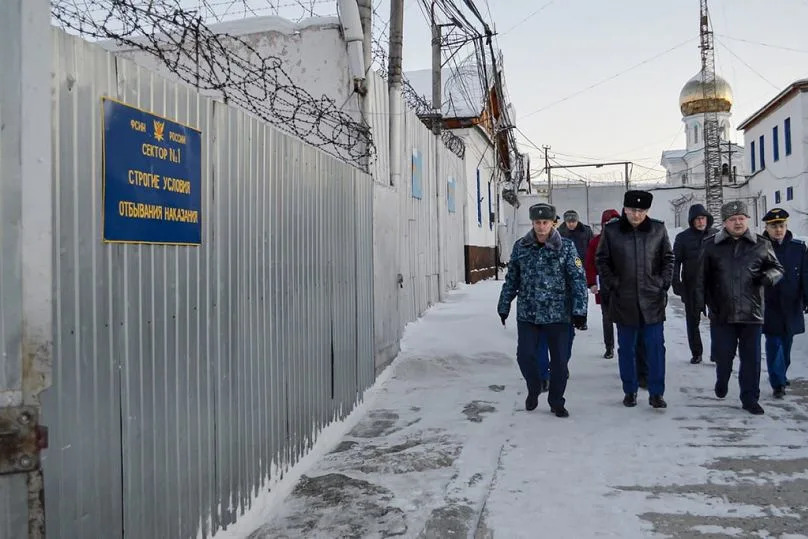
a group of officers walk inside a prison colony in the town of Kharp, in the Yamalo-Nenetsk region. – AP/Human rights ombudsman of Yamalo-Nenets Autonomous District
According to him, Alexei Navalny is being held in “one of the northernmost and most remote settlements” in Russia, where conditions are “difficult”.
In the West, his disappearance caused concern that was not entirely allayed by his reappearance in a very remote region.
On Monday, the United States said it was “deeply concerned” about Alexei Navalny’s “conditions of detention” and demanded his release.
Mr Navalny’s movement has been methodically eradicated by the authorities in recent years, driving his collaborators and allies into exile or prison.
In early December, the Russian authorities brought new charges of “vandalism” against the anti-corruption activist, which could add another three years to his sentence.
Vladimir Putin is aiming for a new six-year term in the Kremlin in the March presidential election, a term that would take him until 2030, when he turns 78.
Russia’s Navalny describes harsh reality at ‘Polar Wolf’ Arctic prison
Andrew Osborn and Olzhas Auyezov – December 26, 2023
FILE PHOTO: Jailed Russian opposition leader Alexei Navalny at a court hearing via video link
MOSCOW (Reuters) -Jailed Russian opposition politician Alexei Navalny on Tuesday confirmed his arrival at what he described as a snow-swept prison above the Arctic Circle and said he was in excellent spirits despite a tiring 20-day journey to get there.
Navalny posted an update on X via his lawyers after his allies lost touch with him for more than two weeks while he was in transit with no information about where he was being taken, prompting expressions of concern from Western politicians.
His spokeswoman said on Monday that Navalny, 47, had been tracked down to the IK-3 penal colony north of the Arctic Circle located in Kharp in the Yamal-Nenets region about 1,900 km (1200 miles) northeast of Moscow.
“I am your new Father Frost,” Navalny wrote jokingly in his first post from his new prison, a reference to the harsh weather conditions there.
“Well, I now have a sheepskin coat, an ushanka hat (a fur hat with ear-covering flaps), and soon I will get valenki (traditional Russian winter footwear).
“The 20 days of the transfer were quite tiring, but I’m still in an excellent mood, as Father Frost should be.”
Navalny’s new home, known as “the Polar Wolf” colony, is considered to be one of the toughest prisons in Russia. Most prisoners there have been convicted of grave crimes. Winters are harsh – and temperatures are due to drop to around minus 28 Celsius (minus 18.4 Fahrenheit) there over the next week.
About 60 km (40 miles) north of the Arctic Circle, the prison was founded in the 1960s as part of what was once the GULAG system of forced Soviet labour camps, according to the Moskovsky Komsomolets newspaper.
Kira Yarmysh, his spokeswoman, has said she believes the decision to move him to such a remote and inhospitable location was designed to isolate him, make his life harder, and render it more difficult for his lawyers and allies to access him.
Navalny, who thanked his supporters for their concern about his welfare during his long transfer, said he had seen guards with machineguns and guard dogs and had gone for a walk in the exercise yard which he said was located in a neighbouring cell, the floor of which he said was covered with snow.
Otherwise, he said he had just seen the perimeter fence out of a cell window. He said he had also seen one of his lawyers.
Navalny, who denies all the charges he has been convicted of, says he has been imprisoned because he is viewed as a threat by the Russian political elite.
The Kremlin says he is a convicted criminal and has portrayed him and his supporters as extremists with links to the CIA intelligence agency who they say is seeking to destabilise Russia.
Navalny earned admiration from Russia’s disparate opposition for voluntarily returning to Russia in 2021 from Germany, where he had been treated for what Western laboratory tests showed was an attempt to poison him with a nerve agent.
In his social media post, he told supporters he was unfazed by what he was facing.
“Anyway, don’t worry about me. I’m fine. I’m awfully glad I finally made it here,” said Navalny.
(Reporting by Andrew Osborn and Olzhas AuyezovEditing by Angus MacSwan, William Maclean)
“MAY THEY ROT IN HELL”: Trump blasted for hitting “new low” in Christmas Truth Social meltdown
Gabriella Ferrigine – December 26, 2023
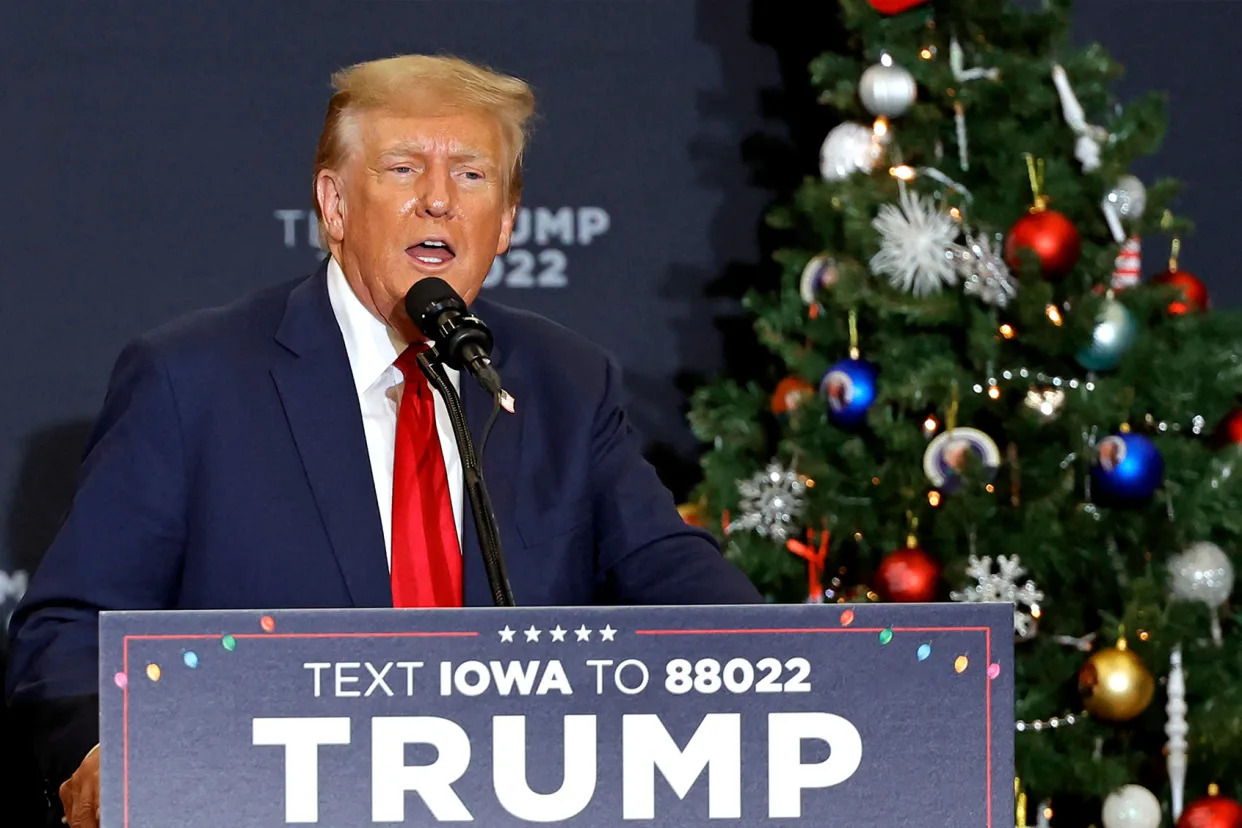
Donald Trump KAMIL KRZACZYNSKI/AFP via Getty Images
Former President Donald Trump spent much of the holiday weekend firing off posts from his Truth Social platform, haranguing President Joe Biden and special counsel Jack Smith, and bemoaning a perceived fall from grace of “our once great U.S.A.”
Trump on Christmas Eve shared a series of messages targeting the committee investigating the Jan 6 Capitol insurrection and the “DERANGED” Smith.
“JOE BIDEN’S MISFITS & THUGS, LIKE DERANGED JACK SMITH, ARE COMING AFTER ME,” Trump wrote. “AT LEVELS OF PERSECUTION NEVER SEEN BEFORE IN OUR COUNTRY???”
“WHY DID THE UNSELECT JANUARY 6th COMMITTEE OF POLITICAL HACKS & THUGS ILLEGALLY DELETE & DESTROY ALL OF THE EVIDENCE THEY USED TO WRITE THEIR FAKE REPORT,” the ex-president fumed on Sunday evening. “WHY DO THEY NOT SHOW THAT I USED THE WORDS ‘PEACEFULLY & PATRIOTICALLY’ IN MY SPEECH? THEY ACTUALLY PRETENDED THAT THESE WORDS WERE NEVER UTTERED. CROOKED POLITICS!!!”
“THEY SPIED ON MY CAMPAIGN,” Trump continued, “LIED TO CONGRESS, CHEATED ON FISA, RIGGED A PRESIDENTIAL ELECTION, ALLOWED MILLIONS OF PEOPLE, MANY FROM PRISONS & MENTAL INSTITUTIONS, TO INVADE OUR COUNTRY, SCREWED UP IN AFGHANISTAN, & JOE BIDEN’S MISFITS & THUGS, LIKE DERANGED JACK SMITH, ARE COMING AFTER ME, AT LEVELS OF PERSECUTION NEVER SEEN BEFORE IN OUR COUNTRY??? IT’S CALLED ELECTION INTERFERENCE. MERRY CHRISTMAS!”
Trump’s Christmas Eve invective followed a major blow to the special counsel’s team, in which the Supreme Court rejected a request to hasten arguments on whether Trump had presidential immunity from federal prosecution for crimes he is accused of commuting while in the White House in election subversion case.
On Monday, the ex-president continued his tirade.
“Merry Christmas to all, including Crooked Joe Biden’s ONLY HOPE, Deranged Jack Smith, the out of control Lunatic who just hired outside attorneys, fresh from the SWAMP (unprecedented!), to help him with his poorly executed WITCH HUNT against ‘TRUMP’ and ‘MAGA,’” he wrote.
“Included also are World Leaders,” Trump added, “both good and bad, but none of which are as evil and ‘sick’ as the THUGS we have inside our Country who, with their Open Borders, INFLATION, Afghanistan Surrender, Green New Scam, High Taxes, No Energy Independence, Woke Military, Russia/Ukraine, Israel/Iran, All Electric Car Lunacy, and so much more, are looking to destroy our once great USA. MAY THEY ROT IN HELL. AGAIN, MERRY CHRISTMAS!”
As noted by the Daily Beast, Trump’s Christmas post included a reference to Smith’s addition of attorney Michael Dreeben — a former member of special counsel Bob Mueller’s team who has argued before SCOTUS more than one hundred times — to his legal team.
MSNBC’s “Morning Joe” panel on Tuesday sharply criticized Trump’s “anger” and “bad faith attacks” to close out the year.
“I think it shows that these indictments and the civil case, despite his pretense otherwise, has gotten to him, because he’s reacting and responding in a way of no one projecting self-confidence or like this is nothing,” panelist Al Sharpton said.
“I also think it shows an inner kind of anger and displacement that he has, because who spends the holiday with this kind of venom, particularly when he is a guy that claims to be this self-confident, self-made guy with this kind of darkness, unless you are just that kind of dark person,” he continued.
“We’ve certainly gotten used to Trump’s unorthodox holiday messages, ‘the haters,’ but this one hit a new low, even for him,” host Jonathan Lemire agreed.
Dictator On Day One: The Executive Orders That Trump Would Issue From The Start
Josh Kovensky – December 26, 2023
Donald Trump has said that he would be a “dictator” on his first day in office.
And a review of his campaign’s plans and messaging shows part of what that may mean: a sweeping range of day-one executive orders aimed at remaking the Constitution and the federal government as we know it.
On his first days in office, Trump is planning on issuing orders which would end birthright citizenship, give himself the authority to fire tens of thousands of federal civil servants, and force federal bureaucrats to obey culture war dictates.
Through executive action, Trump plans to proclaim extreme new interpretations of baseline provisions of the Constitution, dramatically expanding the reach of presidential authority while upturning principles of law and American society, like birthright citizenship, that for decades have been taken for granted. Many of the proposed orders are likely to spark court fights, setting up legal battles over bedrock issues destined for a 6-3 conservative Supreme Court.
Other proposed day-one orders lean into the culture wars with real-world consequences, like one which would bar federal agencies from running programs supporting gender-transition education. Another, less seriously, would reinstate Trump’s vaunted “National Garden of American Heroes,” a park which would feature sculptures of Irving Berlin, William F. Buckley, Abraham Lincoln, Alex Trebek, Ruth Bader Ginsburg, Shirley Temple, and others.
There isn’t anything new about presidents issuing rafts of executive orders on their first day in office. But while new administrations typically issue orders which set new policy and proclaim the values of the new presidency, what distinguishes the Trump plans is the ambition of what he’s proposing.
“The substance and content of some of these proposals go far beyond what presidents have done with executive orders,” Blake Emerson, a law professor at UCLA who studies executive power, told TPM.
The proposed orders come in several buckets:
Executive orders which strike at key constitutional questions
Reissuing and expanding executive orders from his first term
Culture war proclamations
Rescinding Biden-era executive orders
A Trump campaign spokesman did not return TPM’s request for comment.
Trump’s campaign, along with a cottage industry of MAGA think tanks, have laid out what they believe his day-one agenda should be in part through what they call Agenda47, the closest thing the Trump campaign has to a platform.
At the center is the most extreme measure: an executive order aimed at rescinding birthright citizenship.
The Trump campaign describes the proposal in conclusive language, saying that they’ve already arrived at the “correct interpretation” of the 14th Amendment. Under that interpretation, to be described in a day-one executive order, the children of undocumented immigrants and tourists would no longer receive citizenship. Federal agencies, like the Social Security Administration, would be ordered to stop issuing passports, social security numbers, and other markers of citizenship under the order.
“They must go back,” Trump said in a statement accompanying the announcement, referring to the children of illegal immigrants.
The order would likely be met with near-instantaneous legal challenges, but, Emerson said, would be “unprecedented” in its use of executive power: having the White House proclaim, literally by fiat, a new interpretation of the Constitution.
“He can’t change the Constitution with an exec order,” John Woolley, a professor at UC-Santa Barbara who studies executive orders, told TPM. “But he can make things difficult.”
Trump has committed to a number of culture war executive orders as well. One would ban gender transition education in federal agencies, another would ban “ESG investments,” yet another would reverse a Biden executive order promoting diversity. One proposal from the Heritage Foundation-backed Project 2025 envisions an order banning government programs from supporting the teaching of “critical race theory.”
These may seem like ill-defined values statements, but Trump has said that he would issue another order on day one: a broadened version of his Schedule F proclamation from late 2020. In non-legalese, that’s an executive order which would empower him to fire any federal civil servant with policymaking responsibilities for any reason; a category of people which reaches into the tens of thousands.
Trump has framed it as a plan to “shatter the deep state” on the first day, an explicitly political undertaking.
The result, some civil service experts say, could be the mass exodus of professionals. That would lead to some politicization, but, more swiftly, a decapitation of the functioning of several government agencies.
It’s genuinely unclear from the plans that the Trump campaign has released which government functions they want preserved, in order to use for their own ends, and which they want incapacitated.
One promised day-one executive order, for example, calls for a reinterpretation of the 1974 Congressional Budget Control and Impoundment Act, a bedrock law to the modern budgeting system which, among other things, mandates that the executive branch use funding allocated by the legislative.
Trump himself ran afoul of this law in 2019, when he withheld money that Congress allocated to Ukraine as part of a political extortion scheme to coerce Kyiv into damaging Trump’s then-opponent, Joe Biden. Now, he’s proposing to order federal agencies to use the law to identify where programs can be cut, and push to “overturn the limits” that the law places on the executive.
Other plans, including one put out by the Heritage Foundation, would see Trump issue a day-one executive order gutting the Environmental Protection Administration. That would include “explicit language requiring reconsideration of the agency’s structure with reference to fulfilling its mission to create a better environmental tomorrow with clean air, safe water, healthy soil, and thriving communities.”
Many of these proposals would likely run into a buzzsaw of litigation. Federal employees, their unions, and good government groups would sue to block some of them from going into effect.
But in the meantime, Trump would likely be able to unleash massive shifts in policy. One proposal, for example, would ban the federal government from supporting efforts to fight “dis” or “mis” information; another would bring back the travel ban on Muslim countries.
Emerson, the UCLA professor, said that many of them appear to work in tandem. He described the civil service firing order, for example, to TPM as a one-two punch: executive orders which lay out bans on right-wing culture war hobbyhorses, and an executive order with the muscle to fire people who disobey.
“You have a really potent combination where people could be getting fired from civil service posts because they’re not toeing the line on critical race theory, or what have you,” Emerson said.
That New Trump Phone-Call Recording Sounds Pretty Bad, Huh?
Shirin Ali – December 26, 2023
“If you can go home tonight, do not sign it. … We will get you attorneys.” —Ronna McDaniel, chairwoman of the Republican National Committee, on a Nov. 17, 2020, phone call with two Republican officials about not certifying their county’s presidential election results
It seems there’s a sequel to Trump’s infamous “perfect phone call.” Last week, the Detroit News published a recording of a November 2020 phone call Trump made to local Michigan Republican officials, pressuring them not to certify their county’s election results.
RNC Chair Ronna McDaniel was also on the line, pushing Monica Palmer and William Hartmann, two GOP canvassers for Michigan’s Wayne County—which includes Detroit—to reject the certification minutes after they attended a canvassers meeting. Both Palmer and Hartmann did not sign the official statement of votes for Wayne County and later tried to rescind their votes in favor of certification but failed. In the end, Wayne County overwhelmingly voted in Joe Biden, with 68 percent of the vote.
While we did already know about this call—the basic facts of it came to light when Palmer testified to the Jan. 6 committee in 2021—the details of what exactly Trump and McDaniel said weren’t known until now.
In Palmer’s testimony to the House Select Committee, she said she didn’t remember exactly what Trump told her or if he had mentioned anything about Michigan’s election. In the newly published recording, however, Trump claims there were more votes in those counties than people, and that “everybody knows Detroit is crooked as hell.” Michigan’s election director, Jonathan Brater, said that was categorically false in a December 2020 affidavit, that in fact there were “fewer ballots tabulated than names in the poll books.”
The new details raise questions about whether Jack Smith could use this to strengthen his federal election interference case, or whether Trump could face state charges in Michigan, where officials have been conducting their own election interference investigation, similar to what Fulton County District Attorney Fani Willis did in Georgia.
Former Trump lawyer Ty Cobb told Politico the phone call shows “the depths to which Trump personally participated in fraudulently pimping the ‘Big Lie.’ ”
Michigan did ultimately send a fake certificate to the National Archives and Congress claiming that Trump won the state’s 2020 election—and 16 Republicans face felony charges for signing on to it.
This phone call echoes the infamous conversation in which Trump pressured Georgia Secretary of State Brad Raffensperger to find “11,779” votes to overturn Biden’s 2020 victory—the one he’s defended as “an absolutely PERFECT phone call.” (Trump now faces 13 state felony charges for allegedly trying to overturn Georgia’s election results.) Then there’s the phone call Trump had with Arizona Gov. Doug Ducey, in which he also pressured the governor to claim there had been voter fraud so Arizona’s election results could be overturned in his favor.
Karl Rove, a former adviser for the George W. Bush administration, told Fox News that Trump’s actions on this Michigan phone call are “what we would call election interference” and that the former president could face a situation that is similar to what he’s currently dealing with in Georgia. Rove also speculated that McDaniel might face legal ramifications. “I think that was highly inappropriate.”
Step by step, Florida Guard inches toward becoming DeSantis’ personal army | Opinion
The Miami Herald Editorial Board – December 25, 2023
The creeping threat of Florida Gov. Ron DeSantis’ new State Guard has increased again, this time with the news that a special unit within the organization recently took lessons at a Panhandle combat training center on things like “aerial gunnery” and treating “massive hemorrhages.”
Gun training? “Massive hemorrhages”? That sounds ominous.
This is the same guard that was supposed to be a civilian disaster response organization but has become increasingly militarized, according critics, including some former guard members. As we have said before, the big danger is that DeSantis will turn the State Guard into his personal militia. In a state that is already trying to squelch dissent and target vulnerable groups, that’s a scary prospect. This latest information only bolsters that fear.
Fleeing strongmen
That holds especially true in Miami. The push to give the governor what amounts to a personal law enforcement unit should ring some terrifying bells of recognition: Too many people here have had to flee countries run by authoritarians or strongmen who keep power through force.
The reason for the special training, which was reported by the Miami Herald, apparently is to allow DeSantis to use the guard, which reports only to him — a recipe for abuse — to stop migrants at sea. That’s a far cry from using the group to distribute hurricane relief supplies or help out an overworked National Guard.
That this is happening, though, can’t surprise anyone who has been paying attention. Florida’s governor has gone ever more extreme as he has watched his GOP presidential nomination hopes slipping away as Donald Trump’s have grown. His language has grown increasingly incendiary. He has described his plan to shoot and kill drug smugglers at the U.S. southern border using in bloodthirsty, B-movie terms: “We’re gonna shoot them stone cold dead.”
And yet his poll numbers keep going down. According to one recent Quinnipiac University poll, former South Carolina Gov. Nikki Haley has now pulled even with him for second place in the primary — both at a mere 11%. In February, DeSantis polled at 36%. Trump, despite his betrayal of the country that many Republicans once spoke against, now has about 67% support, with less than a month before the first primary votes will be cast.
Political points?
With the State Guard, Florida’s governor is no doubt hoping for a wave of people fleeing their country on the high seas so he can unleash his soldiers on them for political purposes. When the State Guard was revived last year by the Legislature at DeSantis’ behest, there was an actual surge of migrants in the Florida Keys, mostly from Cuba and Haiti. But since then, the surge has mostly dried up.
That makes no difference to the governor. Clearly, DeSantis wants to use the State Guard as a pawn in his fight to stay relevant in the primary by focusing on a sure-fire hit with Republicans: the evils of immigration.
It’ll be hard to go any lower than Trump has, though. He recently launched a particularly horrendous attack, saying that migrants crossing the southern border are “poisoning the blood” of the United States. Afterward, he insisted — in his usual attempt at manipulation — that any similarity between his words and those in Hitler’s “Mein Kampf” manifesto — “All great cultures of the past perished only because the original creative race died out from blood poisoning” — was simply all in our heads.
DeSantis’ push to revive the State Guard during his presidential run was political from the start and has only become more so. This latest weapons and wounds training is part of the progression toward a potential abuse of power in Florida that he has created with the full-on support of the Legislature. And we’re the ones who will be stuck with the results after he’s gone from office.
DeSantis delivers a political smackdown as Miami teachers union struggles to survive | Opinion
The Miami Herald Editorial Board – December 25, 2023
Trashing labor unions, in particular teachers unions, has become a talking point for Florida Gov. Ron DeSantis on the presidential trail. He told California Gov. Gavin Newsom during their Fox News debate that Democrats are “owned lock, stock and barrel, by the teachers union.”
What does that look on the ground, when laws DeSantis signed singling out some types of public-sector unions start to take effect?
The results may be upwards of 30,000 school employees being left without representation to bargain for better pay and working conditions.
The state’s largest teachers union, United Teachers of Dade, is close to decertification thanks to a new law that requires unions have at least 60% of union members pay dues, the Herald reported. The law — Senate Bill 256 — was a union-busting one-two-punch that not only raised the threshold for certification from 50%, but also prohibited unions from deducting dues directly from members’ paychecks. UTD, which represents teachers in the state’s biggest school district in Miami-Dade County, has gained 800 new members, but still failed to meet the state’s stringent requirements. In November, the Herald reported union membership was at 58.4%.
‘Right to work’
The Republican anti-union spiel usually leaves out the fact that Florida, unlike many blue states, is among 26 states that have “right to work” laws. That means workers cannot be forced to join a union and pay dues as a condition of employment. In other words, teachers and school staff do not have to be part of United Teachers of Dade to benefit from the 7% to 10% pay raise the union negotiated with the school district this year,
Teacher unions became a preferred target of DeSantis during his fight to reopen schools during the pandemic and to eliminate anything he deems “woke” indoctrination in schools. The governor has gone even further by demonizing teachers, who have been muzzled on what they say about race and LGBTQ issues in the classroom.
Unions, like all organizations, have had very public shortcomings, such as protecting bad employees from accountability. But if we’re talking about unions that are too powerful, we cannot leave out police and firefighter unions, whose endorsements DeSantis and other Republican gladly accept. It turns out SB 256 exempted those unions — along with those representing corrections officers — from that 60% threshold requirement.
Union pushed back
In other words, the law affects organizations that have directly clashed with DeSantis and the Republican-led Legislature. United Teachers of Dade was among the most vocal groups pushing back against the parental-rights law critics call “Don’t say gay,” laws that made it easier for organizations like Moms for Liberty to push schools to ban books, and DeSantis’ infamous “Stop Woke Act,” which bans instructions that some may interpret as making students feel guilty about being white. UTD President Karla Hernandez-Mats ran against DeSantis in 2022 as Charlie Crist’s running mate.
Meanwhile, groups like the Police Benevolent Association, the largest police union in the state, have been in lockstep with Republicans. In June, the PBA endorsed DeSantis for president, despite supporting Donald Trump in 2020.
Masked as a measure to hold unions accountable, SB 256 was a version of the same kind of political payback Disney received when it opposed the “Don’t say gay” law.
United Teachers of Dade will not face decertification immediately. It must now prove to the state that it has support from at least 30% of its bargaining unit. After that, the union must hold a vote seeking recertification and show at least 50% support. Next year, UTD must try again to meet that 60% threshold, the Herald reported, which could put it in a potentially never-ending cycle.
This is exactly the type of pain the new state law appears to seek to inflict. In Florida, opposition to the party in power comes with a high cost.
Ukraine’s effort to isolate Russia’s economy through ‘International Sponsors of War’ list
Daniil Ukhorskiy – December 25, 2023
Editor’s Note: This story was sponsored by the Ukrainian think-tank Center for Democracy and Rule of Law (CEDEM).
What do a Snickers bar, an Oreo cookie, and Haagen-Dazs ice cream have in common?
Apart from being beloved sweet treats, these products are manufactured by companies that were named “international sponsors of war” by Ukraine’s National Agency on Corruption Prevention (NACP) for fuelling Russia’s economy and its war effort against Ukraine.
While some multinational corporations left Russia following the full-scale invasion in 2022, many stayed behind. Household names such as Unilever, Nestlé, and Mondelez offered a range of excuses for their continued presence in Russia. These companies are not targeted by international sanctions since they do not directly contribute to Russia’s war machine. But according to Ukrainian officials, they might as well be: the tax money that these companies pay into Russia’s coffers may be used to finance its military.
The sponsors of war list is a form of “soft sanctions” that harnesses the power of public pressure. Some companies left Russia after being listed, which the NACP claims as their success. In other cases, the Agency negotiated with companies, securing promises to cut ties with Russia. Some of these commitments are yet to be fulfilled.
The “soft sanctions” approach is praised by academia and civil society alike. Yet, some say Ukraine’s policy on isolating Russia’s economy is too arbitrary, and a centralized policy is needed to achieve victory on the economic front.
Multinationals’ Russia Problem
At the start of Russia’s full-scale invasion of Ukraine, the thousands of international businesses operating in Russia faced immense pressure to leave the Russian market.
McDonald’s was one of the first massive corporations to cut ties, halting sales in March 2022 and announcing a complete withdrawal two months later.
Multinationals are an important part of Russia’s economy. According to the Kyiv School of Economics (KSE), which hosts the most comprehensive tracker of international businesses operating in Russia, these companies contributed $25 billion to the Russian GDP in 2021, and paid $2.9 billion in taxes in 2022, according to KSE and their NGO partner on the project, the B4Ukraine coalition.
According to KSE and B4Ukraine, the three most profitable sectors for multinationals in Russia are alcohol and tobacco, mass-market consumer goods, and automobiles.
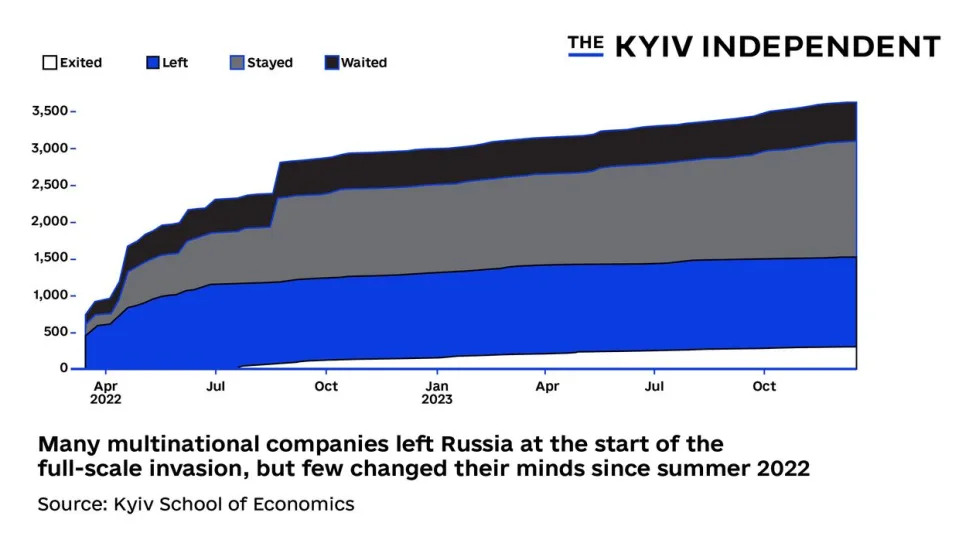
According to the KSE, after April 2022, the flood of companies leaving Russia turned into a drip. The KSE chart shows that most companies decided on whether to leave by summer 2022 at the latest.
A plateau of companies that made commitments to leave (in blue) shows that after an initial surge, few multinationals decided to exit Russia. (Graph by Nizar Al-Rifai)
Shutting the door on Russia isn’t always simple, even for the companies that want to. A recent investigation by the New York Times showed that Russian dictator Vladimir Putin is making withdrawal difficult and costly for foreign companies and enriching Russia in the process.
More than 1,600 foreign companies have continued business as usual in Russia. When challenged about their continued presence, some companies such as Unilever claim only to sell essential goods, while Nestlé cited worries about abandoning their staff, and Carlsberg claims to be unable to find buyers for their business.
These excuses proved thin. Dutch brewer Heineken sold its entire Russian business for the symbolic sum of one euro, showing that withdrawal is possible if a company is ready to take a financial hit. Unilever continued to sell ice cream, under the guise of “essential goods.”
The Kyiv Independent reached out to Unilever, Nestle, and Carlsberg but hasn’t gotten a response as of publication time.
Ultimately, most companies are cynical and profit-driven, and we cannot expect otherwise, says Glib Kanievskyi, co-founder of StateWatch, a Ukrainian transparency watchdog. Any tools that seek to isolate Russia economically must take this into account.
Who are the “sponsors of war’?
The International Sponsors of War list, launched in summer 2022, is an initiative that seeks to turn public opinion against multinationals that stay in Russia and use public pressure to incentivize withdrawal.
Of more than 1,600 foreign companies that stayed in Russia according to KSE, only 45 are listed as sponsors of war. According to Agia Zagrebelska, who oversees the sanctions policy direction at the NACP, there are three main criteria for inclusion: a substantial amount paid in taxes to Russia, any direct connections to the military, and broken promises to withdraw from Russia.
She says the NACP receives suggestions about companies from the public and civil society organizations such as StateWatch. These suggestions are then reviewed in line with the Agency’s criteria.
Some listed companies, like Unilever, snack titan Mondelez, and supermarket chain Auchan, are known worldwide for their consumer goods. Thirteen companies are based in China, a key Russian ally and its largest trading partner.
Of the three most profitable sectors identified by KSE and B4Ukraine, the NACP has widely listed alcohol and tobacco, and mass-market consumer product companies, but the automobile sector is still untouched – no Western automobile companies are on the list.
The list’s purpose is to go after a “gray zone” of companies that are not eligible for sanctions, says Zagrebelska. While there are no legal consequences to being listed, the risk of reputational damage can be enough to change company behavior.
Zagrebelska says the list allows consumers to make informed choices about their purchases, thus enacting a “direct democracy” where the public can vote with their wallets.
‘Soft sanctions’ in action
The NACP points to several companies that stopped dealing with Russia as signs of a successful policy. For instance, British manufacturing group Mondi was listed as a sponsor of war in February 2023, given their sizeable operations in Russia. They were removed from the list in November 2023 following a complete withdrawal.
While Zagrebelska admits that it is difficult to prove that the sponsors of war list had a decisive impact, she says the NACP is confident it pushes companies in the right direction.
In other instances, the NACP negotiated extensively with companies. Three Greek shipping companies saw their status change four times as they made and broke promises to the NACP. Finally, the companies were removed for good when they committed to stop shipping Russian oil entirely.
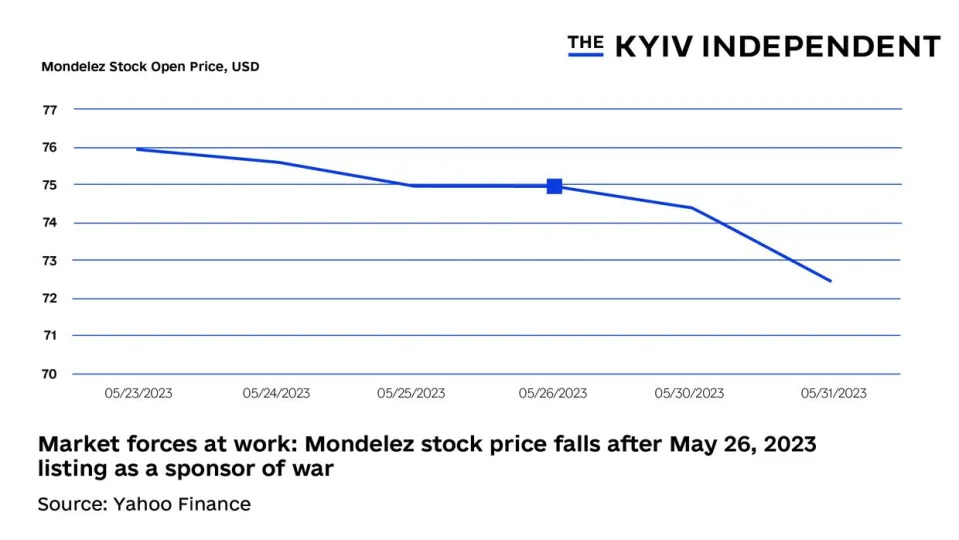
A graph of the Mondelez stock price, the blue square showing the day the company was listed as a sponsor of war by Ukraine’s National Agency on Corruption Prevention. (Graph by Nizar Al-Rifai)
The stock price of Mondelez, the company behind Oreos, Toblerone, and Milka, tumbled by almost five percent after it was labeled a sponsor of war in May 2023. Mondelez has continued its operations in Russia, and its stock price has not recovered.
The snack maker’s financial troubles were likely exacerbated due to a boycott by clients in Sweden and Norway such as Scandinavian Airlines since June 2023. The Nordic companies cited the listing as a sponsor of war as the reason for their decision. Mondelez claimed they were unfairly “singled out.”
The Kyiv Independent reached out to Mondelez but hasn’t heard back as of publication time.
Wrangling with banks
One of the NACP’s most high-profile clashes was with Hungary’s OTP Bank, which operates in Russia and Ukraine and was listed as a sponsor of war in May 2023.
Viktor Orban, Hungary’s prime minister known for pro-Russia stances, was outraged by the listing, and Hungarian diplomats pushed back hard, threatening to derail EU sanctions and Ukraine aid discussions in Brussels.
According to NACP’s Zagrebelska, OTP Bank made significant concessions in discussions with EU and Ukrainian officials and demonstrated a concrete plan for withdrawing from Russia, after which the bank was removed from the list in October 2023. She could not share any details of the plan, which is set to be announced in January 2024, with the Kyiv Independent.
Kanievskyi of StateWatch was skeptical of the NACP’s claim of victory over OTP Bank. He said the likelier explanation is that NACP backed down after internal and external pressure. Passing EU sanctions was more important to the Ukrainian government, he said.
A Ukrainian official who worked closely on negotiations over OTP Bank but was not authorized to speak on the record said the NACP listing caused “a lot of fuss.” They said that the listing of OTP Bank held up the 11th EU sanctions package for up to four weeks and that Ukraine’s Ministry of Foreign Affairs was frustrated with the NACP’s position.
Similar discussions are ongoing about Raiffeisen, an Austrian bank with huge operations in Russia. The bank’s status as a sponsor of war was suspended last week, and Zagrebelska said that NACP is awaiting concrete documentation to show its commitment to withdrawing from Russia.
Once again, the NACP’s decision to remove the bank coincided with Austria’s approval of the latest EU sanctions package. Kanievskyi said the NACP folded to pressure, but Zagrebelska maintained her confidence that Raiffaisen will take concrete steps to withdraw from Russia. She also noted that the bank’s status is only suspended, meaning it can be easily reinstated.
Reflecting on the OTP and Raiffeisen cases, Andrii Onopriienko, a policy expert at KSE, recognized that the sponsors of war list is ultimately a political process that uses these negotiations to try and find a favorable compromise for Ukraine.
On OTP and Raiffeisen, the jury is still out. Should the banks’ promises to exit Russia prove empty, the deterrent power of the list may be weakened. On the other hand, if OTP and Raiffeisen show a real commitment to withdrawing from Russia, the “soft sanctions” and negotiation approach may be vindicated as a powerful tool of economic warfare.
Dealing with the devil?
Another source of criticism has been the inclusion of companies that continue to do business in Ukraine. Philip Morris, one of the “big four” tobacco companies, was listed among sponsors of war in August 2023, having announced a $30 million factory project in Lviv Oblast just two months before.
Japan Tobacco International (JTI), another “big four” cigarette maker is also one of the biggest multinationals still active in Russia and Ukraine, and was also listed as a sponsor of war in August 2023.
Kanievskyi questioned the coherence of listing Philip Morris as a sponsor of war and continuing close cooperation with the company. Many companies on the list maintain significant operations in Ukraine, including Unilever, Nestlé, and Mondelez.
According to Kanievskyi, the cause is a lack of a unified policy and legislative framework.
On the Philip Morris deal, Phil Chamberlain from the campaigning organization Expose Tobacco said that preying on countries in difficult situations to get a better deal was straight out of the “Big Tobacco” playbook. According to Chamberlain, a lack of coherent policy only makes it easier for multinationals to take advantage of the war to increase profits.
According to Hlib Kolesov, a lawyer with the Ukrainian think-tank Center for Democracy and Rule of Law, it is hypocritical of tobacco companies to be contributing to Russia’s economy as they claim to support Ukraine amid war.
“On the one hand, tobacco companies position themselves as good partners of Ukraine, investors in its economy, in recovery, but, on the other hand, the same tobacco companies earn money in Russia and pay huge taxes to the budget of the Russian Federation,” Kolesov told European Pravda.
A picture taken on Aug. 21, 2018, shows the research and development campus of cigarette and tobacco manufacturing company Philip Morris International, in Neuchatel, western Switzerland. (Photo by Fabrice Coffrini/AFP via Getty Images)
Yet, Ilona Sologoub, an economist and head of the VoxUkraine think tank, recognized the challenges faced by Ukraine’s government in elaborating a coherent policy in this area.
Ultimately, Sologoub agreed with the NACP’s “gray area” logic. She said that “soft sanctions” fill a valuable gap, targeting companies that cannot be sanctioned because of the possible negative impact on Ukraine’s economy.
For NACP’s Zagrebelska the presumable “whitewashing” efforts by Philip Morris and other companies are too little, too late. She said she was confident that consumers can see through the efforts and will continue to pressure companies to exit Russia.
The Kyiv Independent requested a comment from Philip Morris but hasn’t heard back as of publication time.
Coordinated policy
Experts were broadly positive about the sponsors of war list and its contribution to Russian economic isolation. “There is no perfect solution,” said KSE’s Onopriienko, “but it is an all-out war. We all do our part.”
Kanievskyi, whose organization StateWatch collaborates extensively with the NACP, emphasized the lack of central government policy as the biggest challenge for Ukraine in this area.
He said that in the early months of the all-out war, companies were more afraid of reputational damage for staying in Russia, while now many are ready to take the risk. For him, this highlights an urgent need for a centralized policy on sanctions and other economic restrictions from the authorities. Ultimately, he says a lack of a clear policy undermines the communications efforts of the NACP which is crucial to the list’s success.
A lack of centralized policy also led to tensions over OTP Bank, with different Ukrainian government agencies pushing for different outcomes, as recounted by the Ukrainian official who worked closely on internal and external negotiations and who is not authorized to speak with the media.
The NACP and partners are looking to develop new initiatives to isolate Russia economically and increase the effectiveness of sanctions. A newly launched project tracks electronic components used in Russian weapons that continue to bypass sanctions. Zagrebelska said that in early 2024, the Agency plans to launch a mobile application allowing consumers to spot products by companies listed as sponsors or war.
In the meantime, Kanievsky underscores the importance of having a coordinated policy on the sponsors of war list. Lacking proper guidance from the central government, Ukrainian officials and civil society may struggle to do their part in isolating Russia’s wartime economy.