CIA director: Not passing Ukraine aid would be a mistake ‘of historic proportions’
Matt Berg – January 30, 2024
Amanda Andrade-Rhoades/AP
Western allies must continue providing assistance to Ukraine in its war with Russia this year, or risk a mistake “of historic proportions,” CIA Director William Burns wrote in a column published Tuesday.
Burns laid out his case in a Foreign Affairs column, noting that less than 5 percent of the U.S. defense budget — “a relatively modest investment with significant geopolitical returns” — is all that Washington sends to Kyiv.
If an opportunity for serious negotiations to end the war emerges, he wrote, providing arms to Ukraine will put it in a stronger bargaining position. Ukraine’s military would also be able to continue fending off Russian troops while rebuilding its infrastructure, while Moscow spends massive amounts of money to keep the war going, Burns added.
“For the United States to walk away from the conflict at this crucial moment and cut off support to Ukraine would be an own goal of historic proportions,” Burns wrote, referencing a soccer term for scoring a goal for the rival team by putting the ball into a player’s own net.
Burns is the latest top U.S. official to publicly make the case for greenlighting assistance to Ukraine, as lawmakers battle over a southern border deal that’s holding up $60 billion in aid to Ukraine. The Biden administration has been urging lawmakers to push a deal through, but there’s no clear indication when lawmakers might strike a deal.
The director’s column also comes after he secretly visited Ukrainian President Volodymyr Zelenskyy in Kyiv earlier this month, briefing him on his expectations for what Russia is planning in the near future, The Washington Post reported.
Trump Was Accused of Calling Fallen US Soldiers ‘Suckers’ and ‘Losers.’ We Examined the Evidence
Nur Ibrahim – January 30, 2024
Liam Enea/Wikimedia Commons
In January 2024, U.S. President Joe Bidencalled former President Donald Trump a “loser,” resurrecting a years-old accusation against Trump that allegedly revealed his true opinion of U.S. military service members. According to alleged eyewitnesses, Trump had called veterans and fallen U.S. soldiers “suckers” and “losers.”
At about the same time, a liberal veterans group launched an advertisement targeting Trump over those alleged past comments. In the ad, a mother who lost her son to war said, “My son is not a loser.”
Trump and his allies have denied the accusation since it first emerged in 2020, shortly before the election between Trump and Biden. Whether performative or authentic, Trump’s apparent support for soldiers in the U.S. military, both active and veteran members, has been part of his presidential campaigns.
Following a story by The Atlantic, a number of reputable news outlets reported on the alleged comments in 2020, relying entirely on anonymous sources from his administration.
However, there appeared to be no evidence of an audio or video recording of the remarks in question, nor was there any documentation, such as transcripts or presidential notes, to independently confirm or deny the alleged quotes’ authenticity. Moreover, since Snopes did not witness the in-question comments firsthand, we can’t say for certain whether Trump called fallen soldiers “suckers” and “losers.”
We reached out to Trump’s representatives to see if they had any supplemental evidence to help substantiate their denial, as well as for a response to renewed attention on the comments in 2023. We will update this story when, or if, we receive a response.
How the Accusations Emerged
Citing anonymous officials from the administration, the 2020 article by The Atlantic, titled, “Trump: Americans Who Died in War Are ‘Losers’ and ‘Suckers’,” unpacked Trump’s trip to Paris in 2018 when he allegedly did not want to visit a cemetery of American war dead. The visit was cancelled.
Trump did not want to visit the Aisne-Marne American Cemetery — which is home to the graves of Americans who fought and died in World War I — for two reasons, according to The Atlantic: He feared the rain would dishevel his hair, and “because he did not believe it important to honor American war dead, according to four people with firsthand knowledge of the discussion that day.” The Atlantic continued (emphasis ours):
Trump rejected the idea of the visit because he feared his hair would become disheveled in the rain, and because he did not believe it important to honor American war dead, according to four people with firsthand knowledge of the discussion that day. In a conversation with senior staff members on the morning of the scheduled visit, Trump said, “Why should I go to that cemetery? It’s filled with losers.” In a separate conversation on the same trip, Trump referred to the more than 1,800 marines who lost their lives at Belleau Wood as “suckers” for getting killed.
Shortly after the publication of The Atlantic report, one unnamed senior official with the U.S. Department of Defense and one senior U.S. Marine Corps officer confirmed the 2018 cemetery remarks from the above report in interviews with The Associated Press (AP). According to the AP, the official had firsthand knowledge of Trump’s remarks, and the officer had been told about them.
Trump Allies Deny the Claims
The White House blamed the canceled cemetery visit on poor weather. Responding to The Atlantic’s reporting, Trump said the accusation was “a disgraceful situation” by a “terrible magazine.”
Trump strongly denied calling fallen soldiers “losers” and “suckers.” Speaking to reporters on Sept. 3, 2020, upon returning from a campaign rally to Washington, D.C., just after the report came out, Trump said: “I would be willing to swear on anything that I never said that about our fallen heroes. There is nobody that respects them more. No animal — nobody — what animal would say such a thing?”
Just days later, Zach Fuentes, a former White House aide who left the administration in early 2019 and was with the president on the Paris trip and presumably near him during the in-question conversations about the cemetery visit, stood up for Trump in an interview with Breitbart.
Referring to Gen. John Kelly, who was with Trump during the trip as his chief of staff, he said, “I did not hear POTUS call anyone losers when I told him about the weather. Honestly, do you think General Kelly would have stood by and let ANYONE call fallen Marines losers?”
Reporting on Fuentes’ interview with Breitbart, The Washington Post noted that the phrase “I did not hear…” is not the same as “it didn’t happen.” Furthermore, there was no evidence of Kelly being around Trump to hear the alleged comments.
Trump’s former national security adviser John Bolton, who said he was on the trip, also issued a denial to Fox News, days after the article came out, saying it was “simply false.”
Then-U.S. Secretary of State Mike Pompeo also denied the claims in an interview with Fox News in September 2020. He said, “I was with him for a good part of that trip, if I’m thinking about this visit and the timing right, and I never heard him use the words that are described in that article. Just, I never saw it.”
How the Claims Resurfaced in 2023
On Oct. 2, 2023, Biden’s official account on X resurfaced the accusation, saying Trump once allegedly “referred to American service members as ‘suckers’ and ‘losers.'” The post (displayed above) included video footage of Biden speaking at a September 2023 event to honor the late U.S. Sen. John McCain, who was a military veteran and prisoner of war. (In that speech, Biden referenced the 2020 story by The Atlantic.)
The day after Biden’s post on X, Kelly repeated the claim, as well. Speaking to CNN story, he said (emphasis, ours):
What can I add that has not already been said? A person that thinks those who defend their country in uniform, or are shot down or seriously wounded in combat, or spend years being tortured as POWs are all ‘suckers’ because ‘there is nothing in it for them.‘ A person that did not want to be seen in the presence of military amputees because ‘it doesn’t look good for me.’ A person who demonstrated open contempt for a Gold Star family – for all Gold Star families – on TV during the 2016 campaign, and rants that our most precious heroes who gave their lives in America’s defense are ‘losers’ and wouldn’t visit their graves in France.
In other words, Kelly, who was with Trump in Paris, confirmed that Trump did call American troops “losers” and “suckers,” though it was unclear whether he witnessed the comments firsthand or heard about them from someone else, or from news reports. (The 2020 Atlantic story detailed a separate incident of Trump visiting the grave of Kelly’s son who was killed in action in Afghanistan, for which Kelly was supposedly present. In that case, Trump allegedly asked of military personnel who volunteered to join the service, “What was in it for them?”)
Responding to the CNN interview, a Trump official issued a statement to CNN, saying, “John Kelly has totally clowned himself with these debunked stories he’s made up because he didn’t serve his president well while working as chief of staff.”
In addition to the alleged statements about service members generally, Trump has publicly insulted McCain, in particular, by calling him “not a war hero,” and “I like people who weren’t captured,” according to footage on C-SPAN. Also, for The Atlantic story, anonymous sources said he called former President George H.W. Bush a “loser” for getting shot down by the Japanese while a Navy pilot during World War II.
In sum, the claim stemmed from a story by The Atlantic, which relied on anonymous, second-hand reports of Trump’s alleged words; there was no independent footage or documented proof to substantiate the in-question comments; and Trump vehemently denies that he once called service members “losers” and “suckers.” While it was certainly possible that he said those things, Snopes was unable to independently verify the claim.
Sources:
Baker, Peter, and Maggie Haberman. “Trump Faces Uproar Over Reported Remarks Disparaging Fallen Soldiers.” The New York Times, 4 Sept. 2020. NYTimes.com, https://www.nytimes.com/2020/09/04/us/politics/trump-veterans-losers.html. Accessed 4 Oct. 2023.
Blake, Aaron. “Analysis | What Trump Officials Really Say — and Don’t Say — in Denying That He Disparaged Fallen Troops.” Washington Post, 8 Sept. 2020. www.washingtonpost.com, https://www.washingtonpost.com/politics/2020/09/08/trump-officials-military-disparagement-denials/. Accessed 4 Oct. 2023.
Goldberg, Jeffrey. “Trump: Americans Who Died in War Are ‘Losers’ and ‘Suckers.'” The Atlantic, 3 Sept. 2020, https://www.theatlantic.com/politics/archive/2020/09/trump-americans-who-died-at-war-are-losers-and-suckers/615997/. Accessed 4 Oct. 2023.
Mason, Jeff, et al. “Biden Warns Trump, ‘MAGA’ Movement Threaten American Democracy.” Reuters, 29 Sept. 2023. www.reuters.com, https://www.reuters.com/world/us/biden-warn-threat-democracy-trump-honor-mccain-2023-09-28/. Accessed 4 Oct. 2023.
“Report: Trump Disparaged US War Dead as ‘Losers,’ ‘Suckers.'” AP News, 4 Sept. 2020, https://apnews.com/article/election-2020-ap-top-news-politics-b823f2c285641a4a09a96a0b195636ed. Accessed 4 Oct. 2023.
Tapper, Jake. “Exclusive: John Kelly Goes on the Record to Confirm Several Disturbing Stories about Trump | CNN Politics.” CNN, 2 Oct. 2023, https://www.cnn.com/2023/10/02/politics/john-kelly-donald-trump-us-service-members-veterans/index.html. Accessed 4 Oct. 2023.
“Trump: “He’s a War Hero Because He Was Captured. I like People That Weren’t Captured.”” C-SPAN. www.youtube.com, https://www.youtube.com/watch?v=541Cg2Jnb8s. Accessed 4 Oct. 2023.
In Biden’s pledge to ‘shut down’ border, a stunning political shift
Analysis by Zachary B. Wolf, CNN – January 29, 2024
President Joe Biden’s evolution on the key election issue of immigration entered a new phase when he promised to “shut down the border right now” if given new powers by Congress.
The deeper policy context of the comments, delivered at a campaign event in South Carolina Saturday and in a statement from the White House on Friday, is that Biden wants to resuscitate a bipartisan deal to pair new border powers with additional military aid for Ukraine and Israel.
But the Trump-like rhetoric from the Democratic president – and the fact that Democrats are not even talking about a pathway to legal status for undocumented immigrants currently in the country – is also an important political admission as immigration-focused Donald Trump zeroes in on the Republican presidential nomination and the border crisis reverberates through the country and into Washington, DC.
Biden is willing to offer concessions so he can make deals, and Trump wants to keep this as a campaign issue.
Trump wants to kill bipartisan deal
“As the leader of our party, there is zero chance I will support this horrible, open-borders betrayal of America,” Trump said in Nevada on Saturday, although future Republican presidents would also benefit from the new power Biden is seeking.
Trump doesn’t think the president needs new power to shut the border. He has promised that, if elected, he will act as “dictator for one day” to do it, and he’s actively working against the bipartisan effort even though parts of it are straight out of his policy playbook.
“The reality is that this includes many provisions that when Donald Trump was president, he hoped would be made into law,” said CNN’s Lauren Fox, appearing Monday on “Inside Politics.” These Trump-friendly priorities, she said, include making it much more difficult for migrants to seek asylum in the US and increasing the speed at which asylum cases can be processed in immigration courts.
Biden’s acknowledgment
CNN’s Priscilla Alvarez, a White House reporter who is also an expert on the issue of immigration, documents Biden’s shift.
“Biden took office pledging to restore asylum and manage the border in a ‘humane’ way,” Alvarez writes. “But his administration has faced the harsh realities and challenges at the US-Mexico border amid record migration across the Western Hemisphere — making it a political vulnerability seized on by Republicans.”
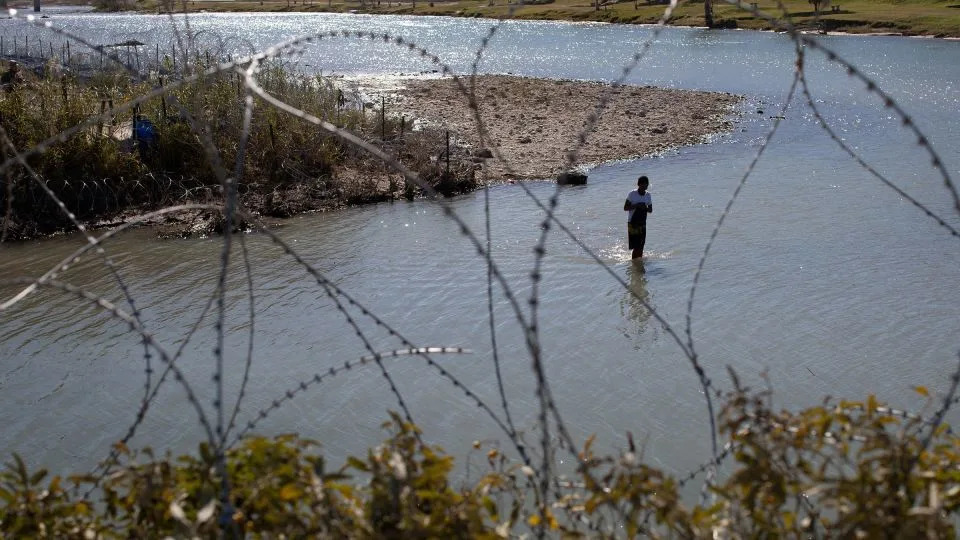
A man crosses the Rio Grande River from Mexico to collect clothing and other items left on the Texas banks of Shelby Park at the US-Mexico border in Eagle Pass, Texas, on January 12, 2024. – Kaylee Greenlee Beal/Reuters
Permanent power for the president
The new permanent power pushed by Biden and Senate negotiators is in line with temporary, Covid-era restrictions originally put in place during Trump’s administration, but which lapsed last year on Biden’s watch.
Following Trump’s lead, rather than work with the president to secure the border, House Republicans have rejected even the idea of a Senate compromise and are gearing up to impeach Biden’s secretary of Homeland Security, Alejandro Mayorkas, for not applying current law to turn away more people at the border.
Still no deal in writing
The framing of this issue may end up being more important than the policy itself. The bipartisan group of senators has not released text for their compromise, but they insist it does exist.
“We do have a bipartisan deal. We’re finishing the text right now,” Sen. Chris Murphy, the Connecticut Democrat who is a key negotiator on the deal, said on CNN’s “State of the Union” on Sunday.
“The question is whether Republicans are going to listen to Donald Trump, who wants to preserve chaos at the border because he thinks that it’s a winning political issue for him,” said Murphy, adding the proposal would give the president, Republican or Democrat, permanent new emergency powers.
What we know
While the text of the bill has not been finalized, Biden ticked off the major points during that appearance in South Carolina:
“It includes an additional 1,300 Border Patrols — we need more agents on the border;
375 immigration judges to judge whether or not someone can come or not come and be fair about it;
1,600 asylum officers;
and over 100 cutting-edge inspection machines to help detect and stop fentanyl coming in.”
GOP negotiator censured by his own party
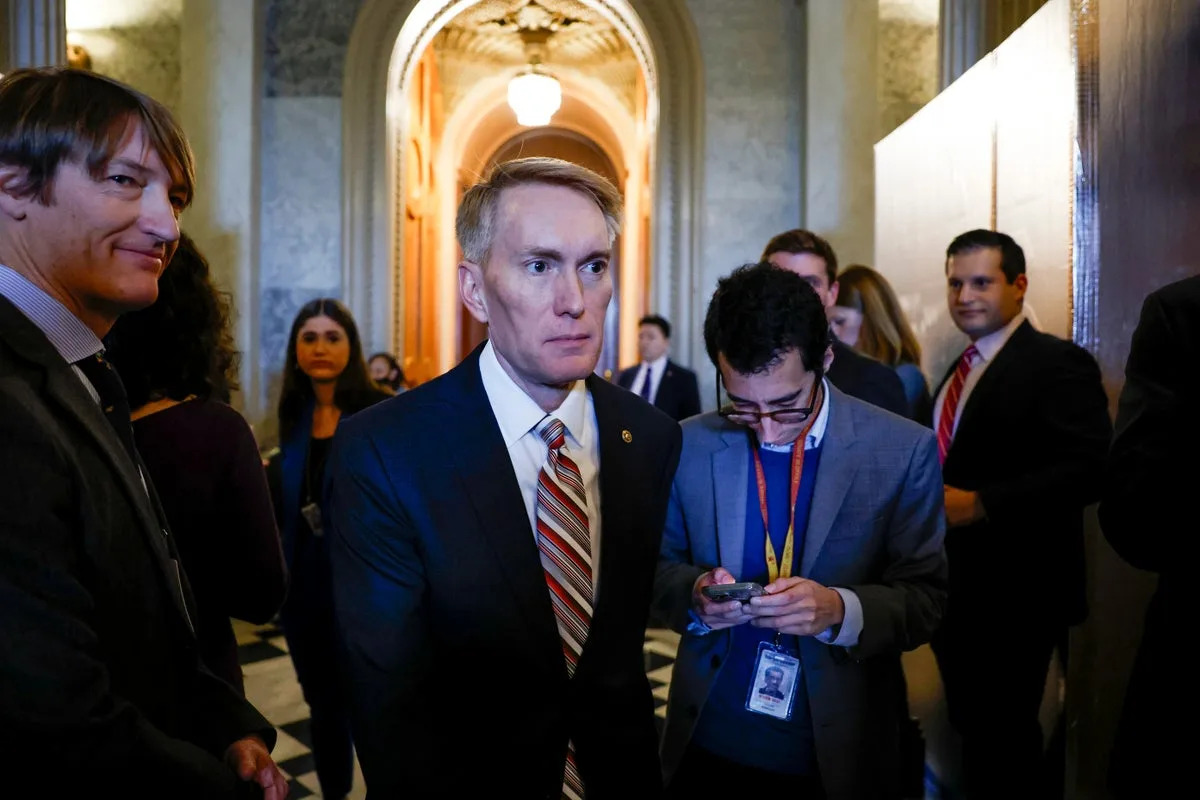
Sen. James Lankford of Oklahoma, the top Republican negotiator, is already facing blowback even though the deal has not been publicly released.
The Oklahoma Republican Party voted over the weekend to censure Lankford and demanded that he abandon the bipartisan talks.
Appearing on “Fox News Sunday,” Lankford was pressed about the new authority for Biden, which would be triggered if there’s an average of 5,000 migrant crossings per day over the course of a full week. Lankford said this would not normalize 5,000 migrant crossings per day. And for context, border officials were dealing with more than 10,000 crossings per day for most of December.
“This is set up for if you have a rush of people coming at the border, the border closes down – no one gets in,” he said. “This is not someone standing at the border with a little clicker, saying, ‘I’m going to let one more in, we’re at 4,999 and then it has to stop.’ It is a shutdown of the border, and everyone actually gets turned around.”
Democrats waiting for details too
Rank-and-file Democrats would surely be frustrated with such a compromise, which does not address their long-term immigration priorities, like giving permanent legal status to the children of undocumented immigrants who were raised in the US or paving a pathway to citizenship for undocumented immigrants who have built lives and paid taxes in the US.
“We have milestones and we have a path to get there, but we were never going to get a path to citizenship in this bill,” former House Speaker Nancy Pelosi told CNN’s Dana Bash on Sunday.
Frustration in US cities
Meanwhile, mayors of Democratic cities continue to raise the alarm about an untenable wave of migrants bused north from border states and draining their infrastructure.
The public view of the current immigration situation has shifted
Nearly half – 45% of Americans in a CBS News poll released early this month – said the situation at the border is a crisis.
And a strong majority of the public – 63% now compared with 55% in September – said the Biden administration should be tougher on immigrants crossing at the border. More than two-thirds, 68%, said they disapproved of Biden’s handling of the border, although that does not translate into support for Republicans. Sixty-five percent of Americans said they disapproved of congressional Republicans’ handling of the issue.
Americans are still broadly supportive of immigration, however. In a Gallup poll released last July, 68% said the overall effect of immigration was a good thing for the US, compared with just 27% who said it was a bad thing.
After publication, White House spokesperson Angelo Fernandez Hernandez provided this statement:
“The American people overwhelmingly agree with what President Biden underlined in his Day One reform plan: that our immigration system is broken and we have an imperative to secure the border and treat migrants with dignity,” Fernandez Hernandez said in an email. “After opposing the record border security funding President Biden has delivered every year of his administration, House Republicans are blocking the border security resources President Biden is fighting for in order to hire more Border Patrol officers and invest in cutting edge technology to detect fentanyl.”
Republicans tried to hammer Biden on immigration. But they turned into a circular firing squad
Eric Garcia – January 29, 2024
(Getty Images)
President Joe Biden might finally be running out of patience with Republicans when it comes to negotiations surrounding an agreement to restrict immigration in exchange for aid to Ukraine.
After weeks of negotiations, Republicans hit a snag last week as former president Donald Trump came out swinging against any agreement. That forced Senate GOP leadership to recalibrate. On top of that, House Speaker Mike Johnson — who leads a far more rabidly anti-immigrant and anti-Ukraine conference than Mitch McConnell leads in the Senate — wrote in a letter to colleagues that the agreement “would have been dead on arrival in the House anyway.”
On Friday evening, Biden released a statement saying that the proposed legislation would give him the ability to “shut down the border when it becomes overwhelmed” and that he would invoke the authority the day he signs the bill into law.
Of course, being able to “shut down the border” is an amorphous term and the definition of shutting it down lies in the eye of the beholder. Nevertheless, Biden wants to have some kind of agreement not only because he wants to free up dollars to help Ukraine defend itself against Russia: A Harvard CAPS-Harris poll from last week showed that more voters consider immigration their top policy concern than the economy.
Republicans have battered Biden on the border ever since he took office, essentially flipping the dynamic after Donald Trump faced numerous negative headlines about family separation and the infamous Mexican border wall. Texas Governor Greg Abbott has even bused migrants to cities with Democratic mayors. That particular move led New York’s mayor Eric Adams to openly criticize Biden.
But Republicans might have gotten high on their own supply when it comes to immigration. As Inside Washingtonexplained last week, Republicans delaying passing an immigration bill to allow Trump to benefit makes it hard for them to argue that the influx of migrants is a crisis that requires immediate addressing. If passing a bill can wait 12 months, then it’s hardly urgent.
Right-wing opposition to the immigration legislation also means that Republicans are turning against each other.
On Sunday, Fox News host Shannon Bream asked Senator James Lankford, the chief Republican negotiator, why he would give Biden the “cover of this deal” which she said would allow people into the United States. Lankford responded by saying four months ago, Republicans united to say they would demand changes in policy “and now it’s interesting a few months later, when we’re finally getting to the end, they’re like, just kidding. We actually don’t want a change in law because of a presidential election year.”
Lankford, a hardline conservative from Oklahoma, has staked much of his credibility on the legislation. So he’s understandably frustrated to see opposition. And shortly after making his case, Senator Rick Scott of Florida, a Trump ally, said on the same Fox program that Lankford was on a “suicide mission.” That also gives Scott the added benefit of knifing Senate Minority Leader Mitch McConnell, with whom he has a tenuous relationship.
Republicans likely had a chance to pass the legislation before Trump returned to his role of being the de facto nominee. But his victories in Iowa and New Hampshire — as well as the coalescing of the GOP around him — has meant that they have to defer to what he dictates.
The ultimate sign that Republicans might be overconfident is their plan to impeach Homeland Security Secretary Alejandro Mayorkas. Why? It’s not entirely clear. But what is apparent is that Johnson, who is a little more than three months into the job, has chosen to appeal to the most far-right factions of his conference.
Holding a series of sideshow hearings for a secretary most people have never heard of will do little to shed light on whether laws are being enforced at the border. But it will allow figures like committee member Marjorie Taylor Greene to pontificate and get more television air time. Indeed, Greene came out strongly against the bipartisan bill in the Senate, despite the fact no text exists.
It appears that Biden is attempting to create a foil to the feud. By saying he would willingly close the border if given the means to do so, he wants to put the pressure on Republicans to pass the bill. If not, he hopes to hammer them for not giving him the power to curb immigration into the US.
Trump and his allies are wielding immigration as a political weapon against Biden, and Ukraine is paying the price
Chris Panella – January 29, 2024
Negotiations on a deal on the border and aid could collapse thanks to Trump.
He put pressure on the bipartisan deal he called “meaningless,” leaving Republicans scrambling on what’s next.
The chaos hurts Ukraine in particular, as its troops fight Russia without new US aid.
Republicans and Democrats have spent weeks carefully negotiating a massive, bipartisan immigration and foreign aid deal, leaving Ukraine in a wait-and-see position on critical support.
As both sides moved closer toward a possible agreement, former President Donald Trump stepped in to torpedo attempts at a compromise.
His opposition to the deal, which some have said may be in hopes of keeping the border as a key campaign issue going into the election this year, has left some Republicans wary of crossing him and others frustrated.
Failure to reach a deal is likely to leave multiple parties feeling aggrieved, but it would especially hurt Ukraine. Its troops are scraping the bottom of the barrel for ammunition to defend themselves and their cities against intensifying assaults, and the country is increasingly nervous about fighting off Russia with little help from its biggest single supporter in the West.
Senate Minority Leader Mitch McConnell said last week in a closed-door meeting with other Republicans that Trump’s pushback against the border deal had forced them into a pickle. The comments were first reported by Punchbowl News.
“When we started this, the border united us and Ukraine divided us,” McConnell said. “The politics on this have changed.”
“We don’t want to do anything to undermine him,” McConnell added, talking about Trump as the former president moves closer to clinching the Republican presidential nomination after successes in Iowa and New Hampshire earlier this month.
The next day, at another closed-door meeting, McConnell said that his comments had been misinterpreted and that he was committed to getting the deal passed.
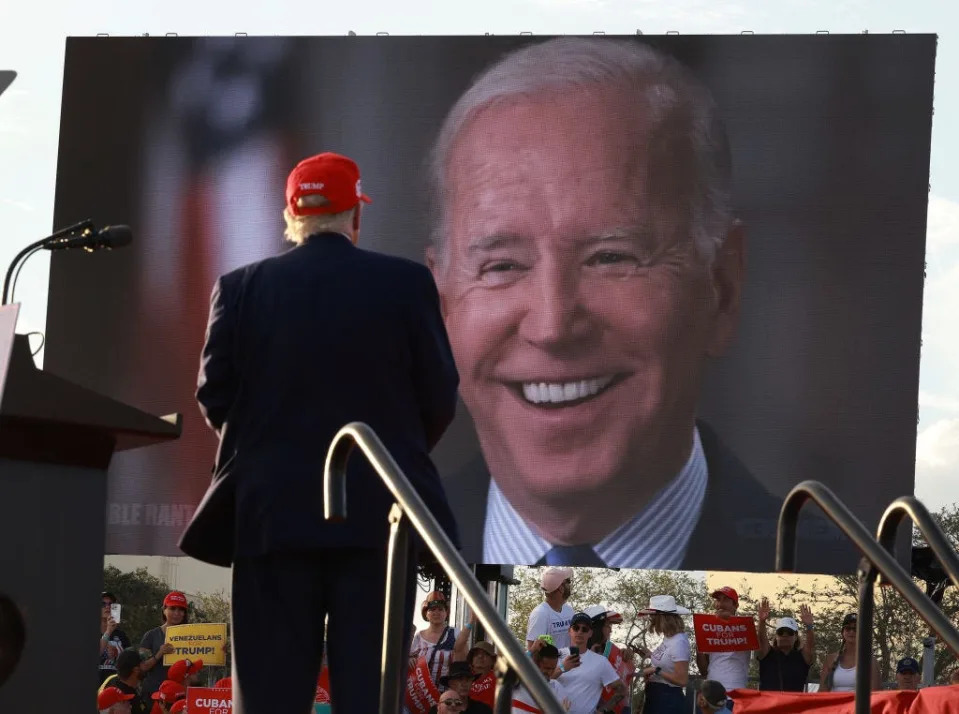
President Donald Trump watches a video of President Joe Biden playing during a rally for Sen. Marco Rubio at the Miami-Dade Country Fair and Exposition on November 6, 2022, in Miami, Florida.Joe Raedle/Getty Images
Trump’s opposition to the bill comes as he campaigns on fixing the border crisis. Last week, he called the deal “meaningless” and asserted that the “ONLY HOPE” for a secure border is voting for him.
Senator Mitt Romney slammed Trump’s response, saying, “I think the border is a very important issue for Donald Trump. And the fact that he would communicate to Republican senators and congresspeople that he doesn’t want us to solve the border problem because he wants to blame Biden for it is … really appalling.”
“But the reality is that, that we have a crisis at the border, the American people are suffering as a result of what’s happening at the border, he said, noting that someone running for president should want to solve the problem as opposed to saying, ‘Hey, save that problem. Don’t solve it. Let me take credit for solving it later.'”
Other Republicans, like Senator Todd Young, have suggested Trump is purposefully disrupting negotiations for his campaign. One Republican Senator told CNN on background: “This proposal would have had almost unanimous Republican support if it weren’t for Donald Trump.”
At a Las Vegas rally on Saturday, Trump doubled-down on his message. “As leader of our party, there is zero chance I will support this horrible open borders betrayal of America,” Trump said. “I’ll fight it all the way. A lot of the senators are trying to say, respectfully, they’re blaming it on me. I say, that’s OK. Please blame it on me. Please.”
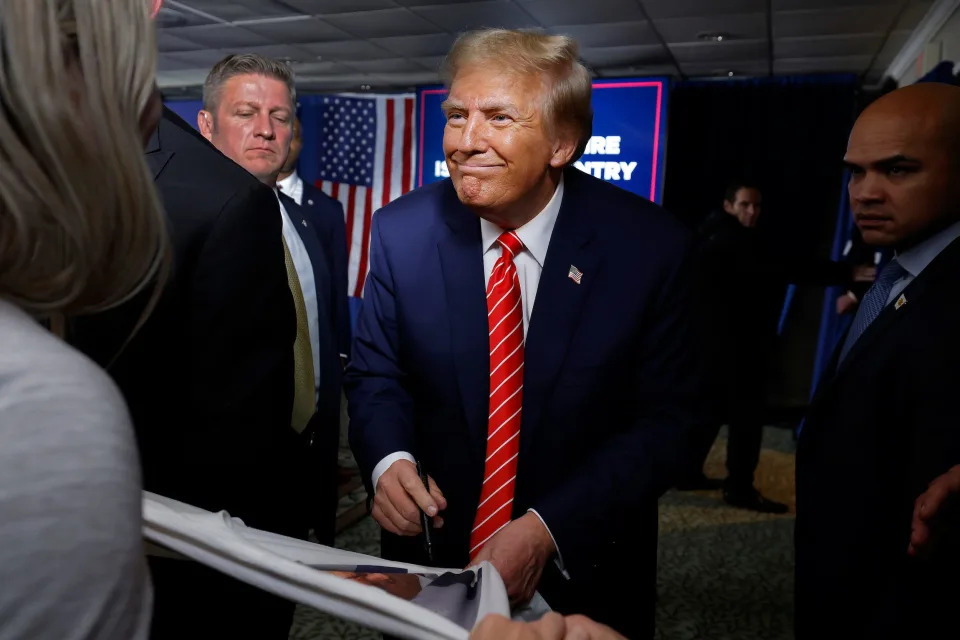
Former President Donald Trump grins as he signs an autograph after a rally in New Hampshire a day before winning the state’s primary.Chip Somodevilla/Getty Images
Despite the border deal being notably to the right of the Biden administration’s stances on immigration, the bipartisan bill could be a win for Biden ahead of the election. Immigration is a top concern for many voters going into November, a potentially jeopardizing problem for Democrats amid spikes in migrant encounters, and a marquee issue for Trump to campaign on.
Both Republicans and Democrats have said they’ve been painstakingly negotiating this deal, which is focused on foreign aid but includes compromises on the border, for weeks, and Biden has shown clear desire to sign it.
In October 2023, Biden originally requested a roughly $111 billion aid package for both Ukraine and Israel. Republicans in Congress blocked it, hoping to force Democrats to agree to stricter immigration and border control policies.
At first, it appeared to result in a stalemate between the two sides, but Biden publicly signaled in December that he was willing to “make significant compromises on the border.” This move ultimately prompted careful discussions on a deal that would meet GOP negotiators’ demands on immigration, while still giving Biden a win.
The deal would also have been a win for Ukraine, which relies on Western security assistance to fuel its war efforts.
But now, as House Speaker Mike Johnson wrote Friday, it appears the deal may be dead before it’s even finished. According to Johnson, “the Senate appears unable to reach any agreement. If rumors about the contents of the draft proposal are true, it would have been dead on arrival in the House anyway.”
But Johnson could also be buckling under the weight of political pressure from Trump’s allies in the House. Earlier this month, Representative Marjorie Taylor Greene said she wouldn’t support any deal and threatened Johnson with a motion to vacate him from the Speaker position if he brought the deal to the House floor. It’s unclear whether such a move would have enough support and what role House Democrats would play, but there’s a risk.
The looming question here is whether Republicans want to do anything to make progress on their issues with immigration and the US border with Mexico at all, or if they hope to continue to weaponize it against Biden and Democrats into the 2024 election. As Texas Governor Greg Abbott showed last week in defying the Supreme Court’s decision to remove the razor wire installed in the Rio Grande, tensions around the issue may only continue to get worse.
Ukrainian President Volodymyr Zelenskyy in Warsaw, Poland, on April 5, 2023.Artur Widak/NurPhoto via Getty Images
The biggest loser in all of this though is probably Ukraine, which has been pleading for more US aid for months.
Ukrainian President Volodymyr Zelenskyy met with US lawmakers back in December in Washington, DC to advocate for more aid, warning that Russian aggression would only increase should Ukraine fall, further endangering other nations, including NATO.
Further Russian aggression could demand more aid and assistance from the US, which would further strain America’s already depleted ammunition and weapons stockpiles.
Earlier this month, Zelenskyy said that some “radical voices from the Republican Party,” which have politicized aid for Ukraine, “are straining Ukrainian society” and leaving his people terrified. He appeared to be referring to a contingent of GOP lawmakers who have loudly denounced future US support for Ukraine. The US is by far the largest single contributor of security assistance to Ukraine.
The reality for Ukraine right now on the battlefield is a perilous one. Russian forces are conducting offensive operations along multiple sectors of the front, forcing Ukraine to fight on defense.
Ukraine likely doesn’t have the resources, particularly ammunition, to launch an offensive anytime soon, but with adequate support, it could hold off Russian forces and prepare for the possibility of new operational opportunities later. Without that support though, it is in for a tough defensive fight, which one expert has said it may not be able to survive.
Federal Judges Warn Of The Dire Threat To Democracy
David Kurtz – January 26, 2024
The Judicial System Is Failing Democracy
In retrospect, I came into the Trump era with way too much confidence that the legal system was up to the task. The last eight years have been humbling in that regard.
As a lawyer-turned-editor, I cautioned my reporting team not to be impatient with the pace and deliberation of legal processes. These things take time. Don’t be hot-headed about it. Chill out. Let things run their course.
The sometimes plodding pace of the system is by design, more a feature than a bug. There’s an entire vernacular around the downsides of too-swift justice: “rough justice,” “lynch mob,” “show trial,” “railroaded.” The list is long.
In the early days of the Trump presidency, efforts to obtain his tax returns or enforce the Emoluments Clause were slow, clumsy, and sometimes reluctantly undertaken by Democrats in Congress. I was inclined to excuse that slowness. But as the threat mounted and become more obvious and the reaction to it failed to rise to the challenge, my own sense of urgency began to change.
When the travesties of the Trump presidency accumulated and potential accountability shifted from the political to legal realms, especially after the Jan. 6 attack, I feared that the legal system was more inclined to sweep it all under the rug than confront it. A lot of our coverage was focused on framing the Jan. 6 attack as merely the culmination of a broad, months-long conspiracy to subvert the election. While the attack on the Capitol did historic damage and finally started to stir law enforcement into action, over-focusing on the physical attack would miss the myriad other ways the election had been subverted using the powers of the executive branch.
In the years since, it has become obvious that the slowness of the legal system isn’t merely the result of a careful, deliberative adherence to the rule of law and the procedural protections necessary to do proper justice. It is also a product of a wariness in confronting Trump and his legions of supporters, an unreasonable tendency to give him the benefit of the doubt, the judiciary’s own overweening sense that it is above politics, and a fundamental failure to appreciate that a strongman who attempted to seize power unlawfully once is a threat to the very existence of the legal system itself.
When the legal system itself is under threat, it must respond with extraordinary measures that continue to protect the procedural and substantive rights of the individual defendant but girds the system against attack, prioritizes institutional self-preservation, and is self-conscious of its role as a bulwark of democracy.
Some individual jurists, like U.S. District Judge Tanya Chutkan, who only got the Trump Jan. 6 case last August, have performed admirably. The legal system as a whole has not. The former chief judge in DC warned last fall that we are “at a crossroads teetering on the brink of authoritarianism.” During the sentencing yesterday of Trump White House official Peter Navarro, U.S. District Judge Amit Mehta called bullshit on it being a “political prosecution.” Also yesterday, in the sentencing of a Jan. 6 rioter, U.S. District Judge Royce Lamberth, a long-serving Reagan appointee, let it rip:
The Court is accustomed to defendants who refuse to accept that they did anything wrong. But in my thirty-seven years on the bench, I cannot recall a time when such meritless justifications of criminal activity have gone mainstream. I have been dismayed to see distortions and outright falsehoods seep into the public consciousness. I have been shocked to watch some public figures try to rewrite history, claiming rioters behaved “in an orderly fashion” like ordinary tourists, or martyrizing convicted January 6 defendants as “political prisoners” or even, incredibly, “hostages.” That is all preposterous. But the Court fears that such destructive, misguided rhetoric could presage further danger to our country.
Six months ago, it looked like the first weeks of the new year would be dominated not by the GOP primary but by pretrial preparations for a whopping four criminal trials of Trump. The race was finally on to hold Trump to account for his cheating in the last two elections before he cheated in a third one. As we sit here at the end of January, the landscape is not what we anticipated.
The Mar-a-Lago case is almost guaranteed to happen after the election. So is the Georgia RICO case. The Jan. 6 case is stuck on pretrial appeals, with the DC Circuit and Supreme Court failing to push things along. The lesser of the four cases – the hush money case in New York – may be the only one tried before the election. Meanwhile, there’s a chance Trump will be brought down by the Disqualification Clause but no one is confident the courts will enforce that against him either.
I’ve gone from annoyed about the repeated complaints about the slowness of the system to sharing those sentiments myself to having my hair on fire that the gravity of the moment calls for so much more than the legal system is prepared to offer. In a way this a mea culpa for urging my staff over the last few years to chill out. Things have not been this urgent since the 1860s. And we’re failing.
Editor’s Note
I dispensed with the usual rundown of the day’s news to focus on the alarming lack of responsiveness from the legal system to the current threat it faces. Normal programming will resume Monday.
[Sponsored] An Inside Story Of The Democratic Party At A Moment Of Great Peril
The Truce, from journalists Hunter Walker (of Talking Points Memo) and Luppe B. Luppen, explores the major fault lines that define Democratic politics today and asks big questions about the future of the party. An engrossing page-turner, The Truce grapples with the dangers that threaten American democracy and the complicated cast of characters who are trying to save it.
Russia has the advantage, and Ukraine needs to dig in if it’s going to fend off the enemy’s war machine, conflict experts say
Jake Epstein – January 26, 2024
Russian maintains several advantages over Ukraine, including manpower and material, experts say.
To keep Moscow’s forces at bay, Kyiv will need to dig in and strengthen its defenses, they said.
The assessment comes as Ukraine faces ammunition shortages and is being outgunned by Russia.
Nearly two years into its full-scale invasion of Ukraine, Russia again has the initiative, and its advantages over Ukraine are mounting.
Conflict experts are warning that Russia maintains a significant advantage over Ukraine in several key areas right now, and Kyiv will need to seriously dig in if it hopes to fend off Moscow’s war machine and have any shot at offensive operations next year.
Michael Kofman and Dara Massicot, experts with Carnegie Endowment for International Peace, and Rob Lee, an expert at the Foreign Policy Research Institute, wrote in commentary published on Friday by War on the Rocks that “while the current state of the war has been described as a stalemate, spurring an animated debate over what that means, Russia holds material, industrial, and manpower advantages in 2024, along with the initiative.”
But, “with tailored Western support, Ukraine could hold against Russian forces this year and rebuild the necessary advantage to conduct large-scale offensive operations in 2025, recreating another opportunity to deal Russia a battlefield defeat,” they said.
They cautioned that “without major adjustments, or if Western support falters, the current path holds a high risk of exhaustion over time and Ukraine being forced to negotiate with Moscow from a position of weakness.”
A Ukrainian soldier in a mask stands near an improvised multiple rocket launcher during firing on Russian positions on Jan. 15, 2024 in Donetsk Oblast, Ukraine.Photo by Roman Chop/Global Images Ukraine via Getty Images
It is a less-than-ideal situation for Kyiv’s forces right now. They’re struggling as the Russian war machine gains momentum.
Ukrainian forces fighting along the war’s sprawling front lines are presently dealing with insufficient ammunition and are being outgunned by Russian troops, a reversal from the situation over the summer, when Kyiv was using artillery to hammer Moscow’s positions.
Furthermore, fears are growing over the future of US security assistance to Ukraine as additional funding remains held up by Congress — despite repeated pleas of urgency from the Biden administration. Officials in Washington, Kyiv, and European partner nations have sounded the alarms that the consequences of aid drying up may be catastrophic.
With a dearth of Western-provided artillery ammunition and combat-effective units for effective offensive operations, Ukraine is focusing on force reconstitution and digging in to hold the line against Russia’s attacks, the experts wrote in their commentary.
A Ukrainian soldier fires towards the Russian position as the Ukrainian soldiers from the artillery unit wait for ammunition assistance at the front line.Ozge Elif Kizil/Anadolu via Getty Images
But to resist additional Russian offensives in the near future, and protect troops from Moscow’s intense artillery and bombing, Ukraine will need to strengthen its defenses and fortifications. It needs tunnels and underground bunkers, the experts said.
Fortifying defenses, they added, will allow Ukraine to better maintain the front line and enable Kyiv to rotate troops and preserve critical ammunition. This method has already proven effective at preventing enemy advances during the war.
One reason why Ukraine’s much-anticipated summer counteroffensive failed to produce significant results was that Russia had built a complex network of defensive fortifications throughout Russian-occupied territory in eastern and southern Ukraine. The toughest defenses, known as the Surovikin Line, consisted of anti-vehicle ditches and obstacles, mines, and sophisticated trench networks.
The failures of the Ukrainian counteroffensive set the stage for renewed Russian offensives in eastern Ukraine, which kicked off in October and focused heavily around the city of Avdiivka. While Moscow has suffered heavy losses during its ongoing assault — both in manpower and in armored vehicles — its forces continue to advance, making small territorial gains. Russia is pushing in various other sectors of the front as well. With fortified defenses though, Ukraine could seriously complicate these efforts.
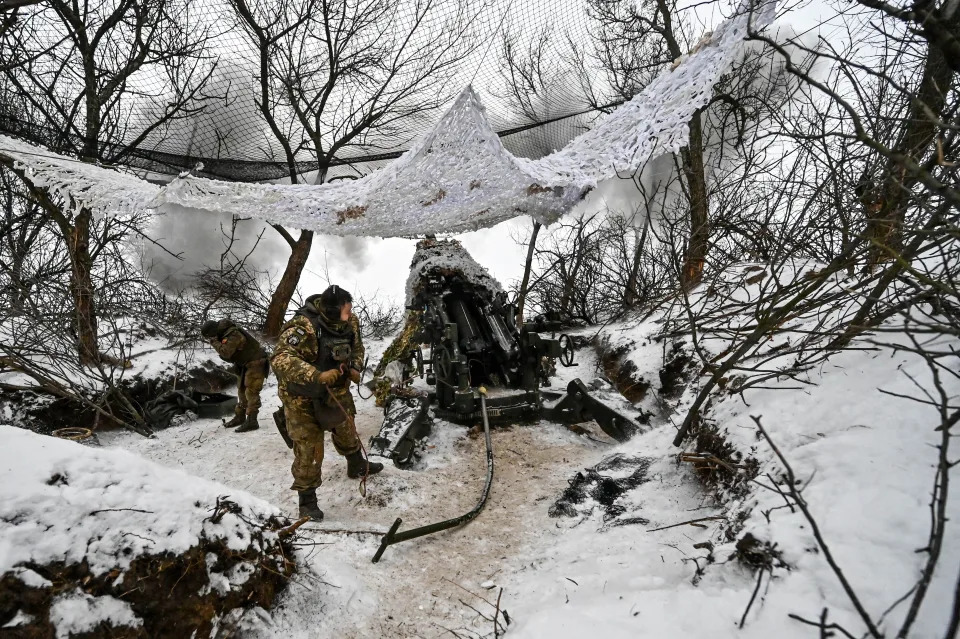
A serviceman of the 66th separate cannon artillery battalion of the 406th separate artillery brigade is pictured by the American M777 howitzer.Dmytro Smolienko / Ukrinform/Future Publishing via Getty Images
Western officials have been reluctant to characterize Russian efforts as effective. A top Pentagon official told reporters this week that while Moscow has tried to shatter the lines in eastern Ukraine, it has “not succeeded” in its efforts.
Still, the US continues to raise concerns that Russian President Vladimir Putin remains intent on capturing Ukraine and more security assistance is needed to keep Kyiv in the fight.
“The fact that Russia continues to demonstrate an intent to fight against Ukraine and to occupy Ukraine and to eliminate Ukraine as a country highlights the fact that this is a serious security threat that is not going to go away,” Pentagon Press Secretary Maj. Gen. Pat Ryder said at a briefing this week.
“The sooner that we’re able to continue to provide the levels of support that we have,” he said, “the better, not only for Ukraine, but for the international community.”
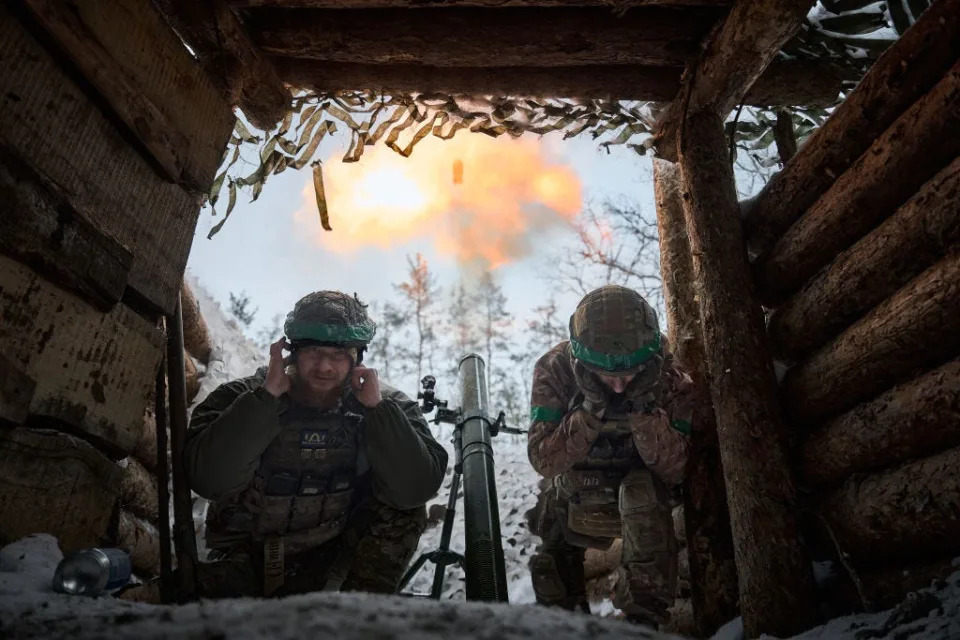
Mortar platoon soldiers with an 82mm mortar perform a combat mission as Ukrainian soldiers hold their positions in the snow-covered Serebryan Forest in temperatures of -15°C, on January 10, 2024 in Kreminna, Ukraine.Kostiantyn Liberov/Libkos/Getty Image
In their recent commentary for War on the Rocks, Kofman, Lee, and Massicot argued that “if this year is used wisely, core problems are addressed, and the right lessons are applied from the 2023 offensive, Ukraine can take another shot at inflicting a major defeat on Russian forces.”
The recommended strategy is one characterized as “hold, build, strike,” with defenses creating opportunities to rebuild the force and strikes degrading Russian capabilities. “Ideally,” the experts explained, “Ukraine can absorb Russian offensives while minimizing casualties and position itself to retake the advantage over time.”
Getting there, however, begins with building a strong, fortified defense-in-depth, but Ukraine also needs continued support to fight off the Russians. As the three experts wrote, “key decisions have to be made this year, the earlier the better, in order to put the war on a more positive trajectory.”
‘The enemy is amassing’: Ukrainian army officials give unvarnished account of the battlefield
Andrew Carey and Maria Kostenko – January 27, 2024
A series of comments by Ukrainian military officials and spokespeople on Saturday provided an unvarnished assessment of Ukraine’s current position on the battlefield, describing offensive Russian operations along much of the front line.
Fighting is intense in the northeast along a stretch of territory where the regions of Kharkiv and Luhansk meet.
Earlier this week, Ukraine announced it had withdrawn its forces from the village of Krokhmalne to take up more advantageous defensive positions on higher ground.
Reports suggest Russian forces continue to press in the area.
A readout from the Army General Staff on its Facebook page said Ukrainian forces had faced down 13 attacks on the settlements of Tabaiivka and Stelmakhivka, to the northwest and south, respectively, of Krokhmalne.
Commenting on fighting there, a spokesman for Land Forces Command told Ukrainian television, “The enemy is focusing on a large number of artillery attacks, trying to advance.”
These small settlements, about 100 kilometers (62 miles) east of Kharkiv, lie close to a major north-south waterway, the Oskil river, and were all liberated by Ukrainian forces in the late summer of 2022, after almost six months of Russian occupation.
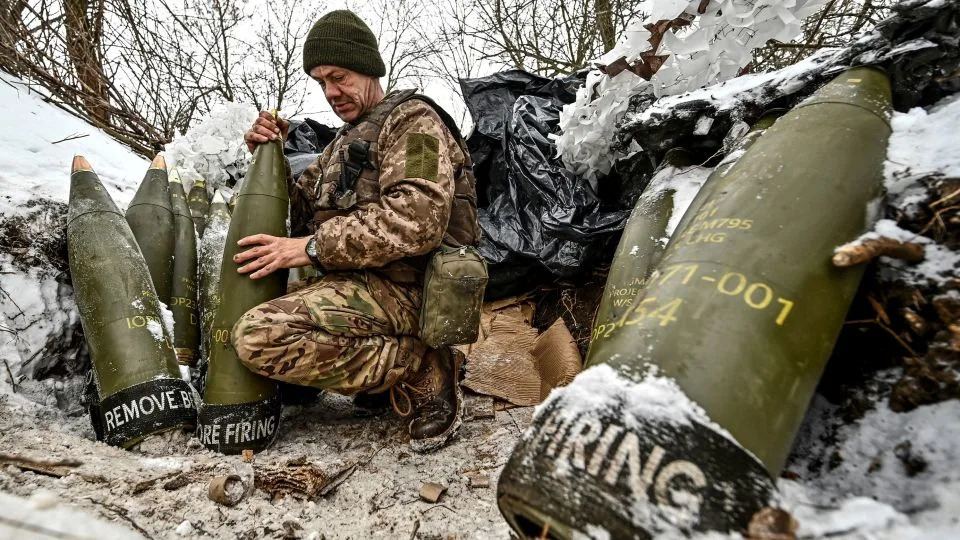
A Ukrainian serviceman prepares 155-mm artillery shells near the front line in Zaporizhzhia, amid Russia’s attack on Ukraine, on January 14, 2024. – Reuters
Further southeast, the area around Bakhmut, which was the overwhelming focus of Russia’s winter offensive exactly a year ago, Ukrainian forces also report coming under increased pressure.
Describing the posture of Russia’s forces to the southwest of the city, around the largely destroyed villages of Klishchiivka and Andriivka, Sergeant Oles Maliarevych of the 92nd Separate Brigade told Ukrainian television: “The enemy is amassing forces … they assault every day.”
He highlighted the huge threat now posed by drones, the impact of which on the battlefield has grown significantly over the past year. The Russians, he said, have significantly more drones than Ukraine, including drones equipped with night vision.
Klishchiivka and Andriivka represent the easternmost edges of Ukraine’s modest territorial gains around Bakhmut, the land reclaimed in September as part of Ukraine’s counteroffensive in the second half of last year.
The sense that Moscow’s troops are looking to win back the small pockets of territory recaptured by Kyiv since June was also brought out by an army spokesman with responsibility for operations to the south, in the Zaporizhzhia region.
Attempts by Ukraine over the summer to push south from the town of Orikhiv towards Tokmak, seen as a key first step in an eventual move to break Russia’s land corridor to Crimea, only made it as far as Robotyne, a little over 20 kilometers (12.4 miles) south.
Now, the spokesman suggested, it was Russia more on the front foot.
“All in all, the invaders are very active, they have increased the number of offensive and assault operations. For the second day in a row, they have been conducting 50 combat engagements daily. The enemy is active in all directions,” Oleksandr Shtupun said.
“In Zaporizhzhia region, the enemy is trying to recapture lost ground.”
Donald Trump’s utmost assault on American democracy and the rule of law has been his ability to exploit these foundational institutions to weaken each as he constantly makes a mockery of both. It’s part and parcel of his efforts to sustain personal power. The ultimate goal is to enable oligarchic domination and facilitate financial looting by the uber-wealthy.
My aim in this commentary is to move beyond Trump’s procedural harms or distractions and to connect his very real substantive crimes, fraudulent behaviors, and policies of deception to the GOP’s larger and unending appropriation of accumulated capital from the US commonwealth.
Contrary to Trump’s repetitive narrative about how the Justice Department (DOJ), state prosecutors, and the courts are engaging in some kind of persecution or witch-hunt and/or weaponization of the rule of law against the former president as part of a “deep state” conspiracy to interfere with his winning back the presidency in 2024, these civil and criminal agencies of adjudication have been bending over backward to privilege or accommodate Trump’s perpetual lawlessness inside and outside various courthouses across America.
For example, the latest episodes of indulging the “man-child” occurred during closing arguments of Trump’s $370M civil fraud trial as well as his second sex abuse defamation civil trial in two Manhattan courtrooms located in close proximity.
In the latter case, which ended Friday with a jury judgment that Trump must pay E. Jean Carroll over $83 million in damages, Judge Lewis Kaplan had this testy exchange with Trump. “I understand you’re probably very eager for me” to remove “you from the trial.” To which Trump sitting between his two lawyers at the defense table shouted back, “I would love it.” Of course, Trump would.
Trump had already been warned that he could be expelled for continuing to disrupt the trial. Nevertheless, the judicially found rapist of Carroll could be heard remarking loud enough to his lawyers for the jurors to hear, “it is a witch hunt” and “it really is a con job.” Never mind that Trump in a previous lawsuit by a jury of his peers had already been found civilly liable for sexual assault as well as defamation of character to the tune of $5 million. It’s little wonder he stormed out of the courtroom on Friday.
In the former case, Judge Arthur Engoron bent the rules and allowed Trump “to go on a courtroom rant lasting several minutes,” which had nothing whatsoever to do with either the law or the facts of the case. Instead, Trump made another political speech claiming that the New York civil trial is a ‘fraud on me’ and that he was “an innocent man” who claimed among other things that the New York Attorney General Letitia James “hates” him and “doesn’t want me to get elected.” Trump also stated to the presiding judge, “I know this is boring you. I know you have your own agenda” here as well.
Procedurally, either Trump as the defendant or one of his attorneys, but not both, was entitled to make the closing argument. However, Judge Engoron made an exception allowing Trump and his attorney Chris Kise to speak during closing arguments. Before doing so, the judge re-iterated what he had previously spelled out one week earlier about what Trump could or could not comment about as part of his closing arguments. Predictably, Trump totally disregarded Judge Engoron’s instructions the same as he had Judge Kaplan’s.
On Friday, former federal judge Barbara Jones, appointed by Engoron to monitor the Trump Organization’s finances, told the judge that Trump had failed to provide “information required to be submitted to me pursuant to the terms of the monitorship order and review protocol.”
Engoron coddled the former president and permitted his procedural misconduct because the judge knew that after his final decision — dismantling Trump’s New York base business empire – to be rendered later this month, Trump and his attorneys would be appealing and filing an avalanche of motions mostly to delay rather than rectify justice. By allowing Trump to speak, Engoron figured there would be one less bogus motion to be made about how the former president had been denied his right to speak on his own behalf.
Again, I do not want to get caught up in these procedural abuses by Trump and his attorneys because their claims are primarily smokescreens designed to deflect attention away from the substantive lawlessness or fraudulent behavior involved in his adversarial conflicts with the administration of justice.
In the case of the fraudulent business trial brought by the New York Attorney General, Trump’s phony legal defense pertaining to his illegal acquisition of money or to his financial looting from both the Internal Revenue System and the US monetary system is that these lending transactions allegedly caused no injuries to the parties involved.
To paraphrase Trump: nobody was injured here or there were no harms to speak of. Of course, that is pure fiction or nonsense as the summary judgment has already been declared and as the final verdict will be revalidated in the next couple of days when Trump and company find themselves liable for at least $300 million.
Trump’s fraudulent business dealings involved in this civil case, like using other people’s money vis-à-vis deceitfully acquired lower interest rates along with tax evasion, are consistent with the former president’s modus operandi and sheds light on some of the other ways in which the 45th president’s appointments of free marketers and deregulators facilitated financial looting on a much grander scale. The GOP’s $1.9 trillion tax break for the wealthy, signed by Trump, is perhaps the most infamous example
As I have argued in Indicting the 45th President, “the Racketeer-in-Chief as POTUS had established from the top down an administrative apparatus marked by placing self-interest, profiteering, and corruption above the public welfare.” In similar fashion, Trump’s “networks for raising and flowing cash loads of electronic money also helped to contribute to the ‘deadly insurrection that was rooted in the same self-serving ethos’.”
By the end of 2023, the ex-president had already spent more than $57 million of other people’s money on his legal fees, which will very likely continue to grow for the foreseeable future. While raising money to steal the election was unlawful, raising money to defend those people from trying to steal an election is perfectly lawful.
As we have learned in some detail from the New York civil fraud trial, Trump has spent most of his dishonest life in search of money. His business history has been filled with overseas financial deals and missed deals. Some of these have involved the Chinese state where Trump “spent a decade unsuccessfully pursuing projects in China, operating an office there during his first run for president and forging a partnership with a major government-controlled company.”
China along with Britain and Ireland are three nations that we know about where Trump maintains bank accounts. These foreign accounts do not show up on Trump’s public financial disclosures where he must list his personal assets because these accounts are not in his name. In the case of China, the bank account is controlled by Trump International Hotels Management, LLC, whose tax records reveal that TIHM paid $188,561 in pursuing licensing deals there from 2013 to 2015 that did not pan out. During those same pre-MAGA years Trump had been paying the IRS less than $1,000 annually.
Until 2019, China’s biggest state-controlled bank rented three floors in Trump Tower stateside, a very lucrative lease that had generated accusations of conflicts of interest for the former president. Citizens for Responsibility and Ethics in Washington (CREW) in its January 15, 2021, report on corruption identified more than 3,700 conflicts of interest while Trump was president because of his decision while in office not to divest from his business interests.
As far as offshore banking laws and accounts go, the release of Trump’s taxes from 2015 to 2020 revealed that for at least 2016 he had an offshore bank account in the Caribbean nation of St. Martin, a popular place to avoid paying taxes. Nevertheless, recall when he was asked during the 2016 campaign whether U.S. citizens should be allowed to save or invest in offshore bank accounts, Trump responded: “No, too many wealthy citizens are abusing loopholes in offshore banking laws to evade taxes.”
At the time, key planks in Trump’s tax reform plan would have allegedly ended the practices of U.S. multinationals stockpiling offshore hundreds of billions of dollars and millions of jobs. For the record, the sheltered tax dollars did not come home nor did outsourced jobs ever come back to America. Those were merely “talking points” that were never going to materialize during a Trump administration.
When it came to stocking the laissez-faire policy swamps, Trump’s political appointments included more than its share of high rolling donors with no expertise in anything let alone with an appropriate area of specialty. As for those appointments where expertise was required, those were located primarily in the areas of business, finance, and the law.
The economic orientation or philosophy of these appointments reinforced generally a “hands off” approach to regulation and taxation. These free marketers were not about recouping billions let alone trillions of dollars from the tax avoiding and tax evading superrich or mega corporations. Quite the contrary, these appointments involved persons who had specialized in tax avoidance. For example, four of Trump’s key economic appointments had been beneficiaries of shell companies and offshore banking accounts including Gary Cohn, Rex Tillerson, Steven Mnuchin, and Randal Quarles.
Chief economic adviser Gary Cohn was the driver behind the White House tax reform act. Leaked documents reveal that between 2002 and 2006 Cohn was either president or vice-president of 22 separate offshore entities in Bermuda for Goldman Sachs. That was before Cohn eventually became the president and COO of Goldman Sachs, one of the foremost banking, securities, and investment management firms in the world.
As for secretary of state Rex Tillerson, leaked documents reveal that before he ascended to chairman and CEO of ExxonMobil in 2006 and while still presiding as president of ExxonMobil Yemen division, Tillerson was also a director of Marib Upstream Services Company that was incorporated in Bermuda in 1997.
Randal Quarles, Trump’s most senior banking “watchdog” was also outed in connection with offshore banks and tax evasion as he appeared prominently in the infamous Paradise Papers.
As we all know the only shining accomplishment of President Trump during his four years in office was a $1.9 trillion tax gift or cut enjoyed primarily by super-wealthy individuals, mega-corporations, and multinational businesses – to the ongoing detriment of the general population — who already had enjoyed the lowest tax rates in the corporate world.
These economic projections are consistent with the negative or not “trickling down” benefits and failures to increase production after the same types of Reagan and Bush II administrations’ tax cuts or benefits for the corporate wealthy had also occurred.
What is consistent is that these same types of neoliberal taxing policies or practices of financial looting from other commonwealths around the global economy have yielded the same dismal outcomes in Argentina, Brazil, Russia, and every other nation where they have been employed.
Head-to-head: Trump accounted for the largest deficit growth in the 21st century of $6.7 trillion in four years while Biden accounted for only $2.5 trillion in his first three years in office.
In stark contrast, however, the deficits accumulated during the Obama and Biden administrations have benefitted the American people in numerous ways, for example, from health care coverage to infrastructure development. Meanwhile, the deficits accumulated by Bush II and Trump had only benefited the wealthy.
While men ran for cover, women rose and stared down Donald Trump | Opinion
Gene Nichol – January 27, 2024
I’m much taken with a particular photograph of Nancy Pelosi. It’s from October 2019. In it, Pelosi stands across the White House Cabinet Room pointing an accusing finger at a seated Donald Trump. The president and the speaker are only a few feet apart. Still, Pelosi is resolute, undaunted. Punctuating a heated foreign policy disagreement, she was reportedly saying that, with Trump, “all roads lead to Putin.” Frosty and fearless.
But that’s not what I find most remarkable about the photo. Pelosi and Trump were not alone in the room. They were surrounded by executive officials and congressional leaders. None, except Pelosi, seemed comfortable with the turn of events. The AP reported:
“Eyeballs – most belonging to men – are averted. Heads are bowed around the table, including those of Joint Chief of Staff Chairman, Mark Milley and House Republican Whip Steve Scalise. House GOP Leader Kevin McCarthy’s eyes are closed. Senate Republican Leader Mitch McConnell is leaning back, a few chairs down from Trump.”
As the males looked for cover, Pelosi rose, and led.
It reminded me of video clips I’d seen from the Oval Office. President Trump would meet in the lavish room with Speaker Pelosi and Senate Majority Leader Chuck Schumer to hammer out their multifaceted differences. Schumer might be energetic and forceful at the press conference afterwards, beyond the confines of the famous building. But when sitting across from Trump, Schumer seemed afraid to look him in the eyes. Only Pelosi fixed her gaze on the bully. Brave, resolute, mission-driven. Never, even for a moment, contemplating fear. Courage occupied only one seat in those meetings. And it wasn’t companion to the males.
The picture I describe points to a growing reality – the outsized role of women in modeling courage, teaching fearlessness, in the new American battle for democracy. We’ve all seen this, thought of it, been marked and altered by it.
Liz Cheney stood not only against Trump, but almost every shamed and humiliated enabler of her caucus and political party. She put her leadership position and her congressional seat on the line in favor of her sacred oath and love of country. She did it all knowingly, without a conceivable doubt about what was to come. I can’t forget the words:
“Tonight I say this to my Republican colleagues who are defending the indefensible. There will come a day when Donald Trump is gone, but your dishonor will remain.”
Nathan Hale had nothing on Liz Cheney.
Ruby Freeman and Shaye Moss, election workers from Fulton County, Georgia, refused to surrender to the intimidation, slanders, and threats of Rudy Giuliani in one of modern America’s starkest contests between good and unrelenting evil. Their prior lives and attachments to beloved community had been sundered by darkness. Trump boasted on a fateful call to Brad Raffensperger that “Freeman’s reputation is done – she is known all over the internet for fraud.” But unlike the fabulist of Mar-a-Lago, Freeman and Moss’ character abides. It gleams. And teaches.
Cassidy Hutchinson, with astonishing stoicism, quietly insisted on the truth, under unspeakable pressure, as Mark Meadows hid, dissembled and conceded his powerlessness before the master — as if gutlessness is all one can expect from human beings.
And E. Jean Carroll, an 80-year-old sexual assault survivor, reclaimed her life, amid continuing taunts by Trump, even at the cost of having to face down her vile assailant. It’s not right to force “a woman to be quiet,” she explained. Even if supposed toughs depend on it.
If we see more women leaders, we’ll see more courage.
Contributing columnist Gene Nichol is a professor of law at the University of North Carolina-Chapel Hill.