Putin’s Allies Accused of Plotting Another Russian Land-Grab
Shannon Vavra – February 26, 2024
Reuters/ Sergei Savostyanov/ Sputnik
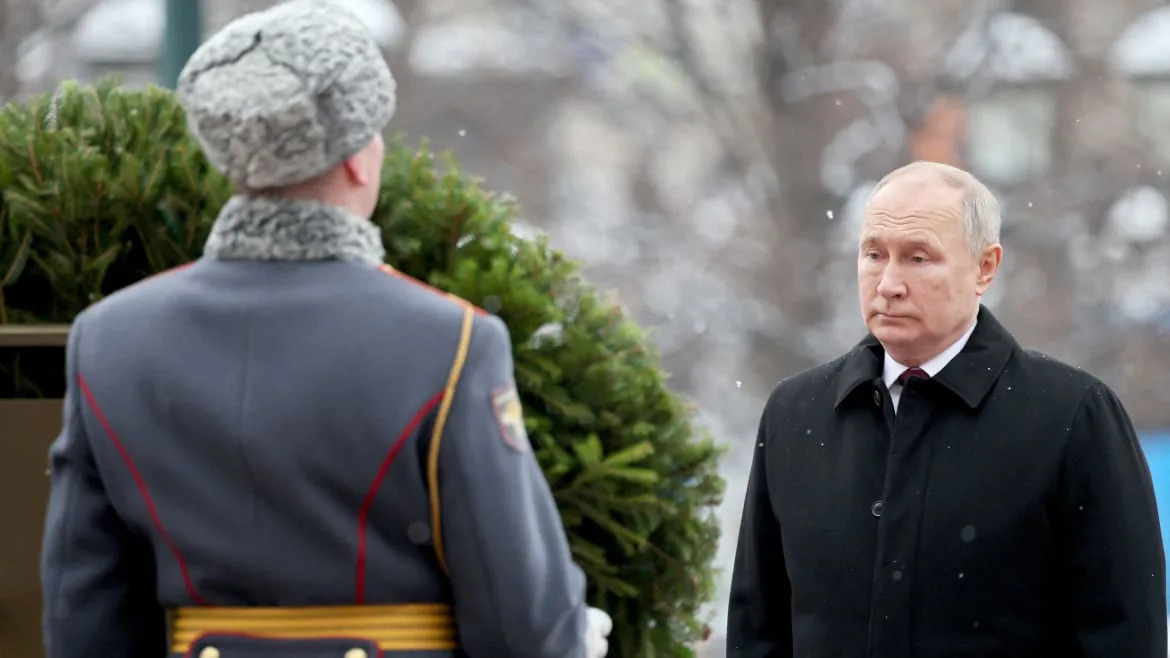
An opposition official in Transnistria, the Kremlin-backed breakaway region in Moldova, has warned that the pro-separatist government will be holding an extraordinary session of congress to formally request Russian annexation this week.
“A request should be voiced, on behalf of citizens living on the Left Bank, to Russia, to accept Transnistria into the Russian Federation, and on February 29, Putin will announce this in his address,” Chorba said in a post on social media.
Moldova has long been warning of a Russian destabilization plot that has threatened to upend its existing pro-western government and influence elections. Last year, U.S. and Moldovan officials told The Daily Beast that a “very intense” Russian influence operation intended to undermine the government was underway.
Moldovan president Maia Sandu, who is running for reelection this fall, has also warned of a Russian plot to stage a coup against her administration.
Concerns about Russia and Transnistria potentially unifying coincide with a concerted effort by the Moldovan government to join the European Union. Last year, the European Council announced it was opening negotiations for Moldovan accession.
Moldova declared independence from the Soviet Union in 1991, but officials believe that Russia has desires to envelope it back into its fold.
Just last week, the European Union imposed sanctions on a paramilitary group and six individuals for allegedly destabilizing Moldova.
“Serious and increasingly intense attempts to destabilize the country are being made again and again,” Josep Borrell, the European Union’s High Representative for Foreign and Security Policy, said in a statement announcing the sanctions this week.
Chorba warned Sandu that Putin and his allies are unlikely to be deterred.
“Mrs. President Sandu, your surroundings frightened you in any way that Russia would strike the territory of Moldova,” he said. “You didn’t take into account one thing that the psychology of the current Russian leadership, particularly Putin, is very similar to the psychology of Hitler, in the late 1930s. Attempts to pacify people like Putin lead to only one thing—a growing appetite of the aggressor.”
Officials in neighboring Ukraine have voiced doubt about whether Transnistria will follow through with an annexation request.
Ukrainian President Volodymyr Zelensky said Sunday he is not convinced they will move forward. “I am not sure that the Transnistrians—or whoever is present at the congress—will take this step next week. I am not sure based on the information I have,” he said, adding that Ukraine has not received any requests from Moldova to supply military aid.
At any rate, Ukraine has made its position on Transnistria clear. Senior Ukrainian diplomat Paun Rohovei met with Moldovan officials to discuss the threat last week, after which the Ukrainian Foreign Ministry issued a statement vowing to “resolutely” respond to such provocation.
“Ukraine stands solely for the peaceful settlement of the Transnistrian issue with the preservation of the sovereignty and territorial integrity of the Republic of Moldova within its internationally recognized borders,” the Ukrainian Foreign Ministry said. “At the same time, Kyiv will resolutely respond to any provocations aimed both at dragging the Transnistrian region into Russia’s war against Ukraine and at destabilizing the situation in Moldova as a whole.”
31,000 Ukrainian troops killed since the start of Russia’s full-scale invasion, Zelenskyy says
Associated Press – February 25, 2024
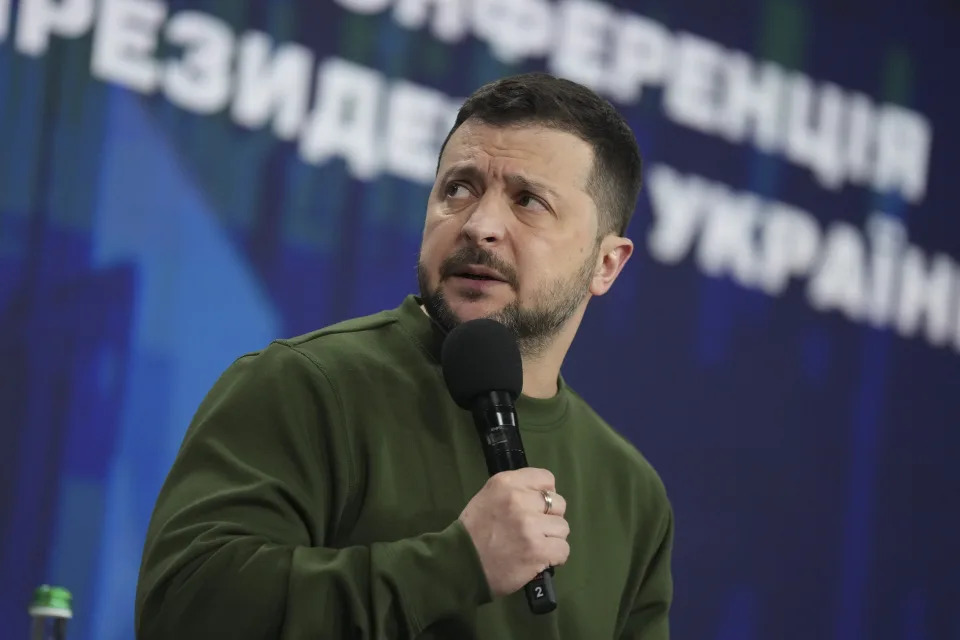
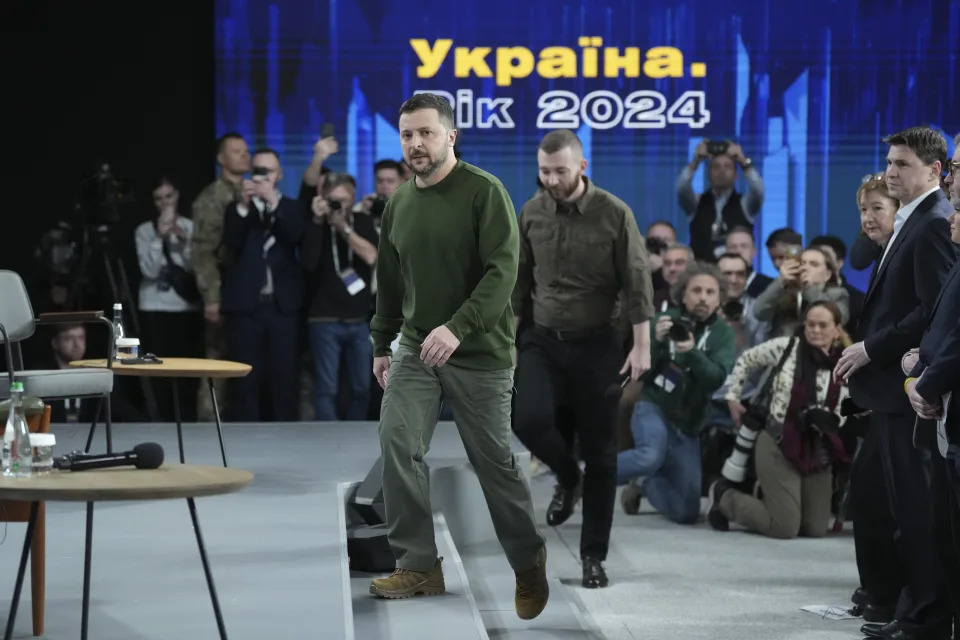
Ukrainian President Volodymyr Zelenskyy answers media questions during his press conference in Kyiv, Ukraine, Sunday Feb. 25, 2024. (AP Photo/Evgeniy Maloletka)Ukrainian President Volodymyr Zelenskyy arrives before a press conference in Kyiv, Ukraine, Sunday Feb. 25, 2024. (AP Photo/Evgeniy Maloletka)
KYIV, Ukraine (AP) — Ukrainian President Volodymyr Zelenskyy said Sunday that 31,000 Ukrainian soldiers have been killed in action in the two years since Russia launched its full-scale invasion.
Zelenskyy said that the number was far lower than estimates given by Russian President Vladimir Putin’s government.
“31,000 Ukrainian military personnel have been killed in this war. Not 300,000, not 150,000, not whatever Putin and his deceitful circle have been lying about. But nevertheless, each of these losses is a great sacrifice for us”, Zelenskyy said at the “Ukraine. Year 2024” forum in Kyiv.
The Ukrainian leader said that he wouldn’t disclose the number of troops that were wounded or missing. He also said that “tens of thousands of civilians” had been killed in occupied areas of Ukraine, but said that no exact figures would be available until the war was over.
“We don’t know how many of our civilians they killed. We don’t,” he said.
It’s the first time that Kyiv has confirmed the number of its losses since the start of Russia’s full-scale war on Feb. 24, 2022.
Russia has provided few official casualty figures. The most recent data from the Defense Ministry, published in January 2023, pointed to just over 6,000 deaths, although reports from U.S. and U.K. officials put that number significantly higher.
A U.S. intelligence report declassified in mid-December 2023 estimated that 315,000 Russian troops had been killed or wounded in Ukraine. If accurate, the figure would represent 87% of the roughly 360,000 troops Russia had before the war, according to the report.
Independent Russian news outlet Mediazona said Saturday that about 75,000 Russian men died in 2022 and 2023 fighting in the war.
A joint investigation published by Mediazona and Meduza, another independent Russian news site, indicates that the rate of Russia’s losses in Ukraine is not slowing and that Moscow is losing about 120 men a day.
Perspective: Two years into the war, language has become a symbol of Ukrainian strength
Mariya Manzhos – February 24, 2024
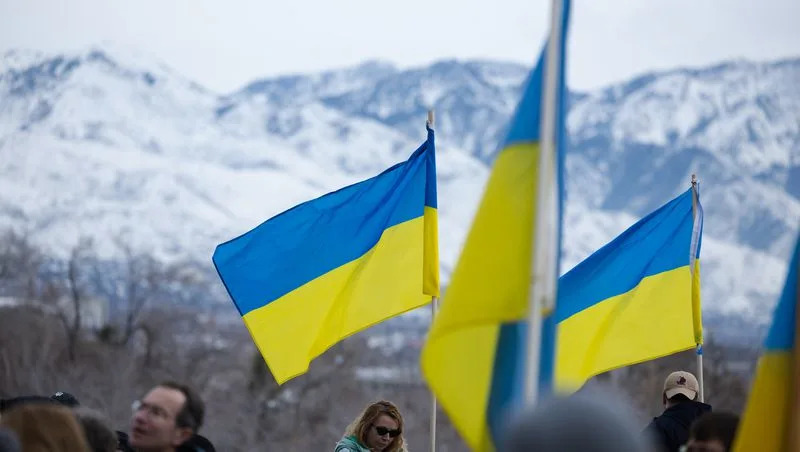
Ukrainian flags were on display during a rally commemorating the one-year anniversary of the Ukraine-Russia war, at the Capitol in Salt Lake City on Saturday, Feb. 25, 2023. | Ryan Sun, Deseret News
Two years ago, I was in Southern California when I got the news that Russia had launched a full-scale invasion of Ukraine. It was my daughter’s 5th birthday and on the docket were a visit to the zoo, cake with cousins and a long-awaited trip to Disneyland the next day. While physically I was with my children, my mind was at home in Kyiv, Ukraine — with my parents.
There, the panic had begun within hours of Vladimir Putin’s announcement of a “special military operation.” People were scrambling to find transportation to evacuate, highways westward jammed with traffic. Horror stories spread quickly and nobody knew what would happen next. I wrote about evacuating my family from Ukraine for Deseret in March of 2022.
The past two years became a process of learning how to live with grief and uncertainty, and how to inhabit two realities at once: one of my life stateside — safe, quiet, predictable — and one in which missiles and shrapnel are destroying homes every day, killing soldiers and children, while the end of the war in my homeland seems to grow increasingly distant.
More than 10,000 Ukrainian civilians have died in the war, according to the Office of the United Nations High Commissioner for Human Rights, and about 70,000 soldiers have been killed, according to U.S. officials. Since February of 2022, more than 6 million people have left the country and nearly 3.67 million are internally displaced. And it’s estimated that 83,000 Russian soldiers died in the war, according to new data from two independent Russian media outlets.
Today, two years since the invasion and 10 years since the annexation of Crimea in 2014, the war has stalled due to the shortage of artillery ammunition, with Ukraine recently losing Avdiivka last week, an industrial city in the Donetsk region.
And while the path forward as the war drags on is uncertain, Ukrainians themselves have never been more sure of who they are.
Despite the recent disappointments on the battlefield, the unity and sense of national identity that were forged at the expense of tragedy and lives have not waned. A recent study from the Ministry of Culture asked 3,200 Ukrainians from several regions to rank their Ukrainian consciousness — how Ukrainian they felt — regardless of where they were born (most identified as Ukrainian citizens). The study found in two years of the war people self-identify more strongly as Ukrainians, and cited deepened interest in the country’s history and culture. The common cultural heritage fueled the emotional resolve to resist the occupants, the study said.
I, too, have grown closer to my Ukrainian culture and language since the invasion by reading poetry, learning new vocabulary and discovering Ukrainian music. In the face of the looming threat of losing my native culture, clinging to it feels urgent and necessary.
This week, as the world marked the second anniversary of the invasion, Ukrainians on Feb. 21 celebrated International Mother Language Day, a UNESCO holiday that found particular resonance with Ukrainians this year. In honor of the occasion, I had a chance to speak about my efforts to return to my native Ukrainian language with students at Odesa National University in a virtual event — which had to be rescheduled due to a prolonged air raid.
Growing up in the 1990s in Kyiv, I spoke Russian at home with my family, even though Ukrainian was the dominant language at my school and in more formal settings. Making an intentional effort to speak Ukrainian has felt like tapping into the part of my Ukrainian identity that’s often been overshadowed by my American one, since I have lived in the U.S. for over 20 years. As I listened to the Ukrainian language and literature professors from Odesa National University, I was struck by their earnest commitment to the language that, unlike me, they use and teach every day. For them too, Ukrainian was no longer just a language of communication, but a way of fighting this war.
One professor spoke about the disagreements in 1917 over whether Russian or Ukrainian should be the language of Orthodox church services and how language separatism led to a religious one. Literature expert Tetyana Shevchenko spoke about drawing strength in times of despair from the poetry of Taras Shevchenko (no relation), a national bard of Ukraine who spent half of his life in serfdom under the Russian empire. She read a few lines from his poem about casting out an adversary from the Ukrainian land.
“I trust his words, and I know this is exactly how it’s going to be,” she said. “Sometimes, when I feel lost, I start reading Shevchenko; his words help me believe in the freedom that I know will come.”
Philologist Larysa Shevchuk invited the students to raise their future children speaking Ukrainian. “We’re in the existential battle for the survival of our nation and our language,” she said. The idea that language is the symbol of Ukrainian defiance and the means all Ukrainians can employ to fight the war resonated with me.
The celebration of my daughter’s birthday — she turned 7 this year— and the day of the full-scale invasion will always remain mutual reminders of one another, and polar opposites in the feelings they stir up. My daughter’s brightness helps me sustain hope that a peaceful future will come to Ukraine. But I also know the costs we will pay to get there.
In Navalny’s last letters, the Russian dissident called Trump’s agenda for a second term ‘really scary’
Kelsey Vlamis – February 20, 2024
Alexey Navalny, Vladimir Putin’s most prominent critic, commented on US politics months before his death.
Navalny expressed concern in letters to a friend over a potential second term for Donald Trump.
Trump briefly mentioned Navalny’s death in a Truth Social post on Monday.
Alexey Navalny, a dissident and the political nemesis of Russian President Vladimir Putin, spent the past few years of his life behind bars but still managed to stay connected to the outside world.
Letters from the final months of his life, obtained by The New York Times, show that Navalny, who’d been imprisoned since January 2021, managed to stay on top of current events — including in the US.
In a letter sent to a friend, a photographer named Evgeny Feldman, Navalny said former President Donald Trump’s agenda for a second term was “really scary,” according to the Times.
He said if President Joe Biden were to have a health issue, “Trump will become president,” adding: “Doesn’t this obvious thing concern the Democrats?”
In another letter to Feldman dated December 3, Navalny again expressed concern over Trump and asked his friend, “Please name one current politician you admire.”
Trump’s office didn’t immediately respond to a request for comment from Business Insider.
On December 6, Navalny disappeared from the IK-6 penal colony about 120 miles east of Moscow. He turned up again on Christmas Day when his lawyers announced they had located him at the IK-3 penal colony, about 1,000 miles northeast of Moscow, above the Arctic Circle.
The Times reported that Navalny’s communication ability from his new prison was greatly diminished.
The journalist Sergei Parkhomenko said he received a letter from Navalny on February 13, a few days before Navalny’s death was announced. In the letter, which Parkhomenko shared on Facebook, Navalny spoke of books and said he only had access to classics at his new prison.
“Who could’ve told me that Chekhov is the most depressing Russian writer?” he wrote.
Trump, for his part, didn’t mention Navalny in the days after his death, despite condemnations from other leaders who directly blamed Putin.
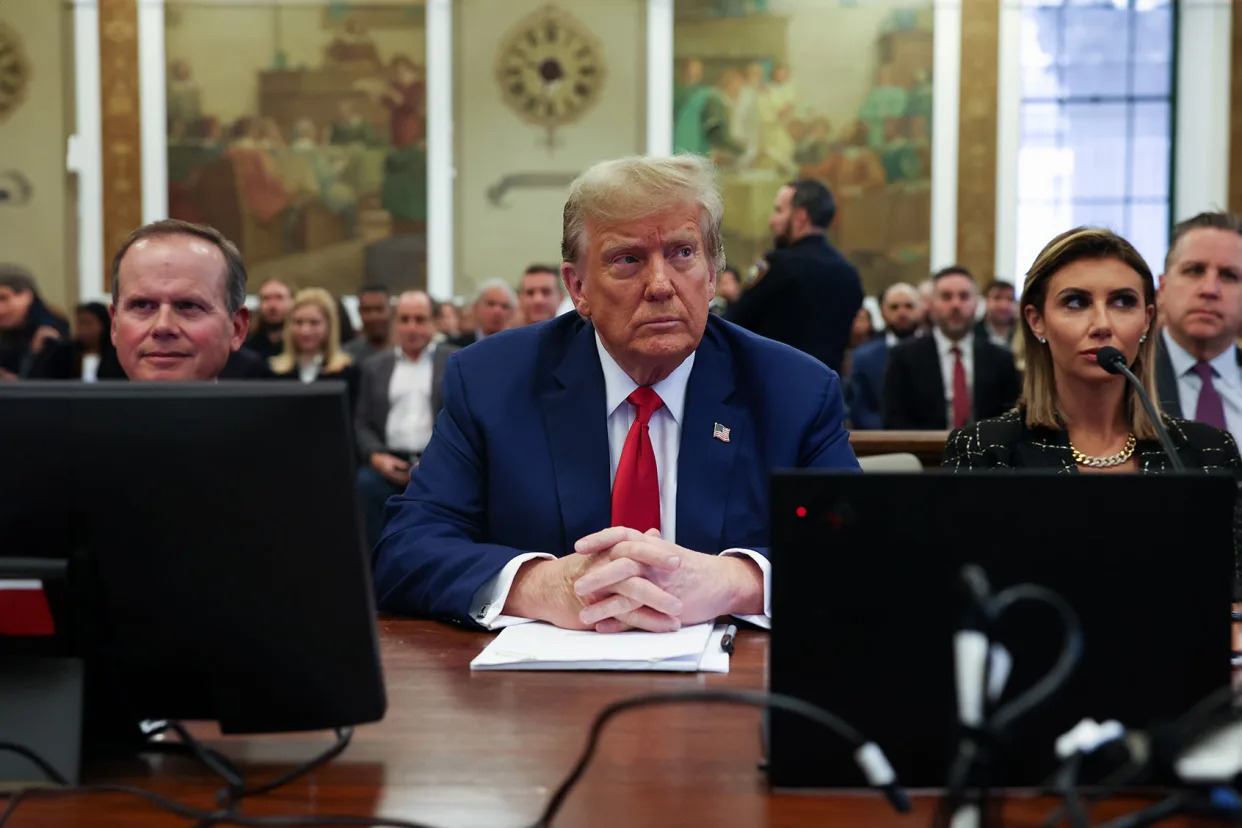
In a Truth Social post on Monday, Trump briefly mentioned Navalny before directing his ire at his own perceived political opponents: “The sudden death of Alexei Navalny has made me more and more aware of what is happening in our Country. It is a slow, steady progression, with CROOKED, Radical Left Politicians, Prosecutors, and Judges leading us down a path to destruction.”
Opinion: Smirnov indictment pushes GOP impeachment probe of Biden off the edge
Opinion by Dennis Aftergut – February 19, 2024
Editor’s Note: Dennis Aftergut, a former federal prosecutor, is currently counsel to Lawyers Defending American Democracy, a nonpartisan organization dedicated to preserving the rule of law. The views expressed here are his own. Read more opinion at CNN.
On Thursday, the Justice Department indicted Alexander Smirnov, a former FBI informant, for lying about President Joe Biden and his son Hunter Biden’s involvement in negotiations with the Ukrainian energy company Burisma Holdings. Smirnov is a central witness in the House Republicans’ Biden impeachment inquiry, which was already circling the drain as committee leaders have persisted in pursuing baseless allegations for political gain.
According to the indictment, Smirnov lied to the FBI by claiming that officials at Burisma, where Hunter Biden served on the board years ago, bribed then-Vice President Biden and his son so the vice president would interfere with a criminal investigation into the company. Smirnov now faces charges for making false statements to the FBI and creating false records.
Smirnov’s testimony has been the “heart” of House Oversight Committee Republicans’ stumbling “investigation” into impeaching President Biden. News of Smirnov’s indictment had Oversight Committee Chair James Comer of Kentucky beating a strategic retreat: “The impeachment inquiry,” he said on Thursday, “is not reliant on the FBI’s [interview of Smirnov]. It is based on a large record of evidence.”
That’s to be expected from politicians trying to salvage an investigation whose key witness has been exposed. With Smirnov’s indictment for fabricating claims, the air is out of the House inquiry’s tires. For those in the fact-based world, the oversight committee’s impeachment car, driven by Comer, is stuck on the edge of a cliff with two wheels hanging in thin air.
The Smirnov episode is Exhibit A in what happens when politicians grinding partisan axes make serious public charges without evidence against elected officials. That shameless behavior erodes citizens’ precious trust in government.
Prosecutors learn early that, in white-collar crimes, you’d better have indisputable documents or witnesses whose testimony is thoroughly corroborated before seeking an indictment. Otherwise, you can get seriously burned in the backfire.
As Hannah Arendt, the dean of 20th century political theorists, wrote in 1971 about years of government lies revealed in the Pentagon Papers amidst the Vietnam War, “There always comes the point beyond which lying becomes counterproductive.”
Politicians like Comer and GOP Ohio Rep. Jim Jordan, chairman of the House Judiciary Committee, could learn something from Arendt and from capable prosecutors about tossing aside facts and truth. Unfortunately, the MAGA committee chairs seem to have neither time nor interest in thought, care, competence or real evidence. All that seems to matter to them is repeating the charges enough times for them to sink into the public consciousness.
In 2016, there was no there there with House Republicans’ Benghazi investigation, but the smear looked like it had an adverse effect on former Secretary of State Hillary Clinton’s presidential campaign. So Republicans have apparently decided, “Let’s do it again.”
But don’t expect it to work this time. The very smart Democrats now on the House Oversight Committee learned from experience and are onto Comer’s political stunts. His claims have been called out by New York Rep. Dan Goldman, a former prosecutor who worked on the first impeachment of former President Donald Trump, and ranking member Rep. Jamie Raskin of Maryland, a constitutional scholar who served on the House Select Committee to Investigate the January 6th Attack on the United States Capitol.
As Yale professor Timothy Snyder, the eminent historian of 20th century totalitarianism, has written, “Students of democracy have argued since ancient times … that the truth matters, and that truth needs defenses.” We are lucky to have capable defenders of truth whose counter-punches have been stronger than Comer’s feckless jabs. They don’t carry the power of reliable facts.
With Smirnov, Comer has led with his jaw. When you are dealing with a shaky witness whose testimony is the key to your fight plan, you need to muscle up with corroboration. Comer has none.
Indeed, Comer and Jordan have overhyped Smirnov’s testimony so many times, according to the progressive watchdog Congressional Integrity Project, that it’s hard to keep count. To cite just one example, last June, Comer told Fox News’ Sean Hannity, “This is one of the highest paid, most respected, most trusted, most effective human informants. So what we learned is what the whistleblowers told Sen. Grassley all along. The FBI never investigated this.”
That last claim is yet another falsehood. This whole investigation into Burisma goes back five years. In early 2020, Rudy Giuliani, Trump’s disgraced lawyer who was trying to dig up dirt on Hunter’s father, handed documents over to Trump administration Attorney General Bill Barr. According to CNN reporting, Barr told reporters at the time, “‘We can’t take anything we receive from Ukraine at face value.’ Former Pittsburgh US Attorney Scott Brady oversaw the FBI investigation of the Giuliani claims. The 1023 document [memorializing Smirnov’s interview] demanded by Comer is among the products of that investigation. … The FBI and prosecutors who reviewed the information couldn’t corroborate the claims.”
There’s the rub. And Comer’s face plant by relying on Smirnov’s alleged lies is just the latest in a long string of leaning on witnesses who have provided no evidence of wrongdoing by President Biden. They include the president’s bookkeeper, Hunter Biden’s business associates, his art dealer and a host of others who’ve said that President Biden is a loving father but was not involved in his son’s business deals. Comer seems to have gone to the ends of the Earth to find dirt on the president. But the congressman has ended up with an empty dustbin.
Impeachment is the most serious non-criminal charge that Congress can bring against a federal official. It is no place to be inflating allegations and to be relying on witnesses whose testimony is not corroborated. Doing so drains public confidence in impeachment as a guardrail on executive abuses of power. Wild charges without basis in reliable evidence insult fact and truth, the foundations of democracy.
New York University professor Ruth Ben-Ghiat put it this way in her seminal book “Strong Men”: “The decay of truth and democratic dissolution proceed hand in hand.” Snyder makes the same point: “Once factual truth is no defense in politics, all that remains is spectacle and force.”
From Comer and Jordan, we’ve seen plenty of spectacle but an absence of light. These point men for Trump and truthlessness are dangers to democracy.
Indicted ex-FBI informant told investigators he got Hunter Biden dirt from Russian intelligence officials
Hannah Rabinowitz and Cheri Mossburg – February 20, 2024
The former FBI informant charged with lying about the Bidens’ dealings in Ukraine told investigators after his arrest that Russian intelligence officials were involved in passing information to him about Hunter Biden, prosecutors said Tuesday in a new court filing, noting that the information was false.
Prosecutors also said Alexander Smirnov has been “actively peddling new lies that could impact US elections” after meeting with Russian spies late last year and that the fallout from his previous false bribery accusations about the Bidens “continue[s] to be felt to this day.”
Smirnov claims to have “extensive and extremely recent” contacts with foreign intelligence officials, prosecutors said in the filing. They said he previously told the FBI that he has longstanding and extensive contacts with Russian spies, including individuals he said were high-level intelligence officers or command Russian assassins abroad.
Prosecutors with special counsel David Weiss’ team said Tuesday that Smirnov has maintained those ties and noted that, in a post-arrest interview last week, “Smirnov admitted that officials associated with Russian intelligence were involved in passing a story about Businessperson 1,” referring to President Joe Biden’s son, Hunter Biden.
The revelations about Smirnov’s alleged foreign contacts were disclosed as part of prosecutors’ arguments to keep him jailed ahead of trial – though a federal judge later granted Smirnov’s release with several conditions, including GPS monitoring and the surrender of his two passports. Smirnov declined to answer questions as he left the courthouse Tuesday evening.
Prosecutors alleged that Smirnov “claims to have contacts with multiple foreign intelligence agencies,” including in Russia, and that he could use those contacts to flee the United States.
The explosive revelation comes amid backlash over how Smirnov’s now-debunked allegations played into House Republicans’ impeachment inquiry into the president.
Smirnov has been charged with lying to the FBI and creating false records. He has not yet entered a formal plea, and his lawyers told CNN in a statement, “Mr. Smirnov is presumed innocent.”
According to the new court filing, Smirnov told investigators he was in contact with “four different Russian officials,” all of whom are “top officials” and two of whom “are the heads of the entities they represent.” Prosecutors did not independently verify in the filing whether Smirnov’s reported contacts are legitimate, nor whether the Russians provided him with disinformation about the Bidens.
The false information that Smirnov reported “was not trivial,” prosecutors wrote.
“It targeted the presumptive nominee of one of the two major political parties in the United States. The effects of Smirnov’s false statements and fabricated information continue to be felt to this day,” prosecutors said, making an apparent reference to the turmoil in Congress over the discredited bribery allegations – which were a key element of the GOP impeachment probe.
Of particular note is a story Smirnov allegedly told the FBI in September 2023, alleging that Hunter Biden was recorded making phone calls in a Kyiv hotel that is “wired” and “under the control of the Russians.” Federal agents said they knew Smirnov’s story was false because Hunter Biden has “never travelled to Ukraine.”
Smirnov told investigators Russian intelligence officers would use the hotel to intercept cell phone calls made by “prominent US persons,” prosecutors said, which the Russian government could use as “‘kompromat’ in the 2024 election, depending on who the candidates will be.” Kompromat is a Russian term that refers to compromising information used for blackmail.
The story, prosecutors noted, matches the story Smirnov told his handler about Hunter Biden being recorded in a foreign hotel.
“Thus, Smirnov’s efforts to spread misinformation about a candidate of one of the two major parties in the United States continues,” prosecutors wrote.
And, prosecutors wrote, Smirnov claims to have met with Russian intelligence officials as recently as November and December 2023.
“What this shows is that the misinformation he is spreading is not confined to 2020,” they wrote. “He is actively peddling new lies that could impact U.S. elections after meeting with Russian intelligence officials in November. In light of that fact there is a serious risk he will flee in order to avoid accountability for his actions.”
Weiss’ team argued in court Tuesday that Smirnov could use his foreign contacts, including those in Russia, to flee the country and resettle abroad out of reach from the US government. The judge pushed back on the prosecutors’ assertion, and sternly warned Smirnov while granting his release: “Do not make a mockery of me.”
This story has been updated with additional details.
CNN’s Holmes Lybrand and Cheri Mossburg contributed to this report.
Legal expert warns delay by Judge Cannon could badly backfire on Trump
Tatyana Tandanpolie – February 20, 2024
Donald Trump Shannon Stapleton-Pool/Getty Images
The delays in Donald Trump’s Florida classified documents case will come to a head Thursday, the date U.S. District Court Judge Aileen Cannon has set as a deadline for the former president and the case’s other defendants to file responses in a discovery dispute with the Justice Department, predicts former U.S. Attorney Joyce Vance.
Writing in her “Civil Discourse” Substack, Vance explained that special counsel Jack Smith’s hopes of bringing the case charging Trump with willfully retaining national security documents post-presidency to trial are dwindling as the pre-trial period drags. Whether he will then appeal to the 11th Circuit Court, she said, hinges in part on what unfolds this week.
“Judge Aileen Cannon continues to string out the timeline, permitting this issue to unnecessarily consume weeks of briefing time,” Vance writes, arguing that Cannon must soon decide on issues involving unclassified and classified evidence, while Smith must soon also determine whether to appeal her rulings if they remain “unfavorable.” The case going to trial before the presidential election “would take a moon shot,” Vance added. “Trump is likely to go into the Republican convention and the election without being held accountable for dangerous mishandling of classified materials—something that should be unthinkable and would have been for Republicans in the pre-Trump era,” Vance writes.
But Trump’s efforts to delay the criminal proceedings may backfire, former federal prosecutor Glenn Kirschner argued, pointing to an expected March 1 hearing to address remaining deadlines in the case.
“We know that Donald Trump and his team of lawyers will try to convince Judge Cannon to try to kick the May 20th trial date,” Kirschner told MSNBC Monday, according to Raw Story. “And you may not expect to hear this from me, but I almost hope that she does kick the May 20th trial date. Why? Because if the Supreme Court denies the stay in the absolute immunity issue and returns the case to [Judge] Tanya Chutkan in D.C. in the election interference case — would love to see her take that case and drop it on the docket for May 20th.”
The Ukraine aid that House Republican leaders are blocking might actually be good for the US economy
John L. Dorman – February 18, 2024
House GOP leaders are standing in the way of a Senate-backed $95 billion aid bill.
The bill would provide about $60 billion to Ukraine as it defends itself against Russia.
The legislation would also bolster the US economy, The Wall Street Journal reported.
House Speaker Mike Johnson is blocking a $95 billion emergency foreign aid bill, saying he’s in “no rush” to take up the legislation the Senate overwhelmingly approved last week.
The bill — opposed by many conservatives due to its exclusion of desired security measures at the US-Mexico border — would provide about $60 billion in badly needed aid for Ukraine as it defends itself against Russia’s nearly two-year-long invasion.
The legislation would also give $14.1 billion in military funding to Israel, $9.2 billion for humanitarian efforts in Gaza, and $8 billion for Taiwan and Indo-Pacific allies to deter Chinese aggression.
While supporters of the legislation say it’s needed urgently to help Ukraine, The Wall Street Journal also points out that the bill would benefit the US economy.
Over the past two years, the US defense industry has seen a surge in demand for weapons and munitions, with European countries looking to boost their military operations and the Pentagon purchasing new equipment, according to the Journal.
Officials in President Joe Biden’s administration said that 64% of the roughly $60 billion appropriated for Ukraine in the Senate-passed bill would reach the US defense industrial base, the Journal reported.
Lael Brainard, the director of the White House National Economic Council, told the Journal in a recent interview that the impact on the US economy would be significant.
“That’s one of the things that is misunderstood … how important that funding is for employment and production around the country,” she told the newspaper.
The Journal reported that the $95 billion in aid, in addition to money from previous packages, can “inject funds worth about 0.5% of one year’s gross domestic product into the US industrial defense base” in upcoming years.
It remains unclear when or if the House will take up the Senate bill. Former President Donald Trump also opposes it and is the likely GOP presidential nominee. Trump in recent weeks also helped tank a bipartisan bill that would have tightened the US asylum system, among other measures.
Stalled US aid for Ukraine underscores GOP’s shift away from confronting Russia
Nicholas Riccardiu – February 19, 2024
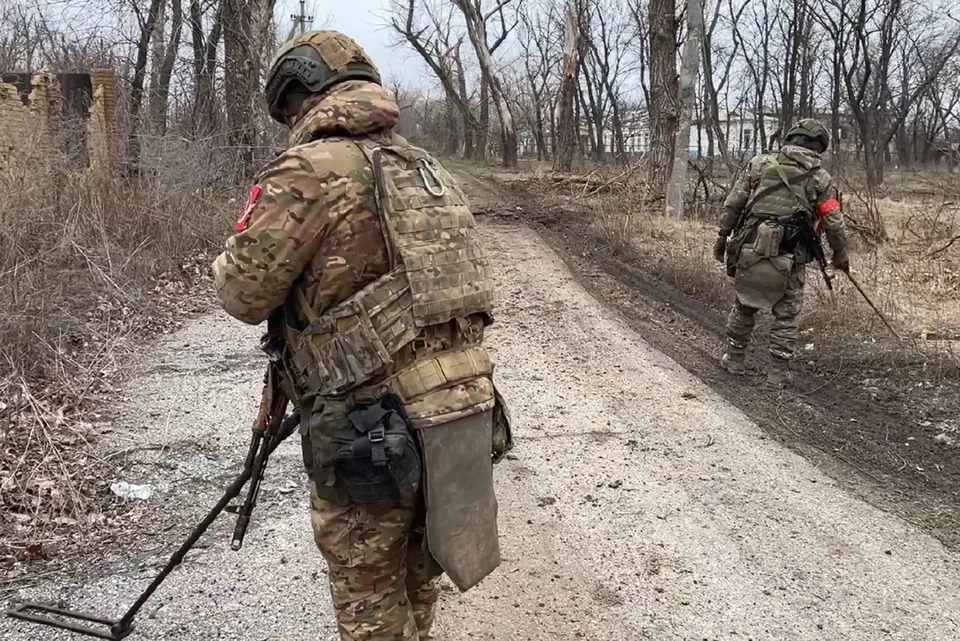
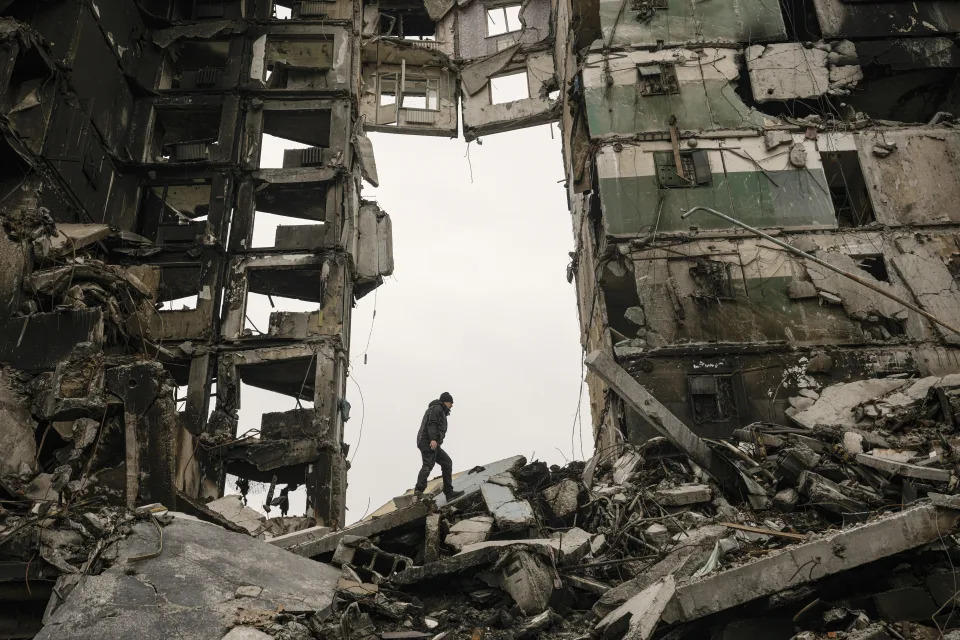
Smoke rises from a building in Bakhmut, site of the heaviest battles with the Russian troops in the Donetsk region, Ukraine, April 26, 2023. The GOP has been softening its stance on Russia ever since Donald Trump won the 2016 presidential election following Russian hacking of his Democratic opponents. The reasons include Russian President Vladimir Putin holding himself out as an international champion of conservative Christian values, the GOP’s growing skepticism of international entanglements and Trump’s own personal embrace of the Russian leader. Now the GOP’s ambivalence on Russia has stalled additional aid to Ukraine. (AP Photo/Libkos, File)Dead bodies are placed into a mass grave on the outskirts of Mariupol, Ukraine, March 9, 2022, as people cannot bury their dead because of the heavy shelling by Russian forces. The GOP has been softening its stance on Russia ever since Donald Trump won the 2016 presidential election following Russian hacking of his Democratic opponents. The reasons include Russian President Vladimir Putin holding himself out as an international champion of conservative Christian values, the GOP’s growing skepticism of international entanglements and Trump’s own personal embrace of the Russian leader. Now the GOP’s ambivalence on Russia has stalled additional aid to Ukraine. (AP Photo/Evgeniy Maloletka, File)Speaker of the House Mike Johnson, R-La., meets with reporters at the Capitol in Washington, Feb. 14, 2024. The GOP has been softening its stance on Russia ever since Donald Trump won the 2016 presidential election following Russian hacking of his Democratic opponents. The reasons include Russian President Vladimir Putin holding himself out as an international champion of conservative Christian values, the GOP’s growing skepticism of international entanglements and Trump’s own personal embrace of the Russian leader. Now the GOP’s ambivalence on Russia has stalled additional aid to Ukraine. (AP Photo/J. Scott Applewhite, File)In this photo released by Russian Defense Ministry Press Service on Monday, Feb. 19, 2024, Two soldiers of the Russian military engineering units eliminate the mine danger in the city of Avdiivka, eastern Ukraine. Russian forces have taken complete control of the Ukrainian city of Avdiivka. (Russian Defense Ministry Press Service via AP)A resident looks for belongings in an apartment building destroyed during fighting between Ukrainian and Russian forces in Borodyanka, Ukraine, April 5, 2022. The GOP has been softening its stance on Russia ever since Donald Trump won the 2016 presidential election following Russian hacking of his Democratic opponents. The reasons include Russian President Vladimir Putin holding himself out as an international champion of conservative Christian values, the GOP’s growing skepticism of international entanglements and Trump’s own personal embrace of the Russian leader. Now the GOP’s ambivalence on Russia has stalled additional aid to Ukraine. (AP Photo/Vadim Ghirda, File)
At about 2 a.m. last Tuesday, Republican Sen. Ron Johnson of Wisconsin stood on the Senate floor and explained why he opposed sending more aid to help Ukraine fend off the invasion launched in 2022 by Russian President Vladimir Putin.
“I don’t like this reality,” Johnson said. “Vladimir Putin is an evil war criminal.” But he quickly added: “Vladimir Putin will not lose this war.”
That argument — that the Russian president cannot be stopped so there’s no point in using American taxpayer dollars against him — marks a new stage in the Republican Party’s growing acceptance of Russian expansionism in the age of Donald Trump.
The Senate last week passed a foreign aid package that included $61 billion for Ukraine on a 70-29 vote, but Johnson was one of a majority of the Republicans to vote against the bill after their late-night stand to block it. In the Republican-controlled House, Speaker Mike Johnson said his chamber will not be “rushed” to pass the measure, even as Ukraine’s military warns of dire shortages of ammunition and artillery.
Many Republicans are openly frustrated that their colleagues don’t see the benefits of helping Ukraine. Putin and his allies have banked on democracies wearying of aiding Kyiv, and Putin’s GOP critics warn that NATO countries in eastern Europe could become targets of an emboldened Russia that believes the U.S. won’t counter it.
“Putin is losing,” Republican Sen. Thom Tillis of North Carolina said on the floor before Johnson’s speech. “This is not a stalemate.” Senate Minority Leader Mitch McConnell of Kentucky was one of 22 Republican senators to back the package, while 26 opposed it.
The divide within the party was on stark display Friday with the prison death of Russian opposition figure and anti-corruption advocate Alexei Navalny, which President Joe Biden and other world leaders blamed on Putin. Trump notably stood aside from that chorus Monday in his first public comment on the matter that referred to Navalny by name.
Offering no sympathy or attempt to affix blame, Trump posted on Truth Social that the “sudden death of Alexei Navalny has made me more and more aware of what is happening in our Country. It is a slow, steady progression, with CROOKED, Radical Left Politicians, Prosecutors, and Judges leading us down a path to destruction.”
Nikki Haley, his Republican presidential primary rival, said Monday that Trump is “siding with a thug” in his embrace of Putin.
Tillis responded to Navalny’s death by saying in a post, “History will not be kind to those in America who make apologies for Putin and praise Russian autocracy.”
Johnson, the House speaker, issued a statement calling Putin a “vicious dictator” and pledging that he “will be met with united opposition,” but he did not offer any way forward for passing the aid to Ukraine.
Within the Republican Party, skeptics of confronting Russia seem to be gaining ground.
“Nearly every Republican Senator under the age of 55 voted NO on this America Last bill,” Missouri Sen. Eric Schmitt, elected in 2022, posted on the social media site X after the vote last week. “15 out of 17 elected since 2018 voted NO. Things are changing just not fast enough.”
“If you oppose a blank check to another country, I guess that makes you a Russian,” Alabama Sen. Tommy Tuberville said on the Senate floor, after posting that conservative commentator Tucker Carlson’s recent controversial interview of Putin shows that “Russia wants peace” in contrast to “DC warmongers.”
Rep. Matt Gaetz, a leading opponent of Ukraine aid in the House, described the movement as “a generational shift in my party away from neoconservatism toward foreign policy realism.”
In interviews with voters waiting to see Trump speak Saturday night in Waterford Township, Michigan, none praised Putin. But none wanted to spend more money confronting him, trusting Trump to handle the Russian leader.
Even before Trump, Republican voters were signaling discontent with overseas conflicts, said Douglas Kriner, a political scientist at Cornell University. That’s one reason Trump’s 2016 promise to avoid “stupid wars” resonated.
“Some of it may be a bottom-up change in a key part of the Republican base,” Kriner said, “and part of it reflects Trump’s hold on that base and his ability to sway its opinions and policy preferences in dramatic ways.”
Trump has long praised Putin, calling his invasion of Ukraine “smart” and “savvy,” and recalling this month that he had told NATO members who didn’t spend enough on defense that he would “encourage” Russia to “do whatever the hell they want” to them. He reiterated that threat days later.
Despite the reluctance within the GOP to continue supporting Ukraine, Russia remains deeply unpopular in the U.S. A July 2023 Gallup poll found that just 5% had a favorable view of Putin, including 7% of Republicans.
But Putin has positioned his country as a symbol of Christian conservatism and resistance to LGBTQ rights, while portraying himself as an embodiment of masculine strength. The combination has appealed to populist conservatives across the Western world. Putin’s appeal in some sectors of the right is demonstrated by Carlson’s recent tour of Russia, after which the conservative host posted videos admiring the Moscow subway and a supermarket that he says “would radicalize you against our leaders.”
“The goal of the Soviet Union was to be the beacon of left ideas,” said Olga Kamenchuk, a professor at Northwestern University. “Russia is now the beacon of conservative ideas.”
Kamenchuk said this is most visible not in Putin’s U.S. poll numbers, but in fading Republican support for Ukraine. About half of Republicans said the U.S. is providing “too much” support to Ukraine when it comes to Russia’s invasion, according to a Pew Research poll in December. That’s up from 9% in a Pew poll taken in March 2022, just weeks after Russia invaded.
When Putin attacked Ukraine, there was bipartisan condemnation. Even a year ago, most Republicans in Congress pledged support. But around the same time, Trump was lamenting that U.S. leaders were “suckers” for sending aid.
By the fall, the party was divided. Republicans refused to include another round of Ukraine funding in the government spending bill, insisting that Democrats needed to include a border security measure to earn their support.
After Trump condemned the compromise border proposal, Republicans sank the bill, leaving Ukraine backers no option but to push the assistance as part of a foreign aid package with additional money for Israel and Taiwan.
Several experts on Russia note that the rhetoric the GOP uses against Ukraine aid can mirror Putin’s own — that Ukraine is corrupt and will waste the money, that the U.S. can’t afford to look beyond its borders and that Russia’s victory is inevitable.
“He’s trying to create the perception that he’s never going to be beaten, so don’t even try,” Henry Hale, a George Washington University political scientist, said of Putin.
Skeptics of Ukraine aid argue the war has already decimated the Russian military and that Putin won’t be able to target other European countries.
“Russia has shown in the last two years that they do not have the ability to march through Western Europe,” said Russell Vought, Trump’s former director of the Office of Management and Budget who is now president of the Center for Renewing America, which opposes additional Ukraine funding.
But several experts noted that Putin has alluded to plans to retake much of the former Soviet Union’s territory, which could include NATO countries such as Lithuania and Estonia that the U.S is obligated under its treaty to defend militarily.
Sergey Radchenko, a professor at Johns Hopkins’ School of Advanced International Studies, noted that Russia for decades has hoped the U.S would lose interest in protecting Europe: “This was Stalin’s dream, that the U.S. would just retreat to the Western hemisphere.”
Associated Press writers Joey Cappelletti in Waterford Township, Michigan, and Mary Clare Jalonick and Lisa Mascaro in Washington contributed to this report.
Denmark to send its ‘entire artillery’ to Ukraine, the country’s prime minister says
Nathan Rennolds – February 18, 2024
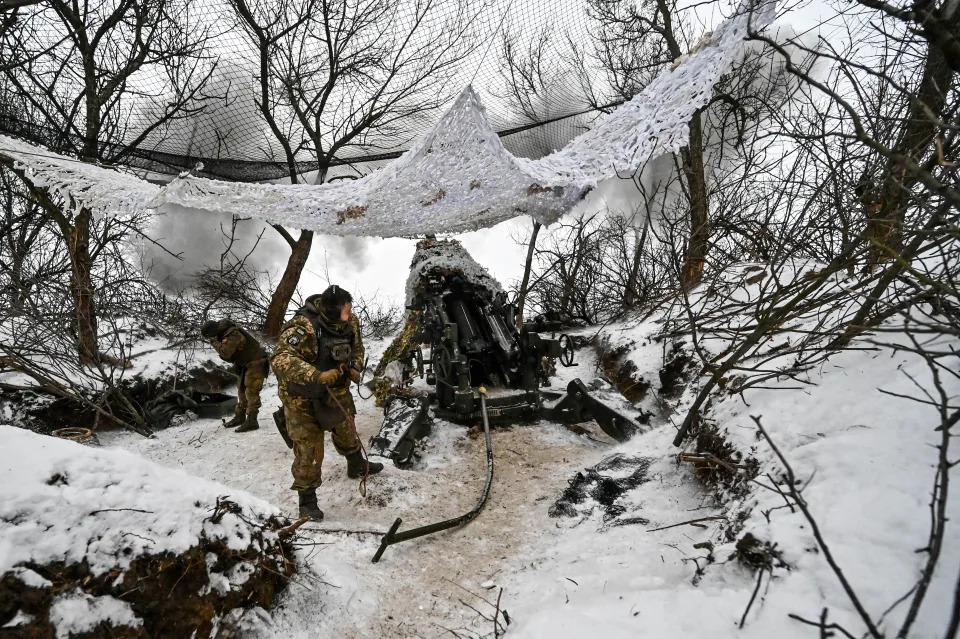
Denmark to send its ‘entire artillery’ to Ukraine, the country’s prime minister says. A Ukrainian soldier preparing 155mm artillery shells in Donetsk Oblast, Ukraine on August 6, 2023.Diego Herrera Carcedo/Anadolu Agency via Getty Images
Denmark is sending all of its artillery to Ukraine, the Danish prime minister has said.
Mette Frederiksen made the announcement while speaking at the Munich Security Conference.
It comes as Ukraine faces severe munitions shortages.
Denmark is sending its “entire artillery” to Ukraine, the Danish prime minister has said.
Speaking at the Munich Security Conference, Mette Frederiksen appealed to other European nations to do more to help Ukraine in its fight against Russian President Vladimir Putin’s invading forces.
“They are asking us for ammunition now. Artillery now. From the Danish side, we decided to donate our entire artillery,” she said.
“I’m sorry to say, friends, there are still ammunition in stock in Europe,” she continued. “This is not only a question about production, because we have weapons, we have ammunition, we have air defense that we don’t have to use ourself at the moment, that we should deliver to Ukraine.”
The Danish announcement will come as particularly welcome news in Ukraine as its military has been starved of artillery shells, forcing it to scale back some operations, Brigadier General Oleksandr Tarnavskyi told Reuters in December.
“There’s a problem with ammunition, especially post-Soviet (shells) – that’s 122 mm, 152 mm. And today, these problems exist across the entire front line,” he said.
Meanwhile, in more positive news to alleviate the ammo famine, the Czech Republic says it could supply 800,000 shells to the Ukrainian military.
A serviceman of the 66th separate cannon artillery battalion of the 406th separate artillery brigade of the Armed Forces of Ukraine is pictured by the American M777 howitzer, Zaporizhzhia direction, south-eastern Ukraine.Dmytro Smolienko / Ukrinform/Future Publishing via Getty Images
Denmark has been a key supporter of Ukraine since Russia launched its full-scale invasion in February 2022.
According to the Kiel Institute for the World Economy, the Nordic country’s military aid commitments increased by 3.5 billion euros, or around $3.8 billion, since November — making it one of the biggest military donors by percentage of GDP, the institute says.
Denmark has pledged 8.4 billion euros, around $9 billion, in military aid.
With a crucial $60 billion US aid package stalled in Congress, European support is becoming ever more important for Ukraine.
Earlier this year, the European Union agreed to a new 50 billion euro, or around $53.9 billion, aid package for Ukraine.
“This locks in steadfast, long-term, predictable funding for Ukraine. The EU is taking leadership and responsibility in support for Ukraine; we know what is at stake,” President of the European Council Charles Michel said at the time, per Reuters.