1.7 million Texas households are set to lose monthly internet subsidy
Pooja Salhotra – April 2, 2024
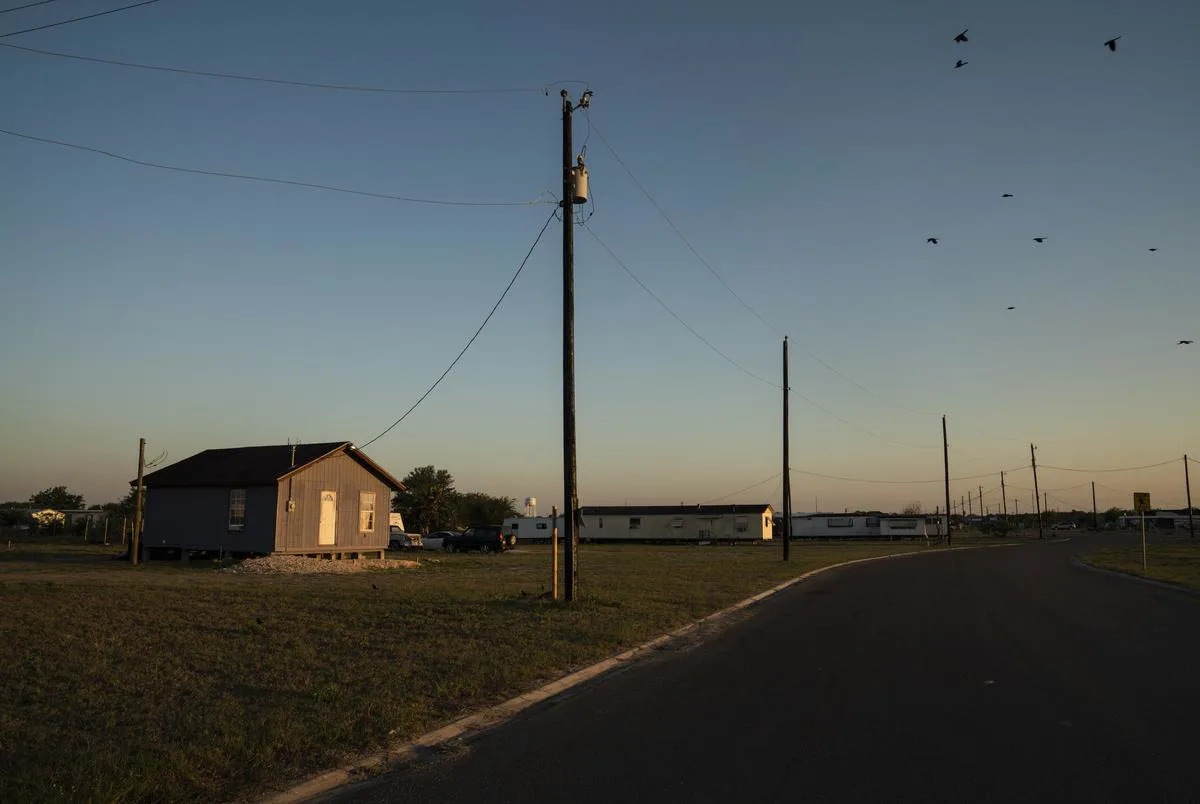
A colonia, unincorporated neighborhoods that lack basic services such as street lights, proper drainage, paved roads or waste management, is seen near Edinburg on March 25, 2020. Credit: Verónica G. Cárdenas for The Texas Tribune
The $30 per month Daisy Solis has saved off of her internet bill for the past two years stretched a long way.
Those dollars covered new shoes for her three, growing children, dinners out at the Chick-fil-A that popped up in her town of Peñitas in South Texas, and part of a higher-than-usual electricity bill.
Now, Solis worries she might have to sacrifice on her internet speed because a federal subsidy that has helped her pay for her internet plan is set to expire at the end of April.
The Affordable Connectivity Program provides a $30 monthly subsidy to help low-income households pay for internet service, and up to $75 per month for households on tribal lands. The $14.2 billion program was part of the 2021 Bipartisan Infrastructure Law and has helped 23 million households in the U.S — including 1.7 million in Texas — save money on their internet bills. The program’s funding is slated to dwindle at the end of April, though, potentially cutting millions off from the internet. In May, limited remaining funding in the program will allow eligible households to receive a partial discount; there won’t be any benefits after May.
“It has really helped me in that I don’t have to stress out about the bill,” said Solis, 27. “Even though it’s $30, $30 goes a long way.”
The program’s termination will disproportionately impact South Texas, where counties along the Texas-Mexico border had higher than average rates of participation. Overall, 1 in 7 Texans used the program. But in some border counties, including Hidalgo County, about half of its residents used the subsidy, according to data from the Federal Communications Commission.
“Some people have told me they might not get internet if [the subsidy] goes away,” said Marco Lopez, a community organizer at La Unión del Pueblo Entero, a nonprofit organization that supports low-income neighborhoods in the Valley. “I don’t know what to tell them because it’s not just cutting off their internet; it’s cutting off their opportunities for jobs, for school, for telehealth.”
A bipartisan group of lawmakers has introduced a bill that would extend funding for the Affordable Connectivity Program through the end of 2024. But the bill has not moved and faces considerable pushback from Republican lawmakers who claim the Biden administration has spent “recklessly.”
In a December letter to the chair of the FCC, a group of lawmakers, including U.S. Sen. Ted Cruz, disputed that the broadband program was necessary. The lawmakers said that most households using the subsidy already had broadband subscriptions. But that’s likely untrue. According to an FCC survey, 47% of respondents reported having either zero connectivity or relying on mobile service before enrolling in the federal program.
On Tuesday, FCC Chair Jessica Rosenworcel sent a letter to Congress urging them to fund the program until the end of the year. She said the funding has been particularly critical for vulnerable populations, including veterans, seniors, and students.
“We know that nearly half of ACP households are led by someone over the age of 50,” she wrote. “The ACP and the broadband service it supports is ‘need to have’ for many seniors, who depend on the program for managing their health and maintaining access to their medical teams.”
The program’s termination comes as the state and federal government pump historic sums of money to expand broadband infrastructure and close the so-called digital divide. Texas is poised to receive more than $3.3 billion federal dollars to help connect the roughly 7 million Texans who lack access to affordable internet. The state will bolster those funds with an additional $1.5 billion that voters approved in November.
Some advocates worry that terminating the Affordable Connectivity Program at this juncture could jeopardize the success of future broadband investments.
“If we build the infrastructure but then all these people lose internet access, we are going to be taking one step forward and two steps back,” said Kelty Garbee, executive director of Texas Rural Funders, a nonprofit focused on rural philanthropy. “It is important to take a long view.”
Rural areas lag behind their urban counterparts when it comes to broadband access. The combination of low population density and remoteness make such areas unattractive to internet service providers, who are hesitant to invest in expensive infrastructure without a guaranteed pool of customers. Garbee worries that ending the government subsidies could shrink the rural customer base and make those areas even less attractive to internet companies.
Jordana Barton-Garcia, who focuses on broadband investments for nonprofit organization Connect Humanity, said that while the termination of ACP will be a significant loss for high poverty areas, the program is a “Band-Aid” solution. She said the subsidy doesn’t address the root of the problem: that the economics of broadband do not work in rural, low-income areas.
“Instead of being ruled by profit-maximizing major corporations, we need other models to serve low and moderate income communities,” she said. “We need to be able to serve without maximizing profits and instead serve for the public good.”
Some communities have found innovative ways to provide broadband to their rural constituents at a low cost. The city of Pharr in Hidalgo County, for example, created a municipal internet service program that offers plans for as low as $25 per month, the price residents in the border community said they could afford. Barton-Garcia said Pharr won’t be affected by the termination of government subsidies because the city has already secured its own funding. Pharr used grant money, a municipal bond as well as American Rescue Plan dollars to create a municipally-run internet service.
Large internet providers such as Comcast said they will continue to support low-income customers with an affordable plan. Comcast offers eligible customers a plan called internet essentials for $9.95 and a slightly higher-speed plan for $29.95.
For smaller providers in rural Texas, though, a low-cost plan is not financially feasible without government support. Charlie Cano, CEO of ETex Telephone Cooperative, said his lowest cost option is $62 per month.
“Anything lower than that is going to jeopardize our business model,” Cano said. “I’m nervous about what we are going to do about that low-cost option.”
In order to qualify as a grantee for the Broadband Equity Access and Deployment Program — the main broadband program created by the bipartisan infrastructure law — providers must offer a low-cost option to low-income customers. Providers like Cano worry this requirement may make it difficult for companies like his to win federal grant dollars.
Disclosure: Comcast has been a financial supporter of The Texas Tribune, a nonprofit, nonpartisan news organization that is funded in part by donations from members, foundations and corporate sponsors. Financial supporters play no role in the Tribune’s journalism. Find a complete list of them here.
Biden administration points finger at Republicans for internet bill hikes
Brian Fung, CNN – April 2, 2024
Spencer Platt/Getty Images
Tens of millions of Americans could see skyrocketing internet bills this spring or may be abruptly kicked off their plans — and it will be congressional Republicans who are to blame, the Biden administration said Tuesday.
The accusation reflects a last-ditch pressure campaign to save a federal program that has helped connect more than 23 million US households to the internet, many for the first time. Without it, those households will be forced to pay hundreds of dollars more per year to stay online.
By the end of the month, funding for the Affordable Connectivity Program (ACP) will run out, jeopardizing the monthly discounts on internet service benefiting an estimated 59 million low-income people, including veterans, students and older Americans.
Many ACP subscribers would be forced to choose between paying for groceries and paying for internet service if the program is shut down, CNN has previously reported.
Although popular with users from across the ideological spectrum, the ACP’s future is in doubt as legislation to extend the program has stalled. Now, as the Federal Communications Commission has begun winding it down, the Biden administration is ramping up pressure on the GOP for standing in the way of a critical lifeline for accessing health care, jobs and education.
“President [Joe] Biden has been calling on Congress to pass legislation that would extend the benefit through 2024. And we know Democratic members and senators have joined him in that effort,” a senior administration official told reporters. “But unfortunately, Republicans in Congress have failed to act.”
Biden has called on Congress to approve $6 billion to continue the ACP. A bill introduced in January by a bipartisan group of lawmakers in the House and Senate would authorize $7 billion. That legislation has 216 co-sponsors in the House, including 21 Republicans, and three in the Senate, including two Republicans.
But policy experts have said it is unlikely Republican House Speaker Mike Johnson will let the bill onto the House floor as GOP leaders have decried government spending, despite the program being used in virtually every congressional district nationwide.
“It is clear the program would be extended if the speaker would allow a vote,” said Blair Levin, an analyst at the market research firm New Street Research. “So far, he has not said anything about it, but it appears he will not allow the House to vote on the legislation. He has not, to my knowledge, said anything substantive about the legislation or the program.”
Levin added that support by Republican Sens. J.D. Vance of Ohio and Kevin Cramer of North Dakota also suggest the bill would pass the Senate, making the House “the biggest obstacle.”
Spokespeople for Johnson and for Senate Majority Leader Chuck Schumer didn’t immediately respond to a request for comment.
The result is a stalemate that, if left unresolved, will lead to the collapse of the ACP by early May.
Administration officials declined to say whether Biden or Vice President Kamala Harris have personally discussed the ACP with congressional Republicans. But the officials told reporters there is currently no Plan B if Congress fails to extend the program.
“There are really no good options in a world in which Congress leaves us without any funding,” said another senior administration official. “There are certainly no easy answers for us to move forward if this program ends. So we want to work as hard as possible to make sure we avoid that possibility.”
Some lawmakers had hoped that money for the ACP could have been included in the recent bipartisan spending deal intended to keep the government open, but those hopes were ultimately left unfulfilled.
On Tuesday, FCC Chairwoman Jessica Rosenworcel sent a letter to Congress outlining the impact that the ACP’s disruption would cause.
“The end of the ACP will have broad impact,” Rosenworcel wrote. “But it is worth noting that they will have special impact on certain vulnerable populations, including senior citizens. We know that nearly half of ACP households are led by someone over the age of 50.”
More than 4 million military households are signed up for the ACP, Rosenworcel added, while 3.4 million households within the ACP program reported using school lunch or breakfast programs, indicating that many program subscribers are parents of children whose ability to do homework assignments may be interrupted by the loss of the ACP. To qualify for the ACP, users are required to meet certain income limits or be a participant in one of a number of other federal aid programs, such as the National School Lunch Program.
Rosenworcel called on Sen. Maria Cantwell and the panel she chairs, the Senate Committee on Commerce, Science, and Transportation, to quickly advance legislation to extend the ACP. But the bill’s future remains foggy.
Our Trump reporting upsets some readers, but there aren’t two sides to facts: Letter from the Editor
Chris Quinn, Editor, Cleveland Plain Dealer – March 30, 2024
Some readers complain that we have different standards involving Donald Trump and Joe Biden. (AP Photo, File)AP
A more-than-occasional arrival in the email these days is a question expressed two ways, one with dripping condescension and the other with courtesy:
Why don’t our opinion platforms treat Donald Trump and other politicians exactly the same way. Some phrase it differently, asking why we demean the former president’s supporters in describing his behavior as monstrous,insurrectionist and authoritarian. I feel for those who write. They believe in Trump and want their local news source to recognize what they see in him.
The angry writers denounce me for ignoring what they call the Biden family crime syndicate and criminality far beyond that of Trump. They quote news sources of no credibility as proof the mainstream media ignores evidence that Biden, not Trump, is the criminal dictator.
The courteous writers don’t go down that road. They politely ask how we can discount the passions and beliefs of the many people who believe in Trump.
This is a tough column to write, because I don’t want to demean or insult those who write me in good faith. I’ve started it a half dozen times since November but turned to other topics each time because this needle hard to thread. No matter how I present it, I’ll offend some thoughtful, decent people.
The north star here is truth. We tell the truth, even when it offends some of the people who pay us for information.
The truth is that Donald Trump undermined faith in our elections in his false bid to retain the presidency. He sparked an insurrection intended to overthrow our government and keep himself in power. No president in our history has done worse.
This is not subjective. We all saw it. Plenty of leaders today try to convince the masses we did not see what we saw, but our eyes don’t deceive. (If leaders began a yearslong campaign today to convince us that the Baltimore bridge did not collapse Tuesday morning, would you ever believe them?) Trust your eyes. Trump on Jan. 6 launched the most serious threat to our system of government since the Civil War. You know that. You saw it.
The facts involving Trump are crystal clear, and as news people, we cannot pretend otherwise, as unpopular as that might be with a segment of our readers. There aren’t two sides to facts. People who say the earth is flat don’t get space on our platforms. If that offends them, so be it.
As for those who equate Trump and Joe Biden, that’s false equivalency. Biden has done nothing remotely close to the egregious, anti-American acts of Trump. We can debate the success and mindset of our current president, as we have about most presidents in our lifetimes, but Biden was never a threat to our democracy. Trump is. He is unique among all American presidents for his efforts to keep power at any cost.
Personally, I find it hard to understand how Americans who take pride in our system of government support Trump. All those soldiers who died in World War II were fighting against the kind of regime Trump wants to create on our soil. How do they not see it?
The March 25 edition of the New Yorker magazine offers some insight. It includes a detailed review of a new book about Adolf Hitler, focused on the year 1932. It’s called “Takeover: Hitler’s Final Rise to Power” and is by historian Timothy W. Ryback. It explains how German leaders – including some in the media — thought they could use Hitler as a means to get power for themselves and were willing to look past his obvious deficiencies to get where they wanted. In tolerating and using Hitler as a means to an end, they helped create the monstrous dictator responsible for millions of deaths.
How are those German leaders different from people in Congress saying the election was stolen or that Jan. 6 was not an insurrection aimed at destroying our government? They know the truth, but they deny it. They see Trump as a means to an end – power for themselves and their “team” – even if it means repeatedly telling lies.
Sadly, many believe the lies. They trust people in authority, without questioning the obvious discrepancies or relying on their own eyes. These are the people who take offense to the truths we tell about Trump. No one in our newsroom gets up in the morning wanting to make a segment of readers feel bad. No one seeks to demean anyone. We understand what a privilege it is to be welcomed into the lives of the millions of people who visit our platforms each month for news, sports and entertainment. But our duty is to the truth.
Our nation does seem to be slipping down the same slide that Germany did in the 1930s. Maybe the collapse of government in the hands of a madman is inevitable, given how the media landscape has been corrupted by partisans, as it was in 1930s Germany.
I hope not.
In our newsroom, we’ll do our part. Much as it offends some who read us, we will continue to tell the truth about Trump.
Extremist ex-adviser drives ‘anti-white racism’ plan for Trump win – report
Martin Pengelly in Washington – April 1, 2024
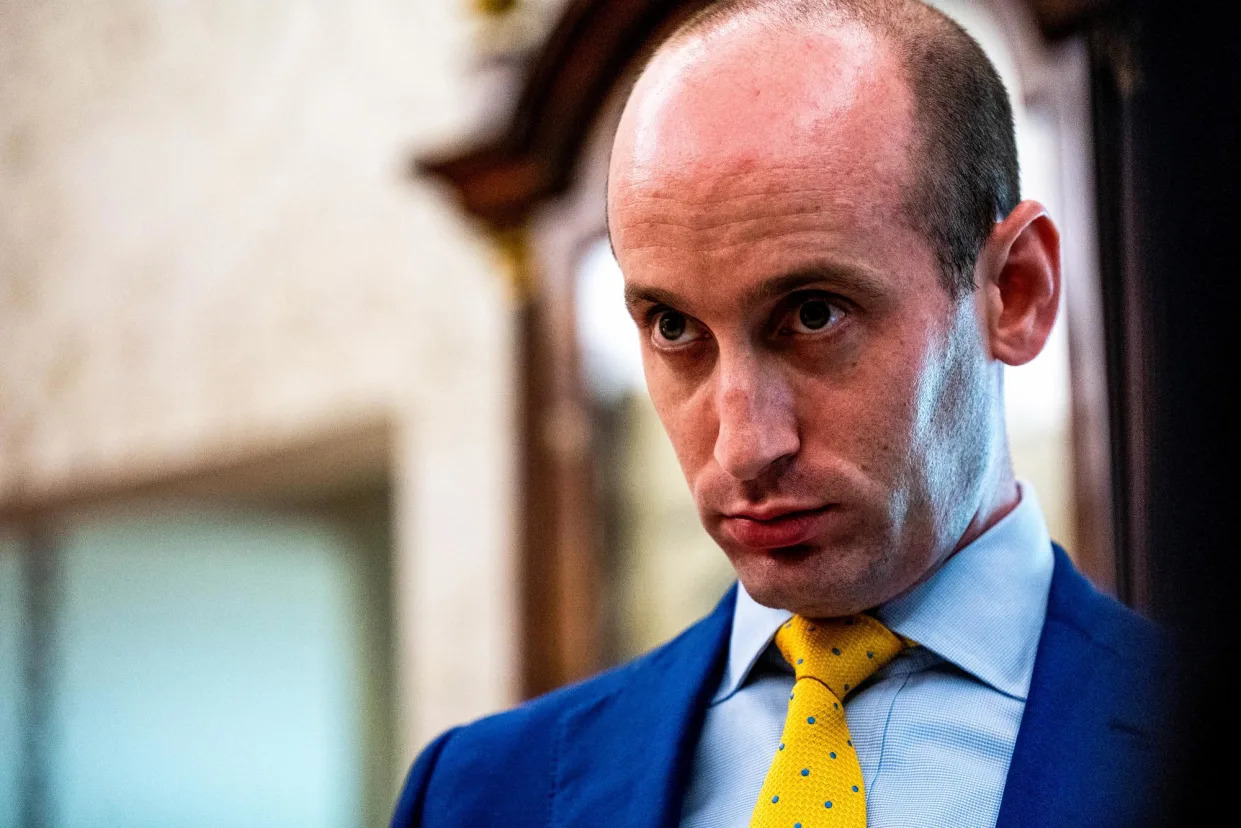
Stephen Miller at the White House, in Washington DC on 15 July 2020.Photograph: Anna Moneymaker/The New York Times/Bloomberg via Getty Images
The anti-immigration extremist, white nationalist and former Trump White House adviser Stephen Miller is helping drive a plan to tackle supposed “anti-white racism” if Donald Trump returns to power next year, Axios reported.
“Longtime aides and allies … have been laying legal groundwork with a flurry of lawsuits and legal complaints – some of which have been successful,” Axios said on Monday.
Should Trump return to power, Axios said, Miller and other aides plan to “dramatically change the government’s interpretation of civil rights-era laws to focus on ‘anti-white racism’ rather than discrimination against people of colour”.
Such an effort would involve “eliminating or upending” programmes meant to counter racism against non-white groups.
The US supreme court, dominated 6-3 by rightwing justices after Trump installed three, recently boosted such efforts by ruling against race-based affirmative action in college admissions.
America First Legal, a group founded by Miller and described by him as the right’s “long-awaited answer” to the American Civil Liberties Union, is helping drive plans for a second Trump term, Axios said.
In 2021, an AFL suit blocked implementation of a $29bn Covid-era Small Business Administration programme that prioritised helping restaurants owned by women, veterans and people from socially and economically disadvantaged groups.
Miller called that ruling “the first, but crucial, step towards ending government-sponsored racial discrimination”.
Recent AFL lawsuits include one against CBS and Paramount alleging discrimination against a white, straight man who wrote for the show Seal Team, and a civil rights complaint against the NFL over the “Rooney Rule”, which says at least two minority candidates must be interviewed for vacant top positions.
Reports of extremist groups planning for a second Trump presidency are common, not least around Project 2025, a blueprint for transition and legislative priorities prepared by the Heritage Foundation, a hard-right Washington thinktank.
Trump’s spokesperson, Steven Cheung, told Axios: “As President Trump has said, all staff, offices, and initiatives connected to [Joe] Biden’s un-American policy will be immediately terminated.”
Throughout Trump’s term in office, Miller was a close adviser and speechwriter – though one of the 45th president’s less successful TV surrogates, ridiculed for using “spray-on hair”.
Controversies were numerous. Among them were reported advocacy for blowing up migrants with drones (which Miller denied); for sending 250,000 US troops to the southern border; and for beheading an Isis leader, dipping the head in pig’s blood and “parad[ing] it around to warn other terrorists” (Miller denied it and called the source of the story, the former defense secretary Mark Esper, a “moron”).
In 2019, after Miller was discovered to have touted white nationalist articles and books, 55 civil rights groups wrote to Trump, protesting: “Stephen Miller has stoked bigotry, hate and division with his extreme political rhetoric and policies throughout his career. The recent exposure of his deep-seated racism provides further proof that he is unfit to serve and should immediately leave his post.”
On Monday, Cedric Richmond, co-chair of Biden’s re-election campaign, said: “It’s not like Donald Trump has been hiding his racism … [but] he’s making it clear that if he wins in November, he’ll turn his racist record into official government policy … It’s up to us to stop him.”
Despite his legal advocacy in the cause of eradicating “anti-white racism”, Miller is not himself a lawyer.
Ty Cobb, a former Trump White House lawyer, recently told the Guardian those close to the former president were now “looking for lawyers who worship Trump and will do his bidding. Trump is looking to Miller to pick people who will be more loyal to Trump than the rule of law.”
Trump Allies Plan to Reinterpret Civil Rights Laws to Protect White People: Report
Nikki McCann Ramirez – April 1, 2024
Allies of Donald Trump and powerful conservative organizations are preparing to launch an offensive against “anti-white racism” should the former president retake the White House in November. According to a report from Axios, those in Trump’s orbit are gearing up for a widespread re-interpretation of civil rights laws to combat what they perceive as reverse racism against white Americans.
According to the report, this would include a mass gutting of government programs and diversity initiatives. “As President Trump has said, all staff, offices, and initiatives connected to Biden’s un-American policy will be immediately terminated,” Steven Cheung, a Trump campaign spokesperson, told Axios.
The initiative is already being spearheaded by former Trump adviser Stephen Miller, who founded the right-wing judicial activist outfit America First Legal after leaving the White House. Miller has leveraged Civil Rights-era laws intended to protect minorities from discrimination to challenge “woke” corporate policies of inclusion. America First Legal has sued Nike, Disney, United Airlines, the National Football League, and CBS Entertainment — among others— for allegedly discriminating against white men. Several of the lawsuits cite the 1964 Civil Rights Act, which prohibits discrimination on the basis of race, color, religion, sex or national origin.
Miller and his organization are not acting alone. America First Legal was consulted by the Heritage Foundation, a conservative think tank, in the drafting of its “Project 2025” policy handbook. The handbook contains language calling for an end to “affirmative discrimination,” and calls for an incoming conservative administration to “reorganize and refocus the DOJ’s Civil Rights Division to serve as the vanguard for this return to lawfulness.”
Trump himself has repeatedly claimed to be the target of anti-white discrimination. As previously reported by Rolling Stone, the former president has directed his advisers to look into ways he might compel the Justice Department to investigate New York Attorney General Letitia James, who successfully sued the former president for fraud last year. Trump regularly refers to James as “racist” in his social media posts and public statements.
Last week, National Review contributing editor Deroy Murdock suggested on Fox Business that Trump has grounds to sue James on the basis of discrimination.
“I think what President Trump should do is sue her on the basis of the 1964 Civil Rights Act,” Murdock said. When asked if he had suggested this directly to the former president, Murdock responded that he “will,” and that the message will get to Trump “sooner or later.”
Feds Want to Seize This $7 Million Condo in a Luxe Trump Building
Justin Rohrlich – April 1, 2024
UCG
U.S. authorities have targeted an apartment in a Donald Trump-branded luxury Manhattan tower, where they are looking to seize a $7 million unit prosecutors say was illicitly obtained by one of Congolese President Denis Sassou-Nguesso’s children.
A forfeiture complaint filed Friday in Manhattan federal court and obtained by The Daily Beast says the action “concerns the misappropriation, theft, or embezzlement of hundreds of millions of dollars from the Congolese treasury, some of which was used for the purchase of a luxury apartment in the Southern District of New York for the use of President Nguesso’s daughter.”
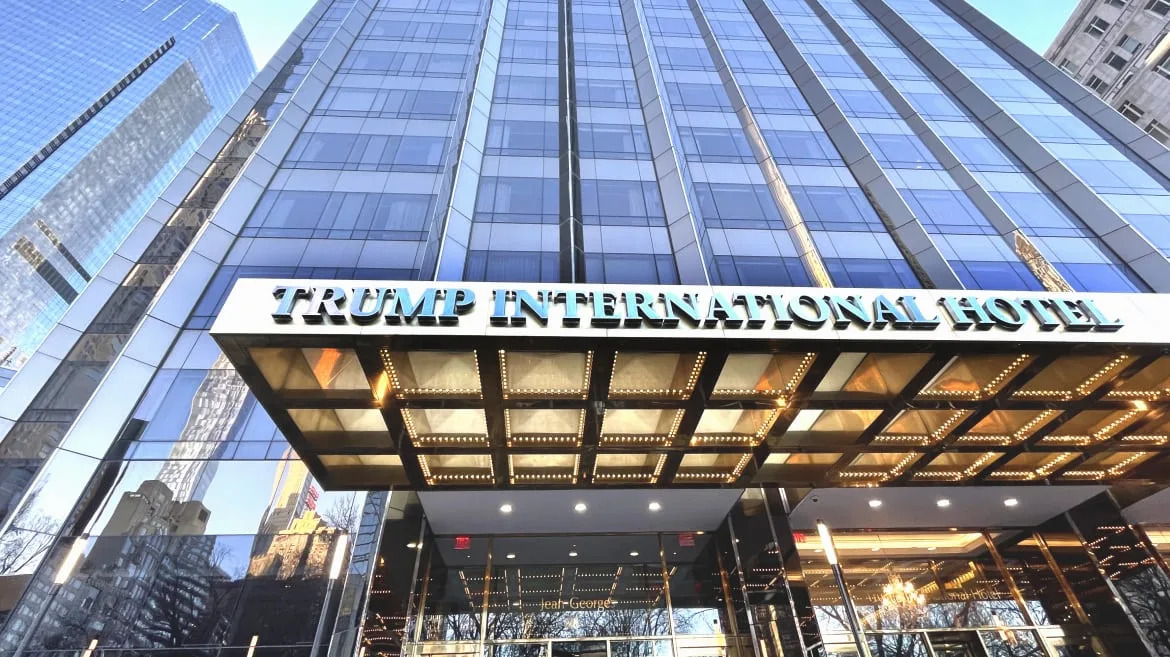
“That property is Unit 32G in the Trump International Hotel & Tower at 1 Central Park West, New York, NY 10023,” the complaint states.
The United States is seeking to repossess the property “because the funds used to acquire it are traceable to violations of specified unlawful activities and U.S. law,” according to the complaint.
Sassou-Nguesso, who has been described as a breathtakingly corrupt kleptocrat, has held power in Congo, almost uninterrupted, since 1979.
Congolese President Denis Sassou-Nguesso with Russian President Vladimir Putin at the 2023 Navy Day parade in Saint Petersburg, Russia.Sputnik/Alexander Kazakov/Kremlin via Reuters
A past listing for the apartment says it is a corner space “overlooking Central Park and the Hudson River [and] captures the essence of the most sought after Columbus Circle neighborhood. Special features include: floor to-ceiling windows, 10′ ceilings, a gracious entrance gallery, living/dining room, a windowed eat-in-kitchen with washer/dryer, two bedrooms with spectacular views and luxurious baths ensuite, plus a powder room, capacious closets and a separate bar, ideal for entertaining. Sorry no pets allowed.”
Ownership of the Trump International Hotel & Tower is complicated, with the Trump Organization managing the building and owning some units and hundreds of individual owners holding the rest. On Monday, a Trump Org spokeswoman, Kimberly Benza, told The Daily Beast, “If this sale did occur, it would be by a 3rd party unit owner unrelated to our Organization.”
The apartment was procured via a byzantine array of shell companies and intermediaries who routed funds stolen from Congo’s public coffers through entities in Portugal, Cyprus, the British Virgin Islands, and Brazil, the forfeiture complaint states. The money finally ended up in the U.S., where Sassou-Nguesso and her enablers hired law firm K&L Gates to purchase apartment 32G “for the benefit of Sassou-Nguesso, using a portion of the laundered funds and embezzlement proceeds,” according to the complaint.
Claudia Sassou-Nguesso, daughter of Congolese President Denis Sassou-Nguesso, during a national assembly meeting in 2012.Guy Gervais/KITINA/AFP via Getty Images
The complaint says Sassou-Nguesso was aware she could be rejected by Trump International as “a politically-exposed person,” and considered listing her cousin as the unit’s beneficial owner to avoid trouble. However, Trump International officials told Sassou-Nguesso’s team that “it was ‘not a problem’ and that the information was ‘only for the condominium building,’” the complaint goes on. On June 24, 2014, a Portuguese businessman representing Sassou-Nguesso in the deal wired a $710,000 deposit to the condo’s seller, sending the $6,525,000 balance a month later, according to the complaint.
“In sum, the money used to purchase the Defendant Asset was a portion of the approximately USD 19.5 million of Congolese state funds embezzled through… sham contracts… and these embezzled funds were used to purchase the Defendant Asset for Sassou Nguesso’s apparent personal enrichment,” the complaint states.
After the Global Witness report was released in 2019, the Trump Organization said that monthly common charges paid by condo owners did not go directly to Trump himself “for profit.”
According to the forfeiture complaint, Sassou-Nguesso paid some $250,000 in common charges between 2018 and 2022. It says they were paid “out of bank accounts in Luxembourg, Portugal, and the United Arab Emirates” in the name of another Portuguese national fronting for Sassou-Nguesso.
Although the apartment has apparently remained unoccupied since it was purchased, prosecutors say they have reviewed emails from Sassou-Nguesso about interior design work to be conducted at the property, transferring, via her worldwide network, more than $400,000 to a Portuguese firm to carry out the job.
The apartment, according to the forfeiture complaint, “is traceable to… a conspiracy to launder the proceeds of specified unlawful activities.”
“The Court, for the reasons set forth herein, adjudge and decree that the Defendant Asset be forfeited to the United States of America and disposed of in accordance with existing laws, together with costs, and for such other relief as this Court deems proper and just,” the complaint states.
The Trump International Hotel & Tower at 1 Central Park West in Manhattan.Angela Weiss/AFP via Getty Images
Trump’s properties, as The New York Times once said, “have a long history of serving as home to people with checkered pasts.”
Former federal prosecutor Kenneth McCallion, a onetime member of an organized crime strike force that investigated potential criminal activities during the construction of Trump Tower, told The Daily Beast that dirty money has long been attracted to Trump buildings.
“They’d pay cash for condos, held them for a few years, sold them, and the proceeds of the sale would then be clean money,” McCallion said.
Haitian dictator Jean-Claude “Baby Doc” Duvalier owned a unit in Trump Tower on Manhattan’s 5th Avenue; alleged Russian gangster David Bogatin—one of at least 13 Russian organized crime figures who have resided in the building—owned five.
A Trump development in Panama was “riddled with brokers, customers and investors who have been linked to drug trafficking and international crime,” according to a 2017 NBC News investigation.
They came for Florida’s sun and sand. They got soaring costs and a culture war.
Shannon Pettypiece – March 31, 2024
One of the first signs Barb Carter’s move to Florida wasn’t the postcard life she’d envisioned was the armadillo infestation in her home that caused $9,000 in damages. Then came a hurricane, ever present feuding over politics, and an inability to find a doctor to remove a tumor from her liver.
After a year in the Sunshine State, Carter packed her car with whatever belongings she could fit and headed back to her home state of Kansas — selling her Florida home at a $40,000 loss and leaving behind the children and grandchildren she’d moved to be closer to.
“So many people ask, ‘Why would you move back to Kansas?’ I tell them all the same thing — you’ve got to take your vacation goggles off,” Carter said. “For me, it was very falsely promoted. Once living there, I thought, you know, this isn’t all you guys have cracked this up to be, at all.”
Florida has had a population boom over the past several years, with more than 700,000 people moving there in 2022, and it was the second-fastest-growing state as of July 2023, according to Census Bureau data. While there are some indications that migration to the state has slowed from its pandemic highs, only Texas saw more one-way U-Haul moves into the state than Florida last year. Mortgage application data indicated there were nearly two homebuyers moving to Florida in 2023 for every one leaving, according to data analytics firm CoreLogic.
But while hundreds of thousands of new residents have flocked to the state on the promise of beautiful weather, no income tax and lower costs, nearly 500,000 left in 2022, according to the most recent census data. Contributing to their move was a perfect storm of soaring insurance costs, a hostile political environment, worsening traffic and extreme weather, according to interviews with more than a dozen recent transplants and longtime residents who left the state in the past two years.
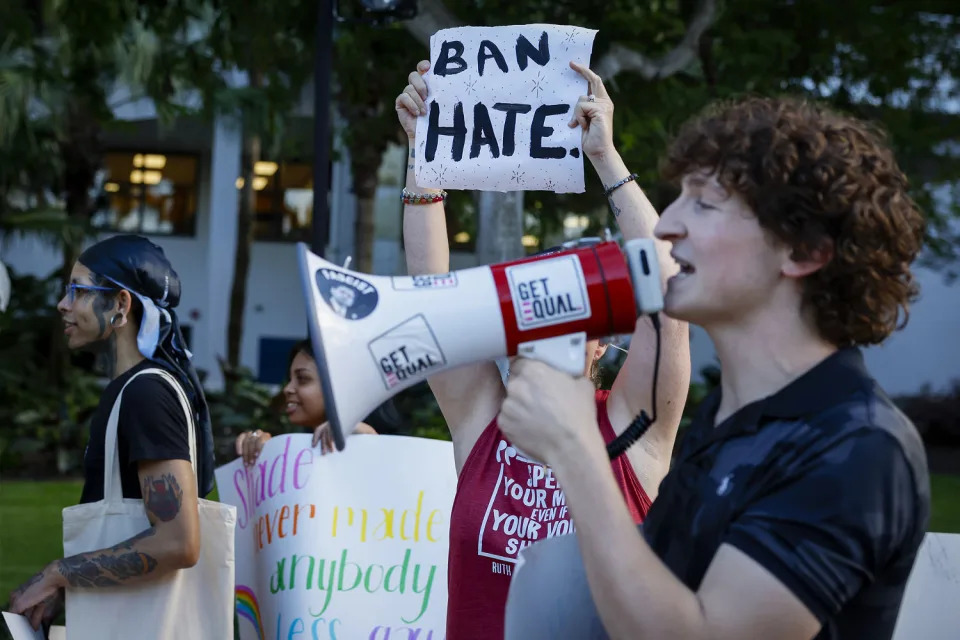
A demonstrator holds a placard reading
“It wasn’t the utopia on any level that I thought it would be,” said Jodi Cummings, who moved to Florida from Connecticut in 2021. “I thought Florida would be an easier lifestyle, I thought the pace would be a little bit quieter, I thought it would be warmer. I didn’t expect it to be literally 100 degrees at night. It was incredibly difficult to make friends, and it was expensive, very expensive.”
Cummings expected she’d have extra money in her paycheck working as a private chef in the Palm Beach area since the state doesn’t have an income tax. But the high costs of car insurance, rent and food cut into that additional take-home pay. After six months of dealing with South Florida’s heat and traffic, she began planning a move back to the Northeast.
“I had been so disenchanted with Florida so quickly,” Cummings said. “There was this feeling of confusion and guilt about wanting to leave, of moving there then realizing this is not anything like I thought it would be.”
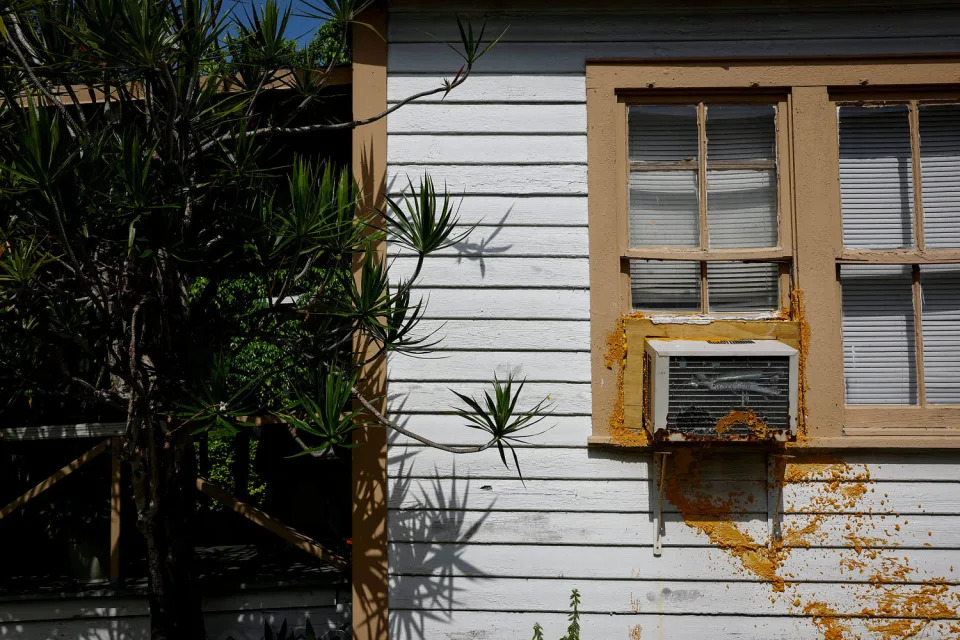
A window air conditioning unit during a heat wave in Miami (Eva Marie Uzcategui / Bloomberg via Getty Images)
While costs have been rising across the country, some areas of Florida have been hit particularly hard. In the South Florida region, which includes Miami, Fort Lauderdale and Palm Beach, consumer prices in February were up nearly 5% over the prior year, compared to 3.2% nationally, according to the most recent data from the Bureau of Labor Statistics.
Homeowners insurance rates in Florida rose 42% last year to an average of $6,000 annually, driven by hurricanes and climate change, and car insurance in Florida is more than 50% higher than the national average, according to the Insurance Information Institute. While once seen as an affordable housing market, Florida is now among the more expensive states to buy a home in, with prices up 60% since 2020 to an average of $388,500, according to Zillow.
For Carter, who made the move in 2022 from Kansas to a suburb of Orlando for the weather, beaches and to be closer to her grandchildren, the costs began to quickly pile up. She purchased a manufactured home and initially expected the lot rent in her community to be $580 a month. But when she arrived she learned her monthly bill was actually $750, and by the time she left it had jumped to $875 a month. Along with the $9,000 in repairs from the armadillos, her car insurance doubled and Hurricane Ian destroyed her home’s roof on her 62nd birthday.
A aerial view of a man wading through a flooded street. (Bryan R. Smith / AFP via Getty Images)
There were also the ever-present conversations and disagreements over politics that started to wear on her. Carter, who describes herself as a “middle of the road” Republican, said she learned to keep her opinions to herself.
“You cannot engage in a conversation there without politics coming up, it is just crazy. We’re retired, we’re supposed to be in our fun time of life,” she said. “I learned quickly, just keep your mouth shut, because I saw people in my own community break up their friendships over it. I don’t like losing friends, and especially over politics.”
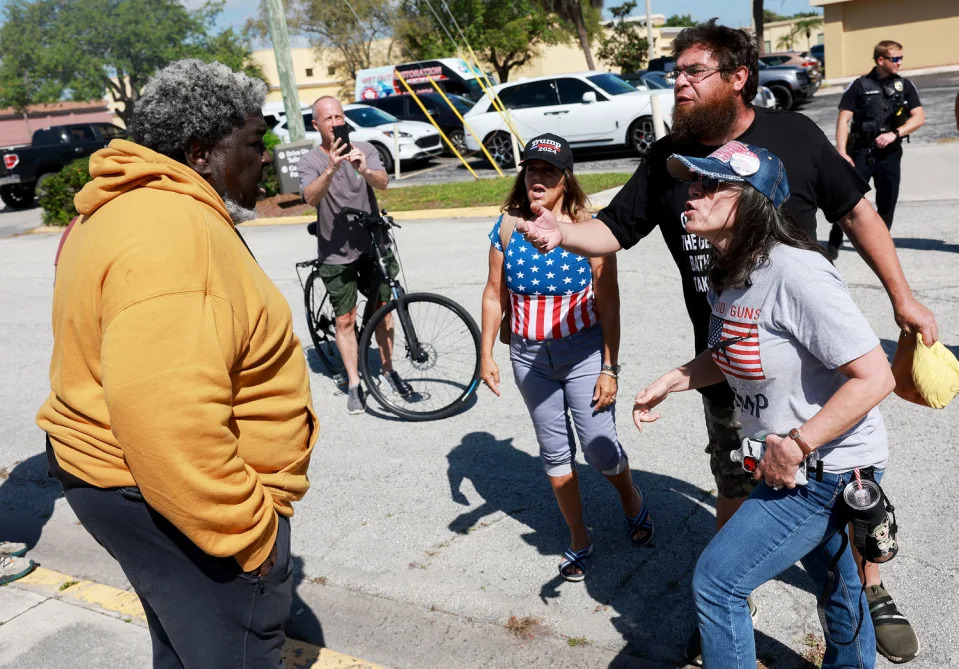
A supporter of President Joe Biden faces supporters of Donald Trump outside of the courthouse in Fort Pierce, Fla., where Trump attended a hearing in his classified records case on March 14. (Joe Raedle / Getty Images)
But she said the final straw was when she couldn’t find a surgeon to remove a 6-inch tumor from her liver that doctors warned could burst at any moment and lead to life-threatening sepsis. After being passed among doctors, she finally found one willing to remove the tumor. But when she called to schedule the surgery, her calls went unanswered and her messages weren’t returned. After months of trying and fearing for her life, she returned to Kansas to have the procedure done.
“It just seemed like one challenge after another, but I kept with it until there was literally a lifesaving event that I needed to get handled and I wasn’t able to do it there,” she said. “I think it was the most difficult year of my life.”
No state has had more residents relocate to Florida in recent years than New York, with 90,000 New Yorkers moving there in 2022, according to census data. Among all out-of-state mortgage applicants, nearly 9% were from New York in 2023, slightly lower than the previous two years but similar to 2019, according to CoreLogic. One of those New York transplants was Louis Rotkowitz. He lasted less than two years in Florida.
“Like every good New Yorker, this is where you want to go,” he said by phone while driving the last of his belongings out of the state to his new home in Charlotte, North Carolina. “It’s a complete fallacy.”
After years working in emergency medicine, and nearly dying from a Covid-19 infection he contracted at work, Rotkowitz said he and his wife were looking for a more pleasant, affordable lifestyle and warmer weather when they decided to buy a house in the West Palm Beach area in 2022. He got a job there as a primary care physician and his wife took a teaching position.
But he said he quickly found the Florida he’d moved to wasn’t the one he’d experienced on regular visits there over the years. His commute to work often took more than an hour each way, he struggled to get basic services like a dishwasher repair, and the cost of his homeowners association fees doubled.
“I had a good salary, but we were barely making ends meet. We had zero quality of life,” said Rotkowitz.
Along with the rising costs, Rotkowitz said he generally felt unsafe in the state between the erratic traffic — which resulted in a number of his patients being injured by vehicles — and a state law passed in 2023 that allowed people to carry a concealed weapon without a license.
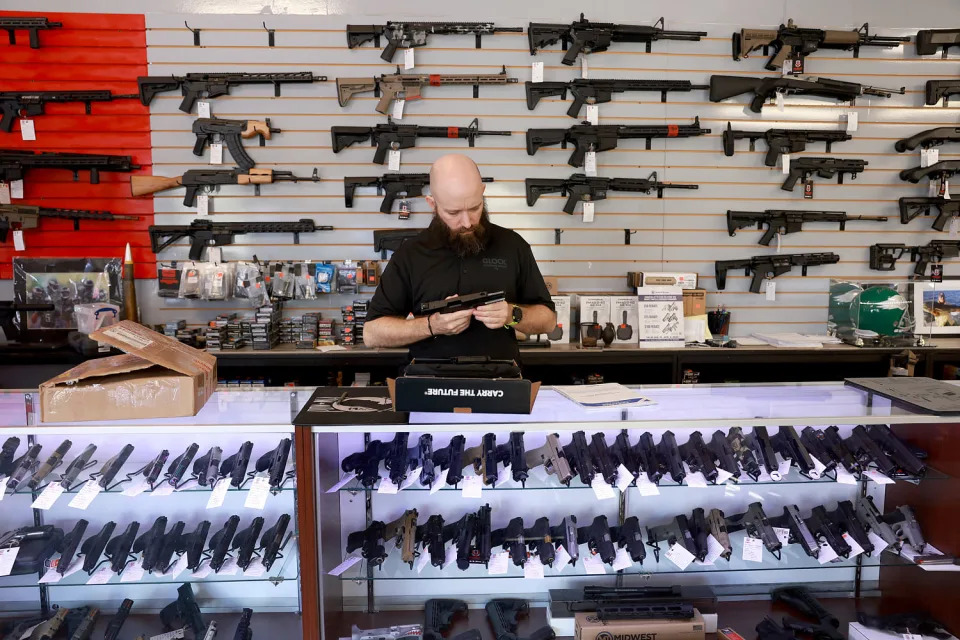
A handgun is inventoried at store that sells guns in Delray Beach (Joe Raedle / Getty Images file)
“Everyone is walking around with guns there,” he said. “I consider myself a conservative guy, but if you want to carry a gun you should be licensed, there should be some sort of process.”
Veronica Blaski, who moved to Florida from Connecticut, said rising costs drove her out of the state after less than three years. When at the start of the pandemic her husband was offered a job in Florida making more money as a manager for a landscaping company, Blaski envisioned warm weather and a more comfortable lifestyle.
The couple, both in their 40s, sold their home in Connecticut and were starting to settle into their new community when Blaski said they were hit with a “bulldozer” of costs at the start of 2023.
Her homeowners insurance company threatened to drop her coverage if she didn’t replace her home’s 9-year-old roof, a $16,000 to $30,000 project, and even with a new roof, she was expecting her home insurance rates to double — one neighbor saw their insurance go from $600 a month to $1,200 a month.
She was also facing rising property taxes as the value of her home increased, her homeowners association fees went from $326 a month to $480, and her insurance agent warned that her car insurance would likely double when it was time to renew her policy. Her husband had to get a second job on weekends to cover the higher costs.
While Florida has an unemployment rate below the national average, Blaski and others said wages weren’t enough to keep up with their expenses. The median salary in Florida is among the lowest in the country, according to payroll processor ADP. To afford a home in one of Florida’s more affordable metro areas, like Jacksonville, a homebuyer would need to earn $109,000 a year, around twice as much income as a buyer would have needed just four years ago, according to an analysis by Zillow.
“My little part-time job making $600, $700 a month went to paying either car insurance or homeowners insurance, and forget about groceries,” said Blaski, who was working in retail. “There are all these hidden things that people don’t know about. Make sure you have extra money saved somewhere because you will need it.”
A woman looks at bottle of juice. (Joe Raedle / Getty Images file)
When her husband’s former boss in Connecticut reached out to see if he’d be willing to return, the couple leaped at the chance.
The reverse migration out of Florida isn’t just among newcomers, but also among longtime residents who said they can no longer afford to live there and are uncomfortable with the state’s increasingly conservative policies, which in recent years have included a crackdown on undocumented immigrants, a ban on transgender care for minors, state interventions in how race, slavery and sexuality are taught in schools, and a six-week ban on abortions.
After more than three decades in the Tampa Bay area, Donna Smith left the state for Pennsylvania in December, with politics and rising insurance costs playing a major role in her decision to leave.
“It breaks my heart, it really does, because Florida was really a pretty great place when I first moved there,” Smith said.
Having grown up in Oklahoma, Smith considered herself a Republican, but as Florida’s politics shifted to the right, she said she began to consider herself a Democrat. It wasn’t until the past several years, though, that politics started to encroach on her daily life — from feuds between neighbors and friends to neo-Nazis showing up at a Black Lives Matter rally in her small town.
“When I first moved to Florida, it was a live-and-let-live sort of beach feel. You met people from all over, everybody was relaxed. That’s just gone now, and it’s shocking. It’s just gone,” said Smith, 61, who works as a graphic designer and illustrator. “Instead, it’s just a constant stressful atmosphere. I feel as though it could ignite at any point, and I’m not a fearmonger. It’s just the atmosphere, the feeling there.”
She was already considering a move out of the state when she was told by her homeowners insurance company that she would need to replace her home’s roof because it was older than four years or her insurance premium would be going up to $12,000 a year from $3,600, which was already double what she had been paying. Even with a new roof, she was told her premium would be $6,900 a year. Before she could make a decision about what to do, her insurance policy was canceled.
Shortly after, Smith ended up moving to the Lancaster, Pennsylvania, area, where she is closer to her adult children. While the majority of voters in her new county chose Donald Trump in the last election, she said politics is no longer such a heavy presence in her everyday life.
“I don’t feel it is as oppressive. People don’t wear it on their sleeve like they did in Florida,” she said. “When you walk in a room, you don’t overhear a conversation all the time where people are saying ‘Trump is the best’ or ‘I went to that last rally,’ and they’re telling total strangers while you’re just waiting for your car or something. It was just everywhere.”
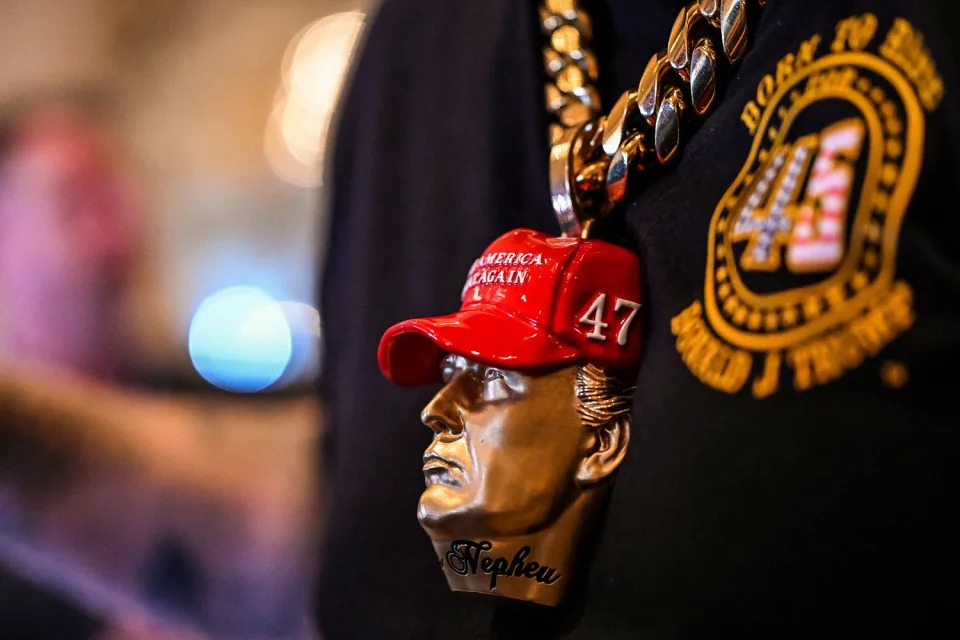
A supporter of Donald Trump wears a Trump bust jewelry. (Chandan Khanna / AFP – Getty Images)
Costs and politics were also enough to cause Noelle Schmitz to leave the state after more than 30 years, despite her son having a year left in high school, and relocate to Winchester, Virginia. She said the politics became ever-present in her daily life — one former neighbor had a massive Trump banner in front of their house for years, and another had Trump written in big letters across their yard. When she put out a Hillary Clinton sign in 2016, it was stolen and her house was egged.
“I saw my neighbors and co-workers become more radicalized, more aggressive and more angry about politics. I’m thinking, where is this coming from? These are not the people I remember,” Schmitz said. “I was finally like, we need to get the hell out of here, things are not going well.”
For some Florida newcomers though, politics is the main draw to the state, said John Desautels, who has sold real estate in Florida for decades. While politics never used to be a topic for homebuyers, Desautels said it is now a regular subject his clients bring up. Rather than asking about schools or amenities in a community, prospective buyers are asking him about the political affiliations of a certain neighborhood.
“One of the first things they say is, ‘I don’t want to be in one of them X or Y political party neighborhoods,’” Desautels said. “I spend hours listening to people vent to me about fleeing the communist government of XYZ and they want to come to freedom or whatever. So the politics have been the biggest issue when we get the call.”
Even home showings have become a politically sensitive issue. He recalled showing an elderly woman one property where there were Confederate flags at the gate and swastikas on the fish tank.
But while politics are a lure to people arriving in the state, he said they’re also among the reasons sellers tell him they’re leaving, and the state’s politics have deterred some of his gay or nonwhite clients from moving there.
“The problem is, when we alienate protected classes, it sounds like a good sound bite, but you’ve got to remember those are people who spend money in our community,” he said. “For this pro-business, free state, I’m feeling it in the wallet, bad.”
In Kansas, Carter says it’s good to be home. She moved into a 55-plus community in a small town about 10 miles from Wichita. While in Florida she was paying nearly $900 in lot rent for her manufactured home, she now pays just $520 in rent for a cottage-style apartment — a place she estimates would have cost her $1,800 a month in Florida.
With the money she’s saving in Kansas, she can afford to visit Florida.
“People call me the modern-day Dorothy,” she said. “There’s no place like home.”
An aerial view of a vehicle driving along a flooded street. (Miguel J. Rodriguez Carrillo / AFP via Getty Images)
Nicole Wallace Gets Fed Up, Tosses Script While Covering Latest Trump Attack: ‘What Are We Going to Do Different?’ | Video
Stephanie Kaloi – March 30, 2024
MSNBC’s Nicole Wallace quite literally threw out her prepared script on Friday on-air while covering breaking news about a new public attack from former president Donald Trump. The visibly angry anchor told a panel of guests that “it’s time to do something different” when speaking about Trump’s outrageous and sometimes dangerous actions on and offline.
Wallace picked up her news script and tossed it to her right as she explained, “I have come on the air with breaking news about requests for gag orders because of threats for judges and their kids more times than I can count today before I got ready.”
After she apologized to the person who “has to write the banner at the bottom of my show,” Wallace added, “Donald Trump broke the rule of law. We should cover a broken judiciary in this country. Donald Trump managed to delay every federal, criminal trial based on facts that he barely denies.”
“Donald Trump managed to enlist the Supreme Court in a delayed process — the highest court in the land. Donald Trump brazenly and repeatedly attacks not just judges … judges don’t have Secret Service protecting them.”
Nicolle Wallace literally throws out the script, disgusted by Donald Trump’s latest behavior. pic.twitter.com/HtbiVrLkzk
Wallace spoke in response to a Truth Social post that Trump published on Thursday about the daughter of Judge Juan Merchan, who had previously placed Trump on a gag order before his April 15 court date in his hush money trial.
Trump wrote, “Judge Juan Merchan is totally compromised, and should be removed from this TRUMP Non-Case immediately. His Daughter, Loren, is a Rabid Trump Hater, who has admitted to having conversations with her father about me, and yet he gagged me.”
“She works for Crooked Joe Biden, Kamala Harris, Adam ‘Shifty’ Schiff, and other Radical Leftists who Campaign on ‘Getting Trump,’ and fundraise off the ‘Biden Indictments’ – including this Witch Hunt, which her father ‘presides’over, a TOTAL Conflict – and attacking Biden’s Political Opponent through the Courts. Former D.A. Cy Vance refused to bring this case, as did all Federal Agencies, including ‘Elections.’
The claim about Merchan’s daughter has not been prove true.
Trump’s repeated use of social media to fire unsubstantiated and unwarranted accusations at his political opponents (perceived and real) is unprecedented in American politics, and has posed a real danger to his targets.
The gag order in Trump’s hush money case is meant to prohibit both Trump and surrogates from making public statements about jurors and witnesses in the trial. He is also banned from making statements about the court’s staff, prosecutors, and family members. The gag order does not prohibit Trump from commenting on Judge Merchan or his family members.
The hush money case is the first of Trump’s four federal cases that will go to trial. He is accused of logging payments to his former lawyer Michael Cohen as legal fees when they were actually for his work during Trump’s 2016 presidential campaign. Those payments included $130,000 to adult entertainment star Stormy Daniels to ensure she would not speak about a sexual encounter she had with Trump.
Trump has pled not guilty to 34 counts of falsifying business records and has denied Daniels’ claims.
Watch the segment with Wallace in the video above.
At this point, I kind of feel bad for No Labels. They’re like the kid at recess who nobody picks for a kickball team.
The allegedly centrist third-party group holds the increasingly inaccurate belief that Americans don’t want to choose between Democratic President Joe Biden and Republican former president and current criminal defendant Donald Trump. Since both candidates have resoundingly locked up presidential nominations, there’s little wind in the sails of the “nobody wants them” argument, but No Labels has persisted.
Even Chris Christie wants nothing to do with No Labels
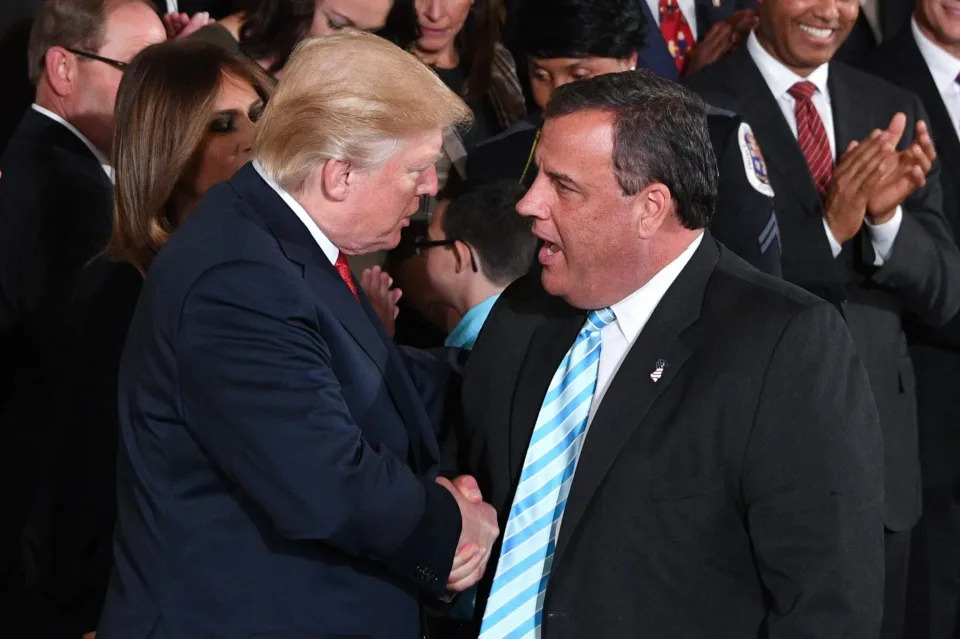
President Donald Trump shakes hands with New Jersey governor Chris Christie after he delivered remarks on combatting drug demand and the opioid crisis on October 26, 2017, in the East Room of the White House in Washington, D.C.
The party has reportedly amassed big bucks from dark-money donors, but it is missing the one thing most necessary for a presidential run: a human person willing to say, “I am the No Labels presidential candidate!” out loud without feeling profoundly embarrassed and ashamed.
This week, Christie became the latest big-name politician to pass on the opportunity.
The former GOP presidential candidate told The Washington Post in a statement: “While I believe this is a conversation that needs to be had with the American people, I also believe that if there is not a pathway to win and if my candidacy in any way, shape or form would help Donald Trump become president again, then it is not the way forward.”
That puts him very much at odds with No Labels, whose organizers surely recognize their candidate’s presence on the ballot might help Trump by pulling votes away from Biden.
I know the group doesn’t like labels, but it is clearly a threat to the incumbent and an asset to the guy who tried to overturn the last election.
My name is Rex Huppke, and I am the No Labels presidential candidate
Others who have said “Yeah, no” to No Labels included: former Maryland Gov. Larry Hogan, a Republican; Sen. Joe Manchin of West Virginia, a Democrat; and former Georgia Lt. Gov. Geoff Duncan, a Republican.
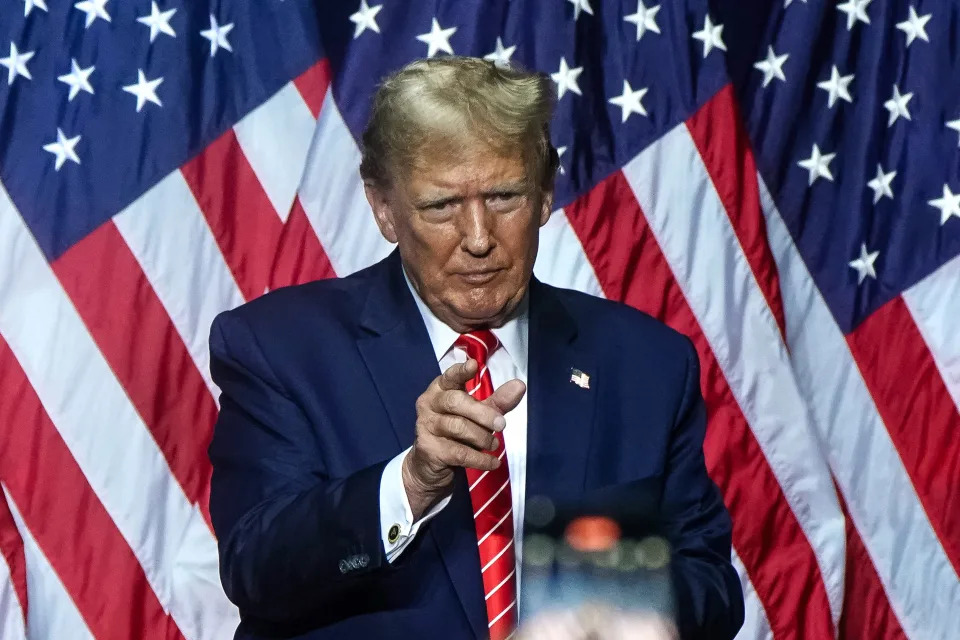
(FILES) Former President Donald Trump gestures to the crowd after speaking at a campaign event in Rome, Georgia, on March 9, 2024.
Since No Labels officials seem both unwilling to go away and unable to find anyone willing to play in their sandbox, I’ll take one for the team and be the group’s presidential candidate.
My platform will be: “For the love of God, please vote for Joe Biden. The other guy is, at best, dictator-curious, and he’s now selling $60 Bibles like some traveling huckster in a bad community theater musical.”
Getting to know the self-declared No Labels presidential candidate
Here is a candidate questionnaire so you can get to know me – Rex Huppke, the 2024 No Labels presidential candidate – a bit better.
Q: Why did you decide to join the No Labels ticket?
A: Well, for starters, I admire the party’s strong opposition to labels. I dislike labels, particularly the ones they put on apples at the grocery store. Those are hard to get off and sometimes I accidentally eat them.
Q: What should voters know about your key policy positions?
A: I don’t have any of those. I’m lucky if I can decide what I want for lunch, so asking me to decide how best to run the economy or deal with Russia is a fool’s errand. Absolutely nobody should vote for me. Ever. They should vote for President Joe Biden, who is by far the least likely of the two major party candidates to lock up journalists, forcibly silence dissenters and sell an entire U.S. state to a foreign power to help pay off his legal debts.
A: I guess I’d go with “incredibly selfish” and then perhaps “unconcerned about democracy” and “righteous to the point of arrogance and dismissive of all vulnerable groups that would be profoundly harmed by a second Trump presidency.”
Q: That sounds a little harsh.
A: Yeah, I guess I’m kind of labeling people a bit. The truth hurts sometimes. But when you think about it, even “No Labels” is a label, right? Like if someone called themselves a “centrist,” that’s a label. The only true “no label” would be … you know … not saying anything. Just kind of shutting up.
Q: Did you get high before this interview?
A: Yes. Yes I did. Nobody should vote for me. I am deeply unqualified. Please vote for Joe Biden.
USA TODAY columnist Rex Huppke has bravely stepped up and offered to be the No Labels presidential candidate. His platform is simple: “Please vote for Joe Biden.”
Q: Will you be picking a running mate?
A: Hah! No. If I’m the best No Labels could find for a presidential candidate, do you honestly think there’s a person alive who would stoop to being my vice president? No, the ticket is just me. And our slogan will be: “Huppke/Nobody 2024! A vote for us is dumb!”
The Unhinged Arguments the Supreme Court Is Fielding on Trump Immunity
Jose Pagliery – March 30, 2024
Photo Illustration by Elizabeth Brockway/The Daily Beast/Getty
Retired American generals vehemently say that no, Donald Trump cannot deploy SEAL Team 6 to kill a political rival. Gun groups howl that the United States is turning into Communist China. And a convicted Jan. 6 rioter warns that President Joe Biden could someday get sued over the death of a jogger in Georgia.
These are among the 18 various groups that shared their wisdom with the Supreme Court earlier this month, filing amicus briefs on the same day that Trump told the high court why he should be able to dodge a federal prosecution for trying to overturn the 2020 election on false pretenses.
Department of Justice Special Counsel Jack Smith’s election interference case against Trump has finally reached the nation’s highest judicial authority, which will determine whether the business tycoon can be put on trial. The timing of the nine justices’ eventual decision will determine if the presumptive 2024 Republican presidential nominee is to face trial in court before Election Day in November.
But ahead of oral arguments next month, the Supreme Court is already getting inundated with all kinds of opinions about the main question in the case: whether a former president enjoys immunity for actions made while at the White House.
The Daily Beast reviewed the litany of uninvited legal arguments spanning 599 pages, ranging from breathless reiterations of Trump’s claims to head-turning warnings. Yet all bear the signs of a historic case that could determine the fate of the election, if not American democracy.
The most unusual and unexpected amicus brief comes from three former high-ranking military leaders: Retired Lt. Gen. Keith Kellogg, who served as Trump’s own acting national security adviser; Robert Wilkie, who served as Trump’s Veterans Affairs Department secretary; and retired Lt. Gen. William “Jerry” Boykin, who once led the Army’s elite commandos in Delta Force and Green Berets.
The three former military men felt it necessary to join together and address—in public and at the national level—one of the crazier Trump legal arguments: that Trump’s immunity from criminal prosecution is so beyond question that it would allow him to order the assassination of his political enemies.
“No—the president cannot order SEAL Team Six to assassinate his political rival and have the military carry out such an order,” they clarified, marking the first time former military leadership has ever had to utter such a phrase in court.
The trio went further, pointing out that a Reagan-era executive order already prohibits anyone acting on behalf of the United States government from taking part in an assassination. They dedicated a significant portion of their 18-page court filing to making clear that military officers would be legally justified in refusing to even carry out an official order from their commander-in-chief, an assertion rarely made by military brass—and one that underlies just how stark their concerns are at this point.
“That a person is a political rival of the president is neither a justification nor an excuse for an unlawful killing. And deliberately carrying out an order to murder such a person would be acting upon a premeditated design to kill or an intent to kill. Therefore, any officer engaged in murder on the orders of a president would be subject to the death penalty or life in prison—and the officer would know it,” they wrote.
Meanwhile, the vast majority of the other amici curiae—the so-called “friends of the court” who weighed in to give the Supreme Court their two cents—largely sided with Trump.
The right-wing nonprofit America’s Future—which screened a bonkers QAnon Hollywood conspiracy “documentary” at Mar-a-Lago earlier this week—joined forces with Gun Owners of America and similar firearms associations to warn the high court that Smith’s prosecution was making the United States look more like China, Russia, or Zimbabwe.
“The prosecution of President Trump by the Biden Administration has a parallel to a recent event in Communist China,” they wrote, recalling the way former Chinese President Hu Jintao has vanished from public view ever since he was mysteriously escorted out of a public ceremony where he had been sitting next to his successor, Xi Jinping.
The United States is heading down that same route, they warned, lamenting “the explosion of lawfare” aimed at Trump for doing what they deemed totally sensible political speech—an argument that rests, in part, on the gun-toting petitioners’ continued rejection of the 2020 election results. They referenced Trump’s “supposed” defeat in Arizona and Georgia.
The real danger here, though, is that while Trump is currently polling strong, the gun groups concede that “the effect of a conviction may be very different and could determine the outcome of the election.”
But it wasn’t the conglomeration of Second Amendment enthusiasts that made a veiled threat over the high court decision. That came from an Alabama electrical engineer who’s become a political financier.
In his court filing, Shaun McCutcheon describes himself as “a successful, self-made American businessman and constitutional patriot.” And he warned Supreme Court justices that the country’s MAGA loyalists aren’t going to suddenly start trusting the U.S. court system to select fair-minded jurors.
“The former President’s tens of millions of supporters cannot reasonably be expected to accept the typical legal fictions of voir dire under such extreme circumstances,” his lawyer wrote.
McCutcheon assigns malicious intent to the Special Counsel’s decision to indict Trump in the largely liberal District of Columbia—never mind that the U.S. Constitution’s Sixth Amendment ensures that a person will be subjected to a speedy and public trial by an impartial jury drawn from the district where his alleged crime was committed, which in this case was the White House.
“A prosecutor appointed by a partisan presidential appointee of the opposing political party may prosecute a former president in a hand-picked venue deeply hostile to that former president, his beliefs, political expression, and legacy,” his lawyer wrote.
While the Supreme Court received various interpretations of presidential immunity that cast the Special Counsel’s investigations as a severe threat to the functions of the commander-in-chief’s job, the sharpest example came from someone who knows a thing or two about Trump’s insurrection.
In his brief, Treniss Evans argued that if Trump can be put on trial for allegedly masterminding a months-long and multi-pronged attack on U.S. democracy, then President Biden could be held personally responsible for the death in February of Georgia nursing student Laken Riley, given that an allegedly undocumented Venezuelan man was arrested for her killing.
“If a President doesn’t have immunity from prosecution for his actions, what prevents Georgia murder victim Laken Riley’s family from suing Joe Biden for allowing her illegal migrant murderer into the USA? Or what if hundreds of families all sued, seriatim?” his lawyer wrote, using the Latin phrase that means “one-by-one.”
Evans made the filing through his “legal advocacy group,” which bears the emotionally charged name Condemned USA. He trivialized Trump’s 2020 election fraud claims, but then went on to assert that Trump and his followers can’t possibly be accused of trying to stop certification of the election with a violent riot because technically Jan. 6, 2021, was just the official counting of the already certified votes before Congress.
The Supreme Court justices will get the sense that this topic is deeply personal for Evans. After all, his brief says right up top that “Mr. Evans has been investigating and reporting events of January 6th since January 6th, 2021. He was present at the Capitol on that day.”
In reality, he was in the violent crowd, held a bullhorn, and entered the Capitol—only to be identified by a Facebook tipster, arrested in Texas two months after the insurrection, and eventually sentenced to three years’ probation. To convince the federal judge to go easy on him, his other lawyer wrote that “Mr. Evans is quite self-reproving, sincerely remorseful, and duly contrite. He is embarrassed of this criminal conduct and the shame he has brought upon himself and his family. He has entered his plea of guilty voluntarily.”
But his March 19 brief before the Supreme Court doesn’t exactly hint at that remorse, nor does it morph into any critique of the man who called on him and others to show up that day and march on the Capitol Building.
Yet another legal advocacy firm asked the Supreme Court to give even more deference to Trump for the actions that led up to the disaster at the tail end of his presidency. The Christian Family Coalition Florida, a conservative Miami group that recently lent its support to Gov. Ron DeSantis’ crackdown on transgender kids in girls’ sports teams, reduced Trump’s election interference efforts to merely “core political speech.” And it would give future politicians carte blanche to lie—and follow through with those lies—regardless of their claim’s merit.
“For the sake of the presidency and the nation, criminal liability cannot turn on a mere factual dispute over whether an ex-president’s communications in challenging an election were ‘knowingly false,’” a lawyer for the group wrote.
In this Trump case, justices also heard from a favorite villain of the American progressive movement: Citizens United, the nonprofit behind the Supreme Court’s 2010 landmark decision that opened the door to having corporations spend unlimited funds on elections.
The group joined with two former U.S. Attorneys General: the Reagan administration’s Edwin Meese III, and the George W. Bush administration’s Michael B. Mukasey. Together, they tried to strip the current team of federal prosecutors going after Trump from any legitimacy.
They argued that Smith “wields tremendous power, effectively answerable to no one, by design.” And they contend that’s something he can’t do without the Senate’s confirmation. Instead, they say, AG Merrick Garland should have taken the same approach he did with the separate Hunter Biden investigation and tap an existing, Senate-confirmed federal prosecutor in charge of a regional office, like Delaware U.S. Attorney David Weiss.
The two conservative former AGs and the nonprofit also claim that most cabinet officials have the authority to appoint officers—minus the Justice Department, a proposition that would give the heads of Agriculture, Education and Homeland Security departments more leeway than the nation’s attorney general. And they warn that Garland’s actions could “create by regulation an entire shadow Department of Justice.”
But leave it to a consortium of 18 state attorneys general—all pro-Trump Republicans led by Alabama AG Steve Marshall—to make the one point everyone can probably agree on.
“If he had not been president, none of this would be happening,” they wrote.