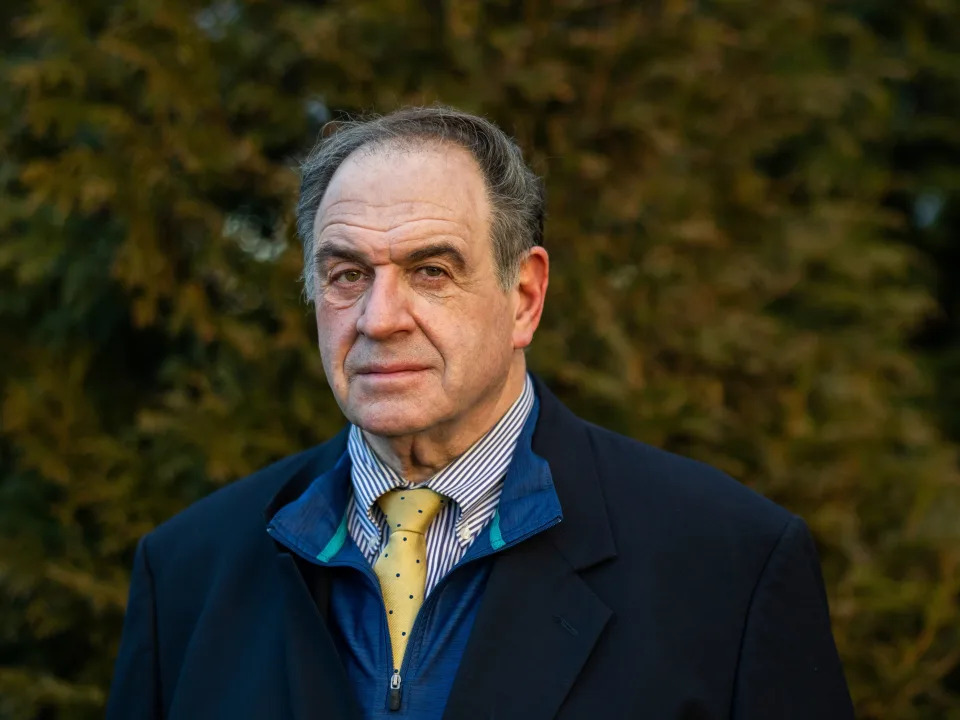
Amy Coney Barrett’s Husband Has a New Client—and It’s Disturbing
Talia Jane – May 29, 2024
According to an exclusive report fromRolling Stone, Supreme Court Justice Amy Coney Barrett’s husband, Jesse Barrett, is now repping Fox Corporation in a $3 million defamation suit, raising questions about conflicts of interest and personal enrichment enjoyed by conservative Supreme Court justices.
As Rolling Stonepoints out, the case is notable because Fox Corporation—the parent company of Fox News—is directly paying the family of a Supreme Court justice, which neither Barrett nor her husband are required to disclose. Barrett’s husband is a managing partner at SouthBank Legal, which opened its D.C. office—led by Barrett—after his wife joined the Supreme Court. Jesse Barrett’s list of anonymized cases on the SouthBank Legal website now includes “represented a prominent media company in a lawsuit alleging defamation.” That addition joins an already lengthy list of white-collar cases on his company profile, tucked between defending a Berkshire Hathaway company in an employment discrimination suit and defending an event promoter from fraud claims.
The defamation lawsuit Jesse Barrett has taken on alleges that Fox 32—a Chicago-area local station for Fox—ran a hit piece about Lavell Redmond who in 2021 was hired by the mayor of Dolton, Illinois, to work as a building code enforcement officer. The Fox report centers Redmond’s conviction for aggravated sexual assault of a minor, for which he pleaded guilty and served 24 years in prison, as the crux of the story while claiming Redmond was hired to enter “into Dolton homes and businesses to inspect them.” Redmond disputes this claim in his suit, according to Rolling Stone, noting that his work entailed inspecting building exteriors, not entering people’s homes.
The outlet later followed up on its reporting with news that Redmond had been arrested and may face new charges for violating the conditions of the sex offender registry—an accusation Redmond alleges is the direct result of Fox’s earlier misleading reporting on his job duties.
Barrett, representing Fox, filed a motion to dismiss the lawsuit, according to Rolling Stone. The motion to dismiss claims the suit was filed too late and that the corporation didn’t commit defamation because the “gist” of the reporting was “indisputably true” and characterized the central outrage of Redmond’s hiring—that a sex offender was entering people’s homes, which resulted in his arrest—as “immaterial details.”
While the relationship between conservative justices and right-wingers continuously raises ethical concerns, constitutional law professor Anthony Michael Kreis noted the odds of Fox Corporation’s case being kicked up to the conservative-held Supreme Court are slim given that Barrett would have to recuse herself from the case, winnowing the number of Fox News–brained justices on the court.
“You don’t hire the spouse of a Supreme Court justice to represent you in major litigation unless (1) you think they’re competent to do so and (2) you don’t foresee going to the Supreme Court where the spouse would have to recuse and you might really want/need their vote,” Kreis wrote on X (formerly Twitter).
Regardless, it’s entirely too convenient that the husband of a conservative Supreme Court justice is representing a conservative media company, and poses curious questions as to why Barrett, who is based in D.C., was tapped to represent the media company based in New York City for a lawsuit filed by a man in Illinois.
North Korea Accused of Launching Floating Poop Balloon Attack
Dan Ladden-Hall – May 29, 2024
Yonhap via Reuters
South Korea’s military on Wednesday accused North Korea of floating balloons loaded with trash and manure across the border and immediately demanded that Pyongyang halt its “inhumane and vulgar” operation.
More than 260 balloons have already been detected in South Korea since the operation began on Tuesday night, South Korea’s Joint Chiefs of Staff said. Images released by the military appear to show the balloons carrying plastic bags—one of which had the word “excrement” written on the side, according to Reuters.
A JCS official told the Seoul-based Yonhap News Agency that the balloons—all of which have fallen to the ground—carried trash, including bits of shoes, plastic bottles, and manure.
No damage or injuries have been reported so far in connection with the balloons, but the military has deployed bomb disposal units and other experts to collect them. Residents have been warned against touching the objects.
“These acts by North Korea clearly violate international law and seriously threaten our people’s safety,” the JCS said, adding a stern warning to “North Korea to immediately stop its inhumane and vulgar act.”
The balloons started arriving days after Kim Kang Il, North Korea’s vice defense minister, slammed propaganda leaflets criticizing the Pyongyang regime that North Korean defectors in the South have been attaching to balloons and sending northward for years.
The minister on Sunday accused Seoul of “despicable psychological warfare” by “scattering leaflets and various dirty things near border areas” and vowed to deliver “tit-for-tat action” in response.
“Mounds of wastepaper and filth will soon be scattered over the border areas and the interior of [South Korea] and it will directly experience how much effort is required to remove them,” he said.
These Insiders Know What Awaits Trump Lawyer Todd Blanche if He Loses
Justin Rohrlich – May 29, 2024
Photo Illustration by Thomas Levinson/The Daily Beast/Getty
The one man perhaps even more anxious for a verdict in the Trump hush-money trial than Donald Trump himself is Todd Blanche.
Trump has already reportedly expressed his frustration with Blanche, his latest defense attorney, and if he loses, Trump’s modus operandi is to go on the offensive. That’s because there are two types of people in Donald Trump’s personal orbit: those who have been publicly trashed by the former president, and those who will be.
“There is no public client quite like Mr. Trump,” former Trump lawyer Jenna Ellis told The Daily Beast. “While every person deserves competent counsel, that counsel also deserves loyalty from their client. Loyalty goes one way with Trump. The problem with the current MAGA base is that they will take whatever position Trump tells them to.”
The twice-impeached ex-commander-in-chief has openly lambasted, to name but a few, his own national security adviser, John Bolton (“one of the dumbest people in Washington”); his own Joint Chiefs of Staff chair, Gen. Mark Milley (“a Woke train wreck”); his own attorney general, William Barr (“a coward who didn’t do his job”); his own UN ambassador, Nikki Haley (“birdbrain”); his own secretary of state, Rex Tillerson (“lazy as hell”), campaign adviser Steve Bannon (“Sloppy Steve”), and his own vice-president, Mike Pence (“wimp,” “traitor,” “not a very good person”).
Trump has hurled insults at judges and at least one state attorney general. He has also not been kind to the various lawyers he has used up and discarded, calling, for example, his onetime personal attorney and “fixer” Michael Cohen a “bad lawyer and fraudster” after Cohen turned on him in 2019. Last month, Trump began badmouthing Blanche, a former federal prosecutor and his lead defense attorney trying to help him beat back 34 felony counts related to a $130,000 hush money payment to porn star Stormy Daniels (“Horseface”), according to sources who spoke to The New York Times. Trump has reportedly bellyached that Blanche isn’t sufficiently deferential to his strategic ideas, and wanted to see Blanche be more aggressive in attacking witnesses.
Closing arguments began on Tuesday; a verdict is expected as early as this week. But what will become of Blanche if Trump is found guilty?
Todd Blanche (right) in Manhattan Criminal Court with Donald Trump during the former president’s criminal hush money trial.Mark Peterson-Pool/Getty Images
To Ellis, who in October pleaded guilty to a felony charge of aiding and abetting false statements in service of Trump’s attempt to overturn the results of the presidential 2020 election, the outcome is highly predictable.
“If Trump decides to publicly trash or blame Todd Blanche and the other attorneys, I’d bet that MAGA immediately brands them ‘the worst lawyers ever’ …instead of recognizing that lawyers can only do as much as they can with the situation—and client—they have,” she said. “From what I have seen, the defense team has done the best they could. Trump frankly is lucky he can even get anyone competent to agree to represent him at this point and I think he would be wise not to trash his lawyers.”
Former White House lawyer Ty Cobb, who represented Trump during the Mueller investigation, has been on the receiving end of Trump’s wrath. After Cobb said last year that Trump’s defense was weak in the ongoing federal case against him for purloining classified documents when he left the Oval Office and refusing to return them, Trump took to his Twitter clone, Truth Social, to denigrate him.
“Ty Cobb is a disgruntled former Lawyer, who represented me long ago, and knows absolutely nothing about the Boxes Hoax being perpetrated upon me,” Trump posted in response. “…His words are angry, nasty, and libelous, only because I did not continue using him (and paying him), and for good reason.”
Jenna Ellis with Rudy Giuliani in 2020.Rey Del Rio/Getty Images
For his part, Cobb doesn’t envision any scenario under which Trump beats the hush money charges.
“The chance of an acquittal is zero to none,” Cobb told The Daily Beast, adding that the odds of a hung jury are “real,” but “not likely.”
However, whether or not Blanche remains on Trump’s legal team is up in the air, he said.
“Who knows, in terms of how Trump will treat his lawyers,” Cobb continued, noting that Manhattan defense attorney Joe Tacopina, who represented Trump in his unsuccessful libel case against writer E. Jean Carroll, withdrew from the hush-money case earlier this year, saying he had to “follow my compass.”
However, attorney Alina Habba, who replaced Tacopina on the Carroll case and proceeded to lose Trump $83 million, “is still on the payroll. So, you don’t really know with him. Now, Todd’s not as attractive as Alina, so…”
Cobb described Blanche as “a cut above, talent-wise and experience-wise, than most of the lawyers in the Trump stable—not all, but many of them, certainly Habba—and I would suspect him to remain on the team.”
“I think Blanche stays on the team,” Cobb went on. “He should stay on the team. Although he was a little less comfortable in court than I expected. I saw a lot of reporting [on Tuesday] that he seemed a little nervous and not necessarily as confident, at least in their assessment… But he’s got the skill set and the experience to do this well.”
Former Trump attorney Ty Cobb.Jerry Cleveland/The Denver Post via Getty Images
Blanche, who used to work as an assistant U.S. attorney in the Southern District of New York, was well respected by his peers there, according to Cobb, citing personal relationships with several of Blanche’s former coworkers. (Blanche did not respond to The Daily Beast’s request for comment on Tuesday.)
“It’d be a real mistake to take Blanche off the team,” Cobb said. “On the other hand, [Trump] has gone through some excellent lawyers.”
A third former member of Trump’s orbit, who asked that their name not be used so as to avoid taking additional public flak from the ex-president, predicts Blanche will quickly become “a target” if Trump loses the case.
“He turns on everyone,” the source told The Daily Beast.
Many of the lawyers who have become overly involved with Trump go on to face criminal charges of their own, are sued, or eventually disbarred, according to the source. They said they believe Blanche “crossed that rubicon—he put all his eggs into [Trump’s] basket, and that’s not a healthy basket, because the eggs eventually go rotten… Rudy Giuliani was his best friend; he turned his back on him in two seconds. He’s disbarred, he’s twice-indicted, he’s bankrupt, he’s a laughing stock. He’s got nothing left.”
If Trump would do this to Giuliani, the source continued, “he’ll do it to anybody.”
“This guy is kryptonite,” they said. “He really is. You know you’re gonna take shrapnel. But then you still get abandoned.”
Honorary degree recipient Ken Burns delivers the Undergraduate Commencement speech at Brandeis University’s 73rd Commencement Exercises on May 19, 2024.
Transcript
Brandeisian, love it.
President Liebowitz, Ron, Chair Lisa Kranc, and other members of the board of trustees, Provost Carol Fierke, fellow honorees, distinguished faculty and staff, proud and relieved parents, calm and serene grandparents, distracted but secretly pleased siblings, ladies and gentlemen, graduating students of the class of 2024, good morning.
I am deeply honored and privileged that you have asked me here to say a few words at such a momentous occasion that you might find what I have to say worthy of your attention on so important a day in all of your lives. Thank you for this honor.
Listen, I am in the business of history. It is not always a happy subject on college campuses these days, particularly when forces seem determined to eliminate or water down difficult parts of our past, particularly when the subject may seem to sum an anachronistic and irrelevant pursuit, and particularly with the ferocious urgency this moment seems to exert on us. It is my job, however, to remind people of the power our past also exerts, to help us better understand what’s going on now with compelling story, memory, and anecdote. It is my job to try to discern patterns and themes from history to enable us to interpret our dizzying and sometimes dismaying present.
For nearly 50 years now, I have diligently practiced and rigorously tried to maintain a conscious neutrality in my work, avoiding advocacy if I could, trying to speak to all of my fellow citizens. Over those many decades I’ve come to understand a significant fact, that we are not condemned to repeat, as the saying goes, what we don’t remember. That is a beautiful, even poetic phrase, but not true. Nor are there cycles of history as the academic community periodically promotes. The Old Testament, Ecclesiastes to be specific, got it right, I think. What has been will be again, what has been done will be done again. There is nothing new under the sun. What those lines suggest is that human nature never changes or almost never changes. We continually superimpose that complex and contradictory human nature over the seemingly random chaos of events, all of our inherent strengths and weaknesses, our greed and generosity, our puritanism and our prurience, our virtue, and our venality parade before our eyes, generation after generation after generation. This often gives us the impression that history repeats itself. It does not. “No event has ever happened twice, it just rhymes,” Mark Twain is supposed to have said. I have spent all of my professional life on the lookout for those rhymes, drawn inexorably to that power of history. I am interested in listening to the many varied voices of a true, honest, complicated past that is unafraid of controversy and tragedy, but equally drawn to those stories and moments that suggest an abiding faith in the human spirit, and particularly the unique role this remarkable and sometimes also dysfunctional republic seems to play in the positive progress of mankind.
During the course of my work, I have become acquainted with hundreds if not thousands of those voices. They have inspired, haunted, and followed me over the years. Some of them may be helpful to you as you try to imagine and make sense of the trajectory of your lives today.
Listen, listen. In January of 1838, shortly before his 29th birthday, a tall, thin lawyer prone to bouts of debilitating depression addressed the young men’s lyceum in Springfield, Illinois. “At what point shall we expect the approach of danger?” He asked his audience, “Shall we expect some trans-Atlantic military giant to step the earth and crush us at a blow?” Then he answered his own question. “Never. All the armies of Europe, Asia, and Africa could not by force take a drink from the Ohio River or make a track on the Blue Ridge in a trial of a thousand years. If destruction be our lot, we must ourselves be its author and finisher. As a nation of free men, we must live through all time or die by suicide.” It is a stunning, remarkable statement, one that has animated my own understanding of the American experience since I first read it more than 40 years ago. That young man was of course Abraham Lincoln, and he would go on to preside over the closest this country has ever come to near national suicide, our civil war, and yet embedded in his extraordinary, disturbing, and prescient words is also a fundamental optimism that implicitly acknowledges the geographical forcefield two mighty oceans east and west and two relatively benign neighbors north and south have provided for us since the British burned the White House in the War of 1812 and inspired Francis Scott Key.
Lincoln’s words that day suggest what is so great and so good about the people who happen to inhabit this lucky and exquisite country of ours. That’s the world you now inherit: our work ethic and our restlessness, our innovation and our improvisation, our communities and our institutions of higher learning, our suspicion of power. The fact that we seem resolutely dedicated to parsing the meaning between individual and collective freedom; What I want versus what we need. That we are all so dedicated to understanding what Thomas Jefferson really meant when he wrote that mysterious phrase, “The pursuit of happiness”. Hint, it happens right here in the lifelong learning and perpetual improvement this university is committed to.
But the isolation of those two oceans has also helped to incubate habits and patterns less beneficial to us: our devotion to money and guns and conspiracies, our certainty about everything, our stubborn insistence on our own exceptionalism blinding us to that which needs repair, especially with regard to race and ethnicity. Our preoccupation with always making the other wrong at an individual as well as a global level. I am reminded of what the journalist I.F. Stone once said to a young acolyte who was profoundly disappointed in his mentor’s admiration for Thomas Jefferson. “It’s because history is tragedy,” Stone admonished him, “Not melodrama.” It’s the perfect response. In melodrama all villains are perfectly villainous and all heroes are perfectly virtuous, but life is not like that. You know that in your guts and nor is our history like that. The novelist, Richard Powers recently wrote that, “The best arguments in the world,” — and ladies and gentlemen, that’s all we do is argue — “the best arguments in the world,” he said, “Won’t change a single person’s point of view. The only thing that can do that is a good story.” I’ve been struggling for most of my life to do that, to try to tell good, complex, sometimes contradictory stories, appreciating nuance and subtlety and undertow, sharing the confusion and consternation of unreconciled opposites.
But it’s clear as individuals and as a nation we are dialectically preoccupied. Everything is either right or wrong, red state or blue state, young or old, gay or straight, rich or poor, Palestinian or Israeli, my way or the highway. Everywhere we are trapped by these old, tired, binary reactions, assumptions, and certainties. For filmmakers and faculty, students and citizens, that preoccupation is imprisoning. Still, we know and we hear and we express only arguments, and by so doing, we forget the inconvenient complexities of history and of human nature. That, for example, three great religions, their believers, all children of Abraham, each professing at the heart of their teaching, a respect for all human life, each with a central connection to and legitimate claim to the same holy ground, violate their own dictates of conduct and make this perpetually contested land a shameful graveyard. God does not distinguish between the dead. “Could you?”
[Audience applauding]
“Could you?” A very wise person I know with years of experience with the Middle East recently challenged me, “Could you hold the idea that there could be two wrongs and two rights?”
Listen, listen. In a filmed interview I conducted with the writer James Baldwin, more than 40 years ago, he said, “No one was ever born who agreed to be a slave, who accepted it. That is, slavery is a condition imposed from without. Of course, the moment I say that,” Baldwin continued, “I realize that multitudes and multitudes of people for various reasons of their own enslave themselves every hour of every day to this or that doctrine, this or that delusion of safety, this or that lie. Anti-Semites, for example,” he went on, “are slaves to a delusion. People who hate Negroes are slaves. People who love money are slaves. We are living in a universe really of willing slaves, which makes the concept of liberty and the concept of freedom so dangerous,” he finished. Baldwin is making a profoundly psychological and even spiritual statement, not just a political or racial or social one. He knew, just as Lincoln knew, that the enemy is often us. We continue to shackle ourselves with chains we mistakenly think is freedom.
Another voice, Mercy Otis Warren, a philosopher and historian during our revolution put it this way, “The study of the human character at once opens a beautiful and a deformed picture of the soul. We there find a noble principle implanted in the nature of people, but when the checks of conscience are thrown aside, humanity is obscured.” I have had the privilege for nearly half a century of making films about the US, but I have also made films about us. That is to say the two letter, lowercase, plural pronoun. All of the intimacy of “us” and also “we” and “our” and all of the majesty, complexity, contradiction, and even controversy of the US. And if I have learned anything over those years, it’s that there’s only us. There is no them. And whenever someone suggests to you, whomever it may be in your life that there’s a them, run away. Othering is the simplistic binary way to make and identify enemies, but it is also the surest way to your own self imprisonment, which brings me to a moment I’ve dreaded and forces me to suspend my longstanding attempt at neutrality.
There is no real choice this November. There is only the perpetuation, however flawed and feeble you might perceive it, of our fragile 249-year-old experiment or the entropy that will engulf and destroy us if we take the other route. When, as Mercy Otis Warren would say, “The checks of conscience are thrown aside and a deformed picture of the soul is revealed.” The presumptive Republican nominee is the opioid of all opioids, an easy cure for what some believe is the solution to our myriad pains and problems. When in fact with him, you end up re-enslaved with an even bigger problem, a worse affliction and addiction, “a bigger delusion”, James Baldwin would say, the author and finisher of our national existence, our national suicide as Mr. Lincoln prophesies. Do not be seduced by easy equalization. There is nothing equal about this equation. We are at an existential crossroads in our political and civic lives. This is a choice that could not be clearer.
[Audience applauding]
Listen, listen. 33 years ago, the world lost a towering literary figure. The novelist and storyteller, not arguer, Isaac Bashevis Singer. For decades he wrote about God and myth and punishment, fate and sexuality, family and history. He wrote in Yiddish a marvelously expressive language, sad and happy all at the same time. Sometimes maddeningly all knowing, yet resigned to God’s seemingly capricious will. It is also a language without a country, a dying language in a world more interested in the extermination or isolation of its long suffering speakers. Singer, writing in the pages of the Jewish Daily Forward help to keep Yiddish alive. Now our own wonderfully mongrel American language is punctuated with dozens of Yiddish words and phrases, parables and wise sayings, and so many of those words are perfect onomatopoeias of disgust and despair, hubris and humor. If you’ve ever met a schmuck, you know what I’m talking about. [audience laughs] Toward the end of his long and prolific life, Singer expressed wonder at why so many of his books written in this obscure and some said useless language would be so widely translated, something like 56 countries all around the world. “Why,” he would wonder with his characteristic playfulness, “Why would the Japanese care about his simple stories of life in the shtetls of Eastern Europe 1,000 years ago?” “Unless,” Singer paused, twinkle in his eye, “Unless the story spoke of the kinship of the soul.” I think what Singer was talking about was that indefinable something that connects all of us together, that which we all share as part of organic life on this planet, the kinship of the soul. I love that.
Okay, let me speak directly to the graduating class. Watch out, here comes the advice. Listen. Be curious, not cool. Insecurity makes liars of us all. Remember, none of us get out of here alive. The inevitable vicissitudes of life, no matter how well gated our communities, will visit us all. Grief is a part of life, and if you explore its painful precincts, it will make you stronger. Do good things, help others. Leadership is humility and generosity squared. Remember the opposite of faith is not doubt. Doubt is central to faith. The opposite of faith is certainty. The kinship of the soul begins with your own at times withering self-examination. Try to change that unchangeable human nature of Ecclesiastes, but start with you. “Nothing so needs reforming,” Mark Twain once chided us, “As other people’s habits.” [audience laughs]
Don’t confuse success with excellence. Do not descend too deeply into specialism. Educate all of your parts, you will be healthier. Do not get stuck in one place. “Travel is fatal to prejudice,” Twain also said. Be in nature, which is always perfect and where nothing is binary. Its sheer majesty may remind you of your own atomic insignificance, as one observer put it, but in the inscrutable and paradoxical ways of wild places, you will feel larger, inspirited, just as the egotist in our midst is diminished by his or her self regard.
At some point, make babies, one of the greatest things that will happen to you, I mean it, one of the greatest things that will happen to you is that you will have to worry, I mean really worry, about someone other than yourself. It is liberating and exhilarating, I promise. Ask your parents.
[Audience laughs]
Choose honor over hypocrisy, virtue over vulgarity, discipline over dissipation, character over cleverness, sacrifice over self-indulgence. Do not lose your enthusiasm, in its Greek etymology the word enthusiasm means simply, “god in us”. Serve your country. Insist that we fight the right wars. Denounce oppression everywhere.
[Audience applauding]
Convince your government, as Lincoln understood that the real threat always and still comes from within this favored land. Insist that we support science and the arts, especially the arts.
[Audience cheering]
They have nothing to do with the actual defense of our country; They just make our country worth defending.
[Audience applauding]
Remember what Louis Brandeis said, “The most important political office is that of the private citizen.” Vote. You indelibly… [audience applauding] Please, vote. You indelibly underscore your citizenship, and most important, our kinship with each other when you do. Good luck and godspeed.
Putin Hints at Bombing Other ‘Densely Populated’ Nations
Allison Quinn – May 28, 2024
Getty Images
Russia’s Vladimir Putin lashed out Tuesday at European countries that are considering giving permission to Ukraine to use their weapons for strikes on Russian territory.
Speaking in Tashkent during a two-day visit to Uzbekistan, Putin warned of “serious consequences” if Western weapons are allowed in attacks on Russian soil.
“In Europe, especially in small countries, they should realize what they are playing with. They should remember that they are countries with small, densely populated territories… This is a factor they should keep in mind before talking about striking Russia,” he said.
His comments came as more and more European leaders expressed support for Ukraine taking the war to Russian territory at a meeting of defense ministers on Tuesday.
EU foreign policy chief Josep Borrell said it is “perfectly possible” for Ukraine to strike targets inside Russia and there is “no contradiction” with the laws of war. “You have to balance the risk of escalation and the need for Ukrainians to defend,” he said, according to Agence France-Presse. Dutch Defense Minister Kajsa Ollongren said the Netherlands would not stop Ukraine from attacking targets on Russian territory, and that she hoped “other countries that have different positions will change that.”
Hanno Pevkur, the defense minister of Estonia, said, “It cannot be normal that Russia is attacking from very deep into Ukrainian territory and the Ukrainians are fighting with one hand behind their back.”
NATO chief Jens Stoltenberg called on NATO officials to reconsider prohibiting Ukraine from using Western-supplied weapons to strike “legitimate targets” outside the country earlier this week. The Biden administration has repeatedly cautioned against Ukraine using American-made weapons to strike inside Russia, though officials are now reportedly debating whether to change that policy.
2 Yale researchers are pulling back the curtain on Russia’s sanctions-stricken economy — and it’s landed them on a list of Putin’s enemies
Jennifer Sor – May 25, 2024
Jeffery Sonnenfeld and Steven Tian have landed themselves on a list of sanctioned individuals for their work shining a light on Russia’s economic situation.Mikhail Klimentyev/Sputnik AFP
Jeffrey Sonnenfeld and Steven Tian, two Yale researchers, have issued dire predictions for Russia’s economy.
Their work has landed them on a list of sanctioned individuals in Russia.
In their view, the country’s economy is in shambles, and Putin could end up losing support of the people.
Jeffrey Sonnenfeld and Steven Tian, two researchers at the Yale School of Management, have been targeted for their views on Russia’s economy since the war in Ukraine began.
Over the last few years, they’ve found themselves on Vladimir Putin’s watch list for stating what they see as a simple truth: the Russian economy is in trouble, and there’s only so much cherry-picking of the data that can obscure that fact.
Moscow has fiercely defended its vision of a prospering economy, but the evidence speaks for itself, Sonnenfeld and Tian say. Soaring prices and ailing consumer sentiment have hit key sectors in Russia’s economy, and Moscow is paying a huge cost to keep its war machine running.
The nation is in such dire straits that citizens could even start turning on Putin later this year, they predicted, assuming the West continues to supply military and financial aid to Ukraine.
“We can list for you what Putin has concealed – suddenly – the past three years. If his economy was performing at the level he claims, he’d provide the data ad not hide those facts,” Sonnenfeld told Business Insider in an interview. “Putin survives only by cannibalizing Russian businesses – throwing the living room furniture into the furnace to keep the fire burning.”
Jeffrey SonnenfeldCourtesy of Jeffrey Sonnenfeld
The researchers, who met as a professor-student pair at Yale, have received a lot of criticism for their work on Russia, much of it in the form of hate mail and threatening phone calls.
“I’ve had a lot of threats on the phone, and my home has been vandalized,” Sonnenfeld told BI last summer. “Now we have so many security cameras I can’t even have my shirt tails untucked, let alone walk around in my shorts at home.”
Both are barred from entering Russia and were put on the nation’s sanctioned US citizens list in 2022.
Still, neither of them regrets their work.
“We’re pretty excited about it,” they said of their research. “Any of the threats only motivate us to work down much harder.”
Putin’s top critics
Sonnenfeld, 70, and Tian, 25, didn’t plan on getting their names added to a list of Putin’s critics.
Neither are technically economists, but they began researching Russia’s economy while compiling a list of companies that exited or scaled back their operations in Russia in the wake of the invasion of Ukraine.
That list went viral online, and was instrumental in getting more than 1,000 companies to scale back their business in the country, the Yale School of Management says on its website.
Steven Tian headshot
Steven TianCourtesy of Steven Tian
At that time, Tian and Sonnenfeld began noticing cracks forming in Russia’s economy. Putin has claimed Russia is becoming the new “growth hub” of the world, and the IMF says Russia’s economy is on track to grow over 3% this year, more than any other OECD economy, including the US. But that doesn’t square with data Sonnenfeld and Tian are seeing, with some pockets of the country’s economy in dire shape.
Among their biggest predictions is that the situation in Russia is so bad that the country could eventually turn on Putin, with a shift in the domestic temperament coming as soon as the November US presidential election this year.
That’s because if Biden is re-elected, the US will likely continue supplying aid to Ukraine, forcing Russia to continue spending money and lives to keep waging war on Ukraine.
“Putin has no grand strategy other than to hope Trump wins and cuts a favorable deal with Russia,” Tian said. “Russia is in for a world of economic pain for a long time to come.”
Positive forecasts on Russia’s economy are based on a lack of visibility, Sonnenfeld and Tian say.
The pair began working together when Tian was an undergraduate at Yale, chasing Sonnenfeld around lecture halls. Eventually, Sonnenfeld became Tian’s advisor and has mentored Tian for over eight years.
The two researchers are still working on ways to urge the West to tighten and enforce sanctions on Russia. They also continue to update their list of companies that have exited the country in the hope that it will encourage more firms to do the same.
Colleagues describe Sonnenfeld as opinionated but generous and charismatic. Tian, meanwhile, has a near-photographic memory and is a highly analytical thinker, colleagues mentioned.
“Steven does a lot of the analytic heavy lifting, and I do the flamboyant color,” Sonnenfeld said of their work together.
People who have worked with them also say the pair is extremely passionate about their work, and both are often known to answer emails at all hours of the night and early morning.
“We don’t believe in regular sleep patterns,” Sonnenfeld added. “Actually, we know it’s very important, but sometimes when there’s a sense of urgency, we do seriously dive into the crisis du jour. We just don’t like bullies, whether or not it’s Putin or some other bravado.”
Former President Donald Trump speaks at a rally at Crotona Park in the Bronx on Thursday, May 23, 2024. (Hiroko Masuike/The New York Times)
NEW YORK — When his criminal trial finishes for the day, Donald Trump typically returns to the marble-and-gold triplex atop Trump Tower, the high rise he built in the early 1980s and used to establish a public image as a master builder.
It is the silver lining for Trump, as he spends his first sustained period of time in Manhattan since he moved to Washington in 2017. He passes the days in a dingy courtroom downtown, where he faces 34 felonies, listening to people from his old life describe him as a depraved liar who sullied the White House. At the end of it all, he could be sent to prison.
But in the evenings, people who have spoken to him say, he has been enjoying being back in the penthouse apartment that he moved into four decades ago. He still considers it home — and a permanent reminder of the easiest period of his life.
That period was the greed-is-good era in which Trump sold himself nationally as a titan of industry, despite a relatively small, and local, real estate portfolio. He had just built a glittering tower on Fifth Avenue, infuriating elites and demanding a tax break from the city. And it is the era he alludes to constantly, referring to 1980s cultural touchstones, including the news show “60 Minutes,” Time magazine and celebrities like boxer Mike Tyson.
It is also the last time Trump’s preferred public image was intact, and it soon came crashing down. The decade ended with a monthslong tabloid war in which people around the city chose sides between him and his first wife, Ivana. At the same time, the image-obsessed Trump was the subject of one investigative story after another, making clear he had far less money than it had seemed, had relied on his father for help and had managed his empire into something close to ruin.
It was in the ’80s that he was in a public dance over whether he wanted to be accepted by elites or throw stones at them, marked most visibly by his decision to smash art deco friezes that had been atop the building he razed to construct Trump Tower.
Yet despite the claims that the city’s power brokers all sneered at him, Trump was humored, indulged and even accepted by some of them. The ’80s were a time when, his path having been helped by his father’s connections in the corrupt Brooklyn political machine, he was developing relationships with publishing titans such as S.I. Newhouse and hanging out in the stadium box held for George Steinbrenner, the New York Yankees owner.
Trump had begun a budding and durable association with one of the city’s power brokers, Manhattan District Attorney Robert Morgenthau, a man whose proximity gave Trump a sense of comfort, according to former Trump Organization employees, and who Trump has said would never have stood for the charges against him.
“It’s absolutely true — that was his golden time, no question,” said Andrew Stein, who was the City Council president in the 1980s and still supports Trump after having briefly suggested he should bypass his third presidential campaign.
Even being president — moving to a city and a world where the rules and laws were foreign and uninteresting to him, and where the establishment rejected him before he arrived — rarely seemed to delight Trump the way that holding court at the 21 Club in midtown Manhattan did.
The trial has highlighted the parts of Trump’s makeup that became clear in the decade that followed, in the 1990s, the ones less immediately apparent after the fame afforded him by his ghostwritten 1987 book, “The Art of the Deal.” The courtroom days have repeatedly touched on his penchant for payback, his love of fixers to defend him, his obsession with being seen as a playboy, his business practices at what is essentially a mom-and-pop company.
But they have also underscored the reality that a man who spent years building an artifice about himself in the press and on TV managed to capture the presidency, when suddenly the question of what parts of him were real or fake was obscured by the power of the Oval Office, a giant government infrastructure and tens of millions of people who had cast ballots for him.
The era that shaped Trump was perhaps best encapsulated by author Tom Wolfe in “The Bonfire of the Vanities,” in which a wealthy investment banker strikes a young Black man in a hit-and-run in the Bronx amid widespread racial tensions, and is ultimately tried in the borough’s beaten-down criminal courthouse as the tabloids devour the story.
It was a building not unlike the one in which Trump has sat most days each week for six weeks, the fluorescent lighting beaming down on the decrepit benches and the letters reading “In God We Trust” over Justice Juan M. Merchan’s head.
Some days, Trump has eviscerated his lawyers and complained privately that he has no Roy Cohn, his original fixer and mentor and lawyer. Like Trump, Cohn was born into outer-borough privilege and then alternately reviled and accepted by powerful people. Cohn, a closeted gay man who tried to purge the federal government of gay people, died in 1986; he had AIDS but told people it was liver cancer.
Cohn, whose connections included President Ronald Reagan, Rupert Murdoch and mobsters, had introduced the Queens-bred Trump to a new world and had taught him to always deny wrongdoing, to attack his attackers and to seek lawyers willing to do anything. But at the start of the ’80s, as he was gaining respectability himself, Trump already seemed ready to put some distance between himself and Cohn.
“All I can tell you is he’s been vicious to others in his protection of me,” Trump told journalist Marie Brenner a few years before Cohn’s death. “He’s a genius. He’s a lousy lawyer, but he’s a genius.”
Trump essentially dropped Cohn, who had been indicted repeatedly, when he fell ill. It was later that Trump lionized Cohn, despite his own criticism of his mentor, as the ideal that his other lawyers, including the new ones he dealt with in Washington, should strive to live up to.
Trump never spent much time back at Trump Tower while he was president. Most weekends, he traveled to Mar-a-Lago, in Palm Beach, Florida, or to Bedminster, New Jersey. He said he was avoiding Manhattan because his motorcade would snarl traffic. But Manhattan had rejected him at the ballot box. Residents had even laughed in his face as he went to vote on Election Day in 2016; one told him, “You’re gonna lose!”
And so in September 2019, after consulting his tax lawyers, Trump rejected Manhattan right back, switching his residence to Florida. By the time he left office, 14 days after an attack on the Capitol by a pro-Trump mob, he was close to done trying to appease anyone but himself.
This month, the former president and presumptive Republican nominee has sought to troll the city he left, to show he can still dominate a place that, in the post-pandemic period, has continued to feel off-kilter.
On Thursday evening, he held a rally of thousands of people not in Manhattan but in the Bronx. The event was in a heavily Black and Latino neighborhood, in a borough where Trump went to college at Fordham University for two years, and where Cohn’s former law partner was once a Democratic Party leader. Trump had suggested to donors at a Manhattan fundraiser days earlier that he might get hurt in the neighborhood, although he seemed quite pleased once he was there.
He denounced transgender girls and women competing in women’s sports, to cheers. He attacked immigrants who entered the U.S. illegally, whose growing use of city services has been a flashpoint.
But the theme of his stories was the past. He talked about building Trump Tower, declaring, “Wherever I go, I know that if I could build a skyscraper in Manhattan, I could do anything.”
He lingered for several minutes describing how he rebuilt the defunct Wollman Rink in Central Park in 1986, a relatively small job that he nonetheless milked for intense media coverage. He detailed the copper pipes that had been stolen and the concrete wasted, and then he said he had found a way to turn the rink into something different.
“The biggest cost was demolition,” Trump said of his work. “Taking it down and then starting all over.”
What a justice’s upside-down flag means for the Supreme Court
Mike Bebernes – Senior Editor – May 22, 2024
Photo illustration: Alex Cochran for Yahoo News; photos: Getty Images (Photo illustration: Alex Cochran for Yahoo News; photos: Getty Images)
What’s happening
Arecent report that an upside-down flag — a popular symbol of the “Stop the Steal” movement to reject the 2020 presidential results — flew outside the home of Supreme Court Justice Samuel Alito in the days following the Jan. 6 assault on the U.S. Capitol has created yet another scandal for a court that was already mired in controversy.
Late last week, the New York Times reported that neighbors had spotted the inverted flag at Alito’s Virginia home in mid-January 2020, just a few days before President Biden was inaugurated. Then on Wednesday, the newspaper published a followup story revealing that a flag featuring a different symbol popular among “Big Lie” proponents had flown outside Alito’s beach house in New Jersey.
The upside-down flag has historically been used as a distress signal by the U.S. military, but in recent decades it has been wielded by a variety of protest movements on both the left and the right. After Biden won the 2020 election, it was adopted by supporters of former President Donald Trump who subscribed to Trump’s lies that the race had been stolen, culminating in a Trump rally where his followers attacked the Capitol building to try to prevent Congress from certifying Biden’s victory.
Alito told the Times that he had “no involvement whatsoever” in flying the inverted flag at his home. It was raised, he said, by his wife in response to yard signs featuring “objectionable and personally insulting language” outside their neighbor’s home.
Legal experts told the Times and other news outlets that the flag was a clear violation of judicial ethics rules, which bar judges from making political statements that might undermine the public’s faith in their ability to be impartial in divisive cases. Unlike other federal courts, though, the Supreme Court enforces its own rules, meaning any response to the flag could only come from the justices themselves.
The judicial code also calls for judges to recuse themselves from cases in which their “impartiality might reasonably be questioned.” But like the ethics rules, recusal decisions are left up to individual judges. Liberal Justice Ketanji Brown Jackson, for example, chose not to take part in recent cases challenging Harvard’s admissions procedures because of her involvement at the school both as a student and a member of its board. Though Alito has recused himself as much as any of his colleagues in recent years, he has thus far declined to step aside from cases involving the 2020 election.
Alito isn’t the only conservative justice on the court to face ethical questions related to the “Big Lie.” His colleague Clarence Thomas also faced calls to recuse himself from cases related to the election and Jan. 6, which he ignored, because of his wife’s involvement in efforts to overturn the results.
Thomas has also been at the center of controversy over his friendship with a wealthy conservative political operative, who reportedly brought Thomas along on dozens of lavish vacations over the past several decades. Alito has faced similar questions about his relationship with a different conservative billionaire who later had cases before the Supreme Court. Both justices have asserted that there is nothing improper about their actions. However, the incidents helped prompt the court to adopt a new voluntary ethics code.
Why there’s debate
Democrats have characterized the flag report as yet more evidence that at least two of the Supreme Court’s conservative justices can’t be trusted to fairly rule on anything related to Jan. 6. Democratic Sen. Dick Durbin, chair of the Senate Judiciary Committee, insisted that both Alito and Thomas recuse themselves from any cases on the issue — including the question of whether Trump has presidential immunity from prosecution, which is currently being considered by the court. Durbin also reiterated his call, echoed by other members of his party, for Congress to pass legally-binding ethics rules for justices.
Some left-leaning legal analysts have gone even further, arguing that Alito’s willingness to have such an inflammatory symbol outside his home is a sign of how the Supreme Court’s conservative majority feels no obligation to display even the appearance of political impartiality.
Judicial experts also worry about how this situation might further erode the public’s faith in the country’s highest court, which has hit record lows in recent years amid a wave of recent scandals and deeply controversial rulings — most notably the decision that overturned abortion rights established by Roe v. Wade.
Some Republicans have said they wish Alito had given more consideration to how the flag might be perceived. But they have roundly rejected suggestions that it indicates he’s incapable of doing his job fairly, arguing that it’s absurd to make the assumption that his wife’s response to a neighborhood spat in any way reflects on his ability to make sound decisions on the court. In the eyes of many conservatives, this controversy — along with broader criticism of conservative justices — is part of a Democratic campaign to pressure the justices into issuing less-conservative rulings or delegitimize the decisions that don’t fit their liberal worldview.
What’s next
Some Senate Democrats have called for an investigation into the flag incident, but Durbin is opposed to the idea, meaning it likely won’t happen.
The court is expected to release decisions in two major Jan. 6 cases — one concerning charges brought against hundreds of people who stormed the Capitol, the other on Trump’s immunity claims — within the next few weeks.
Perspectives
Anyone who is OK with the Big Lie can’t be impartial on Jan. 6 cases
“Who can possibly think he will decide this case in a neutral manner? Of course, Justice Alito’s political leanings were already well-known. But the flag flying incident indicates he has strong views about the facts underlying this case. His decision seems pre-ordained.” — Leslie Levin, University of Connecticut law professor, to Salon
There’s zero reason to question Alito’s ability to rule fairly
“The left wants to tarnish Justice Alito’s reputation, as well as cause him to recuse himself from participating in any case involving Mr. Trump. No such recusal is necessary on ethical or any other grounds. The political views of spouses don’t dictate, or in our experience even influence, how a Justice will rule.” — Editorial, Wall Street Journal
Alito knows that there are no consequences, no matter how openly partisan he is
“The arrogance is bottomless. Why did the Supreme Court justice do this, or allow ‘Mrs. Alito’—on whom he pinned the blame—to do it? He knew it was petty. And he surely knew that, by conventional ethical standards, it was wrong. But he didn’t care because he knew that he stands beyond punishment for such acts.” — Michael Tomasky, New Republic
Liberals have lost the court, so they’ll take any chance to try to tear it down
“There are two transparent purposes of these: to intimidate the justices into trimming their sails for fear of more criticism, and (when that fails) to delegitimize their decisions and lay the groundwork for radical changes to destroy the Court in its longstanding form.” — Dan McLaughlin, National Review
The integrity of the next election is in serious danger with Alito on the court
“After this November’s general election, there are almost certainly going to be further legal challenges to the election results, just as there were in 2020. Alito will be on the court to hear Trump’s arguments in those cases, too. The flag, then, is just the latest reminder of a disturbing reality: that as the Republican party further radicalizes against democracy, the Supreme Court – the body which is tasked with checking these unconstitutional impulses – has become their ally.” — Moira Donegan, Guardian
The court’s critics are trying to turn a nonstory into a national scandal
“If you look hard enough, you can find disturbing symbols anywhere you look, but you must sometimes suspend logic and reason in order to do so. This does not seem like a situation where a sitting Supreme Court justice is supporting overthrowing election results; it looks like a situation where the New York Times is straining to make that the narrative.” — Liz Wolfe, Reason
Alito and Thomas shouldn’t be on the court at all
“There are currently strong grounds to impeach not just Samuel Alito but his fellow benchwarmer Clarence Thomas. Both judges have given evidence of disqualifying corruption as well as of their harboring insurrectionist sentiment.” — Jeet Heer, The Nation
Alito’s wife has every right to express any opinion she wants
“Mrs. Alito has both the constitutional right to express whatever political opinions she pleases, whether I like them or not, as well as a moral right to express them independently of her husband and his position on the court.” — Bret Stephens, New York Times
If I’d pictured Donald Trump’s first criminal trial a few years ago, I’d have imagined the biggest, splashiest story in the world. Instead, as we lurch toward a verdict that could brand the presumptive Republican nominee a felon and possibly even send him to prison, a strange sense of anticlimax hangs over the whole affair.
In a recent Yahoo News/YouGov poll, only 16 percent of respondents said they were following the trial very closely, with an additional 32 percent following it “somewhat” closely. “Those numbers rank as some of the lowest for any recent news event,” wrote Yahoo News’s Andrew Romano. When people were asked how the trial made them feel, the most common response was “bored.” TV ratings tell a similar story. “Network coverage of Donald Trump’s hush money trial has failed to produce blockbuster viewership,” Deadline reported at the end of April. Cable news networks, Deadline said, saw a decline in ratings among those 25 to 54 since the same time last year. At the courthouse last week, I met news junkies who’d lined up at 3 a.m. to get a seat at the trial and maybe score selfies with their favorite MSNBC personalities, but it felt more like wandering into a subcultural fandom than the red-hot center of the zeitgeist. A block or so away, you wouldn’t know anything out of the ordinary was happening.
Perhaps the trial would have captured more of the public’s attention had it been televised, but lack of visuals alone doesn’t explain America’s collective shrug. The special counsel Robert Mueller’s report didn’t have images, either, but when it was published, famous actors like Robert DeNiro, Rosie Perez and Laurence Fishburne starred in a video breaking it down. I’m aware of no similar effort to dramatize this trial’s testimony, and I almost never hear ordinary people talking about it. “Saturday Night Live” tried, last weekend, to satirize the scene at the courthouse with a cold open mocking Trump’s hallway press appearances, but it ended with an acknowledgment of public exhaustion: “Just remember, if you’re tired of hearing about all of my trials, all you’ve got to do is vote for me, and it will all go away.”
It wasn’t a particularly funny line, but it gets at something true that helps explain why this historic trial doesn’t seem like that big a deal. When Trump was president, his opponents lionized lawyers and prosecutors — often in ways that feel retrospectively mortifying — because liberals had faith that the law could restrain him. That faith, however, has become increasingly impossible to sustain.
Mueller punted on the question of whether Trump obstructed justice in trying to impede the Russia probe. The jury in the E. Jean Carroll defamation case found that he committed sexual abuse, but it had little discernible effect on his political prospects. A deeply partisan Supreme Court, still mulling its decision on his near-imperial claims of presidential immunity, has made it highly unlikely that he will face trial before the election for his attempted coup. A deeply partisan judge appointed by Trump has indefinitely postponed his trial for stealing classified documents. With the Georgia election interference case against Trump tied up in an appeal over whether District Attorney Fani Willis should be disqualified over an affair with a member of her team, few expect that trial to start before 2025 — or 2029, if Trump wins the election. And should he become president again, there’s little question that he’ll quash the federal cases against him once and for all.
In theory, the delays in Trump’s other criminal cases should raise the stakes in the New York trial, since it’s the only chance that he will face justice for his colossal corruption before November. But in reality, his record of impunity has created a kind of fatalism in his opponents, as well as outsize confidence among his supporters. In a recent New York Times/Siena poll, 53 percent of voters in swing states said it was somewhat or very unlikely that Trump would be found guilty. That included 66 percent of Republicans but also 42 percent of Democrats.
These voters may be overstating Trump’s chances of an acquittal; many legal experts think the prosecution has an edge. A hopeful possibility, then, is that a guilty verdict will come as a shock to many Americans who have checked out of the news cycle, perhaps giving them pause about putting a criminal in the White House. I wouldn’t count on it, though. In several polls, small but significant shares of Trump supporters said they wouldn’t vote for him if he was a felon, but if recent history is any guide, a vast majority of his supporters will easily rationalize away a conviction. Trump’s minions are already working hard to discredit the proceedings, with House Speaker Mike Johnson calling the trial “corrupt” and a “sham.” It’s worth remembering that the recent embarrassing uproar in a House Oversight Committee meeting, where the Republican Marjorie Taylor Greene insulted a Democratic colleague’s eyelashes, began with Greene’s insinuations about the daughter of the judge in the New York case.
Of course, no matter what Republicans say, Trump can still face prison time if he loses this case. But if he does, he will inevitably appeal, meaning there’s little chance that he’ll be incarcerated before Election Day. It’s not surprising, then, that most people are tuning out the twists and turns of the trial. Whether Trump truly gets his comeuppance is up to the voters, not the jury.
Four minors found working at Alabama poultry plant run by firm found responsible for teen’s death
Laura Strickler – May 18, 2024
Four minors as young as 16 were allegedly discovered working overnight at an Alabama slaughterhouse owned by the same firm that was found directly responsible for the death of a 16-year-old Mississippi worker last summer, the U.S. Labor Department said in federal court filings.
The company, Mar-Jac Poultry, has denied that it knowingly hired minors for its Jasper, Alabama, facility, saying the workers had verified IDs that gave ages older than 17, and has also argued that some of the workers were performing jobs that are not prohibited by federal regulations.
The Labor Department is seeking a temporary restraining order against Mar-Jac as part of the ongoing legal dispute. Agency officials declined to comment, citing their investigation.
The Labor Department has said that most slaughterhouse work is too dangerous for minors and is prohibited by federal regulations. Under the Biden administration, the department has taken action against companies for employing minors to clean, use or work near dangerous machinery. A chicken trade group to which Mar-Jac belongs says it has “zero tolerance” for employing minors, and a major meat industry trade group also stated recently that no minors should be working in slaughterhouses.
Mar-Jac’s attorney Larry Stine said the company has a policy of not hiring anyone under the age of 18. Federal law, however, does not categorically prohibit minors from working in slaughterhouses, listing a few narrow exceptions. Stine told NBC News that to defend against child labor allegations, he argued in court filings that the specific jobs were allowed under the law.
Mar-Jac Poultry in Jasper, Ala. (Google Maps)
Stine wrote in a brief that the job performed by two of the workers in the “rehang department,” which involves lifting and hanging chilled and eviscerated chicken carcasses, is not prohibited by federal regulations. He also wrote that the workers were not using power machinery, and that a job where one of the workers used a knife to cut wings from carcasses on a conveyor belt is also not prohibited.
The company said the workers were verified through the government’s E-Verify system and that once the Labor Department identified them as minors the workers were immediately fired. Stine said the alleged minors in Alabama were hired directly by Mar-Jac and not a third-party staffing company.
The Jasper plant was cited in December for a “serious violation” of worker safety by a different part of the Labor Department, the Occupational Safety and Health Administration.
In November, according to OSHA, an employee “reached into [a] machine using an unguarded approach attempting to rectify the hanging placement of a chicken and was injured.”
According to the agency’s online enforcement database, Mar-Jac formally settled with OSHA on the injury citation earlier this week.
Court documents show the Labor Department’s child labor investigation into the Alabama facility began with a complaint in March of this year. In May, 20 Labor investigators went into the plant without prior notice in the early-morning hours and verified that at least four of the workers at the plant were minors, according to the department’s court filings.
The Jasper facility processes more than 1.6 million chickens per week, according to the company’s website.
In affidavits, Labor Department investigators said there were 18-year-old workers present who told investigators they were hired by Mar-Jac when they were 15.
At least some of the minors working at the plant were Guatemalan and attended a local high school, Labor investigators said. They said the minors started their shifts at 11 p.m. and worked from Sunday through Thursday.
Death in Mississippi
In January, OSHA found Mar-Jac to be directly responsible for the death of 16-year-old Duvan Perez at its Hattiesburg, Mississippi, facility. Perez’s body was sucked into a machine that he was cleaning on the night shift and he died instantly. Perez’s family has filed a wrongful death lawsuit against Mar-Jac.https:
The company has contested OSHA’s conclusions, according to the agency’s enforcement database.
In a previous email about the incident, Stine said, “Mar-Jac thoroughly investigated the accident and has not found any errors committed by its safety or human resources employees. It has learned many lessons from the accident and has taken aggressive steps to prevent the occurrence of another accident or hiring underage workers.”
The NBC News documentary “Slaughterhouse Children” revealed that at least nine times in the past three years, American citizens have complained to the Hattiesburg Police Department and sometimes to Mar-Jac that their identities were stolen and being used by Mar-Jac workers, according to police reports obtained via public information requests.
The company maintained that it was duped by workers using false identities who were hired by an outside staffing firm.
Perez used the identity of a 32-year-old man to get his job at Mar-Jac in Mississippi, the company previously told NBC News. The company has also said Perez was a contract worker and that Mar-Jac relied on a staffing company to fill positions at the Hattiesburg facility and verify work eligibility.
As part of the company’s response to Perez’s death, Mar-Jac said it was applying additional scrutiny to any IDs presented for employment. Company representatives said they were also hanging up signs saying children could not be employed and the third-party hiring firm was required to provide a photo of applicants to Mar-Jac in addition to their photo ID.
Some of the steps Mar-Jac said it was taking in Mississippi are the same as those recommended in a new “best practices” document for meat processing companies released a few weeks ago by the nation’s largest meat industry trade group, the Meat Institute, which represents companies that sell beef, pork, lamb and poultry products.
The group’s best practices were published after a year of aggressive federal investigations and high-profile media coverage showing that the hiring of children to work in slaughterhouses was widespread across the industry.
But the trade group also said categorically that minors should not be working in slaughterhouses. In a press release accompanying the new best practices document, Meat Institute President and CEO Julie Anna Potts wrote, “The members of the Meat Institute are universally aligned that meat and poultry production facilities are no place for children.”
Stine noted that Mar-Jac is not a member of the Meat Institute. Mar-Jac does belong to trade groups representing the poultry industry, including the National Chicken Council, which says it represents companies that provide about 95 percent of chicken meat products to U.S. consumers.
In a statement, Tom Super, a spokesperson for the National Chicken Council, said, “The poultry industry has zero tolerance for the hiring of minors. Our members have recently come together to form a Task Force to Prevent Child Labor, to treat this issue as non-competitive and to foster collaboration through the sharing of best practices that aid in the prevention of minors from gaining employment.”
“Unfortunately, in most of these cases, minors are hired even when using all of the required government screening programs and the applicants appear to be of legal age. These challenges are not unique to the poultry industry but are systemic issues affecting many other sectors in the United States, as well.”
Asked about Mar-Jac’s assertion that minors are not barred from some jobs, however, Super said, “Some jobs are lawful, some aren’t. We oppose all unlawful hiring.”




 Graduate Ceremony