Kagan, liberal Supreme Court justices issue scathing dissent in Chevron ruling
Rachel Frazin – June 28, 2024
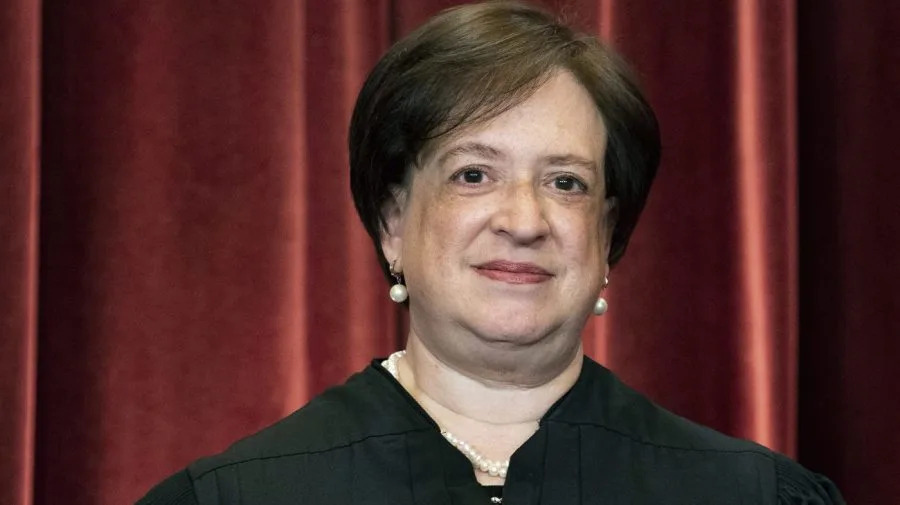
Supreme Court Justice Elena Kagan offered a scathing dissent Friday as her conservative colleagues transferred the power of federal agencies to the courts in a major decision overturning the Chevron deference.
In overruling that doctrine, Kagan argued that “the majority turns itself into the country’s administrative czar.”
Joined by fellow liberal Justices Sonia Sotomayor and Ketanji Brown Jackson, she wrote that the majority replaced a rule of “judicial humility” with one of “judicial hubris.”
“In one fell swoop, the majority today gives itself exclusive power over every open issue—no matter how expertise-driven or policy-laden—involving the meaning of regulatory law,” Kagan wrote.
She added that the decision puts the courts at the center of a wide variety of policy issues, ranging from climate change to artificial intelligence.
“The Court has substituted its own judgment on workplace health for that of the Occupational Safety and Health Administration; its own judgment on climate change for that of the Environmental Protection Agency; and its own judgment on student loans for that of the Department of Education,” Kagan wrote.
The 6-3 decision by the court upended a 40-year administrative law precedent in which federal agencies were given leeway to interpret ambiguous laws through rulemaking.
Now, judges will substitute their own best interpretation of the law, instead of deferring to the agencies — effectively making it easier to overturn regulations that govern wide-ranging aspects of American life.
“Chevron is overruled,” Chief Justice John Roberts wrote in his decision, which was joined by his five conservative colleagues.
Roberts argued that “courts must exercise their independent judgment in deciding whether an agency has acted within its statutory authority.”
Mr. Bruni is a contributing Opinion writer who was on the staff of The Times for more than 25 years.
I’m not sure I’d ever watched Donald Trump lie so incessantly, extravagantly and unabashedly, and that’s saying something. On Thursday night he lied about the attack on the Capitol on Jan. 6, 2021. He lied about the violence in Charlottesville, Va., in 2017. He lied about his relationship with the military, about his concern for the environment — about pretty much any and every subject that came up. He lied with a smile. He lied with a shrug. He lied with a sneer.
That should have been the main, maybe even the only, story of the debate, and it should have made him easy, pitiable prey for his opponent. But President Biden failed to take advantage of it. He seemed — there’s no getting around this — incapable of doing so. And that’s its own big story, one that will only grow over the hours and days ahead.
Biden, 81, came into his face-off with Trump knowing that many voters were concerned about his age and had doubts about his sharpness. His aides knew that, too. And he and they spent much of the past week devoted to preparation, preparation, preparation, pausing occasionally to assure nervous Democrats that Biden had this thing under control.
But from the moment the debate began, he seemed unsteady. Off. His expression was often frozen. His voice was often flat. He garbled words. He corrected himself midsentence, over and over again. He’d clearly memorized key talking points — key phrases — but he repeatedly used them without providing adequate context, swerved from one to another without any transition, halted sentences before they reached their destination, started sentences without giving them any bearings.
Ten minutes in, I had a knot in my stomach. Twenty minutes in, the knot was so tight, it hurt. “We finally beat Medicare,” he said early on, and I had no idea what he was talking about.
He got somewhat clearer as the night wore on. He found more animation. But the damage was done, and it may be significant. I shudder to type that, but there’s no sense in pretending. That’s perhaps what too many of his advisers have been doing up until now — ignoring or wishing away the obvious.
Then again, maybe Biden just had an uncharacteristically bad night. It’s possible. And even if this is now the diminished truth of him, it’s still preferable to the Big Lie of Trump, whose own sentences can be (and on Thursday frequently were) inscrutable, whose behavior is reliably unscrupulous and whose second administration would be stocked with corrupt, vengeful lackeys and would sully our democracy in ways from which we might never recover. As I’ve written before about the signs that Biden is past his peak, the presidency is more than the president: It’s the crew that the president assembles, the culture that the president creates. Biden at his least focused would establish a better crew and culture than Trump at his most.
But can Biden beat Trump? That question predated the debate and will be asked with even more urgency and panic in its aftermath. As will this one: Is it really too late for another Democrat to take Biden’s place? With stakes this high, mustn’t that be discussed one more time before the convention?
Again, I feel a bit sick saying that, because I believe that Biden is a decent man who, as president, has done a better than decent job. In both of those respects, he outpaces Trump by many miles, and if Republican politicians and voters had any decency of their own, they would have sidelined Trump long ago. (They had their chance. He was impeached twice, after all.)
But I’m not weighing in on Biden’s record. I’m evaluating his prospects. And I’m acknowledging that performances as shaky as the one he delivered on Thursday may hurt him badly with the small group of uncommitted voters who will decide what is almost guaranteed to be a very close election. Anyone and everyone who correctly understands the stakes of a Trump victory must grapple with that — and fast.
The best measure of Biden’s ineffectiveness on Thursday night was the dormant Vesuvius of Trump. He never even came close to erupting. Just as many people tuned in to the debate to see how much command Biden could muster and how much confidence he could project, many were curious about Trump’s degree of control. Would he rant, rave and remind voters of how dangerously erratic and fundamentally unpresidential he is?
He didn’t, at least not to the extent that he might have. Sure, he was pouty, petty and promiscuous with superlatives: Everything about him was the very best ever, while everything about Biden was the very worst. It was wholly unnuanced and utterly absurd. But he didn’t interrupt Biden. Didn’t shout. Didn’t scale the pinnacles of nastiness and mockery that he did in past debates.
And the reason was obvious in his bemused, pleased expression as Biden staggered through more than a few of his remarks. Trump realized that Biden was sabotaging himself. Trump reveled in that, at one point expressing puzzlement over some assertion that Biden had just made. “I really don’t know what he said at the end of that sentence,” Trump scoffed. “I don’t think he knows what he said, either.”
The astounding part was that Trump didn’t revel even more. The heartbreaking part was how Biden bungled what were clearly intended to be devastating lines. He connected the death of his son Beau, who did duty in Iraq as a major in the Delaware National Guard, to derogatory comments that Trump reportedly made about Americans who’d served in the military.
“My son was not a loser, not a sucker,” Biden proclaimed, but words that should have been immeasurably poignant just sort of hung there. “You’re the sucker,” Biden added. “You’re the loser.” I cringed. That’s Trump talk, not Biden talk, and its delivery was disjointed, unsettling, odd.
For most of the mere 90 minutes of the debate, Biden seemed to be grasping for something he couldn’t reach. I fear that’s a metaphor. I’m sure it’s a warning.
Frank Bruni is a professor of journalism and public policy at Duke University, the author of the book “The Age of Grievance” and a contributing Opinion writer.
It was the kind of vintage Biden that left MSNBC host Nicolle Wallace with demands of the campaign.
“That should be cut into an ad, and it should be the most money they’ve spent on TV TV so far. That should be running on every swing state digital and broadcast TV by tomorrow morning. That is a person who could win. And I think a lot of Democrats, to Cornell’s [Belcher] point, ran away from the president after coming to the conclusion that the person they saw last night.
Rev. Al Sharpton demanded the ad be put on immediately, not tomorrow.
“I got calls all night,” he said. “And I kept saying to them, do you have a short memory? Just a few years ago, to be exact, 3 1/2 years ago, I happened to be in Charleston, South Carolina, after the Democratic debate, having breakfast, and all of the candidates came. Joe Biden had just entered the race, and he was beaten in New Hampshire, and Jim Clyburn and him hooked up, and he took off. “
Wallace confessed that as a member of the media, she and others have “spent almost a grotesque amount of time trying to understand the bond of [Donald] Trump and his base. And compared to that very small amount of time to understand Joe Biden’s tie to his.”
What Rev. Sharpton was getting at, she said, is “something that has been missed by the, sort of, elite media, is that people see themselves in Joe Biden’s resilience and having to overcome to stutter. They see him in the agony of losing a child, a wife, and a daughter and in parenting someone who struggles with the disease of addiction.”
Now, I don’t think anyone can see themselves in him having to watch his own government prosecute his own son and then saying that he loves this country so much and the rule of law that he won’t pardon him; that’s almost next level. But there is something we miss about the voters and the Biden base’s ties to Biden that I think is really underscored by that clip from today’s speech.”
Team Trump Has a Ukraine Plan—and It’s a Total Nightmare
Ellie Quinlan Houghtaling – June 25, 2024
Donald Trump’s advisers have revealed their new plan for resolving the war between Russia and Ukraine—and it involves Ukraine’s immediate submission.
The plan effectively promises an increase in U.S. weapons aid to Ukraine so long as it shows up for peace talks with Russia, reported Reuters. And while that deal may not sound so bad, the writing between the lines isn’t so simple. Trump’s advisers envision that the peace talks—which Trump would facilitate should he win the November election—would also quietly include Ukraine ceding part of its territory that is currently occupied by Russian forces.
The concept was drawn up by retired Lieutenant General Keith Kellogg and Fred Fleitz, both former chiefs of staff on Trump’s National Security Council. Trump did not immediately sign on to “every word” of the plan, but Fleitz told Reuters that they were “pleased to get the feedback we did.”
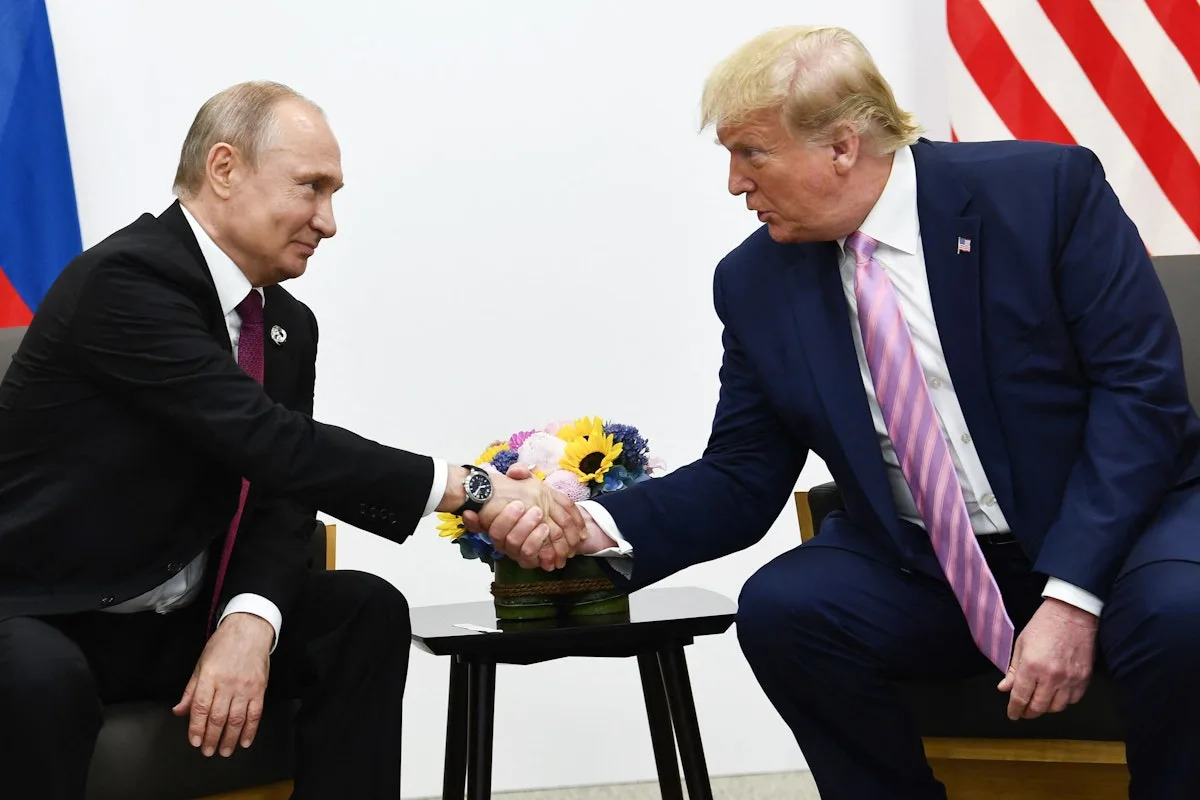
The Kremlin told Reuters that Russian President Vladimir Putin is open to peace talks, but that any proposal by a possible future Trump administration would have to reflect the “reality on the ground.”
When pressed on the details of the plan, Fleitz explained that Ukraine would not formally need to relinquish its land to Russian forces. He did concede, however, that Ukraine was unlikely to regain control of all of its territory in the near future.
Ukrainian presidential adviser Mykhailo Podolyak said that ending the war on the borders of its current front lines—where Russia has gained a foothold in the southeast portion of Ukraine—would be “strange,” pointing to the fact that Russia had violated international law by invading it in the first place.
“Ukraine has an absolutely clear understanding and it is spelled out in the peace formula proposed by President [Volodymyr] Zelenskiy, it is clearly stated there—peace can only be fair and peace can only be based on international law,” Podolyak told Reuters.
The plan’s promise to send more military aid to Ukraine only if it admits defeat and ends the war seems a bit counterintuitive—and disingenuous, considering that Trump and his advisers have done practically everything within their power to undermine sending more military aid to the embattled nation since the beginning of the year. And the plan’s obvious benefit to Russia also raises further concerns over Trump’s notoriouslycushy—and sometimes subservient—relationship with Putin.
Panicking Trump Tries Yet Another Get-Out-of-Debate-Free Card
Edith Olmsted – June 25, 2024
Donald Trump’s campaign is hard at work manufacturing a reason for him to skip Thursday’s presidential debate, and his latest tactic is the most ridiculous one yet.
Trump and his former White House doctor Representative Ronny Jackson, who reportedly kept the former president’s administration “awash in speed,” have repeatedlysuggested that President Joe Biden will take performance-enhancing drugs before the debate, as part of their crusade to undermine the event and give Trump a get-out-of-jail-free card.
Now they’ve elevated their own bonkers conspiracy theory even further: Trump posted a letter to Truth Social on Monday that Jackson supposedly sent to the White House demanding Biden submit to a drug test before the debate.
“I demand that you submit to a clinically validated drug test in order to reassure the American people that you are mentally fit to serve as President and not relying on performance enhancing drugs to help you with your debate performance,” Jackson wrote. The pill-pushing Texas Republican demanded that the results of the president’s drug test be made public.
In his letter, Jackson echoed Trump’s and right-wing media’s insistence that Biden is suffering from cognitive decline, including a reference to a video of Biden that had been doctored to make him appear to wander away from a group at the G7 conference, and Robert Hur’s damning report casting public doubt on Biden’s memory. Hur’s characterization of their interview has been contested by the White House.
All of this concocted drama around drug use, as well as claims that CNN will host a biased debate, positively reek of desperation to get the former president out of Thursday night’s presidential showdown. It’s not surprising, as Trump is not suited to actual debate: His speech is often erratic and incoherent, and he’s prone to going off on tangents. Plus, Trump has historically taken a hit in the polls after debating with Democrats, in 2016, and again in 2020. While Trump loves to hype up a crowd, he’s just not that convincing when he’s sharing the stage.
It also appears that Jackson may soon want to focus on problems of his own. The House Ethics Committee announced Monday that it will review a report from a congressional watchdog that discovered “substantial reason” to believe that Jackson had converted thousands of dollars of campaign money for his own personal use.
Jackson was demoted by the U.S. Navy in 2022 after the Pentagon inspector general found that he regularly drank on the job, berated his subordinates, and acted inappropriately. Last year, Jackson was filmed unleashing a profanity-laced tirade on a Department of Public Safety officer.
Why Republicans Are Talking About Biden’s ‘Dictatorship’
Jamelle Bouie – June 25, 2024
Credit…Will Matsuda for The New York Times
The United States under President Biden is a “dictatorship,” according to Doug Burgum, governor of North Dakota.
“Under Joe Biden,“ Burgum told Fox News, “we’re actually living under a dictatorship today where he’s, you know, bypassing Congress on immigration policy; he’s bypassing Congress on protecting our border; he’s bypassing Congress on student loan forgiveness; he’s defying the Supreme Court.”
Asked on Sunday to defend his claim, Burgum, who is apparently on the short list of potential running mates for Donald Trump, stood his ground, telling CNN that Biden is “bypassing the other two branches of government to push an ideological view of — whether it’s on economics or whether it’s on climate extremism — he’s doing that without using the other branches.”
It is an odd sort of dictatorship in which the head of state is bound by the rule of law as well as by the authority of other constitutional actors, one in which the dictator’s critics can organize to defeat him in an election without intimidation, penalty or threat of legal sanction — and in which he will leave office if he loses. If nothing else, it is hard to imagine a world in which Biden is both a dictator and someone who would allow Burgum, a regime opponent, to speak freely on national television as he works to defeat Biden at the ballot box.
In fairness to the North Dakota governor, he was trying to make a point about a perceived double standard, in which Trump and not Biden is blasted as an authoritarian for his use of executive orders. But even this is misleading, because the issue with Trump is not the use of executive orders per se. Instead, it is his demonstrated contempt for democratic accountability — he does not accept the right of an electorate to remove him from office — his desire to use the instruments of state to inflict punishment and suffering on his political enemies and his efforts to transform the office of the presidency and the broader executive branch into instruments of his personalist rule.
(That said, there is a conversation for another day about the overreliance on executive orders by presidents of both parties as a symptom of congressional weakness and a product of long-running structural transformations in the nature of the presidency, tied specifically to the growth and pre-eminence of the national security state.)
Governor Burgum is obviously wrong about the idea that Biden is a dictator. But he is not the only Trump ally to speak in such dire terms about the United States. As Politico’s Ian Ward noted, Senator J.D. Vance of Ohio — another Republican hoping to stand with Trump as his second — believes that “the United States is on the verge of going up in smoke” and that “electing Trump represents the only hope that Americans have for getting off the path to literal civilization collapse.”
And Russ Vought, former budget chief in the Trump administration and one of the architects of the former president’s second-term agenda, believes that Americans are living in a “post-constitutional” moment that justifies the radical use of executive power to quash protesters with the military, the gutting of the federal civil service in favor of a spoils system for Trump loyalists and the seizing of the power of the purse from Congress. He urges his comrades in arms to “cast ourselves as dissidents of the current regime and to put on our shoulders the full weight of envisioning, articulating, and defending what a Radical Constitutionalism requires in the late hour that our country finds itself in, and then to do it.”
Just as Americans are not living under a Biden dictatorship — in which the watchful eye of Dark Brandon prowls the nation in search of malarkey — the United States is also not on the verge of collapse. Our economy is the envy of the world, we remain the pre-eminent military power, and for all of its serious problems of representation and inclusion, our political system is still capable of handling at least a few of the major issues that face the nation. It does not downplay the challenges we confront to say that we have the capacity and the resources to meet them head on. That, if anything, makes it all the more frustrating that we have not yet secured decent housing, health care, child care and education for everyone in this country. None of these things are beyond our material ability to accomplish — far from it.
Of course, even mentioning the reality of conditions in the United States is a bit beside the point, because the breathless catastrophizing by Trump and his allies is not an expression of ignorance as much as it is a statement of intent. Rhetorically, the MAGA political project of personalist rule in support of social hierarchy, unrestrained capital and the destruction of public goods depends on the conceit that the nation exists in a state of exception that demands extraordinary — and extreme — measures to resolve.
The cultivation of this notion of a state of exception, of a sense of emergency, is the overriding aim of MAGA political messaging. The targets change — in 2020 it was leftists and protesters, this year it is migrants and refugees again, as it was in 2016 — but the goal is always the same: to designate an enemy, to label that enemy an urgent threat to society and to try to win power on a promise to destroy that enemy by any means necessary.
Embedded in this maneuver is a radical claim of sovereignty. The so-called enemy is whoever Trump says it is, and once designated, the entire political system must bend to his will on the notion that he, alone, can fix it.
Sovereign power of the sort that Trump and his allies gesture toward does not exist in the American system as traditionally understood, and there is no provision in our Constitution by which the executive can set aside the rule of law to deal with threats and emergencies. But the point of this rhetoric of exception is to set the conditions for doing just that — for creating an actual state of exception in American politics.
Put another way, if we are on the verge of civilizational collapse, if we are in a post-constitutional moment, if we are already in a dictatorship, then anything is permitted in defense of the old order. And if democracy should stand in the way of recovery and restoration, then democracy should, perhaps, be set aside.
During the Civil War, President Abraham Lincoln did not present himself as a bulwark of liberty who could resolve the crisis alone. He tried, as much as possible, to embody and act on his deep belief in the rule of law. For example, after taking unilateral steps to confront the rebellion and defend the Union at the outset of the conflict, he went to Congress to ask for its blessing and support. In his message, issued on July 4, 1861, Lincoln did not make demands or assert extraordinary powers.
Instead, the political scientist Nomi Claire Lazar wrote, Lincoln invited “Congress to share the burden of both reflection and action, to consider and judge the reasons he has given.” What guided his deliberations, she continued, is “precisely a commitment to the rule of law as a collective and collaborative project. What is the best we can do, given the constraints and imperatives, he asks, and how can we do our best together?”
If there is anything to know about either Trump or his closest allies, it is that they do not share this commitment to collaboration or deliberation or public reason. They know only force and dominance. And they want everything to be a crisis, not for an opportunity to affirm democracy, but for a chance to undermine it.
Jamelle Bouie became a New York Times Opinion columnist in 2019. Before that he was the chief political correspondent for Slate magazine. He is based in Charlottesville, Va., and Washington.
The findings in JAMA Pediatrics show that infant deaths rose after Texas’ Senate Bill 8, which banned all abortion after about six weeks from conception. SB 8 became Texas law in September 2021 and U.S. Supreme Court overturned the constitutional right to abortion just over nine months later, on June 24, 2022. The high court ruling in the Dobbs case prompted more than a dozen states to issue near-total bans on abortion. Observers speculate that evidence will also show increases in infant deaths in those states, akin to what Texas has seen, the study said.
“It just points to some of the devastating consequences of abortion bans that maybe people weren’t thinking about when they passed these laws,” Alison Gemmill, an assistant professor at Johns Hopkins University’s Bloomberg School of Public Health who authored the study, told USA TODAY. She called the deaths following the Texas heartbeat law its “spillover effects on moms and babies.”
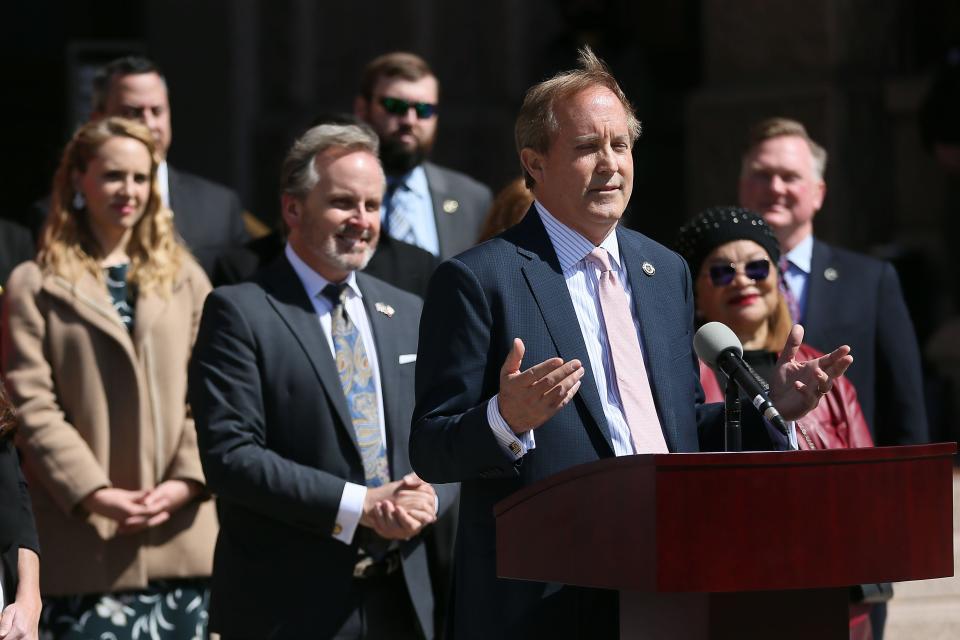
Texas Attorney General Ken Paxton, right, speaks at a pro-life leaders press conference on Feb. 28, 2022, outside the state capitol. The event was held to celebrate the six month anniversary of the Texas Heartbeat Act. Briana Sanchez, Austin American-Statesman
In the wake of the law’s passage in Texas, more babies died before their first birthday, likely due to birth defects or genetic problems that wouldn’t have allowed them to live, the study found. These pregnancies would typically have been terminated by abortion, according to researchers. The Texas heartbeat law does not provide exceptions for pregnancies involving such conditions. Mothers are legally obligated to carry these babies to birth under state law.
In the peer-reviewed Journal of the American Medical Association, Gemmill and researchers from Johns Hopkins and Michigan State University wrote that the Texas law was linked to “unexpected increases in infant and neonatal deaths” between 2021 and 2022. Prior research drew a correlation between the uptick in infant deaths and anti-abortion laws taking effect, however, no studies until now have attributed the fatalities directly to the laws prohibiting the termination of these pregnancies.
“Abortion care is an essential component of comprehensive healthcare, and when it is restricted, the human impacts are devastating,” Wendy Davis, a senior adviser for Planned Parenthood Texas Votes, said in a statement. Davis, who filibustered for abortion rights when she was a Democratic state senator, noted that the study only covered 2022, not the results in 2023 and 2024 in the wake of a more restrictive abortion ban that came with the Dobbs decision. This “likely means the situation on the ground today is even more dire,” Davis said.
Texas Gov. Greg Abbott’s office did not dispute the study’s findings but defended the Republican-controlled state’s anti-abortion record. This effort included the 2021 heartbeat law “to save the innocent unborn, and now thousands of children have been given a chance at life,” Andrew Mahaleris, a spokesperson for Abbott, said in a statement to USA TODAY. He said the governor has taken “significant action to protect the sanctity of life” and offered resources to expectant mothers “so they can choose life for their child.”
Anti-abortion advocates also didn’t contest the uptick in infant deaths cited in the study. Advocates for the heartbeat law and other legislation to restrict abortions say such bans protect life. They say terminating a fetus with a terminal illness is “choosing to kill that child intentionally.”
The overwhelming majority of such abortions happen before the fetus is viable. In Texas, legislation has dramatically reduced the number of abortions performed in the state.
Amy O’Donnell, a spokesperson for Texas Alliance for Life, said the study’s findings didn’t come as a surprise. She said babies born with disabilities and even fatal anomalies deserve a chance at life, even if that means a newborn dies after birth from a condition doctors anticipated would be lethal. The death of a child is not easy, she acknowledged. She noted that her nonprofit offers resources for families grieving from such losses.
“In Texas, we celebrate every unborn child’s life saved. We treasure the fact that our laws are protecting women’s lives,” she said. “We don’t apologize for the fact that we don’t support discrimination against children facing disabilities or fatal diagnoses in or out of the womb. And that’s the line that we just believe should not be crossed.”
Gemmill, of Johns Hopkins, said babies that died shortly after being born with birth defects “probably caused a lot of unnecessary trauma to families.”
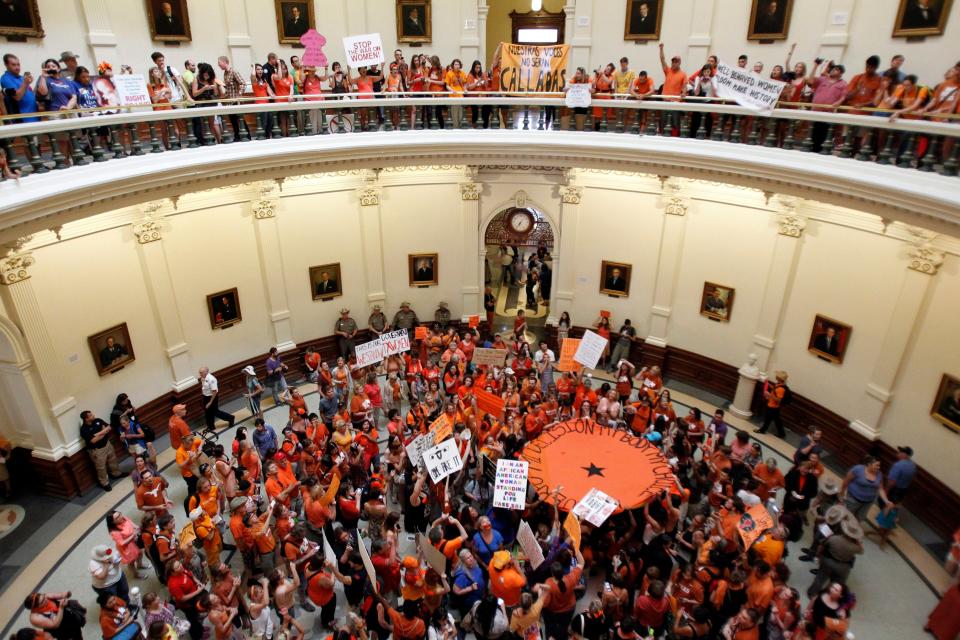
Abortion rights (in orange) and anti-abortion advocates (in blue) rally in the rotunda of the State Capitol, as the state Senate meets to consider legislation restricting abortion rights in Austin, Texas on July 12, 2013. Mike Stone, Reuters.
The researchers examined death records beginning after the heartbeat law went into effect. The study created a “synthetic Texas” that simulated outcomes that would have happened had the law not been in effect and compared the numbers to national trends during that period. In 2021, 1,985 Texas infants died before their first birthday. The next year, with S.B. 8 in effect, the fatalities jumped to 2,240, a 12.9% increase that came as the U.S. experienced an overall increase of less than 2%. Deaths attributable to congenital anomalies or birth defects spiked nearly 23% in Texas compared to a 3% decrease nationally.
“It suggests that, really, this policy was responsible for this increase in infant deaths in Texas,” Gemmill said.
The study is significant because of Texas’ role as a conservative state with urban and rural areas that may reflect what happens in the rest of the U.S., according to Dr. Tracey Wilkinson, an associate professor of pediatrics and obstetrics and gynecology at the Indiana University School of Medicine. Texas has been living under restrictions longer than other states that enacted abortion bans after the Dobbs ruling.
“When people ask me why this is happening, it’s really simple,” said Wilkinson, who was not involved with the new study. “When you take away people’s ability to make decisions (about) if and when they have pregnancies, you’re going to see outcomes like increasing infant and maternal mortality.”
In this file photo, anti-abortion activists stand in the Texas State Capitol to protest an International Women’s Day sit-in for abortion rights on March 8, 2023. Sara Diggins, Austin American-Statesman.
The study did not examine the effects of infant deaths on the health of mothers who were legally required to deliver dead babies to term, nor did it look at the mental health effects of carrying infants and delivering them, only to see them die. The study also raises but does not tackle questions about the financial cost to families of carrying and delivering terminally ill newborns.
Gemmill is now working to understand the impact of abortion restrictions on parents of different races and ethnicities. Prior research has shown that Black mothers and babies face higher death rates than other groups.
The study reflects what Molly Duane, a senior staff attorney at the abortion rights advocacy nonprofit Center for Reproductive Rights, has seen in the courtroom arguing against Texas’ laws. She recently represented women who sued the state after they were denied medical abortions. One of her clients, Samatha Casiano, was required by law to carry a child that developed without a brain. In late May, the Texas Supreme Court ruled pregnant patients must have a “life-threatening condition” in order to terminate a pregnancy.
Duane questioned the claim by anti-abortion activists that Texas is a “pro-life” state, given the study’s findings. “Women are hurting, families are hurting, babies are dying, and no one in the state is taking responsibility for any of that real human suffering,” she said.
In late 2023, a U.S. Centers for Disease Control and Prevention report found increases in infant deaths for the first time in more than 20 years. The states identified in the report with increased fatalities were states that restricted abortion access, however, experts cautioned at the time that they could not say what had caused the spike in fatalities.
The Texas study went one step further, finding one state where abortion restrictions resulted in more deaths.
By Ben Rhodes – July – August, Published on June 18, 2024
Álvaro Bernis
“America is back.” In the early days of his presidency, Joe Biden repeated those words as a starting point for his foreign policy. The phrase offered a bumper-sticker slogan to pivot away from Donald Trump’s chaotic leadership. It also suggested that the United States could reclaim its self-conception as a virtuous hegemon, that it could make the rules-based international order great again. Yet even though a return to competent normalcy was in order, the Biden administration’s mindset of restoration has occasionally struggled against the currents of our disordered times. An updated conception of U.S. leadership—one tailored to a world that has moved on from American primacy and the eccentricities of American politics—is necessary to minimize enormous risks and pursue new opportunities.
To be sure, Biden’s initial pledge was a balm to many after Trump’s presidency ended in the dual catastrophes of COVID-19 and the January 6 insurrection. Yet two challenges largely beyond the Biden administration’s control shadowed the message of superpower restoration. First was the specter of Trump’s return. Allies watched nervously as the former president maintained his grip on the Republican Party and Washington remained mired in dysfunction. Autocratic adversaries, most notably Russian President Vladimir Putin, bet on Washington’s lack of staying power. New multilateral agreements akin to the Iran nuclear deal, the Paris agreement on climate change, or the Trans-Pacific Partnership were impossible, given the vertiginous swings in U.S. foreign policy.
Second, the old rules-based international order doesn’t really exist anymore. Sure, the laws, structures, and summits remain in place. But core institutions such as the UN Security Council and the World Trade Organization are tied in knots by disagreements among their members. Russia is committed to disrupting U.S.-fortified norms. China is committed to building its own alternative order. On trade and industrial policy, even Washington is moving away from core tenets of post–Cold War globalization. Regional powers such as Brazil, India, Turkey, and the Gulf states pick and choose which partner to plug into depending on the issue. Even the high-water mark for multilateral action in the Biden years—support for Ukraine in its fight against Russia—remains a largely Western initiative. As the old order unravels, these overlapping blocs are competing over what will replace it.
A Biden victory in this fall’s election would offer reassurance that the particular risk of another Trump presidency has passed, but that will not vanquish the forces of disorder. To date, Washington has failed to do the necessary audit of the ways its post–Cold War foreign policy discredited U.S. leadership. The “war on terror” emboldened autocrats, misallocated resources, fueled a global migration crisis, and contributed to an arc of instability from South Asia through North Africa. The free-market prescriptions of the so-called Washington consensus ended in a financial crisis that opened the door to populists railing against out-of-touch elites. The overuse of sanctions led to increased workarounds and global fatigue with Washington’s weaponization of the dollar’s dominance. Over the last two decades, American lectures on democracy have increasingly been tuned out.
Indeed, after Hamas’s October 7 attack on Israel and the Israeli military campaign in Gaza, American rhetoric about the rules-based international order has been seen around the world on a split screen of hypocrisy, as Washington has supplied the Israeli government with weapons used to bombard Palestinian civilians with impunity. The war has created a policy challenge for an administration that criticizes Russia for the same indiscriminate tactics that Israel has used in Gaza, a political challenge for a Democratic Party with core constituencies who don’t understand why the president has supported a far-right government that ignores the United States’ advice, and a moral crisis for a country whose foreign policy purports to be driven by universal values. Put simply: Gaza should shock Washington out of the muscle memory that guides too many of its actions.
If Biden does win a second term, he should use it to build on those of his policies that have accounted for shifting global realities, while pivoting away from the political considerations, maximalism, and Western-centric view that have caused his administration to make some of the same mistakes as its predecessors. The stakes are high. Whoever is president in the coming years will have to avoid global war, respond to the escalating climate crisis, and grapple with the rise of new technologies such as artificial intelligence. Meeting the moment requires abandoning a mindset of American primacy and recognizing that the world will be a turbulent place for years to come. Above all, it requires building a bridge to the future—not the past.
THE TRUMP THREAT
One of Biden’s mantras is “Don’t compare me to the Almighty; compare me to the alternative.” As the presidential campaign heats up, it is worth heeding this advice. But to properly outline the dangers of a second Trump term, it is necessary to take Trump’s arguments seriously, despite the unserious form they often take. Much of what Trump says resonates broadly. Americans are tired of wars; indeed, his takeover of the Republican Party would have been impossible without the Iraq war, which discredited the GOP establishment. Americans also no longer trust their elites. Although Trump’s rhetoric about a “deep state” moves quickly into baseless conspiracy theory, it strikes a chord with voters who wonder why so many of the politicians who promised victories in Afghanistan and Iraq were never held to account. And although Trump’s willingness to cut off assistance to Ukraine is abhorrent to many, there is a potent populism to it. How long will the United States spend tens of billions of dollars helping a country whose stated aim—the recapture of all Ukrainian territory—seems unachievable?
Trump has also harnessed a populist backlash to globalization from both the right and the left. Particularly since the 2008 financial crisis, large swaths of the public in democracies have simmered with discontent over widening inequality, deindustrialization, and a perceived loss of control and lack of meaning. It is no wonder that the exemplars of post–Cold War globalization—free trade agreements, the U.S.-Chinese relationship, and the instruments of international economic cooperation itself—have become ripe targets for Trump. When Trump’s more punitive approaches to rivals, such as his trade war with China, didn’t precipitate all the calamities that some had predicted, his taboo-breaking approach appeared to be validated. The United States, it turned out, did have leverage.
But offering a potent critique of problems should not be confused with having the right solutions to them. To begin with, Trump’s own presidency seeded much of the chaos that Biden has faced. Time and again, Trump pursued politically motivated shortcuts that made things worse. To end the war in Afghanistan, he cut a deal with the Taliban over the heads of the Afghan people, setting a timeline for withdrawal that was shorter than the one Biden eventually adopted. Trump pulled out of the Iran nuclear deal despite Iranian compliance, unshackling the country’s nuclear program, escalating a proxy war across the Middle East, and sowing doubt across the world about whether the United States keeps its word. By moving the U.S. embassy in Israel from Tel Aviv to Jerusalem, recognizing the annexation of the Golan Heights, and pursuing the Abraham Accords, he cut the Palestinians out of Arab-Israeli normalization and emboldened Israel’s far right, lighting a fuse that detonated in the current war.
Although Trump’s tougher line with China demonstrated the United States’ leverage, it was episodic and uncoordinated with allies. As a result, Beijing was able to cast itself as a more predictable partner to much of the world, while the supply chain disruptions caused by trade disputes and decoupling created new inefficiencies—and drove up costs—in the global economy. Trump’s lurch from confronting to embracing Kim Jong Un enabled the North Korean leader to advance his nuclear and missile programs under reduced pressure. Closer to home, Trump’s recognition of an alternative Venezuelan government under the opposition leader Juan Guaidó managed to strengthen the incumbent Nicolás Maduro’s hold on power. The “maximum pressure” policy toward Venezuela and Cuba, which sought to promote regime change through crippling sanctions and diplomatic isolation, fueled humanitarian crises that have sent hundreds of thousands of people to the United States’ southern border.
Biden in Washington, D.C., May 2024Evelyn Hockstein / Reuters
A second Trump term would start amid a more volatile global environment than his first, and there would be fewer guardrails constraining a president who would be in command of his party, surrounded by loyalists, and freed from ever having to face voters again. Although there are many risks, three stand out. First, Trump’s blend of strongman nationalism and isolationism could create a permission structure for aggression. A withdrawal of U.S. support for Ukraine—and, perhaps, for NATO itself—would embolden Putin to push deeper into the country. Were Washington to abandon its European allies and promote right-wing nationalism, it could exacerbate political fissures within Europe, emboldening Russian-aligned nationalists in such places as Hungary and Serbia who have echoed Putin in seeking to reunite ethnic populations in neighboring states.
Despite U.S.-Chinese tensions, East Asia has avoided the outright conflict of Europe and the Middle East. But consider the opportunity that a Trump victory would present to North Korea. Fortified by increased Russian technological assistance, Kim could ratchet up military provocations on the Korean Peninsula, believing that he has a friend in the White House. Meanwhile, according to U.S. assessments, China’s military will be ready for an invasion of Taiwan by 2027. If Chinese leader Xi Jinping truly wishes to forcibly bring Taiwan under Beijing’s sovereignty, the twilight of a Trump presidency—by which point the United States would likely be alienated from its traditional allies—could present an opening.
Second, if given the chance, Trump has made it clear that he would almost certainly roll back American democracy, a move that would reverberate globally. If his first election represented a one-off disruption to the democratic world, his second would more definitively validate an international trend toward ethnonationalism and authoritarian populism. Momentum could swing further in the direction of far-right parties in Europe, performative populists in the Americas, and nepotistic and transactional corruption in Asia and Africa. Consider for a moment the aging roster of strongmen who will likely still be leading other powers—not just Xi and Putin but also Narendra Modi in India, Benjamin Netanyahu in Israel, Ali Khamenei in Iran, and Recep Tayyip Erdogan in Turkey. To say the least, this cast of characters is unlikely to promote respect for democratic norms within borders or conciliation beyond them.
This leads to the third danger. In the coming years, leaders will increasingly be confronted with global problems that can be managed or solved only through cooperation. As the climate crisis worsens, a Trump presidency would make a coordinated international response much harder and validate the backlash against environmental policies that has been building within advanced economies. At the same time, artificial intelligence is poised to take off, creating both valuable opportunities and enormous risks. At a moment when the United States should be turning to diplomacy to avoid wars, establish new norms, and promote greater international cooperation, the country would be led by an “America first” strongman.
A TIME TO HEAL
In any administration, national security policy is a peculiar mix of long-standing commitments, old political interests, new presidential initiatives, and improvised responses to sudden crises. Navigating the rough currents of the world, the Biden administration has often seemed to embody the contradictions of this dynamic, with one foot in the past, yearning nostalgically for American primacy, and one foot in the future, adjusting to the emerging world as it is.
Through its affirmative agenda, the administration has reacted well to changing realities. Biden linked domestic and foreign policy through his legislative agenda. The CHIPS Act made substantial investments in science and innovation, including the domestic manufacturing of semiconductors. The act worked in parallel with ramped-up export and investment controls on China’s high-tech sector, which have buttressed the United States’ lead in the development of new technologies such as AI and quantum computing. Although this story is more complicated to tell than one about a tariff-based trade war, Biden’s policy is in fact more coherent: revitalize U.S. innovation and advanced manufacturing, disentangle critical supply chains from China, and maintain a lead for U.S. companies in developing new and potentially transformative technologies.
Gaza should shock Washington out of the muscle memory that guides too many of its actions.
Biden’s most significant piece of legislation, the Inflation Reduction Act, made enormous investments in clean energy technology. These investments will allow the United States to raise its ambition in meeting climate goals by pushing domestic industry and global markets to shift away from fossil fuels faster. Although this breakthrough enhanced U.S. credibility on climate change, it also created new challenges, as even allies have complained that Washington resorted to subsidies instead of pursuing coordinated cross-border approaches to reduce emissions. In this respect, however, the Biden administration was dealing with the world as it is. Congress cannot pass complex reforms such as putting a price on carbon; what it can do is pass large spending bills that invest in the United States.
Despite tensions over U.S. industrial policy, the Biden administration has effectively reinvested in alliances that frayed under Trump. That effort has tacitly acknowledged that the world now features competing blocs, which makes it harder for the United States to pursue major initiatives by working through large international institutions or with other members of the great-power club. Instead, Washington has prioritized groupings of like-minded countries that are, to use a catch phrase, “fit for purpose.” Collaboration with the United Kingdom and Australia on nuclear submarine technology. New infrastructure and AI initiatives through the G-7. Structured efforts to create more consultation among U.S. allies in the Indo-Pacific. This approach involves a dizzying number of parts; one can lose track of the number of regional consultative groups that now exist. But in the context of an unraveled international order, it makes sense to thread together cooperation where possible, while trying to turn new habits of cooperation into enduring arrangements.
Most notably, Biden’s reinvestment in European alliances paid off when Washington was able to swiftly mobilize support for Ukraine in 2022. This task was made easier by the administration’s innovative release of intelligence on Russia’s intentions to invade, an overdue reform of the way that Washington manages information. Although the war has reached a tenuous stalemate, the effort to fortify transatlantic institutions continues to advance. NATO has grown in size, relevance, and resourcing. European Union institutions have taken a more proactive role in foreign policy, most notably in coordinating support for Ukraine and accelerating its candidacy for EU membership. For all the understandable consternation about Washington’s struggle to pass a recent aid bill for Ukraine, Europe’s focus on its own institutions and capabilities was long overdue.
SLOW TO CHANGE
Yet there are three important ways in which the Biden administration has yet to recalibrate its approach to the world of post-American primacy. The first has to do with American politics. On several issues that engender controversy in Congress, the administration has constrained or distorted its options by preemptively deferring to outdated hard-liners. Even as Trump has demonstrated how the left-right axis has been scrambled on foreign policy, Biden at times feels trapped in the national security politics of the immediate post-9/11 era. Yet what once allowed a politician to appear tough to appease hawks in Washington was rarely good policy; now, it is no longer necessarily good politics.
In Latin America, the Biden administration was slow to pivot away from Trump’s “maximum pressure” campaigns on Venezuela and Cuba. Biden maintained, for example, the avalanche of sanctions that Trump imposed on Cuba, including the cynical return of that country to the State Department’s list of state sponsors of terrorism just before leaving office, in January 2021. The result has been an acute humanitarian crisis in which U.S. sanctions exacerbated shortages of basic staples such as food and fuel, contributing to widespread suffering and migration. In the Middle East, the administration failed to move swiftly to reenter the politically contested Iran nuclear deal, opting instead to pursue what Biden called a “longer and stronger” agreement, even though Trump was the one who violated the deal’s terms. Instead,the administration embraced Trump’s Abraham Accords as central to its Middle East policy while reverting to confrontation with Iran. This effectively embraced Netanyahu’s preferred course: a shift away from pursuing a two-state solution to the Israeli-Palestinian conflict and toward an open-ended proxy war with Tehran.
Anyone who has worked at the nexus of U.S. politics and national security knows that avoiding friction with anti-Cuban and pro-Israeli hard-liners in Congress can feel like the path of least resistance. But that logic has turned into a trap. After October 7, Biden decided to pursue a strategy of fully embracing Netanyahu—insisting (for a time) that any criticism would be issued in private and that U.S. military assistance would not be conditioned on the actions of the Israeli government. This engendered immediate goodwill in Israel, but it preemptively eliminated U.S. leverage. It also overlooked the far-right nature of Netanyahu’s governing coalition, which offered warning signs about the indiscriminate way in which it planned to prosecute its military campaign, as Israeli officials cut off food and water flowing into Gaza within days of Hamas’s attack. In the months that followed, the administration has been trying to catch up to a deteriorating situation, evolving from a strategy of embracing Netanyahu, to one of issuing rhetorical demands that were largely ignored, to one of partial restrictions on offensive military assistance. Ironically, by being mindful of the political risks of breaking with Netanyahu, Biden invited greater political risks from within the Democratic coalition and around the world.
The temptation to succumb to Washington’s outdated instincts has contributed to a second liability: the pursuit of maximalist objectives. The administration has shown some prudence in this area. Even as competition ramped up with China, Biden has worked over the last year to rebuild lines of communication with Beijing and has largely avoided provocative pronouncements on Taiwan. And even as he committed the United States to helping Ukraine defend itself, Biden set the objective of avoiding a direct war between the United States and Russia (although his rhetoric did drift into endorsing regime change in Moscow). The bigger challenge has at times come from outside the administration, as some supporters of Ukraine indulged in a premature triumphalism that raised impossible expectations for last year’s Ukrainian counteroffensive. Paradoxically, this impulse ended up hurting Ukraine: when the campaign inevitably came up short, it made the broader U.S. policy toward Ukraine look like a failure. Sustaining support for Ukraine will require greater transparency about what is achievable in the near term and an openness to negotiations in the medium term.
Biden and U.S. officials meeting with a Chinese delegation in Woodside, California, November 2023 Kevin Lamarque / Reuters
Gaza also showcases the danger of maximalist aims. Israel’s stated objective of destroying Hamas has never been achievable. Since Hamas would never announce its own surrender, pursuing this goal would require a perpetual Israeli occupation of Gaza or the mass displacement of its people. That outcome may be what some Israeli officials really want, as evidenced by right-wing ministers’ own statements. It is certainly what many people around the world, horrified by the campaign in Gaza, believe the Israeli government really wants. These critics wonder why Washington would support such a campaign, even as its own rhetoric opposes it. Instead of seeking to moderate Israel’s unsustainable course, Washington needs to use its leverage to press for negotiated agreements, Palestinian state building, and a conception of Israeli security that is not beholden to expansionism or permanent occupation.
Indeed, too many prescriptions sound good in Washington but fail to account for simple realities. Even with the United States’ military advantage, China will develop advanced technologies and maintain its claim over Taiwan. Even with sustained U.S. support, Ukraine will have to live next to a large, nationalist, nuclear-armed Russia. Even with its military dominance, Israel cannot eliminate the Palestinian demand for self-determination. If Washington allows foreign policy to be driven by zero-sum maximalist demands, it risks a choice between open-ended conflict and embarrassment.
This leads to the third way in which Washington must change its approach. Too often, the United States has appeared unable or unwilling to see itself through the eyes of most of the world’s population, particularly people in the global South who feel that the international order is not designed for their benefit. The Biden administration has made laudable efforts to change this perception—for instance, delivering COVID-19 vaccines across the developing world, mediating conflicts from Ethiopia to Sudan, and sending food aid to places hit hard by shortages exacerbated by the war in Ukraine. Yet the overuse of sanctions, along with the prioritization of Ukraine and other U.S. geopolitical interests, misreads the room. To build better ties with developing countries, Washington needs to consistently prioritize the issues they care about: investment, technology, and clean energy.
Once again, Gaza interacts with this challenge. To be blunt: for much of the world, it appears that Washington doesn’t value the lives of Palestinian children as much as it values the lives of Israelis or Ukrainians. Unconditional military aid to Israel, questioning the Palestinian death toll, vetoing cease-fire resolutions at the UN Security Council, and criticizing investigations into alleged Israeli war crimes may all feel like autopilot in Washington—but that’s precisely the problem. Much of the world now hears U.S. rhetoric about human rights and the rule of law as cynical rather than aspirational, particularly when it fails to wrestle with double standards. Total consistency is unattainable in foreign policy. But by listening and responding to more diverse voices from around the world, Washington could begin to build a reservoir of goodwill.
A FAREWELL TO PRIMACY
In its more affirmative agenda, the Biden administration is repositioning the United States for a changing world by focusing on the resilience of its own democracy and economy while rebooting alliances in Europe and Asia. To extend that regeneration into something more global and lasting, it should abandon the pursuit of primacy while embracing an agenda that can resonate with more of the world’s governments and people.
As was the case in the Cold War, the most important foreign policy achievement will simply be avoiding World War III. Washington must recognize that all three fault lines of global conflict today—Russia-Ukraine, Iran-Israel, and China-Taiwan—run across territories just beyond the reach of U.S. treaty obligations. In other words, these are not areas where the American people have been prepared to go to war directly. With little public support and no legal obligation to do that, Washington should not count on bluffing or military buildups alone to resolve these issues; instead, it will have to focus relentlessly on diplomacy, buttressed by reassurance to frontline partners that there are alternative pathways to achieving security.
Avoiding friction with anti-Cuban and pro-Israeli hard-liners in Congress can feel like the path of least resistance.
In Ukraine, the United States and Europe should focus on protecting and investing in the territory controlled by the Ukrainian government—drawing Ukraine into European institutions, sustaining its economy, and fortifying it for lengthy negotiations with Moscow so that time works in Kyiv’s favor. In the Middle East, Washington should join with Arab and European partners to work directly with Palestinians on the development of new leadership and toward the recognition of a Palestinian state, while supporting Israel’s security. Regional de-escalation with Iran should, as it did during the Obama administration, begin with negotiated restrictions on its nuclear program. In Taiwan, the United States should try to preserve the status quo by investing in Taiwanese military capabilities while avoiding saber rattling, by structuring engagement with Beijing to avoid miscalculation, and by mobilizing international support for a negotiated, peaceful resolution to Taiwan’s status.
Hawks will inevitably attack diplomacy on each of these issues with tired charges of appeasement, but consider the alternative of seeking the total defeat of Russia, regime change in Iran, and Taiwanese independence. Can Washington, or the world, risk a drift into global conflagration? Moreover, the reality is that sanctions and military aid alone will not stop war from spreading or somehow cause the governments of Russia, Iran, and China to collapse. Better outcomes, including within those countries, will be more attainable if Washington takes a longer view. Ultimately, the health of the United States’ own political model and society is a more powerful force for change than purely punitive measures. Indeed, one lesson that is lost on today’s hawks is that the civil rights movement did far more to win the Cold War than the war in Vietnam did.
None of this will be easy, and success is not preordained, since unreliable adversaries also have agency. But given the stakes, it is worth exploring how a world of competing superpower blocs could be knitted into coexistence and negotiation on issues that cannot be dealt with in isolation. For instance, AI presents one area in which nascent dialogue between Washington and Beijing should evolve into the pursuit of shared international norms. Laudable U.S. efforts to pursue collaborative research on AI safety with like-minded countries will inevitably have to expand to further include China in higher-level and more consequential talks. These efforts should seek agreement on the mitigation of extreme harms, from the use of AI in developing nuclear and biological weapons to the arrival of artificial general intelligence, an advanced form of AI that risks surpassing human capacities and controls. At the same time,as AI moves out into the world, the United States can use its leadership to work with countries that are eager to harness the technology for positive ends, particularly in the developing world. The United States could offer incentives for countries to cooperate with Washington on both AI safety and affirmative uses of new technologies.
Biden and Saudi Crown Prince Mohammed bin Salman in Jeddah, Saudi Arabia, July 2022 Mandel Ngan / Reuters
A similar dynamic is required on clean energy. If there is a second Biden administration, most of its efforts to combat climate change will likely shift from domestic action to international cooperation, particularly if there is divided government in Washington. As the United States works to secure supply chains for critical minerals used for clean energy, it will need to avoid constantly working at cross-purposes with Beijing. At the same time, it has an opportunity—through “de-risking” supply chains, forging public-private partnerships, and starting multilateral initiatives—to invest more in parts of Africa, Latin America, and Southeast Asia that have not always been an attractive destination for American capital. In a sense, the Inflation Reduction Act has to be globalized.
Finally, the United States should focus its support for democracy on the health of existing open societies and offering lifelines to besieged civil society groups around the world. As someone who has made the case for putting support for democracy at the center of U.S. foreign policy, I must acknowledge that the calcification of the democratic recession in much of the world requires Washington to recalibrate. Instead of framing the battle between democracy and autocracy as a confrontation with a handful of geopolitical adversaries, policymakers in democracies must recognize that it is first and foremost a clash of values that must be won within their own societies. From that self-corrective vantage point, the United States should methodically invest in the building blocks of democratic ecosystems: anticorruption and accountability initiatives, independent journalism, civil society, digital literacy campaigns, and counter-disinformation efforts. The willingness to share sensitive information, on display in the run-up to war in Ukraine, should be applied to other cases where human rights can be defended through transparency. Outside government, democratic movements and political parties across the world should become more invested in one another’s success, mirroring what the far right has done over the last decade by sharing best practices, holding regular meetings, and forming transnational coalitions.
Ultimately, the most important thing that America can do in the world is detoxify its own democracy, which is the main reason a Trump victory would be so dangerous. In the United States, as elsewhere, people are craving a renewed sense of belonging, meaning, and solidarity. These are not concepts that usually find their way into foreign policy discussions, but if officials do not take that longing seriously, they risk fueling the brand of nationalism that leads to autocracy and conflict. The simple and repeated affirmation that all human life matters equally, and that people everywhere are entitled to live with dignity, should be America’s basic proposition to the world—a story it must commit to in word and deed.
BEN RHODES is a co-host of the podcast Pod Save the World and the author of After the Fall: Being American in the World We’ve Made. From 2009 to 2017, he served as U.S. Deputy National Security Adviser for Strategic Communications and Speechwriting in the Obama administration.
C.E.O.s Are Frustrated. That Doesn’t Mean They Embrace Trump.
Corporate executives complain about some of President Biden’s policies, along with his rhetoric. But so far they have not abandoned him en masse.
By Ben Casselman, Jim Tankersley, Sydney Ember and Theodore Schleifer – June 24, 2024
Many corporate leaders view the relative stability of President Biden’s administration as preferable to the chaos that often characterized the Trump presidency. Credit…Al Drago for The New York Times
When the White House chief of staff, Jeffrey Zients, met with dozens of top executives in Washington this month, he encountered a familiar list of corporate complaints about President Biden.
The executives at the Business Roundtable, a group representing some of the country’s biggest corporations, objected to Mr. Biden’s proposals to raise taxes. They questioned the lack of business representation in the Cabinet. They bristled at what they called overregulation by federal agencies.
While the meeting was not antagonistic, it was indicative of three and a half years of executive grousing about Mr. Biden. Business leaders have criticized his remarks on “corporate greed” and his appearance on a union picket line. They chafe at the actions of officials he has appointed — particularly the head of the Federal Trade Commission, Lina Khan, who has moved to block a series of corporate mergers.
A number of prominent figures in Silicon Valley and on Wall Street — including the venture capitalists David Sacks and Marc Andreessen, and the hedge fund magnate Kenneth Griffin — have grown increasingly vocal in their criticism of Mr. Biden, their praise of former President Donald J. Trump, or both.
Still, that shift mostly reflects movement among executives who already supported Republican politicians but had not previously embraced Mr. Trump. There is little evidence of a major shift in allegiance among executives away from Mr. Biden and toward Mr. Trump.
Jeffrey Sonnenfeld, a Yale School of Management professor who is in frequent contact with corporate leaders, said most chief executives he had spoken to preferred Mr. Biden to Mr. Trump, “some of them enthusiastically and some of them biting their lip and holding their nose.”
Executives who have donated to Democrats in the past generally continue to do so: Filings released by the Federal Election Commission last week showed donations to Mr. Biden’s campaign committees from business leaders including Marissa Mayer, the former Yahoo chief, and Brad Smith, the Microsoft president — both of whom recently hosted Biden fund-raisers — and from Mark Cuban, the tech investor.
And despite subtle signs of waning enthusiasm for Mr. Biden among business elites, neither the White House nor the Biden campaign seem particularly concerned. They see their policies on taxation and regulation as effective and broadly popular. And they cite record corporate profits under Mr. Biden’s presidency.
Still, the administration has taken steps to improve its relationship with business leaders. In February, a team including Mr. Zients and Treasury Secretary Janet L. Yellen divided up a list of more than 100 chief executives to contact, White House officials said. In May, the president met with corporate leaders including executives of Marriott, United Airlines and Xerox.
Kenneth Griffin, the hedge fund magnate, is among the prominent business figures who have recently criticized Mr. Biden.Credit…David Swanson/Reuters
Administration officials say feedback from executives has led to policy shifts, as when the Environmental Protection Agency softened new requirements to reduce car and truck emissions after hearing from automakers.
“We’re not going to agree with businesses on everything, but what we’re going to do is, we’re talking to them,” Wally Adeyemo, the deputy Treasury secretary, who frequently meets with business leaders, said in an interview.
The business world’s frustrations with Mr. Biden partly come down to style and rhetoric. Mr. Biden has harangued companies for “ripping people off” by raising prices and shrinking product portions, and he has chastised chief executives for lavish pay packages. He has aligned himself with organized labor more often and more explicitly than past Democratic presidents.
Mr. Biden’s rhetoric has offended even some otherwise sympathetic business leaders. Mr. Sonnenfeld of Yale called it “needlessly off-putting” and “self-destructive.” But it may resonate with the public. In polls, Americans routinely blame large corporations for inflation, and majorities in both parties say they view big business negatively overall.
Beyond atmospherics, a number of Biden administration policies have grated on business leaders. Mr. Biden has proposed raising the corporate tax rate to 28 percent, from 21 percent (though still below the 35 percent that prevailed until the tax cuts signed by Mr. Trump), and to eliminate various industry-specific tax breaks. He has also proposed raising taxes on wealthy individuals — a group that includes many executives and their biggest investors. And his administration has issued or proposed stricter rules on environmental protection, worker safety and consumer rights.
Many of those policies are unsurprising for a Democratic president — as are the complaints they draw from business leaders. Research published in 2022 found that about 70 percent of top executives at S&P 500 companies identified themselves as Republicans.
But in some areas, the Biden White House and its regulatory appointees have been more aggressive than other recent Democratic administrations.
“I think the regulatory agenda that we’ve seen in some areas in the current administration has been troubling,” said Brad Close, the president of the National Federation of Independent Business, a small-business advocacy organization, echoing concerns expressed privately by many businesses, both large and small.
Individual industries have their own complaints. Airlines are upset by Mr. Biden’s efforts to crack down on “junk fees” and to require refunds for delayed flights. Pharmaceutical companies have sued to block the administration’s efforts to negotiate lower prices for drugs for older adults. Nonunionized construction companies are furious about rules requiring agreements between contractors and unions on large federal projects.
“That’s a spear in our heart,” said Milton Graugnard, executive vice president at Cajun Industries, an industrial construction firm in Baton Rouge, La. “It’s damning and damaging to our industry,” added Mr. Graugnard, a Trump donor in the past, “and I know it’s going to drive costs up.”
Still, other industries have praised the administration, particularly for the hundreds of billions of dollars in investment in infrastructure, green energy and domestic manufacturing resulting from legislation it helped enact.
“Our relationship with the Biden administration is a very productive one, especially as it relates to shared policy priorities,” said Kip Eideberg, senior vice president of government relations for the Association of Equipment Manufacturers, which represents companies that build construction and agricultural equipment.
Mr. Eideberg criticized the administration on other issues, like trade policy, where Mr. Biden has maintained tariffs, first imposed under Mr. Trump, that make imported parts and materials costlier. But he said the Biden administration had been far more open to consultation than the Obama administration, which he said seemed to have “very little interest in proactively engaging with the business community.”
The Biden administration argues that whatever different industries might say about their policies, businesses appear to be backing Mr. Biden in a far more important way: with investments.
The quarterly increase in investment under Mr. Biden has been comparable to the trend under Mr. Trump before the pandemic — even though the Federal Reserve has raised interest rates by five percentage points during Mr. Biden’s presidency, a move that typically depresses investment.
Some of Mr. Biden’s business-world backers cite a more fundamental reason for their support: Mr. Trump’s presidency was characterized by frequent policy reversals and near-constant uncertainty, they say. Many are also concerned about his approach to immigration and trade, and about the possibility that Mr. Trump could seek to undermine the independence of the Federal Reserve.
At the session with the Business Roundtable executives, who met with Mr. Trump the same day, Mr. Zients stressed Mr. Biden’s commitment to stability and the rule of law.
“A lot of them — and I do this for a living every day, work with C.E.O.s in big companies — a lot of them view this as a choice between predictability and clarity on the one hand and unpredictability and chaos on the other,” said Roger Altman, senior chairman of the investment bank Evercore, who held Treasury positions under Presidents Jimmy Carter and Bill Clinton.
Steven Cheung, the Trump campaign’s communications director, responded: “President Trump continues to be warmly received by the business community and commended for his policy proposals on deregulation and tax cuts. The clear contrast is a pro-growth economy that benefited all Americans under President Trump versus Joe Biden’s failed record of skyrocketing inflation and business-killing mandates.”
Vinod Khosla, a venture capitalist, hosted Mr. Biden during a fund-raising swing to Silicon Valley last month.Credit…Jason Andrew for The New York Times
The most potent anger from the business community toward the current administration is often directed at regulators, particularly Gary Gensler, the Securities and Exchange Commission chair, and Ms. Khan of the Federal Trade Commission.
Vinod Khosla, a prominent venture capitalist who played host to Mr. Biden on a fund-raising swing to Silicon Valley last month, excoriated Ms. Khan at a conference this month as “not a rational human being.”
But Mr. Khosla is not abandoning his support for Mr. Biden.
“Lina is not the most important part of the Biden presidency,” he said in an email. “And Trump is far worse than Lina in 10 dimensions.”
Keith Rabois, Mr. Khosla’s colleague at the firm Khosla Ventures, sees things differently. Mr. Rabois, a longtime entrepreneur and investor, is a conservative, but he did not support Mr. Trump in 2016 or 2020. Now he is doing so, in part because of Ms. Khan’s approach, but primarily because of what he saw as Mr. Biden’s lackluster support for Israel and Jewish students on college campuses.
Mr. Khosla’s and Mr. Rabois’s divergent conclusions — despite their shared criticisms — reflect a larger pattern. Business leaders who have supported Mr. Biden in the past mostly still do, though some more quietly or with more reservations than before. And some Republican executives who were once skeptical of Mr. Trump or backed him quietly have become more public in their support.
Charles Elson, the founding director of the John L. Weinberg Center for Corporate Governance at the University of Delaware, said many of those who still preferred Mr. Biden had become more quiet in their support — not necessarily because of his policies but because of a sense that Mr. Trump could win.
“They’ve just stopped talking,” Mr. Elson said. “That’s all. They realized it’s too close to call, it’s better to say nothing. You never can be attacked for what you didn’t say.”
Reid J. Epstein contributed reporting.
Ben Casselman writes about economics with a particular focus on stories involving data. He has covered the economy for nearly 20 years, and his recent work has focused on how trends in labor, politics, technology and demographics have shaped the way we live and work.
Jim Tankersley writes about economic policy at the White House and how it affects the country and the world. He has covered the topic for more than a dozen years in Washington, with a focus on the middle class.
Sydney Ember is a Times business reporter, covering the U.S. economy and the labor market.
Theodore Schleifer writes about campaign finance and the influence of billionaires in American politics.