The Devil May Be Enjoying This Election Season, but I Am Not

Thomas L. Friedman – July 9, 2024

Credit…Damon Winter/The New York Times

When I look at my country’s presidential contest, the first thought that comes to mind is that only the Devil himself could have designed this excruciating mess.

Both men running for president right now are unfit for the job: One is a good man in obvious cognitive and physical decline, and the other is a bad man who lies as he breathes, whose main platform is revenge — and who is in his own cognitive tailspin.

But the most important difference for the country — where you really see the Devil at work — is in the difference between the Democrats and the Republicans. The plain fact is that only one party in America’s two-party system is ready to defend our constitutional order anymore. The other party is interested only in gaining and holding power for the sake of it.

The G.O.P.’s moral emptiness is manifested in several ways. The party has been purged of virtually every Republican politician unwilling to submit to its Dear Leader — Donald Trump, who attempted to overturn our last presidential election. The wife of a Republican-appointed Supreme Court justice advocated overturning the results of the election on utterly bogus grounds, which shows you just how little respect that party now has for our sacred institutions. And it is ready to renominate Trump even though many of those who worked most intimately with him in his first term — including his vice president, secretary of defense, secretary of state, chief of staff, national security adviser, press secretary, communications director and attorney general — have warned the country in speeches, interviews and memoirs that Trump is erratic, immoral and someone who must never be let near the White House again.

One of the biggest mistakes Americans would be making if they were to elect Trump again is assuming that because we survived four years of his norm-busting, law-abusing, ally-alienating behavior once, we can skate by again without irreparable damage. It is the political equivalent of assuming that because you played Russian roulette once and survived you can play it again. That’s insane.

But that is precisely why this election is so important and precisely why the Democratic Party, which still prioritizes defending our democracy, must urgently produce a presidential candidate with the wits, vitality and appeal to independents to build an electoral majority to preserve our constitutional order.

Nothing else matters today — nothing, nothing, nothing.

But the leader the Democratic Party has right now, President Biden — someone I admire but who clearly has lost a step cognitively and physically — has combatively dug in his heels, lashed out at his critics and dared them to challenge him at the convention, despite the mounting calls for him to step aside. One would hope that his wife and family, who surely know the extent of his physical and mental frailties, would prevail upon him to step aside, but they won’t — seemingly oblivious to the risk this is posing to the country and the whole Biden legacy.

My God, the Devil must be enjoying this. I am not.

If Biden were to win, we’d all need to pray that he can get out of bed every day to carry out his agenda as well as he did in the past. If Trump were to win, we’d all need to pray that he stays in bed all day so that he can’t carry out his impulsive agenda, which seems driven first and foremost by which side of the bed he gets out of.

We can do better than this — and we must. Because this is also no ordinary election season. We are at a profound hinge of history that is going to put us on a roller coaster of job market volatility, geopolitical volatility and climate volatility.

The artificial intelligence revolution of the past four years is widely expected to slam into the white-collar job market in the next four like a Category 5 hurricane. The lengthy Hollywood writers strike last year was just a tiny foretaste of what this destabilizing revolution in white-collar work will look like.

At the same time, we are in the middle of defining the post-post-Cold War order, now that the U.S.-dominated post-Cold War order has come unstuck since the Russian invasion of Ukraine. Managing a hostile Russia — aligned with an increasingly hostile China, aligned with malign actors like Iran and North Korea, and super-empowered nonstate actors like Hamas, the Houthis and Hezbollah — will take not only incredibly wise U.S. leadership but also a U.S. leader able to forge multiple alliances. The post-post-Cold War world can’t be managed by a lonely American superpower telling all its allies to spend more on defense or we will leave you to the tender mercies of Vladimir Putin.

And finally, speaking of hurricanes, there is every indication that our core climate change challenge — how we manage the disruptive weather that is already unavoidable and avoid the disruptive weather that would become unmanageable — is now on our doorstep. The decisions we make in the next four years may be our last chance to avoid the unmanageable.

Those are just a few of the anticipated challenges facing the next president. And God save us from the unanticipated ones, like massive climate-driven migrations amplifying geopolitical instability. America always needs clearheaded and vigorous leadership, but we need it now more than ever.

Democrats, if they are being responsible, need to imagine Biden two or three years from now, given the inevitable march of time. Do those running the Biden campaign and those Democratic Party leaders who tell Biden to hang tough really believe that in two years he will have the capacity to carry out the rigorous job of president, with all its pressures, even on a good day? He is already saying he doesn’t want to schedule events past 8 p.m., but the presidency has never been and will never be an 8 a.m.-to-8 p.m. job.

And can you imagine the conspiracy theories that will be circulating on social media and Fox News over “who is actually making decisions?” at the Biden White House when people see a president in two years who is more physically and verbally impaired? The only-Biden Democrats — and the Biden campaign — owe the country an answer to that question. I take no joy in asking it, but ask it we must.

Ditto for Trump. What will it mean for America in the age of A.I. to have a president who swore in an affidavit in a 2022 court case, “Since at least Jan. 1, 2010, it has been my customary practice to not communicate via email, text message, or other digital methods of communication”?

What will it mean to have a president who is a crude-oil-loving climate change skeptic when nearly 70 million Americans were under heat alerts last Sunday, a day on which temperatures in Las Vegas hit 120 degrees for the first time in recorded history?

What will it mean in an age when there is no important problem that can be solved by one country alone — whether mitigating climate change, regulating A.I., dealing with massive global migrations or confronting nuclear proliferation — to have a president who believes in America first and only, and that most allies are freeloaders, that U.S. tariffs are paid by China, not American consumers and that global multilateral institutions — NATO, the W.T.O., the European Union, the W.H.O., the U.N. — are an alphabet soup of useless “globalists”?

Of course, I will vote for Biden if he is the Democratic nominee. And you should, too. We have to do anything we can to stop Trump. But Democrats continuing to insist on putting him there are behaving with dangerous recklessness.

I repeat: Just because we managed to barely survive the Trump stress test to our constitutional order once — not without some serious damage — does not mean our democracy can survive another four Trump years with his now Supreme Court-fortified sense of impunity. Especially if we combine the self-induced stress levels from a second Trump term with the boiling external stresses already building up around us.

That would indeed be playing Russian roulette again — only this time with a fully loaded pistol. That’s a game only the Devil himself would design.

More on the 2024 presidential candidates:

Gail Collins and Bret Stephens: The Presidential Fitness Test Is Back – July 8, 2024

Charles M. Blow, Ross Douthat, David French, Nicholas Kristof, Pamela Paul, Lydia Polgreen, Derek Arthur, Sophia Alvarez Boyd, Vishakha Darbha and Jillian Weinberger: Who Should Lead the Democratic Ticket? Six Columnists Weigh In. – July 4, 2024

Charles M. Blow: Forcing Biden Out Would Have Only One Beneficiary: Trump – July 3, 2024

Thomas L. Friedman is the foreign affairs Opinion columnist. He joined the paper in 1981 and has won three Pulitzer Prizes. He is the author of seven books, including “From Beirut to Jerusalem,” which won the National Book Award.

Omnipotent SCOTUS bows to the Court of King Donald

Omnipotent SCOTUS bows to the Court of King Donald

John Hanno – July 4, 2024

I’m astonished, on this Independence Day 2024, the near 250th anniversary, of America’s Founding Father delegates of the Second Continental Congress declaring the original Thirteen Colonies emancipated from the Monarch of Great Britain, King George III., at having to rationalize SCOTUS’s irrational political proclamation, returning subordination of America’s Democratic experiment back to a now unfettered, kleptocratic, facist minded, autocratic King.

The Mighty Oz has spoken. Six extreme right justices of the highest court in the land have shown their true colors. They clearly believe 250 years of American jurisprudence is suspect, and that our elected legislative branch’s of government can’t be trusted to fashion unbiased laws, that large segments of our judicial branch’s of government can’t be trusted to rule fairly and without favor, that the Democratic Institutions which have served us dependably for many decades, can’t be trusted to dispense scientific and reasoned judgments, that the first amendment to the U.S. Constitution, which guarantees Freedom of the Press, is just more proof of a deep state conspiracy, that disaffected members of the Rockefeller, Eisenhower, Regan conservative Grand Old Party can’t be trusted to engage in bipartisan governance, and that pro choice women, people of color, immigrants, LGBTQ folks, environmentalists, gun rights and labor advocates, teachers and librarians, the secular and non christians, all can’t be trusted on anything, and that large majorities of We The People, who are at loggerheads on dozens of critical issues, with this new trump conscripted MAGA cult, with the rich and powerful, and with SCOTUS itself, can’t be trusted.

The uncompromising SCOTUS answer to litigants who seek justice and reasoned deliberation from the Court, and who sometimes kneel in prayer on the steps of the Supreme Court building, begging for help, is:

“You’ve no power here! Begone, before someone drops a house on you too!” Wizard of Oz

This Court’s rulings; sometimes applying originalist or textualist interpretations, sometimes not, sometimes narrow, sometimes expansive, sometimes quick, sometimes slow, sometimes follow The Doctrine of Stare Decisis, but only if it suits them. These consequential decisions, more often than not, render unprecedented and confusing views of the U.S. Constitution, and are befuddling to common folks and legal scholars of every stripe alike.

They might advocate for Fundamental Rights, for corporations yes, but seldom for the less powerful. It’s almost as if they’re taking directives from wealthy, fawning benefactors expecting quid pro quo from justices, or from powerful political party leaders and operatives bent on undermining both the Constitution and our Democracy. Pandering to the rich and powerful, no matter how convoluted in reasoning and no matter how demented or suspect the litigant, is not beyond the courts ability to excuse the un-American and un-Democratic conduct of a demented citizen suffering a boggled mind. One would think that judges who aren’t accountable to anyone, or to any set of rules, who have lifetime jobs, would not be intimidated by the person who hired them.

“As for you, my fine friend, you’re a victim of disorganized thinking. You are under the unfortunate delusion that simply because you run away from danger, you have no courage. You’re confusing courage with wisdom.” — The Wizard of Oz

The 6 far right Supreme Court Jesters (SCJOTUS) have now putinized the Presidency of the United States. trump was always envious of putin and Kim Jong’s luxury of ruling as Kingly monarchs unconstrained by rules, laws, precedent, integrity, equity, honesty, human decency, and above all, the truth. Toss in the express ability to break any of our mortal laws, including retribution and exacting revenge on any perceived member of one’s enemy’s list, and having been granted the capability of disappearing a political rival, and America’s Democracy is no longer the model for the world to aspire to.

“Toto, I’ve got a feeling we’re not in Kansas anymore.” Dorothy

Justice Sotomayor Dissented:

“Looking beyond the fate of this particular prosecution, the long-term consequences of today’s decision are stark. The court effectively creates a law-free zone around the president, upsetting the status quo that has existed since the founding. This new official-acts immunity now ‘lies about like a loaded weapon’ for any president that wishes to place his own interests, his own political survival, or his own financial gain, above the interests of the nation.

“Sotomayor said that the majority opinion, written by Chief Justice John Roberts, invents “an atextual, ahistorical, and unjustifiable immunity that puts the President above the law.””

“Their ruling, she went on, makes three moves that she said “completely insulate Presidents from criminal liability.” Sotomayor said the court creates absolute immunity for the president’s exercise of “core constitutional powers,” creates “expansive immunity for all ‘official acts,'” and “declares that evidence concerning acts for which the President is immune can play no role in any criminal prosecution against him.””

“Orders are nobody can see the Great Oz! Not nobody, not nohow!”— Doorman

Sotomayor warned that the ruling “will have disastrous consequences for the Presidency and for our democracy” and that it sends the message: “Let the President violate the law, let him exploit the trappings of his office for personal gain, let him use his official power for evil ends.”

She added, “Even if these nightmare scenarios never play out, and I pray they never do, the damage has been done. The relationship between the President and the people he serves has shifted irrevocably. In every use of official power, the President is now a king above the law.”

In her own written dissent, Justice Ketanji Brown Jackson said that the majority’s ruling “breaks new and dangerous ground.

“Departing from the traditional model of individual accountability, the majority has concocted something entirely different: a Presidential accountability model that creates immunity—an exemption from criminal law — applicable only to the most powerful official in our Government,” she wrote.

“These things must be done delicately, or you hurt the spell.” Wicked Witch of the West

Jackson warned that under the majority’s “new Presidential accountability mode,” a hypothetical president “who admits to having ordered the assassinations of his political rivals or critics…or one who indisputably instigates an unsuccessful coup…has a fair shot at getting immunity.”

“Pay no attention to that man behind the curtain.” — The Wizard of Oz

Chief Justice Roberts rebukes the 3 liberals on the court, suggesting that his three liberal colleagues had misinterpreted the majority’s opinion and were engaging in “fear mongering.” Roberts argued that they “strike a tone of chilling doom that is wholly disproportionate to what the Court actually does today.” He wrote that “like everyone else, the President is subject to prosecution in his unofficial capacity.”

“My goodness, what a fuss you’re making! Well naturally, when you go around picking on things weaker than you are. Why, you’re nothing but a great big coward!” Dorothy

A Biden campaign adviser, on the other hand, said that the ruling doesn’t change what happened on Jan. 6, 2021.

“Donald Trump snapped after he lost the 2020 election and encouraged a mob to overthrow the results of a free and fair election,” the adviser said. “Trump is already running for president as a convicted felon for the very same reason he sat idly by while the mob violently attacked the Capitol: he thinks he’s above the law and is willing to do anything to gain and hold onto power for himself.”

The twice impeached ex president trump, four times indicted by grand juries, convicted on 34 felony counts, awaiting 3 additional trials on scores more felonies for attempting to overturn the 2020 election and overthrow our government, and for stealing top secret confidential documents, was found guilty of rampant fraud personally and in his business, was also found guilty of sexual assault and libel, has so far escaped being held accountable for his 6 years long crime spree. Because he’s been able to spend more than $100 million dollars of other people’s money on legal fees, in order to delay all of his pending cases, that accounting probably won’t happen before the 2024 presidential election.

“Lions, and tigers and bears! Oh my!” “Lions, and tigers and bears! Oh my!” “Lions, and tigers and bears! Oh my!” Dorothy, Tim Man and Scarecrow.

Soon after the court issued the ruling, Trump celebrated the decision on his Truth Social account, writing in all caps: “Big win for our Constitution and democracy. Proud to be an American!”

“Some people without brains do an *awful* lot of talking, don’t they?” The Scarecrow

trump’s conspirators are numerous, starting with the republi-cons in the U.S. Senate, who could have stopped him long ago. Minority Leader McConnell said the former president was “practically and morally responsible” for the attack on the Capitol on January 6. But after voting to acquit, McConnell argued that he believed it was unconstitutional to convict a president who was no longer in office.

“For 23 years, I’ve been dying to tell you what I thought of you, and now… well, being a Christian woman (Senator), I can’t say it!” — Auntie Em

All of the members of the MAGA republi-con congress could have held trump accountable by not condoning or endorsing every hair-brained scheme, criminal conduct, grift and assault on our Democratic institutions, our courts, the independent press and the American voters.

“Back where I come from there are men who do nothing all day but good deeds. They are called phila… er, phila… er, yes, er, Good Deed Doers.” — The Wizard of Oz

The embarrassing and comical parade of U.S. Congress men and women, dressed in their cult leader’s blue suit and red tie costume, who pontificated outside the New York court about the injustice of the American system of justice’s attempts to hold trump accountable for his one man crime wave, will be remembered in history for their un-American and treasonous butt kissing of an angry, demented megalomaniac bent on retribution and revenge.

“You’re right, I am a coward! I haven’t any courage at all. I even scare myself.” The Cowardly Lion

The U.S. Constitution establishes 3 equal branches of government. The partisan deadlocked legislative branch has proved powerless to hold trump and many of his cowardly conspirators accountable. The many courts who have ruled against and prosecuted trump for his crimes, in spite of scores of trump lawyers filing hundreds of frivolous, obfuscating briefings aimed primarily at delaying accountability until after the election, have been mostly neutered by this unjustifiable Supreme Court ruling on immunity. This rogue court has attempted to not only usurp and strip legislatures, the lower courts and our Democratic institutions of their Constitutional powers, they have empowered the executive branch and the president with a broad immunity contrary to the founding fathers intensions.

There are some hero’s in this American tragedy. Although the U.S. Senate voted 57-43 to acquit trump at his impeachment trial, for his role in inciting the horrific attack on the U.S. Capitol, the largest number of senators in history, voted to find a president of their own party guilty of an impeachment charge. Voting to find Trump guilty were GOP Sens. Richard Burr of North Carolina, Bill Cassidy of Louisiana, Susan Collins of Maine, Lisa Murkowski of Alaska, Mitt Romney of Utah, Ben Sasse of Nebraska and Patrick Toomey of Pennsylvania.

The Republicans in the House censured and forced out Representatives Liz Cheney of Wyoming and Adam Kinzinger of my home state of Illinois, for their courageous role in the January 6th Committee hearings and for referring trump’s conduct to the Justice Department. Liz Cheney has more balls than all the MAGA republi-con men in congress combined.

On September 17, 1787: Benjamin Franklin presided over the first day of the Constitutional Convention, in his home town of Philadelphia.

The day began with a prepared speech from Ben Franklin (PA) who, eighty-one years old and painfully afflicted with gout and kidney stone, was unable to read the speech himself and delegated that task to Wilson (PA).

On September 18, 1787, the final day of the Convention, this now famous quote of Benjamin Franklin was recorded in a journal kept by James McHenry, a Maryland delegate to the Constitutional Convention. 

Elizabeth Willing Powel of Philadelphia, asked Dr. Franklin: “Well Doctor what have we got, a republic or a monarchy – A republic replied the Doctor if you can keep it.”

Oblique view of Powel house, looking southwest
Elizabeth and Samuel Powel’s house at 244 South Third Street, Philadelphia, where the conversation between Elizabeth Powel and Benjamin Franklin might have taken place. Historic American Buildings Survey. Prints and Photographs Division, Library of Congress.

It appears we must rely on another 81 year old patriot to help preserve our Democratic Republic. Although not as eloquent as Benjamin Franklin, and in spite of his word fumbles and stutters, President Joseph Biden believes he’s up to the task. I also believe he is. One very important advantage, is Joe Biden’s ability to bring people together to solve America’s and the world’s monumental problems. With the highly qualified and diverse people he’s brought into his administration (none of them indicted, resigned, fired or in prison), to the 50 countries he’s help assembled to defend Ukraine against trump’s brother from another mother, the Biden administration has more than risen to the task over the last 3 1/2 years. But Uncle Joe can’t do it himself, everyone in his administration must step up. And the voters must award the President with a big D Democratic House of Representatives and U.S. Senate. Joe Biden is remarkably adept at overcoming trying times.

Frightened? Child, you’re talking to a man who’s laughed in the face of death, sneered at doom, and chuckled at catastrophe. I was petrified.” — The Wizard of Oz

trump, on the other hand, hires people not for their expertise at governing or solving problems, but for their ability to dismantle the critical Democratic institutions they’re tasked with running, for their talent at ignoring laws and regulations, for engaging in self-serving financial enrichment, and for turning a blind eye to trump’s chaotic reign of terror. During his administration, the media had flow charts of the dozens of trump appointees who were fired, resigned, indicted, tried, convicted and sent to prison. And all of them had to hire lawyers, and their lawyers had to hire lawyers, and their lawyers, lawyers had to hire lawyers.

And a Final Word From the Library of Congress Blog:

“Another source of Elizabeth Willing Powel’s influence was her own social and political dexterity, which she deployed to make her home a gathering place for the city’s political elite from the revolutionary period through George Washington’s presidency. Among the regulars at Powel’s dinners and parties were George and Martha Washington, with whom the Powel’s became close friends. Letters exchanged between the couples are in the George Washington Papers at the Library of Congress. One of these, from Elizabeth Powel to George Washington, dates from the third year of Washington’s first term as president, a time when he was hoping he would be able to resign the presidency and go home.

Detail of letter from Elizabeth Willing Powel to George Washington
“May you, till the extremest old age, enjoy the pure Felicity of having employed your whole Faculties for the Prosperity of the People for whose Happiness you are responsible, for to you their Happiness is intrusted.” Elizabeth Willing Powel to George Washington, November 17, 1792, George Washington Papers, Manuscript Division.

In his 1789 inaugural address, and in many private letters as well, Washington made clear that he was longing to return to his retirement at Mount Vernon. Less than a week after his inauguration, he wrote to former military officer and South Carolina legislator Edward Rutledge that when he accepted his “duty to embark” on the presidency, which he described as “the tempestuous and uncertain Ocean of public life,” he “gave up all expectations of private happiness in this world.” In the fall of 1792, seeing the end of his first term in sight, Washington began planning his exit. Elizabeth Willing Powel was among the friends who convinced him to stay. In her letter she warned him that his political opponents would see his resignation as a sign that he believed the republican experiment had failed and, fearing for his own reputation, had “withdrawn from it that you might not be crushed under its Ruins.” She pleaded with him: “For Gods sake do not yield . . . to a Love of Ease, Retirement, rural Pursuits.”

Please don’t retire Joe !

George Clooney: I Love Joe Biden. But We Need a New Nominee.

By George Clooney – July 10, 2024

President Biden at a fundraiser in Los Angeles in June.Credit…Alex Brandon/Associated Press

I’m a lifelong Democrat; I make no apologies for that. I’m proud of what my party represents and what it stands for. As part of my participation in the democratic process and in support of my chosen candidate, I have led some of the biggest fund-raisers in my party’s history. Barack Obama in 2012. Hillary Clinton in 2016. Joe Biden in 2020. Last month I co-hosted the single largest fund-raiser supporting any Democratic candidate ever, for President Biden’s re-election. I say all of this only to express how much I believe in this process and how profound I think this moment is.

I love Joe Biden. As a senator. As a vice president and as president. I consider him a friend, and I believe in him. Believe in his character. Believe in his morals. In the last four years, he’s won many of the battles he’s faced.

But the one battle he cannot win is the fight against time. None of us can. It’s devastating to say it, but the Joe Biden I was with three weeks ago at the fund-raiser was not the Joe “big F-ing deal” Biden of 2010. He wasn’t even the Joe Biden of 2020. He was the same man we all witnessed at the debate.

Was he tired? Yes. A cold? Maybe. But our party leaders need to stop telling us that 51 million people didn’t see what we just saw. We’re all so terrified by the prospect of a second Trump term that we’ve opted to ignore every warning sign. The George Stephanopoulos interview only reinforced what we saw the week before. As Democrats, we collectively hold our breath or turn down the volume whenever we see the president, who we respect, walk off Air Force One or walk back to a mic to answer an unscripted question.

Is it fair to point these things out? It has to be. This is about age. Nothing more. But also nothing that can be reversed. We are not going to win in November with this president. On top of that, we won’t win the House, and we’re going to lose the Senate. This isn’t only my opinion; this is the opinion of every senator and congress member and governor that I’ve spoken with in private. Every single one, irrespective of what he or she is saying publicly.

We love to talk about how the Republican Party has ceded all power, and all of the traits that made it so formidable with Ronald Reagan and George H.W. Bush, to a single person who seeks to hold on to the presidency, and yet most of our members of Congress are opting to wait and see if the dam breaks. But the dam has broken. We can put our heads in the sand and pray for a miracle in November, or we can speak the truth.

It is disingenuous, at best, to argue that Democrats have already spoken with their vote and therefore the nomination is settled and done, when we just received new and upsetting information. We all think Republicans should abandon their nominee now that he’s been convicted of 34 felonies. That’s new and upsetting information as well. Top Democrats — Chuck Schumer, Hakeem Jeffries, Nancy Pelosi — and senators, representatives and other candidates who face losing in November need to ask this president to voluntarily step aside.

All of the scary stories that we’re being told about what would happen next are simply not true. In all likelihood, the money in the Biden-Harris coffers could go to help elect the presidential ticket and other Democrats. The new nominee wouldn’t be left off ballots in Ohio. We Democrats have a very exciting bench. We don’t anoint leaders or fall sway to a cult of personality; we vote for a president. We can easily foresee a group of several strong Democrats stepping forward to stand and tell us why they’re best qualified to lead this country and take on some of the deeply concerning trends we’re seeing from the revenge tour that Donald Trump calls a presidential campaign.

Let’s hear from Wes Moore and Kamala Harris and Gretchen Whitmer and Gavin Newsom and Andy Beshear and J.B. Pritzker and others. Let’s agree that the candidates not attack one another but, in the short time we have, focus on what will make this country soar. Then we could go into the Democratic convention next month and figure it out.

Would it be messy? Yes. Democracy is messy. But would it enliven our party and wake up voters who, long before the June debate, had already checked out? It sure would. The short ramp to Election Day would be a benefit for us, not a danger. It would give us the chance to showcase the future without so much opposition research and negative campaigning that comes with these ridiculously long and expensive election seasons. This can be an exciting time for democracy, as we’ve just seen with the 200 or so French candidates who stepped aside and put their personal ambitions on hold to save their democracy from the far right.

Joe Biden is a hero; he saved democracy in 2020. We need him to do it again in 2024.

George Clooney is an actor, director and film producer.

More on Joe Biden and 2024:

Bret Stephens: The Abyss Stares Back at Joe Biden: July 9, 2024

Clark Hoyt: I Share a Birthday With President Biden. Ask Me About Our Age. – July 10, 2024

James Carville: Biden Won’t Win. Democrats Need a Plan. Here’s One. – July 8, 2024

The Editorial Board: The Democratic Party Must Speak the Plain Truth to the President – July 8, 2024

I Share a Birthday With President Biden. Ask Me About Our Age.

New York Times – Guest Opinion

By Clark Hoyt – July 10, 2024

A black-and-white portrait of a smiling President Biden.
Credit…Damon Winter/The New York Times

Mr. Hoyt was a reporter, editor, Washington bureau chief and news executive for Knight Ridder and later served as public editor of The Times.

President Biden and I have something in common: We were born on Nov. 20, 1942 — he in Scranton, Pa., I in Providence, R.I.

He and I once even joked about it, long before anyone could suggest we were too old for our jobs. He was vice president of the United States. I was a journalist.

Mr. Biden is having a very hard time right now, and I get it. That awkward, stiff walk of his? The White House physician says it’s the result of “wear and tear” on his spine. Tell me about it. I’ve had to get shots into my spine to alleviate excruciating pain caused by a collapsed vertebra.

The president and I share other health issues common for folks our age. We each have atrial fibrillation, an occasionally irregular heartbeat that can lead to a stroke. We take Eliquis for it. (Thank goodness for Medicare for me, the White House Physician’s office for him. It’s an expensive drug.) We also suffer from sleep apnea, which can make you wake up over and over, snorting and choking, leaving you tired and unable to focus during the day. We’re both being treated with continuous positive airway pressure that involves wearing a mask attached to a machine by the bed that pumps air into you all night. My wife laughingly calls me Mr. Hose Head.

There’s more, but you get the point: Aging isn’t fun. We do what we can. Mr. Biden works out five days a week. I work with a trainer twice a week and walk at least 10,000 steps a day. None of our physical problems would be disqualifying, perhaps, even for the most demanding job there is. Yeah, that gait might be embarrassing for the leader of the free world, but it’s not disqualifying. But there’s another aspect to getting old that few of us like to admit. It’s the mental decline that goes with the physical.

For nearly half a century I was a journalist, reporting and editing the news. Put me at a keyboard and the prose flowed. Now there are good days and bad — days when I know the word I’m searching for but just can’t bring it up from the La Brea Tar Pit of memory. Sometimes, if I sit for a few minutes, it will pop out. Other times I have to resort to tricks — googling what I think might be synonyms or, when that doesn’t work, reconstructing the whole sentence to circumvent the missing piece. When reading a news story I’ll often find myself asking “Who?” when someone’s last name appears on second reference. Worse are those days when I read an entire page of a book and realize I haven’t absorbed a bit of it.

Oh, the so-called executive function — the mental skills that allow me to manage everyday life — works just fine. I know where I am, what day it is, remember appointments and upcoming social engagements and handle the myriad details of getting through the day, even if my energy is sometimes gone by the end of it. But I’m not president of the United States, with the weight of the world on my shoulders.

Oops. I forgot to mention that I retired nine years ago, at 72. I was sure I had plenty left to contribute, but it was time to pass the responsibility to the next generation. I’ve kept busy, editing projects for a nonprofit news site for a couple of years, and now I’m working with my wife, also a retired journalist, on a nonfiction book about the terrible consequences of nuclear testing.

Watching the president’s debate with Donald Trump last month, I couldn’t help wondering sometimes if he even knew where he was and what was going on — that slack-jawed, vacant stare, the thin, raspy voice, the inability to articulate clear thoughts or parry the flood of falsehoods flowing from his opponent. This sure wasn’t the Joe Biden I recall spending an evening with a decade or so ago. Back then, we were in a relaxed setting at the Washington apartment of John Marttila, Mr. Biden’s longtime political adviser and strategist. Mr. Biden at the end of a grueling day was sharp, funny, empathetic, clear in his arguments about why the United States needed to get out of Afghanistan. His voice was strong, with no hint of the childhood stutter that pops up from time to time.

The president and the White House have floated a number of excuses for the debate fiasco. He just had an off night. He had a cold and was exhausted. He’d recently traveled across multiple time zones and was suffering jet lag. The aides helping him get ready had stuffed him too full of facts and statistics. Yet those off nights seem to be happening more frequently, and now there are reports he’s asking that nothing be scheduled after 8 p.m. — forget that the White House issued a statement saying that the president is capable of acting “with sharpness and resolve, every moment of every day.” Exhausted from a cold? He sounded just great the very next day, reading from a teleprompter. Too much travel before the debate? He’d been back in the Eastern time zone for 11 days, resting and preparing for those 90 minutes we’d all love to forget.

I can’t say his interview that aired Friday night with a sympathetic George Stephanopoulos on ABC News was reassuring. Asked if he’d watched the debate afterward, the president replied, “I don’t think I did, no.” Really? He doesn’t clearly remember that?

No, there comes a time. For each of us, it’s individual. Mr. Biden has a decision to make. He’s a decent, honorable, principled man with a long record of accomplishment. At this late date, only he can decide whether continuing his re-election campaign risks everything — especially his reputation for selfless public service and, should he lose to a convicted felon with contempt for the Constitution and the rule of law, the very future of our Republic.

We should learn from this and never again have to face a presidential election with two candidates many Americans believe are too old for the rigors of the job. Mr. Trump is only three years younger than Mr. Biden and has been showing plenty of signs of mental slippage himself, something largely overlooked and needing far more attention.

We need to consider a constitutional amendment setting upper age limits for elected federal officials, especially president and vice president. Huge majorities in both parties favor it. There should be vigorous discussion about the precise limit, but a starting point could be to declare that candidates are ineligible to run if they’re going to be older than 75 at the end of their term. And I’d say the age limit should apply to federal appointees as well, including judges and justices of the Supreme Court.

The question of age in the highest office won’t be resolved even if President Biden decides to step aside for a younger Democratic candidate — something he’s so far adamantly resisting. And Mr. Trump, who would be 82 at the end of his second term, is staying in the race.

It might be too late for this election now, but it isn’t too late to start a constructive conversation about leadership and age. Our society needs to be confident that those entrusted with the most powerful offices in the land at a time of unrelenting challenges are up to the task.

More on President Biden:

The Editorial Board:The Democratic Party Must Speak the Plain Truth to the President – July 8, 2024

Rachael Bedard: The Struggles of President Biden and the Truth About Aging: July 5, 2024

Frank Bruni: Biden Cannot Go On Like This – June 28, 2024

Clark Hoyt was a reporter, editor, Washington bureau chief and news executive for Knight Ridder and later served as public editor of the Times.

Legal expert: SCOTUS “invented a new rule” that could even give Trump immunity for “unofficial acts”

Salon

Legal expert: SCOTUS “invented a new rule” that could even give Trump immunity for “unofficial acts”

Marina Villeneuve – July 8, 2024

Donald Trump Photo illustration by Salon/Getty Images

Donald Trump’s classified documents case in Florida could hinge on how courts define what constitutes an official presidential act under a landmark Supreme Court ruling outlining presidential immunity, according to a legal expert.

The Supreme Court last week ruled 6-3 that presidents have “absolute immunity from criminal prosecution” for acts that fall within the “exercise of his core constitutional powers he took when in office.” Presidents, according to the ruling, have “at least presumptive” immunity from other official acts, and no immunity for unofficial acts.

Trump pleaded not guilty last year to 40 criminal counts stemming from the discovery of classified documents at Mar-a-Lago after he left office.

His lawyers argue that the Supreme Court’s ruling “guts” special counsel Jack Smith’s own theory of presidential immunity. Trump’s team wants to prevent prosecutors from using evidence that concerns Trump’s “official acts” in any trial.

“The million-dollar question now is how the president’s conduct is categorized,” University of Miami School of Law professor Caroline Mala Corbin told Salon.

“If what he did is considered official conduct, then he has either absolute immunity or at least a presumption of immunity,” she said. “And a presumption that will be very difficult to rebut.”

U.S. District Judge Aileen Cannon — who is presiding over the documents case — is now set to weigh whether Trump had immunity for any alleged acts.

She paused upcoming court deadlines for prosecutors and Trump’s team, and gave special counsel Jack Smith until July 18 to respond to Trump’s motion claiming presidential immunity. A reply from Trump’s team is due July 21.

The grand jury’s indictment includes 32 counts of unauthorized possession and retention of national defense documents, along with counts that allege Trump conspired to conceal documents from FBI investigators.

On Friday, Trump’s lawyers asked Cannon to decide whether the alleged conduct in the documents case is official or unofficial.

In Trump’s motion, his lawyers Todd Blanche and Christopher Kise pointed out that Chief Justice John Roberts — who authored the majority immunity ruling — said that “questions about whether the President may be held liable for particular actions, consistent with the separation of powers, must be addressed at the outset of a proceeding.”

Trump’s lawyers said the indictment concerns “important Presidential powers” including meeting with foreign relations leaders, overseeing international diplomacy and intelligence gathering and responsibility for Executive Branch actions.

Earlier this year, Trump’s lawyers argued that 32 criminal counts are based on official acts — including Trump deciding to “retain” the documents by having them “removed from the White House” while he was still president.

“The timeframe alleged for each of Counts 1 – 32 begins on January 20, 2021,” reads his lawyer’s motion. “President Trump was the Commander in Chief until noon that day.”

Trump’s lawyers said he had the authority to designate the records as personal under the Presidential Records Act, and that he could declassify records under Article II of the Constitution and Executive Order 13526.

Corbin said whether Trump will have absolute immunity for official acts depends on whether Cannon determines he was acting pursuant to a power he shares with Congress.

She pointed to the ruling, which said: “Not all of the President’s official acts fall within his ‘conclusive and preclusive’ authority. The reasons that justify the President’s absolute immunity from criminal prosecution for acts within the scope of his exclusive constitutional authority do not extend to conduct in areas where his authority is shared with Congress.”

Corbin said the Supreme Court’s ruling lacked detailed parameters of what constitutes an official — and core — presidential act.

“I think they defined official conduct expansively, but not definitively,” she said. “So I think there are a lot of questions that remain.”

Pace Law School professor Bennett Gershman said the documents Trump removed belonged to the National Archive.

Trump’s possession and use of those documents as president did fall within the “outer perimeter” of his official duties, according to Gershman.

“But will a court find that his retention of the documents after he left office reasonably could be considered an official act of his presidency? Or would a court more likely conclude that his retention of these documents after he left office was a purely private and personal action on his part having nothing to do with his presidency or with any official acts of his presidency?” Gershman told Salon.

Gershman said it’s “much more reasonable” for a court to conclude that Trump’s retention of the documents falls into the unofficial bucket.

“The Supreme Court’s emphasis on affording a president extremely broad immunity is to allow the president to do his job energetically and fearlessly without tempering his decision-making over fears of prosecution,” Gershman said. “Trump, when he decided to take the documents, had no concern over how the retention and possession would affect his presidency. “

Gershman added: “The way Trump mishandled the documents — storing them in his bathroom, showing them to guests at his house, losing some of them — suggests he didn’t think these documents were official or that he was possessing in an official capacity.”

Former federal prosecutor Andrew Weissmann said the Supreme Court’s ruling won’t “jeopardize the case altogether” — but could limit evidence used by prosecutors.

“The hurrendous [sic] SCOTUS immunity decision’s effect on the Trump MAL case: it may restrict certain evidence, but not jeopardize the case altogether as it is about conduct after Trump was president (unlawful retention of docs and obstruction),” Weissmann wrote on X. “But certain allegations in the indictment may be struck.”

Weissmann pointed to half a dozen paragraphs in the Florida indictment that outlines the alleged conduct, including Trump gathering official documents and other materials in cardboard boxes in the White House.

The indictment also mentions Trump receiving intelligence briefings from high-level government officials and regularly receiving classified intelligence information in the “President’s Daily Brief.”

Trump issued a statement in 2018 stating he has a “unique, Constitutional responsibility to protect the Nation’s classified information, including by controlling access to it.”

And as he prepared to leave the White House in January 2021, the indictment says he and White House staff packed boxes containing “hundreds of classified documents” that were brought to Mar-a-Lago.

Weissmann pointed out that the Supreme Court’s ruling itself opened the door to impact proceedings involving unofficial acts.

“Because the SCOTUS decision says (ie invented a new rule) that even in such an ‘unofficial case’ the government cannot use evidence of ‘official’ conduct to prove the case (and some such arguable conduct is cited in the indictment),” he wrote.

The Supreme Court majority ruling said that allowing evidence of official conduct in cases about unofficial conduct could jeopardize presidential immunity.

“If official conduct for which the President is immune may be scrutinized to help secure his conviction, even on charges that purport to be based only on his unofficial conduct, the ‘intended effect’ of immunity would be defeated,” the ruling says. “The President’s immune conduct would be subject to examination by a jury on the basis of generally applicable criminal laws. Use of evidence about such conduct, even when an indictment alleges only unofficial conduct, would thereby heighten the prospect that the President’s official decisionmaking will be distorted.”

Trump’s lawyers pointed to that finding in their motion, and argued that the indictment does not only include official conduct.

The Supreme Court’s opinion adds: “Allowing prosecutors to ask or suggest that the jury probe official acts for which the President is immune would thus raise a unique risk that the jurors’ deliberations will be prejudiced by their views of the President’s policies and performance while in office.”

Justice Amy Coney Barrett disagreed and concurred in part with Justice Sonia Sotomayor’s dissent, arguing that excluding “any mention” of an official act associated with a bribe ‘would hamstring the prosecution.'”

Barrett said a prosecutor could point to public record to show the president performed the official act and admit evidence of what the president “allegedly demanded, received, accepted, or agreed to receive or accept.”

But Barrett said admitting testimony or private records would invite the jury to “second-guess” the president’s motivations for official acts — which she argues would “‘seriously cripple'” a president’s exercise of official duties.

In her dissent, Sotomayor said federal criminal prosecutions require “‘robust procedural safeguards.'”

“If the Government manages to overcome even that significant hurdle, then the former President can appeal his conviction, and the appellate review of his claims will be ‘particularly meticulous,’” she wrote.

She added: “I am deeply troubled by the idea, inherent in the majority’s opinion, that our Nation loses something valuable when the President is forced to operate within the confines of federal criminal law.”

Justice Ketanji Brown Jackson, meanwhile, called the “official-versus-unofficial act distinction… both arbitrary and irrational.”

Jackson said “the Court has neglected to lay out a standard that reliably distinguishes between a President’s official and unofficial conduct.”

Jackson said she questioned whether a president could be held accountable for committing crimes while undertaking official duties.

“[C]ourts must now ensure that a former President is not held accountable for any criminal conduct he engages in while he is on duty, unless his conduct consists primarily (and perhaps solely) of unofficial acts,” Jackson said.

Corbin called the Supreme Court’s ruling troubling.

“It’s assumed that everyone is subject to the law in the United States, including the president, and it’s a little worrisome that the President might be absolutely immune from criminal law just because he was executing a power given by the Constitution,” Corbin said. “The court’s justification for absolute immunity seemed pretty flimsy, and granting absolute immunity to a president especially when we know certain presidents will happily abuse their power is very worrisome.”

And she called the level of immunity granted unnecessary to protect a president’s ability to do the job.

“Given that future presidents may not be trustworthy, it’s a real worry,” Corbin said. “I mean, we’ve already seen what certain presidents will do without knowing they had absolute immunity. I can’t imagine what we might see from a president who has absolute immunity.”

In a concurrence, Supreme Court Justice Clarence Thomas raised another issue altogether — concerning the constitutionality of the special counsel.

Trump has raised such legal arguments for months and argued that Special Counsel Smith’s appointment and budget violates the Constitution.

Thomas said he wasn’t sure about whether the Attorney General could appoint a private citizen as special counsel, saying: “A private citizen cannot criminally prosecute anyone, let alone a former President.”

“Whether the Special Counsel’s office was ‘established by Law’ is not a trifling technicality,” Thomas said. “If Congress has not reached a consensus that a particular office should exist, the Executive lacks the power to unilaterally create and then fill that office. Given that the Special Counsel purports to wield the Executive Branch’s power to prosecute, the consequences are weighty.”

Trump’s lawyers cited Thomas’ dissent in their motion asking Cannon to resolve constitutional questions about presidential immunity and the special counsel’s authority.

Meanwhile, prosecutors have argued that long-held court precedents have upheld the authorities of special counsels.

Smith has pointed out that when Trump’s former Attorney General William Barr served under former President George H.W. Bush, Barr appointed former circuit and district judges.

And legal experts including D.C.-based national security attorney Bradley Moss say that for decades, criminal defendants indicted by special counsel have unsuccessfully challenged their lawfulness.

The Supreme Court’s ruling could also potentially forestall sentencing for Trump’s criminal charges in New York.

In May, jurors in Trump’s Manhattan criminal trial found Trump guilty of 34 charges of falsifying business records.

Manhattan prosecutors alleged that Trump disguised $130,000 in hush money as a legal expense as part of a scheme to keep information about alleged extramarital sex from voters and unlawfully influence the 2016 presidential election.

But in the wake of the Supreme Court’s immunity ruling, Judge Juan Merchan postponed Trump’s sentencing for at least two months — if, the judge said, “such is still necessary.”

Trump’s lawyers argue that because Trump’s crimes occurred before he assumed the presidency, some of the evidence used should have been redacted.

Prosecutors alleged Trump made or caused the falsification of business records, including invoices and checks to longtime fixer Michael Cohen — some of which have Trump’s signature on them.

Prosecutors also alleged that 2017 Trump Organization general ledger entries falsely described 2017 payments to Cohen as a “legal expense.”

Trump also faces charges for trying to overturn the 2020 election.

A D.C. federal grand jury indicted Trump on four charges in August 2023 accusing the former president of conspiring to thwart his 2020 electoral defeat and the peaceful transfer of power to President Joe Biden.

Last December, U.S. District Judge Tanya Chutkan rejected Trump’s motion to dismiss the charges on grounds of absolute presidential immunity, which he argues completely shields him from prosecution for any actions taken while in office.

In late February, the Supreme Court decided to take up Trump’s immunity appeal.

The justices sent the case back to Chutkan to figure out which acts are official and unofficial.

The Supreme Court’s ruling said deciding whether Trump’s alleged fake electors scheme “requires a close analysis of the indictment’s extensive and interrelated allegations.”

The ruling stressed that the federal government’s role in appointing electors is “limited” and that the president lacks “authority to control the state officials who do.” The opinion also says the framers excluded electors “suspected of too great devotion to the president in office.”

Still, the opinion said: “Unlike Trump’s alleged interactions with the Justice Department, this alleged conduct cannot be neatly categorized as falling within a particular Presidential function.”

The lower court will also weigh Trumps’ tweets urging his supporters to travel to D.C. on Jan. 6, as well as his speech to the crowd gathered at the Capitol.

The court’s opinion said the president has “extraordinary power” to speak with citizens.

But, the opinion added: “There may, however, be contexts in which the President, notwithstanding the prominence of his position, speaks in an unofficial capacity—perhaps as a candidate for office or party leader.”

Schumer pushing bill to strip Trump of court-granted immunity

The Hill

Schumer pushing bill to strip Trump of court-granted immunity

Alexander Bolton – July 8, 2024

Schumer pushing bill to strip Trump of court-granted immunity

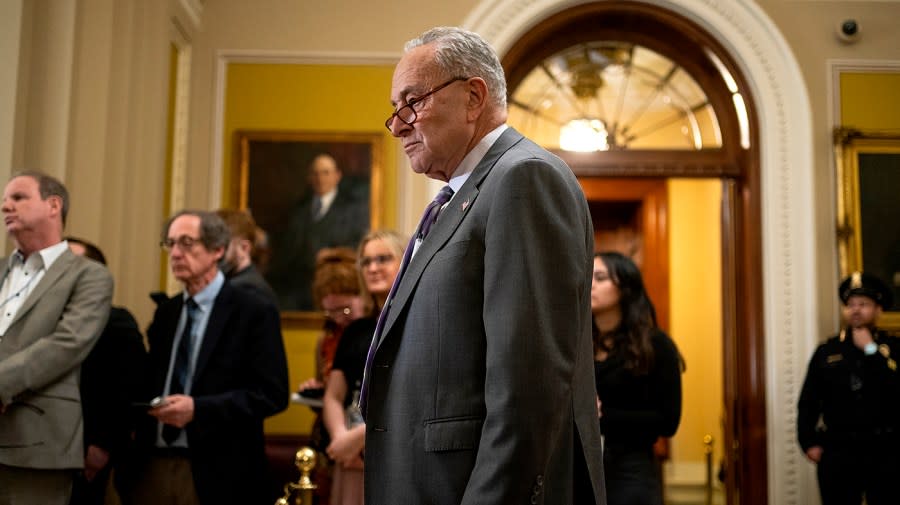
Senate Majority Leader Chuck Schumer (D-N.Y.) announced Monday that he and other Senate Democrats will work to advance legislation to strip former President Trump of the immunity he was granted under a recent Supreme Court ruling protecting a president’s official acts from criminal prosecution.

Schumer, invoking Congress’s powers to regulate the courts, said Democrats are working on legislation to classify Trump’s efforts to subvert the results of the 2020 election as “unofficial acts” so they do not merit immunity from criminal prosecution under the high court’s recent 6-3 decision.

“They incorrectly declared that former President Trump enjoys broad immunity from criminal prosecution for actions he took while in office. They incorrectly declared that all future presidents are entitled to a breathtaking level of immunity so long as their conduct is ostensibly carried out in their official capacity as president,” Schumer said on the Senate floor.

Schumer said the court’s conservative justices had “effectively placed a crown on Donald Trump’s head,” putting him above the law and making him “in many ways untouchable.”

“I will work with my colleagues on legislation classifying Trump’s election subversion acts as unofficial acts not subject to immunity,” he announced. “We’re doing this because we believe that in America no president should be free to overturn an election against the will of the people, no matter what the conservative justices may believe.”

Schumer said senators will keep on working on other proposals to “rein in the abuse of our federal judiciary.”

Some Democrats, including Sens. Chris Van Hollen (Md.) and Sheldon Whitehouse (R.I.), have expressed support for adding language to the Supreme Court’s annual funding bill that would require it to adopt an enforceable code of ethics.

Government watchdog groups, Democratic lawmakers and media pundits have criticized conservative justices Clarence Thomas and Samuel Alito for accepting tens of thousands of dollars in free travel and other gifts from wealthy benefactors.

The Supreme Court granted Trump substantial immunity when it ruled on July 1 that Trump and future presidents could not be prosecuted for crimes related to official acts but left it to lower courts to determine whether Trump’s actions to overturn the results of the 2020 election fell under the category of official acts.

Some legal analysts, however, think the ruling may protect Trump entirely from being prosecuted for the attempts to overturn the election results, which resulted in a mob storming the U.S. Capitol on Jan. 6, 2021, because it would bar prosecutors from presenting actions related to official conduct to a jury as evidence.

Sen. Chuck Schumer eyes new bill hitting back at the Supreme Court’s immunity ruling on Trump

NBC News

Sen. Chuck Schumer eyes new bill hitting back at the Supreme Court’s immunity ruling on Trump

Sahil Kapur and Frank Thorp V – July 9, 2024

WASHINGTON — Accusing conservative Supreme Court justices of placing “a crown on Donald Trump’s head” that allows him to commit crimes with impunity, Senate Majority Leader Chuck Schumer said Monday that he’s eying a legislative response to last week’s court ruling.

“We Democrats will not let the Supreme Court’s decision stand unaddressed. The Constitution makes plain that Congress has the authority to check the judiciary through appropriate legislation. I will work with my colleagues on legislation classifying Trump’s election subversion acts as unofficial acts not subject to immunity,” Schumer, D-N.Y., said on the Senate floor.

Schumer spoke as the Senate returned from recess, a week after the Supreme Court handed Trump a big win in a 6-3 ruling along ideological lines that said presidents have legal immunity from prosecution for “official acts” carried out on the job but not unofficial acts. The terms are subject to interpretation, and Schumer is seeking to define Trump’s attempts to overturn the 2020 election results as being outside the scope of his presidential duties.

“We’re doing this because we believe that in America no president should be free to overturn an election against the will of the people, no matter what the conservative justices may believe,” Schumer said. “As we work on this important matter, we’ll also keep working on other proposals to reassert Congress’s Article I authority to rein in the abuse of our federal judiciary. The American people are tired, just tired, of justices who think they are beyond accountability.”The specifics of the bill aren’t yet determined, and there would undoubtedly be hurdles to advancing the legislation in the Senate, where Democrats hold a razor-thin majority in a chamber that requires 60 votes for passage.

Apart from Congress, the White House told NBC News after the Supreme Court’s ruling that it is exploring its own options for how to respond.

“We are reviewing the decision and certainly will be exploring what could be done to address it to better safeguard democracy and the rule of law in the future, given this dangerous precedent,” White House spokesperson Ian Sams said.

Biden aimed to prove US and global doubters wrong with NATO speech

Politico

Biden aimed to prove US and global doubters wrong with NATO speech

Alexander Ward and Myah Ward – July 9, 2024

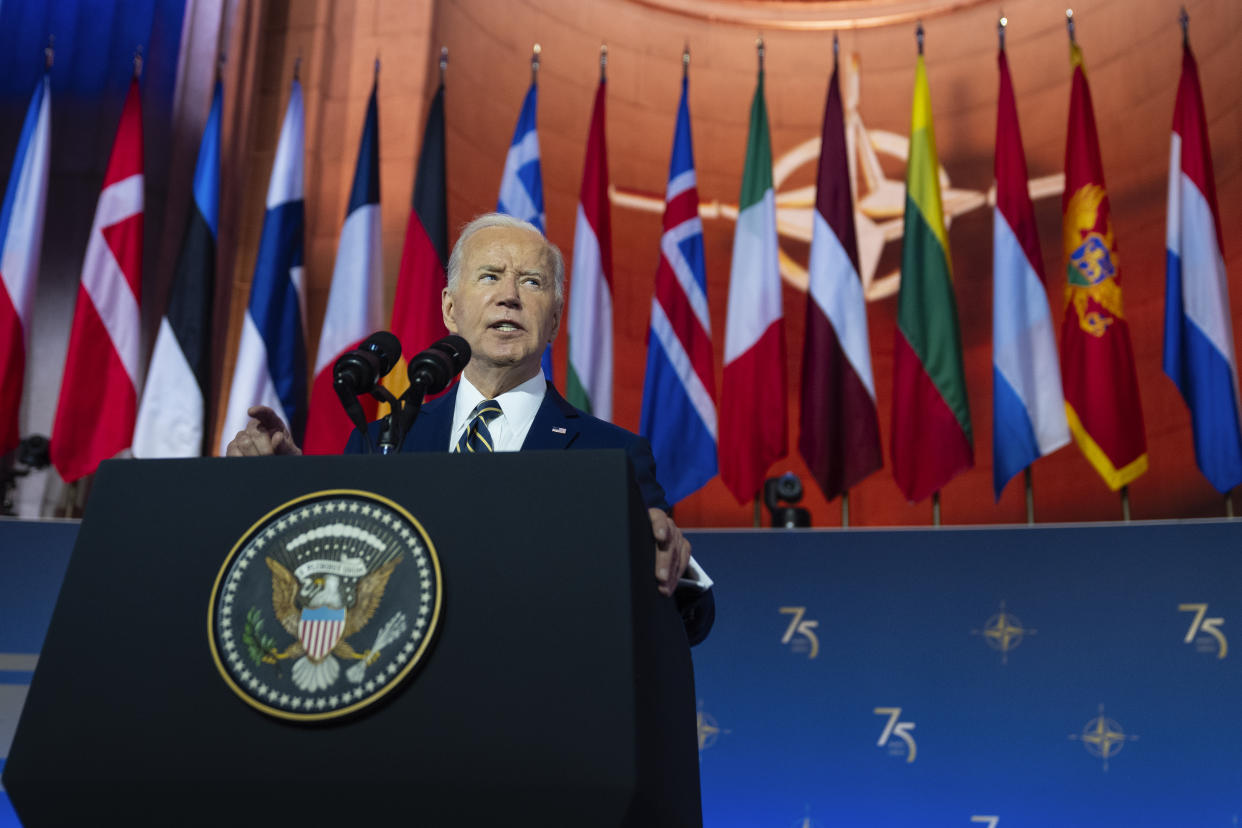
With the eyes of the world on him, President Joe Biden delivered a forceful speech to open the NATO summit in Washington, aiming to reverse doubts about his fitness for the job domestically while boasting that his leadership revitalized the storied alliance and saved Ukraine.

The address, which kicked off three days of high-profile meetings in the steamy U.S. capital, served as both a political and geopolitical test for Biden. With every speech, he must prove that age is just a number and that his shambolic debate performance against former President Donald Trump was a one-off bad night. And with every appearance at the NATO Summit this week, Biden must demonstrate he can still rally allies to Ukraine’s cause for the long haul.

“Ukraine can and will stop Putin,” he said at the ornate Mellon Auditorium in Washington. “Russia will not prevail. Ukraine will prevail.”

The president didn’t fumble over words as he often does during remarks. He was clear and forceful, appearing energized by the transatlanticism that he has embraced throughout his political career.

The speech was more than atmospherics. Biden used the occasion to announce the delivery of new air defenses for Ukraine, one of Kyiv’s top requests for this summit. The U.S. and four NATO allies — the Netherlands, Germany, Italy, Romania — will this year send four Patriot air-defense systems and related components as well as one SAMP/T system. In the coming months, Washington and its partners will also deliver dozens more tactical air-defense systems to bolster Ukraine’s security and expect to make similar announcements later in the year.

A critical part of the new assistance package will see some countries who have ordered air defense missiles from U.S. companies bumped down the list, as supplying those interceptors to Ukraine will take priority.

“Make no mistake: Russia is failing in this war,” Biden declared before noting that 350,000 Russian soldiers have been killed or wounded, with another 1 million people fleeing the country. “When this senseless war began, Ukraine was a free country. Today, it’s still a free country, and the war will end with Ukraine remaining a free and independent country.”

In a joint statement released shortly after Biden’s remarks, the president and the leaders of the Netherlands, Germany, Italy, Romania and Ukraine said: “Our message to Moscow and the world is clear: Our support for Ukraine is strong and unwavering.”

The move ends months of a U.S.-led search for air-defense systems to send to Ukraine and negotiations over how to procure them. Some nations didn’t want to part with the sophisticated defensive weapons, at least not before figuring out how to replace them. Last week, a senior Biden administration official told POLITICO “we’re shaking the hell out of the trees, and we’re going to get the highest number that we can.”

A boost in air-defenses was high on Ukraine’s list, as Russia’s superior arsenal allowed it to bombard cities and key military targets. On Monday, Russia overwhelmed Ukraine’s defenses in Kyiv, launching a deadly strike on a children’s hospital — one of Europe’s largest — leading surviving patients to receive cancer treatments on the street.

Andriy Yermak, head of Ukrainian President Volodymyr Zelenskyy’s office, told POLITICO reporters before the announcement that he was pleased his country would get more support, but he lamented that the delivery was unnecessarily “delayed” and should’ve been completed much sooner. “Now it’s necessary to close our cities,” he said, claiming these and future air-defense system transfers will better protect against Russian missiles and deter future barrages.

Biden will continue to be under a microscope this week as he manages a busy schedule, including a jam-packed Wednesday and a rare news conference on Thursday, when he will face questions about his age and mental acuity.

Biden will use the days ahead to reassure NATO allies — and skittish Democrats at home — that he’s up to the job of taking down Trump, as heads of state from Europe and North America prepare for the possibility of his predecessor’s return. The president has said the summit is a good venue for judging his abilities and has pointed to his leadership in rallying NATO support for Ukraine as evidence that he’s equipped to serve four more years.

With the potential of Trump’s return to power looming, the president has repeatedly highlighted his commitment to NATO, while warning voters that his predecessor would abandon the alliance if he returns to the White House.

Unlike in 2016, NATO allies are actively preparing to manage the return of a NATO-skeptic Trump administration. NATO officials are ramping up weapons production, consulting with Trump’s advisers and holding meetings to prepare for the former president’s return, and with that, an America-first, restraint-focused approach and a deep skepticism toward Europe.

Paul McLeary contributed to this report.

The Most Interesting Justice on the Supreme Court Is Also the Loneliest

By Stephen I. Vladeck – July 8, 2024

Justice Amy Coney Barrett walking at the bottom of steps, next to the figure of a person partly out of frame.
Credit…Stefani Reynolds for The New York Times

When this Supreme Court term began last October, one of the more intriguing predictions from commentators was that Justice Amy Coney Barrett — entering her third full term on the court — would come out of her shell and emerge as the court’s new swing justice, casting the decisive vote in the most divisive cases.

The commentators got half of that right: There’s little doubt, in looking at the oral arguments the court has conducted and the decisions it has handed down over the past nine months, that Justice Barrett has found her voice — and has easily become the most interesting justice. Her questions at argument are penetrating; the analysis in her written opinions spares no one in its detail.

The second part of that prediction didn’t come true, though. Justice Barrett did side with some or all of the three Democratic appointees in several of the term’s most important cases — but her fellow conservatives seldom joined her. Indeed, while Justice Barrett was establishing her principled independence in the middle of the court, the other five Republican appointees moved only further to the right.

When the majority in the Colorado ballot disqualification case went further than necessary, and the Democratic appointees called them out for doing so, there was Justice Barrett — writing separately to chastise all of her colleagues for failing to send a unified message to the country. When Justice Clarence Thomas took too wooden an approach to assessing historical practice and tradition in a trademark case, there was Justice Barrett — pushing back in an important concurrence that was joined by Justice Elena Kagan and in part by Justices Sonia Sotomayor and Ketanji Brown Jackson.

When the Fifth Circuit allowed anti-vaccine activists and red states to bring an unprecedented lawsuit against the Biden administration built on the dubious claim that the government had coerced social-media networks into removing vaccine-related disinformation and misinformation, there was Justice Barrett — writing the majority opinion holding that the plaintiffs hadn’t come close to establishing that they had been harmed by the alleged government action and that the Fifth Circuit clearly erred in concluding to the contrary. And when the court sidestepped a highly charged dispute over emergency abortions in Idaho, it was Justice Barrett who wrote for the court’s “middle” in explaining why.

Even on Monday, when Justice Barrett otherwise joined the five other Republican appointees in holding that presidents enjoy at least some immunity from criminal prosecution, she went out of her way to push back against the majority’s most controversial holding — that protected conduct can’t even be used as evidence in criminal prosecutions against former chief executives.

Her partial concurrence offered a not-so-subtle road map to Judge Tanya Chutkan, presiding over the Jan. 6 prosecution, for how she might apply the majority’s new framework. Just as in her dissenting opinion in the Fischer v. United States case — in which the other Republican appointees, joined by Justice Jackson, voted to narrow a criminal obstruction statute used to prosecute Jan. 6 rioters — Justice Barrett was cleareyed about the threat to democracy Jan. 6 posed and the importance of holding to account those who were responsible for it.

This pattern has repeated in the more opaque context of emergency applications. In March, when the court briefly allowed Texas’ new state-level deportation regime to go into effect, it was a not-so-subtle nudge from Justice Barrett, in a concurring opinion, that prompted the Fifth Circuit to quickly put it back on hold (where it remains).

And in January, it was Justice Barrett who provided the fifth vote (joined by the three Democratic appointees and Chief Justice John Roberts) to allow the Biden administration to remove razor wire that Gov. Greg Abbott of Texas had placed along the U.S.-Mexico border — defusing what had been a brewing conflict between state and federal authorities in and around the town of Eagle Pass.

The justice reflected in all of these cases is someone who comes across in her writings as principled, nuanced and fair-minded — regardless of the bottom line that her votes end up supporting. Many of us may not agree with the principles reflected in her writings (like her majority opinion in a case holding that U.S. citizens don’t have a liberty interest in the immigration status of their noncitizen spouses). What cannot be doubted is that they are principles, and that, to an extent greater than many of her colleagues, Justice Barrett does her best to hew to them.

The problem that the court’s rulings at the end of the term drove home is that, as willing as Justice Barrett is to follow her principles even when they lead her away from Republican political preferences, the same can’t always be said of the other two justices in the court’s middle — Chief Justice Roberts and Justice Brett Kavanaugh. The chief justice wrote the majority opinion in Loper Bright Enterprises v. Raimondo, in which the court overruled its 40-year-old decision in Chevron — and the principle of deference to administrative agencies for which it stood. The chief justice wrote the majority opinion in Fischer, which narrowed the criminal obstruction statute so prevalent in Jan. 6 cases in blatant defiance of the principles of textualism to which the conservative justices are supposedly committed. And the chief justice wrote the court’s sweeping majority opinion in the Trump immunity case.

And it is the split between the five other Republican appointees and Justice Barrett in that last case that is most revealing. Whereas the majority mostly left application of its new and not exactly clear approach to presidential immunity to be hashed out by the lower courts, Justice Barrett “would have answered it now.” Whereas the majority went out of its way to punt on whether the charges against Mr. Trump can go forward, Justice Barrett was emphatic that, for at least some of the charges, she saw “no plausible argument for barring prosecution of that alleged conduct.”

And whereas the majority went out of its way to hold that immunized presidential conduct couldn’t even be used as evidence to try charges for which even the majority agrees there is no immunity, Justice Barrett criticized the majority and endorsed Justice Sotomayor’s dissent, noting that “the Constitution does not require blinding juries to the circumstances surrounding conduct for which presidents can be held liable.”

As with her dissent in the Jan. 6 obstruction ruling, Justice Barrett seems willing to accept that the court lives in the real world — and that the rules it hands down should be designed to actually work on the ground and to persuade those reading them that the court understands the limits on its proper role in our constitutional system.

In the end, this contrast is perhaps one of the defining — and most chilling — takeaways from the Supreme Court’s term: Justice Barrett came out of her shell. And the other Republican appointees retreated into theirs.

Stephen I. Vladeck is a professor of law at Georgetown, writes the One First weekly Supreme Court newsletter and is the author of “The Shadow Docket: How the Supreme Court Uses Stealth Rulings to Amass Power and Undermine the Republic.”

Biden pushes defiant message in letter to Dems, MSNBC appearance

MaddowBlog – From The Rachel Maddow Show

Biden pushes defiant message in letter to Dems, MSNBC appearance

The president appeared on MSNBC’s “Morning Joe” and wrote a letter to congressional Democrats, adopting a defiant posture. Whether it’ll work is unclear.

By Steve Benen – July 8, 2024

In the seven days following his awful debate performance, President Joe Biden adopted a low-key approach. He held no press conferences. He sat down for no major on-air interviews. He was slow to call his congressional allies. The incumbent Democrat appeared to be operating under a dubious assumption: The uproar would fade, the public conversation would shift, and the race would return to “normal.”

If that was Biden’s assumption, it was a mistake: The number of Democratic lawmakers, officials and donors urging the president to withdraw from the race grew considerably as the incumbent waited for the story to blow over.

And so, he’s clearly adopted a new posture. NBC News reported:

President Joe Biden began a crucial week for his candidacy by seeking to stamp out growing criticism by fellow Democrats who want him to step aside in the race. Phoning into MSNBC’s “Morning Joe” on Monday, the president said the voters have chosen him and dared his Democratic critics who want him out to challenge him at the party’s August convention.

“I’m getting so frustrated by the elites in the party. … They know so much more,” Biden said, mockingly. “If any of these guys don’t think I should run, run against me. Go ahead. Announce for president — challenge me at the convention!”

The incumbent added that he believes “average” Democratic voters want him to stay in the race — a conclusion he arrived at after some events in recent days with supporters.

On the one hand, it was a clear message delivered in a high-energy way. On the other hand, it seemed far from ideal to see Biden chastising members of his own party, while complaining about Democratic “elites” — a label the experienced president was apparently applying to his longtime friends and governing partners.

What’s more, it’s worth noting for context that recent polling suggests it’s not just folks attending cocktail parties in Georgetown who believe Biden should stand down.

The call-in appearance on MSNBC dovetailed with a two-page letter sent to congressional Democrats in which Biden argued, among other things, that he won the party’s nominating contests.

“We had a Democratic nomination process and the voters have spoken clearly and decisively,” Biden wrote, referring to his primary and caucus victories. “The voters — and the voters alone — decide the nominee of the Democratic Party,” he added.

“The question of how to move forward has been well-aired for over a week now,” the president’s letter went on to say. “And it’s time for it to end. … Any weakening of resolve or lack of clarity about the task head only helps Trump and hurts us.”

Biden’s strategy, in other words, is rooted in defiance. He’s not addressing the concerns of his intraparty critics, so much as he’s telling them that the conversation they’ve created is irrelevant: If the president isn’t going to end his candidacy, the argument goes, Democrats waiting for him to pass the torch shouldn’t waste everyone’s time with a pointless effort.

This might work, but in my experience, members of Congress don’t like to effectively be told, “Shut up and stop talking about what you want to talk about.”

As for the argument that Biden earned the nomination by way of his party’s nominating process, that’s true. Aside from American Samoa, the president cruised to lopsided victories in every Democratic primary and caucus.

But I’m reminded of the 1980 election.

In case anyone needs a refresher, in 1980, then-Sen. Ted Kennedy challenged then-President Jimmy Carter in a Democratic primary. As the process was just getting under way, the Iran hostage crisis broke, and Carter’s public support initially surged. The incumbent cruised to easy victories in nearly all of the early primaries and caucuses, mostly by wide margins.

But as the nominating fight continued, and developments in Iran dragged on, public support for Carter’s handling of the crisis deteriorated. By the time the June primaries came along, Kennedy was in a vastly stronger position, and as the nominating process wrapped up, he closed out the calendar with several key wins, including a big victory in California.

As the convention drew closer, Kennedy went to party officials with a compelling message rooted in fact: Democratic voters who backed Carter in January’s and February’s contests couldn’t have known what conditions would be like in June and July. It’s not that those contests didn’t count, so much as it was incumbent on the party to recognize the facts that weren’t available to primary and caucus voters months earlier.

If Democrats had it to do over again, Kennedy argued, knowing what the crisis in Iran would do to the president’s national support, the results would have been much different.

And while Kennedy was probably correct, his pitch didn’t work. Party officials stuck to the rules: Carter had earned a clear majority of the delegates, and so he would be the Democratic nominee.

The incumbent soon after lost in a landslide, winning only 49 electoral votes.

Biden’s absolutely right that he received the necessary number of delegates to win the nomination. But if the Democratic electorate had it to do over again, would they make a different choice?

Steve Benen is a producer for “The Rachel Maddow Show,” the editor of MaddowBlog and an MSNBC political contributor. He’s also the bestselling author of “The Impostors: How Republicans Quit Governing and Seized American Politics.”