CDC says COVID wastewater levels are ‘very high’ in VA and NC
KaMaria Braye – August 12, 2024
PORTSMOUTH, Va. (WAVY) – The Centers for Disease Control and Prevention (CDC) reports that wastewater levels of COVID-19 are considered very high across the United States.
At least 26 states are either high or very high for COVID-19 infections. The data shows this summer’s COVID-19 levels could pass the previous two summers.
The CDC says sewage can be tested to find traces of infectious diseases in communities and that the diseases can be found even if people don’t have symptoms.
With most Hampton Roads school districts returning back to school starting in mid-August, the CDC has recommendations for parents to help kids stay healthy while learning.
Potential Tropical Cyclone Five expected to become tropical storm within next few days
Sara Filips – August 11, 2024
Potential Tropical Cyclone Five expected to become tropical storm within next few days
TAMPA, Fla. (WFLA) — The National Hurricane Center issued its first advisory for Potential Tropical Cyclone Five on Sunday as it’s likely to develop into a tropical storm within the next few days.
The system has a 90% chance of development within the next seven days and has ramped up to an 80% chance within 48 hours, the NHC said in a 5 p.m. update.
The wave, which is located about 1,530 miles east-southeast of Antigua, continues to show signs of organization.
The NHC said the system is moving toward the west-northwest at 21 mph with maximum sustained winds of 30 mph. It is expected to move across portions of the Leeward Islands on Tuesday and approach the U.S. and British Virgin Islands on Tuesday night.
“Some strengthening is forecast and the system is expected to become a tropical storm by late Monday,” the NHC said. Ernesto is the next storm name on the list.
“The good news is that it’s expected to turn to the north well to the east of the U.S. and Bahamas and may impact Bermuda later this week,” Max Defender 8 Meteorologist Eric Stone said. The system is not expected to impact Florida.
Why Japan issued its first-ever ‘megaquake advisory’ — and what that means
Evan Bush – August 10, 2024
The Summary
Japan’s meteorological agency on Thursday issued its first-ever “megaquake advisory.”
The warning followed a 7.1-magnitude earthquake off the country’s southern coast.
That raises the risk of an even larger quake on the Nankai Trough, an underwater subduction zone that scientists believe is capable of producing temblors up to magnitude 9.1.
After a 7.1-magnitude earthquake shook southern islands in Japan on Thursday, the country’s meteorological agency sent out an ominous warning: Another, larger earthquake could be coming, and the risk will be especially high over the next week. In the first “megaquake advisory” it has ever issued, the agency said that the risk of strong shaking and a tsunami are greater than usual on the Nankai Trough, a subduction zone with the potential to produce magnitude 8 or 9 temblors. Area residents, it said, should prepare.
The message was not a prediction, but a forecast of enhanced risk — and it shows how far seismologists have come in understanding the dynamics of subduction zone earthquakes.
Here’s what to know about the situation.
A dangerous subduction zone
The Nankai Trough is an underwater subduction zone where the Eurasian Plate collides with the Philippine Sea Plate, forcing the latter under the former and into the Earth’s mantle.
Subduction zone faults build stress, and a so-called megathrust earthquake takes place when a locked fault slips and releases that stress. “Megaquake” is a shortened version of the name. These zones have produced the most powerful earthquakes in Earth’s history.
The Pacific “Ring of Fire” is a collection of subduction zones. In the U.S., the Cascadia subduction zone off the West Coast runs from Vancouver Island, Canada, to Cape Mendocino, California.
A beach is closed in Nichinan in southwestern Japan on Friday, after the country’s issued its first warning about a possible megaquake.
If a megaquake were to happen near Japan, the Philippine Sea Plate would lurch, perhaps as much as 30 to 100 feet, near the country’s southeast coast, producing intense shaking. The vertical displacement of the seafloor would cause a tsunami and push waves toward the coast of Japan. Those waves could reach nearly 100 feet in height, according to estimates from Japanese scientists published in 2020.
A history of big quakes
The Nankai Trough has produced large earthquakes roughly every 100 to 150 years, a study indicated last year. Japan’s Earthquake Research Committee said in January 2022 said there was a 70% to 80% chance of a megathrust earthquake in the subsequent 30 years.
Large Nankai Trough earthquakes tend to come in pairs, with the second often rupturing in the subsequent two years. The most recent examples were “twin” earthquakes on the Nankai Trough in 1944 and 1946.
The phenomenon is due to the segmented nature of the fault; when one segment slips, it can stress another.
People stand outside after leaving a building following an earthquake in Miyazaki on Thursday.
Harold Tobin, a University of Washington professor who has studied the Nankai Trough, said the magnitude-7.1 quake took place in a segment that shakes more frequently than others. Regular earthquakes can relieve stress, so the possibility that the segment itself produces a big earthquake is less of a concern. The worry is the earthquake’s proximity to a segment that’s been building stress since the 1940s. “It’s adjacent to the western Nankai region and that’s clearly locked up. That’s the reason for alert and concern,” Tobin said.
A forecast, not a prediction
Scientists can’t predict earthquakes, but they are developing the ability to forecast times of heightened risk, particularly in areas with frequent shaking and good monitoring equipment, like Japan.
Firefighters walk near a fallen building in Wajima, in Japan’s Ishikawa prefecture, after a New Year’s Day earthquake.
The most likely outcome is that the recent shaking won’t trigger anything, even though the probability of a large earthquake is higher.
“We might wait decades before Nankai has another earthquake,” Tobin said.
A known danger
In 2011, an area of the seafloor roughly the size of Connecticut lurched all at once, producing a magnitude-9.1 earthquake — the third biggest recorded worldwide since 1900. That megathrust earthquake caused a tsunami off Japan’s eastern coast. More than 18,000 people died in the tsunami and earthquake, according to the U.S. National Oceanic and Atmospheric Administration.
The Cascadia Subduction Zone poses a similar risk for the U.S. West Coast, though megathrust earthquakes are expected there less often — every 300 to 500 years. This fault has the capability of producing a magnitude-9.1 earthquake and tsunami waves 80 feet in height. Researchers recently mapped the fault in detail and found it was divided into four segments.
The Founders Saw This Insane Political Moment Coming 237 Years Ago
By Stacy Schiff – August 1, 2024
Stacy Schiff is the author of, most recently, “The Revolutionary: Samuel Adams.”
Credit…Hunter French
If you’re feeling wrung out from the last dizzying weeks of political news, just imagine how the word “unprecedented” must be faring, dragged from its recliner for daily — sometimes hourly — workouts. It needn’t have been.
To understand how we got here, it’s helpful to return to another sweltering summer, a summer when everything actually was without precedent. The 55 men who assembled in Philadelphia 237 years ago to hammer out an American Constitution differed on a great many things. Among the rare points on which most agreed was that the American people could not be trusted to choose a president for themselves. They were easily misled, too often “the dupes of pretend patriots.” The size of the country alone made an informed electorate impossible, given the press, the postal service and the miserable infrastructure.
Slavery (barely discussed) and the mechanics of representation (much discussed) proved vexing. But few questions so confounded the delegates to the 1787 Constitutional Convention as those pertaining to the American presidency. The Articles of Confederation, which had held the colonies together through the Revolution, had made no provision for a chief executive. How should the president be selected and how long should he serve? By what mechanism could he be removed? Should he report to the legislature? Should Congress be empowered to impeach him? What qualified as an impeachable offense?
No subject proved more divisive or elicited such a staggering array of options. It befuddled the delegates in June. They wrangled with it still in September.
King George III loomed large over the proceedings; a single executive seemed a high-risk proposition. Several Southerners favored a three-person executive, a committee that would represent each region of the fledgling Republic. From the start there was concern that rural voices would be drowned out. Some delegates worried that multiple officeholders would dilute the power of the presidency. Others feared the authority of an American president might come even to exceed that of the king. Would a president not do all in his power to retain his hold on the office? What if he committed crimes? “Will not the immense difference between being master of everything and being ignominiously tried and punished” move him to cling to the office, Patrick Henry would later ask. (He had refused to attend the convention because, he claimed, he “smelt a rat.”)
The doctrine of separation of powers asserted itself only slowly. It dogged the delegates as they argued back and forth, attempting to deliver an American presidency that was both insulated from and accountable to Congress. The initial idea was for Congress to elect the chief executive, an idea that met with early, unanimous agreement. The more it was discussed, the muddier the matter grew. Perhaps state legislatures should do the electing? One term seemed sufficient in June but wrongheaded by July. It had not yet occurred to the delegates that the president would sit at the head of a political party. In the original conception he was to transcend factions, like a British sovereign.
A presidential term, it was initially agreed, should be seven years. The convention went on to entertain options of six, 11, 12, 15 and 20 years. Early on, the delegates converged upon a single term, though some had a different definition of what one term constituted. The most ardent proponent of executive authority, Alexander Hamilton, believed a president should serve for life. “It may be said, this constitutes an elective monarchy,” he conceded. But the president best able to resist popular pressures, corruption and foreign influence was the president with life tenure. “An executive is less dangerous to the liberties of the people when in office during life, than for seven years,” argued Hamilton.
Benjamin Franklin — at 81, older than everyone in the room, in most cases by decades — demurred. Even if that executive were a man of unerring, incorruptible instincts, what would happen if he were to grow frail? A man’s life often outlasted his prime, observed Franklin, who strayed from his chair only with visible difficulty. He meandered freely from his point. He entrusted most of his speeches to a colleague.
Weeks of heated inconclusiveness followed. How to remove an unfit executive, whether to allow him a veto and the extent of his powers occupied days. So did the question of salary. At one point it was suggested that anyone elected to the presidency be in possession of a “clear unencumbered estate” of at least $100,000, an amount equivalent to roughly $3.5 million today. Franklin objected, generally opposing the idea that rights be restricted to property owners. “Some of the greatest rogues he was ever acquainted with,” he was said to have quipped, “were the richest rogues.” He strongly urged that the president be reimbursed only for his expenses.
Having spent years in London, having observed the British court at close hand, he knew that men made outlandish efforts to grasp and retain lucrative, powerful offices. He warned against a natural inclination to embrace kings. (He may or may not have known that nearly half his colleagues seemed to prefer some form of royal government.) “I am apprehensive, therefore — perhaps too apprehensive,” he warned, “that the government of these states may in future times end in a monarchy.” An awkward moment followed. In the room, after all, stood General Washington, who had served his country for eight years with honor and without profit. Franklin’s motion found a respectful second. It seems never to have returned to the table.
Some parts of that summer sound deeply familiar. There were long weeks of acrimony and about-faces, personal attacks and pouting. There were deadlocks, diatribes and tantrums. Consensus remained elusive for months and arrived grudgingly in the end. Ultimately it was James Madison who crafted the bare bones of the Electoral College, a system born of confusion and bruising exasperation. (When finally it came time for individual states to ratify the Constitution, some Pennsylvania delegates hid themselves away in their boardinghouses, from which they had to be bodily dragged.) Six days a week the delegates suffocated together for hours, practically seated atop each other in a stifling forty-by-forty-foot room. They took no daily breaks. It was not always possible to follow the debate.
In cutting a Constitution from whole cloth, the delegates met with infinitely more negative examples than appealing models. They had reviewed the republics of antiquity. They had examined the modern states of Europe. They had read their Hume, Montesquieu and Blackstone. They found no single formula that suited their purposes. They had agreed on secrecy — the room felt particularly airless as, for security, the windows were locked tight — an oath that has hampered historians ever since but did nothing to stanch the misinformation that flew from Philadelphia. Toward late July a rumor flew around New England that the delegates had resolved to invite George III’s second son to be crowned king of America.
Then, in mid-convention, came something wholly startling. During a particularly bitter June impasse, Franklin ventured to observe that five weeks’ work had yielded lamentably little. At that same Philadelphia address the Continental Congress had appealed for divine illumination. Should this new assembly do the same? The full Congress consisted of 53 Protestants, the majority of them Episcopalians. Two Catholics rounded out the ranks. Many of them were men of deep piety. If they were founding an American Christian nation when they wrote the Constitution it was not obvious: Franklin’s proposal met with a deafening silence. Hamilton gamely weighed in, to comment that an appeal to heaven would likely alarm the country. It reeked of desperation. A North Carolinian objected that Congress was without the funds to pay a cleric. Only three or four delegates, Franklin noted with what sounds like astonishment, thought prayer essential!
Much of what was said in that room suggests that the founders guessed we would sooner or later wind up injecting coconuts and couches into our political discourse. When they were not attempting to craft a viable American presidency, the delegates worried about how to protect a fledgling government from the worst instincts of its constituents. Those, too, were on full display that July, when the unprecedented collided with the immemorial.
Already once that spring a Philadelphia mob had attacked in the street an elderly German woman named Korbmacher. Long suspected of witchcraft, she was rumored to have poisoned a child with a magic charm. On July 10, a week during which the convention wrangled with the three-fifths clause, a formula that struck even its proposer as abhorrent, the widow Korbmacher was again attacked. This time her assailants armed themselves with stones and knives. She died from her injuries a week later while inside the State House the best minds in America designed — for citizens they felt might not best be trusted with their own political choices — the most enlightened government they could imagine. “Prejudices, worm-eaten prejudices, as our old companions, are hard to be parted with,” The Pennsylvania Packet opined about the attack.
The case went to court in October. It is unclear if the presiding judge handed down any convictions, though he did allow himself a comment from the bench. How had a wrinkled old crone caused such a commotion? Now if some of the luscious damsels he had noticed around town, “animated with the bloom of youth and equipped with all the grace of beauty” had been charged, the accusation would merit attention. Those women, he declared, were created to befuddle and bewitch.
The record is silent as to whether old Korbmacher was childless or owned even a single cat.
Stacy Schiff is the author of six books, including, most recently, “The Revolutionary: Samuel Adams.”
How Hungary’s Orbán uses control of the media to escape scrutiny and keep the public in the dark
Justin Spike – July 31, 2024
FILE – Hungarian Prime Minister Viktor Orban delivers a speech at Tusvanyos Summer University, in Baile Tusnad, Harghita county, Romania, on July 27, 2024. In Hungary, Orbán has extended his party’s control over the media, directly affecting informed democratic participation. (AP Photo/Alexandru Dobre, File)Members of the media work during the government’s press conference on Thursday, Jan 18, 2024. In Hungary, Prime Minister Viktor Orbán has extended his party’s control over the media, directly affecting informed democratic participation. (AP Photo/Denes Erdos)A headphone of a cameraman is seen in the press room during the government’s press conference on Thursday, Jan 18, 2024. Polarization has created “an almost Orwellian environment” in Hungarian media, where the government weaponizes control of a majority of outlets to limit Hungarians’ access to information. (AP Photo/Denes Erdos)
BUDAPEST, Hungary (AP) — In the months leading up to elections for the European Parliament, Hungarians were warned that casting a ballot against Prime Minister Viktor Orbán would be a vote for all-out war.
The right-wing Fidesz party cast the June 9 election as an existential struggle, one that could preserve peace in Europe if Orbán won — or fuel widespread instability if he didn’t. To sell that bold claim, Orbán used a sprawling pro-government media empire that’s dominated the country’s political discourse for more than a decade.
The tactic worked, as it has since Orbán returned to power in 2010, and his party came first in the elections — though not by the margins it was used to. An upstart party, led by a former Fidesz insider, attracted disaffected voters and took 29% of the vote to Fidesz’s 44%.
“Everything has fallen apart in Hungary. The state essentially does not function, there’s only propaganda and lies,” said Péter Magyar, the leader of that new party who has emerged in recent months as perhaps the most formidable challenge yet to Orbán’s rule.
This story, supported by the Pulitzer Center for Crisis Reporting, is part of an ongoing Associated Press series covering threats to democracy in Europe.
Magyar’s Respect and Freedom, or TISZA, party campaigned on promises to root out deep-seated corruption in the government. He has also been outspoken about what he sees as the damage Orbán’s “propaganda factory” has done to Hungary’s democracy.
“It might be very difficult to imagine from America or Western Europe what the propaganda and the state machinery is like here,” Magyar said in an interview before elections with The Associated Press. “This parallel reality is like the Truman Show. People believe that it’s reality.”
Since 2010, Orbán’s government has promoted hostility to migrants and LGBTQ+ rights, distrust of the European Union, and a belief that Hungarian-American financier George Soros — who is Jewish and one of Orbán’s enduring foes — is engaged in secret plots to destabilize Hungary, a classic antisemitic trope.
Such messaging has delivered Orbán’s party four consecutive two-thirds majorities in parliament and, most recently, the most Hungarian delegates in the EU legislature.
But according to Péter Krekó, an analyst and head of the Political Capital think tank in Budapest, Orbán has created “an almost Orwellian environment” where the government weaponizes control of a majority of news outlets to limit Hungarians’ decisions.
“Hungary has become a quite successful informational autocracy, or spin dictatorship,” Krekó said.
The restriction of Hungary’s free press directly affects informed democratic participation. Opposition politicians have long complained that they only get five minutes of air time every four years on public television, the legal minimum, to present their platforms before elections.
In contrast, public television and radio channels consistently echo talking points communicated both by Fidesz and a network of think tanks and pollsters that receive funding from the government and the party. Their analysts routinely appear in affiliated media to bolster government narratives, while independent commentators rarely, if ever, appear.
During the campaign in May, Hungary’s electoral commission issued a warning to the public broadcaster for repeatedly airing Fidesz campaign videos during news segments, a violation of impartiality rules. The broadcaster carried on regardless.
Magyar, who won a seat in the European Parliament, credits his new party’s success partly to its ability to sidestep Orbán’s dominance by meeting directly with voters and developing a large following on social media.
But in Hungary, even those with a strong online presence struggle to compete with Fidesz’s control of traditional outlets.
According to press watchdog Reporters Without Borders, Orbán has used media buyouts by government-connected “oligarchs” to build “a true media empire subject to his party’s orders.” The group estimates that such buyouts have given Orbán’s party control of some 80% of Hungary’s media market resources. In 2021, it put Orbán on its list of media “predators,” the first EU leader to earn the distinction.
The title didn’t come out of nowhere: in 2016, Hungary’s oldest daily newspaper was suddenly shuttered after being bought by a businessman with links to Orbán. In 2018, nearly 500 pro-government outlets were simultaneously donated by their owners to a foundation headed by Orbán loyalists, creating a sprawling right-wing media conglomerate. And in 2020, nearly the entire staff of Hungary’s largest online news portal, Index, resigned en masse after its lead editor was fired under political pressure.
A network of independent journalists and online outlets that continue to function in Hungary struggles to remain competitive, said Gábor Polyák, head of the Media and Communication Department at Eötvös Loránd University in Budapest.
The government is the largest advertiser in Hungary, he said. A study by watchdog Mérték Media Monitor showed up to 90% of state advertising revenue is awarded to pro-Fidesz media outlets, keeping them afloat.
The government’s efforts to control media have moved beyond television, radio and newspapers, shifting into social media posts that are boosted by paid advertisements.
Hungary spent the most in the entire 27-member EU — nearly $4.8 million — on political ads on platforms owned by Facebook’s parent company, Meta, in a 30-day period in May and June, outspending Germany, which has more than eight times the population, according to a recent report based on publicly available data compiled by Political Capital, Mérték Media Monitor and fact-checking site Lakmusz.
The vast majority of that spending came from Fidesz or its proxies, the report found.
One major spender is Megafon, a self-declared training center for aspiring conservative influencers. In the same 30-day period, the group spent $800,000 on boosting its pro-government content on Meta platforms, more than what was spent in total by 16 EU countries in the same period.
With government narratives so pervasive across mediums, a level of political polarization has emerged that can reach deep into the private lives of Hungarians. In recent years, the views of Andrea Simon, a 55-year-old entrepreneur from a suburb of Budapest, and her husband Attila Kohári began to drift apart — fed, according to Simon, by Kohári’s steady diet of pro-government media.
“He listened to these radio stations where they pushed those simple talking points, it completely changed his personality,” Simon said. “I felt sometimes he’d been kidnapped, and his brain was replaced with a Fidesz brain.”
In December, after 33 years of marriage, they agreed to divorce.
“I said to him several times, ‘You have to choose: me or Fidesz,’” she said. “He said Fidesz.”
Still, like many Hungarians who hold fast to traditional values in a changing world, Kohári remains a faithful supporter of Orbán and his policies, despite the personal cost.
His love of his country and belief that Orbán has led Hungary in the right direction have him “clearly convinced that my position is the right one,” he said. “But it ruined my marriage.”
The media divide also has consequences for Hungary’s finances, says independent lawmaker Ákos Hadházy, who has uncovered dozens of suspected cases of graft involving EU funds.
Such abuses, he said, go largely unaddressed because the majority of voters are unaware of them.
“Following the Russian model, (the government) controls state media by hand and spends about 50 billion forints ($135 million) a year on advertisements … that sustain their own TV networks and websites,” he said. “The people that consume those media simply don’t hear about these things.”
On a recent day in Mezőcsát, a small village on the Hungarian Great Plain, Hadházy inspected the site of an industrial park that was built with 290 million forints ($795,000) in EU funds. The problem, he said, is that since the site was completed in 2017, it has never been active, and the money used to build it has disappeared.
Hadházy said that Hungarians “who consciously seek out the real news hear about these cases and don’t understand how it’s possible that there are no consequences when I present such things almost daily.”
He continued: “But it’s not important for the government that nobody hears about them, it’s important that more people hear their lies, and that’s the way it is now. Far more people hear their messages than the facts.”
This story has been corrected to show that the building of the industrial park in the village of Mezőcsát involved EU funds in the amount of 290 million forints, not 290 million euros.
This story, supported by the Pulitzer Center for Crisis Reporting, is part of an ongoing Associated Press series covering threats to democracy in Europe.
Vice President Kamala Harris boards Air Force Two in Westfield, Mass., on July 27. (Stephanie Scarbrough/AP)
Ever since Vice President Kamala Harris took the baton last Sunday from her boss, President Biden, and instantly became the Democratic Party’s new de facto presidential nominee, she has enjoyed one of the most significant “honeymoons” in recent U.S. campaign history.
As a result, the latest polls show Harris closing the gap with Donald Trump in key swing states; pulling even nationally; and surpassing him in terms of favorability and enthusiasm.
Yet all honeymoons come to an end. If Harris hopes to win in November, she will have to differentiate herself from Biden — and convince a decisive number of voters to reject four more years of Trump.
In an attempt to do just that, Harris and her allies have been testing out five main lines of attack: that Trump is “weird”; that he is old; that he is scared to debate; that he is a felon; and that his “Project 2025” agenda is extreme.
Harris has been so committed to these themes that even when Trump questioned her race Wednesday — falsely claiming that she suddenly “made a turn” and “became a Black person” after “only promoting [her] Indian heritage” — she refused to get sucked into a culture war.
“The American people deserve better,” is all Harris said in response.
More on the strategic contrasts Harris is trying to draw:
Trump is ‘weird’
When Biden was running, he constantly called Trump a “threat to democracy.”
Harris hasn’t left that line of attack entirely behind. “Do we want to live in a country of freedom, compassion and rule of law, or a country of chaos, fear and hate?” the vice president asked at a recent rally.
But for the most part, Harris and her allies have pivoted to a different anti-Trump message — one that comes across as a lot less alarmist and a lot more … dismissive.
“Some of what [Trump] and his running mate [JD Vance] are saying, it is just plain weird,” Harris said Saturday at her first fundraiser. “I mean that’s the box you put that in, right?”
The new term caught on after Democratic Gov. Tim Walz of Minnesota — who has been using it for months — called Trump, Vance and their policies “weird” a few times last week.
“Listen to the guy,” Walz told CNN, referring to Trump. “He’s talking about Hannibal Lecter, and shocking sharks, and just whatever crazy thing pops into his mind. And I thought we just give him way too much credit.”
So far, the “weird” attack has frustrated Republicans, “leading them to further amplify it through off-balance responses,” David Karpf, a strategic communication professor at George Washington University, told the Associated Press.
It “makes voters feel like Trump is out of touch,” added Brian Ott, a professor of communications at Missouri State University, in an interview with Newsweek. And “it’s hard to claim that it is in any way out of bounds politically, which makes any response to it seem like an overreaction and, well, weird.”
Trump is old
The first time the Harris campaign officially referred to Trump as “weird” was in a press release put out just days after the vice president announced her candidacy. But there was another, more familiar adjective alongside it.
“Trump is old and quite weird,” the statement said. “After watching Fox News this morning, we have only one question, is Donald Trump OK?”
As everyone knows, Biden is the oldest president in U.S. history; at 81, he was also on track to become the oldest presidential nominee in U.S. history until he ended his campaign last Sunday.
Now Trump, 78, has taken his place.
And so Harris, 59, has turned the tables and started describing the former president as someone who is “focused on the past” — while she, in contrast, is “focused on the future.”
For its part, the Harris campaign has been less euphemistic about the nearly two-decade age gap between the two candidates.
“Tonight, Donald Trump couldn’t pronounce words … went on and on and on, and generally sounded like someone you wouldn’t want to sit near at a restaurant, let alone be president of the United States,” Harris spokesperson James Singer said after a recent Trump speech. “America can do better than [Trump’s] bitter, bizarre and backward-looking delusions.”
Trump is scared to debate
On Sept. 10, Trump and Biden were scheduled to debate for the second time this year. But after the president withdrew from the race — and Harris emerged as the new, de facto Democratic nominee — Trump started to backtrack.
“I haven’t agreed to anything,” Trump said on a press call last week. “I agreed to a debate with Joe Biden.” Around the same time, the former president suggested that ABC News should no longer host, calling the outlet “fake news.”
Harris immediately snapped back. “What happened to ‘any time, any place’?” she said in a post on X.
In response, Harris has seized on Trump’s waffling as evidence that “the momentum in this race is shifting” and that “Trump is feeling it,” as she put it Tuesday during a rally in Atlanta — effectively weaponizing the whole situation to question Trump’s confidence.
“Well, Donald,” Harris said in Atlanta, addressing Trump directly. “I do hope you’ll reconsider. Meet me on the debate stage … because as the saying goes, if you’ve got something to say, say it to my face.”
“As many of you know, before I was elected as vice president, before I was elected as United States senator, I was the elected attorney general, as I’ve mentioned, of California,” Harris said. “And before that, I was a courtroom prosecutor.”
The reason is obvious. Democrats believe Project 2025 policies — deporting millions of immigrants, eliminating the Department of Education, installing loyalists throughout the federal bureaucracy, reversing federal approval of the abortion pill mifepristone — will be unpopular with the public.
“I know nothing about Project 2025,” the former president claimed. “I disagree with some of the things they’re saying and some of the things they’re saying are absolutely ridiculous and abysmal.”
But Harris — who has called Project 2025 a “plan to return America to a dark past” — is not moving on.
“This is his agenda, written by his allies, for Donald Trump to inflict on our country,” Harris spokesperson Julie Chavez Rodriguez said Tuesday. “Hiding the 920-page blueprint from the American people doesn’t make it less real — in fact, it should make voters more concerned about what else Trump and his allies are hiding.”
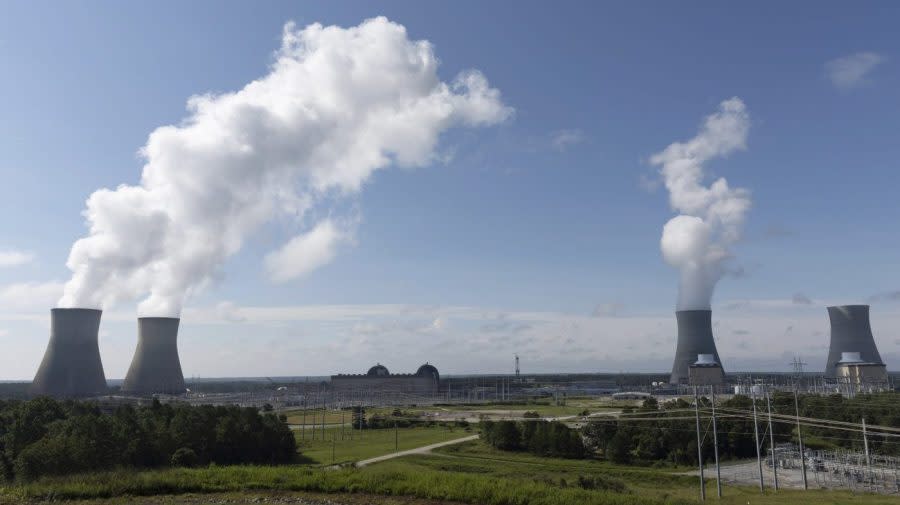
Experts say nuclear energy bill is proof of bipartisan consensus
Zack Budryk – August 1, 2024
The recent passage of major legislation to boost the deployment of nuclear reactors is evidence of a bipartisan consensus on nuclear power as an opportunity to keep pace with China on renewable energy, experts said Thursday at a panel discussion with The Hill.
The ADVANCE Act, which President Biden signed into law in July, passed the Senate 88-2. It directs the Nuclear Regulatory Commission to explore methods of quickening the licensing process for new nuclear technology, as well as streamlining the Energy Department’s technology export process.
The bipartisan vote on the legislation indicates “members of both parties are looking to build on decades of innovation and … create this new opportunity to build new gigawatt-scale clean energy facilities in the United States,” said Lesley Jantarasami, managing director of energy programs at the Bipartisan Policy Center
Jantarasami made the remarks at “The Nuclear Frontier: Securing America’s Energy Future,” which was hosted by The Hill and sponsored by The Nuclear Company. The discussion was moderated by Rafael Bernal, a staff writer at The Hill. Bob Cusack, The Hill’s editor in chief, moderated a separate conversation during the event.
“There’s a lot going on today in recognition of the fact that we are moving toward modernizing our economy, towards building a new energy economy that needs to be centered around clean energy and that nuclear is a foundational piece of that portfolio,” Jantarasami said.
Jantarasami added that widespread interest exists within industry and utilities in deploying new nuclear technology, but the process has been stymied by anxiety about the pressure of being “first out of the gate.”
Panelists also emphasized that there is not a binary choice between a more efficient licensing and approval process and cutting corners on safety. Former Deputy Energy Secretary Mark W. Menezes, president and CEO of the U.S. Energy Association, pointed to reforms at the Food and Drug Administration that reduced the approval timeline as an example of how a balance could be struck.
“This is not about cutting corners [or] creating a process that isn’t diligent,” Jantarasami added, saying there have been “misconceptions around speeding up a process and not doing as much due diligence—we can do both those things.”
Maria Korsnick, CEO at the Nuclear Energy Institute, added that it “isn’t the conversation we had in the 70s and 80s anymore,” when incidents like the Chernobyl disaster and the Three-Mile Island accident led to widespread fears around nuclear power.
Spain, France, Germany: Heatwaves sweep across Europe with devastating consequences
Angela Symons – August 1, 2024
Spain, France, Germany: Heatwaves sweep across Europe with devastating consequences
There’s no end in sight for Europe’s searingly hot summer, as heatwave warnings have been issued from Spain to Germany.
In Paris, too, Olympians have been forced to compete in searing heat – extremes that would have been “virtually impossible” without human-caused climate change, according to climatologist group World Weather Attribution (WWA).
Droughts and wildfires have broken out across the Mediterranean as a result of the hot weather, which looks set to continue throughout August and beyond in some parts.
Extreme heat currently claims more than 175,000 lives annually in Europe, with numbers set to soar, according to a report released by the World Health Organization (WHO) today.
Spain: Temperatures could surpass 43C
Yellow, orange and extreme red heatwave warnings have been issued by Spain’s Meteorological Agency (AEMET) as temperatures threaten to reach 43C in the southeast.
Sweltering highs are forecast across the country’s east coast, south and centre for the majority of August, reaching peak intensity on Thursday – with one in nine of AEMET’s weather stations reaching 40C or higher.
Baza in Grenada and northwest Murcia will be the hardest hit.
The temperature in Barcelona broke records on Tuesday, racing 40C – the hottest day the Catalan capital has seen in at least 110 years, when records began.
According to AEMET, temperatures are likely to be higher than normal until October across much of Spain.
Italy: Rome under maximum heat warning
Helicopters and fire engines tackled a large fire in north-west Rome on Wednesday as a heatwave gripped the Italian capital.
The city has been placed under a maximum heat warning, with temperatures in the high 30s expected on Thursday and Friday.
Florence, Bologna, Milan and Turin are among the other cities also under a red weather warning.
While the blaze on Monte Mario is now under control, Rome and the surrounding areas remain on high alert for wildfires.
The south of the country is facing persistent drought, with farmers in Sicily forced to slaughter or sell off livestock due to severe water shortages.
Germany: Heat warning issued as temperatures creep over 35C
It’s not only southern Europe facing the heat: German Weather Service DWD has issued a warning as parts of the country face 35C-plus temperatures.
Wednesday was expected to be the hottest day of the year – particularly southwest Germany, which will today be hit with thunderstorms and heavy rain as the warm air moves north.
Campaign groups have warned that the country is ill prepared for heatwaves, with Frankfurt’s Senckenberg Society for Nature Research urging the development of early warning systems as the threat of wildfires ramps up.
Environmental non-profit Deutsche Umwelthilfe, meanwhile, released a ‘heat check’ revealing that less than half of the 190 German cities analysed are adequately protecting their citizens against hot weather.
They say more unsealed surfaces and green spaces are needed in cities like Frankfurt and Stuttgart to make them liveable.
Temperatures in Paris reached 35C this week as the city continues to host the Olympic Games.
WWA has warned the high temperatures could impact athletes’ performance and lead to an increase in heat related illness.
Southeastern France is also facing extreme weather, with temperatures of up to 40C expected until at least 4 August. Orange heatwave warnings have been issued by weather service Météo-France in Corsica, Provence-Alpes-Cote d’Azur, Auvergne-Rhone-Alpes and the Occitanie region.
“Extreme heat events like July 2024 in the Mediterranean are no longer rare events,” says WWA. “Similar heatwaves affecting Greece, Italy, Spain, Portugal and Morocco are now expected to occur on average about once every 10 years in today’s climate.”
Mediterranean heatwave ‘virtually impossible’ without climate change: scientists
AFP – July 31, 2024
Scientists from the World Weather Attribution group say the heatwave that hit countries around the Mediterranean in July would have been up to 3.3 degrees Celsius cooler in a world without climate change (FADEL SENNA)
The punishing heat experienced around the Mediterranean in July would have been “virtually impossible” in a world without global warming, a group of climate scientists said Wednesday.
A deadly heatwave brought temperatures well above 40 degrees Celsius (104 Fahrenheit) to southern Europe and North Africa, where such extreme summer spells are becoming more frequent.
Scorching heat claimed more than 20 lives in a single day in Morocco, fanned wildfires in Greece and the Balkans, and strained athletes competing across France in the Summer Olympic Games.
World Weather Attribution, a network of scientists who have pioneered peer-reviewed methods for assessing the possible role of climate change in specific extreme events, said this case was clear.
“The extreme temperatures reached in July would have been virtually impossible if humans had not warmed the planet by burning fossil fuels,” according to the WWA report by five researchers.
The analysis looked at the average July temperature and focused on a region that included Morocco, Portugal, Spain, France, Italy and Greece.
Scientists used this and other climate data to assess how the heat in July compared to similar periods in a world before humanity began rapidly burning oil, coal and gas.
They concluded the heat recorded in Europe was up to 3.3C hotter because of climate change.
Beyond the Mediterranean, intense heat reached Paris this week where athletes competing in the Olympic Games withered as temperatures hit the mid-30s this week.
“Extremely hot July months are no longer rare events,” said Friederike Otto, a climate scientist at Imperial College London, a co-author of the study.
“In today’s climate… Julys with extreme heat can be expected about once a decade,” she said.
Scientists have long established that climate change is driving extreme weather and making heatwaves longer, hotter and more frequent.
This latest episode came in a month when global temperatures soared to their highest levels on record, with the four hottest days ever observed by scientists etched into the history books in July.
The past 13 months have been the warmest such period on record, exceeding a 1.5C limit that scientists say must be kept intact over the long term to avoid catastrophic climate change.
China reveals nuclear energy breakthrough with world’s first ‘meltdown-proof’ plant — here’s how it could change the future of nuclear power
Jeremiah Budin – July 30, 2024
Researchers in China have developed the world’s first meltdown-proof nuclear power plant, The Independent reported.
Nuclear power is one clean alternative to dirty energy sources such as gas, oil, and coal — all of which produce massive amounts of planet-overheating air pollution. However, the development of more nuclear power plants has been hampered by public fear of catastrophic nuclear-plant meltdowns such as the widely known meltdowns at Chernobyl and Fukushima.
While disasters like these are rare, they are still a real concern, which makes China’s new meltdown-proof plant potentially exciting for the future of clean energy.
The researchers from Tsinghua University used several new methods to create the plant, which relies on a “pebble-bed reactor” to virtually eliminate the possibility of a meltdown. The reactor is cooled by helium instead of water and uses highly heat-resistant billiard-ball-sized graphite spheres filled with tiny uranium fuel particles in place of large fuel rods.
While the pebble-bed design cannot be retroactively applied to new nuclear power plants, it could serve as a blueprint for future plants, the scientists explained.
While wind and solar tend to garner more headlines as clean energy sources that can replace dirty energy, nuclear power also has an important role to play. One of the main challenges of replacing dirty energy lies in generating enough clean energy to meet demand, so diversifying and relying on a wider variety of sources makes a lot of sense.
In Wyoming, another nuclear power plant is being built on the site of a retired coal plant — that one also bills itself as being virtually meltdown-proof, by using liquid sodium as a coolant instead of water.
In addition, researchers have discovered a way to make nuclear power plants safer by getting water to boil off and evaporate at a lower temperature. Although nuclear power is already safer than many people believe, these discoveries and inventions are making it safer than ever for future generations.