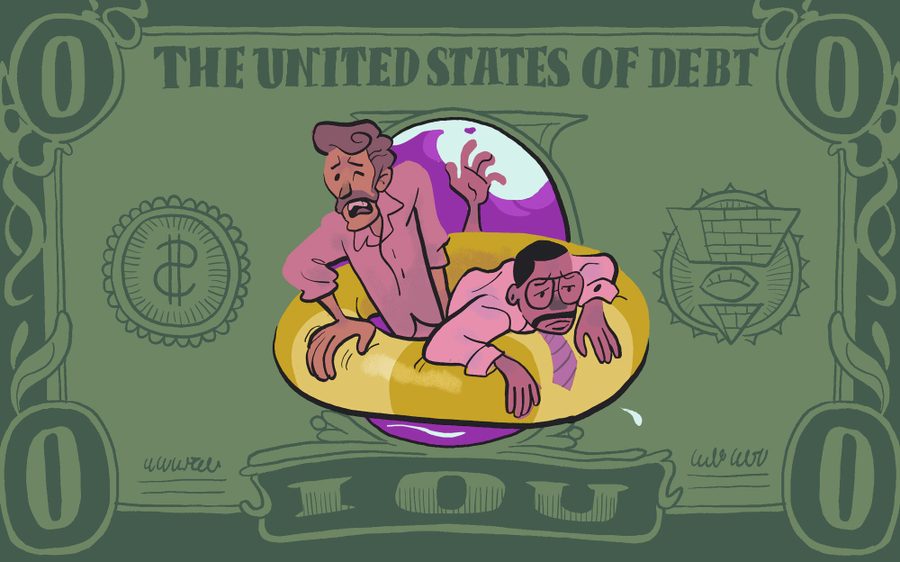
Debtor Organizing Can Transform Our Individual Financial Struggles Into a Source of Collective Strength
Alone, our debt is a liability. Together, it’s our leverage.
J. Patrick Patterson – September 16, 2024
ILLUSTRATION BY KAZIMIR ISKANDER
debt•or pow•er
noun
leverage that springs from an organized association of debtors, often in debt to shared creditors, to negotiate the terms and conditions of debt contracts, including the abolition of unjust debts
the transformation of individual financial struggles into a source of collective strength by waging strategic campaigns of economic disobedience and debt refusal
a tool to build reparative public goods using debt as leverage
Debtor organizing has the potential to bring millions of people who may never have the option of joining a traditional labor union into the struggle for economic justice. —Debt Collective, Can’t Pay, Won’t Pay: The Case for Economic Disobedience and Debt Abolition
Is this a new idea?
Collective debt resistance — if not debtors’ unions — has happened for centuries! Ancient Roman plebeians used strikes, demonstrations and periodic exoduses to win a range of concessions from the aristocratic class, including substantial political rights and the elimination of debt slavery. Today, just as organized renters have leverage over their landlords because they owe the same person, collectively withholding payments (or threatening to!) builds collective power to make demands.
But where does the power come from?
A debtors’ union is a newer concept that is still emerging. Debt Collective is in the throes of this experiment, but the provocation is simple: Just as workers have potential collective power over capital in the form of their employer, and tenants in the form of their landlord, debtors can also wield this kind of collective power when they organize against their creditors.
How can we use it once we build it?
Although debtors’ unions are a new, emerging front in the fight against racial capitalism, their potential holds across many types of debt.
The millions of people being crushed by medical debt could organize locally to demand hospitals cancel their bills. Or they could start a national medical debt strike to advance the cause of universal healthcare.
Credit card debtors could rally against usurious lending practices and advocate for a socially productive — as opposed to predatory — system of credit and debt. Student debtors could transform not only the predatory lending that has become synonymous with higher education, but also the landscape of who has access to that higher education in the first place.
And people with debts in the criminal punishment system could organize to challenge fines, fees and other costs associated with incarceration, demanding the abolition of a system that extracts on so many levels. The possibilities for debt resistance campaigns are practically endless.
J. PATRICK PATTERSON is the Associate Editor at In These Times. He has previously worked as a politics editor, copy editor, fact-checker and reporter. His writing on economic policies and electoral politics has been published in numerous outlets.
Superbug crisis could get worse, killing nearly 40 million people by 2050, study estimates
Jacqueline Howard – September 16, 2024
The number of lives lost around the world due to infections that are resistant to the medications intended to treat them could increase nearly 70% by 2050, a new study projects, further showing the burden of theongoing superbug crisis.
Antimicrobial resistance happens when pathogens like bacteria and fungi develop the ability to evade the medications used to kill them.
The World Health Organization has called AMR “one of the top global public health and development threats,” driven by the misuse and overuse of antimicrobial medications in humans, animals and plants, which can help pathogens develop a resistance to them.
The new study reveals that when it comes to the prevalence of AMR and its effects, “we expect it to get worse,” said lead author Dr. Chris Murray, director of the Institute for Health Metrics and Evaluation at the University of Washington.
“We need appropriate attention on new antibiotics and antibiotic stewardship so that we can address what is really quite a large problem,” he said.
Older adults bear the burden
The researchers – from the Global Research on Antimicrobial Resistance Project, the Institute for Health Metrics and Evaluation and other institutions – estimated deaths and illnesses attributable to versus associated with antimicrobial resistance for 22 pathogens, 84 pathogen-drug combinations and 11 infections across 204 countries and territories from 1990 through 2021. A death attributable to antimicrobial resistance was directly caused by it, while a death associated with AMR may have another cause that was exacerbated by the antimicrobial resistance.
About 520 million individual records were part of the data to make those estimates.
The researchers found that from 1990 to 2021, deaths from AMR fell more than 50% among children younger than 5 but increased more than 80% among adults 70 and older – trends that are forecast to continue.
It was surprising to see those patterns emerge, Murray said.
“We had these two opposite trends going on: a decline in AMR deaths under age 15, mostly due to vaccination, water and sanitation programs, some treatment programs, and the success of those,” Murray said.
“And at the same time, there’s this steady increase in the number of deaths over age 50,” he said, as the world ages; older adults can be more susceptible to severe infection.
The researchers found that the pathogen-drug combination that had the largest increase in causing the most burden among all age groups was methicillin-resistant Staphylococcus aureus, or MRSA. For this combination – the antibiotic methicillin and the bacteria S. aureus – the number of attributable deaths nearly doubled from 57,200 in 1990 to 130,000 in 2021.
Using statistical modeling, the researchers also produced estimates of deaths and illnesses attributable to AMR by 2050 in three scenarios: if the current climate continues, if new potent antibiotic drugs are developed to target resistant pathogens, and if the world has improved quality of health care for infections and better access to antibiotics.
The forecasts show that deaths from antimicrobial resistance will increase by 2050 if measures are not in place to improve access to quality care, powerful antibiotics and other resources to reduce and treat infections.
The researchers estimated that, in 2050, the number of global deaths attributable to antimicrobial resistance could reach 1.9 million, and those associated with antimicrobial resistance could reach 8.2 million.
According to the data, the regions of the world most affected by AMR and attributable deaths are South Asia, Latin America and the Caribbean, and sub-Saharan Africa – and many of these regions don’t have equitable access to quality care, Murray said.
“There are still, unfortunately, a lot of places in low-resource settings where people who need antibiotics are just not getting them, and so that’s a big part of it. But it’s not just the antibiotics. It’s when you’re sick, either as a kid or an adult, and you get sent to hospital, and you get a package of care, essentially, that includes things like oxygen,” Murray said.
“In low-resource settings, even basics like oxygen are often not available. And then, if you are very sick and you need an intensive care unit, well, there’s big parts of the low-resource world – most of them, actually – where you wouldn’t get access to that sort of care,” he said. “So there’s a spectrum of supportive care, plus the antibiotics, that really make a difference.”
But in a scenario where the world has better health care, 92 million cumulative deaths could be averted between 2025 and 2050, the researchers forecast. And in a scenario where the world has new, more potent drugs, about 11 million cumulative deaths could be avoided.
‘There is possible hope on the horizon’
The “innovative and collaborative” approach to this study provides a “comprehensive assessment” of antimicrobial resistance and its potential burden on the world, Samuel Kariuki, of the Kenya Medical Research Institute, wrote in a commentary that accompanied the new study in The Lancet.
Yet he warned that the forecast models do not consider the emergence of new superbugs “and might lead to underestimation if new pathogens arise.”
Overall, “these data should drive investments and targeted action” toward addressing the growing challenge of antimicrobial resistance in all regions of the world, Kariuki wrote.
The new paper represents decades of research on the global burden of antimicrobial resistance, said Dr. Steffanie Strathdee, associate dean of global health sciences and distinguished professor at the University of California San Diego School of Medicine, who was not involved in the study.
Strathdee saw firsthand the effects that antimicrobial resistance can have on health when her husband nearly died from a superbug infection.
“I’m somebody who’s lived with antimicrobial resistance affecting my family for the last eight years. My husband nearly died from a superbug infection. It’s actually one of the infections that’s highlighted in this paper,” said Strathdee, who serves as co-director of the Center for Innovative Phage Applications and Therapeutics at UC San Diego.
During a Thanksgiving cruise on the Nile in 2015, Strathdee’s husband, Tom Patterson, suddenly developed severe stomach cramps. When a clinic in Egypt failed to help his worsening symptoms, Patterson was flown to Germany, where doctors discovered a grapefruit-size abdominal abscess filled with Acinetobacter baumannii, a virulent bacterium resistant to nearly all antibiotics.
The annual number of people dying from gram-negative bacteria, like A. baumannii, that are resistant to carbapenem – a class of last-resort antibiotics used to treat severe bacterial infections – rose 89,200 from 1990 to 2021, more than any antibiotic class over that period, according to the new study.
“That’s one of the urgent priority pathogens, which is one of these gram-negative bacteria,” Strathdee said. “And my husband, when he fell ill from this, he was 69. So he’s exactly at the age that this paper is highlighting, that older people are going to be affected by this more in the future, because our population is aging and people have comorbidities, like diabetes, like my husband has.”
Strathdee’s husband recovered after treatment with phages, viruses that selectively target and kill bacteria and that can be used as a treatment approach for antimicrobial-resistant bacterial infections.
“The most important alternative to antibiotics is phage therapy, or bacteriophage therapy, and that’s what saved my husband’s life,” Strathdee said. “Phage can be used very effectively with antibiotics, to reduce the amount of antibiotics that are needed, and they can even be used potentially in livestock and in farming.”
The new study gives Strathdee hope that the world can reduce the potential burden of antimicrobial resistance. That would require improving access to antibiotics and newer antimicrobial medications, vaccines, clean water and other aspects of quality health care around the world, she said, while reducing the use of antibiotics in livestock, food production and the environment, which can breed more resistance.
“There is possible hope on the horizon,” Strathdee said. “If we were to scale up these interventions, we could dramatically reduce the number of deaths in the future.”
He wants you to believe that as he simultaneously hurls inflammatory rhetoric at Harris and while he sits idly by as Springfield, Ohio, suffers bomb threats and school evacuations over his outrageous and racist lies about legal Haitian immigrants.
Early Monday, Trump spoke with Fox News and decried statements from Democrats calling him “a threat to democracy.”
“Their rhetoric is causing me to be shot at, when I am the one who is going to save the country, and they are the ones that are destroying the country – both from the inside and out,” Trump said, referring to Harris and Democrats as “the enemy from within” and “the real threat.”
Republican presidential nominee Donald Trump addresses journalists at Trump National Golf Club Los Angeles on Sept. 13, 2024, in Rancho Palos Verdes, Calif.
Trump denounces political rhetoric while hurling inflammatory nonsense
The logic in Trump’s statements is twisted beyond comprehension. It’s schoolyard-level reasoning, effectively saying: “You called me a threat to democracy, and that’s a terrible thing to do. And besides, you’re the enemy and you’re destroying the country.”
Let’s start with the apparent assassination plan the Secret Service thankfully foiled. An advance agent spotted a rifle sticking through a fence several hundred yards away from where Trump was playing golf. The agent fired at the gunman, and the man, who didn’t fire any shots, was later apprehended.
The 58-year-old suspect appears to be, as one would expect, a nut whose politics are all over the place. NPR described him as a “vocal supporter-turned-critic of Trump who was passionate about defending Ukraine in its war with Russia.”
There is zero evidence connecting either gunman to Democrats calling Trump “a threat to democracy.” More important, however, that label is not hyperbolic.
Trump is a threat to democracy. That’s a fact with ample evidence.
The idea that Harris or her campaign should stop talking about the threat Trump poses to our democracy is absurd. Democrats aren’t encouraging any form of violence against him or anyone else. They’re speaking a self-evident truth and asking voters to respond accordingly at the ballot box.
On Sunday, before the incident on the Florida golf course, Trump posted on social media: “The Democrats are DESTROYING OUR COUNTRY!”
On Monday morning, he posted on social media: “Because of this Communist Left Rhetoric, the bullets are flying, and it will only get worse! Allowing millions of people, from places unknown, to INVADE and take over our Country, is an unpardonable sin. OUR BORDERS MUST BE CLOSED, AND THE TERRORISTS, CRIMINALS, AND MENTALLY INSANE, IMMEDIATELY REMOVED FROM AMERICAN CITIES AND TOWNS, DEPORTED BACK TO THEIR COUNTIES OF ORIGIN.”
Trump’s racist lies have terrorized an Ohio town
That comes on the heels of a campaign of vile lies about Haitian immigrants in Springfield, Ohio ‒ lies that have led to repeated bomb threats and widespread fear among a community of hardworking, legal immigrants.
On Friday – days after spouting nonsense about Haitian immigrants eating pets – Trump lied, saying: “In Springfield, Ohio, 20,000 illegal Haitian migrants have descended upon a town of 58,000 people destroying their way of life.”
Springfield City Manager Bryan Heck releases a statement in September 2024 saying there’s no evidence of any cats or other pets being harmed or eaten by the Haitian immigrants. Springfield, a central Ohio city of 58,000 about 50 miles west of Columbus, is experiencing a “significant housing crisis,” according to a letter from Heck. He says the city’s Haitian population has increased to 15,000-20,000 in recent years.More
On Sunday, Trump’s running mate, Sen. JD Vance, R-Ohio, effectively admitted that the campaign’s vicious lies about Haitians in Springfield were made up, and that he didn’t care: “If I have to create stories so that the American media actually pays attention to the suffering of the American people then that’s what I’m going to do.”
Except, according to the Republican governor of Ohio, Vance and Trump are also making up the part about the suffering. Springfield has had challenges with an influx of legal immigrants, but the city has not been “destroyed” in any way, shape or form.
Ohio Gov. Mike DeWine said: “These people are here legally. They came to work. They are looking for good people. These are hardworking people.”
Trump has based his entire political identity on inflammatory rhetoric
So spare me the sanctimony over anyone describing him as a threat to democracy. That’s what he is.
Democrats haven’t promoted violence – only voting
Political violence, on any side and of any sort, is abhorrent. Whatever the suspect arrested Sunday was plotting, I’m immensely glad it was stopped.
But whatever the plot was, it can’t be blamed on directly and factually highlighting the threat posed by a man who spews anti-democratic and racist lies without the slightest concern for others.
Trump and his campaign, through their dishonest rhetoric, are wreaking havoc on a Midwestern town. That’s a fact. Through his statements and actions past and present, he poses a threat to our democracy. That’s a demonstrable fact.
The only solution to those concerns, the only action being promoted by Harris and her campaign or people like me who care about America’s basic sense of decency, is simple: Vote.
Vote, and don’t be cowed into silence by a dishonest hypocrite.
It’s not hard to see why most women despise Trump, a man who bragged about sexually assaulting women on tape. On the policy front, of course, Trump is the single person most responsible for the overturn of Roe v. Wade. The published agenda for his second term, Project 2025, includes plans for a national abortion ban and restrictions on contraception. Not only does Trump not try to hide his misogyny, but his campaign makes it a selling point in a bid to win over bitter male voters. On Wednesday, Trump posted a sexually explicit comment about Harris to Truth Social, accusing her of selling sex because she dated other men before she met her husband. As Anderson Cooper noted on CNN, this is not “out of character” for Trump, who usually calls women “pigs,” “dogs” and “nasty” for showing anything but submission to him.
Trump’s campaign is in danger if he can’t get at least a few skeptical women to vote for him. So on Friday, Trump is scheduled to be the keynote speaker at the third annual Moms for Liberty summit in Washington, D.C. It’s another sign that his campaign has run out of ideas to appeal to women. Moms for Liberty’s fall from political grace has been as rapid as their rise to prominence. Associating with the group is more likely to hurt Trump with female voters than to help him.
Moms for Liberty was founded in January 2021. Initially, the group found success in helping Republicans claw back support from suburban women that had been lost during the Trump presidency. By channeling the frustrations parents felt over pandemic school closures, Moms for Liberty positioned itself as a moderate-seeming “parental rights” organization. In reality, the group was controlled by far-right activists with deep ties to Christian nationalism. When Moms for Liberty-linked school board members started taking actions like banning books and vilifying LGBTQ teachers, it provoked a nationwide backlash, with parents in affected communities coming together to kick Moms for Liberty members off their school boards.
“DeSantis and MfL appear to have lost their juice,” journalist Kelly Weill wrote in her recent MomLeft newsletter. “In 2022, the group claimed to have elected approximately half of its 500-plus school board candidates,” reaching an 80% success rate in Florida. In 2023, however, the group only won 35% of its races, and that’s after dramatically scaling back the number of candidates they were running. This month, Moms for Liberty got another shellacking, as only 6 out of 23 candidates backed by DeSantis and Moms for Liberty in Florida even won a primary.
“Big losses across the state for candidates who advanced the group’s agenda, including efforts to ban library books and restrict lessons about race, sex and gender, pointed to mounting dissatisfaction with an organization that had quickly gained sway with powerful Republicans amid the anti-mask, parental rights politics of the pandemic,” reports the Tampa Bay Times.
Despite this, Politico reports, “Republicans show no signs of changing their strategy.” Last year, Trump’s speech before Moms for Liberty drew heavily on plans outlined in Project 2025 to gut public education altogether, starting with abolishing the Department of Education. This year, Moms for Liberty head Tiffany Justice said she hopes “to hear some more plans” regarding this, because “it’s a little more complicated than just waving a magic wand and making it go away.” Democrats no doubt agree they’d like to hear more about Trump’s plan to end the Department of Education, as 64% of Americans oppose the idea.
That Trump and Republicans are sticking with Moms of Liberty suggests they’re desperate. Polling shows that since Harris replaced President Joe Biden as the nominee, there’s been a major uptick in female support for the Democratic ticket. On Tuesday, Democratic research firm TargetSmart published a new report chronicling the surge of voter registrations since Harris joined the race, including a whopping 175% spike in registrations from Black women under 30.
Harris’ appeal is a huge part of this, but it’s also driven by women’s outrage over Trump and his running mate, Sen. JD Vance of Ohio. Vance can’t seem to pull his nose out of women’s uteruses. New quotes of Vance painting childless women as “miserable cat ladies” and “sociopathic” are released practically every day. Like Trump, he has a special zeal for attacking hardworking schoolteachers, claiming teachers who do not have biological children “disorient and really disturb” him.
This rhetoric seems like it will only further alienate female voters, especially mothers who tend to have close relationships with local teachers and know they don’t need to be parents to be skilled professionals. (For one thing, most start teaching full-time at age 22. That’s five years younger than the average age of a first-time parent, and 12 years younger than when Vance had his first child.) It just reinforces the accusation of the Harris campaign that Vance is “weird” and out of touch with how normal Americans live.
But it’s not like Trump and Vance have a lot of options for reaching out to female voters. Moms for Liberty’s brand is failing and their views are unpopular, but they do have “Moms” in their name and female leaders for Trump to be photographed with. If you squint hard enough, that could look like Trump playing nice with women. Moms for Liberty doesn’t offer much, but it’s the best the Trump campaign can do.
Where Does Biden’s Student Loan Debt Plan Stand? Here’s What to Know.
Zach Montague – August 29, 2024
President Joe Biden discusses his administration’s actions to cancel or reduce student loan debts, at the Julian Dixon Library in Culver City, Calif., Feb. 21, 2024. (Al Drago/The New York Times)
WASHINGTON — President Joe Biden’s latest effort to wipe out student loan debt for millions of Americans is in jeopardy.
The Supreme Court on Wednesday refused to allow a key component of the policy, known as the SAVE plan, to move forward after an emergency application by the Biden administration.
Until Republican-led states sued to block the plan over the summer, SAVE had been the main way for borrowers to apply for loan forgiveness. The program allowed people to make payments based on income and family size; some borrowers ended up having their remaining debt canceled altogether.
Other elements of Biden’s loan forgiveness plan remain in effect for now. And over the course of Biden’s presidency, his administration has canceled about $167 billion in loans for 4.75 million people, or roughly 1 in 10 federal loan holders.National & World NewsLatest U.S. and global stories
But Wednesday’s decision leaves millions of Americans in limbo.
Here is a look at what the ruling means for borrowers and what happens next:
Who was eligible for SAVE?
Most people with federal undergraduate or graduate loans could apply for forgiveness under SAVE, which stands for Saving on a Valuable Education.
But the amount of relief it provided varied depending on factors such as income and family size. More than 8 million people enrolled in the program during the roughly 10 months that it was available, and about 400,000 of them got some amount of debt canceled.
The plan has been on hold since July, when a federal appellate court issued a ruling temporarily blocking the program. The Supreme Court on Wednesday denied a request by the Biden administration to lift that injunction.
What happens next?
SAVE is on hold and interest on loans will not accrue while lower courts consider the merits of the legal challenges.
If those challenges succeed, millions of students will most likely be forced to revert to other plans with significantly higher monthly payments.
The Supreme Court said it expected a lower court to move quickly on the case and “render its decision with appropriate dispatch.” The Education Department has said it will provide regular updates for borrowers on its website.
Who can still apply for debt relief?
There are still pathways for people who want to apply for debt relief, including those who borrowed money to attend schools that misled or took advantage of them financially.
Another program is aimed at people working in public service — including teachers, firefighters and members of the military — who had been paying down loans for at least 10 years.
The Public Service Loan Forgiveness Program was established in 2007, but it had been plagued by years of bureaucratic delays and other problems.
A report by the Consumer Financial Protection Bureau in 2017 found that federal loan servicers routinely failed to inform borrowers about their eligibility for the program and systematically miscounted payments that could count toward forgiveness.
The Biden administration revived the program, which has led to debt relief for nearly 1 million people.
The administration has also approved $14.1 billion in forgiveness for about 548,000 borrowers with a total and permanent disability that prevents them from working, a group that includes many military veterans.
Why is this issue tangled up in the courts?
Surveys have consistently found that a majority of Americans support some form of debt relief. But Republican attorneys general and conservative groups have tried to block Biden’s plans in court, saying he is overstepping his authority.
Critics of the debt relief plan characterize it as a taxpayer-funded giveaway.
The legal challenges have steadily chipped away at Biden’s ambitions.
At the beginning of his presidency, Biden promised to wipe out more than $400 billion in student debt for more than 40 million borrowers. The Supreme Court struck that down in June 2023, ruling that his administration did not have the authority to do so.
Cumulatively, this campaign has succeeded in maintaining a comparatively high level of support from ordinary Russians for a fight that has lasted much longer and exacted a much heavier toll than authorities in Moscow originally advertised. But since mid-July, Ukraine’s unexpected incursion into Russia’s Kursk region — and Moscow’s inability to marshal a serious response to it — has shaken public sentiment within Russia.
By just how much? This is documented in a new study by OpenMinds, a Ukrainian data analytics and communications firm. By extensively parsing Russian social media and news outlets, it chronicles that the events in Kursk have impacted popular support for the war among ordinary Russians, as well as increased their dissatisfaction with the Kremlin.
Specifically, it notes a surge of content relating to the war as a result of Ukraine’s raid, as well as a significant decline in positive sentiment in posts, broadcasts and messages regarding the broader conflict. This, the study attributes to two causes.
First, it notes, “there have been fewer cheerful publications about the war” by Russia’s extensive state propaganda organs. Second, “there were more grievances compared to the previous two months … [both] blaming the Russian authorities and general panic regarding the incursion.”
Local fears are indeed rising. Russia’s September 2022 “partial mobilization,” as Vladimir Putin’s domestic conscription effort was euphemistically known, proved to be profoundly unpopular at home, sparking a mass exodus of citizens eager to avoid the draft. Now, worries are rising anew that Moscow’s ongoing struggles on the Ukrainian front could prompt the Kremlin to launch a new effort to beef up its military ranks.
The study documents “a growing concern” for renewed mobilization to respond to Ukraine’s incursion. During the first week of Ukraine’s offensive, it notes, “approximately 39 percent of the publications about mobilization mentioned the Kursk incursion” as a potential precipitating factor. So significant was the furor that Russian lawmakers were forced to speak out publicly to refute rumors that plans for a new conscription drive were in the works.
All this has profoundly constrained the Kremlin’s options. Ordinarily, Moscow would be quick to rally the country around Kyiv’s incursion, which it would invariably depict as an “existential threat” to its sovereignty. However, it hasn’t yet done so — something the OpenMinds study suggests is because “the Russian government understands the sociopolitical risks of a new wave of mobilization and fears the potential consequences related to it.”
What all this might mean for Russia is still too early to tell. Policymakers in Moscow have initiated an array of measures in response to the Ukrainian incursion, ranging from declaring a state of emergency in Kursk as well as the neighboring Belgorod region, surging troops into the area, and creating new administrative units to manage the crisis). Still, as NATO officials have noted, Russia’s official response has been “slow and scattered” — at least so far.
Whether it stays that way is still an open question. It’s already clear, however, that Ukraine has accomplished one of the principal aims of its daring military raid: to bring the conflict home to ordinary Russians and underscore that the war of choice embarked upon by their president carries potentially dire consequences for them personally.
Ilan Berman is senior vice president of the American Foreign Policy Council in Washington, D.C.
On Monday, Donald Trump visited the Arlington National Cemetery to honor the memory of 13 fallen service members. What happened next was a reminder of how little the former president understands about service, sacrifice, and heroism.
On Monday, Donald Trump visited the sacred ground of Arlington National Cemetery, where many of America’s war dead are buried, and posed for photos. In the strangest of these pictures, the former president is smiling and giving a thumbs-up by the grave of a Marine. It’s an image of a man who has no idea how to behave around fallen heroes.
Trump was at Arlington ostensibly to honor the memory of the 13 service members who were killed in a suicide bombing during the chaotic final days of the U.S. withdrawal from Afghanistan. The event was supposed to be respectful and private; according to a press-pool note, the families of the troops had asked that there be no media coverage in the area where the service members were buried. But Trump seemed to have other ideas.
According to a report by NPR, Trump’s campaign staff got into a verbal and physical altercation with a cemetery official who tried to stop campaign staffers from filming and taking photographs in the area of the cemetery reserved for recently fallen soldiers.
The cemetery confirmed that an incident took place on Monday but did not provide any details, instead noting in a statement that federal law prohibits “political campaign or election-related activities within Army National Military Cemeteries.” The Trump-campaign spokesperson Steven Cheung said in a statement that “there was no physical altercation as described,”and added in a post on X that Trump had been allowed a private photographer on the premises. But in his statement, Cheung also accused the cemetery official who’d tried to block Trump’s staff of “clearly suffering from a mental health episode.”
It’s hard to see Trump’s Monday visit as anything but a campaign stop intended to court the military vote. Speaking to a group of National Guard members in Detroit later that day, he blamed President Joe Biden and Vice President Kamala Harris for the failures of the Afghanistan withdrawal.
By now, Trump’s use of the military as a prop for his own ends should surprise no one. Despite his vigorous avoidance of military service, Trump has a long history of denigrating the service of others, even as he poses as a defender of the nation’s military.
As a candidate for the Republican nomination in 2015, he mocked Senator John McCain’s status as a prisoner of war. “He’s not a war hero,” Trump said at the time. “I like people who weren’t captured.”Later, as president, he told his then–chief of staff John Kelly that he didn’t want “any wounded guys” in his planned Independence Day parade: “This doesn’t look good for me.”
Recently, he suggested that the civilian Medal of Freedom is “actually much better” than the military’s Medal of Honor, “because everyone gets the Congressional Medal of Honor, that’s soldiers, they’re either in very bad shape because they’ve been hit so many times by bullets, or they’re dead.”
But Trump is especially out of place around the nation’s fallen troops. As reported by The Atlantic’s editor in chief, Jeffrey Goldberg, Trump went to Arlington Cemetery with Kelly on Memorial Day 2017 and visited the gravesite of Kelly’s son Robert, who had been killed in Afghanistan. Standing next to the former Marine general, Trump said: “I don’t get it. What was in it for them?”
In 2018, Trump canceled a visit to the Aisne-Marne American Cemetery, near Paris; as Jeffrey reported, Trump told staff members that the cemetery was “filled with losers.” Trump also “referred to the more than 1,800 Marines who’d lost their lives at Belleau Wood as ‘suckers’ for getting killed,” according to Jeffrey’s reporting.
Jeffrey’s story is very much a sore spot for a candidate who wants to wrap himself in the flag. Trump has denied the reporting, but it was confirmed to CNN by Kelly: “What can I add that has not already been said? … A person that thinks those who defend their country in uniform, or are shot down or seriously wounded in combat, or spend years being tortured as POWs, are all ‘suckers’ because ‘there is nothing in it for them.’ A person that did not want to be seen in the presence of military amputees because ‘it doesn’t look good for me.’”Kelly went on to corroborate other details in Jeffrey’s article. “God help us,” he concluded.
Monday’s wreath-laying at Arlington was, in part, Trump’s attempt to clean up the mess he has created, and to establish some credibility as a champion of men- and women-at-arms. But in the end, it merely served to remind Americans how little he understands about service, sacrifice, and heroism.
More than 200 Bush, McCain, Romney alums endorse Harris for president, criticize Trump
Joey Garrison, USA TODAY – August 27, 2024
WASHINGTON — More than 200 Republicans who previously worked for either former President George W. Bush, the late Sen. John McCain, R-Ariz., or Sen. Mitt Romney, R-Utah, endorsed Vice President Kamala Harris for president in an open letter Monday obtained exclusively by USA TODAY.
The letter from alums of the three Republican presidential nominees prior to former President Donald Trump comes on the heels of a Democratic National Convention last week in Chicago that showcased Republican detractors of the GOP nominee. At least five former aides to former President George H.W. Bush also signed the letter, which has 238 signatures in all.
A similar group of about 150 anti-Trump former staffers of Bush, McCain and Romney pledged support for President Joe Biden in the 2020 election.
“We reunite today, joined by new George H.W. Bush alumni, to reinforce our 2020 statements and, for the first time, jointly declare that we’re voting for Vice President Kamala Harris and Gov. Tim Walz this November,” the letter reads. “Of course, we have plenty of honest, ideological disagreements with Vice President Harris and Gov. Walz. That’s to be expected. The alternative, however, is simply untenable.”
Democratic presidential nominee Kamala Harris delivers her acceptance speech during the final day of the Democratic National Convention in Chicago on Aug. 22, 2024.
Among those who signed the letter in support of Harris and her running-mate, Minnesota Gov. Tim Walz, include: former McCain chiefs of staff Mark Salter and Chris Koch; Joe Donoghue, former legislative director for McCain; Jennifer Lux, press secretary for McCain’s 2008 campaign, and Jean Becker, longtime chief of staff for George H.W. Bush.
Also backing Harris are David Nierenberg, Romney’s 2012 campaign finance chair; David Garman, under secretary of Energy for George W. Bush; and Olivia Troye, a former advisor to both George W. Bush and Vice President Mike Pence. Troye spoke from the stage of the DNC convention last week.
President George W. Bush speaks during an interview on Wednesday, August 31, 2011 at his office in Dallas about his recollections of Sept. 11, 2001.
“At home, another four years of Donald Trump’s chaotic leadership, this time focused on advancing the dangerous goals of Project 2025, will hurt real, everyday people and weaken our sacred institutions,” the letter says, referring to the Heritage Foundation’s policy blueprint that the Trump campaign has sought to distance itself from.
“Abroad, democratic movements will be irreparably jeopardized as Trump and his acolyte JD Vance kowtow to dictators like Vladimir Putin while turning their backs on our allies. We can’t let that happen.”
The animosity between the camps of McCain, Romney, and Bush and Trump is well-documented.
Others who signed the letters include: Reed Galen, McCain’s deputy campaign manager and co-founder of the Lincoln Project; Jim Swift, a former Republican operative who is now senior editor of The Bulwark, an anti-Trump news and opinion site; and former McCain campaign strategist Mike Murphy.
Citing 2020 exit polling and other voter data, the group claims it was “moderate Republicans and conservative independents in key swing states” who were pivotal in Biden’s victory that ultimately delivered the presidency Biden − Americans who “put country far before party,” they write in the letter.
The group called on more moderate Republicans and independents to “take a brave stand once more” and support Harris over Trump in the fall.
September 13, 2023: Sen. Mitt Romney (R-UT) announces his intention to not run for reelection. Romney, who is 76, announced in a release, “the next generation of leaders must take America to the next stage of global leadership.”.
The Harris campaign has worked to highlight its backing from Republicans who oppose Trump, launching a “Republicans for Harris” group this month and featuring Republican speakers at last week’s convention.
Republicans who addressed the convention included former Rep. Adam Kinzinger, R-Ill., who served on the House panel that investigated Trump’s efforts to overturn the 2020 election; former Trump press secretary Stephanie Grisham; former Georgia Lt. Gov. Geoff Duncan, Mesa, Ariz. Mayor John Giles; and Troye, who worked as a homeland security and counterterrorism adviser to Pence. Pence has said he won’t endorse Trump for president.
Over the weekend, a dozen prominent Republican attorneys who worked for former President Ronald Reagan, George H.W. Bush and George W. Bush endorsed Harris for president. The group included conservative former federal appellate Judge Michael Luttig, who plans to vote for a Democratic president for the first time.
Former Illinois Republican U.S. Rep. Adam Kinzinger speaks during the final day of the Democratic National Convention at the United Center.
On the COVID ‘Off-Ramp’: No Tests, Isolation or Masks
Emily Baumgaertner – August 27, 2024
Visitors on the Coney Island boardwalk on the Friday ahead of the Memorial Day weekend, May 24, 2024. (Karsten Moran/The New York Times)
Jason Moyer was days away from a family road trip to visit his parents when his 10-year-old son woke up with a fever and cough.
COVID-19?
The prospect threatened to upend the family’s plans.
“Six months ago, we would have tested for COVID,” said Moyer, 41, of Ohio. This time they did not.
Instead, they checked to make sure the boy’s cough was improving and his fever was gone — and then set off for New Jersey, not bothering to tell the grandparents about the incident.
In the fifth summer of COVID, cases are surging, and the Centers for Disease Control and Prevention has reported “high” or “very high” levels of the virus in wastewater in almost every state. The rate of hospitalizations with COVID is nearly twice what it was at this time last summer, and deaths — despite being down almost 75% from what they were at the worst of the pandemic — are still double what they were this spring.
As children return to schools and Labor Day weekend travel swells, the potential for further spread abounds. But for many like Moyer, COVID has become so normalized that they no longer see it as a reason to disrupt social, work or travel routines. Test kit sales have plummeted. Isolation after an exposure is increasingly rare. Masks — once a ubiquitous symbol of a COVID surge — are sparse, even in crowded airports, train stations and subways.
Human behavior is, of course, the reason that infections are soaring. But at some point, many reason, we need to live.
“I no longer even know what the rules and recommendations are,” said Andrew Hoffman, 68, of Mission Viejo, California, who came down with respiratory symptoms a few weeks ago after his wife had tested positive for COVID. He skipped synagogue, but still went to the grocery store.
“And since I don’t test, I can’t follow them,” he said.
Epidemiologists said in interviews that they do not endorse a lackadaisical approach, particularly for those spending time around older people and those who are immunocompromised. They still recommend staying home for a couple of days after an exposure and getting the newly authorized boosters soon to become available (despite the poor turnout during last year’s round).
But they said that some elements of this newfound laissez faire attitude were warranted. While COVID cases are high, fewer hospitalizations and deaths during the surges are signs of increasing immunity — evidence that a combination of mild infections and vaccine boosters are ushering in a new era: not a post-COVID world, but a postcrisis one.
Epidemiologists have long predicted that COVID would eventually become an endemic disease, rather than a pandemic. “If you ask six epidemiologists what ‘endemic’ means, exactly, you’ll probably get about 12 answers,” said Bill Hanage, associate director of the Center for Communicable Disease Dynamics at Harvard T.H. Chan School of Public Health. “But it certainly has a sort of social definition — a virus that’s around us all the time — and if you want to take that one, then we’re definitely there.”
Certain threats remain clear. For vulnerable groups, the coronavirus will always present a heightened risk of serious infection and even death. Long COVID, a multifaceted syndrome, has afflicted at least 400 million people worldwide, researchers recently estimated, and most of those who have suffered from it have said they still have not recovered.
But the CDC director, Dr. Mandy Cohen, called the disease endemic last week, and the agency decided this year to retire its five-day COVID isolation guidelines and instead include COVID in its guidance for other respiratory infections, instructing people with symptoms of COVID, RSV or the flu to stay home for 24 hours after their fever lifts. The updated guidelines were an indicator that, for most people, the landscape had changed.
Hanage defended the hard-line mandates from the early years of the pandemic as “not just appropriate, but absolutely necessary.”
“But,” he said, “it is just as important to help people onto an off-ramp — to be clear when we are no longer tied to the train tracks, staring at the headlights barreling down.”
The absence of stringent guidelines has left people to manage their own risks.
“I don’t bother testing myself or our kids for COVID,” said Sarah Bernath, 46, a librarian on Prince Edward Island in Canada. “My husband doesn’t test himself either. Knowing if it’s COVID wouldn’t change whether I stay home or not.”
In some social circles, diverging choices can make for uncomfortable dynamics.
Debra Cornelius, 73, of Carlisle, Pennsylvania, stayed home from a recent indoor party because she learned that several other guests — a family of five — had returned from vacation and tested positive for COVID three days before the gathering, but still planned to attend.
“They said, ‘Oh, it’s like a bad cold, we wouldn’t stay home for a cold,’” she said. “I think people’s attitudes have changed considerably.”
But for countless others, attitudes haven’t changed at all. Diane Deacon, 71, of Saginaw, Michigan, said she tested positive for COVID three days into a trip to Portugal with her two adult daughters. She isolated herself for five days before flying home wearing a mask.
“A number of people asked me, ‘Why did you test? You could have carried on with your vacation,’” she said.
For Deacon, it was about remembering the refrigerated morgue trucks of 2020 and anticipating the vulnerable people she might see on her flight home — people in wheelchairs, or people on oxygen, she said.
“I’m trying to avoid a moral judgment of people who make other choices,” she said. “To me, it was inconvenient and it was unfortunate, but it was not a tragedy.”
In a Gallup poll this spring, about 59% of respondents said they believed the pandemic was “over” in the United States, and the proportion of people who said they felt concerned about catching COVID has been generally declining for two years. Among people who rated their own health positively, almost 9 in 10 said they were not worried about getting infected.
That could be, at least partly, a result of personal experience: About 70% of people said they had been through a COVID infection already, suggesting that they believed they had some immunity or at least that they could muscle through it again if need be.
If the Olympics were any barometer, the rest of the world seems to have exhaled as well. In Tokyo in 2021, there were daily saliva samples, plexiglass dividers between cafeteria seats and absolutely no live spectators; the arenas were so empty that coaches’ voices echoed. In Beijing in 2022, under China’s zero-tolerance policy, conditions were much the same.
But in Paris last month, the organizing committee for the 2024 Olympics offered no testing requirements or processes for reporting infections, and so few countries issued rules to their athletes that the ones that did made news.
There were high-fives, group hugs, throngs of crowds and plenty of transmission to show for it. At least 40 athletes tested positive for the virus, including several who earned medals despite it — as well as an unknowable number of spectators, since French health officials (who had once enforced an eight-month-long nightly COVID curfew) did not even count.
In the United States, about 57% of people said their lives had not returned to prepandemic “normal” — and the majority said they believed it never would. But the current backdrop of American life tells a different story.
The years-old social-distancing signage is faded and peeling from the floors of an indoor market in Los Angeles. Hand-sanitizer dispensers at amusement parks have dried up. The summer camp hosted by Chicago’s Lincoln Park Zoo requires children to bring a face covering — not to protect other children, but the animals.
Michael Osterholm, the director of the Center for Infectious Disease Research and Policy at the University of Minnesota, said the newfound complacency can as much be attributed to confusion as to fatigue. The virus remains remarkably unpredictable: COVID variants are still evolving much faster than influenza variants, and officials who want to “pigeonhole” COVID into having a well-defined seasonality will be unnerved to discover that the 10 surges in the United States so far have been evenly distributed throughout all four seasons, he said.
Those factors, combined with waning immunity, point to a virus that still evades our collective understanding — in the context of a collective psychology that is ready to move on. Even at a meeting of 200 infectious disease experts in Washington this month — a number of whom were older than 65 and had not been vaccinated in four to six months — hardly anybody donned a mask.
“We’ve decided, ‘Well, the risk is OK.’ But nobody has defined ‘risk,’ and nobody has defined ‘OK,’” Osterholm said. “You can’t get much more informed than this group.”
Asked about how the perception of risk has evolved over time, Osterholm laughed.
Opinion: The ideas in Project 2025? Reagan tried them, and the nation suffered
Joel Edward Goza – August 25, 2024
President Reagan, shown in 1981, based many of his policies on ideas from the Heritage Foundation publication “The Mandate for Leadership.” Project 2025 makes up a majority of the latest edition of this title and recommends many of the same extreme policies. (Ron Edmonds / Associated Press)More
Project 2025, the Heritage Foundation’s conservative playbook that would overhaul much of the federal government under a second Trump administration, has sparked fear and concern from voters despite the former president’s attempt to distance his campaign from the plan. But while Project 2025 might seem radical, most of it is not new. Instead, the now-famous document seeks to reanimate many of the worst racial, economic and political instincts of the Reagan Revolution.
Project 2025 begins with its authors (one of whom stepped down last month) boasting of the Heritage Foundation’s 1981 publication “The Mandate for Leadership,” which helped shape the Reagan administration’s policy framework. It hit its mark: Reagan wrote 60% of its recommendations into public policy in his first year in office, according to the Heritage Foundation. Yet the 900-plus-page Project 2025, itself a major component of a new edition of “The Mandate for Leadership,” does not contain any analysis of the economic and social price Americans paid for the revolution the Heritage Foundation and Reagan inspired.
If today’s economic inequality, racial unrest and environmental degradation represent some of our greatest political challenges, we would do well to remember that Reagan and the Heritage Foundation were the preeminent engineers of these catastrophes. Perhaps no day in Reagan’s presidency better embodied his policy transformations or the political ambitions of the Heritage Foundation than Aug. 13, 1981, when Reagan signed his first budget.
This budget dramatically transformed governmental priorities and hollowed out the nation’s 50-year pursuit of government for the common good that began during the New Deal. Once passed, it stripped 400,000 poor working families of their welfare benefits, while removing significant provisions from another 300,000. Radical cuts in education affected 26 million students. The number of poor Americans increased by 2.2 million, and the percentage of Black Americans living in poverty rose to a staggering 34.2%.
Of course, this was just the beginning of Reagan’s war on the poor, the environment and education. Following a Heritage Foundation plan, the Environmental Protection Agency’s operating budget would fall by 27%, and its science budget decreased by more than 50%. Funding for programs by the Department of Housing and Urban Development that provided housing assistance would be cut by 70%, according to Matthew Desmond’s “Poverty, By America.” Homelessness skyrocketed. And, as Project 2025 proposes, Reagan attempted to eliminate the Department of Education but settled for gutting its funding in a manner that set public education, in the words of author Jonathan Kozol, “back almost 100 years.” As funding for these issues nosedived under Reagan, financial support for the “war on drugs” skyrocketed and the prison population nearly doubled.
All the while, protections provided to the wealthy ballooned. Tax rates on personal income, corporate revenue and capital gains plummeted. For example, the highest income tax rate when Reagan took office was 70%. He would eventually lower it to 33%.
To ensure that wealth would be a long-lived family entitlement, Reagan instituted a 300% increase in inheritance tax protections through estate tax exemptions in his first budget. In 1980, the exemption stood at $161,000. By the time Reagan left office in 1989 it was $600,000. Today it is $13,610,000. This means that today nearly all wealthy children enjoy tax-free access to generational wealth.
And beginning during Reagan’s presidency, the number of millionaires and billionaires multiplied, increasing 225% and 400%, respectively, while the poverty of Americans across racial lines intensified. Even white males were more likely to be poor following Reagan’s presidency. Today poverty is the fourth-leading cause of death in the U.S., even though this is the wealthiest nation in the world.
If we feel like we live in a country that isn’t working for anyone who isn’t wealthy, these are some of the core reasons why. Looking back at the Reagan era and the Heritage Foundation’s original “Mandate for Leadership,” we must remember that our domestic wounds are largely self-inflicted, results of buying into racial, economic and environmental lies that continue to be sold. It is precisely the types of policies that devastated the nation during the Reagan administration that Project 2025 now seeks to resuscitate. Perhaps the only truly new thing Project 2025 suggests is using more authoritarian means to enact its agenda.
History has hinges, moments that change the trajectory of nations. The greatest progress in our country has almost always emerged during turbulent times. It is up to the United States’ most committed believers to close the door on terror and trauma and open one that leads to new democratic possibilities.
Our current moment represents more than an election. It is a turning point that has the potential to transform the United States for generations to come. We don’t need the version of the past that Project 2025 is trying to sell us. It didn’t work for most Americans then, and it won’t work for most of us now. But perhaps Project 2025 is the push the Democratic Party needed. While the Republican Party veers further into authoritarianism, Democrats must be equally determined to develop a truly equitable democracy and bind the wounds of a deeply divided nation.
Joel Edward Goza, a professor of ethics at Simmons College of Kentucky, is the author of the forthcoming book “Rebirth of a Nation: Reparations and Remaking America.”