Emails reveal close rapport between top EPA officials, those they regulate

Washington Post

Emails reveal close rapport between top EPA officials, those they regulate

By Juliet Eilperin      July 1, 2018

 Does Scott Pruitt have an ethics problem?
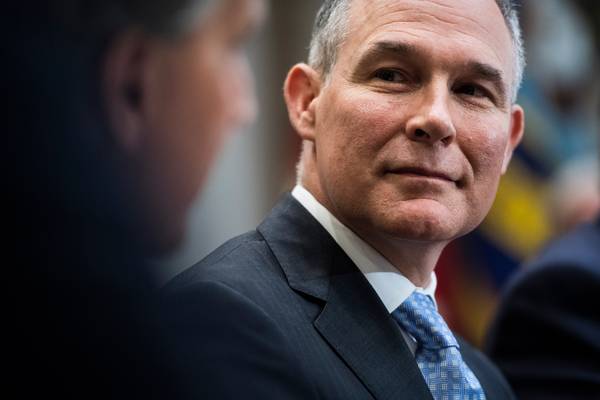
Environmental Protection Agency Administrator Scott Pruitt faces rising scrutiny over several ethics issues, including his use of taxpayer money.(Video: Bastien Inzaurralde/Photo: Jabin Botsford/The Washington Post)

 On the morning of April 1, 2017, Environmental Protection Agency appointee Mandy Gunasekara welcomed to her office a team of lobbyists representing the makers of portable generators.

For months, the Portable Generators Manufacturers’ Association had been trying to block federal regulations aimed at making its product less dangerous. The machines — used by many Americans during power outages after severe storms — emit more carbon monoxide than cars and cause about 70 accidental deaths a year.

Just before President Barack Obama left office, the Consumer Product Safety Commission had approved a proposal that would require generators to emit lower levels of the poisonous gas. Now industry lobbyists were warning Gunasekara of “a potential turf battle . . . brewing” between the commission and the EPA, which traditionally regulates air emissions from engines.

Less than six weeks later, EPA Administrator Scott Pruitt sent a letter informing Ann Marie Buerkle, the commission’s acting chair, that his agency had primary jurisdiction over the issue. Just over three months later, Buerkle signaled she might reassess mandatory regulations and described the industry’s work toward voluntary standards as “very promising.”

The communication between the lobbyists and one of Pruitt’s top policy aides — detailed in emails the agency provided to Democratic Sens. Bill Nelson (Fla.) and Thomas R. Carper (Del.) — open a window on the often close relationship between the EPA’s political appointees and those they regulate. Littered among tens of thousands of emails that have surfaced in recent weeks, largely through a public records lawsuit filed by the Sierra Club, are dozens of requests for regulatory relief by industry players. Many have been granted.

In March 2017, for example, a lobbyist for Waste Management, one of the nation’s largest trash companies, wrote to two top EPA appointees seeking reconsideration of “two climate-related rules” affecting business. (Another lobbyist “sings your praises,” she told the pair.) The EPA subsequently delayed a rule targeting methane emissions from landfills until at least 2020.

 Environmental Protection Agency Administrator Scott Pruitt intervened as the Consumer Product Safety Commission was considering mandatory emissions limits for portable generators, saying the issue was instead the EPA’s domain. (Pablo Martinez Monsivais/AP)

Less than six weeks later, a representative of the golf industry wrote Samantha Dravis, then-associate EPA administrator for the Office of Policy, that “our guys” had been “amazed at the marked difference between our meeting today and the reception at EPA in years” past. The chief executive of the World Golf Association later sent his own email reminding Dravis of “our specific interest in repeal of the Clean Water Rule” — a rule the agency is now reviewing.

And in June 2017, Michael Formica, a lawyer for the National Pork Producers Council, sent a note “from my SwinePhone” thanking Gunasekara and other senior Pruitt aides “for your efforts to help address the recent air emission reporting issues facing livestock agriculture.” The EPA later revamped its guidelines so that pork, poultry and dairy operations do not have to report on potentially hazardous air pollutants arising from animal waste.

EPA spokesman Jahan Wilcox said many of these groups “were dealing with the costly consequences of President Obama’s policies that expanded federal overreach while doing little for the environment.”

Any rule changes underway, he added in an email, received “robust public comment” and have been developed “consistent with administrative law and the rulemaking process” with the goal of improving the environment.

Others are far less enthusiastic about the EPA’s performance under Pruitt — including what appears to be an “open-door policy towards the industries they are supposed to be regulating,” said Brendan Fischer, director of federal reform at the Campaign Legal Centera nonpartisan public watchdog group. “As these emails show, when lobbyists ask top EPA officials to jump, the answer is often ‘how high.’ ”

On some occasions, top EPA officials pushed back on the idea that they would automatically grant industry’s requests: In a sharply worded Aug. 21 email, Dravis told a lobbyist from ConocoPhillips that “no one committed” to relaxing a rule on small incinerators at the oil and gas company’s request. Career staff, she added, had raised concerns about the move.

Although the vast majority of the emails focused on industry concerns, Pruitt aides also tried to reach out to environmentalists, including Natural Resources Defense Council attorney John Walke and Environmental Defense Fund President Fred Krupp.

Walke, however, was unimpressed. “Scott Pruitt is at EPA only to serve the interests of polluting industries,” he said when asked about the overture. “A few token meetings with environmental groups cannot hide his destructive agenda.’’

EPA’s shifting stand on portable generators has proven particularly consequential. The Consumer Product Safety Commission had spent years examining whether to impose mandatory emissions requirements, concluding in late 2016 that the industry could not be trusted to lower emissions on its own. After Pruitt intervened, Buerkle announced last August that the commission would explore the voluntary standards being developed by the industry trade association even as rulemaking on the other front technically continued.

“Staff is obligated to proceed,” a spokeswoman for the commission said Sunday.

It is now working with the National Institute of Standards and Technology to evaluate two voluntary standards that would require a generator’s engine to shut off when carbon monoxide levels get too high.

“I don’t think anyone can deny that safer generators will now be produced,” Bracewell senior principal Edward Krenik, who represents the industry, said in an email Sunday. He noted that the shift is happening “voluntarily and without protracted litigation, which would have delayed any change.”

The safety consulting and certification company UL has proposed a more restrictive limit that would require the generators to emit lower levels of carbon monoxide overall — and shut off much sooner.

In May, Buerkle wrote Nelson and Sen. Richard Blumenthal (D-Conn.) to stress how, “thanks to many years of effort by the CPSC staff and generator manufacturers, safer portable generators are coming to market soon.” However, given that older machines remain in use, she wrote, “it is crucial to keep emphasizing the message that portable generators must be kept outdoors and as far from open windows and doors as possible.”

Despite aggressive public-information campaigns by federal and local officials on that point, carbon monoxide poisoning incidents remain a serious problem. The Florida Poison Information Center Network recorded 509 patients last year, compared with 327 in 2016 and 276 in 2015.

After Hurricane Irma, Nelson said in a statement, “at least 12 people died and many more were injured by carbon monoxide poisoning from portable generators in Florida.”

Nelson went on to accuse Buerkle and Pruitt of colluding “with industry and outside lobbyists to actually kill mandatory safety standards. It’s one of the worst examples of the fox guarding the henhouse I have seen, and it’s just shameful.”

Brady Dennis and Andrew Ba Tran contributed to this report.

Read more:

Amid ethics scrutiny, Pruitt finds his regulatory rollbacks hitting bumps

For Pruitt, gaining Trump’s favor came through fierce allegiance

American hunter’s images of her black giraffe ‘trophy kill’ spark outrage

Fox News

American hunter’s images of her black giraffe ‘trophy kill’ spark outrage

By Holly McKay, Fox News    July 1, 2018

Hunter Tess Thompson Talley ignited a firestorm over her 2017 “dream hunt.”  (Photo: Tess Thompson Talley)

Photos of a female hunter from Kentucky proudly showing off the results of her “dream hunt” – a dead black giraffe in South Africa – have ignited a firestorm across social media after being picked up by a local African media outlet.

“White American savage who is partly a Neanderthal comes to Africa and shoot down a very rare black giraffe courtesy of South Africa stupidity,” read the June 2018 tweet, posted by Africa Digest. “Her name is Tess Thompson Talley. Please share.”

AfricaDigest: White american savage who is partly a neanderthal comes to Africa and shoot down a very rare black giraffe courtesy of South Africa stupidity. Her name is Tess Thompson Talley. Please share

The controversial images, which were posted by a Kentucky woman identified as Tess Thompson Talley a year ago, show her standing proudly beside a dead giraffe bull along with the caption: “Prayers for my once in a lifetime dream hunt came true today! Spotted this rare black giraffe bull and stalked him for quite a while. I knew it was the one. He was over 18 years old, 4000 lbs. and was blessed to be able to get 2000 lbs. of meat from him.”

Trophy hunting is a legal practice in a number of African countries, including South Africa, Namibia, Zambia and Zimbabwe.

“The giraffe I hunted was the South African sub-species of giraffe. The numbers of this sub-species is actually increasing due, in part, to hunters and conservation efforts paid for in large part by big game hunting. The breed is not rare in any way other than it was very old. Giraffes get darker with age,” said Talley, in an email to Fox News.

She points out that the giraffe she killed was 18, too old to breed, and had killed three younger bulls who were able to breed, causing the herd’s population to decrease. Now, with the older giraffe dead, the younger bulls are able to continue to breed and can increase the population.

“This is called conservation through game management,” says Talley, who insists hers was not a “canned” hunt.

Terry Skovronek: Killing animals for fun is a sign of serious mental illness.

Prominent activist and Hollywood actor Ricky Gervais, on the same day Talley’s images went viral, tweeted that “Giraffes are now on the ‘red list’ of endangerment due to a 40% decline over the last 25 years. They could become extinct. Gone forever. And still, we allow spoilt c–ts to pay money to shoot them with a bow and arrow for fun.”

ArtbyAn: an amoebe has more brains than you! Yuk!
Shame on you to think your life is more worth than any other living creature and gives you the right to end its life! Who are you to place yourself above any other living creature. I hope nature takes revenge at you!

However, there is some debate of the “rarity” of the giraffe on Talley’s hit list.

Debra Messing: Tess Thompson Talley from Nippa, Kentucky is a disgusting, vile, amoral, heartless, selfish murderer. With joy in her black heart and a beaming smile she lies next to the dead carcass of…

“The giraffe in the photo is of the South African species Giraffa giraffe, which are not rare – they are increasing in the wild,” Julian Fennessy, Ph.D., co-founder of the Giraffe Conservation Foundation told Yahoo Lifestyle. “Legal hunting of giraffe is not a reason for their decline, despite the moral and ethical side of it which is a different story.”

Nonetheless, the images have spurred deep emotions among those opposed to the controversial practice.

“Shame on you to think your life is more than any other living creature and gives you the right to end its life! Who are you to place yourself above any other living creature,” one person tweeted. “I hope nature takes revenge on you!”

Others have vowed that “killing animals for fun is a sign of serious mental illness,” while others have referred to Talley as a “disgusting excuse for a human being” and a “spoiled wealthy brat with no conscience.” She was also referred to as a “disgusting, vile, amoral, heartless, selfish murderer” by actress Debra Messing.

However, the self-described passionate hunter is hardly the first American to come under intense Internet fire in recent times for overseas trophy kills.

Nikki Tate, a 27-year-old lawyer and “ethical hunter” from Texas sparked outcry – and death threats – late last year after she posted pictures with her kills. But she also attested to receiving scores of messages of support too, being referred to as a “role model and inspiration” in the conservation arena.

And in 2015, Minnesota dentist Walter Palmer was internationally scorned after killing the famous “Cecile the Lion” near a national park in Zimbabwe.

“I get that hunting is not for everyone; that’s what makes this world great is the differences. But to make threats to anyone because they don’t believe the way you do is completely unacceptable. If it was any other belief that was different, threats and insults would be deemed hideous. However, for some reason it is OK to act this way because it’s hunting,” Talley wrote in her email.

Meanwhile, in the United States, the issue of trophy hunting abroad remains a controversial one legislatively as conservation and welfare groups are banding together to encourage the Trump administration to reject import permits for South African lions.

Donald Trump: Big-game trophy decision will be announced next week but will be very hard pressed to change my mind that this horror show in any way helps conservation of Elephants or any other animal.

Under a new process instituted in March this year, trophy hunters are able to provide the U.S government with information confidentially rather than giving public notice in their quest to obtain an import permit, raising questions over the legalities how the kill was carried out, and whether or not mostly illicit practices such as “baiting” were used, violating the ethics of “fair chase.”

Big-game hunters appointed by the Trump team to assist in the re-writing of federal rules pertaining to the importing of heads from African elephants and lions last week defended the trophy hunting practice, contending that threatened and endangered species would go extinct without the anti-poaching programs financed in large part by the hefty fees wealthy Americans pay to carry out the souvenir slaughters.

Where the president himself now stands on the matter, however, remains unclear.

“Big-game trophy decision will be announced next week but will be very hard pressed to change my mind that this horror show in any way helps conservation of Elephants or any other animal,” he tweeted in November.

Hollie McKay has been a FoxNews.com staff reporter since 2007. She has reported extensively from the Middle East on the rise and fall of terrorist groups such as ISIS in Iraq.

Talk About ‘The Appearance of Corruption’

Esquire

Talk About ‘The Appearance of Corruption’

Anthony Kennedy and Donald Trump had a special relationship.

By Charles P. Pierce     June 29, 2018

Getty Images

The more elderly of us who spend a lot of time frolicking with the delightful furry creatures of the Intertoobz are regularly amused by the strange idioms and lingo of this particular universe. For example:

“WTF?”

“Wait. What?”

Or, more simply, “Wut?”

So let me begin by saying, “WTF? Wait. Wut?” From The New York Times:

“One person who knows both men remarked on the affinity between Mr. Trump and Justice Kennedy, which is not obvious at first glance. Justice Kennedy is bookish and abstract, while Mr. Trump is earthy and direct. But they had a connection, one Mr. Trump was quick to note in the moments after his first address to Congress in February 2017. As he made his way out of the chamber, Mr. Trump paused to chat with the justice. “Say hello to your boy,” Mr. Trump said. “Special guy.””

Getty Images

And from the Times: “Mr. Trump was apparently referring to Justice Kennedy’s son, Justin. The younger Mr. Kennedy spent more than a decade at Deutsche Bank, eventually rising to become the bank’s global head of real estate capital markets, and he worked closely with Mr. Trump when he was a real estate developer, according to two people with knowledge of his role. During Mr. Kennedy’s tenure, Deutsche Bank became Mr. Trump’s most important lender, dispensing well over $1 billion in loans to him for the renovation and construction of skyscrapers in New York and Chicago at a time other mainstream banks were wary of doing business with him because of his troubled business history.”

Am I just naïve, or did I have a good reason for the way I just bounced my head off the wall?

In truth, though, this gives me the best reason I ever had to print again one of Associate Justice Anthony Kennedy’s greatest hits:

“We now conclude that independent expenditures, including those made by corporations, do not give rise to corruption or the appearance of corruption. …The fact that speakers [i.e., donors] may have influence over or access to elected officials does not mean that these officials are corrupt. … The appearance of influence or access, furthermore, will not cause the electorate to lose faith in our democracy.”

Of course, it won’t.

Say hello to your boy. I hear he’s a special guy.

RELATED STORY

Everything’s Up for Grabs Now

Respond to this post on the Esquire Politics Facebook page here.

We must not yield to cruelty, fear and divisiveness!

The Late Show with Stephen Colbert

June 26, 2018

Just when things seem too trumped up to trumptinue, #JonStewart tags in with a reminder not to yield to cruelty, fear and divisiveness.

A suburb bets on horses, but not in the way you think

Crain’s

A suburb bets on horses, but not in the way you think

By H. Lee Murphy        June 22, 2018

Tom Struzzieri, owner of Hits. Photo by John R. Boehm.

The south suburbs were devastated three years ago when the owners of the troubled Balmoral Park harness track in far south suburban Crete abruptly closed it. Horses had been running there since the mid-1920’s, and with mostly empty farmland surrounding the track, it was hard to imagine any way of reviving its fortunes.

Now, horses are back at Balmoral, though they aren’t hitched to sulky carts. An upstate New York firm called Hits acquired the 200-acre track and surrounding barns out of bankruptcy late in 2016, at a bargain price of less than $3 million, and has repurposed it as one of the nation’s premier horse show venues featuring hunters and jumpers. The dirt track is gone, replaced by 5-foot barriers and a well-mannered audience watching performers clad in the staunchly English tradition of scarlet coats and tan breeches.

The blue-collar town of Crete, population 8,300, is an unlikely backdrop for a sport that formerly was practiced in such wealthy suburbs as Barrington, Oak Brook, Wayne and Wheaton around metro Chicago. But nearly all the competing facilities in those towns have gone out of business, supplanted by the massive scale of Balmoral, which is big enough to house nine show rings, 1,500 horse stalls and a grandstand with seating for 35,000 spectators. By most standards, Balmoral suddenly ranks as the biggest horse show facility anywhere.

Tom Struzzieri, the owner of Hits (formerly Horse Shows in the Sun), has a half-dozen facilities spread between Palm Springs, Calif., and Saugerties, N.Y. Of some 1,700 horse shows in the U.S. every year, Hits stages 70 of them. Of the biggest 100 shows, it owns 40. Struzzieri, who grew up on Long Island with show horses of his own, offers several Grand Prix competitions each year with million-dollar prizes (Balmoral tops out at $500,000, at an event scheduled for August). Nobody else in the U.S. comes close.

“The big prize money attracts the best riders,” says Kevin Price, executive director of the U.S. Hunter Jumper Association in Lexington, Ky. “Hits has grown at an impressive rate. Harness tracks have fallen on hard times in a lot of places, and the reuse of Balmoral has been a win-win situation for everybody involved.”

MILLIONS INVESTED

Struzzieri, who poured $10 million of Hits money into Balmoral beyond the purchase price to recondition old barns and erect the rings, says he lost money last year in Crete and will be lucky to break even this year on 13 weeks of summer shows. But the Midwest was starved for top-flight competition—show jumping is centered on the East and West coasts—and his initial search several years ago for a venue had taken him to farms south of Rockford holding scant promise.

“We were in the right place at the right time when Balmoral became available,” Struzzieri says. He’s kept much of the old harness track memorabilia intact, down to the betting windows and posters on the walls, as well as the original finish line, maintained in the middle of the Grand Prix ring. “We wanted an old-time horsey ambiance here,” he explains. “The horses boarding here today can sense the history of the place. It gives them comfort.”

Local performers aren’t complaining. Steve Schaefer, a professional rider who owns a farm in the western Kane County town of Maple Park, competes for prize money nearly every weekend through the summer at Balmoral before moving on to Florida to compete in the winter. “This facility was a fabulous idea,” he says. “There may be no other facility in the country like this. Tom is attracting a strong following.”

Europe was once home to the biggest horse show events each summer, but Hits’ lofty prizes at Balmoral, where 75 are directly employed and $3 million will be offered this year, has managed to attract an international audience. Riders from 15 countries will be in residence in Crete in coming weeks. Gonzalo Estelles, a trainer from Argentina, brought four horses and two riders to Balmoral for the summer. “There isn’t a show-jumping place this nice anywhere in South America,” he says through an interpreter.

Michael Einhorn, Crete’s mayor for 33 years, is hoping to attract hotel and restaurant development to town to cater to the Balmoral visitors. “We have a lot of property here zoned for development and ready to go, but nobody really interested yet,” Einhorn says. He says that a new home hasn’t been built in Crete in over a decade, and the state of Indiana, three miles to the east, has siphoned away development. The CSX railroad has planned a $230 million intermodal center not far from Balmoral on 1,100 acres it acquired in 2007, but it is under review by CSX.

“As it is, the arrival of Hits here was a dream come true for us,” Einhorn says. “It’s one thing dealing with a storefront that goes dark downtown. Without Hits, what were we going to do with that 200-acre racetrack after it closed?”

Hits is hoping only for more spectators and sponsors now. Advertisements come from boot-makers and equine feed companies like Purina, but not the national names such as BMW that management covets. Hardly anybody bothers to watch classes on weekdays, while crowds on the busiest weekends top out at 5,000 or so (tickets are $5 on Saturdays; skyboxes in the covered grandstands can be rented). Hits also charges weekly rent to house the horses and an entry fee into every class they run; concessions and gifts offer another revenue stream.

Horse jumping, unique as the only Olympic sport in which men and women compete directly against each other, is an elite endeavor that may never appeal to the masses. “Even so, we have got to do more to market the sport,” Struzzieri says. “We can get much bigger here.”

Photo by John R. Boehm

Capital Gazette Reporter To Trump: ‘I Couldn’t Give A F**k’ About Your Prayers

HuffPost

Capital Gazette Reporter To Trump: ‘I Couldn’t Give A F**k’ About Your Prayers

Mary Papenfuss, HuffPost      June 29, 2018

Scott Pruitt Personally Involved in ‘Ratf*cking’ Ex-Aides Who He Feels Betrayed Him

Daily Beast – Order the Code Red

Scott Pruitt Personally Involved in ‘Ratf*cking’ Ex-Aides Who He Feels Betrayed Him

The EPA chief demands loyalty. He doesn’t always reciprocate, though.

Lachlan Markay and Asawin Suebsaeng      June 28, 2018

On May 18, a top aide to Environmental Protection Agency chief Scott Pruitt testified to a congressional committee that she had been tasked with procuring her boss a used mattress from the Trump International Hotel in Washington, D.C. Just days after news of that testimony broke, the aide, Pruitt’s now former director of scheduling Millan Hupp, submitted her resignation.

But even though Hupp was gone from the agency, Pruitt wasn’t done with her.

According to three sources familiar with the conversations, Pruitt was livid over Hupp’s testimony, which he felt had been particularly humiliating. And he personally reached out to allies in the conservative movement, including some at the influential legal group the Federalist Society, to insist that she had lied about, or at least misunderstood, the request for a used Trump mattress. He also stressed that Hupp could not be trusted—the implication being that she should not be hired at their institutions.

It was an aggressive move by a besiegedscandal-prone Cabinet member against a young staffer—one who worked on Pruitt’s attorney general campaign in Oklahoma, followed him to Washington, and by all accounts had been one of his most loyal aides at the EPA.

But it also showed a side of the EPA chief that top advisers say is not always readily apparent to the public. Though Pruitt demands loyalty among those in his inner circle, he has not reciprocated it to his aides, even as they face a legal and public-relations backlash stemming from his conduct at the agency. Sources say he’s actively undermined the reputations of former and current staffers, with campaigns that former senior EPA officials have described as “ratfucking.”

The targets aren’t just ex-schedulers either.

For months, Pruitt and top aides have suspected Kevin Chmielewski, Pruitt’s former deputy chief of staff, of leaking damaging details about the administrator’s travel and spending habits to the press. Sources say Pruitt led the charge to push back against his former senior aide. And he did so by tasking communications aides with leaking damaging information about Chmielewski’s alleged misconduct at EPA, including supposed unannounced vacations and shoddy timecard practices. Chmielewski has accused Pruitt of retaliation, a charge that is now under investigation by the Office of Special Counsel.

RELATED IN POLITICS

Scott Pruitt Made Staff Fetch His Snacks and Sweets

Lobbyist Pitched Scott Pruitt a Meeting With NatGeo Exec

GOP to Scott Pruitt: Cut the Crap

Knowledgeable sources also told The Daily Beast that Pruitt instructed staff to pitch “oppo hits” to media outlets on other officials who departed on bad terms or were sidelined. The targets include David Schnare, a former member of Donald Trump’s presidential transition team, and career official John Reeder, who Pruitt would privately call a “communist,” according to two people familiar with Pruitt’s complaints and thinking.

Pruitt’s vindictiveness doesn’t put him out of place within the administration. In many respects, it reflects some of the trademark impulses of his boss, Donald J. Trump. But for staff, the episodes have proven exhausting and demoralizing.

Hupp, for her part, was legally obligated to tell investigators the truth about seeking a used mattress from the Trump International Hotel. And as Pruitt faces a mounting number of investigations into his conduct and spending at the agency, other aides are now finding themselves facing their own inquiries, with little assistance from their EPA boss.

Pruitt set up a legal defense fund this year to deal with those inquiries. But sources say he has not offered to use the fund to assist current and former aides with their own considerable legal expenses. Nor, according to sources, has he offered apologies or expressed remorse to those aides for their ongoing legal and personal woes. The mounting financial difficulties that some of those aides face has fueled distress even among those who consider themselves loyal foot soldiers for Pruitt.

Cleta Mitchell, the attorney overseeing the Pruitt legal defense fund, did not respond to requests for comment.

Asked for comment, an EPA spokesperson referred The Daily Beast to Pruitt’s comments before a House committee in May. “I am not afraid to admit that there has been a learning process and when Congress or independent bodies of oversight find fault in our decision-making I want to correct that and ensure that it does not happen again,” Pruitt said at the time. “Ultimately, as the administrator of the EPA, the responsibility for identifying and making changes necessary rests with me and no one else.”

Pruitt Proposes Weakening EPA’s Power Over Water Polluters

EcoWatch

Pruitt Proposes Weakening EPA’s Power Over Water Polluters

Olivia Rosane      June 28, 2018

Cement Creek at Silverton, CO. The region downstream from the Gold King Mine has been an area of extensive USGS water quality research. U.S. Geological Survey

Environmental Protection Agency (EPA) head Scott Pruitt on Wednesday proposed another way to weaken U.S. environmental regulations protecting the nation’s waterways from pollution.

In a memo dated June 26 but released June 27, Pruitt asked the EPA’s Office of Water and Regional Administrators to draft a proposal that would restrict the agency’s ability to revoke permits issued by the U.S. Army Corps of Engineers (USACE) allowing projects to dispose of dredged or fill material in rivers, streams and other waterways, The Hill reported.

“Today, I am directing the Office of Water to take another step toward returning the agency to its core mission and providing regulatory certainty,” Pruitt wrote in the full text of the memo.

If the new proposal becomes policy, it would be the biggest change to how the EPA handles the dredging and filling of streams and waterways under the Clean Water Act in 40 years, according to The Hill.

Specifically, the proposal would block the EPA from preemptively blocking a permit to discharge materials in waterways before the USACE has issued one or revoking a permit issued by the USACE after the fact. It would also require that regional administrators get approval from EPA headquarters before vetoing a permit and that they listen to comments from the public before doing so.

Once a formal draft is ready, the public will have a chance to comment on Pruitt’s proposed change, and opponents can attempt to block it in court, according to The Hill.

Former EPA staffer of the nonprofit Public Employees for Environmental Responsibility Kyla Bennett told The Associated Press that the move would rob the EPA of one of its few means of protecting waterways from mining and other industry.

Instead of protecting waterways, Pruitt’s policy change would help those “he’s always concerned with: oil and gas and mining,” Bennett said. “His buddies who make money.”

Indeed, Pruitt justified the change as simplifying the permit process for businesses.

“This long-overdue update to the regulations has the promise of increasing certainty for landowners, investors, businesses and entrepreneurs to make investment decisions while preserving the EPA’s authority to restrict discharges of dredge or fill material that will have an unacceptable adverse effect on water supplies, recreation, fisheries and wildlife,” Pruitt wrote.

In practice, the EPA has rarely vetoed permits either retroactively or preemptively, though Republicans and industry have argued against their ability to do so. That ability was affirmed in a 2014 decision by the U.S. Court of Appeals for the District of Columbia Circuit.

Pruitt’s memo cited a case in which the EPA suggested it would use its veto power, under Obama, to preemptively block a permit for the pending Pebble Mine in Alaska after concerns from conservationists and Native American groups that it would harm salmon fisheries and wetlands, according to The Associated Press.

Pruitt started a process to reverse that preemptive decision, but in a surprise move, kept it in place following public outcry.

RELATED ARTICLES AROUND THE WEB

Scott Pruitt Has Betrayed the Mission, the National Interest and the

EPA administrator Scott Pruitt is slowly strangling his agency – Vox

Pruitt Takes Clean Water Act Decisions Away from Regional EPA

Scott Pruitt, Under Fire, Plans to Initiate a Big Environmental Rollback

DOON, IOWA Tar Sand Oil Spill.

DOON, IOWA Tar Sand Spill. Part 1 of 50 future videos.
Help me document this spill every few months to make sure it is cleaned up right. Go to HELPPA.org to join #teamJohnBolenbaugh and help fund a good fight against water contamination to save our children.

Most homeowners can go solar with a new program that has zero down and your solar system payment will be less than your current electric bill.

See More

Doon, Iowa Tar Sand spill part 1

DOON, IOWA Tar Sand Spill. Part 1 of 50 future videos. Help me document this spill every few months to make sure it is cleaned up right. Go to HELPPA.org to join #teamJohnBolenbaugh and help fund a good fight against water contamination to save our children. Most homeowners can go solar with a new program that has zero down and your solar system payment will be less than your current electric bill. Push freedomfromfossilfuels.com and enter your info

Posted by John Bolenbaugh WhistleBlower on Thursday, June 28, 2018

Stephen Colbert: Denying Due Process To Anyone Is Denying Due Process To Everyone!

The Late Show with Stephen Colbert

June 25, 2018

Donald Trump’s suggestion that we deport undocumented immigrants without due process might as well have been an insult-loaded Twitter attack against the @FoundingFathers

Denying Due Process To Anyone Is Denying Due Process To Everyone

Donald Trump’s suggestion that we deport undocumented immigrants without due process might as well have been an insult-loaded Twitter attack against the @FoundingFathers

Posted by The Late Show with Stephen Colbert on Monday, June 25, 2018