Manchin’s political worldview was put to the test (and it lost)
The vote on the Jan. 6 commission wasn’t just a disappointment for Joe Manchin, it was a vote that shattered his vision for governance.
By Steve Benen May 28, 2021
As Senate Republicans prepared to kill the bipartisan plan for a Jan. 6 commission, Sen. Joe Manchin (D-W.Va.) was seen on the chamber floor having a tense conversation with Senate Minority Leader Mitch McConnell (R-Ky.). It was obvious to those who saw the discussion that the conservative Democrat was not pleased.
That was understandable. This fight, more than any other in recent memory, put Manchin’s entire political worldview to the test — and it lost.
“Mitch McConnell makes it extremely difficult,” Manchin said. “The commission is something this country needs. There’s no excuse. It’s just pure raw politics. And that’s just so, so disheartening. It really, really is disheartening. I never thought I’d see it up close and personal that politics could trump our country. And I’m going to fight to save this country.”
The senator never explicitly acknowledged the dynamic, but for Manchin, the debate over the commission was not simply a legislative fight; it was a case study for a style of governing.
Indeed, the pieces were in place for Manchin to prove that his approach worked. Most Democrats and Republicans agreed that there was an insurrectionist attack on our seat of government. The parties also agreed on the need for an examination. There were bipartisan negotiations, concessions from both sides, and an eventual compromise agreement.
If Manchin were literally writing a script as to how political disputes should be resolved, it would look exactly like this.
As recently as late last week, the senator assured reporters there was a “very, very good chance” the Senate would pass the bipartisan proposal, adding that he hoped there were at least “10 good, solid patriots” among Senate Republicans.
Manchin didn’t just want to believe this, he needed to believe this. If Republicans rejected a bipartisan compromise, prioritizing politics and electoral strategies over country, then his entire vision of how Congress can operate would be shattered.
We don’t need to change the Senate’s filibuster rules, Manchin tells us, we simply need well-intentioned officials to sit down, talk, listen, compromise, and reach responsible agreements.
It’s an idea with hypothetical appeal. But in practice, a clear majority of Senate Republicans just told the conservative Democrat that his model doesn’t work. The parties reached a consensus, and GOP leaders decided they didn’t much care.
The only responsible way forward is for Manchin to consider the implication of today’s lesson. If 10 Senate Republicans won’t accept a bipartisan plan for a Jan. 6 commission — after they endorsed the idea and accepted Democratic concessions — why in the world would anyone think GOP officials would work in good faith toward a sensible agreement on infrastructure? And voting rights? And immigration? And literally every other meaningful policy dispute under the sun?
Or put another way, now that McConnell and his Republican have discredited Manchin’s preferred model, what is he prepared to replace it with?
‘Sea snot’ is clogging up Turkey’s coasts, suffocating marine life, and devastating fisheries
Morgan McFall-Johnsen May 28, 2021
‘Sea snot’ is clogging up Turkey’s coasts, suffocating marine life, and devastating fisheries
A drone photo shows sea snot near the Maltepe, Kadikoy, and Adalar districts of Istanbul, Turkey on May 2, 2021. Lokman Akkaya/Anadolu Agency via Getty Images.
A goopy substance called sea snot has been clogging Turkish coasts in the Sea of Marmara for months.
The mucus has been filling fishing nets, suffocating coral, and killing marine life.
Climate change and fertilizer runoff may be fueling the algae boom that’s behind the sea snot.
Blankets of a goopy, camel-colored substance have been accumulating in the water off Turkey’s coast for months.
The goop, called marine mucilage or “sea snot,” is covering so much of the coastline along the Sea of Marmara that people can no longer fish there. The sea snot formations can get up to 100 feet (30 meters) deep, according to the Turkish news site Cumhuriyet.
The sea snot fills fishing nets and weighs them down – one fisherman told Cumhuriyet that nets have been bursting from the weight of the mucus. A fishery co-op leader said people were barely pulling in a fifth of the fish they hauled at this time last year.
Marine mucilage is a goopy discharge of protein, carbohydrates, and fat from microscopic algae called phytoplankton. The substance was documented in the Sea of Marmara for the first time in 2007, as researchers at Istanbul University reported in 2008.
Marine mucilage, or “sea snot,” near the Solomon Islands. Prisma Bildagentur/Universal Images Group via Getty Images
Normally, sea snot is not a problem, but when phytoplankton grow out of control, the goop can overpower marine ecosystems. This can wreak ecological havoc, since the substance can harbor bacteria like E Coli and ensnare or suffocate marine life. Eventually, the snot sinks to the sea floor, where it can blanket coral and suffocate them, too.
Since phytoplankton thrive in warm water, scientists suspect that climate change is fueling the new sea-snot crisis. Runoff from nitrogen- and phosphorous-rich fertilizer and sewage could also be causing an explosion in the phytoplankton population.
“We are experiencing the visible effects of climate change, and adaptation requires an overhaul of our habitual practices. We must initiate a full-scale effort to adapt,” Mustafa Sarı, dean of Bandırma Onyedi Eylül University’s maritime faculty, told The Guardian.
A drone photo shows sea snot near Istanbul, Turkey on May 2, 2021. Lokman Akkaya/Anadolu Agency via Getty Images.
This is the largest accumulation of sea snot yet, according to The Guardian. It began in deep waters during the winter then spread to the coastlines this year. Barış Özalp, a marine biologist at Çanakkale Onsekiz Mart University, first noticed it in December but became alarmed once the snot carpets continued to grow through the spring.
“The gravity of the situation set in when I dived for measurements in March and discovered severe mortality in corals,” he told The Guardian.
Thousands of fish have been washing up dead in coastal towns as well, Sarı told The Guardian. The fish could be suffocating because sea snot clogs their gills, or because it depletes the water’s oxygen levels.
“Once the mucilage covers the coasts, it limits the interaction between water and the atmosphere,” Sarı said.
Plague of ravenous, destructive mice tormenting Australians
Rod McGuirk May 27, 2021
1 / 12
Australia Mice Plague
Mice scurry around stored grain on a farm near Tottenham, Australia on May 19, 2021. Vast tracts of land in Australia’s New South Wales state are being threatened by a mouse plague that the state government describes as “absolutely unprecedented.” Just how many millions of rodents have infested the agricultural plains across the state is guesswork. (AP Photo/Rick Rycroft)
BOGAN GATE, Australia (AP) — At night, the floors of sheds vanish beneath carpets of scampering mice. Ceilings come alive with the sounds of scratching. One family blamed mice chewing electrical wires for their house burning down.
Vast tracts of land in Australia’s New South Wales state are being threatened by a mouse plague that the state government describes as “absolutely unprecedented.” Just how many millions of rodents have infested the agricultural plains across the state is guesswork.
“We’re at a critical point now where if we don’t significantly reduce the number of mice that are in plague proportions by spring, we are facing an absolute economic and social crisis in rural and regional New South Wales,” Agriculture Minister Adam Marshall said this month.
Bruce Barnes said he is taking a gamble by planting crops on his family farm near the central New South Wales town of Bogan Gate.
“We just sow and hope,” he said.
The risk is that the mice will maintain their numbers through the Southern Hemisphere winter and devour the wheat, barley and canola before it can be harvested.
NSW Farmers, the state’s top agricultural association, predicts the plague will wipe more than 1 billion Australian dollars ($775 million) from the value of the winter crop.
The state government has ordered 5,000 liters (1,320 gallons) of the banned poison Bromadiolone from India. The federal government regulator has yet to approve emergency applications to use the poison on the perimeters of crops. Critics fear the poison will kill not only mice but also animals that feed on them. including wedge-tail eagles and family pets.
“We’re having to go down this path because we need something that is super strength, the equivalent of napalm to just blast these mice into oblivion,” Marshall said.
The plague is a cruel blow to farmers in Australia’s most populous state who have been battered by fires, floods and pandemic disruptions in recent years, only to face the new scourge of the introduced house mouse, or Mus musculus.
The same government-commissioned advisers who have helped farmers cope with the drought, fire and floods are returning to help people deal with the stresses of mice.
The worst comes after dark, when millions of mice that had been hiding and dormant during the day become active.
By day, the crisis is less apparent. Patches of road are dotted with squashed mice from the previous night, but birds soon take the carcasses away. Haystacks are disintegrating due to ravenous rodents that have burrowed deep inside. Upending a sheet of scrap metal lying in a paddock will send a dozen mice scurrying. The sidewalks are strewn with dead mice that have eaten poisonous bait.
But a constant, both day and night, is the stench of mice urine and decaying flesh. The smell is people’s greatest gripe.
“You deal with it all day. You’re out baiting, trying your best to manage the situation, then come home and just the stench of dead mice,” said Jason Conn, a fifth generation farmer near Wellington in central New South Wales.
“They’re in the roof cavity of your house. If your house is not well sealed, they’re in bed with you. People are getting bitten in bed,” Conn said. “It doesn’t relent, that’s for sure.”
Colin Tink estimated he drowned 7,500 mice in a single night last week in a trap he set with a cattle feeding bowl full of water at his farm outside Dubbo.
“I thought I might get a couple of hundred. I didn’t think I’d get 7,500,” Tink said.
Barnes said mouse carcasses and excrement in roofs were polluting farmers’ water tanks.
“People are getting sick from the water,” he said.
The mice are already in Barnes’ hay bales. He’s battling them with zinc phosphide baits, the only legal chemical control for mice used in broad-scale agriculture in Australia. He’s hoping that winter frosts will help contain the numbers.
Farmers like Barnes endured four lean years of drought before 2020 brought a good season as well as the worst flooding that some parts of New South Wales have seen in at least 50 years. But the pandemic brought a labor drought. Fruit was left to rot on trees because foreign backpackers who provide the seasonal workforce were absent.
Plagues seemingly appear from nowhere and often vanish just as fast.
Disease and a shortage of food are thought to trigger a dramatic population crash as mice feed on themselves, devouring the sick, weak and their own offspring.
Government researcher Steve Henry, whose agency is developing strategies to reduce the impact of mice on agriculture, said it is too early to predict what damage will occur by spring.
He travels across the state holding community meetings, sometimes twice a day, to discuss the mice problem.
“People are fatigued from dealing with the mice,” Henry said.
Sen. Angus King Introduces Legislation To Go After High-Income “Tax Cheats”
Mal Leary, Maine Public Radio May 27, 2021
J. Scott Applewhite/AP. Sen. Angus King, I-Maine, arrives as the Senate holds the final vote to confirm Xavier Becerra, President Joe Biden’s pick to be secretary of Health and Human Services, at the Capitol in Washington, Thursday, March 18, 2021.
Maine Senator Angus King has introduced legislation that would order the IRS to go after high income tax cheats. The measure would allocate $80 billion over 8 years and bolster audit efforts.
Sen. King says that with the demand for money to invest in the nation’s infrastructure and other economic development programs, the IRS should do more audits of high-income earners and corporations. King told MSNBC on Thursday that tax increases should not be on the table when taxes are being under collected.
“Let’s collect the taxes the tax cheats aren’t paying. The estimates are from a half a trillion to a trillion dollars a year,“ King says.
The measure would direct the IRS to set audit rate goals for high-income individuals, corporations, and estates, and increase the penalties for tax noncompliance on taxpayers who earn more than $2 million a year of taxable income. King says most people pay what they owe, but the rich can afford professional help to avoid paying taxes they owe.
“Unfortunately in the last few years they have been focusing their audits on lower income people, are they cheating on the earned income tax credit where they will collect hundreds of dollars instead of on the high income high roller cheats where they could collect millions of dollars,” King says.
‘It’s insane’: Proud Boys furor tests limits of Trump’s GOP
David Siders May 26, 2021
It’s been less than two weeks since South Carolina Republicans rejected Lin Wood’s Q-Anon inspired run for state party chair. In Arizona, the GOP is still consumed with infighting over a farcical review of November election results.
Now comes Nevada, where open warfare has broken out in recent days between state and local party officials over a pro-Trump insurgency involving far-right activists with ties to the Proud Boys.
More than six months after the November election, the forces unleashed by former President Donald Trump — election conspiracists, QAnon adherents, MAGA true believers and even the often violent Proud Boys — are attempting to rewire the Grand Old Party’s leadership at the state and local levels, including in some swing states that will be critical in the midterm elections.
It’s a reflection of Trump’s influence on the Republican Party, but also evidence of the breadth of interests seeking to define Trumpism in the vacuum left by his November defeat.
“It’s insane,” said Katie Williams, a Republican school board trustee in Nevada’s Clark County, where party officials canceled a meeting at a church this week, citing security concerns about extremists trying to take over the party. “We can’t have people acting the way they’re acting. That’s the problem. … It’s like an election hangover.”
The uproar in Nevada, which came on suddenly, suggests how far the GOP is from being finished with its post-election reckoning. After the Republican Party’s state central committee voted narrowly last month to censure Nevada’s Republican secretary of state, Barbara Cegavske — for “failing to investigate” Trump’s baseless allegations of widespread voter fraud — Clark County party officials accused the state party chair, Michael McDonald, of tipping the scales against Cegavske by adding extremist members to the county’s roster at the state central committee meeting.
The state party, in turn, accused the Clark County chair, David Sajdak, of spreading “slanderous lies.” But one self-described member of the Proud Boys, Matthew Anthony Yankley, who goes by Matt Anthony, said on a recent episode of the Johnny Bru Show, a Las Vegas-based podcast, that he participated in the censure and that “our votes absolutely made the difference.”
For Nevada Republicans, the timing of the feud is fraught. The state Legislature has been tilting Democratic in recent years, but Republicans picked up several seats in November anyway, while Trump lost to President Joe Biden by just more than 2 percentage points — a narrower margin than widely expected.
A well-organized Republican Party could help candidates who have at least an outside chance of upsetting Democratic Sen. Catherine Cortez Masto — or first-term Gov. Steve Sisolak next year. Instead, state and local party officials are at one another’s throats — and the GOP’s connections to the Proud Boys are in the headlines.
“I’m really disheartened by this,” said Carrie Buck, a Nevada state senator and the establishment-backed candidate for chair of the Clark County GOP. “If we don’t get this fixed, we don’t win our state back.”
The conflict in Nevada is about more than just a loyalty test to Trump, which is the motivating concern behind Cegavske’s censure. There’s a more fundamental question about what kind of Republican is welcome in the post-Trump GOP. The Trump era not only mainstreamed conspiracy theories — a large majority of Republicans believing Trump’s baseless claims that the election was rigged — it also gave rise to militant, pro-Trump groups like the Proud Boys, which the Southern Poverty Law Center has labeled a hate group. Nationally, several members of the Proud Boys are facing charges for their involvement in the insurrection at the Capitol on Jan. 6.
Last year, the group was emboldened when Trump declined to explicitly condemn white supremacists and militia groups during the first presidential debate, telling the Proud Boys to “stand back and stand by.” (He later adjusted his tone, saying “they have to stand down.”) And other Republicans have struggled more recently with how accommodating to be to extremists within the party. In Washington, GOP leaders this week criticized Rep. Marjorie Taylor Greene (R-Ga.) for comparing coronavirus vaccine and mask requirements to the Holocaust, but they are not disciplining her, much less excommunicating her from the party.
In Clark County, Republican Party leaders are attempting to draw a rare line in the sand. Officials said they have barred seven people, including Anthony, from membership due to their associations with groups they said have disseminated racist and other hateful messages.
Noting the majority-minority composition of Clark County — the state’s most populous county, and a Democratic stronghold — Sajdak said at a news conference this week that “we welcome everyone that is a reasonable and decent human being” but that “I will never tolerate racist or hateful speech.”
Stephen Silberkraus, the party’s vice chair, said after the press conference, “This isn’t a problem within our party. It’s one at the gates that we have to fend off.”
Nevada Sen. Barbara Cegavske, R-Las Vegas, listens to colleagues pay tribute to her 18-years of public service during a Senate floor session on the final day of the 77th Legislative session at the Legislative Building in Carson City, Nev., on Monday, June 3, 2013. (AP Photo/Cathleen Allison)
Republicans in the state Senate appear to be following that reasoning, calling for a review of the vote to censure Cegavske.
“News reports that state party leaders may have formed a relationship with members of the organization known as the Proud Boys to sway the censure vote of a public official is profoundly concerning,” the caucus said in a prepared statement. “If there is a determination that any member or employee of the Nevada Republican Party conspired with these individuals or had knowledge of any wrongdoing in the party vote, Senate Republicans call for their immediate removal and resignation.”
Amy Tarkanian, a former chair of the state party, said there may be enough frustration with McDonald among Nevada Republicans “to possibly not reelect him finally. So, he very well may just be either so desperate that he’s willing to bring in literally anyone of any background, such as the Proud Boys, to help boost up his numbers, or just let the whole ship burn and sink if he doesn’t get reelected.”
She said, “It makes no sense to be bringing people like that into the fold where they’re not welcome.”
McDonald did not respond to requests for comment. Nor did Anthony.
McDonald told the Review-Journal he does not condone hateful or antisemitic rhetoric. Anthony said on the Johnny Bru Show that the Proud Boys are unfairly maligned and that he is “against hate of all kinds.”
In Clark County, the dispute over who can belong is now playing out in court. Anthony and several other activists filed a lawsuit against the Clark County GOP last week complaining they had “arbitrarily been denied membership” or are having their memberships in the party withdrawn, accusing the county party of “discriminatorily and arbitrarily picking and choosing what applicants to approve for membership in the committee.” County party officials said the lawsuit has no merit.
“What they’re clearly afraid of,” said Ian Bayne, a co-founder of No Mask Nevada, which has been supportive of the effort to challenge the local party, is that new activists will “take the entire party out from under them.”
Bayne said he does not know the local Proud Boys members, but added that denying Republicans membership in the local committee is discriminatory. Bayne’s group, though not part of the lawsuit, was encouraging its members to join the county committee to “replace the failures who now run the Clark County GOP,” promising that an unnamed former Trump staffer would be running for chair, likely announcing his candidacy next week.
Bayne said the intra-party tension in Nevada — as in the GOP elsewhere — is little different than past upheavals within the party, dating back to the days of Barry Goldwater and Ronald Reagan.
In Clark County, he said, “the establishment is running and canceling meetings because they’re scared.”
Why it matters that the Wisconsin GOP rejected Medicaid expansion
Biden thought he’d come up with a Medicaid expansion offer that states couldn’t refuse. Republicans still don’t care.
Steve Benen May 26, 2021
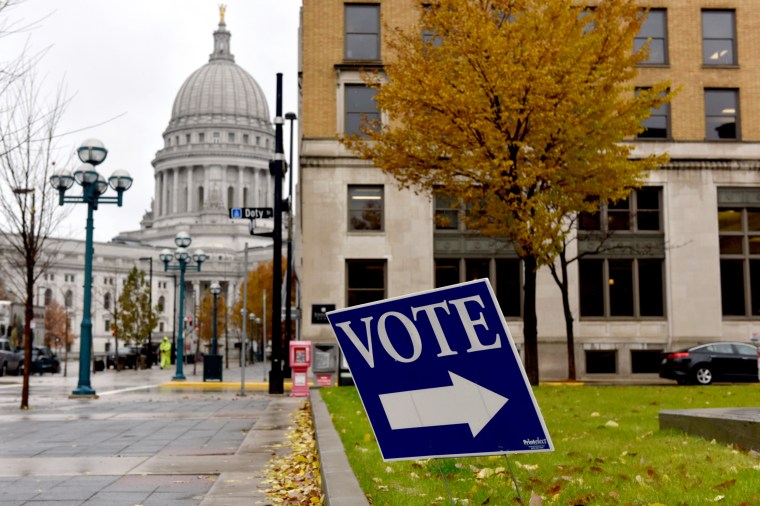
A sign for a polling place near the state capitol in Madison, Wis., on Nov. 6, 2018.Nick Oxford / Reuters file
For most of the country, it was obvious years ago that Medicaid expansion through the Affordable Care Act is a good deal, but as regular readers know, there are still 12 holdouts. As a consequence, there are more than 2 million low-income Americans who don’t have health security, simply because Republicans in their respective states refuse to do the right thing.
One of those 12 states was handed an opportunity to act yesterday. As the Associated Press reported, it did not go well.
Republicans who control the Wisconsin Legislature on Tuesday convened and within seconds ended a special session called by Democratic Gov. Tony Evers to expand Medicaid, dashing chances for the state to receive a one-time bonus of $1 billion in federal coronavirus relief funding. The Senate and Assembly gaveled in and adjourned the special session in mostly empty chambers with only a handful of lawmakers in attendance.
The process was remarkably efficient. After Wisconsin’s Democratic governor called a special session on the matter, officials in the Republican-led state Assembly showed up, banged the gavel, and left after 40 seconds. In the Republican-led state Senate, they moved with even greater speed: the session wrapped up in less than 10 seconds.
GOP legislators not only refused to vote on Tony Evers’ Medicaid expansion plan, they also refused to even debate it.
There are two angles to this that matter, and not just in the Badger State. The first is that, in theory, Republicans in the Wisconsin legislature are risking a fierce public backlash by expressing such callous indifference toward struggling families and their own state’s finances. But in practice, GOP state lawmakers assume they’re free to act with impunity, and they’re almost certainly correct: Wisconsin Republicans have rigged the state’s district lines to such a degree that the GOP keeps power, even when Democrats win more votes.
In other words, Wisconsin Republican legislators can make unpopular and irresponsible decisions, comfortable in the knowledge that, despite operating in an ostensible democracy, there’s little voters can do about it.
But let’s also not lose sight of the financial incentives GOP lawmakers in Wisconsin rejected out of hand. In the Democrats’ COVID relief package, called the American Relief Plan, President Joe Biden thought he’d come up with an offer that states couldn’t refuse.
As we discussed in March, the policy may sound a little complicated, but the offer was straightforward: under the ACA, the federal government already covers 90% of the costs of expanding Medicaid. As Vox explained, the Democrats’ relief package ups the ante: “[N]ewly expanding states would also receive a 5 percent bump in the federal funding match for their traditional Medicaid programs for two years. Because the traditional Medicaid population is significantly larger than the expansion population, the funding bump is projected to cover a state’s 10 percent match for expansion enrollees and then some over those two years.”
It led Jon Chait to joke, “Now states taking the Medicaid expansion would have more than 100 percent of the cost covered by Washington. They would literally have to pay for the privilege of denying coverage to their poorest citizens.”
Nearly three months later, how many states did the obvious thing? None. Literally, not one of the 12 holdouts has budged.
To be sure, Republicans were made aware of the incredibly generous offer, but they nevertheless said no in Wisconsin. And Texas. And Wyoming. And Florida. And Tennessee.
Meanwhile, in Missouri, voters added Medicaid expansion to the state constitution last year, but GOP officials said they don’t care and still won’t approve the policy. A new lawsuit intends to force Republicans’ hands. Watch this space.
U.S. freeways flattened Black neighborhoods nationwide
Andy Sullivan
New York state highway plan shows potential pitfalls of Biden’s infrastructure push.
SYRACUSE, N.Y. (Reuters) – Syracuse wasn’t the only city where Black residents were displaced by the U.S. freeway-building boom of the 1950s and 1960s.
Across the country, local officials saw the proposed interstate system as a convenient way to demolish what they regarded as “slum” neighborhoods near their downtown business districts, historians say. With the federal government picking up 90% of the cost, freeway construction made it easier for politicians and business leaders to pursue their own “urban renewal” projects after residents were evicted.
“It was a mistake that many cities were making,” said University of California, Irvine law professor Joseph DiMento, an expert in the policies of the freeway-building era. “The reasons they were built were heavily for removal of Blacks from certain areas.”
Existing long-distance highways, like the New York State Thruway, largely skirted city centers. The new interstates were built right through them.
Road builders at the time were largely free to ignore environmental, historical, social or other factors, allowing them to focus on the most direct route from one point to another.
More often than not, that meant routing those freeways through Black neighborhoods, where land was cheap and political opposition low.
Some black neighborhoods were targeted even when more logical routes were available, research by the late urban historian Raymond Mohl shows. According to his findings:
*In Miami, Interstate 95 was routed through Overtown, a Black neighborhood known as the “Harlem of the South,” rather than a nearby abandoned rail corridor.
*In Nashville, Interstate 40 took a noticeable swerve, bisecting the Black community of North Nashville.
*In Montgomery, Alabama, the state highway director, a high-level officer of the Ku Klux Klan, routed Interstate 85 through a neighborhood where many Black civil rights leaders lived, rather than choosing an alternate route on vacant land.
*In New Orleans and Kansas City, officials re-routed freeways from white neighborhoods to integrated or predominantly Black areas.
Residents in a handful of cities, including Washington, D.C., Philadelphia and Baltimore, successfully mobilized to block freeway construction in Black neighborhoods. But that was not typically the case.
The road-building program ultimately displaced more than 1 million Americans, most of them low-income minorities, according to Anthony Foxx, who served as transportation secretary under Democratic President Barack Obama.
(Reporting by Andy Sullivan; editing by Marla Dickerson)
Wuhan lab staff sought hospital care before COVID-19 outbreak disclosed – WSJ
FILE PHOTO: WHO team visits Wuhan Institute of Virology
WASHINGTON (Reuters) – Three researchers from China’s Wuhan Institute of Virology (WIV) sought hospital care in November 2019, a month before China reported the first cases of COVID-19, the Wall Street Journal reported on Sunday, citing a U.S. intelligence report.
The newspaper said the previously undisclosed report – which provides fresh details on the number of researchers affected, the timing of their illnesses, and their hospital visits – may add weight to calls for a broader investigation into whether the COVID-19 virus could have escaped from the laboratory.
The Journal said current and former officials familiar with the intelligence expressed a range of views about the strength of the report’s supporting evidence, with one unnamed person saying it needed “further investigation and additional corroboration.”
The first cases of what would eventually be known as COVID-19 were reported at the end of December 2019 in the central Chinese city of Wuhan, where the advanced laboratory specializing in coronavirus research is located.
Chinese scientists and officials have consistently rejected the lab leak hypothesis, saying SARS-CoV-2 could have been circulating in other regions before it hit Wuhan, and might have even entered China from another country via imported frozen food shipments or wildlife trading.
China’s foreign ministry spokesman, Zhao Lijian, said on Monday that it was “completely untrue” that three members of staff at WIV had fallen ill.
“The United States continues to hype up the lab leak theory,” he said. “Does it care about traceability or is it just trying to distract attention?”
The Journal report came on the eve of a meeting of the World Health Organization’s decision-making body, which is expected to discuss the next phase of an investigation into the origins of COVID-19.
Asked about the report, WHO spokesman Tarik Jasarevic said via email that the organization’s technical teams were now deciding on the next steps. He said further study was needed into the role of animal markets as well as the lab leak hypothesis.
A U.S. National Security Council spokeswoman had no comment on the report but said the Biden administration continued to have “serious questions about the earliest days of the COVID-19 pandemic, including its origins within the Peoples Republic of China.”
She said the U.S. government was working with the WHO and other member states to support an expert-driven evaluation of the pandemic’s origins “that is free from interference or politicization.”
“We’re not going to make pronouncements that prejudge an ongoing WHO study into the source of SARS-CoV-2, but we’ve been clear that sound and technically credible theories should be thoroughly evaluated by international experts,” she said.
A joint study into the origins of COVID-19 by the WHO and China published at the end of March said it was “extremely unlikely” that it had escaped from a lab.
But China was accused of failing to disclose raw data on early COVID-19 cases to the WHO team, and the United States, the European Union and other Western countries called on Beijing to grant “full access” to independent experts.
A State Department fact sheet released near the end of the Trump administration said “the U.S. government has reason to believe that several researchers inside the WIV became sick in autumn 2019, before the first identified case of the outbreak, with symptoms consistent with both COVID-19 and common seasonal illnesses.” It did not say how many researchers.
(Reporting by David Shepardson and Andrea Shalal; additional reporting by Gabriel Crossley in Beijing, David Stanway in Shanghai and Stephanie Nebehay in Geneva; Editing by Daniel Wallis and Andrew Heavens)
‘It’s just shocking’: How Missouri Republican politics drove twin crises in Medicaid
Jonathan Shorman, Jeanne Kuang May 23, 2021
Mike Levitt’s nursing homes have experienced a difficult 14 months.
Still recovering after being ravaged by the coronavirus pandemic, Levitt’s Tutera Senior Living & Health Care, which operates five facilities in the Kansas City region, suddenly finds itself at the edge of financial oblivion.
Missouri lawmakers are at fault.
The General Assembly adjourned earlier this month without renewing a tax that funds vast swaths of Medicaid in Missouri. Nursing homes are heavily reliant on Medicaid patients, who have spent down their savings and now depend on the program to pay for their care.
Levitt, Tutera’s vice president, was so frustrated in an interview this week he was reluctant to even discuss what would happen to the homes if the tax is not renewed before it expires this September. Medicaid recipients make up 45% to 95% of residents at Tutera’s facilities.
“It’s unthinkable,” he said. “I hate to think if it doesn’t … We’ve never been here before.”
Missouri’s $12 billion Medicaid program is in the midst of twin crises driven by Republican lawmakers that will play out in the weeks and months ahead. Hundreds of nursing homes, hospitals and pharmacies — and their hundreds of thousands of residents, patients and customers — are caught in the middle.
For the first time in three decades, legislators failed to approve a Medicaid provider tax that generates about $1.6 billion every year. More importantly, the tax allows Missouri to receive an additional $3 billion in federal funds that are then returned to the providers to care for elderly, disabled and low-income residents. Failure to renew the tax would set the program on the course to financial apocalypse.
Hard-right Republicans, led by Sen. Paul Wieland of Imperial, are demanding anti-abortion provisions be included in any renewal.
Gov. Mike Parson is all but certain to call a special session this summer to renew the tax, called the Federal Reimbursement Allowance or FRA. But it remains unclear whether he can focus the session narrowly enough to foreclose an acrimonious birth control debate and how much power Republican leaders really have to end what has become a high-stakes game of chicken.
“It’s just shocking to me and so disheartening to me that we’re using this to leverage any other piece of legislation,” said Nikki Strong, director of the Missouri Health Care Association, which advocates for nursing homes.
The consequences of not renewing the tax are catastrophic, Strong warned. “Without the FRA, every nursing home in the state will be out of business,” she said.
At the same time, Medicaid expansion is in limbo after most Republican lawmakers balked at budgeting the roughly $130 million in state funds needed to expand eligibility for the program on July 1 under the terms voters approved last August. Without funding, Parson officially halted expansion earlier this month.
Advocates for expansion sued Parson’s administration this past week, triggering a legal fight that may lead to a judge ordering the program extended. Months of planning by the health care industry and coverage for an estimated 275,000 residents hinge on the lawsuit’s outcome.
The simultaneous fights over the provider tax and expansion have led to an unparalleled moment of uncertainty for Medicaid. Health care workers and patients are contemplating worst-case scenarios even as they tell themselves Missouri must, eventually, pull back from the edge.
“I think right now people are in shock and feel like we’ve got four months or so to get this thing sorted out,” said Ron Fitzwater, CEO of the Missouri Pharmacy Association.
Michael Levitt, vice president of Tutera Senior Living and Health Care, said he believes nursing homes, such as Northland Rehabilitation & Health Care, are facing a dire financial situation and potentially closure if a key tax that funds Medicaid and pays hospitals and nursing homes is not renewed.
Contraceptives targeted
Wieland, 58, a Catholic who has been in the General Assembly since 2011, is no stranger to showdowns over abortion and contraceptives.
He sued in 2013 to stop his state health insurance plan from covering contraception, saying it violated his religious beliefs. He eventually prevailed in court.
Term-limited and due to leave office in 2023, he is waging one more fight over contraception coverage.
In late March, he inserted provisions into a bill renewing the provider tax that would ban Medicaid coverage of “any drug approved by the federal Food and Drug Administration that may cause the destruction of, or prevent the implantation of, an unborn child.”
That means the abortion pill, RU-486, but it also encompasses common forms of birth control, including IUDs.
Under federal and state law, Medicaid already does not cover abortions, including RU-486, unless the mother’s life is at risk.
“For several years I’ve been figuring out a way to make it so that the state of Missouri taxpayers do not have to fund these drugs that destroy human life,” he said. “I need to do it while I’m still there.”
Wieland’s proposal caused the provider tax to stall and, despite weeks of negotiations, an apparent compromise collapsed in the final hours of session.
With 18 hours left, at the urging of Sen. Bob Onder, a Lake St. Louis Republican, the Senate voted to send the bill to a conference committee where it would be paired with Wieland’s birth control ban. Senate President Pro Tem Dave Schatz cast the deciding vote.
His vote marked an apparent backtracking on a deal with Democrats and some Republicans to pass the provider tax without abortion-related language.
The move effectively killed the bill. Senate Minority Leader John Rizzo, an Independence Democrat, was furious at what he described as a betrayal. He moved with no opposition on the last day of session to adjourn four hours early.
Wieland said this week he, too, was betrayed. The Republican caucus, he said, had agreed to pass yet another version of the tax renewal with his contraceptive ban included.
“It sounds to me like they ignored the will of the Republican caucus and went and tried to make a deal with the Democrats and that blew up in their face,” he said.
Schatz has said he thought the move to send the bill to conference would succeed regardless of his vote, and found it “difficult” to “be in a position of voting against pro-life measures.”
Missouri Senate President Pro Tem Dave Schatz, left, speaks to reporters as Senate Majority Leader Caleb Rowden stands nearby. Schatz cast a deciding vote in whether to send a bill renewing a Medicaid provider tax back to conference committee.
As the fight over contraception was developing, lawmakers were also taking steps to block Medicaid expansion.
Wieland’s first proposal came days before a House committee voted down funding to expand Medicaid, the first in a string of defeats for expansion in the General Assembly. Lawmakers ultimately passed a budget without it.
Unlike the dispute over the provider tax, efforts to block expansion garnered the support of a majority of Republican lawmakers. Some justified their votes against the voter-approved initiative by saying their districts oppose expansion or that constituents didn’t have all the necessary information.
The refusal forced Parson to decide whether to implement expansion without funding or call it off. He chose to call it off and a lawsuit quickly followed.
Parson’s office didn’t respond to questions for this story. Parson has said that without revenue “we are unable to proceed with the expansion at this time” to keep Medicaid financially afloat.
“I think that was the appropriate response on their part,” Rep. Cody Smith, a Carthage Republican who chairs the House Budget Committee, said of Parson’s decision.
As for litigation, Smith said lawmakers “will sit back and watch that process unfold.”
Parson expected to recall lawmakers
The twin developments — the failure to renew the provider tax and the blocking of expansion — have rocked the health profession in Missouri.
The provider tax had been renewed on time so often that its continued existence was almost assumed. And the health care industry had been preparing for expansion for months.
“We’ve been on this wild ride on Medicaid expansion for quite a while now and this latest turn is a bit of a surprise,” said Timothy McBride, a health economist at Washington University in St. Louis.
Health care industry representatives said the tax renewal is nearly always a bargaining chip for conservative Republicans. But Alina Salganicoff, director of Women’s Health Policy at the Kaiser Family Foundation, said she’s never heard of lawmakers trying to ban coverage of specific forms of birth control through the provider tax.
“The particular language that is being used in Missouri is not a language I have seen used in other states,” she said. “These are not medical terms. This is not how medical organizations define and classify drugs.”
Facing the prospect the provider tax will expire, health care advocates remain confident for now legislators will eventually act. They are unanimous in predicting Parson will call a special session.
At the same time, advocates are keeping up pressure. Missouri Foundation for Health President and CEO Dwayne Proctor said Friday that every day “this process is delayed is another day nearly 250,000 Missourians go without the access to health care they need.”
In theory, Parson could voluntarily reverse his stance and implement expansion. But even before advocates filed a lawsuit this week seeking to force him to open up eligibility, he had said he expected the issue to head to the court.
A Cole County Circuit Judge will almost certainly now decide at least the short-term future of expansion. The lawsuit seeks an order requiring Missouri to enroll newly-eligible individuals on July 1.
As for the provider tax, Wieland has vowed to bring up the birth control ban in any special session that allows it. Some political observers have suggested Parson could set strict limits on what lawmakers can consider in a special session.
“I don’t see how you can draft a call and say we’re not going to allow you to amend a bill, and I don’t think the governor will do it anyway,” Wieland said. “He’s not a dictator … I will fight on whatever I need to to get this done, yes.”
Running out of money?
The fights have left Sen. Bill White, a Joplin Republican, frustrated and concerned that Medicaid is likely to run out of money this year, sooner or later.
He voted against paying for the expansion, but acknowledged a court could force the state to enroll new recipients. That would leave the program underfunded regardless of whether the provider tax is renewed.
“It’s a have-to scenario,” White said. “Individual programs we’ve had little fights … they just don’t equal this dollar amount or this impact.”
Jillian Winkler, a nurse at Northland Rehabilitation & Health Care, prepares medication Thursday, May 20, 2021. Nursing homes are facing a dire financial situation and potentially closure if a key tax that funds Medicaid and pays hospitals and nursing homes is not renewed.
Providers like Tutera, the Kansas City-area chain of nursing homes, will be watching.
For Levitt, Tutera’s vice president, imperiling the tax only adds “insult to injury,” as nursing homes across the state struggle to recover financially from revenue losses and high costs fighting the pandemic.
Without the funding, services for 23,000 elderly Missourians, covering everything from changing bedpans to monitoring medications, are on the line.
“We have all these other challenges we dealt with and fought through, and now we’re faced with a 40% cut in Medicaid, just because?” Levitt said. “It’s unconscionable.”
Once More For the People in the Back: You Cannot Negotiate or Compromise With the Republican Party
Jack Holmes May 20, 2021
Photo credit: Drew Angerer – Getty Images
Somehow, after everything, there remain creatures in Washington, D.C. obsessed with bipartisan compromise. One of our two major political parties has lined up in opposition to renewing what’s left of the Voting Rights Act, which swept through Congress on a strong bipartisan basis in the Bush years, when it actually still had some teeth. The same party’s Arizona affiliate is engaged in a circus “audit” of that state’s election results because they didn’t like who won. They’ve also responded to the 2020 election, which many Republicans continue to Just Ask Questions about, by passing hundreds of restrictive voter laws in state legislatures across the country. Through this and gerrymandering and court-packing and the undemocratic features of the Senate and the Electoral College, the party has devoted itself, root and branch, to clinging to power without crafting an agenda that actually appeals to a majority of citizens.
But even beyond any of that, they just submarined their own shared Bipartisan Bill to establish a commission to look into an attack on their own place of work earlier this year. If a mob broke into your company’s offices and ransacked the place, chanting that they wanted to hang the vice president of the firm, would the VP’s putative friends—and brother!—shut down an inquiry into what happened? This is not normal behavior, and it’s not the behavior of an organization whose members can be reasoned with. (As David Freedlander pointed out, House Republican Leader Kevin McCarthy used to back a Commission as a desperate escape from impeaching Donald Trump for his crimes against the republic. Now he’s against this, too. It’s almost like he’s not actually interested in any kind of accountability.) There will be no Bipartisan Compromise so long as the Republican Party clings to the increasingly kaleidoscopic fever dreams blasting out of the right-wing infotainment vortex. As my colleague, Charles P. Pierce, wrote, the Democrats will need to go it alone on a January 6 commission. In truth, they’ll have to go it alone on everything.
Photo credit: Drew Angerer – Getty Images
This ought to have been obvious before. In the Senate, Mitch McConnell has proven to be the most cynical operator that Washington, D.C. has seen in some time, and that’s saying something. McCarthy, in the House, is as craven as he is dense. And the party has a track record, going back to the Obama years, of demanding bipartisan consultation, extracting concessions and watering down bills, then voting against them anyway. This is what happened with the January 6 commission: Republicans got pretty much everything they wanted, and they still shut it down. They will do the same with the American Jobs Plan. As Catherine Rampell brilliantly laid out in the Washington Post, the initial lowball counterproposal they offered was actually vastly inflated. Their aim is to hack away at the bill, then vote against it. And you can probably forget about even that level of commitment to the American Families Plan. Josh Hawley might have some family-benefits proposals, and so might Mitt Romney on the party’s other wing, but when it gets to crunch time, you can expect at least the former (and very possibly the latter) to vote against the plan and fist-pump at the faithful.
This is an American political ecosystem where shame has ceased to function as a social force and, in fact, shamelessness has become a political superpower. To survive and thrive in the entirely degraded post-Trump Republican Party—the culmination of 40-plus years of self-replicating insanity—you cannot have any compunction about lying your ass off and acting in continual, ceaseless bad faith. There are people in this party who voted against the American Rescue Plan and then went bragging to their constituents about all the relief they’d brought home. Flip-flopping is passé. You now have to be able to juggle multiple contradictory positions at once. John Katko made the mistake Wednesday of thinking any principle—even that an attack on their own workplace should be investigated by Congress—was durable enough to survive the gauntlet of self-serving nonsense. Democrats should do their own commission, and then they should do their own bills. This will require Joe Manchin and Kyrsten Sinema coming back to reality, and seeing all of the above for it is before signing off on filibuster reform. You cannot negotiate with the void.