Ta’Kiya Young’s family calls for charges against the officer who killed the pregnant Black woman
Samantha Hendrickson – September 1, 2023
COLUMBUS, Ohio (AP) — Ohio authorities on Friday released bodycam video showing a police officer fatally shooting Ta’Kiya Young in her car in what her family denounced as a “gross misuse of power and authority” against the pregnant Black mother.
Sean Walton, an attorney representing Young’s family, said the video clearly shows that the Aug. 24 shooting of the 21-year-old woman was unjustified and he called for the officer to be fired and charged immediately. Walton also criticized police for not releasing the video footage for more than a week after the shooting.
“Ta’Kiya’s family is heartbroken,” Walton said in an interview with The Associated Press. “The video did nothing but confirm their fears that Ta’Kiya was murdered unjustifiably … and it was just heartbreaking for them to see Ta’Kiya having her life taken away under such ridiculous circumstances.”
A spokesman for the police union said calls to charge the officer before an investigation is complete are premature. The officer is on paid administrative leave while the Ohio Bureau of Criminal Investigation examines the shooting, which is standard practice. A second officer who was on the scene has returned to active duty. Their names, races and ranks have not been released.
Blendon Township Police Chief John Belford called the shooting a tragedy.
“Ms. Young’s family is understandably very upset and grieving,” he said in a written statement released Friday morning. “While none of us can fully understand the depths of their pain, all of us can remember them in our prayers and give them the time and space to deal with this heartbreaking turn of events.”
Young’s death follows a troubling series of fatal shootings of Black adults and children by Ohio police and numerous occurrences of police brutality against Black people across the nation in recent years, events that have prompted widespread protests and demands for police reform.
Young’s father, grandmother and other relatives watched the video before its public release and released a statement Friday through Walton.
“It is undeniable that Ta’Kiya’s death was not only avoidable, but also a gross misuse of power and authority,” the statement said. While viewing the video, the family felt “a lot of anger, a lot of frustration,” Walton told The Associated Press.
“More than anything, there was … a sense of just devastation, to know that this power system, these police officers, could stop her and so quickly take her life for no justifiable reason.”
The video shows an officer at the driver’s side window telling Young she has been accused of theft and repeatedly demanding that she get out of the car. A second officer is standing in front of the car.
Young protests, and the first officer repeats his demand. Young then turns the steering wheel to her right and the car moves toward the officer standing in front of it, who fires his gun through the windshield. Young’s sedan then drifts into the grocery store’s brick wall.
Officers then break the driver’s side window, which Belford said was to get Young out of the car and render medical aid, though footage of medical assistance was not provided.
In his interview with the AP on Friday, Walton denied that Young had stolen anything from the grocery store. He said his firm found a witness who saw Young put down bottles of alcohol as she left the store.
“The bottles were left in the store,” he said. “So when she’s in her car denying that, that’s accurate. She did not commit any theft, and so these officers were not even within their right to place her under arrest, let alone take her life.”
Brian Steel, executive vice president of the union representing Blendon Township police, called Walton a “modern-day ambulance chaser” and criticized his characterization of the shooting as a murder while the investigation is still ongoing and all of the facts have yet to be established.
Steel said in a phone interview that the case will almost certainly be presented to a grand jury for a decision on whether to file charges against the officer, but he declined to say whether Young’s death was justified. “The fact is (the officer) had to make a split-second decision while in front of a moving vehicle, a 2,000-pound weapon,” he said.
Responding to criticism of the delay in releasing the video, Belford said it took time for his small staff to process it and properly redact certain footage, such as officers’ faces and badge numbers, in accordance with Ohio law.
He said the officers’ names cannot be released at this point because they are being treated as assault victims. He said one of the officer’s arms was still partially in the driver’s side window and a second officer was still standing in front of the car when Young moved the car forward.
Young’s death is one of numerous deaths of Black adults and children at the hands of police across the nation that have drawn protests and demands for more accountability. Among the most prominent cases was George Floyd’s death on May 25, 2020. Floyd died after then-Minneapolis police Officer Derek Chauvin, who is white, pressed a knee on his neck for 9 1/2 minutes on the street outside a convenience store where Floyd tried to pass a counterfeit $20 bill. Chauvin was convicted of second-degree murder.
In Ohio, Donovan Lewis was lying on his bed in August 2022 when he was shot by a K-9 officer serving a warrant. Ma’Khia Bryant, a 16-year-old girl in foster care who was accused of swinging at two people with a knife, was fatally shot in April 2021, minutes before the guilty verdict was announced for the Minnesota police involved in the death of George Floyd. In December 2020, Casey Goodson Jr., was shot five times in the back by a Franklin County sheriff’s deputy.
Ohio Families Unite for Political Action and Change, a grassroots organization focused on eradicating police brutality, said the footage shows officers’ conduct was “violent, defenseless, and egregious” and that they acted as “judge, jury and executioner.”
“We are in pain for her family, our community, and all families impacted by police brutality who are re-traumatized upon viewing yet another murder by police in Ohio,” the group said in a statement emailed to the AP.
Young was expected to give birth to a daughter in November. Family and friends held a private vigil a day after Young was killed, releasing balloons and lighting candles spelling out “RIP Kiya.” An online effort to pay her funeral expenses has raised over $7,000.
Ta’Kiya’s siblings, cousins, grandmother and father have rallied around her sons, 6-year-old Ja’Kobie and 3-year-old Ja’Kenlie, who don’t yet understand the magnitude of what happened to their mother, Walton said.
“It’s a large family and Ta’Kiya has been snatched away from them,” Walton said. “I think the entire family is still in shock.”
Young’s grandmother, Nadine Young, described her granddaughter as a family-oriented prankster who was a loving older sister and mother.
“She was so excited to have this little girl,” the grandmother said at a news conference Wednesday. “She has her two little boys, but she was so fired up to have this girl. She is going to be so missed.”
“I’m a mess because it’s just tragic,” she said, “but it should have never ever ever happened.”
Associated Press writers Aaron Morrison in New York; Maryclaire Dale in Philadelphia; Michael Rubinkam in northeastern Pennsylvania; and video journalist Patrick Orsagos in Columbus contributed to this report.
Samantha Hendrickson is a corps member for the Associated Press/Report for America Statehouse News Initiative. Report for America is a nonprofit national service program that places journalists in local newsrooms to report on undercovered issues.
These Voters Share Almost No Political Beliefs, but They Agree on One Thing: We’re Failing as a Nation
Ruth Igielnik – August 20, 2023
A Jackson, Miss., precinct worker cuts individual “I Voted in Hinds County” stickers from the roll, Tuesday, Aug. 8, 2023. Each voter in Hinds County receives a sticker upon receipt of a paper ballot. Voters statewide are selecting their party’s nominees for a number of county and statewide offices in their respective Democratic or Republican primaries. (AP Photo/Rogelio V. Solis) (ASSOCIATED PRESS)More
There are few things that Republicans and Democrats agree on. But one area where a significant share of each party finds common ground is a belief that the country is headed toward failure.
Overall, 37% of registered voters say the problems are so bad that we are in danger of failing as a nation, according to the latest New York Times/Siena College poll.
Fifty-six percent of Republicans and Republican-leaning independents said we are in danger of such failure. This kind of outlook is more common among voters whose party is out of power. But it’s also noteworthy that fatalists, as we might call them, span the political spectrum. Around 20% of Democrats and Democratic-leaning independents say they feel the same way.
Where they disagree is about what may have gotten us to this point.
Why Republicans say the U.S. is in danger of failing
Republican fatalists, much like Republican voters overall, overwhelmingly support former President Donald Trump. This group is largely older — two-thirds of Republicans older than 65 say the country is on the verge of failure — and less educated. They are also more likely than Republican voters overall to get their news from non-Fox conservative media sources like Newsmax or The Epoch Times.
Many of these gloomy Republicans see the Biden administration’s policies as pushing the country to the verge of collapse.
“Things are turning very communistic,” said Margo Creamer, 72, a Trump supporter from Southern California. “The first day Biden became president, he ripped up everything good that happened with Trump; he opened the border — let everyone and anyone in. It’s just insane.”
She added that there was only one way to reverse course: “In this next election if Trump doesn’t win, we’re going to fail as a nation.”
Many Republicans saw the pandemic, and the resulting economic impact, as playing a role in pushing the country toward failure.
“COVID gave everyone a wake-up call on what they can do to us as citizens,” said Dale Bowyer, a Republican in Fulton County, Indiana. “Keeping us in our houses, not being allowed to go to certain places, it was complete control over the United States of America. They think we’re idiots and we wouldn’t notice.”
Why Democrats say the U.S. is in danger of failing
While fewer Democrats see the country as nearing collapse, gender is the defining characteristic associated with this pessimistic outlook. Democratic and Republican women are more likely than their male counterparts to feel this way.
“I have never seen things as bleak or as precarious as they have been the last few years,” said Ann Rubio, a Democrat and funeral director in New York City. “Saying it’s a stolen election plus Jan. 6, it’s terrifying. Now we’re taking away a woman’s right to choose. I feel like I’m watching the wheels come off something.”
For many Democrats, specific issues — especially abortion — are driving their concern about the country’s direction.
Brandon Thompson, 37, a Democrat and veteran living in Tampa, Florida, expressed a litany of concerns about the state of the country: “The regressive laws being passed; women don’t have abortion access in half the country; gerrymandering and stripping people’s rights to vote — stuff like this is happening literally all over the country.
“If things continue to go this way, this young experiment, this young nation, is going to fall apart,” he said.
More than just on the wrong track
Pollsters have long asked a simple question to take the country’s temperature: Are things in the U.S. headed on the right track or are they off in the wrong direction?
Americans’ views on this question have become more polarized in recent years and are often closely tied to views of the party in power. So it is not surprising, for example, that currently 85% of Republicans said the country was on the wrong track, compared with 46% of Democrats. Those numbers are often the exact opposite when there’s a Republican in the White House.
Views on the country’s direction are also often closely linked to the economic environment. Currently, 65% of Americans say the country is headed in the wrong direction. That’s relatively high historically, although down from last summer when inflation was peaking and 77% of Americans said the country was headed in the wrong direction. At the height of the recession in 2008, 81% of Americans said the country was headed in the wrong direction.
What seems surprising, however, is the large share of voters who say we’re on the verge of breaking down as a nation.
“We’ve moved so far away from what this country was founded on,” said William Dickerson, a Republican from Linwood, North Carolina. “Society as a whole has become so self-aware that we’re infringing on people’s freedoms and the foundation of what makes America great.”
He added: “We tell people what they can and can’t do with their own property and we tell people that you’re wrong because you feel a certain way.”
Voters contacted for the Times/Siena survey were asked the “failing” question only if they already said things were headed in the wrong direction. And while this is the first time a question like this has been asked, the pessimistic responses still seem striking: Two-thirds of Republicans who said the country was headed in the wrong direction said things weren’t just bad — they were so bad that America was in danger of becoming a failed nation.
“Republicans have Trump and others in their party who have undermined their faith in the electoral system,” said Alia Braley, a researcher at Stanford’s Digital Economy Lab who studies attitudes toward democracy. “And if Republicans believe democracy is crumbling, it can become a self-fulfilling prophecy, in that they will stop behaving like citizens of a democracy.”
She added, “Democrats are often surprised to learn that Republicans are just as afraid as they are about the future of U.S. democracy, and maybe more so.”
American democracy is cracking. These forces help explain why.
Behind the sense that the political system is broken lies a collision between forces both old and new
By Dan Balz and Clara Ence Morse – August 18, 2023
In a country where the search for common ground is increasingly elusive, many Americans can agree on this: They believe the political system is broken and that it fails to represent them.
They aren’t wrong.
Faced with big and challenging problems — climate, immigration, inequality, guns, debt and deficits — government and politicians seem incapable of achieving consensus. On each of those issues, the public is split, often bitterly. But on each, there are also areas of agreement. What’s broken is the will of those in power to see past the divisions enough to reach compromise.
The Jan. 6, 2021, attack on the Capitol is both an extreme emblem of what happens when democracy stops functioning as it should and the result of relentless attacks by former president Donald Trump on the legitimacy of the election process based on lies and distortions, a continuing threat to U.S. democracy.
In more routine ways, the political system feeds frustration and discontent with its incapacity to respond to the public’s needs. There is little on the horizon to suggest solutions.
The failure has multiple origins,including a collapse of trust in institutions. But one of the most significant is a collision between forces both old and new.
The old dates to the writing of the Constitution — debates and compromises that resulted in representation in the House based on population and in the Senatebased on equal standing forthe states; the odd system by which we elect presidents; and lifetime appointments for Supreme Court justices. In general, the founders often distrusted the masses and sought to create structural protections against them.
The newer element, which has gathered strength in recent decades, is the deepening polarization of the political system. Various factors have caused this:shifts within the two parties that have enlarged the ideological gap between them;geographic sorting that haswidened the differences between red and blue states; a growing urban-rural divide; and greater hostility among individuals toward political opponents.
The result is that today, a minority of the population can exercise outsize influence on policies and leadership, leading many Americans increasingly to feel that the government is a captive of minority rule.
Twice in the past two decades, the president was elected while losing the popular vote —George W. Bush in 2000 and Trump in 2016. That had happened only three times in the previous 200-plus years. The dynamic extends beyond the presidency to the other two branches of government.
A new Washington Post analysis found that four of the nine current justices on the Supreme Court were confirmed by senators who represent a minority of the U.S. population. Since 1998, Republicans have had a majority in the Senate a total of 12 years but did not during that time represent more than half the nation’s population, The Post’s analysis of population data and Senate composition shows.
The Post also found that during Trump’s presidency, 43 percent of all judicial and governmental nominees were confirmed by senators representing a minority of the population. Under President Biden, not quite 5 percent of nominees were confirmed by senators representing a minority of the population.
The state of democracy is not uniformly negative. In moments of crisis especially, elected officials have found common ground. At times, government action does reflect the public will. Under Trump, bipartisan congressional majorities passed and the president signed multiple rounds of relief during the covid-19 pandemic. Biden and Congress came together to pass a major infrastructure package in 2021. Last year, there was bipartisan agreement on legislation to spur production of semiconductor chips in the United States.
At times, protection of minorities and their rights from the will of the majority is needed and necessary. Checks and balances afford further protections that nonetheless can seem to hamstring government’s ability to function effectively. But on balance, the situation now is dire. Americans are more dissatisfied with their government than are citizens in almost every other democracy, according to polling.
Henry Brady, professor of political science and public policy at the University of California at Berkeley, has been studying these issues for many years. As he surveys the current state of the United States’ democracy, he comes away deeply pessimistic. “I’m terrified,” he said. “I think we are in bad shape, and I don’t know a way out.”
This is the first in a series of reports examining what is fueling the visceral feeling many Americans have that their government does not represent them. Alongside debates over specific policies, the overall state of democracy roils the national discussion. Heading into the 2024 presidential election, this issue is likely to be a critical factor for many voters.
Distrust in government
Trust in the federal government began to decline during the Vietnam War in the 1960s and then took a big hit amid the Watergate scandal in the early 1970s. There have been occasional rebounds — after the terrorist attacks on Sept. 11, 2001, or during the late 1990s when the economy was doing well. But for the past two decades — through good economic times and bad — mistrust has been persistent.
Individual institutions have suffered as well. Of late it is the Supreme Court’s reputation has been damaged due to rulings that have gone against popular opinion and a heightened sense that the court has become politicized. For Congress, the decline has been ongoing for decades. Only Wall Street and television news have seen more precipitous declines in trust over the past four decades, according to calculations published by the American Academy of Arts and Sciences.
Americans have long been skeptical of the power of the central government. Scandals and corruption over the years have added to the problem. Lately, officials have openly attacked the very institutions of which they are a part, making it even harder for thebureaucracy to function effectively. No one has done this more than Trump. Attacks on institutions have been a hallmark of his time in politics.
While there is some universality to these conditions, citizens in only a handful of democratic countries take a dimmer view of their government than Americans do of theirs.
Polarization
For much of the United States’ history, the constitutional system created by the founders worked reasonably well. The Civil War is an obvious exception, and other periods have tested the collective will. But overall, government generally functioned, even if not perfectly.
More recently, however, the system’s weaknesses became more apparent as tribalism shapes much of political behavior and the Republican Party has departed from its historical moorings. Trump’s impact has distorted traditional Republican conservatism and has led many Republicans to accept as reality demonstrably untrue beliefs. The best example of that is that a majority in the GOP say Biden was not legitimately elected. The hard-right wing of the Republican Party and Trump voters in particular have been resistant to compromise.
“In comparison to European countries, our constitutional system is not well suited for polarized political parties,” said Nathaniel Persily, a law professor at Stanford Law School.
Election of presidents
The Constitution created an unusual mechanism for electing the president — an electoral college. It was built on assumptions that over the years have proved to be faulty.
The founders distrusted a system based on the popular vote, fearing many citizens would not be well-informed. They put power in the hands of electors. They thought the House would often end up picking the president, not anticipating the effects of what quickly became a two-party system in the United States. The rationale for the current system has been overrun by the realities of today’s politics.
“It was created because the founders couldn’t figure out what to do,” said George C. Edwards III, a political science professor at Texas A&M University and author of “Why the Electoral College Is Bad for America.” “It doesn’t work at all as the founders intended.”
During the first two centuries of the country’s history, there were only three cases in which the person elected president did not receive a majority of the popular vote, in 1824, 1876 and 1888. Now it has happened twice in a quarter century and could happen again in 2024. In both 2000, when Bush became president, and 2016, when Trump was elected, the popular vote supported the Democratic nominee, Al Gore and Hillary Clinton respectively, yet the electoral college vote went in favor of the Republican.
During the past two decades, the number of competitive states in presidential elections, where the victory margin has been five percentage points or fewer, has declined. Meanwhile, the number of states decided by margins of 15 percentage points or more has increased, based on an analysis of state-by-state results by The Post.
Because the outcome in the most competitive states can be decided by a relatively small number of votes, Republicans now have a significantly better chance of winning in the electoral college than in the popular vote. Democrats, meanwhile, roll up huge margins in deep blue states like California that give them no significant boost in the electoral college math.
Congress
In the Great Compromise among delegates to the Constitutional Convention, the House was to be divided based on population, while the Senate would give each state equal representation regardless of population.
In times past, many state delegations to the Senate were split between the two major parties. In 1982, for example, about two-dozen states had split representation. Today there are only six true splits,and those states account for about 9 percent of the U.S. population.
Republicans tend to have full control in less populated states, creating an imbalance in the number of senators they send to Washington and the percentage of the national population they represent. Even when they have recently held a majority in the Senate, they represent a minority of the population. In 2024, two of the nation’s least populous states — West Virginia and Montana — could flip control of the Senate from Democrats to Republicans, if GOP challengers prevail over Democratic incumbents.
This has had an impact especially on confirmations of judicial nominees and senior executive branch appointees. During the four years Trump was in office, nearly half of the individuals nominated for key positions were confirmed by senators representing a minority of the population. No other recent president had more than 5 percent confirmed by senators representing a minority of the population.
Through gerrymandering, population dispersion and the sorting of where people prefer to live, competition for House seats has declined.
The overwhelming majorityof districts now lean strongly either to Republicans or to Democrats. In those districts, that makes the primary election more important than the general election. Because turnout is generally concentrated among the most fervent voters in primary contests, more extreme candidates have an advantage. This has widened the ideological gap in the House, which makes compromise even more difficult.
It has also led to the kinds of dysfunction seen this year, such as the multi-ballot marathon to elect Rep. Kevin McCarthy (R-Calif.) as speaker, or the threats to let the government default on its debts that ultimately were avoided by an old-fashioned bit of compromise.
As the number of swing districts has declined, another phenomenon has become evident: Even in open-seat races, which historically have been more contested than those involving incumbents, the number of landslide victories by members of both major parties has increased dramatically.
The Supreme Court
Democrats have won the popular vote in seven of the last nine presidential elections. But during that time, Republican presidents have nominated six of the nine current members of the Supreme Court. Four of the nine justices, including the three nominated by Trump, were confirmed by senators representing a minority of the population.
The percentage of Americans represented by senators voting to confirm justices has been decreasing over the past half century. Now that justices can be confirmed with a simple majority vote, rather than a supermajority, the phenomenon of confirmation by a majority of senators representing a minority of citizens has become common place when Republicans hold the Senate majority.
State legislatures
In Washington, political divisions have led to gridlock and inaction on many issues. In the states, the opposite has occurred because states have increasingly become either mostly red or mostly blue.
In just two states is the legislature split between Republicans and Democrats. In more than half of the states, the dominant party enjoys a supermajority, which means they can override vetoes by a governor of a different party or generally have their will on legislation.
Similarly, full control of state government — the legislature and the governor’s office — is the rule rather than the exception. Today 39 states fit this definition. The result is a sharper and sharper divergence in the public policy agendas of the states.
The dominant party has been able to move aggressively to enact its governing priorities. That has meant tight restrictions on abortion in Republican states and few or no restrictions in blue states; it’s meant challenges to LGBTQ rights in red states and affirmation of those rights in blue states.
These divisions have made it possible for the dominant party to govern with little regard to the interests of those with allegiance to the minority party and often little accountability as well. The result is two Americas with competing agendas and values.
Public opinion vs. public policy
The gap between public policy and public opinion is one major consequence of today’s frozen federal government. Three of the most talked about issues reflect that: abortion, guns and immigration.
On abortion, most Americans oppose last year’s Supreme Courtdecision in Dobbs v. Jackson Women’s Health Organization, which ended the constitutional right to abortion. On guns, big majorities favor individual proposals to tighten laws, but the gun lobby remains powerful enough to block action.
On immigration, there has been a majority for some years favoring tougher border controls along with a path to citizenship, with some penalties, for the millions of undocumented immigrants living here. Every effort to deal with this in Congress over the past two decades has failed, including attempts to resolve the plight of people brought here illegally as children, known as “dreamers.”
The Constitution
One way to deal with some of the structural issues — the electoral college, a Senate where a minority of the population can elect a majority of members or the lifetime appointments for Supreme Court justices — would be by amending the Constitution. But the U.S. Constitution, though written to be amended, has proved to be virtually impossible to change. Nor is there cross-party agreement on what ails the system. Many conservatives are satisfied with the status quo and say liberals want to change the rules for purely partisan reasons.
It was the drafters of state constitutions who saw the need for amending such documents. Over the history of the country, state constitutions have been amended thousands of times — more than half of all those proposed. But while there have been about 12,000 proposed amendments to the U.S. Constitution, Congress has submitted just 33 to the states, of which 27 have been ratified.
The last amendment was approved in 1992, and that was a provision that had been proposed along with others that became the Bill of Rights. In reality, it has been half a century since a contemporary amendment has been ratified. Given the political conditions in the country, the prospect of two-thirds of both the House and Senate voting to propose an amendment and then three-fourths of the states ratifying it seems extremely unlikely.
To remain a living document, the Constitution needs to be adaptable to changing times, perspectives and conditions. The alternative to amending the Constitution is through judicial interpretation by the Supreme Court. Today the court is dominated by “originalists” who interpret the document through a strict reading of the words and timesin which it was written — long a goal of conservatives. But the America of 2023 is not the America of the framers of the Constitution in the late 18th century, a time when enslaved people were counted as three-fifths of a person and women did not have the right to vote.
Not all countries have written constitutions — Britain, for example. But the amendment process when functioning effectively is “a mechanism to peaceful revolution,” said historian Jill Lepore, who directs the Amendments Project at Harvard University. So there is value to a written constitution, but only if it can be changed.
“The danger,” Lepore said, “is that it becomes brittle and fixed — and then the only way to change your system of government or to reform a part of it is through an insurrection.”
About this project
In the analysis of population data and Senate composition, The Post’s count of senators in each year represents the composition of the Senate on Jan. 31 of that year, with two exceptions: Al Franken is counted in the 2009 Senate and Norris Cotton is counted in the 1975 Senate. In the analysis of confirmations over time, The Post examined all Senate roll call votes with a result of “confirmed.” For all senators who voted to confirm a given nominee, The Post calculated the percent of Americans from the states of those senators that year, with each senator representing half of their state population. Many nominees to various positions were confirmed with a voice vote or through a unanimous consent agreement; these confirmations are not reflected in this data. In the analysis of House elections, The Post determined open House races using several sources, including FEC and MIT elections results data.
Reporting by Dan Balz and Clara Ence Morse. Editing by Griff Witte. Copy editing by Mina Hag. Project editing by KC Schaper. Design and development by Courtney Beesch and Tyler Remmel. Design editing by Betty Chavarria. Illustrations by Courtney Beesch with images from iStock. Topper animation by Emma Kumer. Photo editing by Christine T. Nguyen. Graphics by Clara Ence Morse and Hanna Zakharenko. Graphics editing by Kevin Uhrmacher. Data editing by Anu Narayanswamy. Visual enterprise editing by Sarah Frostenson. Research provided by Monika Mathur. Additional editing, production and support by Philip Rucker, Peter Wallsten, Jenna Johnson and Tom Justice.
Some say Thomas’ longstanding acceptance of freebies shows the need for ethics reform on the Supreme Court.
“This is a shameless lifestyle underwritten for years by a gaggle of fawning billionaires,” Sen. Dick Durbin (D-Ill.) wrote on Twitter. “Justices Thomas and [Samuel] Alito have made it clear that they’re oblivious to the embarrassment they’ve visited on the highest court in the land.”
He said that if the court wouldn’t reform itself, Congress should step in and do it for them.
Other lawmakers went further, demanding that Thomas to step down.
“Thomas takes cash bribes while crushing your freedoms,” Rep. Bill Pascrell Jr. (D-N.J.) wrote on Twitter. “He’s corrupt as hell and should resign today.”
Others also called on him to pack up his robes:
Thomas once bragged that when it came to travel, he preferred camping in Walmart parking lots ― where budget RV travelers often gather ― and “seeing the regular parts of the United States.”
“I come from regular stock, and I prefer that — I prefer being around that,” he said in a documentary financed by one of his travel benefactors, according to Slate.
And as for camping, Thomas owns a $267,230 luxury RV financed by a wealthy friend in a deal he also failed to disclose.
The Thomas scandal has led to growing call for ethics reform of the court ― but at least one justice has bristled publicly at the notion of Congress stepping in.
“No provision in the Constitution gives them the authority to regulate the Supreme Court,” Associate Justice Samuel Alito told the Wall Street Journal last month. “Period.”
Alito, according to ProPublica, took a luxury fishing vacation funded by a billionaire who later had cases before the Supreme Court.
Clarence Thomas’s $267,230 R.V. and the Friend Who Financed It
By Jo Becker and Julie Tate – August 5, 2023
The vehicle is a key part of the justice’s just-folks persona. It’s also a luxury motor coach that was funded by someone else’s money.
Justice Clarence Thomas, circa 2000, with his great-nephew and his Prevost Le Mirage XL Marathon motor coach.
Justice Clarence Thomas met the recreational vehicle of his dreams in Phoenix, on a November Friday in 1999.
With some time to kill before an event that night, he headed to a dealership just west of the airport. There sat a used Prevost Le Mirage XL Marathon, eight years old and 40 feet long, with orange flames licking down the sides. In the words of one of his biographers, “he kicked the tires and climbed aboard,” then quickly negotiated a handshake deal. A few weeks later, Justice Thomas drove his new motor coach off the lot and into his everyman, up-by-the-bootstraps self-mythology.
There he is behind the wheel during a rare 2007 interview with “60 Minutes,” talking about how the steel-clad converted bus allows him to escape the “meanness that you see in Washington.” He regularly slips into his speeches his love of driving it through the American heartland — “the part we fly over.” And in a documentary financed by conservative admirers, Justice Thomas, who was born into poverty in Georgia, waxes rhapsodic about the familiarity of spending time with the regular folks he meets along the way in R.V. parks and Walmart parking lots.
“I don’t have any problem with going to Europe, but I prefer the United States, and I prefer seeing the regular parts of the United States,” he told the filmmakers, adding: “There’s something normal to me about it. I come from regular stock, and I prefer being around that.”
But there is an untold, and far more complex, back story to Justice Thomas’s R.V. — one that not only undercuts the mythology but also leaves unanswered a host of questions about whether the justice received, and failed to disclose, a lavish gift from a wealthy friend.
His Prevost Marathon cost $267,230, according to title history records obtained by The New York Times. And Justice Thomas, who in the ensuing years would tell friends how he had scrimped and saved to afford the motor coach, did not buy it on his own. In fact, the purchase was underwritten, at least in part, by Anthony Welters, a close friend who made his fortune in the health care industry.
A circa 1991 advertisement for Marathon coaches. Credit…Marathon
He provided Justice Thomas with financing that experts said a bank would have been unlikely to extend — not only because Justice Thomas was already carrying a lot of debt, but because the Marathon brand’s high level of customization makes its used motor coaches difficult to value.
In an email to The Times, Mr. Welters wrote: “Here is what I can share. Twenty-five years ago, I loaned a friend money, as I have other friends and family. We’ve all been on one side or the other of that equation. He used it to buy a recreational vehicle, which is a passion of his.” Roughly nine years later, “the loan was satisfied,” Mr. Welters added. He subsequently sent The Times a photograph of the original title bearing his signature and a handwritten “lien release” date of Nov. 22, 2008.
But despite repeated requests over nearly two weeks, Mr. Welters did not answer further questions essential to understanding his arrangement with Justice Thomas.
He would not say how much he had lent Justice Thomas, how much the justice had repaid and whether any of the debt had been forgiven or otherwise discharged. He declined to provide The Times with a copy of a loan agreement — or even say if one existed. Nor would he share the basic terms of the loan, such as what, if any, interest rate had been charged or whether Justice Thomas had adhered to an agreed-upon repayment schedule. And when asked to elaborate on what he had meant when he said the loan had been “satisfied,” he did not respond.
“‘Satisfied’ doesn’t necessarily mean someone paid the loan back,” said Michael Hamersley, a tax lawyer and expert who has testified before Congress. “‘Satisfied’ could also mean the lender formally forgave the debt, or otherwise just stopped pursuing repayment.”
Justice Thomas, for his part, did not respond to detailed questions about the loan, sent to him through the Supreme Court’s spokeswoman.
The two men’s silence serves to obscure whether Justice Thomas had an obligation to report the arrangement under a federal ethics law that requires justices to disclose certain gifts, liabilities and other financial dealings that could pose conflicts of interest.
Vehicle loans are generally exempt from those reporting requirements, as long as they are secured by the vehicle and the loan amount doesn’t exceed its purchase price. But private loans like the one between Mr. Welters and Justice Thomas can be deemed gifts or income to the borrower under the federal tax code if they don’t hew to certain criteria: Essentially, experts said, the loan must have well-documented, commercially reasonable terms along the lines of what a bank would offer, and the borrower must adhere to those terms and pay back the principal and interest in full.
Richard W. Painter, a White House ethics lawyer during the George W. Bush administration, said that when it comes to questions of disclosure, the ethics treatment of gifts and income often parallels the tax treatment. But those intricacies aside, he said, “justices just should not be accepting private loans from wealthy individuals outside their family.” If they do, he added, “you have to ask, why is a justice going to this private individual and not to a commercial lender, unless the justice is getting something he or she otherwise could not get.”
The Times’s unearthing of the loan arrangement is the latest in a series of revelations showing how wealthy benefactors have bestowed an array of benefits on Justice Thomas and his wife, Virginia Thomas: helping to pay for his great-nephew’s tuition, steering business to Mrs. Thomas’s consulting firm, buying and renovating the house where his mother lives and inviting the Thomases on trips both domestic and foreign that included travel aboard private jets and a yacht.
Ethical Issues Inside the Supreme Court
A Crisis of Ethics: A debate over ethical standards for Supreme Court justices has intensified after a series of revelations about lavish gifts and financial largess. Our reporter explains the allegations of misconduct and the growing calls for tighter rules.
Scalia Law: George Mason University’s law school cultivated ties to some of the court’s conservative justices with generous pay and unusual perks. In turn, the school gained prestige, donations and influence.
Justice Thomas has pointed to interpretations of the disclosure rules to defend his failure to report much of the largess he has received. He has said he was advised that the trips fell under an exemption for gifts involving “personal hospitality” from close friends, for instance, and a lawyer close to the Thomases contended in a statement that the justice did not need to disclose the tuition because it was a gift to his great-nephew, over whom he had legal custody, rather than to him.
The Thomases’ known benefactors include wealthy men like the Dallas real estate developer Harlan Crow, the conservative judicial kingmaker Leonard Leo and several members of the Horatio Alger Association of Distinguished Americans, which honors people who succeed despite adversity. Among them: the longtime Miami Dolphins owner Wayne Huizenga, who flew the justice around on his jet.
Mr. Welters, while also a Horatio Alger member, stands apart. For one thing, the two men’s friendship predates Justice Thomas’s time on the federal bench. They met around 1980, when both were members of a small, informal club of Black congressional aides to Republican lawmakers — Mr. Welters worked for Senator Jacob K. Javits of New York and Justice Thomas for Senator John C. Danforth of Missouri.
Anthony Welters, shown with his wife Beatrice in 2016, was a close friend of Justice Thomas’s from their time working as congressional aides. Credit…Astrid Stawiarz/Getty Images for NYU Langone Medical Center
“It wasn’t exactly fashionable to be a Black person working for a Republican, and it was comforting to meet others in the same boat,” the justice wrote in his autobiography, “My Grandfather’s Son.”
They had much in common. Like Justice Thomas, Mr. Welters was raised in poverty, sharing a cramped tenement in Harlem with his parents and three brothers and, after his mother’s death when he was 8, shining shoes under an elevated subway to help make ends meet.
As both men climbed the ladder as political appointees in the Reagan administration, their friendship grew. They stayed close after Justice Thomas joined the federal appeals court in Washington in 1990 and Mr. Welters left government to found AmeriChoice, a Medicaid services provider that he sold to UnitedHealthcare for $530 million in stock in 2002 and continued to lead until retiring in 2016. Mr. Welters and his wife, Beatrice, named Justice Thomas the godfather of one of their two boys, according to The Village Voice.
When Justice Thomas’s 1991 Supreme Court nomination ran into trouble after a former subordinate, Anita Hill, accused him of sexual harassment, Mr. Welters stood by his friend, providing behind-the-scenes advice, according to a book on the hearings written by Mr. Danforth.
And in 1998, the year before the motor coach purchase, Justice Thomas returned the favor. That is when Mr. Welters and his wife, through their foundation, started the AnBryce scholarship program, which gives underprivileged students a full ride to New York University’s law school, along with networking opportunities and career support. Justice Thomas lent his considerable imprimatur to the program, interviewing applicants in his Supreme Court chambers, mentoring scholars and later hiring one graduate as a clerk.
By that point, the justice had become fixated on owning an R.V., and not just any R.V., but the Rolls-Royce of motor coaches: a custom Prevost Marathon, or as he once put it, a “condo on wheels.”
A Toy for the Rich
Justice Thomas was turned on to the luxury brand by Bernie Little, a fellow Horatio Alger member and the flamboyantly wealthy owner of the Miss Budweiser hydroplane racing boat. Mr. Little had owned 20 to 25 custom motor coaches over the years, Mr. Thomas told C-SPAN in 2001.
Back in those days, a basic Prevost Marathon sold for about a million dollars, and could fetch far more depending on the bells and whistles. It was a rich man’s toy, and the company marketed it that way.
“You drive through a neighborhood in South Florida and you see these $10 million homes,” Bob Phebus, Marathon’s vice president, told The South Florida Business Journal in 2006. “You condense that down, put it on wheels and that’s what we have. It’s the same guy that will have a 100-foot yacht and a private aircraft. They’re accustomed to the finer things in life.”Got a news tip about the courts?If you have information to share about the Supreme Court or other federal courts, please send us a secure tip at nytimes.com/tips.
At the time, the Thomases’ primary source of income was the justice’s salary, then $167,900. He had yet to sell his autobiography, and property and other records show that the couple had significant debt: They had purchased their house in 1992 for $552,000 with 5 percent down, then refinanced it two years later, taking out a 15-year mortgage of $496,000. Plus, they had at least one line of credit of between $15,000 and $50,000.
So, in Justice Thomas’s telling, he began searching for a used Prevost at Mr. Little’s suggestion, one with enough miles on it to depreciate the value. “The depreciation curve — it’s very steep,” he made a point of saying in the 2001 C-SPAN interview.
All these years later, he still hasn’t told some of his closest friends how he was really able to swing the purchase.
“He told me he saved up all his money to buy it,” said Armstrong Williams, a longtime friend who worked closely with Justice Thomas in the Reagan administration.
The title history documents reviewed by The Times show that when the motor coach was sold for $267,230 to the Thomases in 1999, it had only 93,618 miles on it, relatively few for a vehicle that experts say can easily log a million miles in its lifetime. It came equipped with plush leather seating, a kitchen, a bathroom and a bedroom in the back. In addition to its orange flame motif, it had a large Pegasus painted on the back, according to Jason Mang, the step-grandson of the previous owner, Bonnie Owenby.
“It was superluxury, really bougie,” he recalled.
On Nov. 19, 1999, after spotting the motor coach on the lot of Desert West Coach in Phoenix and putting a hold on it, Justice Thomas attended a dinner at the conservative Goldwater Institute. In a speech that night, he said he had never yearned to be a federal judge. “Pure and simple, I wanted to be rich,” he said.
Wayne Mullis, the owner of the now-defunct Desert West, said in an interview that Justice Thomas never discussed obtaining traditional financing with him, and that “as far as I know, he paid for it.”
Indeed, Justice Thomas would have been hard-pressed to get a loan from a traditional lender. Banks, and even finance companies that specialize in R.V. loans, are particularly reluctant to lend money on used Prevost Marathons because the customized features are hard to value, according to three leading industry executives interviewed by The Times.
“As a rule, the majority of buyers are cash buyers — they don’t finance the Prevost, generally,” said Chad Stevens, owner of an Arizona-based dealership specializing in high-end motor coaches, whose clients include celebrities and politicians. “In 1999, you would need a very strong down payment and a strong financial portfolio to finance one. It is a luxury item.”
While the terms of Mr. Welters’s loan to Justice Thomas are unclear, rules governing loans of more than $10,000 between friends and family are not.
Loans can be reclassified as gifts or income to the borrower, either of which would have to be reported by the justice under court disclosure rules, if any portion of the debt is forgiven or discharged as uncollectable. But even if a lender does not take those steps, a loan can still be considered a reportable gift or income if it doesn’t meet certain standards.
Loan terms should be spelled out in a written agreement, with a clearly defined, regular repayment schedule, tax experts said. Lenders must charge at least the applicable federal interest rate, which was a little over 6 percent in December 1999, when the deal to buy the motor coach closed. And if a borrower is in arrears, lenders must make a good-faith effort to collect, even to the point of going to court.
“Absent that, it’s more of a gift,” said Rich Lahijani, tax director of Edelman Financial Engines, an independent wealth planning and investment advisory firm.
The title history records held by the Virginia Department of Motor Vehicles do not contain detailed information about the loan itself. What they show is that when the Thomases drove their motor coach back home to Virginia, they registered it in Prince William County, which does not charge personal property tax on R.V.s stored there, unlike Fairfax County, where they live.
Mr. Welters said he released the lien on the vehicle in 2008, and provided this photo of the original title to The Times as evidence. (Addresses and vehicle identification number have been redacted.) Credit…via Anthony Welters
And as of late last month, when The Times reviewed the records, they still listed Mr. Welters as the lien holder, notwithstanding the signed release he said he gave Justice Thomas in 2008 so he could obtain a new, clear title.
Mr. Welters said he could not explain why he was still listed as the holder of the lien. After he gave Justice Thomas the paperwork, he said, “I don’t know what process the borrower should have followed.” (To clear the title, the paperwork should have been brought to the D.M.V., where the lien release would have been recorded and a replacement title issued.) As for Justice Thomas, that was among the matters he declined to discuss with The Times.
‘A Warm, Safe Place’
As details about Justice and Mrs. Thomas’s subsidized trips to vacation homes and resorts have become public in recent months, his professed preference for traveling by motor coach has become something of a “yeah, right” punchline.
But by all accounts, he loves the anonymity, the freedom and the community it affords. He has hosted at least one event at the Supreme Court for a Marathon owners’ club.
Members of the Marathon Coach Club International on the steps of the Supreme Court.Credit…via Marathon Coach
When he hits the road, he often goes unrecognized, which at times has allowed him to travel without a U.S. Marshals’ security detail. Chris Weaver, who worked at Desert West Coach, said the justice had frequently gotten his motor coach serviced there before it closed. “Nine out of 10 times, he was just wearing sweats and a T-shirt,” he said.
Traveling largely through red-state America has also meant that when he is recognized, more often than not it is by fans. Juan Williams, a Fox News commentator who has known Justice Thomas since the Reagan administration, said the motor coach was both the fulfillment of a boyish fantasy and a metaphorical “womb.”
“He talked about the R.V. a lot,” he said. “It was a warm, safe place where he didn’t have to be attacked by liberals and Blacks on the left. What he liked about it was not being pilloried.”
In a 2007 interview, Justice Thomas told Steve Kroft of “60 Minutes” that the motor coach enabled him to escape the “meanness that you see in Washington.” Credit…CBS News
In a 2019 Q. and A. at the court, Justice Thomas said he had made it to nearly two dozen states, and declared himself the proud owner of a KOA campground discount card.
But the Thomases’ road trips have hardly been limited to sleeping at campsites and Walmart parking lots.
In a 2009 call-in to a morning radio talk show, for instance, Mrs. Thomas said they were driving their motor coach through the Adirondacks, on their way to “meet some families from Texas.” ProPublica has reported that the Thomases have spent part of nearly every summer for the past two decades in the Adirondacks as a guest of Mr. Crow, who owns a lakeside resort there with more than 25 fireplaces, three boathouses and a painting of the justice, his host and other guests smoking cigars.
The boathouse at Harlan Crow’s Adirondack resort, where Justice Thomas and his wife have vacationed. Credit…Nancie Battaglia for The New York Times
When the Thomases aren’t houseguests, they have stayed at upscale Marathon-endorsed destinations like the Mountain Falls Luxury Motorcoach Resort in Lake Toxaway, N.C.
There, the justice met Larry Fields, who owns a motor-coach-cleaning business. Mr. Fields said that for several days he had had no idea who Justice Thomas was, telling him he would have to wait in line to have his Prevost washed, which he patiently did.
“He was a great guy,” Mr. Fields recalled. “I think we talked about how great Reagan was. He was low-key. It was just him and his wife and a dog.”
Justice and Mrs. Thomas have traveled to Mountain Falls, a luxury motor coach resort in North Carolina. Credit…Greg Eastman
Upkeep on a motor coach like the justice’s is an expensive constant, and other friends have chipped in to help. While he did not disclose Mr. Welters’s assistance in buying the motor coach, he did report that some former clerks got together and bought him deep-cycle batteries for $1,200 the year after he acquired it. He also reported that in 2002, Greg Werner, who ran a large, family-owned, Nebraska-based trucking company, gave him tires worth $1,200.
And over time, Justice Thomas made the motor coach his own. In a photo The Times obtained that appears to date back to the early 2000s, picturing his great-nephew as a child, the motor coach no longer sported the sizzling orange flames and Pegasus logo. Instead, it was painted in an elegant black-and-gold geometric pattern.
But if the custom coach changed, the justice’s friendship with Mr. Welters endured.
While Mr. Welters was an executive at UnitedHealthcare, Justice Thomas twice recused himself from cases involving the company, in 2003 and 2005. As is the general custom of the court, he did not explain why.
In 2010, Justice Thomas traveled to the capital of Trinidad and Tobago, Port of Spain, at the invitation of the Welterses. By then, the couple had become major Democratic fund-raisers and President Obama had named Ms. Welters ambassador to the island nation. Local newspapers captured the justice and Mr. Welters talking to students at a school.
Justice Thomas at a school in Trinidad and Tobago in 2010 with Mr. Welters, left, whose wife was the ambassador. Flight records show that the Welterses’ private plane flew to and from Dulles Airport on the days Justice Thomas traveled. Credit…U.S. Embassy Trinidad and Tobago
In disclosures, Justice Thomas wrote that the “U.S. Embassy Port of Spain” had paid for his flight. But flight records obtained through the plane-tracking services of MyRadar show that the Welterses’ private Gulfstream G-6 flew from Washington Dulles International Airport and back on the days that Justice Thomas arrived on and departed the Caribbean island.
And Matthew Cassetta, a retired embassy official who helped arrange the visit, said Ms. Welters customarily “offered the plane to people who came down,” always at her own expense to save the taxpayers money.
(Ms. Welters declined to comment on the flights or the loan, except to say, “I just want to tell you that friendships come and go, and that’s what I want to say.”)
The same year, in a speech accepting an award from the Horatio Alger Association, Justice Thomas singled out Mr. Welters as one of his “friends for the whole journey.”
“And for Tony, a special thank you, who understood relationships and who was always there as a friend in the worst times of my life,” he said. “It is a friendship I will treasure forever.”
Reporting was contributed by Steve Eder, Riley Mellen, Robin Stein and Abbie VanSickle.
Jo Becker is a reporter in the investigative unit and a three-time Pulitzer Prize winner. She is the author of “Forcing the Spring: Inside the Fight for Marriage Equality.” More about Jo Becker
There’s a very distinct possibility we could trigger our own extinction or, at the very least, greatly reduce our population while completely altering the way we currently live. Little things like going outside during daylight hours or growing food in the dirt could become relics of the past, along with birds, insects, whales and many other species. War, famine, pestilence and death — that dreaded equine quartet — threaten to topple our dominance on this planet. We are destroying our own home, sawing off the very branch we rest on.
Those who refute this reality, or climate change deniers, misinterpret the same sets of data showing a clear anthropological cause as being part of the “natural” cycle of the planet. Things are warming, they argue, and that is normal. Only, it really isn’t normal.
Climatologists and scientists have been sounding the alarm for decades: Global temperatures and planetary homeostasis are spiraling out of control, and we’re to blame. The climate crisis is no longer a hypothetical future. It’s the tangible present, and the evidence is clear in every grueling heatwave, not-so-uncommon “freak” storm and raging wildfire.
On the opposite extreme is a vocal minority, the accelerationists and nihilists who accept that humanity is overwhelmingly destructive to nature, but argue our extinction would be a welcome relief. I received many such comments on social media after interviewing Peter Ward, a paleontologist and professor at the University of Washington, about his “Medea hypothesis,” a theory that life is not a benevolent force and often causes its own extermination. Many species in Earth’s history became so successful that they wiped themselves out — and we could do the same.
In response to that article, many readers said something such as, “Humans are a virus and should be eradicated.” Obviously, inducing human extinction is an outcome for which only a very cynical personality would advocate. But what about the first part of that statement? Are humans really like a virus, a pathogen, a cancer?
Dr. Warren Hern, a Colorado-based physician and author of the new book “Homo Ecophagus: A Deep Diagnosis to Save the Earth,” argues that human civilization indeed has many similarities with cancer. This isn’t a metaphor, but rather a literal diagnosis — and it can be addressed in the same way that an actual cancer diagnosis can be the first step to treatment.
Salon recently spoke with Hern about his new book, which acts partially as a memoir, textbook, dire diagnosis and poetic ode to a disintegrating planet, discussing the implications for such an urgent prognosis, a new name for the human species that reflects our true nature and how we can still fix this crisis.
This interview has been condensed and lightly edited for clarity.
My opinion is that humans are part of nature — we are not separate from it. After I came across your book, I began asking myself, “Are humans really a cancer on the planet?” I thought, “Aren’t we part of this whole ecosystem?” I initially set out to disprove what you’re saying, but the argument you make is so extremely convincing. I know from your writing that when you were first conceptualizing the notion that humans are a cancer on the planet, it was very unpopular. But now it seems like this idea has earned some mainstream acceptance. Is that true?
This is a fundamental scientific and philosophical question. And, first of all, I agree with you that we are part of nature. We evolved in a natural ecosystem, and we have obviously very intimate close ties with other species, other animals. Humans are unique in that they have culture, although we’re learning that other animals have certain levels of culture also, like whales. So, we are really not unique in that sense, but we have a different and higher level of culture that allows us to dominate other species and ecosystems.
These are cultural adaptations that allow us to survive, but they have become malignant maladaptations because they are now threatening our survival and millions of other species. We have essentially made a decision at this point as a species to go extinct. That’s what we’re doing — we’re eliminating our biosphere and our planetary support system. Consciously or not, and I think mostly unconsciously.
When I first came onto this in the late ’60s, I was horrified. It’s not an analogy; nobody ever died from an analogy. It’s a diagnosis, and that’s different. The diagnosis is the same as the hypothesis. The guy comes into the emergency room with a sore belly, and he has right lower quadrant pain. Your diagnosis is appendicitis until proven otherwise. But that’s a hypothesis because he might have some other disease, or if it’s a woman, they might have an ovarian cyst.
I work with the idea from Karl Popper that science is not advanced by proving anything, but by disproving false hypotheses. The purpose of a hypothesis is to explain reality and predict events. This hypothesis [humans as a cancer] explains what we see going on in reality around us — and has for a long time — and it predicts what is going to happen. And that means the prognosis, in medical terms, for cancer is death. The cancer continues until the host organism dies.
The difference between us and a cancer — the only difference — is we can think, and we can decide not to be a cancer. If the diagnosis is correct, things will continue until we are extinct. The biosphere can’t go extinct; it can’t die, but we can alter it to the point that we can no longer survive. And that will take out millions of other organisms. Clearly, plenty of organisms are going to survive that process. They might even be more intelligent than us. I don’t know.
That’s sort of the general picture. And whether people accept this or want to even listen to it is another thing. For example, in the book, I talk about the guy who took over the anthropology section at AAAS [American Association for the Advancement of Science] back in the early ’90s. He didn’t like this idea, and he wanted them to drop it from the schedule because his wife had cancer and he was very offended by it. I told him, “Well, I’m really sorry that your wife has cancer, and I certainly hope she recovers. This doesn’t have anything to do with your wife’s cancer.”
I hope people can see that because it’s such a good diagnosis. I mean, it really does fit the bill. You look at maps of cities and tumors, and you can see how they kind of grow similarly. But the similarities don’t end there.
The basic premise is that humans have the capacity of developing culture, and that has millions of manifestations, everything from language and speech and mathematics to constructing shelters, building weapons and having medical care to keep us alive. These adaptations have allowed us to go from a few separate species of skinny primates wandering around in Africa a couple of million years ago to being the dominant ecological force on the planet to the point we’re changing the entire global ecosystem.
These cultural adaptations have now become maladaptive. They do not have survival value. And they are, in fact, malignant maladaptations because they’re increasing in a way that cancer increases. So, this means that the human species now has all of the major characteristics of a malignant process. When I was in medical school, we had four of them that were identified: rapid, uncontrolled growth; invasion and destruction of adjacent normal tissues — in this case, ecosystems; metastasis, which means distant colonization; and dedifferentiation, which you see very well in the patterns of cities.
That’s only one example. We now have 10 or 15 other new characteristics of cancer, and the human species fits all of them. And so the disturbing thing about this? If you have any two of the first four characteristics of cancer, it’s cancer until proven otherwise. And cancer does not stop until the host organism has ceased to function, which for our purposes is the biosphere.
Now, I have given the book the name “Homo Ecophagus.” That is my new name for the human species, which currently has the scientific name of Homo sapiens sapiens, or wise, wise man, which makes us the most misnamed species on the planet. Homo ecophagus means the man who devours the ecosystem — and that’s what we are doing.
We are in the process of converting all plant, animal, organic and inorganic material on the planet into human biomass and its adaptive adjuncts or support systems. The evidence for that is all around us.
So, that’s the basic idea in a nutshell, and then the rest of the book is simply manifestations of this malignancy and an explanation of the analysis. And so, the next question is: Can we do anything about this? Should we do something about this? It’s very hard under the circumstances, for example, to think about Vladimir Putin sitting down with Zelensky if they can fix the ecosystem in Ukraine.
Right, it’s a very, very difficult problem. It’s the biggest problem our society faces right now. Literally, nothing else matters if we don’t address this problem.
That’s the point: It’s an existential crisis. Yes.
I have to say that it seems like we’re not going to solve this problem. I don’t want to be negative and despair that we’re all simply going to die from climate change. I recently made a move across the country from California to Illinois. Everywhere you go, you get that dedifferentiation that you speak of, where everything looks the same. Every freeway has the same strip malls. You see all these people in these giant pickup and semi trucks and all this overconsumption. I just don’t see people giving it up. I just don’t see it happening. Not fast enough, at least.
This is what I call the “ecophasic imperative.” Robert Ardrey, a brilliant anthropologist, about 40 or 50 years ago wrote a number of outstanding books. One is called “The Territorial Imperative,” which is about how humans have an imperative need to have and expand their territories.
One of the most lurid manifestations of what we have right now is Donald Trump. Another one is Putin and the war on Ukraine, but humans have been doing this forever. And now our malignant melanoma patients have been put in a position where we are devouring the Earth. We are devouring the ecosystem. We have an imperative to do that. Look at the open pit mines that we have of various kinds. The whole alternative energy programs depend on destroying certain ecosystems to get the rare metals that we need to do that stuff.
I do not want to be negative, either. I’m basically an optimistic and positive person. I’ve been my whole life. The Intergovernmental Panel on Climate Change gives us a list of horribles, and it gets more horrible every year. But what’s the underlying dynamic? I say this is a malignant process going on for hundreds of thousands of years.
This is not new. When the Australian Aborigines arrived on the continent of Australia, they started changing the ecosystem in very dramatic ways, and a lot of species went extinct. My colleague here at the University of Colorado, Giff Miller, has been one of the people showing that it happened in North America. It happened in the Pacific Islands. It happens every place. Humans have made other species extinct wherever they show up.
Of course, it takes individual actions. The obvious side to that is people can make changes in their lives. I’m in Boulder, Colo, for example, where they have a lot of recycling going on, and people are very conscious of that. But, at the same time, you have China putting in a coal-fired power generation plant every week. So, it’s very hard to see how all these individual actions can really have that effect that we want.
Do you have hope for the future, or maybe feel despair about everything? I often get a little bit paralyzed and feel like there’s no point to anything, like we’re all just going to go off the cliff. I’m hoping something will change, that something will shift on a major level, that we’ll all kind of come together on this issue. But I feel like I’ve been waiting for that moment for years.
It’s hard to know how to answer your question when you ask me, “Is there hope?” One of my main answers — which is true — is that young people like you give me hope, people who are looking at this stuff and thinking about it and figuring out what to do. When I look at the current political scene in the United States, it’s very hard to be optimistic because we have a violent fascist movement that occupies the attention of at least a third, if not more, of the population, supporting a man who is a sociopathic criminal.
I think that we make the decisions about these situations — the environment and our survival — through our political process. I want to be optimistic. Let me just share a little example of something with you. A week ago, I went to New Mexico to attend a special memorial service for Dave Foreman.
The meeting was held in a campground outside of Los Alamos, and we were a scruffy-looking bunch of backpackers and tree huggers. I felt right at home with these wonderful people, who were some of the hardcore environmentalists of this country, and people who really, really were dedicated, spent their lives working on protecting the environment. We’ve been talking about people with advanced degrees, with PhDs in ecology and biology, wolf conservation, I don’t know what else.
They were an impressive bunch of people. I enjoyed meeting them, and I participated in this meeting. I admire Dave, who was a friend of mine. And I have his books, and they’re worth reading. OK, this is a highly energetic, wonderful, dedicated, altruistic group in this country. What’s been happening since they started Earth First!? Things are a lot worse than they were.
And it’s very hard to see how that has really influenced the broad scale of things, even though they’ve had a lot of very specific local victories. More people need to understand that we are in an impending extinction crisis for ourselves and for the rest of the ecosystem and other species. We are destroying the planet as we speak — as rapidly as possible — and that must stop. We must find ways to do things differently, and that’s going to make big changes in our lives.
Ahead of Ohio abortion vote, Republicans try to change the rules
Holly Honderich – in Washington – August 5, 2023
An upcoming referendum in Ohio has become a proxy fight for abortion
A pro-abortion referendum looked poised to win in the conservative state of Ohio this November. Now, Republican state legislators are accused of moving the goalposts.
Last summer, just like every summer for the past 22 years, Michael Curtin spent his days on the assorted baseball fields of central Ohio, acting as umpire for high school and college games.
Mr Curtin, retired after a 38-year career in journalism and another four in state politics, loves the game. But this summer, Mr Curtin’s umpire equipment has been neglected, shoved somewhere in the basement of his Columbus home so he could focus on the rules of Ohio politics instead.
“I’m not doing one game,” he said. “And I miss it. But this fight’s too important to lose.”
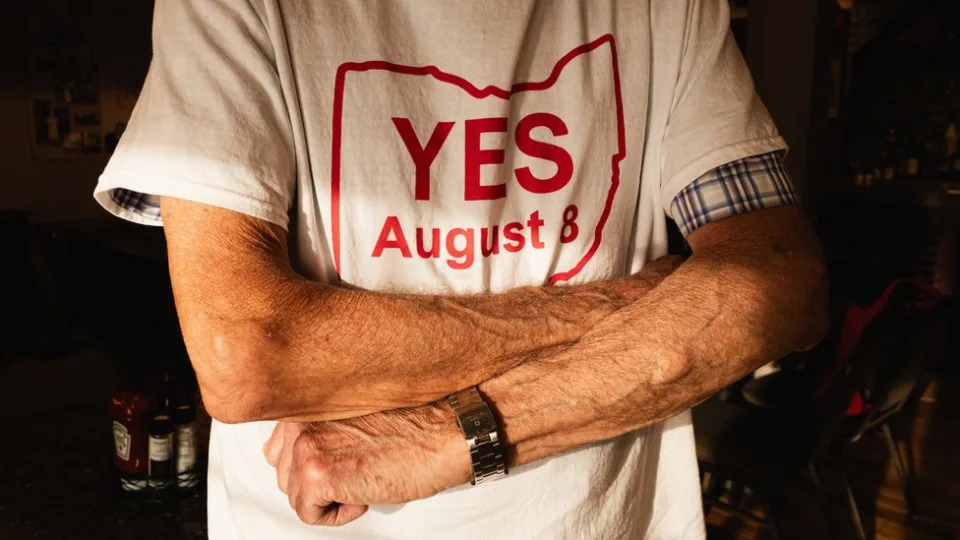
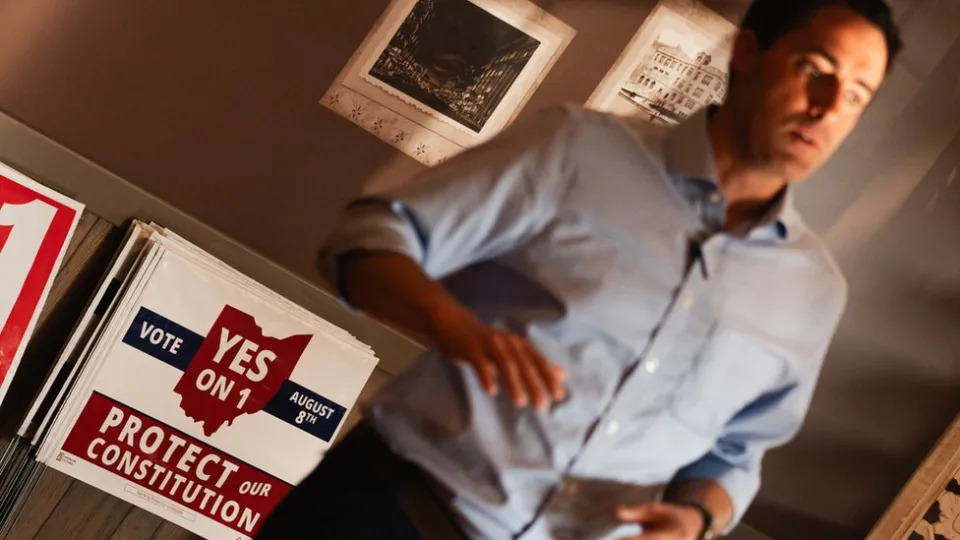
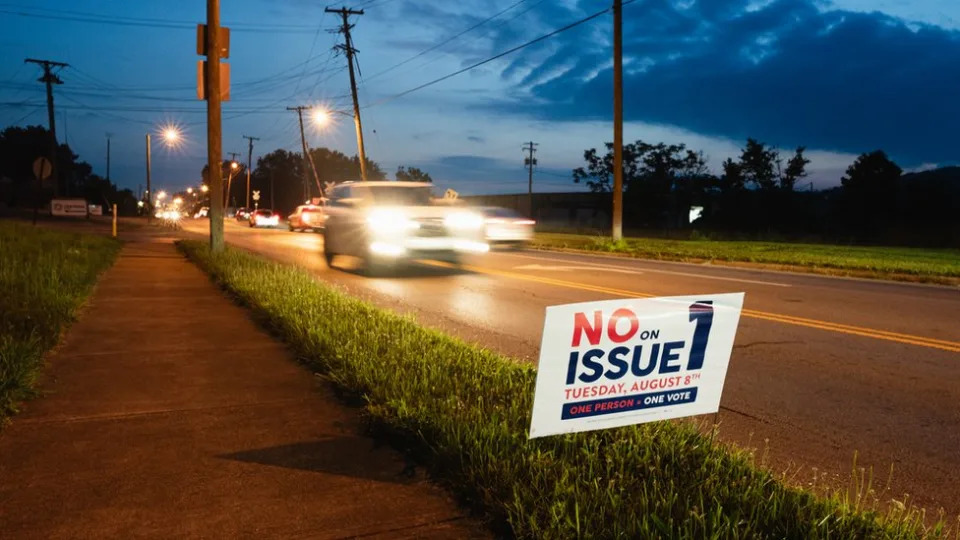
The fight in question is over Issue 1, a deceivingly dull and procedural-sounding referendum on the minimum threshold required to pass constitutional amendments.
The premise is simple: voters will decide on 8 August whether that threshold should remain at 50% plus one, or be raised to 60%.
But Ohio’s vote has become a proxy war over abortion, one of the many state-wide battles that have broken out since the US Supreme Court rescinded the nationwide right to abortion last June.
That’s because Issue 1 is not the only referendum looming. In November, Ohioans will vote on another constitutional amendment, one that would protect abortion access up until foetal viability, around 24 weeks of pregnancy.
The proponents of issue 1 claim that Tuesday’s vote is simply to protect the state’s constitution from outside influence.
But its opponents – a diverse coalition featuring political wonks like Mr Curtin, a retired Supreme Court judge and all of Ohio’s past living governors – have called foul. They claim Issue 1 is a backhanded attempt to change the rules mid-game, raising the voter threshold just in time to thwart the abortion vote.
“Look, everybody knows what’s going on here. Everybody knows,” Mr Curtin said. “This was just bad faith.”
Issue 1 has been championed by Ohio’s secretary of state Frank LaRose
Since Roe v Wade was overturned last June, the country’s abortion fight has increasingly played out in state ballot initiatives. There have been six so far, each one a win for abortion rights.
If Ohio’s vote is passed, it will be the most sweeping affirmation of reproductive rights in a state controlled by a firm Republican majority, said Mary Ziegler, a law professor at the University of California, Davis and a leading authority on the US abortion debate. “It will confirm that there’s some sort of consensus around abortion rights, even in conservative states.”
But if Issue 1 is passed first, and the threshold is raised to 60%, the abortion rights amendment may be finished.
“They [anti-abortion campaigners] very clearly looked at this and said: we cannot win if we don’t change the rules,” said Kellie Copeland, executive director of Pro-Choice Ohio.
Issue 1 has had the full-throated support of Ohio’s chief election official, secretary of state Frank LaRose.
“To allow a bare majority of 50% plus one to change the very ground rules that the state operates on is just not good public policy,” he told the BBC.
Issue 1’s opponents include all four of the state’s living former governors
Mr LaRose, 44, is a veteran of the US Special Forces and now an enthusiastic envoy for the Republican Party, crisscrossing the state for more than 65 pro-Issue 1 events. He is charming, conservative and politically ambitious. In November – at the same time the abortion referendum is held – Mr LaRose will be on the ballot for the US Senate.
In public, Mr LaRose has kept the focus squarely on the constitution. But at a fundraising dinner in May, Mr LaRose made explicit the importance of Issue 1 for the anti-abortion movement.
“I’m pro-life. I think many of you are as well,” Mr LaRose said, in a video recorded by Scanner Media. “This is 100% about keeping a radical pro-abortion amendment out of our constitution. The left wants to jam it in there this coming November.”
In an interview with the BBC, Mr LaRose acknowledged that the “looming abortion amendment” helped bring the Issue 1 vote forward. “But that’s not the only reason,” he said.
To his opponents, Mr LaRose had been caught saying the quiet part out loud.
“There’s an old standard that our grandparents taught us that bears repeating: if you want any credibility in life… never deny the obvious,” Mr Curtin said. “Here is Mr LaRose denying the obvious.”
There have been other accusations of hypocrisy. Earlier this year, Republicans passed a law eliminating nearly all August elections, citing their high cost and low turnout. Then, in an apparent u-turn, they put Issue 1 on the calendar for 8 August.
Even some of Mr LaRose’s fellow Republicans have spoken out against Issue 1.
“You’re talking about changing a part of the Ohio constitution that has been in effect for well over 100 years,” said former Ohio Governor Bob Taft, a Republican. “And it’s worked, it’s worked well, the system is not broken.”
In the 111 years since Ohio first granted voters the power to introduce citizen-led amendments, just 19 of 71 proposed measures have passed. Ohio’s current policy requiring a simple majority is in line with most of the 17 US states that allow citizen-initiated amendments. And in 2015, Ohioans added a new restriction, passing an amendment that prohibited anyone from changing the constitution for their own financial benefit.
“This is an elaborate scheme to suppress the vote of Ohioans… It’s unconscionable,” said former Ohio Supreme Court Chief Justice Maureen O’Connor, also a Republican.
Whatever Mr LaRose’s motivations, Issue 1 has been embraced by Ohio’s anti-abortion lobby. Mike Gonidakis, president of Ohio Right to Life, said he “led efforts” to get signatures from state politicians to put the measure on the ballot.
“In speaking with Frank LaRose I said ‘now’s our time to do this’,” he told the BBC.
Mr Gonidakis, like Mr LaRose, rejected criticism that Issue 1 was underhanded. “It’s not changing the goalposts if Ohioans weigh in and vote on it,” he said.
Experts said they see Ohio’s Issue 1 as part of a broader tactic employed by anti-abortion advocates to circumvent public opinion in service of their ultimate goal, outlawing abortion entirely – a goal that is unsupported by most Americans.
“They think if voters had a straight up and down decision on abortion it wouldn’t go their way, so they’re trying to do what they can to prevent that from happening,” said the University of California’s Ms Ziegler.
As a result, anti-abortion leaders and their Republican allies have found paths around popular support – either relying on the court system or on politicians willing to promote abortion policy regardless of voters’ wishes.
These manoeuvres are possible, Ms Ziegler said, because in so many cases Republican politicians fear the anti-abortion lobby more than their own constituents.
And the strategy suits the movement’s internal logic, in which banning abortion is seen as the worthiest cause.
“There’s a sense in which winning is more important than democracy,” she said.
‘Morning Joe’ Skewers Lindsey Graham for Saying Judge in Jan. 6 Indictment ‘Hates Trump’: ‘So Embarrassing’
Dessi Gomez – August 4, 2023
“Morning Joe” co-hosts Joe Scarborough and Mika Brzezinski slammed Republican Sen. Lindsey Graham for his words about former President Donald Trump’s latest indictment as well as the judge involved and the broader judicial system of the United States.
“It is so disgusting. Lindsey knows better. He obviously knows better, but he’s slandering the judge. He’s attacking the jury system and it’s very interesting. The judge, who’s gonna actually be overseeing the case, was unanimously confirmed by the Senate in 2013 by a vote of 95 to zero,” Scarborough said. “She was unanimously confirmed by the Senate. It’s just like the Republicans used to defend the FBI. They were the ones defending the FBI against attacks from progressives. The second the FBI actually investigated Donald Trump… well, suddenly they hate the FBI. Suddenly they hate the military. They hate military leaders. They slander the chairman of the Joint Chiefs. We can go on and on.”
Graham appeared on Fox News after Trump was arraigned Thursday.
“Any conviction in DC against Donald Trump is not legitimate. So they’re charging him with the crime of taking bad legal advice. That’s what this is about. They’re trying to criminalize the attorney-client relationship,” Graham said. “They’re trying to criminalize exercising of the First Amendment. The judge in this case hates Trump. You could convict Trump of kidnapping Lindbergh’s baby in DC. You need to have a change of venue. We need a new judge and we need to win in 2024 to stop this crazy crap.”
Brzezinski called the senator’s words “so embarrassing.”
“Lindsey Graham’s attacking the jury, we know and they know, the bedrock, the bedrock of our judicial system. ‘We the People,’ that’s how Madison had it set up. Our former party, from Election Day 2020 through January the 6th, trashed American democracy, told Americans and the world you can’t trust fair and free elections if our side doesn’t win,” Scarborough added. “Fox News paid like close to a billion dollars for the lies that they spread about the election and they’re gonna probably have to pay close to another billion dollars. We turn the page. What lesson is learned from that? Absolutely nothing. Because now they’re trashing the judicial system, which I would say is, it’s Madison’s crown jewel. It’s the great leveler of Madisonian democracy. But now they’re trashing that again, for Donald Trump.”
Scarborough then turned to Charlie Sykes, an American political commentator, to ask if he agreed with what Atlantic staff writer Anne Applebaum tweeted on X Thursday.
“If the Republican Party responds to the Trump indictment solely by attacking courts and judges, and if its leaders continue to work to de-legitimize the legal system, I am not sure how we recover.”
‘It’s a crisis’: Maternal health care disappears for millions
Alice Miranda Ollstein and Megan Messerly – August 1, 2023
Rogelio V. Solis/AP Photo
Access to maternal health care is evaporating in much of the country, as hospitals close and obstetricians become harder to find for millions of pregnant people.
New data from the nonpartisan health advocacy group March of Dimes shows that the U.S. — which already has the worst maternal mortality rate among developed nations — saw a 4 percent decline in hospitals with labor and delivery services between 2019 and 2020.
But the raw figure masks the inequities playing out across the country, according to the report. Alabama and Wyoming lost nearly one-quarter of their birthing hospitals in that time period, while Idaho, Indiana and West Virginia lost roughly 10 percent.
“It’s a crisis,” said Stacey Brayboy, the senior vice president of public policy and government affairs at March of Dimes. “Women are struggling to access care, and that’s before and during and after their pregnancies, and we’ve seen an increase in terms of maternal and infant deaths.”
Access to care is also likely to worsen in the coming years, according to several public health experts, as obstetrics units struggle to stay financially afloat, more people become uninsured and new anti-abortion laws limit the number of physicians willing to practice in several states.
Nationally, about 5.6 million women live in counties with no access to maternity care, according to March of Dimes. Far more, 32 million, are at risk of poor health outcomes because of a lack of care options nearby. March of Dimes considers more than a third of all U.S. counties maternal care deserts, with no access to reproductive health services. States with large rural populations — Alaska, Nebraska, North Dakota, Oklahoma and South Dakota — are especially prone to shortages.
The scarcity of maternal health care is particularly acute in areas with higher instances of underlying health problems that are risk factors for maternal mortality — such as hypertension and diabetes — and where states have not expanded Medicaid, leaving hundreds of thousands uninsured.
The declining access to maternal care is one reason maternal mortality rates in the U.S are so high and rising, Brayboy said.
In 2021, roughly 33 people died for every 100,000 live births in the U.S., according to the CDC, up 40 percent from 2020. That’s roughly 10 times the mortality rate of other industrialized nations such as Spain, Germany, Australia or Japan. The maternal mortality rate for non-Hispanic Black people was 69.9, two-and-a-half times the rate of non-Hispanic whites, according to the CDC.
The report relies on data from 2020 and 2021 — before the Supreme Court overturned Roe v. Wade — and the full impact of state abortion bans on maternal care has yet to be documented. But Tuesday’s report reveals most states that have restricted abortion access since then, or where the procedure remains in limbo pending a court ruling, have seen access to obstetric care decline in recent years.
“Abortion providers, OB-GYNs, nurse practitioners are being pushed out of certain parts of the country that do have these restrictive abortion laws. That’s having a spillover effect for those that want to continue their pregnancies,” said Jamila Taylor, president and CEO of the National WIC Association.
There isn’t, however, a clean red state-blue state divide in the data. A few states with near-total abortion bans saw an improvement in access to birthing hospitals in recent years — including Arkansas, North Dakota and Mississippi — and a few states where abortion remains legal saw access worsen, including California, Maryland, and Washington state.
The situation is particularly dire in Alabama, where the number of hospitals with labor and delivery services decreased by 24 percent between 2019 and 2020, and where many more could soon go out of business. The Alabama Hospital Association warned earlier this year that half of the state’s remaining hospitals are “operating in the red,” and are “likely on a collision course with disaster.”
“Many of them are just teetering on the edge, almost not able to cover payroll,” Farrell Turner, the president of the Alabama Rural Health Association, said in an interview. “There are at least seven more, according to my calculations, that are at very high risk of closing before the year is out.”
One factor fueling the obstetric unit closures across the country is the financial mismatch facing hospitals — maternal care is expensive to provide and reimbursements are low, particularly from Medicaid, which pays for more than 40 percent of births. That’s a particular challenge for rural hospitals, which have a higher proportion of patients on government-run health insurance than their urban counterparts.
March of Dimes found that nearly a third of women in Alabama already have no birthing hospital within a 30-minute drive and for some residents, the nearest hospital is more than 70 minutes away — factors the group said raised the risk for “maternal morbidity and adverse infant outcomes, such as stillbirth and NICU admission.” More than a third of the state is considered a maternal care desert, and more than 18 percent of people giving birth received inadequate prenatal care or none at all.
“People have to drive quite some distance in order to deliver, and to obtain prenatal care leading up to that time,” Turner said. “And many folks either lack transportation or can’t afford the gas to get to the care they need. There are some telehealth options out there, but a lot of people lack access to broadband, so the uptake and implementation has been slow.”
The problem is similar in Wyoming, where five of the state’s 23 counties are maternity care deserts and more than 15 percent of residents have no hospital with labor and delivery services within 30 minutes. The state’s vastness poses particular challenges to accessing care, with people living in counties with the highest travel times spending nearly 90 minutes on average to reach the nearest hospital with obstetric care.
Abortion remains legal in Wyoming because a judge temporarily blocked the state’s new pill ban in June, and the state’s trigger ban remains enjoined. But Dr. Giovannina Anthony, an OB-GYN in Jackson, Wyo., said those laws are already affecting access to maternal health care.
“Abortion bans just create one more deterrent to anyone who might want to practice obstetrics and gynecology in Wyoming,” Anthony said.
Even in North Carolina, which has fewer maternity care deserts than the national average, access to obstetric care is headed in the wrong direction. The number of hospitals with labor and delivery services in the state decreased by 1.9 percent between 2019 and 2020, and the March of Dimes report found that 13.4 percent of people in North Carolina had no birthing hospital within 30 minutes.
“These rural communities where the maternity care deserts are, these individuals tend to be sicker. They can have chronic hypertension. They can have diabetes,” said Karen Sheffield-Abdullah, a certified nurse-midwife who has a doctorate in nursing from the University of North Carolina at Chapel Hill. “These are individuals who are coming in with what we call these comorbidities, and yet there aren’t providers for an hour away? Absolutely maternal morbidity and mortality goes up.”
Sheffield-Abdullah said access to maternity care in the state is likely to worsen because of a new law banning abortion after the first trimester.
“If we look at the most recent ban, getting more restrictive in the types of care that we provide to perinatal individuals is not going to improve our outcomes,” she said. “It only makes it more difficult for minoritized populations to get the care that they need.”
Hospitals are also struggling to recruit and retain OB-GYNs and other maternal health providers. Two Idaho hospitals, for example, shut down their labor and delivery services earlier this year, citing staffing woes exacerbated by the state’s near-total abortion ban, which went into effect last summer.
Dr. Stacy Seyb, a maternal fetal medicine specialist who has practiced for 23 years in Idaho, told POLITICO that two of his colleagues have left the state in the last few months, with several more also considering a move, and applications for medical residencies have plummeted.
“It’s hurting our ability to find doctors for a state that’s already severely underserved,” he said of the state’s abortion ban, which threatens medical providers with felony charges if they perform an abortion or help someone obtain one. “It’s hard to take care of patients while looking over your shoulder. So residents and young doctors are saying: ‘Why would I go there and deal with that?’”
Idaho saw a 12.5 percent decrease in the number of birthing hospitals in the state between 2019 and 2020, and nearly 30 percent of the state is considered a maternal health desert, according to March of Dimes. More than 27 percent of counties have both a high rate of chronic health conditions and high rate of preterm births.
Idaho providers fear the situation will further deteriorate now that abortion is banned in the state, but warn the public might remain in the dark because officials dissolved the state’s maternal mortality review committee in July.
“It’s scary for sure,” said Dr. Kylie Cooper, a former leader of the state’s chapter of the American College of Obstetricians and Gynecologists who left Idaho after the abortion ban went into effect. “Most states have the ability to track data and trends for why people are dying in pregnancy and post-partum, but now I don’t know how that will be tracked at all in Idaho.”
The big idea: is it too late to stop extremism taking over politics?
Bizarre conspiracy thinking has infiltrated the mainstream in many western democracies. How can we push back?
Julia Ebner – July 31, 2023
Illustration: Elia Barbieri/The Guardian
Welcome to the 2020s, the beginning of what history books might one day describe as the digital middle ages. Let’s briefly travel back to 2017. I remember sitting in various government buildings briefing politicians and civil servants about QAnon, the emerging internet conspiracy movement whose adherents believe that a cabal of Satan-worshipping elites runs a global paedophile network. We joked about the absurdity of it all but no one took the few thousand anonymous true believers seriously.
Fast-forward to 2023. Significant portions of the population in liberal democracies consider it possible that global elites drink the blood of children in order to stay young. Recent surveys suggest that around 17% of Americans believe in the QAnon myth. Some 5% of Germans believe ideas related to the anti-democratic Reichsbürger movement, which asserts that the German Reich continues to exist and rejects the legitimacy of the modern German state. Up to a third of Britons believe that powerful figures in Hollywood, government and the media are secretly engaged in child trafficking. Is humanity on the return journey from enlightenment to the dark ages?
I am often asked why the UK doesn’t have a successful far-right populist party. My answer is: Because it doesn’t need to
As segments of the public have headed towards extremes, so has our politics. In the US, dozens of congressional candidates, including the successfully elected Lauren Boebert, have been supportive of QAnon. The German far-right populist party Alternative für Deutschland is at an all-time high in terms of both its radicalism and its popularity, while Austria’s xenophobic Freedom party is topping the polls. The recent rise to power of far-right parties such as Fratelli d’Italia and the populist Sweden Democrats bolster this trend.
I am often asked why the UK doesn’t have a successful far-right populist party. My answer is: because it doesn’t need to. Parts of the Conservative party now cater to audiences that would have voted for the BNP or Ukip in the past. A few years ago, the far-right Britain First claimed that 5,000 of its members had joined the Tory party. Not unlike the Republicans in the US, the Tories have increasingly departed from moderate conservative thinking and lean more and more towards radicalism.
In 2020, Conservative MP Daniel Kawczynski was asked to apologise for attending the National Conservatism conference in Rome. The event is well known for attracting international far-right figures such as Italy’s Giorgia Meloni, Hungary’s Viktor Orbán, former Fox News host Tucker Carlson and the hard-right US presidential candidate Ron DeSantis. This year, an entire delegation of leading Conservatives attended the same conference in London. It might be hard for extreme-right parties to rise to power in Britain, but there is no shortage of routes for extremist ideas to reach Westminster.
‘Invasion on our southern coast’ … UK home secretary Suella Braverman. Photograph: AP
Language is a key indicator of radicalisation. The words of Conservative politicians speak for themselves: home secretary Suella Braverman referred to migrants arriving in the UK as an “invasion on our southern coast”, while MP Miriam Cates gave a nod to conspiracy theorists when she warned that “children’s souls” were being “destroyed” by cultural Marxism. Using far-right dog whistles such as “invasion” and “cultural Marxism” invites listeners to open a Pandora’s box of conspiracy myths. Research shows that believing in one makes you more susceptible to others.
I sometimes wonder what a QAnon briefing to policymakers might look like in a few years. What if the room no longer laughs at the ludicrous myths but instead endorses them? One could certainly imagine this scenario in the US if Donald Trump were to win the next election. In 2019 – before conspiracy myths inspired attacks on the US Capitol, the German Reichstag, the New Zealand parliament and the Brazilian Congress – I warned in a Guardian opinion piece of the threat QAnon would soon pose to democracy. Are we now at a point where it is it too late to stop democracies being taken over by far-right ideologies and conspiracy thinking? If so, do we simply have to accept the “new normal”?
There are various ways we can try to prevent and reverse the spread of extremist narratives. For some people who have turned to extremism over the past few years, too little has changed: anger over political inaction on economic inequality is now further fuelled by the exacerbating cost of living crisis. For others, too much has changed: they see themselves as rebels against a takeover by “woke” or “globalist” policies.
What they have in common is a sense that the political class no longer takes their wellbeing seriously, and moves to improve social conditions and reduce inequality would go some way towards reducing such grievances. But beyond that, their fears and frustrations have clearly been instrumentalized by extremists, as well as by opportunistic politicians and profit-oriented social media firms. This means that it is essential to expose extremist manipulation tactics, call out politicians when they normalize conspiracy thinking and regulate algorithm design by the big technology companies that still amplify harmful content.
If the private sector is part of the problem, it can also be part of the solution. Surveys by the Edelman Trust Barometer found that people in liberal democracies have largely lost trust in governments, media and even NGOs but, surprisingly, still trust their employers and workplaces. Companies can play an important role in the fight for democratic values. For example, the Business Council for Democracy tests and develops training courses that firms can offer to employees to help them identify and counter conspiracy myths and targeted disinformation.
Young people should be helped to become good digital citizens with rights and responsibilities online, so that they can develop into critical consumers of information. National school curricula should include a new subject at the intersection of psychology and internet studies to help digital natives understand the forces that their parents have struggled to grasp: the psychological processes that drive digital group dynamics, online engagement and the rise of conspiracy thinking.
Ultimately, the next generation will vote conspiracy theorists in or out of power. Only they can reverse our journey towards the digital middle ages.