Secret document says Iran security forces molested and killed teen protester

BBC News

Secret document says Iran security forces molested and killed teen protester

Bertram Hill, Aida Miller and Michael Simkin – BBC Investigations April 29, 2024

Nika Shakarami
Nika was just 16 years old when she disappeared during protests against Iran’s strict dress code for women [Atash Shakarami]

An Iranian teenager was sexually assaulted and killed by three men working for Iran’s security forces, a leaked document understood to have been written by those forces says.

It has let us map what happened to 16-year-old Nika Shakarami who vanished from an anti-regime protest in 2022.

Her body was found nine days later. The government claimed she killed herself.

We put the report’s allegations to Iran’s government and its Revolutionary Guards. They did not respond.

Marked “Highly Confidential”, the report summarises a hearing on Nika’s case held by the Islamic Revolutionary Guard Corps (IRGC) – the security force that defends the country’s Islamic establishment. It includes what it says are the names of her killers and the senior commanders who tried to hide the truth.

It contains disturbing details of events in the back of an undercover van in which security forces were restraining Nika. These include:

  • One of the men molested her while he was sitting on her
  • Despite being handcuffed and restrained, she fought back, kicking and swearing
  • An admission that this provoked the men to beat her with batons

There are numerous fake Iranian official documents in circulation, so the BBC spent months checking every detail with multiple sources.

Our extensive investigations indicate the papers we obtained do chronicle the teenager’s last movements.

Short presentational grey line
[BBC]

Nika Shakarami’s disappearance and death were widely reported, and her picture has become synonymous with the fight by women in Iran for greater freedoms. As street protests spread across Iran in the autumn of 2022, her name was shouted by crowds furious at the country’s strict rules on the compulsory veil [hijab].

The Woman, Life, Freedom movement had been sparked just days earlier by the death of a 22-year-old woman, Mahsa Amini. She died from injuries sustained in police custody according to a UN fact-finding mission after being accused of not wearing her hijab properly.

In Nika’s case, her family found her body in a mortuary more than a week after she disappeared from a protest. But Iran’s authorities denied Nika’s death was connected to the demonstration and, after conducting their own investigation, said that she had died by suicide.

Just before she vanished, Nika was filmed on the evening of 20 September near Laleh Park in central Tehran, standing on a dumpster setting fire to hijabs.

Others around her chanted “death to the dictator” – referring to Iran’s Supreme Leader, Ayatollah Ali Khamenei.

What she could not have known at the time is that she was being watched, as the classified report makes clear.
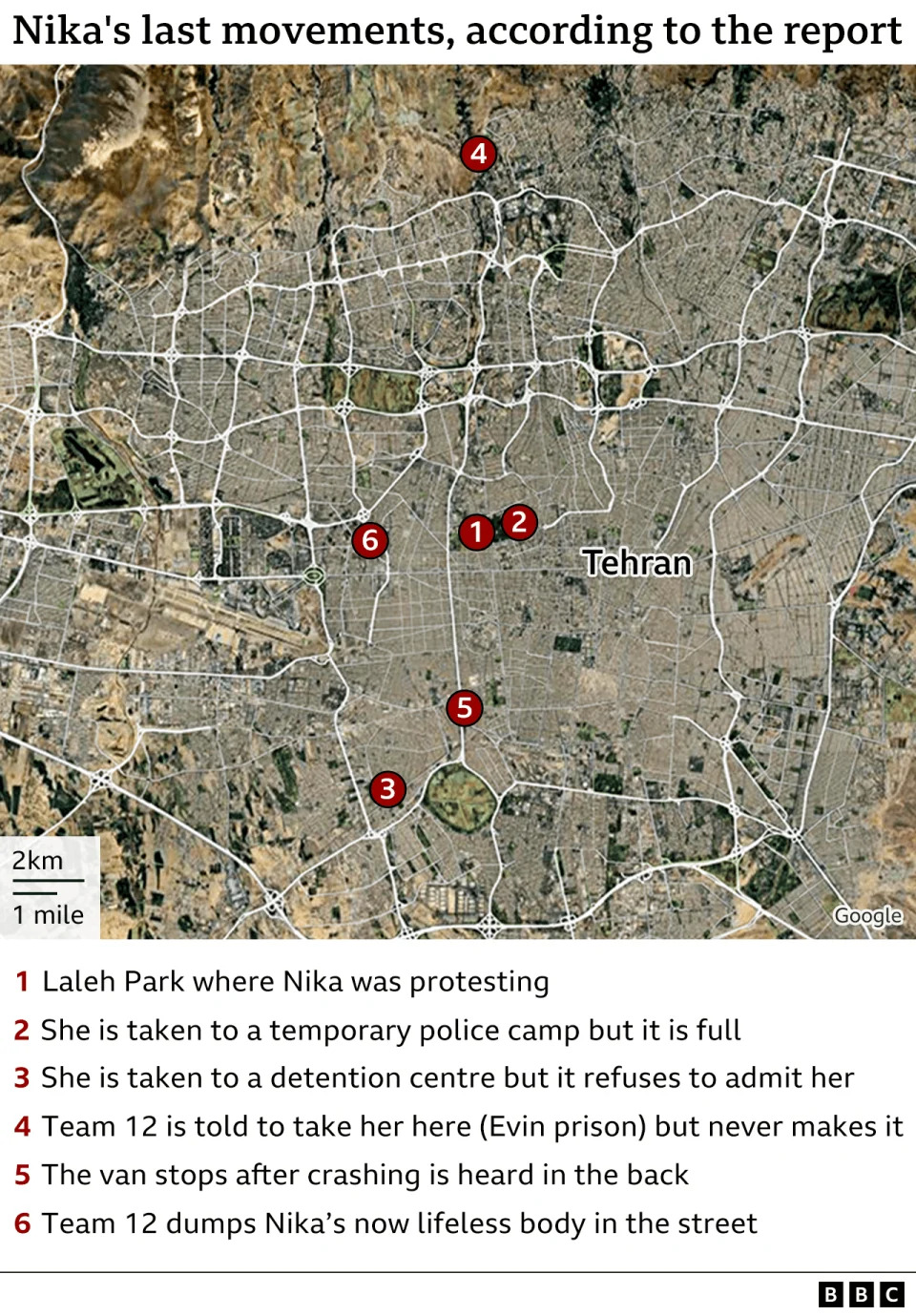
Map of Nika's last movements, according to the document
[BBC]

Addressed to the IRGC’s commander-in-chief, it says it is based on extensive talks with its teams that policed that protest.

Monitoring the demonstration were several undercover security units, the document’s account begins.

It says one of these – Team 12 – suspected the teenager “of leadership, due to her unconventional behaviour and repeated calls with her mobile phone”.

The team sent one of its operatives into the crowd, posing as a protester, to confirm Nika was indeed one of the demonstration’s leaders. Then, according to the report, he called in his team to arrest her. But she fled.

Her aunt had previously told BBC Persian that Nika rang a friend that night to say she was being chased by security forces.

Almost an hour passed before she was spotted again, says the report, when she was detained and put in the team’s vehicle – an unmarked freezer van.
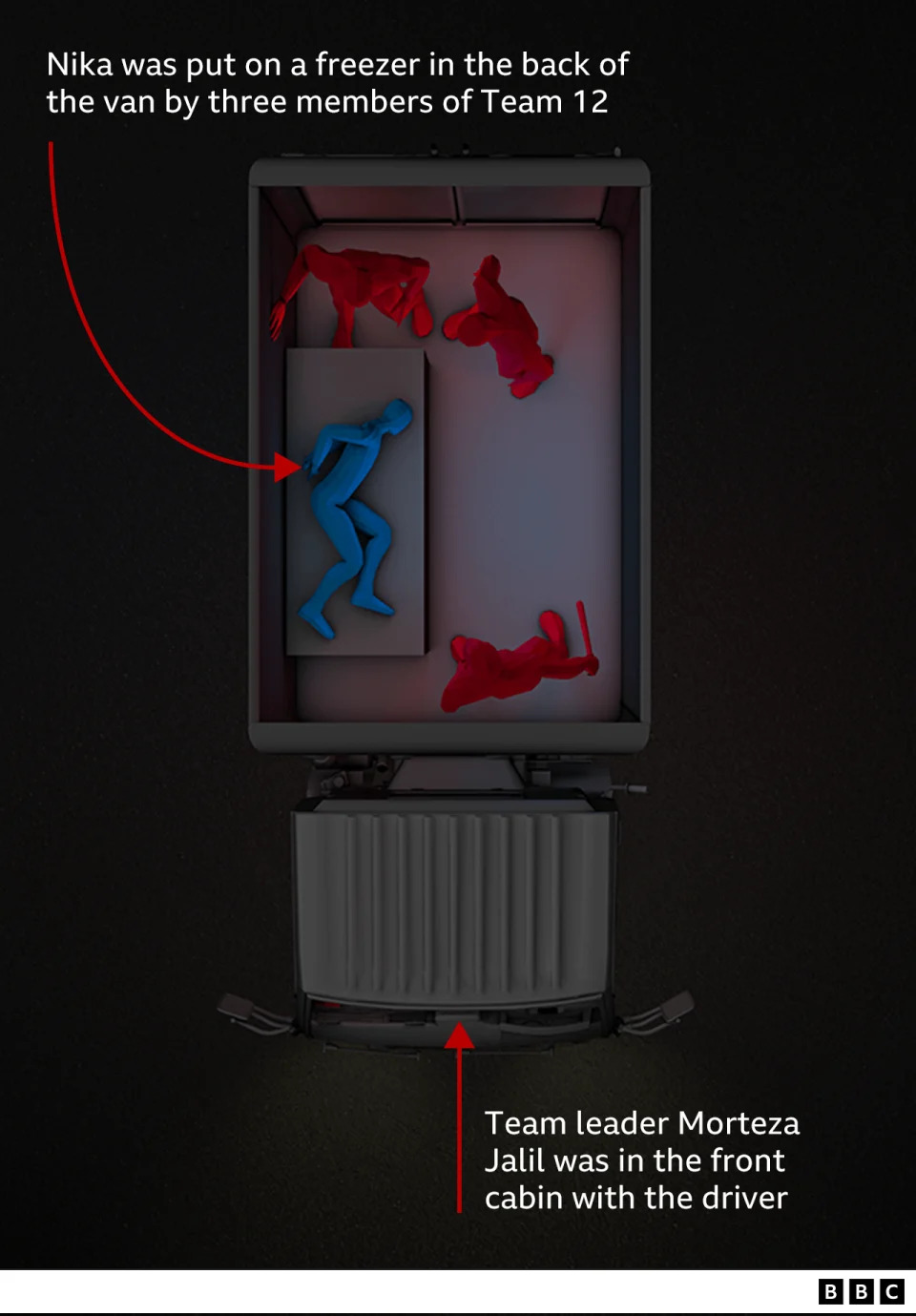
Graphic of the inside of the van Nika was beaten in, according to the document
[BBC]

Nika was in the rear compartment with three Team 12 members – Arash Kalhor, Sadegh Monjazy, and Behrooz Sadeghy.

Their team leader Morteza Jalil was up front with the driver.

The group then attempted to find somewhere to take her, the report says.

They tried a temporary police camp nearby but were turned away because it was overcrowded.

So they continued to a detention centre, a 35-minute drive away, whose commander initially agreed to admit Nika. But then he changed his mind.

“The accused [Nika] was constantly swearing and chanting,” he told investigators for the report.

“At that time, there were 14 other female detainees at the station and my perception was that she could agitate the others.

“I was worried she would cause a riot”.

Morteza Jalil once again contacted his IRGC HQ for advice, says the report, and was told to head to Tehran’s notorious Evin Prison.

En route, he said he began to hear crashing noises behind him coming from the pitch-dark rear compartment of the van.

We know what he was hearing, from the testimony outlined in the document from the men guarding Nika in the back.
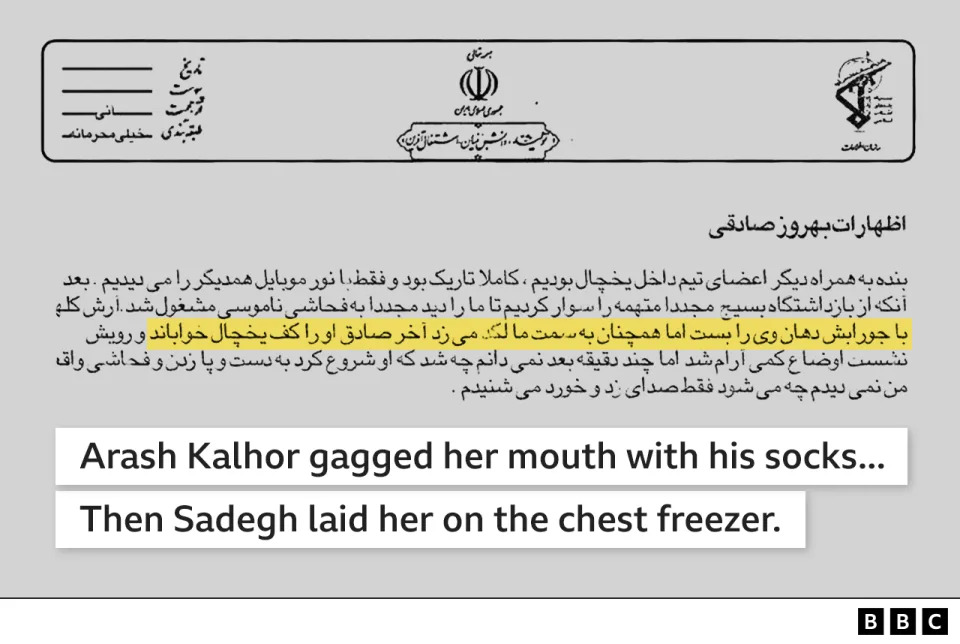
Excerpt from the document passed to the BBC
[BBC]

One of them, Behrooz Sadeghy, said as soon as she had been put back into the van after being rejected by the detention centre, Nika had started to swear and shout.

“Arash Kalhor gagged her mouth with his socks but she started struggling. Then Sadegh [Monjazy] laid her on the chest freezer and sat on her. The situation calmed,” he told investigators.

“I don’t know what happened, but after a few minutes she started swearing. I couldn’t see anything, I could only hear fighting and bashing.”

But Arash Kalhor gave further chilling details.

He says he briefly turned on his phone torch and saw Sadegh Monjazy “[has] put his hand inside her trousers”.

Arash Kalhor said after that they lost control.

“He doesn’t know… who [was doing it], but he could hear… the baton hitting the accused [Nika]… ‘I started to kick and punch but really didn’t know if I was hitting our guys or the accused.'”

But Sadegh Monjazy contradicted Arash Kalhor’s statement, which he said was motivated by professional jealousy. He denied putting his hand in her trousers – but said he could not deny that he became “aroused” while sitting on her and touched Nika’s buttocks.

He said this provoked Nika – despite the fact her hands were tied behind her back – to scratch him and jolt so that he fell over.
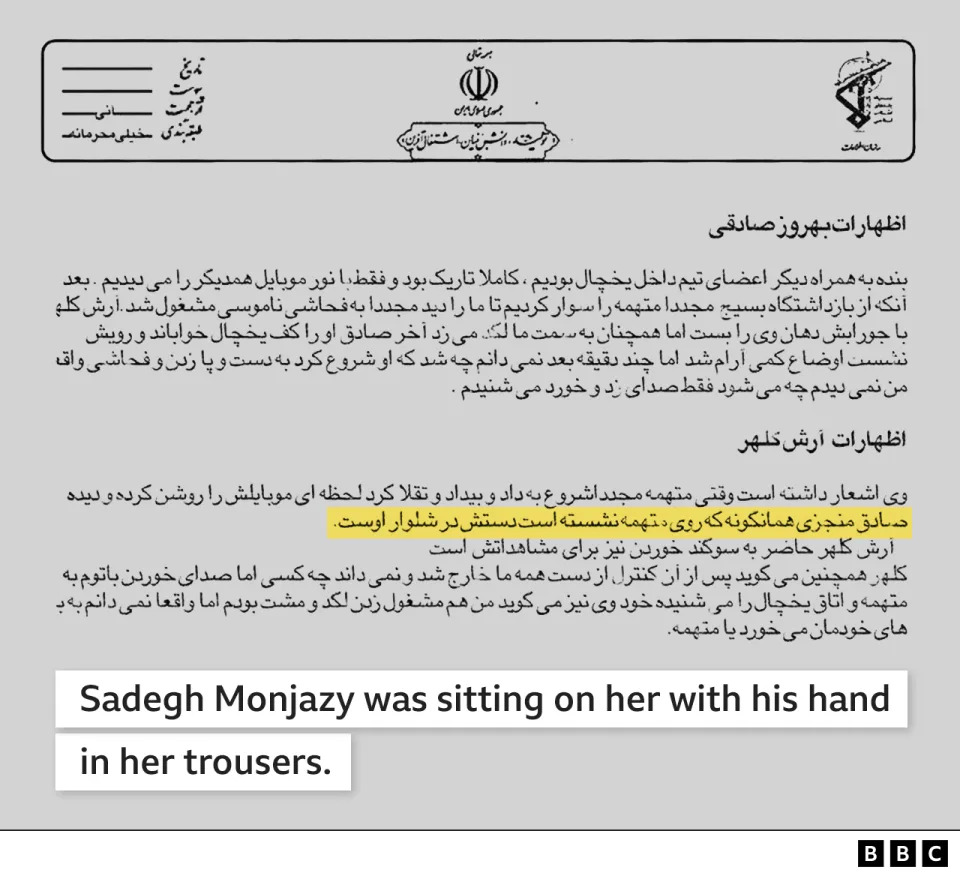
Excerpt from the document passed to the BBC
[BBC]

“She kicked at my face, so I had to defend myself.”

From the van’s cabin, Morteza Jalil ordered the driver to pull over.

He opened the rear door to discover Nika’s lifeless body.

He said he cleaned the blood from her face and head – “which were not in a good condition”.

This echoes the state in which Nika’s mother says she eventually found her daughter in the mortuary, and Nika’s death certificate – obtained by BBC Persian in October 2022 – which states she was killed by “multiple injuries caused by blows with a hard object”.

Team leader Morteza Jalil admitted he didn’t try to find out what had happened.

“I was only thinking about how to transfer her and didn’t ask any questions of anyone. I only asked: ‘Is she breathing?’ I think it was Behrooz Sadeghy who answered, ‘no, she is dead’.”

With a killing on his hands, Jalil called the IRGC’s HQ for a third time.

On this occasion, he spoke to a more senior officer, codenamed “Naeem 16”.

“We already had deaths in our stations, and I didn’t want the number to rise to 20,” Naeem 16 told the investigation. “Bringing her to the base wouldn’t have solved any problems.”

He told Jalil to simply “dump her on the street”. Jalil said they left Nika’s body in a quiet street under Tehran’s Yadegar-e-Emam highway.

The report concludes that a sexual assault caused the fight in the rear compartment of the van, and that strikes from Team 12 had caused Nika’s death.

“Three batons and three Tasers were all used. It is not clear which one of the blows was the fatal one,” it says.

The report contradicts the government’s narrative of what happened to Nika. Nearly a month after her funeral, state television broadcast the results of the official investigation, which said Nika had jumped to her death from a building.

It showed CCTV of a person it claimed was Nika entering an apartment block, but Nika’s mother told BBC Persian in a phone interview that she could not “under any circumstances, confirm that person is Nika”.

“We all know that they are lying,” Nasrin Shakarami later told a BBC documentary, discussing authorities’ claims about the deaths of protesters.

Short presentational grey line
[BBC]

The BBC Eye investigation was not just concerned with the content of the report, but whether it could be trusted as an artefact.

Sometimes, what appear to be official Iranian documents and other materials circulating on the internet are found to have been faked.

Most of these counterfeit documents, however, are easy to spot because they clearly diverge from official formatting – showing erroneous spacing and letter headings, or containing significant grammatical or spelling errors.

They might also include the wrong official slogan or logo for the year they purport to originate from, or an anachronistic title for a government agency or department, for example.

Another indicator is language that does not match the very specific style that tends to be used by Iranian official bodies.

The document our investigation centred on contained a few such inconsistencies. For instance, the “Naja” police force quoted in the report was known as “Faraja” at the time.

Therefore, to further test the document’s veracity, we gave it to a former Iranian intelligence officer who has seen hundreds of legitimate ones.

He rang the IRGC archive – using an official code issued each day to senior intelligence officers in Iran – to check if the case file this report was allegedly part of really existed and what it was about.

He received confirmation that it did, and that the report’s number showed it was part of a 322-page case file on anti-government protesters in 2022.

While we can never be 100% certain, this gave us confidence that it is genuine.

His unique access to the IRGC also helped us iron out another mystery – the identity of “Naeem 16”, the man who told the team to dump Nika’s body.

The former intelligence officer did this by making another call – this time to someone inside Iran’s military apparatus. He was told Naeem 16 is the call sign for a Captain Mohammad Zamani, serving in the IRGC.

That name is listed as one of the attendees at the five-hour hearing into Nika’s death that the report summarises.

We put the allegations to the IRGC and the Iranian government. They did not respond.

The men responsible for Nika’s death were not punished, so far as we know.

Undated photo showing Nika Shakarami (L), who was killed during protests in Iran in September 2022, and her sister Aida Shakarami (R)
Nika with her sister Aida (R) who has herself now been arrested [Social media]

A clue as to why that might be the case can be found in the document itself. All of Team 12 – who were at the hearing – are listed in the report and to the right of their names is the group to which they belong: “Hezbollah”.

This refers to an Iranian paramilitary group, Hezbollah, unrelated to the Lebanese group of the same name. Its members are used by the IRGC but sometimes operate outside its jurisdiction, as the report seems to acknowledge:

“Since the above persons belonged to the forces of Hezbollah, following up this case beyond obtaining the necessary commitments and security guarantees has not been possible,” it says.

IRGC officer Naeem 16, on the other hand, was given a written reprimand, it adds.

As many as 551 protesters were killed by security forces during Iran’s Woman, Life, Freedom movement, most of them by gunfire, according to the UN’s fact-finding mission.

The protests subsided after a few months due to the bloody crackdown by security forces. There followed a lull in activity by Iran’s morality police, but a new crackdown on breaches of the Islamic dress code began earlier this month.

Among those to have been arrested is Nika’s elder sister, Aida..
Many Ukrainian Prisoners of War Show Signs of Trauma and Sexual Violence

The New York Times

Many Ukrainian Prisoners of War Show Signs of Trauma and Sexual Violence

Carlotta Gall and Oleksandr Chubko – April 28, 2024

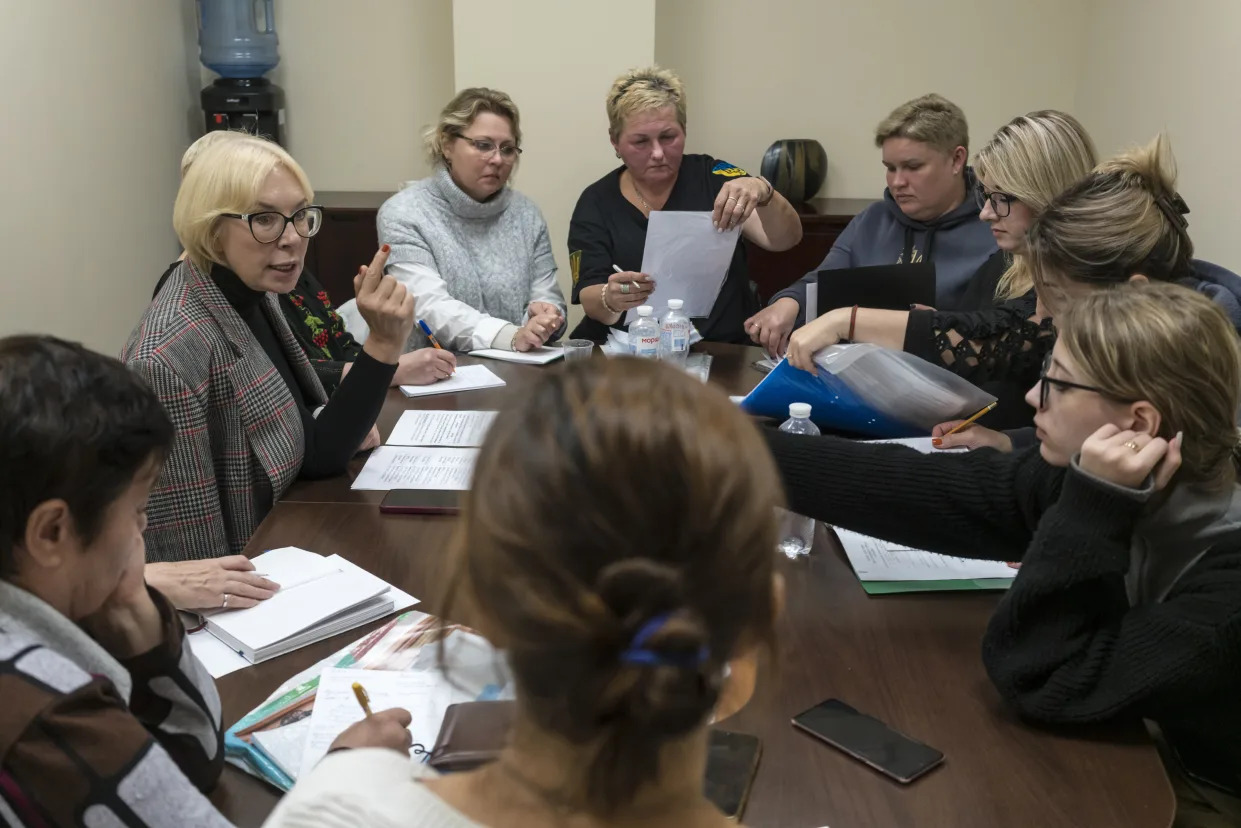
Family members of Ukrainian soldiers who are prisoners of war meet with Lyudmila Denisova, left, the country’s former human rights ombudsman, in Kyiv, Ukraine, Oct. 16, 2023. (Brendan Hoffman/The New York Times)

KYIV, Ukraine — The Ukrainian marine infantryman endured nine months of physical and psychological torture as a Russian prisoner of war, but was allotted only three months of rest and rehabilitation before being ordered back to his unit.

The infantryman, who asked to be identified only by his call sign, Smiley, returned to duty willingly. But it was only when he underwent intensive combat training in the weeks after that the depth and range of his injuries, both psychological and physical, began to surface.

“I started having flashbacks, and nightmares,” he said. “I would only sleep for two hours and wake up with my sleeping bag soaking wet.” He was diagnosed with post-traumatic stress disorder and referred for psychological care, and is still receiving treatment.

Ukraine is just beginning to understand the lasting effects of the traumas its prisoners of war experienced in Russian captivity, but it has been failing to treat them properly and returning them to duty too early, say former prisoners, officials and psychologists familiar with individual cases.

Nearly 3,000 Ukrainian prisoners of war have been released from Russia in prisoner exchanges since the 2022 invasion began. More than 10,000 remain in Russian custody, some of whom have endured two years of conditions that a United Nations expert described as horrific.

The Ukrainian government’s rehabilitation program, which has usually involved two months in a sanitarium and a month at home, is inadequate, critics say, and the traumas suffered by Ukrainian prisoners are growing with the length and severity of the abuse they are being subjected to as the war drags on.

Russia’s torture of prisoners of war has been well documented by the United Nations, with former inmates speaking of relentless beatings, electric shocks, rape, sexual violence and mock executions, so much so that one expert described it as a systematic, state-endorsed policy. Many detainees have also reported lingering symptoms such as blackouts and fainting spells stemming from repeated blows to the head that were severe enough to cause concussions.

Ukraine’s prosecutor general, Andriy Kostin, said in September that “about 90% of Ukrainian prisoners of war have been subjected to torture, rape, threats of sexual violence or other forms of ill-treatment.”

The Russian military did not answer a request for comment on the allegations of mistreatment of Ukrainian prisoners of war.

Most of the released prisoners have returned to active duty after about three months of rest and rehabilitation, as the Ukrainian military, short of troops on the front line, has given relatively few medical exemptions to former prisoners of war.

A law passed this month will allow former prisoners of war the choice of returning to service or being discharged from the military, recognition that many have been subjected to severe mental and physical torture and need prolonged rehabilitation. Ukrainian officials acknowledged that there have been problems in providing sufficient care for former prisoners, but said they had now developed special centers for them using best international practices.

Ukrainian prosecutors have identified 3,000 former military and civilian prisoners who can serve as witnesses for a case they are building for the Ukrainian courts to charge Russian individuals and officials with mistreatment of prisoners. The prosecutors encouraged two of the former prisoners to speak to The New York Times.

One of them was Smiley, 22, who was captured at the beginning of the war when the Russian navy seized Ukrainian positions on Snake Island in the Black Sea. He spoke a year after his release, saying he hoped that shedding light on the conditions of Russian prisons would help not only his own rehabilitation, but also the thousands of prisoners of war still in captivity.

“My sister persuaded me to give my first interview,” he said. “‘You need to tell,’ she said. Maybe if we speak, it will help the treatment of our guys.”

A second Ukrainian serviceman made available by the prosecutors gave a lengthy interview but declined to give his name or call sign, because of the stigma surrounding the abuses he suffered.

The serviceman, 36, said he was taken prisoner along with several thousand soldiers and marines after a long siege at the Azovstal Iron and Steel Works in Mariupol in May 2022. He spent nine months in Russian captivity before being released in a prisoner exchange in early 2023.

He spent most of his time in three detention facilities in the Russian towns of Taganrog, Kamensk-Shakhtinsky and Kursk. He returned critically underweight and suffering from an injured spine and, like many others, blackouts, dizziness and ringing in the ears from frequent beatings on the head.

“I am not fainting any longer,” the serviceman said, “but I have difficulties with my back and concussion, and a squeezing all the time of the area around my heart.” Despite his injuries, he was ordered to return to light duty as a guard after only two months’ rest in a sanitarium.

“I don’t know if I could run a kilometer,” he said.

Prisoners were subjected to brutal daily beatings on their legs, backs and fingers, and mental and physical torture during interrogations, as well as hunger, cold and a lack of medical care, he said. Three men died in custody during his imprisonment, including one who died in the communal cell they shared, he said.

Some of the Russian units guarding or interrogating the prisoners were worse than others, the two former prisoners said, but there were consistent beatings every morning at roll call and torture at most detention facilities. Interrogations would last 40 minutes and often consisted of electric shocks, blows to the head and sexual abuse, real or threatened.

“They start with maximum violence,” the serviceman said. “They say ‘You are lying, you are not telling us everything.’ They put a knife to your ear or offer to cut off one of your fingers.”

Others would beat them on the back of the head so regularly that they lost consciousness, he said.

“If one gets tired, another takes over,” he recalled. “When you fall, they make you stand again. It can last 30 to 40 minutes. At the end they say, ‘Why did you not tell us everything immediately?’”

Smiley said much of the violence was of a sexual nature. One prison unit repeatedly struck the prisoners all over their bodies, including on the genitals, with batons that gave electric shocks, he said. On another occasion, he said, a cellmate was repeatedly kicked in the genitals during roll call, where the prisoners were lined up with their legs spread, facing a wall in a corridor. Smiley suffered permanent injury from an untreated broken pelvis from a truncheon blow and could not bend or lie down without assistance for two weeks.

The International Committee of the Red Cross, which has very limited access to prisoners of war held in Russia, was not permitted to visit him during his nine months of imprisonment, he added.

The second serviceman said he was forced to strip and place his genitals on a stool as his interrogators hit them with a ruler and lay a knife on them, threatening to castrate him.

Interrogators put him through a mock execution, firing a volley of gunfire beside him while he was blindfolded. They threatened him with rape, the serviceman said, making him choose what they should use — a mop handle or the leg of a chair. “Do you want to do it yourself or do you want us to help you?” they taunted him.

He said he was never actually penetrated, but others were raped. “After that you cannot walk normally,” he said. “You suffer for weeks. Other guys had the same treatment.”

“I think they had such an order to break us psychologically and physically so that we would not want anything else in life,” he said, adding that there were suicides in the Taganrog jail.

“You could hear the screams all day,” the serviceman said. “Impossible screams.” Sometimes during a lull, the prisoners could hear the voices of children playing outside, he said.

The ordeal for the former prisoners is by no means over once back home.

“The most difficult thing is having too many people around,” the serviceman said. “Everyone is peacefully walking in the park and you are still afraid that someone is listening, or that you might get shoved or say the wrong thing.”

Maj. Valeria Subotina, a military press officer and a former journalist who was also taken prisoner at Azovstal and who spent a year in women’s prisons in Russia, recently opened a meeting space in Kyiv called YOUkraine, for former prisoners.

“There are many triggers and people do not realize they still need care,” she said.

She returned to service three months after her release in April 2023, but found it hard to sit in an office. “I cannot bear someone approaching me from behind or standing behind me,” she said.

The government psychologists were not of much use, she said. “They often don’t know how to help us,” she said, and civilians often ask careless questions.

As a result, many former prisoners find returning to the front line easier than rejoining civilian life, she said, and only fellow survivors really understand what they are going through.

“We don’t want to feel pity,” she said, “because we are proud that we survived and we overcame this.”

Justice Ketanji Brown Jackson warns of the Oval Office turning into a ‘crime center’ if Trump gets the sweeping immunity he wants

Business Insider

Justice Ketanji Brown Jackson warns of the Oval Office turning into a ‘crime center’ if Trump gets the sweeping immunity he wants

Brent D. Griffiths – April 25, 2024

  • Justice Ketanji Brown Jackson seemed alarmed about Trump‘s ask for sweeping immunity for presidents.
  • Jackson wanted to know how future presidents would be disincentivized to commit crimes.
  • She expressed fear it could turn the Oval Office into “the seat of criminal activity in this country.”

Justice Ketanji Brown Jackson was animated on Thursday when she discussed the potential of what could happen to the presidency if the Supreme Court were to grant presidents the sweeping immunity former President Donald Trump is seeking.

“The most powerful person in the world with the greatest amount of authority could go into office knowing there would be no potential penalty for committing crimes,” Jackson said during oral arguments. “I’m trying to understand what the disincentive is from turning the Oval Office into, you know, the seat of criminal activity in this country.”

Trump’s lawyer, John Sauer, argued for sweeping absolute immunity for former presidents that would shield Trump from special counsel Jack Smith’s prosecution related to efforts to overturn the 2020 presidential election. As multiple justices outlined during oral arguments, the issues in the case could have major implications for the future of the presidency.

Jackson appeared alarmed that some of her colleagues, especially some of the court’s conservatives, seemed more afraid of limiting presidential immunity the court would neuter by the presidency by forcing future leaders to question if a political rival would try to prosecute them after they left office.

Instead, Jackson said there should be at least equal consideration given to the possibility that by granting sweeping immunity, the nation’s highest court would give a green light to presidential criminality if a future president could even tangentially tie criminal actions to carrying out the job of leading the nation.

“Presidents from the beginning of time have understood that that’s a possibility,” Jackson said later of how past leaders understood they could be prosecuted after leaving office. “That might be what has kept this office from turning into the kind of crime center that I’m envisioning.”

Jackson repeatedly underlined her points when questioning Sauer, underlining how far future presidents could push the envelope. She seemed particularly drawn to a brief filed by Georgetown Law School professor Martin Lederman that outlined how presidents with immunity could commit perjury, destroy or conceal documents, or bribe other public officials.

Jackson’s concerns are based on another element of Trump’s arguments, which propose that a president could not be charged with a crime unless the law they are accused of violating specifically mentions that it applies to the presidency.

The court’s newest justice has considered Trump’s conduct and the power of the presidency before. As a Circuit Court judge, Jackson torched the Trump White House for arguing that former White House counsel Don McGahn didn’t have to cooperate with Congress’ investigation.

“Stated simply, the primary takeaway from the past 250 years of recorded American history is that Presidents are not kings,” Jackson wrote in 2019. “Rather, in this land of liberty, it is indisputable that current and former employees of the White House work for the People of the United States, and that they take an oath to protect and defend the Constitution of the United States.”

In Ukraine’s old imperial city, pastel palaces are in jeopardy, but black humor survives

Los Angeles Times

In Ukraine’s old imperial city, pastel palaces are in jeopardy, but black humor survives

Laura King – April 21, 2024

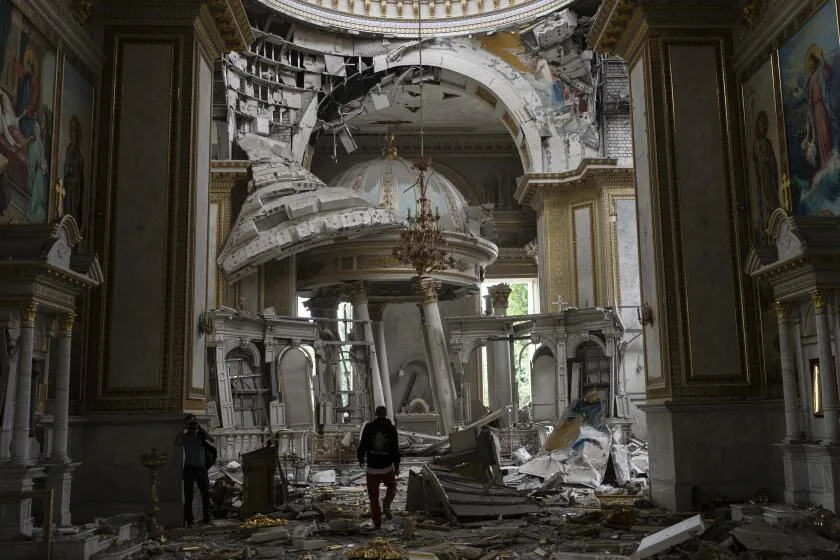
Church personnel inspect damages inside the Odesa Transfiguration Cathedral in Odesa, Ukraine, Sunday, July 23, 2023, following Russian missile attacks. (AP Photo/Jae C. Hong)
Church personnel inspect damage from Russian missile attacks at the Transfiguration Cathedral in Odesa, Ukraine. The cathedral is in the historic city center, a UNESCO-designated site. (Jae C. Hong / Associated Press)

On a cool spring morning, as water-washed light bathed pastel palaces in the old imperial city of Odesa, the thunder of yet another Russian missile strike filled the air.

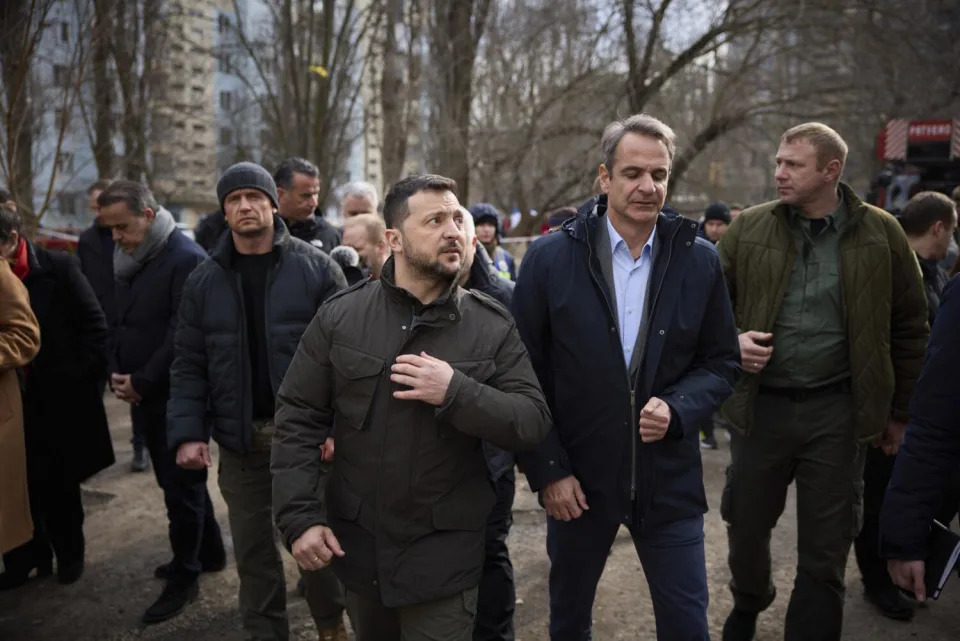
That March 6 blast came within a few hundred yards of a convoy carrying Ukraine’s president, Volodymyr Zelensky, who was touring the country’s principal shipyard with the visiting Greek prime minister, Kyriakos Mitsotaki.

It was a close call, but Ukrainian officials said that in all likelihood the two leaders were not the target. Like so many other strikes during what Ukrainians call the “big war” — ignited by Russia’s all-out invasion in February 2022 — the attack was aimed at Odesa’s port, a strategic prize of centuries’ standing.

The Black Sea harbor and its docklands — Ukraine’s commercial lifeline and a prime military asset — have been the object of intensifying Russian drone and missile attacks in recent weeks, as Ukraine’s dwindling air defenses leave critical infrastructure vulnerable across the country.

Ukrainian President Volodymyr Zelensky and Greek Prime Minister Kyriakos Mitsotakis walk near trees in Odesa, Ukraine.
Ukrainian President Volodymyr Zelensky, center left, and Greek Prime Minister Kyriakos Mitsotakis, center right, walk in Odesa, Ukraine, on March 6. The sound of a Russian airstrike a few hundred yards away reverberated around the port city as they ended their tour. (Ukrainian Presidential Press Office via AP)

In Odesa, the deadly campaign of airstrikes has brought sharply renewed peril to nearly a million inhabitants of one of Ukraine’s most eclectic and cosmopolitan cities, known in equal measures for its people’s mordancy and joie de vivre. And it poses a heightened threat to a world-renowned cultural treasure: the jewel-box grid of streets making up Odesa’s UNESCO-designated historic center, which abuts the port.

Read more: Ukrainians contemplate the once unthinkable: Losing the war with Russia

After a string of attacks on Odesa and its environs, those who watch over the city’s landmark structures are braced for the worst. On many ornate facades in the city center, full-length windows topped with curlicued pediments are boarded over. Inside, as periodic power cuts permit, workers sweep up shattered masonry and painstakingly restore ruined grand staircases.

“It’s very, very difficult work to safeguard these beautiful old buildings,” said Oleksei Duryagin, who heads a firefighting team that works out of a headquarters dating back to the city’s days of horse-drawn fire wagons. “Whenever they try to hit the port, which is what they try to hit, everything here is in danger.”

Because of the building materials used — wood, flammable insulation within the walls — the 19th century buildings that line Odesa’s cobblestone, tree-lined central streets are especially susceptible to fire or collapse. First responders undergo special training in how to fight blazes in structures like Odesa’s sumptuous opera house, perched on a promontory above the seafront.

“From basement to ceiling, I know these buildings like my old friends,” said Duryagin, 52, who has more than three decades of firefighting experience. “I know their mysteries.”

Falling debris from airborne interceptions, rather than direct drone or missile strikes, has caused some of the most serious destruction. Some sites, like the city’s Fine Arts Museum, which is housed in a reconstructed palace, were hit again before they could be cleaned up after an initial attack.

The boarded-up windows on Odesa's Museum of Western and Eastern Art.
The windows on Odesa’s Museum of Western and Eastern Art are boarded up as Russian forces continue to target the port city. (Laura King / Los Angeles Times)

Early in the war, the museum whisked most of its art treasures into hiding. Some display areas are closed off for repairs, and big niches that once held priceless artworks are starkly blank. But the museum remains open to culture-hungry visitors, who must periodically be hustled into its underground shelter when air alerts sound.

Most of the exhibits now have a somber martial theme, including a striking collection of botanical watercolors by a 48-year-old Ukrainian army captain, Borys Eisenberg, an artist and landscape architect who volunteered on the first day of Russia’s invasion and was killed last year on the front lines. His delicate, violet-veined works on paper are mounted on the wooden lids of ammunition boxes.

“You can see that even looking out from the trenches, he found beauty,” said Irina Kulabina, 66, a retired engineer who helps out at the museum. “It’s really important. We should believe in life more than death.”

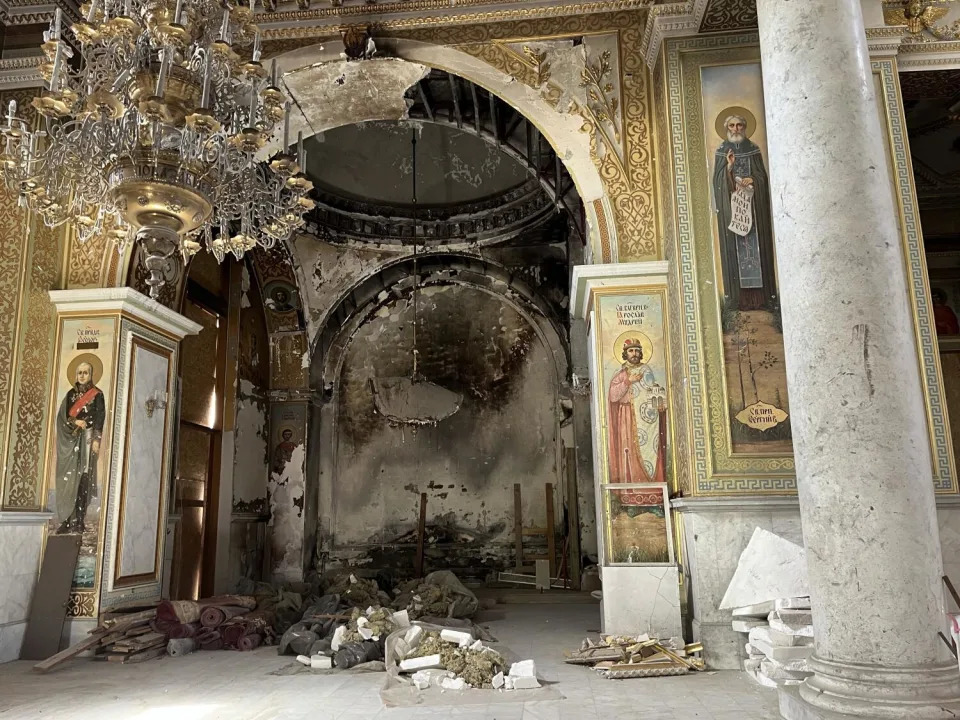
At Odesa’s Transfiguration Cathedral, the city’s largest Orthodox Christian church, a young priest named Father Alexei gazed out at blue sky through a gaping hole punched in an outer wall during a missile attack last July. He wondered aloud if fresh attacks would outpace rebuilding.

Rubble lies on the floor and walls are charred and blackened inside Odesa's Transfiguration Cathedral.
The blackened interior of the Transfiguration Cathedral in Odesa. (Laura King / Los Angeles Times)

“We just don’t know what else is to come,” said the 28-year-old cleric, who came to Odesa as a refugee from a front-line town in the eastern province of Luhansk.

While repairs slowly progress, services are held in a cavernous, basement-level secondary space, lighted only by flickering candles and lanterns whenever the electricity goes out. After the July strike, congregants converged on the landmark church, helping to gather artifacts scattered by the blast.

Read more: After an artist’s studio was damaged in a Russian missile strike, he found a new medium: war debris

“It was really shocking for everyone,” said Father Alexei. Zelensky said at the time that hitting the cathedral amounted to targeting “the foundations of our entire European culture.”

Last month was a particularly deadly one for the city and its outskirts.

March 2 drone attack wrecked a nine-story building, killing a dozen people. Five more perished in the strike four days later that narrowly missed Zelensky and the Greek leader. A missile and drone barrage on March 15 left 21 dead, including a paramedic killed in a dreaded “double tap,” in which first responders are targeted, seemingly deliberately, by strikes aimed at the same site a few moments apart to give rescuers time to arrive.

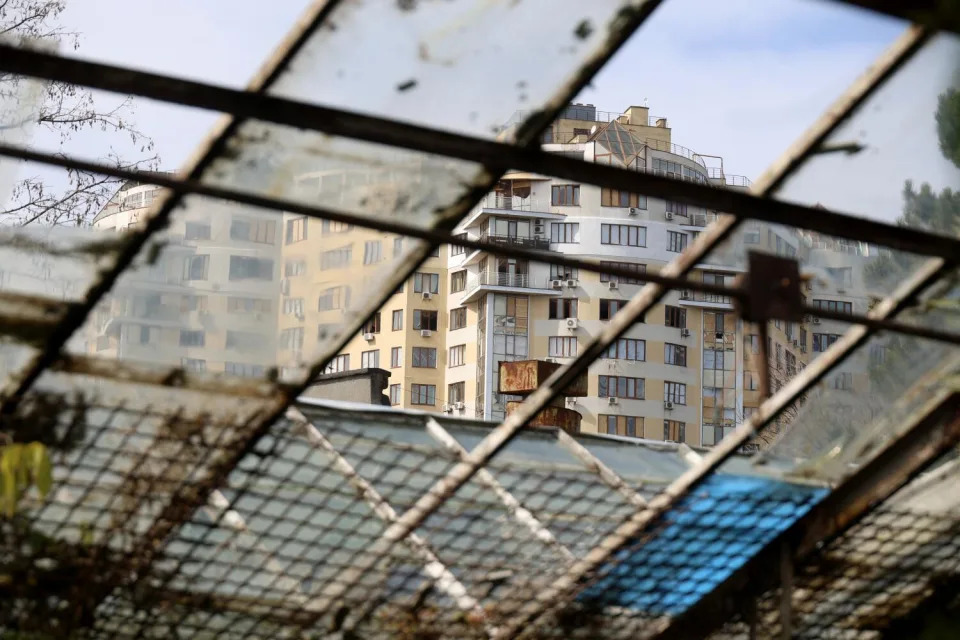
Buildings are seen through a damaged greenhouse roof.
The roof of a greenhouse damaged by a Russian missile attack in the botanical garden of Odesa I.I. Mechnikov National University. (Future Publishing via Getty Images)

More recently, on April 10, six people, including a 10-year-old girl, were killed in a strike on an outlying district of Odesa. That attack came on the 80th anniversary of Odesa’s liberation from Nazi forces during World War II.

The Odesa port and two others on the nearby seacoast have been a particular target of Russian wrath for the last eight months, since Ukraine managed to open a coast-hugging 350-mile Black Sea grain corridor to the Bosporus strait.

At the war’s outset, world grain prices jumped as Ukraine exports slumped, causing hardship in some of the world’s most impoverished countries. Now, though, almost 40 million tons of cargo have been shipped since August 2023, port officials said.

“Sometimes we spend all night in a shelter, then take a coffee and go straight to work — this is our reality,” said Dmytro Barinov, the deputy head of the state-owned Ukrainian Sea Ports Authority. “We feel responsibility not only for the Ukraine economy, to our farmers, but to the whole world that relies on our grain exports.”

As attacks continue and the overall war outlook grows grimmer, the city veers between a sense of relative safety and an acute awareness of peril.

Central cafes are full, and people linger at ice cream stands on the promenade. In flat green fields less than half an hour to the east, though, crews scatter pyramid-shaped reinforced cement antitank obstacles known as “dragon’s teeth.”

An ice cream stand on a public promenade
An ice cream stand on the promenade near the Potemkin Stairs, Odesa’s most famous landmark. Disused “tank traps” on the corner of a main boulevard in Odesa’s center. Laura King / Los Angeles Times

Odessa’s most famous landmark, the Potemkin Stairs — best known for the harrowing tumbling-baby-carriage scene in the 1925 film “Battleship Potemkin” — are topped with a roll of barbed wire. But a military checkpoint a few blocks away has been removed, and pedestrians can draw close enough to gaze down the 192 steps leading to the seafront.

The source of the city’s splendor is now the principal cause of its jeopardy. Odesa’s free port status financed its extraordinary architectural flowering in the 1800s and helped build its vibrant multiethnic society.

Russian warships have been driven back from Ukraine’s Black Sea coast — “when the big war started, we could see them from our palaces,” said naval spokesman Dytro Pletenchuk — but only 150 nautical miles to the east-southeast lies the Russian-occupied Crimean peninsula, from which many strikes are launched.

At that range, there is little time for people in Odesa to get to shelter once missiles are in the air.

Read more: In a storied Ukrainian city, a dance with wartime destiny

Russia’s 2014 seizure of Crimea and its fomenting of a separatist conflict in Ukraine’s east were a precursor to the current invasion. Many here harbor ardent hopes of someday recapturing the peninsula, and are heartened by Ukrainian strikes on Russian forces there, including a damaging attack Wednesday on a large Russian airfield.

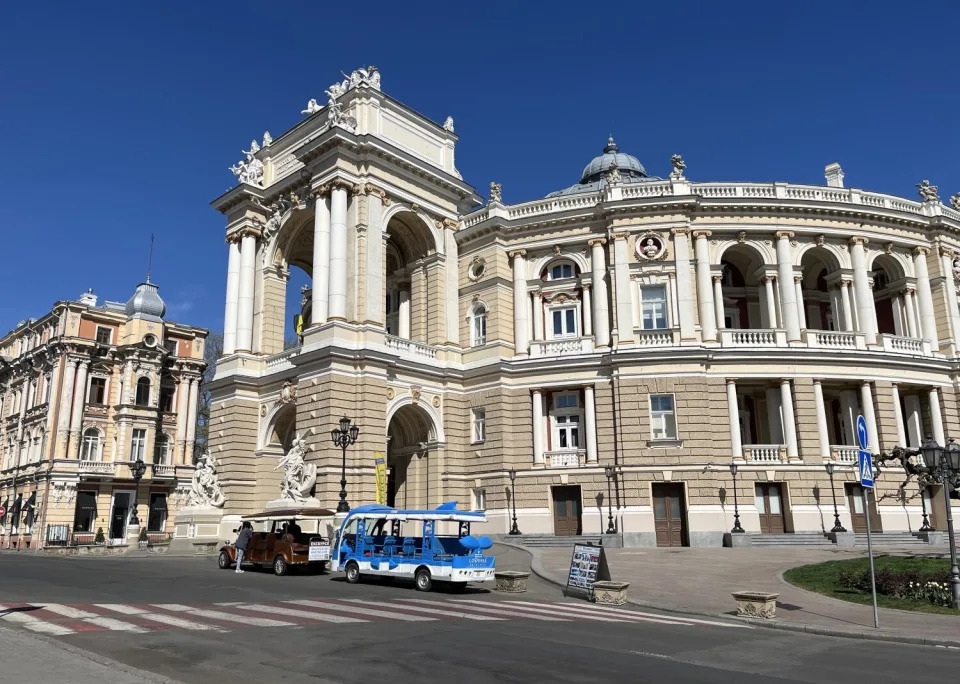
At the National Academic Opera and Ballet Theater — where April offerings include the ballet “Giselle” and Verdi’s opera “Nabucco” — the show goes on, as it has almost continuously since the start of the conflict. The neo-Baroque opera house is no longer sandbagged, but the war still feels ever present.

Odesa's opera house, formerly protected with sandbags.
Odesa’s opera house, formerly protected with sandbags. Performances and rehearsals are often interrupted by air alerts. (Laura King / Los Angeles Times)

“After night bombings come the most difficult days: Actors, singers and dancers are just physically tired, and it’s hard to deliver the emotional spectrum in their performances,” said Oksana Ternenko, 50, a stage director.

“Sometimes it’s like a theater of the absurd,” she said. “We are starting to rehearse, and a singer is showing photos on the phone: ‘Look, here’s a piece of my house that fell on my car.’ ”

Despite all, Odesa maintains an irrepressible offbeat humor.

A man dances on a brick path as musicians play.
A man dances during the Festival of Humor, which has been taking place in Odesa on and around April Fools’ Day since 1973. (Nina Liashonok / Getty Images)

“My parents and I, we’re very happy that Granny is deaf, so the explosions don’t scare her,” said 14-year-old Alina Kulik, who lives in an outlying district that has been hit repeatedly.

“Right now, we’re in a place that’s a little dangerous,” said her 15-year-old friend Anastasia Jelonkina, as the two girls perched on a promenade bench overlooking the seaport. “We know that. But here we are!”

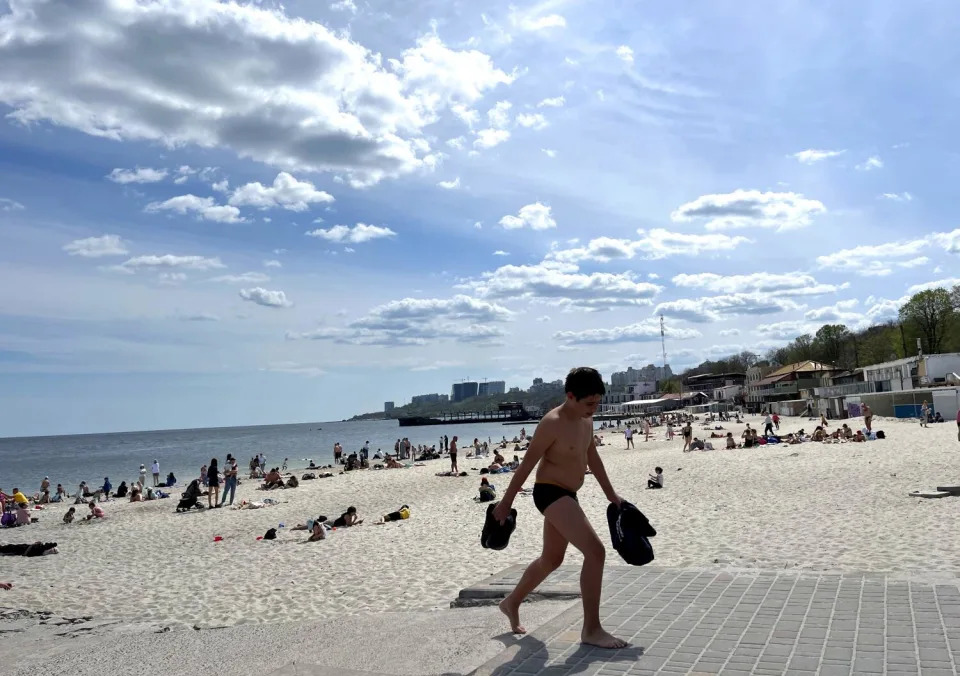
Odesa’s beaches, beloved by tourists before the war and by locals all along, are full again as spring temperatures rise. During much of the last two years, danger from mines and debris from destruction of a massive dam on the Dnipro River kept the shoreline largely closed.

Sunbathers flock to an Odesa city beach.
Sunbathers flock to an Odesa city beach. De-mining efforts allowed the reopening of the seashore. (Laura King / Los Angeles Times)

But intensive de-mining efforts have rendered the sea off Odesa relatively safe for swimming again, and a tousle-haired Irina Khosovana, a 62-year-old doctor who is a fifth-generation Odesan, said nothing — not even periodic air alerts — could keep her away.

“The sea is our comfort,” she said, gesturing toward the blue expanse. “Coming here is as important as life.”

A largely Russian-speaking city at the start of the war, Odesa still has deep cultural roots in common with the enemy now battering its shores. The poet Pushkin is still revered, with a grand boulevard named for him and a big statue taking pride of place in front of the city council building.

But another prominent piece of statuary near the opera house was deemed a symbol of colonialist oppression — that of the Russian empress known as Catherine the Great. Her likeness, hauled down in the war’s first year, is now boxed up in a black lean-to outside the damaged art museum.

Atop the empty plinth where the statue once stood flies a blue-and-yellow Ukrainian flag.

Has Russian Propaganda “Infected” Republicans? The Truth Is More Sinister.

Slate

Has Russian Propaganda “Infected” Republicans? The Truth Is More Sinister.

Molly Olmstead – April 20, 2024

Earlier this month, Republican Texas Rep. Michael McCaul, the head of the House Foreign Affairs Committee, told Puck News that Russian propaganda had “infected a good chunk of my party’s base.” Several days later, another Republican, Rep. Michael Turner of the House Permanent Select Committee on Intelligence, said he agreed. “Anti-Ukraine and pro-Russia messages, some of which we even hear being uttered on the House floor,” Turner told CNN, are “directly coming from Russia.”

It was a notable moment—and a telling one, as the House gets ready for a contentious vote on aid to Ukraine. The vote is being loudly protested by far-right politicians including Rep. Marjorie Taylor Greene, who is pushing to oust House Speaker Mike Johnson from his role over the issue.

It’s not the first time Republican lawmakers have accused their colleagues of essentially being Russian pawns. But as far-right rabble-rousers in the Republican Party have increasingly advocated against continued support of Ukraine—and even some mainstream Republicans no longer interpret Russian aggression as a ruthless threat to democracy and the international order—the most extreme lawmakers appear to be mirroring the Kremlin’s own propaganda.

Last Monday, Greene told Steve Bannon’s War Room podcast that Ukraine was waging a “war against Christianity” and Russians “seem to be protecting” the religion. The idea of Russia as a great (white) Christian nation has been percolating in right-wing thinking for more than a decade, despite Russia’s history of suppressing non-Orthodox Christianity and exerting power over the Russian Orthodox Church.

But Greene didn’t limit herself to praising Russia’s religious nationalism on Bannon’s show: She cited, as fact, anti-Ukraine disinformation that “the Ukrainian government is attacking Christians” and “executing priests.” This prompted former Rep. Ken Buck, another Republican, to call Greene “Moscow Marjorie” on CNN.

And indeed, this assertion does mirror Russia’s own talking points about Ukraine. (In actuality, the crimes Greene accused Ukraine of committing are crimes Russian forces have perpetrated.) But whether the Kremlin’s own talking points are being piped into the brains of right-wing American politicians—or just bear a striking similarity to the new isolationist rhetoric of the far right—is a matter of interesting debate.

Russian propaganda operations have evolved somewhat from the infamous social media campaigns that influenced the 2016 U.S. presidential election.

Take the case of a false narrative about Ukrainian president Volodymyr Zelensky using U.S. aid money to buy himself two yachts. This rumor—which is demonstrably false, given that the ownership of ships can be easily tracked—has been swirling in right-wing social media circles for months and popping up in American politicians’ talking points. It’s such an effective fabrication that North Carolina Sen. Thom Tillis told CNN in December that the debate over aid to Ukraine had been halted on the Hill in part because some lawmakers were concerned that “people will buy yachts with this money.”

But where did that idea come from? According to the BBC, the assertion that Zelensky had purchased two luxury yachts with U.S. aid money originated in November on a YouTube channel with just a handful of followers. The day after the video was posted, a site called DC Weekly published the claim as news, and that report was then picked up by other websites.

DC Weekly is not some kind of alternative newspaper or community blog; Clemson University researchers Darren Linvill and Patrick Warren argued in a report in December that the website was likely created to share fake news created by Russian state actors. The site is populated with A.I. content, has clearly fake authors, and has been partially hosted on a server in Moscow.

Russian disinformation that is packaged as news, Linvill said in a phone interview, often follows a similar pattern of dissemination. “I would bet my retirement on the fact that the Russians create the videos, plant the videos, write the stories, plant the stories, and distribute the stories,” Linvill wrote in an email.

“It’s the logic of the thing,” he said, “but also the fact that it happens repeatedly.” He pointed to a dozen other instances of disinformation narratives that started as assertions in obscure YouTube videos and were then picked up by publications with similarly legitimate-sounding names.

From 2016 through 2020, Linvill said, Russian propagandists focused on creating social media accounts to promote divisive ideas within the existing American discourse. That is still happening. But today, Linvill said, resources are more likely to be directed toward creating entire fake platforms, including websites that look like news sites. The stories tend to be sensationalized in a way that encourages organic sharing.

According to the Washington Post, Kremlin materials “obtained by a European intelligence service” show Moscow-linked strategists also stoke division in the U.S. by amplifying stories based in reality—including about migrants overwhelming the border, poverty and inflation, and reasons not to trust mainstream media.

But the story of the yacht shows how a fabricated rumor, likely originating in Russia, can start circulating in American politics. On Bannon’s War Room in December, Sen. J.D. Vance said, of his fellow politicians, “there are people who would cut Social Security, throw our grandparents into poverty, why? So that one of Zelensky’s ministers can buy a bigger yacht?”

The yacht story had a specific origin, but the growing anti-Ukraine sentiment among right-wing circles is harder to trace. After years of warfare and many millions of dollars in American aid, it makes sense that American enthusiasm for the Ukrainian cause might organically ebb.

And there is one man whose personal grudge against Ukraine could also cause Republicans to sour on a U.S. ally: Donald Trump.

“When American journalists and congresspeople use Russian talking points, they’re quoting Trump,” said Sarah Oates, a professor who studies disinformation and propaganda at the University of Maryland. “They are broadcasting Russian propaganda, but the conduit is Trump.”

Trump has several reasons to dismiss Russia’s threat to the international order. For starters, he openly admires authoritarian leaders like Vladimir Putin and has shown an interest in modeling himself after them. More importantly, the association of his 2016 election with Russian election-meddling caused some on the left to question the legitimacy of his victory.

For legitimacy reasons, then, Republicans have an incentive to downplay the potency of Russian propaganda. Not to mention: The basis of much of the Republican Party’s attacks on President Biden relies on a misleading assertion that his son Hunter Biden colluded with corrupt Ukrainian officials. Portraying Ukraine as a corruption-riddled country bolsters right-wing conspiracy theories about Biden’s family.

In other words, shared talking points between Republicans and the Russian propaganda machine don’t necessarily mean Russia is effective in seeding its influence; it’s a mutually beneficial swirl of conspiracy theories. “I think this is just a highly useful convergence of goals for Putin and Trump,” Oates said.

“Trump does not care; he literally is not thinking about it,” Oates said, referring to the possibility that many of Trump’s talking points could come from Russia. “His calculus is, ‘How can I win?’ ”

Because it’s quite possible that Americans who want the U.S. to abandon Ukraine may have arrived at that opinion on their own, Thomas Rid, a professor of strategic studies at Johns Hopkins, has warned against giving the Russians too much credit for swaying American public opinion.

Rid’s argument is: We shouldn’t help Russian strategists by assuming they’ve succeeded. Russia wants to undermine Americans’ trust in our systems and in our democracy. Believing that another country has the capability to, say, sway an election, serves that goal. “If we exaggerate the impact, we make the operations more successful than they would be otherwise,” he said, “and undermine trust in our own democracy, which is the goal of this game.”

It’s important, he argued, not to blame misinformation, isolationism, and other factors that led to changing views of the war on external actors alone. Americans, Rid said, are “perfectly capable of coming up with crazy ideas.”

Take Sen. Tommy Tuberville’s claim about why Putin needed to invade Ukraine. Speaking to a right-wing Alabama website, Tuberville said: “It’s a communist country, so he can’t feed his people, so they need more farmland.”

The claim—coming from a man who couldn’t name the three branches of American government and who thought World War II was fought over socialism—seems to be pure, homegrown nonsense.

“It’s blaming our own problems on others,” Rid said. “That’s the problem I find worrying.”

To be clear, Russian propaganda should be taken seriously: The country’s plans for deepening existing societal conflicts in the U.S. are not a secret. Given the various motivations at play and the inherent vagaries of how information and belief travel, though, it’s hard to know just how much the Republican Party has been “infected” by Russian propaganda, as Rep. McCaul put it.

What we can say with certainty is that there’s an alliance of interests. In his bizarre interview with Tucker Carlson in February, Putin laid out his several invented justifications for the invasion and said that he was interested in “peace.” The next day, Tuberville said he opposed sending aid to Ukraine because the Carlson interview “shows that Russia is open to a peace agreement.”

In her work, Oates found that researchers often couldn’t tell the difference between media pulled from Fox News and Russia Today, a Russian news network and propaganda arm; “identical” talking points don’t mean Russia is pulling the strings.

But there is still something to be gleaned from the coherence between Republicans and Russian strategists—and it’s probably a warning about our own news-media ecosystems. Rep. McCaul seemed to note this, telling Puck News that he saw “nighttime entertainment shows” in the U.S airing content that was “almost identical” to what was playing on Russian state TV.

Trump campaign announces 100,000 poll watchers and attorneys poised for election day

Independent

Trump campaign announces 100,000 poll watchers and attorneys poised for election day

Gustaf Kilander – April 19, 2024

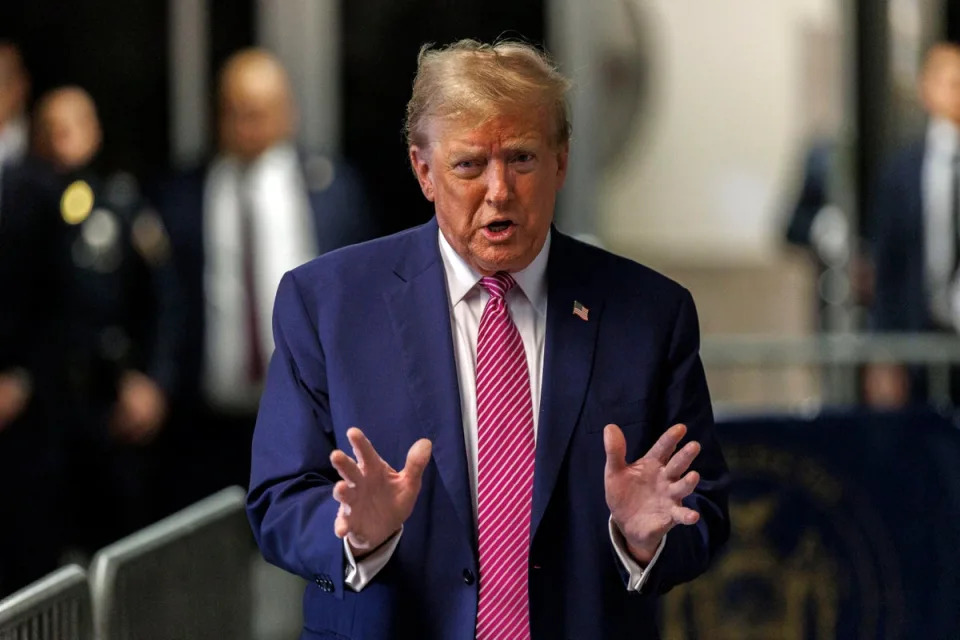
Trump complains to press about how cold it is in courtroom

The Trump campaign has announced that they will have 100,000 poll watchers and attorneys ready to take action on election day as former president Donald Trump’s obsession with election security continues.

Mr Trump tried to overturn the 2020 election citing baseless allegations of fraud by Democrats, and he has made similarly evidence-free claims regarding what Democrats may do this November. Even in 2016, Mr Trump asserted that he only lost the popular vote to Hillary Clinton because of fraud.

The Trump Campaign and the Republican National Committee (RNC) said in a Friday statement that they would launch “the most extensive and monumental election integrity program in the nation’s history”.

Mr Trump said in a statement: “Having the right people to count the ballots is just as important as turning out voters on Election Day. Republicans are now working together to protect the vote and ensure a big win on November 5th!”

The RNC said the program was designed by Chair Michael Whatley, Co-Chair Lara Trump and Chief Counsel Charlie Spies as well as the Trump campaign and that it’s intended to “have over 100,000 dedicated volunteers and attorneys deployed across every battleground state”.

Former President Donald Trump speaks with the media at his trial on Friday at Manhattan Criminal Court (AP)

“Whenever a ballot is being cast or counted, Republican poll watchers will be observing the process and reporting any irregularity,” the RNC said in its statement.

Trump supporters showed up to locations where votes were being counted in 2020, demanding that the counting stop, often in the false belief that mail-in ballots were fraudulent. Some election workers have faced death threats.

Recounts and audits in several states failed to find any wrongdoing. Mr Trump fired the leader of his election security agency days after it issued a statement saying that the 2020 election was one of the safest in history.

The latest announcement states that the RNC and the Trump campaign plan on overseeing machine testing, early voting, election day voting, mail ballot processing, and any post-election activity such as canvassing, audits and recounts.

Mr Spies said in a statement that they would take Democrats “to court if they don’t follow rules or try to change them at the last minute”.

Many Republicans were outraged at the expansion of mail-in voting in 2020 in the midst of the pandemic. Some Republican-led states passed laws restricting ballot access after the 2020 election.

“President Trump has said that the Republican victory in November needs to be too big to rig,” Mr Spies said.

In 2016, Mr Trump lost the popular vote by almost three million ballots, in 2020, he lost it by more than seven million. When asked by The Independent earlier this month if Mr Trump has any chance of winning the popular vote this year, former Republican strategist Rick Wilson said: “None whatsoever.”

Mr Whatley and Lara Trump were installed atop the RNC following the recent ouster of former RNC chair Ronna McDaniel.

In a statement on Friday, Ms Trump said: “Every ballot. Every precinct. Every processing center. Every county. Every battleground state. We will be there.”

Former GOP insider: Trump has “reprogrammed a generation” to fight against democracy

Salon

Former GOP insider: Trump has “reprogrammed a generation” to fight against democracy

Chauncey DeVega – April 16, 2024

Capitol Riot; Trump Supporters Nathan Howard/Getty Images

The first of Donald Trump’s four criminal trials is finally underway in Manhattan. This trial, on campaign-finance charges related to Trump’s alleged “hush money” payments to Stormy Daniels, is truly historic, marking the first time in American history that a current or former president has been tried for criminal offenses.

A guilty verdict in combination with the outcomes of his three other pending trials in Florida, Georgia and Washington, D.C., will clearly have an impact on how many Americans vote in the upcoming presidential election. The potential consequences should not be underestimated, given that current polls show a statistical dead heat between Trump and President Biden.

In an evocative preview published by the Economist, the “hush money” trial is described as a “meld of genres”:

The solemnity of the first prosecution of a former president, who also happens to be running again, will nod to tragedy. Really, though, this is a seedy burlesque, with a bit of farce. The case is about sex, money and blackmail. Mr. Trump’s former lawyer and fixer, who will testify against him, once described the conduct at issue as the “filth and muck of politics”…. Every trial is part theatre. This one, slated to run for six to eight weeks (beginning with jury selection), will be a sell-out.

Trump’s criminal trials are historic in other ways as well: They seem to echo the lessons of one of the most dreadful chapters in modern history. In 1923, Adolf Hitler was sentenced to five years in prison for an attempted coup (known as the Beer Hall Putsch) against the state government of Bavaria. He served less than one year, using the time to write the first volume of “Mein Kampf.” After his release, of course, Hitler continued his rise to power, becoming the de facto dictator of Germany less than 10 years later.

Donald Trump has already attempted one coup, and the American people were fortunate that it failed. He has never disavowed the Jan. 6 attack on the Capitol and, not unlike Hitler, continues to threaten violence (including imprisonment and execution for “treason”) against anyone and everyone who oppose him and the MAGA movement.

If Trump is actually sent to prison, the MAGA movement will likely be blunted, if not broken. American democracy and the might then be able to avoid the fate that befell Germany 90 or so years ago.

Miles Taylor served as chief of staff in the Department of Homeland Security during Trump’s first term. He spoke out early about Trump’s unfitness for office, as author of the 2018 New York Times “Anonymous” editorial. Since then, Taylor has written two books, “A Warning” and “Blowback: A Warning to Save Democracy from Trump’s Revenge.” His new paperback edition of “Blowback” has just been published, incorporating an argument that Trump’s second administration will be far more competent and formidable in its assault on American democracy and the rule of law than the first one was.

In the second half of our conversation, Taylor cautions that the existential danger to American democracy posed by Trump, the MAGA movement, and today’s Republican Party will continue well past Election Day 2024. The American people still have the power and agency to defeat those forces, Taylor says, but only if they shake off complacency and apathy and act to defend democracy and freedom — not just at the ballot box but throughout our society.

This is the second installment of a two-part conversation.

How do you assess Donald Trump and his MAGA movement’s danger to the safety and future of the country and our pluralistic democracy?

Look, I’m still a conservative. This isn’t about a Republican coming to the White House. I don’t even think Trump is a real Republican. It’s about a man who’s said he wants to use government as a tool of revenge — and to advance his own self-interest. That sort of intent — sitting atop the spy agencies and military apparatus of the government — writes its own horror story.

How do we locate Donald Trump and the American authoritarian movement as part of a larger global movement to end democracy, which also includes Vladimir Putin, Viktor Orbán, and other malign actors?

They are one and the same — reactions to populism. This is where I’ll say that the culprits here aren’t actually the autocrats themselves. It’s us. We’re choosing to empower these people. We can choose not to. The choice we make will define us.

Why do you think the news media and political elites haven’t made the global dimension of this threat to our democracy much clearer?

Attacks on Western democracy from within were not on my bingo card post-9/11. I fear the wayward ex-president will get his way eventually in trying to chip away at the community of democracies. He needn’t win back the White House to execute his vision. Trump has done something more insidious. By co-opting the Republican Party, he has reprogrammed a generation of devotees with his anti-constitutional and anti-democratic views. Copycats will try to fulfill his unfinished plans well beyond his lifespan, an undertaking made possible because GOP leaders have anesthetized their consciences and normalized Trump-like conduct for a decade.

If Trump is defeated this November, will the danger of right-wing political violence decrease? Many experts are concerned that a defeat on Election Day will only amplify the danger from Trump and his followers.

I’ll put it simply. Whether Trump wins or loses, the risk of political violence is high. If he loses, it will likely be far worse than Jan. 6. If he wins, I fear there will be a violent reaction around the country from the far left — a reaction that Trump will use to “justify” a crackdown. Thus, the spiral will begin. There’s no magic wand that can prevent this. We just need to show restraint, urge our neighbors to do the same and condemn political extremism.

Looking back, do you have any regrets about your time in the administration and how you chose to speak out? What do you know now that you wish you knew then?

Six years ago, I sounded an alarm that the sitting president was acting in a way that was “amoral” and “reckless” behind the scenes and that his own staff thought he posed a grave threat to the country. Many people dismissed me and believed Trump’s accusation that I was being disloyal.

Five years ago, I wrote a book about the deeper extent of instability inside the White House and why re-electing Trump could be catastrophic. Many people dismissed me and believed Trump’s claim that it was a “make-believe book” of “deep state” lies.

Four years ago, during the 2020 campaign, I said that if Trump lost, he would try to stay in office, a situation that could end “tragically.” Many people dismissed me and believed the claims of Trump’s acolytes that he’d do the right thing when the time came.

Three years ago, I assembled GOP dissenters to warn that Trumpism maintained a “viselike grip” on the party and that the anti-constitutional wing would overtake it completely if preventive action wasn’t taken. Many people dismissed me and said the GOP would move on from Trump.

Two years ago, I predicted that Trump would run again for the presidency and would likely lead the GOP field. Many people dismissed me and said Trump would be taken out by the courts first.

Last year, I released this book to explain in precise detail what would happen if Trump or another MAGA figure retook the White House, including the specific ways they would weaponize American government against their foes.

My goal here isn’t to prove that I’m prescient. Nor do I think I should be applauded because predictions about a dangerous man and his mob-like movement keep coming to fruition. What I’ve been saying for years about deeper threats to the American experiment should have been painfully obvious to almost anyone who’s paying attention. Yet far too many Americans are imperiling the future once more by ignoring the clanging and rattling truth that could cause the entire country to come undone.

What do you think will happen next? Where are we in the story of the Trumpocene?

First, I say in the book that America’s survival as the United States is not inevitable, but its demise will become a certainty if we continue down our current path. No free system of government can survive the willful ignorance of its people. But I’m not a fatalist; if I were, I wouldn’t have written this book or spent my life trying to protect our country. In fact, I am an optimist about the trajectory of free societies like our own. A democracy is a living thing. Like most living things, it will fight for its survival by exhausting all available possibilities for persistence, though a spirited effort might not be visible until it’s in mortal danger. That hour will be upon us soon.

Second, I note that America can survive the century if we renegotiate our social contract. By that I mean we should examine the underpinnings of our polity together — from the actual ways we vote and mechanisms for spurring political competition to the very Constitution that binds us. Although it may seem impracticable, a renegotiation will look more appealing in the decades ahead of us, more so, I suspect, in the face of genuine hardship. A people so divided cannot continue forward without addressing their divisions openly; otherwise, they should peaceably separate, or spiral toward a violent end.

Thankfully, we are blessed by nature with a say in the matter. Destiny is manifested by decision. So what happens next will depend on our collective willpower as a country and our resolve to eschew the dread of indecision. On that point I feel hopeful, because every guiding milestone we’ve placed on humankind’s trail has been put there by choice. And we can do so once again at a moment of our choosing.

What can the American people do to stop the bureaucrats, advisers and others who will try to orchestrate the Trump dictatorship if he wins this election?

The choice is ours, as it has always been. The founders saw America as an experiment, dependent entirely on our conscious efforts to sustain it and not on preordainment. Some readers will lament these grim forecasts while they loiter in the shadows, contorting logic to justify to themselves why their silence is an exception to the need for all Americans to admit the seriousness of our situation. To those readers I say: I don’t judge you. I’ve been you. I’ve made excuses for staying quiet. But companionship won’t save you from the consequences.

Fewer citizens will make the harder choice. Those who do will start defying their political tribes by calling for civility; they will resist intimidation and reject the moral equivalency crawling into our political discourse; they will put country over party by advocating for system-wide reforms to make our democracy more representative of all views and less prone to upheaval; and they will openly evangelize — through trial and error — the small rituals of civic faith that can restore a democracy. If this is you, then I believe you are America’s last, best hope.

Trump Allies Have a Plan to Hurt Biden’s Chances: Elevate Outsider Candidates

The New York Times

Trump Allies Have a Plan to Hurt Biden’s Chances: Elevate Outsider Candidates

Jonathan Swan, Maggie Haberman, Shane Goldmacher and Rebecca Davis O’Brien – April 10, 2024

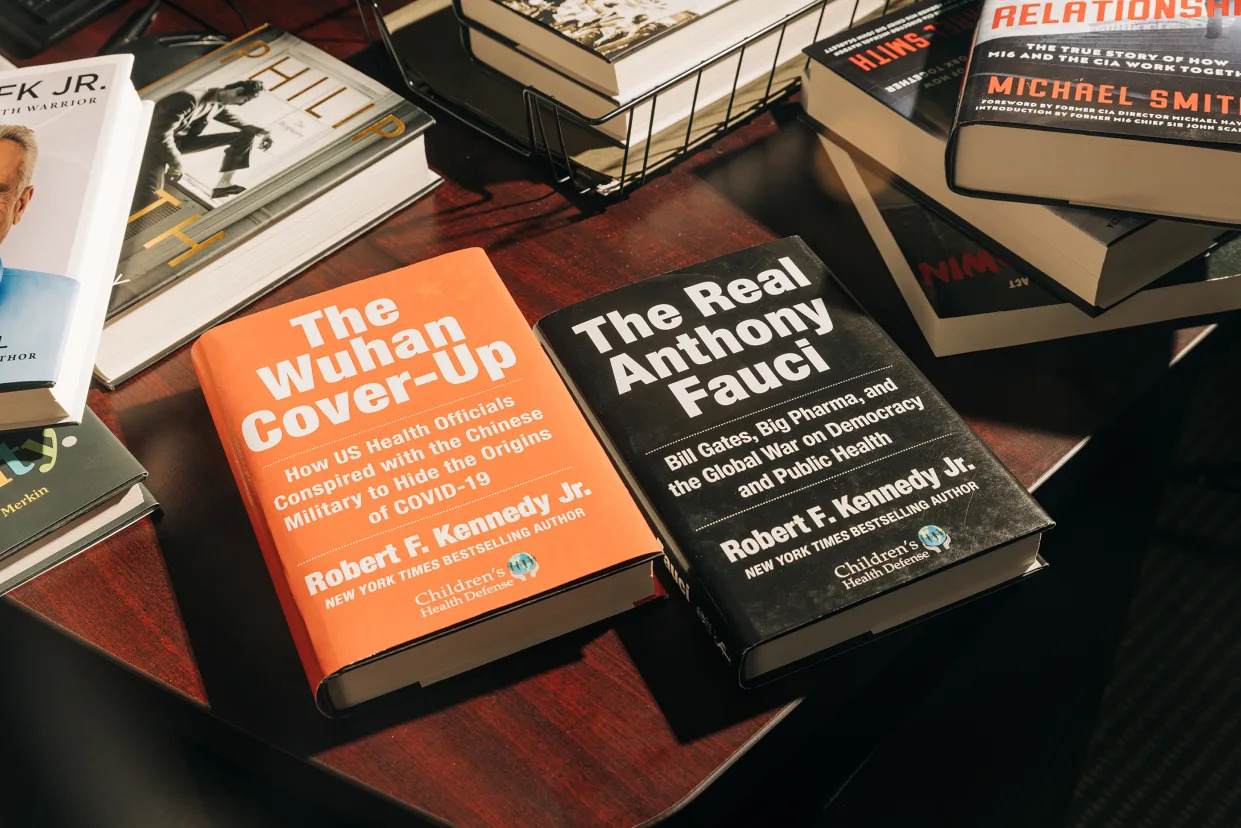
Two Skyhorse Publishing titles by Robert F. Kennedy Jr., a Democrat running for president, in the office of the company’s founder, Tony Lyons, in New York, Aug. 10, 2023. (Jeenah Moon/The New York Times)

Allies of former President Donald Trump are discussing ways to elevate third-party candidates in battleground states to divert votes away from President Joe Biden, along with other covert tactics to diminish Democratic votes.

They plan to promote independent candidate Robert F. Kennedy Jr. as a “champion for choice” to give voters for whom abortion is a top issue — and who also don’t like Biden — another option on the ballot, according to one person who is involved in the effort and who, like several others, spoke on the condition of anonymity to discuss the plans.

Trump allies also plan to amplify the progressive environmental records of Kennedy and expected Green Party candidate Jill Stein in key states — contrasting their policies against the record-high oil production under Biden that has disappointed some climate activists.

A third parallel effort in Michigan is meant to diminish Democratic turnout in November by amplifying Muslim voters’ concerns about Biden’s support for Israel’s war in the Gaza Strip. Trump allies are discussing running ads in Dearborn, Michigan, and other parts of the state with large Muslim populations that would thank Biden for standing with Israel, according to three people familiar with the effort, which is expected to be led by an outside group unaffiliated with the Trump campaign.

Many of these third-party-boosting efforts will probably be run out of dark-money entities that are loosely supportive of Trump. Both the Trump campaign and the main super political action committee supporting the former president, MAGA Inc., are already aggressively framing Kennedy as a far-left radical to draw potential Democratic voters away from Biden.

Whatever the mechanism, the Trump team’s view is simple and is backed by public and private polling: The more candidates in the race, the better for Trump. Biden’s team agrees. And in a race that could be decided by tens of thousands of votes — as the last two presidential elections have been — even small shifts in the share of votes could change the result.

“There is no question that in a close presidential race, independent or minor party candidates can have a disproportionately large impact,” said Roger Stone, who is Trump’s longest-serving political adviser and who has worked on third-party campaigns, including advising Gary Johnson, the Libertarian Party’s nominee in 2012.

Republican donors are pouring funds into Kennedy’s independent bid for the presidency. He has raised substantially more from donors who previously supported Trump than he has from those who backed Biden. Some are big names in Republican politics who have so far given relatively small amounts, including $3,300 last August from Elizabeth Uihlein, whose family is among the GOP’s biggest contributors.

Timothy Mellon, the largest single donor to Kennedy’s biggest super PAC, is also the largest backer of MAGA Inc. Mellon, a reclusive billionaire from one of America’s wealthiest families, has over the past year given the Kennedy super PAC $20 million and the Trump super PAC $15 million, as of the most recent disclosures that were filed in March. Another prominent Kennedy backer is Patrick Byrne, the former CEO of Overstock.com who worked with Trump on his effort to overturn the 2020 election.

Trump himself is intensely interested in the third-party candidates, according to aides. He is eager to know what their effect is expected to be on the race and how they are polling, although his engagement beyond asking questions of those around him is unclear.

Trump has been worried about the Libertarian Party pulling conservative voters away from him in November. But Richard Grenell, who is the former acting director of national intelligence and who is expected to play a big role in any second Trump administration, has been using his connections with Libertarian activists and donors to try to persuade them to attack Biden more than Trump, according to people familiar with his efforts.

Other Trump supporters are trying to help third-party and independent candidates with the expensive and arduous process of gathering the signatures needed to get on state ballots. Scott Presler, the conservative activist whom Lara Trump said she wanted as an early hire at the Republican National Committee, publicly reached out on social media to Stein and Cornel West, a left-wing academic who is running for president as an independent, to offer his help in collecting signatures to get them on the ballot.

Presler could not be reached for comment.

The moves by Trump allies come as the Democratic Party, alarmed by the potential for third-party candidates to swing the election, has mobilized a team of lawyers to scrutinize outsider candidates, including looking into whether they’ve followed the rules to get on state ballots.

For decades, third-party candidacies have loomed large in U.S. presidential elections. The best known in modern history is Ross Perot, whose run as a billionaire populist independent in 1992 garnered 19% of the vote and helped Bill Clinton win with only 43% of the popular vote. Ralph Nader, a Green Party candidate, siphoned votes away from Vice President Al Gore in the nail-biter 2000 presidential race against George W. Bush.

And in 2016, Stein, as the Green Party candidate, gave a meaningful — and arguably election-deciding — boost to Trump by drawing progressive voters away from former Secretary of State Hillary Clinton in Pennsylvania, Michigan and Wisconsin. That year, billionaire businessperson and Home Depot co-founder Bernie Marcus, a supporter of Trump, helped fund efforts to bolster Stein.

Polling shows that third-party candidates could play an especially large role in 2024. Most Americans are unhappy with the choice between Trump and Biden. Voters are increasingly disillusioned with the two major parties, and trust in American institutions has eroded over the past 30 years. Those trends provide an opening for candidates who style themselves as anti-establishment outsiders willing to blow up the system. Trump took advantage of similar conditions in 2016.

In a Quinnipiac University poll in late March, Biden and Trump both received less than 40% of the vote in a hypothetical five-way race, with Kennedy getting 13%, Stein receiving 4% and West capturing 3%.

In the multicandidate race, Trump led by a single percentage point; Biden led Trump by 3 percentage points in a hypothetical head-to-head race.

“The path to victory here is clearly maximizing the reach of these left-wing alternatives,” said Steve Bannon, the former White House chief strategist who also served as Trump’s campaign chair in 2016.

“No Republican knows that oil production under Biden is higher than ever. But Jill Stein’s people do,” Bannon added. “Stein is furious about the oil drilling. The college kids are furious about it. The more exposure these guys get, the better it is for us.”

Brian Hughes, a spokesperson for Trump, described Kennedy as a “leftist and liberal with a history of supporting an extreme environmental agenda.” He said more broadly of the Democratic push to challenge outsider candidates, “While Joe Biden and his allies claim to defend democracy, they are using financial and legal resources to prevent candidates access to the ballot.”

“President Trump believes any candidate who qualifies for the ballot should be allowed to make their case to America’s voters,” he added.

For months, the Trump team has been privately polling various iterations of third-party tickets in battleground states. It has concluded that candidates floated for the Green Party and No Labels, which recently abandoned its effort to field a presidential candidate, pulled substantially more votes from Biden than from Trump.

A person briefed on other polling by Trump allies said that while it varies by state, Kennedy also pulls more votes from Biden than from Trump. The person cited as an example the Trump team’s recent private polling of voters in Arizona. Trump loses Hispanic voters by a close margin in a head-to-head contest against Biden there, but he wins Hispanic voters on the full ballot in Arizona — an indication that third-party candidates draw more heavily from Biden’s core constituencies than from Trump’s.

Still, Kennedy is seen as more of a potential threat to Trump. He has spent the past few years appearing on conservative news media programs and talking about issues like his fierce opposition to the COVID-19 vaccine. Advisers to Trump say that many Republican voters don’t know anything about Kennedy’s liberal views on gun control and the environment, and the Trump team hopes to bring back some of those voters after framing Kennedy as a liberal Democrat.

Allies of Trump and Biden are in a tug of war to define Kennedy, who has far more support than any other third-party candidate.

Democratic lawyers and operatives, many of whom have privately said that neither Gore nor Hillary Clinton had teams that took third-party candidates seriously enough, are fighting hard to keep Kennedy off the ballot. The Democratic National Committee hired Lis Smith, a veteran communications operative, and tasked her with branding Kennedy as a pro-Trump spoiler candidate.

Kennedy’s campaign and the super PACs backing him have paid an array of lawyers and consultants to secure ballot access. One of the consultants, Rita Palma, was captured in a video detailing a strategy to encourage New York voters to support Kennedy: “The Kennedy voter and the Trump voter, our mutual enemy is Biden.” Palma outlined a hypothetical scenario in which Kennedy would win enough electoral votes to prevent either Trump or Biden from winning 270 electoral votes, pushing the decision to Congress in what is known as a contingent election.

On her account on the social platform X, Palma has expressed support over the years for both Kennedy and Trump. In posts first reported by CNN on Tuesday, she had endorsed Trump’s false claims that the 2020 election was stolen and described Sidney Powell, who has pleaded guilty to six misdemeanor counts related to Trump’s efforts to overturn his 2020 election loss in Georgia, as “my person of the decade.”

Stefanie Spear, a spokesperson for the Kennedy campaign, described Palma as “a ballot-access consultant” for upcoming signature collection efforts in New York. Of Palma’s remarks about the hypothetical scenario, Spear said Palma’s statements “in no way reflect the strategy of the Kennedy campaign.”

Spear did not respond to requests for comment about the Trump allies’ efforts to elevate Kennedy, or to inquiries about Palma’s support for Trump’s claims about the 2020 election.

Many conservative news media personalities and influencers recently turned against Kennedy after he decided to run as an independent instead of as a Democrat and it became apparent that he could pull votes from Trump.

Still, one complication with attacking Kennedy is that Trump has made clear that he likes him.

Trump put out a statement on Truth Social, his social media platform, that called Kennedy “a radical-left Democrat,” but he has mostly laid off him otherwise. Trump has called Kennedy a “very smart person” and has even privately floated him as a potential running mate, though his advisers view that prospect as extremely unlikely.

An outside group aligned with Trump asked a question about a Trump-Kennedy ticket in a poll several weeks ago, according to a person with knowledge of the survey. The results were not particularly striking. Trump had told an ally that he believed Kennedy could help him with voters who were upset with him for his support of the COVID-19 vaccine.

“I like Trump-Kennedy. I like the way that sounds,” Trump told another ally recently. “There’s something about that that I like.”

Trump’s Big Lie About Biden Implodes After MAGA Ally Admits Truth

The New Republic – Opinion

Trump’s Big Lie About Biden Implodes After MAGA Ally Admits Truth

Greg Sargent – April 11, 2024

Steve Bannon no doubt thought he was being deviously clever. Speaking with The New York Times this week, he elaborated on a sophisticated plan that Donald Trump’s allies have developed for boosting third-party candidates, so they siphon votes from President Biden.

A key part of this scheme, Bannon noted, entails boosting expected Green Party candidate Jill Stein by highlighting oil production under Biden to pull environmentally concerned voters away from him. As Bannon put it:

No Republican knows that oil production under Biden is higher than ever. But Jill Stein’s people do. … Stein is furious about the oil drilling. The college kids are furious about it. The more exposure these [third-party candidates] get, the better it is for us.

Whoa, that’s some serious 11-dimensional chess, Steve! Except for one thing. If you think for a second about Bannon’s quote—that “oil production under Biden is higher than ever”—it entirely undermines one of Trump’s biggest lies: the claim that Biden’s effort to transition the United States to a decarbonized economy has destroyed the nation’s “energy independence,” leaving us weak and hollow to our very core.

This saga captures something essential about how MAGA-world fights the information wars. You’ll note that Bannon is not even slightly troubled by the idea that telling the truth about Biden’s record to one set of voters—left-leaning, green-minded ones—might contradict one of Trump’s most frequent lies to countless others.

It isn’t just that for Bannon, assertions should be evaluated purely for their instrumental usefulness. It’s also that he apparently has total confidence that voters who really need to hear the truth he uttered—those in the industrial and Appalachian heartlands who are the targets of Trump’s propaganda—never, ever will, even if he admits to it right in the paper of record.

It’s hard to overstate how central Trump’s story about “energy independence” is to his campaign. His basic claim is that under his presidency, we produced record levels of oil, inherently making us strong, whereas under Biden, we’re seeing a “war on American energy” responsible for many ills: deindustrialization, vulnerability to leftist enemies within, dependence on China and other nefarious “globalist” actors, and all-around national decline.

In reality, Biden’s green policies are facilitating billions of dollars in investments in rebuilding the industrial base via green energy manufacturing, which is creating a whole lot of advanced manufacturing jobs for people without college degrees—exactly the targets of Trump’s demagoguery. Those policies are driving a manufacturing boom, ironically in red-leaning communities. Green manufacturing makes us stronger, not weaker—more prepared for a future in which climate change becomes a more pressing threat, not just to the world, but to our own national interests.

Importantly, all this is happening while the U.S., under Biden, is producing more oil and more natural gas than ever before. Incidentally, as Washington Post fact checker Glenn Kessler details, Trump wasn’t even that responsible for the recent oil boom anyway: It started before his presidency, thanks to new energy technologies.

“The U.S. is now producing more oil and gas than it ever has, and exporting more than ever,” Jesse Jenkins, an energy expert at Princeton University, told me. “We’re a net exporter of all fossil fuels. So we’ve achieved that long-sought goal of physical energy security.”

Now the idea of “energy independence” is confusing to begin with. Even if we export more than ever before, oil is a global commodity, which inevitably makes us vulnerable to international shocks. But the answer to that is to wean ourselves off fossil fuels, not to drill more, as Trump wants. Regardless, by Trump’s own metric—that “energy independence” is good, that net exports of fossil fuel energy make us definitionally strong—we’ve achieved more of this under Biden. And critically, his policies are at the same time transitioning us to a post-carbon economy.

Bannon knows all this. Yet Trump and his allies keep repeating the contrary story. “They obviously know this narrative is a crock of lies,” Jenkins said.

It’s worth stressing that some progressive voters might nonetheless be reasonably upset about oil production under Biden. But the broader story remains that Biden is moving us toward a decarbonized economy by using the levers of government to boost demand and production of renewable energy sources over time.

“What’s important to note is that U.S. greenhouse gas emissions are falling,” Jenkins says. That both this and robust oil production and exports are occurring simultaneously, he notes, would probably be viewed positively by moderate voters, including in Appalachia and the industrial Midwest.

That is, if those voters hear any of this through the fog of MAGA agitprop. Trump’s attacks on Biden’s energy “weakness” are designed to tell a meta story that has little to do with policy details: Trump will protect us from an array of shadowy forces associated with green energy—leftism, China, ill will toward good ol’ American fossil fuel–guzzling SUVs—while Biden is making us vulnerable to them.

You can see how this works in Trump’s proposal for across-the-board tariffs. These would hike prices for American consumers—they would impose a tax—even as Democrats have opted for green policies that move away from the more traditional policy of a carbon tax. Yet as Brian Beutler and Matthew Yglesias explain, Trump can still present his tariffs as a form of protection and Biden’s green agenda as a form of vulnerability, because each of these policies “code” that way for many voters.

Bannon understands all this. Strikingly, he declares that “no Republican knows” that oil production is so high under Biden, which is another way of saying that no Republican voters know that Trump is lying in their faces. Bannon and other MAGA propagandists are making sure of that. They are using their influence over information flows to those voters to ensure that the truth never reaches them. And they’re absolutely confident in their ability to succeed.

Trump is recreating his web of chaos at home and abroad in a preview of what a second term could look like

CNN

Trump is recreating his web of chaos at home and abroad in a preview of what a second term could look like

Analysis by Stephen Collinson, CNN – April 10, 2024

Marco Bello/Reuters

Some top Democrats worry that Americans have forgotten the chaos that raged every day Donald Trump was president, and that voters’ faded recall of the uproar will end up handing him a second term.

The presumptive GOP nominee is, however, doing a good job of jogging memories as he blazes a trail of disruption through Congress, immigration and national security policy, reproductive health care and the nation’s top courts.

After storming to the Republican nomination, Trump is again the epicenter of controversy. His volatile personality, loyalty tests, rampant falsehoods, thirst to serve his political self-interest and the aftershocks of his first term are compromising attempts to govern the country. And the election is still seven months away.

Many of today’s most intractable conflicts in US politics can be traced to Trump and the turmoil that is an essential ingredient of his political appeal to base voters who want Washington and its rules ripped down – no matter the consequences.

Events this week – and over the first three months of this year – illustrate how much Trump has shaped the political tumult:

— On Wednesday, House Speaker Mike Johnson suffered another stunning defeat, further gutting his authority, after hard right GOP members blocked a bill to reauthorize a critical surveillance spying program at Trump’s behest.

— Another measure critical to America’s capacity to wield its global power and its international reputation – a $60 billion arms package for Ukraine – is still going nowhere. Trump ally Rep. Marjorie Taylor Greene is threatening to topple Johnson if he dares to pass it.

— Nationwide chaos is, meanwhile, spreading in the wake of the Trump-built Supreme Court conservative majority overturning Roe v. Wade in 2022. In the latest stunning twist, Arizona is about to revert to a near total Civil War-era abortion ban.

— Bipartisan efforts to solve a border crisis are in tatters after Trump’s House followers in February killed the most sweeping and conservative bill in years. The ex-president appeared to want to deprive President Joe Biden of an election-year win and to continue his searing claims that America is being invaded by undocumented migrants he calls “animals.”

— Some of the nation’s top courts are being tied in knots by Trump’s incessant, and often frivolous, appeals as he desperately tries to postpone the shame of becoming the first ex-president to go on criminal trial. His unchained social media posts may be coming perilously close to infringing a gag order ahead of his hush money trial beginning Monday.

— The Supreme Court will later this month wrestle with Trump’s claims of almost unchecked presidential power – a constitutional conundrum that no other president in two-and-a-half centuries of American history ever raised. The suit is largely a ruse to delay his federal election interference trial – and it is working.

Trump’s entanglement in some of the most intense political storms rocking Washington, and reverberating even beyond US shores, offers fresh evidence of his power – expressed through his capacity to make key elements of the Republican Party bend to his will. It highlights his mercurial personality and a political style that relies on instinct rather than long-term strategy. And it is leaving no doubt that the mayhem that burst out of the Oval Office during his administration would return at an even more intense level if he gets back there in 2025.

Trump delivers a blow to Johnson – then invites him to Mar-a-Lago

Trump dispensed his orders to his acolytes in the House with the words “Kill FISA” on his Truth Social network.

The former president was referring to the Foreign Intelligence Surveillance Act, which national security officials say is critical to allowing espionage agencies to listen to communications of suspected terrorists and US adversaries. Some of those key powers need to be reauthorized by Congress by the middle of the month.

Critics of the law, including some civil liberties groups and some conservatives, argue that Section 702 of the act, which allows the surveillance of foreigners outside the US, is unconstitutional because sometimes Americans in contact with those targets get swept up in the net. But Trump is bent on vengeance against the FBI over its investigation into contacts between his 2016 campaign and Russia. He claimed in a social media post that FISA was “ILLEGALLY USED AGAINST ME, AND MANY OTHERS. THEY SPIED ON MY CAMPAIGN!!!”

On Wednesday, 19 Republicans – including some of Trump’s loudest backers in the House – bucked Johnson and voted with Democrats to block consideration of the bill, dealing yet another blow to the speaker’s fast-ebbing authority and provoking a potential national security crisis.

Bill Barr, Trump’s former attorney general, told CNN’s Annie Grayer on Wednesday that the actions of his former boss and allies were “a travesty and reckless.” Barr argued that the ex-president was being driven by “personal pique rather than rationality and sound policy.” He said Trump’s complaints about the investigation into his 2016 campaign had nothing to do with the FISA section that needs to be reauthorized. And in a chilling warning, Barr accused the ex-president of putting US national security at risk. “We’re faced with probably the greatest threat to the homeland from terrorist attack and our means of defending against that is FISA. And to take that tool away, I think, is going to result in successful terrorist attacks and the loss of life,” he said.

Johnson’s latest humiliation came as he’s fighting for his job on another front. He held tense crisis talks on Wednesday with Greene, who is threatening to call a vote to oust him. The speaker may be the most conservative person to ever hold his job, but the Georgia lawmaker is accusing him of becoming a Democrat in all but name. Johnson’s crime was to keep the government open by passing budget bills and his consideration of the delayed Ukraine funding, which is also opposed by the former president.

“If he funds the deep state and the warrantless spying on Americans, he’s telling Republican voters all over the country that the continued behavior will happen more, spying on President Trump and spying on hundreds of thousands of Americans,” Greene told CNN’s Manu Raju on Wednesday. She added: “The funding of Ukraine must end. We are not responsible for a war in Ukraine. We’re responsible for the war on our border, and I made that clear to Speaker Johnson.”

Trump’s role in these two issues that threaten to bring Johnson down make it all the more curious that the speaker plans to travel to Mar-a-Lago on Friday to hold a joint news conference with the Republican presumptive nominee.

Johnson badly needs Trump to wield his influence with the restive GOP majority if he is to survive. And his pilgrimage to the Florida resort will make a strong statement about who really runs the House majority. There is a clue to a potential quid pro quo in the announced topic of their press conference – “election integrity.” That’s the code in Trump’s world for false claims that the 2020 election was stolen from him.

Johnson was a prominent purveyor of falsehoods about a stolen election and his continued willingness to buy into them might be the price for securing Trump’s support now.

Ukraine’s future may depend on the speaker sacrificing his future

Trump’s transformation of the GOP from a party that used to laud President Ronald Reagan’s victory over the Kremlin in the Cold War to one that often seems to be fulfilling Russian President Vladimir Putin’s foreign policy goals is striking.

The GOP’s blockade of more funding for Ukraine threatens America’s global authority and reputation as a nation that supports democracies and opposes tyrants like a Russian leader who is accused of war crimes. Ukrainian President Volodymyr Zelensky has warned that the war will be lost if the US arms don’t arrive. He told CNN’s Frederik Pleitgen on Wednesday that “what we have now is not sufficient. If we want to truly prevail over Putin.”

A few hours later, Gen. Christopher Cavoli, commander of US European Command, backed up Zelensky’s warnings. “If one side can shoot and the other side can’t shoot back, the side that can’t shoot back loses. So the stakes are very high,” Cavoli told the House Armed Services Committee.

Yet Trump has vowed to end the war in 24 hours if he wins a second term. That can only happen one way – by Zelensky giving territorial concessions to Putin, who launched an illegal invasion and to whom the former US president has often genuflected.

News that Johnson is heading to Mar-a-Lago is yet another reason for US supporters of Ukraine to worry.

Abortion chaos

One of Biden’s goals is trying to remind suburban, moderate and independent voters who may be alienated by Trump’s constant chaos how disorientating life could be when he was president.

That’s one reason why the Biden campaign has seized on the fallout of the Supreme Court’s overturning of Roe v. Wade to highlight the pandemonium that can result from Trump’s leadership.

The overturning of the nationwide constitutional right to an abortion was based on the reasoning that state legislatures that are closer to the people than the judiciary are the appropriate place for such a divisive moral question. In an ideal world or a political vacuum, that might be the case. But the decision took little account of the corrosive polarization of America’s politics and the result has been a confusing patchwork of state laws and court decisions. Many patients are being deprived of vital health services – for instance after miscarriages. Some IVF fertility treatments have been stopped in Alabama, for example, and the Supreme Court has been forced to consider an attempt to halt nationwide access to a widely used abortion pill.

Anti-abortion campaigners are, meanwhile, pushing hard for total state and national bans on the procedure while abortion rights advocates are seeking to inject the issue into key election races — with significant recent success in even some red states.

Trump this week tried to defuse the growing threat to his campaign from his and the conservative Supreme Court majority’s handiwork, insisting he’d leave the issue to the states. His damage control effort didn’t even last 24 hours. The Arizona Supreme Court’s decision to reinstate a 160-year-old ban triggered a backlash that went right back to the former president.

Trump had another go on Wednesday, pledging that he wouldn’t sign a federal ban on abortion as president – as many conservatives are pushing him to. But given how many times he’s shifted his position on the issue, it’s hard to know what he really thinks.

For once, Trump could end up being the chief victim of the chaos he wreaks.