Lost Cause marches on, 1861 to now

Chicago Suntimes

Lost Cause marches on, 1861 to now

Futile open rebellion goes back to the Confederacy. Trump will also lose, but will also keep fighting.

Donald Trump campaign rally In Jacksonville, Florida in 2016.
Trump flags and Confederate flags are often seen side-by-side, which is fitting, since both represent futile rebellions by weaker parts of the country against dominant American principles and government. Getty 


The South was never going to win the Civil War.

If you consider the resources of the North, the moment the first Confederate cannon fired on Fort Sumter, the South’s doom was sealed. A week later, the Chicago Tribune ran a prescient editorial explaining why.

“It is a military maxim of modern war that the longest purse wins,” it begins, outlining the North’s advantages in manpower, manufacturing, maritime strength and, most of all, money. “The little State of Massachusetts can raise more money than the Jeff Davis Confederacy.”

The conclusion may have been foregone, but it took four years and 620,000 American lives to play out.

It’s still unfolding. The Confederacy lost the war, but never gave up the fight — its baked-in bigotry, the proud ignorance required to consider another human being your property, marches on, from then to now. Manifesting itself plainly in the Trump era, his entire political philosophy being the slaveholder mentality decked out in new clothes, trying to pass in the 21st century. They even wave the same rebel flag. Kind of a giveaway, really.

The Lost Cause marches on, as we will see Wednesday, when Congress faces another ego-stoked rebellion: Donald Trump’s insistence that his clearly losing the 2020 presidential election in the chill world of fact can be set aside, since he won the race in the steamy delta swampland between his ears.

No way. Not as long as there are Americans, like the Chicagoans rushing to sign up to fight in April 1861, who are true patriots and willing to stand up for democracy.

A supporter of President Donald Trump walks with a confederate flag during a protest on December 12, 2020 in Washington, DC.
Urged on by the president, Trump supporters have been showing up to protest in Washington, D.C. ever since the November election. This group with a Confederate battle flag were there in December. Trump has called for his backers to rally near the White House on Wednesday, the day Congress meets to count the Electoral College votes that gave the win to President-elect Joe Biden. Getty


While trying to thwart the will of the people, the president has, for the past two months, ignored a lethal pandemic raging across the country — one whose toll over two years may match the Civil War’s over four. Aided by Republican politicians in open rebellion to the Constitution and the laws of this country. And millions of Americans who support him because, like the slave-holding South, they have made a fundamental error in judgment. They believe their own self-aggrandizing delusions, convinced their opponents will collapse at a touch.

Almost exactly 160 years ago, the smaller, weaker South thought it could impose its will on the whole country by military force. During the past four years Trump, who received 10 million fewer votes than his opponents in two presidential elections, served not America, but only his fanatical base. Never forget the Trump administration initially tried to shrug off COVID as a blue state problem.

The South expected the Northern population to rebel with them, against their own government. Like today, their warped worldview was stoked by the media.

“This preposterous idea has been instilled into their noddles from reading such satanic and tory sheets as the New York Herald and Chicago Times,” the Trib editorialized, “which they were led to suppose reflected Democratic opinion in the Free States.”

(The copperhead Chicago Times, I hasten to point out, is no relation to the paper you’re reading now. It folded in 1901. Our forefather, the Chicago Daily Times, began in 1929.)

The South figured out how, in losing, to win, after a fashion. They waited out the federal troops of Reconstruction, then returned to slavery, barely altered and under a new name, keeping Blacks down in economic and legal bondage. For 100 years. First slaves couldn’t vote. Then Blacks in the South were kept from voting. And today the president tries to bat Black votes away, if not for him.

The fight continues. In the spring of 1861, the Tribune called the Southern secession “the most senseless and causeless rebellion of all history.” Until now. We may have surpassed it with Trump’s frantic tearing at our democracy, supported by a cast of cowards and traitors, hailed by the eternally duped. And for what? Lower taxes? A wall? Their fetus friends? An embassy in Jerusalem? I will never understand it.

No matter. They’re losers. They lost in 1865, lost in 2020. Evil always loses, eventually. Since they continue to fight, desperate to go back to the plantations of their dreams, they’ll continue to lose. Not every battle. But their war against the future is futile, doomed. Drowned out by the swelling ranks of diverse, accepting Americans, facing actual problems with courage and candor, dedicated to helping our nation become what she is destined to be.

Corporate America should torpedo the Republican party

Corporate America should torpedo the Republican party

Rick Newman, Senior Columnist                
Imagine buying a stock, then learning the seller changed his mind and canceled the transaction, without consequence.

Imagine running a storefront with a landlord who raised the rent whenever he felt like it, regardless of what the lease stipulated.

Imagine receiving a patent for a new invention that competitors could copy anyway, cashing in on your breakthrough without investing any of the hard work.

This is the sort of chaos the Republican party —once, supposedly, the party of business—now advocates in its effort to overturn the legitimate election of incoming President Joe Biden. When Congress counts the presidential electoral votes on January 6, at least a dozen Republican senators and more than 100 Republican members of the House plan to challenge the vote tallies in swing states that Biden won, giving him the presidency. Every state ran a free and fair election, with no meaningful disruptions or illegalities. Yet Republicans, led by a petulant President Trump, want to overturn the results anyway, because they don’t like the outcome. The rules don’t matter.

American capitalism works because rules, laws and customs dominate. Buyers and sellers in virtually every transaction know what to expect and have legal recourse if the other side cheats. Contracts force everybody to abide by predictable norms. There are flaws, but enforceable rules make the system better for everybody: Big firms, small businesses, workers and consumers.

Trump and his Republicans conspirators trying to overturn Biden’s win are saying, just this once, let’s break the rules. No biggie.

But it is a biggie. These Republicans are endorsing Venezuela-style ad hockery to keep their group in power illegitimately. Markets seem to be writing off the GOP insurgency as political shenanigans that are just for show. It’s way worse than that. The former “law and order” party has morphed into a crime and disorder party that cannot be business-friendly if its only priority is to retain power at any cost. This is a metastasis of the crony capitalism Trump has practiced for the last four years. It rewards only those on the winning side, while punishing those who play by the rules.

FILE - In this Dec. 16, 2020 file photo, Sen. Josh Hawley, R-Mo., asks questions during a Senate Homeland Security & Governmental Affairs Committee hearing to discuss election security and the 2020 election process on Capitol Hill in Washington. Walmart apologized on Wednesday, Dec. 30, for a tweet that called Hawley a sore loser for contesting the U.S. presidential election. The tweet from Walmart was in response to Hawley’s tweet announcing his plans to raise objections next week when Congress meets to affirm President-elect Joe Biden’s victory in the election. (Greg Nash/Pool via AP, File)


The many businesses that keep politicians in power by funding their campaigns should stop donating to any candidate who doesn’t overtly support the rule of law, in business and politics, both. Here’s a starter list of the 12 seditious senators who want to overturn Biden’s election, along with some of the top corporate donors for each, according to the Center for Responsive Politics. There’s no simple list of corporate donors to politicians, because companies donate to both campaign committees and political action committees that campaign on behalf of a favored politician. Some “dark money” donations aren’t even public. This list represents a combination of corporate donations to PACs and companies with the employees who donated the most to each candidate.

Marsha Blackburn, Tennessee: Top donors: HCA, Southwest Family of Companies, FedEx, AT&T, Comcast

Mike Braun, Indiana: Jasper Engines & Transmissions, Reyes Holdings, Alliance Coal, Eli Lilly, Wabash Valley Produce

Ted Cruz, Texas: Woodforest National Bank, Lockheed Martin, Berkshire Hathaway, Sullivan & Cromwell, Delta Air Lines, Insperity, Stewart Title Guaranty

Steven Daines, Montana: Charter Communications, Langlas & Associates, Amgen, Microsoft, Berkshire Hathaway, FedEx, United Parcel Service

Josh Hawley, Missouri: Diamond Pet Foods, Emerson Electric, Herzog Contracting, Hunter Engineering, Charles Schwab Corp, Edward Jones, Alliance Coal

Ron Johnson, Wisconsin: Northwestern Mutual, Foley & Lardner, Koch Industries, ABC Supply, Honeywell, AT&T Jenmar Corp., Elliott Management, CSX

John Kennedy, Louisiana: Acadian Ambulance Service, Atco Investment, Morris & Dickson, Amway/Alticor, Central Management, Ochsner Health System

James Lankford, Oklahoma: Koch Industries, Blue Cross/Blue Shield, Honeywell, Cox Enterprises, Ernst & Young, Devon Energy, United Parcel Service, Berkshire Hathaway

Bill Hagerty, Tennessee: Rogers Group, Apollo Global Management, FedEx, HCA, Cerberus Capital Management, Hall Capital, International Paper

Cynthia Lummis, Wyoming: Sinclair Companies, San Francisco Giants, Occidental Petroleum, Exxon Mobil, Pinnacle West Capital

Roger Marshall, Kansas: Burns & McDonnell, Nuterra Capital, Poet LLC, Watco Companies, Bukaty Companies, Goldman Sachs, Spirit Aerosystems, Bristol-Myers Squibb

Tommy Tuberville , Alabama. Hometown Lenders, Drummond Co., Wellborn Cabinet, Collazo Enterprises, Proshot Concrete

Trump conspirators in the House say as many as 140 Republicans will join the 12 seditious senators to subvert Biden’s victory. There’s no full list of the plotters, yet, but 106 House Republicans signed on to a doomed Texas lawsuit that tried to overturn Biden’s victory in December, and failed. That’s likely the core group.

SUGAR HILL, GA - JANUARY 03: U.S. Senator Ted Cruz waves to the crowd as he is introduced during the SAVE AMERICA TOUR at The Bowl at Sugar Hill on January 3rd, 2021 in Sugar Hill, Georgia. Cruz is an American politician and attorney serving as the junior United States Senator for Texas since 2013. He was also runner-up for the presidential nomination in the 2016 election. (Photo by David J. Griffin/Icon Sportswire)
U.S. Senator Ted Cruz waves to the crowd as he is introduced during the SAVE AMERICA TOUR at The Bowl at Sugar Hill on January 3, 2021 in Sugar Hill, Georgia. (Photo by David J. Griffin/Icon Sportswire)
Not the business-friendly party anymore

Republicans won’t be able to prevent Biden from taking office, since Democrats control the House and obviously won’t block the electoral vote counting. So corporate donors might think they should just hold their noses until the whole mess blows over. It’s probably worth supporting the Republicans’ low-tax, deregulatory agenda even if it means overlooking a few cranks in the party.

That view deserves a rethink. The Trump GOP did cut taxes and regulations, but it did so in a partisan way that was fiscally unsustainable and likely to be temporary. Trump, meanwhile, kneecapped free trade and declared war on companies he held personal vendettas against, such as Amazon, Time Warner, Facebook and Harley-Davidson. Out of spite, he wrecked the postal service, which many small businesses rely on.

There is no longer a business-friendly Republican party. The criminal attempts to prevent Biden from taking office are really a scramble among ambitious Republicans to claim the Trump base as their own in future elections, and keep feeding these voters the nativist lies and reckless populism that earned Trump four years in office. Business lobbies that support Republicans today are asking for more Trumpian chaos, which could backfire as the party rampages toward extremism and marginalization.

The Democratic party is not a comfortable home for corporate interests, either, though a stable Biden administration would be better for business than Trumpian turmoil. With the Republican party devolving into a gang of kooks and hoodlums, it may be time to draft whatever honest and ethical Republicans are left into a new party that can claim the rational middle and reinforce the rules of democracy. It can’t be worse than what the Republican party offers now.

The Fine Print in a 5,593-Page Spending Bill: Tax Breaks and Horse Racing

The Fine Print in a 5,593-Page Spending Bill: Tax Breaks and Horse Racing

Luke Broadwater, Jesse Drucker, Rebecca R. Ruiz – December 23, 2020
Senate Minority Leader Sen. Chuck Schumer (D-N.Y.) departs a meeting at the Capitol in Washington late Tuesday, Dec. 15, 2020, with the top congressional leaders to discuss the omnibus package and COVID-19 relief. (Anna Moneymaker/The New York Times)


WASHINGTON — Tucked away in the 5,593-page spending bill that Congress rushed through Monday night is a provision that some tax experts call a $200 billion giveaway to the rich.

It involves the tens of thousands of businesses that received loans from the federal government this spring with the promise that the loans would be forgiven, tax free, if they agreed to keep employees on the payroll through the coronavirus pandemic.

But for some businesses and their high-paid accountants, that was not enough. They went to Congress with another request: Not only should the forgiven loans not to be taxed as income, but the expenditures used with those loans should be tax deductible.

“High-income business owners have had tax benefits and unprecedented government grants showered down upon then. And the scale is massive,” wrote Adam Looney, a fellow at the Brookings Institution and a former Treasury Department tax official in the Obama administration, who estimated that $120 billion of the $200 billion would flow to the top 1% of Americans.

The new provision allows for a classic double dip into the Paycheck Protection Program, as businesses get free money from the government, then get to deduct that largess from their taxes.

And it is one of hundreds included in a huge spending package and a coronavirus stimulus bill that is supposed to help businesses and families struggling during the pandemic but, critics say, swerved far afield. President Donald Trump on Tuesday night blasted it as a disgrace and demanded revisions.

“Congress found plenty of money for foreign countries, lobbyists and special interests, while sending the bare minimum to the American people who need it,” he said in a video posted on Twitter that stopped just short of a veto threat.

The measure includes serious policy changes beyond the much-needed $900 billion in coronavirus relief, such as a simplification of federal financial aid forms, measures to address climate change and a provision to stop “surprise billing” from hospitals when patients unwittingly receive care from physicians out of their insurance networks.

But there is also much grumbling over other provisions that lawmakers had not fully reviewed, and a process that left most of them and the public in the dark until after the bill was passed. The anger was bipartisan.

“Members of Congress have not read this bill. It’s over 5,000 pages, arrived at 2 p.m. today, and we are told to expect a vote on it in two hours,” Rep. Alexandria Ocasio-Cortez, D-N.Y., wrote on Twitter on Monday. “This isn’t governance. It’s hostage-taking.”

Sen. Ted Cruz, R-Texas, agreed — the two do not agree on much.

“It’s ABSURD to have a $2.5 trillion spending bill negotiated in secret and then — hours later — demand an up-or-down vote on a bill nobody has had time to read,” he wrote on Twitter on Monday.

The items jammed into the bill are varied and at times bewildering. The bill would make it a felony to offer illegal streaming services. One provision requires the CIA to report back to Congress on the activities of Eastern European oligarchs tied to President Vladimir Putin of Russia. The federal government would be required to set up a program aimed at eradicating the murder hornet and to crack down on online sales of e-cigarettes to minors.

It authorizes 93 acres of federal lands to be used for the construction of the Teddy Roosevelt Presidential Library in North Dakota and creates an independent commission to oversee horse racing, a priority of Sen. Mitch McConnell, R-Ky., the majority leader.

McConnell inserted that item to get around the objections of a Democratic senator, who wanted it amended, but he received agreement from other congressional leaders.

Alexander M. Waldrop, CEO of the National Thoroughbred Racing Association, said Tuesday that McConnell had “said many times he feared for the future of horse racing and the impact on the industry, which of course is critical to Kentucky.”

That the racing legislation — versions of which the industry had debated for years — passed as part of the COVID-19 relief bill was of no particular mind, Waldrop said.

“It just developed this way over the last several weeks,” he said. “The only approach left to us was a federally sanctioned, independent, self-regulatory organization. It was our only viable option left, and this legislation accomplishes that.”

But the tax provisions — including extending a $2.5 billion break for race car tracks and allowing a $6.3 billion write-off for business meals, derided as the “three-martini lunch” expense — have prompted the most hand-wringing.

The bill also lowers some taxes on alcoholic beverages.

No break is bigger, however, than the deductions that will soon be permitted under the Paycheck Protection Program. Businesses had been lobbying the Treasury Department and the IRS since the spring to deduct spending from PPP loans, but Treasury Secretary Steven Mnuchin was firmly opposed, saying deducting expenditures from funds not considered taxable income violated “Tax 101.”

The PPP was the most visible part of the federal government’s coronavirus relief efforts in the spring to keep small businesses afloat. So far, the government has distributed more than $500 billion in loans, which could be forgiven and turned into permanent grants as long as the businesses use most of the money to pay workers and keep people employed.

In passing the law in the spring, Congress explicitly said that the PPP funds should not be included as taxable income — unlike, say, unemployment benefits.

Despite that largess, businesses wanted more. In May, the heads of the tax-writing committees — Sens. Charles E. Grassley, R-Iowa, and Ron Wyden, D-Ore., and Rep. Richard E. Neal, D-Mass. — wrote Mnuchin urging him to reconsider his opposition.

“Small businesses need help maintaining their cash flow, not more strains on it,” they wrote.

But a Brookings Institution analysis said the change would help far more wealthy than mom-and-pop business owners.

“So there’s no cost on the way in and no cost on the way out — those two don’t add up,” said Richard L. Reinhold, the former chairman of the tax department at Willkie Farr & Gallagher and a professor at Cornell Law School. Congress could have simply expanded the PPP program, but instead it did it almost by stealth, through a tax deduction.

“That’s the part that is troublesome,” he said.

Although there had been discussion of limiting the deduction to PPP recipients below a certain income threshold, the final provision was made available to anyone, regardless of income.

The Small Business Administration this month released data showing that just 1% of the program’s 5.2 million borrowers had received more than a quarter of the $523 billion disbursed.

That 1% included high-priced law firms like Boies Schiller Flexner and the operator of New York’s biggest horse tracks, which received the maximum loan amount of $10 million.

“The year 2020 is going to be one of the most unequal years in modern history,” Looney said. “Part of the inequity is the effect of COVID, which hammered service sectors the most and allowed rich, educated people to work on Zoom. But the government totally compounded these inequities with their response.”

Yet in the end, only six senators, all Republicans, voted against the coronavirus relief package and spending bill, mostly citing fiscal concerns about runaway spending, while 85 House members — a mix of Democrats and Republicans — voted against its military provisions. The bill increased military spending by about $5 billion.

Rep. Ro Khanna, D-Calif., opposed the military spending but voted for other aspects of the bill. He and his liberal colleagues had lobbied for direct payments for most Americans as part of a relief package, and he said he shared colleagues’ concerns about a lack of time to review the final piece of legislation.

“We need a better system to have members review online text as it is being drafted and have input,” Khanna said. “That said, leadership did keep us informed on almost daily calls about the essential aspects of the bills and the issues at stake.”

Sen. Joe Manchin III, D-W.Va., one of the leaders of the bipartisan group that pushed for a $900 billion stimulus, said leadership intentionally waited until the last minute to unveil final proposals.

“Leadership likes the process the way it is,” he said. “Wait until the deadline, and then there’s no input at all. They say, take this or not. I’m sick and tired of how this game has been played.”

That said, there was plenty for lawmakers to cheer for. They sent out news releases promoting preferred provisions like the ban on most surprise medical bills, the restoration of college financial aid for incarcerated people, and the restrictions on the use of powerful planet-warming chemicals that are commonly used in air conditioners and refrigerators. The bill also creates new museums honoring women and Latinos.

“What you see at the end of every Congress is a clearing of the decks,” said Josh Huder, a senior fellow at the Government Affairs Institute at Georgetown University. “It’s all the stuff we wanted to pass but couldn’t. Everybody would love for legislation to be passed individually, but that is really a function of a bygone era that is not coming back.”

“There’s a lot of good stuff,” he said, “but something definitely gets snuck in.”

Who are you calling a socialist? Republicans are the real party of socialism in America

Who are you calling a socialist? Republicans are the real party of socialism in America

Steven Strauss, Opinion columnist               December 19, 2020


With Senate control on the line in two Georgia runoff elections next month, Republicans are claiming that President-elect Joe Biden and the Democrats are “socialists.” That’s their shorthand for government interference in the economy, corruption, failure to enforce the law, incompetence, and subsidizing people who should support themselves.

Let me suggest four areas where the incoming Biden administration, allied with serious conservatives, can fight “socialism” while upholding progressive values.

► Eliminate farm subsidies and farm support programs (which will cost $46 billion this year — up from $22 billion last year — and will account for about 40% of this year’s farm income) that interfere with agricultural markets. As Chris Edwards at the Cato Institute noted: “Agriculture is no riskier than other industries and does not need an array of federal subsidies.” Also from the Cato Institute: “About 97% of all farm households are wealthier than the median U.S. household. Farm income was 52% higher than median U.S. household income.”

I know of no progressive organization that supports these farm subsidy programs. However, America’s farmers are different from other Americans. They are 95% white and do one thing the majority of Americans refuse to do: Farmers overwhelmingly vote Republican (President Donald Trump may have gotten as much as 85% of the farm vote this year).

Tax subsidies that make no sense

► Eliminate the money-losing “socialist” National Flood Insurance Program. From the point of view of progressives (who believe climate change is a real and pressing concern), NFIP makes no sense. It encourages living in flood-prone areas (where progressives believe flooding will get worse due to climate change) by offering subsidized federal flood insurance. As the General Accounting Office noted: “NFIP premiums do not reflect the full risk of loss, which increases the Federal fiscal exposure created by the program, obscures that exposure from Congress and taxpayers …”

In 2017, Congress wrote off $16 billion in losses from this program. But by March 2020, it had already accumulated another $20 billion in losses. About 60% of NFIP policies were issued in Florida, Louisiana, and Texas, which all voted for Trump this year.

U.S. Capitol building on March 25, 2020, in Washington, D.C.


► Invest $10 billion per year to fund IRS tax enforcement, targeted at the very wealthy — those making over $1 million a year. According to a recent estimate by former Treasury Secretary Lawrence Summers, University of Pennsylvania law professor Natasha Sarin and former IRS Commissioner Charles O. Rossotti, this investment would yield about $100 billion a year in extra Federal tax revenues.

If you’re a conservative who thinks defunding police enforcement is a bad idea, you should think the same about the recent defunding of IRS tax enforcement (by cutting the IRS budget). The IRS budget shrank 20% in real terms from 2010 to 2019, while in the same period the U.S. economy grew about 25%. The result is that the number of audits of Americans making over $1 million per year declined by about 75%. At the same time, the IRS was pressured to focus its scarce resources on auditing low income Americans. Notably, the main driver of this IRS defunding is the GOP.

► Make states routinely subsidized by the rest of the country get their act together. Most American states are roughly in balance between what their residents pay into the federal government and what they receive back. A few states (mainly Democratic) are “maker” states (among them Connecticut, Massachusetts, New Jersey and New York) that pay vastly more to the federal government than they receive.

‘Taker’ states do bad job for citizens

Then there are states that get back a lot more than their residents pay in taxes. These “taker” states are mainly low-income states in the southeast, most of them dominated by Republicans. Given our progressive tax system and safety net, federal money tends to automatically flow to these states.

If you’re a conservative, transferring money from “makers” to “takers” is generally frowned on. If you’re a progressive, it makes sense to ask some hard questions about what’s going on with these “taker” states. Because, despite all the money these states receive, they don’t do a good job for their citizens.

Mississippi illustrates just how bad this situation is. Annually, Mississippi receives $19 billion more from the federal government than it pays into the system. Despite this support, Mississippi has the highest homicide rate, highest infant mortality rates and lowest median household income of any American state.

No socialist nightmare: Georgia, if you’re listening, ignore conservatives peddling socialist Senate hallucinations

It’s time the leaders in these poorly run states make changes to improve the lives of their citizens — hopefully while reducing their hefty dole from the rest of the country. If they are unwilling to reform, maybe federal money and programs should be cut off.

Some of what I’m proposing will require legislation, and the devil’s in the details. But if you’re an ideological conservative, you should be willing to work with the Biden administration to implement some or all of these proposals.

If you’re a hypocritical member of the GOP (that is, you want to keep using federal tax dollars to buy the farm vote for Republican candidates), and-or a Trumpist, you probably loathe everything I’ve proposed. But it’s time for the incoming Biden administration to pull back the curtain on which is the true party of socialism in America.

Steven Strauss is a lecturer and visiting professor at the Princeton School of Public and International Affairs and a member of USA TODAY’s Board of Contributors.

Trump’s Future: Tons of Cash and Plenty of Options for Spending It

Trump’s Future: Tons of Cash and Plenty of Options for Spending It

Shane Goldmacher and Maggie Haberman  December 18, 2020
Election workers during the Fulton County ballot recount in Atlanta on Nov. 14, 2020. (Nicole Craine/The New York Times)


Donald J. Trump will exit the White House as a private citizen next month perched atop a pile of campaign cash unheard-of for an outgoing president, and with few legal limits on how he can spend it.

Deflated by a loss he has yet to acknowledge, Trump has cushioned the blow by coaxing huge sums of money from his loyal supporters — often under dubious pretenses — raising roughly $250 million since Election Day along with the national party.

More than $60 million of that sum has gone to a new political action committee, according to people familiar with the matter, which Trump will control after he leaves office. Those funds, which far exceed what previous outgoing presidents had at their disposal, provide him with tremendous flexibility for his post-presidential ambitions: He could use the money to quell rebel factions within the party, reward loyalists, fund his travels and rallies, hire staff, pay legal bills and even lay the groundwork for a far-from-certain 2024 run.

The postelection blitz of fundraising has cemented Trump’s position as an unrivaled force and the preeminent fundraiser of the Republican Party, even in defeat. His largest single day for online donations actually came after Election Day — raising almost $750,000 per hour Nov. 6. So did his second-biggest day. And his third.

“Right now, he is the Republican Party,” said John McLaughlin, a Republican pollster who worked on Trump’s reelection campaign. “The party knows that virtually every dollar they’ve raised in the last four years, it’s because of Donald Trump.”

Trump has long acted with few inhibitions when it comes to spending other people’s money, and he has spent millions of campaign dollars on his own family businesses in the last five years. But new records show an even more intricate intermingling of Trump’s political and familial interests than was previously known.

Lara Trump, Trump’s daughter-in-law and a senior campaign adviser, served on the board — and was named on drafts of the incorporation papers — of a limited liability company through which the Trump political operation spent more than $700 million since 2019, according to documents reviewed by The New York Times.

The arrangement has never been disclosed. One of the other board members and signatories in the draft papers of the LLC, American Made Media Consultants, was John Pence, the nephew of Vice President Mike Pence and a senior Trump adviser. The LLC has been criticized for purposefully obscuring the ultimate destination of hundreds of millions of dollars of spending.

Lara Trump and John Pence were originally listed as president and vice president on the incorporation papers, documents reviewed by the Times showed. Sean Dollman, the campaign chief financial officer, was the AMMC treasurer.

“Lara Trump and John Pence resigned from the AMMC board in October 2019 to focus solely on their campaign activities; however, there was never any ethical or legal reason why they could not serve on the board in the first place,” said Tim Murtaugh, a spokesperson for Trump. “John and Lara were not compensated by AMMC for their service as board members.” Murtaugh also said the two were not compensated for other positions they were listed as holding.

For Trump, the quarter-billion dollars he and the party raised over six weeks is enough to pay off all of his remaining campaign bills and to fund his fruitless legal challenges and still leave tens of millions of dollars.

Trump’s plans, however, remain extremely fluid. His refusal to accept Joe Biden’s victory has stunted internal political planning, aides say, with some advisers in his shrinking circle of confidants hesitant to even approach him about setting a course of action for 2021 and beyond.

Those who have spoken with Trump say he appears shrunken, and over his job; this detachment is reflected in a Twitter feed that remains stubbornly more focused on unfounded allegations of fraud than on the death toll from the raging pandemic.

Trump has talked about running again in 2024 — but he also may not. He has created this new PAC, but a different political entity could still be in the works, people involved in the discussions said. Talk of counterprogramming Biden’s inauguration with a splashy event or an announcement of his own is currently on hold.

Trump had been tentatively planning to go to Georgia on Saturday, according to a senior Republican official, to support the two Republicans in Senate runoff races there. But he is still angry at the state’s Republican governor and secretary of state for accepting the election result and simply doesn’t want to make the trip. There is some discussion about him going after the Christmas holiday, but it’s not clear he will be in a more magnanimous mood by then.

But even as he displays indifference toward the Georgia races, the Trump political apparatus has taken advantage of the grassroots energy and excitement over the two runoffs to juice its own fundraising. Email and text solicitations have pitched Trump supporters to give to a “Georgia Election Fund,” even though no funds go directly to either Republican senator on the ballot, irritating some Senate GOP strategists.

Instead, the fine print shows 75% of the donations to the Georgia fund go to Trump’s new PAC, called Save America, with 25% to the Republican National Committee.

After weeks of shouting “FRAUD” to supporters in emails and asking them to back an “Election Defense Fund” (which also sent 75% of donations to his new PAC), the Trump operation has subtly shifted its tone and focus, returning to more sustainable pre-election themes, like hawking signed hats and opposing socialism.

Trump and the RNC did spend about $15 million combined in legal costs and other spending related to disputing the election between Oct. 15 and Nov. 23, according to federal records.

Besides a $3 million payment to Wisconsin to fund a partial recount in the state, Trump’s largest recount-related payment did not go to attorney fees but to American Made Media Consultants, the Trump-linked LLC on which Lara Trump was listed an original signatory. The firm received $2.2 million Nov. 12 in two payments labeled “SMS advertising,” better known as text messaging.

American Made Media Consultants was the subject of a complaint to the Federal Election Commission earlier this year that accused it of “laundering” funds to obscure the ultimate beneficiary of Trump campaign spending. Federal records show the firm had more than $700 million in funds flow through it since 2019. The vast majority of funds were spent before Lara Trump resigned from the board.

For a sense of scale of just how much money Donald Trump will have at his disposal, the new Trump PAC’s $60 million-plus haul — and counting — is about as much money as he spent to win his party’s presidential nomination in 2016.

Some campaign finance experts have speculated that Trump might try to use the excess of cash in his new PAC, formally known as a leadership PAC, to pay for his own personal future legal quagmires as he faces investigations once he leaves office. (A senior Trump adviser said they don’t expect the money to be used for personal legal needs.)

“A leadership PAC is a slush fund,” said Meredith McGehee, executive director of Issue One, a group that supports increased political transparency. “There are very, very, very few limits on what he can’t spend money on.”

In the last five years, Trump has never shied from spending hundreds of thousands of dollars from his contributors on his private businesses, a practice he could continue or expand while out of office.

Just since mid-October, the Trump Victory Committee, a joint account operated with the RNC, has paid more than $710,000 to the Trump Hotel Collection, while his reelection account has continued to pay more than $37,000 per month to rent space in Trump Tower.

It is not clear where his post-presidential operation will be based or who will run it, although several advisers expect it will be in Florida, where he is planning to move.

But as a former president, Trump will be allocated a certain amount of taxpayer money for staff and office space for life after leaving the White House, and he is beginning to have discussions about which aides from the West Wing will accompany him.

His senior political advisers — Bill Stepien, Justin Clark and Jason Miller, among others — are among those who may stay involved with him politically.

While Trump’s post-presidency remains largely shapeless, he has demonstrated his desire to exert his control on national politics, especially among Republicans.

He has already endorsed Ronna McDaniel, a close ally, to serve another term as chair of the RNC. He has floated primary challenges to Republicans, such as Gov. Brian Kemp of Georgia, who have crossed him by rejecting his baseless theories of election fraud. He has even asked aides how he can retain control of the party if he isn’t a candidate.

One person close to Trump said that he has sounded less certain about declaring he’s running in 2024 than he had just two weeks ago. That uncertainty is causing anxiety for a number of advisers and aides to the president, some of whom might join other campaigns but are stuck in limbo until Trump makes up his mind. Announcing for president would trigger tighter rules on Trump’s political spending and added financial disclosures, including of Trump’s personal finances, that simply operating a PAC would not.

Trump’s future ambitions have also created a cloud over who exactly will control some of the most valuable assets from the 2020 campaign, including Trump’s lengthy list of supporters from whom he has raised hundreds of millions of dollars. Both the RNC and Trump are entitled to some of this valuable voter data, and efforts at “decoupling” the data are underway but expected to last months.

The RNC has typically stayed out of presidential primaries, but no former president in the modern era has seriously considered running again after losing reelection, putting the party apparatus in uncharted territory. His embrace of McDaniel as an ally in running the party could further complicate matters.

“There’s no bully pulpit as large as the presidency, but nevertheless, President Trump is likely to play a significant role in the future of the Republican Party,” said Whit Ayres, a Republican pollster. “It’s very difficult to imagine him following the same pattern as George W. Bush, Barack Obama and other presidents have followed in keeping their mouths shut and letting the new president try to govern.”

The North Carolina hog industry’s answer to pollution: a $500m pipeline project

The Guardian

The North Carolina hog industry’s answer to pollution: a $500m pipeline project

Michael Sainato and Chelsea Skojec                 December 11, 2020
<span>Photograph: Gerry Broome/AP</span>
Photograph: Gerry Broome/AP


Elsie Herring of Duplin county, North Carolina, lives in the house her late mother grew up in, but for the past several decades her home has been subjected to pollution from nearby industrial hog farms.

“We have to deal with whether it’s safe to go outside. It’s a terrible thing to open the door and face that waste. It makes you want to throw up. It takes your breath away, it makes your eyes run,” said Herring.

She explained they also deal with constant trucks on the road, hauling pigs, dead and alive, in and out of the area, feed trucks, and the flies and mice that the farms attract.

Eastern North Carolina has about 4,000 pink hued pools of pig feces, urine and blood as a result of the hog industry, where 9m pigs produce over 10bn gallons of waste annually in the state. When the waste lagoons reach capacity, excess waste is sprayed on to nearby fields. In 2000, Smithfield Foods agreed with state officials in North Carolina to finance research to find and install alternatives to the waste lagoons and spraying systems, but none were deemed economically feasible.

But now – instead of implementing safer waste systems – Smithfield Foods is pushing to use the hog waste lagoons to collect, transport and sell the methane gas they produce. That terrifies many local people and environmental activists who see it as seeking to profit from an ecological problem rather than fix it.

“It only lines their pockets. They’re trying to sell it as renewable energy. It’s only renewable if pigs continue to poop, which is why I’m afraid they’re going to push the moratorium on new hog farms, because if you have that great of a demand, you have to supply to meet it,” added Herring.

“They’re not treating the waste, they’re converting it, so how is that hog waste ever clean?”

The North Carolina Department of Environmental Quality is considering the first permit approval for an industrial-scale biogas project in North Carolina, which would cap waste lagoons from industrial pig farms in the state, capturing the methane and transporting it through pipelines to a processing plant.

The product, called biogas, is being proposed by a $500m joint venture between Smithfield Foods and Dominion Energy, Align RNG, as a solution to the hog waste pollution problems plaguing North Carolina, but residents and environmental organizers are raising concerns that the project will worsen the problem.

Related: ‘Suffocating closeness’: US judge condemns ‘appalling conditions’ on industrial farms

“The biogas is a false solution,” said Naemma Muhammad, a community organizer and resident of Duplin county. “It doesn’t solve the problems we’ve been dealing with for three decades, which is to get rid of the lagoons and spraying systems so people can breathe and enjoy their property in the way they intended. We don’t need anything to encourage this industry to continue business as usual.”

The Grady Road Project includes trapping methane gas at 19 industrial hog waste sites in Duplin and Sampson counties in North Carolina, where over 30 miles of pipelines will be constructed to a central processing facility and distributed through existing natural gas pipelines. Duplin and Sampson counties are the top-hog producing counties in the US. The project is one of several biogas proposals being pushed by Smithfield and Dominion Energy.

Muhammad noted residents still don’t know where the 30 miles of pipeline will be laid or which waste lagoons will be used for the project, and the pipelines will pose greater risks of spills and leaks to the wetlands and groundwater in the region.

Jets of liquified hog waste shoot from spray guns and on to a field near Wallace, North Carolina.
Jets of liquified hog waste shoot from spray guns and on to a field near Wallace, North Carolina. Photograph: Allen G Breed/AP


The methane capturing also produces other pollutants, posing greater risks to nearby communities when waste is sprayed on fields and spills are common, especially during strong storms.

“The process creates excessive concentrations of ammonia by extracting the methane,” said Sherri White-Williamson, the environmental justice policy director of North Carolina Conservation Network. “This is another way for the industry to be able to keep the lagoon sprayfield system in place. This is not a good system and to continue to find ways to justify keeping that system in place makes no sense.”

The waste produced by the industry has a long documented impact on the health, living conditions and pollution of communities near these hog farms, recognized as environmental racism as Black people, Native Americans and Latinos are more likely to live there than white people, according to a 2014 study by researchers at the University of North Carolina at Chapel Hill.

Living in the vicinity of a hog industrial operation has been linked to chronic illnesses such as asthma, anemia, kidney disease, certain cancers and high blood pressure.

“Methane aside, hundreds of other air and water pollutants remain uncaptured and are emitted untreated by the lagoon and sprayfield system to the environment and the communities which surround these facilities,” said Ryke Longest, the co-director of the Environmental Law and Policy Clinic at Duke University.

Will Hendrick, the staff attorney for Waterkeeper Alliance, noted North Carolina’s senate bill 315 passed in 2020 removed environmental standard requirements to pave the way for proposals such as the biogas project, despite other existing and cleaner technologies to produce biogas.

Young hogs at Everette Murphrey Farm in Farmville, North Carolina. Waste from the industry has had a long documented impact on the health of nearby communities.
Young hogs at Everette Murphrey Farm in Farmville, North Carolina. Waste from the industry has had a long documented impact on the health of nearby communities. Photograph: Gerry Broome/AP


Those standards called for new or modified permits to address five environmental problems with hog waste, including the elimination of animal waste discharge to surface water and groundwater, and substantially eliminating ammonia, odor, disease transmitting vectors, and nutrient and heavy metal contamination.

“The biggest problem with their biogas proposal is it fails to address those five long known well-documented problems,” said Hendrick. “Now suddenly they have money to invest in waste management technologies, but are conveniently overlooking their commitment to the people of North Carolina.”

The hog industry tried to appeal nuisance lawsuits won by residents in North Carolina over the effects of waste and odors from hog industry farms, and North Carolina legislators passed laws in response to the lawsuits limiting the ability of residents to sue the industry. A federal court recently upheld the verdict, in which a federal judge noted there was ample evidence farming practices persisted despite known harmful effects to neighbors. Herring was a party to that suit.

According to the North Carolina Department of Environmental Quality, a decision on the permit application will be decided within approximately 30 days after the hearing, which will be scheduled after 20 November.

“We care about their health and the health of our environment. That’s why we started this project in the first place, to improve the region’s air quality and protect the climate for future generations,” said a spokesperson for Dominion Energy. They claimed the project will reduce emissions in the area by more than 150,000 metric tons a year.

“We will continue reaching out to make sure everyone’s voice is heard and everyone has the facts. The community has our pledge we’re going to do this the right way.”

A fork in the road for responsible NC hog farming

A fork in the road for responsible NC hog farming

Derb Carter                      

Last month, a federal appeals court ruled that it was proper for a jury to award monetary damages to neighbors of a Smithfield Foods controlled hog operation in Bladen County. The neighbors complained that the putrid odor and other adverse impacts adversely affected their rights to use and enjoy their property. In affirming damages are proper, one judge concluded: “It is past time to acknowledge the full harms that the unreformed practices of hog farming are inflicting.”

Twenty years after Smithfield entered a formal agreement with the North Carolina Attorney General to convert its primitive lagoon and sprayfield waste management systems on all company-owned and contract farms to environmentally superior systems that are economically feasible, Smithfield has not converted any.

Smithfield industrial hog facilities continue to store vast amounts of raw hog waste in excavated lagoons and then spray it on to neighboring fields – polluting water and air. For many neighbors, the stench and filth outside their homes is unbearable.

Now, Smithfield is proposing to cover hog lagoons on many of its hog operations, capture methane or biogas, and construct miles of pipelines to convey the gas to a processing facility it proposes to construct in Duplin County in a joint venture with Dominion Energy. The processed gas would be injected into a natural gas pipeline and used as an energy source. While removing emissions of methane that would otherwise contribute to climate change and utilizing it for energy has merit, Smithfield’s approach is dependent on perpetuating the flawed, harmful lagoon and sprayfield waste system.

Flushing millions of gallons of raw hog waste from industrial-scale barns into lagoons and then spraying on nearby fields has had, and continues to have, substantial adverse impacts on the environment and many communities in eastern North Carolina.

Numerous studies have tied the lagoon and sprayfield system to increased nutrient levels that plague our coastal waters, leading to periodic algal blooms and fish kills. Capping lagoons to collect methane will actually increase the amount of nutrients generated from the hog waste, leading to more water quality problems.

It doesn’t have to be this way. In Missouri, Smithfield now touts its “next generation technology” to manage waste that it agreed to install on all of its hog operations there. This wholesale conversion to improved waste management was forced by lawsuits from neighbors and that state’s attorney general. It is operational and profitable on hundreds of Smithfield hog operations in Missouri.

Smithfield’s new waste management technology in Missouri appears to have been enabled by the revenue generated from marketing biogas. In addition to capturing and utilizing methane from the waste, Smithfield’s Missouri hog operations converted to mechanical barn scrapers instead of barn flushing. This reduced the amount of waste laden water and reduced odor from operations by 59 to 87 percent.

Smithfield has requested that North Carolina state agencies approve necessary permits authorizing the proposed biogas project. The pending decision places eastern North Carolina at a significant fork in the road. As Smithfield has requested, the state can allow Smithfield to simply cover lagoons, capture and profit from biogas, and perpetuate the flawed lagoon and sprayfield system.

Or the Attorney General can hold Smithfield to its commitment to use economically feasible and superior waste management systems that substantially eliminate impacts to neighbors and the environment.

Before allowing Smithfield to develop its proposed biogas venture, the Department of Environmental Quality should ensure the company at a minimum employs a complete waste management system that not only taps methane but substantially reduces or eliminates odors, nutrients, and pollution.

It is past time that Smithfield acts responsibly. If it can clean up its act in Missouri, it can do the same in North Carolina.

Derb Carter is director of the Southern Environmental Law Center’s North Carolina offices.

Trump Strutted Like a Player, But Also Got Played

Trump Strutted Like a Player, But Also Got Played

Timothy L. O’Brien                December 14, 2020


(Bloomberg Opinion) — Anyone still clinging to the idea that Donald Trump is a crafty strategist who furthered his goals by corrupting everyone around him during an unspooled and vindictive presidency might want to consider, instead, that Trump himself was often gamed — at least when it comes to some of the signature policies that will define his administration. To be sure, Trump unleashed torrents of dangerous vitriol that made it safe for his party and supporters to embrace racial, economic and cultural divisions more openly and enthusiastically. And Trump’s stagecraft was certainly sui generis, tethered to outre mythmaking and serial fabulism. But apart from propagating a cult of personality, Trump’s performance art rarely revolved around policy debates or goals. It just revolved around him. On the policy frontier, where voters’ lives are shaped and institutions are remodeled, others were in charge. Those people most likely regarded Trump as a useful foil, someone easy to manipulate or outmaneuver if you had the stomach and patience for it. There are myriad examples, but for now let’s focus on Senate Majority Leader Mitch McConnell, Attorney General William Barr and Federal Reserve Chair Jerome Powell. Each of those men embodies some traits needed to turn Trump into a sock puppet — or to simply keep him out of the way. They could be wily (McConnell, Barr, Powell), craven (McConnell, Barr) or courageous (Powell), but needed at least one of those attributes to achieve their goals. History will also probably judge each of them in proportion to how much their particular vices or virtues drove policy and procedure.“ At the risk of tooting my own horn, look at the majority leaders since L.B.J. and find another one who was able to do something as consequential as this,” McConnell, a history buff, told the New York Times after he rammed Justice Amy Coney Barrett onto the Supreme Court in October. McConnell regards his conservative reshaping of the federal judiciary as his signature accomplishment, and his legacy goes well beyond the Supreme Court. He has pressed the Senate to confirm at least 229 federal court appointments during Trump’s presidency, and, for the first time in 40 years, hasn’t left a left a single vacancy on district and circuit courts — even if that has meant repopulating the judiciary with young, white men bearing threadbare resumes. Trump didn’t have a sophisticated, informed view of the judiciary before becoming president. But he let McConnell transform such traditionally liberal venues as the Ninth Circuit Court of Appeals because the senator sustained him in other ways. McConnell ran interference when Trump was impeached. He helped court Trump’s incendiary political base. He kept to the shadows when Trump attacked the Black Lives Matter movement. He remained silent when Trump savaged the integrity of the presidential election. McConnell, according to those close to him, held Trump in low regard but protected him anyway to feed his own political ambitions, further fuel his fundraising apparatus and go about dismantling the federal government. McConnell’s fealty and machinations came home to roost this year when Trump failed to effectively respond to the Covid-19 pandemic and the Senate was left so broken it appears unable to pass a second coronavirus relief package even though it has bipartisan support. It’s not clear yet whether McConnell, content to wield power for power’s sake alone, will pay any penalties for cuddling with Trump. But there’s no question that he has spun the president like a top the last several years whenever one of his own goals was in play. Then there’s Barr, who, when asked last year whether his ward-heeler’s advocacy for Trump has tainted his legacy and his reputation in the legal community, responded with trademark indifference: “I’m at the end of my career. … Everyone dies.” Barr has been a longstanding proponent of an unrestrained imperial presidency, and those views took root long before he encountered Trump. But he went out of his way to audition for his Justice Department job because he undoubtedly saw Trump as a useful vehicle for furthering those aims. Among other things, Barr helped Trump end-run Special Counsel Robert Mueller’s Russia investigation, gave Trump the latitude to misuse federal force on U.S. streets, helped protect White House advisers on the wrong side of the law, knee-capped federal prosecutors investigating matters close to Trump and helped give early credence to Trump’s claims that the presidential election was rigged before later reversing himself. Trump grew weary with Barr after the attorney general refused to rush a Justice Department probe of how law enforcement went about investigating the president, but Barr initiated the investigation to begin with because he shared Trump’s belief that the deep state was out to get him. Barr reportedly worked hard to make sure that a federal investigation into President-elect Joe Biden’s son, Hunter, was kept under wraps during the election, but one wonders, given Barr’s record, how the investigation was started in the first place. Trump harbored authoritarian designs well before he intersected with Barr, but it’s Barr who tried to build a throne for the president — and taught Trump how to go about it. Powell, inhabiting the wonky and cloistered confines of the Federal Reserve, is the brighter tale here. An articulate, compassionate and relatively soft-spoken member of Trumplandia, Powell runs a financially powerful institution that Trump has repeatedly tried to strong-arm during his presidency. “Who is our bigger enemy, Jay Powell or Chairman Xi?” Trump once asked. Powell endured all of this with great calm and confidence, managing to win plaudits as one of the best Fed leaders of the modern era. He’s also been directly responsible for helping the U.S. economy weather the Covid-19 pandemic. He’s well aware that the Federal Reserve Act is meant to protect his independence from the White House, and he’s demonstrated repeated bravery charting his own course despite Trump’s interference. Asked during a congressional hearing if he’d pack up and leave if Trump tried to fire him, Powell said three times that he wouldn’t. “The law clearly gives me a four-year term, and I intend to serve it,” he responded. Trump pressured Powell to adopt rate cuts that would stoke the economy in the short run, but Powell largely made such calls on the merits. He also became one of the strongest voices in the government for using federal powers to support the financial well-being of average workers and the lives and livelihoods of those bowled over by the pandemic. To get there, he essentially ignored Trump — and expanded the Fed’s mandate and mission along the way. Powell’s tenure is a reminder that Trump can’t corrupt people willy-nilly. They have to be primed for it beforehand. And bad things didn’t happen during Trump’s time in office because he landed in Washington with a fully realized plan. Bad outcomes took root because Trump was surrounded by bad actors, some of whom knew exactly how to play him.

Michael Flynn’s firing: A lie, a leak, and then a liability

NBC News

Michael Flynn’s firing:
A lie, a leak, and then a liability

Inside the 25 days that shook the Trump presidency.

By Carol E. Lee       December 3, 2020

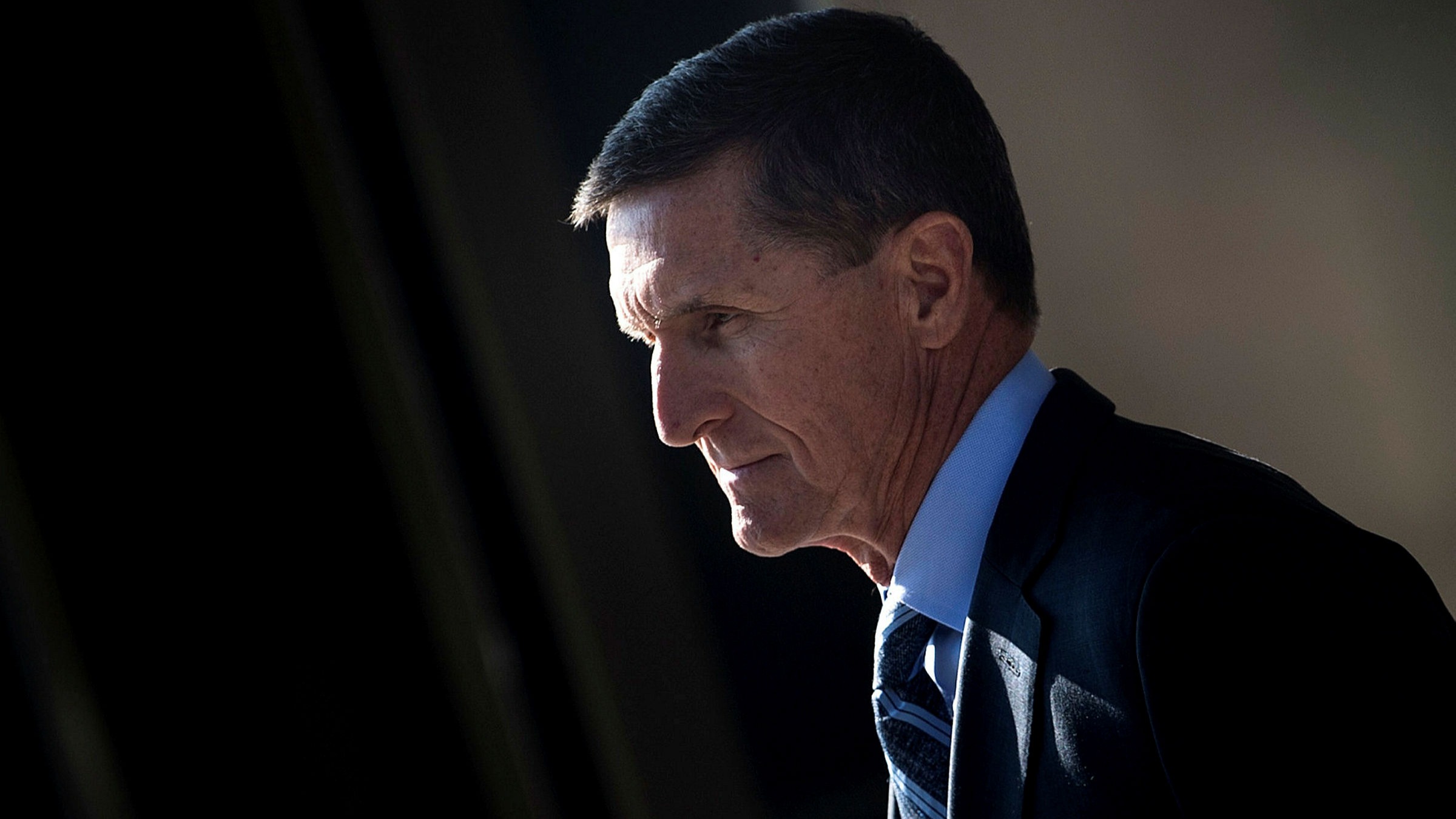
Donald Trump pardons ex-national security adviser Michael Flynn | Financial  Times

WASHINGTON — Michael Flynn was looking for a criminal defense attorney — on the internet.

The sun had set and much of the White House staff had cleared out for the night. Nearly alone, Flynn hovered over his assistant who was seated at her desk just outside his corner office, scanning attorney biographies on her computer screen.

He hadn’t told the president or his top advisers what prompted the Google search: Two FBI agents had interviewed him that afternoon about his contacts with Russia.

It was Flynn’s fifth day as President Donald Trump’s national security adviser. On Feb. 13, 2017, the 25th day of the Trump presidency, Flynn would be gone, fired for lying to the vice president and the FBI.

Now, after twice pleading guilty to making false statements to federal agents, Flynn is a free man — thanks to a president who says his former national security adviser was targeted by an overzealous FBI in a set up orchestrated by political foes. On a balmy Thanksgiving eve in Washington, Trump short-circuited the judicial process to grant Flynn a full pardon. He wished the retired Army general and his family a warm holiday. And Flynn returned the favor by appealing to the president’s leading grievance, writing that his former boss has been “viciously targeted” as a victim of “a coup against our nation.”

The president’s Nov. 25 pardon abruptly capped nearly four years of legal and political drama that began when Trump fired a national security adviser he’d come to privately disparage and ended with the White House declaring Flynn “an innocent man.”

“The president has pardoned General Flynn because he should never have been prosecuted,” the White House statement read. Vice President Mike Pence has so far been silent about the pardon. After portraying himself as a victim of Flynn’s deception who unwittingly repeated his falsehoods publicly, Pence earlier this year said he believes Flynn unintentionally misled him about his clandestine talks with the Russians.

But a comprehensive examination of his time as Trump’s national security adviser, including interviews with more than 20 people who were directly involved in uncovering or covering up his actions, suggests that Flynn knowingly misled investigators and the president’s inner circle repeatedly. Once considered one of the country’s top intelligence officials and skilled in deception, Flynn not only concealed key details of his conversations with Vladimir Putin’s handpicked ambassador in Washington, but also an investigation he knew was closing in on him.

By the end of the first week of Trump’s presidency, as the new administration plunged itself into foreign and domestic turmoil, a small group of senior White House officials had been repeatedly confronted with the truth about Flynn’s conversations with Russia’s ambassador, Sergey Kislyak – that they had discussed newly-imposed U.S. sanctions against Moscow. They also learned that two FBI agents had questioned Flynn about those conversations in a secure conference room just a short walk from the Oval Office, and that he’d answered with a false account similar to the one he’d given Pence.

“Everyone’s forgetting that Flynn was fired because he was lying to everyone,” one senior White House official directly involved with the Flynn matter said recently. “After weeks of asking him, he was still saying he never talked to the Russian ambassador about sanctions.”

And as officials grappled with Flynn’s own cover-up, they too engaged in similar action. The president and his closest aides worked to keep the revelations, including warnings from senior Justice Department officials that Flynn could be blackmailed by the Russians, from the public and just about every senior official in the fledgling administration all the way up to the vice president.

White House officials who worked alongside Flynn when he was national security adviser described a perfect storm of secrecy, distrust, loyalty and confusion that enabled the retired three-star general to remain on the payroll of the American taxpayers, with access to the country’s most tightly held secrets and at the helm of life-and-death decisions — despite knowledge at the highest levels of government that he could be a liability.

Those who agreed to share details from that time spoke to NBC News over many months on the condition of anonymity.

Their recollections revealed angry confrontations between a deceptive Flynn and his colleagues in the West Wing, an indecisive president more worried about his public image than the potential national security implications of Flynn’s actions, and a White House counsel searching for a crime instead of confronting a potential threat. Key evidence that Flynn had lied was only shared with Pence when its existence became public — 15 days after Trump and a handful of senior White House officials were informed of it.

This period of time, which was the subject of intense examination by Special Counsel Robert Mueller, stood at the intersection of his investigations: how Russia interfered in the 2016 election, whether Trump associates conspired with Moscow in that endeavor, and if the president attempted to obstruct the FBI’s investigation into any such coordination.


Flynn was one of the first Trump associates to be ensnared in the Russia investigation – and on Nov. 25 of this year he became the first to be relieved of the legal consequences of being a convicted felon.

Trump’s use of the presidential pardon power circumvented a pending decision by a federal judge, Emmet Sullivan, on whether to move forward with sentencing Flynn after the Justice Department filed a motion on May 7 to dismiss the case. Leadership at the Justice Department wasn’t consulted about the pardon and had preferred to see through the request for dismissal, which argued there was no investigation to justify the FBI interview in which the former national security adviser made false statements.

Flynn admitted to making false statements in that interview not only about his Russia contacts but also his attempt during the Trump transition to scuttle an Obama administration effort to condemn Israeli settlements with a resolution at the United Nations. As part of his plea deal, Flynn further admitted to giving false statements to the Justice Department about being paid for lobbying on behalf of the government of Turkey.

Sullivan balked at the Justice Department’s motion to dismiss a case the president had relentlessly portrayed as unfair in his efforts to undermine the Mueller investigation. Sullivan brought in a retired federal judge — who, as an assistant U.S. attorney, had prosecuted the mafia boss John Gotti — to argue that the judicial branch can reject a Justice Department request to dismiss a case if it’s believed to be politically motivated.

This past summer, Flynn tried to force Sullivan to grant the Justice Department’s motion. But the D.C. Circuit Court of Appeals ultimately rejected the effort.

It was one of many dramatic twists and turns in the sentencing of Flynn since he first appeared in Sullivan’s court in December of 2018. At that time the judge angrily rejected Mueller’s recommendation that Flynn merely be put on probation because he was a model cooperating witness. Over the next year, Flynn made the surprise decision to hire new lawyers, broke from the federal prosecutors he’d cooperated with and requested to withdraw his guilty plea.

“In truth, I never lied,” Flynn wrote in a court filing this past January. “I will fight to restore my good name.”

In response to specific questions about this article, Flynn’s lawyer, Sidney Powell, referred NBC News to court filings posted on her website.

Flynn’s first lawyer, Robert Kelner, declined to comment. The White House and Pence’s office had no comment.

A pardon for Flynn was a long-sought outcome for the president who hired him, fired him and, until losing re-election, said he’d consider bringing him back into the White House.

From his earliest days in office Trump has sought to shield Flynn from federal investigation, reportedly asking his then-FBI director to let any inquiry go. And after distancing himself from Flynn when he cooperated with the Mueller investigation, Trump later latched onto his case as a political cudgel. Flynn became a cause célèbre for the president and his Republican base.

Had Sullivan sentenced Flynn, Trump made clear he would pardon him, and the president’s team had been prepared since at least June for an announcement. “There was no question internally whether he would pardon Flynn,” a senior White House official said. It was just a matter of when.

In September, Powell, Flynn’s lawyer, said during a court hearing that she had spoken with the president directly and asked him not to pardon her client. But with Trump leaving the White House on Jan. 20, time was running out. “That was the motivation,” the senior White House official said of the timing.

Still, the pardon changes nothing about why Trump has said he fired Flynn: because he lied. Neither does Flynn’s reversal on his guilty plea. Or Pence’s newly adopted view that he is now “more inclined to believe” Flynn didn’t intentionally lie to him.

That Flynn remains the leading personification of Trump’s grievances – namely that forces are out to get him – and a catalyst for additional presidential pardons based on similar motivations makes his time as national security adviser and the circumstances around his firing newly germane.

Despite the lies and warnings that Flynn could be compromised, the president and his closest aides didn’t seriously discuss firing Flynn until the controversy was made public by journalists. That delay allowed Flynn to play a leading role in every sensitive national security decision in the early days of the Trump presidency:

* Trump’s hastily executed order banning travel to the U.S. by individuals from some majority-Muslim countries.

* An ill-fated counterterrorism raid in Yemen that led to the death of a Navy SEAL.

* A North Korea missile launch that caught the new administration flat-footed at the president’s Florida resort.

* Flynn publicly put Iran “on notice” over its aggression in the Middle East, a move that foreshadowed sharply escalated tensions between Washington and Tehran.

* As head of the National Security Council, Flynn arranged for a permanent council seat for the president’s chief political strategist, Steve Bannon, an unusual move and an unwelcome surprise to Trump.

Jan. 26, 2017

Trump was unmoved.

White House counsel Don McGahn was sharing what he had just learned: Flynn had been interviewed by the FBI and may have lied. McGahn had just met with Acting Attorney General Sally Yates for about 15 minutes and chief among Yates’ concerns was that Flynn wasn’t truthful with Pence and other White House officials when he told them he had not discussed U.S. sanctions with Kislyak, Russia’s ambassador in Washington, during phone calls several weeks before Trump’s inauguration on Jan. 20, 2017.

Flynn and Kislyak spoke on Dec. 29, 2016, the same day the Obama administration announced new sanctions against Russia in response to Moscow’s interference in the U.S. presidential election held the month before. They spoke again two days later, after Russian President Vladimir Putin announced he would not retaliate against the U.S. for the sanctions. Putin’s restraint had shocked American intelligence officials, who only later learned about Flynn’s discussions with Kislyak while analyzing Russia’s response to the sanctions.

Flynn’s Dec. 29 conversation with Kislyak became public in news reports on Jan. 12. Three days later, Pence said publicly that after talking to Flynn he could confirm that call “had nothing whatsoever to do with those sanctions.” That raised concerns at the Justice Department that Pence might also be in on the deception with Flynn.

The White House didn’t know it but the FBI had previously opened an investigation into Flynn because of concerns about his relationship with the Russian government. And Flynn’s phone calls with Kislyak, as well as his false assurance to Pence that they didn’t discuss sanctions, had raised new alarms among investigators.

McGahn explained Flynn’s possible legal exposure: the perjury statute and the Logan Act, which makes it illegal for any American to negotiate with foreign governments in a dispute with the U.S. without authorization from the current U.S. government.

Trump, with his chief of staff Reince Priebus and senior adviser Stephen Bannon by his side, listened but seemed unphased. He asked McGahn to start again.

McGahn told the president he didn’t think the FBI clearly had Flynn on charges of giving false statements and, after meeting with Yates, McGahn wasn’t sure what the issue was: Is Flynn a security risk? Should the president get rid of him? Is the national security adviser under investigation?

That’s when Trump perked up: “Not again, this guy, this stuff.”

The president had already grown frustrated with Flynn, in what one senior White House official described as “a personality clash.” Trump had started complaining to aides about Flynn during the transition. He thought Flynn interrupted him too much during briefings and that his Kislyak contacts were generating a steady stream of negative press coverage. Just days into his presidency, Trump wouldn’t even look at Flynn during intelligence briefings. “He couldn’t stand Mike Flynn,” another senior White House official said. “He wanted to fire Flynn before he even got to the White House.”

Trump told McGahn, Priebus and Bannon not to discuss the issue with any other White House officials. Instead, he directed them to figure out the problem and come back with a plan.

“Then no one looked into it,” with any urgency, a senior White House official at the time said.

Bannon was the one official among them who seemed to possibly know for weeks that Flynn had been lying. He’d spoken with Flynn about the sanctions on Jan. 1 — the day after Flynn’s second discussion with Kislyak — and they agreed they had “stopped the train on Russia’s response,” according to Mueller’s report.


Trump has insisted he had no knowledge of Flynn’s discussions about sanctions with Kislyak before the talks took place, though federal investigators later found it implausible that senior officials including Bannon and Flynn would have kept it from him.

The circle of people with knowledge of Flynn’s lies, his FBI interview, and the Justice Department’s warning, was tight. But McGahn made a decision to widen it slightly when he ignored Trump’s instructions and tapped John Eisenberg, a deputy White House counsel and legal adviser to the National Security Council, to figure out whether Flynn had given false statements to the FBI or violated the Logan Act.

McGahn also figured there must be a recording of Flynn’s phone call with Kislyak that they could listen to. The National Security Agency had wiretapped the phone of the Russian ambassador. It’s a standard U.S. intelligence operation that Flynn, a former military intelligence officer, later said he knew about when the FBI interviewed him on Jan. 24.

Deputy FBI Director Andrew McCabe had called Flynn on a secure phone line around lunch time that day to tell him the FBI wanted to come by the White House to talk to him about his contacts with Russians.

McCabe told Flynn he could have a lawyer present, though stressed that the matter would be handled more quickly if he didn’t. He also said if Flynn did bring along a lawyer, officials at the Justice Department would also have to get involved.

Flynn replied that he didn’t need a lawyer.

He agreed to meet without asking McCabe for any details.

Ahead of their arrival at the White House, FBI officials discussed how to approach Flynn. “What’s our goal? Truth/Admission or to get him to lie so we can prosecute him or get him fired?” one official wrote in a memo.

By 2:15 p.m. Flynn was alone in the White House with two FBI agents, including FBI Deputy Assistant Director Peter Strzok. Flynn appeared in a good mood. He talked about everything from hotels he’d stayed at during the presidential campaign to terrorism to Trump’s knack for interior design. He even offered the agents “a little tour” of the West Wing, walking them right past Trump and a couple of movers discussing where to place artwork.

When the conversation moved to his contacts with Kislyak, Flynn “was fully aware that federal officials routinely monitor, record, and transcribe such conversations with foreign officials,” he later wrote in a court filing, and knew the FBI probably had transcripts of his calls.

And yet there in the White House, with the two FBI agents, he denied asking Kislyak to hold back on moves that would escalate tensions. “It wasn’t, ‘don’t do anything,’” he said.

Flynn also said he didn’t remember a follow-up conversation with Kislyak, after Putin announced he would not escalate. That’s when the ambassador told Flynn his request had gone to the highest levels of the Russian government.

Despite the obvious discrepancies, the agents later noted that Flynn displayed no “indicators of deception” and didn’t leave them with the impression that he was lying or thought he was lying. Within hours of their departure, Flynn would be on the hunt for a lawyer.

Jan. 27, 2017

It’s possible the president’s national security adviser broke the law.

That’s what deputy White House counsel Eisenberg told his boss on a Friday morning, exactly one week after Trump’s inauguration.

After an initial look at Flynn’s conduct, Eisenberg suggested that Flynn might have given false statements to the FBI or violated the Logan Act. But, he noted, no one has ever been successfully charged under the Logan Act, and he downplayed the likelihood the Justice Department would pursue such charges.

McGahn told Eisenberg to ask Yates back to the White House for another meeting.

McGahn, Priebus and Bannon were already suspicious of Yates, a holdover from the Obama administration, and questioned her motives. Obama officials made clear they had no respect for Flynn. Obama had ousted Flynn as director of the Defense Intelligence Agency in 2014. And after the 2016 election, Obama personally advised Trump against hiring Flynn.

McGahn’s second meeting with Yates was also 15 minutes long but more contentious. McGahn questioned why it would matter to the Justice Department if one White House official lied to another. Yates replied that this situation “was a whole lot more than that,” walking McGahn again through her concerns.

He asked if taking action against Flynn would interfere with an FBI investigation into his conduct. Yates said it would not. “It wouldn’t really be fair of us to tell you this and then expect you to sit on your hands,” she said.

That’s when McGahn asked for evidence. “Is this something we could see?” Yates said she couldn’t give him the recordings of Flynn’s conversation but said she’d look into getting him transcripts.


A few paces away in the Oval Office, Trump called FBI Director James Comey, who was in charge of the Russia investigation, to invite him to the White House that night for dinner. The previous evening, Trump had asked several of his senior advisers during dinner what they thought of Comey.

Bannon and Priebus seemed nervous about the president dining alone with the FBI director. “Do you want someone to come with you?” Bannon asked Trump. Trump said he wanted to have dinner with Comey alone, that he was just meeting with him to decide whether to keep him in the job.

“Don’t talk about Russia, whatever you do,” Priebus told the president. Trump promised he wouldn’t.

But alone with Comey in the Green Room on the main floor of the White House, Trump did just that.

And he indicated he was souring on Flynn. To illustrate the point, he told Comey a story about Flynn waiting six days after Putin had reached out to Trump to schedule a return phone call with the Russian leader.

“The guy has serious judgment issues,” Trump said.

Jan. 28 to Feb. 2, 2017

“How’d it go?” Bannon asked the president the next after his dinner with Comey.

All the president revealed was that he had determined Comey was a good guy whom he intended to keep.

It was Saturday and Trump was about to hold his first phone call as president with Putin. Kislyak had tried multiple times for weeks to get Flynn to arrange for the two leaders to speak the day after Trump’s inauguration. The Russians had wanted it to be via secure video. But Flynn didn’t respond to those requests from Kislyak, who even left a voicemail for the incoming national security adviser the day before the inauguration asking for “an answer to the idea of our two president’s speaking.”

A week after the Russians had hoped that conversation would take place, Flynn, Pence, Priebus, Bannon and White House press secretary Sean Spicer had gathered around the Resolute Desk, while Trump was on the phone call with Putin.

Across the West Wing, a different phone call was about to be set up.

Mary McCord, the acting assistant attorney general who had accompanied Yates to her first meeting with McGahn, received an email sent from Flynn’s White House account requesting a secure phone call to follow up on the McGahn meeting. It was odd enough that Flynn was sending her an email. But what made this truly a mystery for McCord is that the email was signed by Eisenberg.

She decided not to reply and instead sent a new email directly to Eisenberg.

The following day, she and Eisenberg spoke. He told McCord that he had been in Flynn’s office the day before and an assistant had accidentally switched his and Flynn’s phones when giving them back. He then said that he and Flynn had the same password for their phones, and so he accidentally sent the email from the national security adviser’s account.

He also told McCord that from now on he would be handling the Flynn matter, not McGahn.

They spoke again the next day, Monday, about arranging for Eisenberg to review the transcripts of Flynn’s call with Kislyak. Yates also called McGahn to tell him the transcripts were ready for review.

Within hours of their discussion that morning of Jan. 30, Trump fired Yates, citing her refusal to enforce his travel ban.

McCord emailed Eisenberg Tuesday to say the transcripts were ready for him to review and she put him in touch with Peter Strzok, one of the FBI agents who interviewed Flynn and was involved with the case.

Eisenberg didn’t respond. She emailed him again the following day to ask if he’d accessed the transcripts. He didn’t respond until Feb. 2.

Within hours, two FBI agents arrived at the White House carrying a secure briefcase containing the highly classified transcripts.

McGahn told Eisenberg to look them over and report back on potential issues.

Flynn, meanwhile, held a meeting with National Security Council officials in the auditorium of the Eisenhower Executive Office Building next to the White House.

When one of them asked him what he thought about Yates refusing to defend Trump’s travel ban — and generally the idea of an administration official refusing to implement a president’s policies — Flynn was dismissive. “What she did was illegal,” he replied.

Eisenberg sat with the two FBI agents in McGahn’s West Wing office and read through the transcripts. It was clear Flynn had misled Pence.

But it wasn’t clear to Eisenberg what criminal charge deceiving the vice president would bring.

Eisenberg asked the FBI agents: Is this it? What am I missing? Is this a big deal?

The agents remained stone-faced and didn’t respond.

The agents packed up the documents in the briefcase and left the White House.

Eisenberg wrote a memo outlining the possible crimes Flynn could be accused of committing. But he wasn’t sure the White House had enough information to make a recommendation to the president. He discussed his findings with McGahn and they agreed that Flynn was unlikely to be charged with violating the Logan Act. However, they remained unsure if Flynn was vulnerable to a charge of giving false statements in his FBI interview.

The next day, Flynn had a private lunch with Trump in the presidential dining room.

Feb. 6 to Feb. 8, 2017

Trump had barely begun settling into the White House and was already seething over the latest chyrons scrolling across cable news about his administration.

He was in the Oval Office with Flynn, complaining about negative media coverage that had been circulating for almost a month about the calls with Kislyak. The details of Trump and Flynn’s private conversation were disclosed by Flynn to investigators and included in the final report issued by the Special Counsel.

The president wanted specifics. So Flynn dutifully listed the dates on which he said he had spoken with Kislyak.

When Trump asked what he and Kislyak talked about — the question driving the controversy — Flynn said that they might have discussed the Obama administration’s sanctions against Russia. It was a stunning departure from his insistence to the vice president, other senior White House officials, and the FBI that the topic had not come up.

Trump didn’t seem particularly shocked, according to Flynn’s own retelling of the meeting. And, he told investigators, that the president actually corrected him on one of the dates on which he said he’d spoken with Kislyak.

At 4 p.m. on Wednesday, Feb. 8, Comey arrived at the White House for a meeting with Priebus.

Trump had suggested that his chief of staff be the FBI director’s main point of contact in the White House, so Priebus had invited Comey over for what he described as a “meet and greet.” After some initial discussion of immigration issues, intelligence gathering and leaks, Priebus steered the conversation to Flynn.

“Do you have a FISA order on Mike Flynn?” Priebus asked, referring to a top-secret warrant to wiretap an American citizen suspected of being a spy for a foreign government.

It was highly unusual for a White House chief of staff to ask the FBI director such a question. But Comey agreed to answer and said there wasn’t a FISA warrant on Flynn.

A few hours later Flynn had a meeting with a Washington Post reporter. At the end of their discussion on a variety of foreign policy issues, the reporter asked Flynn if he was sure he didn’t discuss sanctions with Kislyak during their Dec. 29 call.


Despite denials, the Post had learned from multiple administration officials that Flynn had raised the topic on the call.

Although he had told Trump in the Oval Office that he might have, Flynn again repeated the answer he’d given multiple times: he was sure sanctions weren’t discussed. The reporter asked if that could be on the record, and Michael Anton, the NSC’s spokesperson, agreed.

Around 10 p.m., however, Flynn called Anton to ask the status of the Post’s story. Changing his story once again, Flynn told Anton he could no longer say with 100 percent confidence that he didn’t discuss sanctions with Kislyak. Anton called the Post reporter with a new statement — and unsuccessfully asked the paper not to report that Flynn had said just hours earlier that sanctions weren’t discussed.

The new statement that Flynn “couldn’t be certain that the topic never came up” was carefully worded but marked a sea change. Neither Flynn nor Anton told other senior officials about the new statement.

Feb. 9 to Feb. 10, 2017

At 9:30 p.m. on Feb. 9, the Post published its article. It immediately set off a firestorm inside and outside the White House. Nearly everyone in the West Wing was blindsided.

“We went bananas,” said a senior White House official who was there at the time.

Only then did McGahn, whom Trump had tasked with looking into Flynn’s conduct, decide to refocus on the issue.

Priebus was having dinner with the president in the White House residence when McGahn, who still had not read the transcripts of Flynn’s calls with Kislyak, urgently asked him to leave the dinner to discuss the Post article. Priebus was fuming. They summoned Flynn from the national security adviser’s suite, and a handful of senior White House officials, including White House counsel, deposed him in Priebus’ office.

“What the f— is going on?” Priebus asked Flynn.

Flynn responded that he now wasn’t completely sure if sanctions had come up in the Kislyak call.

“Well, you told me that didn’t happen, so which is it?” Priebus said to Flynn, who responded again that he was unsure.

Around 6:20 the following morning, Pence’s aide, Marc Lotter walked over to the West Wing to see Anton.

“We have a problem,” he said, adding that Flynn had “essentially made the Vice President of the United States a liar” by telling him he hadn’t discussed sanctions with Kislyak – a lie Pence then repeated in a nationally televised interview. Pence wanted to read the transcripts of Flynn’s Kislyak calls.

When David Ignatius of the Washington Post first reported that Flynn had spoken with Kislyak the day the Obama administration’s sanctions were announced, Flynn directed his deputy, KT McFarland, to call the columnist and say that he and the Russian ambassador did not discuss sanctions during the call.

“I want to kill the story,” Flynn told McFarland.

After McFarland spoke with the columnist, the Post updated his article with an anonymous Trump official saying Flynn and Kislyak did not discuss sanctions.

Pence knew he’d be asked about it during an interview the following Sunday on CBS, and he wanted to hear Flynn’s explanation directly. He called the incoming national security adviser, who told the vice president-elect that the topic of sanctions never came up. And that’s what Pence said on national television.

It was almost a month after Flynn told Pence he hadn’t discussed sanctions with Kislyak that Pence wanted to compare his conversation with Flynn to the ones Flynn had with Kislyak.

McCabe had been at the White House for an unrelated briefing that morning. When he got to his car outside the West Wing, his driver told him the White House had been frantically trying to reach him.

He connected by phone with Priebus who said the Vice President wanted to see the transcripts — now. McCabe said he’d have to get them.

“Where’s your office?” Priebus asked.

McCabe, the deputy director of the FBI, explained that he worked out of FBI headquarters.

The transcripts of Flynn’s phone calls with Kislyak were brought to the White House in a secure briefcase, just as they were eight days earlier.

Pence, his chief of staff Nick Ayers, Priebus and McGahn huddled in a conference room in the Situation Room suite reading the transcripts. McCabe remained in the room and at one point was asked whether Flynn had violated the Logan Act. He told the group that was a possibility that the FBI was investigating.

Pence asked Ayers to get him a printed copy of his CBS interview. After Ayers returned with it, Pence compared the transcript of his interview with the transcripts of Flynn and Kislyak.

He barely spoke as he read through the documents line by line.

“Number one, what I would ask you guys to do – and make sure this, make sure that you convey this, okay?” the transcript showed Flynn said to Kislyak during their Dec. 29 call – the day the Obama administration announced the Russia sanctions – “do not uh, allow this administration to box us in, right now, okay?”

“I know you have to have some sort of action,” Flynn continued. “Make it reciprocal. … Don’t go any further than you have to. Because I don’t want us to get into something that has to escalate.”

Kislyak explained that one of the problems Moscow had is in addition to expelling Russian diplomats from the U.S., the Obama administration just sanctioned key Russian intelligence entities.

“So that’s something that we have to deal with,” Kislyak said to Flynn. “But I’ve heard what you say, and I certainly will try to get the people in Moscow to understand it.”

Flynn made the case that “we need cool heads to prevail.”

Pence compared that to the transcript of his response on CBS, when asked about Flynn’s Dec. 29 phone call with Kislyak.

“I talked to General Flynn about that conversation,” Pence said in the interview. “They did not discuss anything having to do with the United States’ decision to expel diplomats or impose censure against Russia.”

“So did they ever have a conversation about sanctions ever on those days or any other day?” Pence was asked.

“They did not,” the vice-president elect replied.

Pence read the transcript of a follow-up call between Flynn and Kislyak on Dec. 31, after Russia announced it would not retaliate for the sanctions.

“I have a small message to pass to you from Moscow,” Kislyak told Flynn.

“I appreciate the steps your president has taken. I think that it was wise,” Flynn interjected.

“I just wanted to tell you that our conversation was also taken into account in Moscow,” Kislyak said.

“Good,” said Flynn.

“Your proposal that we need to act with cold heads, uh, is exactly what is uh invested in the decision,” Kislyak added.

“Good,” Flynn said again.

In Pence’s interview on CBS, the transcript showed, he had dismissed the idea of more than one conversation between Flynn and Kislyak. “I don’t believe there were more conversations,” he said.

“He was smoldering,” one person in the room described Pence as he read the transcripts.

Priebus got up in the middle of the meeting, said he’d seen enough, and left the room.

Afterward, Pence was clear: The transcripts revealed that Flynn hadn’t been truthful. But Pence wanted to think about whether he’d advise the president to fire Flynn.

More than two weeks after Yates’ first warning about Flynn, McGahn, Priebus and Bannon had the first serious conversation with Trump about whether to fire the national security adviser. They told Trump they had reviewed the transcripts of Flynn’s call with Kislyak, and that it was clear he had lied to Pence.

Priebus, who early on thought Flynn had to go, was even more certain. Flynn either knowingly lied to the vice president — which Priebus and McGahn believed he had done — or he was too incompetent to serve as national security adviser if he couldn’t remember details like the topics of his conversation with the Russian ambassador. Neither, from their perspective, was acceptable. All three advisers recommended Trump fire Flynn.

The drama unfolded behind the scenes as Trump welcomed Japanese Prime Minister Shinzo Abe to the White House for official meetings, followed by a weekend at his sprawling South Florida estate, Mar-a-Lago.

As national security adviser, Flynn had a high-profile role in Abe’s visit that day.

That afternoon Flynn joined Trump and senior White House officials on Air Force One for the flight to Florida and the weekend with Abe.

Trump wandered to the press cabin in the back of the plane while giving his wife a tour of the aircraft and told reporters he hadn’t seen the Post report on Flynn.

“I don’t know about that,” he said.

Feb. 11 to Feb. 12, 2017

“What’s he doing here?” Trump snapped to a friend when he saw Flynn that weekend at Mar-a-Lago.

The controversy over Flynn’s contacts with Kislyak showed no signs of waning. Yet Flynn felt confident he would weather the firestorm.

He played a role in the scramble that night on the outdoor terrace at Mar-a-Lago as the U.S. and Japanese delegations were dining, to craft a response to a North Korean missile test.

White House aide Stephen Miller was asked the following morning on the Sunday news shows whether Trump has confidence in Flynn, and he did not have an answer.

Meanwhile, Flynn was among those helping plan for Trump’s Monday meeting with Canadian Prime Minister Justin Trudeau at the White House.

On the president’s flight back to Washington Sunday, Flynn was in the conference room on Air Force One leaning over an aide to go over some paperwork, his image splashed on a large flat-screen TV behind him showing news coverage about whether he’d be fired.

During the flight, Trump asked Flynn if he had lied to Pence. Flynn said he might have forgotten details of his conversations with Kislyak but he didn’t believe he had lied. “OK,” Trump said. “That’s fine. I got it.”

After landing at the military base in Maryland where Air Force One is kept, Flynn was among the handful of aides who joined the president on his helicopter for the flight back to White House.

Feb. 13, 2017

Trump was still unsure about whether Flynn should go.

“He was torn,” said a White House official who was involved in the discussions.

The White House plan was for Flynn to do TV interviews that day criticizing North Korea’s test launch. And Flynn juggled national security meetings throughout the morning, ducking out of lunch with Trudeau to deal with a hiccup in the rollout of a major escalation in U.S. sanctions on a top government official in Venezuela that the administration was about to announce.

In a parallel set of Monday morning meetings, Trump’s most senior aides were vigorously debating Flynn’s future.

McGahn, Priebus and Bannon shuttled back and forth between the Oval Office and the chief of staff’s suite. All three had advised firing Flynn.

But Trump’s view was that firing his national security adviser after just a few weeks would play into the hands of his critics. And he worried about how it would reflect on him.

“It’s going to make me look bad,” he told his advisers. “We’re going to look like a bunch of clowns.”

Spicer told reporters Trump was “evaluating the situation” and speaking with Pence and others about the issue.

One of the president’s top aides thought Trump was trying to shift the burden of deciding whether to fire Flynn onto Pence when he said: “Mike, he disappointed you. He let you down.” Flynn had apologized privately to Pence who wasn’t happy with him. Still, Pence told Trump he’d support whatever decision he made.

By the afternoon, Trump had concluded that Flynn had to go. He tasked Priebus with delivering the news. A resignation letter was prepared and Priebus delivered the news.

“Flynn said he wanted to take a shot at drafting the letter,” one senior White House official who was there at the time said. “But there was a draft given to him.”

Flynn asked to say goodbye to Trump, so Priebus brought him to the Oval Office for his last meeting as Trump’s national security adviser. “He didn’t see this coming,” the official said of Flynn.

Trump hugged his national security adviser of just 24 days and shook his hand. “We’ll give you a good recommendation,” the president told him. “You’re a good guy. We’ll take care of you.”

Publicly, the White House had been sending a different message. Kellyanne Conway, the president’s counselor, said in an afternoon TV interview that Trump had full confidence in Flynn.

McGahn, meanwhile, worked with the White House press office on drafting talking points on Flynn’s resignation that said the president had been advised Flynn was unlikely to be prosecuted for any crime, but that Flynn had lost the president’s trust.

Before the White House announced Flynn’s resignation, The Washington Post published a detailed account of Yates’ Jan. 26 warning about him to McGahn.

Once again, the White House press office was caught off guard. McGahn hadn’t told officials about the meeting, even after the initial report about Flynn discussing sanctions with Kislyak.

“You didn’t need to know,” McGhan told Spicer.

Spicer told reporters that Flynn’s departure was “not based on a legal issue but based on a trust issue.”

After Flynn

Trump seemed relieved during lunch at the White House with New Jersey Gov. Chris Christie, a friend, and Jared Kushner, his son-in-law and senior adviser.

“Now that we fired Flynn, the Russia thing is over,” Trump told Christie. A former federal prosecutor, Christie laughed. “No way,” he said. “This thing is far from over.” And he warned Trump that Flynn would never go away, “like gum on the bottom of your shoe.”

Around 4 p.m., after a homeland security briefing, Trump asked Comey to stick around and kicked all the other officials out of the Oval Office, including the attorney general.

“I want to talk about Mike Flynn,” Trump said to Comey.

“He’s a good guy and has been through a lot,” Trump said, insisting Flynn didn’t do anything wrong in talking to the Russian ambassador but had to be fired for lying to Pence. “I hope you can see your way clear to letting this go, to letting Flynn go.”

Trump never said publicly or privately that Flynn had lied to him. Just to Pence, and, in a tweet in December 2017, the FBI.

Comey interpreted the president’s words “letting this go” as a directive to stop investigating Flynn. At this point in the FBI’s investigation, no grand jury subpoenas had been issued.

Yet the president still seemed worried that Flynn’s legal troubles might ensnare him. Ten days after Flynn was fired, Trump ordered Priebus to have the deputy national security adviser write an internal email saying that Trump did not direct Flynn to call Kislyak to discuss sanctions.

The deputy, KT McFarland, was already uncertain about her own future. She had been asked to resign and told a possible ambassadorship to Singapore was on offer. But she wasn’t sure about the truthfulness of the claim the president wanted her to make.

She consulted the White House counsel’s office and Eisenberg advised her against writing the email. Priebus then later did the same, coming by her office to tell her not to write it and to forget he even mentioned it.

Trump then asked Priebus to call Flynn to check in and tell him the president still cared about him. Priebus did and added that Flynn is an American hero. And then the president asked McFarland to convey to Flynn he felt bad for him and he should stay strong.

On March 5, McGahn learned the FBI had asked the presidential transition team for documents relating to Flynn. The president told his aides he wanted Dana Boente, the acting attorney general in charge of the Russia investigation, to find out whether he or the White House was under investigation.

Concerned about what else might come out on Flynn and the Russia investigation generally, Priebus and Bannon set up a Russia “war room” inside the White House in May, in part to compile a thick file on Flynn that included detailed diagrams on whom he met with and what conflicts he might have had. The idea was to be prepared with responses before any damaging new stories emerged.

But the “war room” was disbanded soon after because, some officials believed, the White House response was increasingly handled by a very tight circle of aides as the Mueller investigation appeared to get closer to members of the president’s family.

Six months later, Flynn began cooperating with Mueller’s investigation. His lawyer informed the president’s legal team that he could no longer share information with him, a typical step for someone whose client has decided to cooperate with investigators.

Trump’s personal lawyer at the time, John Dowd, left a voicemail for Flynn’s lawyer on Nov. 22, 2017, saying if “any information that implicates the president” comes up, “we need some kind of heads up. Um, just for the sake of protecting all of our interests if we can.” He then added that Trump’s feelings about Flynn hadn’t changed.

Flynn’s lawyer returned the call to reiterate that he couldn’t share information anymore. Dowd said the decision indicated a hostility toward Trump and he’d be sure to relay that to the president. Flynn’s lawyer took Dowd’s comments as an attempt to get Flynn to reconsider cooperating.

Before Flynn’s plea agreement was publicly disclosed in December, Jared Kushner spoke with Mueller’s team about the two issues the former national security adviser pleaded guilty to lying about: the Kislyak calls and Trump transition officials’ efforts to derail an Obama administration policy on Israel.

Five days after Flynn pleaded guilty in a Virginia federal court to lying to the FBI, Trump called then-Attorney General Jeff Sessions into the Oval Office. Sessions had infuriated Trump by recusing himself because of his own contacts with Kislyak and his deep involvement in the Trump campaign. Trump suggested to Sessions that he “unrecuse” himself and take control of the Russia investigation.

“You’d be a hero,” the president said.

Mueller concluded that it would have been reasonable for Flynn to want Trump to know about his conversations with Kislyak, given that the ambassador had indicated to Flynn that his request for Moscow not to retaliate had been relayed went all the way to Putin.

The special counsel also noted that when Trump explained why he fired Flynn, he never said that Flynn had lied to him, just to Pence. Still, he wrote, “the evidence is inconclusive and could not be relied upon to establish the president’s knowledge.”

Pence was asked in Dec. 2017 if he knew Flynn had lied to the FBI at the time he was fired. “”What I can tell you is that I knew that he had lied to me,” Pence told CBS. “And I know the president made the right decision with regard to him.”

Flynn reaffirmed his guilty plea at his first sentencing hearing in December 2018, when Judge Sullivan rejected the Mueller team’s recommendation of probation.


Over the next 23 months, the alliance between Flynn and federal prosecutors frayed – and the Justice Department under the new leadership of Attorney General Barr intervened.

“There was a lot of pressure on the Justice Department,” one person close to the White House said.

Flynn requested to withdraw his guilty plea on Jan. 14, 2020 – almost three years to the day that Pence publicly assured the country that Flynn had not discussed sanctions with Kislyak. . In response, federal prosecutors revised their sentencing recommendation to include a short jail sentence.

Several weeks later the prosecutors reversed that position to again say probation is an “appropriate” sentence, fueling speculation that pressure from the top levels of the Justice Department was weighing in on cases in which the president had a keen interest.

Unknown publicly at the time was that Barr was seeking an internal review of Flynn’s case, specifically his FBI interview. In February, Barr tasked a U.S. attorney in Missouri with investigating the circumstances surrounding the interview. That led to the Justice Department’s determination that Flynn’s case should be thrown out because “evidence is insufficient to prove its case beyond a reasonable doubt.”

The request followed a public shift by Flynn that aligned more closely with the president’s narrative.

“When FBI agents came to the White House on January 24, 2017, I did not lie to them,” Flynn wrote in a court filing. “I believed I was honest with them to the best of my recollection at the time.”

Yet for officials who worked with Flynn in the White House at the time — who asked him repeatedly for weeks if he’d talked about sanctions with Kislyak and were told no — the mystery still lingers: why wasn’t he honest with them?

“The biggest question that’s never been answered is why didn’t he tell everyone in the West Wing that he talked to him about sanctions?” one official said. “Because no one would have cared if he did.”

When he leaves office, can ex-President Trump be trusted with America’s national security secrets?

When he leaves office, can ex-President Trump be trusted with America’s national security secrets?

Ken Dilanian                     

WASHINGTON — When David Priess was a CIA officer, he traveled to Houston, he recalls, to brief former President George H.W. Bush on classified developments in the Middle East.

It was part of a long tradition of former presidents being consulted about, and granted access to, some of the nation’s secrets.

Priess and other former intelligence officials say Joe Biden would be wise not to let that tradition continue in the case of Donald Trump.

They argue soon-to-be-former President Trump already poses a danger because of the secrets he currently possesses, and they say it would be foolish to trust him with more sensitive information. With Trump’s real estate empire under financial pressure and his brand suffering, they worry he will see American secrets as a profit center.

“This is not something that one could have ever imagined with other presidents, but it’s easy to imagine with this one,” said Jack Goldsmith, who worked as a senior Justice Department official in the George W. Bush administration.

“He’s shown as president that he doesn’t take secret-keeping terribly seriously,” Goldsmith said in an interview. “He has a known tendency to disrespect rules related to national security. And he has a known tendency to like to sell things that are valuable to him.”

Goldsmith and other experts noted that Trump has a history of carelessly revealing classified information. He told the Russian foreign minister and ambassador in 2017 about extremely sensitive terrorism threat information the U.S. had received from an ally. Last year he tweeted what experts said was a secret satellite photo of an Iranian nuclear installation.

Image: President Donald Trump meets with Russian Foreign Minister Sergey Lavro (Russian Foreign Ministry Photo / AP)


The president also may be vulnerable to foreign influence. His tax records, as reported by the New York Times, reveal that Trump appears to face financial challenges, having personally guaranteed more than $400 million of his companies’ debt at a time when the pandemic has put pressure on the hotel industry, in which Trump is a major player.

“Is that a risk?” said Priess, who wrote “The President’s Book of Secrets,” about presidents and intelligence. “If it were someone applying for a security clearance, damn right it would be a risk.”

The White House did not respond to requests for comment. The Biden transition declined to comment.

Trump has said his finances are sound, and that the debts are a small percentage of his assets. Generally, though, large debts to foreign banks — Trump’s biggest creditor is reported to be Deutsche Bank, a German institution with links to Russia — would exclude a person from a top secret clearance.

Presidents, however, are not investigated and polygraphed for security clearances as all other government officials are. By virtue of being elected, they assume control over all the nation’s secret intelligence, and are allowed by law to disclose any of it, at any time, to anyone.

Former presidents aren’t subject to security clearance investigations, either. They are provided access to secrets as a courtesy, with the permission of the current president.

Typically, former presidents are given briefings before they travel overseas, or in connection with an issue about which the current president wishes to consult them, Priess and other experts say.

When President Bill Clinton sent former president Jimmy Carter to diffuse a tense stand off in Haiti, for example, Carter likely received classified briefings on the situation ahead of his trip.

And when George H.W. Bush visited his son in the White House, he sat in on on the President’s Daily Brief, the highly classified compendium of secrets that is presented each morning to the occupant of the Oval Office, according to Priess, who interviewed both men for his book.

It’s unclear whether former President Barack Obama has received intelligence briefings after he left office, but President Trump said in March that he hasn’t consulted his predecessors about coronavirus or anything else.

Former presidents have long made money after leaving office by writing books and giving speeches, but no former president has ever had the kind of international business entanglements Trump does. Trump has business interests or connections in China, Russia and other U.S. adversary countries that covet even tiny portions of what he knows about the American national security state.

That said, Trump probably is not conversant with many highly classified details, experts say, He was famous for paying only intermittent attention during his intelligence briefings and declining to read his written materials. Moreover, intelligence officials tend not to share specifics about sources and methods with any president, unless he asks.

So Trump probably doesn’t know the names of the CIA’s spies in Russia, experts say. But presumably he knows a bit about the capabilities of American surveillance drones, for example, or how adept the National Security Agency has been at intercepting the communications of various foreign governments.

Trump disclosed secret weapons system to Woodward

The president revealed to Bob Woodward in the new book ‘Rage’ that he had built a secret weapons system. The panel discusses.

Like so much with Trump, his track record of sharing secrets has been unprecedented in American presidential history.

In interviews with the journalist Bob Woodward for a book released this fall, Trump boasted about a secret nuclear weapons system that neither Russia nor China knew about.

According to the Washington Post, Woodward’s sources “later confirmed that the U.S. military had a secret new weapons system, but they would not provide details, and that the people were surprised Trump had disclosed it.”

When Trump briefed the public about the commando raid that killed ISIS leader Abu Bakr al Baghdadi, he disclosed classified and sensitive details, according to reporting by NBC News.

In 2017, Trump gave the location of two American nuclear submarines near North Korea to the president of the Philippines.

That same year, a member of his golf club at Mar-a-Lago took a photo of a briefing Trump and the Japanese prime minister were receiving in a public area about North Korea, and posted it on Facebook.

Image: Donald Trump and Shinzo Abe at Mar-a-Lago (Nicholas Kamm / AFP - Getty Images file)
Image: Donald Trump and Shinzo Abe at Mar-a-Lago (Nicholas Kamm / AFP – Getty Images file)


In 2018, the New York Times reported that Trump commonly used insecure cell phones to call friends, and that Chinese and other spies listened in, gaining valuable insights.

Doug Wise, a former CIA officer and Trump critic, argued this week in a piece on the Just Security web site that Trump has long posed a national security danger, and that affording him access to secrets after he leaves the White House would compound that danger.

Trump’s large debts, he wrote, present “obvious and alarming counterintelligence risks” to the United States.

Russian President Vladimir Putin, for one, would have a great incentive to pay Trump to act on Russia’s behalf, Wise wrote.

“Assuming President Joe Biden follows custom, Trump would continue to have access to sensitive information that the Russians would consider valuable,” he wrote. “As horrifying as it would seem, could a financially leveraged former president be pressured or blackmailed into providing Moscow sensitive information in exchange for financial relief and future Russian business considerations?”

It was not impossible to envision Trump paid millions on retainer by Gulf Arab states or other foreign governments, Harvard professor Goldsmith said, “in the course of which he starts blabbing and disclosing lots of secrets. It wouldn’t be an express quid pro quo, but people would pay for access to and time with him, knowing that he will not be discreet.”

Former CIA Director John Brennan, a frequent Trump critic who was denied access to his own classified file by the president, said the Biden administration should carefully weigh the question of Trump’s access to future secrets.

“The new administration would be well-advised to conduct an immediate review to determine whether Donald Trump should have continued access to classified information in light of his past actions and deep concern about what he might do in the future,” he said.

Then again, it may never become an issue, said former CIA officer Marc Polymeropoulos, who pointed out that Trump has long displayed “disdain” for American intelligence agencies.

“I would frankly be surprised if he even wanted these briefings,” Polymeropoulos said.