A new Biden proposal would make changes to Advantage plans for Medicare: What to know

USA Today

A new Biden proposal would make changes to Advantage plans for Medicare: What to know

Maureen Groppe, USA TODAY – November 6, 2023

WASHINGTON − The Biden administration wants to make changes to private Medicare insurance plans that officials say will help seniors find plans that best suit their needs, promote access to behavioral health care and increase use of extra benefits such as fitness and dental plans.

“We want to ensure that taxpayer dollars actually provide meaningful benefits to enrollees,” said Health and Human Services Secretary Xavier Becerra.

If finalized, the proposed rules rolled out Monday could also give seniors faster access to some lower-cost drugs.

Administration officials said the changes, which are subject to a 60-day comment period, build on recent steps taken to address what they called confusing or misleading advertisements for Medicare Advantage plans.

Just over half of those eligible for Medicare get coverage through a private insurance plan rather than traditional, government-run Medicare.

Here’s what you need to know.
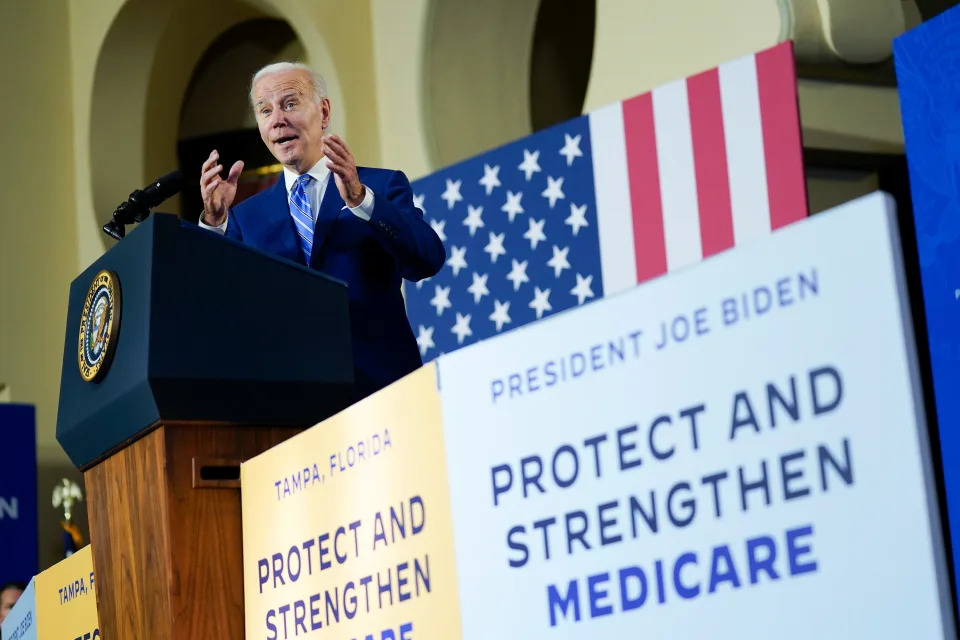
President Joe Biden speaks about his administration's plans to protect Social Security and Medicare and lower healthcare costs, Feb. 9, 2023, at the University of Tampa in Tampa, Fla.
President Joe Biden speaks about his administration’s plans to protect Social Security and Medicare and lower healthcare costs, Feb. 9, 2023, at the University of Tampa in Tampa, Fla.
Extra Medicare benefits

Nearly all Medicare Advantage plans offer extra benefits such as eye exams, dental and fitness benefits. They’re offered at no additional cost to seniors because the insurance companies receive a bump up from their estimated cost of providing Medicare-covered services.

But enrollees use of those benefits is low, according to the Centers for Medicare and Medicaid Services.

To prevent the extra benefits serving primarily as a marketing ploy, the government wants to require insurers to remind seniors mid-year what’s available that they haven’t used, along with information on how to access the benefits.

“The rule will make the whole process of selecting a plan and receiving additional benefits more transparent,” Becerra said.

Broker compensation limits

Because many seniors use agents or brokers to help them find a Medicare Advantage plan, the administration argues better guardrails are needed to ensure agents are acting in the best interest of seniors. Officials said the change would also help reduce market consolidation.

“Some large Medicare Advantage insurance companies are wooing agents and brokers with lavish perks like cash bonuses and golf trips to incentivize them to steer seniors to those large plans,” said Lael Brainard, director of Biden’s National Economic Council.

“That’s not right. Seniors should get the plan that is based on their needs, in their best interests, not based on which plan has the biggest payoff for marketers,” Brainard said.

The proposed changes would broaden the definition of broker compensation so limits on compensation are harder to get around.

Behavioral health care

Medicare Advantage plans must maintain an adequate network of providers. Under the proposed changes, networks would have to include a range of behavioral health providers, including marriage and family therapists and mental health counselors.

An estimated 400,000 of such therapists and counselors will be able to bill Medicare for services next year under recently passed legislation intended to expand access to mental health services.

Lower drug costs

The administration wants to give seniors faster access to cheaper versions of biologic pharmaceuticals, which are made from living cells. The proposed change would give Medicare drug plans more flexibility to substitute a lower-cost version of a biologic – a “biosimilar” – for the more expensive original.

“Any increased competition in the prescription drug market is a key part of our comprehensive effort to lower drug prices,” said Neera Tanden, Biden’s domestic policy adviser.

Medicare Advantage Hospitals, doctors drop private Medicare plans over payment disputes

‘Sandwich generation’ is in a jam and struggling with caregiving costs, survey shows

Yahoo! Finance

‘Sandwich generation’ is in a jam and struggling with caregiving costs, survey shows

Dylan Croll – November 4, 2023

Meeting basic living expenses is tough enough when you go it alone. But what about when you have someone else to look after?

According to New York Life’s new Wealth Watch Survey, nearly half of the “sandwich generation” – folks with children and elderly family members to look after – report being unable to meet basic living expenses, like food or medical care, in the last year due to caregiving costs.

Of those surveyed, 90% say they’ve made a “lifestyle change or financial decision” due to the cost of caregiving.

The study, which surveyed 1,003 sandwich generation adults between Aug. 31 and Sept. 10, shows how unprepared they are for the expenses of caregiving. It also reveals how they’re adapting.

“People should care because you can be individually financially healthy, have your bills under control, have adequate emergency savings,” said Suzanne Schmitt, head of financial wellness at New York Life. “But you’re one caregiving event away from having your own finances challenged.”

Read more: How much money should I have in an emergency savings account?

Portrait of happy and healthy young Asian woman and her mother in the kitchen, home insurance and wellness concept
Is the so-called sandwich generation under financial siege? (Photo: Getty Creative) (BlessedSelections via Getty Images)

The study also reports a demographic shift in those who make up the Sandwich Generation. Millennials, 27-42 years old, are increasingly becoming caregivers. In 2023, the study reported, 66% of self-reported caregivers were millennials while 23% were Gen Xers. Meanwhile, in 2020, merely 39% of caregivers were millennials and 40% were Gen Xers, between the ages of 43 – 58.

Men are also playing a more active role in caregiving, according to the study. For instance, in 2023, 45% of self-reported caregivers were women while 55% were men. That’s in stark contrast to 2020, when 64% of self-reported caregivers were women and 36% were men.

“Males as a result likely of the pandemic are more willing to admit to providing care and are more apt to be pulled into the act of household caregiving for children and also older loved ones,” said Schmitt.

Though more men are becoming caregivers, women still bear a notable financial and emotional load from caregiving. The study found that 72% of men “said they would be able to afford providing the same level of care for their loved ones for at least another year before adjusting their financial plan” while only 54% of women said the same. And the report finds that 50% of women say that caregiving negatively impacts their mental health compared to 39% of men.

Women also continue to spend more hours per week caregiving than men, according to the study.

“Women historically have underreported caregiving, because it’s often just seen by many women as something they simply do,” Schmitt said. “Picking up prescriptions, managing medications, doing grocery shopping, doing cooking.”

Happy African American senior man in wheelchair talking to his daughter who is visiting him in nursing home.
Family caregivers are struggling to make ends meet. (Photo: Getty Creative) (Drazen Zigic via Getty Images)

Meanwhile, the sandwich generation as a whole is struggling to make ends meet as they care for children and the elderly. The study finds that 40% say they “made a financial decision they regret due to mental strain from caregiving.” More than 50% say they’ve “made a sacrifice” when it comes to financial security due to caregiving needs. Of those that have made a financial change due to caregiving responsibilities, 34% reported cutting back on expenses, 26% reported contributing less to their emergency savings, and 26% reported taking on more debt.

Read more: Personal loan vs. credit cards: What to use for an emergency?

On the other hand, the sandwich generations’ financial struggles have also made them more far-sighted. For instance, over 3 in 4 agree that “the experience of caring for their aging relative led them to purchase or explore purchasing financial protection products,” according to the survey. New York Life also reports that 34% of study respondents plan to pay for future caregiving costs by paying more out of their own budget, 28% say they plan to do so by working overtime in their jobs, 27% say they will do so by spending the retirement savings of those they will be caring for.

The sandwich generation is also saving money for their children to take care of them. According to the study, 42% say they’ve put aside $43,136.67 on average.

“As a silver lining in all of this we believe that younger people are starting to have those thoughts and internal dialogue and conversations with spouses and partners earlier in life,” Schmitt said. “Where they simply have more time to save more runway to consider products and solutions, and ultimately be proactive in putting a plan in place before they find themselves in this care.”

House GOP unveils $14.3 billion Israel aid bill that would cut funding to IRS

CBS News

House GOP unveils $14.3 billion Israel aid bill that would cut funding to IRS

Caitlin Yilek – October 30, 2023

Washington — House Republicans want to pay for emergency aid to Israel by cutting funding to the IRS, teeing up a collision with the White House and Democratic-controlled Senate over how to support a key U.S. ally.

The House GOP released a $14.3 billion standalone measure on Monday that would pay for aid to Israel by cutting the same amount in funding that was allocated to the IRS under the Inflation Reduction Act, one of President Biden’s signature pieces of legislation.

“We’re going to have pays-for in [the bill],” House Speaker Mike Johnson told Fox News on Monday. “We’re not just going to print money and send it overseas.”

The Republican bill sets up a battle over support for Israel, with Mr. Biden and Democrats in the Senate wanting to pair aid for Israel with tens of billions of dollars in aid to Ukraine, which some House Republicans oppose. The White House asked Congress for a $105 billion aid package two weeks ago, which included $14 billion for Israel and $61 billion related to Ukraine.

Johnson, who supports separating the aid packages, acknowledged that the cuts to the IRS would be unpopular among Democrats, but said he planned to call Senate Majority Leader Chuck Schumer for a “direct” and “thoughtful conversation.”

“I understand their priority is to bulk up the IRS,” Johnson told Fox News. “But I think if you put this to the American people and they weigh the two needs, I think they’re going to say standing with Israel and protecting the innocent over there is in our national interest and is a more immediate need than IRS agents.”

The president signed the Inflation Reduction Act into law in 2022, and it included hundreds of billions of dollars for Democratic priorities related to climate change, health care costs and taxes. It also boosted the IRS’ funding by $80 billion, allowing the agency to hire thousands of agents and revamp decades-old technological systems. Experts said the upgrades and hiring boost were long overdue and would improve the agency’s ability to process tax returns, but the provision was highly unpopular among Republican lawmakers.

When it comes to aid for Ukraine, Johnson has said he wants more accountability for the billions of dollars the U.S. is spending to help repel Russia’s invasion, specifically asking the White House to detail where the money is going and what the end game in the conflict is.

White House press secretary Karine Jean-Pierre called the bill a “nonstarter” and said it would “set an unacceptable precedent that calls our commitment to one of our closest allies into question.”

“Demanding offsets for meeting core national security needs of the United States — like supporting Israel and defending Ukraine from atrocities and Russian imperialism — would be a break with the normal, bipartisan process and could have devastating implications for our safety and alliances in the years ahead,” she said in a statement Monday.

Democratic Rep. Rosa DeLauro of Connecticut, the ranking member on the House Appropriations Committee, said Monday that offsetting emergency aid with cuts to the IRS sets a “dangerous precedent.”

“House Republicans are setting a dangerous precedent by suggesting that protecting national security or responding to natural disasters is contingent upon cuts to other programs,” the Connecticut Democrat said in a statement. “The partisan bill House Republicans introduced stalls our ability to help Israel defend itself and does not include a penny for humanitarian assistance.”

GOP Sen. Susan Collins of Maine, who serves as vice chair of the Senate Appropriations Committee, said Monday she would prefer to pair aid to Ukraine and Israel.

When asked whether she was concerned about offsetting emergency spending with budget cuts, she said, “Right, the question is where does it end?”

The House Rules Committee plans to take up the GOP’s Israel bill on Wednesday.

New GOP House speaker proposes aiding Israel with IRS funds meant to nab rich US tax cheats

The Week

New GOP House speaker proposes aiding Israel with IRS funds meant to nab rich US tax cheats

Peter Weber, The Week US – October 31, 2023

 House Speaker Mike Johnson.
House Speaker Mike Johnson.

House Republicans on Monday proposed giving Israel $14.3 billion in emergency military aid, but their bill would pay for that aid “by cutting IRS funds aimed at cracking down on rich tax cheats and improving taxpayer service,” The Washington Post reported. The aid package is the first substantive legislation released under new House Speaker Mike Johnson (R-La.). And if it passes in the House, it stands no chance of making it through the Senate.

President Biden requested $14.3 billion to help Israel in its war against Hamas but he paired it with $61 billion in aid for Ukraine plus another $10 billion in humanitarian aid for Ukraine, Israel and Gaza. The Senate is following that approach of bundling the aid together in one package, with bipartisan support. The House GOP bill not only removes the Ukraine aid, but also attempts to take another bite out of the Inflation Reduction Act’s $80 billion for increased enforcement of tax laws among noncompliant wealthy individuals and companies, plus money for the IRS’s new free online tax filing service.

According to the nonpartisan Congressional Budget Office, the $80 billion spent on IRS enforcement would reduce the deficit by nearly $200 billion. The White House said the House GOP’s latest attempt to “help the wealthy and big corporations cheat on their taxes” would grow the deficit. Mark Mazur, a former assistant treasury secretary, said the proposed cuts are “like if you take a dollar from the IRS and throw a $5 bill out the window.”

Johnson defended his “first draft of this bill” on Fox News, saying the priority of Democrats may be “to bulk up the IRS” but most Americans would “say standing with Israel and protecting the innocent over there is in our national interest and is a more immediate need than IRS agents.”

House GOP’s Israel Aid Plan Would Add Billions to Deficit: CBO

The Fiscal Times

House GOP’s Israel Aid Plan Would Add Billions to Deficit: CBO

Yuval Rosenberg – November 1, 2023

Jack Gruber/USA Today

House Speaker Mike Johnson’s plan to cut IRS funding to pay for the cost of a $14.3 billion aid package to Israel would add billions to the deficit over the next 10 years, according to a new estimate from the Congressional Budget Office.

The nonpartisan budget scorekeeper projected that rescinding more than $14 billion in IRS funding as the House GOP proposes to do would scale back the tax agency’s enforcement and consequently decrease revenues by $26.8 billion from 2024 through 2033. The revenue loss would far outweigh the spending cuts, resulting in a net increase in the deficit of $12.5 billion from the IRS portion of the plan — and the aid to Israel would bring the total cost of the bill to nearly $27 billion.

IRS Commissioner Danny Werfel said Tuesday that the cuts to his budget in the House bill would increase the deficit by far more, estimating it would add $90 billion over 10 years — a figure that The Washington Post reports is “based on IRS modeling that shows a 6-to-1 ratio of money spent on tax enforcement to revenue collected.”

House plan is DOA in the Senate: The CBO score was seen as a blow to the House plan, particularly given that if the new speaker had not included the IRS cuts, the aid for Israel would likely pass the House with strong bipartisan support, potentially jamming the Senate and lawmakers who favor packaging aid to Israel with more money to support Ukraine in its war against Russia.

Johnson dismissed the CBO estimate, telling reporters: “We don’t put much credence in what the CBO says.”

In truth, the CBO report is likely little more than a formality at this point since Johnson’s plan — if it can even pass the narrowly divided House — would be doomed in the Senate, where Democrats oppose the IRS funding cuts and are looking to combine aid to Israel with the Ukraine assistance and other emergency funding requested by President Joe Biden.

Senate Majority Leader Chuck Schumer on Wednesday called the House plan “totally unserious and woefully inadequate” and criticized its fiscal effects. “Here, the House is talking about needing a pay-for to reduce the deficit – and they put in a provision that actually increases the deficit. Why? Because they don’t want their super-rich, mega-wealthy friends to be audited by the IRS, like every other citizen is,” Schumer said. “So the House GOP proposal is not going to go anywhere. It’s dead before it even is voted on.”

Schumer urged Johnson to start over in a more bipartisan fashion, but the speaker reportedly told a gathering of Senate Republicans that military aid to Israel must move as a standalone bill because a larger package cannot pass with the support of the House Republican majority. Johnson reportedly also told the senators that he backs more aid to Ukraine but that it would need to be paired with reforms to border security. The speaker, relatively unknown to his Senate counterparts, reportedly also said that he’s focused on passing what he can through the House and would worry later about reconciling those bills with Senate versions.

With the November 17 deadline to avoid a government shutdown approaching, Johnson also said he will look to pass a stopgap spending bill that runs through mid-January rather than the mid-April timeframe he had previously said was also a possibility.

Biden threatens a veto: The White House has made clear that the House plan is unacceptable to President Joe Biden, who would veto it if it somehow lands on his desk.

In a lengthy and forceful statement issued Tuesday evening, the White House slammed the GOP plan as unnecessarily politicizing aid to Israel, excluding essential humanitarian assistance and failing to meet the urgent needs of the moment. “It inserts partisanship into support for Israel, making our ally a pawn in our politics, at a moment we must stand together. It denies humanitarian assistance to vulnerable populations around the world, including Palestinian civilians, which is a moral and strategic imperative. And by requiring offsets for this critical security assistance, it sets a new and dangerous precedent by conditioning assistance for Israel, further politicizing our support and treating one ally differently from others,” the White House said. “This bill is bad for Israel, for the Middle East region, and for our own national security.”

The bottom line: Even with the new CBO score, Johnson and House Republicans plan on passing their Israel aid bill on Friday, setting a confrontational tone for the series of budget battles that lie ahead — and making clear that they have priorities that take precedence over deficit reduction.

US EPA needs to phase out food waste from landfills by 2040 -local officials

Reuters

US EPA needs to phase out food waste from landfills by 2040 -local officials

Leah Douglas – October 31, 2023

FILE PHOTO: Workers use heavy machinery to move trash and waste at the Frank R. Bowerman landfill in California

(Reuters) – A group of local U.S. government officials from 18 states on Tuesday urged the Environmental Protection Agency to phase out food waste disposal in landfills by 2040 to cut emissions of the potent greenhouse gas methane.

Food waste causes 58% of the methane emissions that come from landfills, the EPA said in an Oct. 19 report that calculated those emissions for the first time. The U.S. is lagging on a goal to halve food waste by 2030, and the EPA has been criticized for under-investing in the issue.

“Without fast action on methane, local governments will increasingly face the impacts of warming temperatures, sea level rise, and extreme weather events,” the officials, including the mayors of Seattle and Minneapolis, said in a joint letter to the agency.

They also asked the agency to update landfill standards to better detect and mitigate methane leaks.

More than one third of food produced in the U.S. is wasted, and methane emissions from landfilled food waste are growing, totaling more than 55 million metric tons of CO2 equivalent in 2020, according to the EPA.

Landfills are responsible for about 14% of U.S. methane emissions, according to the EPA. Methane is 28 times stronger than carbon dioxide as a greenhouse gas over a 100-year period.

Some cities and municipalities have voluntary household composting programs for food waste. Residents of New York City, which was not among the cities that signed the letter to EPA, will soon be required to separate food scraps from the rest of their household trash.

The EPA provides resources on its website for household food waste management and has a program for businesses to commit to cutting their food waste, though the agency does not verify their progress.

Food waste will be a priority at this year’s United Nations climate conference, to be held at the end of November in the United Arab Emirates.

(Reporting by Leah Douglas; Editing by Marguerita Choy)

Americans are still putting way too much food into landfills. Local officials seek EPA’s help

Associated Press

Americans are still putting way too much food into landfills. Local officials seek EPA’s help

Melina Walling – October 31, 2023

Shredded organic materials are piled up before being taken to a anaerobic digester at a GreenWaste Zanker Resource Recovery Facility in San Jose, Calif., Friday, Oct. 27, 2023. For the first time since the 1990s, the EPA updated its ranking of preferred strategies for waste reduction, ranging from preventing wasted food altogether (by not producing or buying it in the first place) to composting or anaerobic digestion, a process by which food waste can be turned into energy in the form of biogas. (AP Photo/Jeff Chiu)
A truck loaded with organic material exits a GreenWaste Zanker Resource Recovery Facility with the generators that will convert biogas into electricity at rear in San Jose, Calif., Friday, Oct. 27, 2023. For the first time since the 1990s, the EPA updated its ranking of preferred strategies for waste reduction, ranging from preventing wasted food altogether (by not producing or buying it in the first place) to composting or anaerobic digestion, a process by which food waste can be turned into energy in the form of biogas. (AP Photo/Jeff Chiu)
Generators that will convert biogas into electricity sit at a GreenWaste Zanker Resource Recovery Facility in San Jose, Calif., Friday, Oct. 27, 2023. For the first time since the 1990s, the EPA updated its ranking of preferred strategies for waste reduction, ranging from preventing wasted food altogether (by not producing or buying it in the first place) to composting or anaerobic digestion, a process by which food waste can be turned into energy in the form of biogas. (AP Photo/Jeff Chiu)

CHICAGO (AP) — More than one-third of the food produced in the U.S. is never eaten. Much of it ends up in landfills, where it generates tons of methane that hastens climate change. That’s why more than 50 local officials signed onto a letter Tuesday calling on the Environmental Protection Agency to help municipal governments cut food waste in their communities.

The letter came on the heels of two recent reports from the EPA on the scope of America’s food waste problem and the damage that results from it. The local officials pressed the agency to expand grant funding and technical help for landfill alternatives. They also urged the agency to update landfill standards to require better prevention, detection and reduction of methane emissions, something scientists already have the technology to do but which can be challenging to implement since food waste breaks down and starts generating methane quickly.

Tackling food waste is a daunting challenge that the U.S. has taken on before. In 2015, the U.S. Department of Agriculture and the EPA set a goal of cutting food waste in half by 2030, but the country has made little progress, said Claudia Fabiano, who works on food waste management for the EPA.

“We’ve got a long way to go,” Fabiano said.

Researchers say the EPA reports provide sorely needed information. One report found that 58% of methane emissions from landfills come from food waste, a major issue because methane is responsible for about a quarter of global warming and has significantly more warming potential than carbon dioxide.

With the extent of the problem clearly defined, some elected leaders and researchers alike hope to take action. But they say it will take not just investment of resources but also a major mindset shift from the public. Farmers may need to change some practices, manufacturers will need to rethink how they package and market goods, and individuals need to find ways to keep food from going to waste.

So for the first time since the 1990s, the EPA updated its ranking of preferred strategies for waste reduction, ranging from preventing wasted food altogether (by not producing or buying it in the first place) to composting or anaerobic digestion, a process by which food waste can be turned into biogas inside a reactor. Prevention remains the top strategy, but the new ranking includes more nuances comparing the options so communities can decide how to prioritize their investments.

But reducing waste requires a big psychological change and lifestyle shift from individuals no matter what. Researchers say households are responsible for at least 40% of food waste in the U.S.

It’s a more urgent problem than ever, said Weslynne Ashton, a professor of environmental management and sustainability at the Illinois Institute of Technology who was not involved with the EPA reports. Americans have been conditioned to expect abundance at grocery stores and on their plates, and it’s expensive to pull all that food out of the waste stream.

“I think it is possible to get zero organic waste into landfills,” Ashton said. “But it means that we need an infrastructure to enable that in different locations within cities and more rural regions. It means we need incentives both for households as well as for commercial institutions.”

With the problem clearly defined and quantified, it remains to be seen whether communities and states will get extra help or guidance from the federal level — and how much change they can make either way. The EPA has recently channeled some money from the Inflation Reduction Act toward supporting recycling, which did include some funding for organics waste, but those are relatively new programs.

Some local governments have been working on this issue for a while. California began requiring every jurisdiction to provide organic waste collection services starting in 2022. But others don’t have as much of a head start. Chicago, for instance, just launched a city-wide composting pilot program two weeks ago that set up free food waste drop-off points around the city. But prospective users have to transport their food scraps themselves.

Ning Ai, an associate professor of urban planning and policy at the University of Illinois Chicago, said the report could be bolstered by more specific information about how different communities can adopt localized solutions, since preventing food waste might look different in rural and urban areas or in different parts of the country. But she was also impressed that the report highlighted tradeoffs of environmental impacts between air, water and land, something she said is not often as aggressively documented.

“These two reports, as well as some of the older ones, that definitely shows up as a boost to the national momentum to waste reduction,” said Ai, who was not involved with the EPA’s research.

Read more of AP’s climate coverage at http://www.apnews.com/climate-and-environment

Associated Press climate and environmental coverage receives support from several private foundations. See more about AP’s climate initiative here. The AP is solely responsible for all content.

SC wastes more food than any other state, new study shows. Here’s why and how much

The Island Packet

SC wastes more food than any other state, new study shows. Here’s why and how much

Sarah Claire McDonald – November 1, 2023

With the coming months bringing seasonal food fads and festive holidays, food waste has the potential to be much more prominent around this time of year.

After Cherry Digital, a communications agency, surveyed 3,200 Americans to find out how much was thrown away this past year, it was discovered that U.S. households waste about $907 worth of food annually.

Food waste comes in to Re-Soil, near Elgin, and is composted over a 15 day period.

As for South Carolina, the reported estimation was much higher than the nation’s.

Residents in households around the Palmetto State were reported to waste over $1,300 worth of food each year, according to survey data from the study.

After the findings were broken down state-by-state, the survey found that South Carolinians were the most wasteful overall, getting rid of $1,304.68 worth of food each year.

The least-wasteful state in the U.S. is West Virginia, the study states. This state’s residents reportedly only throw away $404.90 worth of their annual groceries.

Although this could in part be due to wasted leftovers, there could be another issue afoot.

The survey shows that only one-quarter of people know what the “use-by date” actually means for peak product quality.

According to the findings, the survey displayed that 30.4% of individuals believed that this date means the last date the product was edible, 22% thought that it meant that it was the last date the food product could be displayed and sold in a store and 21% believed that it meant the date that the product would be at its best flavor and quality, which is the meaning behind a “best-by date.”

According to the United States Department of Agriculture Food Safety and Inspection Service (USDA FSIS), examples of commonly used phrases and their meaning include:

  • A “Best if Used By/Before” date indicates when a product will be of its best flavor or quality. It is not a purchase or safety date.
  • A “Sell-By” date tells the store how long to display the product for sale for inventory management. It is not a safety date.
  • A “Use-By” date is the last date recommended for the use of the product while at peak quality. It is not a safety date except for when used on infant formula as described below.
  • A “Freeze-By” date indicates when a product should be frozen to maintain peak quality. It is not a purchase or safety date.

The survey also discovered that, for food wasted, 51.1% of people believe that best before dates on fruits and vegetables should be ignored as “it’s easy to tell if something has gone bad,” as detailed by its findings. The study also discovered that the foods Americans would most likely throw away are dairy products at 46.6%, 22.3% for meat, fish at 19.2%, bread at 5.1% and vegetables at 8.5%.

Discarded rotten fruit left for waste after a market.

For those who don’t want their uneaten or unused food to go to waste, your local community may have several food drives, food banks and community help centers that will take all kinds of donations, especially around the holidays.

Although there could be several others, Feeding America’s website lets its users search for nearby affiliated food banks to donate. This website can be found online at https://www.feedingamerica.org/find-food-bank.

New tool reveals swaths of American coastline are expected to be underwater by 2050: ‘Time is slipping away’

The Cool Down

New tool reveals swaths of American coastline are expected to be underwater by 2050: ‘Time is slipping away’

Brittany Davies – October 31, 2023

If you ask Climate Central — which has a coastal risk screening tool that shows an area’s risk for rising sea levels and flooding over the coming decades — Texas’s coastline is in trouble.

The new map-based tool compiles research into viewable projections for water levels, land elevation, and other factors in localized areas across the U.S. to assess their potential risk.

The predictive technology indicates that, under some scenarios, many of Texas’s coastal areas, such as much of Galveston Island, Beaumont, and the barrier islands, will be underwater during floods by 2050.

What’s happening?

Coastal areas face threats from rising sea levels caused by melting ice caps and warming oceans, as well as flooding from storms intensified by changing temperatures. The Environmental Protection Agency (EPA) estimates more than 128 million people live in coastal communities, many of which will be severely impacted by the effects of higher tides and dangerous storms.

CNN reports that coastal flooding could cost the global economy $14.2 trillion in damages, not including loss of life and well-being, by the end of the century. The loss of land due to sea level rise is also detrimental to the entire ecosystem, disrupting important wetlands and freshwater supplies.

Why is this concerning?

The coastal risk screening tool provides startling insight into how many areas will likely be affected by rising tides and floods, especially if nothing is done to mitigate Earth’s rapidly rising temperatures. As 2050 quickly approaches, time is slipping away to prepare and protect communities and ecosystems from the rising waters.

Planning, approving, and implementing new infrastructure and other major projects to keep communities safe can take years to complete. Because the wheels of bureaucracy turn slowly, cities need to start planning now before they find themselves in too deep.

What’s being done to reduce the risk?

Many of the most vulnerable regions are densely populated and people are already dealing with personal and economic damages from intensified flooding. While some may be able to move or make changes to their homes and communities to prepare for rising waters, not everyone has the means or desire to make these changes.

Several actions may be taken by individuals, organizations, municipalities, and the government to reduce the impacts of coastal flooding. The first step is understanding where the vulnerabilities are, indicates Peter Girard of Climate Central. Protecting existing wetlands and utilizing nature-based solutions such as living shorelines or sand dunes can lessen the impacts of flooding, storm surges, and erosion.

Community developers are encouraged to consider those most vulnerable when implementing coastal resiliency strategies such as shifting populations or building flood walls. Individuals living in flood zones should learn about the risks and obtain insurance protection if available.

Join our free newsletter for cool news and cool tips that make it easy to help yourself while helping the planet.

FDA tells consumers to stop using eye drops from major brands due to infection risk

USA Today

FDA tells consumers to stop using eye drops from major brands due to infection risk

Gabe Hauari, USA TODAY – October 30, 2023

The U.S. Food and Drug Administration is advising consumers to stop using some over-the-counter eye drops due to a potential risk of infection that may lead to partial vision loss or blindness.

The agency issued an alert Friday flagging 26 eye care products from CVS Health, Leader (Cardinal Health), Rugby (Cardinal Health), Rite Aid, Target Up&Up and Velocity Pharma.

The FDA recommended the manufacturer of these products to recall all lots on Oct. 25 after investigators found unsanitary conditions in the manufacturing facility and positive bacterial test results from environmental sampling of “critical drug production areas” in the facility, the agency said.

CVS, Rite Aid and Target are removing the products from their store shelves and websites, according to the FDA, while products branded as Leader, Rugby and Velocity may still be available to purchase in stores and online. These products should not be purchased, the agency warned.

From COVID meds to abortion: Why conservatives are fighting the FDA’s power to regulate drugs

The FDA is recalling certain eye drop products due to a risk of infection to consumers.
What should you do if you have used these products?

People who have signs or symptoms of an eye infection after using these products should talk to their health care provider or seek medical care immediately, the FDA says.

The FDA also recommends consumers properly discard these products.

There have been no reports of eye infection associated with these products as of Friday, but the FDA encourages health care professionals and patients to report adverse events or quality problems with any medicine to the agency’s MedWatch Adverse Event Reporting Program.

For a full list of the 26 eye care products the FDA flagged, click here.

This bacteria can kill young people: There’s a new way to prevent it.