Hundreds of new oil and gas projects approved despite climate crisis
Valentin Rakovsky – November 30, 2023
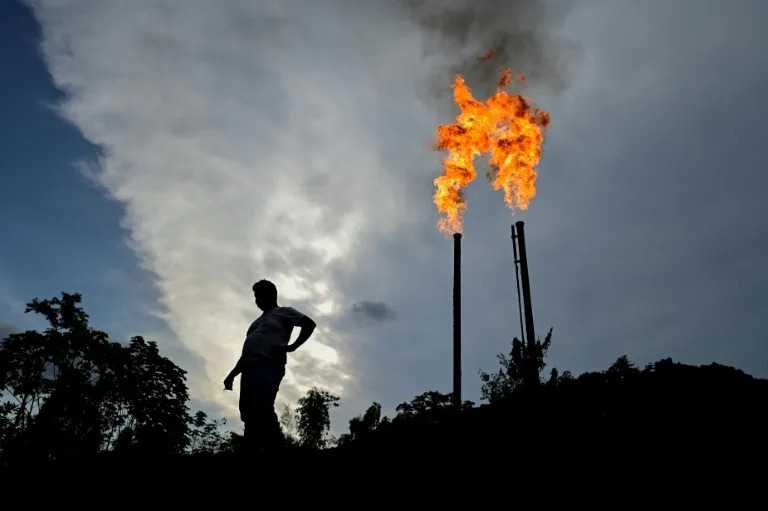
A gas flare from a refinery in Ecuador (Pedro PARDO)
More than 400 oil and gas projects were approved globally in the last two years despite calls to abandon all new hydrocarbon development, new figures showed as the UN COP28 climate talks opened Thursday.
With greenhouse gas emissions threatening to heat the planet to catastrophic levels, countries at the talks in Dubai are under pressure to agree to phase out oil, gas and coal in order to meet the Paris Agreement goal of limiting warming to 1.5 degrees.
Nearly 200 private and public corporations across 58 countries were involved in the 437 new fossil fuel projects, according to figures from the nonprofit Reclaim Finance, based on data from Rystad Energy consultants.
The data demonstrates the mismatch between the continuing exploitation of fossil fuels — responsible for most of humanity’s greenhouse gases — and the target of limiting warming.
“We are in denial about the environmental emergency and the conclusions drawn by IPCC (Intergovernmental Panel on Climate Change) scientists,” Lucie Pinson of Reclaim Finance told AFP.
The UN’s IPCC climate expert panel has said emissions need to be slashed by over 40 percent this decade to keep the 1.5C threshold in sight.
And in May 2021, the International Energy Agency (IEA) issued an explosive warning saying “no new oil and gas fields” could be approved for its pathway to net zero emissions to be met, as well as no new coal mines.
Countries agreed at Glasgow’s COP26 in late 2021 to “phasedown” coal power that does not involve emissions being captured before they go into the atmosphere.
But attempts to widen ambition to include targets on reducing oil and gas have so far met stiff opposition, despite a surge in renewable energy.
– ‘Desperate’ need –
And fossil fuel expansion shows no sign of stopping.
All of the 437 new projects since 2022 have received their “final investment decision” — a key commitment where investors sanction the development and production of a new hydrocarbon field.
Once in production, they will produce oil and gas in vast quantities for years to come.
State-backed oil companies were behind 57 percent of the projects.
Some 22 percent were linked to just seven oil giants: BP, ExxonMobil, Shell, Chevron, ConocoPhillips, Eni and TotalEnergies.
Qatar alone is due to host 17 percent of the total expected future production of these planned gas and oil projects, when measured in volume.
Saudi Arabia would host 13 percent, Brazil 10 percent, the United States eight percent and this year’s COP28 host, the United Arab Emirates would have six percent.
The IEA estimates that global demand for oil and gas will peak by 2030, but oil giants argue the transition to renewables is not happening fast enough to replace fossil fuels.
There is a “desperate need” for oil and gas still, said Shell CEO Wael Sawan in July.
And several European oil giants — including Shell, BP and Enel — have recently rolled back on some of their energy transition targets.
In February, BP backtracked on plans to cut its oil and gas output by 40 percent from 2019 levels by 2030, targeting a 25 percent reduction instead.
The third heatwave of the summer hits SpainHeatwave in Beijing, China
DUBAI (Reuters) – With a month to run, 2023 will reach global warming of about 1.4 degrees Celsius (2.5 Fahrenheit) above preindustrial levels, adding to “a deafening cacophony” of broken climate records, the World Meteorological Organization (WMO) said on Thursday.
The WMO’s provisional State of the Global Climate report confirms that 2023 will be the warmest year on record by a large margin, replacing the previous record-holder 2016, when the world was around 1.2C warmer than the preindustrial average.
It adds to the urgency world leaders face as they wrestle with phasing out fossil fuels at the United Nations annual climate summit COP28, which begins on Thursday in Dubai.
“Greenhouse gas levels are record high. Global temperatures are record high. Sea level rise is record high. Antarctic sea ice record low,” WMO Secretary General Peterri Taalas said.
The report’s finding, however, does not mean the world is about to cross the long-term warming threshold of 1.5C that scientists say is the ceiling for avoiding catastrophic climate change under the 2015 Paris Agreement.
For that, the level of warming would need to be sustained for longer.
Already, a year of 1.4C has provided a frightening preview of what permanently crossing 1.5C might mean.
This year, Antarctic sea ice reached its lowest winter maximum extent on record, some 1 million square kilometres (386,000 sq miles) less than the previous record. Swiss glaciers lost about 10% of their remaining volume over the last two years, the report said. And wildfires burned a record area in Canada, amounting to about 5% of the country’s woodlands.
Climate change, driven by the burning of fossil fuels, combined with the emergence of the natural El Nino climate pattern in the Eastern Pacific pushed the world into record territory this year.
Next year could be worse, the scientists said, as El Nino’s impacts are likely to peak this winter and drive higher temperatures in 2024.
(Reporting by Gloria Dickie; editing by Barbara Lewis)
The sun sets behind a burned forest near Mariposa, California (DAVID MCNEW)
This year is set to be the hottest ever recorded, the UN said Thursday, demanding urgent action to rein in global warming and stem the havoc following in its wake.
The UN’s World Meteorological Organization warned that 2023 had shattered a whole host of climate records, with extreme weather leaving “a trail of devastation and despair”.
“It’s a deafening cacophony of broken records,” said WMO chief Petteri Taalas.
“Greenhouse gas levels are record high. Global temperatures are record high. Sea level rise is record high. Antarctic sea ice is record low.”
The WMO published its provisional 2023 State of the Global Climate report as world leaders gathered in Dubai for the UN COP28 climate conference, amid mounting pressure to curb planet-heating greenhouse gas pollution.
United Nations chief Antonio Guterres said the record heat findings “should send shivers down the spines of world leaders”.
The stakes have never been higher, with scientists warning that the ability to limit warming to a manageable level is slipping through humanity’s fingers.
The 2015 Paris climate accords aimed to limit global warming to well below two degrees Celsius above pre-industrial levels — and 1.5C if possible.
But in its report, the WMO said 2023 data to the end of October showed that this year was already around 1.4C above the pre-industrial baseline.
– ‘Not just statistics’ –
The agency is due to publish its final State of the Global Climate 2023 report in the first half of 2024.
But it said the difference between the first 10 months of this year and 2016 and 2020 — which previously topped the charts as the warmest years on record — “is such that the final two months are very unlikely to affect the ranking”.
The report also showed that the past nine years were the hottest years since modern records began.
“These are more than just statistics,” Taalas said, warning that “we risk losing the race to save our glaciers and to rein in sea level rise”.
“We cannot return to the climate of the 20th century, but we must act now to limit the risks of an increasingly inhospitable climate in this and the coming centuries.”
The WMO warned that the warming El Nino weather phenomenon, which emerged mid-year, was “likely to further fuel the heat in 2024”.
That is because the naturally-occurring climate pattern, typically associated with increased heat worldwide, usually increases global temperatures in the year after it develops.
The preliminary report also found that concentrations of the three main heat-trapping greenhouse gases — carbon dioxide, methane and nitrous oxide — reached record high levels in 2022, with preliminary data indicating that the levels continued to grow this year.
Carbon dioxide levels were 50 percent higher than the pre-industrial era, the agency said, meaning that “temperatures will continue to rise for many years to come”, even if emissions are drastically cut.
– ‘Climate chaos’ –
The rate of sea level rise over the past decade was more than twice the rate of the first decade of satellite records (1993-2002), it said.
And the maximum level of Antarctic sea ice this year was the lowest on record.
In fact, it was a million square kilometres less than the previous record low at the end of the southern hemisphere winter, the WMO said — an area larger than France and Germany combined.
Meanwhile, glaciers in North America and Europe again suffered an extreme melt season, with Swiss glaciers losing 10 percent of their ice volume in the past two years alone, the report showed.
Dramatic socio-economic impacts accompany such climate records, experts say, including dwindling food security and mass displacement.
“This year we have seen communities around the world pounded by fires, floods and searing temperatures,” UN chief Guterres said in a video message.
He called on the leaders gathered in Dubai to commit to dramatic measures to rein in climate change, including phasing out fossil fuels and tripling renewable energy capacity.
“We have the roadmap to limit the rise in global temperature to 1.5C and avoid the worst of climate chaos,” he said.
“But we need leaders to fire the starting gun at COP28 on a race to keep the 1.5 degree limit alive.”
Some Republicans sound alarm after Trump revives focus on Obamacare
Kristen Holmes, Alayna Treene and Kate Sullivan – November 30, 2023
Go Nakamura/Reuters
Former President Donald Trump’s renewed focus on repealing and replacing the Affordable Care Act, known colloquially as Obamacare, has alarmed some Republicans scarred by the GOP’s failure to deliver on promises to dismantle the law and who view the issue as a political loser with the American people.
Many on Trump’s team said they were surprised by the former president’s recent declaration on his social media website Truth Social that replacing Obamacare would be a priority of his administration, as Obamacare had not been a focal issue in ongoing policy conversations and the campaign has not yet drafted any kind of health care policy alternative. One Trump adviser told CNN the post came “completely came out of nowhere,” and said the team “has not been talking to him about health care.”
Some Trump advisers who spoke with CNN also conceded that calling for the termination of a health care law that provides millions of Americans coverage and is largely viewed favorably by the public is a political loser going into 2024. Republicans have tried and failed for years to implement substantial changes to Obamacare and the party has largely abandoned efforts to campaign on the issue.
The resurrection of the health care battle has given Democrats fresh political ammo, and the Biden campaign quickly seized on Trump’s threats. The campaign held a press call with former House Speaker Nancy Pelosi and North Carolina Democratic Gov. Roy Cooper, whose state will become the 40th to expand Medicaid on Friday, to respond to Trump’s comments. The campaign also on Thursday released an ad focused on health care and prescription drug costs, attempting to draw a sharp contrast with Trump. The ad – which features a pediatric nurse who calls Trump’s health care policies “troubling” – will run in media markets in seven states that will be key to Biden’s 2024 electoral map.
“There are very few issues where Republicans are at a greater disadvantage then health care. The Biden campaign desperately wants the election to be about health care and abortion. If the election is about those two issues in 2024, then Democrats will have a great night in November,” Ken Spain, a GOP consultant and former communications director for the National Republican Congressional Committee, told CNN.
“The concern that Republicans have always had about Trump is his lack of discipline. The question is, is this really an issue he intends to campaign and formulate a strategy around, or is this just another lapse in discipline?” Spain added.
Health care “was a loser in 2018 and it’s a loser now,” one Trump-aligned Republican operative told CNN, referencing the 2018 midterm elections that ushered in a Democratic majority in the House of Representatives.
Trump’s health care legacy while in office is viewed by many Republicans as lackluster at best. His failure to fulfill his core campaign promise of repealing and replacing Obamacare – even with a GOP monopoly on power in Washington – was an early blow to Trump, who had painted himself as the ultimate dealmaker.
“Talk about the border,” the operative said. “Talk about the economy. Talk about no more foreign wars. Don’t talk about health care.”
Advisers to Trump said the catalyst for the former president’s posts was a recent article written by the Wall Street Journal editorial board that raised concerns that patients are seeing higher costs because insurers are using work arounds to an Affordable Care Act rule. Trump included a portion of the op-ed in his initial post on the issue.
The topic had also recently been brought up to Trump during a Mar-a-Lago meeting with Jeff Colyer, the former governor of Kansas. The two discussed health care policy over lunch, a Trump adviser told CNN.
Trump’s online pronouncements about replacing the law with his own belied the fact that his campaign has not settled on health care plan.
The campaign’s in-house policy team, led by advisers Vince Haley and Ross Worthington, has been drafting aggressive proposals for a potential second Trump term, but the campaign has not been actively working on a health care proposal, the Trump adviser told CNN. The team first started floating ideas for an alternative to Obamacare in recent days — but only after Trump started posting about it online.
One person familiar with the campaign’s process said it was likely that Trump’s team would also review health care proposals put forward by outside advocacy groups, including Project 2025, a partnership of groups organized by the conservative think tank the Heritage Foundation. But this person stressed the proposals by the outside groups are merely suggestions and that the campaign would look at a range of ideas before putting forward its own unique proposal.
“The campaign is not going to adopt a position that’s suicidal,” this person said, acknowledging how politically fraught the issue can be. “But it is equally suicidal not to recognize the American people’s profound cry for health care reform.”
Like many of the policy proposals Trump’s current team is drafting for a potential second term, there are also serious concerns about how the former president could successfully enact them if reelected, acknowledging the necessary obstacles Congress and the courts could pose to a new health care agenda.
Trump bringing health care back to the forefront has also reignited talk of his failure to repeal and replace Obamacare in 2017.
Members of Trump’s orbit have long blamed that failure on the late Sen. John McCain of Arizona, who famously voted that year against repealing the ACA with a dramatic “thumbs down” on the Senate floor, tanking the Trump administration’s efforts.
And despite Trump’s promises to release a health care plan that could replace Obamacare, Trump left office in 2020 without having produced one. Just weeks before the 2020 presidential election, Trump issued an executive order pledging to protect Americans with preexisting conditions, but the plan fell far short of a comprehensive proposal.
CNN’s Betsy Klein and Tami Luhby contributed to this story.
Trump’s 48-Hour Manic Rant Had Immediate Consequences
Ellie Quinlan Houghtaling – November 30, 2023
The GOP’s presidential front-runner had himself a bit of an unhinged social media binge over the last couple of days, using Truth Social to air his scattered grievances, attack the wife of the judge overseeing his New York bank fraud trial, and take a wild left turn by claiming sudden allyship with the broader Black Lives Matter movement.
Kicking off the rapid-fire onslaught of posts late Tuesday, Trump called MSNBC’s coverage of the Republican Party “illegal activity,” adding that the “so-called ‘government’ should come down hard” on the news outlet and “make them pay.”
Then the former president revived an old gripe that “Obamacare sucks”—thus reopening the possibility that his campaign will renew the call to “repeal and replace” the Affordable Care Act that has dogged the GOP since that law’s inception. Less than 20 minutes later, he redirected his attention to the sexual assault allegations made against him by columnist E. Jean Carroll, spewing comments eerily similar to the ones that have already lost him two defamation cases brought by the writer, in which he claimed that the allegations were a “made up fairytale” that was “funded by political operatives” to interfere with the 2020 presidential election results.
Over the ensuing hours, Trump also warned that the indictments against him had opened up “pandora’s box,” which he followed by snubbing his Koch-backed GOP opponent Nikki Haley as “a very weak and ineffective Birdbrain.”
In yet another post, Trump said he had done “more for Black people than any other President,” including Lincoln. He also confused the support of Mark Fisher, the founder of Black Lives Matter Incorporated, for that of the larger, national movement, despite statements front and center on BLM INC.’s web page that they’re not affiliated with “any other Black Lives Matter Movement.”
But the pièce de résistance of Trump’s 48-hour digital diatribe was a string of attacks on the wife of the judge overseeing his business fraud trial, Manhattan Supreme Court Justice Arthur Engoron, whose gag order on Trump had been repealed. In five separate posts, Trump uplifted a conspiracy theory that Dawn Engoron and her husband were inherently biased in his case and that Mrs. Engoron had attacked Trump and other “white male politicians” online.
“Judge Engoron’s Trump Hating wife, together with his very disturbed and angry law clerk, have taken over control of the New York State Witch Hunt Trial aimed at me, my family, and the Republican Party,” Trump wrote on Truth Social.
In a statement to Newsweek, Engoron denied ownership of the account and any of its content.
“I do not have a Twitter account. This is not me. I have not posted any anti-Trump messages,” she told the outlet.
That may have been enough to convince a New York appeals court that Trump wasn’t capable of playing nice without his recently stayed gag order, which the four-judge panel dutifully reinstated on Thursday, in an attempt to halt the verbal onslaught against the judge, his court staff and, apparently, his family.
Donald Trump Wants Federal Government To “Come Down Hard” On MSNBC For Its Criticism Of Him
Ted Johnson – November 29, 2023
Former President Donald Trump’s attacks on the media are central to his image, but he’s once again calling on the federal government to take action against NBCUniversal for its MSNBC criticism of him.
In a late night post on his social media platform Truth Social, Trump complained that MSNBC “uses FREE government approved airwaves, and yet it is nothing but a 24 hour hit job” on him and “the Republican party for the purposes of ELECTION INTERFERENCE.”
He also attacked Brian Roberts, the CEO of NBCU parent Comcast, as a “slimeball who has been able to get away from these constant attacks for years.”
“It’s the world’s biggest political contribution to the Radical Left Democrats who, by the way, are destroying our Country. Our so-called ‘government’ should come down hard on them and make them pay for their illegal political activity. Much more to come, watch!”
A bit of background: MSNBC is a cable network, so it does not use the public airwaves. Yet even if it was a broadcast outlet, the FCC has been clear that it will not regulate news programming content. The Fairness Doctrine, which required that broadcasters present an array of viewpoints on controversial issues, was abandoned more than 35 years ago during Ronald Reagan’s presidency.
The Federal Election Commission expenditure rules, meanwhile, exclude the news media, or more specifically, “any cost incurred in covering or carrying a news story, commentary, or editorial by any broadcasting station (including a cable television operator, programmer or producer).”
Trump’s attacks on NBC, MSNBC and Roberts are nothing new. In the first year of his presidency, he was upset over the network’s reporting and suggested that NBC’s broadcast license be challenged. Ajit Pai, who Trump appointed to chair the FCC, said a week later that the FCC “under the law does not have the authority to revoke the license of a broadcast station based on the content of a particular newscast.”
While Trump’s Truth Social post was one of many, many outbursts at the news media, his suggestion of government retaliation, something that would surely raise a First Amendment challenge, also comes as many of his allies and others on the right chide tech platforms for censorship over their content moderation practices.
The Republican attorneys general of Missouri and Louisiana have been challenging the Biden administration’s contacts with social media platforms, claiming that they were efforts to curb misinformation about Covid vaccines and elections were in fact censoring conservative speech. The administration has argued that it is merely pointing out the spread of misinformation on platforms about urgent issues of public health and election integrity. Supreme Court last month lifted a preliminary injunction on Biden administration contacts while it will hear arguments in the case in a hearing next year.
Trump has told supporters that he would be their “retribution” in a second term, and has vowed to appoint a special prosecutor to go after Joe Biden and his family. The New York Times and The Washington Post also have been reporting in recent weeks on Trump and his allies’ plans for a second term, including taking greater hold over the federal workforce.
Russia is preparing a ‘loyalty agreement’ requirement for foreigners
Guy Faulconbridge and Lidia Kelly – November 29, 2023
Steam rises from chimneys of a heating power plan over the skyline of central Moscow
MOSCOW (Reuters) -Russia’s interior ministry has prepared draft legislation that would force foreigners to sign a “loyalty agreement” forbidding them from criticising official policy, discrediting Soviet military history, or contravening traditional family values.
Since President Vladimir Putin ordered troops into Ukraine in February 2022, Russia has introduced a slew of tough laws that outlaw discrediting the military, and courts have handed down long jail sentences to opposition activists.
As the 2024 presidential election approaches, Putin has cast the war as part of an existential battle with the West, saying he will defend Russia’s “sacred” civilisation from what he portrays as the West’s decadence.
The TASS state news agency reported on Wednesday that the draft legislation had been prepared by the interior ministry and would force all foreigners entering Russia to sign an agreement that essentially restricts what they can say in public.
A foreigner entering Russia would be prohibited from “interfering with the activities of public authorities of the Russian Federation, discrediting in any form the foreign and domestic state policy of the Russian Federation, public authorities and their officials”, TASS said.
The proposed agreement would include clauses about morality, family, “propaganda about non-traditional sexual relations” and history.
In particular, foreigners would be barred from “distorting the historical truth about the feat of the Soviet people in the defence of the Fatherland and its contribution to the victory over fascism”.
The Soviet Union is estimated to have lost at least 27 million people in World War Two and eventually pushed Nazi forces back to Berlin. Governments loyal to Moscow then took power across swathes of eastern Europe.
It was not clear from Russian media reports which foreigners the draft legislation – if it becomes law – would apply to or what the punishment would be for not adhering to the “agreement” which foreigners would have to sign upon entry to Russia.
The Kremlin declined to comment on the initiative.
‘LOYALTY AGREEMENT’
Opposition activists and foreign diplomats in Moscow have for months been warning that the authorities are toughening their stance on any dissent ahead of the presidential election.
The Kremlin said earlier this month that some measure of censorship was needed as Russian troops were fighting in Ukraine, and cautioned those who wanted to criticise the military to think carefully before they did.
For the draft to become law, it has to be introduced to the State Duma, Russia’s lower house of parliament, and to go through committee review and several readings before being submitted to Putin for signing.
The chairman of the Duma’s CIS Affairs Committee said that the draft law was well advanced and was being worked on by the interior ministry, the government, the presidential administration as well as his committee.
“The draft law on the so-called ‘loyalty agreement’ with migrants entering the Russian Federation is in a high degree of readiness,” Leonid Kalashnikov told Interfax.
Kalashnikov said some details of the proposed law were still to be worked out. The interior ministry did not immediately respond to requests for a comment.
The law has not yet been introduced formally in parliament, according to Reuters searches of the Duma’s database.
Since the start of its war in Ukraine, Russia has imposed a number of restrictions on foreigners from what it calls “unfriendly countries” – meaning those that have imposed sanctions on it over its war in Ukraine.
(Reporting by Lidia Kelly in Melbourne and Guy Faulconbridge in Moscow; Editing by Andrew Osborn and Nick Macfie)
COP28: What is it, who’s going and what are the key sticking points?
World leaders are set to meet at the UN climate summit in Dubai for the next two weeks to discuss tackling climate change
Rabina Khan, Contributor – November 29, 2023
Representatives from around the world will gather at Expo City in Dubai, UAE, for COP28. (AP) (Kamran Jebreili, Associated Press)
Thousands of politicians, economists, faith leaders, activists and many others are convening in Dubai for the latest UN climate conference, COP28.
This year’s event, which kicks off today, will focus on ramping up the shift to clean energy by cutting greenhouse gas emissions before 2030 in a bid to limit the impact of climate change.
But with competing priorities at play, the likelihood of consensus among the key players around the major sticking points remains in the balance.
This year, even the location of the conference has sparked some controversy.
The UAE has invested heavily in solar and wind energies, but it also remains one of the world’s top oil-producing nations.
“It is the equivalent of appointing the CEO of a cigarette company to oversee a conference on cancer cures,” said campaign group 350.org.
COP28 president-designate and the UAE’s special envoy for climate change Sultan Al Jaber has defended his country hosting the latest round of climate talks. (AP) (Kamran Jebreili, Associated Press)
COP28 agenda
As in previous years, the central issues are cutting fossil fuels and the greenhouse gases driving climate change by ramping up the shift to clean energy.
COP28 aims to prioritise securing funding for climate action in less affluent countries, fostering inclusivity, and addressing diverse issues like nature, people, health, finance and food and work towards a new agreement benefiting developing nations.
Although the hope is to continue to limit global temperature rises to 1.5֯C – the world is currently on track for 2.4-2.6C of warming – and the efforts being pursued to tackle this have been described by the UN as “nowhere near ambitious enough”.
The focus will also be on how people can best use nature and land use, moving to clean energy sources and making COP28 the “most inclusive” ever.
COP28 will focus on clean energy, aiming to cut greenhouse gas emissions before 2030, fostering inclusivity, and addressing issues like nature, people, health, finance, and food. (Source: COP28) (COP28)
Who are the key players?
King Charles III, prime minister Rishi Sunak, and foreign secretary David Cameron will be the most high-profile UK representatives.
However, their popularity among some allies remains uncertain due to Sunak’s support for North Sea oil and recent retreat on domestic net zero targets. His decision to advise against Charles attending COP27 also raised eyebrows.
The conference itself is being hosted by Sultan al Jaber – the boss of one of the world’s largest oil companies, the Abu Dhabi National Oil Company (ADNOC) – and whose appointment was greeted with scepticism. He insists he wants to guide major oil and gas producers toward emission reduction goals, focusing on eliminating methane emissions by 2030.
However, the UAE this week had to fend off uncomfortable allegations from leaked documents that it planned to use meetings to promote deals for its national oil and gas companies to other countries. A COP28 spokesperson described the documents as “inaccurate”.
The absence of US president Joe Biden means climate envoy John Kerry will attempt to navigate disagreements on climate finance and broader US-China tensions.
His relationships with Al Jaber and Beijing’s Xie Zhenhua, the vice-chairman of China’s top economic development body, could shape the summit’s outcomes. While viewed positively, Xie’s stance on a fossil fuel “phase-out” remains a point of contention.
Pope Francis, pictured here meeting Sultan Ahmed Al Jaber at the Vatican in October, will make history as the first pope to attend the global climate summit at this year’s COP28. (Abaca Press/Alamy Live News) (ABACAPRESS, Abaca Press)
Russia, a major carbon polluter with a recent climate pledge aiming for net zero by 2060, will be represented by Vladimir Putin’s climate adviser, Ruslan Edelgeriyev.
Saudi Arabia’s stance on oil, gas, and coal will also likely pose challenges. Chief negotiator Khalid al-Mehaid will defend fossil fuels with a focus on reducing pollution, transitioning to renewables.
At the other end of the spectrum, the UN climate chief Simon Stiell, from Grenada, balances the interests of nearly 200 nations, seeking difficult answers and clear targets for climate action.
Representing the least-developed countries, Madeleine Diouf Sarr, head of the climate change division in Senegal’s Ministry of Environment will prioritise clear targets for adaptation and financial support amid growing concerns of the disproportionate impact of climate change on vulnerable nations.
The presence of philanthropist and former Microsoft CEO Bill Gates at COP28 underscores the intersection of environmental responsibility and business. (Reuters) (Leah Millis / reuters)
And Barbados prime minister Mia Mottley,willchampion climate equity, pushing for financial mechanisms benefiting vulnerable nations. Her outspoken calls for a just global financial system and debt-pause clauses have often resonated on the international stage.
Two other familiar faces include Pope Francis, who will make history as the first pope to attend the climate summit, and Bill Gates.
Gates will wear two hats at COP28: advocating for climate action through philanthropy and investing in green technologies. His presence underscores the intersection of environmental responsibility and business.
Watch: Barbados – Prime Minister Addresses United Nations General Debate, 78th Session
https://youtube.com/watch?v=ftHsJscUARU%3Frel%3D0
COP28: The sticky points
Differing views on the future of “unabated” fossil fuels, like coal, oil, and gas without emissions capture, are anticipated at COP28. While the UAE’s Al Jaber calls for a gradual “phase down”, the European Union is likely to advocate for a complete “phase out”.
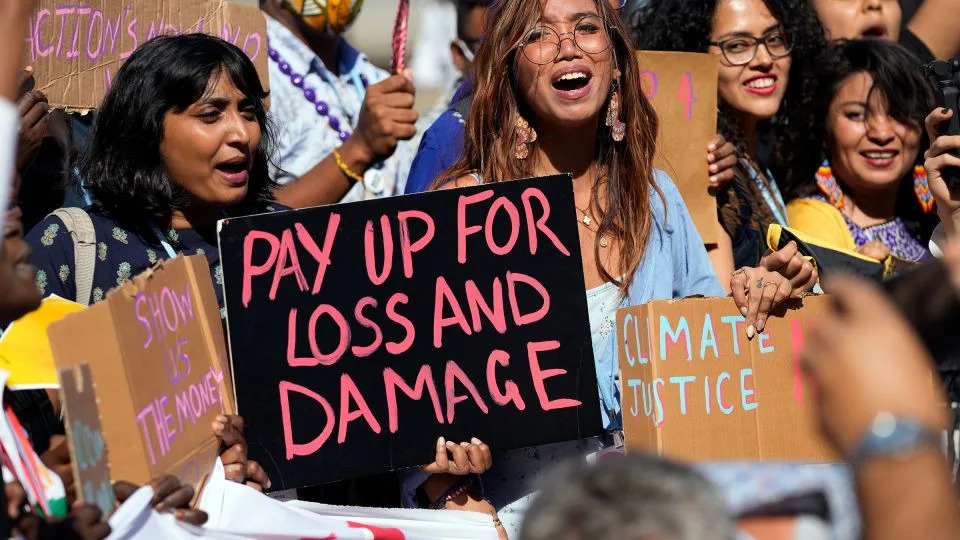
Financial issues loom, with the unclear implementation of a “loss and damage” fund from richer to poorer countries, and the US rejecting climate reparations for historical emissions.
The EU aims to lead with a groundbreaking deal to phase out “unabated” coal, oil, and gas globally, but resistance is expected from major fossil fuel producers like Saudi Arabia and developing nations reliant on fossil fuels for economic growth.
China, the US, India and Russia are the top four polluters, according to data from Statista, China was the biggest emitter of carbon dioxide (CO2) emissions in 2021, accounting for nearly 31% of the global emissions. The world’s top five largest polluters were responsible for roughly 60% of global CO2 emissions in 2021.
COP28’s key challenge is staying below a 1.5C temperature rise. To achieve this, there’s a push for a binding energy package—tripling renewable energy by 2030 and deploying 1.5 terawatts yearly.
Financial clarity is crucial, demanding a $200bn annual increase for the Global South, according to 350.org, an international movement of ordinary people working to end the age of fossil fuels.
“As civil society campaigners, demonstrations and protests are expected to be limited to the UN-designated zones only but we are determined to make our voices heard and that this COP28 should be one that leads to decisive action to tackle the climate crisis,” Kim Bryan, 350’s associate director told Yahoo!.
Watch COP28 climate change summit begins: Here’s what you need to know
Are the annual climate summits working? These countries are going to the courts, instead
Ella Nilsen, CNN – November 29, 2023
Few leaders paint a picture of the climate crisis as vividly as United Nations chief António Guterres. He has accused world leaders of opening “the gates of hell” and said the planet is “heading into uncharted territories of destruction” after deadly heat waves and floods.
“The current fossil fuel free-for-all must end now,” Guterres said last year. “It is a recipe for permanent climate chaos and suffering.”
Yet the UN climate summit, known as COP, is tedious. It is full of jargon, snail-paced developments and painful consensus-building that can be broken by a single country’s veto.
Now some are asking: Is the process even working? Some small island nations — countries that are facing irrevocable change from rising seas — say no.
Over the decades, these painstaking negotiations have worked to prevent several catastrophic degrees of global warming. COP’s biggest win was the Paris Agreement, widely seen as one of the most effective environment treaties, which set a goal to limit global warming to well under 2 degrees Celsius, and preferably to 1.5 — a target that climate scientists, advocates and most countries have since rallied around.
Before those talks, the world was on track for roughly 4 degrees of warming. Countries’ pledges after Paris pushed that to 2.5 to 2.9 degrees, according to recent UN figures.
But the Paris Agreement was voluntary by design, in large part due to the influence of the US, and it relies on a system of collective shaming and competitive ambition in lieu of legal consequences. It contained “very few obligations” for major polluters, said Payam Akhavan, an attorney for the Commission of Small Island States on Climate Change and International Law.
Vanuatu, Tuvalu and Antigua and Barbuda are now asking international courts to issue “advisory opinions” that could fundamentally change future COPs by compelling countries to set legally binding targets to cut climate pollution, rather than voluntary ones.
“The turn toward international litigation is an attempt to put some teeth in the toothless Paris regime, by declaring the 1.5-degree target is a binding target and not discretionary,” Akhavan told CNN.
As world leaders head to Dubai for COP28 this week, this courtroom strategy is raising eyebrows among the United States’ current and former climate negotiators, who say that while diplomacy can be stubborn and slow, it yields progress.
Even fierce climate advocates who agree COP should be more ambitious still believe the summit is a powerful and worthwhile endeavor.
“There is a lot of questioning whether this process will deliver or not,” Ani Dasgupta, president and CEO of international climate nonprofit World Resources Institute, told CNN. “However, I believe COP, or some version of COP, will remain and absolutely is needed. This is the only forum that I know where poor countries actually have a place at the table that is equal, to negotiate with rich countries across a vastly important topic.”
‘Countries move farther when they move together’
COP’s detractors and advocates alike agree it is a crucial annual meeting, but also one that is plodding and technical. An errant word or piece of punctuation can derail negotiations, and it can — and often does — take years for incremental progress to happen.
“I would say it’s necessary, but maybe not sufficient,” said Sue Biniaz, the deputy for US climate envoy and former Secretary of State John Kerry.
Sue Biniaz, the US deputy climate envoy, at Yale University in New Haven, Connecticut, on October 31, 2022. – Frances F. Denny/The New York Times/Redux
Biniaz has a lot of experience at COPs; she was the United States’ lead climate lawyer for more than two decades and was one of the key authors of the Paris Agreement.
Both Biniaz and other former top US climate negotiators told CNN that although each climate summit is often judged as a singular event, it is more important to look at the year leading up to it.
“It’s necessary because the fact that it meets annually and puts pressure on countries is a good thing, and we’re in a lot better position with the annual COPs and the Paris Agreement than we would have been without it,” Biniaz told CNN. “At the same time, it is really difficult and challenging to get agreement among everyone in the world, particularly when you have geopolitical issues, and some countries may be more motivated to reach agreement than others.”
International politics and the dynamics within countries matter to the success or failure of COP. There is no better recent example of than the shockwave that surged through the summit when former President Donald Trumppulled the US out of the Paris agreement in 2017 — a move President Joe Biden reversed upon taking office.
In this June 2017 photo, President Donald Trump after announcing his intention to abandon the Paris Agreement in the Rose Garden of the White House in Washington, DC. – Doug Mills/The New York Times/Redux
Still, former and current US negotiators say climate diplomacy has helped keep the world’s temperature from reaching truly alarming highs.
“If you look at those first assessments coming out of the scientific community back then, we were looking at an incremental temperature gain of about 7 degrees,” said Jonathan Pershing, a former Kerry deputy who now directs the William and Flora Hewlett Foundation’s environment program. “Seven degrees, today, is unimaginable.”
Pershing added that the fact the world’s governments are now racing to keep to below 2 degrees of warming is an “extraordinary transition.”
“The collective endeavor has fundamentally altered the trajectory of greenhouse gas emissions,” Pershing said. “I think countries move farther when they move together.”
The annual summit has also become the most visible rallying point for global climate action, former US climate envoy Todd Stern told CNN. The summits used to largely be a gathering of only government climate negotiators, but each year COP becomes much larger — drawing advocates, businesses (including fossil fuel companies) and think tanks from all corners of the globe.
In this 2009 photo, Todd Stern, US special envoy for climate change, listens to questions during a press conference in the Bella Center in Copenhagen. – Jens Astrup/AFP/Getty Images
Stern thinks the growing spectacle of COP is a positive force, impossible to ignore even for groups that used to deny climate change’s existence. Even US House Republicans have sent a delegation for the past two years.
“It’s a two-week moment in the course of the year when people around the world — or at least some meaningful subset of people around the world — are paying attention to it,” Stern said. “That needs to keep getting bigger and bigger and bigger because that puts pressure on governments.”
Too little, too slow
Attorneys for the small island nations who are rocking the boat at COP say the proof it isn’t working is in the extreme heat felt around the world this year, and the global records smashed.
The world’s governments are working to hold global temperature rise to 1.5 degrees Celsius — above which scientists say a hotter world with more severe droughts and intense storms will become difficult to adapt to.
But 1.5 degrees is no longer an abstract concept; the world briefly crossed that temperature threshold this summer, though scientists caution it will take several years above that limit to say with confidence it’s been officially exceeded. This summer was a taste of life at this threshold: Wildfires raged across Europe, mighty rivers like the Mississippi and the Amazon fell to new lows, and hot-tub-like ocean water killed coral reefs and rapidly intensified hurricanes and cyclones.
“It’s not as if 1.5 is safe in any way, but we are very much on track to cross it,” said Margaretha Wewerinke-Singh, an international lawyer representing the island nation Vanuatu in climate litigation at the International Court of Justice. “Clearly we need more mitigation ambition to make sure we don’t end up with an unlivable world.”
The potential for an unlivable world weighs heavily on young COP negotiators, who are urging swift action to cut climate pollution.
Mitzi Jonelle Tan, of the Philippines, center, participates in a Fridays for Future protest calling for money for climate action at the COP27 in Sharm el-Sheikh, Egypt, in 2022. – Peter Dejong/AP/File
Hailey Campbell, a 25-year-old, Hawaii-based climate adaptation specialist who successfully lobbied for more official youth representation at COP, told CNN it is sometimes disconcerting to spend long hours and days at international summits debating the precise words on climate finance and ramping down fossil fuel use, then return to her Honolulu home and see climate impacts first-hand.
“You go back home and you’re like, ‘sea level rise is still here, [we] still need to do something about it,’” said Campbell, the co-executive director of advocacy group Care About Climate. “If I had to pick just one thing to come out of this year’s COP, it would be language to commit to an equitable phase-out of all fossil fuels.”
Two of the world’s highest courts are expected to weigh in on the small island nations’ cases as soon as next year. While the advisory opinions alone can’t force faster action from countries, it can “inject some urgency, some political will, some vision” into the annual climate talks and protect the “inalienable rights” — the very survival — of these disappearing nations, Wewerinke-Singh said.
“I think that the COP process has failed,” Akhavan said. “But we must make it work because we have no other choice.”
Jeff Bezos’ superyacht is in South Florida. It’s so big it has to anchor at a seaport
Madeleine Marr – November 29, 2023
Motorsport Images/Michael Potts/Motorsport Images//Sipa USA
South Florida, meet The Koru.
That’s the name of Jeff Bezos’ colossal yacht that just dropped anchor in Port Everglades in Fort Lauderdale. The word means “new beginnings” in Maori, the language spoken by indigenous Polynesians of mainland New Zealand, where the Amazon founder’s private jet was spotted in 2020.
How ginormous is this triple-masted behemoth? Roughly 400 feet long and 250 feet tall, it’s the size of a cruise ship. That ginormous.
The luxury schooner is so big it can’t even hang with other leisure ships; she reportedly is parked near two oil tankers. It has two pools, a hot tub, multiple lounges, dining areas and bars, and perhaps the pièce de résistance, a wooden figurehead on the prow rumored to be modeled after Bezos’ fiancée, Lauren Sanchez.
The 59-year-old billionaire shelled out about $500M for his snazzy new toy, which was built just for him in the Netherlands by Oceanco, the company that also constructed Dallas Cowboys owner Jerry Jones’ superyacht, the Bravo Eugenia.
Get used to seeing The Koru around, especially if you set sail on a vacation. Bezos, a Palmetto High alum, lives back here full time now, after spending three decades in Seattle, busy reinventing the way the world shops.