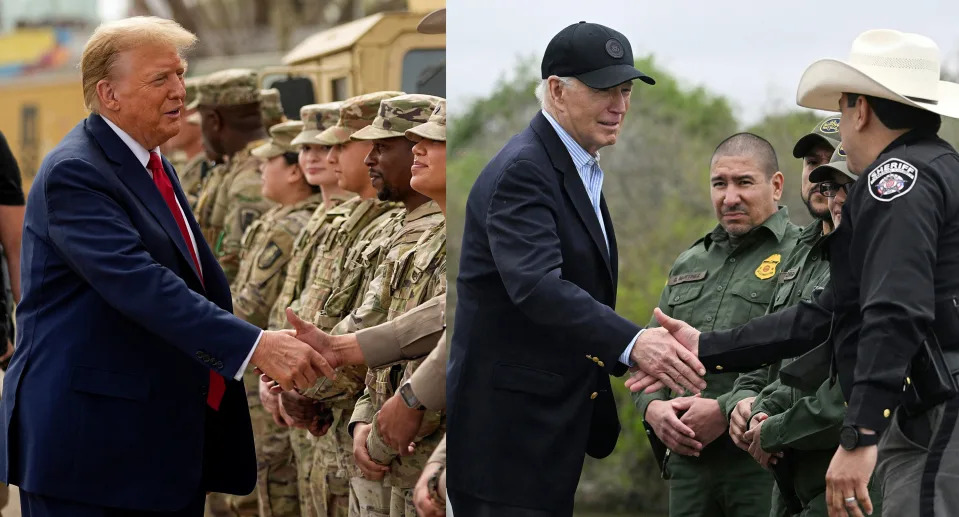
Trump’s vaccine rhetoric sends chills through public health circles
Nathaniel Weixel – March 9, 2024
Public health advocates are watching in growing alarm as former President Trump increasingly embraces the anti-vaccine movement.
“I will not give one penny to any school that has a vaccine mandate or a mask mandate,” Trump said in a recent campaign rally in Richmond, Va.
It’s a line Trump has repeated, and his campaign said he is only referring to school COVID-19 vaccine mandates — but that hasn’t eased fears that the GOP leader could accelerate already worrying trends of declining child vaccination.
Trump “is an important voice. He has a big platform. And he uses that platform, in this case, to do harm. Because he’s implying by saying that we shouldn’t mandate vaccines, vaccines are in some ways ineffective or unsafe,” said Paul Offit, a pediatrician and vaccine expert at the Children’s Hospital of Philadelphia.
The ironic part, Offit noted, is that the Trump administration kickstarted Operation Warp Speed, which helped drug companies use a relatively new technology to make two very effective and safe COVID-19 vaccines in less than a year.
Throughout the campaign, Trump has performed a complicated tap dance regarding COVID vaccines. He simultaneously wants to take credit for their speedy development but has also criticized their use and knocked his now former rivals for being too pro-vaccine.
In a post on Truth Social reacting to Biden’s State of the Union speech on Thursday, Trump again claimed credit for the COVID-19 shots.
“You’re welcome, Joe, nine month approval time vs. 12 years that it would have taken you!”
Every state and the District of Columbia requires children to get vaccinated against certain diseases before they start school, including measles, mumps, polio, tetanus, whooping cough and chickenpox. A plan to withhold federal funding would have widespread impact.
“Like most states, Virginia requires MMR vaccine, chickenpox vaccine, polio, etc. So Trump would take millions in federal funds away from all Virginia public schools,” former GOP Rep. Barbara Comstock (Va.) wrote in response to his campaign threat on X, formerly Twitter.
Since the public health emergency ended last May, no state requires students to get the COVID-19 vaccine, while 21 states have laws specifically banning schools from requiring COVID-19 shots.
Trump’s campaign says his comments only apply to states that mandate COVID-19 vaccines — making it essentially an empty threat.
“If you actually listen to the entire section, and also if you’ve been following his speeches for the past year, he’s talking about COVID vaccines in addition to masks in the same breath. This isn’t anything new,” Trump campaign spokesman Steven Cheung said in an email.
Experts say the politicization of vaccines has led to an increase in hesitancy and is sparking more outbreaks of preventable diseases like measles.
There have been measles outbreaks in 15 states this year, most recently in Florida, where state Surgeon General Joseph Ladapo did not recommend parents vaccinate their children or keep unvaccinated students home from school as a precaution.
Instead, he sent a letter to parents advising them to make their own decisions about school attendance.
Ladapo was appointed by Gov. Ron DeSantis (R) in 2021 and has since aligned himself with anti-vaccine sentiments, primarily about the COVID-19 shots.
Ladapo told people not to get the most recent shot and has drawn sharp rebukes from the medical community — as well as federal health agencies — for claims that the shots alter human DNA, can potentially cause cancer, and are generally unsafe.
Georges Benjamin, executive director of the American Public Health Association, said he worries that Trump is signaling he will empower more people like Ladapo if he wins reelection.
“I worry about any administration that doesn’t follow good evidence and good science, that they will put more and more people like them in their administration,” Benjamin said.
“We know that Trump had some extraordinarily competent people [in his first term]. But we also know that he had some extraordinarily incompetent people, and that in many situations, some of the really incompetent people carried the day because they aligned with his philosophy,” Benjamin added.
Robert Blendon, a professor emeritus of health politics at the Harvard School of Public Health, said the experience in Florida and the comments from Trump are part of a much broader Republican backlash against public health expertise and government mandates that can be traced to anti-COVID policies.
“It isn’t that he’s just going after these anti-vaccine votes,” Blendon said of Trump.
Trust in public health authorities has dropped precipitously among Republicans since 2021, and Blendon said Trump is a symbol of that. The anti-vaccine movement has never been associated with one particular political party, whereas the public health backlash is strongly Republican-centric.
“That’s made it very, very powerful,” Blendon said. “There are Republicans in the House and Senate, who when they’re not investigating public health, want to cut back the budget … so it has caught on within the Republican base very widely.”
Whether it’s anti-vaccine specifically or anti-public health more broadly, the sentiment is growing.
According to the Centers for Disease Control and Prevention, the percentage of kindergartners whose parents opted them out of school-required vaccinations rose to the highest level yet during the 2022-2023 school year.
Robert F. Kennedy Jr., a well-known vaccine skeptic who is running for president as an independent, has gained a major platform to spread misinformation and widely debunked claims about vaccines.
He has falsely claimed vaccines cause autism, falsely declared the coronavirus shot is the world’s deadliest vaccine and questioned the safety of shots’ ingredients.
Offit, the vaccine expert, said he thinks public health officials could have done a better messaging job on the COVID-19 shots, and that by mandating vaccines they “inadvertently leaned into a Libertarian left hook.”
Still, Offit said he is concerned about the increasing anti-science rhetoric from politicians like Trump.
“I feel like we’re on the edge of a precipice here … you have the most contagious of the vaccine preventable diseases coming back to some extent, and with Donald Trump basically casting aspersions on vaccines, that’s only going to worsen.”
Republicans’ Big FBI Cut Came From Scrapping One Senator’s Earmark
Catie Edmondson – March 9, 2024
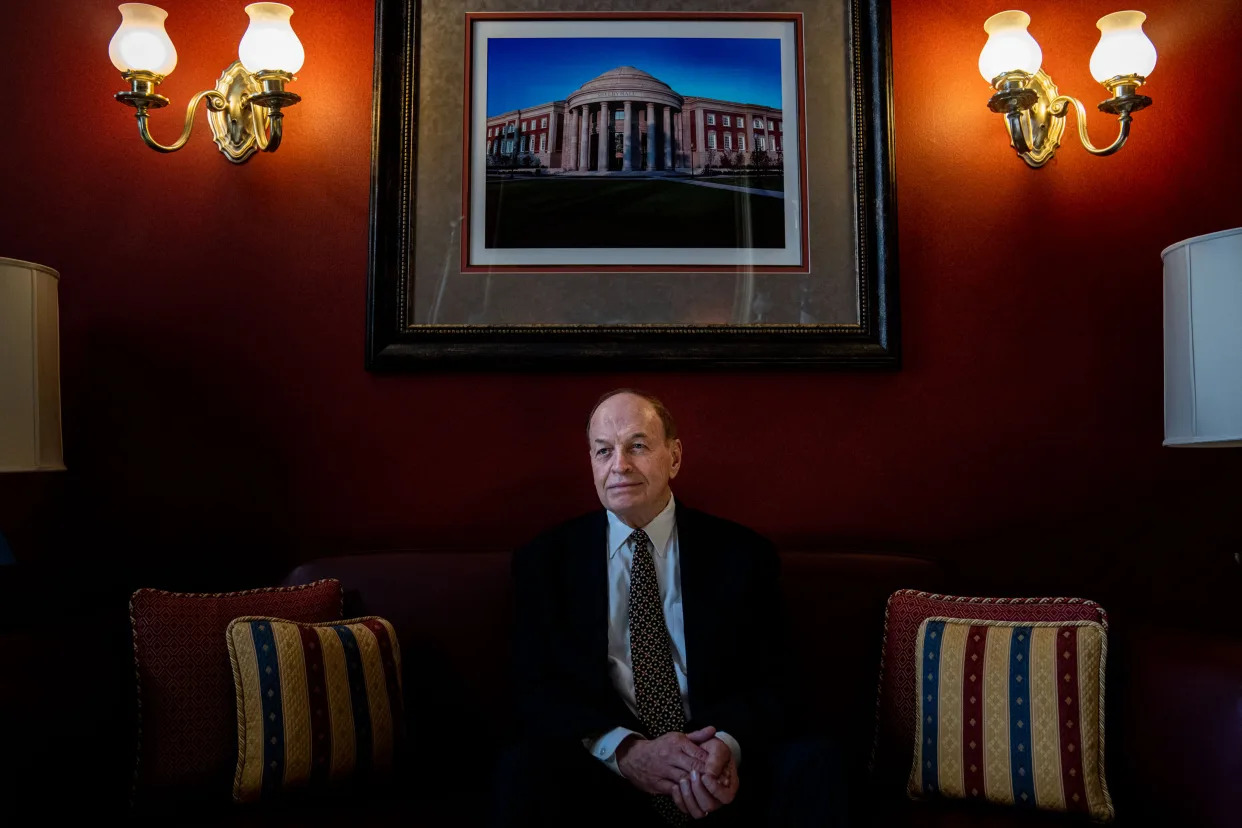
Sen. Richard Shelby (R-Ala.) in his office on Capitol Hill in Washington on Dec. 13, 2022. (Haiyun Jiang/The New York Times)
WASHINGTON — When Republicans won the House majority, some of their most conservative members pledged to use their power to slash the budgets of the federal agencies they claimed had been weaponized against them — chief among them the FBI.
So when Speaker Mike Johnson unveiled the package of six government spending bills he had negotiated with Democrats that cleared Congress on Friday, he touted the “deep cuts” — 6% — Republicans had secured to the agency’s budget.
But the story of the FBI cut is not so much one of how House Republicans used their slim majority to raze the budget of an agency they claim has gone rogue. Instead, it is a remarkable yarn about how a single powerful senator used budgetary sleight of hand to steer hundreds of millions of dollars to a single project in his state, only to see the money slashed by members of his own party after he retired.
Out of the $654 million lawmakers agreed to cut this year from the FBI’s operating budget, $622 million came from eliminating what was essentially an old earmark: money for construction at the bureau’s campus at Redstone Arsenal in Huntsville, Alabama. The funding was placed into the budget years ago by Sen. Richard Shelby of Alabama, a legendary pork-barreling veteran who retired in 2022 at 88.
The actual cut to the FBI’s operating budget — mostly for personnel and operations — was roughly $32 million, or 0.3%.
Ultraconservative Republicans like Rep. Chip Roy of Texas who voted against the spending package this week, deriding it as full of budgetary gimmicks, pointed to the elimination of Shelby’s pet project as a prime example of how little his party had actually been able to cut.
Grousing about the FBI budget cut on the House floor this week, Roy said, “What they won’t tell you is, 95% of that cut is eliminating an earmark from Richard Shelby, because Richard Shelby is no longer here to defend his pet project building back in Alabama.”
For years, Shelby used his perch on the Appropriations Committee to single-handedly transform the landscape of his home state, harnessing billions of federal dollars to conjure the creation and expansion of university buildings and research programs, airports and seaports, and military and space facilities.
One of his most prioritized projects was the twin FBI campuses at Redstone Arsenal in Huntsville, where over the course of a decade, he steered more than $3 billion to build up the 1,100 acres of land the bureau has secured there for facilities dedicated to cyberthreat intelligence and training.
The FBI has said to expect that more than 4,000 jobs will come to Huntsville over the next eight to 10 years.
Normally, such pet projects are funded through earmarks — a practice that allows lawmakers to direct federal funds for specific projects to their states and districts. Those projects are enumerated in a separate list, which clearly lays out how much federal money is going to a specific project, and which lawmaker requested it.
Shelby instead shoehorned money for the campus into the text of the spending bill, in an apparent effort to ensure it would be available even after he left Congress. For multiple years in a row, the Biden administration requested about $61 million for the FBI’s construction budget. Instead, at the senator’s behest, Congress gave it $632 million one year, and $652 million the next. Shelby did not immediately respond to a request for comment.
In each case, the laws stated that the additional funding was to be used to address the FBI’s “highest priorities outside of the immediate national capital area,” meaning Washington, D.C.
While it did not say so in the legislation, it was clear that that meant only one place: Huntsville.
“Growing the FBI’s presence in Huntsville has been a priority of mine for quite some time,” Shelby said in an announcement in 2022 touting the additional funding. “And I am proud to have helped bring it to fruition.”
Russia’s presidential election is nearing. We already know who the winner will be
Rob Picheta – March 8, 2024
Russia is nearing a presidential election that is all but certain to extend Vladimir Putin’s rule throughout this decade and into the 2030s.
The vast majority of votes will be cast over three days from 15 March, though early and postal voting has already begun, including in occupied parts of Ukraine where Russian forces are attempting to exert authority.
But this is not a normal election; the poll is essentially a constitutional box-ticking exercise that carries no prospect of removing Putin from power.
The president’s dominance over the Russian electoral system has already been reinforced as the election looms. The country’s only anti-war candidate has been barred from standing, and Alexey Navalny, the poisoned and jailed former opposition leader who was the most prominent anti-Putin voice in Russia, died last month.
Here’s what you need to know about the election.
When and where will the election take place?
Voting will be held from Friday March 15 until Sunday March 17, the first Russian presidential election to take place over three days.
A second round of voting would take place three weeks later if no candidate gets more than half the vote, though it would be a major surprise if that were required. Russians are electing the position of president alone; the next legislative elections, which form the make-up of the Duma, are scheduled for 2026.
Early voting began late last month in certain hard-to-access areas, with approximately 70,000 people able to cast their ballots in remote areas of Russia’s Far Eastern Federal District, according to state news agency TASS. The region makes up more than a third of Russia’s total territory but has only about 5% of its population.
Voting will take place over three days in March. – Maxim Shemetov/Reuters
Early voting in Zaporizhzhia, one of four Ukrainian regions Russia said it would annex in September 2022 in violation of international law, also began on February 25, TASS said.
Russia has already held regional votes and referenda in those occupied territories, an effort dismissed by the international community as a sham but which the Kremlin sees as central to its campaign of Russification.
How long has Putin been in power?
Putin signed a law in 2021 that allowed him to run for two more presidential terms, potentially extending his rule until 2036, after a referendum the previous year allowed him to reset the clock on his term limits.
This election will mark the start of the first of those two extra terms.
He has essentially been the country’s head of state for the entirety of the 21st century, rewriting the rules and conventions of Russia’s political system to extend and expand his powers.
That already makes him Russia’s longest-serving ruler since Soviet dictator Joseph Stalin.
Putin’s previous efforts to stay in control included a 2008 constitutional amendment that extended presidential terms from four years to six, and a temporary job swap with his then Prime Minister Dmitry Medvedev the same year, that preceded a swift return to the presidency in 2012.
Who else is running?
Candidates in Russian elections are tightly controlled by the Central Election Commission (CEC), enabling Putin to run against a favorable field and reducing the potential for an opposition candidate to gain momentum.
The same is true this year. “Each candidate fields juxtaposing ideologies and domestic policies, but collectively they feed into Putin’s aim of tightening his grip on Russia during his next presidential term,” wrote Callum Fraser of the Royal United Services Institute (RUSI) think tank.
Nikolay Kharitonov will represent the Communist Party, which has been allowed to run a candidate in each election this century, but has not gained as much as a fifth of the vote share since Putin’s first presidential election.
Two other Duma politicians, Leonid Slutsky and Vladislav Davankov, are also running. Davankov is deputy chair of the Duma, Russia’s lower house of parliament, while Slutsky represents the Liberal Democratic Party of Russia, the party previously led by ultra-nationalist firebrand Vladimir Zhirinovsky, who died in 2022. All are considered to be reliably pro-Kremlin.
But there is notably no candidate who opposes Putin’s war in Ukraine; Boris Nadezhdin, previously the only anti-war figure in the field, was barred from standing by the CEC in February after the body claimed he had not received enough legitimate signatures nominating his candidacy.
In December, another independent candidate who openly spoke out against the war in Ukraine, Yekaterina Duntsova, was rejected by the CEC, citing alleged errors in her campaign group’s registration documents. Duntsova later called on people to support Nadezhdin’s candidacy.
Writing on social media in February, opposition activist Leonid Volkov dismissed the elections as a “circus,” saying they were meant to signal Putin’s overwhelming mass support. “You need to understand what the March ‘elections’ mean for Putin. They are a propaganda effort to spread hopelessness” among the electorate, Volkov said.
Are the elections fair?
Russia’s elections are neither free nor fair, and serve essentially as a formality to extend Putin’s term in power, according to independent bodies and observers both in and outside the country.
Putin’s successful campaigns have been in part the result of “preferential media treatment, numerous abuses of incumbency, and procedural irregularities during the vote count,” according to Freedom House, a global democracy watchdog.
Outside of election cycles, the Kremlin’s propaganda machine targets voters with occasionally hysterical pro-Putin material, and many news websites based outside Russia were blocked following the invasion of Ukraine, though more tech-savvy younger voters have grown accustomed to using VPNs to access them.
Protests are also tightly restricted, making the public expression of opposition a perilous and rare occurrence.
Ballot papers bearing Putin’s name are prepared ahead of the election. – Vladimir Nikolayev/AFP/Getty Images
Then, as elections come into view, genuine opposition candidates almost inevitably see their candidacies removed or find themselves prevented from seeking office, as Nadezhdin and Duntsova discovered during this cycle.
“Opposition politicians and activists are frequently targeted with fabricated criminal cases and other forms of administrative harassment designed to prevent their participation in the political process,” Freedom House noted in its most recent global report.
Is Putin popular in Russia?
Truly gauging popular opinion is notoriously difficult in Russia, where the few independent think tanks operate under strict surveillance and where, even in a legitimate survey, many Russians are fearful of criticizing the Kremlin.
But Putin undoubtedly has reaped the rewards of a political landscape tilted dramatically in his favor. The Levada Center, a non-governmental polling organization, reports Putin’s approval rating at over 80% – an eye-popping figure virtually unknown among Western politicians, and a substantial increase compared to the three years before the invasion of Ukraine.
The invasion gave Putin a nationalist message around which to rally Russians, and even as Russia’s campaign stuttered over the course of 2023, the war retained widespread support.
National security is top of mind for Russians as the election approaches; Ukrainian strikes on Russian border regions have brought the war home to many people inside the country, but support for the invasion — euphemistically termed a “special military operation” by Russia’s leaders — remains high.
The Levada Center found at the end of 2023 that “increased inflation and rising food prices may have a lasting impact on the mood of Russians,” with the proportion of Russians cutting back on spending increasing.
But that is not to say Russians expect the election to change the direction of the country. Putin benefits heavily from apathy; most Russians have never witnessed a democratic transfer of power between rival political parties in a traditional presidential election, and expressions of anger at the Kremlin are rare enough to keep much of the population disengaged from politics.
Putin’s former speechwriter, Abbas Gallyamov, told CNN last month that discontent against the president was increasing in Russia. Gallyamov said Putin is attempting to eliminate opposition leaders from society to at least ensure such discontent remains “unstructured,” “disorganized” and “leaderless” ahead of future elections.
How will Navalny’s death affect the election?
The timing of the death of Alexey Navalny – Putin’s most prominent critic – served to emphasize the control Russia’s leader exerts over his country’s politics.
In one of Navalny’s final court appearances before his death, he urged prison service workers to “vote against Putin.”
“I have a suggestion: to vote for any candidate other than Putin. In order to vote against Putin, you just need to vote for any other candidate,” he said on February 8.
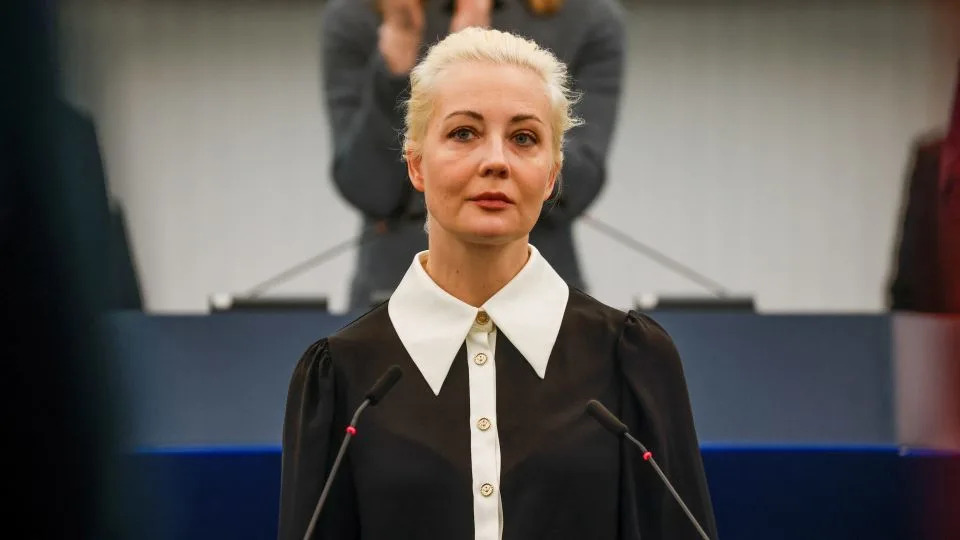
Yulia Navalnaya, the widow of Alexey Navalny, addresses the European Parliament in Strasbourg, France, on February 28, 2024. – Johanna Geron/Reuters
His death has cast an ominous shadow over the campaign. Navalny’s widow, Yulia Navalnaya, urged the European Union to “not recognize the elections” in a passionate address to its Foreign Affairs Council a few days after she was widowed.
“Putin killed my husband exactly a month before the so-called elections. These elections are fake, but Putin still needs them. For propaganda. He wants the whole world to believe that everyone in Russia supports and admires him. Don’t believe this propaganda,” she said.
Thousands gathered for Navalny’s funeral in Moscow despite the threat of detention by Russian authorities.
Navalnaya has since urged Russian people to turn out at noon on the final day of the elections, March 17, as a show of protest. In a video posted on social media, Navalnaya told Russians they could “vote for any candidate besides Putin, you can ruin your ballot, you can write Navalny on it.”
She added that Russians did not have to vote, but could “stand at a polling station and then go home… the most important thing is to come.”
This story has been updated.
CNN’s Anna Chernova, Pauline Lockwood and Mariya Knight contributed reporting.
Legal expert: Trump lawyer begging for “mercy” suggests he’s “having difficulty” coming up with bond
Igor Derysh – March 7, 2024
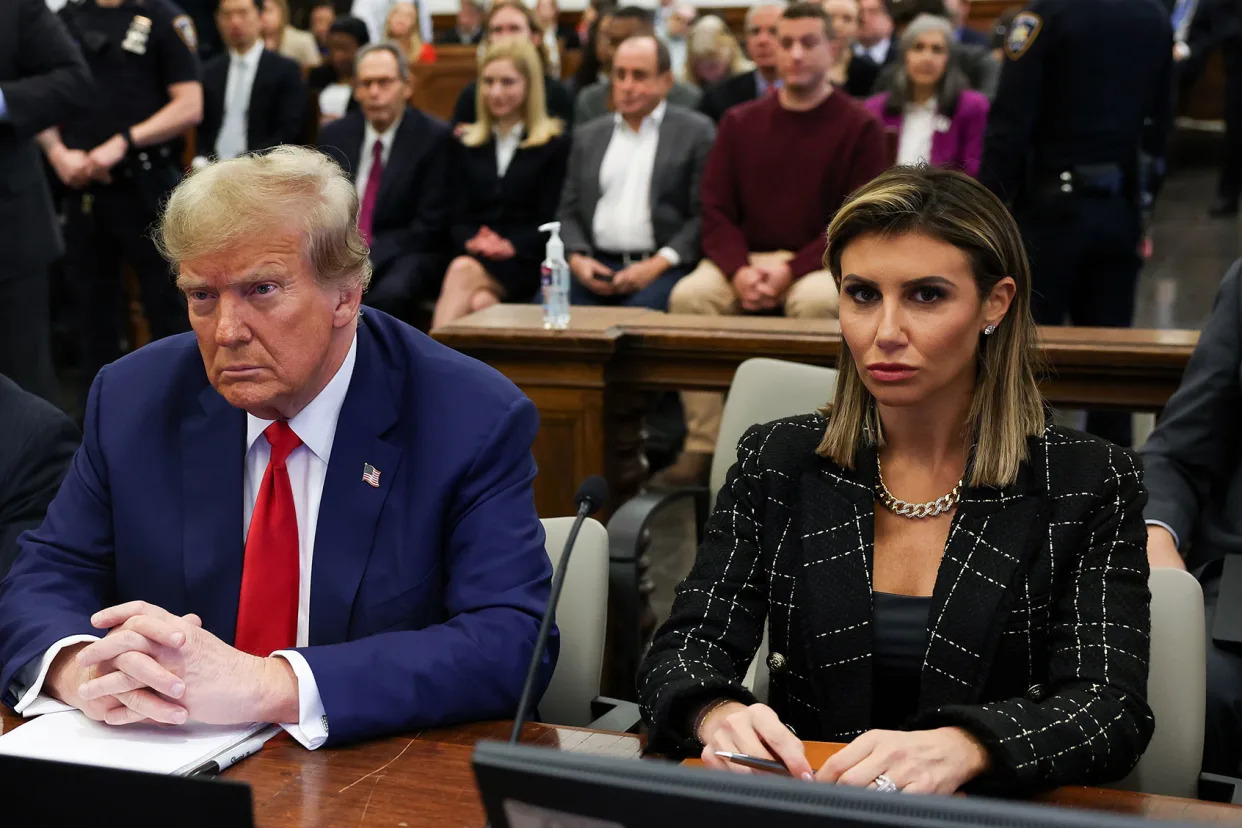
Donald Trump; Alina Habba Shannon Stapleton-Pool/Getty Images
Former President Donald Trump’s lawyers asked a judge on Tuesday to delay enforcing the $83 million defamation penalty a jury handed down in writer E. Jean Carroll’s defamation trial.
Trump attorneys Alina Habba and John Sauer asked New York Judge Lewis Kaplan to extend the stay of the ruling, which is set to expire on Monday. Trump will have to pay Carroll or put up $91 million in cash bond needed to appeal the ruling.
In New York, a defendant must pay a cash bond of 110% of the judgment to appeal the ruling of a civil case.
“Requiring President Trump to post a bond or other security before this Court’s ruling on his stay motion threatens to impose irreparable injury in the form of substantial costs (which may or may not be recoverable),” the attorneys wrote.
The letter asked the judge to extend the stay through at least Thursday.
“Habba is asking Judge Lew Kaplan — who has yet to rule on Trump’s request to stay enforcement of the $83.3 million E. Jean Carroll judgment as his post-trial motions are resolved — for some mercy,” tweeted MSNBC legal analyst Lisa Rubin. “Specifically, she notes that the existing stay expires Monday and asks that if Kaplan does not rule by tomorrow, he should at least stay enforcement of the judgment for three business days after that ruling.”
Rubin added that the letter suggests “Trump could be having difficulty arranging for a bond of $91-plus million.”
“Expecting that Kaplan will deny his request for a longer stay, he is trying to buy himself time to obtain one or free up sufficient cash,” she wrote.
The New York Times’ Maggie Haberman told CNN on Thursday that the repeated requests for a delay suggest “there is clearly a problem so far in acquiring a bond.”
“It doesn’t mean that they won’t get there, but I’m not sure what a couple of more days delay is going to do. And the judge has already said no delay previously,” she said.
Habba previously argued in a filing that “requirement of a bond would be inappropriate … where the defendant’s ability to pay the judgment is so plain that the cost of the bond would be a waste of money.”
E. Jean Carroll’s lawyer Roberta Kaplan rejected that argument in a letter to the judge.
“Trump offers no alternative means other than his own unsubstantiated say so that he will have $83.3 million available when Carroll prevails on appeal,” the attorney wrote.
Judge Kaplan issued an order on Monday stating that a ruling on the stay request will be “rendered as promptly as is reasonably possible.”
“Without implying what that decision will be or when it will be made, however, it will not come today,” he wrote.
15 promises Donald Trump has made so far in his campaign for a second term
Piper Hudspeth Blackburn and Abby Turner – March 6, 2024
Former President Donald Trump, now the presumptive Republican nominee, has made a number of promises on the campaign trail, including rolling back car pollution rules, building 10 new cities and appointing a special prosecutor to investigate President Joe Biden and his family.
While some of Trump’s plans are lacking in detail, here are some of the policies he says he would enact if elected for a second term.
Immigration
Trump has made immigration and the border a central campaign issue, successfully pressuring Republicans to reject a major bipartisan border deal last month and making a trip to the southern border on February 29, where he touted his previous hard-line immigration policies.
In a Des Moines Register op-ed published roughly a week before winning the Iowa caucuses in January, Trump vowed to use the “Alien Enemies Act to remove known or suspected gang members, drug dealers, or cartel members from the United States.”
“We will shift massive portions of federal law enforcement to immigration enforcement — including parts of the DEA, ATF, FBI, and DHS,” he wrote.
In a video posted on Truth Social in late February before his border visit, Trump also promised to “carry out the largest domestic deportation operation in American history.”
After the Israel-Hamas war began last October, Trump also promised to terminate the visas of “Hamas’ sympathizers.”
“We’ll get them off our college campuses, out of our cities and get them the hell out of our country, if that’s OK with you,” he added.
Drug cartels
The former president has also made waging “war” on drug cartels a priority for his second term. If elected, Trump said in his November 2022 campaign announcement that he would ask Congress to ensure that drug smugglers and human traffickers can receive the death penalty for their “heinous acts.”
Trump also vowed to “take down” drug cartels by imposing naval embargos on cartels, cutting off cartels’ access to global financial systems and using special forces within the Department of Defense to damage the cartels’ leadership.
Education
Trump announced plans in a September 2023campaign video to close the Department of Education and send “all education and education work and needs back to the states.”
“We want them to run the education of our children, because they’ll do a much better job of it,” he added.
The former president has also promised to “put parents back in charge and give them the final say” in education. In a January 2023 campaign video, the former president said he would give funding preferences and “favorable treatment” to schools that allow parents to elect principals, abolish teacher tenure for K-12 teachers, use merit pay to incentivize quality teaching and cut the number of school administrators, such as those overseeing diversity, equity and inclusion initiatives.
Trump also said in that campaign video that he would cut funding for schools that teach critical race theory and gender ideology. In a later speech, Trump said he would bring back the 1776 Commission, which was launched in his previous administration to “teach our values and promote our history and our traditions to our children.”
The former president said he would charge the Department of Justice and the Department of Education with investigating civil rights violations of race-based discrimination in schools while also removing “Marxists” from the Department of Education. A second Trump administration would pursue violations in schools of both the Constitution’s Establishment and Free Exercise clauses, which prohibit the government establishment of religion and protect a citizen’s right to practice their own religion, he said.
Health care
Last November, Trump promised to replace the Affordable Care Act, known colloquially as Obamacare, in a series of posts on Truth Social. A Trump-backed effort to repeal andreplace Obamacare failed in 2017 after three Republicans senators joined with Democrats to vote against the bill.
“Getting much better Healthcare than Obamacare for the American people will be a priority of the Trump Administration,” he said.
“It is not a matter of cost, it is a matter of HEALTH. America will have one of the best Healthcare Plans anywhere in the world. Right now it has one of the WORST!,” he continued. He also doubled down on his vow during a speech in early January.
Trump also vowed in a June 2023 campaign video to reinstate his previous executive order so that the US government would pay the same price for pharmaceuticals as other developed countries. Some of the former president’s pharmaceutical policies were overturned by Biden.
Gender care
“I will revoke every Biden policy promoting the chemical castration and sexual mutilation of our youth and ask Congress to send me a bill prohibiting child sexual mutilation in all 50 states,” Trump said at the 2023 Conservative Political Action Conference last March.
Trump added in a campaign video that he would issue an executive order instructing federal agencies to cut programs that promote gender transitions, as well as asking Congress to stop the use of federal dollars to promote and pay for gender-affirming procedures. The former president added that his administration would not allow hospitals and health care providers to meet the federal health and safety standards for Medicaid and Medicare if they provide chemical or physical gender-affirming care to youth.
Justice system
Trump has promised to use the Department of Justice to attack critics and former allies. In several videos and speeches, the former president also laid out plans to gut the current justice system by firing “radical Marxist prosecutors that are destroying America.”
“I will appoint a real special prosecutor to go after the most corrupt president in the history of the United States of America, Joe Biden, and the entire Biden crime family,” Trump said in June 2023 remarks. “I will totally obliterate the Deep State.”
Trump said in a campaign video last year that he would reinstate a 2020 executive order to remove “rogue” bureaucrats and propose a constitutional amendment for term limits on members of Congress.
To address what he labeled the “disturbing” relationship between technology platforms and the government, the former president said in a January 2023 video that he would enact a seven-year cooling off period before employees at agencies such as the FBI or CIA can work for platforms that oversee mass user data.
Trump added in multiple campaignreleases that he would task the Justice Department with investigating online censorship, ban federal agencies from “colluding” to censor citizens and suspend federal money to universities participating in “censorship-supporting activities.”
In a September 2023 speech at the Family Research Council’s Pray Vote Stand Summit in Washington, DC, Trump also touted plans to continue appointing conservative judges.
“I will once again appoint rock-solid conservative judges to do what they have to do in the mold of Justices Antonin Scalia; Samuel Alito, a great gentleman; and another great gentleman, Clarence Thomas,” he said.
Trump has also pledged to “appoint U.S. Attorneys who will be the polar opposite of the Soros District Attorneys and others that are being appointed throughout the United States.”
In a September 2023 speech in Washington, DC, Trump also announced that he would appoint a task force to review the cases of people he claimed had been “unjustly persecuted by the Biden administration.” Trump noted that he wanted to “study the situation very quickly, and sign their pardons or commutations on day one.”
It’s a move that could lead to potential pardons of many rioters from the January 6, 2021, insurrection – which he suggested he would do at a CNN town hall in May 2023.
Crime
Trump said in two February 2023 campaignvideos that if “Marxist” prosecutors refuse to charge crimes and surrender “our cities to violent criminals,” he “will not hesitate to send in federal law enforcement to restore peace and public safety.”
Trump added that he would instruct the Department of Justice to open civil rights investigations into “radical left” prosecutors’ offices that engaged in racial enforcement of the law, encourage Congress to use their legal authority over Washington, DC, to restore “law and order” and overhaul federal standards of disciplining minors to address rising crimes like carjackings.
Addressing policies made in what Trump calls the “Democrats’ war on police,” the former president vowed in a campaign video that he would pass a “record investment” to hire and retrain police, strengthen protections like qualified immunity, increase penalties for assaulting law enforcement officers and deploy the National Guard when local law enforcement “refuses to act.”
The former president added that he would require law enforcement agencies that receive money from his funding investment or the Department of Justice to use “proven common sense” measures such as stop-and-frisk.
Foreign policy
Trump has continued his attacks against member countries of NATO, a European and North American defense alliance. At a South Carolina rally last month,Trump said he would not abide by the alliance’s collective-defense clause and would encourage Russia to do “whatever the hell they want” if a member country didn’t meet spending guidelines.
“NATO was busted until I came along,” Trump said. “I said, ‘Everybody’s gonna pay.’ They said, ‘Well, if we don’t pay, are you still going to protect us?’ I said, ‘Absolutely not.’ They couldn’t believe the answer.”
The former president has also previously pledged to end the war in Ukraine, though he’s offered no details on how he would do so.“Shortly after I win the presidency, I will have the horrible war between Russia and Ukraine settled,” Trump said at a New Hampshire campaign event last year, adding in another speech that it would take him “no longer than one day” to settle the war if elected.
Trump further addressed his strategy of stopping the “never-ending wars” by vowing to remove “warmongers,” “frauds” and “failures in the senior ranks of our government,” and replace them with national security officials who would defend America’s interests. The former president added in a campaign video that he would stop lobbyists and government contractors from pushing senior military officials toward war.
Trump said in multiple campaignvideos that he would spearhead an effort to build so-called “Freedom Cities” to “reopen the frontier, reignite American imagination, and give hundreds of thousands of young people and other people, all hardworking families, a new shot at home ownership and in fact, the American Dream.”
In his plan, the federal government would charter 10 new cities on federal land, awarding them to areas with the best development proposals. The former president said in a campaign video that the Freedom Cities would bring the return of US manufacturing, economic opportunity, new industries and affordable living.
In the March 2023 video, Trump added that the US under a second Trump administration would lead in efforts to “develop vertical-takeoff-and-landing vehicles for families and individuals,” not letting China lead “this revolution in air mobility.” The former president said these airborne vehicles would change commerce and bring wealth into rural communities.
Electric vehicles
Trump has promised to roll back new car pollution rules at the Environmental Protection Agency that could require electric vehicles to account for up to two-thirds of new cars sold in the US by 2032. Biden’s electrical vehicle-related policies, Trump claimed at a Michigan rally last September, “spell the death of the US auto industry.”
“On day one, I will terminate Joe Biden’s electrical vehicle mandate, and I will cancel every job-killing regulation that is crushing American autoworkers,” Trump added.
Energy
Trump has promised to reduce energy prices by increasing domestic production. In several campaign appearances, he has laid out plans to end delays in federal drilling permits and leases.
“We’re going to ‘drill, baby, drill’ right away,” Trump told a crowd of supporters in Des Moines, Iowa, during a victory speech after winning the state’s Republican caucusesin January.
At a South Carolina rally in February, he pledged to remove limits on American natural gas exports.
Trade
At the same rally in South Carolina,Trump pledged to impose “stiff penalties on China and other trade abusers.”
“It’s called you screw us, and we screw you,” Trump said.
Under his proposed “Trump Reciprocal Trade Act,” the former president said if other countries impose tariffs on the US, the country would impose “a reciprocal, identical” tariff right back.
It was the same pledge Trump made in a campaign video in 2023: to impose the same tariffs that other countries may impose on the US on those countries. The goal, the former president said then, is to get other countries to drop their tariffs.
As part of a larger strategy to bring jobs back into the US, Trump also said he would implement his so-called “America First” trade agenda if elected. By setting universal baseline tariffs on a majority of foreign goods, the former president said Americans would see taxes decrease as tariffs increase. His proposal also includes a four-year plan to phase out all Chinese imports of essential goods, as well as stopping China from buying up America and stopping the investment of US companies in China.
The former president has particularly focused on China, vowing in a January 2023 campaign video to restrict Chinese ownership of US infrastructure such as energy, technology, telecommunications and natural resources. Trump also said he would force the Chinese to sell current holdings that may put national security at risk. “Economic security is national security,” he said.
Economy
Trump has promised to extend the cuts from his 2017 Tax Cuts and Jobs Act, notably the TCJA’s individual income tax breaks. The former president has also talked about reducing the corporate tax rate from the current 21% to 15%.
“I will make the Trump tax cuts the largest tax cut in history,” the former president said last month at the Black Conservative Federation’s Honors Gala in South Carolina. “We’ll make it permanent and give you a new economic boom.”
Trump has also pledged to repeal Biden’s tax hikes, “immediately tackle” inflation and end what he called Biden’s “war” on American energy production.
Second Amendment
“I will take Biden’s executive order directing the federal government to target the firearms industry, and I will rip it up and throw it out on day one,” Trump said at the 2023 National Rifle Association Institute for Legislative Action leadership forum last April.
The former president also promised in the speech that the government would not infringe on citizens’ Second Amendment rights and that he would push Congress to pass a concealed carry reciprocity.
Equity
“I will create a special team to rapidly review every action taken by federal agencies under Biden’s ‘equity’ agenda that will need to be reversed. We will reverse almost all of them,” Trump said in a campaign video.
Trump added in multiple campaignvideos that he would revoke Biden’s equity executive order that required federal agencies to deliver equitable outcomes in policy and conduct equity training. If elected, Trump said he would also fire staffers hired to implement Biden’s policy, and then reinstate his 2020 executive order banning racial and sexual stereotyping in the federal government.
CNN’s Tami Luhby, Kate Sullivan and Kristin Holmes contributed to this report.
Today’s Supreme Court is a threat to democracy — but activists plan to fight back
Paul Rosenberg – March 3, 2024
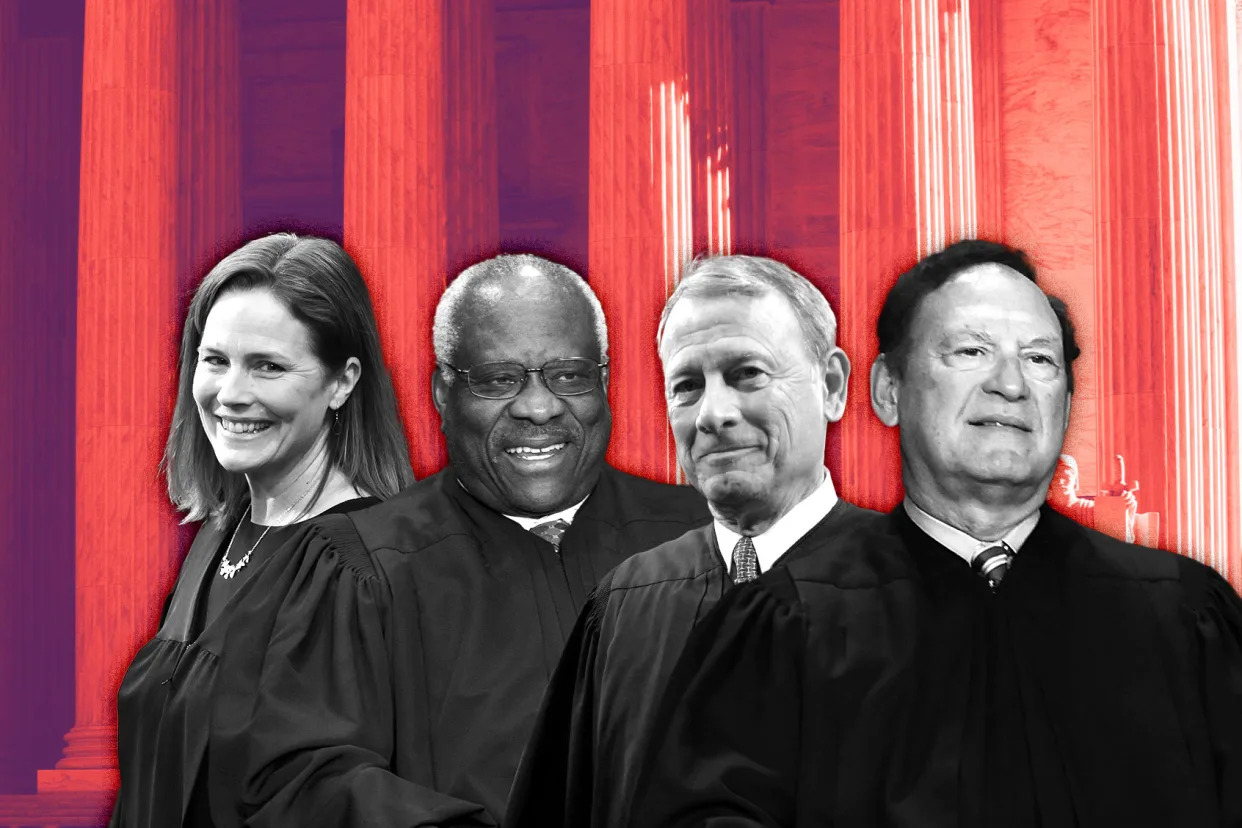
Amy Coney Barrett, Clarence Thomas, John Roberts and Samuel Alito Photo illustration by Salon/Getty Images
The Supreme Court is a supreme threat to American democracy. That was Abraham Lincoln’s view in light of the Dred Scott decision, expressed in his First Inaugural Address. And it was vividly illustrated after Lincoln’s assassination, when the Civil War amendments and civil rights legislation passed by Congress were effectively nullified by the Supreme Court, enabling former Confederates and other white supremacists to destroy the possibility of multiracial democracy for almost a century. “Our democracy suffers when an unelected group of lawyers take away our ability to govern ourselves,” as Harvard Law professor Nikolas Bowie wrote in 2021, based on his testimony before the do-nothing Presidential Commission on the Supreme Court of the United States.
Since then, the Court’s decision in Dobbs v. Jackson Women’s Health, which overturned the precedent of Roe v. Wade, has brought Bowie’s point home with a vengeance. But it’s not just about abortion. On guns, environmental protection, discrimination, labor rights, affirmative action, student debt relief and numerous other issues, Mitch McConnell’s court-packing scheme and Donald Trump’s appointments have succeeded in dramatically undercutting Americans’ people’s capacity for self-government and the promotion of “the general welfare” promised in the preamble to the U.S. Constitution.
While the electoral backlash against Dobbs has been heartening, that’s essentially a reaction to the most alarming and personally invasive Supreme Court decision, not a proactive effort to dismantle the source of the threat. That’s why the new online lecture and discussion course, “What to Do About the Courts,” feels so important: It’s an effort to begin laying the groundwork for fundamental court reform. It’s a collaboration between the Law and Political Economy Project and the People’s Parity Project which featured Bowie as its leadoff lecturer on Jan. 30. A second session, looking at the history of reform efforts, was held Feb. 20.
“This is really core to what our organizations are doing and how we’re thinking about the work that we need to be engaged in for many years to come,” PPP executive director Molly Coleman told Salon. The online venue, she said, made it possible to “open this up quite a bit more than if we had done this as an in-person meeting group on a law school campus.”
The discussion component is critical, according to LPEP executive director Corinne Blalock: “It really does reflect our theory of change and how we understand how ideas move in the world.”
“We didn’t want this to just be a lecture series,” Coleman added. “Court reform should be something that’s built by the people. Part of this project is thinking about how we end judicial supremacy, how we make sure that the people have power, and not just unelected, unaccountable judges. We would be remiss if that wasn’t modeled in our programming.”
For generations, Americans have largely been blind to the Supreme Court’s profoundly anti-democratic character, because under former Chief Justice Earl Warren, the court was instrumental in reversing the post-Reconstruction destruction of democracy, most notably with the landmark ruling in Brown v. Board of Education, which officially ended school segregation. But however significant Brown was in cultural and historic terms, in reality it only reduced segregation and certainly did not restore multiracial democracy. Congress began to do that with the 1965 Voting Rights Act — but nearly 50 years later, in Shelby County v. Holder, the Supreme Court undid much of that law and once again began undermining democracy.
The halo effect around the Supreme Court, resulting from the Brown decision and the Warren court’s legacy more broadly — which continued into the 1970s with Roe v. Wade — was finally shattered for most attentive Americans by the Dobbs decision in 2022. Now, perhaps, Bowie’s unheeded warning a year before that may get the hearing it deserves, fleshed out by a range of possible court reforms that have been considered, implemented in the past (the subject of the course’s second session) or modeled elsewhere by healthier democracies (the subject of its upcoming third one).
“Really thinking about transforming the court felt politically inconceivable a few years ago,” said Blalock. “There were certainly scholars who felt the urgency, but we needed the material stakes to really connect it to people’s lives. With all the atrocious things that the Supreme Court has done recently, that piece has sort of been done for us. So our role is helping people connect that to a set of political ideas.”
There’s another and perhaps larger concern, Blalock continued. “For everyone on the left or left of center who’s thinking about transformative change, whether it’s climate change, reproductive rights or labor, it feels like the Supreme Court is looming,” she said. “We felt that our two organizations were particularly well-suited to step in and help connect the dots.”
“Despite this moment where the Supreme Court is at the center of so many conversations, despite a lot of excitement and energy around the possibility of court reform, there is a lack of information about what court reform can look like,” Coleman added. “Even folks who are living and breathing this work in advocacy spaces might be talking about expansion or might be talking about ethics reform, but so many of these other reforms that have been tried in the past haven’t entered the mainstream conversation. We felt there was an important void to fill, to take some of these ideas that are being discussed in the legal academy or by historians and bring them to the mainstream of progressive organizing spaces.”
The series began with Bowie addressing the foundation of the problem: the wildly disproportionate power of the Supreme Court, where five individuals can effectively thwart the will of 340 million citizens. Because judicial supremacy is so deeply ingrained in our system, people tend to assume it’s enshrined in the Constitution. It’s not. Lawyers are taught that it derives from the Supreme Court’s legendary 1803 decision Marbury v. Madison, but they’re generally not taught the larger story that casts the decision in a questionable partisan light. One might describe it, in fact, as a judicial coup.
As Bowie recounted, when the Federalist government under President John Adams passed the wildly unconstitutional Alien and Sedition Acts in 1798, the opposing party led by Thomas Jefferson didn’t turn to the courts. “Federal judges were just as partisan, just as committed to stamping out political opposition, as anyone else,” Bowie said. “So Jefferson’s party ended up getting rid of this law not by going to court, but by winning an election.”
In the lame-duck session that followed Jefferson’s victory in the controversial election of 1800, Adams and the Federalists created a bunch of new federal courts and packed them with supportive judges. That included Adams’ appointment of John Marshall, the outgoing secretary of state, as chief justice of the Supreme Court. After that, Bowie said, Jefferson’s party proposed a bill to destroy or undo all these new courts, which led to fierce debate:
Federalists responded [that] federal courts need to have this power to strike down federal laws. If Congress can simply get rid of the courts, then federal courts won’t have this power anymore. And for Jefferson’s party in Congress, they thought the idea that federal courts would strike down federal laws was this crazy innovation. Just a really bad idea and obviously partisan in motivation. … They thought there was nothing in the Constitution that says a federal judge can strike down a federal law. It would be a really weird distribution of power to give federal judges this control.
In the wake of that debate, Bowie said, Marshall authored the famous majority opinion in Marbury v. Madison, which “effectively just parroted the Federalist position from Congress.” In short, the position held by a minority in Congress became the law of the land — and not on some narrow legalistic point, but on the fundamental question of who is allowed to interpret the Constitution.
That remained a purely theoretical issue for more than 50 years. “Marshall didn’t end up disagreeing with Congress about the constitutionality of any legislation for the remainder of his term,” Bowie said. Then came the 1857 Dred Scott decision, which struck down the Missouri Compromise and denied Congress the right to prohibit slavery in the nation’s territories. This became a defining issue for the newly-formed Republican Party, which didn’t just shrug and accept it. As Bowie put it, “They responded, ‘What is the court doing? The court should not have this power,’” and ran on a platform “that repudiated the court’s power to decide this constitutional question.” After Lincoln was elected in 1860, “he and Congress passed legislation that did precisely what the Supreme Court said Congress could not do.”
There was certainly much more to Bowie’s presentation — and much more Supreme Court mischief that undermined the rights of Black Americans for generations — but that should be sufficient to show that our meek modern-day acceptance of judicial supremacy rests upon a profound ignorance of our own history. Both Jefferson and Lincoln, revered today as the founders of our two major parties, vehemently rejected judicial supremacy. It’s time for 21st-century Americans to seriously consider doing the same — or at the very least, to place significant limitations on it. The question, of course, is exactly how to limit or replace judicial supremacy, and what specific reforms can get us there.
The February session of “What to Do About the Courts” began to answer those questions, looking into the history of court-disempowering reforms and proposals, with professors Samuel Moyn of Yale and William Forbath of the University of Texas. Moyn cited a number of reform ideas:
Popular overrides of court decisions by referendum, as proposed by Theodore Roosevelt in his 1912 third-party presidential campaign.
“Jurisdiction stripping,” meaning laws that limit the court’s jurisdiction over certain kinds of statutes.
A supermajority requirement, meaning a bare majority of five justices could not invalidate laws passed by Congress, as proposed by progressive Sen. William Borah in 1923.
Congressional authority to override any Supreme Court decision by a two-thirds vote, as proposed by Sen. Robert La Follette Sr. in his 1924 third-party presidential campaign.
Prohibiting federal court injunctions in labor disputes, as mandated by the 1932 Norris–La Guardia Act.
Forbath looked more closely at the history of labor law: how the growth of a national economy increased the use of secondary strikes and boycotts, how common law and the Sherman Anti-Trust Act were used to declare them illegal and how that, along with court-sanctioned state violence, “inspired a decades-long, high-profile campaign of official union defiance of anti-strike and anti-boycott decrees,” undergirded by “a richly elaborated moral and constitutional order, a rival order built on the First and 13th amendments.” That movement declared, Forbath said, that “courts were quite literally creating property rights in man and elevating property rights over human rights.”
During the 1920s, Forbath continued, there were “constant calls and dozens of bills and proposals for laws and amendments to the Constitution that would enact what we call court reform. They brought movement constitutionalism to the halls of Congress,” resulting in the aforementioned Norris-La Guardia Act, even before FDR’s New Deal. That came about in part, Forbath said, because the judiciary had “squander[ed] its own legitimacy. Too many working-class Americans had come to see the courts for what they were: They were the place where the ruling class went to rule, dispensing class-bound decisions in the name of the Constitution.”
That kind of keen historical awareness, vigilance and activism may well be needed today. Arguably that shouldn’t be difficult to ignite, given the current radical Supreme Court and its recent actions. It may be much more difficult to create a unified movement with a clear vision for change. Divisions. to be sure, existed in earlier eras as well. “Back in the early 20th century, there was a rift between Black freedom organizations like the NAACP and labor and progressives who were most invested in labor reforms,” Forbath said. While the latter groups wanted to disempower the courts, the Black freedom movement largely did not, because the courts — however inadequate they were — appeared to be its most reliable allies.
That particular division no longer applies, but there are undeniably different priorities for different constituencies that could fragment reform efforts. More broadly, Forbath asked: “Do we want movement justices and judges, as brash in their way as the right-wing movement justices today? Or do you want more technocratic judges, committed above all to judicial restraint and a fair reading of progressive statutes?” The answer is not immediately obvious.
The seminar’s next session, Blalock said, will be “on the international and comparative perspective, which helps make this all feel so much more doable, particularly when for so long these have been treated like radically fringe ideas. After that, we’re going to dig a little more into the weeds about what the options are [and] really walk through the specific nature of how the reform would work. The final session is going to be on how we build a movement around this. We’re bringing in Astra Taylor from the Debt Collective, in conversation with Sabeel Rahman, who comes from more the government policy side, to talk about how we take these ideas forward beyond the reading group.”
So far, the feedback has been “alarmingly positive,” Coleman said. “The biggest thing we’re hearing is that even current law students aren’t hearing these ideas on their campus. They really feel that they’re getting something unique in this space [and] they’re really excited to bring it back to broader communities.” Beyond law school campuses, there are leaders in progressive organizations who “want every single person they work with to be at the next iteration of the reading group,” she said. “People want more folks to know what conversations are happening. That’s been pretty exciting.”
While attorneys, law students and activists are important audiences for these ideas, there’s also a need for broader conceptual, narrative and communications work aimed at a general audience. The right has successfully unified under the rhetoric of constitutional “originalism,” regardless of how vacuous that idea is in practice (Salon stories here and here). Conservative power is grounded in conceptual simplicity, even though the right’s ideas have proven inherently inadequate to the complexity of the modern world. To counter it, liberals and progressives must address that complexity — real history and real science, not myths — while heeding Einstein’s advice: “Everything should be made as simple as possible, but not simpler.” In short, the progressive movement needs a counternarrative of its own, although identifying just one narrative might prove impossible.
One possible narrative, alluded to above, is to focus on the constitutional concept of “general welfare,” articulated in terms of public goods, an underlying logic laid out in Donald Cohen and Allen Mikalean’s 2022 book “The Privatization of Everything.” Another possibility is to focus on public health, which, as I argued in 2021, can “serve as a long-term, overarching framework to reframe our politics, to provide us with new common sense in addressing a wide range of diverse issues by highlighting common themes and connecting what works.”
Other narratives are surely possible. But it’s crucial that they encompass those four elements: common sense, a wide range of diverse issues, common themes and a pragmatic focus on what works. It’s no accident that the common law tradition encompasses those central themes. The promise of “What to Do About the Courts” is that history teaches us that change is possible and we can make it happen: Once legal scholars and activists on the left have fashioned the right framework, they believe they’ll have the wind at their backs.
The ‘uniparty’? Conservatives bash bipartisanship by attacking fellow Republicans
Sahil Kapur and Allan Smith – March 3, 2024
WASHINGTON — An empowered faction of Donald Trump – aligned Republicans is seeking to redefine dealmaking as an insult by deploying the term “uniparty” to attack colleagues who work with Democrats and strike deals that fall short of what their base wants.
The growing use of the word among the GOP’s ascendant culture warriors represents an effort by conservative lawmakers, activists and commentators to disparage bipartisan agreements on matters that have broad support in Congress like government funding, infrastructure spending and aid for U.S. allies like Ukraine.
Rep. Bob Good, R-Va., chair of the far-right Freedom Caucus, called the recent House passage of a bill to avert a partial government shutdown an example of a “uniparty vote,” with Republicans who “talk about spending cuts and talk about fiscal responsibility” but ultimately support compromise spending measures.
“The uniparty is when the rubber meets the road and Republicans and Democrats join hands to stick it to the American people,” Good told NBC News.
He added that “unfortunately, too many Republicans are all too eager” to compromise with Democrats.
While Republicans control the House, Democrats hold the Senate majority and the White House, where President Joe Biden on Friday signed into law the short-term funding bill that was negotiated with House Speaker Mike Johnson, R-La., to keep the government open.
House and Senate Republicans who have assailed the so-called uniparty — including Reps. Lauren Boebert of Colorado, Marjorie Taylor Greene of Georgia and Matt Gaetz of Florida, as well as Sens. Rick Scott of Florida and J.D. Vance of Ohio — all voted against the latest government funding bill.
The House voted 320-99 to pass the measure, followed by a 77-13 vote in the Senate — evidence that there is “absolutely” a “uniparty” in Washington, according to Boebert.
“It means Republicans who vote Democrat Light, who side with the other party because they are weak and refuse to take a stand,” she said in an interview. “Unfortunately, too many Republicans campaign as conservatives and govern like Nancy Pelosi.”
Vance, a leading critic of additional funding for Ukraine’s military effort, said he doesn’t know where the term “uniparty” came from but cited the recent debate over assisting Ukraine in fending off Russia as an example.
“Whether you call it a uniparty or something else, I do think it suggests something’s broken about our democratic process,” he said.
Where did the term come from?
The modern use of “uniparty” traces back a few years, though its roots run deeper. The term’s framing has long been a favorite of Steve Bannon, the former Trump White House official and right-wing media personality who has been deploying it for years. Trump himself has reposted items from supporters who use the descriptor on his Truth Social platform.
The right has previously embraced similar wording, like “regime,” which Florida Gov. Ron DeSantis used repeatedly during his 2024 presidential campaign to describe the federal government, and “drain the swamp,” a rallying cry during Trump’s 2016 campaign. There’s also “the cathedral,” a term used by some on the right to describe institutions they see as controlling acceptable political discourse.
Meanwhile, the left and third-party candidates have at times embraced similar terminology. An aide to former President Barack Obama described the foreign policy establishment as “the Blob,” while former Green Party presidential nominees Ralph Nader and Jill Stein have used “uniparty” in railing against the U.S. political system.
In the 2024 campaign, independent presidential candidate Robert F. Kennedy Jr. has invoked the term, including when he wrote in The Baltimore Sun last month that special interest groups “control our government to such an extent that — no matter which party is in charge — many Americans now refer to the two parties as the ‘uniparty.’”
Stefanie Spear, a Kennedy spokesperson, said in a statement that “more Americans of all political persuasions are recognizing that both establishment parties largely represent the same corporate interests.”
“The term uniparty is therefore quite natural, and Mr. Kennedy is pleased that it is gaining traction,” she said.
Sen. Rand Paul, the son of libertarian former Rep. Ron Paul of Texas, noted the third-party roots of the uniparty framework, saying, “There’s been a uniparty since I was a kid and would come up here in the 1970s.”
“Libertarians always used it when they were running as another independent party,” Paul, R-Ky., said in an interview. “Hadn’t been used as much within the Republican Party, but I think it’s catching on.”
Some Republicans dislike the framing
The term is most often used when discussing two distinct issues — funding for Ukraine and government spending. And the leader who finds himself most under attack on that front is Senate Minority Leader Mitch McConnell, R-Ky., who recently announced he will step down from leadership after the November elections.
McConnell has vociferously pushed for additional funding for Ukraine and, in a time of divided government, has been able to cut a series of deals with the Biden administration.
“Believe me, I know the politics within my party at this particular moment in time,” McConnell said during a portion of his Senate floor speech on Wednesday announcing his pending retirement that focused on the need for America to lead on the global stage. “I have many faults; misunderstanding politics is not one of them.”
Yet some Republicans, including those aligned with the lawmakers who voted against the short-term spending agreement and have pushed back on new funding for Ukraine, find the term odd.
“What, you can’t differentiate between a Democrat and Republican up here?” said Rep. Troy Nehls, R-Texas.
Asked why his colleagues are using the term, he replied: “I don’t know. I guess everybody’s gotta come up with something clever.”
And one Senate Republican aide, speaking on condition of anonymity, said they “don’t like the term, frankly.”
“I think it went from ‘the swamp,’ which I do like, to ‘the regime,’ which I like less, then ‘uniparty,’ which I like even less,” this person said. “And they all kind of mean the same thing. But I think it sounds increasingly nerdy and weird and people don’t really know what they mean.”
This person said they feel some lawmakers are using this language because it sounds “like a vaguely intellectual term, even though it’s not, actually.”
As for what separates “uniparty” initiatives from the kind of bipartisanship some of these right-wing lawmakers might take part in, this person said the distinction was simple: If leadership on both sides is for it, it’s “uniparty,” but if the leaders of both parties oppose it, it’s not.
Democrats continue to celebrate bipartisanship
Sen. Brian Schatz of Hawaii, a member of Democratic leadership, said the use of the term by certain Republicans highlights their interest in catering only to a narrow slice of the electorate.
“If they want to make it crystal clear that their coalition comprises 28% of the public, then I welcome that,” he said. “They are a minority and they are trying to turn the fact that their views are minority opinions into some sort of virtue. But the truth is that they’re way out of the mainstream, and any competent political party would not emphasize that point.”
Democrats have not hesitated to celebrate acts of bipartisanship, even when it leads to legislation or policies they consider imperfect.
“As I said directly to the speaker over and over and over again, the only way to get things done here is with bipartisanship, and this agreement is another proof point,” Senate Majority Leader Chuck Schumer, D-N.Y., said on the floor Thursday of the short-term government funding bill. “When bipartisanship is prioritized, when getting things done for the American people takes a high priority, good things can happen even in divided government.”
In a statement Wednesday, White House press secretary Karine Jean-Pierre used “bipartisan” three times in one sentence to describe the legislation.
“The bipartisan agreement announced today would help prevent a needless shutdown while providing more time to work on bipartisan appropriations bills and for the House to pass the bipartisan national security supplemental as quickly as possible,” she said.
Could it apply to Trump?
Rep. Tim Burchett, R-Tenn., framed his use of “uniparty” entirely around spending, using the term to describe “the group that always votes for more spending and more debt.”
“The letter beside their name does not matter: [They’re] Republicans that vote like Democrats and the Democrats that vote like Republicans,” Burchett said.
By that measure, the term could extend to Trump, whose policies in office led to increased spending and deficits, even when Republicans controlled both the House and Senate.
Former South Carolina Gov. Nikki Haley, who worked in the Trump administration as U.S. ambassador to the United Nations, has repeatedly brought up Trump-era spending on the campaign trail as she seeks to defeat her onetime boss for the GOP nomination.
“I would love to tell you that Joe Biden did that to us,” she said in South Carolina last month while expressing dismay over the national debt. “But I always have spoken to you in hard truths. And I’m going to do that with you tonight. Our Republicans did that to us too. You look at the fact that President Trump put us $8 trillion in debt in just four years. More than any other president.”
One word she did not use in describing that predicament: uniparty.
Trump warns of ‘languages coming into our country’ that ‘nobody’ has heard of
Alec Hernández, Jake Traylor and Katherine Koretski – March 3, 2024
Warning about the dangers of illegal immigration at the southern border has long been one of Donald Trump’s campaign mainstays, going back to the day he launched his first presidential bid. At the time, he said Mexico was sending “rapists” and people who were bringing “drugs” and “crime.”
But lately, the former president has seized on a new thing he says migrants are bringing: languages.
“We have languages coming into our country. We don’t have one instructor in our entire nation that can speak that language,” Trump said before a crowd of thousands of supporters at the Conservative Political Action Conference outside Washington, D.C., last month.
“These are languages — it’s the craziest thing — they have languages that nobody in this country has ever heard of. It’s a very horrible thing,” he added.
Trump repeated the comment the following week during an appearance at the southern border alongside Texas Gov. Greg Abbott, saying that migrants are entering the country speaking “truly foreign languages.”
“Nobody speaks them,” he said after a tour of the border in Eagle Pass.
And addressing a rally in Virginia Saturday night, Trump described New York classrooms as overwhelmed with “pupils from foreign countries, from countries where they don’t even know what the language is.”
“We have nobody that even teaches it. These are languages that nobody ever heard of,” he claimed.
It’s not entirely clear what languages Trump is referencing.
When asked to clarify Trump’s remarks, campaign spokesman Steven Cheung responded, “There are migrants invading from countries that we know nothing about, which is the point.” He did not respond to a follow-up question about what those countries are.
At campaign rallies, Trump routinely says he would carry out the largest domestic deportation operation in history if re-elected. Trump also vows to reinstate his infamous Muslim travel ban, expand it to include Gazan refugees, and incorporate “ideological screenings” for all immigrants. Trump has also claimed multiple times that immigrants are poisoning the blood of America, a comment President Joe Biden’s campaign likened to the rhetoric of Adolf Hitler.
“I’ve been so proud of how Joe has placed women at the center of his agenda. But Donald Trump?” the first lady said to boos. “He spent a lifetime tearing us down and devaluing our existence. He mocks women’s bodies, disrespects our accomplishments and brags about assault. Now he’s bragging about killing Roe v. Wade.”
The first lady continued: “He took credit again for enabling states like Georgia to pass cruel abortion bans that are taking away the right of women to make their own health care decisions. How far will he go? When will he stop? You know the answer: He won’t. He won’t.”
As the first lady embarks on a three-day, four-stop battleground state campaign swing, launching the “Women for Biden-Harris” coalition, her role in the reelection effort is becoming clearer. The campaign is looking to use a top surrogate to organize – and mobilize – female voters heading into the general election, all while delivering a clear message about Trump.
“Donald Trump is dangerous to women and to our families. We simply cannot let him win,” she said in Atlanta.
The first lady is also traveling through Arizona, Nevada and Wisconsin, and she’s expected to court Black and Latino communities as the campaign looks to make inroads with those key demographic groups.
Much of the first lady’s work in the early stages of the campaign has focused on crisscrossing the country for fundraisers, but in the months ahead she’s expected to become a more frequent presence on the trail advocating on behalf of her husband and his agenda.
The first lady has long said that she’s not a political adviser to the president, instead explaining to CNN that she helps her husband by relaying what she sees and hears from people on the road. But she is his most trusted partner and holds influence in the White House and campaign. She sits in on some of the president’s political meetings and hiring decisions for some key staff, sources familiar with the matter said, and is eager to hit the road to push for a second Biden term.
The first lady is juggling her campaign work with her official role and her full-time teaching job at Northern Virginia Community College. While she took a break from teaching for part of 2020 to focus on the campaign, there’s no indication just yet that she’s decided to do the same this year. The campaign is looking to hire staff to support the first lady as she ramps up her outreach, a source familiar with the plans said.
A majority of her travel in 2024 will be stateside with campaign season in full swing, but it’s possible she could travel alongside the president to the G7 summit in Italy in June, as well as attend the Paris Olympics, according to a source familiar with her plans.
How to use a less-divisive Biden
Jill Biden was an active surrogate on behalf of her husband in 2020 and campaigned for Democratic candidates down the ballot during the 2022 midterm elections. As she’s traveled the country to promote the administration’s initiatives, she’s appeared in a mix of red states and more moderate areas and is expected to take a similar approach in 2024.
“She’s not going to just go to deep, deep blue areas. She’s going to go to a variety of areas in this country,” a source familiar with the planning said.
Biden campaign advisers believe the first lady’s appeal has far reach – particularly with women and grassroots supporters and in moderate parts of the country.
“The first lady’s trusted voice has been critical in reaching the voters who will decide this election. As a mom, grandmother, and educator, the first lady is uniquely able to reach and relate to core constituencies and effectively communicate the President’s message to the American people,” Biden campaign manager Julie Chavez Rodriguez told CNN in a statement.
Like many first ladies who have come before her, Biden is making her pitch as a surrogate who is significantly more popular than her husband. A recent CNN poll conducted by SSRS found that 59% of respondents had an unfavorable opinion of the president, compared with 30% who viewed the first lady unfavorably. As a less polarizing and relatable figure, the first lady is now being deployed to sell her husband’s policies and candidacy to the critical coalition of women that he’ll need once more in November.
Female voters made up a key part of the president’s 2020 coalition – he won 57% of female voters, who made up 52% of all voters in the 2020 election, according to CNN exit poll data.
“Women for Biden-Harris” is the first coalition effort the campaign has launched as it hopes to use the days around Super Tuesday to mobilize voters. The women-focused effort will include organizing calls from campaign surrogates and digital ad buys targeted toward women. This will include digital ads from the first lady’s swing, marking the first time she and her campaign work will be a central focus of an advertising push this cycle.
The push for female voters was on display in Atlanta on Friday as the first lady encouraged women to use their voices to organize heading into November.
“We’re going to do what we did in 2020 and 2022. We’re going to talk to our friends, and we’re going to tell them why this election is so important. We’re going to tell them what’s at stake. Sign up for phone banks and canvassing shifts. We’re going to meet this moment as if our rights are at risk because they are. As if our democracy is on the line, because it is,” she said.
Dr. Biden, who is the first presidential spouse to keep her full-time job teaching English at a community college, often approaches her speeches from that teaching experience, trying to distill policy issues for voters in “real terms.” She’s also expected to leverage her personal background as a working mother and grandmother to connect with female voters, tapping into common threads in their lives to talk about the power of women.
“Here’s the thing about men like Donald Trump – they underestimate our power because they don’t understand it,” she said in Atlanta. “They see us working night shifts and making grocery lists, driving to soccer practices and volunteering, caring for parents and raising money for those in need, and they think we can be ignored. They don’t know that our to-do lists are our battle maps.”
“When our daughters’ futures are at stake, when our country and its freedom hangs in the balance, we are immovable and unstoppable,” she added.
On Saturday, the first lady was confronted with an issue that has caused frustration within parts of the Democratic Party – the president’s handling of the Israel-Hamas war. She was interrupted several times by pro-Palestinian protesters as she spoke in Tucson, Arizona, at an event for Arizona List, which works to elect Democratic women who support abortion rights.
Taking on Trump
Jill Biden’s willingness to hit the campaign trail aggressively – and to support a reelection campaign, her husband’s fourth and final presidential bid – stems in part from the president’s predecessor and expected opponent, she told journalist Katie Rogers in an interview for her book, “American Woman,” which explores the role of the modern first lady.
“I would rail against injustice if I feel like somebody who would be Joe’s opponent would not be a good thing for this country,” the first lady told Rogers when asked about Trump being the possible Republican nominee. “I think I would work even harder.”
As she prepared for her first speech of this week’s campaign swing, the first lady specifically wanted to tap into the feelings many Democrats had when Trump beat Hillary Clinton in the 2016 race to remind voters about what’s at stake in November’s election, a source familiar with her thinking said.
“We can’t wake up on November 6 like we did in 2016 terrified of the future ahead of us, thinking, ‘My God, what just happened? What are we gonna do now?’’” she said. “We must reelect Joe Biden and Kamala Harris.”
Many of her critiques of her husband’s predecessor this campaign season have come in off-camera fundraisers. In one of her first fundraisers of the campaign, she expressed shock that Republicans appeared to continue supporting the former president as he faced his first indictment.
In the hours after Trump called on Republicans in a social media post to block the president’s hard-fought bipartisan border package this year, Jill Biden fired back, telling a group of donors in Houston, “Trump is trying to do everything he can to make Joe look bad, you know, even at the lives – sacrificing lives of so many people just for his own political gain.”
The first lady, a fierce defender of the president, has also pushed back on other critiques of her husband, including from special counsel Robert Hur, whose report questioned the president’s mental faculties while noting that he couldn’t remember the year their son Beau Biden passed away from brain cancer.
That detail struck a nerve with the Biden family, and the campaign channeled the first lady’s frustration into an email sent in her name to defend her husband and call out “inaccurate and personal political attacks against Joe.” The personal missive, which only featured a donate button at the end and did not include a specific contribution ask from the first lady, became the campaign’s second most lucrative email since the president’s launch announcement.
Influence and issues
With her efforts on the trail, Jill Biden joins a long line of first ladies who have campaigned for incumbent presidents seeking a second term. That role comes with an inherent ability to influence public perception of their husbands.
“A first lady definitely has that opportunity and privilege, really, to soften the messages – even the hardest messages,” said Anita McBride, who served as a top aide to former first lady Laura Bush.
Biden is confronting challenges to women’s health care and reproductive rights, an issue her husbad’s campaign is making a centerpiece of its strategy to attract moderate voters.
While Vice President Kamala Harris is the administration’s lead voice on the topic, the first lady is also using her platform, meeting with women affects by the Supreme Court’s Dobbs decision that overturned Roe v. Wade and extending an early invitation to the State of the Union address to Kate Cox, the Texas mother of two who had to leave her state to seek an abortion to end a life-threatening pregnancy. She’s spoken about abortion in personal terms, recounting how she helped a high school friend recover from an abortion in the era before Roe v. Wade.
“Women will not let this country go backwards,” the first lady said. “We’ve fought too hard for too long. And we know that there is just too much on the line.”
She approaches the conversation from a practical, less political standpoint.
“It’s just the nature of the job of first lady – that is probably the only person who’s campaigning for the president that could really find the windows of opportunity to rise above the politics, turn down the heat a little bit, appeal to people’s sensibilities and compassion for each other,” McBride said, adding that Biden is able to speak to more controversial issues such as abortion in a “humanizing way, and just a less combative way” than elected politicians.
The first lady is also looking for ways to interact with people in the community, aside from formal events and campaign speeches.
Before leaving Atlanta on Friday, she visited 3 Parks Wine Shop, a small business owned by a Black woman, to hear about its work and the neighborhood while also partaking in a wine tasting.
The first lady decided to take two bottles – a red and a white – for the plane ride out West. And as the group members sampled a sauvignon blanc, they raised their glasses to a campaign season toast: “To 2024.”
The context behind Joe Biden, Donald Trump’s dueling immigration speeches at Texas border
Maria Ramirez Uribe – March 2, 2024
The two 2024 presidential election front-runners traveled to Texas on Thursday to deliver vastly different messages about a key election issue: immigration.
Former President Donald Trump stoked fear about the people crossing the southern U.S. border, citing recent high-profile criminal cases in which authorities charged immigrants who were in the U.S. illegally. President Joe Biden blamed Republicans for sidelining a Senate immigration bill he said would have given his administration the resources and powers needed to reduce illegal immigration.
Speaking at Eagle Pass, the epicenter of a feud between the state and the federal government, Trump joined Gov. Greg Abbott, the Border Patrol union’s leader and Texas National Guard members.
A few minutes after Trump spoke and about 300 miles south, Homeland Security Secretary Alejandro Mayorkas, U.S. Rep. Vicente Gonzalez, D-McAllen, and Border Patrol agents joined Biden as he spoke in Brownsville.
Trump spent the hours before his speech blasting Biden’s immigration policies over social media and in a Daily Mail article, seeking to position himself as the only person able to “stop Biden’s illegal immigrant invasion.”
At the end of his speech, Biden asked Trump to join him in getting Congress to pass the Senate border security bill.
“Instead of playing politics with the issue, why don’t we just get together and get it done,” Biden said.
PolitiFact listened to both presidential candidates. Biden overstated the authority provided to him in the border security bill. Trump made broad, often unsubstantiated statements about the migrants entering the U.S. and his administration’s immigration successes.
Here’s the context behind some of their statements:
Biden overstates possible effect of emergency authority in border security bill
The Senate bill “would also give me as president, or any of the next presidents, emergency authority to temporarily shut down the border between ports of entry.” — Biden in Brownsville
The Senate proposal, which failed 49-50, sought to enable the executive branch to block people from seeking asylum in between ports of entry if illegal immigration encounters reach certain levels.
That doesn’t mean people would stop coming to the border. A public health policy to mitigate COVID-19’s spread that was in place from March 2020 to May 2023 also largely blocked people from seeking asylum, but border encounters rose.
“There is this idea that we control how many migrants attempt illegal crossings. We do not,” Theresa Cardinal Brown, the Bipartisan Policy Center’s senior adviser for Immigration and border policy, previously told PolitiFact. “We control what happens once we encounter someone who has already crossed the border illegally.”
Under current immigration law, people on U.S. soil can seek asylum regardless of how they entered the country. The bill’s emergency authority tried to change that. But the government’s ability to quickly remove people from the U.S. would still hinge on its resources and other countries’ willingness to take back immigrants.
“In short, there is no authority that Congress could pass that would allow for a ‘complete and total shutdown of the border,’” Brown told us in February. “That’s just not how borders work in any real sense. Especially not our border with Mexico.”
Former President Donald Trump and President Joe Biden were both on the border Thursday, with Trump in Eagle Pass and Biden in Brownsville.
Trump leaves out context on migrants and crime, exaggerates his administration’s success
The person charged with a Georgia nursing student’s murder “is an illegal alien migrant who was led into our country and released into our communities by ‘Crooked Joe’ Biden.'” — Trump in Eagle Pass
Laken Riley, a 22-year-old University of Georgia nursing student, was killed while on a run Feb. 22. Authorities charged Jose Ibarra with the murder.
Ibarra, a 26-year-old from Venezuela, was stopped by U.S. Customs and Border Protection when he illegally crossed the border in September 2022, according to Immigration and Customs Enforcement. Ibarra was paroled in, allowing him to be released in the U.S. to await further immigration proceedings.
There is conflicting information on whether he was arrested in New York City. ICE told PolitiFact the New York Police Department arrested Ibarra on Aug. 31, 2023, and charged him with “acting in a manner to injure a child less than 17 and a motor vehicle license violation.” ICE said the police released him before immigration authorities were able to issue a detainer request for him. But NYPD told PolitiFact there were no arrests under the name “Jose Ibarra” in 2023.
Despite high-profile cases of crimes committed by, or charged to immigrants in the U.S. illegally, research shows that immigrants aren’t more likely to commit crimes than U.S.-born people. A 2023 Stanford University study found immigrants are 30% less likely to be incarcerated than people born in the U.S. Research published in 2024 by the libertarian Cato Institute found that in Texas, immigrants in the U.S. illegally have a lower homicide conviction rate than people born in the U.S.
“We ended catch and release.” — Trump in Eagle Pass
This is misleading and doesn’t reflect what happened. Republicans often use the term “catch and release” to describe immigration authorities stopping immigrants at the border and releasing them so they can await their court hearings outside of federal custody.
Both Democratic and Republican administrations have followed this practice for decades because there’s limited detention space and court rulings have capped how long someone can be held.
In January 2017, Trump signed an executive order to end “catch and release.” But a few months later, his own attorney general testified to the Senate that the practice continued because of the long case backlog and a shortage of immigration judges.
“We built 571 miles of border wall, much more than I promised I’d build.” — Trump in Eagle Pass
During his 2016 presidential campaign, Trump promised to build a border wall along at least 1,000 miles of the nearly 2,000-mile U.S. southern border. He didn‘o‘t fulfill that promise.
U.S. Customs and Border Protection data say the Trump administration built barriers along 458 miles. But even most of that construction replaced existing smaller, dilapidated barriers and didn’t add to the total miles of southern border barriers.
The amount of new primary barriers built — 52 miles — is about 10 times less than Trump’s estimate. Primary barriers are the first impediment people encounter when trying to cross the border from Mexico; they can block people who are walking or driving.