Drinking water in US prisons may contain dangerous levels of ‘forever chemicals’: Study

The Hill

Drinking water in US prisons may contain dangerous levels of ‘forever chemicals’: Study

Sharon Udasin – March 21, 2024

Nearly half of American prisons are located downstream from water sources that are likely contaminated with cancer-linked “forever chemicals,” a new study has found.

Due to insufficient water quality testing in and around such sites, officials have only found that 5 percent of U.S. carceral institutions are situated in watersheds that definitively contain these toxic compounds, according to the study, published in the American Journal of Public Health. But tens of thousands of people are incarcerated at those facilities — and presumptive sources of exposure were found near many more sites.

When it comes to toxins like forever chemicals, also known as PFAS, incarcerated populations are of particular concern because they have minimal ability to reduce their exposures and are therefore especially vulnerable to acute health effects, the researchers stressed.

“If you think of the incarcerated population as a city spread out over this vast archipelago of carceral facilities, it would be the fifth largest city in the country,” senior author Nicholas Shapiro, a medical anthropologist the University of California, Los Angeles, said in a statement.

That figurative “city,” he continued, has “potentially very high levels of toxicants in its water and no ability to mitigate exposure.”

Notorious for their ability to persist in both the human body and in the environment, PFAS have been connected to a variety of illnesses — including kidney cancer, thyroid disease and testicular cancer.

There are thousands of types of PFAS (per- and polyfluoroalkyl substances), found in industrial waste, certain types of firefighting foam and household products, such as nonstick pans, waterproof apparel and many cosmetics.

To draw their conclusions about prisons’ potential exposure to the substances, the researchers assembled a list of the country’s 6,118 carceral facilities from the Department of Homeland Security and conducted a geospatial data analysis to pinpoint which sites were situated in watersheds with known or likely PFAS pollution.

They also considered whether watershed boundaries were at higher elevations with respect to the carceral institutions, as such positioning increases the likelihood that pollutants are infiltrating the facility’s water supply.

Ultimately, they identified 310 sites — or 5 percent of the total facilities — situated in such watersheds, at a lower elevation than at least one known source of PFAS contamination.

At least 150,000 people, of which at least 2,200 are juveniles, live in these facilities, according to the study.

But the reality may be far worse. The authors found that nearly half of all U.S. carceral institutions — 47 percent — have at least one presumptive source of PFAS pollution at a higher elevation than the facilities and within their watershed boundaries.

More than half of U.S. juvenile facilities — 56 percent — meet that description, per the findings.

These potentially polluted prisons, jails and detention centers — the majority of which are state- and county-run institutions — house about 990,000 people, including at least 12,800 juveniles, the authors noted.

Many carceral facilities may be contending with multiple PFAS exposures, with 31 percent of U.S. institutions located in areas with more than one presumptive source of contamination, according to the study. About 13 percent have more than five presumptive sources.

Because about a third of the carceral facilities were missing complete population data, however, the total number of individuals exposed could be much higher, the researchers warned.

Co-author Lindsay Poirier, an assistant professor of statistical and data sciences at Smith College, emphasized the challenges the researchers faced in conducting the study due to the “substantial data gaps” in water quality monitoring and population numbers.

“We’re trying to draw attention to areas that have been underassessed,” Poirier said in a statement.

In addition to the lack of transparent information available, the authors pointed to potential environmental justice issues, as the residents of U.S. prisons “are disproportionately Black, Latinx, Indigenous, low-income, and LGBTQ+.”

Incarcerated youths are also disproportionately adolescents of color, with Black youths more than four times more likely than white youths to be held in a juvenile institution, per the study.

U.S. prisons, they explained, are therefore “an important window into how the justice system advances public health inequities,” the researchers stated.

Although the authors could not test whether the polluted water was for sure entering the prisons, they stressed a need for further research, as these toxins can have lifelong health impacts.

“The most rigorous and consistent water testing is done in well-resourced or particularly engaged communities,” Shapiro said, noting that these same communities are best equipped to reduce their exposure.

“Incarcerated populations have a lot in common with marginalized populations elsewhere in the country that lack the resources and political clout to get their water cleaned up,” Shapiro added. “That needs to change.”

Republicans Call for Raising Retirement Age in Clash With Biden

Bloomberg

Republicans Call for Raising Retirement Age in Clash With Biden

Jack Fitzpatrick – March 20, 2024

(Bloomberg Government) — The largest caucus of House Republicans called for an increase in the Social Security retirement age Wednesday, setting up a clash with President Joe Biden over spending on popular entitlement programs.

The Republican Study Committee, which comprises about 80% of House Republicans, called for the Social Security eligibility age to be tied to life expectancy in its fiscal 2025 budget proposal. It also suggests reducing benefits for top earners who aren’t near retirement, including a phase-out of auxiliary benefits for the highest earners.

The proposal sets the stage for an election-year fight with Biden, who accused Republicans of going after popular entitlement programs during his State of the Union address.

Sign up for What to Know in Washington , a morning newsletter with the most important stories from Congress, the administration, and beyond.

“If anyone here tries to cut Social Security, Medicare, or raise the retirement age, I will stop you,” Biden said in his March 7 address to Congress.

Rep. Kevin Hern (R-Okla.), the caucus’s chairman, said the president’s opposition to Social Security policy changes would lead to automatic benefit cuts when the program’s trust fund is set for insolvency in 2033. A phased-in retirement age change was a standard feature of past negotiations, he said.

“Anytime there’s been any reforms in history – President Clinton, President Reagan – had a slow migration of age changes for people that are 18, 19 years old,” Hern told reporters Wednesday.

Former President Donald Trump, the likely GOP presidential nominee this year, has offered an inconsistent position on entitlements. He said in a March 11 CNBC interview that “there’s a lot you can do in terms of entitlements, in terms of cutting.” He then told Breitbart he “will never do anything that will jeopardize or hurt Social Security or Medicare.”

The caucus’s budget proposal is more aggressive than the recent proposal by House Budget Committee Chairman Jodey Arrington (R-Texas), who advanced a budget resolution earlier this month that called for a bipartisan commission to negotiate Social Security and Medicare solvency but didn’t make specific policy recommendations. The Republican Study Committee, meanwhile, called for policy changes that would reduce spending on Social Security by $1.5 trillion and Medicare by $1.2 trillion over the next decade.

Republicans have said their proposals aren’t truly cuts and wouldn’t affect those at or near retirement. But Biden and congressional Democrats such as Rep. Brendan Boyle (D-Pa.), ranking member of the Budget Committee, have said they won’t support an increase in the age of eligibility.

The caucus’s proposal leaves some details out. It calls “modest changes to the primary insurance amount” for those who aren’t near retirement and “earn more than the wealthiest” benefit level. It also proposes “modest adjustments to the retirement age for future retirees to account for increases in life expectancy.” And it would “limit and phase out auxiliary benefits for high income earners.”

The proposal projects to balance the federal budget by 2031, outlining $16.6 trillion in spending cuts over a decade.

The proposal calls for Medicare spending reductions by implementing a “premium support model” in which private Medicare Advantage plans would compete with the federal Medicare plan. It proposes moving graduate medical education payments, which go to teaching hospitals for their residency programs, into a trust fund separate from Medicare.

Biden’s fiscal 2025 budget proposal, released March 11, called for an increase in the tax rate to support Medicare on those earning more than $400,000 a year, from 3.8% to 5%. It also broadly called for top earners to pay more to support Social Security, but didn’t make specific proposals. White House Office of Management and Budget Director Shalanda Young told reporters the Biden administration doesn’t like the current structure of the payroll tax — which only applies to the first $168,600 of an individual’s income.

The document notes that Biden previously supported increasing the retirement age from 65 to 67 after bipartisan negotiations in 1983.

One of the trust funds that supports Social Security is projected for insolvency in 2033, the program’s board of trustees said their most recent estimate in March 2023.

House’s largest conservative caucus calls for increase in retirement age

The Hill

House’s largest conservative caucus calls for increase in retirement age

Sarah Fortinsky – March 20, 2024

The Republican Study Committee (RSC), which comprises nearly 80 percent of all House Republicans, called for an increase in the retirement age in its budget proposal released Wednesday.

The RSC budget proposes raising that age for those who are not near retirement “to account for increases in life expectancy.” The budget did not provide specifics.

The budget also proposes limiting and phasing out auxiliary benefits for “high income earners.”

Without offering details, the RSC proposes “modest changes” to the primary insurance amount (PIA) benefit formula, which also would not apply to seniors near retirement, nor would it apply to the wealthiest earners.

The RSC repeatedly sounded the alarm in the budget proposal about the prospect of the Social Security fund becoming insolvent and called for a bipartisan approach to solving the issue.

“With insolvency approaching in the 10-year budget window, Congress has a moral and practical obligation to address the problems with Social Security,” the RSC proposal read. “These common-sense, incremental reforms will simply buy Congress time to come together and negotiate policies that can secure Social Security solvency for decades to come.”

The budget proposal, however, devotes significant space to railing against President Biden and his proposed tax policies, including rate hikes for the wealthiest Americans.

In releasing the budget report, the RSC sets up a potential clash with the White House, as President Biden has repeatedly tried to claim Republicans want to slash Social Security benefits.

At his State of the Union address on March 7, Biden said, “If anyone here tries to cut Social Security or Medicare or raise the retirement age, I will stop them.”

“I will protect and strengthen Social Security and make the wealthy pay their fair share,” he said.

The issue has become a sticking point ahead of the 2024 presidential election. The Biden campaign seized on a recent interview on CNBC with former President Trump, where he floated possible cuts.

“There is a lot you can do in terms of entitlements, in terms of cutting and in terms of also the theft and the bad management of entitlements, tremendous bad management of entitlements,” Trump said in the interview. “There’s tremendous amounts of things and numbers of things you can do. So I don’t necessarily agree with the statement.”

Biden responded on social media, writing, “Not on my watch.”

Trump soon walked back his remarks, saying in a subsequent interview with Breitbart, “I will never do anything that will jeopardize or hurt Social Security or Medicare … We’ll have to do it elsewhere. But we’re not going to do anything to hurt them.”

“There’s so many things we can do,” Trump said on Breitbart. “There’s so much cutting and so much waste in so many other areas, but I’ll never do anything to hurt Social Security.”

Susan Rice Sounds The Alarm On How Donald Trump’s Debts Could Risk U.S. Security

HuffPost

Susan Rice Sounds The Alarm On How Donald Trump’s Debts Could Risk U.S. Security

Lee Moran – March 21, 2024

Former U.S. National Security Adviser Susan Rice on Wednesday talked about the threat that could be posed to America’s security over the hundreds of millions of dollars that presumptive GOP nominee Donald Trump owes in civil trials damages.

Trump owes “some $500 million or more,” is struggling to meet the bond in his $464 million fraud ruling and so “you have to wonder where he’s going to get that money from,” the Obama White House official told MSNBC’s Lawrence O’Donnell.

“In the event that [Trump] has to take that money from an individual or an entity, whether domestic or international, that individual or entity will potentially have real influence over him and so that is of concern” if he returns to the White House, said Rice.

Rice noted Trump’s “long history of foreign financial entanglements” and warned, “There’s just so many ways the stench of money from dubious places infuses his business enterprise and so this would add more questions should that be the case going forward.”

But “the big picture is even beyond the foreign financial entanglements,” added Rice, recalling Trump’s frequent siding with Russian President Vladimir Putin, his praise of dictators and his threat to abandon America’s allies in the NATO military alliance.

Ex-Trump Aide Says He’d Respond To Bankruptcy In 1 Whining Way: ‘I Can Hear It Now’

HuffPost

Ex-Trump Aide Says He’d Respond To Bankruptcy In 1 Whining Way: ‘I Can Hear It Now’

Lee Moran – March 21, 2024

Former Trump White House press secretary Stephanie Grisham on Wednesday said she could envision Donald Trump declaring bankruptcy in a bid to stall the seizure of his assets as the former president struggles to meet the bond to appeal the $464 million damages he owes following his civil fraud trial.

CNN’s “OutFront” anchor Erin Burnett noted how the presumptive GOP nominee had “built his entire candidacy, his political career about being this billionaire, successful businessman” and asked Grisham whether he’d be willing to declare bankruptcy so close to the 2024 election, given the negative message it may send to voters. Trump has done so on multiple previous occasions.

“I do,” replied Grisham.

New York Attorney General Letitia James, who brought the civil case agonist Trump and his business, can next week begin the process of seizing his assets.

Grisham suggested that “rather than lose Trump Tower, Mar-a-Lago or Bedminster, those top three for sure, he would declare bankruptcy.”

Trump will then “lean into it,” she predicted.

“Privately, will he like it? No, he’ll hate it,” Grisham said. “But he’ll lean into it and say ‘This is what I was forced to do,’ ‘This is because of the left wing,’ ‘This is because of the New York liberals, they’re doing this to me,’ ‘This is just a business move to protect myself.’”

“I can hear it now,” said Grisham. “He won’t like it personally, but I can absolutely see him doing that.”

Grisham later suggested Trump, if he wins the 2024 election, may be able to reverse the move. A bankruptcy now would be all about stalling the loss of those properties, she added.

Related…

Leonard Leo, Koch networks pour millions into prep for potential second Trump administration

NBC News

Leonard Leo, Koch networks pour millions into prep for potential second Trump administration

Katherine Doyle – March 21, 2024

WASHINGTON — Huge funding from influential conservative donor networks is flowing into a conservative venture aimed at creating a Republican “government-in-waiting,” including over $55 million from groups linked to conservative activist Leonard Leo and the Koch network, according to an Accountable.US review shared exclusively with NBC News.

Launched by the Heritage Foundation in April 2022, Project 2025 is a two-pronged initiative to develop staunch conservative policy recommendations and grow a roster of thousands of right-wing personnel ready to fill the next Republican administration. With former President Donald Trump now the GOP’s presumptive 2024 nominee, the effort is essentially laying the groundwork for a potential Trump transition if he wins the election in November.

With contributions from former high-level Trump administration appointees and an advisory board that has grown to over 100 conservative organizations, proponents describe Project 2025 as the most sophisticated transition effort that has existed for conservatives. The initiative includes a manifesto devising a policy agenda for every department, numerous agencies and scores of offices throughout the federal government.

In this Nov. 16, 2016 file photo, Federalist Society Executive Vice President Leonard Leo speaks to media at Trump Tower in New York. Leo is advising President Donald Trump on his Supreme Court nominee.  (Carolyn Kaster / AP file)
In this Nov. 16, 2016 file photo, Federalist Society Executive Vice President Leonard Leo speaks to media at Trump Tower in New York. Leo is advising President Donald Trump on his Supreme Court nominee. (Carolyn Kaster / AP file)

Since 2021, Leo’s network has funneled over $50.7 million to the groups advising the 2025 Presidential Transition Project as part of its “Project 2025 advisory board,” according to tax documents reviewed as part of the analysis by Accountable.US, a progressive advocacy group. That sum includes donations from The 85 Fund, a donor-advised nonprofit group that funnels money from wealthy financiers to other groups, and the Concord Fund, a public-facing organization.

In 2022, the donor-advised fund DonorsTrust, which received more than $181 million from Leo-backed groups from 2019 to 2022, contributed over $21.1 million to 40 organizations advising Project 2025. It contributed nearly $20 million to 36 nonprofit organizations advising Project 2025 in 2021.

Leo, a top conservative megadonor, has worked to shift the American judiciary further to the right, having previously advised Trump on judicial picks while he was in office and helping to build the current conservative Supreme Court majority.

In addition to Leo’s funding to organizations advising Project 2025, the Heritage Foundation’s own donations surged in 2022. It contributed $1,025,000 to nine of the advisory groups, up from a total of $174,000 in grants to other nonprofit groups a year earlier.

The Heritage Foundation did not immediately respond to a request for comment.

The review by Accountable.US also found that oil billionaire Charles Koch’s network directed over $4.4 million in 2022 to organizations on Project 2025’s advisory board via its donor conduit, Stand Together Trust.

Project 2025’s vision for the next conservative administration’s energy agenda would rapidly increase oil and gas leases and production through the Interior Department to focus on energy security, and proposals include reforming offices of the Energy Department to end focus on climate change and green subsidies.

The Environmental Protection Agency would cut its environmental justice and public engagement functions, “eliminating the stand-alone Office of Environmental Justice and External Civil Rights,” according to a proposal drafted by Mandy Gunasekara, a former chief of staff at the EPA under Trump.

The advisory board for Project 2025 includes representatives from conservative groups led by veterans of the Trump administration, such as America First Legal, the Center for Renewing America and the Conservative Partnership Institute, as well as conservative mainstays like the Claremont Institute, the Family Research Council and the Independent Women’s Forum.

Accountable. US executive director Tony Carrk warned that Project 2025’s stark conservative program and its advisory groups are made possible by funding from right-wing donors’ funneling tens of millions of dollars to the effort.

“The ‘MAGA blueprint’ isn’t a one-off project — it’s backed by the same far-right figures who have long dictated the conservative agenda,” Carrk said. “Leo, Koch and others should be held to account for propping up a policy platform that puts special interests over everyday Americans and poses an existential threat to our democracy.”

While the groups advising Project 2025 haven’t been supporting a candidate outright, many of the people leading them or with longtime affiliations have close ties to Trump after having served in his administration. NBC News projects that Trump has now clinched the delegate majority for the Republican nomination, setting up a rematch with President Joe Biden in November.

How NY’s Judge Engoron is tightening the leash on Trump ahead of looming Truth Social merger and fraud judgement deadline

Business Insider

How NY’s Judge Engoron is tightening the leash on Trump ahead of looming Truth Social merger and fraud judgement deadline

Laura Italiano – March 21, 2024

  • Trump‘s finances are in flux, with a massive fraud judgment and a multi-billion-dollar SPAC merger looming.
  • On Thursday, Trump’s fraud judge set rules for an “enhanced” court-imposed monitoring of Trump Org.
  • Trump must give 5 days notice if he’s moving $5M or more in cash or assets out of the business.

With the cash hit of a $457 million fraud-judgment debt and the cash boon of a potential multi-billion-dollar SPAC merger both looming this week, Donald Trump’s finances are in a tailspin.

Shareholders are scheduled to vote Friday on a merger that would bring Truth Social’s parent company public. Trump’s stake, according to The Wall Street Journal, could be worth roughly $3.5 billion.

Coincidentally, his finances will now be scrutinized like never before.

On Thursday, the judge who set a massive, $454 million judgment in Trump’s New York’s civil fraud case last month (it’s risen by $3 million in interest since) issued five pages of rules for the “enhanced” court-imposed monitoring of the Trump Organization.

Effective immediately, Trump Org must give Barbara Jones — a retired federal judge who’s been Trump’s court-ordered monitor since November, 2022 — specific advance notice of big shifts in the Company’s assets or structure.

The judge, state Supreme Court Justice Arthur Engoron, had warned a month ago, in his February verdict, that there would be exactly the kind of leash-tightening that Thursday’s order now sets for Trump and his fiscal babysitters.

Under the order, Trump must give five days advance notice “of any transfer of cash or other assets” totaling $5 million or more, “including transfers to any individual defendant.”

It happens to be five days before Trump’s March 25 deadline to pay his fraud judgment to New York in full or, failing that, to set the money aside as he appeals, in the form of an appeal bond totaling the full amount plus millions more in interest.

Trump has said he cannot afford a bond.

Under Thursday’s order, Trump must also give the monitor 30 days notice of “any planned creation or dissolution of business entities, including equity ownership purchased or assets acquired by any Defendant,” the judge further ordered on Thursday.

There are currently 415 entities — including the LLCs holding his physical properties — under the Trump Org umbrella.

The company has a dozen bank accounts, previous fraud-case filings have said. On Thursday, Engoron set new deadlines for Trump sharing the monthly statements for these bank accounts with the monitor.

Effective immediately, “the Trump Organization shall provide copies of monthly bank statements for all bank or brokerage accounts of the Trust within five business days of the end of each month,” Engoron ordered.

The “Trust” is a reference to the Donald J. Trust Revocable Trust, which holds all of Trump Org’s assets and for which Trump is the sole beneficiary.

The judge also ordered on Thursday that Trump foot the bill for the additional staff needed for this extra monitoring. Trump has already been paying for the team Jones brought in to watch his books 16 months ago.

Finally, the judge took action to prevent Trump from using the monitorship as a legal shield, as his lawyers attempted to do during the civil trial.

Neither Jones nor a yet-appointed Independent Director of Compliance “shall be liable for any fraud, material misstatements, misrepresentations or omissions” in Trump’s financial disclosures.

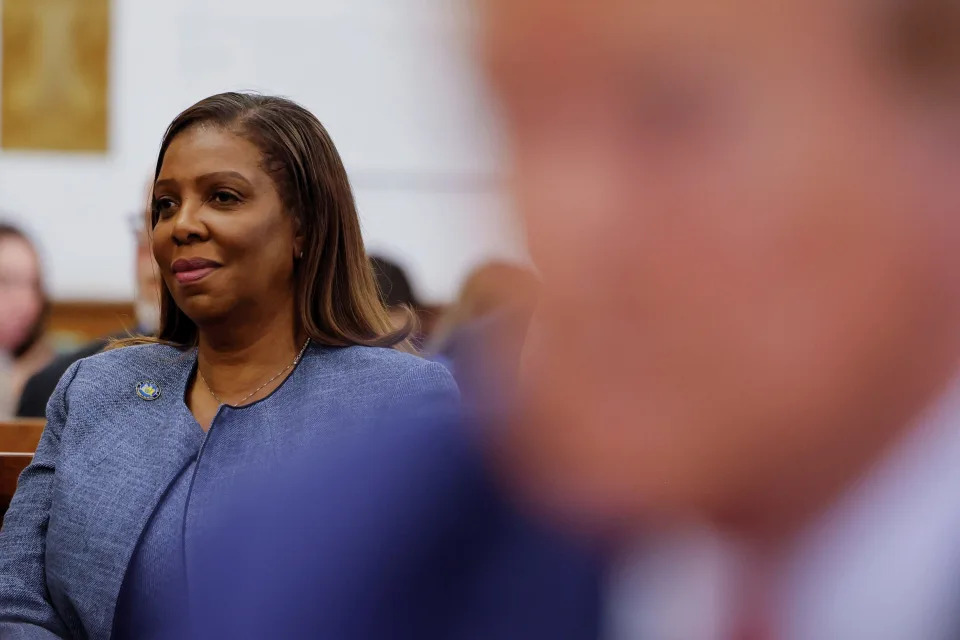
New York Attorney General Letitia James attended closing arguments in the Trump civil fraud trial.
New York Attorney General Letitia James attended closing arguments in the Trump civil fraud trial.Pool/Reuters
More fraud? More penalties

Violations of Thursday’s order could result in the judge ordering more penalties against Trump Org, the judge warned. Those potential penalties include throwing the company into receivership and the possible forced dissolution of assets, the judge said in last month’s verdict.

Trump and his three codefendants — Donald Trump, Jr., Eric Trump, and former Trump Org CFO Allen Weisselberg — owe a combined fraud-trial penalty of $467 million as of Thursday, according to a penalty calculator maintained by the Associated Press.

Trump’s portion of that total was $457 million as of Thursday, an obligation that increases by another $1 million in interest every nine days.

New York Attorney General Letitia James has promised that if Trump misses his deadline for paying up or buying an appeal bond — which he’s said he cannot do — she’ll start grabbing assets.

She has already begun to do so.

New York officials have registered the Trump judgment in Westchester County, just north of Manhattan, in what Bloomberg said Thursday was a sign that his properties in the area could be seized if he defaults on what he owes the state.

Trump owns a 200-plus-acre estate, Seven Springs, in the county.

Last month’s verdict found Trump and his top executives conspired to deceive banks and insurers through a decade of financial filings that exaggerated his net worth by as billions of dollars a year. Trump is appealing the verdict.

State Farm to non-renew 72,000 policies in California

KTLA

State Farm to non-renew 72,000 policies in California

Iman Palm – March 21, 2024

State Farm to non-renew 72,000 policies in California

State Farm General Insurance Company plans to non-renew about 30,000 property insurance and 42,000 commercial apartment policies in California, the company announced Wednesday.

State Farm, California’s largest insurer as of 2022, said the move would impact 2% of its total policies in the state and was made to ensure “long-term sustainability.”

3D printed fire-resistant home being built in L.A. County

The 42,000 commercial apartment non-renewals represent a complete withdrawal from the commercial apartment market in California. The other 30,000 non-renewals would impact homeowners, rental dwellings, and other property insurance policies, according to State Farm.

The announcement applies to California customers only. The company said those impacted will be notified between July 3 and Aug. 20.

“This decision was not made lightly and only after careful analysis of State Farm General’s financial health, which continues to be impacted by inflation, catastrophe exposure, reinsurance costs, and the limitations of working within decades-old insurance regulations. State Farm General takes seriously our responsibility to maintain adequate claims-paying capacity for our customers and to comply with applicable financial solvency laws. It is necessary to take these actions now,” the company said in a statement.

The company also said it will continue working with the Department of Insurance, Gov. Gavin Newsom and other policymakers as they pursue reforms “to establish an environment in which insurance rates are better aligned with risk.”

Can California lure insurers back to the state?

In February, the state’s insurance department announced proposals to reform California’s insurance regulations. The new proposal would allow insurance companies to switch from using historical data to catastrophe modeling, meaning companies would calculate projections of future risk when raising rates and pass on the cost of reinsurance to consumers.

The new changes are expected to take effect at the end of the year.

Last year, State Farm announced it would stop accepting new insurance applications for all business and personal property in California.

Since then, other companies like Allstate have announced similar moves.

State Farm discontinuing 72,000 home policies in California in latest blow to state insurance market

Associated Press

State Farm discontinuing 72,000 home policies in California in latest blow to state insurance market

Associated Press – March 21, 2024

FILE - Homes leveled by the Camp Fire line a development on Edgewood Lane in Paradise, Calif., on Nov. 12, 2018. State Farm will discontinue coverage for 72,000 houses and apartments in California starting summer 2024, the insurance giant said. The Illinois-based company, California's largest insurer, cited soaring costs, the increasing risk of catastrophes like wildfires and outdated regulations as reasons it won’t renew the policies on 30,000 houses and 42,000 apartments, the Bay Area News Group reported Thursday, March 21, 2024. (AP Photo/Noah Berger, File)
Homes leveled by the Camp Fire line a development on Edgewood Lane in Paradise, Calif., on Nov. 12, 2018. State Farm will discontinue coverage for 72,000 houses and apartments in California starting summer 2024, the insurance giant said. The Illinois-based company, California’s largest insurer, cited soaring costs, the increasing risk of catastrophes like wildfires and outdated regulations as reasons it won’t renew the policies on 30,000 houses and 42,000 apartments, the Bay Area News Group reported Thursday, March 21, 2024. (AP Photo/Noah Berger, File)
FILE - Residences leveled by a wildfire in Paradise, Calif., are seen on Nov. 15, 2018. State Farm will discontinue coverage for 72,000 houses and apartments in California starting summer 2024, the insurance giant said. The Illinois-based company, California's largest insurer, cited soaring costs, the increasing risk of catastrophes like wildfires and outdated regulations as reasons it won’t renew the policies on 30,000 houses and 42,000 apartments, the Bay Area News Group reported Thursday, March 21, 2024. (AP Photo/Noah Berger, File)
Residences leveled by a wildfire in Paradise, Calif., are seen on Nov. 15, 2018. State Farm will discontinue coverage for 72,000 houses and apartments in California starting summer 2024, the insurance giant said. The Illinois-based company, California’s largest insurer, cited soaring costs, the increasing risk of catastrophes like wildfires and outdated regulations as reasons it won’t renew the policies on 30,000 houses and 42,000 apartments, the Bay Area News Group reported Thursday, March 21, 2024. (AP Photo/Noah Berger, File)

SACRAMENTO, Calif. (AP) — State Farm will discontinue coverage for 72,000 houses and apartments in California starting this summer, the insurance giant said this week, nine months after announcing it would not issue new home policies in the state

The Illinois-based company, California’s largest insurer, cited soaring costs, the increasing risk of catastrophes like wildfires and outdated regulations as reasons it won’t renew the policies on 30,000 houses and 42,000 apartments, the Bay Area News Group reported Thursday.

“This decision was not made lightly and only after careful analysis of State Farm General’s financial health, which continues to be impacted by inflation, catastrophe exposure, reinsurance costs, and the limitations of working within decades-old insurance regulations,” the company said in a statement Wednesday.

“State Farm General takes seriously our responsibility to maintain adequate claims-paying capacity for our customers and to comply with applicable financial solvency laws,” it continued. “It is necessary to take these actions now.”

The move comes as California’s elected insurance commissioner undertakes a yearlong overhaul of home insurance regulations aimed at calming the state’s imploding market by giving insurers more latitude to raise premiums while extracting commitments from them to extend coverage in fire-risk areas, the news group said.

The California Department of Insurance said State Farm will have to answer question from regulators about its decision to discontinue coverage.

“One of our roles as the insurance regulator is to hold insurance companies accountable for their words and deeds,” Deputy Insurance Commissioner Michael Soller said. “We need to be confident in State Farm’s strategy moving forward to live up to its obligations to its California customers.”

It was unclear whether the department would launch an investigation.

Last June, State Farm said it would stop accepting applications for all business and personal lines of property and casualty insurance, citing inflation, a challenging reinsurance market and “rapidly growing catastrophe exposure.”

The company said the newly announced cancellations account for just over 2% of its California policies. It did not say where they are located or what criteria it used to determine that they would not be renewed.

Putin is ready to squeeze Russia’s outrageously wealthy elite to fund a future war with NATO, analysts say

Business Insider

Putin is ready to squeeze Russia’s outrageously wealthy elite to fund a future war with NATO, analysts say

Tom Porter – March 21, 2024

Putin is ready to squeeze Russia’s outrageously wealthy elite to fund a future war with NATO, analysts say
  • Vladimir Putin is moving to squeeze Russia’s wealthy elite, a think tank said.
  • He needs the money to boost military spending, analysts said, and is prepared to ruffle feathers.
  • Analysts said it’s a sign Putin’s readying for a war with NATO.

Russian President Vladimir Putin is preparing to squeeze Russia’s wealthy elite to fund a conflict with NATO, a think tank said.

The Institute for the Study of War, a US think tank, drew attention to two recent speeches in which Putin voiced rare criticism of the rich loyalists who’ve been the backbone of his power.

In a Tuesday meeting with leaders from Russia’s lower parliament, the Duma, Putin set out the priorities for his new term in office.

He urged officials to “act in the interest of the state instead of corporations or parties.”

The remarks could be seen as a thinly veiled swipe at the widespread corruption that characterizes modern Russia (and from which, Putin’s critics allege, he has also handsomely benefited).

In similar remarks given about a month before to Russia’s Federation Council, Putin said that “individuals who ‘lined their pockets’ in the 1990s” — who are among its crop of oligarchs — are not the real elite.

The actual elite, he said, “are workers and military servicemen who proved their loyalty to Russia.”

The ISW said the remarks indicated that Putin was sending a warning shot to the “siloviki,” the wealthy ex-security officials who form an important part of his power base.

Taken together, the remarks pick away at the long-standing implicit bargain analysts say Putin struck with the country’s wealthy, agreeing to leave their riches untouched in exchange for political support.

The ISW said Putin was changing tack, “signaling that Russia’s long-term financial stability will require imposing at least some pain on some wealthy industrialist siloviki,” it said.

Putin appears willing to risk his accord with his wealthy backers to boost preparations “for a potential future large-scale conflict with NATO,” the ISW said.

The report comes after a series of warnings from Western leaders that Putin might be preparing for a war with the West.

Denmark’s defense minister said it could come in as little as five years.

The NATO alliance has provided Ukraine with crucial support in fighting the Russian invasion, and Putin has repeatedly menaced the alliance with the prospect of nuclear war.

Analysts say that the Russian president has long harbored ambitions to seize back control of territory in northern and eastern Europe that was once part of the Soviet Union and that victory in Ukraine could embolden him.

But fulfilling that ambition would not come cheap.

Who are the siloviki?

When Putin came to power in 1999, he moved to punish some who had grown wealthy during the liberalization of Russia in the ’90s.

Specifically, he took on those who challenged him, such as the oil magnate Mikhail Khodorkovsky.

A new faction expanded its power under Putin, the siloviki.

Some were handed control over state energy companies and corporations in an apparent exchange for their loyalty, becoming vastly wealthy.

The US sought to undermine Putin’s power by targeting the assets of Russia’s wealthy loyalists in a series of sanctions in the wake of the Ukraine war’s start.

But the Russian economy has managed to withstand the worst effects of the fallout from the Ukraine war, and the loyalty of Putin’s wealthy backers has mostly held firm.

Some members of the Russian business elite were critical of the Ukraine war, fearing the effects on Russia’s economy and society. But, The Guardian reported, many have since resigned themselves to the war and Putin’s continued rule.

And it’s not just Putin’s willingness to shake up his relationship with his wealthy loyalists that indicates his readiness to rapidly expand Russia’s military.

Sergei Shoigu, Russia’s defense minister, announced plans Wednesday to massively expand Russia’s armed forces by creating two new armies.

Analysts say that Russia is also expanding its military presence in Russia’s northwest, near the borders with NATO’s Baltic allies.

“Several Russian financial, economic, and military indicators suggest that Russia is preparing for a large-scale conventional conflict with NATO,” the ISW said, “not imminently but likely on a shorter timeline than what some Western analysts have initially posited.”