Here’s who could be responsible for paying for the Baltimore bridge disaster
Erin Snodgrass – March 26, 2024
Scroll back up to restore default view.
The Francis Scott Key Bridge in Baltimore collapsed after a container ship collided with it.
Several entities will likely be on the hook to foot the bill in the aftermath of the disaster.
The maritime insurance industry will be saddled with the highest costs.
The Francis Scott Key Bridge in Baltimore collapsed on Tuesday after a large container ship ran into it, leading to six presumed deaths and millions of dollars in possible damage.
It’s still too early to estimate the total economic impact of the disaster, but between the cost of rebuilding the decades-old bridge, compensating the victims’ families, and paying out damages for disruptions to the supply chain, the eventual cost of the disaster is expected to be significant.
Who will pay to rebuild the bridge?
President Joe Biden said on Tuesday the federal government should be responsible for paying to reconstruct the damaged Francis Scott Key Bridge.
“It is my intention that the federal government will pay for the entire cost of reconstructing that bridge, and I expect Congress to support my effort,” Biden said.
The bridge was built in the 1970s for about $60 million, but the cost of rebuilding it could be 10 times its original price tag, an engineering expert told Sky News.
The Francis Scott Key Bridge, named for Francis Scott Key, the author of the Star Spangled Banner.WilliamSherman via Getty Images
Baltimore is among the busiest ports in the nation, seeing more than a million shipping containers pass through each year. The collapse — which closed the port to all maritime and most road traffic until further notice — is already beginning to wreak havoc on the supply chain.
The cost of building the bridge back fast enough to offset diversions as much as possible could saddle the government with a more than $600 million bill, David MacKenzie, chair of engineering and architecture consultancy COWIfonden, told Sky News.
Who will pay for damages to the ship and its cargo?
The container ship, the Dali, is owned by a Singapore-based firm. The ship’s charterer, Maersk, confirmed to Business Insider that vessel company Synergy Group operates the ship.
However, the companies with cargo aboard the Dali will ultimately be responsible for the ship’s damages and cargo costs.
The Dali was carrying 330 containers, which now must be re-routed, according to Ryan Petersen, CEO of supply chain logistics company Flexport, which had two containers on the ship.
An ancient maritime law known as “general average” dictates that companies with even a single container aboard a ship have to split the damages pro rata based on the number of containers, ensuring all the stakeholders benefiting from the voyage are splitting the risk, Petersen said.
Drone footage shows aftermath of the Dali container ship’s collision into the Francis Scott Key Bridge in Baltimore, Maryland, on March 26, 2024.Anadolu Agency via Reuters
The principle dates back hundreds of years and was originally meant to ensure sailors on board a ship weren’t worried about specific cargo if a disaster required them to start throwing containers overboard, according to Petersen.
Who will pay for everything else?
The majority of the financial fallout is likely to lay primarily with the insurance industry, according to media reports.
Industry experts told FT that insurers could pay out losses for bridge damage, port disruption, and any loss of life.
The collapse could drive “one of the largest claims ever to hit the marine (re)insurance market,” John Miklus, president of the American Institute of Marine Underwriters, told Insurance Business.
He told the outlet that the loss of revenue from tolls while the bridge is being rebuilt will be expensive, as will any liability claims from deaths or injuries.
The Dali is covered by the Britannia Steam Ship Insurance Association Ltd., known as Britannia P&I Club, according to S&P Global Market Intelligence.
Britannia did not immediately respond to a request for comment from Business Insider but told FT it was “working closely with the ship manager and relevant authorities to establish the facts and to help ensure that this situation is dealt with quickly and professionally.”
Britannia is one of 12 mutual insurers included in the International Group of P&I Clubs, which maintains more than $3 billion of reinsurance cover, sources familiar with the matter told Insurance Business.
Britannia itself is liable for the first $10 million in damages, both FT and Insurance Business reported. Whatever remains is dealt with by the wider mutual insurance group and Lloyd’s of London, a reinsurance market in the UK, according to FT.
Fast-food companies seeing low-income diners pare orders
Waylon Cunningham – March 27, 2024
McDonald’s Corp. reports fourth quarter earningsA Wendy’s sign and logo are shown at one of the company’s restaurant in Encinitas, California
SAN ANTONIO, Texas (Reuters) – Runaway prices at U.S. fast-food joints and restaurants have made people skittish down the income ladder and executives at chains including McDonald’s and Wendy’s recently said they worry about losing business from those on the tightest budgets.
Roughly a quarter of low-income consumers, defined as those making less than $50,000 a year, said they were eating less fast food and about half said they were making fewer trips to fast-casual and full-service dining establishments, according to polling in February by Revenue Management Solutions, a consulting firm.
The rising price of food is contributing to budget-conscious diners cutting back.
Whether consumed at home or in a restaurant, food prices rose 20% from Jan. 2021 to Jan. 2024, the fastest jump on record. A recent census Household Pulse Survey showed half of people earning less than $35,000 a year had difficulty paying everyday expenses, and nearly 80% were moderately or “very” stressed by recent price increases.
Lauren Oxford, a musician who works part time at a bed-and-breakfast in Tennessee, said she used to stop by McDonald’s after running errands, treating herself to two double hamburgers, fries and a drink, for less than $5. As prices rose, she switched to smaller hamburgers and stopped getting the drink.
But after a year in which McDonald’s franchisees drove prices up about 10% according to the company’s executives, she’s going to McDonald’s less in general. “Now I don’t know if I can justify that.”
In the Fed’s most recent Beige Book compendium of anecdotal reports gathered from business and community contacts around the country, 7 of 12 regional Fed districts reported low-income consumers were changing spending habits in search of bargains, seeking more help from community groups, or struggling to access credit.
About one-third of Black American households, and 21% of white American households, earned less than $35,000 in 2022, according to the latest available U.S. census data.
For fast-food companies that often promote an image of affordability, low-income consumers are a significant portion of the customer base and a bellwether for longer-term trends. But they are typically the first to cut back spending and the last to come back.
But now, chains may be less likely to chase customers as hard as they have in the past because even with a drop in traffic, sales have remained consistent supported by increased prices.
Fast food companies aren’t “in a hurry to take traffic over profit the way they were a decade ago,” said Mike Lukianoff, CEO of SignalFlare.ai and a veteran consultant in the fast food industry.
For example back in 2008, Subway introduced its nationwide $5 footlong, which became the poster sandwich for the Great Recession. That spurred rivals to introduce extreme value deals for budget-conscious customers, such as “$5 Fill-Up Boxes” at Yum! Brands KFC.
In 2016, McDonald’s, after a prolonged slump in sales, introduced a bundle deal it called “McPick 2”, allowing customers to choose 2 items, like a McDouble, for $2. Within months, Wendy’s offered a four for $4 deal. Burger King offered five for $4. Pizza Hut had a $5 “flavor menu.”
APP-DRIVEN DISCOUNTS
Now, instead of across-the-board menu slashes and broad discounts, industry analysts say chains are being more selective, aiming them at specific demographics or limiting them to specific meal times or channels, such as its app or only through delivery.
McDonald’s executives told investors in February that it would rely on its existing “value menu” to appeal to low-income consumers who might be tempted to eat packaged food at home instead. CFO Ian Borden said affordability is core to the brand, and the company would continue “evolving” its value offerings.
“The battleground is certainly with that low-income consumer,” McDonald’s CEO Chris Kempczinski told investors, referring to people making less than $45,000.
Wendy’s recently introduced a limited-time $1 burger — available only through its app. Its CFO Gunther Plosch told investors in February that among lower-income customers, their traffic is down but their share with the general market is unchanged.
For major fast-food companies, loyalty apps are the go-to strategy among major brands to increase retention and the average amount of money spent. The upside for chains, David Henkes, senior principal with Technomic said, is that they capture more transaction data and demographic data for the consumer, “which is a trade-off many are happy to do.”
For example, McDonald’s frequently offers in-app discounts, such as 20% off an order or free delivery with a large enough order.
Domino’s halved the minimum purchase price to get points in its loyalty program, to $5 from $10, its CEO told investors at a conference in January. It also reduced the number of purchases needed to get a free pizza to as few as two from six. “And so essentially, for this lower-income consumer, we’ve made the brand more accessible,” CEO Russell Weiner said.
To be sure, not every chain is seeing weakness among low-income customers. At Taco Bell, which sells a single taco for $1.40 at many of its stores in San Antonio, locations in low-income markets did better than other locations, Yum! CEO David Gibbs told investors in February.
McDonald’s still holds its appeal for Andreas Garay, a retail worker eating at a McDonald’s in westside San Antonio. He said he plans to keep his coffee-and-Big-Mac habit– even if prices continue going up.
(Reporting by Waylon Cunningham in San Antonio and Howard Schneider in Washington, D.C.; Editing by Anna Driver)
Mumbai becomes Asian capital with most billionaires, bumping Shanghai: Report
Filip Timotija – March 27, 2024
The city of Mumbai has officially surpassed Shanghai as Asia’s capital with the most billionaires, according to a new Hurun Global Rich List 2024 report.
Mumbai, India’s financial powerhouse, now has 92 billionaires, closely edging out Beijing’s 91 and Shanghai with 87.
This year’s list marked Mumbai’s first time in the world’s top three, according to the report.
Globally, the Big Apple still leads the way. New York City has the most billionaires with 119. London was second with 97. Beijing, which was ranked first last year, dropped to fourth place.
China has the most billionaires out of any country with 814, although it lost 155 of them. The U.S. was second with 800 billionaires. India was third with 271.
“Wealth creation in China has gone through deep changes these last few years, with the wealth of billionaires from real estate and renewables down,” the research firm said in the report.
“Whilst as many as 40% of the Hurun Global Rich List from the high water mark two years ago have lost their billionaires status, China has added a 120 new faces to the list. Despite the large drop in the number of billionaires, China still has more known billionaires than the US.”
Zhong Shanshan, chair of bottled water giant Nongfu Spring, kept his spot as the richest person in China.
Globally, the number of billionaires increased — now at 3,279 billionaires, up 167 from last year, according to the report.
The rapid development of artificial intelligence (AI) has helped generate new ultra-wealthy individuals.
“AI has been the major driver for wealth growth, generating over half of all the new wealth this year,” the research firm said. “The billionaires behind Microsoft, Google, Amazon, Oracle and Meta have seen significant surges in their wealth as investors bet on the value generated by AI.”
India’s Income Inequality Is Now Worse Than Under British Rule, New Report Says
Astha Rajvanshi – March 27, 2024
A fisherman colony alongside commercial buildings in the Indian city of Mumbai, now Asia’s billionaire capital. Credit – Dhiraj Singh—Bloomberg/Getty Images
A new study from the World Inequality Lab finds that the present-day golden era of Indian billionaires has produced soaring income inequality in India—now among the highest in the world and starker than in the U.S., Brazil, and South Africa. The gap between India’s rich and poor is now so wide that by some measures, the distribution of income in India was more equitable under British colonial rule than it is now, according to the group of economists who co-authored the study, including the renowned French economist Thomas Piketty.
The current total number of billionaires in India is peaking at 271, with 94 new billionaires added in 2023 alone, according to Hurun Research Institute’s 2024 global rich list published Tuesday. That’s more new billionaires than in any country other than the U.S., with a collective wealth that amounts to nearly $1 trillion—or 7% of the world’s total wealth. A handful of Indian tycoons, such as Mukesh Ambani, Gautam Adani, and Sajjan Jindal, are now mingling in the same circles as Jeff Bezos and Elon Musk, some of the world’s richest people.
“The Billionaire Raj headed by India’s modern bourgeoisie is now more unequal than the British Raj headed by the colonialist forces,” the authors write.
The observation is particularly stark when considering India is now hailed as an 8% GDP growth economy, according to Barclays Research, with some projecting that India is poised to surpass Japan and Germany to become the world’s third-largest economy by 2027.
But the authors of the World Inequality Lab study reached this conclusion by tracking how much of India’s total income, as well as wealth, is held by the country’s top 1%. While income refers to the sum of earnings, interest on savings, investments and other sources, wealth (or net worth) is the total value of assets owned by an individual or group. The authors combined national income accounts, wealth aggregates, tax tabulations, rich lists, and surveys on income, consumption, and wealth to present the study’s findings.
For income, the economists looked at annual tax tabulations released by both the British and Indian governments since 1922. They found that even during the highest recorded period of inequality in India, which occurred during the inter-war colonial period from the 1930s until India’s independence in 1947, the top 1% held around 20 to 21% of the country’s national income. Today, the 1% holds 22.6% of the country’s income.
Similarly, the economists also tracked the dynamics of wealth inequality, beginning in 1961, when the Indian government first began conducting large-scale household surveys on wealth, debt and assets. By combining this research with information from the Forbes Billionaire Index, the authors found that India’s top 1% had access to a staggering 40.1% of national wealth.
Because the number of Indian billionaires shot up from one in 1991 to 162 in 2022, the total net wealth of these individuals over this period as a share of India’s net national income “boomed from under 1% in 1991 to a whopping 25% in 2022,” the authors said.
The report also found that the rise in inequality had been particularly pronounced since the ruling Bharatiya Janata Party first came to power in 2014. Over the last decade, major political and economic reforms have led to “an authoritarian government with centralization of decision-making power, coupled with a growing nexus between big business and government,” the report states. This, they say, was likely to “facilitate disproportionate influence” on society and government.
They added that average Indians, and not just the Indian elite, could still stand to gain from globalization if the government made more public investments in health, education, and nutrition. Moreover, a “super tax” of 2% on the net wealth of the 167 wealthiest Indian families in 2022-23 would result in 0.5% of national income in revenues, and “create valuable fiscal space to facilitate such investments,” the authors argued.
Until the government makes such investments, however, the authors caution against the possibility of India’s slide toward plutocracy. The country was once a role model among post-colonial nations for upholding the integrity of various key institutions, the authors say, and they point out that even the standard of economic data in India to study inequality has declined recently.
“If only for this reason, income and wealth inequality in India must be closely tracked and challenged,” the authors say.
It is an overcast, unseasonably warm morning on Wednesday, Nov. 6, and the world has woken up in shock as Donald Trump has emerged as the winner of the U.S. presidential election. America’s cities are once again full of mute, stunned liberals avoiding eye contact with one another on the morning commute, as the grim reality of what Trump might do with this power begins to set in. At his victory speech just after 2 a.m., when the networks called Wisconsin, and thus the election for him, Trump took the stage and declared, “Judgment Day is coming for America’s enemies, and no Marxist, Harvard leftist, gender-radical, illegal, or criminal thug in our great country will be safe come January.” And in some ways that bleak morning might represent the high point of the next four—or 40—years, given what Trump and his allies have in store for us.
This is a worst-case scenario. But it’s far from impossible. A Trump restoration is in the works—and it should feel like an existential threat to everyone who cares about liberal democracy and the incomplete but tangible social, racial, and economic progress that has been made since the New Deal era.
And yet, President Joe Biden’s manifest flaws are dangerously obscuring the scale of the threat of a second Trump term. There is no sense in denying it: Biden looks and sounds very old, and his speaking style, never particularly inspirational, has deteriorated to the point that he is a clear political liability. While he brought what passes for his A-game to the State of the Union, he will need to sustain that level of energy and coherence through an eight-month-long slog to the election to improve his chances of winning.
His decision to run for a second term has not only jeopardized his many achievements but put the very existence of U.S. democracy at much more serious risk. His administration’s staunch support of Israel, a defensible posture in the aftermath of the unconscionable Hamas attacks on Oct. 7, has become a genuinely baffling study in Biden’s inability to pivot or use America’s considerable leverage to do the right thing. The White House hasn’t settled on a winning strategy to address the lingering consequences of post-pandemic inflation, preferring to boast about the very real low unemployment numbers and robust GDP growth that simply have not moved the needle politically. And the Biden administration has remained curiously inert in the face of growing public frustration with the migrant crisis, preferring to blame Congress for refusing to fix it.
Nevertheless, allowing Donald Trump and his friends to plunge our country into a dystopian nightmare of authoritarianism will not help anyone in Gaza, in the grocery store, or at the border. It will worsen, not rectify, America’s history of writing blank checks to far-right governments in Israel. It will not lead to humane policy options for asylum-seekers but instead deliver them into the hands of morally bankrupt demagogues. Electing Trump would merely add more considerable suffering and trauma to theirs, and deprive us all of the ability to do anything about it.
Much has been made of the far-right Project 2025—a blueprint for radically restructuring and reorienting executive-branch policymaking, created by a network of right-wing think tanks and pressure groups—and its terrifying implications for U.S. democracy. But that document concerns only the threats Trump’s reelection poses to executive-branch agencies (and contains many unresolvable contradictions between dismantling and wielding the “administrative state”). Myriad public dangers emanating from the Trump and GOP legislative agenda, as well as the possibility of an even harder-right Supreme Court, are getting far less attention. That needs to change.
Let’s start with the court. That Sonia Sotomayor, who will turn 70 this year, is still sitting on the Supreme Court means that Democrats have yet to grasp how strategic retirements work in the new hyperpartisan political order. Unlike Democrats, who still seem to view a Supreme Court seat as a personal sinecure bestowed upon the righteous for a lifetime of achievement, the leaders of the far-right judicial movement understand the stakes and will place enormous pressure on the oldest Republican appointees to retire under a second Trump term. Clarence Thomas, who has been on the court since 1991, turns 76 this year, and Samuel Alito turns 74. Even John Roberts, who would turn 70 just after Trump’s inauguration, might go.
Think about it this way: If Republicans replace this trio with three early-middle-age ideologues like Amy Coney Barrett, the court will be in the GOP’s hands until everyone reading this article is dead or nearing retirement. If Trump gets to replace Sotomayor, who suffers from a health problem (Type 1 diabetes) that significantly reduces life expectancy, the far right would have an unassailable 7–2 majority with which to remake American society for a generation.
Very little that liberals or progressives care about is likely to survive another 20 or 30 years of reactionary control of the Supreme Court. Although much of the focus has justifiably been on Dobbs, and the looming threat to Obergefell, birth control, and IVF, a conservative supermajority would also likely gut a century of jurisprudence around taken-for-granted features of the American political and economic order, including bargaining rights for organized labor, the constitutionality of federal programs like Social Security and Medicare, and—it nearly goes without saying—the Affordable Care Act. We will effectively return to the early 20th century’s Lochner era, when the Supreme Court repeatedly struck down worker protections and rights for more than 30 years until FDR threatened it with court packing.
Sure, “Vote for Biden so the conservative supermajority can’t get younger and larger” is tough to fit on a bumper sticker, and no one in the party from Biden on down seems to have the stomach for the necessary escalation or a political vision for the court that can be communicated to voters. But unless you want to spend the rest of your lives watching Brett Kavanaugh and his friends upend your lives one right and benefit at a time, you have to hold the line here.
SCOTUS is, of course, also right now at the very center of Trump’s threat to American democracy. The court’s galling decision to repeatedly delay Trump’s trial for the 2020 post-election coup attempt and the Jan. 6 insurrection means that he probably won’t face justice until after he could conceivably win reelection. Most concerningly, this off-the-rails Supreme Court has bafflingly decided to take up the question of a president’s absolute immunity after Trump’s team argued that he should be free from any consequences of anything he did as president. Though cooler heads may in the end prevail over the Thomas-Alito wing, the fact that this is up for debate at all is incredibly alarming.
Much has been made of reports that Trump plans to deploy the military to quell post-election protests under the Insurrection Act. But a Trump unchained from any conceivable repercussions for his decisions in his office is a far worse threat than just that. Imagine for a moment what would happen if the Supreme Court ruled in Trump’s favor: First of all, the effort to hold him accountable for trying to overthrow the American system of government would be over—instantly. Even more problematically, what conceivable limits would there be on a President Trump beginning in 2025 if SCOTUS has just ruled that his efforts to perpetrate a coup in broad daylight were well within the ambit of his presidential authority?
Who or what exactly would stop Trump from, say, creating a new security apparatus, abducting leftists and political enemies—as he has pledged—and dropping them out of helicopters over the Pacific like the Latin American dictators the far right still worshipsonce did? He could order the hits, then preemptively pardon the people who carry out his orders. That might seem melodramatic and far-fetched. But if the Supreme Court grants him immunity as president, no one could touch him for it legally. And if Republicans simultaneously controlled both chambers of Congress, there would be no impeachment option either. We’ve learned the hard way, far too many times, that a critical mass of elected Republicans will do Trump’s bidding no matter how grotesque his actions.
Maybe he’ll stop short of creating an American Stasi. But a president who is unbound by the law could order the DOJ to gin up investigations of leading journalists, prominent Democrats, professors, activists, and nonprofit leaders. Independent media outlets could be “acquired” by allies or buried under lawsuits and government harassment, as they have been in Trump’s favorite quasi-authoritarian regime in Hungary. Troops could be deployed to garrison blue cities, to not only find and deport immigrants but also chill and repress any dissident fervor that develops in the aftermath of his takeover. He would say he’s merely fighting crime, “illegals,” and election fraud, but Trump could conceivably place the cities he fears and despises, where his political adversaries wield most of their power and influence, under what amounts to an open-ended military occupation.
It gets worse. If Donald Trump wins the 2024 election, he is highly likely to do so while bringing Republican control of the House and Senate with him. With Mitch McConnell out of the way as party leader, there is a very good chance that the new GOP Senate leadership will nuke the filibuster and govern with a simple majority. And that means that the toxic, vengeful politics of Texas and Florida will go national. Trump showed time and again during his first term that he was not just willing but eager to subcontract his domestic policymaking to the right-wing think tanks that write most state-level legislation for Republicans. National Republicans no longer pretend to have a written or informal platform, but Trump has a campaign website with policy plans called “Agenda 47” that can be read alongside Project 2025, as well as the actual policy record of state Republicans, to give us a pretty clear sense of what they have planned.
Trump continues to spin and deflect, but under unified Republican control, Congress could obviously try to pass a national abortion ban, and he would sign it. House Republicans are already gunning for a nationwide ban on gender-affirming care, and electing a Republican trifecta this November will mean that, practically speaking, it could soon be either illegal or impossible to be transgender in the United States. The proof is in the hundreds of red-state anti-trans bills introduced and the dozens passed just since 2023, including Florida’s ban on gender reassignment surgery for minors, which also gives the state the right to kidnap children from parents who pursue gender-affirming care. Agenda 47 claims that the Trump administration will “investigate Big Pharma and the big hospital networks to determine whether they have deliberately covered up horrific long-term side-effects of ‘sex transitions’ in order to get rich at the expense of vulnerable patients.” As Masha Gessen once said, “Believe the autocrat.”
The enemies list doesn’t stop there. Trump’s promised militarized mass-deportation effort could be just the beginning of the crackdown on both legal and illegal immigration; we could also see an effort to end birthright citizenship, a move that, if it succeeds, would result in millions being suddenly stripped of their status as Americans. You will find this not in Project 2025 but in Trump’s online platform and the ugly words that frequently spill out of his mouth, like in May 2023, when he posted a video in which he argued, “I will sign an executive order making clear to federal agencies that under the correct interpretation of the law, going forward the future children of illegal aliens will not receive automatic U.S. citizenship.” Whether you believe the “going forward” part of that promise is up to you.
And get ready for a flurry of moves against the remaining redoubts of liberalism and democracy, particularly in secondary and higher education. Radicalized Republicans in Congress will try to bar federal loans and grants from being used at any universities with policies that support inclusion and diversity. This is not speculation: Rep. Dan Crenshaw introduced a bill in the House last year to prevent public funds from being used at schools with DEI policies, based on existing Texas legislation.
They won’t stop there. Republicans would eventually try to block funding for schools with any kind of race or gender studies programs, as the state of Florida tried to do last year, and before long every syllabus in the country could be scrutinized for evidence of anti-patriotic crimes, until anyone who isn’t a right-wing ideologue is driven from the academy altogether. Trump’s Agenda 47 promises to establish a new national “American Academy” by “by taxing, fining, and suing excessively large private university endowments”—i.e., strip-mining them for cash. A Trump administration, in other words, would effectively end American higher education as we know it.
That’s to say nothing of how, under GOP rule, every public school librarian and schoolteacher in America could suddenly find themselves under siege by cranks and culture warriors like their counterparts today in Texas and Florida. Agenda 47 threatens to create a new “credentialing body” that would “certify teachers who embrace patriotic values,” to eliminate teacher tenure, and to rescind funding “for any school or program pushing Critical Race Theory, gender ideology, or other inappropriate racial, sexual, or political content.” And like Hungary’s Viktor Orban, Trump would surely relish the opportunity to sign legislation banning public school teachers from going on strike.
This radical agenda would surely be accompanied by an assault on Democrats’ ability to ever win another free and fair election. Congress would pursue a national voter ID law, a ban on ballot harvesting, harsh new restrictions on mail-in balloting, the elimination of same-day voter registration, and new ways to purge Democrats from voter lists—all plans that are already in the “American Confidence in Elections Act,” which has been introduced in the House. What’s left of the Voting Rights Act would be set aside or perhaps repealed. Maniacs exercising their “constitutional carry” rights would patrol outside polling stations across the country with AR-15s, and Democratic voters would be subjected to endless legal challenges. Any Democratic effort to retake a chamber of Congress in 2026 or win the presidency in 2028 would have to run through President Trump’s formidable election conspiracy machine, the army of aspiring petty autocrats who will be put in charge of the nation’s election machinery, and the elected leaders who will come under enormous pressure not to turn power over to Democrats should those Democrats win.
At that point, the vaunted separation of powers that some analysts still cling to as our last great hope won’t be of much help. With as many as seven Trump judges on the Supreme Court and a federal judiciary that will once again be stocked with his allies and true believers, even many of the brazenly unconstitutional orders and laws that are in the works will have a good chance of standing up in court. And all the while, demoralized Democrats will be pointing fingers at one another for their catastrophic loss, which—knowing Dems—could easily be pinned on Biden’s more progressive policies like the Inflation Reduction Act, whose historic climate provisions would also be reversed almost immediately. Efforts to highlight the contributions of his age and Gaza policies to this disaster would run straight into the same narrative-makers who pinned the disappointing scale of Democrats’ 2020 victory on progressive activists chanting “Defund the Police” rather than on Biden’s overcautious campaign and reliance on appealing to disenchanted Republicans.
It’s not hyperbole to say that the America that a second Trump term would create might be an almost unrecognizable realm of economic insecurity, political persecution, racist hatred, and gender tyranny, a Christian nationalist hellscape that would be virtually impossible to dismantle once it is put into place.
Joe Biden may not be the ideal man standing between us and this horror show, but he is a seasoned politician with a strong track record and a plenty competent team. (Plus, he’s all there is unless he decides to step aside.) He and every Democrat in the White House and Congress must do everything they can to shift the focus from Biden’s age and unpopularity to Trump’s very public laundry list of malevolent plans, and national media organizations must continue to do the relatively easy work of telling readers and viewers about Trump’s reactionary agenda. Readers may be completely burned out on learning about Trump’s crimes, but the alternative—that Trump gets into office and perpetrates more of them—is truly unthinkable.
Trump and J.D. Vance embrace populist economics. That’s bad for Americans.
James Davis – March 26, 2024
Republicans are excited to run against Bidenomics in the 2024 election. So why are some of the loudest GOP members bear-hugging the lie at the heart of Bidenomics?
The populist wing of the Republican Party is increasingly enamored with the idea that Washington, D.C., should control the economy − that politicians and bureaucrats are smart enough to govern the everyday decisions of more than 330 million Americans and job creators.
That view is clear in rising GOP support for everything from tariffs, which former President Donald Trump has proposed, to bailouts to the federal rejection of business decisions. These Republicans are embracing the very government control that has caused millions of Americans to fall behind under President Joe Biden.
Sen. J.D. Vance of Ohio, a leading Republican populist, is a case in point. The senator recently declared that Federal Trade Commission Chair Lina Khan – one of the key architects of Bidenomics − is “one of the few people in the Biden administration that I think is doing a pretty good job.”
Under Khan’s leadership, the FTC has blocked numerous business mergers. Vance apparently likes that, saying it helps build “a competitive marketplace” that “allows consumers to have the right choices” and doesn’t ignore “all the other things that really matter.”
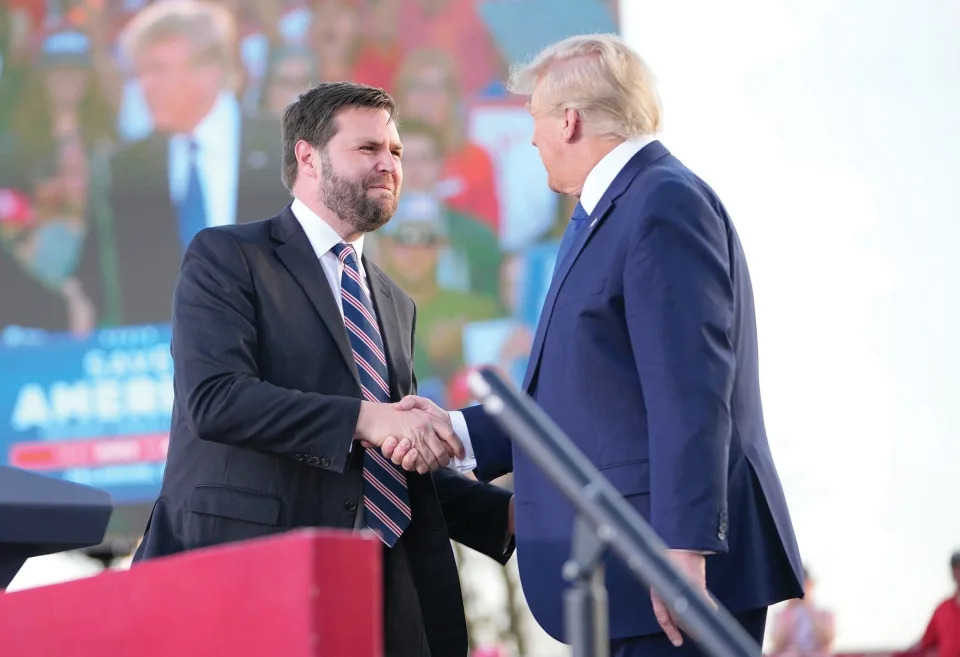
Former President Donald Trump and Sen. J.D. Vance, R-Ohio.
FTC’s aggressiveness is hurting American consumers
Yet, far from empowering consumers and increasing competition, the FTC’s actions have done considerable damage to Americans, with worse on the way.
The FTC’s move in February to block the merger between Kroger and Albertsons is the latest proof. The grocery store chains proposed the partnership not to limit competition, but to stay competitive against the likes of Amazon and Walmart. Without a merger, Kroger and Albertsons are more likely to lay off workers, increase automation and raise prices, none of which benefits consumers or workers.
Nor would it help consumers if grocery chains go out of business and other companies gain market share − the real road to fewer options and higher prices. The true threat to competition isn’t two grocery chains becoming one, but rather two becoming zero, which is more likely after the FTC’s intervention.
Does the prospect of shuttered stores and lost jobs really deserve populist praise? How about the FTC’s attempt to prevent victory in America’s war on cancer? That’s what happened when the commission sued to block the merger of Illumina and Grail in 2021.
The biotech companies saw a chance to transform cancer testing, empowering far more Americans to learn whether they have cancer far earlier. The key to stopping cancer is early detection, which saves lives as well as money on costly end-stage cancer treatments.
The merger posed no threat to consumers or competition because Illumina and Grail don’t compete. They operate in different parts of the health care supply chain, and by joining, they could achieve greater efficiency, which leads to lower prices and faster development.
No matter: After two years of fighting the FTC, Illumina and Grail separated. The FTC put populist demands ahead of people’s health.
The same story has played out over and over under Khan’s leadership of the FTC. It sued Amazon for promoting its own products and pressuring its competitors − the nature of competition − yet the commission is threatening popular features like two-day shipping and rock-bottom prices that customers love.
It’s investigating a financial firm’s acquisition of Subway, threatening a deal that could help the low-margin business grow its store footprint and serve more customers.
FTC lost lawsuits against Meta and Microsoft
And the FTC has lost lawsuits against mergers by Microsoft and Meta after failing to show how competition or customers would be hurt. The agency is trying to micromanage the most dynamic economy on earth, forcing companies to defend commonsense business decisions in court instead of serving customers and strengthening society.
That’s the real problem − the belief that government has the genius to direct the economy. That misguided view is at the heart of both Bidenomics and Republican populism, as Vance’s comments make clear.
When Vance says that people should have “the right choices” and that markets should focus on what “really matters,” he isn’t just second-guessing private decisions by companies and customers. He’s saying bureaucrats like Khan and politicians like him should substitute their will for the combined wisdom of the American people.
Republicans have already gone too far down that road, and not just Vance. The party of opportunity is substituting economic freedom for government control, economic fairness for taxpayer subsidies and belief in Americans’ individual choices for central planning.
Bidenomics shows where that road leads − fading optimism, and rising fear that our best days are behind us. If more and more Republicans think that approach is correct, then Americans are right to fear for our country’s future.
James Davis is founder and president of Touchdown Strategies, a Virginia-based communications firm.
Column: Trump wants to round up over a million undocumented migrants from California. Here’s how he might do it
Doyle McManus – March 25, 2024
Former President Trump speaks near a section of border wall in Texas in 2021. His plans for a prospective second term include using National Guard troops in mass deportation operations to seize undocumented migrants, transport them to camps in Texas and expel them. (Associated Press )
Former President Trump has focused relentlessly on illegal immigration as a centerpiece of his campaign for the White House, just as when he first ran in 2016.
“They’re poisoning the blood of our country,” he has said of undocumented migrants, using language redolent of the racist doctrines of Adolf Hitler.
He promises to launch “the biggest domestic deportation campaign in American history” on Day One of his new presidency.
His chief immigration advisor, Santa Monica-born Stephen Miller, has spelled out what that would mean: Trump would assemble “a giant force” including National Guard troops to seize undocumented migrants, transport them to camps in Texas and expel them.
“A very conservative estimate would say about 10 million,” Miller told pro-Trump talk show host Charlie Kirk.
If “unfriendly states” — like California — don’t want to cooperate, Miller said, Trump could order Guard units from red states like Texas to cross their borders to enforce the law.
The operation would be “as daring and ambitious … as building the Panama Canal,” Miller promised.
That’s a pretty bloodless way to describe a process that would uproot thousands of families, separate children from their parents and disrupt communities. But before we get to that, a preliminary question:
If he wins in November, could Trump really do that?
From a legal standpoint, the answer is yes.
If Trump invokes the Insurrection Act and declares that the National Guard is needed to enforce federal immigration law, he could send Texas troops into California whether Gov. Gavin Newsom agrees or not, legal scholars said.
“We normally don’t want the military enforcing the law inside the country; law enforcement is supposed to be provided by police forces that are local — and locally accountable,” said William Banks, an emeritus professor of law at Syracuse University. “But the Insurrection Act gives the president sweeping authority. You could drive a lot of trucks through that law.”
Newsom would presumably file a lawsuit against Trump to try to block the move, but it would almost certainly fail.
“No state has ever sued successfully to stop a deployment of the Guard under the Insurrection Act,” warned Joseph Nunn of the Brennan Center for Justice at New York University.
There are also practical concerns. Most National Guard units are neither trained nor equipped for law enforcement missions.
“Tracking down undocumented migrants is complicated and time-consuming,” Nunn noted. “You need people who know how to do it, like ICE [Immigration and Customs Enforcement] agents.
“The Guard would resist that kind of mission mightily,” added Banks. “They hate this kind of stuff. They would be better suited to patrol the border — to stand next to the wall, the fence or the river and discourage people from coming across.”
So if Trump listens to his generals — not a sure thing — he’d be more likely to use Guard units to bolster weak spots on the border and manage those newly built transit camps for deportees.
That would free up ICE agents for raids on Central Valley farms and Los Angeles sweatshops — which is what immigration agents did in earlier crackdowns, including the offensively named Operation Wetback, which expelled more than a million Mexican migrants (and some U.S. citizens) in 1954.
So legally, there may not be that much California can do. But the fallout in a state home to an estimated 1.9 million undocumented people — roughly 5% of the population — would be difficult to imagine.
The human impact of uprooting most or all of these California residents would be gigantic. Many undocumented migrants are members of families that include legal residents and U.S. citizens, including children.
Many are deeply rooted in their communities; more than two-thirds have lived in the state longer than 10 years, according to one estimate.
“When you harm the undocumented, you harm U.S. citizens too,” said Angelica Salas, executive director of the Coalition for Humane Immigrant Rights in Los Angeles.
“I’ve seen families devastated by the deportation of their loved ones. I’ve seen families, when the father is deported, go right into economic ruin,” Salas said. “The trauma for children, especially small children, is enormous.”
The economic impact of mass deportations would be huge, too. An estimated 1.5 million California workers, more than 7% of the state’s workforce, are undocumented. About half work in agriculture, construction, hospitality and retail, industries that already suffer from severe labor shortages.
Federal Reserve Chair Jerome H. Powell said this month that the growth of immigrants in the workforce had strengthened economic growth. “It’s just arithmetic,” said Powell, a Trump appointee. “If you add a couple of million people to an economy … there will be more output.” Abruptly subtracting a million or more would have the opposite effect.
Trump advisors aren’t planning to stop at removing undocumented people from the country.
Miller wants to go after some people in the country legally too.
He has proposed expanding the criteria for deportation to include people with valid visas “whose views, attitudes and beliefs make them ineligible to stay” in the eyes of the new Trump administration.
“The obvious example here would be all of the Hamas supporters who are rallying across the country,” he said.
An immigration task force organized by the conservative Heritage Foundation and led by a former Trump administration official proposed blocking Federal Emergency Management Agency grants to state and local agencies that refuse to cooperate with ICE enforcement operations, a standard that would presumably disqualify most or all California agencies.
The task force also proposed denying federal loans and grants to students at universities that allow undocumented migrants to pay in-state tuition, a rule that would affect UC and the Cal State systems.
It adds up to a recipe for a major collision with California, the state most out of step with Trump’s determination to rid the country of undocumented migrants.
None of this constitutes a defense of the Biden administration’s policies, which have failed to deter thousands of migrants from crossing the border and applying for asylum on often-dubious grounds.
But it’s worth remembering that only a few weeks ago, Trump ordered Republicans in Congress to kill a bipartisan bill that would have increased funding for immigration enforcement and raised the bar for asylum claims — because, as he admitted, he didn’t want to allow President Biden to appear as if he was fixing the problem.
Trump just got a huge 62% discount on his bond. That’s extremely rare, legal experts say.
Laura Italiano,Jacob Shamsian,Geoff Weiss – March 26, 2024
An appeals court on Monday massively reduced Trump’s bond in his civil fraud trial.
It was a rare turn of events, legal experts told Business Insider.
But Trump is continuing to rack up interest, and he’ll end up owing far more if he loses his appeal.
An appellate-court decision reducing former President Donald Trump’s bond to $175 million was a win for the former president — and certainly a rare one, according to legal experts.
After being ordered to pony up his $454 million judgment following his New York civil fraud trial last month, Trump had told the court he couldn’t secure a bond for that amount.
But the former president was tossed a last-minute lifeline Monday when an appeals court ordered a whopping 62% reduction in the size of the bond. He has 10 days to pay up.
Neil Pedersen, the owner of the surety-bond agency Pedersen & Sons, told Business Insider that in his company’s 30-year history, he and his employees had handled thousands of bonds.
In that time, he’s heard of only about a couple dozen instances when a New York appeals court reduced an appeal bond — and those involved far lower judgments.
“It’s extremely rare,” Pedersen said.
Appellate judges are reluctant to let the losers of lawsuits essentially offer IOUs — instead of a collateral-backed bond — while an appeal progresses, legal experts have explained.
Should Trump lose his appeal down the road, he’ll owe the full amount almost immediately. And New York Attorney General Letitia James will be left chasing him for the remainder.
Eric Snyder, the bankruptcy chair of Wilk Auslander LLP, who routinely enforces judgments in New York, told BI he’d never seen a bond get reduced like this.
Snyder said the court might feel comfortable that Trump could pay the judgment if he were to lose his appeals.
He added that Trump wouldn’t easily be able to sell shares in his properties, given that a prospective buyer would see a record of the judgment. Plus, Trump Tower is in New York — making it within reach of the attorney general’s power if payment comes due.
Snyder also said the court’s decision to reduce Trump’s bond could suggest it might later lower Trump’s total penalty.
“It might be an indication it’ll get reduced on appeal,” he said.
While the lowered bond buys Trump time, he’ll still owe the entire sum if he loses on appeal. As part of Monday’s decision, Trump is required to file a full appeal argument in time for the court’s September 2024 session.
And for every day that passes, the amount owed is accruing interest — to the tune of roughly $112,000 a day.
Pedersen said that meant Trump could end up owing New York well over a half-billion dollars when all is said and done.
“Once his appeals are exhausted, he’ll only have five to 10 days to satisfy the judgment, or whatever amount of the judgment is affirmed,” Pedersen said.
Following a three-month trial, New York Supreme Court Justice Arthur Engoron found Trump and other Trump Organization executives liable for the nearly half-a-billion-dollar penalty last month. Engoron found they had conspired to inflate the value of their real-estate assets to dupe lenders.
Speaking to reporters Monday, Trump applauded the appellate court’s decision to lower his bond.
“It will be my honor to post,” he said, adding that it would be in “cash.”
Wealthy Corporations Are Paying Their CEOs More Than They Pay in Taxes
Tesla, Ford, Netflix and T-Mobile are among scores of profitable U.S. firms that pay their top executives more than they pay in federal taxes. It’s a system that rewards the super rich and punishes the rest of us.
Sarah Anderson, William Rice and Zachary Tashman – March 26, 2024
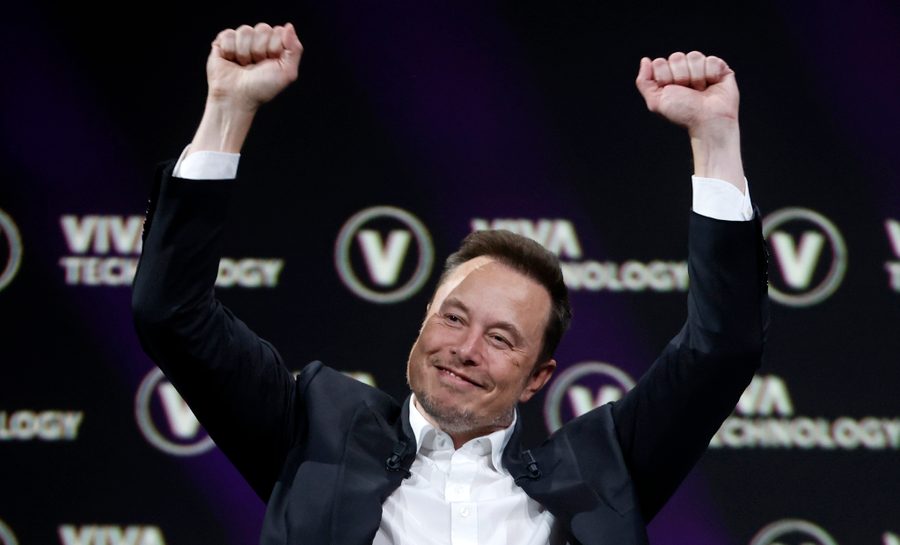
Elon Musk is very happy about the current tax structure—it’s making him incredibly rich.(GETTY IMAGES)
In his State of the Union address, President Biden called out “massive executive pay” and vowed to “make big corporations and the very wealthy finally pay their share” of taxes.
Corporate tax dodging and CEO pay have gotten so out of control that many major U.S. companies are paying their top executives more than they’re paying the American government.
Tesla is perhaps the most dramatic example. Over the period from 2018 to 2022, the electric car maker raked in $4.4 billion in profits but paid no federal income taxes. Meanwhile, Tesla CEO Elon Musk, already among the incredibly wealthy, saw his fortune skyrocket and became one of the world’s richest men with an estimated net worth of more than $190 billion.
When it comes to fleecing taxpayers while overpaying executives, Tesla is hardly alone. A new report we co-authored for the Institute for Policy Studies and Americans for Tax Fairness analyzes executive pay data for some of the country’s most notorious corporate tax dodgers.
What did we find? In addition to Tesla, 34 other large and profitable U.S. firms — including household names like Ford, Netflix and T-Mobile — paid less in federal income taxes between 2018 and 2022 than they paid their top five executives.
Another 29 profitable corporations paid their top executives more than they paid in taxes in at least two of the five years of the study period.
One company on our list stands out for the infamous role its executives played in the 2008 financial crisis: American International Group (AIG). Back then, the insurance giant ignited a firestorm by pocketing a more than $180 billion taxpayer bailout and then announcing plans to hand out $165 million in bonuses to the very same executives responsible for pushing the company — and the nation — to the brink of collapse.
Today, AIG is playing the same greedy game of overpaying its top brass and sticking taxpayers with the bill. Between 2018 and 2022, the company paid its top five executives more than it paid in federal income taxes, despite collecting $17.7 billion in profits. In 2022, CEO Peter Zaffino alone made more than $75 million.
Lavish executive compensation packages and skimpy corporate tax payments are not unrelated. Executives have a huge personal incentive to hire armies of lobbyists to push for corporate tax cuts because the windfalls from these cuts often wind up in their own pockets.
The 2017 Republican tax law slashed the corporate tax rate from 35% to 21% and failed to close loopholes that whittle down IRS bills even further. As a result, many large, profitable corporations ended up paying no federal taxes at all.
Over the following year, corporations took the savings from those tax cuts and spent a record-breaking $1 trillion on stock buybacks, a financial maneuver that artificially inflates the value of executives’ stock-based pay.
Wealthy executives became even wealthier while the nation lost billions of dollars in corporate revenue that could have been used to lower costs and improve services for ordinary people (not to mention healthcare, housing and other vital areas). Until this self-reinforcing cycle is broken, we’ll have a corporate tax and compensation system that works for top executives — and no one else.
What can we do to break this cycle?
Congress can tackle the entwined problems of inadequate corporate tax payments and excess executive pay on several fronts. Raising the corporate tax rate to 28% (just halfway back to Obama-era levels) would generate $1.3 trillion in new revenue over the next decade.
Congress can also close loopholes and eliminate wasteful tax breaks, for instance by removing the incentives for American firms to shift profits and production offshore. Both of these proposals have been pushed by the White House.
Policymakers also have a wealth of tools to curb excessive executive pay, from tax and contracting reforms to stronger regulations to rein in stock buybacks and banker bonuses.
Under our current system corporations are rewarding a handful of top executives more than they are contributing to the cost of public services needed for our economy to thrive. That needs to change, now.
This op-ed was distributed by OtherWords.org.
SARAH ANDERSON directs the Global Economy Project and co-edits Inequality.org at the Institute for Policy Studies.
WILLIAM RICE is a senior writer at Americans for Tax Fairness.
ZACHARY TASHMAN is a Senior Research and Policy Associate at Americans for Tax Fairness.
Judge Rips Into Trump Lawyers, Sets Hush Money Trial for April
Jose Pagliery – March 25, 2024
Spencer Platt/Reuters
Just a couple weeks ago, before prosecutors handed over about 200,000 new documents to the former president’s defense team and the judge delayed the proceedings, March 25 was supposed to be the start date of Donald Trump’s first criminal trial. And until a pre-trial hearing for the hush money case started on Monday, March 25 was supposed to be the day—as the former president’s lawyers believed—the judge might excoriate prosecutors over the missing evidence and potentially issue sanctions against them.
But when the hearing was over Monday, it was clear March 25 will instead be remembered as the day the judge slammed Trump’s lawyers for more waiting games and set the new trial date for April 15.
New York Supreme Court Justice Juan Merchan declined to issue sanctions against attorneys on either side, but he determined that a short-lived document scandal had essentially amounted to nothing.
“The defendant has been given a reasonable amount of time to prepare,” he said, ordering jury selection to begin in 21 days.
The judge indicated that the trial will commence days before the Jewish holiday of Passover and New York City’s spring break, but he promised not to hold court on any day that week if it would violate a person’s religious views.
Trump walked out of the courtroom with a grim look on his face, tossing a thumbs up at an acquaintance in the audience and whispering “thank you.”
Monday’s hearing knocked down what was perceived to be Trump’s last-ditch attempt to push back his trial, but it also served as the latest example of a judge running out of patience with Trump’s disruptive legal strategy.
Merchan questioned Trump’s legal team for more than an hour for what he eventually called a “misleading” tactic that threw trial plans into chaos this month, following a confusing moment when the feds suddenly dumped 200,000 pages of evidence.
Merchan laid the blame entirely at Trump’s feet, appearing flummoxed that the former president’s lawyers managed to briefly derail the trial with over-the-top accusations. He implied that this amounted to nothing more than continuing delay games.
The judge took particular aim at Trump defense lawyer Todd Blanche, saying that he should have known to seek out records for his client instead of sitting back and waiting for the Manhattan District Attorney’s Office to produce them—only to complain about it on the eve of trial. And Merchan didn’t hold back, noting that Blanche is a former federal prosecutor at the U.S. Attorney’s Office for the Southern District of New York, the very same office now at the center of a storm over missing evidence.
“You were there for 13 years. So you know that the defense has the same ability as the prosecution to obtain these documents. So when you received the people’s first production, you could have very easily done exactly as you did in January. but for whatever reason you waited until two months before trial,” Merchan said.
“Your Honor,” Blanche began to say.
“Why didn’t you do it in June? Or July?” the judge continued.
Blanche tried to deflect blame back to the DA, citing a New York law that requires turning over evidence.
“It’s not our job to get it,” he said.
“It’s not the people’s job either,” the judge shot back.
The judge seemed perturbed that Trump’s team never brought up any of these issues during what was supposed to be the final pre-trial hearing on Feb. 15—only to have this issue crop up a month later, just weeks before the start of the first ever criminal trial against a former American president.
In court, Blanche continued to blame the DA’s office, claiming that the batch of records his team had just received from the U.S. Attorney’s Office for the Southern District of New York proved that DA prosecutors held back evidence.
For more than a year, the former president’s legal team has been trying to probe the personal life of Michael Cohen—the one-time Trump confidante who has since become a key witness in the DA’s case—and they scored a win by prodding SDNY for Cohen’s emails despite resistance from the DA and even the judge.
“There’s tremendous amounts of bank records that were produced, and people think we can simply ignore those,” Blanche said in court. “I mean, thousands and thousands… meetings with witnesses and the FBI related to the 2016 election.”
“You mean the Mueller investigation?” the judge asked impatiently, referring to the Justice Department’s Trump-Russia investigation.
“Yes,” Blanche responded.
“That’s not relevant,” Merchan shot back. “That has nothing to do with this case. I decide if it’s relevant. If you’re going to offer something from the Muller investigation, it’s not coming in.”
“The witness discussed what his job was,” Blanche said.
Prosecutors have decried the invasive maneuver as nothing but a vengeful payback scheme to discredit a valuable witness and distract from the real issue: how Trump engaged in a coverup, using Cohen as a cutout to deliver Stormy Daniels $130,000 to keep her quiet about their one-night stand in order to save his 2016 presidential campaign from an embarrassing scandal and faking business records to hide Cohen’s reimbursement.
When the judge turned to the DA’s team, he heard an alternate take from Matt Colangelo, an assistant district attorney who has investigated Trump for years at the Attorney General’s office and now with the DA. Colangelo told the judge that most of the documents recently produced by the feds were mostly copies that Trump already had—and actually strengthened the case, not weakened it. Merchan pointedly asked how many records were actually new.
“Three hundred records or fewer… almost exclusively cumulative and largely inculpatory,” Colangelo said.
“Largely inculpatory?” the judge asked.
“Right, your Honor,” the prosecutor responded.
Although DA Alvin Bragg Jr. was in the courtroom, he remained quiet and seated with the audience a few feet behind the table where his prosecutors argued the case.
But the judge appeared almost enraged when he called attention to the way Trump tried to fabricate a scandal and drag in the court itself, noting how Trump has alleged in documents that the DA has held back evidence and was attempting to make the judge “complicit” in an “unethical strategy.” The judge narrowly defined the DA’s responsibilities, then when Blanche couldn’t cite cases that said otherwise, Merchan let it rip.
“If you don’t have a case right now, that is really disconcerting, because the allegation the defense makes in all of your papers about the people’s misconduct is incredibly serious. Unbelievably serious,” Merchan said. “You are literally accusing the Manhattan DA’s office… of engaging in prosecutorial misconduct—and of trying to make me complicit in it. And you don’t have a single cite to support that position, that the people by not obtaining the documentation at the US Attorney’s Office had somehow committed some sort of fraud on the court?”
While Trump was in court, he managed to score a temporary victory in his other ongoing legal nightmare in New York State. An appellate court gave him an extra 10 days to come up with the money necessary to halt the New York Attorney General from seizing his various properties as a result of losing a three-month bank fraud trial. Trump had previously failed to find a surety company willing to prove him a half billion dollar lifeline to halt last month’s $464 million judgment before a Sunday night deadline, but the appeals court lowered the sum needed to pause seizures down to $175 million.
Monday marked the first day that New York AG Letitia James could have moved to seize his various properties, something that Trump earlier in the morning was raging about on his Truth Social media site.
“Why should I be forced to sell my ‘babies,’” he complained in a post just before heading to the Manhattan courtroom for the day’s hearing.
James has already effectively put a blanket lien on his 212-acre, forested estate of Seven Springs north of the city earlier this month.