Trump on political violence in 2024: ‘If we don’t win, you know, it depends’

NBC News

Trump on political violence in 2024: ‘If we don’t win, you know, it depends’

Jake Traylor and Scott Bland – April 30, 2024

Mark Peterson

Former President Donald Trump said in a new interview with Time magazine that he doesn’t think there will be political violence around the 2024 election because he believes he’ll win — but that it “always depends on the fairness of an election.”

The comments came along with a statement that Trump would “consider” pardoning every person who has been charged or convicted for rioting at the Capitol on Jan. 6, 2021, after the then-president rallied his followers against what he has repeatedly and baselessly called a “rigged” election.

Trump also answered questions digging into his campaign position on abortion policy being left up to the states — and deflecting questions pressing him on any potential federal action, including his position on whether abortion medication should be available. And Trump reinforced past statements he has made on Russia doing “whatever the hell they want” to NATO countries who don’t pay their “fair share” and the extent of a military crackdown he plans to order on illegal immigration.

When Trump was asked in an initial interview about the prospect of more political violence in 2024, after the events following the 2020 election, he said no. “I think we’re gonna have a big victory. And I think there will be no violence,” Trump said.

But asked in a follow-up conversation about what will happen if he doesn’t win, Trump was equivocal.

“Well, I do think we’re gonna win,” Trump answered. “We’re way ahead. I don’t think they’ll be able to do the things that they did the last time, which were horrible. Absolutely horrible. So many, so many different things they did, which were in total violation of what was supposed to be happening. And you know that and everybody knows that. We can recite them, go down a list that would be an arm’s long. But I don’t think we’re going to have that. I think we’re going to win. And if we don’t win, you know, it depends. It always depends on the fairness of an election.”

Trump also said that he’d be reluctant to hire people for a second administration who thought President Joe Biden won the 2020 election: “I wouldn’t feel good about it,” he said.

On the people charged and convicted of violent acts as Congress was preparing to certify the 2020 election results on Jan. 6, 2021, Trump complained that they’ve faced a “two-tier system” but, when pressed, said, “I would consider that, yes,” when asked if he’d consider pardoning every single person prosecuted for their actions on Jan. 6.

‘The states are going to have to be comfortable or uncomfortable, not me’

Trump’s rare long-form interview included him talking through his position on leaving abortion policy up to states. When asked directly if he was comfortable with states deciding to punish women who access abortions after the designated state-specific ban, Trump said: “I don’t have to be comfortable or uncomfortable. The states are going to make that decision. The states are going to have to be comfortable or uncomfortable, not me.”

Then, asked if women’s pregnancies should be monitored by state governments to ensure they don’t get abortions after a certain timeline ban, Trump said: “I think they might do that. Again, you’ll have to speak to the individual states.”

Trump also dodged on the question of whether women should have access to abortion pills. As the interviewer noted that Republican allies of Trump have called “for enforcement of the Comstock Act, which prohibits the mailing of drugs used for abortions by mail,” Trump said he will be making a statement later but declined to outline his position.

“I will be making a statement on that over the next 14 days,” Trump said. In the follow-up interview on April 27, Time noted that Trump had not yet made the statement even though two weeks had passed.

“I’ll be doing it over the next week or two,” Trump said. “But I don’t think it will be shocking, frankly. But I’ll be doing it over the next week or two.”

Trump recently said that it should also be up to individual states to determine any penalty for doctors who perform abortions outside state law. He labeled a question about what he’d do on potential federal legislation on abortion a hypothetical “because it won’t happen. You’re never going to have 60 votes.”

‘I can see myself using the National Guard and, if necessary, I’d have to go a step further’

When asked about immigration, Trump reiterated a consistent campaign promise to use the U.S. military to remove undocumented immigrants from the country.

And Trump said he’d be willing to use other parts of the U.S. military besides the National Guard to address issues inland as well as the border, saying, “I can see myself using the National Guard and, if necessary, I’d have to go a step further.” When the interviewer noted the law preventing the deployment of the military against civilians, Trump claimed undocumented immigrants weren’t civilians and said: “These are people that aren’t legally in our country. This is an invasion of our country.”

Trump has previously vowed to relocate thousands of overseas U.S troops to the southern border to crack down on border security as well as promising to terminate “every open border policy of the Biden administration.”

Trump also floated the idea of migrant detention camps, calling it a “possibility” but something he hopes “we shouldn’t have to do very much of.”

At the core of Trump’s immigration promises over the last year is the use of local law enforcement, though policy specifics surrounding the idea have been scarce.

When asked to clarify, Trump proposed “police immunity from prosecution” and left the door open to possible incentives from the federal government for state and local police departments.

‘If you’re not going to pay, then you’re on your own’

On international affairs, Trump again dug in on recent comments that Russia could “do whatever the hell they want” to NATO countries who do not “pay up” what he deems are appropriate military expenses.

Trump told Time, “Yeah, when I said that, I said it with great meaning, because I want them to pay. I want them to pay up. That was said as a point of negotiation. I said, Look, if you’re not going to pay, then you’re on your own. And I mean that.”

Trump also backed up comments that he wouldn’t “give a penny” to Ukraine unless other European countries started supporting Ukraine in “equalizing” amounts.

“I said I wouldn’t give unless Europe starts equalizing,” Trump said. “They have to come. Europe has to pay. We are in for so much more than the European nations. It’s very unfair to us. And I said if Europe isn’t going to pay, who are gravely more affected than we are, if Europe is not going to pay, why should we pay?”

Trump also conceded that a two-state solution between Israel and Palestine looks “very, very tough,” and that Israeli Prime Minister Benjamin Netanyahu has “rightfully” been criticized for the fact that Hamas was able to attack Israel on Oct. 7.

Trump Is Flirting With Quack Economics

Paul Krugman – April 29, 2024

Donald Trump, his back to the camera, stands at a microphone, looking away and wearing a MAGA cap with his last name stitched on the back.
Credit…Michelle Gustafson for The New York Times

More than 30 years ago, the economists Rudiger Dornbusch (one of my mentors) and Sebastian Edwards wrote a classic paper on what they called “macroeconomic populism.” Their motivating examples were inflationary outbreaks under left-wing regimes in Latin America, but it seemed clear that the key issue wasn’t left-wing governance per se; it was, instead, what happens when governments engage in magical thinking. Indeed, even at the time they could have included the experience of the military dictatorship that ruled Argentina from 1976 to 1983, which killed or “disappeared” thousands of leftists but also pursued irresponsible economic policies that led to a balance-of-payments crisis and soaring inflation.

Modern examples of the syndrome include leftist governments like that of Venezuela, but also right-wing nationalist governments like that of Recep Tayyip Erdogan of Turkey, who insisted that he could fight inflation by cutting interest rates.

Will the United States be next?

I wish people would stop calling Donald Trump a populist. He has, after all, never demonstrated any inclination to help working Americans, and his economic policies really didn’t help — his 2017 tax cut, in particular, was a giveaway to the wealthy. But his behavior during the Covid-19 pandemic showed that he’s as addicted to magical thinking and denial of reality as any petty strongman or dictator, which makes it all too likely that he might preside over the type of problems that result when policies are based on quack economics.

Now, destructive economic policy isn’t the thing that alarms me the most about Trump’s potential return to power. Prospects for retaliation against his political opponents, huge detention camps for undocumented immigrants and more loom much larger in my mind. Still, it does seem worth noting that even as Republicans denounce President Biden for the inflation that occurred on his watch, Trump’s advisers have been floating policy ideas that could be far more inflationary than anything that has happened so far.

It’s true that inflation surged in 2021 and 2022 before subsiding, and there’s a vigorous debate about how much of a role Biden’s economic policies played. I’m skeptical, among other things because inflation in the United States since the beginning of the Covid pandemic has closely tracked with that of other advanced economies. What’s notable, however, is what the Biden administration didn’t do when the Federal Reserve began raising interest rates to fight inflation. There was a clear risk that rate hikes would cause a politically disastrous recession, although this hasn’t happened so far. But Biden and company didn’t pressure the Fed to hold off; they respected the Fed’s independence, letting it do what it thought was necessary to bring inflation under control.

Does anyone imagine that Trump — who in 2019 insisted that the Fed should cut interest rates to zero or below — would have exercised comparable restraint?

As a number of observers have noted, some of Trump’s policy proposals would surely raise inflation. An immigration crackdown would undermine one of the key factors that have allowed America to combine solid economic growth with falling inflation. Proposals for a wave of new tariffs would raise consumer prices — and the odds are that Trump would raise tariffs well beyond the 10 percent rate he’s been floating if it didn’t significantly reduce U.S. trade deficits, which it wouldn’t.

What’s really worrisome, however, are indications that a future Trump regime would manipulate monetary policy in pursuit of short-run political advantage, justifying its actions with crank economic doctrines.

The Federal Reserve is a quasi-independent institution, not because of any sacrosanct constitutional principle, but because nations have found that in practice it’s important to limit partisan influence over interest rates and money creation. But in recent weeks there have been reports that Trump advisers want to take away much of the Fed’s independence, presumably so that Trump could juice the economy and the stock market the way he wanted to in 2019.

There are also reports that Trump advisers, obsessed with the trade deficit, want to devalue the dollar, which would indeed help exports but would also be clearly inflationary — raising import prices and overheating a U.S. economy that is already running hot. (In fact, our economic strength is probably the main reason the dollar has been rising.)

And even as they talk about weakening the dollar, Trump advisers are reportedly discussing punishing other countries that reduce their use of the greenback — which seems both contradictory and to involve a delusional view of how much economic power even America possesses.

The details of these bad ideas are probably less important than the mind-set they reveal, one that rejects hard-learned lessons from the past and buys into economic fantasies.

And how would Trump respond if things went wrong? Remember, he suggested we look into fighting Covid by injecting disinfectant. Why expect him to be any less inclined to magical thinking in dealing with, say, a new surge in inflation?

Again, macroeconomic policy isn’t my biggest worry about what could happen if Trump returns to power. But it’s definitely a worry.

Midwest tornadoes: What a decaying El Niño has to do with violent storms in the central US

The Conversation

Midwest tornadoes: What a decaying El Niño has to do with violent storms in the central US

Jana Lesak Houser, The Ohio State University – April 29, 2024

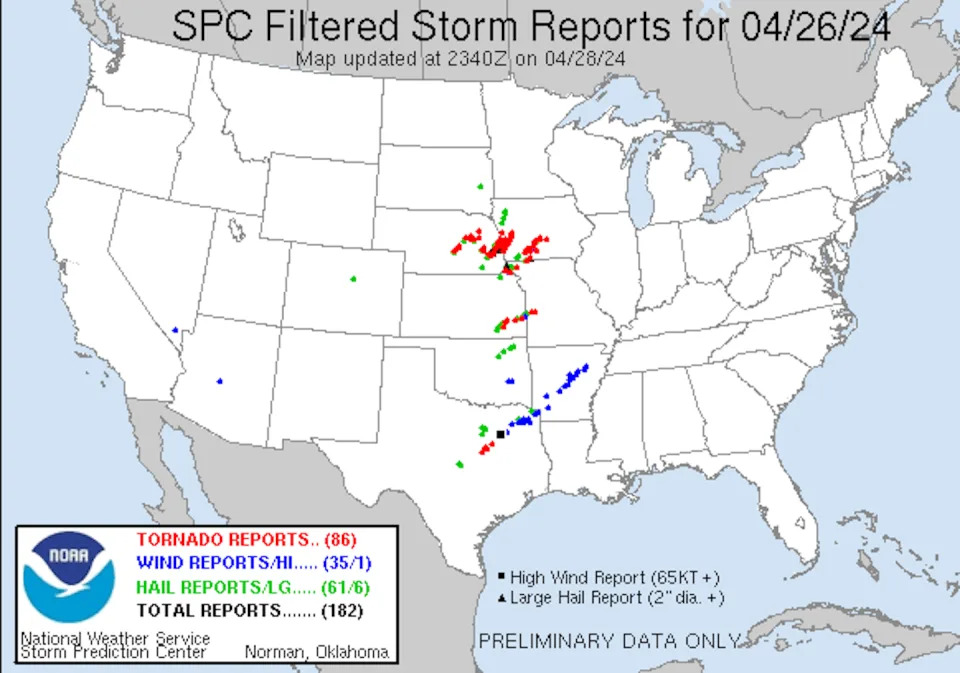
Dozens of tornadoes hit the central U.S. April 26-28, 2024, tearing through suburbs and small towns and damaging hundreds of homes from Oklahoma to Nebraska and Iowa.

Spring is tornado season in the U.S., but the tornadoes in Nebraska and Iowa were quite a bit farther north and east of what would be typical for tornadoes in late April, when tornado activity is more common in Oklahoma and Texas.

The outbreak did fit another pattern for severe weather events, however, that occur as the atmosphere transitions out of El Niño. And this is exactly what was happening in late April.

I study tornadoes and the conditions under which they form. Here’s how these storm systems develop and what El Niño has to do with it.

Map shows lines of tornadoes across Nebraska and Iowa
Preliminary reports of tornadoes and hail during severe storms on April 26, 2024, collected by the National Oceanic and Atmospheric Administration’s Storm Prediction Center. NOAA
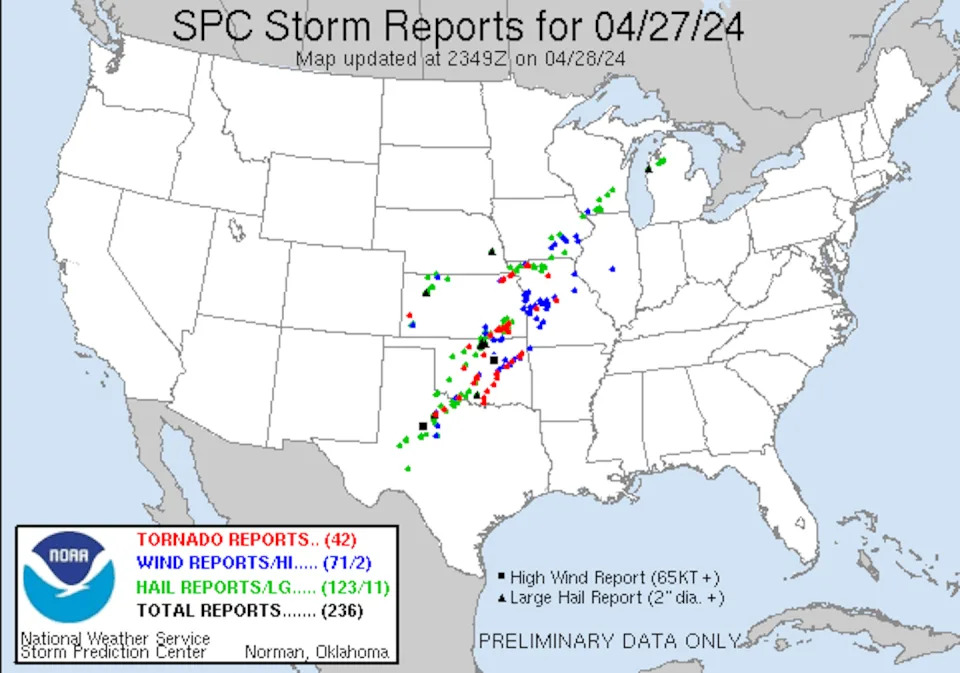
Map shows severe storms lines from Texas to Illinois.
Preliminary reports of tornadoes and hail on April 27, 2024, collected by the Storm Prediction Center. NOAA.
The right conditions for a tornado

Two basic conditions are required to produce the rotating supercell thunderstorms that are capable of generating tornadoes:

  1. Warm moist surface conditions and cold air above.
  2. Winds that change in both speed and direction as you move up in the atmosphere, known as vertical wind shear.

Picture a kid who has a helium balloon at a party and releases it – the balloon floats upward. Like that helium balloon, the warm moist air is less dense than the surrounding colder air, so it rises, accelerating upward. This upward motion releases heat, moisture and energy, and causes thunderstorms to develop.

As with many severe weather outbreaks that occur in the U.S., the atmosphere became primed for storms as warm moist air at the surface was being transported northward from the Gulf of Mexico by a series of surface low-pressure systems.

Higher up, about halfway between the ground and where airplanes fly, atmospheric waves within and below the jet stream were transporting cold air through the middle part of the atmosphere. These waves, formally called Rossby waves and commonly referred to as troughs and ridges, also enhanced vertical wind shear.

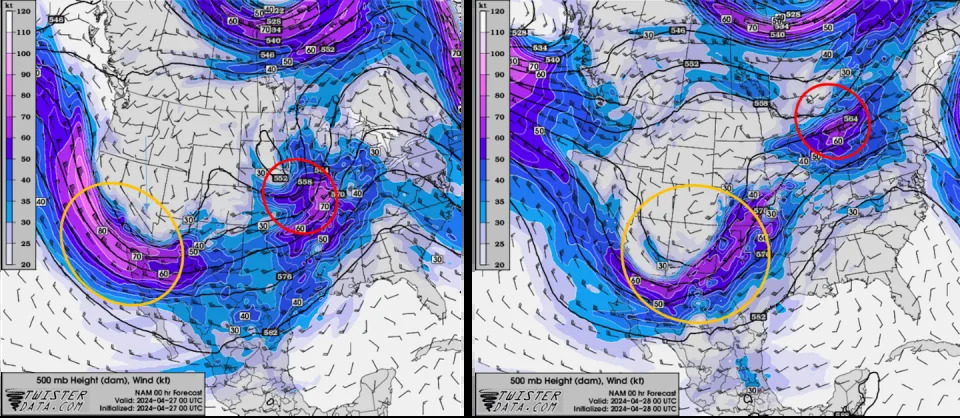
A small atmospheric wave that moved through the Central Plains and Midwest on April 26, helped trigger the tornadoes in Nebraska and Iowa, including a large, destructive tornado in the suburbs of Omaha, Nebraska, and in the town of Minden, Iowa, about 30 miles away.

The following day, a bigger wave moved through Oklahoma, where tornadoes damaged several small towns that evening.

The two images show the short-wave trough, circled in red, and the longer wave, circled in orange, traveling behind it. On the left is April 26, with the short-wave trough moving through Nebraska. On the right, the longer wave is affecting Oklahoma and Kansas on April 27. <a href=
The two images show the short-wave trough, circled in red, and the longer wave, circled in orange, traveling behind it. On the left is April 26, with the short-wave trough moving through Nebraska. On the right, the longer wave is affecting Oklahoma and Kansas on April 27. TwisterData.com

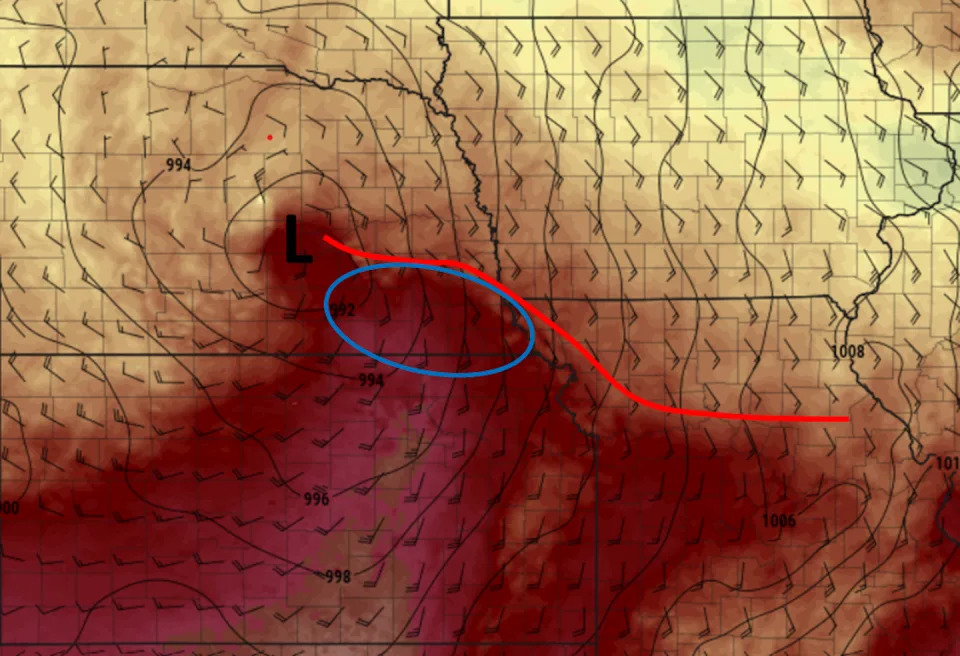
What was especially important was how close these parameters were to the center of the surface low-pressure system and a warm front that extended just to the east of it. The tornado-producing storms were able to tap into that instability and draw on the strong vertical wind shear generated in the vicinity of the warm front.

A chart map of wind direction and temperature shows the warm front across Nebraska and Iowa where the tornadoes developed.
Surface temperatures (colors), winds (barbs indicating direction the wind was blowing from), surface pressure (solid black contours) indicating the location of the low pressure system (L), the warm front (red line) and the region of favorable conditions (blue circle) on the evening of April, 26, 2024. Pivotal Weather

In addition to the tornadoes, the warm moist storms brought heavy rainflash flooding and large hail across parts of the central U.S.

What El Niño has to do with tornado weather

In late 2023 and early 2024, much of the world experienced above-average temperatures, likely linked to global climate change and exacerbated by El Niño. El Niño is a naturally occurring cyclical climate phenomenon that affects both the oceans and the atmosphere.

When El Niño decays, the atmospheric waves change and can become wavier, so they have a greater amplitude. That tends to enhance conditions needed for tornadoes.

The U.S. often sees more frequent tornadoes when the climate is transitioning out of El Niño. The strong El Niño of 2023-24 was decaying in April 2024, and forecasters expect it to be gone by summer.

Forecasts can save lives

The tornadoes caused severe damage in several communities as they tore apart homes and buildings. At least five people died in the storms. But early communications that warned the public of the threat for severe weather days before the storms likely saved more lives.

Weather experts are getting better at predicting tornado conditions. It is not uncommon now to know days in advance of the actual event that an elevated threat exists. Forecasters have high-resolution weather models that can anticipate storms at an appropriate spatial scale to provide a sense of the likely organization of the storms and come close to the location.

The better we understand these storms’ attributes, the better those forecasts and warnings can become.

This article is republished from The Conversation, a nonprofit, independent news organization bringing you facts and trustworthy analysis to help you make sense of our complex world. It was written by: Jana Lesak HouserThe Ohio State University

Read more:

Jana Lesak Houser receives funding from The National Science Foundation.

An El Niño-less summer is coming. Here’s what that could mean for the US

CNN

An El Niño-less summer is coming. Here’s what that could mean for the US

Mary Gilbert, CNN Meteorologist – April 29, 2024

It may be spring, but it’s not too soon to look ahead to summer weather, especially when El Niño – a player in last year’s especially brutal summer – is rapidly weakening and will all but vanish by the time the season kicks into gear.

El Niño’s disappearing act doesn’t mean relief from the heat. Not when the world is heating up due to human-driven climate change. In fact, forecasters think it could mean the opposite.

What this summer’s weather could look like

El Niño is a natural climate pattern marked by warmer than average ocean temperatures in the equatorial Pacific. When the water gets cooler than average, it’s a La Niña. Either phase can have an effect on weather around the globe.

By June, forecasters expect those ocean temperatures to hover close to normal, marking a so-called neutral phase, before La Niña builds in early summer, according to NOAA’s Climate Prediction Center.

But the strength of El Niño or La Niña’s influence on US weather isn’t uniform and varies greatly based on the strength of the phenomena and the season itself.

The influence of El Niño or La Niña on US weather isn’t as clear-cut in the summer as it is in the winter, especially during a transition between the two phases, said Michelle L’Heureux, a climate scientist with the Climate Prediction Center.

Temperature differences between the tropics and North America are more extreme in the winter, L’Heureux explained. This allows the jet stream to become quite strong and influential, reliably sending storms into certain parts of the US.

In the summer, the difference in temperature between the two regions isn’t as significant and the obvious influence on US weather wanes.

But we can look back at what happened during similar summers to get a glimpse of what could come this summer.

In short: It’s not cool.

The summer of 2016 was one of the hottest on record for the Lower 48. La Niña conditions were in place by midsummer and followed a very strong El Niño winter.

Summer 2020 followed a similar script: La Niña conditions formed midsummer after a weak El Niño winter but still produced one of the hottest summers on record and the most active hurricane season on record.

Then there’s the fact that these climate phenomena are playing out in a warming world, raising the ceiling on the extreme heat potential.

“This obviously isn’t our grandmother’s transition out of El Niño – we’re in a much warmer world so the impacts will be different,” L’Heureux, said. “We’re seeing the consequences of climate change.”

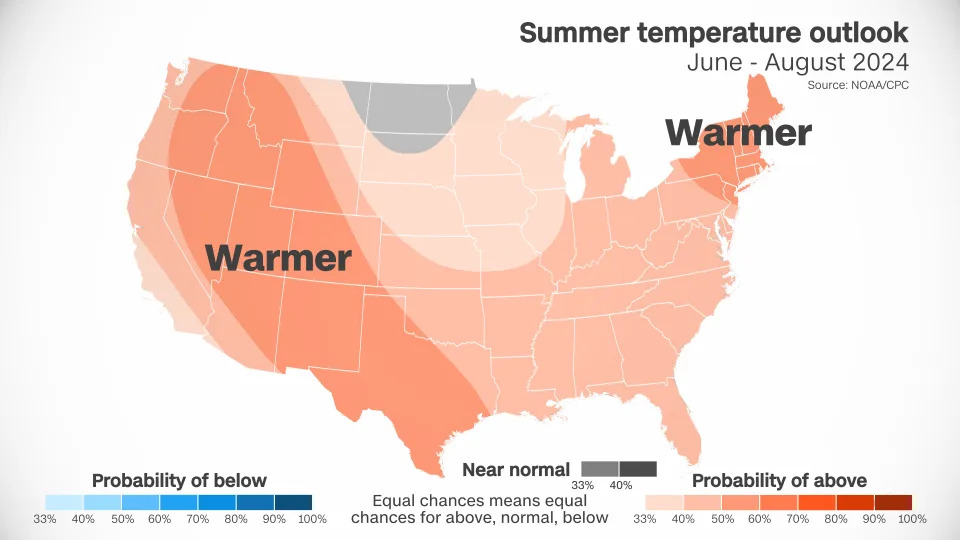
Current summer temperature outlooks for the US are certainly bringing the heat.

CNN Weather
CNN Weather

Above-average temperatures are forecast over nearly every square mile of the Lower 48. Only portions of the Dakotas, Minnesota and Montana have an equal chance of encountering near normal, above- or below-normal temperatures.

A huge portion of the West is likely to have warmer conditions than normal. This forecast tracks with decades of climate trends, according to L’Heureux.

Summers have warmed more in the West than in any other region of the US since the early 1990s, according to data from NOAA. Phoenix is a prime example. The city’s average July temperature last year was an unheard-of 102.7 degrees, making it the hottest month on record for any US city. It was also the deadliest year on record for heat in Maricopa County, where Phoenix is located.

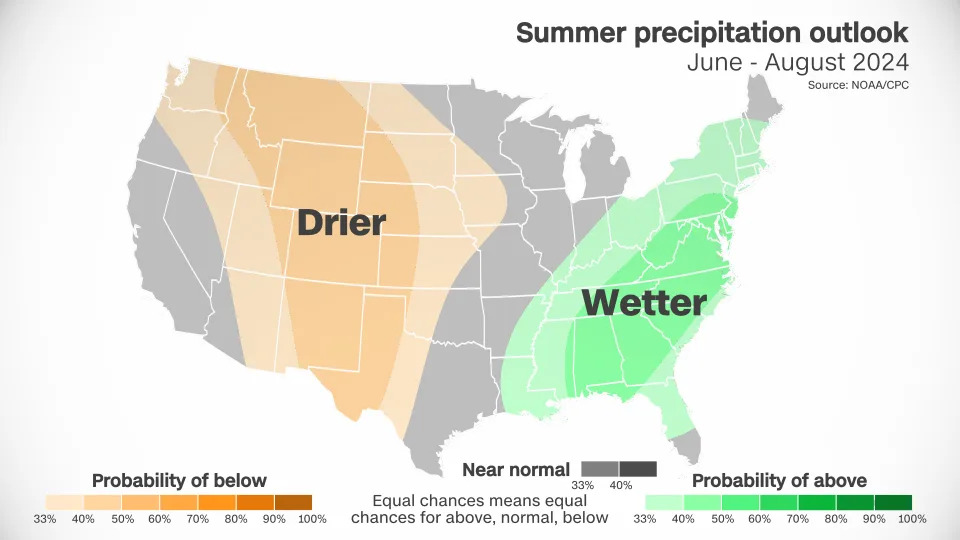
Forecasts also show a worrying precipitation trend for parts of the West.

CNN Weather
CNN Weather

Large sections of the West and the central US are likely to be drier than normal. This dryness, combined with above-normal heat, which only amplifies the dryness, could be a recipe for new or worsening drought.

Wetter than normal conditions are in the forecast from the Gulf Coast to the Northeast. Stormy weather could be a consistent companion for much of the East – but whether it comes from typical rain and thunderstorms or tropical activity won’t be known for months.

A brutal summer also predicted in the water

Heat isn’t the only threat to look out for.

The strengthening La Niña conditions, coupled with ocean temperatures which have been at record highs for over a year, could supercharge the Atlantic hurricane season.

A warming world generates more fuel for more tropical activity and stronger storms. La Niña tends to produce favorable atmospheric conditions to allow storms to form and hold together in the Atlantic.

Early this month, forecasters at Colorado State University released their most active initial forecast ever.

“We anticipate a well above-average probability for major hurricanes making landfall along the continental United States coastline and in the Caribbean,” the group said in a news release.

Farmers warn food aisles will soon be empty because of crushing conditions: ‘We are not in a good position’

The Cool Down

Farmers warn food aisles will soon be empty because of crushing conditions: ‘We are not in a good position’

Nick Paschal – April 28, 2024

The United Kingdom is facing dire food shortages, forcing prices to skyrocket, and experts predict this is only the beginning.

What’s happening?

According to a report by The Guardian, extreme weather is wreaking havoc on crops across the region. England experienced more rainfall during the past 18 months than it has over any 18-month period since record-keeping began in 1836.

Because the rain hasn’t stopped, many farmers have been unable to get crops such as potatoes, carrots, and wheat into the ground. “Usually, you get rain but there will be pockets of dry weather for two or three weeks at a time to do the planting. That simply hasn’t happened,” farmer Tom Allen-Stevens told The Guardian.

Farmers have also planted fewer potatoes, opting for less weather-dependent and financially secure crops. At the same time, many of the potatoes that have been planted are rotting in the ground.

“There is a concern that we won’t ever have the volumes [of potatoes] we had in the past in the future,” British Growers Association CEO Jack Ward told The Guardian. “We are not in a good position and it is 100% not sustainable,” Ward added.

Why is it important?

English farmers aren’t alone — people are struggling to grow crops worldwide because of extreme weather.

Dry weather in Brazil and heavy rain in Vietnam have farmers concerned about pepper production. Severe drought in Spain and record-breaking rain and snowfall in California have made it difficult for farmers to cultivate olives for olive oil. El Niño and rising temperatures cut Peru’s blueberry yield in half last year. Everyone’s favorite drinks — coffeebeer, and wine — have all been impacted by extreme weather.

According to an ABC News report, the strain on the agriculture industry will likely continue to cause food prices to soar.

If these were just isolated events, farmers could more easily adapt — bad growing seasons are nothing new. The problem is that rising temperatures are directly linked to the increasing amount of gases such as carbon dioxide and methane in the atmosphere.

Since the start of the Industrial Revolution, humans have burned dirty energy sources such as coal, oil, and gas, which release a significant amount of those gases. Our climate is changing so drastically that the 10 warmest years since 1850 have all occurred in the last decade.

“As climate change worsens, the threat to our food supply chains — both at home and overseas — will grow,” Energy and Climate Intelligence Unit analyst Amber Sawyer told The Guardian.

What can we do about it?

“Fortunately, we know many ways we can make the food system more resilient while reducing food emissions. The biggest opportunity in high-income nations is a reduction in meat consumption and exploration of more plants in our diets,” said Dr. Paul Behrens, an associate professor of environmental change at Leiden University in the Netherlands.

If we replace a quarter of our meat consumption with vegetables, we could cut around 100 million tons of air pollution yearly. It may seem strange to suggest eating more vegetables with the decline in crop production. However, reducing the land and water used for animal agriculture and diverting those resources to growing more produce would drastically help the declining food supply.

Growing our own food is also a great way to reduce our reliance on store-bought produce, and it can save you hundreds of dollars a year at the grocery store.

Drought devastates crops in southern Africa: ‘The grain I have is only enough for the next two months’

The Cool Down

Drought devastates crops in southern Africa: ‘The grain I have is only enough for the next two months’

Timothy McGill – April 27, 2024

The Africa hunger crisis, exacerbated by a climate change–amplified El Niño, is reaching a critical point. A recent Reuters report paints a grim picture, revealing that southern Africa is grappling with its most severe drought in several years.

What’s happening?

Earth saw a record $63 billion in damages from weather disasters in 2023. Many of those disasters were made worse by El Niño. Reuters cited a study from October last year that “even suggested that climate change may now be as significant a factor in triggering El Niño conditions as natural causes like sun rays.” An El Niño is an unusual warming of the eastern Pacific Ocean along and near the equator.

This year’s extreme drought has devastated crops, and now millions are hungry in southern Africa. World Vision calls it a “severe food crisis” that is “driving millions of people into a heightened risk of hunger and starvation.”

The peak of farming season in southern Africa is from October to March. Several weather disasters have struck the region since the end of 2023’s season. Tropical storm Freddy destroyed homes in Blantyre, the capital of Malawi, on March 14, 2023. This March, tropical storm Filipo brought devastating floods to Maputo, the capital of Mozambique.

Drought is impacting this part of the world, with increasing global temperatures exacerbating the problem. The lack of rainfall has decimated maize crops in southern Africa. An estimated 24 million people are impacted by hunger and malnutrition. The soil is normally suitable for maize farming.

Seventy percent of southern Africa’s maize comes from South Africa. The ongoing drought has led to a 15% drop in the country’s maize production for 2023-24 compared to 2022-23.

Watch now: These futuristic gas stations could completely change what it’s like to own an EV

“The grain I have is only enough for the next two months. It is going to be hunger from here on,” farmer Mandisireyi Mbirinyu told Reuters.

What is being done?

African countries have been forced to come up with innovative ways to deal with drought. Some of these approaches include reusing rainwater, preserving humidity in fields, and promoting effective and inclusive consultation. The United Nations Sustainable Development Group suggests several ways that communities can end desertification, including “combatting soil erosion and restoring coastal ecosystems, leveraging innovation, technology, partnerships and private finance, and supporting the livelihoods of people displaced by drought.”

How can I help?

Giving to climate-friendly causes and organizations like World Vision that help communities overcome poverty and injustice are among the ways to help. Learning about the crisis and sharing the information with family and friends on social media can also help by spreading the word.

Join our free newsletter for cool news and cool tips that make it easy to help yourself while helping the planet.

In Ukraine’s old imperial city, pastel palaces are in jeopardy, but black humor survives

Los Angeles Times

In Ukraine’s old imperial city, pastel palaces are in jeopardy, but black humor survives

Laura King – April 21, 2024

Church personnel inspect damages inside the Odesa Transfiguration Cathedral in Odesa, Ukraine, Sunday, July 23, 2023, following Russian missile attacks. (AP Photo/Jae C. Hong)
Church personnel inspect damage from Russian missile attacks at the Transfiguration Cathedral in Odesa, Ukraine. The cathedral is in the historic city center, a UNESCO-designated site. (Jae C. Hong / Associated Press)

On a cool spring morning, as water-washed light bathed pastel palaces in the old imperial city of Odesa, the thunder of yet another Russian missile strike filled the air.

That March 6 blast came within a few hundred yards of a convoy carrying Ukraine’s president, Volodymyr Zelensky, who was touring the country’s principal shipyard with the visiting Greek prime minister, Kyriakos Mitsotaki.

It was a close call, but Ukrainian officials said that in all likelihood the two leaders were not the target. Like so many other strikes during what Ukrainians call the “big war” — ignited by Russia’s all-out invasion in February 2022 — the attack was aimed at Odesa’s port, a strategic prize of centuries’ standing.

The Black Sea harbor and its docklands — Ukraine’s commercial lifeline and a prime military asset — have been the object of intensifying Russian drone and missile attacks in recent weeks, as Ukraine’s dwindling air defenses leave critical infrastructure vulnerable across the country.

Ukrainian President Volodymyr Zelensky and Greek Prime Minister Kyriakos Mitsotakis walk near trees in Odesa, Ukraine.
Ukrainian President Volodymyr Zelensky, center left, and Greek Prime Minister Kyriakos Mitsotakis, center right, walk in Odesa, Ukraine, on March 6. The sound of a Russian airstrike a few hundred yards away reverberated around the port city as they ended their tour. (Ukrainian Presidential Press Office via AP)

In Odesa, the deadly campaign of airstrikes has brought sharply renewed peril to nearly a million inhabitants of one of Ukraine’s most eclectic and cosmopolitan cities, known in equal measures for its people’s mordancy and joie de vivre. And it poses a heightened threat to a world-renowned cultural treasure: the jewel-box grid of streets making up Odesa’s UNESCO-designated historic center, which abuts the port.

Read more: Ukrainians contemplate the once unthinkable: Losing the war with Russia

After a string of attacks on Odesa and its environs, those who watch over the city’s landmark structures are braced for the worst. On many ornate facades in the city center, full-length windows topped with curlicued pediments are boarded over. Inside, as periodic power cuts permit, workers sweep up shattered masonry and painstakingly restore ruined grand staircases.

“It’s very, very difficult work to safeguard these beautiful old buildings,” said Oleksei Duryagin, who heads a firefighting team that works out of a headquarters dating back to the city’s days of horse-drawn fire wagons. “Whenever they try to hit the port, which is what they try to hit, everything here is in danger.”

Because of the building materials used — wood, flammable insulation within the walls — the 19th century buildings that line Odesa’s cobblestone, tree-lined central streets are especially susceptible to fire or collapse. First responders undergo special training in how to fight blazes in structures like Odesa’s sumptuous opera house, perched on a promontory above the seafront.

“From basement to ceiling, I know these buildings like my old friends,” said Duryagin, 52, who has more than three decades of firefighting experience. “I know their mysteries.”

Falling debris from airborne interceptions, rather than direct drone or missile strikes, has caused some of the most serious destruction. Some sites, like the city’s Fine Arts Museum, which is housed in a reconstructed palace, were hit again before they could be cleaned up after an initial attack.

The boarded-up windows on Odesa's Museum of Western and Eastern Art.
The windows on Odesa’s Museum of Western and Eastern Art are boarded up as Russian forces continue to target the port city. (Laura King / Los Angeles Times)

Early in the war, the museum whisked most of its art treasures into hiding. Some display areas are closed off for repairs, and big niches that once held priceless artworks are starkly blank. But the museum remains open to culture-hungry visitors, who must periodically be hustled into its underground shelter when air alerts sound.

Most of the exhibits now have a somber martial theme, including a striking collection of botanical watercolors by a 48-year-old Ukrainian army captain, Borys Eisenberg, an artist and landscape architect who volunteered on the first day of Russia’s invasion and was killed last year on the front lines. His delicate, violet-veined works on paper are mounted on the wooden lids of ammunition boxes.

“You can see that even looking out from the trenches, he found beauty,” said Irina Kulabina, 66, a retired engineer who helps out at the museum. “It’s really important. We should believe in life more than death.”

At Odesa’s Transfiguration Cathedral, the city’s largest Orthodox Christian church, a young priest named Father Alexei gazed out at blue sky through a gaping hole punched in an outer wall during a missile attack last July. He wondered aloud if fresh attacks would outpace rebuilding.

Rubble lies on the floor and walls are charred and blackened inside Odesa's Transfiguration Cathedral.
The blackened interior of the Transfiguration Cathedral in Odesa. (Laura King / Los Angeles Times)

“We just don’t know what else is to come,” said the 28-year-old cleric, who came to Odesa as a refugee from a front-line town in the eastern province of Luhansk.

While repairs slowly progress, services are held in a cavernous, basement-level secondary space, lighted only by flickering candles and lanterns whenever the electricity goes out. After the July strike, congregants converged on the landmark church, helping to gather artifacts scattered by the blast.

Read more: After an artist’s studio was damaged in a Russian missile strike, he found a new medium: war debris

“It was really shocking for everyone,” said Father Alexei. Zelensky said at the time that hitting the cathedral amounted to targeting “the foundations of our entire European culture.”

Last month was a particularly deadly one for the city and its outskirts.

March 2 drone attack wrecked a nine-story building, killing a dozen people. Five more perished in the strike four days later that narrowly missed Zelensky and the Greek leader. A missile and drone barrage on March 15 left 21 dead, including a paramedic killed in a dreaded “double tap,” in which first responders are targeted, seemingly deliberately, by strikes aimed at the same site a few moments apart to give rescuers time to arrive.

Buildings are seen through a damaged greenhouse roof.
The roof of a greenhouse damaged by a Russian missile attack in the botanical garden of Odesa I.I. Mechnikov National University. (Future Publishing via Getty Images)

More recently, on April 10, six people, including a 10-year-old girl, were killed in a strike on an outlying district of Odesa. That attack came on the 80th anniversary of Odesa’s liberation from Nazi forces during World War II.

The Odesa port and two others on the nearby seacoast have been a particular target of Russian wrath for the last eight months, since Ukraine managed to open a coast-hugging 350-mile Black Sea grain corridor to the Bosporus strait.

At the war’s outset, world grain prices jumped as Ukraine exports slumped, causing hardship in some of the world’s most impoverished countries. Now, though, almost 40 million tons of cargo have been shipped since August 2023, port officials said.

“Sometimes we spend all night in a shelter, then take a coffee and go straight to work — this is our reality,” said Dmytro Barinov, the deputy head of the state-owned Ukrainian Sea Ports Authority. “We feel responsibility not only for the Ukraine economy, to our farmers, but to the whole world that relies on our grain exports.”

As attacks continue and the overall war outlook grows grimmer, the city veers between a sense of relative safety and an acute awareness of peril.

Central cafes are full, and people linger at ice cream stands on the promenade. In flat green fields less than half an hour to the east, though, crews scatter pyramid-shaped reinforced cement antitank obstacles known as “dragon’s teeth.”

An ice cream stand on a public promenade
An ice cream stand on the promenade near the Potemkin Stairs, Odesa’s most famous landmark. Disused “tank traps” on the corner of a main boulevard in Odesa’s center. Laura King / Los Angeles Times

Odessa’s most famous landmark, the Potemkin Stairs — best known for the harrowing tumbling-baby-carriage scene in the 1925 film “Battleship Potemkin” — are topped with a roll of barbed wire. But a military checkpoint a few blocks away has been removed, and pedestrians can draw close enough to gaze down the 192 steps leading to the seafront.

The source of the city’s splendor is now the principal cause of its jeopardy. Odesa’s free port status financed its extraordinary architectural flowering in the 1800s and helped build its vibrant multiethnic society.

Russian warships have been driven back from Ukraine’s Black Sea coast — “when the big war started, we could see them from our palaces,” said naval spokesman Dytro Pletenchuk — but only 150 nautical miles to the east-southeast lies the Russian-occupied Crimean peninsula, from which many strikes are launched.

At that range, there is little time for people in Odesa to get to shelter once missiles are in the air.

Read more: In a storied Ukrainian city, a dance with wartime destiny

Russia’s 2014 seizure of Crimea and its fomenting of a separatist conflict in Ukraine’s east were a precursor to the current invasion. Many here harbor ardent hopes of someday recapturing the peninsula, and are heartened by Ukrainian strikes on Russian forces there, including a damaging attack Wednesday on a large Russian airfield.

At the National Academic Opera and Ballet Theater — where April offerings include the ballet “Giselle” and Verdi’s opera “Nabucco” — the show goes on, as it has almost continuously since the start of the conflict. The neo-Baroque opera house is no longer sandbagged, but the war still feels ever present.

Odesa's opera house, formerly protected with sandbags.
Odesa’s opera house, formerly protected with sandbags. Performances and rehearsals are often interrupted by air alerts. (Laura King / Los Angeles Times)

“After night bombings come the most difficult days: Actors, singers and dancers are just physically tired, and it’s hard to deliver the emotional spectrum in their performances,” said Oksana Ternenko, 50, a stage director.

“Sometimes it’s like a theater of the absurd,” she said. “We are starting to rehearse, and a singer is showing photos on the phone: ‘Look, here’s a piece of my house that fell on my car.’ ”

Despite all, Odesa maintains an irrepressible offbeat humor.

A man dances on a brick path as musicians play.
A man dances during the Festival of Humor, which has been taking place in Odesa on and around April Fools’ Day since 1973. (Nina Liashonok / Getty Images)

“My parents and I, we’re very happy that Granny is deaf, so the explosions don’t scare her,” said 14-year-old Alina Kulik, who lives in an outlying district that has been hit repeatedly.

“Right now, we’re in a place that’s a little dangerous,” said her 15-year-old friend Anastasia Jelonkina, as the two girls perched on a promenade bench overlooking the seaport. “We know that. But here we are!”

Odesa’s beaches, beloved by tourists before the war and by locals all along, are full again as spring temperatures rise. During much of the last two years, danger from mines and debris from destruction of a massive dam on the Dnipro River kept the shoreline largely closed.

Sunbathers flock to an Odesa city beach.
Sunbathers flock to an Odesa city beach. De-mining efforts allowed the reopening of the seashore. (Laura King / Los Angeles Times)

But intensive de-mining efforts have rendered the sea off Odesa relatively safe for swimming again, and a tousle-haired Irina Khosovana, a 62-year-old doctor who is a fifth-generation Odesan, said nothing — not even periodic air alerts — could keep her away.

“The sea is our comfort,” she said, gesturing toward the blue expanse. “Coming here is as important as life.”

A largely Russian-speaking city at the start of the war, Odesa still has deep cultural roots in common with the enemy now battering its shores. The poet Pushkin is still revered, with a grand boulevard named for him and a big statue taking pride of place in front of the city council building.

But another prominent piece of statuary near the opera house was deemed a symbol of colonialist oppression — that of the Russian empress known as Catherine the Great. Her likeness, hauled down in the war’s first year, is now boxed up in a black lean-to outside the damaged art museum.

Atop the empty plinth where the statue once stood flies a blue-and-yellow Ukrainian flag.

US can send fresh weapons to Ukraine ‘within days’

The Telegraph

US can send fresh weapons to Ukraine ‘within days’

Tony Diver – April 20, 2024

Speaker Mike Johnson talks to reporters after the House voted to approve the aid to Ukraine
Speaker Mike Johnson talks to reporters after the House voted to approve the aid to Ukraine – J. Scott Applewhite/AP

US weapons could be sent to Ukraine within days, after the House of Representatives voted to approve more than $60 billion (£48.5 billion) in military aid.

Kyiv’s army has resorted to increasingly desperate measures amid dwindling supplies of key missiles and relentless Russian bombardment that has translated into frontline advances.

Some troops have had to rely on civil society donations of items like drones or have started using decoy air defence systems to draw away enemy fire.

The Pentagon has already moved stockpiles of the most-needed arms closer to Ukraine’s borders in anticipation of the bill passing so that they could be sent to Kyiv at short notice.

Joe Biden’s “supplemental” bill on foreign aid funding has been held up for months in Congress amid opposition from Republicans.

Joe Biden's "supplemental" bill on foreign aid funding has been held up for months
Joe Biden’s “supplemental” bill on foreign aid funding has been held up for months – Alex Brandon/AP

On Saturday night the House voted to approve the package, sending it on to the Senate, where it is expected to pass early this week.

Chuck Shumer, the Democrat majority leader in the Senate, has suggested it could be approved as early as Tuesday. Mr Biden has said he will sign the bill as soon as it reaches his desk.

The aid package replenishes a Pentagon budget that can be accessed by Mr Biden through the Presidential Drawdown Authority (PDA), a power used for foreign aid purchases.

It allows the White House to send existing US military stockpiles to another country. More than $40 billion worth of equipment has been sent to Ukraine using this method since the start of the war in February 2022.

Maj Gen Pat Ryder, the Pentagon’s press secretary, said this week that the US had already moved weapons closer to Ukraine in the hope the bill would pass, allowing them to be moved more quickly.

“We have a very robust logistics network that enables us to move material very quickly,” he said. “We can move within days.”

The main aid requests from Ukraine to other allies in recent months have been for air defence missiles to protect the country’s cities from Russian attacks, and shells to use on the front lines in the East.

Ukraine's front line has been feeling the strain
Ukraine’s front line has been feeling the strain – ANATOLII STEPANOV/AFP

The next package is likely to include ATACMS missiles, which have already been sent in limited quantities to the front line, and Patriot missiles for Ukraine’s air defence systems.

The most recent round of aid, which was drawn from savings in the existing Pentagon budget, included munitions for the High Mobility Artillery Rocket Systems (HIMARS).

The US stores some 155 million howitzer rounds in Europe, and could send them to Ukraine within days.

The global supply of rounds began to fall in recent months after the US budget for Ukraine aid dwindled and European manufacturers were unable to keep up with demand.

William Burns, the director of the CIA, has said that without speedy assistance from the US, Ukraine could lose the war against Russia this year.

Despite initial plans for a spring offensive this year, Ukraine has resorted to defending its existing front lines against Russian troops, without the weapons or personnel to launch a new push into Crimea.

The military draft in Ukraine was this week lowered to include men aged over 25, from its previous level of 27.

As the war in Ukraine has progressed, the US has agreed to send increasingly expensive military systems to Kyiv, including the Abrams tank.

An Abrams tank in Ukraine
An Abrams tank, which have been provided by the US, in Ukraine – X

Russia has also stepped up its defence procurement since February 2022, and has received drones from Iran and missile technology from China, according to US officials.

The Pentagon hopes that the package approved in the House on Saturday will be enough to meet America’s defence commitments to Ukraine until the presidential election, which will be held in November.

Republican efforts to stall the aid ramped up in recent months amid pressure from Donald Trump, the GOP’s nominee, who has opposed further spending and promised to end the war “in one day” if he wins the election.

Despite Mr Zelensky’s requests for advanced fighter jets from the US, planes are unlikely to be approved from the US.

Last year, Mr Biden approved some F-16 fighter jets to be sent to Ukraine from Denmark, under a rule that allows the US government to determine which countries can use planes that American manufacturers have produced.

The Pentagon has also agreed to train Ukrainian pilots to fly the planes, including at the Morris Air Force Base in Arizona.

With one letter, Trump turned the Republican Party into an extortion racket

USA Today – Opinion

With one letter, Trump turned the Republican Party into an extortion racket

Rex Huppke – April 18, 2024

I’d like to congratulate Donald Trump on the speed with which he’s turned the Republican Party into something resembling an extortion racket.

Aside from sinking his fangs into the Republican National Committee like a hungry bat on a plump Berkshire hog, the man spending his days in a Manhattan courtroom under criminal indictment is now looking to bleed cash out of down-ballot GOP campaigns.

In an April 15 letter, Trump’s campaign notified all Republican candidates that if they use the former president’s name, image or likeness on any campaign advertisements, they need to deliver at least 5% of the money they raise back to the aforementioned criminal defendant.

Former US President Donald Trump attends the second day of his trial for allegedly covering up hush money payments linked to extramarital affairs, at Manhattan Criminal Court in New York City on April 16, 2024.

You know, a little kickback for the boss man. Just enough to get Trump’s beak wet. Because, as has been made abundantly clear, the GOP is Trump and Trump is the GOP.

The Republican Party is now nothing but a Donald Trump piggy bank

He’s got his daughter-in-law Lara Trump in place at the top of the RNC pecking order, and she didn’t hold back detailing the committee’s singular focus: “Every single penny will go to the No. 1 and the only job of the RNC – that is electing Donald J. Trump as president of the United States and saving this country.”

What is Trump afraid of? On eve of hush money trial, big, bold Donald Trump shows he’s nothing but a giant chicken

Sorry, other Republican candidates! Maybe you can find a different Republican National Committee to help you out. Oh, and in the meantime, if you mention the Republican at the top of the ticket, you need to ship some of the green you raise back upstream to the guy already vacuuming donor money up like a Statue-of-Liberty-size Dirt Devil.

If this sounds unbecoming of a presidential candidate who claims to be wildly successful and incredibly wealthy, wait until you see the tacky sneakers and weird Bibles he’s selling.

Biden is out-fundraising Trump, so more Bibles must be sold!

Adding to the cash thirst, the former president’s campaign is trailing President Joe Biden badly in the fundraising department.

A Financial Times analysis released this week found: “Donald Trump has raised $75 (million) less for his presidential bid than Joe Biden and has 270,000 fewer unique donors now than at the same stage of his run for the White House four years ago.”

President Joe Biden speaks to members of the United Steel Workers Union at the United Steel Workers Headquarters on April 17, 2024 in Pittsburgh, Pennsylvania. Biden announced new actions to protect American steel and shipbuilding industries including hiking tariffs on Chinese steel.

He’d have to sell a moon-high stack of Bibles to catch up, so the grift must grow. And grow it has with this new “pony up some cash” push on fellow candidates.

Trump campaign’s letter to other GOP candidates reads like a mob flick

As if actively trying to get Trump’s campaign cast in the next Martin Scorsese gangster film, the letter to down-ballot Republicans included this line: “Any split that is higher than 5% will be seen favorably by the RNC and President Trump’s campaign and is routinely reported to the highest levels of leadership within both organizations.”

Why do Republicans hate each other? Nobody hates the GOP as much as Republicans hate the GOP. Just ask Marjorie Taylor Greene.

Sure, 5% is nice. That’s fine. But, you know, maybe do 10%, maybe even 15%? That’s the kinda thing that gets you noticed, kid.

When you give your party to someone under criminal indictment, well …

The letter also included this note to any campaigns that use Trump’s name, image or likeness and don’t play ball: “Any vendor whose clients ignore the guidelines mentioned above will be held responsible for their clients’ actions. Repeated violations will result in the suspension of business relationships between the vendor and Trump National Committee JFC.”

Yeah, nice little campaign you got there. Shame if anything happened to it, you know?

This all sounds dodgy as the day is long, but regardless, here’s what all the little Republican candidates not named Donald Trump are going to do. They’re going to line up in their fancy Trump sneakers with their Trump Bibles tucked under their arms and drop an offering in the MAGA hat at the feet of the Donald.

Frankly, it’s what they deserve.

They gambled on this guy again.

And the house always wins.

Ozempic use appears to be changing people’s personalities —experts think they know why

New York Post

Ozempic use appears to be changing people’s personalities —experts think they know why

Adriana Diaz – April 17, 2024

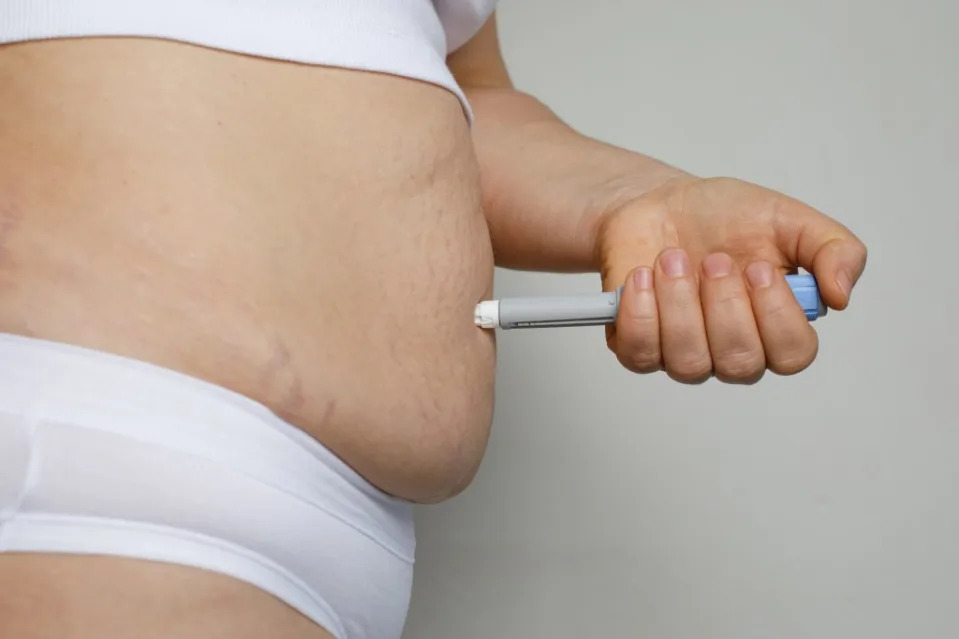
man injecting Ozempic and another looking depressed

Move over, Ozempic fingerOzempic face and Ozempic butt — say hello to Ozempic personality.

The latest transformative outcome of the buzzy weight loss drug may be the most profound yet, with a growing number of patients claiming that the GLP-1 medication — and others like it — have caused anxiety, depression and suicidal ideation, even as they shed the pounds.

Looking into the science behind the life-changing jabs, experts revealed why the medications, originally intended to treat diabetes, could be changing people’s personalities and behaviors.

millaf – stock.adobe.com

Ozempic, and other popular treatments like Wegovy, have an impact on dopamine levels, which are responsible for a range of functions.

Along with impacting our emotional and physical drive for food, the brain chemical impacts feelings of reward, pleasure, motivation and movement.

These changing levels could help explain why some users have even claimed the drugs have also reduced their cravings for drugs, alcohol and sex.

Dr Kent Berridge, a professor of psychology and neuroscience at the University of Michigan, explained to The Daily Mail that both addictive substances and food activate the same dopamine signals and reward-learning regions in the brain.

He also noted that: “Cravings for addictive drugs are also amplified by hunger.”

“When researchers are trying to get animals to learn to self-administer cocaine, they often will keep them hungry for a little while, as this helps them learn,” Dr. Berridge explained.

The medical expert added: “Hunger is specifically for food but it’s more general than that, it activates craving for a lot of things. If you’re hungry, the motivational value of things, even that are not food, seems to increase.”

Dr Kent Berridge, a professor of psychology and neuroscience at the University of Michigan, explained to The Daily Mail that both addictive substances and food activate the same dopamine signals and reward-learning regions in the brain. REUTERS

Because these drugs help patients to feel satiated for longer, experts believe they then also lessen cravings for things other than food as well, such as drugs and alcohol.

“Satiety may be not only reducing the craving for food, but potentially for other things,” Dr. Berridge said.

GLP-1 drugs appear to alter the motivational dopamine systems, dampening but not eliminating desires. For example, patients have found that they don’t lose their appetites but eat less while on these medications which experts believe could translate to other vices.

“That would be a possibility — taking the [edge off certain cravings], and those are the ones that are problematic if you’re trying to lose weight or if a person is trying to stop taking drugs,” Dr. Berridge said.

Because these drugs help patients to feel satiated for longer, experts believe they then also lessen cravings for things other than food as well, such as drugs and alcohol. Getty Images

He also shared that a decreased libido while on GLP-1 drugs is “conceivable.”

Dr. Berridge explained that because sex is a pleasurable natural desire, suppressing the reward pathway could lead to a reduced sex drive.

“If you’re suppressing [dopamine activation] a little bit and cutting down those mountain peaks, sexual desire is a natural peak, so that would be plausible,” the medical expert said.

However, he admitted that exacly how GLP-1 drugs are suppressing dopamine systems is still unknown.

The US Food and Drug Administration’s adverse event reporting system received 606 reports of psychiatric disorders connected to Ozempic, along with 324 reports connected to Saxenda and 190 to Wegovy in 2023.

The FDA requires that medications for weight management that work on the central nervous system, including Saxenda and Wegovy, carry a warning about suicidal thoughts.

Ozempic, which is only FDA-approved to treat diabetes, does not come with that warning.

Research has shown that bariatric surgery patients have an increased risk for suicide and self-harm behaviors following the procedure.

Lead study author Dr. Alexis Conason, a licensed psychologist in NYC, noted that triggering experiences such as changes in quality of life and unrealistic expectations also occur to those going through other weight loss treatments such as Ozempic.

“People put so much emotion and hope into weight loss, and are sold this fantasy that if they just lose weight everything’s gonna be okay and all the good things that they want in life will come when they lose weight,” Conason previously told The Post.

However, some patients have reported this changed mindset even when the needle on the scale drops but experts aren’t shocked.

“It’s not necessarily surprising when you see there may be an increase in suicidal ideation and other things like that because you’ve taken away a really important coping mechanism for many people,” Brooke Boyarsky Pratt, CEO and co-founder of weight-inclusive care company Knownwell, told The Post in 2023.

However, the medical expert admitted that how GLP-1 drugs are suppressing dopamine systems is still unknown. myskin – stock.adobe.com

Dr. Gregory Dodell of Central Park Endocrinology also noted that patients on medications that suppress their appetite may not be getting sufficient nutrients, which in turn disrupts their mental stability.

“So much of balancing our body is about what we eat and drink,” he said.

The European Medicines Agency recently said there was no evidence for a causal link between Ozempic and suicidal thoughts. The FDA came to a similar conclusion in January.

The weight-loss drugs have risen in popularity so quickly in the last few months that the FDA announced shortages as the medication flew off the shelves.

But some experts have also warned that they have not been available long enough to study the long-term effects and are likely being misused by some as a quick way to shed a few pounds.

If you are struggling with suicidal thoughts or are experiencing a mental health crisis and live in New York City, you can call 1-888-NYC-WELL for free and confidential crisis counseling. If you live outside the five boroughs, call or text 988 or chat 988lifeline.org.