What is a heat dome? Is SC in a heat dome? What to know about ‘ring of fire’ thunderstorms.

Greenville News

What is a heat dome? Is SC in a heat dome? What to know about ‘ring of fire’ thunderstorms.

Nina Tran, Greenville News – June 20, 2024

A heat wave is a period of unusually high temperatures over a region. As temperatures cook on the Midwest and Northeastern coast, the term “heat dome” has been used to describe the hot weather, leaving many questions to be answered.

The National Weather Service (NWS) has issued a hazardous weather outlook from Friday, June 21 through Wednesday, June 26 for Northeast Georgia, the North Carolina foothills and Piedmont, and Upstate South Carolina.

High temperatures are forecast to reach the mid 90s Saturday through Monday, with heat indices expected to reach 100 to 104 degrees. Those who are sensitive to the heat will want to decrease their time spent outdoors to prevent heat-related illnesses.

Here’s what to know about the heat dome and how you and your family can stay safe in it.

What is a heat dome?

Per AccuWeather, the term “heat dome” is used to describe a sprawling area of high pressure promoting hot and dry conditions for days or weeks at a time. It is similar to a balloon in the way it expands and contracts as the day goes on. When a certain area is inside it, it can feel very warm. A heat dome can interfere with the production of clouds, leading to an increase in sunlight and high temperatures. In turn, the cooling demand will increase, which may boost the strain on a region’s power grid. Drought conditions may also develop due to extended dry and hot spells.

More: It’s getting hot out: Here are the best settings for your air conditioner in South Carolina

What are ‘ring of fire’ thunderstorms?

Since heat domes act as large, immovable bubbles, moisture is forced up and over the heat bubble, according to AccuWeather. This causes “ring of fire” thunderstorms to form along the fringes of heat, which may bring severe weather into the area.

“Let’s say, for example, you had a big high pressure over the Southern Plains, Texas, or Oklahoma. What will happen is, on the northern fringes of higher pressure, you’ll get these periods of thunderstorms that develop, maybe over the Central Plains. It will move around the periphery of that high pressure, which tends to be in kind of a circular shape, hence the ring terminology to it.” said Thomas Winesett with the NWS at Greenville-Spartanburg International Airport.

Ring of fire features are currently favorable for the Midwest and parts of the Ohio Valley due to centered high pressure activity in both areas. As the heat dome ensues, will South Carolina also get a chance for severe weather?

“That’s not to say we can’t get some thunderstorms, but it won’t be the true ring of fire type storms maybe until later, later next week if that high pressure shifts back off to the west or Texas, New Mexico.” Winesett said. “So when that happens, that might allow us to get into a more active pattern where we see those ring of fire type storms maybe coming more out of the Mississippi Valley and Tennessee Valley and towards the Appalachia.”

People leave the beach beach at Phipps Ocean Park as a thunderstorm approaches July 7, 2023 in Palm Beach. The national weather service issued a heat advisory for Palm Beach County with a high near 94 degrees and heat index from 108 to 112.
When will the heat dome end?

Doug Outlaw with the NWS at GSP said he hopes current weather conditions do not stick around for too much longer, especially with the reestablishment of high temperatures next weekend. Next Friday’s heat will bump down a few degrees before temperatures continue to soar. The timing of a cool down period remains uncertain.

“It is typical to have heat waves on and off during the summer, but we hope that the weather doesn’t get stuck and we end up way up in the 90s every day for weeks,” he said. “But we’ve got to be prepared for the possibility of something like that.”

Outlaw forecast the following high temperatures for Greenville heading into next week:

∎ Friday, June 21: 91 degrees

∎ Saturday, June 22: 93 degrees

∎ Sunday, June 23: 94 degrees

∎ Monday, June 24: 95 degrees

∎ Tuesday, June 25: 95 degrees

∎ Wednesday, June 26: 96 degrees

∎ Thursday, June 27: 95 degrees

A child stands at a fountain in Georgetown Waterfront Park amid a heat wave in Washington, June 19, 2024.
Types of heat warnings issued by the National Weather Service

The NWS issues several types of heat advisories depending on severity. The different types are as follows:

∎ Excessive heat warning: This warning is issued 12 hours of the onset of extremely dangerous heat conditions. When the maximum heat index temperature is expected to reach 105 or higher for at least two days and the nighttime temperature will not drop below 75, the warning is issued. This rule may vary across the country, especially for areas not used to extreme heat conditions. Precautions should be taken immediately during extreme conditions to prevent serious illness and even death.

∎ Excessive heat watch: A watch is issued when an excessive heat event is favorable within the next 24 to 72 hours. When the risk of a heat wave has increased but the occurrence and timing is uncertain, a watch is issued.

∎ Heat advisory: An advisory is issued within 12 hours of the onset of extremely dangerous heat conditions. When the maximum heat index temperature is anticipated to be 100 degrees or higher for at least two days and the nighttime temperature will not drop below 75 degrees, an advisory is issued. This rule may vary across the country, especially for areas not used to extreme heat conditions. Precautions should be taken immediately during extreme conditions to prevent serious illness and even death.

∎ Excessive heat outlook: An outlook is issued when there is a potential risk for an excessive heat event within the next 3-7 days, providing information for those who need considerable lead-time to prepare for the event.

People cool off at the lakefront as temperatures climbed above 90 degrees Fahrenheit on June 19, 2024 in Chicago. A heat wave has brought record warm temperatures to much of the Midwest and Northeast areas of the country this week.
High temperatures forecast across US Midwest, Northeast

These are the high temperatures forecast for several Midwest and Northeast cities from Juneteenth and June 20. Temperatures will dip between this week and early next week, according to a USA TODAY story:

∎ Manchester, New Hampshire: 97, 99. Dropping to 86 by June 24.

∎ Albany, New York: 96, 97. Dropping to 86 by June 24.

∎ Detroit, Michigan: 95, 93. Dropping to 83 by June 24.

∎ Toledo, Ohio: 94, 96. Dropping to 84 by June 24.

∎ Indianapolis, Indiana: 92, 95. Jumping to 96 by Saturday, June 22 before dropping to 97 on June 24.

∎ Caribou, Maine: 96, 95. Dropping to 76 by June 24.

∎ Philadelphia, Pennsylvania: 94, 95. Jumping to 100 by Friday, June 21 before dropping to 90 on June 24.

∎ Boston, Massachusetts: 95, 97. Dropping to 85 by June 24.

∎ Washington, D.C.: 90, 92. Jumping to 98 by Saturday June 22 before dropping slightly to 93 on June 24.

Mayflower Beach in Dennis fills up on a hot weekday morning, June 20, 2024, as beachgoers seek relief from the heat. The Town of Dennis has announced a new plan to deal with beach crowding there on July 4. 
Steve Heaslip/Cape Cod Times
Mayflower Beach in Dennis fills up on a hot weekday morning, June 20, 2024, as beachgoers seek relief from the heat. The Town of Dennis has announced a new plan to deal with beach crowding there on July 4. Steve Heaslip/Cape Cod Times
How to prepare for the heat

Tips from NOAA:

∎ Make sure the air conditioner is functioning properly. If your home does not have air conditioning or loses power, visit a designated cooling shelter or other air-conditioned location such as the mall or public library.

∎ Check on friends, families, neighbors, and pets to ensure they are safe in the heat. It is important to check on those who live alone or do not have air conditioning.

∎ Never leave children, dependents, or pets unattended in vehicles. The sun can heat the inside of the car to deadly temperatures in minutes.

∎ Wear loose clothing that is light-colored and covers the skin.

∎ Hydrate with water throughout the day, avoiding caffeine and sugary beverages.

∎ Set aside one gallon of drinking water per person a day in case of a power outage.

∎ Keep out of the sun and stay indoors on the lowest level. Curtains and shades should be closed.

∎ Immerse yourself in a cool bath or shower. Cooling your feet off in water can also help.

∎ If temperatures are cool at night, let the cool air in by opening windows.

∎ If you are outside, stay in the shade. Apply sunblock and wear a wide-brimmed hat before going outside.

∎ To avoid heat exhaustion, do not engage in strenuous activities. Use a buddy system and take breaks in the shade when working in extreme heat.

∎ For critical updates from the National Weather Service (NWS), tune into NOAA Weather Radio.

For more heat safety information, visit weather.gov/heat or heat.gov.

Nina Tran covers trending topics for The Greenville News. Reach her via email at ntran@gannett.com

Why this week’s heat wave could be next summer’s normal

The Hill

Why this week’s heat wave could be next summer’s normal

Zack Budryk – June 20, 2024

The extreme heat slamming the eastern U.S. this week may be a sign of things to come as monthly temperature records continue to give way.

A broad swath of the Midwest and eastern U.S. are currently under a heat dome, caused by a high-pressure system in the Earth’s upper atmosphere that compresses the air beneath it, making it expand into a dome shape.

Research published in March in the journal Science Advances found that since 1979, as climate change has intensified, heat waves have gotten hotter and more commonplace, and the physical area covered by heat domes has expanded as well. They’ve also slowed down by about 20 percent, leaving the people in their paths to contend with their effects longer.

“Every summer we get heat waves, and heat waves are getting more extreme and they’re getting more frequent and they’re lasting longer,” said Jonathan Overpeck, the Samuel A. Graham dean of the School for Environment and Sustainability at the University of Michigan.

In this specific heatwave, the system of warmth is moving north and east, but it’s part of a broader, more ominous pattern in which heat waves start from a warmer background, said Richard Rood, professor emeritus of climate and space science and engineering at the University of Michigan.

“The oceans have been extraordinarily warm all year, the Atlantic and Gulf of Mexico in particular,” he said. “So when summer comes and you start seeing heat waves, you’re starting from a higher temperature background.”

As heat accumulates, Rood told The Hill, one consequence is higher temperatures earlier in the year, such as this week’s heat, which began before the official start of the summer Thursday but in earlier years might be more typical of July or August.

The extreme heat patterns began in the Midwest earlier this week, and are expected to extend into the Northeast over the rest of the week. More than 76 million people were under some form of heat advisory Tuesday morning in the U.S., and about twice that number faced temperatures of more than 90 degrees. The National Weather Service projects record-breaking heat in cities like Detroit and Philadelphia as well as parts of New England this week.

Much like the heat waves of previous years in places like Europe and the Pacific Northwest, the heat is hitting regions that have little experience with such extremes, like northern New England. This means in many cases individuals are unprepared, as is broader community infrastructure of the kind that exists in historically hotter regions.

Both personal air conditioning and resources like cooling centers are “still inadequate in a lot of areas in the U.S. where access to air conditioning hasn’t been historically needed,” said Amy Bailey, director of climate resilience and sustainability at the Center for Climate and Energy Solutions.

“Our infrastructure, our institutions and daily practices aren’t well-suited for these long stretches of extreme heat, and the longer it takes us to catch up the more lives are on the line,” Bailey added.

It also demonstrates “the criticality of having a grid that is resistant to extreme weather,” she added.

Overpeck said much of the extreme heat is attributable to the impact of climate change, but El Niño has also been a factor, and “we expect — hope might be a better word — that temperatures might start to ameliorate.”

The most recent El Niño, a climate phenomenon that causes unusually warm surface temperatures in the Pacific Ocean, began last June, which was also the warmest June on record.

The globe saw its overall hottest summer on record the same year and recently concluded a 12-month period in which every month set a temperature record.

“We’re really looking at the next few months to tell us whether something dramatic is surprising us in the global temperatures,” Overpeck said. “If it starts cooling off, [and] it hasn’t started to do that yet, we can ascribe [these] more unusual temperatures to the El Niño. If it keeps rocketing up, we’ll have to think about why climate change [is] accelerating.”

He noted that surface warming of oceans, where the majority of the heat trapped by greenhouse gases goes, has also accelerated lately.

While local authorities have urged people in affected areas to stay inside where possible, that is not an option for those who work outdoors or the homeless population of major metropolitan areas, Overpeck noted.

The temperatures of this week are likely to subside somewhat while remaining high throughout the summer, but ultimately they may be a vision of what summers look like in the longer term, Rood said. This week is almost certainly not a “one-off event,” he added. “We are probably going to see a series of events this summer.”

“I wouldn’t call it a new normal — I would call it perhaps a vision of 10, 20, 30 years,” he said. If the trend continues, he added, the extremes of this week won’t seem extraordinary years from now.

“You’re getting a glimpse into the future, warmer world,” he said.

Putin Has Tainted Russian Greatness

By Serge Schemann – June 20, 2024

Crowds of people pack the Red Square in Moscow. One person waves a huge flag with Vladimir Putin’s face on it.
Credit…Maxim Shipenkov/EPA, via Shutterstock

Serge Schmemann is a member of the editorial board and the author of a book about Russia, “Echoes of a Native Land.”Want to stay updated on what’s happening in Russia? Sign up for Your Places: Global Update, and we’ll send our latest coverage to your inbox.

Many years ago, in the 1980s, I went to Brighton Beach, then in its heyday as a district of newly arrived Soviet Jews, to celebrate the first year (there would not be many more) of the lively local Russian-language weekly, The New American. It was a grand event, rich in humor and tinged with nostalgia. I asked a middle-aged partygoer for his thoughts on his lost homeland, and his reply has stayed with me: “I hate Russia, for forcing me to leave her.”

It was an apt summary of what waves of émigrés from Russia and the Soviet Union since the early 20th century have felt: a sorrowful sense of loss for a motherland — what Russians call “toska po rodine” — coupled with resentment at the autocratic powers that forced them out. My grandparents were among the “White” Russians who fled the Revolution and moved to Paris in the 1920s. A second wave of emigrants left in World War II. The third, Soviet Jews, started leaving in the 1970s. Vladimir Putin has now created another wave of people fleeing Russia, and many of them may still believe, as my forebears did, that they will one day return to the homeland.

Most probably will not.

It’s hard to say precisely where Russian exiles stand, politically or in their sense of attachment to Russia. The waves of emigrants differ widely one from another, and in the United States, they have not behaved like immigrants from Italy, China or Poland who formed hyphenated-American communities and organizations that have persisted over generations. Russian immigrants to America have, by comparison, melded quickly into the general population. Brighton Beach is one of the few places with any Russian flavor in the United States.

Still, the prevailing attitude I’ve encountered among Russian émigrés is the love-hate expressed by my interlocutor in Brighton Beach. It’s the love of an extraordinary culture, a deep attachment to the expanse of steppes and taiga, along with contempt for the chronic misrule, adventurism, imperial illusions and corruption of the leaders.

At least, that was the attitude before Feb. 24, 2022, when Mr. Putin ordered the full-scale invasion of Ukraine. Now, I more often encounter, and feel, a new attitude: shame.Sign up for the Opinion Today newsletter  Get expert analysis of the news and a guide to the big ideas shaping the world every weekday morning. Get it sent to your inbox.

The émigrés I grew up with, and those I came to know in America and as a reporter in Israel, rarely felt troubled by the sins of their motherland. Why would they? There were no politics in the usual sense in the Russia they came from, no sense among the vast majority of the population that they had any say in what their self-perpetuating leaders did for them or to them from behind the Kremlin ramparts. The Gulag was not their doing; their Russia was the culture, the scramble for scarce goods, the anecdotes told around vodka in steamy kitchens, the shashlik by a lazy river. Most Russians concentrated on protecting their lives from “them,” as people in the Soviet Union would refer to the leadership and its secret police, a finger pointed to the ceiling, and to survive. Or leave.

The Russian invasion of Ukraine — so cruel, so pointless, so devastating — has changed all this, at least for those not mesmerized by Mr. Putin’s recidivist claptrap. It’s hard not to feel shame at the evidence of Russians killing and raping people who did them no wrong, people who share so much of their history and culture.

And it has become difficult to feel pride in all the things that Russians can genuinely boast about — the great books, the Bolshoi, the hockey stars, the spirituality — when Mr. Putin is dispatching waves of boys to kill and die for his false version of Russia’s manifest destiny and his personal grievances against the West.

This is not necessarily a logical reaction. Tolstoy or Tchaikovsky are not to blame for Mariupol. And most Russians are not directly complicit in Mr. Putin’s malice. But Mr. Putin rose to power pledging to restore greatness to Russia, and the key to that is the desire among ordinary Russians to feel, again, a sense of belonging to a globally respected power. Russians may have been too caught up in Mr. Putin’s chimera to recognize that the seizure of Crimea or the incursions into Donetsk and Luhansk were a precursor of much worse.

When the Russian tanks began their grim parade toward Kyiv on Feb. 24, 2022, Russians, too, were in shock. “We, the Russians living inside and outside of the country, will have to bear the shame of this situation for years to come,” wrote Anastasia Piatakhina Giré, a psychotherapist in Paris, shortly after the invasion. She grew up in the Soviet Union, and many of her patients are displaced Russians. “We can do very little to turn down the volume of this feeling, no matter how many Ukrainian flags we display on our social media feeds or either publicly or privately in our daily lives.”

A year later, another expatriate, Anastasia Edel, the author of “Russia: Putin’s Playground: Empire, Revolution and the New Tsar,” wrote a syndicated column about trying to come to grips with the shame and confusion: “As someone who was shaped by Russian and Soviet literature, I have been made to feel like an unwilling partner to Russian crimes. That is why, since last February, I have abandoned any pretense of being a cultural envoy. I have been an envoy of nothing — just another immigrant who came to America in search of a better life.”

That is the tragic irony of Mr. Putin’s war. His attempt to “restore Russian greatness” through violence and hatred has tainted Russia’s real greatness for years to come, just as his attempt to quash Ukrainian nationhood has steeled its foundations. We know from the Germans’ postwar history that restoring a battered national identity is a project of decades, maybe more.

In the end, Tolstoy and Tchaikovsky will survive, as did Goethe and Bach, and Ukraine will be rebuilt and incorporated more closely in the West. But for Russians and those of us who identify even a little bit as Russian, something elemental has been destroyed, and a lot of painful soul-searching lies ahead.

More on Putin’s Russia:

Paula Erizanu: My Country Knows What Happens When You Do a Deal With Russia – April 23, 2024

Serge Schmemann: In Death, Navalny Is Even More Dangerous to Putin’s Lies – Feb. 17, 2024

Serge Schmemann: Things in Russia Aren’t as Bad as the Bad Old Soviet Days. ‘They’re Worse.’ – May 8, 2023

Serge Schmemann joined The Times in 1980 and worked as the bureau chief in Moscow, Bonn and Jerusalem and at the United Nations. He was editorial page editor of The International Herald Tribune in Paris from 2003 to 2013. 

Why some scientists think extreme heat could be the reason people keep disappearing in Greece

CNN

Why some scientists think extreme heat could be the reason people keep disappearing in Greece

Laura Paddison, CNN – June 19, 2024

It was a shock when Michael Mosley, a doctor and well-known TV presenter in the UK, was found dead earlier this month after hiking in scorching temperatures on the Greek island of Symi.

But it is now one of a series of tourist deaths and disappearances in Greece as the country endures a powerful, early summer heat wave with temperatures pushing above 40 degrees Celsius (104 degrees Fahrenheit).

On Saturday, a Dutch tourist was found dead on the island of Samos. The following day, the body of an American tourist was found on Mathraki, a small island west of Corfu. Albert Calibet, another American tourist, has been missing since he set out for a hike on June 11 on Amorgos. And two French women disappeared on Sikinos after going for a walk.

The bodies of those who died still need to be examined to establish the precise cause of death, but authorities are warning people not to underestimate the impacts of the searing temperatures.

“There is a common pattern,” Petros Vassilakis, the police spokesman for the Southern Aegean, told Reuters, “they all went for a hike amid high temperatures.”

Some scientists say what’s happening in Greece offers a warning sign about the impacts of extreme heat on the body, and in particular the brain, potentially causing confusion, affecting people’s decision-making abilities and even their perception of risk.

As climate change fuels longer and more severe heat waves, scientists are trying to unravel how our brains will cope.

The brain is ‘the master switch’

Research has traditionally focused on the impact of extreme heat on muscles, skin, the lungs and the heart, but “the brain, for me, is the key to it all,” said Damian Bailey, a physiology and biochemistry professor at the University of South Wales. It’s the “master switch” for the body, he told CNN.

It’s in the brain that body temperature is regulated. The hypothalamus, a small diamond-shape structure, acts as a thermostat. It performs a delicate dance to keep the body’s internal temperature at or very close to 37 degrees Celsius (98.6 Fahrenheit). When it’s hot, the hypothalamus activates the sweat glands and widens blood vessels to cool the body down.

But the brain functions well within a narrow range of temperatures and even small changes can affect it. Many people will be familiar with a feeling of slowness and laziness on a warm summer’s day.

But as heat increases, it can have serious effects, including lowering the fluids in the body and decreasing blood flow to the brain, Bailey said. He compares the brain to a Hummer — it needs vast resources to function.

Tests he has run on research participants in an environmental chamber, where he cranked temperatures up from 21 to 40 degrees Celsius (around 70 to 104 Fahrenheit), showed a drop in blood flow to the brain by about 9% to 10%.

“That is a big deal in terms of not getting enough fuel into an engine which is running at high end all of the time,” Bailey said.

Jeff Nerby, with Arrow-Crete Construction, on a hot and humid day while working in Milwaukee, Wisconsin on June 17, 2024. - Mike De Sisti/The Milwaukee Journal Sentinel/USA Today Network/Reuters
Jeff Nerby, with Arrow-Crete Construction, on a hot and humid day while working in Milwaukee, Wisconsin on June 17, 2024. – Mike De Sisti/The Milwaukee Journal Sentinel/USA Today Network/Reuters

And it has an impact. Extreme heat can disrupt typical brain activity, said Kim Meidenbauer, a neuroscientist at Washington State University. The brain networks that usually allow people to think clearly, to reason, to remember, and to construct and formulate ideas, can get “thrown out of whack,” she told CNN.

It gets harder to make complex decisions, such as which path to take on a hike — a decision that sounds simple but requires weighing multiple different factors.

There’s also evidence to suggest people are more likely to make risky decisions and engage in impulsive behavior when they’re exposed to heat, she added.

An altered perception of risk coupled with impaired cognitive function can have very serious consequences. “You’re not just talking about potentially getting a little bit too warm and maybe having a sunburn,” she said. “You’re talking about potentially life-threatening (situations), like making poor decisions, having your judgement clouded.”

Scientists are only just beginning to unravel the range of impacts heat has on the brain, not just in terms of decision-making but mood, emotions and mental health.

“Our understanding is really pretty minimal,” Meidenbauer said. “It’s a major unknown at this point.”

Who is vulnerable?

Some people are more vulnerable to heat than others. Older people, especially those over 65, are more at risk, because their bodies don’t always thermoregulate as well. The people who have gone missing in Greece were all in their mid-50s and older.

Very young children and pregnant women also face elevated risk, as do those with pre-existing conditions, including mental health conditions.

But heat can be dangerous for anyone.

In 2016, a team of scientists followed 44 college students during a heat wave in Boston and found those without air conditioning experienced significant declines in cognitive performance.

“No one is immune to the health effects of heat,” said Jose Guillermo Cedeño Laurent, one of the research authors and an assistant professor at the Rutgers School of Public Health. “Our brain is an exquisitely sensitive organ,” he said.

Someone who is very fit understands the dangers and carries plenty of water is still gambling if they decide to go on a hike in very high temperatures, Bailey said.

“You make wrong decisions and it can cost you your life.”

How to protect yourself

There are behavioral things people can do to protect themselves and lower risk, experts say.

These include not exercising during the hottest parts of the day, instead going in the coolest parts of the day and seeking shade when possible. Wearing loose clothing and applying ice packs to the head and neck can also help.

Drinking water is vital and not just when you feel very thirsty, Bailey said. It’s important not to get to a point where the body is losing fluids faster than it can take them on. Experts also recommend electrolyte drinks, which can help replace some of the fluids lost through sweating.

Ethan Hickman takes a break from unloading a trailer of fireworks in Weldon Spring, Missouri, on June 17, 2024. - Jeff Roberson/AP
Ethan Hickman takes a break from unloading a trailer of fireworks in Weldon Spring, Missouri, on June 17, 2024. – Jeff Roberson/AP

Use location-sharing apps, said Meidenbauer. “Make sure someone knows where you are.”

Over the long term, regular exercise is important — providing it’s not outside during the hottest parts of the day — as it can help the body thermoregulate. “The fitter you are the more resilient you are to these climatic environmental stresses,” Bailey said.

It will take time to unravel the exact causes of death of those who lost their lives in Greece but there is a lesson that can still be taken away from the tragedies, Bailey said.

“No matter how intelligent or how fit you might think you are … if you’re going out in 40 degrees celsius plus temperatures, even if you’re well prepared, you’re running the gauntlet.”

CNN’s Stephanie Halasz and Issy Ronald contributed to this report.

Earth’s rotating inner core is starting to slow down — and it could alter the length of our days

Live Science

Earth’s rotating inner core is starting to slow down — and it could alter the length of our days

Harry Baker – June 19, 2024

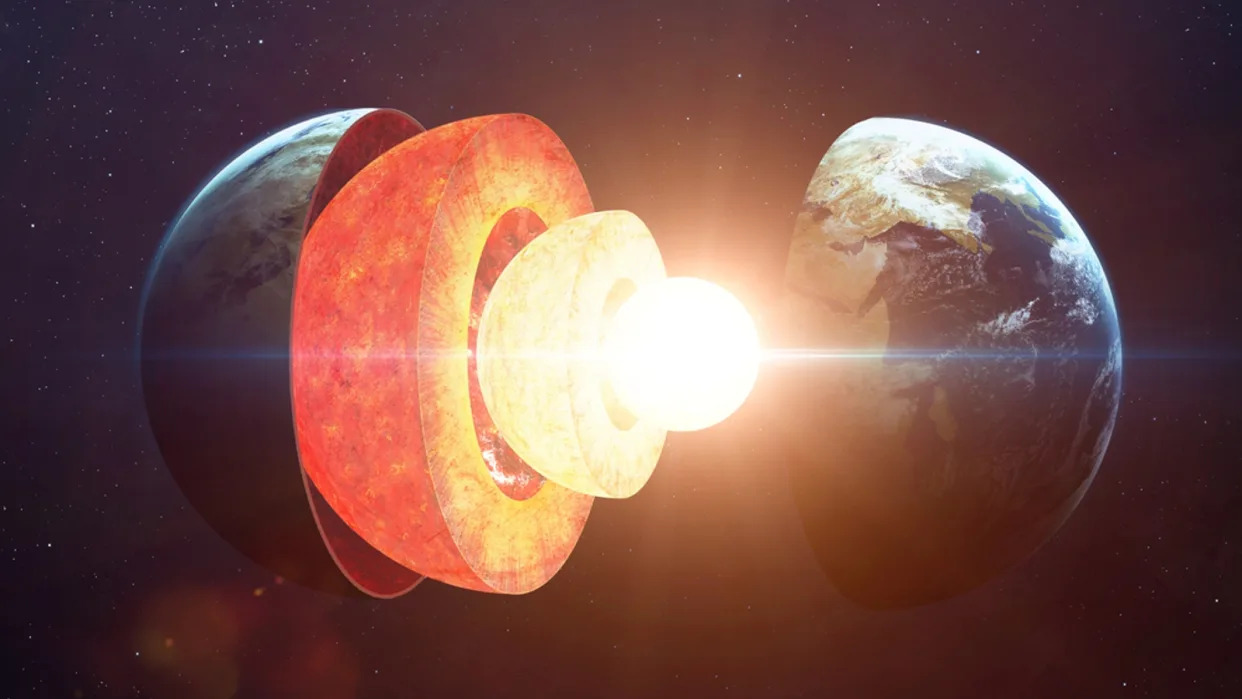
 The Earth's layers arranged like a Russian nesting doll in outer space.
Credit: Shutterstock

The heart of our planet has been spinning unusually slowly for the past 14 years, new research confirms. And if this mysterious trend continues, it could potentially lengthen Earth’s days — though the effects would likely be imperceptible to us.

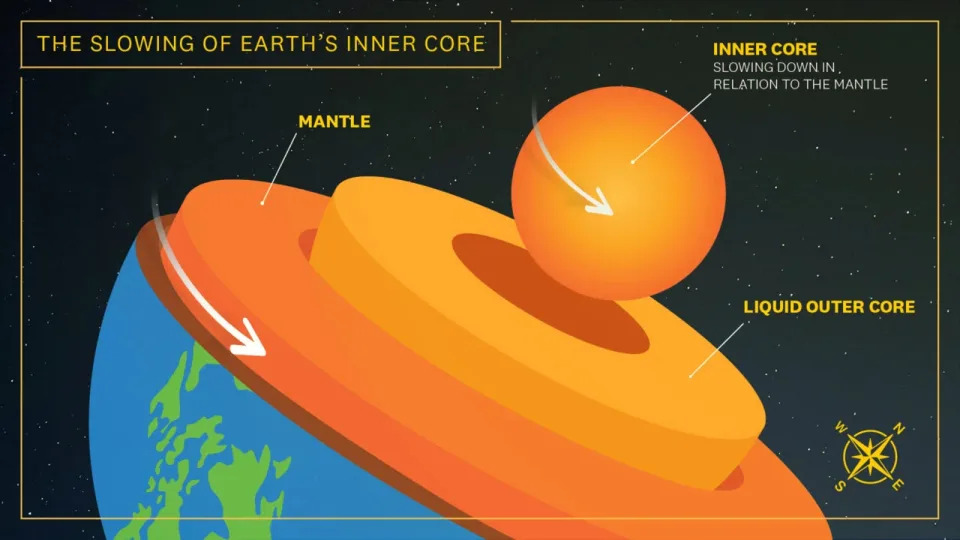
Earth’s inner core is a roughly moon-size chunk of solid iron and nickel that lies more than 3,000 miles (4,800 kilometers) below our feet. It is surrounded by the outer core — a superhot layer of molten metals similar to those in the inner core — which is surrounded by a more solid sea of molten rock, known as the mantle, and the crust. Although the entire planet rotates, the inner core can spin at a slightly different speed as the mantle and crust due to the viscosity of the outer core.

Since scientists started mapping Earth’s inner layers with detailed seismic activity records around 40 years ago, the inner core has rotated slightly faster than the mantle and the crust. But in a new study, published June 12 in the journal Nature, researchers found that since 2010, the inner core has been slowing down and is now rotating a bit more slowly than our planet’s outer layers.

“When I first saw the seismograms that hinted at this change, I was stumped,” John Vidale, a seismologist at the University of Southern California, Dornsife, said in a statement. “But when we found two dozen more observations signaling the same pattern, the result was inescapable.”

If the inner core’s rotation continues to decelerate, its gravitational pull could eventually cause the outer layers of our planet to spin a little more slowly, altering the length of our days the researchers wrote.

However, any potential change would be on the order of thousandths of a second, which would be “very hard to notice,” Vidale said. As a result, we would likely not have to change our clocks or calendars to adjust for this difference, especially if it were only a temporary change.

Related: ‘New hidden world’ discovered in Earth’s inner core

A diagram showing how the inner core can rotate compared to the mantle and crust

This is not the first time scientists have suggested that Earth’s inner core is slowing down. This phenomenon, known as “backtracking,” has been debated for around a decade but has been very hard to prove.

In the new study, researchers analyzed data from more than 100 repeating earthquakes — seismic events that occur repeatedly at the same location — along a tectonic plate boundary in the South Sandwich Islands in the South Atlantic Ocean between 1991 and 2023.

Each earthquake allowed scientists to map the core’s position relative to the mantle and by comparing these measurements, the team was able to see how the inner core’s rotation rate changed over time.

The new study is the “most convincing” evidence so far that backtracking has been happening, Vidale said.

It is currently unclear why the inner core is backtracking, but it is likely caused by either “the churning of the liquid iron outer core that surrounds it” or “gravitational tugs from the dense regions of the overlying rocky mantle,” the researchers wrote.

It is also unclear how frequent backtracking is. It is possible that the inner core’s spin is constantly accelerating and decelerating, but these changes likely happen over decades or longer. Therefore, longer data sets are needed to infer anything about long-term trends.

related stories

Mysterious new substance possibly discovered inside Earth’s core

Rare primordial gas may be leaking out of Earth’s core

Ancient ocean floor surrounds Earth’s core, seismic imaging reveals

The inner core remains one of the most mysterious of Earth’s hidden layers. But in recent years, new technologies are allowing researchers to learn more about the inner core, including that it is slightly lopsided, that it is softer than expected, that it potentially wobbles off Earth’s axis and that it has a separate innermost core.

The study authors will continue to analyze seismic data to learn more about the heart of our planet and how it changes over time.

“The dance of the inner core might be even more lively than we know,” Vidale said.

Extreme heat, wildfires and climate change are causing Canadians to feel heightened sense of eco anxiety: ‘How are we going to live?’

Yahoo! Style

Extreme heat, wildfires and climate change are causing Canadians to feel heightened sense of eco anxiety: ‘How are we going to live?’

Climate anxiety, ecological grief and solastalgia are terms used to describe the emotional distress caused by environmental changes.

Pia Araneta – June 19, 2024

This article is for informational purposes only and is not a substitute for professional medical advice, diagnosis or treatment. Contact a qualified medical professional before engaging in any physical activity, or making any changes to your diet, medication or lifestyle.

FORT NELSON, BRITISH COLUMBIA, CANADA - MAY 14: Smoke rises after fire erupts in Western Canada on May 14, 2024. Wildfires in Western Canada prompted thousands to flee their homes, while 66,000 were on standby to evacuate as a fast-moving blaze threatened another community Saturday. A growing wildfire moved relentlessly toward Fort Nelson, British Columbia (B.C.), resulting in officials ordering more than 3,000 to leave their homes in Fort Nelson and nearby Fort Nelson First Nation.Within five hours, the fire had grown to 8 square kilometers. (3 square miles) from a modest half square kilometer.Tinder dry conditions and flames fanned by powerful winds caused the wildfire to spread and prompted the evacuation order, which was issued at 7.30 p.m. (Photo by Cheyenne Berreault/Anadolu via Getty Images) climate fears
As wildfires continue to burn across the country, Canadians are sharing their climate fears. (Photo by Cheyenne Berreault/Anadolu via Getty Images)

Annie Malik, a 33-year-old living in London, Ont., often feels anxious or overwhelmed by the environmental state of the planet: Heatwaves in Pakistan — where she’s from — heat warnings and record-breaking temperatures in the summer coupled with mild winters in Canada and air pollution from wildfires that are becoming more common during the summer months.

“What is going to happen to the world? If the planet is inhabitable, how are we going to live?” said Malik.

Her family still resides in Pakistan, where air conditioning units are a luxury amid soaring temperatures and a spike in heat-related illnesses.

“There’s no way I can go back during the summers because I can’t handle the heat…People are dying every day in the summer,” said Malik, adding that she worries for her family.

Annie Malik, a 33-year-old living in London, Ont. said her biggest worry around climate change is her family in Pakistan. She can no longer visit during the hot summer months and she thinks about her family's survival. (Image provided by Annie Malik)
Annie Malik, a 33-year-old living in London, Ont. said her biggest worry around climate change is her family in Pakistan. She can no longer visit during the hot summer months and she thinks about her family’s survival. (Image provided by Annie Malik)

Malik’s sentiments are echoed by many Canadians who are feeling eco-anxious, or emotional from the effects of climate change, especially since last year’s record-breaking wildfires. According to a 2023 survey by Unite For Change, 75 per cent of Canadians are experiencing anxiety about climate change and its impacts.

If the planet is inhabitable, how are we going to live?Annie Malik

Yahoo Canada recently spoke to Canadians about their eco-anxiety, as well as a mental health expert on how to cope.


What is climate anxiety?

Climate anxietyecological grief and solastalgia are all similar terms to describe the emotional distress caused by environmental changes. The American Psychological Association defines it as “a chronic fear of environmental doom” and recognizes it as a legitimate increasing mental health concern.

Cree Lambeck, clinical director at Cherry Tree Counselling, offers eco-counselling services and said some clients can present with both physical and mental health symptoms from ecological issues. For example, someone might struggle with asthma and breathing issues from air pollution. “Other times a person can feel stress or really powerless around climate change,” said Lambeck.


What are the signs & symptoms of climate anxiety?

According to the Mental Health Commission of Canada, symptoms of eco-anxiety can include:

  • Feelings of depression, anxiety or panic
  • Grief and sadness over the loss of natural environments
  • Existential dread
  • Guilt related to your carbon footprint
  • Anger or frustration toward government officials
  • Obsessive thoughts about the climate

How to cope with climate anxiety

Heather Mak is a 42-year-old from Toronto who said she’s felt eco-anxious for well over a decade, which “can feel overwhelming.”

Mak transitioned out of a marketing career into the sustainability field, hoping she could take control of some of her anxieties. She’s currently in corporate sustainability, working with large businesses on environmental and social issues, and she runs a nonprofit called Diversity in Sustainability.

Heather Mak is a 42-year-old living in Toronto and she changed careers from marketing to sustainability. Mak said taking action in her work helps her cope with her eco-anxiety, but a side effect is that she can get burnt out from ongoing crises. (Image provided by Heather Mak)

“How I try to deal with it is by taking action,” she said. “But then again, when you start working in this field, it’s almost like you can never sleep — because the scope of the issue just keeps getting bigger.”

How I try to deal with it is by taking action. Heather Mak

Last year, Mak heard about the Climate Psychology Alliance and started seeing a climate-aware psychologist to help her process some of her feelings from eco-anxiety, as well as burnout from her work.

As recommended by her psychologist, Mak tries to immerse herself in nature as much as possible to keep herself grounded. “There’s also groups called climate cafes,” said Mak. “I think just chatting with others who are going through the same thing really helps.”

Other times, Mak will channel her energy into writing letters to elected officials.


Set boundaries and concrete strategies: Expert

At Cherry Tree Counselling, Lambeck offers clients “walk and talk ecotherapy.” The sessions can be in-person or over the phone and both the therapist and client will chat outdoors.

Lambeck said many people access eco-counselling services, from adolescents to seniors. “People can experience [climate anxiety] throughout their lifespan and it can present in different ways — like with parenting,” said Lambeck. Some research has found that young adults are even hesitant to have kids due to climate change. “There’s a lot of existential worry associated with global crises.”

It’s important to take breaks and set those boundaries and practice self-care and find social support in those times.Cree Lambeck, clinical director at Cherry Tree Counselling

Considering environmental issues can impact many prongs in someone’s life, like family planning or lifestyle choices, Lambeck said she tries to offer clients practical tools and concrete strategies that might help tackle some of the turmoil. For instance, she might help target some ways a person can reduce their carbon footprint, identify some of their core values, or try to find opportunities or sustainable initiatives the person might be able to participate in.

“For some people, this can help provide a sense of empowerment or control if they’re feeling helpless. Engaging in meaning-focused coping and finding purpose,” Lambeck said.

Another strategy is to focus on boundary setting or limit the exposure of distressing news. “What is the balance between staying informed or excess consumption?” Lambeck said. Images of burning forests, oil spills and floods are plentiful and distressing and can exacerbate our eco-anxiety. “So it’s important to take breaks and set those boundaries and practice self-care and find social support in those times,” she adds.

How extreme heat affects the body — and who’s most at risk

Yahoo! Life

How extreme heat affects the body — and who’s most at risk

Kate Murphy, Producer – June 18, 2024

Pittsburghers flock to the Water Steps at the Riverfront Park along the Allegheny River
People enjoying Riverfront Park in Pittsburgh. (Jeff Swensen/Getty Images)

Nearly 77 million Americans across the Midwest and Northeast are under heat alerts this week, with the National Weather Service warning of dangerously hot temperatures as high as the triple digits in many areas.

In Phoenix, temperatures are forecast to reach 113 degrees on Thursday — the first day of summer — followed by 115 degrees on Friday.

Extreme heat like this can be lethal, according to the Centers for Disease Control and Prevention. Heat-related deaths in the U.S. have been increasing over the past few years, with about 1,600 in 2021; 1,700 in 2022, and 2,300 in 2023, according to the Department of Health and Human Services.

As temperatures are expected to scorch parts of the U.S. this week, here’s some important info on what extreme heat can do to the body, who is most at risk and heat-related illnesses to watch out for:

What happens to your body in extreme heat

A normal human’s body temperature ranges from 97°F-99°F. The body’s temperature needs to be regulated in order for internal organs to function properly. When your brain senses a change in body temperature, either hot or cold, it tries to help your body readjust.

When the body’s temperature is too hot, one of the most common ways the body cools itself is through sweat, which then evaporates in dry heat, thus cooling the body.

The other way the body cools itself is by moving warmer blood away from the internal organs to capillaries at the surface of the skin. That’s why people look flushed when their body temperature is elevated.

Heat-related illnesses can set in when the air temperature is hotter than the skin’s temperature, around 90°F, because it’s more difficult for your body to cool itself. When there’s extreme heat combined with humidity, sweat doesn’t evaporate as easily. That means your body’s temperature rises even higher, according to the Mayo Clinic.

👶 Who is most vulnerable to extreme heat?

According to the National Institute of Health and the CDC, the following groups are most at risk in extreme heat:

  • Children: The way their bodies regulate internal body temperatures can make them overwhelmed more quickly.
  • Older adults: They’re more likely to have a chronic medical condition or to be taking medications that affects the body’s response to heat.
  • People with chronic medical conditions: They’re less likely to sense and respond to changes in temperature.
  • Pregnant people: Their bodies must work harder to cool down not only their body, but the developing baby’s as well.
  • People experiencing homelessness: Those unsheltered or experiencing housing insecurity are more exposed to extreme heat.
  • Athletes and outdoor workers: Those who exercise or do strenuous work outside in extreme heat are more likely to become dehydrated and develop a heat-related illness
  • Pets: They can develop heat-related illnesses too.

To find out information on cooling centers in your state, the National Center for Health Housing provides a list.

Heat-related illness symptoms to watch out for:

The Centers for Disease Control provides a guide for what to watch for and what to do to prevent heat-related illnesses like heat stroke, heat exhaustion, heat cramps, sunburn and heat rash.

Recycling Is Broken. Should I Even Bother?

Every little bit helps. But doing it wrong can actually make matters worse.

By Winston Choi – Schagrin – June 17, 2024

A colorful illustration of two hands holding a jumble of household items including a can, a magazine, a wine bottle and a shampoo bottle. The background is hot pink and the items are framed by a green “chasing arrows” recycling symbol.
Credit…Naomi Anderson – Subryan

Recycling can have big environmental benefits. For one thing, it keeps unwanted objects out of landfills or incinerators, where they can produce potent greenhouse gasses and potentially hazardous pollutants.

Even more important, recycling allows us to extract fewer resources. The amount of energy required to recycle aluminum, for example, is less than 5 percent of the energy needed to mine new ore from the ground. Similarly, the more paper we recycle, the fewer trees we cut down.

But recycling rates in the United States have remained stubbornly flat for years. And, in some cases, they’re dismal. Just 10 percent of plastics are actually recycled. Meanwhile, hundreds of thousands of tons of recyclable waste are exported, often to developing countries.

It’s no wonder a lot of readers have asked us whether individual efforts make any difference at all. To answer that question, it helps to understand how the system works and how people use it.

The way the system is set up, recycling is a business. And our recyclables — metals, paper, and plastics — are commodities.

When you throw something into the blue bin, whether it’s recyclable or not, it gets carted off to a sorting plant where it runs along a conveyor belt and gets grouped with similar items. Then, the recyclable stuff is bundled. The process is labor-intensive.

One of the biggest challenges is that companies don’t want their material contaminated with things they don’t recycle or can’t recycle. The more random stuff that goes into a sorting plant, the more work facilities need to do to weed it out. And that increases costs.

Once that’s done, if the plant can find a buyer at a price that makes sense, the bundles will be shipped off to a recycling plant. Sometimes a local one, and sometimes one as far away as Africa or Southeast Asia. If they can’t, everything goes into a landfill or gets incinerated.

Recycling metals makes a lot of sense from an economic perspective, for the reasons outlined above. It’s just a lot cheaper than scraping ore from the ground. And, metals like aluminum can be endlessly recycled.

It also makes environmental sense. Mining contaminates soil and waterways. Recycling aluminum cans requires just a small fraction of the energy and water that mining does.

And recycling paper helps keep forests intact. Paper packaging accounts for around 10 percent of global logging, according to the forest conservation group Canopy. We save water, energy and greenhouse gas emissions when we recycle compared with products made from new pulp.

With glass and plastics, however, things start to get complicated.

Although intact glass is endlessly recyclable (the process has been around since Roman times) it often gets crushed or damaged on its way to sorting facilities, lowering its quality and sometimes rendering it unusable.

And “plastics” is an umbrella term for a seemingly endless number of different compounds with different chemicals and additives that can determine every attribute from color to stiffness.

That’s a problem for recyclers. Different kinds of plastic can’t be melted down together, so they have to be painstakingly, and expensively, sorted by color and composition.

Also: Plastics, if recycled at all, are usually “downcycled” into garden furniture or plastic fiber for insulation, after which it’s no longer recyclable. Recycling plastics again and again isn’t usually possible.

The result is that manufacturers often opt for new plastic, made from the plentiful byproducts of oil and gas, because it’s cheaper and easier.

One way to improve recycling is to regulate what can be sold in the first place. Almost three dozen countries in Africa have banned single-use plastics. And 170 countries have pledged to “significantly reduce” the use of plastics by 2030.

Another way is with technology, said Cody Marshall, the chief system optimization officer at The Recycling Partnership, a national nonprofit organization. More sorting plants are adopting better optical scanners that can detect a greater variety of plastics. (That technology is improving, but it’s still imperfect.)

When you do buy things, consider whether you can recycle the packaging. When choosing drinks, metal containers are generally better than plastics. When you shop online, you can sometimes ask for less packaging, as with Amazon’s “frustration-free” option. And remember the first two Rs: reduce and reuse.

Although these are small things you can do, the reality is that recycling’s challenges are systemic.

So, is it worth the effort?

In theory, every item you recycle can keep resources in the ground, avoid greenhouse gases and help keep the environment healthy. And that’s all good.

“The value is in displacing virgin materials,” said Reid Lifset, a research scholar at Yale’s School of the Environment.

But here’s the critical part: Don’t wish-cycle.

Follow the instructions provided by your local hauler. If you throw in stuff they don’t want, the effort needed to weed it out makes it less likely that anything will get recycled at all.

What a foolish psycho’: Trump’s Father’s Day rant slammed by critics — Biden among them

What a foolish psycho’: Trump’s Father’s Day rant slammed by critics — Biden among them

Kathleen Culliton – June 16, 2024

'What a foolish psycho': Trump's Father's Day rant slammed by critics — Biden among them
Former President Donald Trump speaks during the Alabama Republican Party’s 2023 Summer meeting at the Renaissance Montgomery Hotel on Aug. 4, 2023, in Montgomery, Ala. Trump’s appearance in Alabama comes one day after he was arraigned on federal charges in 
 Washington, D.C.
 D.C.
 for his alleged efforts to overturn the 2020 election. Julie Bennett/Getty Images

It’s not an American holiday until former President Donald Trump issues his all-caps complaint and is immediately, and ruthlessly, mocked.

On Father’s Day, Trump decided to celebrate his status as family patriarch with a lengthy tirade against “radical left degenerates” the former president, recently convicted on criminal charges, accused of “trying to influence” the judicial system against him.

President Joe Biden’s campaign was quick to respond Sunday evening with a succinct synopsis.

“Convicted felon Trump posts a deranged, all caps ‘Father’s Day’ message attacking the judicial system and promising revenge and retribution against those who don’t support him,” his campaign tweet reads.

ALSO READ: ‘Harm Democrats’: Republican lawmakers practically giddy about Trump prison silver lining

Hours earlier, Trump — who has a history of marking holidays by posting angry rants against his foes — issued the following screed on Truth Social:

“HAPPY FATHER’S DAY TO ALL, INCLUDING THE RADICAL LEFT DEGENERATES THAT ARE RAPIDLY BRINGING THE UNITED STATES OF AMERICA INTO THIRD WORLD NATION STATUS WITH THEIR MANY ATTEMPTS AT TRYING TO INFLUENCE OUR SACRED COURT SYSTEM INTO BREAKING TO THEIR VERY SICK AND DANGEROUS WILL,” he wrote.

ALSO READ: Republican dodo birds have a death wish for us all

“WE NEED STRENGTH AND LOYALTY TO OUR COUNTRY, AND ITS WONDERFUL CONSTITUTION. EVERYTHING WILL BE ON FULL DISPLAY COME NOVEMBER 5TH, 2024 – THE MOST IMPORTANT DAY IN THE HISTORY OF OUR COUNTRY. MAKE AMERICA GREAT AGAIN!!!”

The Biden-Harris campaign was not the only voice raising a sly eyebrow at Trump’s comment, quickly flooded with dozens of messages of frustration, amusement and rage.

“He always has the worst holiday greetings of anyone I know,” wrote X user Franklin.

“Such a narcissistic, small man,” added Dawn Young-McDaniel.

“Yep, he is consistent in only one manner,” replied Trish Davis, “Telling us what a foolish psycho he aspires to be.”

The EPA Grossly Underestimated How Many Carcinogens are Polluting This Louisiana Region’s Air, Study Says

Futurism

The EPA Grossly Underestimated How Many Carcinogens are Polluting This Louisiana Region’s Air, Study Says

Maggie Harrison Dupré – June 15, 2024

A chemical plant-smattered stretch of Louisiana between New Orleans and Baton Rouge is already known as “Cancer Alley” due to disproportionately high levels of illnesses related to chemicals released by the area’s many manufacturing facilities. Now, according to a new study from researchers at Johns Hopkins University, the stretch of land — which, again, is already called Cancer Alley — is even worse off than scientists already thought.

The study, published this week in the journal Environmental Science & Technology, examined the rates of a toxic gas called ethylene oxide in the air covering the Louisiana region. Ethylene oxide is a known and potent carcinogen linked to lymphomas, breast cancer, and other health and life-threatening illnesses, and was banned in the European Union back in the early 1990s. But ethylene oxide is used to manufacture other chemicals, and though the Environmental Protection Agency (EPA) recognizes its toxicity, chemical plants in Louisiana’s Cancer Alley stretch continue to use the poisonous gas in their production processes — and as a result, leak ethylene oxide into the air.

And yet, though it’s long been known that the plants leak the poisonous gas, this new Johns Hopkins research finds that the EPA has been grossly underestimating exactly how much ethylene oxide is actually in Cancer Alley’s air. According to these new findings, the area’s average ethylene oxide level is double what previous EPA models suggested — and well beyond levels considered safe for area inhabitants.

“We expected to see ethylene oxide in this area,” said study senior author Peter DeCarlo, an associate professor at the university’s Department of Environmental Health and Engineering, in a statement. “But we didn’t expect the levels that we saw, and they certainly were much, much higher than EPA’s estimated levels.”

As explained in the study, any level of airborne ethylene oxide above 11 parts per trillion (PPT) is considered dangerous for long-term exposure (which, we should note, isn’t really that much, and speaks to how toxic the gas is.) Horrifyingly, the researchers found ethylene oxide levels above 11 PPT in three-quarters of the overall area they studied, with average levels for affected areas hovering around 31 PPT.

“We saw concentrations hitting 40 parts per billion,” said DeCarlo, “which is more a thousand times higher than the accepted risk for lifetime exposure.”

The findings are staggering. And as the researchers note, those who live and work in the area have never — until now — had access to this kind of detailed, accurate data about ethylene oxide figures. And it’s important to note that Cancer Alley’s Black residents are disproportionately likely to develop petrochemical industry-related illness, and that the EPA has openly accused Louisiana lawmakers of engaging in environmental racism.

“There is just no available data, no actual measurements of ethylene oxide in air, to inform [plant] workers and people who live nearby what their actual risk is based on their exposure to this chemical,” DeCarlo added.

As Grist reports, the EPA — which very much needs to update its modeling data — moved this year to install heavier regulations on ethylene oxide use and emissions. And though that’s certainly a necessary step, experts have continued to warn that the agency and other regulating bodies have been very slow to take it.

“The fossil fuel and petrochemical industry has created a ‘sacrifice zone’ in Louisiana,” Antonia Juhasz, a senior researcher on fossil fuels at Human Rights Watch, said earlier this year after the global nonprofit released a devastating report about the health consequences of Cancer Alley’s rampant chemical and fossil fuel pollution. “The failure of state and federal authorities to properly regulate the industry has dire consequences for residents of Cancer Alley.”

Indeed, mitigating future exposure through strict regulations is essential. But so, too, is supporting the people and communities currently living ethylene oxide’s harms.

“These monitors are good,” Rise St. James founder Sharon Lavigne, whose community action group opposes petrochemical expansion, told Grist of the Johns Hopkins report. “But in the meantime, people are dying.”