U.S. Officials Had a Secret Oil Deal With the Saudis. Or So They Thought.
Mark Mazzetti, Edward Wong and Adam Entous – October 26, 2022
President Joe Biden, center, is greeted by dignitaries as he arrives at King Abdulaziz International Airport in Jeddah, Saudi Arabia, on Friday, July, 15, 2022. (Doug Mills/The New York Times)
WASHINGTON — As President Joe Biden was planning a politically risky trip to Saudi Arabia this summer, his top aides thought they had struck a secret deal to boost oil production through the end of the year — an arrangement that could have helped justify breaking a campaign pledge to shun the kingdom and its crown prince.
It didn’t work out that way.
Biden went through with the trip. But earlier this month, Saudi Arabia and Russia steered a group of oil-producing countries in voting to slash oil production by 2 million barrels per day, the opposite of the outcome the administration thought it had secured as the Democratic Party struggles to deal with inflation and high gas prices heading into the November elections.
The move led angry Biden administration officials to reassess America’s relationship with the kingdom and produced a flurry of accusatory statements between the two governments — including a charge by the White House that Saudi Arabia was helping Russia in its war in Ukraine.
Lawmakers who had been told about the trip’s benefits in classified briefings and other conversations that included details of the oil deal — which has not been previously disclosed and was supposed to lead to a surge in production between September and December — have been left fuming that Crown Prince Mohammed bin Salman duped the administration.
This account is based on interviews with American officials and officials from Gulf Arab nations, as well as Middle East experts with knowledge of discussions between the two nations.
What happened over the last half-year is a story of handshake agreements, wishful thinking, missed signals and finger-pointing over broken promises. Far from rebuilding a relationship with a leader Biden had once pledged to treat as a “pariah” after the murder of journalist Jamal Khashoggi, the outcome has been another low point in America’s tumultuous ties with Saudi Arabia.
The episode is also a revealing example of how Saudi Arabia, under the leadership of its ambitious and often ruthless crown prince, appears eager to shed some of its longtime reliance on the United States, with Crown Prince Mohammed trying to position Saudi Arabia as a powerhouse of its own.
American officials said that, even days before the OPEC+ decision, they had received assurances from the crown prince there would be no production cuts — and when they learned of the Saudi reversal, they made a futile last-ditch push to change minds in the royal court.
The Saudi Energy Ministry said in a statement that “the kingdom rejects these allegations and stresses that such mischaracterizations made by anonymous sources are entirely false.”
The ministry added, “The decisions of OPEC Plus are reached by the consensus of all members and determined solely by market fundamentals, not politics.”
White House officials admit they were angered and surprised by what they said was a Saudi about-face, but insist their overall strategy to lower energy costs is working.
At the same time, U.S. officials are bracing for another potential price surge in December, if a European embargo on Russian oil goes into effect and the Saudis refuse to increase oil production to make up for the anticipated reduction in supply. The officials say that would be a sure sign that the Saudis were helping the Russians by undermining the American and European-led plan.
“While we clearly disagreed with the OPEC Plus decision in early October, we recognize the importance of continuing to work and communicate with Saudi Arabia and other producers to ensure a stable and fair global energy market,” said Amos Hochstein, Biden’s energy envoy.
Even some of the president’s staunchest supporters have called the episode an example of the administration sacrificing principles for political expediency — and having little to show for it.
“There’s now a level of embarrassment as the Saudis merrily go on their way,” said Rep. Gerald E. Connolly, D-Va., a member of the House Foreign Affairs Committee.
Biden administration officials began planning in the spring for the president to make a summit stop in Saudi Arabia while also visiting Israel over the summer. They knew such a trip would bring criticism.
But some of the president’s aides saw both short- and long-term benefits for the trip and had quietly tried to repair the relationship. They said it was important to work with the kingdom on the Yemen war and Iran, and to expand Israel’s acceptance in the region. More immediately, they believed, the trip could shore up a Saudi commitment to convince OPEC to increase oil production as Russia’s war in Ukraine had led to surging global fuel prices.
Leading proponents of the visit, including Hochstein and Brett McGurk, the top National Security Council official for Middle East policy, met during the spring with Crown Prince Mohammed and his advisers. American officials said that in May, they reached a private oil deal with the Saudis that had two parts.
First, the Saudis would accelerate an OPEC+ production increase of 400,000 barrels per day already planned for September, moving it to July and August. Then the Saudis would get the cartel to announce a further production increase of 200,000 barrels per day for each month from September to December of this year.
On June 2, OPEC+ announced they would move up the production increase scheduled for September — fulfilling the first part of the secret deal.
That same day, the White House announced Biden would soon make a trip to Saudi Arabia.
The price of oil was slowly dropping by the time Biden arrived in Jeddah, Saudi Arabia, on July 15 for his meeting with Crown Prince Mohammed and other Arab leaders. The image of the American president bumping fists with the Saudi crown prince he once vilified endures from the trip, but behind the scenes, White House officials believed they had at least shored up Saudi commitments on a number of fronts.
Saudis officials seemed eager to demonstrate to the Americans that they had delivered on their commitments — during the summit, they gave members of Biden’s delegation a chart showing oil prices had fallen to $101 per barrel, down from more than $120 per barrel after the war in Ukraine began.
The Americans came away from the summit with the belief that the agreement was on track and that Crown Prince Mohammed was satisfied. But in Riyadh, top Saudi officials were privately telling others that they had no plans for further meaningful oil production increases.
American officials say they believe that Crown Prince Mohammed was particularly influenced by a high-level Sept. 27 meeting in which Prince Abdulaziz, the energy minister, argued that cuts were needed to keep prices from plummeting. The U.S. officials said they learned Prince Abdulaziz asserted that the Saudi government would lack the resources to fund economic diversification projects at the heart of Prince Mohammed’s domestic agenda.
Some U.S. officials believe that the Russians influenced the Saudi about-face, pointing to Prince Abdulaziz’s strong working ties with top Russian officials close to Putin.
Saudi officials vehemently denied marching in lock step with Russia and said they have viewed themselves as a neutral mediator in Russia’s war with Ukraine. Some American officials said that an answer to whether Riyadh has truly cast its lot with Moscow will come on Dec. 4, when OPEC+ is scheduled to meet again.
Is Arizona’s Kari Lake the most ‘dangerous’ politician in America?
Andrew Romano, West Coast Correspondent – October 25, 2022
Kari Lake, the Arizona Republican candidate for governor and former Fox 10 Phoenix news anchor, seems to be everywhere lately.
Earlier this month, the Atlantic declared her “Trumpism’s leading lady,” then spent more than 3,500 words explaining why. The Washington Post elaborated a few days later. “[Lake] has emerged as a Republican phenom by amplifying Donald Trump’s lie that the 2020 election was stolen,” read the subhead of its even longer profile. Last week, Axios went several steps further and reported that top Democratic strategists now believe Lake has the “potential to soar to a vice presidential spot or a post-Trump presidential candidacy.”
Kari Lake, Republican candidate for Arizona governor, at the Conservative Political Action Conference in Dallas in August. (Brian Snyder/Reuters)
“If you get a candidate who has the performance skills of a major-market local TV anchor and the philosophy and thinking of Steve Bannon, that’s a potent and dangerous combination,” Barack Obama guru David Axelrod told the site. “Look at Italy.”
“I’m going to win the election and I will accept that result,” Lake said (twice).
It remains to be seen, of course, whether she can actually defeat her opponent, Democrat Katie Hobbs. Long considered the frontrunner, Hobbs, the Arizona secretary of state, made her own national headlines for holding the line against relentless right-wing efforts to overturn Trump’s 2020 loss there.
Part of the problem, local observers say, is that the subdued, soft-spoken Hobbs has proved to be a limp campaigner whose unwillingness to debate Lake has become almost as much of an issue as the issues themselves.
Arizona gubernatorial candidate Katie Hobbs, once the frontrunner, is currently trailing Lake. (Mario Tama/Getty Images)
“Hobbs is a mediocre Democratic politician, and she’s running a mediocre race,” Robert Robb, a longtime columnist for the Arizona Republic and a former GOP political consultant, told Yahoo News. “So it’s no surprise that Lake’s competitive. It’s still a Republican-leaning state in a Republican-leaning year.”
But others see Lake’s own telegenic talent as the bigger factor. The national media has made much of what one might call her style: the “familiar pixie cut”; the large silver cross she took to wearing “for protection” shortly before she announced her campaign; the “impossibly smooth” skin showcased in “ethereal” campaign videos. And then there’s the power of her voice — “deep but still feminine; firm, even severe, but smooth,” as the Atlantic put it. “Like black tea with a little honey.”
“She’s a local celebrity,” Arizona pollster and political consultant Paul Bentz told Yahoo News. “She’s great with an audience. She’s great on camera. She’s a more polished version of Trump. And because of all that, she’s put herself in a position where she’s tied this thing up.”
For all their primary-season success, MAGA candidates haven’t exactly been taking purple states like Arizona by storm. In Pennsylvania, for example, hard-right state Sen. Doug Mastriano is lagging well behind his Democratic opponent for governor. And although he’s risen some in recent surveys, the GOP’s 36-year-old nominee for U.S. Senate in Arizona, Blake Masters, is still polling behind Lake.
So what makes Lake different? At first, Arizona Democrats were publicly rooting for her to beat establishment rival Karrin Taylor Robson in the GOP primary; no less of an authority than former Gov. Janet Napolitano told the New York Times in August that Lake was a “one-trick pony” who would be easier to defeat in November.
“If this is an election about Trump and 2020 in Arizona, then Democrats will win,” Napolitano said. Leading Arizona Democrats even tried to tip the scales for Lake by touting Robson’s past donations to Democratic candidates.
Donald Trump with Lake at a rally in Mesa, Ariz., Oct. 9. (Brian Snyder/Reuters)
Now they may come to regret that decision. “We wanted these extreme candidates on the Republican side,” Roy Herrera, the Arizona state counsel for Joe Biden’s 2020 campaign, told the Times. “Now we got them and, you know, are we sure we wanted that?”
By any normal standard, Lake remains one of 2022’s most out-there figures. In the wake of the 2020 election, Arizona’s far-right Republican activists and legislators pushed hard to reverse Trump’s 10,457-vote loss — the narrowest margin of any state in the country. But not a single one of the 24 challenges filed in Maricopa, the state’s largest county, since Nov. 3, 2020, was upheld in court. Multiple audits (including a private count funded by Trump supporters) found zero evidence of fraud; in fact, the partisan GOP audit actually widened Biden’s margin of victory by 360 votes.
Lake at a campaign stop in Scottsdale, Ariz., on Oct. 7. (Mario Tama/Getty Images)
None of these positions is mainstream. Yet Lake may soon show that with the right combination of poise, polish and bravado, none of them has to be disqualifying either — not even in a swing state like Arizona.
“It’s all based on personality,” Bentz told Yahoo News. “I mean, she’s an incredible actress. It’s not clear how much of this stuff she believes. Maybe it’s all of it. But she is absolutely the party’s next ‘great communicator.’”
And that’s why Democrats like Axelrod are starting to think that Lake might be one of the most “dangerous” politicians in America.
The danger, according to democracy advocates, isn’t so much that Lake might beat Hobbs and implement the policies we expect from Republican governors. Rather, they worry that, given the chance, she will try to steal the 2024 presidential election for the GOP nominee.
If Lake and her Republican ticketmates and fellow 2020 election deniers Mark Finchem (secretary of state) and Abraham Hamadeh (attorney general) win as well, they and Arizona’s almost-certain-to-be-Republican-led Legislature could make all kinds of changes to help Trump win the state two years from now, regardless of the actual results.
For his part, Finchem — who argues that Marxists conspired to manipulate the 2020 election, that people cast ballots with “software that flips votes” and that Biden is “a fraudulent president” — has already said he would ban early voting and sharply restrict mail-in ballots. More worryingly, he’s thrown his weight behind efforts to empower the state Legislature to overturn election results.
In May, Finchem assured his supporters that if he had been secretary of state last time around, “we would have won. Plain and simple.” Last month, he implied to Time magazine that he would not certify the state’s electoral votes for Biden in 2024.
Mark Finchem, GOP candidate for Arizona secretary of state. (Matt York/AP)
“I’m extremely concerned about candidates who make false claims about the 2020 election — and who applaud the things that were done to not only discredit the results, but to undermine the results and change the outcome,” Robb, the former GOP strategist, said.
“[Lake and Finchem] are not forswearing doing that again in the future. That’s deeply worrying.”
But the stakes go beyond 2024. The hope among Democrats — not to mention many Trump-wary Republicans — was that only Trump, with his all-consuming celebrity and shameless showmanship, could really sell pure, uncut Trumpism to the masses, and that without him MAGA would wither.
Lake’s emergence, however, suggests a new way forward for Trumpism after Trump.
The youngest of nine — eight girls and one boy — Lake grew up “off a gravel road” in rural eastern Iowa. Her father was a public high school teacher; her mother was a nurse. “My family was very poor,” she has said. “You had to work if you wanted shampoo.”
Describing Lake as someone who “sought attention in the newsroom,” a former Fox colleague recently told the Washington Post that “everything starts with her being the ninth of nine kids.” But when a reporter from Phoenix magazine asked Lake how her childhood shaped her, she batted the question away.
“I’ve read that young kids in big families sometimes have to fight for recognition and attention,” the reporter asked.
“We had to fight for food, not recognition,” Lake shot back.
A sign depicting Lake as Rosie the Riveter, seen at a Tucson, Ariz., rally in October. (Rebecca Noble/Reuters)
Either way, the spotlight found her soon enough. A few months after graduating from the University of Iowa, she was on the air as a weekend weather anchor in her native state; by the time she was 25, she was doing the same job in Phoenix. Lake went on to spend 22 years as a Fox 10 anchor, mostly covering the evening news — and becoming a household name in the process.
“I am beloved by people, and I’m not saying that to be boastful,” she told the New York Times in August. “I was in their homes for the good times and the bad times.”
It was a successful career — she was one of the few local news anchors to land interviews with both Obama and Trump — but it ended last year in controversy.
Although Lake was reportedly a Republican before she donated to John Kerry in 2004 — then registered as an independent in 2006, a Democrat in 2008 and a Republican again in 2012 — she didn’t come off as conservative. In fact, Fox colleagues have described her as a head-over-heels Obama fan who dabbled in Buddhism, wore a red Kabbalah string around her wrist and befriended John McCain’s son Jimmy as well as popular Phoenix drag queen Barbra Seville. (Lake “was the queen of the gays!” a former co-worker told the Atlantic.)
A primary attack ad in July from the campaign of Arizona Republican gubernatorial candidate Karrin Taylor Robson attempts to portray Lake as a supporter of former President Barack Obama. (Justin Sullivan/Getty Images)
In 2016, Lake pitched mass amnesty as a “humane and fair” solution for the roughly 11 million immigrants living in America illegally. In 2017, she shared a meme on Facebook declaring Trump’s inauguration a “national day of mourning and protest.”
But something flipped after Trump took office. In 2018, Fox 10 hung a widescreen monitor in the newsroom to rank on-air talent by social media likes, retweets and replies; that same year, Lake took to her official Fox 10 Twitter account to dismiss a movement for teacher pay raises as “nothing more than a push to legalize pot.”
Although she later apologized, colleagues noticed a shift. “When she found something that garnered attention,” one told Phoenix magazine, “she gravitated toward that.”
In 2019, Lake joined the right-wing social media platform Parler. Viewers complained; lawyers got involved. “F*** them,” Lake said, on a hot mic, when her co-anchor warned that the station could get blowback from outlets like the local alt-weekly. She later described the next year or so — when she started retweeting debunked COVID-19 misinformation and clashing with producers over calling Biden the “president-elect” — as the period in which “I got canceled.”
“That’s when all of this started going downhill,” Fox 10’s former human resources director told the Washington Post. “Her thing became, ‘It’s freedom of speech, I have the right to say what I want to say.’”
In March 2021, Lake resigned. “Journalism has changed a lot since I first stepped into a newsroom, and I’ll be honest, I don’t like the direction it’s going,” she said in a video posted to Rumble. “I found myself reading news copy that I didn’t believe was fully truthful, or only told part of the story. … I’ve decided the time is right to do something else.”
She launched her campaign for governor three months later.
Lake has explained her transformation as typical: a lifelong Republican becoming disenchanted with the overseas adventurism of the George W. Bush era, then reverting back to her roots. She claims to be in good company, citing other famous party switchers such as Ronald Reagan, Donald Trump and Arizona GOP Chair Kelli Ward.
Lake at the Conservative Political Action Conference in Dallas, Aug. 5. (LM Otero/AP)
None of which, of course, has stopped rivals from questioning her sincerity. “I believe she’s an opportunist,” Robson, her primary opponent, told Fox News shortly before the August election. “She’s actually a fraud, a fake. She’s not who she says she is. She’s a fabulous actress.”
Old colleagues have advanced more nuanced theories. “The only thing I can come up with in watching this is that her conservative views, little by little, brought her power and recognition that she had never felt before,” Marlene Galán-Woods, another former Channel 10 anchor, told the Post. “It’s intoxicating. The Kool-Aid is the power and all these people fawning over you — you forget what the truth is anymore.”
Whatever Lake really believes, however, most observers seem to agree on one thing: She knows how to perform. The power of her MAGA magnetism — and the unusual skill set she brings to the table — have been on full display in the closing days of the campaign.
Two moments in particular stand out.
The first came Sunday, Oct. 9, at a Trump rally in Mesa, just east of Phoenix. Lake spoke in complete, composed sentences — without notes, or a teleprompter, or a single crutch phrase like “um.” But more important than how the former newscaster spoke is what she spoke about. Or rather, what she didn’t.
Lake at a rally in Mesa, Ariz., on Oct. 9. (Matt York/AP)
Instead of fanciful election denialism, she focused on mainstream, meat-and-potatoes fare: Her plan for more career and technical education opportunities; her plan to counter what she calls “Bidenflation” by barring local government from taxing groceries or rent payments; her push to secure the border so that fentanyl stops “kill[ing] our babies”; her desire to “replace the woke garbage with common sense” in public school education; her call for “tough love to get [unhoused] people into treatment.”
In her framing, “the new Republican Party” — the party, presumably, of Trump and Lake — isn’t the party of “very fine people on both sides” and Jan. 6. Rather, it’s “the most inclusive party in the history of politics.”
“I don’t care if you think you’re a Democrat. If you don’t like the way the Democrat Party is going, chances are you’re a Republican,” Lake said, throwing open her arms. “We don’t care what color your skin is. We don’t care what zip code you come from. We love all of you. And if you like common-sense solutions, then welcome.”
In July, the last time Trump stumped for her in Arizona, Lake had “railed about a stolen election five times during [her] 20-minute speech,” according to the Arizona Republic. Now her message was tailored for the broader electorate. One-third of Arizona voters are Latino; one-third are independents. To win in November, a Republican like Lake can’t afford to just rile up the base.
Lake supporters cheer their candidate in Mesa, Ariz. (Brian Snyder/Reuters)
“If the focus is on who’s a potential rising star within the MAGA universe, Lake is a contender,” said Robb. “She does unquestionably well with Trump crowds and with Trump. But she’s got a way to go in the next few weeks just to squeak out a victory that ought to be a walk in the park for a Republican candidate for governor.”
The second moment came exactly one week later, after a “Black Voices for Kari” event at Phoenix’s Bobby-Q barbecue restaurant. Lake might not have mentioned 2020, but the press did. “Over the weekend your name was trending everywhere,” a reporter said right out of the gate. “And most of [those mentions] were asking, ‘Is she an election denier?’”
Lake didn’t hesitate. “Let’s talk about election deniers,” she said as an aide handed her what was presumably a GOP research document. “Here’s 150 examples of Democrats denying election results.”
She mentioned Hillary Clinton saying that “Trump is an illegitimate president.” She mentioned 2018 Georgia gubernatorial candidate Stacey Abrams — who is running again in 2022 — “claiming she never lost.” She even invoked Al Gore, who won the popular vote in 2000 but lost the election to George W. Bush after conservative Supreme Court justices stopped the recount in Florida.
“Since 2000, people have questioned the legitimacy of our elections,” Lake said. “And all we are asking is, in the future, we don’t have to have that happen anymore.”
Trump has been a big booster of Lake’s candidacy. Here they are at a “Save America” rally in July. (Mario Tama/Getty Images)
Never mind that Lake’s argument here — that her denialism, and by extension Trump’s, is just politics as usual, and nothing to worry about — bears little resemblance to reality. Trump’s refusal to accept the results of the 2020 election, and the embrace of his conspiracy theories by Republicans nationwide, is without parallel in American history.
Regardless, Lake sounded like she believed every word of what she was saying. The next morning, she posted a video of the exchange on Twitter. It now has more than 2.1 million views.
Pediatric hospital beds are filling up as RSV spreads across the US. Here are the symptoms to look out for and who’s most at risk of getting seriously ill.
Catherine Schuster-Bruce – October 24, 2022
In severe cases, a patient with RSV may need to be given oxygen, a breathing tube, or be put on a ventilator to help them breathe.Marijan Murat/picture alliance
Difficulty breathing and dehydration could be signs that a child is sick with RSV.
Confirmed RSV cases in the US have increased in recent weeks.
RSV usually causes a mild illness, but can be serious, particularly in infants and older people.
Difficulty breathing and dehydration are among the signs of respiratory syncytial virus that parents should look out for, doctors say, as pediatric hospital beds fill up across the country amid an unusual outbreak of the illness.
RSV typically causes mild, flu-like symptoms that get better within weeks without treatment, according to the Centers for Disease Control and Prevention. However, it can be serious, especially for infants and older people, with the potential to cause pneumonia and inflammation of the small airways called bronchiolitis, which can lead to respiratory failure and death.
The CDC estimates that around 58,000 children younger than 5 years are hospitalized with the virus each year.
“RSV can be super dangerous for some young infants and younger kids, particularly those that are less than 2 years of age,” Dr. Priya Soni, an assistant professor of pediatric infectious diseases at Cedars Sinai Medical Center, told CNN.
CDC data shows that confirmed cases in the US have increased in recent weeks, and doctors across the country have reported high numbers of kids sick with RSV, as well as other illnesses.
Dr. Jesse Hackell, chair on the committee on practice and ambulatory medicine for the American Academy of Pediatrics, told The Washington Post that it was “very hard to find a bed in a children’s hospital — specifically an intensive care unit bed for a kid with bad pneumonia or bad RSV because they are so full.”
Dr. Juan Salazar, physician in chief of Connecticut Children’s Medical Center, told The Hill RSV cases are expected to rise in fall, but they started spiking in early September and have risen exponentially since, which he hadn’t seen before.
Hospitals in more than 24 states around the country, including Rhode Island, Washington, Colorado, Texas, Ohio, Louisiana, New Jersey, Massachusetts as well as the District of Columbia, told ABC News they are struggling with more pediatric cases than normal of infections other than COVID.
“We’re seeing RSV infections going rampant all throughout the country,” Mora, a volunteer medical spokesperson for the American Lung Association, told CNN.
Seek medical help if your child is having difficulty breathing or seems dehydrated
According to the CDC, early symptoms of RSV include: a runny nose, a cough, which may progress to wheezing, and decreased appetite.
Infants younger than 6 months may have one symptom like: irritability, decreased activity, decreased appetite, or pauses while breathing. RSV may not always cause a fever, according to the CDC.
Doctors told CNN that parents should seek medical attention if a child has any signs of labored breathing or dehydration including: breathing harder or faster, the belly moving up and down, nasal flaring, and diapers that are less wet than usual.
Infants who are premature, aged six months and younger, have birth lung or heart defects, or neuromuscular disorders that make it difficult to clear secretions are most at risk of getting sick, according to the CDC. Most kids younger than 2 years of age will catch it without getting seriously unwell.
Adults with compromised immune systems and older adults, particularly those with underlying heart or lung diseases, are also at higher risk of getting seriously ill from RSV.
RSV can spread when an infected person coughs or sneezes
A person can catch RSV when virus droplets from an infected person’s cough or sneeze gets into their eyes, nose, or mouth.
Dr. Elizabeth Mack, division chief of Pediatric Critical Care at the MUSC Children’s Health, said in a press release that babies often get RSV from someone in the household: “It’s common that the older sibling goes to day care, went to the store, went to a party, came home, had a runny nose and then the infant got really sick.”
Covering your nose and mouth when you sneeze can help prevent RSV from spreading
People can help to prevent RSV by: covering coughs and sneezes with a tissue or a sleeve, and regularly washing hands for at least 20 seconds.
Mack said that it was a “good idea” to wash your hands before interacting with a newborn, “regardless of whether you’re symptomatic or have been around anybody who’s sick.”
“If somebody’s sick, avoid close contact, avoid sharing utensils or food. Frequently touched surfaces should be cleaned if somebody in the household is sick,” she said.
Parents can treat RSV at home with pain killers
There is no specific treatment for RSV. For many, it is a mild illness that can be treated at home. Parents can give their kids non-aspirin pain killers, like ibuprofen, ensure they drink enough, and speak with a healthcare provider before using non-prescription cold remedies, according to the CDC.
Babies under the age of 6 months or older people may need hospital treatment if they become dehydrated or have trouble breathing.
In severe cases, a patient may need to be given oxygen, a breathing tube, or be put on a ventilator to help them breathe, which usually lasts a few days, the CDC website states.
There isn’t yet a widely available vaccine for RSV, but scientists are working on it.
“The unfortunate thing is that there is a vaccine against RSV, but it’s only available to babies with high-risk conditions. Vaccinations begin in October, but the surge hit early,” Mack said.
Listen to the audio of Bob Woodward’s interviews with Trump that made him think of the former president as an ‘unparalleled danger’ rather than simply incompetent
Hannah Getahun – October 23, 2022
Washington Post reporter Bob Woodward and former President Donald Trump.William B. Plowman/NBC NewsWire via Getty Images and Anna Moneymaker-Pool/Getty Images
Bob Woodward said he changed his mind about Trump after re-listening to his own interviews.
Woodward previously described the former president as the “wrong man” for the presidency.
But “Trump is an unparalleled danger,” Woodward wrote on Sunday in the Washington Post.
Ahead of the release of his never-before-heard audio interviews with former President Donald Trump, Watergate journalist Bob Woodward wrote that after listening to the unreleased tapes again, he concluded that Trump was an “unparalleled danger” rather than just the “wrong man” to be president.
“The Trump Tapes: Bob Woodward’s Twenty Interviews with President Trump,” set to be released Oct. 25, is an audiobook of previously unreleased conversations between the veteran journalist and the businessman-turned-politician.
In an op-ed for the Washington Post released Sunday, which includes previously unreleased snippets of “The Trump Tapes,” Woodward wrote that he had concluded his 2020 book on Trump by calling him “the wrong man for the job.”
Woodward now says his assessment of Trump did not accurately describe the former president.
“Two years later, I realize I didn’t go far enough. Trump is an unparalleled danger,” Woodward wrote.
He continued: “When you listen to him on the range of issues from foreign policy to the virus to racial injustice, it’s clear he did not know what to do. Trump was overwhelmed by the job. He was largely disconnected from the needs and leadership expectations of the public and his absolute self-focus became the presidency.”
Woodward explains in his piece for the Post that he decided to release the tapes to capture Trump’s personality in a way that the written word couldn’t. “Trump’s voice magnifies his presence,” Woodward said.
The tapes allow listeners to hear Trump repeatedly interrupting and at times mocking Woodward as they speak about the most pressing policy issues of his presidency, including his handling of the COVID-19 pandemic, which Woodward described as Trump’s “greatest failure.”
In clips of the Trump Tapes previously released by CNN, Trump can be heard talking about his admiration for strongmen leaders like Russian President Vladimir Putin and North Korean President Kim Jong Un. In another clip, Trump also bragged to Woodward that no other president was “tougher” than him when faced with impeachment.
A representative for Trump did not immediately respond to Insider’s request for comment.
‘We are going to be homeless’: How mobile homeowners are being forced out in metro Phoenix
Catherine Reagor, Juliette Rihl and Kunle Falayi, – October 22, 2022
Homeowners in mobile home parks across metro Phoenix are getting evicted.
Many own the mobile home but rent the small lot it sets on.
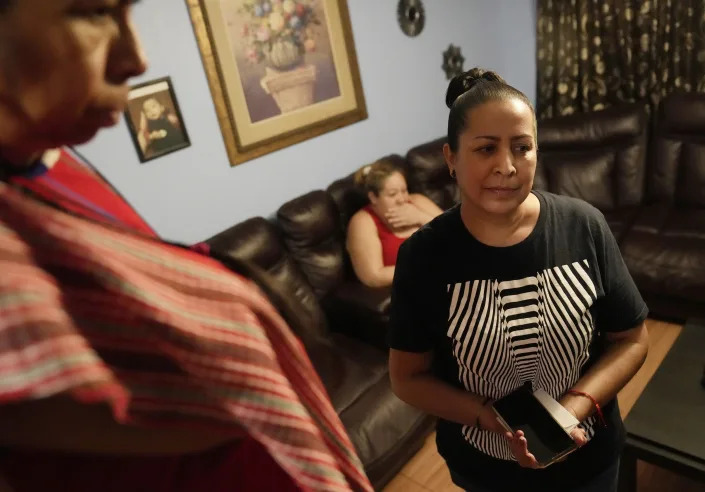
“This is more than just a notice to get out,” said Priscilla Salazar, whose family has lived 11 years in the Weldon Park mobile home community near 16th Street and Osborn Road. “We are going to be homeless.”
Like Valley apartments, some mobile home park owners are raising rents when leases expire and evicting tenants who can’t pay.
In other cases, owners are shutting the parks down so the land can be used for something else, including housing that mobile homeowners can’t afford. Some mobile home park buyers are clearing out tenants and flipping the infill sites for big profits.
Mobile homes have long been one of the most affordable housing options for metro Phoenix residents, but the growing number of parks closing or becoming pricier is putting many residents in a bind. New affordable parks aren’t being built, and many mobile homeowners can’t afford to live elsewhere or move their homes to other communities in the Valley, alarming housing advocates and prompting government officials to seek solutions.
In mid-September, tenants of Weldon Court received a notice that their park would be closing. It had been sold for $5.48 million to an investor from California just days before. Tenants were given six months to move out.
The Weldon Court mobile home park was recently sold, and mobile homeowners in the community were given six months to move out.
“This is our little mini Phoenix. This is our community,” said Salazar, whose children have grown up in the park. Many tenants are low-income families or seniors on fixed incomes.
Residents of Weldon Court and two other Valley mobile home parks that are evicting tenants or raising rents recently protested at the Arizona Capitol and Phoenix City Council chambers. The other two parks with residents fighting their landlords are Las Casitas — which is now called Beacon — at 19th Avenue and Buckeye Road, and Periwinkle, at 27th Avenue and Colter Street.
Mobile home park buying spree
Like with affordable Phoenix-area apartments, investors are snatching up mobile home parks in the Valley.
Since the beginning of 2021, at least 30 trailer, manufactured and mobile home parks have sold for almost $260 million, according to an Arizona Republic analysis of real estate records.
The Valley has been a hub for factory-built homes since after World War II. Many GIs returning home headed to the Southwest. Some hitched a travel trailer to their cars and put down roots and wheels in metro Phoenix.
Most of the metro Phoenix mobile home parks to sell during the past five years are prime infill sites.
The mobile home park buying and closure spree comes as Arizona is facing a shortage of 270,000 homes.
“It’s horrible for people who own their mobile home and have been living in a park for decades,” said Pamela Bridge, director of litigation and advocacy at Community Legal Services. “Investors are raising rents and our office is seeing so many more evictions in older parks.”
She said many longtime residents in Phoenix-area mobile home parks have paid off their homes and made improvements on them, but they can’t afford to move them and can’t find other parks where they can rent a space.
“These people have done nothing wrong,” she said. “We need to leave these mobile home park owners in stable situations.”
Jerry Suter, an 83-year-old veteran who has lived at the Periwinkle Mobile Home Park for 28 years, planned to live out the rest of his days there. He called the park’s closing “devastating” and “traumatic.” With an income of $1,290 in Social Security payments each month, he said he can’t afford to live anywhere else.
Grand Canyon University bought the park six years ago, decided to close it and plans to build student housing.
“They’re going to literally have to drag me out of there,” Suter said. “I’m not giving up my trailer.”
Phoenix has about 20,000 mobile homes, which represents about 3.1% of all of the area’s homes, according to the U.S. Census Bureau. That’s far more than the number of mobile homes that can be found in cities with similar populations, including Houston, San Diego and Philadelphia.
But the supply of mobile homes and parks is shrinking. About 5% of Phoenix homes were in mobile home parks in 2018.
The rapid disappearance of mobile home parks is due, in part, to transactions like this: In 2018, homebuilder Taylor Morrison bought the former Scottsdale Wheel Inn Ranch RV and Mobile Home Park, where residents were evicted by another owner a few years before. Similar scenarios with investors buying the parks, evicting the tenants and then selling to a developer are happening across metro Phoenix.
The Phoenix city manager’s office recently created a task force to research potential solutions to the mobile home dilemma. The task force will present its findings to the City Council next month.
District 8 Councilmember Carlos Garcia, whose district includes Las Casitas mobile home park, said he wants to find a way to keep people in their homes or, if the evictions move forward, find new places for the residents to live.
“To me, all options are on the table,” Garcia said. “Priority is to make sure these families don’t end up on the streets.”
Sylvia Herrera (left) and Raquel Hernandez meet during an emergency meeting at the Beacon mobile home park (formerly Las Casitas mobile home park) on Sept. 20, 2022, in Phoenix. The residents were asked to sign a four-month lease and are worried about being evicted by the new owner. Hernandez recently bought her mobile home in the park.
Residents of Beacon mobile home park were given a new lease in late September. Their rent will increase by 88% over the next four years, it said.
Elvia Ramirez, who lives in the park with her children, started looking for somewhere else to move. But the single mother of four, who works as a receptionist and has lived in the park since she was a teenager, hasn’t been able to find something within her budget.
“Even the mobile homes are too expensive now,” said Ramirez, 33. If she doesn’t secure a new home, she said, she and her kids will probably have to move in with family.
The median price of a U.S. mobile home is now $61,400, according to a LendingTree study. That’s up 35% since 2016.
Many mobile homes are several decades old, and some are even trailers, the oldest type of mobile house. Some of the parks in metro Phoenix sold since early last year are more than 70 years old.
Many parks won’t rent to owners of older mobile homes because their houses may not be up to code. Also, some with additions can’t be moved without damaging them.
The typical rent for a mobile home lot in the Phoenix area was about $400 to $500 a month in 2019, according to housing advocates. Now, rents are rising above $1,000 per lot in some Valley parks.
Help available to mobile homeowners
Arizona has a fund to help, but some mobile homeowners don’t hear about it, and others cannot fully benefit from it because of the age of their residences.
For some owners, the fund isn’t enough to help them move, so they take less than $2,000 in state funds to walk away from their mobile home.
Under Arizona law, mobile home park residents who are displaced because of redevelopment are eligible to receive up to $12,500 from the state’s relocation fund.
But many of the mobile homes are so old, they cannot be moved to another park, either because they would fall apart or because they don’t meet current wind-resistance codes.
Residents who have to leave their homes in place because they can’t be moved can get only $1,875 from the fund, which is managed by the Arizona Housing Department.
Many residents and housing advocates said more help is needed.
“Now I have to abandon my home and give it to the university,” Suter said. “What am I gonna buy for $1,875?”
Patricia Dominguez said her family recently spent $4,000 on a new roof for their home — more than double what they will be reimbursed if they abandon it.
“What they’re offering is nothing compared to the love, and the blood, and the sweat and tears that we’ve all put into our unit,” said Dominguez. Her mother and sister, Salazar, live in Weldon Court.
Community organizer Sylvia Herrera, who is working with residents of all three parks to get more time and money before eviction, said the state relocation fund is “deceiving” because many people can’t move their trailers and therefore can’t access the full relocation amount.
“These are not really resources if you can’t qualify,” she said.
Tara Brunetti, assistant deputy director of the Arizona Department of Housing’s Manufactured Housing Division, said park owners must notify the agency if they plan on closing a park and give tenants 180 days’ notice.
“That gives us time to reach out to the residents” and offer them help, she said. “We are definitely seeing more applications for the fund now.”
The fund has more than $7.6 million to help mobile home park residents.
Sylvia Herrera leads an emergency meeting of residents at the Beacon mobile home park (formerly Las Casitas mobile home park) on Sept. 20, 2022, in Phoenix. The residents were asked to sign a four-month lease and are worried about being evicted by the new owner.
The state program does offer more money than it did five years ago, but it took a legislative move to get the increase.
Mobile homeowners and their advocates are hoping for a different kind of fix.
Some cities, including Portland, Oregon, and Austin, Texas, have updated their zoning laws to help prevent mobile home residents from displacement.
A 2018 Austin city ordinance zoned existing mobile home parks as a “mobile home residence district.” That means if the landowner wanted to use the land for a different purpose, they would need City Council approval to change the zoning.
In 2018, when a new owner began evicting longtime residents from the Tempe Mobile Home Park near Arizona State University, the city of Tempe stepped in and helped get rent concessions from the landlord. Tempe also set up meetings for the tenants to negotiate with the new owner and get aid from the Arizona Housing Department.
That former mobile home park is now high-end apartments.
“I believe there should be laws or community work in cities and counties that come up with long-term solutions for people in the park. These people are a vital part of our community,” said Bridge, of Community Legal Services. “We want their children to remain in schools and for the parents to be able to get to their jobs nearby.”
Then, big Wall Street-backed investment firms were behind most of the sales. Now, big and small investors are driving the trend, but almost all are out-of-state buyers.
The biggest Phoenix-area mobile home park sale since the beginning of 2021 was $84.5 million for the Royal Palm park in Phoenix at 19th and Dunlap avenues. Property records show Chicago-based Continental Communities is the new manager.
Bridge said she has come across several cases of new out-of-state mobile home park owners not giving tenants or the state enough move-out notice.
Mobile home evictions are tracked differently than other rental evictions, and the data to tally the total isn’t available in Arizona.
“Because of the housing crisis, there is no affordable housing. Trailer parks are the most affordable housing right now that you can find,” Herrera said. “People are just trying to retain that, trying to hold on to living in mobile home parks.”
Coverage of housing insecurity on azcentral.com and in The Arizona Republic is supported by a grant from the Arizona Community Foundation.
How unhealthy is red meat? And how beneficial is it to eat vegetables? A new rating system could help you cut through the health guidelines
Aleksandr Aravkin, Associate Professor of Applied Mathematics, University of Washington, Jeffrey Stanaway, Assistant Professor of Global Health and Health Metrics Sciences, University of Washington, and Christian Razo, Postdoctoral Fellow at the Institute for Health Metrics and Evaluation, University of Washington – October 21, 2022
The new rating system shows that eating the right amount of vegetables can lower your risk of heart disease by nearly 20%. Westend61/Getty Images
The Research Brief is a short take about interesting academic work.
The big idea
We developed a new method for assessing health risks that our research suggests should make it a lot easier for people to determine which health advice to follow – and which to ignore. The approach, recently published in the journal Nature Medicine, offers a straightforward way for both policymakers and the general public to assess the strength of evidence for a given health risk – like consuming red meat – and the corresponding outcome – ischemic heart disease – using a rating system of one to five stars.
The system we developed is based on several systematic reviews of studies regarding risk factors like smoking and health outcomes such as lung cancer. Well-established relationships between risks and outcomes score between three and five stars, whereas cases in which research evidence is lacking or contradictory garner one to two stars.
In our analysis, only eight of the 180 pairs that we analyzed received the top rating of five stars, indicating very strong evidence of association. The relationship between smoking and lung cancer, as well as the relationship between high systolic blood pressure – the higher of the two numbers in a blood pressure reading – and ischemic heart disease were among those eight five-star pairs.
This rating system enables consumers to easily identify how harmful or protective a behavior may be and how strong the evidence is for each risk-outcome pair. For instance, a consumer seeing a low star rating can use that knowledge to decide whether to shift a health habit or choice.
While the visualization tool provides a nuanced understanding of risk across the range of blood pressures, the five-star rating signals that the overall evidence is very strong. As a result, this means that clear guidelines can be given on the importance of controlling blood pressure.
Why it matters
Clear messages and evidence-based guidance regarding healthy behaviors are crucial. Yet health guidance is often contradictory and difficult to understand.
Currently, most epidemiological analyses make strong assumptions about relationships between risks and health outcomes, and study results often disagree as to the strength of risk-outcome relationships. It can be confusing for experts and nonexperts alike to parse through conflicting studies of varying strength of results and determine if a lifestyle change is needed.
This is where our method comes in: The star-based rating system can offer decision-makers and consumers alike much-needed context before headline-grabbing health guidance is dispensed and adopted.
For example, the average risk of ischemic heart disease with a blood pressure of 165 mmHG – or millimeters of mercury, the basic unit used for measuring pressure – is 4.5 times the risk of the disease with blood pressure of 100 mmHG; but this is just a single estimate. The relative risk of ischemic heart disease increases by more than four times across the blood pressure range, and there is inherent uncertainty in the estimate based on available data. The rating of five stars incorporates all of this information, and in this case means that relative risk of ischemic heart disease across the entire range of exposures increases by at least 85%.
On the other hand, take the example of red meat consumption. Consuming 100 grams of red meat per day – as opposed to none – results in a very modest (12%) increase in risk for ischemic heart disease. That’s why it scores a rating of just two stars, consistent with only a weak association.
People should be well aware of their levels of exposure to risks classified with three to five stars, such as systolic blood pressure. By monitoring and keeping one’s blood pressure as low as possible, a person can substantially reduce the risk of developing ischemic heart disease.
What’s next
Our hope is that decision-makers will be able to use our star rating system to create informed policy recommendations that will have the greatest benefits for human health. We also hope the public can use the ratings and the visualization tool as a way to more clearly understand the current level of knowledge for different pairs of health risks and outcomes.
Jeffrey Stanaway receives funding from the Bill and Melinda Gates Foundation.
Aleksandr Aravkin and Christian Razo do not work for, consult, own shares in or receive funding from any company or organization that would benefit from this article, and have disclosed no relevant affiliations beyond their academic appointment.
Republicans plan to torpedo key Biden policies as polls predict midterm victory
Chris Stein in Washington DC – October 21, 2022
Photograph: Evelyn Hockstein/Reuters
A standoff over the debt ceiling. Aid to Ukraine on the chopping block. And impeachment proceedings against homeland security secretary Alejandro Mayorkas – or perhaps even president Joe Biden himself.
With polls indicating they have a good shot of winning a majority in the House of Representatives in the 8 November midterms, top Republican lawmakers have in recent weeks offered a preview what they might do with their resurgent power, and made clear they have their sights set on key aspects of the Biden administration’s policies at home and abroad.
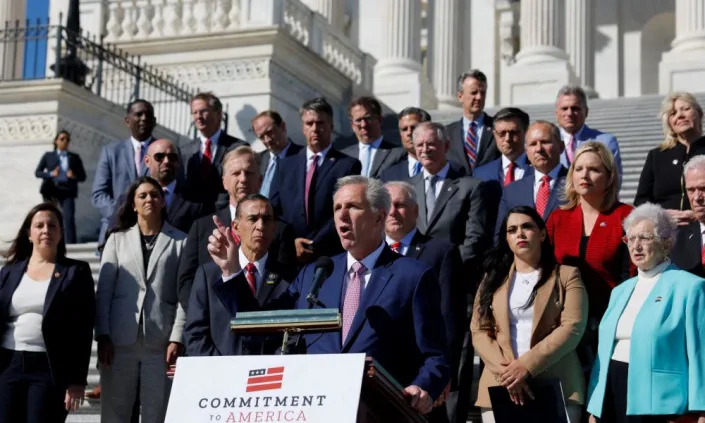
Kevin McCarthy, the top Republican in the chamber, this week signaled in an interview with Punchbowl News that if Congress is going to approve an increase in the amount the federal government can borrow – as it’s expected to need to by sometime next year – Republicans are going to want an agreement to cut spending in return.
“You can’t just continue down the path to keep spending and adding to the debt,” said McCarthy, who is likely to be elevated to speaker of the house in a Republican led-chamber. “And if people want to make a debt ceiling [for a longer period of time], just like anything else, there comes a point in time where, okay, we’ll provide you more money, but you got to change your current behavior.”
Asked if he might demand that Social Security and Medicare, the two massive federal retirement and healthcare benefit programs that are nearing insolvency, be reformed as part of debt ceiling negotiations, McCarthy replied that he would not “predetermine” anything.
But the California lawmaker warned that members of his caucus were starting to question the money Washington was sending to Ukraine to help it fend off Russia’s invasion. “Ukraine is important, but at the same time it can’t be the only thing they do and it can’t be a blank check,” he told Punchbowl.
Then there’s the question of if Republicans will choose to exercise the House’s powers of impeachment – as they did against Bill Clinton in 1998, and as Democrats did to Donald Trump in 2019 and 2021.
The prime target appears to be Mayorkas, whom Republicans have pilloried amid an uptick in arrivals of migrants at the United States’ border with Mexico. Yet another target could be Biden himself – as Jim Banks, chair of the conservative Republican Study Committee, which crafts policy for the party, suggested on Thursday.
Political realities may pose an obstacle to McCarthy and his allies’ ability to see their plans through. High inflation and Biden’s low approval ratings have given them momentum to retake the House, but their chances of winning a majority in the Senate are seen as a toss-up. Even if they did win that chamber, they’re unlikely to have the two-thirds majority necessary to convict Biden, Mayorkas, or whomever else they intend to impeach – or even the numbers to overcome Democratic filibusters of any legislation they try to pass.
Matt Grossman, director of Michigan State University’s Institute for Public Policy and Social Research, questioned the GOP’s willingness to legislate. The party’s plans, as outlined in the Commitment to America McCarthy unveiled last month, appear thin in comparison to similar platforms rolled out in 1994 and 2010, when Republicans again took back Congress’ lower chamber from Democratic majorities.
“There’s a longstanding asymmetry between the parties. Republicans legitimately want government to do less,” he said.
“They’re doing pretty well electorally without necessarily needing a policy agenda, and they’re tied to, kind of, defending the Trump administration or attacking the Biden administration. There’s not much of a felt need for a lot of policy.”
There are also signs of division within the party over how the GOP should use its new majority. In his interview with Punchbowl, McCarthy said he was against “impeachment for political purposes” and focused instead on addressing crime, border security and economic issues, all familiar themes for Republicans running this year.
The split was even more pronounced when it came to Ukraine. On Wednesday, Trump’s former vice-president Mike Pence called in a speech at influential conservative group the Heritage Foundation for Republicans to continue to support the country, saying “there can be no room in the conservative movement for apologists to” Russian president Vladimir Putin.
The day after, the foundation’s president Kevin Roberts put out a statement saying: “Heritage will vigorously oppose Washington’s big spenders who attempt to pass another Ukrainian aid package lacking debate, a clear strategy, targeted funding and spending offsets.”
Democrats are assured control of Congress until the end of the year, and have taken note of the apparent erosion of will to support Kyiv. NBC News reports they may push for another big military aid infusion in a year-end spending bill, intended to keep the Ukrainians armed for months to come.
It seems clear that Republicans will eventually coalesce behind a strategy to strong-arm the Biden administration for some purpose, but Grossman predicted the likely result would be similar to the 2013 government shutdown, when then president Barack Obama and the Democrats refused the GOP’s demands to dismantle his signature health care law.
“With McCarthy it just seems like he is a go along,” he said. “He’s going to be a go-along speaker and that’s going to be the case with a pretty fractious caucus.”
Photos show the Mississippi River is so low that it’s grounding barges, disrupting the supply chain, and revealing a 19th-century shipwreck
Morgan McFall-Johnsen, Paola Rosa-Aquino – October 21, 2022
Randy Statler sits on a rock to watch people walk to Tower Rock, an attraction normally surrounded by the Mississippi River and only accessible by boat, in Perry County, Missouri, on October 19, 2022.Jeff Roberson/AP Photo
The waters of the Mississippi River have fallen to historic lows, driving a shipping and industry crisis in the heart of the US.
The Mississippi is a major channel for shipping and tourism, running from northern Minnesota down through the Midwest plains and emptying through Louisiana, with numerous tributaries stretching east and west. All that boat-based commerce relies on the river’s deep waters, which can accommodate hefty vessels carrying cargo like soybeans, corn, fertilizer, and oil, or cruise-line passengers.
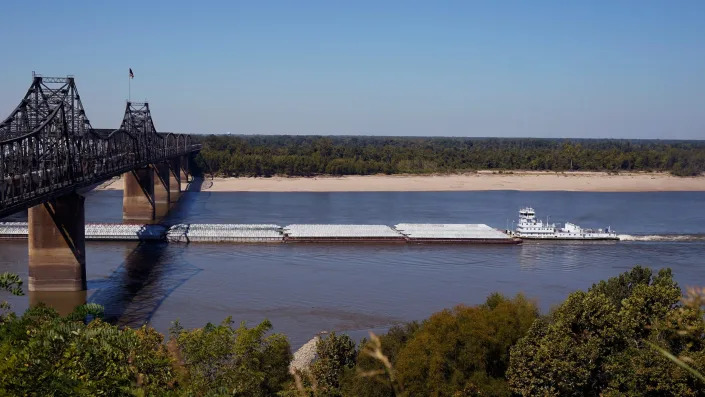
A barge tow floats past the exposed banks of the Mississippi River in Vicksburg, Mississippi, on October 11, 2022.Rogelio V. Solis/AP Photo
For the past month, though, the water has dwindled so low that ships are getting stuck in the mud and sandbars at the river bottom. The Coast Guard imposed new restrictions on how low ships and barges can sit in the water. The price of shipping goods along the river skyrocketed, The Wall Street Journal reported on Friday, and the US Army Corps of Engineers (USACE) began emergency dredging to deepen the river at more than a dozen key choke points, where a backup of about 2,000 barges built up.
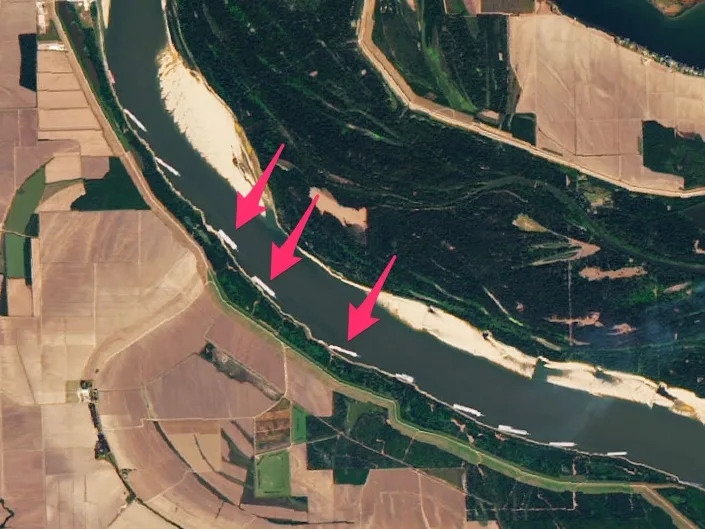
A NASA satellite image from October 7 shows the parched river, with barges queued up along its shorelines.
An image from a Landsat satellite shows the parched Mississippi River north of Vicksburg, Mississippi, on October 7, 2022.NASA Earth Observatory/USGS Landsat
“This is the most severe we’ve ever seen in our industry in recent history,” Mike Ellis, the CEO of American Commercial Barge Line, told CNBC on Wednesday.
A close look at the satellite image reveals barges waiting on the river’s shores.NASA Earth Observatory/USGS Landsat
“That’s a significant impact to our supply chain,” Ellis said, adding, “We can’t get the goods there.”
Even more barges were waiting in another part of the satellite image.NASA Earth Observatory/USGS Landsat
The water receded so much that it revealed human remains and a 200-year-old shipwreck along the river’s new banks. In Missouri, people are walking across the dry, exposed riverbed to an island that’s normally only accessible by boat.
A man walking along the Mississippi River in Baton Rouge, Louisiana, stops to look at a shipwreck revealed by the low water level on October 17, 2022.Sara Cline/AP Photo
On the Louisiana coast, the river is so low that ocean water from the Gulf of Mexico began pushing upstream. USACE is racing to build a 1,500-foot-wide underwater levee to prevent saltwater from creeping further up the river, where it could contaminate drinking water, CNN reported on Tuesday. Already, there’s a drinking water advisory in effect for the coastal region of Plaquemines Parish.
Drought is drying the Mississippi River to record lows
A passenger paddle wheeler passes between the river bridges in Vicksburg, Mississippi, on October 11, 2022.Rogelio V. Solis/AP Photo
Just a few months ago, the Mississippi River basin was flooding. This summer, historic rainfall caused flash flooding and overflowing rivers in Kentucky, St. Louis, Missouri, parts of Illinois, and Jackson, Mississippi.
Despite these extreme sporadic rainfall events, overall, the Midwest is in an abnormal drought. The Ohio River Valley and the Upper Mississippi aren’t getting enough rain to feed the giant river.
US Drought Monitor
Up and down the Mississippi, waters have dropped to levels approaching the record low set in 1988. In Memphis, Tennessee, the waters plunged below that record on Monday, according to data from the National Weather Service.
“There is no rain in sight, that is the bottom line,” Lisa Parker, spokeswoman for the USACE Mississippi Valley Division, told the Journal. “The rivers are just bottoming out.”
Boats rest in mud at Mud Island Marina as the water on the Mississippi River continues to recede in Memphis, Tennessee, on October 19, 2022.Scott Olson/Getty Images
Scientists must conduct rigorous analysis to attribute any single event to climate change. However, this year’s extreme conditions of both drought and floods is consistent with what scientists have been predicting and observing: Rising global temperatures are driving more weather variability in the central US, fueling both more severe droughts and one-off rainfall events.
That’s because climate change, driven by all the greenhouse gasses that humans have released into the atmosphere, is changing the planet’s water cycle. Rising temperatures are increasing water evaporation and changing the atmospheric and ocean currents that distribute moisture across the globe.
Droughts are unearthing relics and remains of the past
The remains of a ship lay on the banks of the Mississippi River after recently being revealed due to the low water level, in Baton Rouge, Louisiana, on October 17, 2022.Sara Cline/AP Photo
The severe drought along the river is so intense that it uncovered a centuries-old shipwreck. In early October, low water levels revealed the old sunken ship along the banks of the Mississippi River in Baton Rouge, Louisiana. Archaeologists believe these remains are from a ferry that sunk in the late 19th or early 20th century, The Associated Press reported.
Though this is the first time the ship has been fully exposed, it’s not a new discovery. Small parts of the vessel emerged from low waters in the 1990s.
“At that time the vessel was completely full of mud and there was mud all around it so only the very tip tops of the sides were visible,” Chip McGimsey, Louisiana’s state archaeologist, told the AP. “They had to move a lot of dirt just to get some narrow windows in to see bits and pieces,” McGimsey said.
A shipwreck is exposed along the banks of the Mississippi River due to low water levels, in Baton Rouge, Louisiana, on October 18, 2022.Stephen Smith/AP Photo
McGimsey thinks the ship could be the Brookhill Ferry, which carried people and possibly horse-drawn wagons across the Mississippi, until it sunk in a storm in 1915, according to news stories from the State Times archives.
The river’s receding waters also led to a more gruesome discovery. On Saturday, a Mississippi woman found human remains while searching for rocks with her family on the banks of the drought-stricken river. The remains included a lower jawbone, rib bones, and some unidentified bone pieces, Scotty Meredith, Coahoma County’s chief medical examiner, told CNN.
“Because these water levels are so low that we knew it was only a short matter of time before human remains were found,” Crystal Foster, the woman who found the remains, told WMC.
They are the latest in a bevy of discoveries to surface from receding waters. Over the summer, multiple set of remains were found in Nevada’s Lake Mead, which fell to historically low levels amid climate change-fueled drought.
But it’s not all bad news. Shrinking bodies of water could be a boon for experts tasked with solving missing persons cases, according to Jennifer Byrnes, a forensic anthropologist who consults with the Clark County coroner’s office, which reviews deaths in Lake Mead.
“A big body of water disappearing is going to help us, from a forensic perspective,” Byrnes told Insider.
Correction: October 21, 2022 —A photo caption in an earlier version of this story misstated the location of Vicksburg. The city is in Mississippi, not Louisiana.
Study: Cancer-causing gas leaking from CA stoves, pipes
Drew Costley – October 20, 2022
Gas stoves in California homes are leaking cancer-causing benzene, researchers found in a new study published on Thursday, though they say more research is needed to understand how many homes have leaks.
In the study, published in Environmental Science and Technology on Thursday, researchers also estimated that over 4 tons of benzene per year are being leaked into the atmosphere from outdoor pipes that deliver the gas to buildings around California — the equivalent to the benzene emissions from nearly 60,000 vehicles. And those emissions are unaccounted for by the state.
The researchers collected samples of gas from 159 homes in different regions of California and measured to see what types of gases were being emitted into homes when stoves were off. They found that all of the samples they tested had hazardous air pollutants, like benzene, toluene, ethylbenzene and xylene (BTEX), all of which can have adverse health effects in humans with chronic exposure or acute exposure in larger amounts.
Of most concern to the researchers was benzene, a known carcinogen that can lead to leukemia and other cancers and blood disorders, according to the National Cancer Institute.
The finding could have major implications for indoor and outdoor air quality in California, which has the second highest level of residential natural gas use in the United States.
“What our science shows is that people in California are exposed to potentially hazardous levels of benzene from the gas that is piped into their homes,” said Drew Michanowicz, a study co-author and senior scientist at PSE Healthy Energy, an energy research and policy institute. “We hope that policymakers will consider this data when they are making policy to ensure current and future policies are health-protective in light of this new research.” 0:01 0:38 Scroll back up to restore default view.
Homes in the Greater Los Angeles, the North San Fernando Valley, and the San Clarita Valley areas had the highest benzene in gas levels. Leaks from stoves in these regions could emit enough benzene to significantly exceed the limit determined to be safe by the California Office of Environmental Health Hazards Assessment.
This finding in particular didn’t surprise residents and health care workers in the region who spoke to The Associated Press about the study. That’s because many of them experienced the largest-known natural gas leak in the nation in Aliso Canyon in 2015.
Back then, 100,000 tons of methane and other gases, including benzene, leaked from a failed well operated by Southern California Gas Co. It took nearly four months to get the leak under control and resulted in headaches, nausea and nose bleeds.
Dr. Jeffrey Nordella was a physician at an urgent care in the region during this time and remembers being puzzled by the variety of symptoms patients were experiencing. “I didn’t have much to offer them,” except to help them try to detox from the exposures, he said.
That was an acute exposure of a large amount of benzene, which is different from chronic exposure to smaller amounts, but “remember what the World Health Organization said: there’s no safe level of benzene,” he said.
Kyoko Hibino was one of the residents exposed to toxic air pollution as a result of the Aliso Canyon gas leak. After the leak, she started having a persistent cough and nosebleeds and eventually was diagnosed with breast cancer, which has also been linked to benzene exposure. Her cats also started having nosebleeds and one recently passed away from leukemia.
“I’d say let’s take this study really seriously and understand how bad (benzene exposure) is,” she said.
Trump drops F-bombs and shares potentially sensitive information in newly released audio
Stephen Proctor – October 19, 2022
Previously unheard audio featuring former President Donald Trump aired Tuesday on Anderson Cooper 360. Famed journalist Bob Woodward recorded 20 conversations he had with the former president, with Trump’s knowledge, from 2016 through 2020. Trump, who is facing possible legal peril for taking classified documents when he left office, appears in one recording to share sensitive information with Woodward.
“I have built a weapons system that nobody’s ever had in this country before,” Trump said. “We have stuff that you haven’t even seen or heard about. We have stuff that Putin and Xi have never heard about before.”
Trump also spoke of Russia’s nuclear capabilities.
“Getting along with Russia is a good thing, not a bad thing, alright?” Trump said. “Especially because they have 1,332 nuclear f***ing warheads.”
Throughout his presidency, Trump was criticized for his apparent affinity for authoritarian leaders, which he spoke about to Woodward.
“It’s funny, the relationships I have, the tougher and meaner they are, the better I get along with them. You know? Explain that to me someday, OK,” Trump said. “But maybe it’s not a bad thing. The easy ones are the ones I maybe don’t like as much or don’t get along with as much.”
In another recording, Trump brags about how he handled being impeached, while at the same time taking shots at two of his predecessors who also faced impeachment.
“There’s nobody that’s tougher than me,” Trump said. “Nobody’s tougher than me. You asked me about impeachment. I’m under impeachment, and you said, you know, you just act like you won the f***ing race. Nixon was in a corner with his thumb in his mouth. Bill Clinton took it very, very hard. I just do things, OK?”
In 2016, Woodward asked then-candidate Trump about having his staff sign non-disclosure agreements. Woodward recorded Trump talking to his staff about who had and who had not yet signed one. Trump was confident in the effectiveness of these agreements at the time, but a multitude of former officials wrote tell-all books after leaving the administration.
Woodward plans to release the more than eight hours of recordings as an audiobook titled The Trump Tapes on Oct. 25.