Florida’s insurance crisis isn’t about ‘woke.’ It’s about state leaders in a stupor

The Miami Herald – Opinion

Florida’s insurance crisis isn’t about ‘woke.’ It’s about state leaders in a stupor | Opinion

The Miami Herald Editorial Board – July 24, 2023

Pedro Portal/pportal@miamiherald.com

Upon Farmers Insurance’s announcement that it was pulling out of Florida, Jimmy Patronis, the state’s chief financial officer went right to the heart of the state’s continuing insurance crisis: “The more we learn about Farmers Insurance, the more it’s clear its leadership doesn’t know what they’re doing. While they’re bad at helping people, they’re good at virtue signaling.”

As reported in the Herald, Patronis criticized what he called Farmers’ “ ‘sustainable insurance’ and aligning investments with its social values, like avoiding investing in polluters or companies that sexually or racially discriminate against employees.” The concept is called environmental, social and governance investing — ESG, for short — a political target for Republicans lately.

Basically, Patronis blames Farmers for doing business while incorporating a “woke” ideology, the go-to scapegoat these days, the convenient and facile argument in Gov. Ron DeSantis’ Florida.

We beg to differ.

Whether Farmers Insurance rightly values the principles of ESG is irrelevant here. What’s important is that 100,000 policies in Florida — auto, property — are going belly up.

The wrong excuse

It’s not that the company might be woke; it’s that state lawmakers and the governor were asleep at the wheel as other insurance companies fled Florida long before Farmers.

It’s that lawmakers have been in a stupor as Floridians cried out for relief from soaring property insurance rates.

It’s that those same elected leaders were single-minded zombies who protected insurance companies, not homeowners, during two special sessions.

And yet these are the same legislators who were filled with boundless energy when it came to carrying out Gov. DeSantis’ culture wars in his now-lackluster drive toward to the White House.

Now Patronis, not to be left out, is skirmishing with Farmers. When the Editorial Board asked his office what specifically the insurance company had done in the offending area of ESG, Deputy Chief Financial Officer Frank Collins III doubled down: “While Farmers Insurance is keeping their commitment to the United Nations, they’re dumping 100,000 Florida policyholders; too bad their affection for ESG standards couldn’t stop these Floridians from being dropped.”

Know what else is too bad? That this is Patronis’ politically lame attempt to distract Floridians from the fact that 13 companies have gone insolvent in Florida. Others have stopped writing policies in the state, sending property owners’ premiums soaring into the stratosphere and leaving Citizens as the insurer of last resort for so many property owners. Tim Cerio, Citizens president and CEO, has predicted that the number of policies to reach 1.5 million by the end of the year.

Launch a probe?

And while he was denigrating Farmers, Patronis added he planned to look into complaints against the company, which could trigger a market investigation and — perhaps — fines and fees. This, of course, sounds like a retaliatory move in the same vein as our thin-skinned governor’s costly fight against Disney.

If there truly is something for Patronis to investigate, why did he wait until now to actually do his job? As CFO, the state’s so-called “business manager,” he oversees insurance and consumer services, responding to Floridians on finance-related queries, especially complaints about insurance fraud and related matters.

Interestingly, he found the time this month to tout the launch a new online site: “This morning, we deployed the Florida IRS Transparency Portal where Floridians can submit complaints about individual IRS agents,” Patronis announced on July 13. “We will take this information to look for patterns on how the IRS is targeting Floridians, which will help us craft laws to protect our businesses. We also want to provide the public with a tool where they can report harassment by the IRS.”

His curious use of the militaristic word “deploy” aside, we, too, don’t believe individuals and entities should be targeted by the IRS, especially for their political beliefs, and hope that Floridians across the political spectrum will have equal access to his concern.

But while Patronis is protecting Floridians from the tax collector, he’s among the many state leaders who have left us exposed and vulnerable to the state’s insurance crisis.

“Woke” isn’t the problem; willful neglect is.

Should You Try Scalp Oils To Regrow Thinning Hair? We Asked A Dermatologist

She Finds

Should You Try Scalp Oils To Regrow Thinning Hair? We Asked A Dermatologist

Marissa Matozzo – July 24, 2023

Taking care of your scalp is essential, experts say, if your goal is to prevent or stop hair loss or thinning. Along with revamping your diet, an additional way to nurture your scalp and increase hair growth is to incorporate scalp oils into your routine to provide hydration and a vibrant appearance.

In an effort to gain more insight on scalp oils and their benefits for individuals with thin, fine hair, we sought out the expertise of a board-certified dermatologist and hair specialist, Dr. Yoram Harth, Medical Director of MDhair. Below, he shares his suggestions and advice for those wanting to give scalp oils a try.

The Benefits Of Scalp Oils For Fine, Thin Hair: Growth, Hydration And More

For those just beginning to explore the world of scalp oils, it can be overwhelming to sort through the numerous options. Harth simplifies the selection process by indicating there are two main varieties of hair oils. “One type, which is applied to the scalp skin and intended to help with scalp health and hair regrowth, is called a scalp treatment serum,” he explains.

Harth notes that the “other type of hair oil is applied to the hair strands and is intended to help strengthen the strands and reduce breakage and split ends.” Scalp oils, “particularly those designed as scalp treatment serums,” he says, can be “beneficial for thin, fine hair.”

These oils are “formulated to promote scalp health, nourish the hair follicles, and stimulate blood circulation” in the scalp, he adds. If your goal is to regrow your hair or just make your tresses stronger, he says that a healthy scalp environment can “lead to improved hair growth and a reduction in hair loss.”

The “best scalp oils and scalp treatment serums would include DHT blockers,” he continues, that help “reduce the effects of DHT on the hair follicles.”

One benefit of scalp oils, Harth reiterates, is a nourished scalp. “Scalp oils deliver essential vitamins, minerals, and amino acids to the scalp, which can promote a healthy environment for hair growth,” he adds.

He says that they also “moisturize” the scalp, helping to “alleviate dryness and reduce flakiness on the scalp, which can contribute to hair breakage.”

When used regularly, these oils also “block the effects of DHT on hair follicles.” Harth notes that “this is especially important in people with androgenetic, age-related, and perimenopause hair loss.”

Another benefit is “enhanced blood circulation.” Pairing scalp massages with oils can “stimulate blood flow, improving nutrient delivery to hair follicles,” he points out.

Lastly, a vital benefit of scalp oiling is gaining “protection from damage,” Harth concludes, as “certain scalp oils have protective properties that shield the hair and scalp from environmental stressors.”

When it comes to scalp oil recommendations, for beginners, Harth recommends “using a combination of plant-based scalp treatment serums like MDhair regrowth serum and another type of oil to apply often to the hair strands, like MDhair’s peptide hair repair oil.” (Good to know!)

Hundreds of thousands of people fled Russia after it invaded Ukraine — and now the countries that took them in are seeing a boost in their economies

Insider

Hundreds of thousands of people fled Russia after it invaded Ukraine — and now the countries that took them in are seeing a boost in their economies

Huileng Tan – July 24, 2023

Russians are seen attempting to leave their country to avoid a military call-up for the Russia-Ukraine war as queues have formed at the Kazbegi border crossing in the Kazbegi municipality of Stepantsminda, Georgia on September 28, 2022. The number of Russian citizens entering Georgia has increased by approximately 45 percent after Vladimir Putin's partial mobilisation order.
Russians were seen attempting to leave their country for Georgia to avoid a military call-up on September 28.Davit Kachkachishvili/Anadolu Agency/Getty Images
  • Scores of Russians fled their homeland following the outbreak of the Ukraine war.
  • Many resettled in neighboring countries such as Armenia, Georgia, and Kyrgyzstan.
  • The growth of such countries surged in 2022 after the arrival of these Russians, a new report found.

Hundreds of thousands of Russians who fled their homeland following the country’s invasion of Ukraine have resettled in neighboring countries — and are boosting their economies.

The exodus of Russians started after many highly educated professionals — such as academics, finance, and tech workers — left Russia in the early days of the war, Insider’s Jason Lalljee reported in March 2022. About six months later, there was another wave of departures after Russian President Vladimir Putin ordered a partial military mobilization for the Ukraine war on September 21.

By October, about 700,000 Russians had left the country, Reuters reported, citing Russian media — but the Kremlin rejected those numbers, saying it didn’t have this data.

Many of these Russians landed in neighboring countries, setting up new lives and businesses, and ended up boosting the economies of these nations, the independent Russian media outlet Novaya Gazeta reported Friday.

The GDP of the South Caucasus — a region comprising Armenia, Azerbaijan, and Georgia — grew by an outsize 7% in 2022, the World Bank found. This far outpaced the 5.6% growth that World Bank economists had predicted.

Armenia — once known as the Silicon Valley of the Soviet Union — saw its 2022 growth spike to 12.6%, the World Bank found. The institution’s economists had forecast last year 7% growth for the country.

Suren Parsyan, a lecturer at the Armenian State University of Economics, told Novaya Gazeta that Armenia’s growth last year was thanks to the newly arrived Russians, particularly those working in IT.

Russians transferred about $1.75 billion to Armenia in 2022, Martin Galstyan, the country’s central-bank governor, said in January, Armenia’s News.am reported.

Meanwhile, Georgia’s GDP jumped by 10.1% in 2022, the World Bank said, beating an 8.8% growth forecast. Money transfers from Russia rose fivefold, from $411 million in 2021 to $2.1 billion in 2022, according to data from Georgia’s central bank.

Even Kyrgyzstan’s economy grew by 7% in 2022, outpacing a 4% forecast, the World Bank said.

Turkey, a hot spot for Russians fleeing the war, saw its economy grow 5.6% in 2022, outpacing a forecast of 4.7%, according to World Bank data.

Oleg Itskhoki, an economics professor at the University of California, Los Angeles, told Novaya Gazeta that the GDP performance in such countries demonstrated that the newly arrived Russians had savings and were wealthier than the local residents.

To be sure, immigration hasn’t had only a positive influence on the economies. The influx of Russians also contributed to a rise in inflation, such as a jump in hotel rates and rents in Kazakhstan and Georgia, Bloomberg reported in September.

No stupid history, no crime scene kitties

Chicago Suntimes

No stupid history, no crime scene kitties

Resisting the urge to find small positives in the generally horrible.

By Neil Steinberg –  July 23, 2023

A cat sits on the sidewalk and watches as Chicago Police investigate inside an apartment in the 7700 block of South Carpenter Street after an officer shot and killed a man while answering a call of a domestic disturbance in the Gresham building on the South Side, Monday, Oct. 4, 2021.
A cat watches as Chicago police investigate inside an apartment in the 7700 block of South Carpenter Street after an officer shot and killed a man while answering a call of a domestic disturbance in the Gresham building on the South Side, Monday, Oct. 4, 2021.

What is it about stupid people anyway?

You can believe the most god-awful nonsense — factually incorrect, self-flattering, steaming kettles of BS — and parade that stupidity around to the delight of your fellow idiots, cheering and high-fiving one another at big rallies, celebrations of toxic dumbness.

Yet let somebody point it out, let them cough into their fist and mutter, “You’re stupid,” and suddenly the stupid fall to the ground, clutching themselves, declaring their injury to heaven.

It’s so … for want of a better word … stupid. How can some people get upset if you call themstupid when they’re perfectly happy being stupid? It’s a mystery.

Say your house were on fire — a situation even more dire than being stupid. And I say, “Your house is on fire,” causing you to collapse in a heap and declare yourself insulted, insisting that your house — obviously ablaze before us, thick black smoke pulsing out of the windows — is fine and how dare I suggest otherwise? Rude!

Who does that? Stupid people, I suppose.

I haven’t written much about Florida Gov. Ron DeSantis, honestly, because I still suspect he’s some kind of a sham — a performance art piece perhaps — designed to make Donald Trump look good, between his daft war on Disney and his imbecilic assault on history.

Maybe you haven’t heard. In its constant quest to make white people feel better, the state of Florida’s No. 1 priority, apparently, is downplaying race when teaching American history.

Florida’s new curriculum, unsatisfied with presenting racism as a dusty relic of the 19th century, is taking the next step and redefining America’s original sin, slavery, as something akin to high school shop class.

“Slaves developed skills, which, in some instances, could be applied for their personal benefit,” the curriculum notes.

Now, it is one thing to suggest that historic wrongs can have positive consequences. Polish anti-Semitism a hundred years ago was bad, but it drove my grandfather to Cleveland before the real butchery began. Which was good. For him.

But to focus on that scrap of positivity while denying the bulk of the horror is just … stupid. It’s like celebrating that Anne Frank got a best-selling book out of hiding from the Nazis while ignoring that she died in Bergen-Belsen.

Yet there was DeSantis on Friday, doubling down — the go-to move for the stupid since they can’t reevaluate — and supporting the new curriculum.

“They’re probably going to show that some of the folks that eventually parlayed, you know, being a blacksmith into doing things later in life,” DeSantis said.

And they give out free pudding in the Burn Center at Loyola. But were I to tuck a line in a burn story — “Burn patients enjoy free pudding, to their personal benefit, since pudding is delicious” — my editor would ask me to rethink that.

Then again, I’m a professional communicator and snug among — I hope — the non-stupid. We consider our audience.

Let me end with a true story. A photographer mentioned what she calls “crime scene kitties.” Her job takes her to crime scenes, where cats often appear. We got into a discussion of why the kitties are there — drawn by commotion? The cats I know would flee instead. Maybe cats are everywhere but, when standing around crime scenes for hours, she notices them.

“That could be a story!” I said.

Then I did a trick the stupid seldom attempt: I thought about it. I don’t write a lot of crime stories. To swoop into a tragic problem plaguing Chicago — people being murdered — and focus on the cats that wander over, there’s something grotesque about that. Something trivial. Something insulting, to victims and families. I did that empathy thing liberals are so good at, considering people other than myself, and reluctantly concluded: no crime scene kitties story.

That’s why Ron DeSantis should never be president. Because his campaign strategy — appeal to people threatened by anyone not exactly like themselves, people who can’t recognize the racism both in America’s past and in their own hearts right this flippin’ second — is stupid, if effective. We don’t want that guy. As if to underscore the difference, on Saturday the White House announced the creation of national monuments to Emmett Till. Till’s story is jarring and terrible — that photo of him in the casket. And essential and true and American. How could you ponder a history that didn’t include it?

Stupid.

Trump’s GOP rivals open door to cutting Social Security for younger people

The Washington Post

Trump’s GOP rivals open door to cutting Social Security for younger people

Jeff Stein, The Washington Post – July 22, 2023

Vice President Mike Pence, right, and Florida Gov. Ron DeSantis take questions during a Florida Coronavirus Response Meeting, at the West Palm Beach International Airport, Friday, Feb. 28, 2020, in West Palm Beach, Fla. (AP Photo/Terry Renna) (ASSOCIATED PRESS)

Three of Donald Trump’s rivals for the 2024 GOP presidential nomination are pushing for cuts to Social Security benefits that would only affect younger Americans, as the party’s leaders grapple with the explosive politics of the retirement program.

In comments on Sunday as well as in interviews earlier this year, Florida Gov. Ron DeSantis (R) said Social Security will need to be revamped – but not for people who are near or in retirement.

Former vice president Mike Pence and former South Carolina governor Nikki Haley have taken similar positions since launching their presidential campaigns. From the earliest days of his 2016 run, Trump has vowed not to touch either Social Security or Medicare – a break from GOP orthodoxy that has shifted the party’s views – and has more recently hammered DeSantis for wanting to cut the program.

“When people say that we’re going to somehow cut seniors, that is totally not true,” DeSantis said on Fox News. “Talking about making changes for people in their 30s and their 40s so the program’s viable – that’s a much different thing, and something I think there’s going to need to be discussion on.”

On Monday, Pence told Fox Business: “I’m glad to see another candidate in this primary has been willing to step up and talk about that.”

The positions the three Trump rivals are taking suggest that even the fiscally conservative candidates in the GOP presidential primary are reluctant to endorse cutting Social Security for seniors, highlighting just how much the party has shifted on the issue. Former House speaker Paul D. Ryan (R-Wis.), the party’s 2012 vice-presidential candidate, had led the party in championing budget blueprints that would have entailed significant cuts to both Social Security and Medicare.

As the Republican Party becomes increasingly reliant on older voters for support and as Trump continues to exert heavy influence over the party’s beliefs, GOP policymakers have followed the former president’s lead in steering clear of proposals to cut the program, with House Speaker Kevin McCarthy (R-Calif.) ruling that out in debt ceiling negotiations earlier this year with the White House.

But concentrating potential cuts on the young, as the Trump challengers have proposed, has its downsides as well. The candidates’ posture risks alienating young voters who have already become increasingly alienated from the Republican Party. And cutting benefits for younger people leaves the bulk of the problem unresolved, experts say, given that the Social Security funding crisis is projected to arrive decades before millennials receive their first checks.

“It clearly would not address the shortfall, or the short- to medium-term problem we’re going to have in 10 years or less,” said Howard Gleckman, senior fellow at the Urban-Brookings Tax Policy Center, a nonpartisan think tank.

Economists of both parties agree that Social Security and Medicare, the health insurance program for the elderly, face funding crises if Congress does not act to shore up their finances somehow, either by reducing benefits or raising taxes. If no reforms are enacted, Social Security benefits for an estimated 60 million people will be cut by 20 percent starting in 2033, according to the most recent report of the Boards of Trustees of the Social Security and Medicare trust funds. Medicare also faces automatic benefit cuts as soon as 2031, the report says.

President Biden has proposed increasing taxes on the rich and businesses to prevent Medicare from running out of funds. But the latest White House budget does not propose a solution for extending Social Security. Numerous congressional Democrats have called for trillions in new taxes to avoid the Social Security shortfall, as well.

Policy experts have long said it will probably take a mixture of reduced spending and higher taxes to address the looming funding shortage facing Social Security and Medicare. Social Security’s old age and survivors insurance trust fund is expected to only be able to pay 77 percent of benefits in 2033, which would probably lead to automatic reductions in payments. People in their forties are still more than two decades away from receiving Social Security benefits.

The comments from DeSantis and Pence suggest that some Republicans have “not updated their talking points from the 1990s,” said Brian Riedl, senior fellow at the Manhattan Institute, a libertarian-leaning think tank. Thirty years ago, Riedl said, it would have been possible to argue for resolving the funding shortfall only by limiting benefits for future recipients. But given that the enormous baby boomer generation is now at retirement age, exempting them from cuts would still leave the program in crisis.

“I get the politics of not wanting to lead with, ‘We will cut seniors,'” Riedl said. “But it might be better to say nothing than to offer an unpopular approach that doesn’t even avoid a debt crisis because it would be implemented far too late.”

DeSantis’s message will probably soon be tested. Trump has released video messages tying DeSantis to House Republicans who wanted to cut Social Security and for pushing to raise the retirement age when the Florida governor served in Congress, although Trump has also expressed support in the past for raising the retirement age.

“Donald Trump ruled Social Security and other benefits out of bounds politically” for Republican politicians, said Bill Galston, senior fellow at the Brookings Institution, a Washington-based think tank. “But there are still Republicans, including some leading Republicans, who understand we won’t make serious progress on our fiscal problems until everything’s on the table. They’re trying to open that discussion, without it immediately being shut down.”

CDC: Toxic blue-green algae is infecting humans, animals in Michigan summers

Detroit Free Press

CDC: Toxic blue-green algae is infecting humans, animals in Michigan summers

Mika Travis, Detroit Free Press – July 21, 2023

Harmful algae blooms in Michigan and other states are spiking during the summer in freshwater bodies such as lakes, according to a recent CDC report.

Harmful algae blooms are often caused by a rapid growth of cyanobacteria, known as blue-green algae, a naturally occurring bacteria. Gary Kohlhepp, Lake Michigan unit supervisor of the Michigan Department of Environment, Great Lakes, and Energy, said that a small amount of cyanobacteria is a safe and natural part of the water system, but it can become toxic when it begins to cluster in large quantities and creates blooms. Toxins produced in these blooms can lead to illness in humans and animals.

According to the National Oceanic and Atmospheric Administration, blue-green algae blooms are a common occurrence in the Great Lakes, specifically Lake Erie.

CDC report results

The CDC report collected voluntary data from public health agencies across 16 states on harmful algae bloom events in 2021, referred to as harmful algal blooms in the report. Here were the findings:

  • Most reported events occurred during the summer, with a peak in August (25% of reported events).
  • Most of the events (90%) reported were in lakes, reservoirs or other freshwater bodies.
  • A third of the reports of human illness occurred in June.
  • The most common symptoms in humans were gastrointestinal, generalized (headaches and fevers, for example), and dermatologic.
  • Reports of animal illnesses occurred primarily in August (86%), mostly involving wildlife.
  • The most common symptoms in domestic pets were gastrointestinal, such as vomiting, and generalized, such as lethargy.
  • A harmful algae bloom event in Washington killed 2,000 bats.
  • There were 368 harmful algae bloom events reported, resulting in 117 human cases of illness and at least 2,715 animal cases of illness. (Animal cases are underrepresented because some group animal reports did not provide the number of total animals impacted, or indicated that the number they gave was an underestimate.)

Kohlhepp said that EGLE had seen an increase in reporting on harmful algae blooms, though that may not indicate an actual increase in the quantity of blooms in the state.

“I think some of that increase is just that people are more aware of it and more likely to report it,” he said.

Pets: Dogs are dying from blue green algae. What owners need to know

Spotting harmful algae blooms

These harmful algae blooms can appear as accumulations of algae that coat the surface of the water or as a neon green color in the water.

Kohlhepp said that if there aren’t any visible signs of a harmful algae bloom in the water, there’s a good chance it’s safe, though the only certain way to tell whether a body of water is toxic is by testing.

In one instance, Kohlhepp’s team tested a clear spot in a lake that had a harmful algae bloom in another part of it. In the spot that appeared clear, there was only a miniscule amount of cyanobacteria picked up.

“The good news is, generally, if you don’t see a bloom, the toxins are not present,” Kohlhepp said. “There’s almost always an indication that there’s something going on when the toxins are present, either that bright color or the surface accumulation.”

Great Lakes: Antibiotics for humans, livestock found in waters flowing to Lake Erie

Symptoms of exposure

According to Michigan Sea Grant, the most common type of blue-green algae in the Great Lakes is microcystis, a bacteria which produces a liver toxin and skin irritant.

When exposed to these harmful algae blooms, humans often develop a rash. Other possible symptoms include nausea, headache and fever.

Animals, such as dogs, who experience symptoms may appear sluggish. Other symptoms found in animals include vomiting and dark urine.

Steps to take after exposure

Because humans usually experience dermatologic symptoms, Kohlhepp recommends washing off as soon as possible after coming in contact with a harmful algae bloom. If they notice symptoms, they should visit a doctor for next steps.

Dogs and other animals should also be rinsed off after exposure, though symptoms may still arise if they ingested the algae-filled water. Pet owners should watch for symptoms and take them to a veterinarian if they notice any symptoms.

How to report a harmful algae bloom

EGLE collects reports of harmful algae blooms through email at algaebloom@michigan.gov. They recommend sending a photo alongside the report, so that they can more easily identify algae blooms and send someone to test the water.

Nearly two thirds of women suffering from dangerous cholesterol levels

The Telegraph

Nearly two thirds of women suffering from dangerous cholesterol levels

Henry Bodkin – July 21, 2023

Cholesterol test
Cholesterol test – iStockphoto

Women are more likely to have high cholesterol than men, with nearly two thirds suffering from dangerous levels, a major health survey has found.

Experts have warned that millions of people are unknowingly at significant risk of a potentially fatal heart attack or stroke, with half of UK adults overall suffering from high cholesterol.

The data, from nearly a quarter of a million participants, also showed that more than one in four have high blood pressure.

The figures were obtained through an unprecedented collaboration between the NHS, life science companies and major health charities in order to obtain a true picture of the hidden state of cardiovascular health in the UK.

The Our Future Health program encourages volunteers of all ages to undergo a quick set of tests at a nearby clinic, with those found to be at risk referred on for treatment. Health leaders said the results showed that “thousands” of lives could be saved from such proactive testing.

High cholesterol is mainly caused by eating fatty food, being overweight and not exercising enough, as well as smoking and drinking alcohol – although genes also play a role.

The survey found that 62 per cent of women tested had high cholesterol, compared to 46 per cent of men.

Dr Richard Francis, the head of research at the Stroke Association, said: “These early findings from the Our Future Health programme show us that many women could be living with unmanaged high cholesterol, a risk factor for stroke and other serious cardiovascular diseases.

“It’s good that this has been spotted, and the next step will be to find out why it’s happening. It could be that approaches to screening women for high cholesterol need to be improved, or that we need better provision of cholesterol management strategies as there isn’t a one-size-fits-all solution.”

The survey also found that the proportion of people with high blood pressure increased with age. Twelve per cent of 18 to 28-year-olds had high blood pressure, but this increased to 46 per cent among people aged 80 or over.

Meanwhile, high cholesterol was most prevalent in people in their 50s, affecting 67 per cent of those aged 50 to 59.

High cholesterol is thought to lead to seven per cent of all deaths in England. Alongside high blood pressure, it has been described as one of the “silent killers” that tend not to manifest through symptoms and are only discovered after a medical emergency.

A key method of reducing high cholesterol is to cut back on foods that are high in saturated fats – primarily found in red meat and full-fat dairy, as well as eliminating trans fats. Increasing foods rich in omega-3 fatty acids and soluble fibre also help.

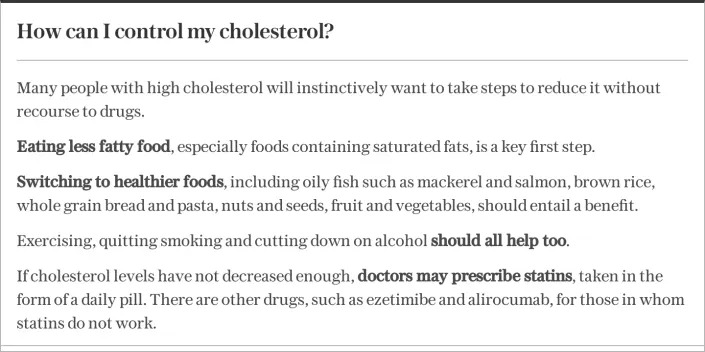
How can I control my cholesterol?

Sir Nilesh Samani, the medical director of the British Heart Foundation, said: “These findings from Our Future Health support previous estimates that show millions of people in the UK are living with undetected high blood pressure and raised cholesterol, which can put them at significant risk of a heart attack or stroke.

“Tackling these treatable silent killers must remain a priority if we are to prevent people suffering or dying needlessly.”

The survey aims to recruit up to five million volunteers across the UK to create one of the most detailed pictures of population health. It is currently inviting people who live near clinics to give a blood sample and have some physical measurements taken. Anyone over the age of 18 can join by signing up online.

Dr Franis said: “Initial data from the programme has uncovered information that would normally be very challenging to identify. Up to 90 per cent of strokes are preventable, so a study of this scale has the potential to tell us so much about two of the most common risk factors for stroke and hopefully lead to more research to reduce our risk of stroke.”

The Our Future Health program is aiming to recruit volunteers from ethnic minority groups who have been under-represented in previous health research but tend to have higher rates of high blood pressure and cholesterol.

DeSantis’ campaign is hemorrhaging support with this type of GOP voter, polls show

Miami Herald

DeSantis’ campaign is hemorrhaging support with this type of GOP voter, polls show

Alex Roarty – July 21, 2023

Lily Smith/The Register/Lily Smith/The Register / USA TODAY NETWORK

Republican voters with a college degree and a built-in skepticism of Donald Trump were supposed to form the backbone of Ron DeSantis’ strategy to win the 2024 GOP presidential primary.

Instead, they’re leaving his campaign in droves.

A trio of Republican primary polls, including previously unpublished data obtained by McClatchyDC, show that Florida’s governor has suffered steep declines in support among GOP voters with at least a bachelor’s degree, an erosion that threatens to undermine his candidacy.

Their defections — which started in the spring and have continued this summer — are disproportionately responsible for DeSantis’ overall decline in the race, where polls show he now sits a distant second place to Trump. In all three surveys, the governor now has barely half the support with college-educated white voters that he did when the year began, larger drop-offs than he suffered with other demographic groups.

The numbers reflect a pressing problem for the Florida Republican as he seeks to reset his campaign amid fundraising concerns and flagging poll numbers, challenging him to recover the lost support among voters who once made him Trump’s top rival for the nomination. The national surveys paint a troubling picture for his campaign, even as his allies insist that recent state-level polling already shows his candidacy regaining momentum.

A poll from decision intelligence company Morning Consult, for instance, found that DeSantis’ support had dropped 18 points among white college-educated Republicans, from 41% when the year began to 23% in mid-July, according to internal data shared with McClatchyDC.

A poll from market research firm Ipsos, meanwhile, found the governor’s support had been halved since mid-March, when it reported he had 39% among college-educated Republicans, according to data shared with McClatchy.

The same survey, released this week, found he had dropped to 20% among those voters, a 19-point decline. (Ipsos’ survey did not distinguish between college-educated white Republicans and college-educated Republicans, although the difference between the makeup of the two groups is small.)

A publicly available survey from Quinnipiac University found the largest drop in support for DeSantis, with the governor going from 51% support in a February poll of college-educated white Republicans to 29% with them now — a 22-point decline.

These voters abandoned DeSantis’ campaign at roughly twice the rate as Republicans without a college degree, a review of polling data found.

None of the three surveys asked why DeSantis has lost the support of college-educated Republicans. But in interviews with non-partisan pollsters and Republican political operatives, some of them speculated that the governor’s decision this year to double down on a sharp-edged conservative agenda could have alienated voters who once viewed him as a more pragmatic, mainstream politician.

DeSantis earlier this year signed a law in Florida banning abortions six weeks after pregnancy, and during the campaign, he has sought to outflank Trump on LGBTQ issues while positioning himself as an “anti-woke” warrior eager to combat the political left in all sectors of society.

“College-educated Republicans were looking for an alternative to Donald Trump, and they initially thought Governor DeSantis, after his 19-point win in Florida, made for a good one,” said Whit Ayres, a veteran GOP pollster. “But the way he has run his campaign, constantly tacking to the right, has turned off many of those people who were initially attracted to him.”

Ayres emphasized that he thought DeSantis still had time to recover from his underwhelming start, arguing people who once supported him can be brought back into the fold with a smart strategy that included more moderate positioning. And some Republican operatives disagree that DeSantis’ more conservative tack is at the root of his drop in support, arguing that Trump’s own popularity, combined with an indictment in March that conservatives saw as wildly unjust, is more responsible for the shift than anything the Florida governor did.

DeSantis’ allies say they already see signs that his popularity has rebounded, dismissing the importance of national surveys instead of state-based polling in places with an early nominating contest. A survey released in New Hampshire this week, from University of New Hampshire Survey Center, found DeSantis receiving 23% support, up from 22% in April, while Trump dropped from 42% to 37%.

The survey showed DeSantis earning the support of 12% of Republicans with only a bachelor’s degree, and 20% support of GOP voters with a graduate degree.

“You’re going to start to see this narrative continue to develop as more state level polling increases, particularly in those states where you see the impact of our ground game,” said an official with Never Back Down, the super PAC supporting DeSantis.

But the official conceded that Trump had gained ground earlier this year after he was indicted by a Manhattan grand jury over allegations he illegally paid hush money to an adult film actress, a prosecution conservatives think is politically motivated. And indeed, while DeSantis’ support with college-educated sank, Trump’s standing with those voters improved markedly since the year began.

Morning Consult, for instance, found Trump’s support nationally with these Republicans improving from 33% to start the year to 46% by mid-July. Among all college-educated GOP voters, Ipsos found him improving from 31% in mid-March to 36% this week.

And Quinnipiac showed him growing from 22% support in February to 34% in a survey released Wednesday.

In all three surveys, Trump now has more support among college-educated voters than DeSantis.

Trump has always fared better among Republicans without a college degree than those with a degree, dating back to his 2016 candidacy when he shocked the GOP establishment and won the party’s nomination. His presidency, in fact, helped shift the party toward a more blue-collar constituency, facilitating an influx of those voters into the GOP’s fold while simultaneously pushing many college-educated men and women, including former Republicans, to start backing Democratic candidates.

Compared to GOP voters without a college degree, GOP pollsters say, college-educated Republicans are socially moderate and fiscally conservative, with some of them both repelled by Trump’s rhetoric and uninterested in his stated aim of making the party’s economic agenda more populist

They might have expected a different approach from DeSantis, political experts say, and soured on him when he didn’t meet that expectation.

“College-educated voters tend to be more liberal,” said Tim Malloy, a polling analyst with Quinnipiac. “And DeSantis has gone right a good deal more than many expected him to do so.”

DeSantis’ support has suffered among Republicans without a college degree, too, though at lower rates than he has among those with degrees.

Among non-college white Republicans, Morning Consult and Quinnipiac found DeSantis’ support dropping 10 and 11 points since the start of the year. Ipsos found his support among non-college Republicans dropping six points since March.

DeSantis’ overall standing in the GOP primary has declined markedly since the start of the year, according to an average of polls compiled by FiveThirtyEight.com. The site has found his support dropping from about 37% to start the year to about 21% now.

Some Republican strategists argue that amid such an overall drop, DeSantis’ standing with college-educated voters was bound to suffer, especially given that he had more of them to lose when the year began. And they question whether DeSantis’ loss of support among college-educated voters is really driving his overall decline.

GOP pollster Patrick Ruffini, for instance, found that DeSantis and Trump were running roughly even with “very conservative” Republicans at the end of last year. The former president, however, had a 65-point edge with those same voters in June, according to a survey his firm conducted.

In an interview, Ruffini said he thinks Trump’s numbers were temporarily low after a disappointing midterm election last year, a time when he had done little campaigning and voters were upset the party hadn’t won control of the U.S. Senate majority. Those frustrations have gradually subsided since, he said.

“You add on top of that something most Republicans see as a tainted and partisan prosecution, and it’s not hard to process what’s been happening here,” he said.

Poll: Trump voters say racism against white Americans is a bigger problem than racism against Black Americans

Yahoo! News

Poll: Trump voters say racism against white Americans is a bigger problem than racism against Black Americans

The polling follows the dismissal of a lawsuit put forth by the survivors of the Tulsa Race Massacre, which many saw as a potential blueprint for reparation efforts.

Marquise Francis and Andrew Romano – July 21, 2023

Supporters of former President Donald Trump
Trump supporters at a campaign event in Pickens, S.C., July 1. (Sean Rayford/Getty Images)

As public support for reparations for African Americans remains stubbornly low, a new Yahoo News/YouGov poll reveals one major roadblock: Donald Trump voters believe that racism against white Americans has become a bigger problem than racism against Black Americans.

The survey of 1,638 U.S. adults, which was conducted from July 13-17, shows that among 2020 Trump voters, 62% say that racism against Black Americans is a problem today — while 73% say that racism against white Americans is a problem.

Asked how much of a problem racism currently is, just 19% of Trump voters describe racism against Black Americans as a “big problem.” Twice as many (37%) say racism against white Americans is a big problem.

Trump voters and self-identified Republicans — overlapping but not identical cohorts — are the only demographic groups identified by Yahoo News and YouGov who are more likely to say racism against white Americans is a problem than to say the same about racism against Black Americans. A majority (51%) of white Americans, for instance, think racism against people who look like them is a problem — but overall, far more white Americans (72%) say racism against Black Americans is a problem.

A protest from earlier this year in Oakland, Calif., against the killing of Tyre Nichols by police in Memphis, Tenn.
A protest from earlier this year in Oakland, Calif., against the killing of Tyre Nichols by police in Memphis, Tenn. (Tayfun Coskun/Anadolu Agency via Getty Images)

Politics, in other words, is the dividing line here — and political dynamics go a long way toward explaining why reparations for Black Americans continue to be so unpopular in the U.S.

The new Yahoo News/YouGov poll follows the dismissal earlier this month of a lawsuit put forth by the three remaining survivors of the 1921 Tulsa Race Massacre seeking reparations for ongoing harm caused by the racist rampage that destroyed their once-thriving majority-Black community a century ago. The trio of survivors had sued under Oklahoma’s public nuisance law, claiming that the ripple effects of the massacre continue to affect the Greenwood community today.

Many supporters saw the Oklahoma suit as a potential blueprint for reparation efforts around the country. But the latest ruling, which dismissed the case with prejudice — meaning it cannot be filed again — is seen as a stinging setback. The survivors and their attorneys have promised to appeal.

Yet the reality is that even with qualifications, most U.S. adults oppose reparations for Black Americans. According to the Yahoo News/YouGov poll, just a quarter of them (24%) say Black Americans should receive “restitution or reparations from the government — not necessarily direct cash payments — as a result of inequities caused by racism and slavery,” while 56% say they should not.

Support is only marginally higher (29%) when respondents are asked specifically about reparations for “descendants of enslaved Black Americans” rather than all “Black Americans.” And even when questioned about reparations for the “three remaining survivors of the Tulsa race massacre” — that is, living people who were directly harmed by racial violence — less than half of Americans are in favor (45%). Most are either opposed (33%) or unsure (22%).

What happened in Tulsa?

The massacre at the center of the court case took place on May 31, 1921, when an angry white mob beat and killed hundreds of Black residents in Greenwood, which had earned the nickname “Black Wall Street” because of the success of its Black residents. Earlier that day, the Tulsa Tribune reported that a Black man had raped a white woman, although there were varying accounts of the incident. Confrontations between Black and white people broke out near the courthouse as the case was being heard.

Over the next two days, 35 city blocks went up in flames. There were widespread reports of looting and more than 1,250 homes burned; 300 people were killed and 800 others were injured as the white mobs outnumbered Black residents who were forced to retreat into the Greenwood district. Generations of Black progress were wiped out in less than 48 hours.

The aftermath of the Tulsa Race Massacre
The aftermath of the Tulsa Race Massacre, during which mobs of white residents attacked Black residents and businesses of the Greenwood District in Tulsa, Okla., June 1921. (Bettmann Archive/Getty Images)

Property claims documenting $1.8 million worth of damage, the equivalent of about $27 million today, were deemed obsolete, according to a 2001 state commission report. With most insurance paperwork and bank documents lost in the riot, almost all Greenwood residents had no restitution for their homes or businesses, and couldn’t retrieve their funds from the banks.

The chief motive for the attack, experts say, was white resentment over Black advancement. But it’s translated into little restitution for what was lost.

The big political hurdle

To be clear, reparations for Black Americans are not particularly popular across the political spectrum. Republicans are opposed 84% to 8%; Independents are opposed 62% to 8%. Democrats favor reparations by a 21-point margin (49% to 28%) — but even that’s not majority support, and much of it is attributable to overwhelmingly pro-reparations sentiment (69% to 11%) among Black Americans themselves, who tend to identify as Democrats.

Among white Americans, meanwhile, just 17% say yes to reparations; 66% say no.

Still, the major outliers when it comes to race are on the right-wing. When asked how big a problem racism against Black Americans was in the past, Biden and Trump voters basically agree, with 93% of the former and 85% of the latter agreeing that it was a problem.

Former President Donald Trump at a rally in Carson City, Nev.
Trump at a rally in Carson City, Nev., on Oct. 18, 2020. (Mandel Ngan/AFP via Getty Images)

The disagreement is over whether it’s still a problem today — or rather, as Trump voters seem to believe, whether it’s less of a problem than racism against white Americans, which reparations, in their view, would only exacerbate. When Trump voters are asked why Black Americans shouldn’t receive reparations, the top answer isn’t that “racism never held Black Americans back” (13%); it’s that “racism is no longer holding Black Americans back” (62%). Reparations, they say, would only “increase racial divisions” (57%) because “other Americans have [also] faced inequities because of racism” (60%).

Similarly, Trump voters are the only group (other than Republicans at large) who are more likely than not to say there isn’t any “problem with systemic racism in America” (61%) and to disagree with the idea that “racism is not merely the product of individual bias or prejudice, but also something embedded in legal systems and policies” (55%) — issues that reparations are intended to ameliorate.

A pathway for reparations

Tatishe Nteta, a professor of political science at the University of Massachusetts Amherst and director of the UMass Poll, who’s been surveying how Americans feel about reparations for two years, acknowledges the low popularity of reparations, but notes it’s bigger than public opinion.

“Reparations policy is not necessarily about public opinion,” Nteta told Yahoo News. “It’s about the recognition by a private institution, individuals or governments. It’s about atoning for the mistreatment directed at a particular group.”

Vernon AME Church pastor Robert Turner
Pastor Robert Turner after leading a protest on reparations in Tulsa, Nov. 18, 2020. (Joshua Lott/Washington Post via Getty Images)

Pointing to success at the local level in passing reparations initiatives and programs in progressive cities and towns like Evanston, Ill.Amherst, Mass. and Detroit, Nteta says that any racial and economic redress in those cities could create a domino effect, which could convince other more moderate cities and states to consider.

“If reparations achieves the goal of creating some level of racial equality, and the recipients of reparations are also happy with the atonement by whatever the institution is, then you could use this as a model going forward. You could find more moderate cities or moderate states passing reparations programs once you’ve seen the success in these smaller localities.”

____________

The Yahoo News survey was conducted by YouGov using a nationally representative sample of 1,638 U.S. adults interviewed online from July 13-17, 2023. The sample was weighted according to gender, age, race, education, 2020 election turnout and presidential vote, baseline party identification and current voter registration status. Demographic weighting targets come from the 2019 American Community Survey. Baseline party identification is the respondent’s most recent answer given prior to March 15, 2022, and is weighted to the estimated distribution at that time (32% Democratic, 27% Republican). Respondents were selected from YouGov’s opt-in panel to be representative of all U.S. adults. The margin of error is approximately 2.7%.

Former Sen. Claire McCaskill Goes Scorched Earth On ‘Little, Lily-Livered’ Republicans

HuffPost

Former Sen. Claire McCaskill Goes Scorched Earth On ‘Little, Lily-Livered’ Republicans

Lee Moran –  July 21, 2023

Former Sen. Claire McCaskill (D-Mo.) on Thursday ripped the Republican Party for what it’s become in the Donald Trump era.

McCaskill, now a political analyst for MSNBC, recalled on the “Morning Joe” show how GOP leaders in 2012 “rejected” her then-Republican challenger, the late Rep. Todd Akin (R-Mo.), for his comments on “legitimate rape.”

But 11 years later, with the party in thrall to Trump, McCaskill explained how it’s a different story, as even top Republicans continue to defend the former president amid his mounting legal woes and reported imminent indictment in the special counsel probe into the Jan. 6, 2021, attack on the U.S. Capitol.

“The main difference here is not the conduct of the candidate, it is the reaction of the leaders of his party,” McCaskill said, noting how Senate Minority Leader Mitch McConnell (R-Ky.), Sen. Lindsey Graham (R-S.C.) and House Speaker Kevin McCarthy (R-Calif.) all condemned Trump in the immediate aftermath of the insurrection.

“But then they got scared,” she said. “They just became little, lily-livered cowards and were too afraid that, somehow, they couldn’t hold on to their precious office or their precious power if they stated the obvious.”

“So, it is not so much what Donald Trump has done,” McCaskill added. “It’s the rest of the Republican Party who has elevated him and kept him elevated that has brought this upon America.