Biden is beating Trump on stocks. History shows markets do better under Democrats

CNN

Biden is beating Trump on stocks. History shows markets do better under Democrats

Matt Egan, CNN – November 1, 2024

The S&P 500’s annual returns during the Biden era were the second best in modern history, behind only Clinton on the 1990s.

Yahoo is using AI to generate takeaways from this article. This means the info may not always match what’s in the article. Reporting mistakes helps us improve the experience.

In 2020, former President Donald Trump warned that the historic stock market boom on his watch would implode if voters replaced him with Joe Biden.

“If you want your 401k’s and stocks…to disintegrate and disappear, vote for the Radical Left Do Nothing Democrats and Corrupt Joe Biden,” Trump tweeted in July 2020.

It was an ominous warning from a president who, more than his predecessors, obsessed over market gains and viewed them as a real-time barometer of his success.

In reality, with Biden in the White House, the US stock market not only preserved those Trump-era gains, but generated even more massive ones for millions of Americans’ 401(k) plans, nest eggs and college savings plans.

The S&P 500, the gold-standard market index of 500 US stocks, has posted a compound annual growth rate of 14.1% from Biden’s November 2020 election through Thursday’s closing bell, according to veteran market strategist Sam Stovall of CFRA Research.

The market returns under Biden are the second best in modern history going back to 1945, Stovall found. The only stronger performance was during the booming dotcom days under former President Bill Clinton during the 1990s.

The findings are surprising given the relatively low marks Americans give Biden on the economy and how the issue remains a challenge for Vice President Kamala Harris, who Biden tapped to succeed him.

Yet the Biden-era gains reflect the US economy’s relentless rebound from the pandemic, the historic period of low unemployment and the artificial intelligence gold rush on Wall Steet.

“Biden benefited from the tech-fueled recovery following the shallow and swift bear markets of 2020 and 2022,” Stovall said.

Trump presided over market surge

But the market also boomed under Trump.

The S&P 500 enjoyed a compound annual growth rate of 12.1% from Trump’s surprise election in November 2016 through Biden’s 2020 victory, according to CFRA. That’s the third best performance in modern history, behind only Clinton and Biden.

“The Trump market was so strong because of a combination of very low inflation, very low interest rates and tax cuts,” said Stovall.

Another way to measure presidential market performance would be to start from the moment they are sworn in. By that metric, the S&P 500’s growth rate of 14.1% under Trump is second all-time, just ahead of 13.8% under Barack Obama and well ahead of the 10.3% under Biden.

However, Stovall said it makes more sense to start the clock at Election Day because that’s when markets start pricing in policy changes.

For instance, US stocks surged after Trump defeated Hillary Clinton in 2016 in a red wave that gave Republicans control of Congress. Wall Street immediately started betting that Trump would be able to enact his agenda, especially massive tax cuts that would juice corporate profits.

“Investors are anticipators. They don’t wait for the actuality,” Stovall said.

Despite a tech-led selloff on Thursday, the S&P 500 still ended October with a year-to-date gain of 19.6%. That makes 2024 its best election year through October since 1936, according to Bespoke Investment Group.

Democrats beat Republicans

History shows that the market tends to rise no matter which party is in power. However, contrary to popular belief that Republican presidents are better for the economy and the market, Democrats have enjoyed stronger market gains and faster economic growth.

The S&P 500’s growth rate under Democrats is 10% compared with 6.7% under Republicans, according to CFRA. Gross domestic product has averaged 3.9% under Democratic presidents, well ahead of the 2.4% under Republicans.

“Whether it is by coincidence or causation, historical evidence suggests that the market and economy perform better under Democratic presidential leadership,” Brian Belski, chief investment strategist at BMO Capital Markets, wrote in a note to clients earlier this week.

All Democratic presidents have enjoyed a rising stock market during their time in office, led by the 16.5% compound annual growth rate under Clinton.

Two Republicans presided over market downturns: Richard M. Nixon (-4.1% compound annual growth rate) and George W. Bush. Bush ranked last among the 14 presidents since 1945.

Part of that disparity could have to do with which presidents had recession occur during their terms.

Before early 2020, Trump was on track to be the first Republican president since 1945 to avoid a recession. But then Covid-19 crashed the economy, causing unemployment to skyrocket and GDP to crash.

By contrast, none of the Democratic presidents since 1945 have had a recession occur during their terms, according to CFRA.

Bush inherited the bursting of the dotcom bubble, which helped start a recession just a few months after he took office. Bush was also in office during the 2008 financial crisis and the Great Recession.

“Republican presidents – specifically Richard Nixon and George W. Bush – have had the misfortune of presiding over periods of economic deterioration rather than economic prosperity, leading to lower market returns,” Belski wrote.

Gridlock is good?

Of course, the composition of Congress plays a huge role in how much of a president’s campaign promises can become reality. When the opposing party controls Congress, there is a natural check on the White House that often prevents presidents from enacting controversial legislation.

Investors know this and there’s even an old market mantra that “gridlock is good” because it prevents Washington from meddling too much with the economy.

Indeed, Stovall found that the best market performance historically has occurred under a Democratic president with a split Congress. In those six years since 1945, where such a dynamic has been in place, the S&P 500 has enjoyed a sizzling growth rate of 16.8%.

Market returns have been weakest when there is a Republican president with a Democratic Congress.

Still, markets performed well in the past when there is unified government, with one party controlling the White House and both chambers of Congress.

And gridlock comes with risks because it can paralyze Congress on must-pass legislation such as the debt ceiling. It can also complicate and slow down rescue packages during times of crisis.

Tax cuts don’t necessarily boost stocks

One risk investors have been mulling this year is that some or all of the 2017 tax cuts are allowed to expire in 2025, causing rates to surge.

Trump has vowed to fully extend his signature tax law, but Democrats in Congress and Harris have called for rolling some of it back.

“The prospect of any sort of tax increase has always spooked investors since the perception is that higher rates would impede stock market performance potential,” BMO’s Belski wrote. “We understand the consternation, nobody wants to pay higher taxes, but the prevailing wisdom that tax hikes destroy markets is misguided if history is any sort of guide.”

BMO found that there is “little proof” that lower individual, corporate and capital gains tax rates boost the market.

In fact, the market has generally performed better during times of higher, not lower, tax rates across changes in all three categories, BMO found.

As with many things, presidents often get too much credit for market booms, and too much blame for the busts.

Although presidential decisions and landmark legislation can have a real impact, markets are influenced by other factors such as wars, interest rates and most importantly the timing of recessions.

What I Truly Expect if an Unconstrained Trump Retakes Power

By Michelle Goldberg, Opinion Columnist – November 1, 2024

Donald Trump, wearing a “Make America Great Again” hat, points his finger.
Credit…Damon Winter/The New York Times

Lately, I’ve seen conservatives taunting liberals online by asking why, if we really think America could be on the verge of fascism, our bags aren’t packed. “It’s tempting to begin trolling my anti-Trump friends by asking if they are liquefying assets, getting passports in order, etc.?” Scott McConnell, a founding editor of The American Conservative, posted on X. National Review’s Michael Brendan Dougherty said something similarly snarky: “So fascism is here and you’re not doing what people did when fascism showed up, which is contemplating emigration in terror or joining armed resistance.”

These jabs seem meant to mock the dread many of us are living in. But despite their bad faith, they’ve lodged in my mind, especially during the late-night insomniac hours when I’m up panicking about what’s going to happen on Tuesday. They’ve goaded me to think through what I truly expect to happen if an unconstrained Donald Trump retakes power, and what it would mean to raise children in a country sick enough to give it to him.

Many people I know who have the privilege to do so are in fact making contingency plans; friends whose family histories entitle them to European passports have secured them. But while I’m having lots of half-idle conversations about emigration, I’m not living my life as if either tyranny or exile is imminent, even though I believe, in keeping with assessments by prominent generals who’ve worked closely with Trump, that he’s a fascist.

Partly, I just feel frozen with horror. This awful liminal period is like waiting for the results of a biopsy, and it’s hard to reason clearly about the future until there’s a prognosis. Beyond that, a lesson of modern autocracy is that ordinary life, or at least a diminished version of it, can go on even as democratic hopes are slowly strangled.

My single biggest fear about a Trump restoration is that he keeps his promise to carry out “the largest domestic deportation operation in American history.” As The New York Times has reported, that would mean sending ICE to carry out “workplace raids and other sweeps in public places aimed at arresting scores of unauthorized immigrants at once,” and warehousing them in a network of newly built prison camps.

If this happens, there will almost certainly be large protests. And when they break out, it is not far-fetched to think Trump would order the military to violently suppress them; the generals now warning about a second Trump term say he wanted to do just that in the past. This is what I envision when I think of MAGA fascism: people demonized as “vermin” being dragged off to camps, while dissent is violently crushed by the armed forces. I don’t know how anyone who has listened to Trump and those around him can dismiss this scenario as hysterical.

There will, I assume, be persecutions of Trump’s more high-profile enemies. We know that Trump, in his first term, harangued Attorney General Jeff Sessions to prosecute Hillary Clinton, and the ex-president and his allies have been clear about their intention to end the independence of the Justice Department. Mitt Romney is taking seriously the possibility that Trump will use the government to go after him, telling The Atlantic’s McKay Coppins, “I think he has shown by his prior actions that you can take him at his word.” Gen. Mark Milley, who was chairman of the Joint Chiefs of Staff under Trump and President Biden until he retired last year, told the journalist Bob Woodward that he fears Trump could have him recalled to duty and court-martialed for disloyalty. Anyone significant enough to threaten Trump could find themselves targeted.

And it won’t be only the powerful who need fear attacks by the MAGA state. Just look at those who’ve found themselves in the cross hairs of America First Legal, an organization headed by the former Trump aide Stephen Miller, which The New York Times called “a policy harbinger for a second Trump term.” It has sued charities that help women pay for abortions, Maryland schools that “expose children to radical gender ideology,” and “woke” corporations — including the N.F.L. — trying to increase diversity. In a second Trump term, Miller and his allies will be able to deploy the power of agencies including the Justice Department, the Department of Education and the Equal Employment Opportunity Commission against their foes.

Often, of course, they won’t have to; we’re already seeing troubling signs that some plutocrats are obeying in advance. The Washington Post’s decision to quash its editorial board’s endorsement of Kamala Harris shocked so many of the paper’s readers because it seemed, despite the Post owner Jeff Bezos’ insistence to the contrary, like an act of corrupt capitulation.

As The Post itself has reported, Bezos’ companies have billions of dollars in government contracts at stake, and during the last Trump administration, the president went out of his way to punish the billionaire for Post coverage he didn’t like. In 2019, The Post reported, Marc Short, then Mike Pence’s chief of staff, told leaders of Bezos’ space exploration company, “You have a Washington Post problem.”

The transition from democracy to autocracy is a process, not an on-off switch. By the end of Trump’s first term, when the president was pressuring state officials to change vote totals, staffing the highest levels of government with thugs and lackeys, and, eventually, siccing a vigilante mob on the Capitol, we’d already gone farther on the path to authoritarianism than I’d once thought possible. The place we left off at in January 2021 will, in all likelihood, be the starting point for a Trump administration in 2025.

Johnny McEntee, who started as a Trump bag carrier, had by the end of Trump’s presidency become so powerful that some referred to him as the “deputy president.” As The Atlantic reported, he turned the Presidential Personnel Office, an agency in charge of hiring and firing political appointees, “into an internal police force, obsessively monitoring administration officials for any sign of dissent, purging those who were deemed insufficiently devoted to Trump and frightening others into silence.”

Now a leader of Project 2025, McEntee will most likely have a major role in staffing a new Trump White House. He recently called — with the kidding-not-kidding sneer common to MAGA — for scrapping the 19th Amendment, the one giving women the right to vote.

Days out from the election, pointing out the potential nightmares ahead feels like screaming into a void. Trump’s deep contempt for liberal democracy is, as they say, baked in. When Milley called Trump “fascist to the core,” and when Gen. John Kelly, a former Trump chief of staff, said that he wanted to rule as a dictator, the political debate wasn’t about whether they were correct, but about whether their words would matter. (The consensus seemed to be no.) So those of us who recognize what Trump is lurch forward to Tuesday, a coin flip away from losing what we thought was our democratic birthright, trying and often failing to think through the aftermath of the unthinkable.

But even if the unthinkable happens, it won’t happen all at once. Hannah Arendt wrote, in “The Origins of Totalitarianism,” about how the dislocations of World War I created a mass of stateless people who lived “outside the pale of the law.” Seeing these people deprived of human rights, those secure in their citizenship did not generally worry about their own. “It was precisely the seeming stability of the surrounding world that made each group forced out of its protective boundaries look like an unfortunate exception to an otherwise sane and normal rule,” wrote Arendt.

My kids keep asking anxiously what will happen if Trump wins. I tell them that their lives won’t change, that we’ll have to try to stand up for others who are more vulnerable, but that we ourselves will be fine. The last two words I only say in my head: “For now.”

Michelle Goldberg has been an Opinion columnist since 2017. She is the author of several books about politics, religion and women’s rights, and was part of a team that won a Pulitzer Prize for public service in 2018 for reporting on workplace sexual harassment. 

Donald Trump Is Done With Checks and Balances

By Jamelle Bouie, Opinion Columnist – November 1, 2024

A dense crowd in a sea of red hats at Donald Trump’s rally at Madison Square Garden; a supporter stands up wearing a jersey that reads “America 1.”
Credit…Damon Winter/The New York Times

What does it mean to say that “democracy is on the ballot” on Election Day?

In her speech on Tuesday in Washington, D.C., delivered from the same place near the White House where Donald Trump incited a crowd to attack the Capitol on Jan. 6, 2021, Vice President Kamala Harris said it was a question of whether Americans “have a country rooted in freedom for every American” or whether they have one “ruled by chaos and division.”

It was a question, she said later in her remarks, of whether the United States would “submit to the will of another petty tyrant” and become a “vessel for the schemes of wannabe dictators.”

The vice president was not wrong. Election Day will be a referendum on whether we want an autocrat in office — a plebiscite, of sorts, on the very idea of government of the people, by the people and for the people. But Harris’s answer is incomplete. Also at stake on Tuesday, when it comes to the question of American democracy, is the future of the Constitution.

Will it continue into the 21st century as Frederick Douglass’s “glorious liberty document,” or will it legitimize an American-style authoritarianism as a new “covenant with death,” to use the words of Douglass’s erstwhile abolitionist ally, William Lloyd Garrison.

It is important to remember that the Constitution was neither written nor ratified with democracy in mind. Just the opposite: It was written to restrain — and contain — the democratic impulses of Americans shaped in the hothouse of revolutionary fervor.

“Most of the men who assembled at the Constitutional Convention in Philadelphia in 1787 were also convinced that the national government under the Articles of Confederation was too weak to counter the rising tide of democracy in the states,” the historian Terry Bouton writes in “Taming Democracy: ‘The People,’ the Founders, and the Troubled Ending of the American Revolution.”

The framers’ Constitution would tamp down on and bind the democratic energies of those Americans who thought their revolution stood for something more egalitarian — more revolutionary — than what its leaders and leading figures imagined. It would channel democratic energy through divided institutions backstopped by counter-majoritarian rules and requirements, each designed to make it as difficult as possible to turn popular energy into governing majorities.

In short, the founders built a limited, exclusionary government centered on elite management of the people’s affairs. But by the start of the 19th century, it was clear that the people would not allow the Constitution to contain their democratic impulses and aspirations. The American Republic would not be as limited or as exclusive as the framers had envisioned.

Broad literacy and the wide availability of newspapers, pamphlets and books brought a vibrant culture of political debate and contestation. The emergence of organized political factions and, later, formal political parties brought large numbers of Americans into the political process, transforming the very nature of the union.

As Americans democratized their culture, their Constitution followed. They reshaped their constitutional order around political parties and embraced mass political participation as an integral part of the system.

You can see the vibrancy of this early form of American democracy, as exclusive as it still was, in the multitude of movements and minor parties that emerged throughout the antebellum period. There were Know-Nothings and Anti-Masons and Free Soilers, Liberty Party partisans and groups like the Wide Awakes.

“In America,” Alexis de Tocqueville observed during his tour of Jacksonian America, “democracy is given over to its own inclinations. Its pace is natural and all its movements are free.”

Out of the contradictions of America’s nascent democracy came a catastrophic civil war. And out of the practical and ideological demands of that war came the most expansive and, to that date, most inclusive vision yet for American democracy, encoded in a set of amendments that reconstituted the union as a nation. The 13th Amendment abolished chattel slavery. The 14th Amendment enshrined birthright citizenship and guaranteed the “privileges and immunities” of that citizenship. And the 15th Amendment outlawed racial discrimination in voting, giving Congress all the authority it needed to enforce that prohibition.

It should be said here that it wasn’t simply the act of amendment that changed and further democratized the Constitution. A political document as much as a legal one, its character and meaning are realized as much through practice and the everyday challenge of making it work as they are in law and legislation. Which is to say that if the Constitution that emerged out of the Civil War was more democratic than the one that helped produce that war, a good part of that was because Americans themselves, like the freed people of the South, fought to realize their democratic aspirations.

They were joined, in subsequent decades, by Americans of many other backgrounds. Over the next century and through great effort, American democracy would grow in fits and starts to include women and a broad variety of immigrant groups. And while Black Americans would suffer under the long night of Jim Crow, they would continue their struggle for equality, inclusion and recognition.

We were not given a democratic Constitution; we made one. We unraveled the elitist and hierarchical Constitution of the founders to build something that works for us — that conforms to our expectations.

But nothing is permanent. What’s made can be unmade. And at the foundation of Donald Trump’s campaign is a promise to unmake our democratic Constitution.

Consider his priorities. He wants to use the law enforcement arm of the federal government to harass his opponents and exact “retribution” on his political enemies.

“I will appoint a real special prosecutor to go after the most corrupt president in the history of the United States of America, Joe Biden, and the entire Biden crime family,” Trump said last year. In September he threatened “Lawyers, Political Operatives, Donors, Illegal Voters, & Corrupt Election Officials” with “long-term prison sentences” if they are found guilty of voter fraud, which Trump seems to equate with any form of political opposition.

Trump also wants to deport tens of millions of people from the United States, which will inevitably include American citizens, whether they’re the children of undocumented immigrants or students demonstrating in support of Palestinians. “Immediately after taking the oath of office, I will launch the largest mass deportation program in American history,” Trump said at an event in Texas last week.

To accomplish this, the former president intends to use the 1798 Alien Enemies Act, which allows the president to detain and deport noncitizens from countries at war with the United States. The idea, if it needs to be spelled out, is to classify undocumented immigration as an act of war and use the law to remove foreign nationals from the United States without due process. To obtain the personnel necessary to carry out deportations on such a large, national scale, Trump would deputize local and state law enforcement as well as deploy the National Guard.

It is not just that Trump would attempt these power grabs — which would, on their own, introduce a level and degree of state repression heretofore unseen in American history — but that he would have the support of a legal and political movement eager to constitutionalize his actions as a legitimate exercise of presidential power. Trump would act in an authoritarian manner, and his allies would then write that authoritarianism into the Constitution.

That, in fact, is what the Supreme Court did in Trump v. Hawaii, when it turned a blind eye to the clear evidence of racial and religious bigotry driving the former president’s “travel ban” (neé Muslim ban) and freed the administration to impose its restrictions under a theory of broad (or perhaps a better word would be “credulous”) deference to the executive branch.

The court took a similar approach this year in Trump v. United States, when it gave the president a broad grant of criminal immunity from prosecution for “official acts.” Rather than reckon with the overwhelming evidence that Trump abused the office of the presidency in an illegal effort to overturn the results of an election he lost, what is in effect the Republican majority on the court turned the plain meaning of the Constitution on its head, freeing future presidents — including, perhaps, a future President Trump — to abuse their power under cover of law.

More so than most of his predecessors, Trump strained against the limits of the presidency. He never understood that the office was bound by higher law — that his power wasn’t absolute. He never understood that he was an officer of the Constitution and a servant of the people; he never understood that he was a subject and not the sovereign.

It was because of this fundamental misunderstanding — itself tied to his bottomless solipsism — that Trump tried to twist and turn the presidency into an extension of his ego. To the extent he failed to accomplish this, it was only because he was stymied by those around him — officials who chose to honor their commitment to the Constitution over the interests of one man. Those same officials now warn that if he is given another term in office, he will rule as a tyrant.

America got lucky. It won’t get lucky again. Free of the guardrails that kept him in place the first time, affirmed by the Supreme Court and backed by allies and apparatchiks in the conservative movement, Trump will merge the office of the presidency with himself. He will shake it from its moorings in the Constitution and rebuild it as an instrument of his will, wielded for his friends and against his enemies. In doing so, he will erode the democratic assumptions that undergird our current constitutional order. And he will have the total loyalty of a Republican Party that itself is twisting and abusing the counter-majoritarian features of the American system to undermine and unravel democracy in the states it controls.

“Democracy is never a gift bestowed by benevolent, farseeing rulers who seek to reinforce their own legitimacy,” the historian Sean Wilentz writes in “The Rise of American Democracy: Jefferson to Lincoln”:

It must always be fought for, by political coalitions that cut across distinctions of wealth, power and interest. It succeeds and survives only when it is rooted in the lives and expectations of its citizens and is continually reinvigorated in each generation. Democratic successes are never irreversible.

Most Americans have lived only in a world where democracy was secure, where democracy was assumed. On Tuesday we’ll decide if we want to stay in that world or leave it behind.

The Sun endorses Kamala Harris and Tim Walz to lead the nation

The Las Vegas Sun

The Sun endorses Kamala Harris and Tim Walz to lead the nation

The Las Vegas Sun – October 20, 2024

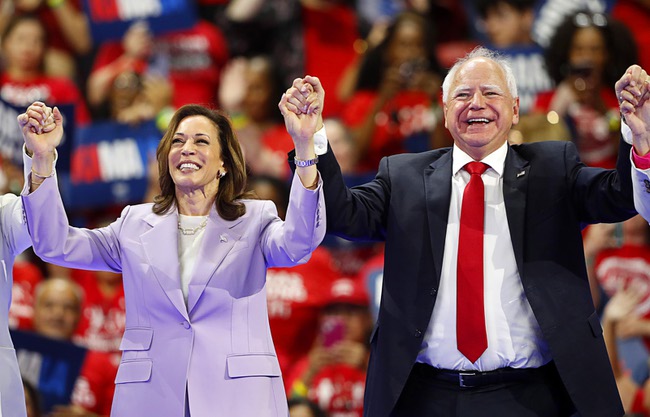
Harris-Walz Rally at Thomas & Mack

Democratic presidential nominee Vice President Kamala Harris and running mate Minnesota Gov. Tim Walz join hands during a rally at the Thomas & Mack Center Saturday, Aug. 10, 2024.

The upcoming presidential election presents a pivotal moment for the United States, offering a choice between preserving democracy or sliding into autocracy.

The Republican Party has nominated a womanizing narcissist and aspiring dictator as its candidate. He and his supporters believe in trampling on the rights of women, providing greater protections to guns than schoolchildren, silencing the history and existence of people of color and LGBTQ+ people, forcing working class families and seniors to choose between food and medicine and ceaselessly attacking the immigrants who dream of a better life.

The Democratic Party, on the other hand, has nominated a leader who will fight to preserve the rights and institutions that have made the United States the envy of the world while championing the promise of the American dream. She believes in fighting for the rights of women to choose what happens to their body, protecting children from criminals armed with weapons of war, preserving Social Security and health care programs that Americans have paid into their entire lives, giving a helping hand to those in need and creating pathways to citizenship for immigrants who contribute to our economy and our communities.

Kamala Harris represents a bridge between the measured approach of Joe Biden and the hunger for change that drove millions to support Donald Trump. While we understand the belief held by many Americans that they are being left behind, Trump is not the answer. His disregard for democratic institutions, tarnishing of the judiciary and inability to conceive of a government that serves anyone or anything beyond his personal interests are the hallmarks of an aspiring dictator. Harris, on the other hand, offers the stability and confidence of a veteran public servant and the bold vision, energy and adaptability that is needed in a rapidly evolving world.

As vice president, Harris has proven herself a capable ambassador who will strengthen America’s alliances and project a position of strength to our adversaries. For a nation still recovering from the damage to its international standing under Trump, Harris represents a return to stronger ties to our allies, determined resistance to our enemies, principled diplomacy and a strong defense of democratic values. She will not coddle our enemies and betray our friends as Trump did.

Harris’ work in the U.S. Senate reinforced her credentials as a champion for middle-class and working families. She supported legislation that aimed to lower health care costs, protect Social Security and Medicare, and expand affordable housing — issues that resonate with older Americans who have spent their lives contributing to society and now seek dignity in their twilight years. Harris’ push for measures to combat climate change, from reducing greenhouse gas emissions to investing in clean energy, aims to address not only immediate health concerns but also an understanding of the long-term effects that current policies will have on future generations.

A former prosecutor and California attorney general, Harris has demonstrated a commitment to public safety while championing reforms that aimed to make the justice system more equitable. Her tenure focused not only on holding wrongdoers accountable but also on creating pathways to rehabilitation — policies that resonate with voters who believe in the Constitution’s promise of safety, security and accountability that are balanced against liberty, fairness and a commitment to second chances for those who earn them.

Yet, it is not just her experience that makes Harris the right choice — it is also her vision. As the child of immigrants and the first woman of color to serve as vice president, she has already made history and inspired a new generation to believe in the promise of American democracy. Those experiences have inspired her vision of a government more representative of the people it serves — no matter their social, cultural, geographic or economic background.

At the Democratic National Convention, she spoke of rebuilding the middle class and creating an “opportunity economy where everyone has the chance to compete and a chance to succeed.” Tellingly, she accepted the nomination for the presidency on behalf of “every American, regardless of party, race, gender or the language your grandmother speaks,” “everyone who has ever set out on their own unlikely journey,” and “people who work hard, chase their dreams and look out for one another.”

This language reflects Harris’ understanding that every American has a story to tell and that many of those stories share the common threads of overcoming hardship through hard work and the strength and support of family and community. She is genuinely interested in those stories, interested in who we are as Americans, what we want our future and our children’s future to look like and what she can do to help realize those dreams.

For American women, the ability to pursue a vision of their own choosing is growing increasingly difficult as dozens of states with GOP-controlled legislatures impose oppressive restrictions on women’s rights to control their own bodies and receive lifesaving medical care.

Beyond reproductive rights, women also continue to bear the brunt of lawmakers’ failure to support paid family leave, affordable child care, an extension of the child tax credit or even the Equal Pay Act. While in the Senate, Harris sponsored or cosponsored legislation championing each of these issues.

Older voters too have a particular stake in a Harris presidency. With Social Security and Medicare facing long-term funding challenges, the nation needs a leader who will protect and strengthen these programs. Harris has pledged to do so while opposing efforts to privatize or cut benefits. Furthermore, her emphasis on affordable prescription drug pricing is an issue of immediate relevance to all of us, but especially seniors who often struggle with high health care costs.

Her vice-presidential running mate, Minnesota Gov. Tim Walz, shares Harris’ vision for leadership and governance that serves all Americans. It’s what inspired him to become a high school teacher, a football coach, an adviser to the school’s gay-straight alliance and a mentor to generations of young people trying to navigate decisions about the next steps in their soon-to-be adult lives. Walz also carried that vision into the governor’s office, where he cut taxes for the middle class, expanded access to prekindergarten and ensured that no child would go hungry at school, all while balancing the state budget.

Just as Harris stands in sharp contrast to Trump, Walz stands in sharp contrast to Trump’s running mate, Ohio Sen. JD Vance. From what we can tell, Vance’s only notable accomplishments since graduating from Yale Law School in 2013 have been helping billionaire venture capitalists make more money; founding a charity that didn’t help anyone except for Vance, who used it as a front for his political ambitions; and serving as an advisory board member for an organization that helped create the Project 2025 plan to destroy democracy and eliminate numerous civil rights.

Some readers might ask why we don’t note Vance’s time in the U.S. Senate among his accomplishments, but the reality is that he has accomplished nothing as a senator. Not even one of the 57 legislative bills Vance authored passed the Senate. Of course, Vance’s failure to do his job while collecting a taxpayer-funded salary is also likely related to his spending the past two years licking the boots of Trump and spreading bizarre and hateful theories about women in American life and inventing disgusting stories about Haitian immigrants. Vance’s bigotry does not appear to have a bottom, nor does his craven opportunism have limits.

The fact that Trump chose Vance as his running mate while Harris chose Walz underscores the differences in their judgment. While Harris seeks a commitment to public service and common good, Trump seeks nothing more than a “yes man” who can fulfill his pathetic need to be surrounded by people who stroke his ego and are willing to hate anyone Trump wants him to hate. Worse, Vance has made it clear that if faced with the same choice that Mike Pence faced when Congress was certifying the Electoral College vote, Vance would soil the Constitution for Trump.

It’s telling that Trump and Vance speak of America in the darkest terms and invent one imaginary crisis after another. They describe a chaotic, violent and evil America that is nothing like the lived experience of our citizens. They are lying. And like a long list of political villains before them, they trade in fear for power’s sake.

Harris and Walz on the other hand, don’t shirk from the challenge to improve policies and programs that need to be improved. But when they look at America and they describe their vision, it is filled with hope, inclusion and mending the wounds that have been inflicted by political vandals like Trump. The contrast could not be more stark: Harris and Walz love this country, its people and its freedom, Trump and Vance only want to own it. Harris looks at Americans and sees promise and opportunity that should be nurtured. This is what this nation needs in a leader.

One can’t ignore the striking differences in economic policies either. Trump’s crazed plan to institute massive tariffs to support his equally crazed plan for multitrillion-dollar tax cuts will doom America to a deep recession and burden future generations with trillions of dollars in additional deficit spending. His tariffs will cause massive inflation as the costs of the tariffs are passed on to American consumers and American companies. They will also result in retaliation from other nations targeting U.S. business and industry, crippling our economy.

We need to be clear-eyed on this: Trump’s tariff plans are not workable and not serious. They will deliver gigantic wealth to the richest Americans today, while saddling future generations with the bill for Trump’s debt. It’s a grift on a multitrillion dollar scale. Trump has bankrupted nearly all of his businesses; his current proposals will bankrupt this country for a generation or more. Virtually every responsible economist who has analyzed Trump’s plans warns of disaster if he’s allowed to get ahold of our economy again.

Harris, meanwhile, wants to ensure the middle class can thrive with detailed proposals to improve home affordability, small business creation and guarantees not to raise taxes on the middle class. While we believe her plans need further refinement in a variety of areas because the deficits are larger than we would like (but a fraction of the deficit spending Trump, the king of bankruptcies, has in mind) we have absolute faith in the idea that Harris will pull together a coalition of the brightest minds to bring about the strong economy that America deserves. When Harris speaks of an “opportunity economy,” she is serious.

In choosing Harris, Americans have an opportunity to elect a candidate who embodies both steadiness and a commitment to optimistic change. Her career is defined by a dedication to justice and equity, and her vision for the country prioritizes the needs of everyday Americans over the interests of the elite. She has shown she can rise to the moment and unite the country across generational and racial divides. Her leadership promises a government that works for all, restoring trust in public institutions while forging a path to a fairer, more sustainable future.

We can, in other words, choose to vote to make life better by putting people in office who believe in America and its people. Or we can vote to put people in office who want to divide further into camps, who have enemies lists, promise to put troops in the street and retaliate for dissent and repression.

That’s not a hard choice.

The country stands at a crossroads. A vote for Harris is a vote for renewal, stability and a government that genuinely serves the people. It is time for a leader who represents progress without abandoning the values that have long defined America. Kamala Harris is ready to take the helm and steer the nation forward. Americans deserve it. America demands it.