Want a fixer-upper in Japan? You could nab one of millions of country houses for sale for just $25,000.
Eliza Relman – April 17, 2023
Want a fixer-upper in Japan? You could nab one of millions of country houses for sale for just $25,000. Thatched roofed houses in a traditional village, Kyoto Prefecture, Miyama, Japan on August 9, 2018 in Miyama, Japan. Eric Lafforgue/Getty Images
Japan has a glut of abandoned homes in rural areas and small towns.
Government officials are auctioning them off for as little as $500.
Americans are getting in on the deal.
With home prices and rents increasingly unaffordable in the US, some Americans are looking for their dream homes abroad. In Japan, a growing portion of the country’s housing stock is unoccupied and increasingly attracting American buyers.
The country has at least 8.5 million such “akiya,” the Japanese word for unoccupied home, according to government data from 2018. Some experts believe there are as many as 11 million empty houses. When owners of these traditional homes die, those who inherit the properties often don’t want them or are unable to maintain them. In Japan, land remains valuable, while houses lose value over time and are often torn down and rebuilt.
Government officials are concerned that growing numbers of akiyas are hurting their efforts to revitalize rural parts of the country. So they’re subsidizing renovations and selling homes often for around $25,000, and sometimes for as little as $500.
Americans are getting in on the deal. They’re increasingly buying up these houses and restoring them, the New York Times reported.
Matthew Ketchum, a Pittsburgh native who lives in Tokyo, is taking advantage of the akiya market in a different way. In 2020, he co-founded a real estate consultancy, called Akiya & Inaka, that markets and sells akiya and other traditional homes, the Times reported. Ketchum said he’s seen a strong growth in interest from American buyers.
“At first, we were getting most of our inquiries from Japan residents, Australians and Singaporeans,” Ketchum told the Times. “That has changed now, with the vast majority of our international clients being based in the U.S.”
Jaya and Chihiro Thursfield, whose experience Insider reported on in 2021, moved to Japan from London in 2017 and bought an abandoned akiya less than an hour outside Tokyo for $30,000, or three million Japanese yen, in 2019. They spent about $150,000 and two years renovating the home, where they’ve lived with their twin sons and cats since December 2020.
The Thursfields, who were also profiled by the Times, have documented their renovations on Youtube, where viewers can see how they transformed a home largely in disrepair into a beautiful, minimalist property.
“This was truly an abandoned house in terms of the declined inheritance and everything left behind by the previous owners,” Jaya, who’s Australian, told Insider.
Russia’s economy is hurting – and a new wave of EU sanctions aimed at crippling its ‘war machine’ are coming. Here are 6 key developments in the past week.
Zinya Salfiti – April 16, 2023
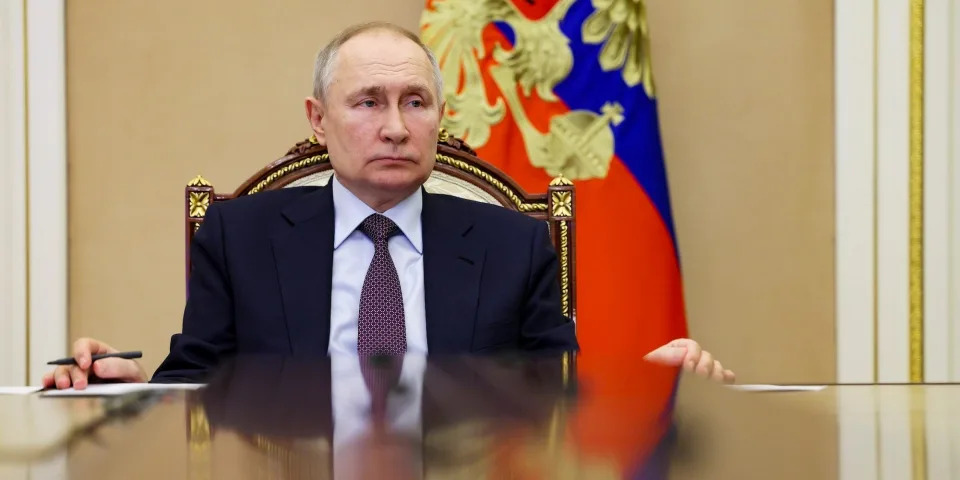
Russian President Vladimir Putin.Gavriil Grigorov/Sputnik, Kremlin Pool Photo via AP
Russia’s economy is hurting and a new wave of EU sanctions targeting its “war machine” are coming.
Growing links to China, an unstable currency and “cherry-picked” data are key developments.
Here are six key things to know about what’s going on in Russia over the past week.
Russia’s economy is reeling from the web of Western sanctions imposed on it after Vladimir Putin launched his war in Ukraine — and an official from the European Union recently said that Moscow will soon face a new wave of penalties coming from Europe.
The country’s finances have taken a massive hit. Russia’s private sector is shrinking, it has posted a $29 billion deficit in the first three months of 2023, and its main revenue sources – oil and gas exports – have plunged since a price cap was imposed by Western powers late last year.
Russia’s growing economic ties to China, its unstable currency, and rising doubts about the accuracy of official government data coming out of Moscow are just some the key developments over the past week.
Here are 6 key things to know about what’s going on in Russia as it grapples with the impact of sanctions on its economy:
1. It’s not clear how Russia’s economy is faring
The world’s top forecasters can’t seem to agree on whether Russia’s economy is expanding or contracting. That’s in part because of the questionable accuracy of the official data provided by Putin’s government since the war began.
Seven predictions from the likes of JPMorgan, Morgan Stanley, Goldman Sachs, the IMF, Bank of Russia and more, all have different – and conflicting – estimates of Russia’s real GDP in 2023.
2. “Cherry-picked” data
Economists around the world have cautioned against relying too much on economic forecasts and predictions that heavily depend on official data coming from Moscow’s government. They said official stats are trying to paint a rosy picture of a resilient economy that’s withstood the impact of sanctions – when in reality, the economy is in tatters.
“Since the Ukrainian invasion, our data has shown that the Kremlin’s economic releases have become increasingly cherry-picked, selectively tossing out unfavorable metrics while releasing only those that are more favorable,” two Yale researchers said.
Alexei Bayer, an independent economist, echoed this view and said the situation is much worse than it seems.
“Russian economic statistics are a collection of lies and distortions,” Bayer said. “They are meant to convince people at home that their economy is chugging along despite the war, and people abroad that Western economic sanctions don’t work and therefore should be rescinded.”
3. There’s a massive hole in the Kremlin’s budget
Russia – the world’s second-larges oil and gas producer — lost over $15 billion in oil and gas revenue during the first quarter of 2023, thanks to the price cap aimed at crippling Moscow’s energy exports.
Russian President Vladimir Putin said he’s optimistic that the situation will improve in the next few months given rising oil prices. Still, some experts said the country has lost its largest export markets, and these shrinking markets for Russia’s resources will eventually push the Kremlin to cut spending on infrastructure and social programs.
4. Falling energy export revenue is shaking the ruble
The Russian ruble is coming off its worst week against the dollar since last year, cratering more than 5%. The falling currency comes as the country’s energy export revenue dipped, and evidence mounts that Russia’s recession in 2022 was way worse than initially thought.
5. Russia is becoming more economically linked to China
While Putin rejected the idea that his country is becoming more economically dependent on China, and said it’s a notion that comes from “jealous people,” Chinese President Xi Jinping was able to secure sweeping trade agreements between the nations without offering up any concrete support in Ukraine.
“The main conduit of a deeper integration of China into Russia has been the Chinese yuan which is now perceived by the Russians as a much safer reserve currency to keep,” Kpler analyst Viktor Katona told Insider.
6. New EU sanctions are looming
The embattled Russian economy is set to face a fresh round of painful sanctions.
Mairead McGuinness, a top EU official, confirmed on Thursday that Europe has plans to roll out its 11th package of penalties against Russia.
She didn’t specify what the new sanctions would be aimed at. However, earlier rounds targeted Russia’s oil and gas exports, key technologies, access to its currency reserves, and both individuals and companies.
Ukraine’s fighter jet fleet is slowly growing, but its weapons to bring down Russian jets are dwindling, leaked US document shows
Christopher Woody – April 16, 2023
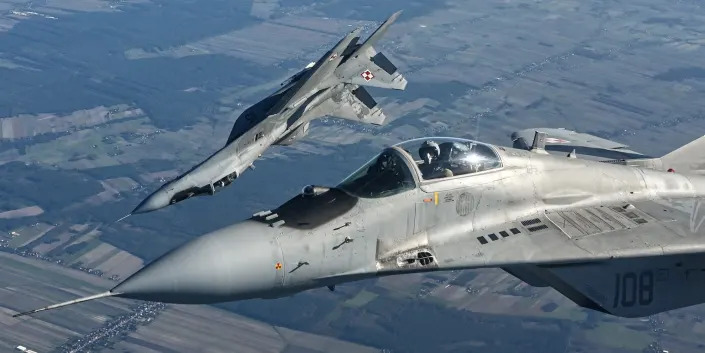
Polish MIG-29 fighter jets during a NATO shielding exercise over Poland in October 2022.Omar Marques/Getty Images
Poland received permission from Germany to send Ukraine five more MiG-29s this week.
The jets will bolster Ukraine’s fighter fleet, which is still under fire from Russia’s larger air force.
But air-defense ammunition is a more urgent need, one underscored in recently leaked US documents.
Poland received permission from Germany to send five MiG-29 fighter jets to Ukraine this week, bolstering Kyiv’s fleet ahead of a season of more intense fighting.
The jets, however, won’t tip the scales in the aerial battle between Russia and Ukraine, and they will arrive as Ukraine and its partners scramble to find more ammunition for Ukrainian air-defense weapons, which have been vital to denying Russia’s aircraft and missiles the ability to strike at will.
Berlin approved Warsaw’s request to send jets to Ukraine on Thursday, the same day it was received. Poland acquired 22 MiG-29s, which had been part of the East German military, from Germany in 2003 with the requirement that the Germans approve any future transfers.
Poland and Slovakia pledged to send roughly two dozen MiG-29s to Ukraine in March. At the time, Poland’s president said the first four jets would be delivered within days, and Ukrainian officials said in late March that the first Slovakian jets were already in combat around Kharkiv.
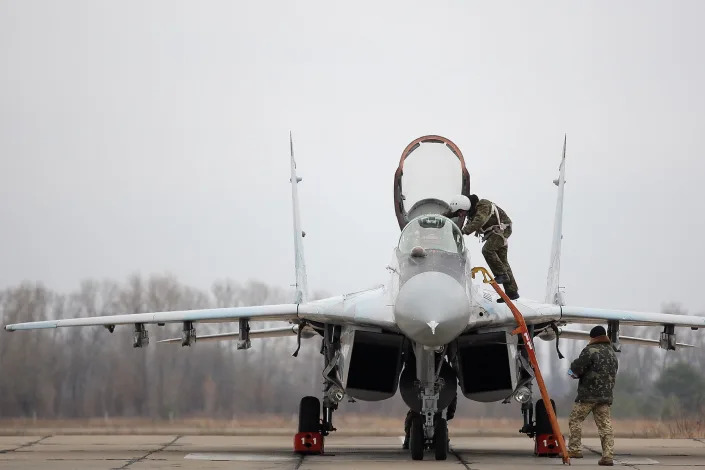
A Ukrainian pilot exits a MiG-29 at an airbase outside of Kyiv in November 2016.Danil Shamkin/NurPhoto via Getty Images
The MiG-29s will give Kyiv an airpower boost and be familiar to pilots with experience on Ukraine’s own MiGs, but Russian and Ukrainian jets remain of limited use over the battlefield, as each side has air-defense weapons that have prevented the other from achieving air superiority.
“Their integrated air- and missile-defense is working pretty well, to the point where they’re shooting down [each] other’s aircraft,” Gen. James Hecker, the commander of US Air Forces in Europe, said at an event hosted by the Mitchell Institute for Aerospace Studies on March 22.
Having more jets “is going to help” the Ukrainians, Hecker said. “This will allow them to come at different axes, which will complicate the problem that Russia has.”
“Is that going to be the enabler that’s going to let them get air superiority? No, I don’t think so, not anytime soon,” Hecker added. “The integrated air- and [missile-defense] system that both Ukraine as well as Russia have is very extensive, and it would be difficult from a US perspective to take all that down in a couple days.”
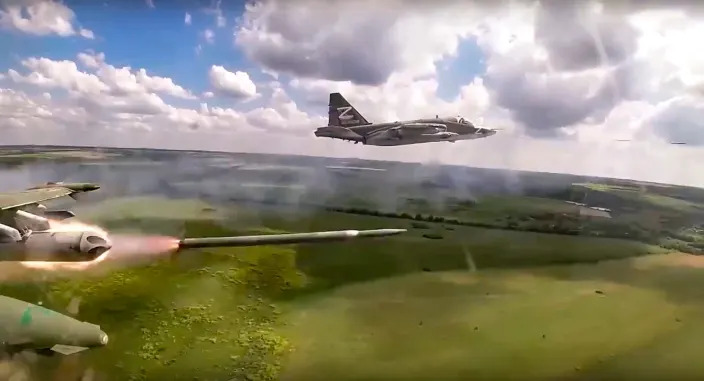
Ukraine started the war with a smaller, less advanced air force than Russia and has lost more than 60 aircraft, while Russia has lost more than 70, Hecker said at a separate event in early March. Both air forces have shifted tactics and now operate farther from the front line, playing to the advantage of the Russian aircraft, which have an edge at longer ranges.
A Russian Su-25 ground-attack jet fires rockets on a mission in Ukraine in July 2022.Russian Defense Ministry Press Service via AP
Ukraine has also adopted US-made weapons, including anti-radiation missiles that have helped suppress Russian surface-to-air missiles and extended-range bomb kits that have had “some success,” Hecker said on March 22.
Ukrainian officials have requested more advanced jets like the US-made F-16, arguing they will give Ukrainian pilots an advantage. US officials have said repeatedly that it would be too costly and time-consuming for Ukraine’s air force to adopt those jets and that other weapons are more immediately useful, particularly air-defense systems, which both Ukrainian and Western officials have cited as one of their highest priorities.
According to classified US Defense Department documents leaked online in recent weeks, US officials believe that Kyiv is at risk of running out of air-defense weapons and ammunition by late spring or early summer, leaving important targets exposed to Russian attacks.
Ukraine’s current air-defense plan “balances limited resources to protect critical national infrastructure (CNI), population centers, front line of troops (FLOT), and other key assets,” according to a summary on one document, which has markings that indicate it was prepared on February 23 and was classified top secret. Insider obtained a copy of it and other documents but could not independently verify their authenticity.
Ukraine’s “ability to provide medium range air defense to protect the FLOT will be completely reduced by MAY 23,” the summary says. A detailed assessment included in the document said Soviet-designed Buk and S-300 systems compose 89% of Ukraine’s defenses for targets above 20,000 feet and that based on expenditure rates at the time, the Buks would be expended by March 31 and S-300s by May 2.
Other systems, such as older Soviet-era SA-3s or Western-provided NASAMs, are limited in number and “unable to match” the volume of attacks.
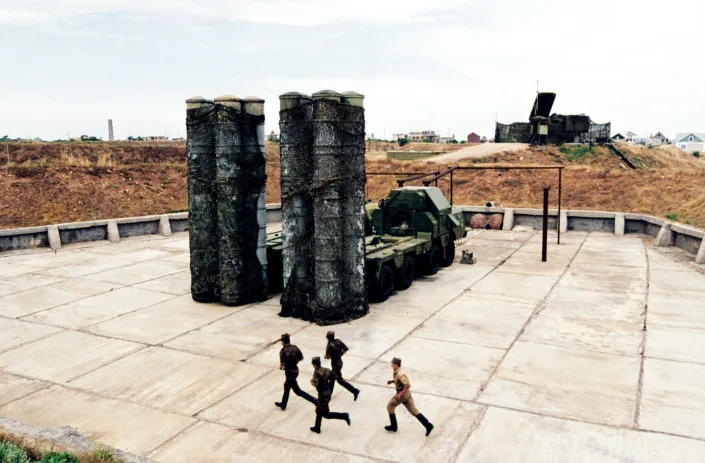
Ukrainian soldiers rush to an S-300 air-defense missile station during training near Sevastopol in July 1995.VALERY SOLOVJEV/AFP via Getty Images
Short-range air-defense weapons provided by Western countries, like Stinger missiles or the Gepard cannon, “mitigate the expenditure” of other surface-to-air missiles but “do not have the same deterrent effect” on Russian aircraft. Ukraine also has “limited to no” air-to-air defense, the document says.
Without the threat posed by those interceptor missiles, Russian aircraft would have greater freedom to attack Ukrainian aircraft and bomb Ukrainian targets, including in support of Russian front-line troops, the leaked document says. Russia’s long-range missiles could also be more accurate, as they would no longer have to dodge air defenses, and the Russian military could expand the type of munitions it is using and conduct a greater range of aerial operations, further challenging Ukraine’s ability to mass forces to conduct attacks.
The document suggests several courses of action, including resupplying Buk and S-300 missiles over the following three months and restricting their usage to Russian tactical aircraft. The document also suggests “military deception” and adjusting firing doctrine to counter Russian aerial attacks more effectively.
The document further recommends over a three- to six-month period providing more Western-made air-defense systems, like Patriots, and expediting work on something called the “FrankenSAM,” which may refer to a modification of an existing weapon or weapons.
The document echoes many of the warnings by Western officials and experts, who have cautioned that without sufficient air-defense ammunition, Ukrainian infrastructure would be more vulnerable, its forces more exposed, and Russia’s military more free to use its aircraft and gather its forces for renewed attacks.
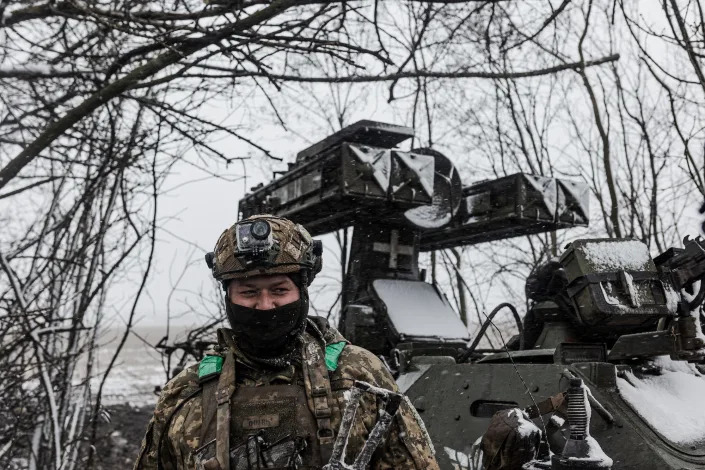
A Ukrainian soldier next to an anti-aircraft battery near Bakhmut on March 30.Diego Herrera Carcedo/Anadolu Agency via Getty Images
Western countries have made air-defense ammunition a focus of recent security-assistance efforts, a reflection of broader efforts to support Ukraine ahead of an expected counteroffensive in the spring and summer.
On March 15, nearly 50 countries participated in the 10th meeting of the Ukraine Defense Contact Group, during which air-defense systems were a major point of discussion. “A broad mix of air-defense systems have been promised, and they will protect the skies over Kyiv and the free cities of Ukraine,” Gen. Mark Milley, chairman of the Joint Chiefs of Staff, said after the meeting.
On April 4, the US announced a $2.6 billion package of security aid for Ukraine that included ammunition for the Patriot system the US provided in December, which will come from existing US stockpiles, as well as ammunition for NASAMs, gun trucks and laser-guided rockets to shoot down drones, anti-aircraft ammunition, and air-surveillance radars, which will be ordered from the US defense industry and take longer to deliver.
The dozens of countries at the Contact Group meeting “responded” to the challenge and were able to provide “a lot more surface-to-air missiles” to Ukrainian forces, Hecker said on March 22, “but it’s something that they’re using constantly because of the tactics that the Russians are using.”
The Superfood You Should Be Adding To Literally Everything For A Healthier Body And Brain
Georgia Dodd – April 16, 2023
There are many healthy habits that you can incorporate into your daily life to promote a healthier body and brain. You can go for a morning jog to boost your metabolism and you can complete a crossword puzzle every night to improve your memory and thinking skills. But, experts agree that one of the best ways to maintain a healthier body and brain is to consume all the nutrients you need to thrive–and that’s where superfoods come in. Superfoods are just high-nutrient and low-calorie foods that are especially beneficial for your health. Luckily, they’re not hard to come by and you probably are already unknowingly eating them.
To learn more about a superfood that both your body and brain will love, we spoke to Paulina Lee, MSHS, RD, LD, a functional gut health dietitian and founder of Savvy Stummy, LLC, Lisa Richards, a registered nutritionist and creator of The Candida Diet, and Dana Ellis Hunnes, PhD, dietitian and author of Recipe For Survival. They told us that you should consider reaching for walnuts on a regular basis if you want to help your brain and body flourish as you age. Learn more about this delicious and nutritious superfood below!
When it comes to superfoods, nuts are some of the best options out there because they contain important nutrients that your body and brain need to thrive. This is especially true for walnuts. In fact, regularly eating walnuts is a great way to reduce inflammation, slow aging, and boost memory. Walnuts have a high concentration of DHA, a type of omega-3 fatty acid. DHA has been shown to improve cognitive abilities in adults and reduce age-related cognitive decline. “These fatty acids are important for brain health and have been shown to improve cognitive function, reduce inflammation, and lower the risk of neurodegenerative diseases,” Richards says. That’s good to know!
And, walnuts are a great source of vitamin E and zinc. These vitamins and minerals keep your cells healthy by protecting them from oxidative damage. Walnuts are highly recommended by health experts like Lee when it comes to reducing inflammation and weight management. “Walnuts contain high amounts of omega-3 fatty acids and antioxidants,” she says. “Omega-3 fatty acids contain anti-inflammatory properties, which may help to reduce weight-related inflammation. Antioxidants from the polyphenols in nuts can fight against oxidative stress by neutralizing free radicals, which are unstable molecules that may cause cell damage and increase disease risk.” Noted!
One of the main reasons that nuts like walnuts make such a fantastic snack for weight loss and the body’s overall health is that they’ll keep you fuller for longer than unhealthy, processed snacks will. “This is a good snack that won’t put on weight because it’s very satisfying,” Hunnes explains. “It’s got protein, fiber, very healthy fats and it can help prevent you from eating more calories later in the day, and it also prevents blood-sugar swings (which make you feel hungry, even if you’re not).”
This crunchy snack can protect your body from free radical damage and more. “Eating walnuts not only protects you from free radicals that can cause skin damage and wrinkles but they’ve also been linked to lower levels of LDL cholesterol which helps to prevent heart disease,” Hunnes adds. You can also add walnuts to your salads and parfaits, or even eat them as nut butter.
The Bottom Line
Maintaining a healthy body and brain is all about making nutritious and beneficial decisions every day. Not only should you eat a healthy diet of superfoods like walnuts, but also make sure that you’re drinking enough water, consistently working out, and performing brain exercises to boost cognition, as well. When in doubt, you can always reach for a handful of walnuts as a snack for a healthier body and brain. Of course, you should also reach out to your doctor if you are seriously concerned about your brain and overall health!
Ukraine hails GPS-guided Excalibur artillery shells that can hit a target 25 miles away with pinpoint accuracy
Alia Shoaib – April 15, 2023
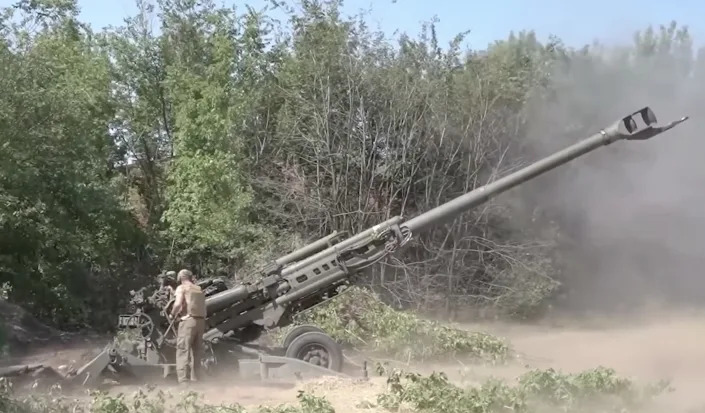
An M982 Excalibur.Gen. Valeriy Zaluzhny / Facebook
Ukraine’s commander-in-chief posted a Facebook video showing the effects of the M982 Excalibur.
Gen. Valeriy Zaluzhny praised the maximum accuracy of the precision-guided shells.
The US has supplied Ukraine with more than 3,000 of the advanced shells, according to a report.
Ukraine’s top general Valeriy Zaluzhny shared a video showing the effectiveness of US-provided M982 Excalibur shells against Russian forces.
In the video, which was posted to Zaluzhny’s Facebook page, a Ukrainian soldier praised the high-precision Excalibur shells, saying they were extremely important for accurately striking Russian forces’ equipment.
“Constant firing by our gunners against Russian positions on the Right [western] Bank [of the Dnipro River] for 24 hours a day, led to the enemy losing a huge amount of equipment which had been shelling Mykolaiv,” the serviceman said, according to a translation by the Kyiv Post.
The video shared by Ukraine’s commander-in-chief appears to show several destroyed Russian weapons systems, including what seems to be a 2S7 Pion self-propelled cannon and two S-300 anti-aircraft systems, the Kyiv Post reported.
The GPS-guided 155 mm shells offer an accurate, longer-range alternative to conventional artillery shell, capable of hitting within seven feet of their target.
The Excalibur has a range of 25 miles, according to Pentagon budget documents from last year that first confirmed the shells had been sent to Ukraine.
While the weapon can be used to accurately strike targets within that range with normal artillery, the US has even used it to score a direct hit on a truck at more than 40 miles in tests, Forces.net reported.
BAE Systems, the manufacturer, said the shell’s “key feature” is that it has the same accuracy regardless of the distance between the gun and the target, adding that it has a “Circular Error Probability,” which is a measure of a weapon’s precision, of less than 10 meters.
The rounds are fired after a crew puts GPS coordinates into the shell, and once it is launched its deployable fins pop out, allowing it to adjust its trajectory to hit the designated location.
The Excalibur’s accuracy “enables a first-round effect on target, reducing the number of rounds required while reducing collateral damage,” according to Army budget documents reported on by Bloomberg.
One downside of the shells is the cost — each Excalibur round costs around $100,000, the documents say, compared with just a few hundred dollars for a conventional munition such as the M795, the US military’s standard unguided 155 mm shell.
It is thought that the US has sent around 3,000 Excalibur rounds to Ukraine since Russia invaded last year, Forces.net reported in January.
How Many Feet Are in a Mile? Here’s a Simple Trick To Remember the Exact Number
Beth Ann Mayer – April 15, 2023
Learn precisely how many feet are in a mile and more fun facts.
Your thoughts on the mile are likely all about perspective. If you’re driving, it’s likely a quick trip (barring massive traffic). You can probably leave a minute before you have to be there and arrive on time. Walking? That’s more of a slog. A marathon runner? No big. But if the only marathon you’ve ever participated in is one that involved watching Law & Order: SVU, running a mile can feel like a steep hill to climb, even if it’s a flat road. How many feet are in a mile, anyway?
You probably learned how many feet are in a mile sometime in school. But, like the difference between an isosceles and a trapezoid and scalene triangle, you likely forgot all about it (unless you’re a parent and your kid needs help with homework).
Here’s a refresher on how many feet there are in a mile, plus more fun facts worth remembering for your next water cooler chat.
How Many Feet Are in a Mile?
There are 5,280 feet in a mile. This distance is a British imperial unit and United States customary unit. It’s equivalent to 1,760 yards.
Where Did the Mile Originate?
The mile originated from the Roman mille passus, AKA “a thousand paces” or “5,000 Roman feet.” According to Merriam-Webster, a Roman pace was equal to five Roman feet or 4.85 English feet. It was “measured in pacing from the heel of one foot to the heel of the same foot when it next touches the ground.”
How Did It Become 5,280 Feet?
Sometime around 1500, the English divided the mile into eight furlongs. Each furlong was 625 feet long, making the mile 5,000 feet. The Statute of 1593, which came under Queen Elizabeth I, lengthened the furlong to 660 feet. That extra 35 feet per furlong added 280 total feet to the mile. The final tally? 5,280 feet.
What Distance Is a Furlong?
Initially, the furlong was 625 feet. But the Statute of 1593 under Queen Elizabeth I extended the length of a furlong to 660 feet.
What Distance Is a Country Mile?
A country mile isn’t an actual unit of measure—it’s a term used to describe a sneaky-long distance. Country roads usually aren’t a straight line like a highway—they can be winding from left to right and up and down. The shortest distance between two points is a straight line, so a winding dirt road can feel longer than it is.
How To Easily Remember How Many Feet Are in a Mile
To easily remember how many feet are in a mile, think of the phrase “five tomatoes.” It’s similar to the 5,280 feet in a mile. Think about it. “Five-to-may-toes” sounds sort of similar to “five-two-eight-oh.”
NATO member Finland breaks ground on Russia border fence
Kostya Manenkov and Sergei Grits – April 15, 2023
Finland’s border guards walk at construction site of the border barrier fence between Finland and Russia near Pelkola border crossing point in Imatra, south-eastern Finland, Friday, April 14, 2023. (AP Photo/Sergei Grits)The construction site of the Finland-Russia eastern border barrier fence near Pelkola crossing point in Imatra, south-eastern Finland, Friday April 14, 2023. In Pelkola the construction of a pilot fence of approximately three kilometres has started on both sides of the Imatra border crossing point. Finland’s 1,340 kilometer (832 mile) border with Russia is the longest of any European Union member. (Roni Rekomaa/Lehtikuva via AP)
IMATRA, Finland (AP) — The construction of barbed-wired fence along Finland’s long border with Russia – primarily meant to curb illegal migration – has broken ground near the southeastern town of Imatra less than two weeks after the Nordic country joined NATO as the 31st member of the military alliance.
The Finnish Border Guard on Friday showcased the building of the initial three kilometer (1.8 mile) stretch of the fence to be erected in Pelkola near a crossing point off Imatra, a quiet lakeside town of some 25,000 people.
Finland’s 1,340 kilometer (832 mile) border with Russia is the longest of any European Union member.
Construction of the border fence is an initiative by the border guard that was approved by Prime Minister Sanna Marin’s government amid wide political support last year. The main purpose of the three-meter (10-foot) high steel fence with a barbed-wire extension on top is to prevent illegal immigration from Russia and give reaction time to authorities, Finnish border officials say.- ADVERTISEMENT -https://s.yimg.com/rq/darla/4-11-1/html/r-sf-flx.html
In 2015-2016, Moscow attempted to influence Finland by organizing large numbers of asylum-seekers to northern Finnish crossing points in the Arctic Lapland region. Russian authorities were seen deliberately ushering thousands of asylum-seekers – mostly from Iraq, Afghanistan and other Middle East nations – to those border crossing points.
The move was seen as a show of muscle by Moscow. The issue was settled when Finnish President Sauli Niinistö held talks with Russian President Vladimir Putin. The flow of migrants stopped shortly thereafter.
This is a scenario that Finland – a nation 5.5 million people that officially became a NATO member on April 4 – wants to prevent from repeating itself.
Border officials are quick to acknowledge, however, that it was Russia’s invasion of Ukraine on Feb. 24 last year – the main reason for Finland’s quick push to join NATO after decades of military nonalignment – that prompted construction of the border fence.
“Border barrier fence was no kind of political topic before the war (in Ukraine). And actually, it wasn’t a kind of plan of the Finnish border guard,” Brig. Gen. Jari Tolppanen, head of the technical division at the Finnish Border Guard, told The Associated Press. “All changed after the attack (of Russia against Ukraine).”
The pilot section of the fence is scheduled to be completed by this summer, while the barrier will eventually be extended to a maximum of 200 kilometers (124 miles). It will cover areas – in bits and pieces of separate length – mainly in southeastern Finland near the main border crossing points with Russia but it will also have sections up in the Arctic north in Lapland.
“In this new situation, we must have much more credible and much more independent border control,” Tolppanen said. “We need to strengthen our resources. And the fence is necessary in order to manage, for example, large-scale illegal immigration.”
Imatra is located a mere seven kilometers (4.4 miles) off the Russian industrial town of Svetogorsk in the Karelia region and is a few hours’ drive away from Russia’s second city of St. Petersburg. The town has a long history in dealing with Russians – tourists, day-trippers and permanent residents alike.
“Here in Imatra, we’re not so afraid about Russians because the border has always been there and it has never been open like between European countries,” said Antero Lattu, vice chairman of Imatra City Council. He stressed that locals aren’t afraid of Russians “but we’re happy because of that fence.”
Erkki Jouhki, who works as a town planner, agreed but also stressed Finland’s military capabilities. NATO membership gives Finland “a strong back but we have a very strong army. it’s very well (armed) … it’s a very modern army here because of Russia.”
The border fence project is estimated to cost a total of 380 million euros ($422 million) and is scheduled to be completed by 2026.
Finland’s long eastern frontier runs mainly through thick forests. In some places the Finnish-Russian border is marked only by wooden posts with low fences meant to stop stray cattle.
Jari Tanner in Helsinki contributed to this article.
Finland starts fence on Russian border amid migration, security concerns
Anne Kauranen – April 14, 2023
Finland starts building border fence on Russian border
IMATRA, Finland (Reuters) – Finland is building the first stretch of a fence on its border with Russia on Friday, less than two weeks after it joined the NATO military alliance to complete a security U-turn taken in response to the war in Ukraine.
Fearing retaliation from the east following its NATO application, the government decided last year to construct the barrier, primarily in case Russia moved to flood the border with migrants.
Finland aims to guard against a repeat of events on the European Union’s eastern frontier in Poland in winter 2021, when the bloc accused neighbouring Belarus – a staunch Russian ally – of engineering a crisis by flying in migrants from the Middle East, giving them visas and pushing them across the border.
Made of steel mesh, the Finnish fence is scheduled to cover some 200 kilometres (125 miles) of the most critical parts of its border by the end of 2026. Project manager Ismo Kurki said on Friday that, while it is not intended to stop any invasion attempt, the fence will have surveillance equipment.
Meanwhile, there has so far been little human activity along the border, which stretches to 1,300 km in all.
Last year, Finland detected only 30 illegal crossings there, while Russian border guards stopped some 800 attempts to enter Finland, the Finnish Border Guard said.
“The situation at the Finnish-Russian border has been stable and is stable at the moment,” said Border Guard Brigadier General Jari Tolppanen, as one of his teams worked on the first 3-kilometre (1.9-miles) stage of the fence at Imatra, some 250km (155 miles) northeast of Helsinki.
“But in this totally changed (security) situation, Finland must have more credible and more independent border control. And Finland needs to be less dependent on the Russian border control,” he added.
Poland and the Baltic States have already began erecting fences on their borders with Russia and Belarus following the February 2022 invasion of Ukraine.
Until now, the Finnish-Russian border has been a mere line in the vast forests covering the area, marked only by a low wire fence intended to stop cattle and other domestic animals but not people.
The new fence will be 3 metres (10ft) high, topped with razor-wire and tracked by a road, and cost an estimated 380 million euros ($417 million).
“Most of (the border area) is very remote and very difficult to access. We construct the target areas which are accessible by vehicle and where large-scale illegal immigration is likely,” Tolppanen said.
($1 = 0.9106 euros)
(Reporting by Anne Kauranen; editing by John Stonestreet)
Gunmen storm Mexican resort, kill 7, including child
Daniel Becerril – April 15, 2023
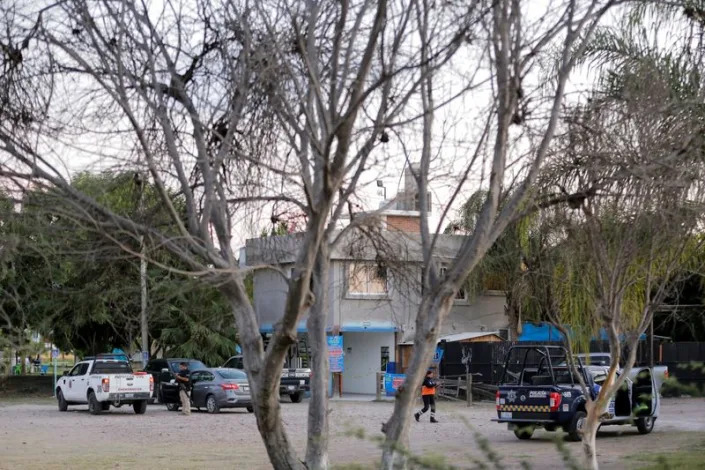
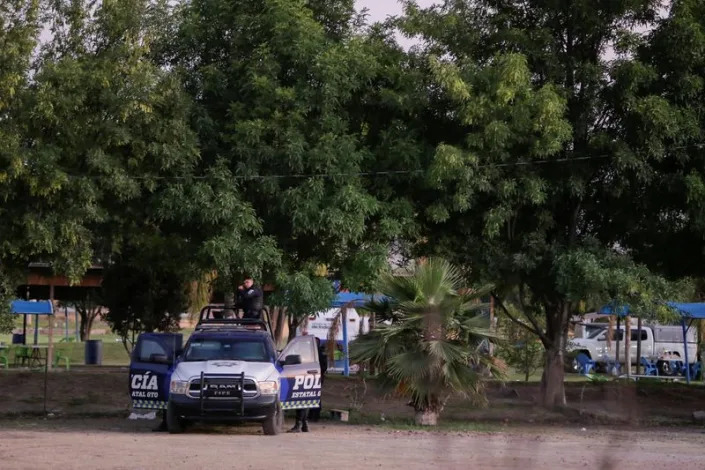
MEXICO CITY (Reuters) – Armed men on Saturday killed a child and six others after storming a resort in the central Mexican state of Guanajuato, authorities said, in a region increasingly plagued by drug cartel violence.
Footage widely shared on social media showed the aftermath of the attack in a palm-studded resort in the small town of Cortazar, about 65 km (40 miles) south of the Guanajuato city.
It was not clear who was behind the shooting that killed the seven-year-old, three men and three women, Cortazar’s local security department said. One person was seriously injured in the La Palma resort.
But in recent years rival drug cartels have been waging brutal battles to control territory and trafficking routes through the state.
Video taken soon after the attack showed shocked adults and children walking past piles of dead bodies near a swimming pool.
“Heavily armed sicarios arrived and this is what happened,” said an unidentified man, using a word for hired assassins as he filmed at the resort in a video shared on the internet.
Reuters could not independently verify the contents of the video.
“After the attack, (the attackers) fled, but not before causing damage to the resort store and taking the security cameras and the monitor,” Cortazar’s security department said in a statement.
(Reporting by Daniel Becerril; Writing by Drazen Jorgic; Editing by William Mallard)
— Republican Accountability (@AccountableGOP) April 13, 2023
Trump has long had starry eyes for dictators and strongmen, and spent much of his presidency cozying up to such leaders ― while at the same time often keeping the staunchest U.S. allies at arm’s length.
He sided with Putin when questioned about U.S. intelligence that found Russia interfered on his behalf in the 2016 election, and boasted that he got along so well with Kim that they “fell in love.”
And just last week, he bragged to Sean Hannity about how he “got along great” with various dictators.
On the flipside, he dismissed Canadian Prime Minister Justin Trudeau as a “far left lunatic” and accused French President Emmanuel Macron of being “very insulting.”
The Republican Accountability Project has been releasing videos, ads and billboards calling out Trump and the GOP lawmakers who enabled his lies about the 2020 election and supported the Jan. 6 insurrection.