Russians Fear They’ll Soon Be Starving ‘Like North Koreans’
Julia Davis – January 10, 2023
Alexey Malgavko/Reuters
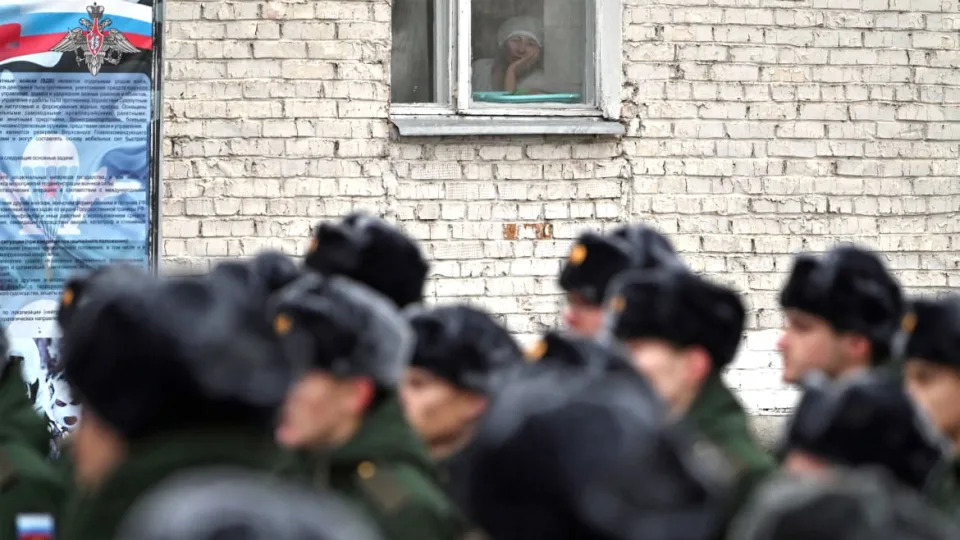
Russia rang in the new year with gaudy excess, patriotic fervor and echoes of a Soviet past. In studios filled with visiting servicemen, brought in from the front lines to film the New Year’s extravaganza, hosts and performers toasted victory and mocked the West for the side effects of Russian sanctions. Comedian Yevgeny Petrosyan cheered for the troops, assuring them that the entire country was behind them. He taunted Ukraine and its Western allies: “Like it or not, Russia is enlarging!”
Noisy bravado couldn’t hide the fact that no one was drinking from the champagne glasses seemingly filled with sparkling water, or the blank stares on the faces of the visiting troops. One of the hosts, sports commentator Dmitry Guberniev, compared life to a biathlon—a grueling cross-country ski race with rifle shooting—and surmised: “If you’re having a hard time, then the finish line is near and victory is close!”
Holiday cheer notwithstanding, even Russian propagandists realize that hard times are only starting and attempts to summon a ghost of the Soviet past are directly related to a starkly different way of life that awaits the average Russian. On Wednesday, host of Solovyov Live Sergey Mardan struggled to contain his feelings about “the grinning and glee on the federal channels,” which continued even after the news of a HIMARS strike that killed dozens of Russian troops in Makiivka. Mardan raged: “What happened in Makiivka is a tragedy! A real tragedy! There didn’t have to be a phone call from the top for them to figure out that TV programming should be changed to something that is more fitting. Instead of vulgar anecdotes, put on any old Soviet movie.”
The Soviet grooming that is being implemented by many Russian propagandists is meant to condition the people to the rapid decline in the standards of living to which many of them have become accustomed. The expectations are so dire, Mardan posed a startling question to his economic expert, Denis Raksha: “What are our chances? Do we even have them or not? Will we have to live like South Korea in the 1950s-1960s? Will we end up having to eat fire ants?”
Raksha explained that if Russia intends to drastically rebuild its economy in order to be self-sustaining everyday life will become quite difficult, even if Russians won’t have to resort to eating ants. He added: “Currently, the industrialization reminiscent of that of the 19th century or the 1920s-1930s is practically impossible. In that case, we’d have to live not like South Koreans, but like North Koreans.”
Workers remove debris of a destroyed building used as temporary accommodation for Russian soldiers, 63 of whom were killed in a Ukrainian missile strike as stated the previous day by Russia’s Defence Ministry in Makiivka, Russian-controlled Ukraine, Jan. 3, 2023.Alexander Ermochenko/Reuters
Another kind of hunger is also concerning Russian experts: a looming lack of ammunition. On Jan. 2, Victor Murakhovsky, editor-in-chief of the Arsenal of the Fatherland magazine, raised an alarm on his Telegram channel, where he wrote: “In 1914, miscalculations of the General Staff as to the rate of accumulation of shells (900 shots) led to an acute shortage of shells for the army in the field. Urgent measures were required to save the army from a complete shell starvation. The military industry was not ready to solve this problem… the “ammo hunger” was fully eliminated only in 1916.”
Murakhovsky went on to explain his calculations for the same problem that is raising its head now: “In the early 1990s, the Russian army inherited from the Soviet army about 15 million tons of missiles and ammunition… As of January 1, 2013, the Armed Forces of the Russian Federation had 3.7 million tons of ammunition, of which 1.1 million tons are unusable. This means that 2.6 million tons of ammunition are usable. In 2020, almost 300 thousand pieces of ammunition were repaired and more than 20 thousand shells for multiple launch rocket systems were collected. The realistic need for ammunition is MILLIONS of pieces per year.”
During his program, Mardan described the predictions of the upcoming ammunition shortages as “apocalyptic writings” and pondered out loud whether Russian industry would be able to solve this problem. His guest, military expert Vladislav Shurygin, cautiously replied: “I read that post. It should be acknowledged that it was written by one of our best military professionals… but his calculations didn’t include the rate at which the ammo is currently being produced.” He argued that imposing strict usage norms on the battlefield was the way to keep the issue under control. Meanwhile, Russia is reportedly continuing to court other pariah states to source weapons and ammo to replenish its dwindling stocks.
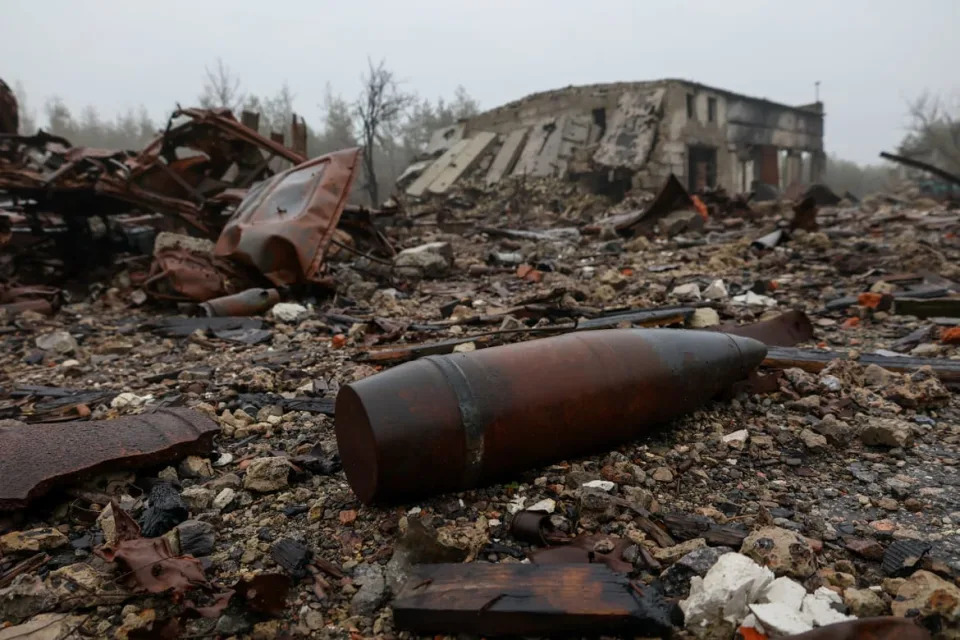
An ammunition depot of the Russian military, which was destroyed by Ukrainian servicemen in the city of Izyum, Kharkiv region on Dec. 13, 2022. Military equipment of the Russian forces and ammunition of various calibers, including non-detonated ones, were destroyed all around.Sofiia Bobok/Anadolu Agency via Getty Images
The simple solution of abandoning Russia’s failing invasion of Ukraine never seems to occur to the pro-Kremlin propagandists. Mardan raged: “The enemy has to be destroyed down to the root! It has to be exterminated! Russian history of the last 1,000 years shows that the deed has to be brought to its final conclusion… If Stalin had deported [the people of] Western Ukraine—to me, it’s still a mystery why he didn’t do it—perhaps none of this would be happening.”
To sweeten the pot, the host rejoiced over millions of Ukrainian refugees who ended up in Russia, while Moscow struggles to alleviate a severe demographic crisis: “Look at how much the Motherland is spending to solve the demographic problem… We got these people [Ukrainians] for free, for nothing—approximately five million of them! Five million souls!”
Concluding the program, Mardan grimly noted: “To everyone who says that Russia should get up off its knees—myself included—my friends, I’m afraid that our former way of life is a thing of the past… It’s practically unavoidable… perhaps we’ll be reflecting upon the past year as our last fat year. On the other hand, a great victory is ahead of us!”
‘What madness looks like’: Russia intensifies Bakhmut attack
Andrew Meldrum – January 10, 2023
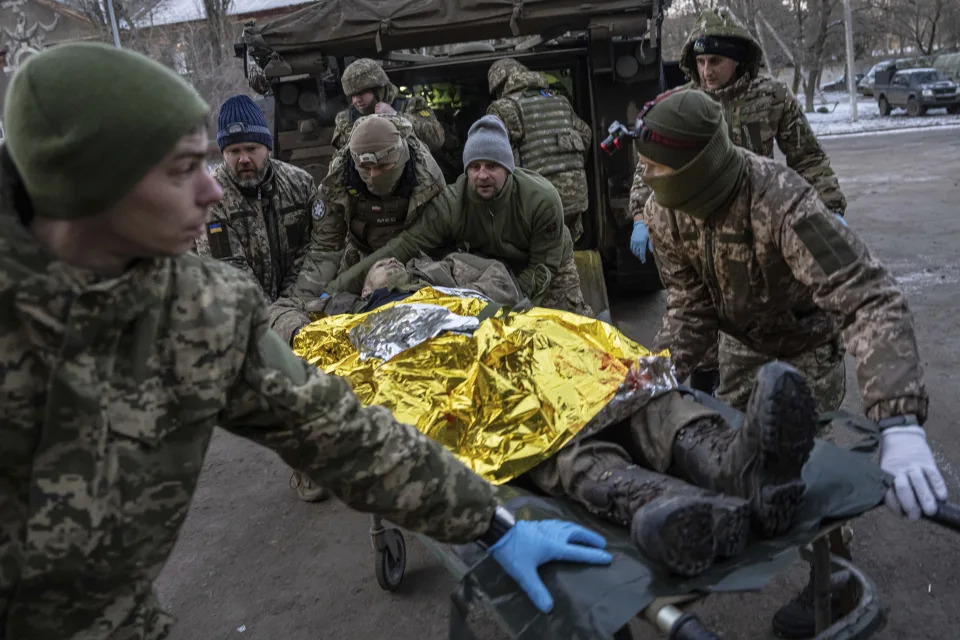
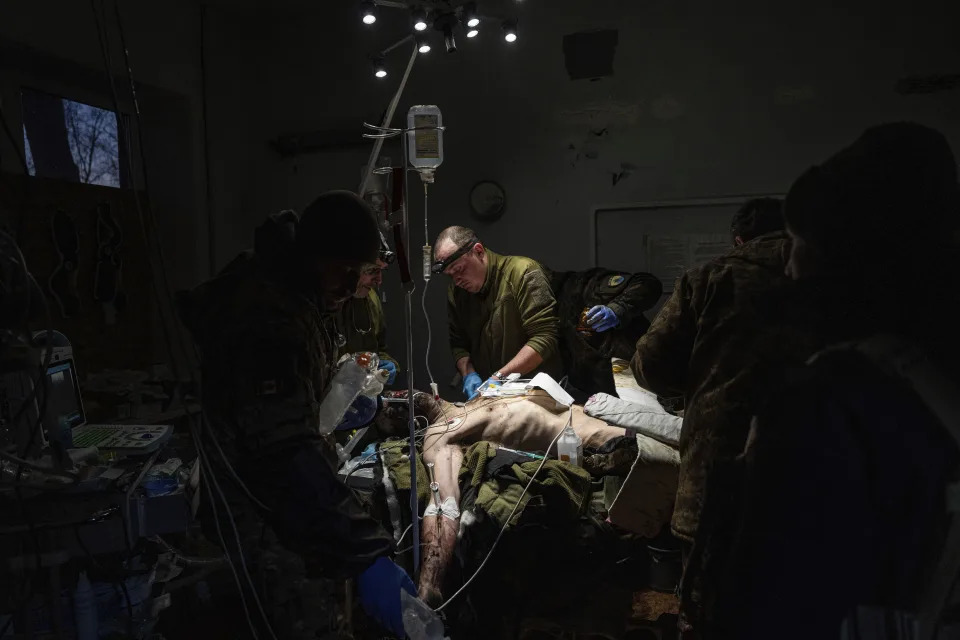
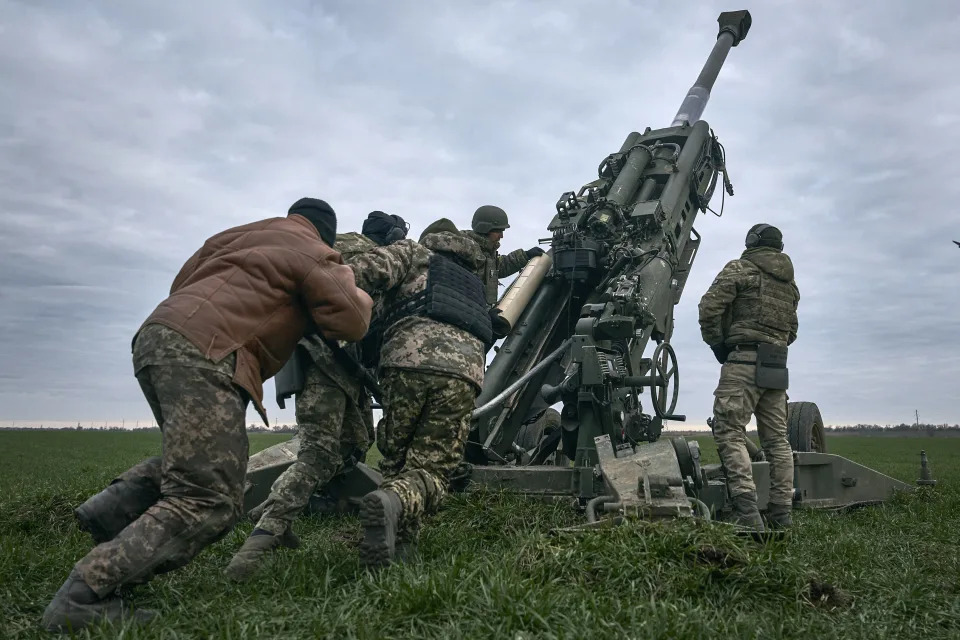
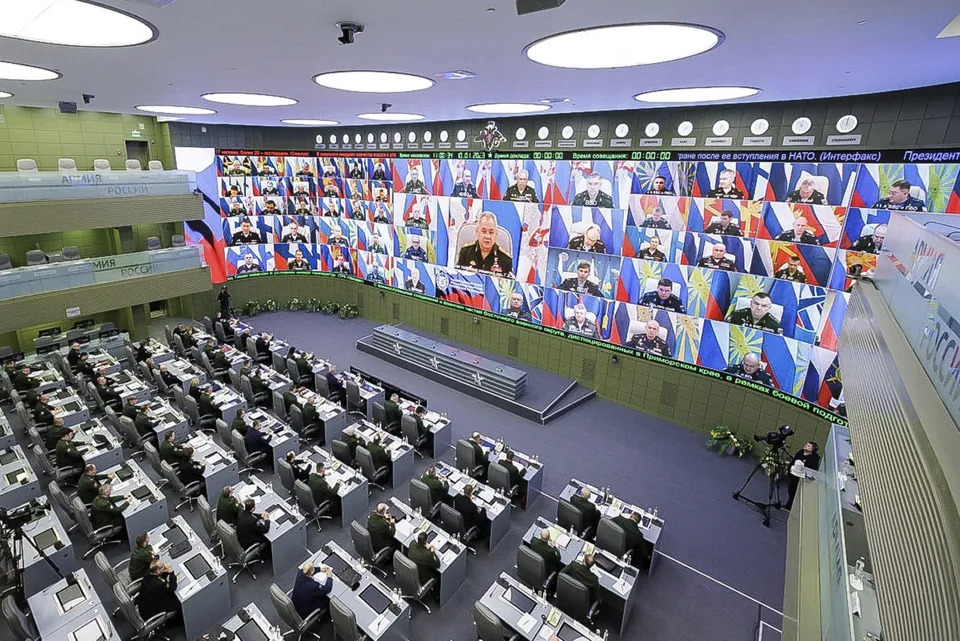
Ukrainian military medics carry an injured Ukrainian serviceman evacuated from the battlefield into a hospital in Donetsk region, Ukraine, Monday, Jan. 9, 2023. The serviceman did not survive. (AP Photo/Evgeniy Maloletka)Ukrainian military doctors treat their injured comrade who was evacuated from the battlefield at the hospital in Donetsk region, Ukraine, Monday, Jan. 9, 2023. The serviceman did not survive. (AP Photo/Evgeniy Maloletka)A Ukrainian serviceman carries his injured comrade evacuated from the battlefield into a hospital in Donetsk region, Ukraine, Monday, Jan. 9, 2023. (AP Photo/Evgeniy Maloletka)Ukrainian military medics carry an injured Ukrainian serviceman evacuated from the battlefield into a hospital in Donetsk region, Ukraine, Monday, Jan. 9, 2023. A serviceman did not survive. (AP Photo/Evgeniy Maloletka)Ukrainian soldiers prepare a U.S.-supplied M777 howitzer to fire at Russian positions in Kherson region, Ukraine, Jan. 9, 2023. (AP Photo/Libkos)In this handout photo released by Russian Defense Ministry Press Service on Tuesday, Jan. 10, 2023, Russian Defense Minister Sergei Shoigu is seen on the screen as he speaks during a meeting with Russian high level officers in Moscow, Russia. (Russian Defense Ministry Press Service via AP)
KYIV, Ukraine (AP) — Russian forces are escalating their onslaught against Ukrainian positions around the wrecked city of Bakhmut, Ukrainian officials said, bringing new levels of death and devastation in the grinding, monthslong battle for control of eastern Ukraine that is part of Moscow’s wider war.
“Everything is completely destroyed. There is almost no life left,” Ukrainian President Volodymyr Zelenskyy said late Monday of the scene around Bakhmut and the nearby Donetsk province city of Soledar, known for salt mining and processing.
“The whole land near Soledar is covered with the corpses of the occupiers and scars from the strikes,” Zelenskyy said. “This is what madness looks like.”
Late Tuesday, the head of the Wagner Group, a Russian private military contractor, Dmitry Prigozhin, claimed in audio reports posted on his Russian social media platform that his forces had seized control of Soledar, with battles continuing in a “cauldron” in the city’s center. Ukrainian officials did not comment on the claim, and The Associated Press was unable to verify it.
The U.K. Defense Ministry said earlier that Russian troops alongside soldiers from the Wagner Group had advanced in Soledar and “are likely in control of most of the settlement.”
The ministry said that taking Soledar, 10 kilometers (6 miles) north of Bakhmut, was likely Moscow’s immediate military objective and part of a strategy to encircle Bakhmut. But it added that “Ukrainian forces maintain stable defensive lines in depth and control over supply routes” in the area.
A Western official, speaking on condition of anonymity, said the Wagner Group “has moved from being a niche sideshow of Russia’s war to a major component of the conflict,” adding that its forces now make up as much as a quarter of Russian combatants.
The Kremlin, whose invasion of its neighbor 10 1/2 months ago has suffered numerous reversals, is hungry for victories. Russia illegally annexed Donetsk and three other Ukrainian provinces in September, but its troops have struggled to advance.
After Ukrainian forces recaptured the southern city of Kherson in November, the battle heated up around Bakhmut.
Ukraine’s deputy defense minister, Hanna Malyar, said Russia has thrown “a large number of storm groups” into the fight for the city. “The enemy is advancing literally on the bodies of their own soldiers and is massively using artillery, rocket launchers and mortars, hitting their own troops,” she said.
Pavlo Kyrylenko, the Donetsk region’s Kyiv-appointed governor, on Tuesday described the Russian attacks on Soledar and Bakhmut as relentless.
“The Russian army is reducing Ukrainian cities to rubble using all kinds of weapons in their scorched-earth tactics,” Kyrylenko said in televised remarks. “Russia is waging a war without rules, resulting in civilian deaths and suffering.”
Wounded soldiers arrive around the clock for emergency treatment at a Ukrainian medical stabilization center near the front line around Bakhmut. Medics fought for 30 minutes Monday to save a soldier, but his injuries were too severe.
Another soldier suffered a head injury after a fragment pierced his helmet. Medics quickly stabilized him enough to transfer him to a military hospital.
“We fight to the end to save a life,” Kostyantyn Vasylkevich, a surgeon and the center’s coordinator, told The Associated Press. “Of course, it hurts when it is not possible to save them.”
The Moscow-backed leader of the occupied areas of Donetsk, Denis Pushilin, told Russian state TV control over the city would create “good prospects” for taking over Bakhmut, as well as Siversk, a town further north where Ukrainian fortifications “are also quite serious.”
An exceptional feature of the fighting near Bakhmut is that some of it has taken place around entrances to disused salt mine tunnels which run for some 200 kilometers (120 miles), the British intelligence report noted.
“Both sides are likely concerned that (the tunnels) could be used for infiltration behind their lines,” it said.
In Russia, two signs emerged Tuesday that officials were grappling with the military shortcomings revealed during the conflict in Ukraine.
Russian Defense Minister Shoigu, whose performance has been fiercely criticized in some Russian circles but who has retained Russian President Vladimir Putin’s confidence, said Tuesday that his military would use its experience in Ukraine to improve combat training.
Military communications and control systems will be improved using artificial intelligence, Shoigu said, and troops will be given better tactical gear and equipment.
The second indication of trouble involves Russia’s production of weapons and other supplies its military needs for the fight in Ukraine. The deputy head of Russia’s Security Council, Dmitry Medvedev, warned that officials who failed to meet deadlines for such items could face criminal charges.
Putin appointed Medvedev last month to head a new commission tasked with trying to solve the military’s supply problems. Numerous reports have suggested Russia is running low on certain weapons and was sending some troops into battle with insufficient equipment and clothing.
Part of the Kremlin’s challenge is keeping up with the weapons and supplies that Western allies are providing to Ukraine.
The Patriot surface-to-air guided missile defense system is one of the weapons Ukraine is about to receive, and the Pentagon announced Tuesday that about 100 Ukrainian troops will head to Oklahoma’s Fort Sill as soon as next week to begin training on it. That will help Ukraine protect itself against Russian missile attacks. The United States pledged one Patriot battery last month, and Germany has pledged an additional system.
Germany’s foreign minister, Annalena Baerbock, announced Tuesday while visiting Ukraine’s second largest city, Kharkiv, that her country would also provide 40 million euros ($43 million) to help with demining, energy infrastructure and internet connections, German news agency dpa reported.
Several front-line cities in eastern Ukraine’s Donetsk and Luhansk provinces have witnessed intense fighting in recent months.
Together, the provinces make up the Donbas, a broad industrial region bordering Russia that Putin identified as a focus from the war’s outset and where Moscow-backed separatists have fought since 2014.
Russia’s grinding eastern offensive captured almost all of Luhansk during the summer. Donetsk escaped the same fate, and the Russian military subsequently poured manpower and resources around Bakhmut.
Taking Bakhmut would disrupt Ukraine’s supply lines and open a route for Russian forces to press toward Kramatorsk and Sloviansk, key Ukrainian strongholds in Donetsk.
Like Mariupol and other contested cities, Bakhmut endured a long siege without water and power even before Moscow launched massive strikes to take out public utilities across Ukraine.
Kyrylenko, the Donetsk region’s governor, estimated more than two months ago that 90% of Bakhmut’s prewar population of over 70,000 had fled since Moscow focused on seizing the entire Donbas.
Ukraine’s presidential office said at least four civilians were killed and another 30 wounded in Russian shelling between Monday and Tuesday.
Vitaliy Kim, the governor of the southern Mykolaiv region, said Russian forces shelled the port of Ochakiv and the area around it late Monday and again early Tuesday. He said 15 people, including a 2-year-old child, were wounded.
Grand jury in Georgia delivers report on Trump, charges could come in next few months
Michael Isikoff, Chief Investigative Correspondent – January 9, 2023
Former President Donald Trump at a rally in Commerce, Ga., in March of last year. (Megan Varner/Getty Images)
A Georgia special grand jury investigating Donald Trump’s efforts to overturn the results of the 2020 election in that state has delivered its report to local judges, paving the way for Fulton County District Attorney Fani Willis to potentially bring criminal charges against the former president and some of his allies in the next few months.
The special grand jury completed its work late last year after taking testimony from dozens of witnesses — including former White House chief of staff Mark Meadows and Sen. Lindsey Graham, R-S.C. — who never testified before the House committee investigating Jan. 6. But Willis never subpoenaed Trump himself to testify, apparently concluding that it would needlessly bog down her investigation with legal motions and other court challenges from the former president.
Willis herself is expected to get a copy of the report sometime on Monday. The Fulton County judge overseeing the case, Robert McBurney, filed an order Monday morning with the court declaring that the special grand jury — which had been convened at Willis’s request and began taking testimony last June — had completed its work.
Fulton County Superior Court Judge Robert McBurney instructs potential jurors during proceedings in May of last year. (Ben Gray/AP)
“It is the ORDER of this Court that the special purpose grand jury now stands DISSOLVED,” McBurney wrote in his order. “The Court thanks the grand jurors for their dedication, professionalism, and significant commitment of time and attention to this important matter. It was no small sacrifice to serve.”
McBurney also scheduled a hearing for Jan. 24, to determine if portions of the report or the entire document can be made public. Under Georgia law, special grand juries such as the one Willis convened can conduct investigations and make recommendations about whether to bring criminal charges. But for such charges to be formally filed, Willis will have to present the evidence to a regular grand jury — a process that could take several more months.
“This is a major milestone,” Norm Eisen, a Brookings Institution fellow who served as an adviser to the House Judiciary Committee during the first impeachment of Trump, told Yahoo News. “I think it’s safe to say that charges are likely — but not certain — against Trump and a single-digit number of co-conspirators.”
At a minimum, Willis’s probe appears to be on a faster track than a broader U.S. Department of Justice investigation into Trump’s conduct relating to the 2020 presidential election and the events of Jan. 6. That investigation is now being overseen by a special counsel, Jack Smith, appointed by Attorney General Merrick Garland. (Smith, who had been serving as an international war crimes prosecutor in the Hague, only recently returned to the United States following his recuperation from a bicycle accident.)
Fulton County District Attorney Fani Willis, right, talks with a member of her team during proceedings to seat a special purpose grand jury in Fulton County, Ga., last May. (Ben Gray/AP)
Willis first announced her probe in early 2021, after the disclosure of then-President Trump’s Jan. 2, 2021, phone call to Georgia Secretary of State Brad Raffensperger urging him to “find” enough votes to flip the state’s electoral votes from Joe Biden to Trump. Since then, she has expanded the probe to include related schemes in the state, including the appointment of so-called fake electors pledged to Trump and who were convened by Georgia Republican Party Chairman David Shafer at the state capital on Dec. 14, 2020.
Willis has strongly hinted that she was examining whether to use Georgia’s broad racketeering law to bring conspiracy charges against Trump and his allies. Like many other details in the special grand jury’s still secret report, it is not clear whether the grand jurors themselves recommended that approach.
But Eisen said it is not a surprise that Willis chose not to call Trump before the special grand jury. “We all know that Trump would never have cooperated,” he said. “So why bother?”
John Deere will let US farmers repair their own equipment
The deal comes amid political pressure over right to repair measures.
Jon Fingas, Reporter – January 9, 2023
Jon G. Fuller/VW Pics/Universal Images Group via Getty Images
John Deere has been one of the stauncher opponents of right to repair regulation, but it’s now willing to make some concessions. Deere & Company has signed a memorandum of understanding with the American Farm Bureau Federation (AFBF) that lets US farmers and independent repair shops fix equipment, rather than requiring the use of authorized parts and service centers. Users will have access to official diagnostics, manuals, tools and training. Deere will let owners disable electronic locks, and won’t bar people from legally obtaining repair resources even if the company no longer offers them.
The agreement includes some protections for the equipment maker. John Deere won’t be required to “divulge trade secrets,” or to allow repairs that might disable emissions controls, remove safety features or modify power levels. Unsurprisingly, fixes also can’t violate the law.
The memorandum is effective as of January 8th, although John Deere didn’t detail exactly how or when it would alter its practices. We’ve asked the company for comment. In a statement, senior VP Dave Gilmore said the company was looking forward to working with customers and the ABFB in the “months and years ahead” to provide repair facilities.
The pact is characterized as a “voluntary” private arrangement. However, it comes alongside mounting political pressure that effectively gave John Deere little choice but to improve repairability. President Biden ordered the Federal Trade Commission to draft right to repair regulation in 2021, while states like New York have passed their own (sometimes weakened) legislation. If Deere doesn’t act, it risks legal battles that could limit where and how it does business in the country.
As it stands, the farm equipment maker isn’t alone in responding to government action. Apple, Google, Samsung and other tech brands now have do-it-yourself repair programs in place. Microsoft will offer Surface parts to users later this year.
UN says ozone layer slowly healing, hole to mend by 2066
Seth Borenstein – January 9, 2023
In this NASA false-color image, the blue and purple shows the hole in Earth’s protective ozone layer over Antarctica on Oct. 5, 2022. Earth’s protective ozone layer is slowly but noticeably healing at a pace that would fully mend the hole over Antarctica in about 43 years, a new United Nations report says. (NASA via AP, File)
DENVER (AP) — Earth’s protective ozone layer is slowly but noticeably healing at a pace that would fully mend the hole over Antarctica in about 43 years, a new United Nations report says.
A once-every-four-years scientific assessment found recovery in progress, more than 35 years after every nation in the world agreed to stop producing chemicals that chomp on the layer of ozone in Earth’s atmosphere that shields the planet from harmful radiation linked to skin cancer, cataracts and crop damage.
“In the upper stratosphere and in the ozone hole we see things getting better,” said Paul Newman, co-chair of the scientific assessment.
The progress is slow, according to the report presented Monday at the American Meteorological Society convention in Denver. The global average amount of ozone 18 miles (30 kilometers) high in the atmosphere won’t be back to 1980 pre-thinning levels until about 2040, the report said. And it won’t be back to normal in the Arctic until 2045.
Antarctica, where it’s so thin there’s an annual giant gaping hole in the layer, won’t be fully fixed until 2066, the report said.
Scientists and environmental advocates across the world have long hailed the efforts to heal the ozone hole — springing out of a 1987 agreement called the Montreal Protocol that banned a class of chemicals often used in refrigerants and aerosols — as one of the biggest ecological victories for humanity.
“Ozone action sets a precedent for climate action. Our success in phasing out ozone-eating chemicals shows us what can and must be done – as a matter of urgency — to transition away from fossil fuels, reduce greenhouse gases and so limit temperature increase,” World Meteorological Organization Secretary-General Prof. Petteri Taalas said in a statement.
Signs of healing were reported four years ago but were slight and more preliminary. “Those numbers of recovery have solidified a lot,” Newman said.
The two chief chemicals that munch away at ozone are in lower levels in the atmosphere, said Newman, chief Earth scientist at NASA’s Goddard Space Flight Center. Chlorine levels are down 11.5% since they peaked in 1993 and bromine, which is more efficient at eating ozone but is at lower levels in the air, dropped 14.5% since its 1999 peak, the report said.
That bromine and chlorine levels “stopped growing and is coming down is a real testament to the effectiveness of the Montreal Protocol,” Newman said.
“There has been a sea change in the way our society deals with ozone depleting substances,” said scientific panel co-chair David W. Fahey, director of the U.S. National Oceanic and Atmospheric Administration’s chemical sciences lab.
Decades ago, people could go into a store and buy a can of refrigerants that eat away at the ozone, punch a hole in it and pollute the atmosphere, Fahey said. Now, not only are the substances banned but they are no longer much in people’s homes or cars, replaced by cleaner chemicals.
Natural weather patterns in the Antarctic also affect ozone hole levels, which peak in the fall. And the past couple years, the holes have been a bit bigger because of that but the overall trend is one of healing, Newman said.
This is “saving 2 million people every year from skin cancer,” United Nations Environment Programme Director Inger Andersen told The Associated Press earlier this year in an email.
A few years ago emissions of one of the banned chemicals, chlorofluorocarbon-11 (CFC-11), stopped shrinking and was rising. Rogue emissions were spotted in part of China but now have gone back down to where they are expected, Newman said.
A third generation of those chemicals, called HFC, was banned a few years ago not because it would eat at the ozone layer but because it is a heat-trapping greenhouse gas. The new report says that the ban would avoid 0.5 to 0.9 degrees (0.3 to 0.5 degrees Celsius) of additional warming.
The report also warned that efforts to artificially cool the planet by putting aerosols into the atmosphere to reflect the sunlight would thin the ozone layer by as much as 20% in Antarctica.
Federal agency considers ban on gas stoves following report linking them to childhood asthma
A study released last week found gas stoves were the cause of 12.7% of childhood asthma cases in the United States.
Davis Knowles, Senior Editor – January 9, 2023
A blue flame from the burner of a natural gas stove. (David McNew/Getty Images)
The U.S. Consumer Product Safety Commission is considering a federal ban on gas stoves in response to a growing body of scientific research has linked them to a variety of health problems.
“This is a hidden hazard,” Richard Trumka Jr., an agency commissioner, told Bloomberg in an interview. “Any option is on the table. Products that can’t be made safe can be banned.”
The agency will begin public comment sessions this winter as it begins weighing restrictions on emissions from gas stoves that have found to be harmful to human health.
Last week, a study in the peer-reviewed International Journal of Environmental Research and Public Health concluded that gas stoves, which are used in roughly 40% of U.S. homes, were responsible for 12.7% of childhood asthma cases in the country. In all, the study found, gas stoves are responsible for giving asthma to 650,000 children in the U.S.
“When the gas stove is turned on, and when it’s burning at that hot temperature, it releases a number of air pollutants,” Brady Seals, a co-author of the study and the carbon-free buildings manager at the energy policy think tank RMI, told Yahoo News. “So these are things like particulate matter, carbon monoxide and nitrogen dioxide, along with others. So, for example, nitrogen dioxide is a known respiratory irritant. And the EPA, in 2016, said that short-term exposure to NO2 causes respiratory effects like asthma attacks.”
The dangers of using gas stoves have long been known. In 2013, a meta-analysis published in the International Journal of Epidemiology found that children living in homes with gas stoves were 42% more likely to experience symptoms of asthma than those that lived with electric ranges and ovens, while 24% were more likely to be diagnosed with lifetime asthma.
Sen. Cory Booker of New Jersey is one of a group of lawmakers concerned with the effects of gas stoves. (Elizabeth Frantz/Reuters)
In December, Sen. Cory Booker, D-N.J., and Rep. Don Beyer, D-Va., sent a letter co-signed by 18 Democratic lawmakers to Consumer Product Safety Commission Chairman Alexander Hoehn-Saric, asking the agency to take steps to limit the risks posed by gas stoves, which they said were more significant for lower-income Americans.
“These emissions can create a cumulative burden to households that are already more likely to face higher exposure to both indoor and outdoor air pollution. Statistics show that Black, Latino, and low-income households are more likely to experience disproportionate air pollution, either from being more likely to be located near a waste incinerator or coal ash site, or living in smaller homes with poor ventilation, malfunctioning appliances, mold, dust mites, secondhand smoke, lead dust, pests, and other maintenance deficiencies,” the letter stated.
Using a stove’s ventilation hood greatly reduces the health risks associated with gas ranges and ovens, but many homes don’t have them. And even using a hood doesn’t obviate the health risks. A 2022 study by researchers at Stanford University found that gas stoves regularly leak, and that approximately 40 million units in the U.S. represent problems for human health as well as the emissions that cause climate change.
“Using a 20-year timeframe for methane, annual methane emissions from all gas stoves in U.S. homes have a climate impact comparable to the annual carbon dioxide emissions of 500,000 cars,” the study stated.
Given the number of gas stoves currently in American homes, new emissions restrictions could set off a political standoff. On Monday, Sen. Ted Cruz, R-Texas, offered a preview of that likely battle.
Kim Jong-un’s midlife crisis: ‘He’s crying after drinking a lot’
Nicola Smith – January 8, 2023
In heroic mode, Kim Jong-un rides a white horse to climb Mount Paektu near the border with China – KCNA via KNS
A distinct puncture hole on a fleshy right forearm, seen just inside the sleeve of a boxy Mao suit. This tiny mark, when first spotted on Kim Jong-un in May 2020, caused an instant reaction among observers of the North Korean regime. Was it the trace of an IV drip? A giveaway of surgery? At the very least, it was an unusual sign of vulnerability in a man who rules his nation with a suffocating grasp.
The needle mark was seen on footage shortly after Kim had been out of public view the previous month. Rumours had circulated that he was either dead or in a vegetative state. When he was finally seen, touring a fertiliser factory, foreign medical observers concluded the wound could be related to a cardiovascular procedure, possibly for a stent placement.
The truth never emerged. So furtive is Kim about his health that on rare trips abroad he travels with his own toilets, to prevent foreign intelligence services scouring his excretions for clues. But the dramatic weight loss that followed his 2020 health scare, possibly due to bariatric surgery, is proof that even dictators must endure the trials of middle age.
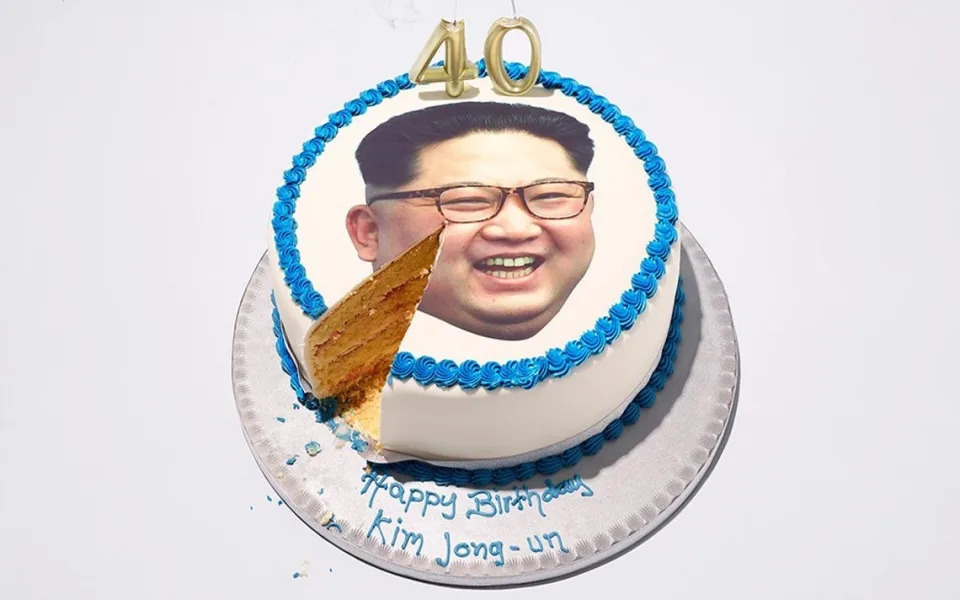
This month, according to our best guesses, Kim turns 40. It’s indicative of how little the outside world knows about him that conflicting sources will put him at 39 or even 38. Either way, the approach of his fifth decade brings new anxieties.
Kim Jong-un turns 40 – Benjamin Swanson
‘He probably feels more mortal now than he did three years ago, and he had Covid earlier this year apparently as well,’ says Peter Ward, a North Korea expert and post-doctoral researcher at Seoul’s Kookmin University.
The regime itself appears to have acknowledged Kim’s mortality, quietly creating the unprecedented role of ‘first secretary’ – a de facto deputy – in the ruling party hierarchy. ‘It seems to be because they are concerned about managing another illness,’ says Ward.
Since 2011, Kim has secured his power base, brutally putting down any threat to his rule. But the impact of a global financial crisis and sanctions on the North Korean economy – along with climate change wreaking havoc on farming – could present the leader with his toughest decade yet, thinks Ward.
Adding to the pressure on Kim will be the battle to block the influx and spread of information that could destabilise his strictly curated persona. To North Koreans, Kim is sold as a benevolent provider and semi-divine figure who inspires devotion and fear.https://www.youtube.com/embed/iKM8C829oN8?enablejsapi=1&modestbranding=1&origin=http://www.telegraph.co.uk&rel=0
To the rest of the world, he is almost a figure of ridicule. Last March, when he appeared in a Top Gun-style propaganda movie, clad in a shiny leather jacket and aviator shades while walking past a monster missile – all in dramatic slow motion – he was mocked by the West.
Yet the threat he poses globally is no joke. One muggy Pyongyang morning in August 2017, Lindsey Miller was woken at 6am by a deep rumbling. Her body shook as she ran out to the garden to look into the sky. ‘It sounded like an aeroplane going overhead but it didn’t fade away,’ she recalls now.
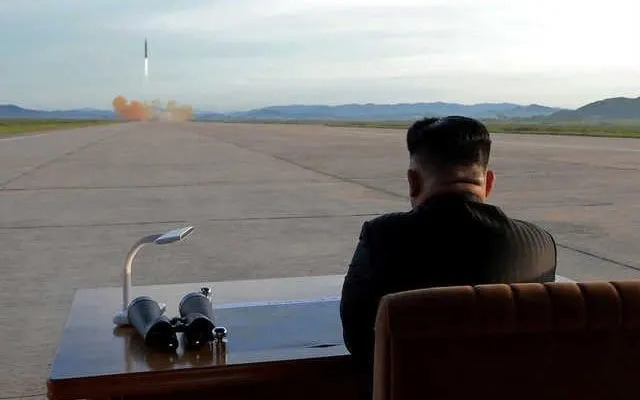
The author of North Korea: Like Nowhere Else, Miller lived in Pyongyang from 2017 to 2019 with her diplomat husband. She is one of the few Westerners to have experienced the roar of a North Korean ballistic missile test as a Hwasong-12 took off from the capital’s airport.
City residents carried on normally, Miller recalls. ‘The thing that made me more nervous was the response internationally. I was scared,’ she says. ‘It felt like a very real sense of danger.’ Diplomats were told to pack a bag in case of an emergency exit. ‘There were North Koreans who said how stressed they felt. They were worried about the potential for real war breaking out,’ she adds.
Kim seems set on raising the stakes. Since January 2022, he has test-launched an unprecedented volley of ballistic and cruise missiles, including a purported hypersonic weapon and his largest missile, the Hwasong-17, designed to carry a nuclear warhead more than 9,300 miles, within reach of the US mainland.
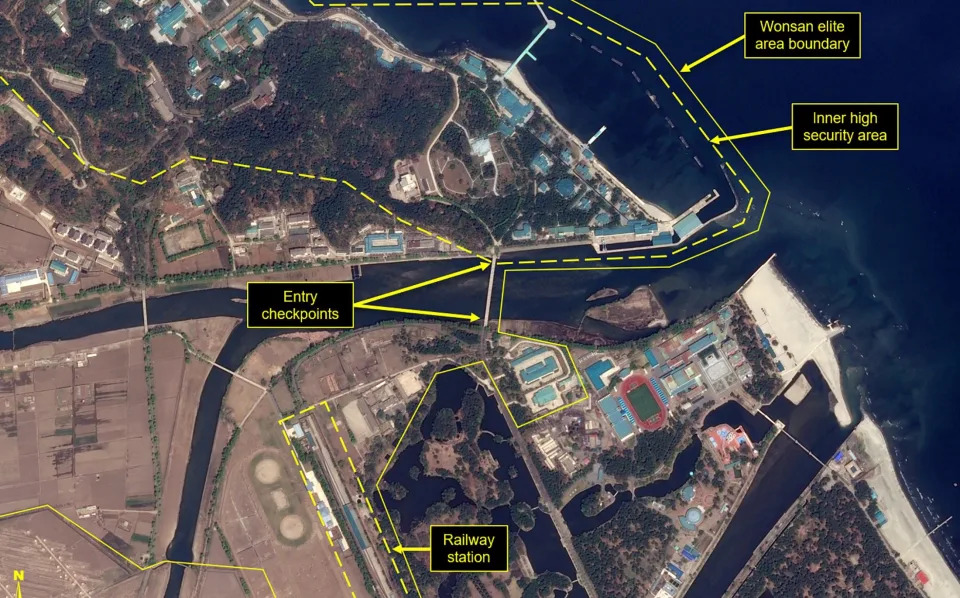
A satellite image taken over Wonsan in 2020 – Reuters
There had been a respite from aggression in 2018, during talks between Kim and then-US President Donald Trump. But the cycle of intense military escalation has since resumed; intelligence officials now warn Kim is gearing up for a seventh nuclear test, possibly a tactical weapon, and further confrontation with Seoul, Washington and the West.
So, what could Kim Jong-un be capable of?
In Asia, the significance of turning 40 is an expectation that a person ‘does not waver in their judgements’, explains Chun In-bum, a former lieutenant general in the South Korean army. ‘Kim Jong-un’s legacy is a Maoist, Stalinist legacy,’ says Chun. ‘So if he is 40, he is probably going to think that, “My path is the right path”… He is going to be more convinced of who he is and he will be very hard line.’
A tendency towards ruthless determination was already evident in Kim as a child. ‘He had such an abnormal childhood and was raised in such a dysfunctional family, there is really no other way that he could have turned out,’ says North Korea expert Anna Fifield. ‘From a very early age he was treated like a princeling in a way that not even the British Royal family would be.’
Fifield’s 2019 biography, The Great Successor, pieces together his life story. As a child Kim knew he would be handed the keys to the kingdom, after his dictator father Kim Jong-il identified him as more suitable for iron-fisted rule than his older brothers.
The stunning vistas along the eastern coastal resort of Wonsan provided the backdrop for Kim’s early years, which he spent sequestered in opulent villas with high iron gates. The vast property still plays a special role in his playboy lifestyle.
Kim’s decadence may be concealed from his hungry subjects, but high-resolution satellite imagery allows the world to view his expanding property empire. Recent pictures of the Wonsan enclave have revealed four cruise ships and a marina, with 10 villas dotting a 530m-long white sandy beach and manicured gardens. One boat is 80m in length and is said to boast dual twisting water slides.
He married Ri Sol-ju in 2008, and is thought to have three children. The Kim family enjoys as many as 30 luxury villas, and several private islands, according to Bruce Songhak Chung of South Korea’s Kyungpook National University. And in September, new verified images showed the expansion of ornate buildings at Kim’s lakeside mansion in South Pyongan province.
Kim Jong-un and his daughter pose in front of the Hwasong-17 ‘monster missile’ – KCNA/Reuters
But now Kim faces the challenge to all midlifers: how to mitigate the threat he poses to himself. Overweight, a heavy smoker (of local brand 7.27 cigarettes) and drinker (he prefers fine spirits and expensive French wines), he frequently ignores the advice of his doctors and wife to exercise and cut back on indulgences. His father died at the age of 69. Kim’s long absences from the public eye suggest he is dealing with an array of serious health problems.
‘I heard he is crying after drinking a lot. He is very lonely and under pressure,’ says Dr Choi Jinwook, a Seoul-based North Korea academic.
In November, Kim unexpectedly pushed his ‘beloved daughter’ Kim Ju-ae into the spotlight. In her first introduction to the world, Kim was seen gently holding her hand in choreographed photographs as they inspected a new intercontinental ballistic missile. Analysts were left guessing about his message. Was the girl in the white puffy jacket and red shoes his heir? Or simply a prop to humanise him? Ju-ae, who was born in 2012, would be too young to take over in the event of his sudden death.
There is wide consensus among observers that the role would temporarily fall to his ambitious younger sister, Kim Yo-jong, who has often been spotted at his side, carrying his files or even his ashtray. ‘Family interests come first,’ says Andrei Lankov, a professor at Kookmin University in Seoul, and an authority on North Korea.
There are no reliable estimates of Kim’s personal fortune – in 2013, South Korean media suggested it could be $5 billion – but his personal assets grow even as dangerous levels of hunger rise in the nation of 26 million.
Last year, he warned citizens to brace for a crisis similar to the 1990s famine, which is believed to have killed up to 3.5 million people. In an interview with me last year, Professor Hazel Smith of the Centre for Korea Studies at London’s School of Oriental and African Studies confirmed that food insecurity is now at a similar level. ‘The conditions that we had in the famine years that precipitated malnutrition are in place today,’ she said. ‘There is starvation in North Korea right now.’
Kim Jong-un watching a Hwasong-12 missile launch
The crisis has been building for years thanks to the Kim family’s mismanagement of the agriculture sector and a centralised system that focuses heavily on providing food for the military and political elites, at the cost of the general population.
In 2019 and 2020, a string of typhoons hammered harvests and sent the cost of maize and rice soaring. ‘There is obviously climate change and long run environmental impacts,’ says Ward. ‘The point is their inability to handle them and the fragility of their supply system is not an environmental issue per se.’
Shortages grew in 2021 even as the pandemic forced the UN’s World Food Programme to suspend operations in the country. It warned that another poor harvest meant the North Korean population, already 40 per cent undernourished, would be short of about 860,000 tonnes of food that year.
Add in the impact of global sanctions and plunging trade with China due to border closures, and by June 2022, the South’s government-backed Korea Development Institute was warning the isolated North could fall into a ‘famine in silence’.
Naturally, Kim has never gone hungry. He was shielded from the 1990s famine as a child in his Wonsan paradise, with huge playrooms filled with toys and kitchens full of pastries and tropical fruits. Yet Fifield’s biography quotes Kenji Fujimoto, a Japanese sushi chef who spent years serving the Kims, as saying that a precocious Kim endured a solitary childhood, cut off without playmates.
Aged 12, he turned up with a ‘pudding-bowl haircut’ under the alias Pak-un at a $20,000-a-year international school in Bern, Switzerland. His maternal aunt and uncle Ko Yong Suk and Ri Gang cared for him and his older brother Jong-chol, later defecting to run a dry-cleaning business outside New York. ‘We lived in a normal house and acted like a normal family,’ Ko told Fifield. ‘I made snacks for the kids. They ate cake and played with Legos.’
Kim, though, was short-tempered, stubborn and intolerant. Classmates from the school recalled a loner who displayed frustration at his academic weaknesses. ‘He kicked us in the shins and even spat at us,’ recounts one in the biography. Others remembered his aggressiveness and trash talk on the basketball court. But his Portuguese friend João Micaelo described him as quiet, decisive and ambitious.
In 1998, Kim’s privileged European bubble imploded after his mother was diagnosed with advanced breast cancer; he returned home to face his destiny, taking on his father’s mantle after his death. His youth and Western education raised hopes that he might be more inclined towards reform, but those expectations quickly fizzled.
‘He realised if he was just treated normally, he wouldn’t be anyone,’ says Fifield. ‘He needed to keep this system completely intact, or his family would lose all of its power and status.’
Kim Jong-un’s 11 years in power have been defined by inhumanity and a determination to establish his reclusive regime as a nuclear state. The glimpse of Kim at the 2018 Singapore Summit, greeting Donald Trump with a wide smile, was all part of an act, says Fifield. ‘The real Kim Jong-un is the one that lives in Pyongyang and is Machiavellian,’ she says. ‘He is trying to strike fear into the heart of the populace and the top officials of the regime, to make sure that they don’t think about crossing him but also to generate the other half of the Machiavellian equation – which is love.
‘He completely played Donald Trump like a fiddle… all of it was designed to bolster his legitimacy at home and give him that brag book of photos where he could show people of North Korea that he is respected and treated as an equal by all these other leaders.’
Meeting with then US President Donald Trump in June 2019 – AFP
His wife Ri Sol-ju – described by Fifield as the ‘Kate Middleton’ of North Korea in the sense that she is an aspirational yet approachable figure – is said to have tried to modernise the dynasty. She was even seen holding hands with the South Korean First Lady at a summit in 2018. But Kim operates with a chilling cruelty.
Nine years ago he reportedly ordered the execution of his influential uncle and mentor Jang Song-thaek, accusing him of treason. Unconfirmed reports suggest Jang was mown down by anti-aircraft guns, and his body incinerated with flamethrowers. The facts were hazy, but the message was clear. It was reinforced in 2017 by his alleged decision to murder his half-brother Kim Jong-nam at Kuala Lumpur airport using a nerve agent.
Lankov describes Kim as a sometimes capricious, but rational ‘third-generation CEO’; a man prepared to be brutal internally, while also building a nuclear weapons deterrent in order to protect himself and his family from foreign invasion. ‘His goal is very simple – to die a natural death in his palace, decades later. He wants to stay in power. He understands… if he loses power, very soon he will probably lose his life and everyone who he loves,’ Lankov says. ‘He is protecting his life, not lifestyle.’
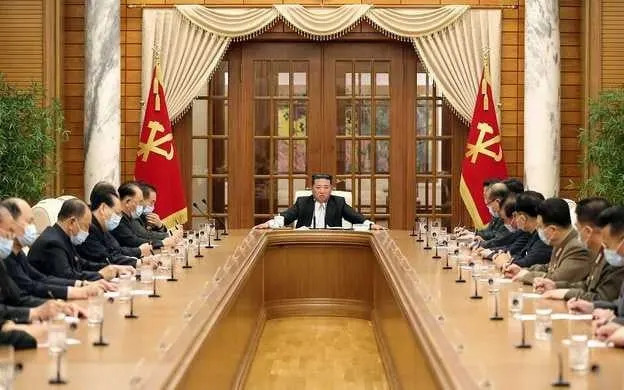
Heading a meeting of the Workers’ Party of Korea last May
Having neutralised the North Korean elites, whose prosperity is entwined with his fate, Kim tried to prevent a popular uprising by enforcing ‘information isolation’. Jihyun Park, 54, a defector and human rights activist who now lives in Manchester, tells me that as a child growing up under Kim Jong-il’s reign, she had no concept of how desperate the North Korean situation was. At school they were ‘brainwashed’ and ‘we believed everything we were told’.
Back then, in the pre-internet era, indoctrination was easier. Kim, while established as royal stock, has a more fragile cult of personality than his father and grandfather, Kim Il-sung, the nation’s founder. The younger Kim’s propaganda is less impressive, reduced to outlandish tales of learning to drive aged three, or a purported ability to control the weather. The first known mural depicting Kim’s exploits – digging at a greenhouse complex – has only recently appeared. It pales in comparison to the resplendent statues of his father and grandfather.
Hanna Song, from the Database Center for North Korean Human Rights in Seoul, said Kim’s youthful interest in technology is also a double-edged sword. He has to keep the younger, tech-savvy generation under control, through draconian laws and punishments for ‘anti-socialist behaviour’. In 2021, he unleashed a crackdown on ‘words, acts, hairstyle and attire of young people’ and a fresh ban on unsanctioned videos, broadcasts and speaking in a ‘South Korean’ style. Radio possession risks years in prison, and access to the open internet is blocked, allowing only a heavily censored state intranet.
Song said defectors’ motivations have shifted, from basic survival in the early 2000s to a new disillusionment with the leadership. ‘We’ve heard about North Koreans who are similar ages to Kim Jong-un who just couldn’t believe they had to serve a leader with his little experience,’ she says.
There could be one more astounding plot twist – and it’s a development that will only add to Kim’s mounting anxieties. In 2017, after his father Kim Jong-nam was poisoned in Malaysia, a young man called Kim Han-sol was spirited out of Macau, via Taipei, the capital of Taiwan, to an unknown destination. He is Kim Jong-un’s nephew.
Now 27, is he the other Kim being groomed in the wings for leadership at the earliest opportunity?
‘He seems to be somewhere in Europe being protected and taken care of, which I think is a great thing to do,’ former lieutenant general Chun tells me, ‘because we need him for some eventualities that might occur in North Korea. I am glad somebody is looking that far ahead.’
US Department of Agriculture approves first-ever vaccine for honeybees
The drug could protect bees from American foulbrood, a bacteria that can devastate entire colonies.
Igor Bonifacic, Weekend Editor – January 8, 2023
NurPhoto via Getty Images
The humble honeybee hasn’t had an easy go of things recently. Between climate change, habitat destruction, pesticide use and attrition from diseases, one of the planet’s most important pollinators has seen its numbers decline dramatically in recent years. All of that bodes poorly for us humans. In the US, honeybees are essential to about one-third of the fruit and produce Americans eat. But the good news is that a solution to one of the problems affecting honeybees is making its way to farmers.
This week, for the first time, the US Department of Agriculture granted conditional approval for an insect vaccine. A biotech firm named Dalan Animal Health recently developed a prophylactic vaccine to protect honeybees from American foulbrood disease. The drug contains dead Paenibacillus larvae, the bacteria that causes the illness.
Thankfully, the vaccine won’t require beekeepers to jab entire colonies of individual insects with the world’s smallest syringe. Instead, administering the drug involves mixing it in with the queen feed worker bees eat. The vaccine then makes its way into the “royal jelly” the drones to feed their queen. Her offspring will then be born with some immunity against the harmful bacteria.
The treatment represents a breakthrough for a few reasons. As The New York Times explains, scientists previously thought it was impossible for insects to obtain immunity to diseases because they don’t produce antibodies like humans and animals. However, after identifying the protein that prompts an immune response in bees, researchers realized they could protect an entire hive through a single queen. The vaccine is also a far more humane treatment for American foulbrood. The disease can easily wipe out colonies of 60,000 bees at once, and it often leaves beekeepers with one choice: burn the infected hives to save what they can.
Dr. Annette Kleiser, the CEO of Dalan, told The Times the company hopes to use the vaccine as a blueprint for other treatments to protect honeybees. “Bees are livestock and should have the same modern tools to care for them and protect them that we have for our chickens, cats, dogs and so on,” she said. “We’re really hoping we’re going to change the industry now.”
I’m homeless in California. And I have an easy, cost-free solution to homelessness | Opinion
Lydia Blumberg – January 8, 2023
Renée C. Byer/rbyer@sacbee.com
I and my fellow residents of Wood Street Commons, an unhoused community in Oakland, believe politicians pushing sweeps of homeless encampments are only making things worse.
One thing that would dramatically improve the lives of unhoused people in California could be done today, wouldn’t cost taxpayers any money and would require no effort by politicians or city workers. It’s as simple as a governor or mayor uttering three words: Stop sweeps now.
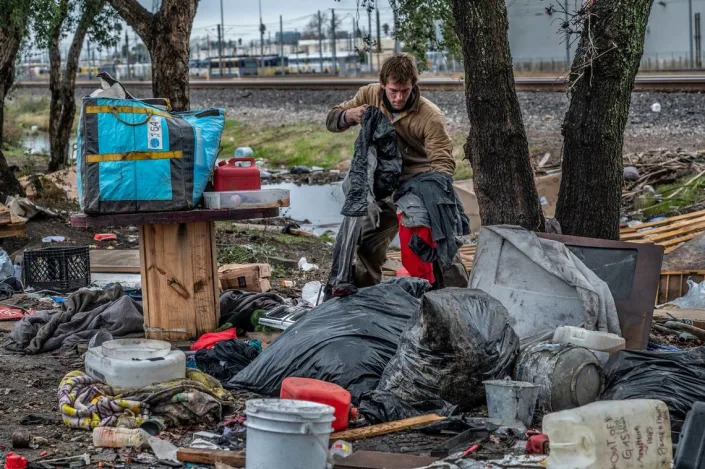
Each time a homeless camp is dismantled, people’s lives are destroyed. All the effort we put into creating a home — we do not actually consider ourselves homeless because our camp is our home — is wiped away. Our worldly possessions, including identification, medical records, family heirlooms, clothing, electronics, furniture, instruments, bedding, tents, tools and other items that we use to earn income, are literally thrown into garbage trucks. Our handmade shelters are smashed by giant machines as we watch.
Opinion
How is this acceptable? How can the people who order and carry out sweeps live with themselves?
Each time a homeless camp is dismantled, its residents face more obstacles to overcoming what put them on the street in the first place. We create camps as a way to create stability, cultivate community, and accrue needed resources to pull ourselves up by our own bootstraps. Destroying camps pushes us down and forces us to start over, with nowhere to go and often with nothing but the clothes on our backs.
Any politician who pledges to end homelessness in one breath and then pledges to rid the streets of encampments in the next — looking at you, Gov. Gavin Newsom — is completely out of his mind.
The billions spent “helping” the homeless are profoundly undermined by the daily aggression of sweeps, which many unhoused people experience several times a year. Take it from us, the real experts on this issue: Sweeps make homelessness more entrenched.
Sweeps are also an enormous waste of taxpayer money. A 2021 sweep in Los Angeles’ Echo Park, where which roughly 200 people were removed in a violent show of police force, cost an estimated $2 million. That’s nearly $10,000 per person! These are people whose lives were destroyed at an expense that could have housed them for months.
Yet city leaders declared the Echo Park sweep a rousing success, claiming nearly everyone from the camp was placed in temporary housing. But UCLA studies conducted a year later found that only a dozen or so of them remained in temporary housing. Of the rest, four were placed in permanent housing; seven died; and most returned to the streets.
Large cities routinely sweep one or more camps per day, meaning this cruelty is repeated thousands of times each year across the state and country. Sweeps don’t get rid of camps; they just move them around, causing chaos and wasting millions in the process.
A growing body of research illustrates why we should not only keep camps intact; we should actually encourage and celebrate them. That may sound crazy to many readers, but it couldn’t be more logical.
In a review of research on the topic, the U.S. Department of Housing and Urban Development noted that emergency shelters are unavailable, inaccessible or inhospitable to many unhoused people.
“Encampments may be the best alternative among a limited set of options,” the HUD report said.
It’s important to consider why people choose camps over other alternatives. Most temporary shelter facilities, and many of the permanent housing options designed to house the unhoused, come with a long list of rules that make them a little too much like prison. Among the most common rules are those limiting guests, spouses, pets, cooking, decorations and more possessions than can fit in a suitcase.
Tiny homes and sheds — the latest trends — are often placed like barracks on asphalt lots, surrounded by barbed wire and staffed by rude security guards. Would you give up your freedom to move to one of these places?
Humans need more than food, water and shelter. Autonomy and a sense of belonging are equally important to survival — and are actually the keys to recovery for people who have had a hard time in life. The impersonal facilities that we’re asked to move into are not designed with this in mind.
But autonomy and belonging are the essence of what camps are about. We camp together because it is essential to our physical and mental survival.
Our community on Wood Street in Oakland has recently been subjected to devastating sweeps. Caltrans has cleared an enormous section of the camp.
But the part that remains is stronger than ever. We cook for each other, distribute clothing and bedding, build our own tiny homes, play music, help each other heal, and host cultural events that have been attended by hundreds of housed residents. We see ourselves as part of a movement redefining the identity of American cities for the better: an identity based on an ethos of interdependence rather than the cult of independence that defines the world of the housed.
The last bit of land that we occupy on Wood Street is slated for clearance on Monday. We’ve been trying to work with Oakland officials to find a place where we can set up a new community and begin to rebuild yet again, but they refuse to cooperate. The city loves to tell us where we can’t be but has yet to tell us where we can be.
We do not accept this, which is why we’re taking matters into our own hands. We recently rode our bikes to the Capitol in Sacramento to speak with lawmakers there, and we will continue to press the case at City Hall. We will not be denied the essential human right to exist and exert our free will.
This piece was authored by Lydia Blumberg and other residents of Wood Street Commons, a settlement of unconventionally housed residents in West Oakland founded on the idea of “homeless helping the homeless.”
Come to the ‘war cry party’: How social media helped drive mayhem in Brazil
Elizabeth Dwoskin – January 8, 2023
Supporters of former president Jair Bolsonaro clash with police during a protest outside the Planalto Palace in Brasilia on Sunday. (Eraldo Peres/AP)
In the weeks leading up to Sunday’s violent attacks on Brazil’s congress and other government buildings, the country’s social media channels surged with calls to attack gas stations, refineries and other infrastructure, as well as for people to come to a “war cry party in the capital,” according to Brazilian social media researchers.
Online influencers who deny the results of the country’s recent presidential election used a particular phrase to summon “patriots” to what they called a “Festa da Selma” – tweaking the word “selva,” a military term for war cry, by substituting an “m” for the “v” in hopes of avoiding detection from Brazilian authorities, who have wide latitude to arrest people for “anti-democratic” postings online. “Festa” is the Portuguese word for “party.”
Organizers on Telegram posted dates, times and routes for “Liberty Caravans” that would pick people up in at least six Brazilian states and ferry them to the party, according to posts viewed by The Washington Post. One post said, “Attention Patriots! We are organizing for a thousand buses. We need 2 million people in Brasilia.”
That online activism culminated in busloads of people landing in the capital Sunday, where they stormed and vandalized three major government buildings, reportedly setting fires and stealing weapons in the most significant assault on the country’s democratic institutions since the country’s 1964 military coup.
Brazilian analysts have long warned of the risk in Brazil of an incident akin to the Jan. 6, 2021, insurrection at the U.S. Capitol. In the months and weeks leading up to the country’s presidential election in October – in which leftist Luiz Inácio Lula da Silva defeated the right-wing incumbent, Jair Bolsonaro – social media channels were flooded with disinformation, along with calls in Portuguese to “Stop the Steal” and cries for a military coup should Bolsonaro lose the election.
On TikTok, researchers found that five out of eight of the top search results for the keyword “ballots” were for terms such as “rigged ballots” and “ballots being manipulated.” At the same time, Facebook and Instagram directed thousands of users who plugged in basic search terms about the election toward groups questioning the integrity of the vote. On Telegram, an organizing hub for Brazil’s far right, a viral video taken down by authorities called for the murder of the children of leftist Lula supporters.
In the days following the final election tally on Oct. 30, Bolsonaro supporters who rejected the results blocked major highways across the country. These blockades morphed into demonstrations in dozens of cities, where supporters camped out in front of military bases for weeks. Some held signs saying “Stolen Election” in English, a testament to the close ties between right-wing movements in both countries.
Though Lula’s inauguration last week took place largely without incident, calls for violence and destruction have accelerated online in recent weeks, said researcher Michele Prado, an independent analyst who studies digital movements and the Brazilian far right.
“For years now, our country has been going through a very strong process of radicalizing people to extremist views – principally online,” she said. “But in the last two weeks, I’ve seen ever-growing calls from people incentivizing extremism and calling for direct action to dismantle public infrastructure. Basically, people are saying we need to stop the country in its tracks and generate chaos.”
Posts demanding a coup, along with common pro-Bolsonaro hashtags claiming “election fraud,” and “stolen election,” have circulated on all social media services. The most violent rhetoric as well as the most direct organizing has taken place on the largely unmoderated messaging service Telegram.
Researchers in Brazil said Twitter in particular was a place to watch because it is heavily used by a circle of right-wing influencers – Bolsonaro allies who continue to promote election fraud narratives. Several influencers have had their accounts banned in Brazil and now reside in the United States. Bolsonaro himself was on vacation in Florida on Sunday.
Billionaire Elon Musk, who completed his acquisition of Twitter in late October, fired the company’s entire staff in Brazil except for a few salespeople, said a person familiar with the firings who spoke on the condition of anonymity to describe sensitive matters. Among those fired in early November included eight people, based in Sao Paulo, who moderated content on the platform to catch posts that broke its rules against incitement to violence and misinformation, the person said. The person said they were not aware of any teams actively moderating rule-breaking content on Twitter in Brazil.
Criticism specifically targeting Alexandre de Moraes, a judge at the Superior Electoral Court and the Supreme Federal Court who is despised by Bolsonaro supporters because he has blocked many prominent right-wing leaders from posting online, have also stepped up since the election, Prado and others said.
Footage circulating on social media from Sunday’s demonstration showed rioters pulling a chair from a government building, upon which they placed the seal of the Brazilian republic. One rioter shouted, “Look everyone, it’s Big Alexander’s chair!,” using a derogatory nickname for Moraes. Expletives followed, according to the video. It could not be confirmed if the chair had been taken from Moraes’s chambers.
Despite their seeming similarities, Brazilian researchers said, Bolsonaro supporters are careful not to draw too many comparisons to Jan. 6 in the United States because doing so could trigger arrest for inciting anti-democratic acts, a crime in Brazil. If Jan. 6 is referenced, as it was in a handful of posts this week, the utterances appear in code, said Viktor Chagas, a professor at Fluminense Federal University in Rio de Janeiro state who researches online, far-right movements.
Still, Chagas said, Sunday’s riot was “a clear attempt to emulate the invasion of the U.S. Capitol, as a reproduction of Trumpist movements and a symbolic signal of strength and transnational connections from the global far-right.”
Chagas noted that Jan. 9 is an important nationalist symbol in Brazil, marking the day the country’s first ruler, Emperor Dom Pedro I, declared that he would not return to Portugal, in what is popularly known as “I Will Stay” Day.
“It is as if Bolsonarists were equating Bolsonaro with D. Pedro I, and indicating that the former government will remain,” he said. Some posts have also referenced “I will stay day,” indicating that the demonstrations would probably continue through Monday, he added.
In a tweet on Sunday, Bolsonaro – a prolific social media user who has been relatively quiet since his election defeat – denounced the attacks: “Peaceful demonstrations, by law, are part of democracy,” he tweeted, hours after the assault began. “However, depredations and invasions of public buildings as occurred today, as well as those practiced by the left in 2013 and 2017, were outside of the law.”
Brazilian researchers said that among Bolsonaro supporters, a counternarrative had begun to circulate Sunday, blaming the Lula government and people from Lula’s party for infiltrating peaceful, democratic demonstrations to turn the country against supporters of Bolsonaro. The counternarrative also had echoes of the Jan. 6 insurrection, in which many Trump supporters blamed left-wing activists for the violence.
The mayhem Sunday was “a disaster,” said Paulo Figueiredo Filho, a presenter for the right-wing channel Jovem Pan who lives in Florida and has had his social media accounts canceled by Moraes. “It is Moraes’s wet dream.”