More river water tapped to meet Tampa Bay’s future thirst
C.T. Bowen, Tampa Bay Times – August15, 2022
CLEARWATER — New tap water for the Tampa Bay region will come from an old source.
On Monday, the board of Tampa Bay Water — the region’s wholesale water supplier — voted unanimously to expand an existing plant in Hillsborough County to treat more water drawn from the Hillsborough and Alafia rivers and the Tampa Bypass Canal.
The vote was the culmination of a nearly four year-long study on how to meet future water demands for residents and businesses in Hillsborough, Pinellas and Pasco counties and the cities of Tampa, St. Petersburg and New Port Richey.
The expanded plant has a projected construction cost of $90.7 million and will increase the water supply as much as 12 million gallons each day. So-called surface water treatment accounted for 43% of the 189 million gallons of water the utility delivered daily during July.
The board picked the expanded plant over more costly alternatives. Building a new surface water treatment facility near the C.W. “Bill” Young Regional Reservoir in eastern Hillsborough carried a price tag of $145.6 million and expanding the desalination plant in Apollo Beach had a projected expense of $310 million.
The expanded surface water plant, west of North Falkenburg Road, is expected to be completed by the end of 2028.
Pinellas County Commissioner Dave Eggers noted the expansion helps Tampa Bay Water move “a little bit, not much, but a little bit” away from its reliance on groundwater.
“I think it’s healthy,” Eggers said.
Tampa Bay Water is required to update its master water plan every five years and it already is beginning the revision to provide new water sources for 2033 and beyond. Both the expanded desalination plant and a new surface water treatment facility will be considered again as part of the update, said Maribel Medina, the utility’s senior engineering manager.
Hillsborough County Commissioner Harry Cohen said the utility needed to diversify its portfolio of future water sources since expanding an existing treatment plant meant Tampa Bay Water was “doubling down on one.”
“I think that as we do that (updating the future plan) we’ve got to go a little outside the box and start being a little more bold,” Cohen said. “If we’re going to be conservative in our approach this time around, which I think we are, I think we really need to look at new technology, and new sources in the next round.”
Much of the US Will Be an ‘Extreme Heat Belt’ by the 2050’s
Leslie Kaufman – August 14, 2022
(Bloomberg) –
So you think it’s hot out there now? Consider the summer of 2053. That’s what researchers at First Street Foundation, a New York nonprofit that studies climate risk, have done in a report published today.
They predict that in three decades, more than 100 million Americans will live in an “extreme heat belt” where at least one day a year, the heat index will exceed 125° Fahrenheit (52° Celsius) — the top level of the National Weather Service’s heat index, or the extreme danger level. (The index combines temperature and humidity to arrive at how it feels when you go outside.)
Along with the report, First Street has released a free web tool that lets users search US addresses to determine their heat risk.
The future heat belt is a huge swath of the country that includes the Southeast and the area just west of the Appalachian Mountains, stretching from Texas and Louisiana all the way up through Missouri and Iowa to the Wisconsin border. This is not the part of the nation we most associate with heat, but since it is inland there are “no coastal influences to mitigate extreme temperatures,” and many communities “are not acclimated to warmer weather relative to their normal climate,” the report states.
The sharpest heat increase, however, will be felt in Miami-Dade County, Florida, where the hottest days now, those reaching 103°F, will increase in frequency from 7 days a year to 34 by 2053.
The findings are part of the sixth report by First Street to help Americans picture how warming will impact them at home. Previous reports looked at fire and floods, and the foundation made available fire and flood risk scores for every property in the contiguous US on its website.
Unlike those menaces, heat does not affect the survival of homes themselves and related insurance costs, so it does not have the same immediate threat to property value. But Matthew Eby, founder and chief executive of First Street, says he felt it was urgent to take on nonetheless.
“Increasing temperatures are broadly discussed in yearly averages, but the focus should be on the extension of the extreme tail events expected in a given year,” he said in a statement. In other words, when people discuss climate change they often use yearly averages, which can inadvertently blunt the severity of what is coming. Even relatively small increases in global yearly averages will include far more common extreme heat events.
According to the report, across the country, on average, peak temperatures now on the hottest 7 days per year will be reached 18 days a year in most localities.
While you might not lose your home to extreme heat, it certainly has other risks. The recent heat wave in the Pacific Northwest sent almost 1,000 people to the hospital. Power grids experience blackouts, knocking out air conditioning. People can experience exhaustion and dehydration as temperatures soar and can die from heatstroke. Bridges and roads buckle.
Temperatures are notoriously difficult to predict accurately even a few days out, much less 30 years. However, there are differences between climatology and meteorology. First Street uses climatology modeling that shows rising global temperatures based on the current level of greenhouse gas emissions to predict warming trends. Then it layers on address-specific information, such as how much tree canopy cover is nearby, or whether a home in an urban area is surrounded by impervious surfaces, like parking lots, that absorb and retain heat.
The peer-reviewed model also takes into account variables like proximity to a large body of water, which might moderate temperatures, and whether the home is high in the mountains, which is cooler. Some of these variables will change over time, but for the purposes of this exercise, First Street keeps them stable.
Jeremy Porter, the foundation’s lead researcher, says there is far less variation house to house for extreme heat than for fire or flood. Yet the scoring offers very practical financial information. Because it looks at the square footage of a house and state electricity prices, the scoring tool can estimate how much an individual home’s energy bills can be expected to rise if the owner has air conditioning.
Today we are complaining about inflation, but even with the slew of rebates in the Inflation Reduction Act, some Americans may look back at the cooling costs from the summer of 2022 as a bargain.
The U.S. could see a new ‘extreme heat belt’ by 2053
Denise Chow and Nigel Chiwaya– August 14, 2022
An “extreme heat belt” reaching as far north as Chicago is taking shape, a corridor that cuts through the middle of the country and would affect more than 107 million people over the next 30 years, according to new data on the country’s heat risks.
The report, released Monday by the nonprofit research group First Street Foundation, found that within a column of America’s heartland stretching from Texas and Louisiana north to the Great Lakes, residents could experience heat index temperatures above 125 degrees Fahrenheit by 2053 — conditions that are more commonly found in California’s Death Valley or in parts of the Middle East.
The projections are part of First Street Foundation’s new, peer-reviewedextreme heat model, which shows that most of the country will have upticks in the number of days with heat index temperatures above 100 degrees over the next 30 years as a result of climate change.
The heat index represents what a temperature feels like to the human body when humidity and air temperature are combined. It is commonly referred to as the “feels like” temperature.
“Everybody is affected by increasing heat, whether it be absolute increases in dangerous days or it’s just a local hot day,” said First Street Foundation’s chief research officer, Jeremy Porter, a professor and the director of quantitative methods in social sciences at the City University of New York.
It has already been a sweltering summer for much of the U.S. and Europe. The National Oceanographic and Atmospheric Administration’s latest monthly climate report, published Aug. 8, found that last month was the country’s third-hottest July since record-keeping began nearly 130 years ago.
As humans continue to pump heat-trapping greenhouse gases into the atmosphere, temperatures around the world are rising, which increases both the frequency of extreme heat events and their severity.
Researchers at First Street used their model to create an online tool called Risk Factor to give people hyperlocal snapshots of how their property is affected by extreme temperatures and what could change over the next three decades. The organization previously created similar resources to evaluate specific addresses’ risks from wildfires and flooding.
The new model uses high-resolution measurements of land surface temperatures and incorporates the effects of canopy cover, proximity to water and other factors that determine local temperature variability. Future heat risk is then calculated using different forecast scenarios for greenhouse gas emissions in the decades to come.
The researchers looked at the seven hottest days expected for any property this year and calculated what the equivalent could be in 30 years. Across the country, they found that, on average, a community’s seven hottest days are projected to become the location’s 18 hottest days by 2053.
The most pronounced shift was found in Miami-Dade County, Porter said, where the area’s seven hottest days, with heat index temperatures at 103 degrees, are projected to increase to 34 days at that temperature in 30 years.
But in addition to widespread increases in heat exposure, First Street’s model also identified what Porter and his colleagues call an “extreme heat belt” that covers about one-quarter of the country’s land area.
About 8.1 million U.S. residents in 50 counties are at risk of experiencing heat index temperatures over 125 degrees. But by 2053, the projection expands to more than 1,000 counties across an area that is home to more than 107 million people, according to First Street’s model.
The zone’s geographic boundaries and its sheer size were surprising, Porter said.
“How far north it stretched — I think a lot of people just hearing southern Wisconsin, Chicago and those areas being part of the extreme heat belt is surprising,” he added.
The agricultural impact of such a wide-ranging heat belt in the country’s heartland is particularly worrisome, said Noboru Nakamura, a professor of geophysical sciences at the University of Chicago, who was not involved with First Street’s research.
“If there are hot spots and dry spells in these places, farmers will have to shift their priorities and what types of crops they’ll plant, and that will all have a lot of long-term consequences,” Nakamura said.
There are also enormous public health and safety concerns with heat exposure, he added. Across the country, heat causes more deaths every year than any other weather event, according to the National Weather Service.
Sharp increases in extreme heat are likely to affect people’s lives and livelihoods in certain places, Nakamura said, and they could even play a factor in where people choose to call home.
“If a certain fraction of days per year are over 100 degrees, then unless you have the resources and infrastructure to stay cool, then it makes certain places very difficult to survive,” Nakamura said. “I can certainly envision that would shake up peoples’ decisions about where to live.”
Deadline looms for drought-stricken states to cut water use
Sam Metz and Felicia Fonseca – August 14, 2022
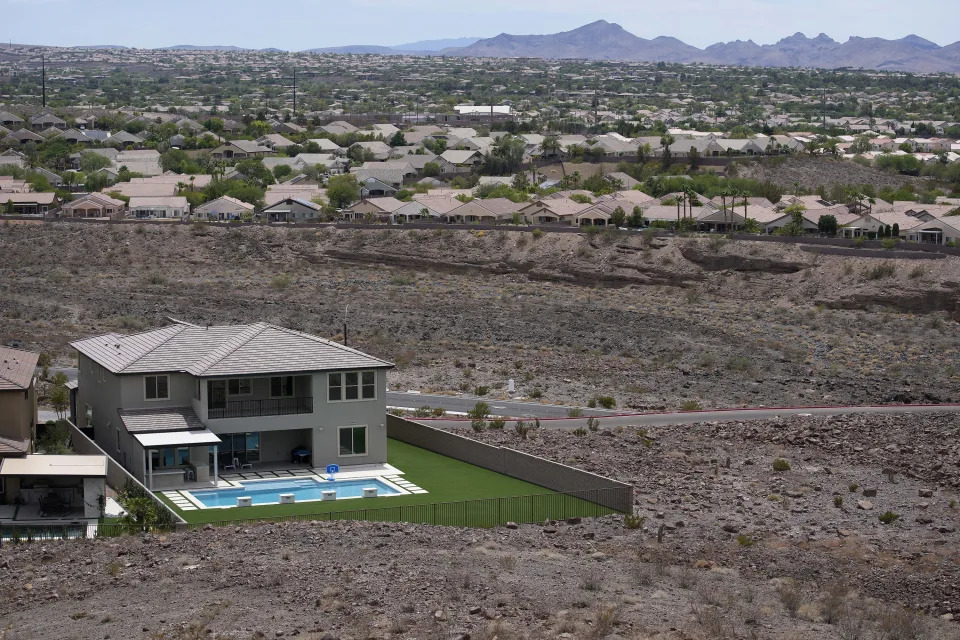
Visitors view the dramatic bend in the Colorado River at the popular Horseshoe Bend in Glen Canyon National Recreation Area, in Page, Ariz., on Sept. 9, 2011. Some 40 million people in Arizona, California, Colorado, Nevada, New Mexico, Utah and Wyoming draw from the Colorado River and its tributaries. The U.S. Bureau of Reclamation is expected to publish hydrology projections on Tuesday, Aug. 16, 2022, that will trigger agreed-upon cuts to states that rely on the river. (AP Photo/Ross D. Franklin, File) ASSOCIATED PRESSFarmer John Hawk looks over his land as his seed onion fields are watered in Holtville, Calif., Sept. 3, 2002. For the seven states that rely on the Colorado River that carries snowmelt from the Rocky Mountains to the Gulf of California, that means a future with increasingly less water for farms and cities although climate scientists say it’s hard to predict how much less. The U.S. Bureau of Reclamation is expected to publish hydrology projections on Tuesday, Aug. 16, 2022, that will trigger agreed-upon cuts to states that rely on the river. (AP Photo/Reed Saxon, File) ASSOCIATED PRESSA boat cruises along Lake Powell near Page, Ariz., on July 31, 2021. Seven states in the U.S. West are facing a deadline from the federal government to come up with a plan to use substantially less Colorado River water in 2023. The U.S. Bureau of Reclamation is expected to publish hydrology projections on Tuesday, Aug. 16, 2022, that will trigger agreed-upon cuts to states that rely on the river. Prolonged drought, climate change and overuse are jeopardizing the water supply that more than 40 million people rely on. (AP Photo/Rick Bowmer, File) ASSOCIATED PRESSA home with a swimming pool abuts the desert on the edge of the Las Vegas valley, Wednesday, July 20, 2022, in Henderson, Nev. The U.S. Bureau of Reclamation is expected to publish hydrology projections on Tuesday, Aug. 16, 2022, that will trigger agreed-upon cuts to states that rely on the river. (AP Photo/John Locher, File) ASSOCIATED PRESSA formerly sunken boat sits upright into the air with its stern stuck in the mud along the shoreline of Lake Mead at the Lake Mead National Recreation Area, Friday, June 10, 2022, near Boulder City, Nev. Lake Mead water has dropped to levels it hasn’t been since the lake initially filled over 80 years earlier. Prolonged drought, climate change and overuse are jeopardizing the water supply that more than 40 million people rely on. States are acknowledging that painful cuts are needed, but also stubbornly clinging to the water they were allocated a century ago. (AP Photo/John Locher, File) ASSOCIATED PRESSThe Colorado River flows at Horseshoe Bend in the Glen Canyon National Recreation Area, Wednesday, June 8, 2022, in Page, Ariz. Seven states in the U.S. West are facing a deadline from the federal government to come up with a plan to use substantially less Colorado River water in 2023. The U.S. Bureau of Reclamation is expected to publish hydrology projections on Tuesday, Aug. 16, 2022, that will trigger agreed-upon cuts to states that rely on the river. (AP Photo/Brittany Peterson, File) ASSOCIATED PRESSAn aerial view of Lake Powell on the Colorado River along the Arizona-Utah border on Sept. 11, 2019. The U.S. Bureau of Reclamation is expected to publish hydrology projections on Tuesday, Aug. 16, 2022, that will trigger agreed-upon cuts to states that rely on the river. (AP Photo/John Antczak, FIle ) ASSOCIATED PRESS
SALT LAKE CITY (AP) — Banks along parts of the Colorado River where water once streamed are now just caked mud and rock as climate change makes the Western U.S. hotter and drier.
More than two decades of drought have done little to deter the region from diverting more water than flows through it, depleting key reservoirs to levels that now jeopardize water delivery and hydropower production.
Cities and farms in seven U.S. states are bracing for cuts this week as officials stare down a deadline to propose unprecedented reductions to their use of the water, setting up what’s expected to be the most consequential week for Colorado River policy in years.
The U.S. Bureau of Reclamation in June told the states — Arizona, California, Colorado, Nevada, New Mexico, Utah and Wyoming — to figure out how to use at least 15% less water next year, or have restrictions imposed on them. On top of that, the bureau is expected to publish hydrology projections that will trigger additional cuts already agreed to.
“The challenges we are seeing today are unlike anything we have seen in our history,” Camille Touton, the bureau’s commissioner, said in a U.S. Senate hearing that month.
Tensions over the extent of the cuts and how to spread them equitably have flared, with states pointing fingers and stubbornly clinging to their water rights despite the looming crisis.
“It’s not fun sitting around a table figuring out who is going to sacrifice and how much,” said Bill Hasencamp, the Colorado River resources manager at Metropolitan Water District, which provides water to most of Southern California.
Representatives from the seven states convened in Denver last week for eleventh-hour negotiations behind closed doors. Officials party to discussions said the most likely targets for cuts are farmers in Arizona and California. Agricultural districts in those states are asking to be paid generously to shoulder that burden.
But the tentative agreements fall short of what the Bureau of Reclamation has demanded and state officials say they hope for more time to negotiate details.
The Colorado River cascades down from the Rocky Mountains into the arid deserts of the Southwest. It’s the primary water supply for 40 million people. About 70% of its water goes toward irrigation, sustaining a $15 billion-a-year agricultural industry that supplies 90% of the United States’ winter vegetables.
The river is divided among Mexico and the seven U.S. states under a series of agreements that date back a century, to a time when more water flowed through the river. But climate change has transformed the river’s hydrology, providing less snowmelt and causing hotter temperatures and more evaporation. As it’s yielded less water, the states have agreed to cuts tied to the levels of reservoirs that store river water.
Last year, federal officials for the first time declared a water shortage, triggering cuts to Nevada, Arizona and Mexico’s share of the river to help prevent the two largest reservoirs — Lake Powell and Lake Mead — from dropping low enough to threaten hydropower production and stop water from flowing through their dams.
The proposals for supplemental cuts due this week have inflamed disagreement between upper basin states — Colorado, New Mexico, Utah and Wyoming — and lower basin states — Arizona, California and Nevada — over how to spread the pain. The lower basin states use most of the water and have thus far shouldered most of the cuts. The upper basin states have historically not used their full allocations but want to maintain their water rights to plan for population growth.
Gene Shawcroft, the chairman of Utah’s Colorado River Authority, believes the lower basin states should take most of the cuts because they use most of the water and their full allocations.
He said it was his job to protect Utah’s allocation for growth projected for decades ahead: “The direction we’ve been given as water purveyors is to make sure we have water for the future.”
In a letter last month, representatives from the upper basin states proposed a five-point conservation plan that they said would save water but argued most of the cuts needed to come from the lower basin. The plan didn’t commit to any numbers.
“The focus is getting the tools in place and working with water users to get as much as we can rather than projecting a water number,” Chuck Cullom, the executive director of the Upper Colorado River Commission, told The Associated Press.
That position, however, is unsatisfactory to many in lower basin states already facing cuts.
“It’s going to come to a head particularly if the upper basin states continue their negotiating position, saying, ‘We’re not making any cuts,’” said Bruce Babbitt, who served as Interior secretary from 2003-2011.
Lower basin states have yet to go public with plans to contribute, but officials said last week that they had a tentative proposal to reduce consumption that fell slightly short of the federal government’s request to cut 2 to 4 million acre-feet.
An acre-foot of water is enough to serve 2-3 households annually.
Hasencamp, the Metropolitan Water District’s Colorado River resource manager, said all the districts in the state that draw from the river had agreed to contribute water or money to the plan, pending approval by their respective boards. Water districts, in particular the Imperial Irrigation District, have been adamant that any voluntary cut does not curtail their high priority water rights.
Southern California cities likely will be putting up money that could fund fallowing farmland in places like Imperial County and water managers are considering leaving water they’ve stored in Lake Mead as part of their contribution.
Arizona will likely be hit hard with reductions. The state has in the past few years shouldered much of the cuts and with its growing population and robust agricultural industry, has less wiggle room than its neighbors to take on more, said Arizona Department of Water Resources Director Tom Buschatzke. Some tribes in Arizona have also contributed to propping up Lake Mead in the past, and could play an outsized role in any new proposal.
Irrigators around Yuma, Arizona, have proposed taking 925,000 acre-feet less of Colorado River water in 2023 and leaving it in Lake Mead if they’re paid $1.4 billion, or $1,500 per acre-foot. The cost is far above the going rate, but irrigators defended their proposal as fair considering the cost to grow crops and get them to market.
Wade Noble, the coordinator for a coalition that represents Yuma water rights holders, said it was the only proposal put forth publicly that includes actual cuts, rather than theoretical cuts to what users are allocated on paper.
Some of the compensation-for-conservation funds could come from a $4 billion drought earmark in the Inflation Reduction Act under consideration in Washington, U.S. Sen. Kyrsten Sinema of Arizona told the AP.
Sinema acknowledged paying farmers to conserve wasn’t a long-term solution: “In the short-term, however, in order to meet our day-to-day needs and year-to-year needs, ensuring that we’re creating financial incentives for non-use will help us get through,” she said.
Babbitt, too, said money in the legislation will not “miraculously solve the problem” and prices for water must be reasonable to avoid gouging because most water users will take a hit.
“There’s no way that these cuts can all be paid for at a premium price for years and years,” he said.
Fonseca reported from Flagstaff, Arizona. Associated Press reporter Kathleen Ronayne contributed from Sacramento, California.
A disastrous ‘megaflood’ flood in sunny and dry California? It’s happened before
Mike Snider, USA TODAY – August 14, 2022
Grayscale lithograph of K Street in the city of Sacramento, California — during the Great Flood of 1862. The flood affected the Western United States, from Oregon through California, and Idaho through New Mexico.
While intense droughts, wildfires and earthquakes are typically the main concern across the West, the study released Friday warned of another crisis looming in California: “Megafloods.” It notes climate change is increasing the risk of floods that could submerge cities and displace millions of people across the state. It says an extreme monthlong storm could bring feet of rain – in some places, more than 100 inches – to hundreds of miles of California.
While the scenario might sound like something out of a movie, it’s happened before.
California has experienced severe floods throughout the 20th Century, including in 1969, 1986, and 1997. But a flood from farther in the past – the Great Flood of 1862 – is being eyed by researchers as the threat to California grows by the day.
Though it occurred 160 years ago, the flood – deemed a “megastorm” for its historical rainfall covering huge swaths of the state – illustrates that the threat is not merely theoretical.
Researchers are sounding the alarm because flood of that scale today would have far more devastating impacts in a state that is now the nation’s most populous.
Intense rainstorms pummeled central California “virtually unabated” from Christmas Eve 1861 until January 1862, Scientific American chronicled in a 2013 story on “The Coming Megastorms.”
The flow of water created “a huge inland sea … a region at least 300 miles long,” leaving Central and southern California underwater for up to six months, the magazine said. Floodwaters stretched as wide as 60 miles across, wrote UCLA researchers in their recent flood risk study.
“Thousands of farms are entirely under water – cattle starving and drowning,” wrote scientist William Brewer (author of “Up and Down California in 1860-1864”) in a letter to his brother, cited by Scientific American. “All the roads in the middle of the state are impassable; so all mails are cut off. The telegraph also does not work clear through. In the Sacramento Valley for some distance the tops of the poles are under water.”
An estimated 4,000 people died and one-third of all property in the state was destroyed, including one-fourth of its 800,000 cattle, which either drowned or starved, wrote the SFGate news site in a retrospective earlier this year.
The Great Flood of 1862 would be much worse if it happened today
The region that was underwater in 1862 is now home to many more people than it was then — it’s home to some of California’s fastest-growing cities including Bakersfield and Sacramento.
Back then, the state’s population was about 500,000, but today it’s nearly 40 million. “Were a similar event to happen again, parts of cities such as Sacramento, Stockton, Fresno and Los Angeles would be under water even with today’s extensive collection of reservoirs, levees and bypasses,” researchers who worked on the flood-risk study released Friday said in a press release.
The resulting disaster would cause an estimated $1 trillion in damage, the biggest disaster in world history, they say.
And the effects would go beyond central and southern California, said Daniel Swain, a UCLA climate scientist and the study’s co-author. “Every major population center in California would get hit at once – probably parts of Nevada and other adjacent states, too,” he said.
Major highways such as Interstate 5, which runs along the Pacific coast from Canada to Mexico, and I-80, which dissects California through San Francisco and Sacramento, would likely be shut down for weeks or months, he said.
The ripple effects would impact global economics and supply chains.
Lightning strikes east of the eastern front of the McKinney Fire, in the Klamath National Forest near Yreka, Calif. on Aug, 2, 2022.
What causes megafloods?
Atmospheric rivers are long water vapor streams formed about a mile above Earth. They can “carry as much water as 10 to 15 Mississippi Rivers from the tropics and across the middle latitudes,” wrote Michael Dettinger, research hydrologist for the U.S. Geological Survey, and Lynn Ingram, a University of California, Berkeley, professor of earth and planetary science, in Scientific American.
When one comes across the Pacific Ocean and hits the Sierra Nevada, “it is forced up, cools off and condenses into vast quantities of precipitation,” they wrote.
Warming temperatures are making extreme storms more likely – with more runoff, researchers say. In a 2018 study, Swain estimated there was a 50-50 chance of a megaflood the size of the Great Flood of 1862 happening again by 2060, Popular Science reported. “It would essentially inundate land that is now home to millions of people,” he said then.
The new research suggests climate change has already doubled the likelihood of extreme storms and each additional degree of global warming increases the likelihood of a megaflood.
Research is continuing on potential flood effects and how to prepare for the them. Keeping the issue alive in the mind of Californians is important because drought, wildfires and earthquakes get all the attention, Swain said.
“There is potential for bad wildfires every year in California, but a lot of years go by when there’s no major flood news,” he said. “People forget about it.”
Northeastern farmers face new challenges with severe drought
Jennifer McDermott – August 14, 2022
PROVIDENCE, R.I. (AP) — Vermont farmer Brian Kemp is used to seeing the pastures at Mountain Meadows Farm grow slower in the hot, late summer, but this year the grass is at a standstill.
That’s “very nerve-wracking” when you’re grazing 600 to 700 cattle, said Kemp, who manages an organic beef farm in Sudbury. He describes the weather lately as inconsistent and impactful, which he attributes to a changing climate.
“I don’t think there is any normal anymore,” Kemp said.
The impacts of climate change have been felt throughout the Northeastern U.S. with rising sea levels, heavy precipitation and storm surges causing flooding and coastal erosion. But this summer has brought another extreme: a severe drought that is making lawns crispy and has farmers begging for steady rain. The heavy, short rainfall brought by the occasional thunderstorm tends to run off, not soak into the ground.
Water supplies are low or dry, and many communities are restricting nonessential outdoor water use. Fire departments are combatting more brush fires and crops are growing poorly.
Providence, Rhode Island had less than half an inch of rainfall in the third driest July on record, and Boston had six-tenths of an inch in the fourth driest July on record, according to the National Weather Service office in Norton, Massachusetts. Rhode Island’s governor issued a statewide drought advisory Tuesday with recommendations to reduce water use. The north end of the Hoppin Hill Reservoir in Massachusetts is dry, forcing local water restrictions.
Officials in Maine said drought conditions really began there in 2020, with occasional improvements in areas since. In Auburn, Maine, local firefighters helped a dairy farmer fill a water tank for his cows when his well went too low in late July and temperatures hit 90. About 50 dry wells have been reported to the state since 2021, according to the state’s dry well survey.
The continuing trend toward drier summers in the Northeast can certainly be attributed to the impact of climate change, since warmer temperatures lead to greater evaporation and drying of soils, climate scientist Michael Mann said. But, he said, the dry weather can be punctuated by extreme rainfall events since a warmer atmosphere holds more moisture — when conditions are conducive to rainfall, there’s more of it in short bursts.
Mann said there’s evidence shown by his research at Penn State University that climate change is leading to a “stuck jet stream” pattern. That means huge meanders of the jet stream, or air current, get stuck in place, locking in extreme weather events that can alternately be associated with extreme heat and drought in one location and extreme rainfall in another, a pattern that has played out this summer with the heat and drought in the Northeast and extreme flooding in parts of the Midwest, Mann added.
Most of New England is experiencing drought. The U.S. Drought Monitor issued a new map Thursday that shows areas of eastern Massachusetts outside Cape Cod and much of southern and eastern Rhode Island now in extreme, instead of severe, drought.
New England has experienced severe summer droughts before, but experts say it is unusual to have droughts in fairly quick succession since 2016. Massachusetts experienced droughts in 2016, 2017, 2020, 2021 and 2022, which is very likely due to climate change, said Vandana Rao, director of water policy in Massachusetts.
“We hope this is maybe one period of peaking of drought and we get back to many more years of normal precipitation,” she said. “But it could just be the beginning of a longer trend.”
Rao and other water experts in New England expect the current drought to last for several more months.
“I think we’re probably going to be in this for a while and it’s going to take a lot,” said Ted Diers, assistant director of the New Hampshire Department of Environmental Services water division. “What we really are hoping for is a wet fall followed by a very snowy winter to really recharge the aquifers and the groundwater.”
Rhode Island’s principal forest ranger, Ben Arnold, is worried about the drought extending into the fall. That’s when people do more yardwork, burn brush, use fireplaces and spend time in the woods, increasing the risk of forest fires. The fires this summer have been relatively small, but it takes a lot of time and effort to extinguish them because they are burning into the dry ground, Arnold said.
Hay farmer Milan Adams said one of the fields he’s tilling in Exeter, Rhode Island, is powder a foot down. In prior years it rained in the spring. This year, he said, the dryness started in March, and April was so dry he was nervous about his first cut of hay.
“The height of the hay was there, but there was no volume to it. From there, we got a little bit of rain in the beginning of May that kind of shot it up,” he said. “We haven’t seen anything since.”
Farmers are fighting more than the drought — inflation is driving up the cost of everything, from diesel and equipment parts to fertilizer and pesticides, Adams added.
“It’s all through the roof right now,” he said. “This is just throwing salt on a wound.”
The yield and quality of hay is down in Vermont too, which means there won’t be as much for cows in the winter, said Vermont Agriculture Secretary Anson Tebbetts. The state has roughly 600 dairy farms, a $2 billion per year industry. Like Adams, Tebbetts said inflation is driving up prices, which will hurt the farmers who will have to buy feed.
Kemp, the president of the Champlain Valley Farmer Coalition, is thankful to have supplemental feed from last year, but he knows other farmers who don’t have land to put together a reserve and aren’t well-stocked. The coalition is trying to help farmers evolve and learn new practices. They added “climate-smart farming” to their mission statement in the spring.
“Farming is challenging,” Kemp said, “and it’s becoming even more challenging as climate change takes place.”
Trump frantically packed up documents to take with him in the last days of his presidency after finally accepting he was leaving the White House, report says
Kelsey Vlamis – August 13, 2022
President Donald Trump talks to reporters while hosting Republican Congressional leaders and members of his cabinet in the Oval Office at the White House July 20, 2020 in Washington, DC.Doug Mills-Pool/Getty Images
FBI agents recovered classified materials during a raid on Mar-a-Lago Monday, court documents say.
Sources told NBC News that in the last days of Trump’s presidency aides rushed to pack up documents.
One source said Trump didn’t seriously start preparing to exit the White House until after January 6.
Between the January 6 Capitol attack, challenges to the 2020 election, and his impending second impeachment, President Donald Trump had some chaotic final days in office.
Amid the chaos and the realization that every election challenge was failing, Trump began instructing aides to pack up documents he planned to take with him to Mar-a-Lago, according to an NBC News report published Saturday.
Two sources with knowledge of the situation told the outlet Trump’s aides were hurriedly stuffing documents and other materials into banker boxes that were then shipped to Mar-a-Lago, Trump’s Palm Beach club and residence.
One source said Trump only seriously began making plans to leave the White House after January 6, his final two weeks in office, after months of baselessly claiming he had won the election.
“It was a chaotic exit,” the source told NBC. “Everyone piled everything — staff, the White House movers — into the moving trucks. When they got to Mar-a-Lago, they piled everything there in this storage room, except for things like the first lady’s clothes. Everything in a box went there.”
The source said Trump was in a “dark place” at the time and that “he didn’t care about the boxes,” adding: “If you had brought him into that storeroom, and asked, ‘Which are your presidential papers?’ he couldn’t tell you.”
Trump has denied any wrongdoing and claimed he had declassified all the records at Mar-a-Lago, though he did not provide documentation of the declassification.
The New York Times reported on Saturday that one of Trump’s lawyers told the Justice Department in June that all classified documents had been returned. But, given the recovery of additional classified documents on Monday, the report raised questions about how cooperative and forthcoming the former president and his team have been with investigators.
Trump’s office did not immediately respond to Insider’s request for comment.
During his four years in office, Trump developed a reputation for being flippant with presidential records, which are required by law to be preserved. Reports have said Trump would rip up papers or even flush them down the toilet. Some of his former staff members also said he would ask to keep certain documents.
Cheney predicts a lengthy fight for American democracy in her campaign’s closing message
Jon Ward, Chief National Correspondent – August 11, 2022
Rep. Liz Cheney released a closing message video ahead of a Republican primary she is expected to lose next week, framing the congressional race as part of a bigger fight for the soul of the nation.
Regardless of the race’s outcome, Cheney, a Wyoming Republican, has publicly hinted recently that she will run for president in 2024. Privately, those close to her have done nothing to discourage others from assuming she will. And while her video message spoke of a long fight required to reject the “poisonous lies” of former President Donald Trump about the 2020 election, she did not give any specific hints about her future plans.
Cheney did, however, talk of a cause that she said would unite Republicans, Democrats and independents. That is a nod to a national effort she seems intent on leading that transcends party and ideology.
“America cannot remain free if we abandon the truth. The lie that the 2020 presidential election was stolen is insidious. It preys on those who love their country. It is a door Donald Trump opened to manipulate Americans to abandon their principles, to sacrifice their freedom, to justify violence, to ignore the rulings of our courts and the rule of law,” Cheney said.
“This is Donald Trump’s legacy, but it cannot be the future of our nation,” she said.
Rep. Liz Cheney. (Via YouTube)
“If we do not condemn these lies, if we do not hold those responsible to account, we will be excusing this conduct and it will become a feature of all elections. America will never be the same.”
Polls show Cheney is likely to lose her seat in Congress next Tuesday by double-digit margins, to a Republican primary challenger who has shown fealty to Trump and his baseless claims of a rigged election in 2020.
That challenger, Harriet Hageman, is expected not only to win the primary contest for Wyoming’s only congressional seat but, in a state that is largely Republican, to easily win the fall election.
Cheney has said for over a year that she is intent on keeping Trump out of the presidency for a second time, following his central role in fomenting an assault on the Capitol on Jan. 6, 2021.
Since then she has been the top Republican on the select committee investigating Jan 6. The panel’s work has revealed how much of what happened on Jan. 6 was premeditated by Trump and his allies.
The questions facing Cheney now — if she does lose to Hageman — will revolve around how much she says about her future plans, including a possible White House run.
Saudi firm has pumped Arizona groundwater for years without paying. Time to pony up
Bruce Babbitt and Robert Lane – August 11, 2022
The Butler Valley is an empty stretch of desert west of Phoenix, worthy of note for two reasons.
It holds more than 6 million acre-feet of groundwater, strategically located near the Central Arizona Project canal.
And more than 99% of Butler Valley is owned by the state of Arizona in trust for the support of public schools.
In 1982 as the Central Arizona Project canal neared completion, Wes Steiner, the renowned director of the Department of Water Resources, proposed that the state set aside Butler Valley as a groundwater reserve for future use in connection with the CAP.
Acting on his advice, we worked with the federal Bureau of Land Management to transfer the Valley into state ownership to be managed by the State Land Department.
How much water has Fodomonte pumped?
In June, The Arizona Republic uncovered the story of how the State Land Department had recently handed over thousands of acres to a Saudi corporation called Fondomonte, giving it permission to pump unlimited amounts of groundwater to grow alfalfa hay for export to Saudi Arabia.
This tale of official misfeasance began in 2015 when the State Land Department began leasing land to Fondomonte at an annual rental of just $25 per acre.
However, the 2015 lease in addition allowed Fondomonte to pump unlimited amounts of groundwater at no cost whatever.
How much is Fondomonte pumping? The company refuses to disclose how much water it uses each year, and the State Land Department has never bothered to demand reports. That Fondomonte is growing alfalfa year round on approximately 3,500 acres can be verified from aerial photos.
And according to U.S. Geological Survey studies, alfalfa in Butler Valley requires 6.4 acre-feet of water per acre. That means the company has likely been pumping 22,400 acre-feet of water each year for the last 7 years.
Void its lease, charge for past rent
How much should the state be charging for this water? The Arizona Constitution, Article 10, Section 4, requires that land leases and “products of land” … “shall be appraised at their true value.”
The appropriate method for determining true value is hiding in plain sight. The Central Arizona Project sells water to customers throughout Maricopa County for $242 per acre foot delivered through the project canal that passes just south of Butler Valley.
Add these figures, and Fondomonte should have been paying $5.42 million per year for each of the last seven years.
What should be done to clean up this scandal? First, Gov. Doug Ducey should instruct the State Land Department to void the lease and restore Butler Valley to its intended use as a groundwater reserve for the future.
Second, Gov. Ducey should instruct the attorney general to collect past due rentals of about $38 million to be held in trust for the benefit of Arizona school children.
Bruce Babbitt served as governor of Arizona from 1978 to 1987. Robert Lane served as State Land commissioner from 1982 to 1987.
DRIED UP: Lakes Mead and Powell are at the epicenter of the biggest Western drought in history
Zack Budryk – August 11, 2022
A formerly sunken boat rests on a now-dry section of lakebed at drought-stricken Lake Mead on May 10. (Photo by Mario Tama/Getty Images)
“The moment of truth is here for everyone. … We need to change fundamentally how we manage and use water.”
Christopher Kuzdas, Environmental Defense Fund
The American West is experiencing its driest period in human history, a megadrought that threatens health, agriculture and entire ways of life. DRIED UP is a series of stories examining the dire effects of the drought on the states most affected — as well as the solutions Americans are embracing.
Nowhere is the Southwest’s worst drought since the year 800 more evident than Lake Powell and Lake Mead, the pair of artificial Colorado River reservoirs whose plunging levels threaten major water and power sources for tens of millions of people.
Already, the region is being forced to adapt to the sweeping effects of climate change, and the lakes and their surrounding area are nearing an environmental point of no return.
The retreating waters have revealed everything from World War II-era boats to multiple sets of human remains, including one in a barrel, a morbid reminder of Las Vegas’s history of organized crime.
Lake Mead is projected to get down to 22 percent of its full capacity by year’s end, while Lake Powell is expected to drop to 27 percent, according to estimations from the federal Bureau of Reclamation. Both now sit at record lows.
In Lake Mead alone, the net water loss has worked out to more than 6 trillion gallons, according to data from the National Park Service.
Hoover Dam is already seeing reduced electricity production from Lake Mead’s shrinking size, and the reservoir is projected to fall to approximately 150 feet above “dead pool” status, or the point at which the levels are too low to flow downstream, endangering both power and drinking water.
“The moment of truth is here for everyone,” said Christopher Kuzdas, a senior water program manager with the Environmental Defense Fund. The issues, he added, are an “unmistakable signal that people — we need to change fundamentally how we manage and use water.”
The Colorado River’s vital importance to the West
The Colorado River Basin is in a unique position when it comes to drought: The river’s waters are governed by a century-old agreement among seven states, which allocates more water than actually exists in the river because it was based on data from one of the wettest decades in U.S. history.
The river, America’s sixth-longest, winds through Arizona, California, Colorado, Nevada, New Mexico, Utah and Wyoming, and its basin covers about 8 percent of the continental U.S. Approximately 80 percent of its waters eventually go to agriculture, but it also provides drinking water for 25 million people, and its hydroelectric dams produce an average of 8,478 gigawatt hours a year in power-generating capacity.
“Failure isn’t an option, because there is so much at stake here.”
— Christopher Kuzdas, Environmental Defense Fund
Under the interstate usage compact, a new round of water cuts will kick in automatically on Jan. 1 for Arizona, Nevada, New Mexico and possibly California if water levels have not increased by year’s end.
For Lake Powell, specifically, the seven states reached an agreement in April to forfeit their water from the reservoir so that it can keep producing power. The federal government, meanwhile, plans to move about 162 billion gallons from the Flaming Gorge Reservoir into Lake Powell.
And if the states involved in the Colorado River compact can’t agree on a plan to reduce water use by 2 million to 4 million acre-feet by Monday, the federal government will step in to determine the cuts.
“Failure isn’t an option, because there is so much at stake here,” Kuzdas said.
Much of the water policy in the U.S., particularly in the West, was developed so long ago that the era’s different values and priorities made an eventual reckoning inevitable, Kuzdas said.
“We were already trending on this trajectory, but climate change is happening maybe 20 or 30 years sooner than it otherwise would have,” he said.
For residents, difficult choices may lie ahead
The western U.S. in general has already had to make numerous overhauls to how it manages water over the centuries and decades, said Jay Lund, a professor of civil and environmental engineering at the University of California at Davis.
“We’re going to have to continue to make those changes for these macroeconomic reasons. But we’re also going to have to make these changes because of this sort of macro climatic change that we’re seeing with the climate warming,” Lund said. That’s going to mean less water, but it’s also going to mean changes in local ecosystems as hotter temperatures become a new normal, he added.
“We’re going to have some very difficult philosophical, political, practical, economic decisions on how we want to manage these changing conditions,” he said.
Meanwhile, the West, like much of the U.S., is baking under more and more record-shattering, climate change-fueled heat waves. Between 2000 and 2021, the West saw average temperatures about 1.64 degrees Fahrenheit above the average through the second half of the 20th century.
A study published in the journal Nature Climate Change indicates the drought, which could persist until 2030, has been made approximately 40 percent worse by the effects of the warming planet.
Robert Glennon, a law and public policy professor at the University of Arizona, emphasized the importance of local solutions.
“We have tools in our toolkit capable of changing the direction that we’ve been moving,” Glennon said.
Active conservation measures, he told The Hill, “remain the fruit that’s easiest to pick.” He pointed to water conservation steps already taken by major western and southwestern cities including Phoenix, San Diego and Los Angeles. Those cities, he said, have managed to get their water use below that of the 1980s despite major population growth.
To some extent, however, Glennon said, meaningful conservation will also require a “cultural shift” around how Americans, those in the West particularly, think about water needs.
“I think we can back up and ask ourselves … why on Earth are we watering our lawns in the desert?” he said.
“I often get the question, ‘Can we fix it?’ … and the answer is, absolutely yes,” said Jonathan Deason, director of the Environmental and Energy Management Program at George Washington University’s School of Engineering and Applied Science. “We caused it and so humans can fix it. We will fix it. But how much pain will we go through before we do?”
Boaters cruise in front of mineral-stained rocks in The Narrows upstream of the Hoover Dam on July 28 in the Lake Mead National Recreation Area, Nevada. The drought has left a white “bathtub ring” of mineral deposits left by higher water levels on the rocks around the lake. (Photo by Ethan Miller/Getty Images)
State and local policymakers have pressed for active changes to address the drought as well. In a June hearing of the Senate Energy and Natural Resources Committee, John J. Entsminger, general manager of the Southern Nevada Water Authority, called on Congress to make “massive investments in agricultural efficiencies.” And Maurice Hall, vice president of climate resilient water systems for the Environmental Defense Fund, said the Bureau of Reclamation should have wide latitude to develop groundwater policies with states.
Beyond the Colorado River: Water crises lurk beneath the surface
Some of the challenges facing Lakes Mead and Powell are specific to the Colorado River basin due to the interstate agreement. But as unprecedented heat slams broad swathes of the country, the basin may be a preview of what it looks like for America to pivot to an adaptational approach to heat and drought.
“The Colorado River is getting the most attention recently, but the Central Valley in California has hideously overpumped its groundwater,” Glennon said. “The ground levels there have dropped by 30 to 40 feet — the whole surface of the Earth has dropped in response to excessive groundwater [depletion].”
Separately, he noted, the Ogallala Aquifer, which underlies much of the Great Plains states and parts of Texas, is projected to be 70 percent depleted over the next few decades, and the Supreme Court last year had to intervene in a water dispute between the states of Florida and Georgia, ruling against the Sunshine State’s claim that water overconsumption by Georgia is depleting Florida’s oyster fisheries.
The Lake Mead and Lake Powell crises are also coming at a major moment for federal climate policy — the White House, after nearly two years, appears poised to secure major climate climate legislation, which has cleared the Senate and is set for a vote in the Democratic-controlled House on Friday.
But if, as expected, Democrats lose their majority in one or both chambers in November’s midterm elections, much of the further work on climate reform will likely be limited to the state level.
But Glennon says in many ways, that’s already the case.
“Even if you had a vast, grand [climate change] mitigation policy at the federal level, you would still have to have tremendous amounts of state and federal activities in terms of climate change adaptation, because there’s just very little likelihood that mitigation alone get rid of the need for local adaptation,” he said.