The Trump Organization used to borrow from major banks. Now look who’s lending it money.

NBC News

The Trump Organization used to borrow from major banks. Now look who’s lending it money.

Gretchen Morgenson – April 7, 2022

Donald Trump used to bank with the big guns. Now he’s borrowing from Axos Financial, an obscure, internet-only institution based in San Diego and Las Vegas.

In mid-February, Axos refinanced a $100 million Trump Tower mortgage due in September, a New York City Finance Department document shows. The new loan was made just days after The Trump Organization’s auditor resigned, saying that 10 years of the company’s financial statements could not be relied upon.

In lending to The Trump Organization, Axos is stepping up when other banks have balked. But this is not unheard-of for Axos. An examination of legal filings, internal documents and land records shows Axos has a history of handling atypical loans.

Axos has teamed up with nonbank lenders on loans to small businesses that carried cripplingly high double- and triple-digit effective annual interest rates, loan documents show. The bank has also specialized in loans to foreign nationals, internal documents and its website state, and has offered a type of loan that allows borrowers who paid cash for a property to turn around and instantly take money out. Such loans may pose money laundering risks, banking analysts say.

Trump Tower on Fifth Avenue (Spencer Platt / Getty Images file)

The bank has also been sued by two former employees who say they were wrongfully fired after they raised questions about its practices. On March 21, Jennifer Brear Brinker, hired in 2018 to review the bank’s loan portfolios for its Governance, Risk Management and Compliance Department, filed suit against Axos in federal court in California.

Brinker accused the bank of intentionally understaffing its compliance department “in an effort to conceal its failure to comply with federal banking regulations” and contends she was terminated in January 2021 while completing a report highlighting deficiencies at Axos including “significant issues in the bank’s anti-money laundering practices.”

A spokesman for Axos, who asked not to be identified, said the bank disputes Brinker’s allegations “and her perception of the underlying factual circumstances.” Axos intends to defend against the lawsuit vigorously, the spokesman added.

A lawyer representing Brinker declined to comment further on her case but said they both look forward to proving her claims in court.

Later this month, Axos is scheduled to face a former internal auditor in a wrongful termination case in California federal court. That auditor, Charles Matthew Erhart, 35, was fired by Axos after he raised concerns about its practices, his 2015 lawsuit says. Among other practices alleged by Erhart — Axos allegedly failed to advise regulators of substantial and risky loans to dubious borrowers, did not disclose to regulators that it had received grand jury and other subpoenas, improperly denied that it held documents responsive to a Securities and Exchange Commission subpoena and instructed employees not to communicate with regulatory officials.

The bank’s spokesman said it denies every one of Erhart’s allegations. “All were investigated, both internally by Axos’s audit committee and independent counsel, and externally by government regulators and outside auditors,” the statement said. “None of the investigations or audits found any merit in Erhart’s allegations.”

‘Cash-recapture loans’

Axos was founded in 2000 as Bank of Internet USA, or BofI, a digital enterprise with no brick-and-mortar branches; it changed its name to Axos in 2018. Its shares trade on the New York Stock Exchange.

With $15.5 billion in assets at the end of 2021, Axos is a relatively small, federally chartered savings institution. J.P. Morgan Chase, by comparison, holds over $3 trillion in assets. Some $12.6 billion of Axos’ assets are loans, including residential mortgages and loans on commercial real estate and multi-family dwellings, SEC filings show.

Axos is overseen by Gregory Garrabrants, a lawyer, former Goldman Sachs banker and McKinsey & Co. consultant. Before joining Axos in October 2007, Garrabrants was an executive at Indymac, a huge California savings & loan that collapsed in July 2008 under a mountain of toxic mortgages, according to bank regulators. Indymac was one of the nation’s biggest bank failures, costing the FDIC fund more than $10 billion, a government investigator estimated.

Axos has been a fast grower and has turned in a torrid stock performance in recent years. In 2018, Garrabrants earned $27 million, just 10 percent less than the $30 million received by Jamie Dimon, the chief executive of JPMorgan Chase.

In lending to the Trump Organization, Axos is forging ties with a borrower that has proved troublesome for other banks over the years, with multiple bankruptcies more than a decade ago and many lawsuits.

Axos declined to comment about the terms of the loan and the Trump Organization’s spokeswoman did not respond to an email seeking comment from NBC News. But Eric Trump told CNN in a statement that “Trump Tower is one of the most iconic properties in the world and sits on arguably the most prestigious corner in all of New York. We have incredibly low debt, have a tremendous amount of cash and have an extremely profitable company. We had no problem refinancing.”

In September, Forbes valued the commercial office and retail space backing the $100 million Trump Tower mortgage Axos refinanced at $285 million; Gucci is a retail tenant on the ground floor, paying an estimated $24 million a year.

Gucci Flagship Store Extends Lease In Trump Tower (John Smith / VIEWpress via Getty Images)

The $100 million Trump Tower mortgage represents a large loan for a bank the size of Axos. As a savings association, Axos is subject to limits on loans to one borrower based on a measure of its capital. On June 30, 2021, that limit was $203.8 million, the bank’s filings show, and its largest outstanding loan balance was $145 million.

For fiscal year 2021, Axos held $3.2 billion in commercial real estate loans, or 27.5 percent of its total loans. Most were on properties in California, its regulatory filings show. The new Trump Tower financing increases Axos’ lending in New York state by almost 30 percent, based on its December 2021 holdings.

Axos held $4.4 billion in single-family mortgages in 2021 or 38 percent of its loans held for investment.

In her lawsuit, former employee Brinker alleged that in 2020 Axos tried to conceal problems with home loans made to borrowers by A & D Mortgage, a Hollywood, Fla.-based nonbank mortgage lender financed by Axos. The bank failed to tell its board or its investors the loans had become problems, Brinker alleged. A&D Mortgage was funded by an Axos credit line for five years, from April 2016 to April 2021, Uniform Commercial Code filings show.

A&D would sell the mortgages it had underwritten using Axos’s line of credit into a pool of loans packaged and issued by a related entity known as Imperial Fund Capital Partners. But when Covid struck, investors refused to buy the security and the loans remained as collateral backing Axos’s credit line for longer than the 60 days the bank’s policy allowed, according to Brinker’s lawsuit.

A&D Mortgage is headed by Maksim Slyusarchuk, according to Florida corporate records, who described himself in a 2013 lawsuit he filed in Miami-Dade County as “an international businessman with experience in the Russian markets and in international finance.”

Slyusarchuk also owns 50 percent of Imperial Fund Capital, an SEC registered investment adviser with $316 million under management; it pools mortgages into securities and sells them to investors. One of its units, Imperial Fund II LLC, is financed by Sovcombank, a UCC filing shows, Russia’s ninth largest bank. Sovcombank was sanctioned by the U.S. Treasury on Feb. 24.

Neither A&D Mortgage, Imperial Fund nor Slyusarchuk responded to an email message seeking comment.

On its website, Axos says it has extensive experience in mortgage lending to “nonresident aliens” and offers loans of up to $20 million accompanied by 50 percent down payments. A 2014 investor presentation noted that the bank specialized in lending to Chinese nationals, for example, who do not have tax returns that they can present to document their financial standing.

Axos has also made loans to Russian nationals; asked about the risk of such lending given the Ukraine invasion, the Axos spokesman said they represent a fraction of 1 percent of Axos’ loans. “All such loans were done at low loan-to-value ratios and are well secured,” he added.

The 2014 Axos investor presentation also shows the bank offered so-called cash recapture loans, made to individuals paying cash in full for a property who want “to recoup some of their investment.” The bank required no waiting period to cash out, the presentation noted, but said the source of the initial purchase funds “must be sourced/seasoned.” Bank analysts say such loans may raise the risk of money laundering.

The Axos spokesman said the bank conducts “a full, know-your-customer investigation” of each cash-recapture loan applicant. The loans are “subject to strict underwriting and program qualification parameters,” he said, “designed to ensure full compliance with Anti-Money Laundering and Bank Secrecy Act laws and all other legal or regulatory requirements.”

Axos has also teamed up with some aggressive non-bank lenders charging sky-high interest rates to small business borrowers, NBC News has previously reported. The bank conducted some of these arrangements through its unit in Nevada, a state with no interest rate limits, allowing downstream lenders to evade state usury caps on loans they made to borrowers operating in more restrictive jurisdictions. Predatory lending experts call these arrangements “rent-a-bank schemes,” and they were permitted under a Trump-era banking rule. Last year, President Joe Biden signed a resolution rescinding the rule.

Axos disputed that this business involved “rent-a-banks” and said its operation was “a bank sponsorship program, operated so as to be fully compliant with legal and regulatory requirements, through which it entered into agreements with several third-party service providers.” All but one of these programs have been wound down, the spokesman added.

Joint interest agreement

In recent years, Axos has aggressively pursued anonymous bloggers who posted critical analyses of the bank’s activities on investing websites, court documents show. In 2017, Axos joined forces with top executives at MiMedx Group, a formerly high-flying maker of skin grafts, to identify anonymous critics of the companies. Axos and MiMedx entered into a “joint interest agreement” to investigate the critics, court documents and internal emails show.

Two of the top MiMedx executives with whom Axos pursued the joint interest agreement — former chief executive Parker Petit and former COO William Taylor — were convicted of fraud in 2021 and sentenced to jail in a case unrelated to Axos. Much of what had been alleged about MiMedx by the critics it targeted turned out to be accurate, the criminal case showed.

A spokeswoman for MiMedx said the company does not comment on legal matters but noted that its “senior leadership team and board of directors are entirely new since 2019.”

Regarding its arrangement with the convicted former MiMedx executives, the Axos spokesman said that when it struck the agreement with Petit and Taylor, Axos needed to communicate with MiMedx about the activities of investors who had bet against both companies and publicized those bets. He added that “the truth of allegations against MiMedx was unknown and the company and its executives appeared to enjoy a favorable reputation.”

The Erhart case

Later this month, the 2015 wrongful termination case filed by Erhart, the former Axos auditor, is scheduled to go to trial. Erhart‘s lawyer, Carol Gillam, declined to comment on the case.

Erhart began working at Bank of Internet, as Axos was known at the time, in Sept. 2013, documents show. Previously an examiner at the Financial Industry Regulatory Authority, he’d led an examination that identified a broker who allegedly stole $4.2 million from his customers, his lawyer said.

A native of rural Kansas who put himself through the University of Kansas working on an assembly line and a road construction crew, Erhart began identifying problems soon after he was hired at Axos, according to his complaint. He says he expressed concerns about concentration risk at the bank, for example, noting to superiors that just nine of its customers accounted for 40 percent of its total deposits. Erhart alleges that he was advised by his boss’s superior not to put that information in an email.

Some of Erhart’s allegations about Axos’s practices had to do with the Bank Secrecy Act, which aims to curtail and detect money laundering and loans to what banking regulators call “politically exposed persons.” They are people who, because of their public positions or relationships, “may present a risk higher than other customers by having access to funds that may be the proceeds of corruption or other illicit activity.”

Banks are supposed to collect information about customers’ risk profiles to monitor and determine whether a client’s banking activities are suspicious. Erhart contended in his lawsuit the bank made material alterations of “numerous reports” required under the Bank Secrecy Act’s quality control rules and did not disclose substantial loans to criminals and politically exposed persons. In early 2015, Erhart’s complaint says, he uncovered information about borrowers who exposed the bank to reputation risk, including “very high level foreign officials from major oil-producing countries and war zones.” He did not identify specific borrowers in the complaint.

In March 2015, Erhart turned over bank records to Axos’s main regulator, the Treasury Department’s Office of the Comptroller of the Currency, his complaint said. He emailed the information he had compiled to his mother for safekeeping. He was fired in June 2015.

The OCC has not taken regulatory action against the bank. Erhart now works as a partner at a cryptocurrency consulting firm.

“In the years since Erhart first made his allegations,” the bank’s spokesman said, “Axos has suffered no adverse business event, no restatement, no spike in reserves, no loss of a major contract, no material weakness disclosure, no earnings miss. Independent auditors and government regulators — all with full knowledge of all Erhart’s allegations — have consistently issued clean audit opinions, passed examinations, and granted further regulatory approvals for more than seven full years.”

Asked to supply copies of the clean audit opinions and examinations, Axos declined, saying they are confidential.

The company did supply a copy of a 2017 letter from the Securities and Exchange Commission saying it had closed an investigation into Axos and did not intend to recommend an enforcement action against the bank. Still, the SEC said its letter “must in no way be construed as indicating that the party has been exonerated or that no action may ultimately result from the staff’s investigation.”

In a separate civil case in 2017, Garrabrants sued Erhart alleging that he had stolen his confidential information. The bank also sued Erhart’s mother in Kansas, to whom the former auditor had sent information about the bank’s activities for backup. Axos settled the case against Erhart’s mother; it declined to state the terms.

Garrabrants’ case against Erhart went to trial last fall. The jury found that Erhart had violated California law “in connection with theft of Garrabrants’ personal, confidential, and financial information,” the bank’s spokesman said.

Gillam, Erhart’s lawyer, provided a statement on this suit. “The documents Mr. Erhart accessed that related to Mr. Garrabrants were in bank files he found in the course of doing his work as an internal auditor,” she said. “They were only used to support Mr. Erhart’s allegations of wrongdoing that he presented to the bank’s principal regulator, the Office of the Comptroller of the Currency.”

The jury “rejected Garrabrants’ claim of intentional infliction of emotional distress and awarded him $1,500 on an invasion of privacy claim,” Gillam added. On an anti-hacking allegation, the jury awarded $1 to Garrabrants, an amount he had requested.

Erhart is appealing that verdict, Gillam said.

In late February, Axos also entered into a settlement agreement with a Houston Municipal pension fund that had sued the bank in 2015. That matter, which became a class action, alleged securities fraud largely based on Erhart’s allegations.

The terms of the settlement have not yet been made public. When asked why the bank was settling now, its spokesman said: “While Axos continues to believe that it would have prevailed at trial, this settlement allows Axos to avoid the distraction and continued expense of litigation.”

More Russians Consider Costs of War in Ukraine as Casualties Mount

The New York Times

More Russians Consider Costs of War in Ukraine as Casualties Mount

Anton Troianovski, Ivan Nechepurenko and Valeriya Safronova

April 7, 2022

The bodies of Russian soldiers in the morgue in Trostyanets, Ukraine, on Friday, April 1, 2022. Many Russians have been in the dark about their country's losses. (Tyler Hicks/The New York Times)
The bodies of Russian soldiers in the morgue in Trostyanets, Ukraine, on Friday, April 1, 2022. Many Russians have been in the dark about their country’s losses. (Tyler Hicks/The New York Times)

Ivan Kononov, a senior lieutenant in the Russian marines, loved to cook. He made Italian food for his unit in the field, his brother said, and traded rations for spices when he was serving in Syria.

Alexander Kononov, 32, last saw his brother at the military hospital morgue in the southern Russian city of Rostov-on-Don in March. He had died in a firefight for a steel plant in the Ukrainian port city of Mariupol. He was 34. Walking to the morgue, Alexander Kononov recalled, he passed the open gate of a warehouse and glimpsed dozens of black body bags lined up on the floor.

It was only with his brother’s death, Kononov said in a phone interview, that he started paying attention to the war raging just over 50 miles from his home. And he realized, he said, that his brother had died in a war that “no one needs.”

“If everyone learns everything, there will be protests,” Kononov, who works in a freight business, said, referring to the awareness of the Russian public at large. “And I think that would be for the best. Because this war has to stop. There ought to be no wars at all.”

Six weeks after President Vladimir Putin’s invasion of Ukraine, many Russians remain in the dark about the depth of their country’s losses — and about the carnage and atrocities that their military is inflicting as it retreats in the North. But increasingly, the reality of war is intruding in the lives of regular families when death notices and body bags arrive, causing some, like Kononov, to question the war.

For others, though, the grim news of casualties is only hardening a determination to defeat Ukraine and support Putin’s conflict with the West.

“If America didn’t supply weapons to the Ukrainian Nazis, then there would be no deaths of our young guys,” Alexander Chernykh, who lost his 22-year-old son, Luka Chernykh, a corporal in military intelligence, said in a phone interview. “My personal opinion is we should just whack America with a nuclear bomb and that’s it, so that they stop getting involved in other countries’ business.”

Whether the growing personal pain of war weakens the public’s resolve for rallying around the Kremlin could help determine the future of the conflict. Insisting that the invasion is only a “special military operation” and that no conscripts will be sent to fight, the government is still trying to avoid the impression that Europe’s biggest land war since 1945 will demand widespread personal sacrifice from regular Russians.

A recent survey by independent pollster Levada found that 35% of Russians were paying little or no attention to events in Ukraine; and on state television, the deaths of Russian soldiers are rarely mentioned.

Russia last announced casualties from the war March 25, setting the count at 1,351 deaths. U.S. officials said last month that a conservative estimate put the Russian death toll at more than 7,000 people. The Russian service of the BBC on Wednesday said it had counted 1,083 military deaths that had been announced by local officials or in the local media across Russia. But 20% of those deaths concerned officers — a disproportionate toll indicating that vast numbers of deaths of lower-ranking soldiers may be going unreported.

The official silence about casualties recalls the Soviet war in Afghanistan. About that conflict, Belarusian author Svetlana Alexievich later wrote, “There were only rumors of notifications of death arriving at rural huts and of regulation zinc coffins delivered to prefabricated flats.”

This time, snippets of news about deaths reach the Russian public in announcements by local authorities and universities and notices on wives’ and mothers’ social media pages. And when it does arrive, the grim news is most often cloaked in the official language of the war.

The governor of the Ryazan region in western Russia recently said that four men from the area had died “in the struggle against the criminal nationalist regime.” In Ulyanovsk, a city by the Volga River, the wife of Senior Lt. Vladislav Lukonin of the 106th Guards Airborne Division posted that her husband had died protecting the “peaceful sky above Russia.”

When the Industrial Pedagogical College in the western city of Klintsy disclosed the death of a recent graduate, Alexei Prigoda, who was 23, on its social media page this week, it said he “died participating in the ‘Special Operation on the Territory of Ukraine,’ fulfilling his duty to the Fatherland.”

The next day, the college announced a music festival this weekend called “For Peace! For Russia! For the President!” featuring 10 local rock groups.

In the 1980s, the grinding war in Afghanistan eventually magnified the public’s disenchantment with Soviet rule. A Committee of Soldiers’ Mothers, formed at the end of the war to protect young men from abuse by the military, helped to shape a new civil society that pierced the state’s silence.

But the Afghanistan War lasted a decade. Anastasia Nikolskaya, a Moscow sociologist, said she saw no evidence of battlefield deaths turning Russians against the war in Ukraine.

Unlike during the war in Afghanistan, she said, the Russian public is being given a clear explanation for why their country is fighting: for their security in the face of Western aggression, and against Nazism. (To justify the war, Putin falsely describes Ukraine’s government as run by Nazis.) For the most part, she said, Russians are trying to avoid engaging with news of civilian deaths.

“We are trying to distance ourselves from such information,” she said. “It’s too hard to hear and know about this news. We can’t do anything about it.”

Committees of soldiers’ mothers are still operating but trying to stay out of the public eye given the state’s repression of opposition to the war. They have been fielding inquiries from people looking for sons and brothers, as evidenced on their pages on the Russian social network VKontakte.

“I haven’t heard from my brother in a week,” one man wrote. “Who do I contact? My neighbor was told yesterday she would get her son’s body in the next few days.”

In the southern Russian republic of North Ossetia, Oleg Marzoyev, a reserve officer, has been tracking the deaths of soldiers from the region on his accounts on Telegram and Instagram, writing that he was doing so because the government was not.

“You, who make these decisions, what are you trying to achieve?” he wrote last month. “People have a question: Why is there no proper attitude toward the memory of the dead?”

With war deaths growing, word of the dangers of fighting in Ukraine is filtering down through the public, and there have even been cases of service members trying to avoid combat.

Mikhail Benyash, a lawyer in the southern city of Krasnodar, said he has received more than 100 requests from Russian military and national guard service members about their legal rights should they refuse to fight.

He said he was defending three national guard members who protested the decision to fire them for rejecting the order to go to Ukraine. Nine others were pressured to drop complaints, he said.

“They don’t see a point in killing anyone,” he said of the Russians who refuse to fight. “Plus, they don’t see a point in being killed.”

But for soldiers’ families, the state’s propaganda remains influential. Chernykh, whose son grew up in a small town in Siberia and died thousands of miles west, near the Ukrainian town of Konotop, said he did not watch television news. Yet, he said Russia was fighting Nazis who were being supplied by the United States, and he dismissed the idea that his country’s army could be responsible for the atrocities being uncovered in Ukraine.

“I know the Russian spirit, and I know that Russians do not shoot at civilians,” Chernykh, an engineer, said in a phone interview from the Siberian city of Krasnoyarsk. “Only Nazis could do that.”

In another Siberian city, Khanty-Mansiysk, a 38-year-old woman named Alina — she asked that her last name be withheld out of fear of repercussions — also said she believed that her brother, a lieutenant colonel, had perished fighting Nazism.

Through tears, she said that a small group of Nazis in Ukraine was causing misery by encouraging the mistreatment of ethnic Russians. It was all an echo of World War II, she said, when some Ukrainians collaborated with the Nazis — a storyline propagated at length on Russian television.

“This is a repeat of what happened before,” she said. “This is a repeat of this history.”

For many others, there is the feeling of being at the mercy of events beyond their control. In North Ossetia, Marina Kulumbegova, 25, has been avoiding watching the news. Her father, Robert Kulumbegov, 47, left for eastern Ukraine on the first day of the war to deliver supplies to Russian troops, then stayed to fight, she said, “because there were boys there who were my brother’s age” — 23.

“The only people who know what’s really happening there are the guys who are fighting there,” she said in a phone interview from the city of Vladikavkaz. “To talk about it, to say your opinion on it, has absolutely no use.”

The Ordinary Civilians in Estonia Preparing to Protect Their Country Against Putin

Time

The Ordinary Civilians in Estonia Preparing to Protect Their Country Against Putin

Lisa Abend/Klooga, Estonia – April 7, 2022

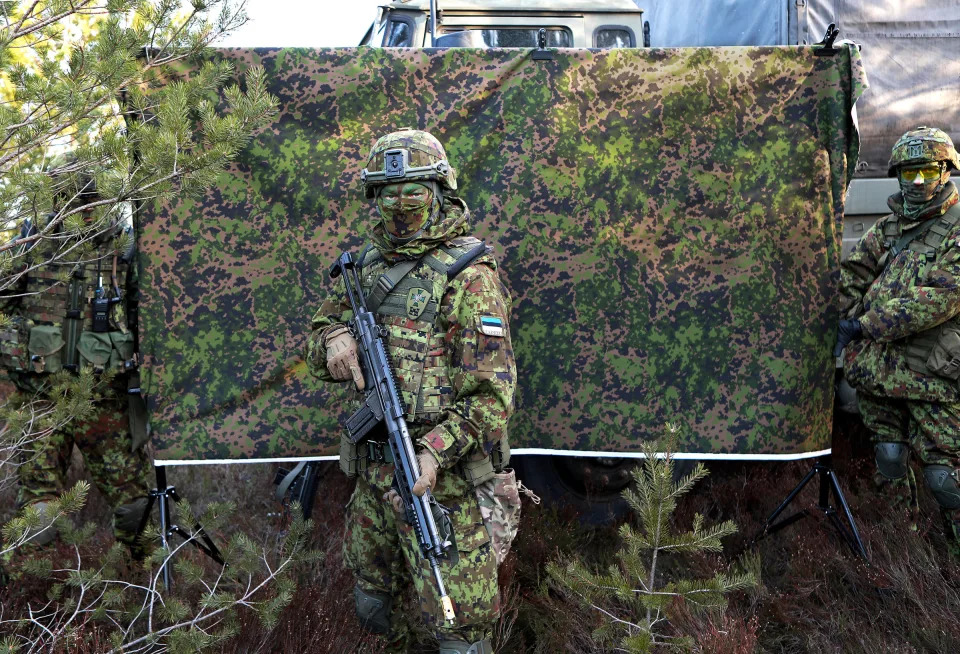
Members of the Estonian Defense League after training on March 27, in Männiku, Estonia. Credit – Birgit Püve for TIME

The ambush came at dawn. Moments before, the only sound in the frigid forest of Klooga, 40 km west of the Estonian capital Tallinn, had been light snoring coming from beneath a handful of camouflaged tarps. But seconds after machine-gun fire broke their sleep, several fighters erupted from their makeshift shelters and began returning fire. Flashes from their rifles illuminated the still dark woods, while blue smoke poured from a bomb intended to obscure the enemy’s path.

Read More: ‘Putin’s Appetite Will Only Grow.’ Estonia’s Prime Minister Says We’re Not Doing Enough to Stop Russia

Within minutes, the battle was over. Although the outnumbered fighters did not manage to vanquish the opposing force, Kaia, an accountant who had left her baby at home that weekend, was pleased with the training exercise. “They did pretty well,” she said of the volunteers in the Estonian Defense League (EDL) she was helping instruct. “They stayed calm, and they held their ground.”

The Baltic states of Estonia, Latvia, and Lithuania have been preparing to do the same. A shared border with Russia, and a painful history of Soviet occupation that began in the 1940s and saw the deportation and imprisonment of hundreds of thousands of citizens, spurred all three nations to join NATO once they regained independence in the 1990s. It has also led them to adopt a broad, society-wide approach to defense that has proved especially relevant more recently, as Russia has ramped up disinformation efforts in the region. Nowhere is that more evident than in Estonia, where 15,000 ordinary citizens like Kaia spend several weekends each year training in guerrilla warfare as part of the EDL. And since Russia invaded Ukraine in February, heightened fears that the Baltics could be the Kremlin’s next target have spurred thousands more to sign up.

A member of the Estonian Defense League in the forests of Klooga, Estonia on March 27.<span class="copyright">Birgit Püve for TIME</span>
A member of the Estonian Defense League in the forests of Klooga, Estonia on March 27.Birgit Püve for TIME

“We are not conscripts. We are not regular army,” said Henri, 20, a participant in the Klooga “ambush” who works in sales. (Most members speaking with TIME preferred not to give their last names as a security precaution.) “We are ordinary Estonian men and women ready to put our blood on the line for every inch a possible occupier would want to gain of our land.”

Read More: ‘Everybody’s Waiting for Putin to Die.’ A Russian Businessman on the Hopes for His Homeland

Estonia takes protecting its population of 1.3 million seriously. Its defense budget is proportionately the third highest among NATO countries, and while there are only 7,000 active–duty soldiers in its military, it bulks up its defense and deterrence capabilities with reservists and with the EDL, which is the region’s largest volunteer force. At the start of 2022, it counted some 15,000 members, plus 10,700 in its youth organizations and Women’s Defense League, which provides support to the fighting units. That already added up to nearly 2% of the population, and since Russia invaded Ukraine on Feb. 24, the organization has received roughly 2,000 new applications for membership.

Most members are unpaid, though the Ministry of Defense funds their training and supplies weapons. “I truly believe that Estonians will grab a weapon or a tool against the Russian invaders,” says Lauri Abel, the ministry’s Under Secretary for Defense Readiness. A former commander of the Tallinn EDL, Abel sees the corps’ civilian status as crucial to its success. “They’re the link between the armed forces and society. They are everywhere, working in different companies. They carry the defense spirit to society.”

Even before the war in Ukraine, a full 57% of Estonians said they would be willing to participate in their country’s defense; some 80% approve of the EDL. It helps explain what induced Katlin, a 36-year-old who works in the financial sector, to spend a below-zero Sunday in late March in the snow, learning to make impromptu stretchers that could be used to haul wounded comrades out of the woods. “I wear heels five days a week. So this,” she says, gesturing to her heavy flak jacket and boots, “is a big difference. But I want the knowledge, and I want to be prepared.”

Estonian women at the Estonian Defense League firing range in Männiku, Estonia on March 27.<span class="copyright">Birgit Püve for TIME</span>
Estonian women at the Estonian Defense League firing range in Männiku, Estonia on March 27.Birgit Püve for TIME

Preparation is at the heart of the league. New recruits spend eight weekends in basic training, where they learn to fire and clean weapons, to handle explosives, and a range of other survival skills. After passing a final test, they are allowed to keep their state-issued weapons at home. “I don’t know many countries in the world where the state entrusts its citizens to have combat weapons at their homes, just in case,” said one veteran member. “If we are suddenly attacked, I don’t need to go to a certain point to get my gear. I can just step out of my front door, walk 20 feet into the bushes, and then I’m dangerous.”

Read More: Inside the Historic Mission to Provide Aid and Arms to Ukraine

Against a conventional army with its large battalions and rigid formations, the EDL’s small, local units are intended to be much more agile. “One of our original principles is that you fight in the area you are from,” says Major Rene Toomse, who oversees the EDL’s training programs. “The point is that during peacetime you have time to learn all the terrain: you know where you can hide, where you can produce good ambushes—it’s your turf. Imagine what kind of leverage that gives you against an invading enemy. They have no idea where to go, and you know every inch.”

Trainees in the forest of Männiku, Estonia on March 27<span class="copyright">Birgit Püve for TIME</span>
Trainees in the forest of Männiku, Estonia on March 27Birgit Püve for TIME

The EDL hasn’t yet had to test its abilities in a real conflict, but it collaborates with the Estonian military and with other NATO forces in war games and joint exercises, and is a major reason why researchers at the Rand organization consider Estonia’s total defense capabilities to be among “the most developed” of the Baltic states.

Read More: Meet the Lithuanian ‘Elves’ Fighting Russian Disinformation

That serves as reassurance in a country where many believe that should Ukraine fall, they will be next. After sitting in on the Klooga unit’s practice ambush, Major Toomse drove to a target range where a different unit was spending its Sunday learning to fire two-person antitank weapons called Carl-Gustavs. “If Russia thinks it can reoccupy Estonia or any Baltic country,” Toomse said, “it’s going to be a disaster for them.”

With reporting by Simmone Shah/New York

Ukraine: A killing ground for Russian armor. Are tanks now obsolete?

Yahoo! News

Ukraine: A killing ground for Russian armor. Are tanks now obsolete?

Niamh Cavanagh, Producer – April 7, 2022

Despite having only the fourth-largest military in the world, Russia is the superpower when it comes to its supply of tanks, with 12,950 in 2020 — more than double the number of the U.S., which came in second with 6,333 vehicles.

As Russia’s invasion of Ukraine continues into its seventh week, it appears that President Vladimir Putin’s military forces might be taking a toll. Pictures of destroyed Russian tanks have been posted and shared across social media since the beginning of the war.

As of March 24, the Kremlin had lost hundreds of tanks since the war began in February, Ukraine’s Foreign Ministry stated. Russian vehicles have suffered heavy losses thanks to Ukrainian troops armed with antitank missiles, including the U.K.’s Next Generation Light Antitank Weapon, or NLAW, and the American Javelin antitank missile.

A member of the Ukrainian Territorial Defense Forces looks through the sight of an armament.
Members of the Ukrainian Territorial Defense Forces examine new armament, including NLAW antitank systems, in Kyiv on March 9. (Genya Savilov/AFP via Getty Images)

This has led some experts to say that warfare has changed, and that tanks and armored personnel carriers are now obsolete. “They are too expensive & are easily destroyed with manifold light anti-tank weapons or drones,” Anders Aslund, an expert on Russia, Ukraine and Eastern Europe, wrote on Twitter.

According to the open-source intelligence organization Oryx, Russia has lost a total of 450 tanks: 221 were destroyed, six were damaged, 41 were abandoned and 182 were captured. And Russia could lose more with the introduction of Switchblades, U.S. combat drones designed to attack personnel and light vehicles. On Tuesday, defense officials announced they were training Ukrainian soldiers in the U.S. on how to use the weapons to attack enemy tanks and armored vehicles. These 100 drones, which are carried in a backpack, were part of an $800 million military aid package to Ukraine.

So with Russia having lost hundreds of tanks, does this mean these armored vehicles are now becoming obsolete in modern warfare? According to Scott Boston, a senior defense analyst at the global policy think tank RAND Corporation, it’s a definite “not yet.”

“The first and most obvious piece of evidence that I have for that is that Ukrainians right now are asking for more armored vehicles,” Boston told Yahoo News. “And they would very much like to get support from the U.S. and from the West with more armored vehicles and more tanks.”

A Ukrainian serviceman stands on the turret of a destroyed Russian army tank.
A Ukrainian serviceman stands on the turret of a destroyed Russian army tank on April 3. (Sergei Supinsky/AFP via Getty Images)

Last month, Ukrainian President Volodymyr Zelensky asked NATO to either donate or sell 500 tanks to his country. “You have at least 20,000 tanks,” he said to the alliance’s heads of state. “Ukraine asked for a percent, 1% of all your tanks to be given or sold to us.” A number of countries in the organization use the same Soviet-era tanks and armored vehicles that Ukrainian soldiers already use themselves. However, it is not clear what type of tanks Zelensky was asking for.

One reason a large amount of Russian tanks have been destroyed, Boston said, is that Russia is doing the attacking — meaning Ukrainians are on the defensive, so they are targeting more enemy munitions. Boston said this is likely to change and more of Ukraine’s tanks would be destroyed when it transitions to the offensive.

Another reason for the graveyard of tanks is that Ukrainians are intelligently targeting Russian logistics, and so the ability to get fuel to the frontline has proved difficult. According to Boston, one specific Russian tank division lost a lot of vehicles due to abandonment rather than direct enemy action.

With this in mind, Boston told Yahoo News he doesn’t know that “we’re yet in the last generation of human-operated tanks.” He explained that this is because infantry will be used on battlefields for many years to come, and so protected transport for soldiers on foot will also be needed. “It’s an insurance policy for your infantry,” he said. “And the infantry protect the tank. That’s why they call it the ‘combined arms’ team. Without it, the tank is just as useless as everything else.”

A Ukrainian soldier inspects a burned Russian tank.
A Ukrainian soldier inspects a burned Russian tank on April 2 in Dmytrivka, Kyiv region. (Alexey Furman/Getty Images)

One former British Army officernow a defense military analyst, said people should be careful to “avoid drawing the wrong conclusions” on tanks. “Russia’s disastrous tactics have been a terrible advertisement for tanks,” Nicholas Drummond wrote on Twitter. “No artillery support. No infantry support. No air support,” he said, referring to images showing destroyed Russian tanks. “This is not how combined arms tactics work in an era of multi-domain operations.”

But how was there no support available for these tanks? According to Boston, “Russia went into this fight apparently thinking that they had bribed enough Ukrainian officials. And very few Ukrainians actually wanted to fight them, and [the Russians] believed they weren’t going to encounter serious resistance. They appear to have built their operations plan around that incredibly faulty assumption.”

And so time will tell how tanks will show up during the course of this war, but one thing is for certain, according to experts: They will be around for a lot longer.

Perma-sanctions: Biden under pressure to punish Russia until Putin’s gone

Politico

Perma-sanctions: Biden under pressure to punish Russia until Putin’s gone

Nahal Toosi – April 6, 2022

Mikhail Klimentyev, Sputnik, Kremlin Pool Photo via AP

Evidence that Russian troops murdered hundreds of Ukrainian civilians is leading some U.S. lawmakers to insist that America and its allies keep sanctions on Moscow so long as Vladimir Putin remains in power — even if he withdraws from Ukraine.

The sentiment is likely to grow in a Congress where anti-Putin feeling is strong and bipartisan. It could put the White House in a tricky position, making it potentially harder to bring peace to Ukraine by enticing Putin through sanctions relief.

The lawmakers want to punish Putin for what he’s done to Ukraine and innocent civilians in particular, and they recoil at the idea of allowing Russia’s economy to be revived with Putin still in power, in part because they don’t trust him not to re-invade Ukraine later.

“As long as we’re in agreement that Putin is a war criminal, he’s conducting crimes, and obviously his government is complicit all the way down the chain with Putin appointees and loyalists, then, how can we in good conscience lift the sanctions?” asked Rep. Mike Waltz (R-Fla.), who has called for even tougher penalties on Moscow.

Rep. Tom Malinowski (D-N.J.), who served as a top human rights official in the Obama administration, shared similar sentiments online and in an interview. “I can’t imagine returning Russia’s wealth to Putin after what he’s done and while Ukraine lies in ruins,” Malinowski said.

Despite a statement suggesting otherwise from President Joe Biden, his administration insists it’s not seeking regime change in Russia, and for now, it is more focused on raising the pressure, not relieving it. On Wednesday, the administration unveiled new sanctions whose targets included Russian banks and Putin’s daughters.

But White House aides are leery of following Congress’ lead on sanctions, fearful that lawmakers are prone to respond to the political whims of the moment without having to manage the longer-term fallout. Sanctions relief can be a useful instrument in the diplomatic toolkit. And administration officials have signaled — vaguely — that they’re willing to relieve economic pain on the Kremlin if it pulls its troops out of Ukraine.

“The purpose of the sanctions … is not to be there indefinitely. It’s to change Russia’s conduct,” Secretary of State Antony Blinken said on NBC News earlier this month. “And if, as a result of negotiations, the sanctions, the pressure, the support for Ukraine, we achieve just that, then at some point the sanctions will go away.”

But aides are also well aware that lifting penalties on adversarial regimes has, in the past, spurred fierce political backlash at home, such as in the case of Iran, and they are trying to coordinate their Russia-related moves closely with Congress.

The images of dead civilians, some of them in mass graves, that recently emerged from the Kyiv suburb of Bucha have left many lawmakers conflicted as to exactly how the sanctions endgame should play out. Many suspect that more such atrocities will be uncovered as the fight continues.

“Absent the war crimes evidence, I would say ‘Yes, we should be prepared to relieve sanctions if Putin pulls out of Crimea and all of the rest of Ukraine,’” said Sen. Chris Murphy (D-Conn.) who often defends Biden’s policies. Following the Bucha reports, “this question of when to lift sanctions is going to be a very difficult one.”

The administration’s general sense is that it will be a long time before the Ukraine conflict reaches a point where significant sanctions removal is even an option. “Putin does not seem interested in ending the fight despite the devastation that he’s bringing upon his own forces and his own people and economy,” a senior U.S. diplomat told POLITICO.

That being said, many U.S. officials believed that Russia’s superior military would quickly capture most if not all of Ukraine — a prediction that has proven incorrect.

Regime change or behavior change?

Economic sanctions — a broad term that can mean anything from trade restrictions to freezes on an individual’s financial assets — are in theory designed to shape behavior, analysts and officials say. That logic requires that a person or institution under sanctions needs to know those penalties will be removed if they change their actions. Otherwise, they have little incentive to shift course.

In reality, however, as the United States has grown less willing to use military force and struggled at times with diplomatic efforts, sanctions have become a way to punish or isolate an adversary, even when there’s no sign that they will change their behavior. Countries such as North Korea and Cuba have endured U.S. sanctions for many years without appreciably changing to Washington’s liking.

At the very least, imposing sanctions is a feel-good, symbolic move.

“You’ve got to freakin’ do something sometimes,” said Brian O’Toole, a former Treasury sanctions official.

Looming over the entire sanctions debate are the actions of Putin himself. The Russian autocrat has long believed the United States wants to see him toppled. If he becomes convinced that Washington won’t ease the sanctions so long as he remains in power, he may have even less incentive to withdraw from Ukraine.

Malinowski noted the possibility that Putin may hunker down, but he also pointed out that the Russian leader appears unwilling to withdraw regardless of sanctions pressure. The House member is pushing a bill that would give the U.S. government more authority to seize certain Russian assets and divert them to help rebuild Ukraine.

“We’ll either need to use sanctioned assets directly to help Ukraine, or compel Russia to do so as a condition of easing sanctions,” Malinowski said.

The Zelenskyy factor

Sanctions relief is not a zero-sum game. Many of the decisions related to it will depend on how well Ukrainians fight back against Russians, not to mention power dynamics in Moscow.

The United States and its allies could lift some sanctions, all at once or in stages, depending on the steps Putin takes to bring an end to the fighting. They could also simultaneously impose new sanctions on Russia to punish it for war crimes or other reasons, as they did on Wednesday.

One major factor to be considered is what Ukrainians want.

If Ukrainian President Volodymyr Zelenskyy decides to agree to a negotiated settlement with Moscow, he may ask that the United States and Europe relieve sanctions as part of that deal. Zelenskyy’s word would go a long way in Washington, where at the moment he has many admirers within both political parties.

But even then, U.S. officials and their counterparts in Europe would likely weigh their own national security interests. Eastern European and Baltic countries that fear Putin’s appetite for their soil, for example, may lobby against a partial or full end to sanctions on Moscow. But Western European countries whose economies rely heavily on Russian energy exports may favor quicker sanctions relief.

The West Wing has noticed that some U.S. lawmakers want to extend the punishments until Putin is deposed, and some in the White House have expressed internal concern that a move by Congress could tie the hands of negotiators or further provoke Putin.

But the prevailing belief is that if the sanctions were an obstacle to a peace deal and Zelenskyy wanted them dropped, the United States and its allies would acquiesce, according to two senior Biden administration officials.

When asked recently if Zelenskyy can negotiate sanctions relief, however, Blinken was noncommittal.

“If [Ukraine] concludes that it can bring this war to an end, stop the death and destruction, and continue to assert its independence and its sovereignty, and ultimately that requires the lifting of sanctions, of course we’re going to look at that,” Blinken told NBC News.

The atrocities in Bucha, not to mention what will likely be more such tragedies uncovered in the future, will make it harder for Zelenskyy to agree to a deal with Russia, predicted O’Toole.

“If everybody is honest with themselves about this, there’s so little chance that there is a real resolution to this with Putin in power,” O’Toole said.

A good deal also will depend on who’s in charge at the White House come the cessation of hostilities; the president has significant authority to impose or remove sanctions through executive actions. But Congress can also pass legislation to bind the president.

The case of Iran is instructive: The United States used sanctions to help push Iran to agree to a 2015 deal that restricted its nuclear program. But Republicans and many Democrats opposed the agreement and the sanctions relief it required. The lawmakers passed legislation giving themselves more power to review such agreements.

The deal is now largely defunct since then-President Donald Trump abandoned it in 2018, but Biden’s efforts to revive the agreement have drawn bipartisan backlash, with lawmakers unhappy with the idea of providing sanctions relief for Iran’s Islamist regime. As a result of the back and forth, international companies have largely refrained from reentering the Iranian market, complicating the calculus of a meaningful end to economic punishment.

Likewise in Russia, hundreds of companies have left the country as the United States, European Union and other governments unveiled their sanctions. As long as Putin stays in power, many of those companies may never return, even if the economic restrictions are lifted. And were Putin somehow to be toppled, or die, there’s no guarantee his successor will be any more acceptable to the West.

For as long as Putin rules, though, the sanctions should remain, some lawmakers say.

“There will be attempts to normalize trade relations again if Russia ends their aggression, but I disagree,” said Rep. John Curtis, a Republican from Utah. “Putin’s government should be treated as a pariah going forward.”

Jonathan Lemire contributed to this report. 

Putin’s UN ambassador says if Russia really wanted to kill civilians in Ukraine, more people would be dead

Business Insider

Putin’s UN ambassador says if Russia really wanted to kill civilians in Ukraine, more people would be dead

Rebecca Cohen – April 6, 2022

Vasily Alekseevich Nebenzya, Permanent Representative of Russia to the United Nations, speaks during a meeting of the UN Security Council, Tuesday, April 5, 2022, at United Nations headquarters.AP Photo/John Minchillo
Putin’s UN ambassador says if Russia really wanted to kill civilians in Ukraine, more people would be dead
  • Putin’s UN ambassador said if Russia were targeting Ukrainian civilians, more would be dead.
  • He also claimed that Russia is acting in “strict compliance” with international humanitarian law.
  • Russia has repeatedly denied evidence of mass civilian killings, including that in Bucha over the weekend.

Russian President Vladimir Putin’s United Nations ambassador, Vasily Nebenzya, said at a press conference Tuesday that if Russia really wanted to kill Ukrainian civilians, more would be dead.

“I would like to reiterate that the Russian military forces act in strict compliance with international humanitarian law and do not target civilians and civilian objects,” Nebenzya said.

He said that if the Russians were pursuing attacks on civilians, “the scale of losses and devastation would be worse by digits.”

Nebenzya also alleged that the US had killed more civilians in its occupation of Iraq than Russia is accused of killing in Ukraine since their invasion on February 24.

The United Nations’ Office of the High Commissioner for Human Rights said on Sunday that it had recorded 1,417 civilian deaths and 2,038 civilian injuries in Ukraine since Russia invaded the eastern European country in February.

The agency said, however, that it “believes that the actual figures are considerably higher.”

Russia has strongly denied evidence of civilian massacres in Ukraine, including recent evidence of mass graves holding nearly 300 bodies in the town of Bucha.

“The truth of what happened in Bucha will reveal itself,” Nebenzya said at the press conference.

A tweet from the Russian Ministry of Foreign Affairs Sunday, meanwhile, said “All the photos and videos published by the Kiev regime in Bucha are just another provocation.”

Top US general says the only way the US could have stopped Putin was to send troops into Ukraine, which Biden warned would start World War III

Business Insider

Top US general says the only way the US could have stopped Putin was to send troops into Ukraine, which Biden warned would start World War III

Bill Bostock – April 6, 2022

Gen. Mark Milley at a House Armed Services Committee hearing in Washington, DC, on Tuesday.REUTERS/Tom Brenner
Top US general says the only way the US could have stopped Putin was to send troops into Ukraine, which Biden warned would start World War III

Mark Milley said sending US troops into Ukraine was likely the only way to stop Putin from invading.

But the general said he was against doing so, as it would “risk armed conflict with Russia.”

NATO forces have refused to engage militarily with Russia on Ukrainian soil, distressing Zelenskyy.

The top US general said the only way to stop Russian President Vladimir Putin would be to send US troops into Ukraine — an action he and President Joe Biden have both opposed, saying it would spark a new conflict with Russia.

“Short of the commitment of US military forces into Ukraine proper, I’m not sure he was deterrable,” Gen. Mark Milley told the House Armed Services Committee on Tuesday.

“The idea of deterring Putin from invading Ukraine, deterring him by the US, would have required the commitment of US military forces, and I think that would have risked armed conflict with Russia.”

Since Russia invaded Ukraine on February 24, Ukrainian President Volodymyr Zelenskyy has repeatedly asked the US and NATO to send troops and enforce a no-fly zone over Ukraine, moves that would likely bring Western forces in direct combat with Russian forces.

NATO has stayed away from direct intervention, choosing to supply military and humanitarian aid.

Biden tweeted on March 11 that a direct US or NATO military incursion into Ukraine would be unfeasible and would start a world war.

“I want to be clear: We will defend every inch of NATO territory with the full might of a united and galvanized NATO,” he said.

“But we will not fight a war against Russia in Ukraine. A direct confrontation between NATO and Russia is World War III. And something we must strive to prevent.”

On Tuesday, Milley said he “certainly wouldn’t have advised” sending US troops into Ukraine to deter Putin.

As the West announced sanctions on Russia following the invasion, Putin put Russia’s nuclear-weapons program on high alert, brandishing the threat of nuclear war to ward off military intervention. However, Western officials believe that nothing has actually changed with the readiness of Russia’s nuclear program.

Russia’s invasion of Ukraine has slowed in recent weeks. Ukrainian and Western officials have said they believe Putin is repositioning troops for an all-out attack on the Donbas region in eastern Ukraine.

The region is home to the pro-Russian separatist regions of Donetsk and Luhansk. Russia recognized the Ukrainian territories as independent states days before the invasion.

As the fighting has continued across Ukraine, Russian and Ukrainian officials have held negotiations about a cease-fire.

Zelenskyy told the BBC on Monday that talks would continue despite evidence of Russian war crimes. Ukraine has accused Russia of killing at least 300 civilians, many in a gruesome fashion, in the town of Bucha, near Kyiv.

Micro-plastics Found in Lungs of Living People for First Time, and Deeper Than Expected

EcoWatch – Health – Wellness

Micro-plastics Found in Lungs of Living People for First Time, and Deeper Than Expected

Olivia Rosane –  April 06, 2022

Microplastics found in the Canary Islands.

Micro-plastics found in the Canary Islands. DESIREE MARTIN / AFP via Getty Images

It is possible to breathe in micro-plastics

A study accepted for publication in Science of the Total Environment last month detected micro-plastics in the lung tissue of living people for the first time, and much deeper than the researchers expected. 

“We did not expect to find the highest number of particles in the lower regions of the lungs, or particles of the sizes we found,” senior author Laura Sadofsky at Hull York medical school told The Guardian. “It is surprising as the airways are smaller in the lower parts of the lungs and we would have expected particles of these sizes to be filtered out or trapped before getting this deep.”

The research comes as more and more evidence shows that micro-plastics are penetrating the human body. Another study published days earlier found micro-plastics in human blood for the first time, and in almost 80 percent of the people sampled. 

The new study also found the plastic in the majority of lung tissue samples – 11 out of 13, the study authors wrote. A total of 39 microplastics were found in all regions of the lung. 

Previous studies had found plastics in lung samples taken from autopsies. One 2021 study in Brazil found microplastics in the lungs of 13 out of 20 people studied, The Guardian reported. A 1998 study of U.S. lung cancer patients found plastic and plant fibers in more than 100 samples. However, the lung tissue in the most recent study came from live patients at Castle Hill Hospital in East Yorkshire, the Press Association reported. It was removed in surgeries as part of the patients’ routine medical care. 

“Microplastics have previously been found in human cadaver autopsy samples; this is the first robust study to show microplastics in lungs from live people,” Sadofsky said, as the Press Association reported. 

The scientists used spectrometry to identify the plastics, The Guardian explained. The most common two types of plastic were polypropylene, which is used for packaging and pipes, and PET, which is commonly used for beverage bottles. 

In total, 11 microplastics were found in the upper parts of the lung, seven in the middle and 21 in the lower parts, a result that was particularly surprising, according to the Press Association.

“Lung airways are very narrow so no-one thought they could possibly get there, but they clearly have,” Sadofsky said, as the Press Association reported. 

The findings build on reports that people exposed to microplastics in industrial settings have developed respiratory symptoms and diseases, the study authors wrote. 

“This data provides an important advance in the field of air pollution, micro-plastics and human health,” Sadofsky said, as the Press Association reported. “The characterization of types and levels of micro-plastics we have found can now inform realistic conditions for laboratory exposure experiments with the aim of determining health impacts.”

WHO: 99% of the world is breathing polluted air

Yahoo! News

WHO: 99% of the world is breathing polluted air

Ben Adler, Senior Editor – April 6, 2022

Virtually everyone on Earth is breathing polluted air, according to a new report from the World Health Organization (WHO). In a report released Monday, the U.N. agency stated that 99% of the global population “breathes air that exceeds WHO air quality limits, and threatens their health.”

That startling fact can be attributed in part to improved monitoring of air quality. An all-time high of more than 6,000 cities in 117 countries now monitor air pollution. That’s 2,000 more cities than the last update to the WHO’s air quality database, and six times as many as when it launched in 2011. The WHO is also now able for the first time to measure ground-level average annual concentrations of nitrogen dioxide, and it can track smaller sizes of particulate matter than ever before. (Exposure to nitrogen dioxide can cause respiratory disease such as asthma, symptoms such as coughing, and emergency room visits.)

An aerial view of vehicles driving near downtown Los Angeles.
An aerial view of vehicles driving near downtown Los Angeles. (Mario Tama/Getty Images)

The high percentage of areas that exceed the threshold for harmful pollution is also driven by the fact that last year the WHO tightened its standards for air quality for the first time in 15 years. The organization lowered exposure levels of pollutants including sulfur dioxide, carbon monoxide, ground-level ozone and particulate matter. The WHO calculates that air pollution causes more than 7 million premature deaths each year.

“It has been recognized that air pollution has an impact at a much lower level than previously thought,” Dr. Sophie Gumy, technical officer at WHO’s Department of Environment, Climate Change and Health, told UN News. “So, with all the new evidence that has come up over the last 15 years since the last WHO air quality guideline update, most of the values of the guidelines levels have been reduced.”

Most air pollution is caused by the combustion of fossil fuels such as oil, gas and coal, which are also responsible for the greenhouse gas emissions causing climate change. Climate change is also itself a cause of increasing air pollution, due to the fact that ground-level ozone, also known as smog, forms more readily in warmer temperatures, and wildfires are increasingly frequent and severe.

The WHO called for nations to accelerate their transition to electric vehicles and clean sources of energy.

“Current energy concerns highlight the importance of speeding up the transition to cleaner, healthier energy systems,” said WHO Director-General Tedros Adhanom Ghebreyesus in the report. “High fossil fuel prices, energy security, and the urgency of addressing the twin health challenges of air pollution and climate change, underscore the pressing need to move faster towards a world that is much less dependent on fossil fuels.”

Birds and Bees Make Better Coffee, Study Finds

EcoWatch

Birds and Bees Make Better Coffee, Study Finds

Cristen Hemingway Jaynes – April 06, 2022

Birds and bees work together as pollinators

Birds and bees work together as pollinators. DansPhotoArt on flickr / Moment / Getty Images

For many people, one rich, pleasant smell signals the start of a new day more than any other: coffee. Different techniques have been used to get the best cup of the caffeine-rich liquid, from a French press to the pour-over method.

A unique new study has found that the secret to better coffee is really in control of the birds and the bees.

In the study, researchers found that when birds and bees joined forces to protect and pollinate coffee plants, the result was coffee beans that were bigger, more abundant and of better quality, reported the University of Vermont. Some of the flying assistants come from thousands of miles away, and without them the $26 billion coffee industry would see a 25 percent decrease in crop yields, or about $1,066 per hectare —  a hectare equals almost two and a half acres — in coffee losses.

“Until now, researchers have typically calculated the benefits of nature separately, and then simply added them up,” said Alejandra Martínez-Salinas of the Tropical Agricultural Research and Higher Education Center (CATIE), who was the study’s lead author, the University of Vermont (UVM) reported. “But nature is an interacting system, full of important synergies and trade-offs. We show the ecological and economic importance of these interactions, in one of the first experiments at realistic scales in actual farms.”

For the study, the researchers from Latin America and the U.S. used the world’s most popular type of coffee, Coffea arabica, a self-pollinating crop. They used small lace bags and large nets to test four scenarios on 30 coffee farms in Costa Rica. These included bee pollination alone; pest control by birds alone; zero bee and bird activity; and “a natural environment” in which the bees and birds were free to work together, going about their pollinating activities and munching on insects like the damaging coffee berry borer, which affects worldwide coffee production.

“These results suggest that past assessments of individual ecological services… may actually underestimate the benefits biodiversity provides to agriculture and human wellbeing,” said Taylor Ricketts of the University of Vermont’s Gund Institute for Environment. “These positive interactions mean ecosystem services are more valuable together than separately.”

The study, “Interacting pest control and pollination services in coffee systems,” was published in the journal Proceedings of the National Academy of Sciences.

In the study, it was found that the birds and bees had combined positive effects on the overall weight, weight uniformity and set of the coffee fruit — which all affect the quality and price — that were more significant than each of their effects alone, the University of Vermont reported.

“One important reason we measure these contributions is to help protect and conserve the many species that we depend on, and sometimes take for granted,” Ph.D. candidate at UVM’s Gund Institute for Environment and Rubenstein School of Environment and Natural Resources Natalia Aristizábal said. “Birds, bees, and millions of other species support our lives and livelihoods, but face threats like habitat destruction and climate change.”