Ukraine has ‘defeated the initial Russian campaign,’ study concludes
Grayson Quay, Weekend editor – March 20, 2022
Ukrainian soldiers in Kyiv FADEL SENNA / AFP) (Photo by FADEL SENNA/AFP via Getty Images
The D.C.-based Institute for the Study of War concluded that “Ukrainian forces have defeated the initial Russian campaign of this war,” in an assessment published Saturday, The New York Times reported.
The assessment argues that Russia had failed in its initial goal of swiftly capturing Kyiv and other major cities and toppling the Ukrainian government and that Russian forces “are very unlikely” to capture these major objectives if they persist in their present strategy.
“The doctrinally sound Russian response,” the assessment concluded, would be for Russian forces to pause and regroup instead of “continuing to feed small collections of reinforcements into an ongoing effort to keep the current campaign alive.”
United States Secretary of Defense Lloyd Austin made similar comments in Bulgaria on Saturday. “I think [Russia] envisioned that they would move rapidly and very quickly seize the capital city. They’ve not been able to do that,” he said, according to CNN.
In an address to the nation delivered Sunday, Ukrainian President Volodymyr Zelensky said over 14,000 Russian troops have been killed since the invasion began on Feb. 24. The U.S. estimates Russian military deaths at around 7,000.
“In places of especially fierce battles, the frontline of our defense is simply piled with the corpses of Russian soldiers,” Zelensky said.
Kori Schake, the director of foreign and defense policy at the right-leaning American Enterprise Institute, wrote in The Washington Post on Thursday that the “deficiencies of the Russian military are exacerbating the damage and risks of the war.”
Schake argued that “Russia’s first resort to overcome inadequacies has been to shift its focus from attacking military forces to targeting civilian populations indiscriminately.”
As of Saturday, the United Nations Office of the High Commissioner for Human Rights was able to confirm that 847 Ukrainian civilians have been killed in the fighting, though the report also says the “OHCHR believes that the actual figures are considerably higher.”
Russia uses hypersonic missiles in strike on Ukraine arms depot
March 19, 2022
LONDON (Reuters) – Russia said on Saturday it had used hypersonic Kinzhal (Dagger) missiles to destroy a large weapons depot in Ukraine’s western Ivano-Frankivsk region.
Russia’s Interfax news agency said it was the first time Russia had deployed the hypersonic Kinzhal system since it sent its troops into Ukraine on Feb. 24.
Defence ministry spokesman Igor Konashenkov told a briefing that the underground depot hit by the Kinzhal system on Friday housed Ukrainian missiles and aircraft ammunition, according to a recording of the briefing shared by Russian news agencies.
Reuters was not able to independently verify Konashenkov’s statements.
A spokesperson for Ukraine’s air force command confirmed a Russian missile strike on Delyatyn in the Ivano-Frankivsk region on Friday, without giving further details.
Russia prides itself on its advanced weaponry, and President Vladimir Putin said in December that Russia was the global leader in hypersonic missiles, whose speed, manoeuvrability and altitude make them difficult to track and intercept.
The Kinzhal missiles are part of an array of weapons unveiled in 2018.
Konashenkov added on Saturday that Russian forces had also destroyed military radio and reconnaissance centres near the Ukrainian port city of Odessa using the Bastion coastal missile system.
Moscow refers to its actions in Ukraine as a “special operation” to weaken its southern neighbour’s military capabilities and root out people it calls dangerous nationalists.
Ukrainian forces have mounted stiff resistance and Western countries have imposed sweeping sanctions on Russia in an effort to force it to withdraw its forces.
(Reporting by Reuters; Editing by Kevin Liffey, Frances Kerry and Helen Popper)
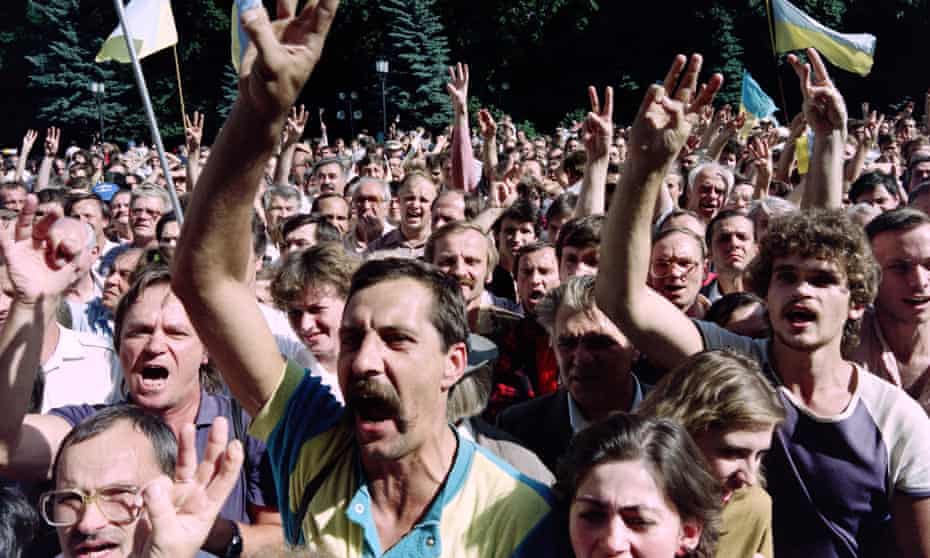
Pro-independence demonstrators at a rally in central Kyiv in 1991. Photograph: Anatoly Sapronenkov/AFP/Getty Images
How the country has transformed from a Russian client state to a would-be EU nation where liberals and nationalists have found common cause
Ukraine has been an independent country for more than half Vladimir Putin’s adult life (he turns 70 this year). It’s been a free republic for more than 30 years, long enough for the first generation of Ukrainians born since independence to have school-age children of their own. It’s had seven different leaders, all of them still alive.
It would be sentimental – and patronizing – to talk about a country having “grown up”. But 30 years is long enough for countries to change, for better or for worse; long enough for countries to have eras. Ukraine was well into its second era, its European era, when Putin invaded last month. Putin never accepted the right of post-Soviet Ukraine to exist in independent Ukraine’s first era. In terms of understanding the country, that’s the period he’s stuck in; Putin doesn’t acknowledge that a second era began.
The west shares many of the Kremlin’s misapprehensions about Ukraine. We are still too ready to see the country through the cliche of a “nationalist, Ukrainian-speaking” west and a “Russia-friendly, Russian-speaking” south and east. Or, more crudely and colourfully, neo-communist miners in the east, neo-Nazis in the west. Of course it was never that simple, even in post-Soviet Ukraine. But European-era Ukraine, which emerged in 2014, overturned its own political fundamentals. Faced with an existential struggle against a powerful, ruthless neighbour, Russia, where nationalism now serves autocracy, an emergent class of Ukrainian liberals made common cause with Ukrainian nationalists. It’s been an uncomfortable alliance but it has kept the country together. As Ukraine defends itself against Putin’s terror campaign, mutually estranged liberals and nationalists in other countries – the US, England, France – would do well to watch.
To talk about “European Ukraine” isn’t to describe an achieved state but a state of hope: hope of membership in the European Union – more meaningful to Ukraine, at least until Russia attacked, than membership of Nato.
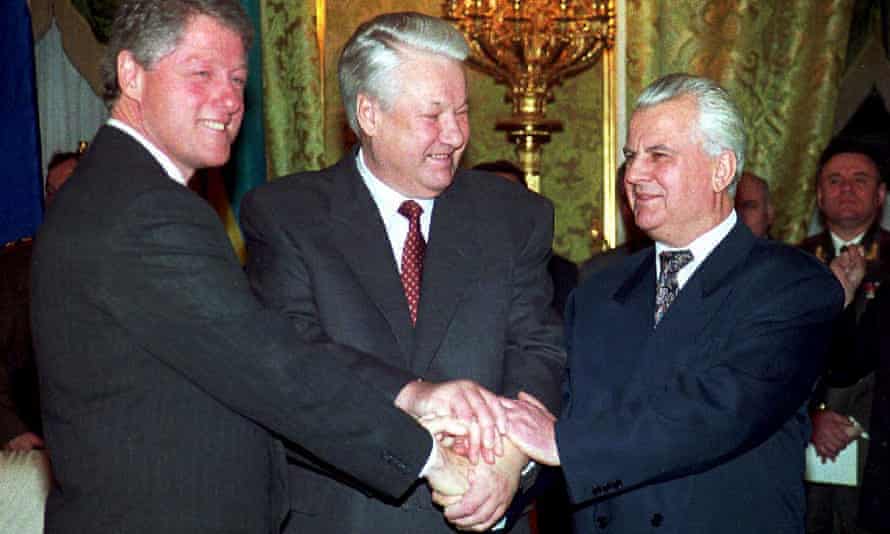
Bill Clinton, Boris Yeltsin and Ukraine’s Leonid Kravchuk after signing a nuclear disarmament agreement in the Kremlin in 1994. Photograph: Sergei Supinsky/AFP/Getty Images
Advertisement
Ukraine’s hope of Europe had its material side, a hope of grants, jobs and trade. Since the “revolution of dignity” – also known as “Maidan” – in 2014, trade with the EU soared while trade with Russia plunged. More than a million Ukrainians went to work, legally or otherwise, in the EU. Since Russia invaded Ukraine on 24 February, much has been made in Britain of the EU’s openness to Ukrainian refugees compared with the barriers put up by London. But it’s a depressing reflection of how mainstream anti-immigrant assumptions have become in the UK that virtually no one in Britain is aware the EU gave Ukrainians visa-free access years ago, as a reward for their country’s sacrifices in Europe’s name. Since 2017, as a result of that and of Brexit, Ukrainians have levelled up and Britons levelled down to identical rights of EU entry: 90 days’ stay without a visa.
Beyond the material hopes of European-era Ukraine, there is the prospect, less tangible and more powerful, of an alternative form of nationhood. Rather than the archaic, romantic, racial mystifications of old Ukrainian nationalism, or Putin’s neo-imperial vision of Ukraine pulverised and remade as a puppet state to serve Russian nationalism, it’s of Ukraine pursuing its free course as an equal member of a self-constraining, self-governing association of countries, the EU.
The beauty of the EU, for Ukraine, is the capaciousness of its model for both liberals and nationalists. In some ways, the aims of European-era Ukraine closely resemble those of the Scottish National party and the Irish republic: to use the economic power of the EU to leverage their own, to break out of the orbit of a delusional post-imperial culture, to find national self-determination by accepting multinational rules. As Tom Nairn wrote of Scotland, a country could aspire to “a new interdependence where our nationhood will count, rather than towards mere isolation”.
For Ukraine’s more conservative nationalists, it’s Poland and Hungary that offer the more appealing EU models – stridently patriotic, subordinating media, courts and education to national ideals and social conservatism, all while getting subsidies and trading freely within the EU.
The prelude to Ukraine’s European era occurred in 2013 under president Viktor Yanukovych, a profoundly corrupt politician from the east of the country. Although seen as a proxy for Kremlin interests, and generally loyal to the idea of post-Soviet Ukraine as a Russian client state, he threw his weight behind an association agreement with the EU. He had his country on side, but Putin gave it to be understood that he considered it a betrayal – Ukraine could partner with the EU or Russia, not both.
Whether Yanukovych was genuinely up for the deal with Brussels, or simply angling for a bigger bung from Moscow, he changed his mind at the last minute, took a large loan from Putin and turned his back on the EU.Advertisement
It was November. Protests began in Kyiv against abandonment of the EU deal. There were calls for Yanukovych to resign. Small, peaceful protests were put down violently by the police. Parliament, then controlled by Yanukovych allies, passed repressive laws against free speech and gatherings. As 2013 passed into 2014, the protests grew, their demands expanded and their base spread. Opposition to Yanukovych and calls for deeper ties to Europe evolved into attacks on the entire corrupt, oligarchic system of business and government.
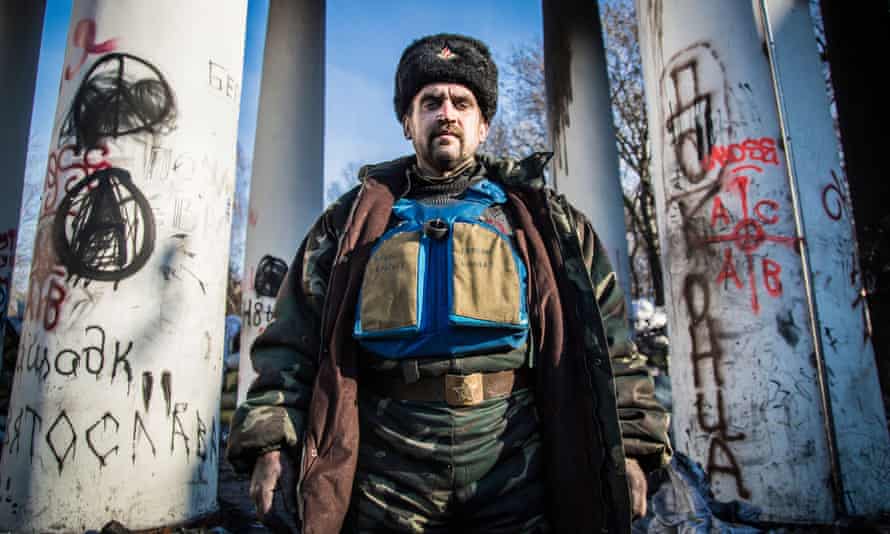
Young members of the liberal intelligentsia were joined by radical nationalist groups, by small-business owners and by factory workers. Opposition MPs aligned themselves with the protesters. Increasingly violent street battles were waged around Kyiv’s central square, Maidan Nezalezhnosti. Barricades went up. Weapons escalated from clubs and stones and shields to molotov cocktails, to stun grenades and rubber bullets, to actual bullets. Some police were shot; more than 100 protesters were killed.
In 2014, protests erupted in Kyiv’s Maidan Square over the government’s withdrawal from EU talks. More than 100 were killed; president Viktor Yanukovych fled to Russia. Photograph: Getty Images
In the third week of February, for reasons still mysterious – perhaps because the security forces ceased to believe in the president – the regime collapsed. European foreign ministers brokered a peace deal with Yanukovych, the Maidan crowd refused to accept it, and Yanukovych fled the country. Parliament voted in an interim government and prepared for new elections.
Barely had the revolutionaries’ victory sunk in before Russia annexed Crimea in a nearly bloodless coup de main. In Yanukovych’s home region of Donbas, on the border with Russia, locals angry at the treatment of their lawfully elected president seized administrative buildings. They were quickly ousted, only to be replaced, in April, by a new wave of rebels helped by volunteers from Russia. Fighting escalated to a full-scale war, culminating in incursions by regular Russian troops. Thousands of people were killed. By 2015, the front lines had stabilised and fighting lessened, with part of Donbas under joint Russian-rebel control. The rest of Ukraine was at peace. In 2017, the association agreement with the EU came into force.Advertisement
Even before the war in the Donbas began, there were warnings of what the longer term held. In what reads now as an astonishingly accurate forecast of what was to come, in an interview with a Ukrainian paper in March 2014, the former Putin adviser Andrei Illarionov spelled it out, failing only to predict that eight years would pass first. “There’s an aim and a plan to attack Ukraine which was put together years ago,” he said. It has many different elements … Crimea, the south-east and, of course, a change of power in Kyiv. And then there are other things: a new [Ukrainian] constitution, to be written in the Kremlin, disarmament of the Ukrainian people, liquidation of Maidan, and so on.”
“Liquidation of Maidan” sounds different from the current Kremlin programme, until you realise this is simply “denazification” by another name.
It might seem trivial now, when Ukraine is on fire and hundreds are being killed every day, when all that seems important is how many Russian tanks and planes and soldiers the Ukrainians have to blow up to make Putin stop, to talk about abstractions like nationalism and liberalism. And yet without these forces coming together over the past seven years of semi-peace, would Ukraine have held out this long?
I remember being surprised, when I visited Kyiv at the end of February 2014, to see how focused liberals and nationalists alike were on a European future. The spokesman for one of the most notorious radical nationalist groups, Right Sector, talked to me about Poland as a model for the country. European flags were everywhere. I went for dinner one evening with a friend of a friend, a successful businesswoman. The Maidan was very localised; a huge encampment of brown tents crowded together, wreathed in the smoke of hundreds of stoves, in which exhausted people, who had fought nightly battles in freezing conditions, lived difficult lives away from home. But right next door to it were expensive restaurants with waiters in spotless white shirts serving fine wines and tuna carpaccio. “You know, the nationalists were very important,” said the businesswoman, sipping her grenache. “They did very good work at the leading edge.”
I’ve always been in two minds about that conversation with someone who had been very kind to me. On the one hand, it had that air of somebody being grateful that somebody else was doing their dirty work; that one person had education, good taste and proper gentle sentiments, and they were grateful that their interests were being protected by another person who risked their life with a petrol bomb and a brick, and whose most conservative, chauvinist views the first person would definitely not want to hear at their dinner table in peacetime. On the other hand, my friend’s friend was being honest about the realities of a dangerous situation, and resistance towards a nasty, increasingly repressive regime: that she was not one of nature’s fighters, and she was glad to have people prepared to fight for their country on her side. “Nationalist” and “liberal”, after all, are words with an extremely broad range of meanings.
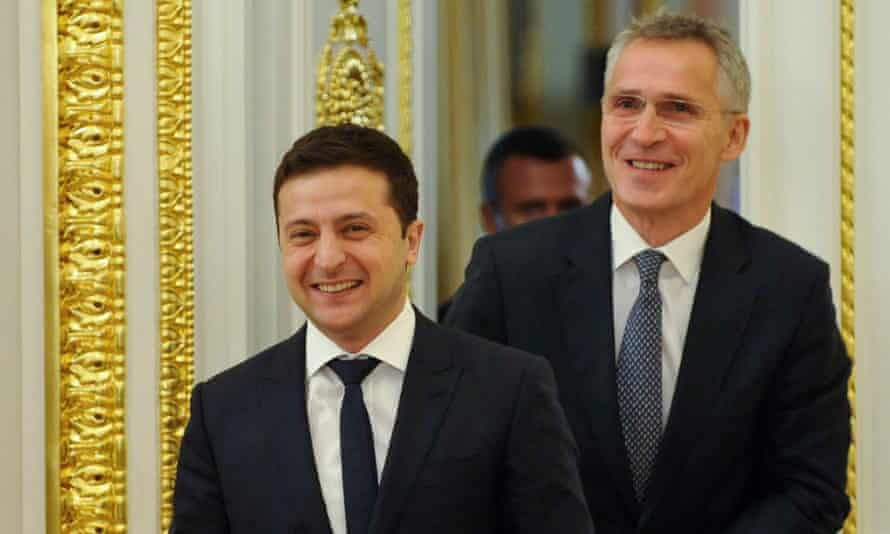
President Volodymyr Zelenskiy and Nato secretary general Jens Stoltenberg meet in Kyiv as Ukraine decides to pursue Nato as well as EU membership. Photograph: Sergei Chuzavkov/Shutterstock
“For me, ‘national’ is what allows me to defend Ukraine as an independent, sovereign nation,” said the Ukrainian philosopher Evhen Bistritsky in 2018, at a time when disillusionment with Ukraine’s post-Maidan failures to get to grips with corruption and institutional inertia was running deep.
“I am a liberal, defending the independence of Ukraine. Part of Ukrainian society supports conservative values, linking them to security. If we’re really only going to preach universal, classical, liberal values … we promote discord in the country.”
In a country not fighting for its existence, in the US, perhaps, or Britain, or France, in some safe part of the EU, such language would have marked Bistritsky out as a centrist, a moderate, even, more pejoratively, an undemocratic compromiser. In the present Ukrainian context, faced with the Russian killing machine, “discord” becomes “failure to fill the ranks”.
Recently the Ukrainian writer Artem Chekh published Absolute Zero, his memoir of service in the Ukrainian army on the Donbas front in 2015. In it he faces up to the strangeness of being a liberal, cosmopolitan, intellectual man serving alongside workers and farmers who see the world in patriotic, if cynical, absolutes. I went around to his flat in Kyiv a few weeks ago for coffee and cake. Now he has taken up a gun again to protect the city against the invader. In an article for the London Review of Books blog, he lists his comrades: “a music producer, an owner of a household chemicals store, a teacher, an artist, a bank clerk, a former investigator, a doctor. The ability to write, paint, act, play a musical instrument or dance doesn’t matter now. What counts is military experience.”
Ukraine ‘temporarily’ loses access to Sea of Azov – Defense Ministry
March 18, 2022
FILE PHOTO: Ships are seen near the Azov Sea port of Mariupol
(Reuters) – Ukraine’s defence ministry said late on Friday it lost access to the Sea of Azov “temporarily” as invading Russian forces were tightening their grip around the Sea’s major port of Mariupol.
“The occupiers have partially succeeded in the Donetsk operational district, temporarily depriving Ukraine of access to the Sea of Azov,” Ukraine’s defence ministry said in a statement.
The ministry did not specify in its statement whether Ukraine’s forces have regained access to the Sea.
Russia said on Friday its forces were “tightening the noose” around Mariupol, where an estimated 80% of the city’s homes had been damaged more some 1,000 people may still be trapped in makeshift bomb shelters beneath a destroyed theatre.
Mariupol, with its strategic location on the coast of the Sea of Azov, has been a target since the start of the war on Feb. 24 when Russian President Vladimir Putin launched what he called a “special military operation”.
The city lies on the route between the Russian-annexed peninsula of Crimea to the west, and the Donetsk region to the east, which is partially controlled by pro-Russian separatists.
Russia claimed as early as March 1 that its forces had cut off the Ukrainian military from the Sea of Azov.
(Reporting by Lidia Kelly; Editing by Kenneth Maxwell)
Putin replaced 1,000 personal staff members in February over fears they would poison him, report says
Jake Epstein – March 18, 2022
Vladimir Putin.Alexei Druzhinin/Getty Images
Putin replaced 1,000 personal staff members in February over fears they would poison him.
The Daily Beast reported that those sacked included bodyguards, cooks, launderers, and secretaries.
A French agent said an attempted assassination would come from within the Kremlin.
Russian President Vladimir Putin replaced about 1,000 personal staff members in February over fears that they would poison him, a report said.
Those sacked included bodyguards, cooks, launderers, and secretaries, The Daily Beast reported on Wednesday, citing a Russian government source.
February was marked by US and Western officials repeatedly warning that Russia was preparing to stage a pretext to justify waging war against Ukraine after it spent months gathering troops along their shared border.
As much of the world has condemned Russia’s ongoing bombardment of Ukraine, an operative for France’s General Directorate for External Security told The Daily Beast that carrying out an attempted assassination of Putin “is on every intelligence agency’s design table.”
South Carolina Sen. Lindsey Graham has even called for Putin’s assassination, drawing criticism from fellow Republican lawmakers.
“The only way this ends is for somebody in Russia to take this guy out,” Graham tweeted earlier in March. “You would be doing your country — and the world — a great service.”
The operative told The Daily Beast that an attempted assassination wouldn’t be the job of a foreign government.
“The attempt will be from within the Kremlin,” the operative said. “Russian intelligence is likely the only one left that deploys poison as a default” to assassinate people.
Poison as a killing tool is not unheard of in Russia. Alexei Navalny, the prominent Kremlin critic, was poisoned with the Soviet-era nerve agent Novichok in Siberia in August 2020, and Putin has been widely accused of ordering the attack.
Russia’s staggering losses over 3 weeks of Ukraine fighting already exceed entire wars
Julie Coleman and Alex Ford – March 19, 2022
Smoke rises from a Russian tank destroyed by the Ukrainian forces on the side of a road in Lugansk region.
7,000 Russian troops have been killed in battle, according to a US intelligence estimate.
Russian troop deaths are already more than the number of American troops killed in either the Iraq or Afghanistan wars.
At this rate, Russia is suffering what could soon be unsustainable losses.
In the three weeks since Russia launched its war against Ukraine, the fighting has taken a heavy toll on both sides and the civilians trapped in cities like Kharkiv and Mariupol, where authorities are trying to rescue 1,300 people who had sheltered in a theater that was attacked.
The toll also appears to be huge and mounting for Russia’s military.
Seven thousand Russian troops have been killed in battle so far, according to a US intelligence estimate reported by the New York Times, and that’s a conservative estimate. Four Russian generals have died and the Times reported on March 16 that between 14,000 and 21,000 Russians troops had been injured.
By this estimate, Russian military deaths are now much higher than the number of American troops killed in either the Iraq or Afghanistan wars, at 4,825 and 3,576 respectively.
The Russian casualties appear to be of a scale similar to those at Iwo Jima — one of the bloodiest battles in Marine Corps history – where about 6,852 US troops died and around 19,000 were injured in five weeks of fighting against an entrenched Japanese force, which sustained an estimated 18,000 dead and missing.
If Russian forces were to continue losing troops at this rate, in a year about 121,000 Russian troops would be dead, with injured likely to be three or four times higher — suggesting Russia’s offensive must break the Ukrainian resistance or suffer unsustainable losses. That toll, for example, would be higher than American casualties during the Korean War, where 36,576 Americans died over the course of three years.
Ukraine’s military has also suffered heavy losses, likely to be much higher than the 1,300 troops Ukraine has confirmed as killed.
Some Russians are breaking through Putin’s digital iron curtain – leading to fights with friends and family
Cat Zakrzewski and Gerrit De Vynck – March 19, 2022
BRAZIL – 2021/10/20: In this photo illustration, the Virtual Private Network (VPN) is seen displayed on a smartphone. This type of connection establishes safe internet browsing, making your location invisible. (Photo Illustration by Rafael Henrique/SOPA Images/LightRocket via Getty Images) (SOPA Images via Getty Images)
Days after Russian tanks rolled into Ukraine, Maria, a 37-year-old mother in western Russia, downloaded a virtual private network, an effort to circumvent the blockade she saw descending across the country’s Internet.
The instinct proved correct. As the Kremlin began reversing years of relative Internet freedom and restricting American social networks and Western news sites, the VPN proved a lifeline, allowing her to chat with a friend in the United States and read updates on Facebook and Instagram, refreshing news about the war every 10 to 20 minutes. Maria thinks the conflict is a “tragedy” and says reading about it leaves her with “anger, sadness and empathy.”
But Maria says her mother believes what she sees on Russian-state run television, where the Russian invasion is portrayed as a righteous military campaign to free Ukraine from Nazis. The different visions have led to bitter arguments, and after one that left her mother in tears, Maria vowed to stop talking to her about the war.
Some Russians – often with social, educational or professional ties to the United States and Western Europe – are trying to pierce Russian President Vladimir Putin’s propaganda bubble, at times leaving them at odds with their own families, friends and co-workers. The war in Ukraine is only deepening the divide that was already present between young, tech-savvy people and an older generation who gets their news mostly from TV and has always been more comfortable with Putin’s vision of the country.
Nearly 85% of the country’s population is online, according to data from the World Bank. But only some of those people use American social networks. In 2022, about half of Russian Internet users were on Instagram, and only a fraction were on Facebook and Twitter, according to data from research firm eMarketer.
Many Russians who go online have come to rely on a range of digital tools to outmaneuver Russian censors. They seek out independent news about the war online, splitting them from others whose information comes from government propaganda that floods TV, government-backed websites and large swaths of social networks that remain unrestricted, like Telegram or VK, which are home to many pro-government groups.
This ideological gulf was reflected in interviews with a half-dozen people in Russia, who in most instances spoke on the condition of anonymity to avoid violating the country’s fake news law.
“Shock, hatred and depression,” are the words Mikhail Shevelev, a Moscow-based journalist, uses to describe the “very serious” and “drastic” divide that has emerged between people reading independent online sources and those who primarily get their news from TV.
“It’s really difficult for anyone – even Russians who do not live in Russia – to understand the scale of absolutely illogical perceptions of information and outright lies,” he said.
Older Russians make up the primary viewership of Russia’s state television news, which has been flooded with reports of fake U.S. biowarfare labs and Ukrainian “Nazis.”
At the same time, Putin is using increasingly advanced censorship technology. In addition to the recent restrictions on Facebook and Twitter, Russia has blocked the websites of many major Western media outlets, including Britain’s BBC and Germany’s Deutsche Welle. In response to sanctions and public pressure, major tech companies including Apple, Microsoft and Amazon have suspended some sales and services in the country, further contributing to what’s being called a “digital iron curtain.”
Still, Russians seem determined to get around the restrictions. According to the digital intelligence firm Sensor Tower, the top five VPNs in Apple’s App Store and the Google Play store were downloaded 6.4 million times between Feb. 24 and March 13. In the three weeks before Russia invaded Ukraine, the same VPN apps were downloaded only 253,000 times.
Independent Russian media organizations, which have moved their reporters outside of the country, still report some of what’s happening in Ukraine, and there are still some discussions happening on community groups on VK, Russia’s most popular social media network, according to Russians who spoke to The Washington Post. Some Russians are also finding independent news on Telegram and YouTube, which Russia has not yet blocked.
Alexander, a tech worker from Moscow in his 20s, said he’s aware of people who’ve unfriended each other online, writing posts about how they’ll never shake a certain person’s hand again because of their opinion on the war. “My aunt, she stopped talking to a few of her friends whom she knew for ages,” he said.
Bot accounts, widely assumed to be run by government employees, muddy the picture by commenting and posting pro-government messages on VK, said Daria, a Moscow resident in her 20s. “It’s sometimes difficult to distinguish a bot from a genuine government supporter.”
Some Russians who use VPNs are finding the posts and arguments around the war too intense and are pulling back.
Lucy, a 29-year-old designer from the North Caucasus region in Russia, said she has cut back on using Instagram because of angry comments against Russians. She has relatives in Ukraine who’ve had to flee the Russian attack, and said she is half Ukrainian herself. But the heated environment online has pushed her away from engaging on social media.
“At the beginning, I empathized a lot with them. I might not be there, but as I’m a very sensitive person I can feel the pain they’re going through,” she said. As the war progressed, she began getting death threats online, and she unfollowed many of the Ukrainian accounts she had been following. “It’s very hard to be blamed for something you don’t do personally,” Lucy said.
Other young Russians said these online attacks on Russians are pushing some toward a more pro-war position in line with the government. One channel on Telegram was full of memes and posts decrying “Russophobia,” and saying that Western countries were supporting Ukraine out of hatred against Russians.
One pro-government Telegram group, with over 110,000 subscribers, posted a video of what it claimed were volunteers heading to Ukraine to help with the invasion. “We don’t need the whole world with us, dear friends. It is enough if all the Russian peoples are with us,” read the caption under the video.
Putin’s years-long campaign to tighten his grip on Russia’s once-open information ecosystem intensified in November 2019, when the country’s “sovereign Internet” law came into force. That law required Internet providers in Russia to install government-issued black boxes on their premises that would enable the government to control Web traffic by giving the Russian government the power to slow a site from loading or block it entirely.
Some people in Russia are also turning to Tor, an open source system that enables anonymous communications, to visit services. Twitter and Facebook have built versions of their platforms that work with the software. Artem Kozliuk, head of the Russian digital rights group Roskomsvoboda, said that he and others in the country are navigating an increasingly complex mix of VPNs and special browser plug-ins to access basic information on both their laptops and phones. His organization is putting together a guide to help people navigate the different services.
“Now information goes through many proxy systems, through many obstacles before it reaches users,” he said.
Despite the surge in VPN interest, the Kremlin’s crackdown has made many fearful of sharing their political views online. And the two-tier information system continues to rule Russian opinion.
“A huge number of Russians, including me, don’t comment and don’t share their opinion on social media in any way,” Daria said. “People who watch television do believe that there are no civilian casualties and our government only fights against nationalists who oppress Russians living in Ukraine . . . People who read and watch government-controlled sources aren’t exposed to pictures of destroyed cities and fleeing Ukrainians.”
Ilya Yablokov, a lecturer at the University of Sheffield who studies the Russian Internet, said he believes Russia’s censorship abilities so far have allowed the government to succeed in controlling the narrative inside the country’s borders. But that may not always be the case
“It’s the control of power, it’s the control of narrative, it’s the control of population,” he said. “The question is for how long are they going to be winning?”
– – –
The Washington Post’s Heather Kelly and Craig Timberg contributed to this report.
The event was held at Luzhniki Stadium in the center of Moscow. Attendees wore the Russian colors of red, white and blue. “We don’t abandon our own,” one slogan adorning the stadium said, in a seeming echo of the message that an embittered Putin delivered on Wednesday, when he castigated Russians who either have fled to or are siding with the West in protest of the war in Ukraine.
“For Russia” and “For a World Without Nazism,” read other slogans hanging in the packed stadium on the banks of the Moscow River, as Putin’s unprovoked assault on Russia’s sovereign neighbor enters its fourth week.
Russian President Vladimir Putin delivers a speech on Friday at Luzhniki Stadium in Moscow. (RIA Novosti Host Photo Agency/Alexander Vilf via Reuters)
He invoked Russia’s proud military history and its defeats of both Hitler and Napoleon. Its military record has been tarnished more recently by corruption, incompetence and abuse, all of which have become evident during the Ukrainian campaign.
“Shoulder to shoulder. They help, support each other. And if needed, they take a bullet on the battlefield — as if for their own brother,” Putin told the flag-waving rally attendees. “We haven’t seen such unity in a long time.”
At one point, the video feed of the Moscow rally — which included musical performances and a reading of patriotic poetry — was interrupted, with the live feed replaced by recorded footage. According to a social media post from RIA Novosti, the state-owned wire service, the disruption was caused by a server malfunction.
People watch a broadcast of Putin’s speech outside the stadium. (RIA Novosti Host Photo Agency/Vladimir Astapkovich via Reuters)
The rally was called “Crimean Spring,” in reference to the eighth anniversary of Putin’s invasion of the Black Sea peninsula of Crimea, which was originally part of Ukraine. Whereas that 2014 campaign, which also saw Putin invade two eastern provinces, did not encounter significant resistance or a united international response, the war in Ukraine has gone poorly for Russia, leading some to wonder if Putin badly miscalculated sentiment both at home and abroad.
Putin continued to claim that his invasion of Ukraine was necessary to prevent “genocide,” which the U.S. had predicted he would use as a pretext for the assault.
According to the United Nations, more than 700 civilians have been killed since Russia launched the invasion on Feb. 24.
Ukraine’s Mariupol says Russia forcefully deported thousands of its people
March 19, 2022
FILE PHOTO: A view shows a damaged residential building in the besieged city of Mariupol
(Reuters) – The city council of Ukraine’s Mariupol said Russian forces forcefully deported several thousand people from the besieged city last week, after Russia had spoken of “refugees” arriving from the strategic port.
“Over the past week, several thousand Mariupol residents were deported onto the Russian territory,” the council said in a statement on its Telegram channel late on Saturday.
“The occupiers illegally took people from the Livoberezhniy district and from the shelter in the sports club building, where more than a thousand people (mostly women and children) were hiding from the constant bombing.”
Reuters could not independently verify the claims.
Russia’s Defence Ministry said busses carrying people it called refugees from Mariupol began to arrive to Russia on Tuesday, Russian news agency RIA Novosti reported last week. The ministry was not immediately available to comment on the Mariupol city council’s claims.
Some 400,000 people have been trapped in Mariupol, on the Sea of Azov, for more than two weeks, sheltering from heavy bombardment that has severed central supplies of electricity, heating and water, according to local authorities.
The Russian TASS news agency reported on Saturday that 13 busses were moving to Russia, carrying more than 350 people, about 50 of whom were to be sent by rail to the Yaroslavl region and the rest to temporary transition centres in Taganrog, a port city in Russia’s Rostov region.
Russia’s Defence Ministry said this month that Russia had prepared 200 busses to “evacuate” Mariupol citizens.
RIA Novosti agency, citing emergency services, reported last week that nearly 300,000 people, including some 60,000 children, have arrived in Russia from the Luhansk and Donbas regions, including from Mariupol, in recent weeks.
Russia’s Defence Ministry said this month that more than 2.6 million people in Ukraine have asked to be evacuated.
Reuters could not immediately verify those reports.
Mariupol, a key connection to the Black Sea, has been a target since the start of the war on Feb. 24, when Russian President Vladimir Putin launched what he calls a “special military operation” to demilitarise and “denazify” Ukraine. Ukraine and the West say Putin launched an unprovoked war of aggression.
As Russia has sought to seize most of Ukraine’s southern coast, Mariupol has assumed great importance, lying between the Russian-annexed peninsula of Crimea to the west and the Donetsk region to the east, which is partially controlled by pro-Russian separatists.
(Reporting by Lidia Kelly; Editing by William Mallard)
Russian military slog in Ukraine a ‘dreadful mess’ for Putin
Ellen Knickmeyer – March 18, 2022
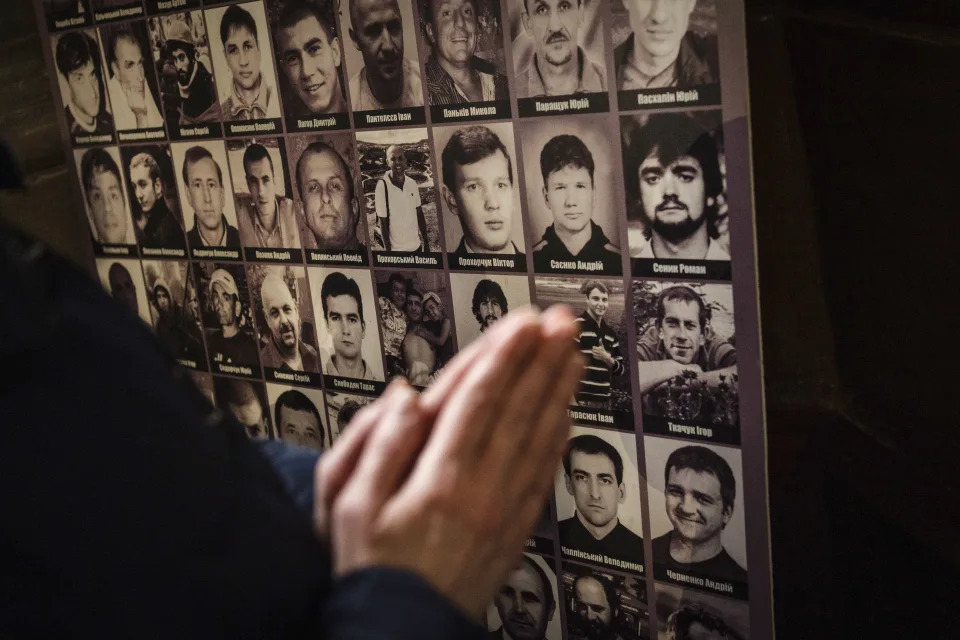
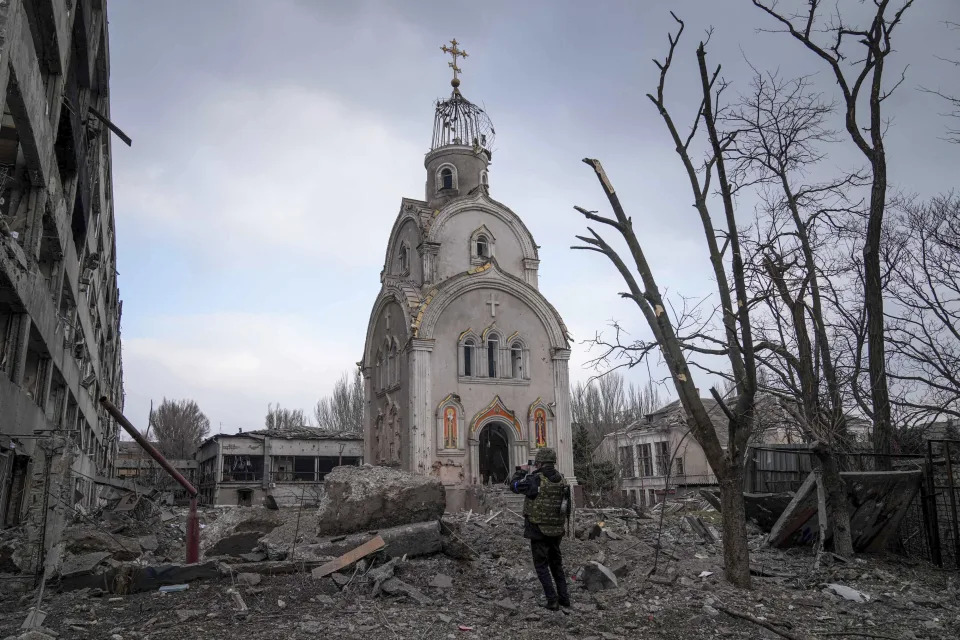
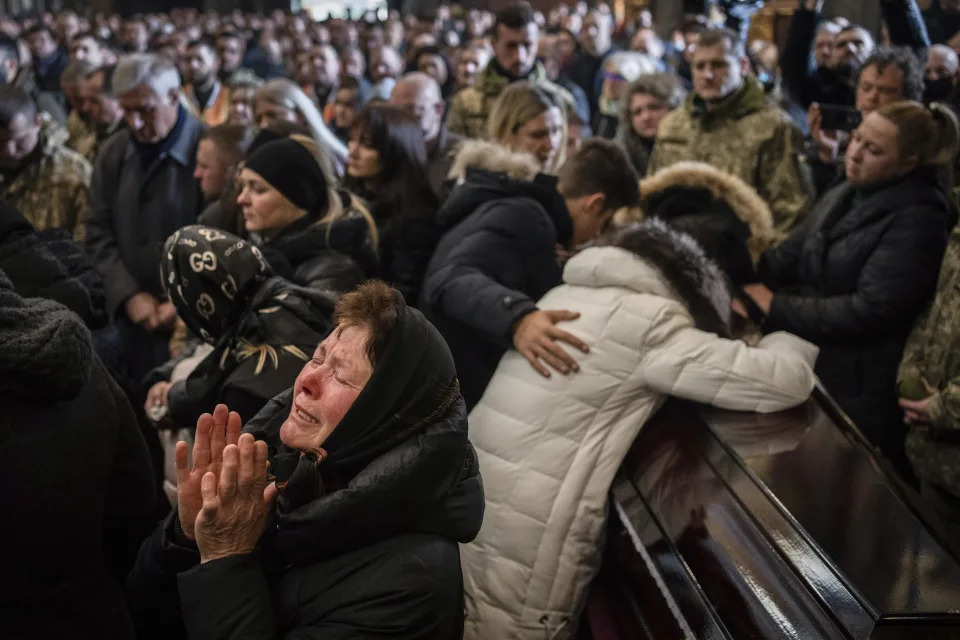
FILE – A Ukrainian Territorial Defence Forces member holds an NLAW anti-tank weapon, in the outskirts of Kyiv, Ukraine, March 9, 2022. (AP Photo/Efrem Lukatsky, File) ASSOCIATED PRESSFILE – Cars drive past a destroyed Russian tank as a convoy of vehicles evacuating civilians leaves Irpin, on the outskirts of Kyiv, Ukraine, March 9, 2022. (AP Photo/Vadim Ghirda, File) ASSOCIATED PRESSFILE – A Christian worshiper prays in front of pictures of fallen soldiers at the Saints Peter and Paul Garrison Church in Lviv, western Ukraine, March 6, 2022. The memorial is dedicated to Ukrainian soldiers who died after 2014. (AP Photo/Bernat Armangue, File) ASSOCIATED PRESSFILE – A Ukrainian serviceman takes a photograph of a damaged church after shelling in a residential district in Mariupol, Ukraine, March 10, 2022. (AP Photo/Evgeniy Maloletka, File) ASSOCIATED PRESSFILE – Apartments damaged by shelling, in Kharkiv, Ukraine, March 13, 2022. (AP Photo/Andrew Marienko, File) ASSOCIATED PRESSFILE – Relatives and friends attend a funeral ceremony for four of the Ukrainian military servicemen, who were killed during an airstrike in a military base in Yavoriv, in a church in Lviv, Ukraine, March 15, 2022. (AP Photo/Bernat Armangue, File) ASSOCIATED PRESSFILE – Khreshchatyk, one of the main streets in Kyiv, Ukraine, empty due to curfew, March 1, 2022. (AP Photo/Emilio Morenatti, File) ASSOCIATED PRESSRussia Ukraine War The Grind FILE – An elderly woman is assisted while crossing the Irpin river on an improvised path under a bridge, that was destroyed by Ukrainian troops designed to slow any Russian military advance, while fleeing the town of Irpin, Ukraine, March 5, 2022. (AP Photo/Vadim Ghirda, File) ASSOCIATED PRESS
A truck carrying Russian troops crashes, its doors blown open by a rocket-propelled grenade. Foreign-supplied drones target Russian command posts. Orthodox priests in trailing vestments parade Ukraine’s blue and yellow flag in defiance of their Russian captors in the occupied city of Berdyansk.
Russia has lost hundreds of tanks, many left charred or abandoned along the roads, and its death toll is on a pace to outstrip that of the country’s previous military campaigns in recent years.
Yet more than three weeks into the war, with Putin’s initial aim of an easy change in government in Kyiv long gone, Russia’s military still has a strong hand. With their greater might and stockpile of city-flattening munitions, Russian forces can fight on for whatever the Russian president may plan next, whether leveraging a negotiated settlement or brute destruction, military analysts say.
Despite all the determination of Ukraine’s people, all the losses among Russia’s forces and all the errors of Kremlin leaders, there is no sign that the war will soon be over. Even if Putin fails to take control of his neighbor, he can keep up the punishing attacks on its cities and people. Ukraine’s president said Russia is trying to starve Ukraine’s cities into submission and that Putin is deliberately creating “a humanitarian catastrophe.”
“His instinct will be always to double down because he’s got himself into a dreadful mess, a huge strategic blunder,” said Michael Clarke, former head of the British-based Royal United Services Institute, a defense think tank.
“And I don’t think it’s in his character to try to retrieve that, except by carrying on, going forward,” he said.
At the start, Russians thought “they would install, you know, some pro-Russian government and call it a day and declare victory,” said Dmitry Gorenburg, a researcher on Russia’s security at the Virginia-based CNA think tank. “That was sort of Plan A, and as near as we can tell, they didn’t really have a Plan B.”
Russia’s first apparent plan — attack key Ukrainian military targets, and make a quick run to Kyiv, the capital — failed immediately. It was foiled by Ukraine’s defenses along with the countless mistakes and organizational failures by a Russian force that had been told it was only mobilized for military drills.
Clarke, the British researcher, related accounts of Russian troops selling communication equipment and fuel out of military vehicles to locals during the weeks they waited on Ukraine’s borders.
Putin’s forces are in position to capture the besieged port city of Mariupol. Overall, Russians appear to be fighting with three objectives now: to surround Kyiv, to encircle spread-out Ukrainian fighters in the east and to break through to the major port city of Odessa in the west, said Michael Kofman, an expert on the Russian military and program director at CNA.
Kofman cautions that much of the information on the war is coming from Ukrainians or from their American or other allies. That makes the partial picture skewed and a full picture impossible.
A senior U.S. defense official on Friday said the Russians have launched more than 1,080 missiles since the start of the war and that they retain about 90% of the combat power they had arrayed around Ukraine at the beginning of the invasion.
The U.S. assesses that the airspace over Ukraine remains contested, the official said, speaking on condition of anonymity to discuss the military assessments. The Ukrainian air force is continuing to fly aircraft and employ air and missile defenses..
“Just look at the map, and you just look at how little progress the Russians have been able to make,” Pentagon spokesman John Kirby said recently.
The math of military conquests and occupation may be against Putin in Ukraine.
Estimates of Russian deaths vary widely. Yet even conservative figures are in the low thousands. That’s a much faster pace than in previous Russian offensives, threatening support for the war among ordinary Russians. Russia had 64 deaths in five days of fighting during its 2008 war with Georgia. It lost about 15,000 in Afghanistan over 10 years, and more than 11,000 over years of fighting in Chechnya.
Russia’s number of dead and wounded in Ukraine is nearing the 10% benchmark of diminished combat effectiveness, Gorenburg said. The reported battlefield deaths of four Russian generals — out of an estimated 20 in the fight — signal impaired command, he said.
Researchers tracking only those Russian equipment losses that were photographed or recorded on video say Russia has lost more than 1,500 tanks, trucks, mounted equipment and other heavy gear. Two out of three of those were captured or abandoned, signaling the failings of the Russian troops that let them go.
Meanwhile, Russia needs to limit its use of smart, long-range missiles in case they’re needed in any larger war with NATO, military analysts say. On Saturday, the Russian military said it has used its latest hypersonic missile for the first time in combat, claiming that the Kinzhal, with a range of up to 2,000 kilometers (about 1,250 miles), destroyed an underground warehouse storing Ukrainian missiles and aviation ammunition.
When it comes to the grinding job of capturing and holding cities, conventional military metrics suggest Russia needs a 5-to-1 advantage in urban fighting, analysts say. Meanwhile, the formula for ruling a restive territory in the face of armed opposition is 20 fighters for every 1,000 people — or 800,000 Russian troops for Ukraine’s more than 40 million people, Clarke notes. That’s almost as many as Russia’s entire active-duty military of 900,000.
On the ground, that means controlling any substantial chunk of Ukrainian territory long term would take more resources than Russia could foreseeably commit.
Other Russian options remain possible, including a negotiated settlement. Moscow is demanding that Ukraine formally embrace neutrality, thus swearing off any alliance with NATO, and recognize the independence of the separatist regions in the east and Russian sovereignty over Crimea, which Russia annexed in 2014.
Russia’s other options include an unrelenting air campaign in which it bombs and depopulates cities as it did in Chechnya and Syria. U.S. officials also warn of the risk of Russian chemical attacks, and the threat of escalation to nuclear war.
“Unless the Russians intend to be completely genocidal — they could flatten all the major cities, and Ukrainians will rise up against Russian occupation — there will be just constant guerrilla war” if Russian troops remain, Clarke said.
——
Associated Press writer Lolita C. Baldor contributed to this report.