Trump denies flushing records down the toilet, says he was told he was under ‘no obligation’ to turn over documents, despite the law requiring it
Brent D. Griffiths – February 10, 2022
Former President Donald Trump speaks to supporters during a rally at the Iowa State Fairgrounds on October 09, 2021.Scott Olson/Getty Images
Trump denies Maggie Haberman’s report that he would clog toilets by trying to flush documents down them.
Trump also says he was “told I was under no obligation” to promptly turn over his records, which isn’t how the law works.
There are now at least four reported ways Trump tried to destroy documents in the White House.
Former President Donald Trump on Thursday denied reports that he flushed documents down a White House toilet and said he was told he was under “no obligation” to turn over his administration’s records, a claim that flies in the face of presidential records law.
“Also, another fake story, that I flushed papers and documents down a White House toilet, is categorically untrue and simply made up by a reporter in order to get publicity for a mostly fictitious book,” Trump said in a statement released by his Save America PAC after Axios reported on excerpts of New York Times reporter Maggie Haberman’s upcoming book, “Confidence Man.”
Bloomberg White House reporter Jennifer Jacobs said Haberman’s reporting about the documents in toilets is “100% accurate” and that sources at the time confirm that staff found torn up pieces of papers in toilets and thought that Trump was behind it.
Trump has now faced days of questions and reports over his apparent flouting of the Presidential Records Act, which requires every White House to preserve memos, documents, and other memorabilia that is considered the property of the American people.
“In actuality, I have been told I was under no obligation to give this material based on various legal rulings that have been made over the years,” Trump claimed in his statement.
The National Archives, which collects, sorts through, and later releases presidential records, has asked the Justice Department to investigate if Trump broke the law when he took documents to Mar-a-Lago, The Washington Post reported. In another sign of the seriousness of the situation, The Times reports that officials found possible classified information in the documents Trump belatedly handed over.
There are now at least four reported ways Trump sought to destroy documents while in the White House:
He ripped them up (as Politico first reported in 2018).
Axios, citing Haberman’s book, reports that “staff in the White House residence periodically discovered wads of printed paper clogging a toilet — and believed the president had flushed pieces of paper.”
Historians and experts have pointed out that the Presidential Records Act is relatively toothless in punishing those who fail to comply with it. But, as The Daily Beast reported, one federal law dealing with the mutilation or destruction of documents carries the possibility that Trump could be barred from ever holding office again.
One Menacing Call After Another: Threats Against Lawmakers Surge
Catie Edmondson and Mark Walker – February 10, 2022
Rep. Ilhan Omar (D-Minn.) speaks with reporters at the Capitol in Washington, Feb. 8, 2022. (Sarahbeth Maney/The New York Times)
WASHINGTON — Early one morning in November 2019, Rep. Rodney Davis, R-Ill., received a profanity-laden voicemail message at his office in which the caller identified himself as a trained sharpshooter and said he wanted to blow the congressman’s head off.
Two years earlier, Rep. Maxine Waters, D-Calif., received a similar voicemail message from an irate man who falsely accused her of threatening President Donald Trump’s life. “If you do it again, you’re dead,” he said, punctuating the statement with expletives and a racial epithet against Waters, who is Black.
Across the country, the office of Rep. Ilhan Omar, D-Minn., received a profane call from a man who said that someone should “put a bullet in her” skull, before leaving his name and phone number.
The cases were part of a New York Times review of more than 75 indictments of people charged with threatening lawmakers since 2016. The flurry of cases shed light on a chilling trend: In recent years, and particularly since the beginning of Trump’s presidency, a growing number of Americans have taken ideological grievance and political outrage to a new level, lodging concrete threats of violence against members of Congress.
The threats have come in almost every conceivable combination: Republicans threatening Democrats, Democrats threatening Republicans, Republicans threatening Republicans. Many of them, the review showed, were fueled by forces that have long dominated politics, including deep partisan divisions and a media landscape that stokes resentment.
But they surged during Trump’s time in office and in its aftermath, as the former president’s own violent language fueled a mainstreaming of menacing political speech and lawmakers used charged words and imagery to describe the stakes of the political moment. Far-right members of Congress have hinted that their followers should be prepared to take up arms and fight to save the country, and in one case even posted a video depicting explicitly violent acts against Democrats.
A plurality of the cases reviewed by The Times, more than a third, involved Republican or pro-Trump individuals threatening Democrats or Republicans they found insufficiently loyal to the former president, with upticks around Trump’s first impeachment and, later, the Jan. 6 attack on the Capitol last year. In some cases leading up to Congress’ official count of electoral votes on Jan. 6, callers left messages with lawmakers in both parties warning them to keep Trump in office or face violence.
Nearly a quarter of the cases were Democrats threatening Republicans. Many of those threats were driven by anger over lawmakers’ support for Trump and his policies, including Republican attempts to repeal the Affordable Care Act, as well as the drive to confirm one of his Supreme Court nominees, Brett Kavanaugh.
In 2018, for example, a Florida man called the office of Rep. Brian Mast, R-Fla., nearly 500 times and threatened to kill his children over the congressman’s support for Trump’s family separation policy at the southern border.
Other cases had no discernible partisan leanings or were driven by delusion or wild conspiracy theories, such as the belief embraced by QAnon that Democrats are part of a satanic cult.
Overall, threats against members of Congress reached a record high of 9,600 last year, according to data provided by the Capitol Police, double the previous year’s total. In the first three months of 2021 alone, the Capitol Police fielded more than 4,100 threats against lawmakers in the House and Senate, straining the law enforcement personnel tasked with investigating them.
“We’re barely keeping our head above water for those investigations,” J. Thomas Manger, the Capitol Police chief, testified last month. “We’re going to have to nearly double the number of agents who work those threat cases.”
Threats against members of Congress jumped more than fourfold after Trump took office. In 2016, the Capitol Police investigated 902 threats; the following year, that number reached 3,939.
The threats range from phone calls with gruesome, specific descriptions of violence that have led to jail time for the callers to broad threats posted on social media for which juries have, on occasion, acquitted those charged.
Each threat is reviewed and “thoroughly investigated,” a Capitol Police spokesman said. The reviews include assessments of the potential for targeted violence and the immediate risk to the victim. In some cases, the Capitol Police work in tandem with the FBI to investigate.
Two days after the Electoral College confirmed Joe Biden’s victory in 2020, Ryder Winegar, a former Navy cryptologist living in New Hampshire, called six members of Congress — both Democrats and Republicans — while heavily intoxicated and threatened to hang them if they did not support Trump.
In one of the calls, he warned that if a lawmaker did not stand behind Trump, he would hang them, according to court records. He also said that he would refuse to vote for any “RINO candidate like yourself,” using the acronym for Republican in name only.
In another call, Winegar said a member of Congress could worry either about being “outed as a racist” or about people like him “stringing” her up.
In Illinois, Randall Tarr was drinking coffee and watching television early one morning — either the History Channel or National Geographic, he recalled in an interview — when he saw an advertisement accusing Davis of turning a blind eye to Russian interference in the 2016 election and encouraging viewers to call his office. Tarr, an Army veteran who at one time identified as a Republican, was furious.
“I’m like, dude, I got to do this,” Tarr recounted. “It’s already been proven by our intelligence agencies, the CIA and the FBI, and the Russians were guilty of this. I didn’t stop there. I just kept going, which was stupid. Something I shouldn’t have said, I know.”
In the voicemail message, according to court records, Tarr informed Davis of his training — “I’m a sharpshooter,” he said — and threatened to murder the congressman.
“That was a stupid part of my call,” Tarr said in the interview. “I don’t even own a weapon. I just got mad, and I regret it.”
Patrick Carlineo Jr., who had been gorging himself on right-wing talk radio before making the call to threaten Omar, also expressed regret when he appeared before a judge in 2019.
“I was listening to the Glenn Beck show, then I listened to Rush Limbaugh, and they were talking about her on both shows, and I get a little carried away with the coffee in the morning,” Carlineo said. “I just got all fired up.”
Anthony Lloyd, who threatened Waters in 2017, told the FBI agents who were dispatched to investigate his call that he also “religiously” followed the news and had grown upset after hearing on talk radio that the California congresswoman had threatened Trump’s life, a false claim.
“I’m not a planner, I’m not a terrorist guy,” Lloyd told the agents. “I’m very patriotic and I love my country.”
Most calls have not led to actual violence. But they can terrorize offices, sending lawmakers rushing to cancel events and find security, and traumatizing the aides or even interns who have the misfortune to answer them.
In another case, an aide in Waters’ district office testified that she answered the phone one morning and received a broadside from a caller who hurled racial epithets and said he would be attending all of the congresswoman’s events and would kill her and “every last one of you that works for her.” The call was so frightening that the aide physically shook upon hearing it, she testified.
Many of the threats, especially those directed at lawmakers of color, contained racial slurs or threats against certain races. Others used the language of white supremacy, like the caller who threatened Sen. Richard Burr, R-N.C., and Rep. Katherine Clark, D-Mass., both of whom are white, and said he would start shooting Black people.
In several cases, defense lawyers have taken to arguing that their client should not be punished for comments that were consistent with what elected officials and political pundits have said. Several rioters who stormed the Capitol on Jan. 6 have employed similar “Trump made me do it” defenses.
When the judge in Carlineo’s case expressed concern during a hearing that the defendant had referred to Omar in his phone call as a “radical Muslim” and said that people like her had no place in government, his lawyer cited comments both Trump and former Vice President Mike Pence had made about her.
In a second case involving a threat against Waters, the defendant’s lawyer argued that the judge should allow her to explain to the jury that her client’s call came after Trump had publicly feuded with Waters, and that the threat had even quoted some of Trump’s insults about the congresswoman.
In most cases, judges were clearly unsympathetic.
“Just because the current leader in Washington is permitting the type of discourse,” one judge fumed in 2017, when Trump was president, “that does not mean that it has to be countenanced. Some of this is just vile and threatening.”
Opinion: We must give Russia multiple reasons to ‘think twice’ before attacking Ukraine
Glen Duerr – February 8, 2022
Members of Ukraine’s Territorial Defense Forces, volunteer military units of the Armed Forces, train in a city park in the capital Kyiv on Jan. 22 as fears of a Russian invasion loom over the country.
At times, mired in corruption and with ongoing challenges in numerous areas of society, Ukraine — a former Soviet republic — is a country many people typically overlook.
Yet, despite these challenges — many of which were inherited under its time in the Soviet Union — Ukraine maintains a broadly democratic structure that tries to uphold the rule of law and provides a level of liberty and freedom for its citizens.
There is no treaty that binds Ukraine’s defense to the United States as the former is not a member of NATO. And while the United States is a signatory on the 1994 Budapest Memorandum, which effectively handed over nuclear weapons from Kiev to Moscow in exchange for promises to uphold Ukraine’s territorial integrity, it is not a treaty obligation for Washington that promises protection by American troops.
But if Russia invades Ukraine again, as it did in 2014 with the illegal annexation of Crimea and the stalemated frozen conflicts in the eastern provinces of Donetsk and Luhansk, or installs a puppet pro-Russian regime in Kiev, it threatens much of the existing world order enjoyed since the end of World War II.
That order is messy and has sometimes caused economic upheavals, but the world since 1945 has been made much safer for the expansion of the free market, constitutional rights, and liberty, in many parts of the globe.
Russian President Vladimir Putin listens during a meeting in the Kremlin, in Moscow, Russia, Tuesday, Jan. 18, 2022.
As such, policymakers in the United States and its allies should do as much as possible to dissuade Vladimir Putin from further territorial breaches of Ukraine.
Failure to at least assist Ukraine emboldens other autocratic regimes around the world like China, Iran, and Turkey to engage in similar behaviors. Suddenly, there may be a lot less liberty and far fewer protections for constitutional rights and the free market.
Vladimir Putin has long claimed that NATO’s expansion in eastern Europe is an inherent threat to Russia’s security. Historically, Russia has been invaded from the west on several occasions: by Poland-Lithuania in 1610, Sweden in 1709, Napoleon’s France in 1812, during the Russian Civil War in 1917, and Hitler’s Germany in 1941. Yet, this argument is a “straw man” in many respects.
First, Russia’s assertion that it needs a buffer is historically misplaced.
Joseph Stalin negotiated such a buffer with Roosevelt and Churchill at the end of World War II, citing the massive death toll on the Soviet Union in fending off the Nazis.
While this is true, Stalin himself allowed his foreign minister, Vyacheslav Molotov, to sign an agreement with his German counterpart, Joachim Von Ribbentrop, to divide eastern Europe (also known as the Nazi/Soviet non-aggression pact). Stalin himself assumed that Hitler would be of no threat to him.
Second, democracies and democratic aspirants throughout eastern Europe are far more threatened by Russia than the other way around, as evidenced by numerous incursions to the airspaces of Russia’s neighbors as well as ongoing and increasingly sophisticated cyber espionage coming from Moscow. No country in eastern Europe in modern times has considered the prospect of attacking Russia.
The United States and many NATO allies have done much to arm and train Ukrainians to defend themselves against the threat of Russian militarism. Yet, much more could be done, especially in terms of sanctions and pressuring Putin in the energy sector.
A return to North American energy independence and/or an increase in the global energy supply will help, noting that Putin generally does not act out on the world stage while the supply of oil and natural gas is high around the world, pushing down his profits in the energy sector.
Next, NATO should refuse all concessions to Russia except for trying to assure the Kremlin that the West has no ambitions to ever engage in an unprovoked attack against it.
Finally, further helping Ukrainians is another key deterrent. Although Russia is on paper far more powerful than Ukraine, lessons of the 1939-1940 Winter War are apparent. In that conflict, the small country of Finland fended off an abrasive attack from the Soviet Union and fought the superpower to a draw.
Pressuring Vladimir Putin on several fronts and reminding him of this history is a useful way to have him think twice before attacking Ukraine. Although the current world order certainly has its shortcomings, it is a system where the free market, constitutional rights, and liberty, have generally expanded.
Glen Duerr is associate professor of International Studies at Cedarville University.
The Jan. 6 Capitol attacks offer a reminder – distrust in government has long been part of Republicans’ playbook
Amy Fried, John M. Nickerson Professor of Political Science, University of Maine and Douglas B. Harris, Professor of political science, Loyola University Maryland – February 9, 2022
The Republican National Committee has legitimized the Jan. 6, 2021, Capitol attacks. The RNC declared on Feb. 4, 2022, that the insurrection and preceding events were “legitimate political discourse” — an assertion that Sen. Mitch McConnell soon after countered, saying that it was a “violent insurrection.”
The Justice Department is investigating former President Donald Trump’s involvement on Jan. 6, when several thousand rioters stormed the U.S. Capitol. The attacks resulted in the deaths of at least seven people and the injury of 150 police officers.
Meanwhile, Trump says he will consider pardoning Jan. 6 rioters if he is reelected in 2024, while continuing to lie that the 2020 election was stolen.
It’s the latest step in a long-standing, systemic effort of the Republican Party to sow and capitalize on public distrust.
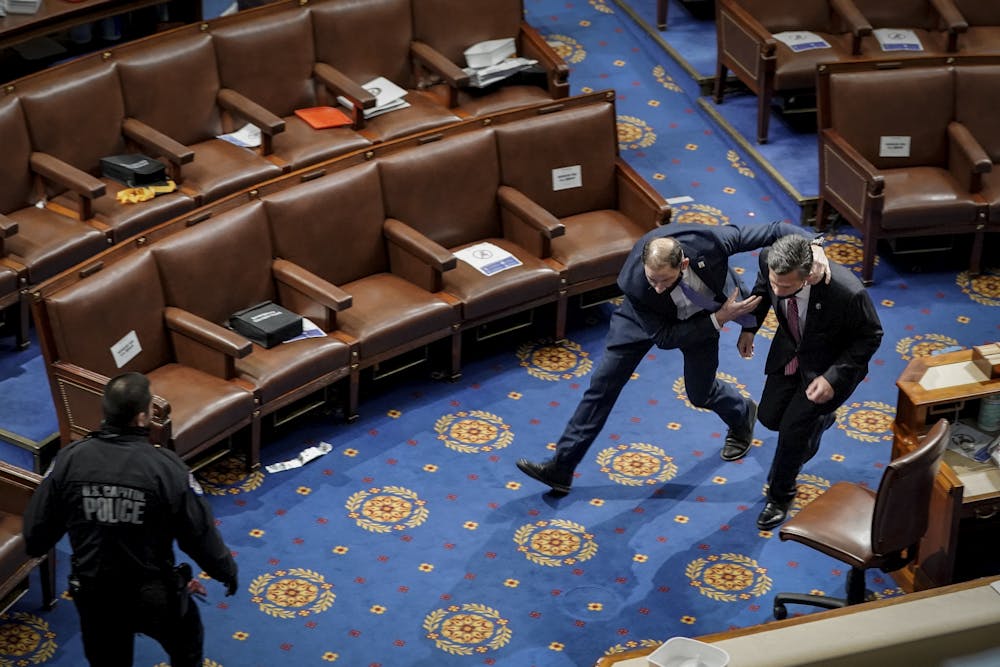
A police officer runs, ducking, with another man – both wearing black suits – across the U.S. House floor.
How distrust can help in politics
There are a few clear benefits to leveraging distrust as a political tool.
Over the past several decades, Republicans have used distrust to caution voters against opponents in election campaigns and to argue that Democrats’ policy proposals would hurt Americans. Republicans have also sown political distrust toward institutions they did not control – like the presidency – while seeking to empower the same institutions when they were in power.
Our research shows that distrust has been a particularly powerful resource for Republican politicians as they work to galvanize the conservative base and attract the independent voters they need to win elections.
History of distrust
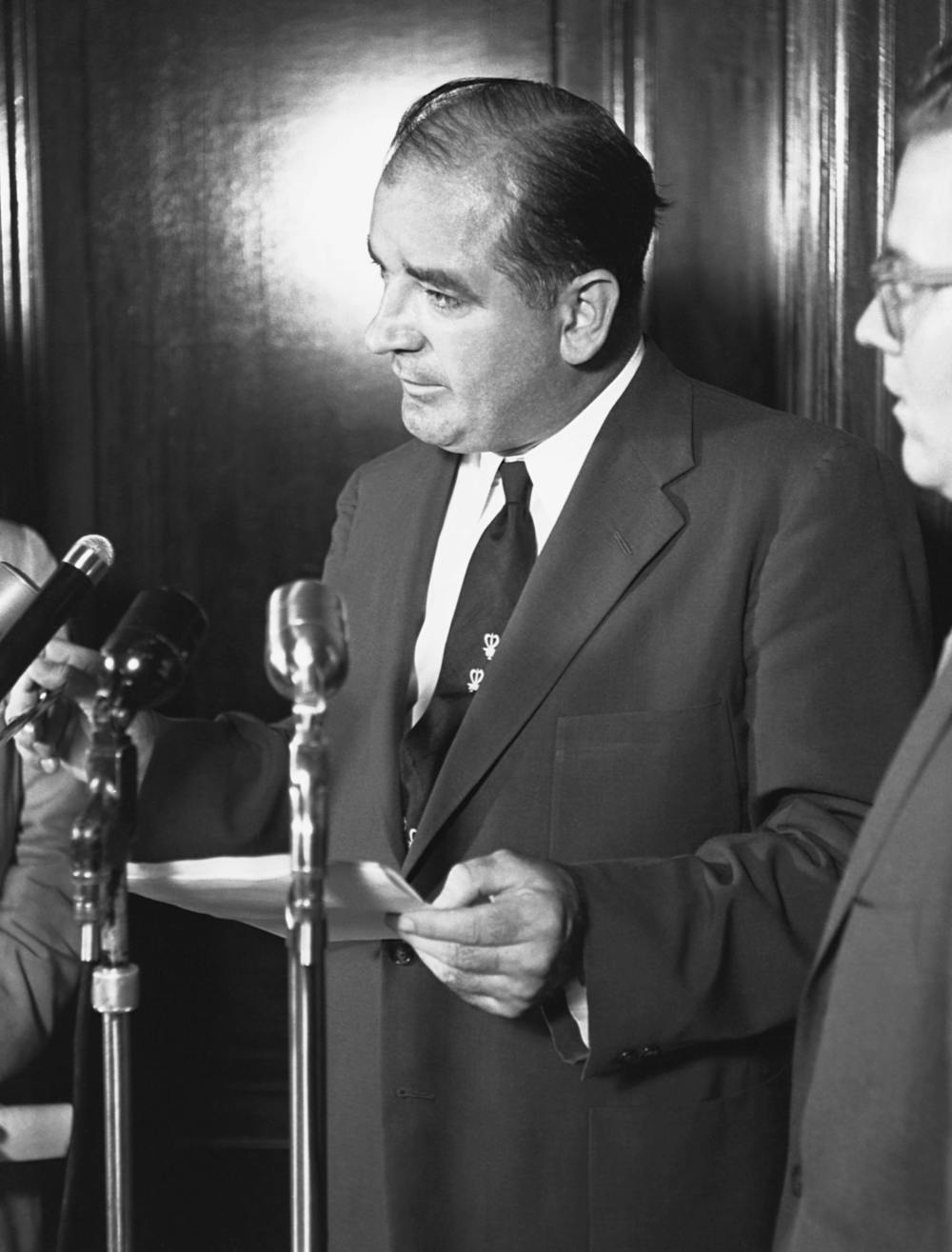
In the 1950s, Republican Sen. Joe McCarthy conducted a series of high-profile probes into U.S. government officials’ potential Communist Party affiliations. McCarthy and others used smear tactics to delegitimize political opponents, painting them as untrustworthy.
Democrats began championing civil rights in the early 1960s. Republicans then adopted an electoral plan known as the Southern strategy around 1968, wooing white Southerners who opposed Democrats’ progressive direction on civil rights and social issues and who championed states’ power.
Left-wing American politicians have also capitalized on government distrust, especially regarding national security. Historian Paul Sabin attributes distrust in government to such liberal reformers as Ralph Nader, who criticized cozy relationships between government and business.
But it is largely Republicans who have strategically promoted political distrust. Republicans have also used distrust to rally against Democrats’ health policy proposals.
Working for the American Medical Association in 1961, 20 years before his election, for example, former President Ronald Reagan said that the proposal that would become Medicare was “one of the traditional methods of imposing socialism or statism on a people.”
Newt Gingrich’s 1990s fight against former President Bill Clinton and House Democrats marked a turning point, as Gingrich encouraged his fellow Republicans to use hyperbolic and highly personal attacks against Democratic colleagues, casting them as undeserving of citizens’ trust.
An early 1990s campaign memo from Gingrich advised candidates to define “the Democrats as the party of radical left-wing activists, unionized bureaucracies, and corrupt political machines.”
When arguing against Clinton’s proposed health reform, Republicans used phrases like “Gestapo medicine” to elicit fear of a destructive government.
In 2009 and 2010, opponents of the Affordable Care Act raised the prospect of government “death panels” making life-and-death decisions for citizens. A Republican strategist urged Republican leaders to characterize the health care plan as a “government takeover” which “like coups … lead to dictators and a loss of freedom.”
A man in a suit speaks into microphones in a black-and-white photo.
‘He had everyone enraged’
The echoes of more than a half-century of anti-government rhetoric spilled over on Jan. 6.
Trump’s “drain the swamp” rhetoric, along with his claim that elections are rigged, fueled people’s long-held suspicions toward government.
In a New York federal district court in January 2021, one of the accused Jan. 6 insurrectionists defended his participation in the attack, saying that he had “tired of the corruption of government.”
Some protesters present on Jan. 6 were involved in far-right anti-government groups, such as the Oath Keepers and Three Percenters.
Oath Keepers founder Stewart Rhodes wrote on the messaging app Signal two days after the November 2020 election that the group’s members shouldn’t accept the election results, saying, “We aren’t getting through this without a civil war.”
Other insurrectionists rationalized their actions by citing Trump’s false claims in court.
Some rioters, for example, defended themselves against trespassing charges by saying that Trump “invited” them to the Capitol.
One accused insurrectionist, Zachary Wilson, said, “I was caught up in President Trump telling everybody the election was stolen. He had everyone enraged.”
Trump’s promotion of distrust about the election results proved legally dangerous to citizens who were moved by his rhetoric.
Distrust in the American election system has grown since the Jan. 6 attacks. More than 3 in 10 Americans believe the nation’s system is fundamentally unsound, according to a November 2021 Monmouth University poll, up from 22% in January 2021. That finding fits with the longer-term GOP effort to weaponize political distrust.
Both authors received support for portions of the research for their book, “At War With Government: How Conservatives weaponized Distrust from Goldwater to Trump” (2021, Columbia University Press). Amy Fried received funding from the University of Maine for several archival visits and to support research assistants at several other archives. Douglas B. Harris received funding from the Everett McKinley Dirksen Congressional Research Center, the Carl Albert Congressional Research & Studies Center at the University of Oklahoma, and the Loyola University Summer Research Grant Program.
Amy Fried does not work for, consult, own shares in or receive funding from any company or organization that would benefit from this article, and has disclosed no relevant affiliations beyond their academic appointment.
Sorry, Mitch McConnell. Frankenstein’s Monster Runs the GOP Now
Wajahat Ali – February 9, 2022
Samuel Corum/Getty Images
Groupthink, obedience, loyalty, and propaganda are the lifeblood of every successful cult trying to indoctrinate, retain, and strengthen its members. That’s why it was such a rare and strange sight to see Senate Minority Leader Mitch McConnellpublicly break with the Republican National Committee and House Minority Leader Kevin McCarthy over the censure of Reps. Liz Cheney and Adam Kinzinger.
Don’t be fooled by this public theater. McConnell is desperately trying to put lipstick on a wild, savage pig before a contentious and pivotal 2022 midterm election. He realizes the aforementioned livestock he’s nurtured has transformed into a radicalized and weaponized death herd willing to violently tear down our democratic institutions.
Republican National Committee Chairperson Ronna McDaniel reflected the grievance of a wounded cult member when she said, “Liz Cheney and Adam Kinzinger crossed a line” by choosing to join “a Democrat-led persecution of ordinary citizens who engaged in a legitimate political discourse that had nothing to do with the violence at the Capitol.” Sen. Mitt Romney—McDaniel’s uncle— apparently “exchanged texts” with his niece over the RNC’s “inappropriate message,” but, alas, he was unpersuasive.
But it would be a grave mistake to assume that McConnell and other Republicans—such as Sens. Romney and John Thune, who support his sentiment—are “moderate Republicans,” an oxymoron that should have been retired in 2016. They are walking dinosaurs soon to be replaced by the true base of the GOP, which increasingly believes in the Big Lie, entertains the “Deep State” conspiracy theory, and wants to model itself after Hungary’s authoritarian, ethnoreligious nationalism.
If anything, their distancing is perhaps motivated by self-interest with an increasing realization that the Department of Justice and the House Select Committee are ramping up their investigations, which might implicate many of their colleagues and place them in serious legal jeopardy. At any rate, their words are hollow when compared to their actions, which are in full support of the GOP’s radical agenda against voting rights, climate change, income inequality, gun control, police reform, and any meaningful attempt at addressing diversity, equity, and inclusion.
Recall that McConnell similarly had harsh words for Trump after the failed coup attempt, but he still voted against impeaching him. In 2021, McConnell warned of a “death spiral” for democracy, yet he has done almost nothing to rein in the extremists of his own party. His legacy will be defined by being an obstructionist who made the Senate into a legislative graveyard and surgically packed the courts with right-wing hacks—most notably the Supreme Court, which just oversaw a 5-4 decision that will suppress Black voters in Alabama.
Another top Republican who is doing his part to accelerate the death spiral of U.S. democracy is House Minority Leader Kevin McCarthy, who rather than answer questions about the RNC’s “legitimate political discourse” madness, ran from reporters like he was practicing for an upcoming track and field competition.
Much like McConnell, McCarthy initially blamed Trump, publicly saying, “the president bears responsibility for Wednesday’s attack on Congress by mob rioters.” A year later, after realizing his base was fully radicalized by the Big Lie, he did a 180 and said, “I was the first person to contact him when the riots were going on,” adding that Trump promised to “put something out to make sure to stop this. And that’s what he did; he put a video out later.”
When asked if he supported the RNC’s resolution, McCarthy declined to respond. However, he defended the use of “legitimate political discourse,” and did a remarkable Jedi mind trick by suggesting the RNC was actually referring to subpoenas sent to RNC officials who were allegedly part of Trump’s false electors scheme. Nobody believed him. Nonetheless, House Republicans did emerge from a closed-door meeting agreeing that Rep. Cheney, who voted with Trump 93 percent of the time and used to be the third highest-ranking Republican, should not be re-elected.
Both Ms. Cheney and Mr. Kinzinger were targeted by the RNC for simply putting loyalty to the country and national security above the GOP’s interests. Their punishment is permanent exile. They were not guilty of antisemitism, anti-Muslim bigotry, allegations of sex trafficking, or palling around with white nationalists. Those are the acceptable sins, respectively, of Reps. Marjorie Taylor Greene, Lauren Boebart, Matt Gaetz, and Paul Gosar. None of them have been publicly condemned by the RNC for their vile behavior nor reprimanded by the party’s leadership.
For his brief dalliance with democracy, Pence now also stands condemned and joins Kinzinger and Cheney in the small cast of villains and traitors to the right-wing cause.
Despite spending four years utterly debasing himself and prostituting his dignity and ethics in servitude of Trump, Pence was recently thrown under the bus by none other than former UN Ambassador Nikki Haley, who still nurtures hopes of becoming president one day. Pence’s crime? He said Trump was “wrong” to claim that the vice president could have overturned the results of the 2020 election. Haley jumped on Fox News to praise Pence as a “good man” and an “honest man,” but nonetheless revealed her true loyalties when she admitted, “But I will always say, I just, I’m not a fan of Republicans going against Republicans.”
Haley, perhaps unintentionally, revealed a painful and sad truth about the modern GOP that many within powerful institutions, especially the media, are still unwilling to hear. It is no longer a normal political party with sober adults who are able and willing to form guardrails that protect democracy. The movement is so beholden to its radicalized base that it must abandon its own legacy star, Liz Cheney, simply for refusing the Big Lie.
Where are the moderate Republicans and why can’t they condemn this violent extremism? They’re too busy applying lipstick to a pig, but sadly they can’t hide the true face of this ravenous herd coming for our democracy.
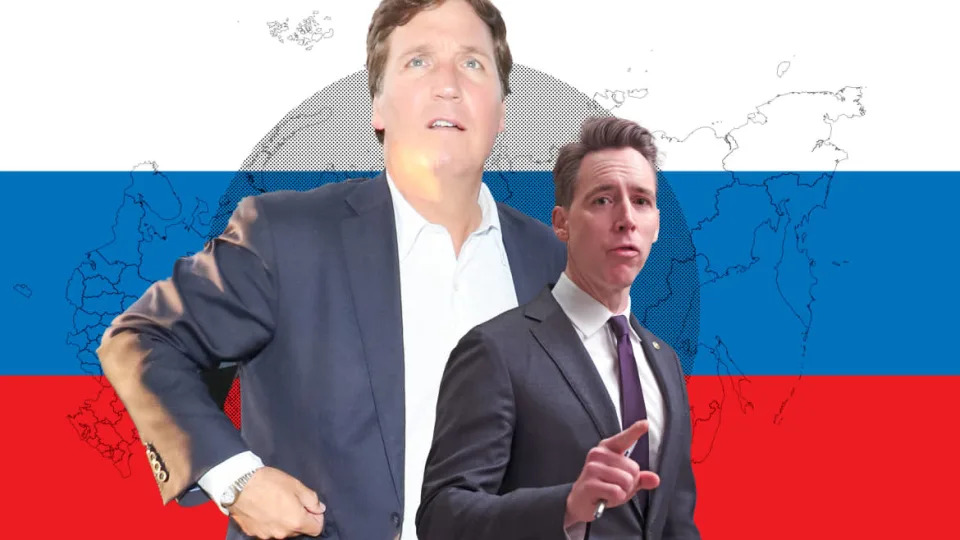
Russia’s Big, Bizarre ‘Thank You!’ to Tucker Carlson and Josh Hawley
Julia Davis – February 9, 2022
Photo Illustration by Luis G. Rendon/The Daily Beast, Getty
There’s no question about it: the Kremlin has found a group of advocates in Fox News and the GOP, and Russian state media mouthpieces couldn’t be more grateful. Scarcely a day goes by without a supportive mention of Tucker Carlson on Russian airwaves, and his open opposition to U.S. support of Ukraine—as it faces down the imminent threat from Russia—are bearing fruit.
Carlson, who has been described as “practically the co-host” of state TV propagandists and “a voice of reason,” is often quoted to support official Kremlin narratives. Russian senator Alexey Pushkov claimed that the West—and not Russia—is “provoking war.” He asserted: “This isn’t just my opinion. Prominent Fox News commentator Tucker Carlson says that the mainstream media is getting us ready for war, demanding war.”
At the same time, Russian state TV worries about the scrutiny Carlson and others are facing for insisting that the United States should abandon the fledgling democracy and allow the Kremlin to continue its conquests of Russia’s neighbors unabated. On Sunday’s edition of the weekly program Vesti Nedeli, New York-based reporter Valentin Bogdanov asserted: “If you’re smart, you’re pro-Putin. Those who don’t believe in Washington’s magic are treated as witches… Tucker Carlson is on the watch list of the hawks.”
Vesti Nedeli went on to air clips from Carlson’s Friday show, where the talk show host complained that “during a closed-door briefing in Congress on Russia, Jim Cooper of Tennessee, a Democrat, asked an intelligence briefer to find out if this show is tied to Russia. We are not tied to Russia, of course.”
Describing himself as an “opposition journalist,” Carlson claimed that “Joe Biden’s NSA” secretly monitored his electronic communications last year. He was likely referring to an incidental collection linked to his communications with “Kremlin intermediaries” in an effort to secure an interview with Russian President Vladimir Putin. Carlson criticized Republicans who “now believe Russia is our greatest enemy” and opined: “They could stop this tomorrow. If Mitch McConnell criticized the build-up to the war with Putin, it would end immediately… The lunacy would end. But they are not doing that. Instead, Republicans are every bit as hysterical about Russia as Adam Schiff ever was… Is that what Republican voters want?”
Carlson proceeded to compare a potential Russian invasion of Ukraine to what’s happening at the U.S.’s southern border. “Texas is a state that’s had well over 1 million foreign nationals pour into it illegally over the last year. Right over the border. That is a far bigger invasion than anything Vladimir Putin is planning in Ukraine,” he said on Friday. In response to Carlson’s complaints, Congressman Cooper’s office reportedly told Tucker Carlson Tonight that Cooper “has every right to ask whatever questions he thinks are important to strengthening American security during confidential House Intelligence Committee hearings.”
But Russian state television doesn’t see it the same way. What’s at stake, Bogdanov alleged, is not simply the taming of Carlson, but preventative sanctions against Russia or its Nord Stream 2 gas pipeline to Germany. He complained that by accusing former President Donald Trump of “working for Russia,” the Democrats “tied his hands and feet and squeezed him out of the White House.”
Kremlin propagandists have high hopes for Trump’s triumphant return—which they’re promising to support—along with what they describe as “the new wave of Republicans.” Classifying them as a “horde” or “pack,” Bogdanov pointed to Sen. Mike Braun (R-IN), who opposed the deployment of American troops to Eastern Europe, and Sen. Roger Marshall (R-KS), who has echoed Tucker Carlson’s talking points on Russia, including when Marshall said: “I’m against sending U.S. troops to Ukraine. I’d send them to the southern border [of the U.S.] before sending them to Ukraine.”
Russian state television singled out their favorite of the bunch: Josh Hawley, who recently demanded that President Joe Biden suspend U.S. support for Ukraine’s potential NATO membership. Hawley also called on the U.S. to stop carrying “the heavy burden it once did in other regions of the world, including Europe.” It was such music to the Russian propagandists’ ears that across state media, Hawley’s position was extolled and anyone who criticized him was smeared.
During last week’s White House media briefing, press secretary Jen Psaki said: “If you are digesting Russian misinformation and parroting Russian talking points, you are not aligned with longstanding bipartisan American values, which is to stand up for the sovereignty of countries like Ukraine… That applies to Sen. Hawley, but it also applies to others who may be parroting the talking points of Russian propagandist leaders.”
Appearing on a state TV show TheBig Game on Thursday, the president of the Center for the National Interest, Dimitri Simes claimed that Jen Psaki practically accused “leading Senator” Hawley of acting as an agent of Russia. Simes surmised that a sharp split is taking place within the Republican party, with the two congressmen, Braun and Marshall, suddenly opposing any intervention by the United States with respect to Ukraine’s attempts to defend itself from Russia’s aggression.
Simes was so incensed that Psaki dared to criticize Hawley’s stance that he compared the White House press secretary to the notorious chief of the NKVD, Lavrenty Beria, who played a major role in the bloody purges of Joseph Stalin’s opponents. Concerns about Hawley’s alleged persecution reverberated throughout state media channels. On Thursday, channel Rossiya-24 complained that Hawley was being “harshly denounced” by Psaki and English-speaking RT said that he was “admonished… for telling Biden to let Ukraine defend itself and focus on China.”
The same day, Olga Skabeeva, the host of 60 Minutes, also criticized Psaki for “coming after Hawley” and agreed with panelists on the show, who argued that Democrats are on their way out. She urged Ukrainians not to rely on Biden, and instead to work on establishing better relations with Trump, especially since the former U.S. president made it clear that he would be happy to let Ukraine handle Russia’s aggression without America’s help.
Skabeeva concluded: “Trump said he will become the 47th president [of the United States]… We have already started working on that. Having elected him the first time, I think we can manage to do it again.”
Putin’s super yacht abruptly left Germany amid sanction warnings over Russia-Ukraine tensions, report says
Julie Coleman – February 9, 2022
Russian President Vladimir Putin’s yacht Graceful.Marcus Brandt/picture alliance via Getty Images
Vladimir Putin’s yacht Graceful left Hamburg before finishing repairs, German media reported.
It is speculated Graceful made an abrupt exit to avoid Western sanctions if Russia invaded Ukraine.
The luxury superyacht is said to be worth at least $100 million.
A yacht named Graceful and said to belong to Russian President Vladimir Putin left port in Hamburg abruptly before finishing repairs, according to reports from German media.
It is unclear what prompted the move, but the $100 million yacht’s relocation from German waters to Kaliningrad, part of Russian territory, came amid fears the West would impose sanctions if Russia invaded Ukraine.
While Moscow has continuously denied any plans to invade its neighbor, it has gathered over 100,000 troops at positions all around Ukraine and has even sent six assault ships into the Black Sea, moving more combat power toward the former Soviet territory.
The US and UK have warned of sanctions on Russian elites, and President Joe Biden has threatened to sanction Putin personally should Russia decide to attack Ukraine. He has also deployed troops to Eastern Europe to support NATO members and has put thousands of US troops on “heightened alert” as tensions rise.
Some have speculated that sanctions could target certain luxury assets. Graceful was spotted on a public maritime-traffic-tracking site sailing for Kaliningrad.
Graceful arrived last year in Hamburg, where the superyacht has been receiving several modifications, including two forward balconies and an extension to the swimming platform, Boat International reported.
It was built by the German shipbuilding company Blohm and Voss and officially launched in 2014. Designed by H2 Yacht Design, Graceful is classified as a tri-deck superyacht, according to Boat International.
The luxury yacht is 270 feet long and equipped with a gym, a saloon featuring a white Steinway piano, a spa, a library, and a 49-foot indoor pool that can be converted into a dance floor. The vessel is meant to accommodate up to 12 guests and 14 crew.
Jonny Horsfield, H2’s founder, told Boat International in 2015 that Graceful was meant to be a timeless yacht.
“The owner is a very confident person,” Horsfield told the outlet without mentioning Putin directly. “He knows what he likes and he’s not a slave to trends.”
The Russian president’s net worth is unknown, but it has been speculated that Putin is worth as much as $200 billion, if not more, Fortune previously reported. Documents leaked last year suggested that Putin had secret assets abroad.
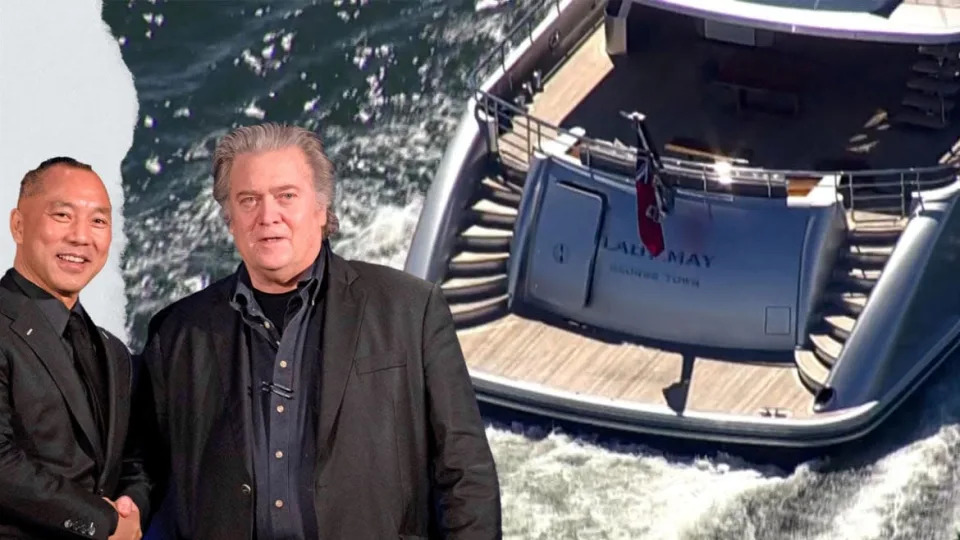
A New York judge slapped Guo Wengui, who also uses the aliases Kwok Ho Wan and Miles Guo, with $134 million in contempt of court fines on Wednesday for violating multiple restraining orders barring him from selling or relocating the boat or any other property he controls. The high price tag results from nearly a year of the fugitive Chinese national defying the court’s order that he return the craft to a U.S. port—an order that carried a daily forfeiture of $500,000.
Court documents filed in late January showed the 151-foot-long pleasure vessel blithely plying the western Mediterranean. Now, Guo has only until Monday to come up with the funds. His attorneys at BakerHostetler—a firm with close ties to the Republican National Committee—declined to comment for this story.
The punishing penalties result from a case unrelated to Bannon’s maritime arrest a year and a half ago for allegedly looting a nonprofit, a charge for which he never faced prosecution thanks to a last-minute pardon from outgoing President Donald Trump.
Rather, the fines are connected to a separate fight over Guo’s enigmatic yet ostentatious wealth. Nearly five years ago, an affiliate of the Hong Kong-based investment firm Pacific Alliance Group brought suit against Guo, alleging his companies had failed to repay tens of millions of dollars in loans made between 2008 and 2009 or deliver on promised property transactions. The opulent boat has emerged as a key asset in that fight over the allegedly unpaid tab.
Guo, a Shandong-born construction magnate, absconded from the Chinese mainland in 2014, fleeing charges ranging from corruption and money-laundering to rape (all of which he has denied). Since 2017, he has lived in luxury, setting up residence in a $68 million Central Park penthouse and underwriting numerous right-wing projects, from nonprofits with Bannon to dodgy media operations to bogus COVID-19 studies to would-be Twitter competitor GETTR. All the while, he has sought refugee status and attacked figures in both the Communist Chinese regime and in the dissident diaspora online.
The yacht imbroglio is hardly the first time Guo’s activities have run afoul of U.S. authorities. In September 2021, his companies agreed to pay half-a-billion dollars in Security and Exchange Commission fines for running a crypto-currency scheme in violation of federal regulations.
Florida high court refuses DeSantis request on redistricting
February 10, 2022
FILE – Florida Gov. Ron DeSantis speaks during a news conference at Vizcaya Museum and Gardens, Tuesday, Feb. 1, 2022, in Miami. The Florida Supreme Court told DeSantis on Thursday, Feb. 9, it will not answer his question on whether a Black congressman’s district is unconstitutional. (AP Photo/Rebecca Blackwell, File) (ASSOCIATED PRESS)
TALLAHASSEE, Fla. (AP) — The Florida Supreme Court told Republican Gov. Ron DeSantis on Thursday it will not answer his question on whether a Black congressman’s district is unconstitutional.
DeSantis has interjected himself into the once-a-decade process of drawing new congressional maps, something highly unusual for a governor to do. The House and Senate have considered maps that largely left Democratic U.S. Rep. Al Lawson’s district intact, but DeSantis is pushing a map that would make his district lean Republican.
After submitting his map, DeSantis asked the Supreme Court if Lawson’s district is unconstitutional. The district runs from Jacksonville to Gadsden County west of Tallahassee, a distance of about 200 miles (about 321 kilometers). DeSantis questioned whether drawing it to contain Black communities so far apart met the state and federal constitutions.
The court said the issue was too complicated to simply grant an advisory opinion.
“The scope of the Governor’s request is broad and contains multiple questions that implicate complex federal and state constitutional matters and precedents interpreting the Voting Rights Act of 1965,” it wrote.
Former bank CEO sentenced in loan scheme to land Trump administration position
February 9, 2022
Former bank CEO Stephen Calk was sentenced to one year and a day in prison this week after he was convicted for participating in a loan scheme with the goal to secure a role in the Trump administration.
Calk, who was formerly the head of the Chicago-based Federal Savings Bank, was sentenced on Monday over his dealings with Paul Manafort, the onetime chairman of former President Trump’s 2016 campaign.
The U.S. Attorney’s Office for the Southern District of New York said that Calk improperly used his position as CEO to secure high-risk loans for Manafort and leveraged that as a means to gain a senior position in the Trump administration, according to a press release.
“Stephen Calk abused his position as the CEO of a federally-insured bank to try to buy himself prestige and power by trading millions of dollars in high-risk loans for influence with a presidential campaign and consideration for positions at the highest levels of the Defense Department,” U.S. Attorney Damian Williams said in the release.
“Today’s sentence sends the message that those who corrupt federally regulated financial institutions will be held to account.”
Last year, Calk was convicted of conspiracy to commit financial institution bribery and financial institution bribery.
During his trial, prosecutors presented evidence arguing that he was seeking a position as either the secretary of the Army or head of the Treasury, Commerce or Defense departments, though he was not chosen for those jobs.
Calk was also sentenced on Monday to two years of supervised release and 800 hours of community service. He will also have to pay fines totaling more than $1 million, according to the release.
“As you can imagine, my life is in shambles,” he said during the sentencing, according to The Washington Post. “I deeply, deeply regret that the bank’s reputation has been tarnished as a result of my indictment and my conviction.”