‘Mad’ Mike Hughes’ Last Ride: Inside a Flat-Earther’s Doomed Mission

Rolling Stone

‘Mad’ Mike Hughes’ Last Ride: Inside a Flat-Earther’s Doomed Mission

Kelly Weill – February 15, 2022
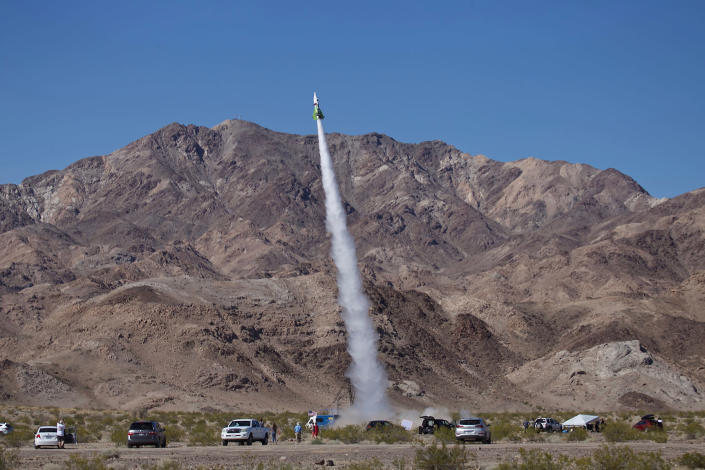
Mad Rocket Scientist - Credit: Matt Hartman/AP
Mad Rocket Scientist – Credit: Matt Hartman/AP

In 2018, while reporting from the Flat Earth International Conference in Colorado, I met a man who’d towed a rocket ship into a hotel conference room. He was Mike Hughes, an amateur rocket stuntman and vocal champion of Flat Earth theory. He hoped to launch himself into space to take a photograph that would prove once and for all whether Earth was a globe, or a flat disc.

Though the answer might seem obvious to the vast majority of globe-dwellers, a small but committed movement of conspiracy theorists believes Earth is not a sphere but a great, celestial Frisbee contained within a dome. I spent years within this movement while reporting my book Off The Edge: Flat Earthers, Conspiracy Culture, and Why People Will Believe Anything. At first I believed the theory to be weird, even occasionally funny. Then in February 2020, it turned deadly serious. That month, Mike Hughes died while trying to ride his homemade rocket thousands of feet into the atmosphere. He was among a collective of conspiracy theorists pushing their inquiries to life-threatening extremes.

The rocket took off like a punctured balloon, wobbly and erratic. A jagged trail of steam traced the ship’s path across the sky, up thousands of feet above the California desert. For a moment, the rocket seemed to hover, oblivious to gravity.

Then the inevitable descent. To onlookers on the ground, the ship and the man inside it were a blur of black.

“Come on, parachute,” one watcher murmured anxiously.

“Pull it, Mike,” another man shouted. But the parachutes that had bloomed above Mike Hughes on his previous death-defying rocket launches were nowhere to be seen. “Pull it! Pull it! Oh God.”

Hughes’s rocket crashed into the dust with absolute finality. There was no need to call an ambulance.

Until that moment, Hughes had been one of the most famous living Flat Earthers. He had earned his fame by taking the theory to its logical conclusion. He was going to build a rocket ship, blast into Earth’s upper reaches, and see for his own eyes whether the horizon was flat or curved. “This space launch is to prove or disprove the Flat Earth,” he told me in spring 2019.

I thought it was a terrible idea. I suggested, much too gently, that it was a terrible idea. I thought it was such a terrible idea that I wrote a chapter about Hughes and the cadre of conspiracy theorists attempting dangerous stunts to prove their beliefs. I titled the chapter “Someone Is Going to Die for No Reason.” Then I dropped the matter and never raised it to him again. Hughes was 64 at the time and didn’t need my advice, I reasoned. Besides, I doubted he’d really attempt the launch. For the past year, he’d notified me of various complications: parachute malfunctions and unforeseen weather that delayed his project. I began to suspect he was searching for excuses, avoiding a dangerous stunt that would force him to confront the curved horizon. I was wrong about his convictions. On Feb. 22, 2020, in a gray stretch of desert, Hughes joined the growing ranks of conspiracy-theory casualties, and I’ve had to live with that scrapped chapter title on my conscience ever since.

In the mid-1840s, when Samuel Rowbotham popularized Flat Earth as a “zetetic” science, he preached that zetetics should believe only what they could personally observe. Rowbotham was a fraud, routinely borrowing and often even misrepresenting real scientists’ work when it suited him. But Hughes, with his insistence on seeing the world for himself, was one of the truest zetetics I’ve ever known.

Hughes had an advantage that most other would-be zetetic Flat Earthers lacked: he knew how to build a rocket and had no fear of dangerous stunts. Born to a race-car hobbyist in 1956, Hughes spent much of his youth traveling the county-fair circuit, where his father competed in dirt-track races. Oklahoma City was home, but Hughes and his family spent so much time traveling from state to state, speedway to speedway, that life began to feel like a long racing circuit of its own. “It’s just consuming. It consumes your life,” Hughes wrote of his father’s hobby in his self-published autobiography. “You got no time for anything else and it just eats at relationships like termites to wood.”

When his pit-crew gigs dried up like his racing career, Hughes started driving a limousine, and chasing thrills as a freelance stuntman on the side. While trying to outdo a famous stunt by daredevil Evel Knievel, Hughes began tinkering with homemade rockets, which could propel him on long horizontal jumps off ramps. One stunt led to the next. If he could launch across a river, he thought, then perhaps he could break the record for vertical height in a homemade rocket. He toppled that record, then broke his own record on a subsequent launch, inching upward each time until his dreams became a list of altitudes.

“I don’t believe in science,” he told reporters in November 2017. “I know about aerodynamics and fluid dynamics and how things move through the air, about the certain size of rocket nozzles and thrust. But that’s not science, that’s just a formula. There’s no difference between science and science fiction.”

But there is a difference. A science fiction author can save a character from certain death with a few twists of plot. Hughes was working with the indifferent mathematical fact of gravity. And as early as a March 2018 launch — Hughes’s first after coming out as a Flat Earther— that difference very nearly killed him.

Hughes had intended the launch to take him only eighteen hundred feet in the air, much too low to observe the planet’s curvature. Still, he managed to fundraise more than $7,000 online from Flat Earthers — and from people who thought his project was a big joke. They almost funded a tragedy. Short on cash, Hughes built the rocket in his garage and converted an old mobile home into a launch ramp. Then he hauled the whole thing to Amboy, a windswept California ghost town with a history of bad karma: stories of hauntings and occult rituals and bloody motel rooms. Other towns with legitimate governments had turned Hughes away, unwilling to deal with the headache of a potential rocket catastrophe. But Amboy, a popular filming location for horror movies, was virtually a theme park for destruction, and its owner welcomed Hughes for what was nearly another nightmare.

As he approached his rocket (emblazoned with research flat earth), Hughes noticed a hissing noise, like an air mattress deflating. The noise was a vapor leak, but after the trip to Amboy and the makeshift launch-ramp assembly, no one knew how long the rocket had been compromised, which would determine how dangerous it would be. “We don’t know if it’s been going for five minutes or five hours,” Hughes told me. A friend who had helped with his rocket construction urged him to wait, telling him they could fix the problem, if Hughes was willing to postpone.

“I said ‘You know what, I’m not waiting any longer. I got in, and I did it,” Hughes told me. His secondhand parachutes were 23 and 21 years old. “I didn’t even know if they were going to work. They were all I could afford.”

One of the chutes failed on the way down, and Hughes slammed into the earth, barely clinging to consciousness. “It was pretty ugly,” he said. “I could have died.” When he recovered from the hard landing, Hughes announced his new plans to prove Flat Earth by flying to outer space in a “rockoon,” a homemade rocket attached to weather balloons that would carry it upward after the rocket fuel burned out. He would build the rockoon in his garage, ride it 68 miles above Earth’s surface, and, before gravity reclaimed him and his parachutes deployed, take a photograph of the world. It was a breathtakingly dangerous stunt, but everyone who knew Hughes said there was no talking him out of it. “He had an IQ of 136. He’s very smart,” Waldo Stakes, Hughes’s close friend who had helped him build his rockets, told me, “but he’s very hardheaded . . . Once he’s made his mind up about something, he’ll just continue no matter what. He’ll just do it.”

Just do it, death be damned, is a popular sentiment among Flat Earth’s most extreme zetetics. At the 2019 Flat Earth International Conference, I found myself seated behind a man named Bobby Hartley, who wore a T-shirt advertising a 2025 trip to fabled lands beyond Antarctica.

The frozen continent often conjures an air of foreboding among Flat Earthers. Like most popular Flat Earth models, including Rowbotham’s, argue that Antarctica extends like an icy ring around the pancake planet, keeping all its oceans in check. Common variations on this claim include a theory that Antarctica’s most distant edge touches the base of a dome that encloses Earth and that the international treaties against colonizing Antarctica are actually part of a nefarious scheme to prevent people from seeing the dome. This subset of believers claims that Antarctica is highly militarized and that unauthorized explorers will eventually hit a kind of polar Area 51, defended by armies of the New World Order.

There are dissenters within the Flat Earth world, of course. A group called the Infinite Plane Society suggests that Antarctica extends out to eternity, a universe of ice to cradle our little blue oasis. Hartley told me he thought another world existed beyond the ice wall, and that other people likely already lived in this distant land. “I just got into Flat Earth about a year ago, but I’m obsessed with this land beyond Antarctica. I want to go there so bad,” Hartley told me. He seemed like a pleasant guy, and our conversation felt almost normal, until he divulged, laughingly, that the trip was something of a suicide mission. “Of course, we all might die. I’m not married. I have no kids.”

It was a startling comment from someone I’d just met 30 seconds earlier, and I asked him whether he was serious. Apparently so.

“There is about a five percent chance of me making it. Out of that five percent chance of making it, I would say a one percent chance of ever coming back. It would almost be a one-way trip.” Those odds would be worth it, even to spend 24 hours in the land beyond the ice, he said. I made some polite noises, with what I hoped was a neutral expression.

I’ll probably never be any good talking death wishes with strangers, but a couple years in this scene had made me better at it. This was the second time that year, for example, that I’d spoken with a Flat Earther who had pitched me on a likely deadly trip to the lands beyond Antarctica. Months earlier, I’d spoken with Michael Marshalek, a friend of Mike Hughes, who was planning his own trip across the ice.

Digitally manipulated image of moon casting shadow on flat earth. - Credit: Ikon Images/AP
Digitally manipulated image of moon casting shadow on flat earth. – Credit: Ikon Images/AP

Ikon Images/AP

“Mad Mike is going up, and I’ll be headed south,” Marshalek told me. He was out to prove Flat Earth by trekking as far as Antarctica would take him. For Marshalek, all specicies of Earth’s shape were under consideration until he reached its edge. “I think it’s infinite until proven otherwise,” he said. “If there’s a dome, which many Flat Earthers believe in, I myself want to go out there and see that, take a chunk of the dome.”

Like Hughes, Marshalek was making steady, even worrying progress toward setting off on his mission. A tech worker for a major New York City bank, he already had most of the funds saved for his planned expedition by the time we spoke in May 2019. He intended to reach the South Pole (or whatever’s out there) by snowkiting, a technique that involves riding skis while clinging to a large kite or sail that captures the wind. The plan had obvious challenges. Snowkiting is an extreme sport, one that leaves a rider at the mercy of sudden winds and rocky terrains — two conditions Antarctica has in frightening abundance. Snowkiting also prioritizes speed over distance. The world’s longest and most challenging snowkite race is the Ragnarok, a scrupulously supervised 100-kilometer race in Norway each year. Antarctica, meanwhile, is merciless and more than 2,381 miles (or 3,831 kilometers) across. Famed polar explorer Børge Ousland has used a kite and skis to cross parts of the continent, but he also offset them with grueling hikes in parts of the expedition where snowkiting would be, in his own words, “certain death.”

And Ousland knew where he was going. He knew how much food to pack, how many days he could survive in the frozen wild before sending out an SOS. Marshalek, with his philosophy of “infinite until proven otherwise,” would not be setting out with the same luxuries. If he planned to survive a journey that could be infinite, I asked him, wouldn’t he eventually need to turn around and come home? How would he know when that was necessary? Marshalek promised to reveal his full itinerary in due time. When he did, he expected it would strike a blow against “edge-ophobes,” his term for Flat Earthers who don’t seek the planet’s outer limits. He accused edge-ophobes of being afraid to explore, caught in a gridlock of excuses about why they can’t simply traverse Antarctica. “They’re stuck in debates all the time,” he said. “They say, ‘You can’t burn fuel, there’s treaties, it’s too cold.’ They’re all excuses.”

Here’s another excuse, for any Flat Earthers reading: anyone trying to sell you a ticket for a Flat Earth–oriented Antarctic expedition is probably trying to scam you. I’ve stumbled upon two of these grifts without really trying.

In March 2017, someone who called himself John Bramha began registering social media accounts and buddying up with Flat Earthers online. Bramha claimed to be part of the elite group that enforced Antarctica’s boundaries, protecting it from intruders. He and a handful of others from this secret police force had turned rogue aftr discovering the wonders that lay at the earth’s edge, and now he was leading expeditions to the end of the world to share the truth of what lay beyond. For his trouble, of course, he needed funding. Specifically $1 million in hard-to-track Bitcoin payments. “You might think that’s a lot of money, but it’s just the cost of 10 Tesla Model S cars,” he told viewers in a YouTube clip. “People spend, collectively, way more than this on personal luxuries.” He planned to earn his million by selling 10 seats on his expedition for $100,000 each. He never showed his face in his videos, and the avatar he used on Facebook and Twitter had been stolen from a stock-image website.

By the way, Bramha said, the $100,000 trip would cure his customers of cancer. The dome surrounding Flat Earth was actually a wall of pure energy that “cures you instantly of anything you might be suffering from, medically,” he claimed on YouTube. He shared a supposed picture of said energy wall, which looked like a pretty standard glacier.

For a group that doesn’t believe in gravity or the moon, Flat Earthers were remarkably quick to support Bramha. At least one popular Flat Earth YouTube channel made a video vouching for the shadowy Antarctican, without ever meeting him. Flat Earthers tweeted that they’d filled out applications for Bramha’s $100,000 excursion, and by summer 2017 Bramha claimed (albeit dubiously) that he’d sold six tickets. Of those alleged customers, two were counting on the trip to save their lives. “We have two persons on board who are suffering from Cancer and this expedition will heal them,” Bramha wrote on Facebook.

The expedition was scheduled for November 2017, at which point (of course) Bramha vanished from the internet, taking with him whatever money he’d swindled from the desperate. The popular Flat Earth YouTube channel that had vouched for him uploaded a new video, this time claiming Bramha’s scam was evidence of a conspiracy to make Flat Earthers look bad. As it turned out, the new video noted, Bramha’s picture of the “pure energy” glacier had been taken by a professional photojournalist focused on the environment and climate change. The photojournalist had won grants from scientific institutions, including NASA. The connection to NASA, that great Flat Earth bogeyman, was enough for Flat Earthers to accuse Bramha of being a “big science” saboteur. To them, Flat Earth theory was still vindicated, in its way: someone wanted to suppress its believers.

Remarkably, the following year, someone else tried a similar stunt. A company called Over the Poles offered a onetime flight over part of Antarctica starting at $11,900. The trip is technically possible, although rarely attempted, due to the danger involved. One notorious 1979 Antarctic sightseeing flight left all 257 passengers and crew dead after it crashed into a mountain in whiteout conditions. Over the Poles said it was going much farther inland than that deadly crash site and, while it did not market exclusively to Flat Earthers, it acknowledged the conspiracy movement on its website. (John Bramha and Over the Poles did not return requests for comment.)

Michael Marshaek told me he bought a ticket in the brief months that Over the Poles operated its website. Then, like Bramha’s venture before it, the company and all its affliates vanished from the internet, leaving people holding expensive tickets to nowhere. Yet as vicious as the Antarctica scams were to their victims, the situation could have been worse: the ice wall–curious crowd could have taken an ill-planned trip to the South Pole and died. They would all have joined the growing ranks of conspiracy theorists committing real-world harm in an effort to prove their beliefs.

From OFF THE EDGE: Flat Earthers, Conspiracy Culture, and Why People Will Believe Anything by Kelly Weill. Reprinted by permission of Algonquin Books of Chapel Hill. Copyright © 2022 by Kelly Weill. All rights reserved.
West’s Megadrought Is Worst in 1,200 Years

EcoWatch

West’s Megadrought Is Worst in 1,200 Years

Olivia Rosane – Feb 15, 2022

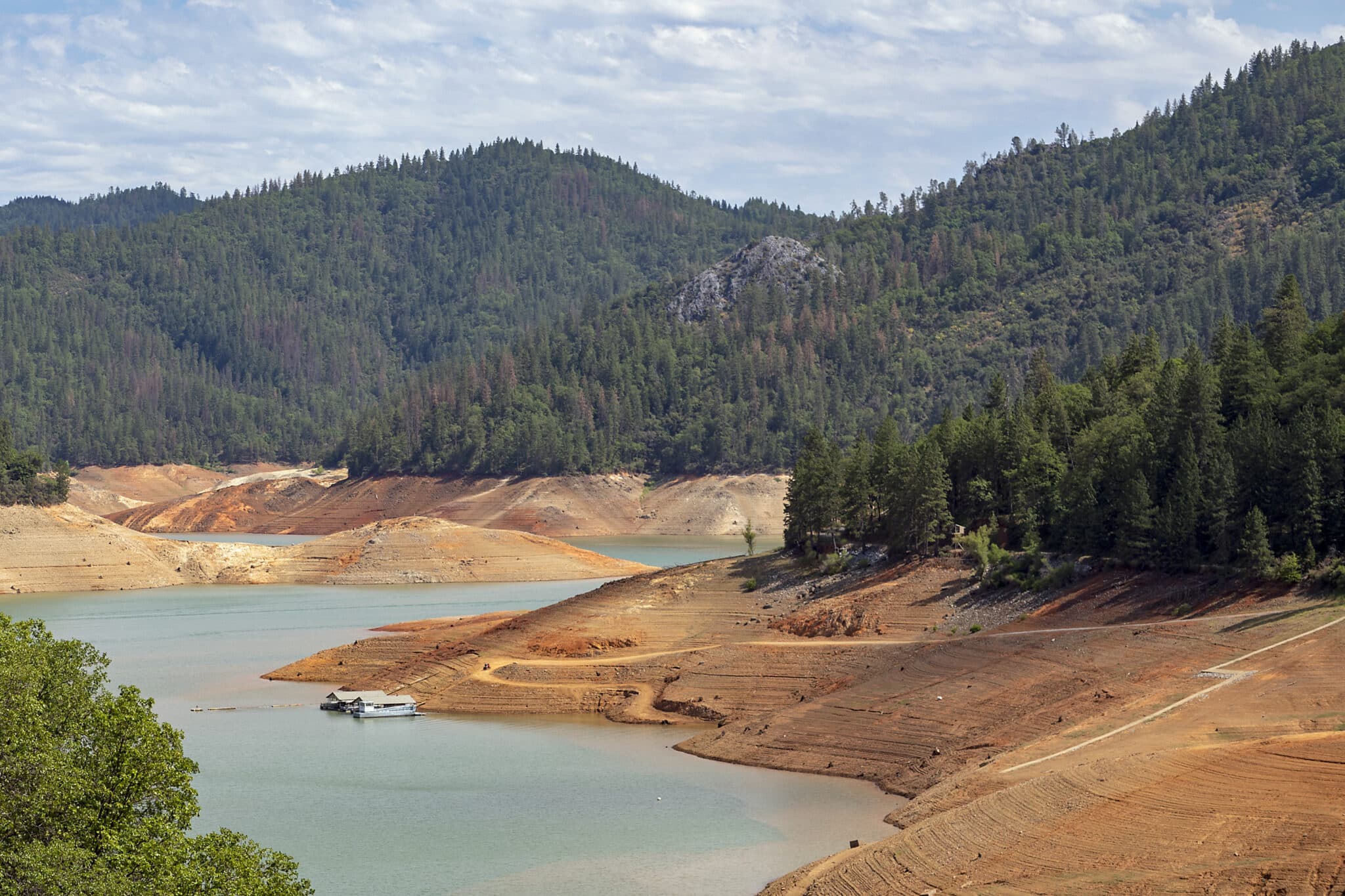
low water level at Shasta Lake, California due to drought

Callifornia’s Shasta Lake depleted by drought. NNehring / E+ / Getty Images

The Southwestern U.S. is currently experiencing its worst megadrought in 1,200 years, a new study has found.

The research, published in Nature Climate Change Monday, found that the period from 2000 to 2021 was the region’s driest since at least 800 A.D.

“Anyone who has been paying attention knows that the west has been dry for most of the last couple decades,” study lead author and University of California, Los Angeles climate scientist Park Williams told The Guardian. “We now know from these studies that is dry not only from the context of recent memory but in the context of the last millennium.”

A megadrought is a dry spell that lasts for more than 20 years. These extended dry spells are naturally occurring in the region. However, the climate crisis has made the current drought 42 percent more extreme. 

“The results are really concerning, because it’s showing that the drought conditions we are facing now are substantially worse because of climate change,” Williams told the Los Angeles Times. “But that also there is quite a bit of room for drought conditions to get worse.”

The researchers based their findings on evidence of past droughts recorded in tree rings from around 1,600 sites in the North American West, from Montana to Northern Mexico. They focused on droughts that lasted for 23 to 30 years.

The new study builds on previous research which found that the period from 2000 to 2018 was the driest since a megadrought in the 1500s. The extremely dry summer of 2021 “really pushed it over the top,” Williams told The New York Times, making the current 22 year period the driest since 800 A.D., which is the point at which the researchers’ data set begins. The study authors calculated that around 19 percent of the severity of 2021’s drought could be attributed to climate change. 

The megadrought is already having major impacts across the region, the Los Angeles Times pointed out. It has depleted California’s reservoirs, shrunken Utah’s Great Salt Lake to record low levels and fueled extreme wildfires. And the bad news is that there isn’t necessarily an end in sight. 

“This drought at 22 years is still in full swing,” Williams told The New York Times., “and it is very, very likely that this drought will survive to last 23 years.”

In fact, researchers believe it is likely to last as long as 30 years. Further, if it weren’t for the climate crisis, the drought would likely have ended in 2005 or 2006 when rainfall would have been enough to relieve it, The AP reported.

Julie Cole, a University of Michigan climate scientist who was not involved in the research, told The New York Times that the study shows how temperature can make more of a difference than precipitation when it comes to prologing a drought. 

“[T]he air is basically more capable of pulling the water out of the soil, out of vegetation, out of crops, out of forests,” Cole said. “And it makes for drought conditions to be much more extreme.”

Average temperatures in the Southwestern U.S. have been 1.6 degrees Fahrenheit higher since 2000 when compared to the previous 50 years, according to the Los Angeles Times.

Jonathan Overpeck, the dean of environment at the University of Michigan who wasn’t part of the study, told The AP that it was an “important wake-up call.”

“Climate change is literally baking the water supply and forests of the Southwest, and it could get a whole lot worse if we don’t halt climate change soon,” he said.

In Post-Trump Reversal, U.S. Joins Call for Global Plastics Treaty

EcoWatch

In Post-Trump Reversal, U.S. Joins Call for Global Plastics Treaty

Olivia Rosane – February 15, 2022

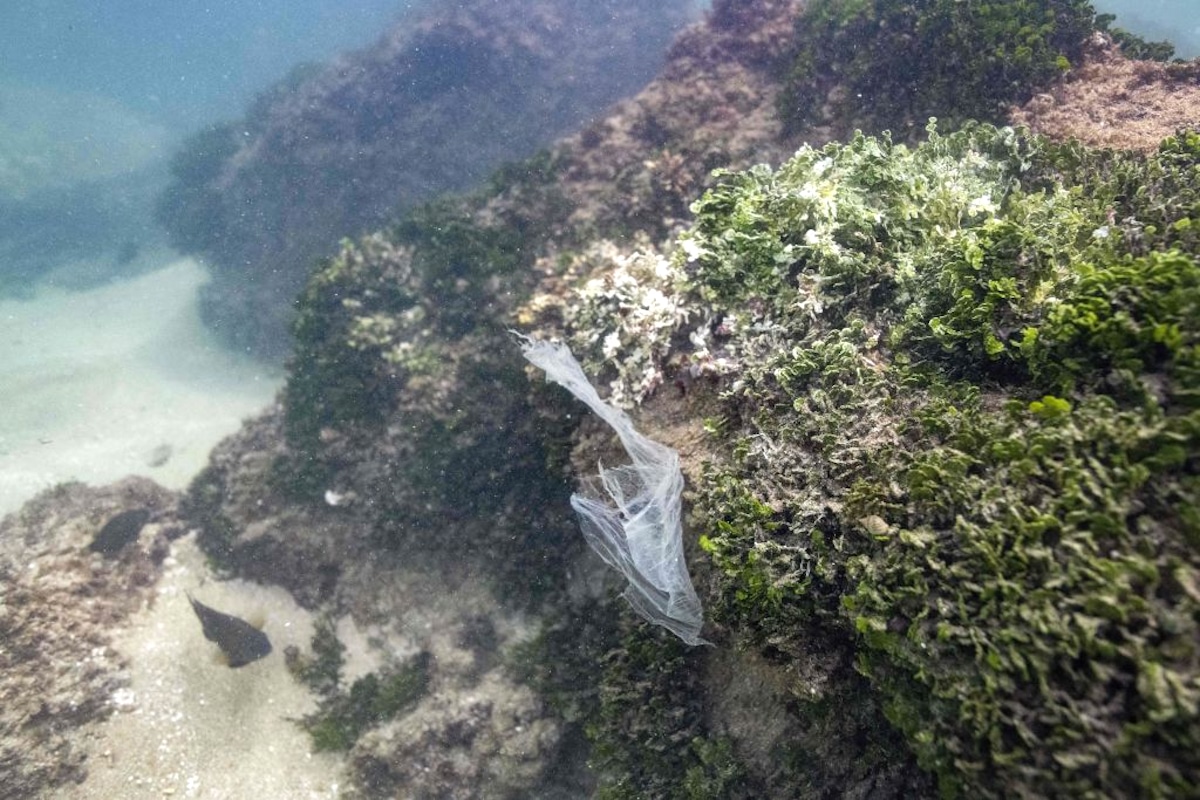
A plastic bag in the Indian Ocean

A plastic bag drifts past the Indian Ocean reef near Ahangama in Weligama on Dec. 31, 2021. OLIVIER MORIN / AFP via Getty Images

The U.S. and France have joined forces to call for an international treaty to control plastic pollution

They issued their joint statement on the last day of the One Ocean Summit from February 9 to 11 convened by France in its port city of Brest. 

“The United States and France are committed to protecting our environment for future generations,” the statement read. “Recognizing the transboundary aspects of plastic pollution and the importance of curbing it at its source, the United States and France support launching negotiations at the upcoming 5th UN Environment Assembly (UNEA) on a global agreement to address the full lifecycle of plastics and promote a circular economy.”

The treaty would be designed to limit the amount of plastic in the world’s oceans and would be modeled on the 2015 Paris agreement, CBS News reported. The United Nations also supports a new treaty, and staffing and an agenda for the deal will start being discussed at UNEA, which will take place in Nairobi from February 28 to March 2. 

“The agreement should include binding and non-binding commitments, call on countries to develop and implement ambitious national action plans, and foster robust engagement of stakeholders to contribute toward the agreement’s objectives while complementing national government contributions,” France and the U.S. said.

Greenpeace responded positively to news of a potential treaty, but expressed concerns over some details of the statement.

“The U.S. has come a long way. It is one of the world’s biggest plastic polluters and a major exporter of plastics to the Global South,” Greenpeace USA’s ocean campaign director John Hocevar said in response. “After being one of a handful of countries actively opposing a plastic treaty under the Trump administration, it is very encouraging to see this turnaround. Though it is worrying to see the U.S. mention the inclusion of non-binding commitments in the treaty mandate. Binding commitments are needed in order to ensure government and corporate accountability.”

2022 is emerging as an important year for the world’s oceans and the fight to preserve them. After UNEA, the U.S. and the Republic of Palau are hosting the coral-reef focused “Our Ocean” conference from April 13-14, while the UN Ocean Conference will take place in Lisbon, Portugal in late June and early July, CBS News reported.

“The ‘One Ocean Summit’ in France is the first in a series of ocean action meetings in 2022 that we hope will stop the decline in the ocean’s health this year… urgent action is required,” UN Secretary General’s Special Envoy for the Ocean Peter Thomson told CBS News. 

The UN hopes the final plastics treaty will be negotiated within two years, which would be a record-breaking pace.

In addition to the call for a new treaty, other commitments emerged at the One Ocean Summit, The Guardian reported. These included:

  1. Twenty-seven EU states and 16 other countries said they would reach an agreement by the end of the year for sustainable use of the high seas, which no country controls.
  2. Thirty more countries agreed to protect 30 percent of their land and sea by 2030.
  3. The European Bank for Reconstruction and Development (EBRD), the European Investment Bank (EIB) and the French, German, Italian and Spanish development banks pledged four billion euros by 2025 to decrease the nine million tonnes (approximately 9.9 million U.S. tons) of plastics that enter the oceans yearly. 
  4. Six more countries joined the International Maritime Organization’s Cape Town agreement to better regulate fishing boat safety standards and therefore reduce illegal fishing. 
  5. Twenty-two European shipowners said they would reduce underwater noise and pollution. 

“[W]e should take here, in Brest, clear and firm commitments,” French French president Emmanuel Macron, who hosted the summit, said Friday, as The Guardian reported. 

A Russian invasion of Ukraine would potentially unleash a ‘polar vortex’ on the stock market and push economies into a recession

A Russian invasion of Ukraine would potentially unleash a ‘polar vortex’ on the stock market and push economies into a recession, Morgan Stanley’s Mike Wilson says

Isabelle Lee – February 14, 2022

russia ukraine
A convoy of Russian armored vehicles moves along a highway in Crimea. 
  • Morgan Stanley said a Russian invasion of Ukraine would pose a significant risk to global equities.
  • An invasion “materially increases the odds of a polar vortex for the economy,” strategists said.
  • “Energy stocks could be most at risk for a correction,” they added.

Morgan Stanley said a potential Russian invasion of Ukraine would pose a significant risk to global equities and send some economies into recession.

“In our view, it materially increases the odds of a polar vortex for the economy and earnings,” strategists, led by Chief Investment Officer Michael Wilson, said in a note published Monday, adding that a surge in energy prices would roil markets.

“Energy stocks could be most at risk for a correction should a potential invasion happen in a way that leads to an oil and nat gas spike,” they said. “Such a spike would destroy demand, in our view, and perhaps tip several economies into an outright recession – the polar vortex.”

Crude-oil prices have seen upward pressure in the past weeks amid increasing tensions between Russia, a major oil producer, and Ukraine, which is a key conduit for energy exports to Western Europe. 

On Monday, oil prices moved closer to the $100-per-barrel mark. West Texas Intermediate crude rose 2.30% to $95.24 per barrel as of 2:40 p.m. ET. Brent crude, the international benchmark, gained 2.10% at $96.42.

The rally came after a US official warned an attack could come this week, saying Russia moved some long-range artillery and rocket launchers into firing position, according to CBS. US officials had warned of a possible Russian invasion before the Winter Olympics ends on Sunday.

President Joe Biden in a lengthy phone call Saturday asked Russian President Vladimir Putin to pull back the more than 100,000 Russian troops stationed at its border with Ukraine. Biden warned Putin the US would “respond decisively and impose swift and severe costs” if such an incursion happens.

The new geopolitical development adds pressure to US stocks, which have already been hit by a more hawkish Federal Reserve determined to tame inflation. 

Still, Wilson said it seems the 7.5% surge in the Consumer Price Index in January, the highest in 40 years, is now “old news.” Instead, what he thinks investors should focus on is growth — or the lack thereof. 

“While the level of inflation is likely to remain well above the Fed’s target in the foreseeable future, the rate of change may have peaked, which could reduce investors’ and the market’s current obsession with it,” he said. 

In particular, investors should focus on “Ice,” he said, referring to the “Fire and Ice” narrative he discussed at length in a September note.

At that time, he laid out two near-term risk paths for the stock market: Fire, a more optimistic outlook that would occur if the Fed begins to remove monetary accommodation as the US economy overheats; and Ice, which would occur if upward earnings revisions slow and higher-frequency macro data points deteriorate. The latter, he said, would be “destructive” as it would translate to a 20% dive in the S&P 500. 

Wilson has repeatedly reiterated that US equities are headed for a correction — which remains incomplete — and has given among the lowest year-end targets for the benchmark index: 5,000 as the bull case and 4,400 as the base case. 

And if the invasion doesn’t happen? Wilson said he simply foresees a “colder than normal winter and spring.”

In Russia’s Ukraine plans, how much does the mud matter?

Associated Press

In Russia’s Ukraine plans, how much does the mud matter?

Vladimir Isachenkov and Yuras Karmanau – February 14, 2022

MOSCOW (AP) — The Russian expression “tanks don’t fear mud” is common enough that it’s been the title of a short-lived Russian television series and can be found stenciled on car windows.

And it’s yet another reason why any Russian decision to invade Ukraine is likely to depend very little upon fears that a spring thaw will hinder tanks from crossing boggy ground. Russia’s military has, in addition to tanks and other armored vehicles that are well equipped for mud, a range of fighter jets and missiles that are the hallmarks of any modern military.

U.S. President Joe Biden has said that Russia is essentially in position for an invasion of Ukraine “assuming that the ground is frozen above Kyiv,” the Ukrainian capital that is only 75 kilometers (47 miles) from the border of Belarus, a key Russian ally. It’s not the first time an American official has invoked Russia’s need for frozen ground to stage an invasion.

But analysts trying to figure out how Russia could invade say any assault would start with air and missile strikes, likely targeting Ukrainian military sites.

“If (Russian President Vladimir) Putin agrees to an invasion, then it won’t be tanks or ships in the vanguard, but rather aircraft and missile forces. The first targets for them will be air defense systems and the missile defense force, command posts, critical infrastructure, after which the advantage of Russian forces in the air and upper hand on land and sea are guaranteed,” said Mykola Sunhurovskyi, a military analyst at the Kyiv-based Razumkov Center think tank.

Some Ukrainian analysts have acknowledged that the country’s air defenses are insufficient in case of a massive Russian assault. Kyiv has prodded its Western allies to provide the country with modern air defense systems in addition to ground combat weapons provided by the U.S., Britain and others.

Sunhorovskyi said “the only deterrent is the West’s position and the readiness of millions of Ukrainians to fight to the end.”

The Kremlin, which has denied having any Ukraine invasion plans, has scoffed at an argument that it wants to see the ground frozen to launch an attack on Ukraine. Ukrainian officials agree that frozen ground or mud isn’t an issue.

Russian Foreign Minister Sergey Lavrov pointed at the argument to taunt British Foreign Secretary Liz Truss following their icy talks in Moscow on Thursday.

“They say that Russia is waiting for the ground to freeze like a stone so that tanks could easily roll into Ukrainian territory,” Lavrov told reporters. “The ground was like that with our British colleagues, with numerous facts we cited bouncing off them.”

Konstantin Sivkov, a Russian military analyst, said even if there were a ground incursion, Russian battle tanks are significantly lighter than Western armored vehicles and don’t get bogged down.

“Our tanks are much better suited for advancing on muddy terrain, there is nothing to worry about,” Sivkov said in remarks carried by the FAN news outlet. “A thaw can only stop Western tanks.”

Yuras Karmanau reported from Kyiv, Ukraine.

Accounting Firm Drops Trump Organization Over Dubious Financial Docs

Daily Beast

Accounting Firm Drops Trump Organization Over Dubious Financial Docs

Jose Pagliery – February 14, 2022

Mario Tama
Mario Tama

The Trump Organization’s trusted outside accounting firm has taken the unprecedented step of ditching its client, explaining that the former president’s family company has a decade of financial statements that can’t be trusted.

The bombshell move by Mazars USA—the accounting firm that has long worked with former President Donald Trump’s family and friends—was revealed in court filings in New York on Monday.

The decision to drop Trump follows last month’s aggressive move by New York Attorney General Letitia James to publicly file documents detailing accounts of what it called “significant evidence” of financial fraud.

The AG’s office is in the midst of two similar investigations of the Trump empire: A civil lawsuit exploring potential bank fraud by the company, and a joint criminal probe with the Manhattan District Attorney into alleged tax dodging and financial fraud.

Judge Forces Top Trump Org Lieutenants to Turn Over Key Documents

While the criminal case is proceeding quietly before a grand jury in New York City, Monday’s revelations stem from the AG’s civil lawsuit, which seeks to force Trump and two of his adult children to testify about business dealings.

In a letter to the Trump Organization on Feb. 9, the U.S. branch of the global accounting firm Mazars told the company that “the statements of financial condition for Donald J. Trump” ranging between 2011 and 2020 “should no longer be relied upon and you should inform any recipients thereof… that those documents should not be relied upon.” The firm explained that the decision was made in light of the AG’s revelations as well as “our own investigation.”

The letter goes on to sever all future business ties. “We have also reached the point such that there is a non-waivable conflict of interest with the Trump Organization,” Mazars wrote. “As a result, we are not able to provide any new work product to the Trump Organization.”

The AG’s office, which got a hold of the letter, filed it in court to bolster its case that Trump, Ivanka Trump, and Don Jr. should be forced to testify about how so many family real estate development projects and properties had wildly fluctuating values that seemed high whenever they needed loans but low whenever it came time to pay taxes.

Trump Organization Indictment May Spell Trouble for Trump Spawn

The Trump Organization did not immediately respond to a request for comment.

The letter also alluded to another matter that criminal investigators reviewed with the Manhattan DA’s office: A Trump building apartment in New York City that was provided to Matt Calamari Jr.—a family insider who is now the corporate director of security.

Junior, the son of Trump Organization COO Matthew Calamari Sr., received immunity from a criminal prosecution when he testified before the grand jury investigating company benefits—such as corporate apartments—that may have run afoul of taxing laws, according to a source with direct knowledge of his testimony.

In the firm’s Feb. 9 letter, Mazars general counsel William J. Kelly described how accountants had not yet been able to finish preparing the tax paperwork for the former president and first lady, Melania, because they hadn’t answered questions about Calamari Jr.’s fringe benefits.

“We believe the only information left to complete those returns is the information regarding the Matt Calimari Jr. apartment. As you know, Donald Bender has been asking for this information for several months but has not received it,” Kelly wrote.

Donald Bender, a partner at Mazars, has served as the trusted accountant for Trump and his lieutenants for years, a role that has since drawn scrutiny from law enforcement, according to sources with firsthand knowledge of the transactions and current investigations.

Mazars has found itself in the spotlight since at least 2016, when Trump successfully ran for president but broke with tradition and refused to disclose his tax returns. The firm successfully protected Trump’s tax returns from seeing the light of day, receiving widespread rebuke in the process. And the precedent-establishing Supreme Court fight that ultimately handed those tax documents to the Manhattan DA—but not Congress—bears the firm’s name.

Ukraine crisis: miscalculation could trigger unintended wider conflict

The Guardian

Ukraine crisis: miscalculation could trigger unintended wider conflict

Julian Borger in Washington – February 13, 2022

<span>Photograph: AP</span>
Photograph: AP

The unprecedented Russian military encirclement of Ukraine has not only brought closer the prospect of a devastating war in that country, it has also raised the risks of triggering an unintended wider conflict.

The US and Nato have been adamant that their troops will not enter Ukraine no matter what happens, and the Pentagon has pulled out the 160 national guard soldiers who were acting as military advisers.

Related: Biden warns Putin: you’ll pay a heavy cost if you attack Ukraine

Even during the cold war, Washington and Russia made sure their forces did not clash, and Joe Biden has made clear he would seek to keep it that way.

“That’s a world war when Americans and Russia start shooting at one another,” Biden said.

However, the massing of Russian troops in Belarus and the deployment of a substantial Russian naval force in the Black Sea, matched on a smaller scale by Nato land, sea and air reinforcements on the alliance’s eastern flank, means there is far more military hardware in close proximity than is normal. And with proximity comes the increased danger of accidents and unintended consequences.

“The risk of something going down like a mid-air collision, or a trigger-happy Russian or American, can really escalate things quickly,” said Danny Sjursen, a former army major and director of the Eisenhower Media Network.

“You’re setting yourself up for accidents and miscalculation, and that’s when you can get out of control real quick, because there are domestic considerations both in Russia and in the United States. An American pilot dies – now what? I’m not saying that necessarily means we go to cataclysmic nuclear war but it escalates things.”

The US national security adviser, Jake Sullivan, told CBS News on Sunday that the US had sought to be transparent about its troop deployments in eastern Europe in order “to avoid mistake, miscalculation or escalation and also to send a very clear message to Russia we will defend every inch of Nato territory”.

There is a long history of close encounters over the Baltic and Black Seas. Earlier this month US jet fighters scrambled to intercept Russian warplanes operating close to Nato airspace while British and Norwegian planes took off to monitor Russian aircraft flying into the North Sea.

While Russia has shut off large parts of the Black Sea to conduct its manoeuvres, Nato navies have stayed out of the immediate vicinity for now, while building up their presence in the Mediterranean. If they do decide to go through the Bosphorus in a show of strength, or to safeguard commercial shipping, the risk will rise again.

Elisabeth Braw, a senior fellow at the American Enterprise Institute, said the danger was further heightened by Russia’s suspected use of “GPS spoofing”, interference with the navigational equipment of other vessels.

On several occasions recently, civilian ships traveling in the Black Sea have encountered mysterious GPS troubles that showed the vessels being in a different part of the Black Sea or even on land. It was widely though the incidents were caused by Russia testing its technology.

“It raises the risk for naval vessels that are in the Black Sea, which we should remember is not that big, and it’s crowded,” Braw said. “There’s enormous shipping activity in the Black Sea, and so all those crews face the risk of having no GPS.”

The transfer of combat troops from Russia’s far east to Belarus has not only significantly increased the imminent threat to Ukraine, but also made eastern European Nato members increasingly nervous.

“The closest training ranges in Belarus are 150 to 200km from Vilnius or Warsaw,” said Kristjan Mäe, the head of the Nato and EU department at Estonia’s ministry of defence. “This is a Russian force posture that hasn’t been there previously.”

A refugee crisis at the Polish-Belarus border last year led to a close encounter between the troops facing each other, with Warsaw complaining that Belarus forces opened fire in the direction of their soldiers.

“We have to remember that the people who are actually out on the frontline are very young men and women and they face enormous responsibility,” Braw said. “Yes there is a chain of command but if there is some sort of provocation or aggression, intentional or unintentional, that is directed against them, then they have to respond.”

The close encounters so far have occurred in peacetime. In the event of war, nerves will be far more on edge, communications could be hampered or flooded with disinformation.

“We cannot be entirely confident that in the lead-up to or during a conflict that Nato and Russia will be able to communicate, especially as current civil and military communication systems between them are not as robust or technically resilient as they should be,” Sahil Shah, a policy fellow at the European Leadership Network, said.

“The world’s two largest nuclear-armed states have returned to the brink of conflict exactly 60 years after the Cuban missile crisis. If diplomacy is not pursued to the fullest extent, the risks of miscalculation and miscommunication could potentially pull in wider Europe into a devastating war. Without dialogue on how to manage de-escalation, it will be as if our leaders are running into a monsoon with newspapers over their heads.”

Manchin wants Sinema to take a fresh look at tax rate hikes on corporations and the rich, but she’s not budging

Insider

Manchin wants Sinema to take a fresh look at tax rate hikes on corporations and the rich, but she’s not budging

Joseph Zeballos-Roig – February 14, 2022

Joe Manchin speaks with Kyrsten Sinema
Sen. Joe Manchin speaks with Sen. Kyrsten SinemaJacquelyn Martin/AP Photo
  • Manchin wants Sinema to revisit her opposition to hiking tax rates on the rich and corporations.
  • “Why can’t we just get a good solid tax plan that works?” he told the Wall Street Journal.
  • But Sinema doesn’t appear like she’s dropping her opposition to those tax increases anytime soon.

Sen. Joe Manchin is starting to turn up the heat on another Democratic holdout with competing demands on President Joe Biden’s spending bill.

The conservative West Virginia Democrat has ramped up calls this month to step up taxes on the richest Americans and large firms. But he’s likely to encounter resistance from Sen. Kyrsten Sinema of Arizona, who shut the door on hiking tax rates on both of those groups last fall.

“I respect her and what her concerns may be, but I think basically our financial situation is getting worse, not better, so maybe we can take another look at it,” Manchin told The Wall Street Journal. “I would hope so.”

“Why can’t we just get a good solid tax plan that works? That’s the first thing to do.” he told the Journal.

The Arizona Democrat doesn’t seem like she’ll budge anytime soon and it’s unclear whether she’d drop her opposition when Democrats take another swing at passing a skinnier spending bill later this year. A spokesperson for her office opened the door to other plans that strengthen economic competitiveness and add jobs.

“There are many ways to pay for such ideas that do not include tax-rate increases that hurt small businesses and our economic competitiveness while we continue to emerge from a pandemic and economic downturn,” a Sinema spokesperson told the Journal.

The competing demands from the pair underscore the difficult and tricky path ahead for Democrats trying to resuscitate the spending plan. Manchin torpedoed the House bill in December, and all Senate Democrats must coalesce around another package to muscle it through the 50-50 chamber along party lines.

Sinema’s opposition to tax rates prompted Democrats to scramble in the fall for new ways to finance their plans to expand healthcare, childcare and education. Many in the party appeared taken by surprise at the prospect that Democrats could blow a campaign pledge to roll back the Republican tax law.

“Boy, oh boy, that would be a great irony — if a Democratic president, House and Senate embraced the 2017 tax cuts,” Sen. Mark Warner of Virginia told Insider last October.

Manchin has said he backs hiking the corporate tax rate to 25% as part of a future spending bill. He told NBC News earlier this month that he’s onboard with a 15% corporate minimum tax, a 28% capital gains tax, and closing other loopholes.

Voting: Starting the steal?

The Week

Starting the steal?

The Week Staff – February 13, 2022

Donald Trump.
Donald Trump. Tasos Katopodis/Getty Images

Election-integrity watchdogs are sounding the alarm as Trump allies take control of swing states’ election machinery. Here’s everything you need to know.

What is the concern?

Acolytes of Donald Trump, galvanized by his false claims of voter fraud, are laying the groundwork for overturning future elections by commandeering state and county election systems. A major reason Trump failed in his efforts to overturn the 2020 election is that state and local election officials, many of them Republicans, certified the results over Trump’s objections and threats. In response, Trump allies such as far-right nativist Steve Bannon have launched a campaign to replace principled officials with Trump allies, from the lowest county volunteer up to states’ top election officials. Next time, the battered guardrails that held firm in 2020 might be gone, said Wendy Weiser of the Brennan Center for Justice. “This is a giant crisis,” she said. “We’ve never seen anything like that before.”

How are Trump’s allies doing this?

The most visible effort is being made by scores of Stop the Stealers who are running to be secretaries of state — in most states, the top election official. An NPR analysis counts at least 20 current Republican secretary of state candidates who question the legitimacy of the 2020 election, running in 17 states. In Georgia, Secretary of State Brad Raffensperger, who famously resisted Trump’s entreaties to “find” 11,780 Trump votes, is being challenged by Jody Hice, a Trump-endorsed congressman who opposed certifying the 2020 vote. In Michigan, among those running in the Republican primary is Kristina Karamo, a community college professor who has called the Jan. 6 uprising a “false flag” operation by leftists and says Democrats are following “a Satanist agenda.” Running in Arizona is Mark Finchem, a member of the Oath Keepers militia who was present at the Capitol insurrection and has links to QAnon. “There’s a lot of crazy going around,” said Trey Grayson, a Republican former secretary of state in Kentucky. “You have people running for these offices where the most important duty is counting the votes and accepting the results even if you don’t like the outcome, and these folks don’t appear to be well-positioned to do that.” There are also efforts to replace lower-level elections officials.

Where is that happening?

Across numerous battleground states, at every level. In Michigan, the state Republican Party replaced Aaron Van Langevelde, a member of the state board of canvassers who cast a decisive vote to certify the state’s election results in favor of Biden. In eight of the state’s largest counties, Republicans have replaced members of the boards of canvassers — who certify results — with Trump partisans. “They’re laying the groundwork for a slow-motion insurrection,” said local Democratic election lawyer Mark Brewer. In Horry County, South Carolina, a longtime Republican election official, Mike Connett, lost his position after an unprecedented crush of citizens showed up for a county convention and elected a QAnon supporter. In Pennsylvania, hundreds of Trump supporters recruited by Stop the Steal groups won county election inspector positions in November, some through write-in campaigns. There and in many other states, Trump-linked newcomers are filling positions vacated by veteran officials who are walking away after being inundated with threats and harassment. Officials in many counties say they’ve been deluged with Trump loyalists volunteering to serve as precinct officers, many of them rallied by Bannon. In some states, proposed new laws might help them contest or overturn any results they don’t like.

What would those laws do?

They’d give state legislatures unprecedented power to exert control over local election boards and the certification of results. At least 148 such bills were introduced in 36 states last year, according to a report by three nonpartisan watchdog groups called “A Democracy Crisis in the Making.” Bills were proposed in seven states, including Arizona, Missouri, and Nevada, that would have given legislatures the power to change or overturn election results. “We are at code red,” said Jena Griswold, Colorado’s Democratic secretary of state. “We are seeing a coordinated effort by extreme Republicans to undo American democracy.” Much of this legislation has not yet passed, but three states have enacted laws giving partisan legislators pathways to control county election administration. They include Georgia, which passed a sweeping election bill last March. It allows a state board appointed by the Republican legislature to take control of county vote tallying, and to replace a local board with a handpicked administrator who could invalidate ballots.

What can be done?

Election-integrity experts say federal legislation is needed that would restrict a state legislature’s ability to insert itself into election administration or vote certification — but Senate Republicans oppose federal rules over how states run elections. That leaves one realistic strategy for those opposed to the MAGA organizing campaign: a counter-movement of principled Republicans and Democrats to prevent a Trumpist takeover of election machinery. Bannon, meanwhile, crows that Trump populists are making great inroads. “It’s about winning elections with the right people — MAGA people,” he said. “We will have our people in at every level.”

Bannon’s volunteer army

For Rick Barnes, the Republican Party chair in Texas’ Tarrant County, the barrage of calls was baffling. People were suddenly clamoring to know how they could become volunteer precinct officers, a low-­level role that’s never drawn much interest. The reason, Barnes soon learned, was Steve Bannon. On his popular War Room podcast, the former Trump adviser had issued a “call to action,” beseeching Trump supporters to volunteer at local election boards — part of a “precinct strategy,” aimed at taking the reins of election administration “village by village.” Bannon’s effort has yielded big dividends. When ProPublica reached out to Republican leaders in 65 counties, 41 reported an unprecedented surge in volunteers, one unmatched on the Democratic side. “People are coming out of the woodwork,” said Polk County, Florida, party chair J.C. Martin. Their motivation is simple, said Palm Beach County GOP chair Michael Barnett, who’s seen a similar surge. They feel Trump was defrauded of his rightful win, and that “their involvement in upcoming elections will prevent something like that from happening again.”

Team USA’s Erin Jackson becomes first Black woman to win Olympic speed-skating gold after teammate gave up her spot

CBS News

Team USA’s Erin Jackson becomes first Black woman to win Olympic speed-skating gold after teammate gave up her spot

February 14, 2022

Erin Jackson has become the first Black woman to win a speedskating medal at the Winter Olympics. A gold one, at that.  

Jackson won the 500 meters Sunday with a time of 37.04 seconds, giving the American speedskating program its first speedskating medal of the Beijing Games and first individual medal since 2010.

But this one meant much more than national pride.

Speed Skating - Women's 500m
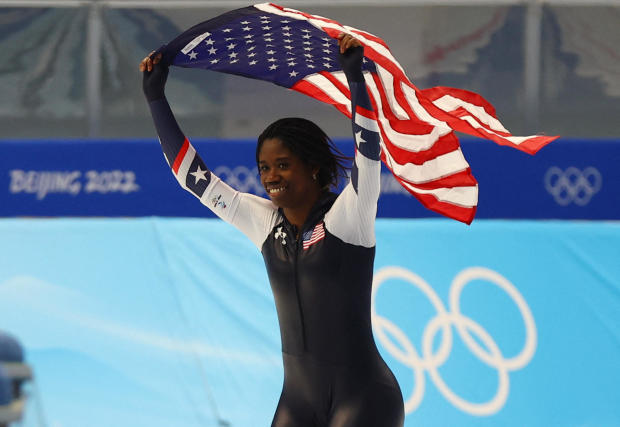
Erin Jackson of the United States celebrates with the national flag of the United States after winning gold at the Beijing Winter Olympics, Feb. 13, 2022.FABRIZIO BENSCH / REUTERS

The 29-year-old Jackson, a former inline skater who switched to the ice shortly before the 2018 Pyeongchang Olympics, joined fellow American Shani Davis as the only Black athletes to win speed-skating medals at the Olympics.

The silver went to Miho Takagi of Japan, while Angelina Golikova of the Russian team took the bronze.

Jackson’s gold came after the native of balmy Ocala, Florida, slipped at the U.S. trials and shockingly finished third, putting her spot on the Olympic team in jeopardy.

But teammate Brittany Bowe, who finished first at the trials, gave up her spot on the team to ensure Jackson would get to skate in Beijing.

At the time, Jackson praised Bowe, calling her an “amazing friend, teammate and mentor.”

“This is an act I’ll never forget,” she wrote. “You can bet I’ll be the loudest voice in the oval cheering for her in the 1000 and 1500 next month.”

As it turned out, the Americans received a third place in the 500 when the final allocations were made, so Bowe got to skate as well. She finished 16th.

Jackson skated in the next-to-last of 15 pairs with Takagi’s time of 37.12 – set about a half-hour earlier in the fourth pairing – in her sights.
 
If she was still thinking about that slip at the U.S. trials, it sure didn’t show.
 
Jackson bolted off the line and was under Takagi’s time as she veered into the first turn. She kept up her speed through the crossing straight and into the final turn, swinging both arms furiously as she came to the finish of speedskating’s shortest race.
 
As soon as her skates crossed the line, Jackson’s head turned toward the scoreboard.
 
She broke into a big smile when she saw the “1” beside her name. Her coach, Ryan Shimabukuro, pumped his arms and slapped hands with her as she glided by.
 
There was still one pairing left, but Jackson knew she could do no worse than bronze.
 
A few minutes later, the gold was hers.
 
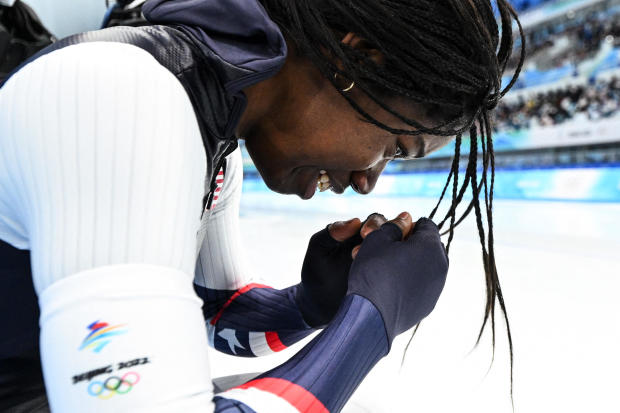
Jackson sat on the padding along the infield, appearing to shed a few tears with her head bowed.

SSKATING-OLY-2022-BEIJING
USA’s Erin Jackson celebrates victory in the women’s 500m speed skating event during the Beijing 2022 Winter Olympic Games at the National Speed Skating Oval in Beijing on February 13, 2022.SEBASTIEN BOZON/AFP VIA GETTY IMAGES

 She was no doubt reflecting, too, on her remarkable journey.
 
The inline and roller derby skater knew she would have to trade her wheels for blades if she wanted to go for Olympic glory.
 
Making the switch just months before the Pyeongchang Games, she was such a fast study that she earned a spot on the U.S. team. She finished 24th in the 500, but it was clear that she had barely tapped into her potential.
 
During the current World Cup season, Jackson suddenly emerged as one of the world’s best sprinters. She won four of eight 500 races – the first Black woman to earn one of those titles, as well – and came to the Olympics as one the favorites.
 
She lived up to the billing in Beijing, becoming the first American woman to win an individual Olympic medal since 2002.
 
She grabbed an American flag and did a victory lap around the Ice Ribbon oval, the stars and stripes fluttering above her head.